Showing posts sorted by relevance for query suburb. Sort by date Show all posts

28.9.22

BASTIAT'S GRAND FICTION IN THE BEDROOM COMMUNITIES.

It will materialize in the course of a lament by Laura "11-D" McKenna.
In our decentralized system of government, most social services, from education to housing, are provided by localities. And the people who run those local governments, like my school board friend, must write the checks and somehow make the spreadsheets work. One dollar for the autistic person means one fewer dollar for a prestigious AP program or a library program aimed at seniors. Some people fill up the tax coffers in a community, while others are very costly.

This crazy way of providing services in this country has reduced everyone to a number. What’s your number? Multiply your number of kids by the price of schooling at the local public school, the extra services they need, and then subtract your local taxes. Are you a positive or a negative?
It doesn't have to be that way.  But restrictive zoning practices have contributed to a situation in which many municipalities are not capable of raising sufficient taxes locally to cover the services the voters would like them to offer.  That's long been an area of policy interest at Northern Illinois University, although, unfortunately, much of the publicity the university makes available came across as normative: oh, look how unsustainable that sprawl is!

Not necessarily.
Strong Towns frequently feature communities that were once vibrant manifestations of car culture and suburban affluence.  Many of them, including Colerain, Ohio, a Cincinnati suburb, have turned into swamps of public squalor amid private destitution (to tweak an old J. K. Galbraith phrase.)  It goes beyond the downscale people attempting to cross the butt-ugly stroads, which is the focus of the post.  "What are the options for the folks who find themselves standing on the side of Colerain Avenue? They can work part time at one of the fast food outlets. They can scrape by month to month with payday loans and pawn shop transactions. Or they can join the military which is by far the best career option, although it comes with certain risks."  The author's thesis, consistent with Strong Towns writers' emphasis on the suburban growth ponzi scheme, is that these once-promising bedroom suburbs have become obsolete and the strip malls and tract houses have trickled down to people less capable of taking care of what they have.
That might be too harsh. The McKenna household could be in a municipality facing a different sort of problem. "The school districts, police, and fire protection, might rely on people who have to live at a distance from the Upgraded Executive Boxes and McMansions that change hands among the transferees. As long as the test scores are high, and the athletic teams competitive, Curriculum Wars are probably infrequent, and silly zero-tolerance policies unchallenged."  Yes, that post is over ten years old, and the Curriculum Wars ought to be top of mind among parents in the upcoming election.

21.4.21

THE EMERGENCE OF A CONCEPT.

I first became aware of a line of argument we now understand as Strong Towns in the wake of a police stop that went wrong in Ferguson, Missouri.  One component of that argument is in the decline and fall of formerly vibrant suburbs as creative destruction overtakes the housing stock and commercial infrastructure.  "[O]nce-promising bedroom suburbs have become obsolete and the strip malls and tract houses have trickled down to people less capable of taking care of what they have."

The next step in emergence is its circulation by an academician in one of the Journals of Highbrow Opinion.  "Left-behind suburbs such as Brooklyn Center [a Minneapolis suburb] and Ferguson [the St. Louis suburb] are perfectly tailored to produce inequality, discrimination, and conflict."

I don't know how much time author Will Stancil, a Minnesota legal scholar, spends in the weeds of urban planning or location and land use.  Read the article, dear reader, and note the pure Strong Towns flavor of his claims.
U.S. Census Bureau data indicate that Brooklyn Center is the most rapidly segregating community in Minnesota. In 1990, the city was 90 percent white; its poverty rate was low, at 5 percent. Three decades later, the city is 38 percent white and its poverty rate has tripled, to 15 percent. It is now the poorest major suburb in the Twin Cities region, and it has a higher percentage of residents of color than any other major municipality in the area. Ferguson underwent nearly identical changes in the years before a police officer shot Michael Brown to death in 2014; the city transitioned from 85 percent white in 1980 to 29 percent white in 2010. Over the same period, its poverty rate almost quadrupled.
Might be an interesting conversation to have amongst Strong Towns wonks, New Urbanism wonks (there are differences) and civil rights wonks, which appears to be Mr Stancil's area of concentration.
Like many resegregating suburbs, Brooklyn Center was once a hub of opportunity, where middle- and working-class residents lived side by side. These places have proved attractive to economically successful families of color seeking better schools and an escape from the discrimination and disinvestment that are endemic in segregated central-city neighborhoods. Black Americans especially are migrating to the suburbs in record numbers. Just since 2000, the urban Black population in major metropolitan areas has fallen by about 5 percent, while the suburban Black population has grown by more than 40 percent, according to my calculations.

In wealthy new suburbs and exurbs, where McMansions line endless cul-de-sacs, housing that working-class families of color can afford is scarce. Inner-ring suburbs typically have an older housing stock, including small postwar houses, more rental units, and cheap high-density housing. Families migrating from the central cities of a metro area tend to cluster in these more affordable communities; so do immigrants. (Brooklyn Center has the highest share of foreign-born residents in the Twin Cities area.) Other, more nefarious forces also funnel nonwhite families toward the inner suburbs—such as the practice of discriminatory racial “steering,” wherein real-estate agents are more likely to show families of color homes in already-diverse neighborhoods. As a result, the demographics of many older suburbs are shifting fast.
Some of what he's calling attention to might be driven by a mix of snob zoning and mass-production of homogeneous new houses.  There's something else at work.  "School changes have a major impact on city demographics, because many affluent residents with children will leave if they feel that the percentage of minority students and poor students is too high."  But don't you dare call attention to the toxic culture that sometimes comes with diversity, or to the cultural collapse more generally, at least not in the pages of The Atlantic.  At best you get, "Tragically, the residents of resegregated suburbs face the same obstacles that many had attempted to escape by leaving major cities: struggling schools, unemployment, poverty, and police violence."  Suggest any correlations, let alone causation, between those two phenomena noted in those quotes, at your peril.

2.7.18

AVOID CANDY FLOSS, FLOSS MORE, AND HAVE NO FUN.

There's something fitting about an upscale suburb whose name sounds like the advice your dentist gives you engaging in truly joy-killing snob zoning.  "Five years ago, Luke Lambert and his wife bought a red brick house on a tree-lined street in this Chicago suburb. Two years later, he bought a blue 1966 Ford F-100 pickup with plans to fix it up." Sorry, no. You can't leave a pickup truck in a driveway overnight, because that might give the impression that the neighborhood is inhabited by tradesmen. (Never mind that tradesmen command salaries way beyond what your cubicle jockey can often hope for these days.)

It's an older suburb, and the kind of garage that accompanies an older house might be commodious for a Model A, or a Terraplane, but civilian pickup trucks, even the ones with the ridiculous short bed you can't put 4x8 sheets of plywood, sheetrock, or insulation in, tend to be higher and wider.  Here's Chicago Tribune coverage.
Pickup trucks aren’t the grubby, unsightly workhorses of yore. They’re no more likely to end up rusty, dinged and dented than your typical passenger car, SUV or other vehicle.

Automakers market today’s shiny pickups to families who pile kids into the back seats of extended cabs and shuttle them to school, soccer games and dance rehearsals. Some luxury pickups cost more than $50,000. Some are so big they can’t fit into some of Flossmoor’s small garages.
Apparently, the domestic automakers are shifting ever more of their production to passenger trucks, whether in the pickup form with that ludicrous short bed, or as sport-utes. And yet, advocates of relaxing the parking restrictions hope there will be a new birth of home improvement.  "Other residents said lifting the ban would encourage more people to spruce up their homes and yards. Making trips to home-improvement stores for mulch and other materials would be easier if pickups were allowed, they said. Home values might increase."  Right.

This is Flossmoor, though, and one resident wants it to stay that way.  "'We are an elitist community,' he said. 'This is Flossmoor. We are different from everyone else.'"

The Wall Street Journal notes that Flossmoor's snob zoning also prevents above-ground swimming pools.

11.4.12

WHY RIDERSHIP INCREASES ON METRA.

Carl from Chicago looks at the effect of rising gasoline prices on driving behavior.
In the suburbs of Chicago you typically drive long distances during the normal course of the day. For instance it is over 30 miles from the Chicago loop downtown to Naperville each way. Since you probably will be driving around a bit when you get there, it is reasonable to think that you might burn 3-4 gallons of gas depending on traffic and mileage, along with $5 in tolls (depending on the route you take). If you figure that gas is $5 / gallon, then that round trip just cost TWENTY DOLLARS. Note that this analysis doesn’t consider the wear and tear on your car… this is just the incremental cost of the journey.

I remember growing up that $20 was a lot of money. You could live for a few days with $20 in your pocket (just the occasional fast-food meal, some gas, etc…). Now you spend $20 EVERY TIME YOU GET IN THE CAR.

This type of taxation does severely punish the “working” poor. It doesn’t punish the poor who aren’t working nearly as much, because they can take the laborious time to use whatever public transportation is available. The working poor, on the other hand, are essentially “on the clock” and if you are near or a bit above minimum wage you are probably taking home maybe $10 / hr after taxes. Thus the trip from Naperville (or a nearby suburb) to and from Chicago just took up TWO HOURS of your working time.
The residents of Naperville, if they have day jobs in the Loop, at least have the opportunity of riding the Naperville Zephyrs, which are time and cost-competitive with driving, even before one considers parking charges in the city.  Residents of other suburbs don't have access to as many express train options, but they are riding.  But commutes from suburb to suburb are still most convenient by road, high gasoline prices and mal-timed traffic lights notwithstanding.

24.6.19

DEVELOPMENT-ORIENTED TRANSIT.

Clare Malone compares and contrasts two Ohio suburbs on opposite sides of the Cuyahoga River, and on opposite sides of the schism in the Party of Government.
My maternal grandparents bought the house where I grew up in 1949. They were the rare Catholics in Shaker Heights, Ohio, a suburb of Cleveland, and they lived at the edge of the city, a few blocks away from a Jesuit college and parish. They were entering their 40s, and that they could buy in tony Shaker carried a certain cachet. The city probably wasn’t quite as excited to have them. My paternal grandfather, who was a real estate agent and lived a town over, was sometimes told by sellers in Shaker that they didn’t want their homes shown to any Catholics (like him) or Jews. The city had few black residents then. After one black couple did move to Shaker in the mid-1950s, their newly built home was firebombed in the middle of the night. That determined so much, too.

Parma, a city on the other side of the Cuyahoga River — which bisects Cleveland both geographically and transcendentally — was on the precipice of a wild population sprout in ’49. The city’s neat rows of modest houses still speak to the enthusiasm of its post-war suburban sprawl. In the course of two decades, Parma’s population grew from 30,000 to more than 100,000. It was the butt of Cleveland jokes, though. In a blue-collar part of the country, Parma was almost too blue collar — its flamingos-on-the-lawn, pierogies-in-the-kitchen reputation was so infamously parodied by a local 1960s TV personality that the mayor of Parma called the comedy “a dangerous slur to the community.”

For Cleveland suburbs, Shaker and Parma have little in common other than that, until recently, Democratic presidential candidates could count on their votes. But in 2016, Parma voted for Donald Trump, and Shaker didn’t. To Clevelanders, this split followed a certain logic. Shaker and Parma have long been of different tribes, though the same political party.
There's evidence that once upon a time, Shaker Heights was a sundown suburb.  The story is germane to Cold Spring Shops for a number of reasons.

29.10.20

SHOULDN'T THE CHURCHES BE ALONG THE CAR LINES?

Strong Towns contributor Pete Saunders offers praise for streetcar suburbs.  He has in mind more than the quasi-planned-use developments that sometimes were projected along with the rapid transit, such as Shaker Heights outside Cleveland.  "Personally, I love streetcar suburbs because they often have a mixed-use character that places built after them lack. There's also often a community or neighborhood connectivity within them that I find appealing; many streetcar suburb communities are full of proud, organized and vocal residents who advocate strongly on behalf of their community's values."

Such neighborhoods are emergent.
In cities of the Midwest and West, such as Indianapolis and Des Moines, streetcar lines formed the skeleton of the emerging metropolis and influenced the initial pattern of suburban development.[2] Socio-economically, streetcar suburbs attracted a wide range of people from the working to upper-middle class, with the great majority being middle class. By keeping fares low in cost and offering a flat fare with free transfers, streetcar operators encouraged households to move to the suburban periphery, where the cost of land and a new home was cheaper. In many places, especially the Midwest and West, the streetcar became the primary means of transportation for all income groups.[3]

As streetcar systems evolved, cross-town lines made it possible to travel from one suburban center to another, and interurban lines connected outlying towns to the central city and to each other. Between the late 1880s and World War I, a number of industrial suburbs appeared outside major cities, including Gary, Indiana, outside Chicago, and Homestead and Vandergrift, both outside Pittsburgh.[4]

Concentrated along radial streetcar lines, streetcar suburbs extended outward from the city, sometimes giving the growing metropolitan area a star shape. Unlike railroad suburbs which grew in nodes around rail stations, streetcar suburbs formed continuous corridors. Because the streetcar made numerous stops spaced at short intervals, developers platted rectilinear subdivisions where homes, generally on small lots, were built within a five- or 10-minute walk of the streetcar line. Often the streets were extensions of the gridiron that characterized the plan of the older city.

Neighborhood oriented commercial facilities, such as grocery stores, bakeries, and drugstores, clustered at the intersections of streetcar lines or along the more heavily traveled routes. Multiple story apartment houses also appeared at these locations, designed either to front directly on the street or to form a u-shaped enclosure around a recessed entrance court and garden.
I question some of the examples, as those steel towns (Gary, Homestead, to a lesser extent Vandergrift) were either in place prior to the streetcars, or were planned communities.  Those u-shaped apartment buildings were an adaptation to temperate climates before air conditioning, offering more windows to open on hot days, as well as more sun rooms for winter.  You'll see the same configuration on older hotels, no doubt to the despair of their current owners, who would like to provide for more rooms.

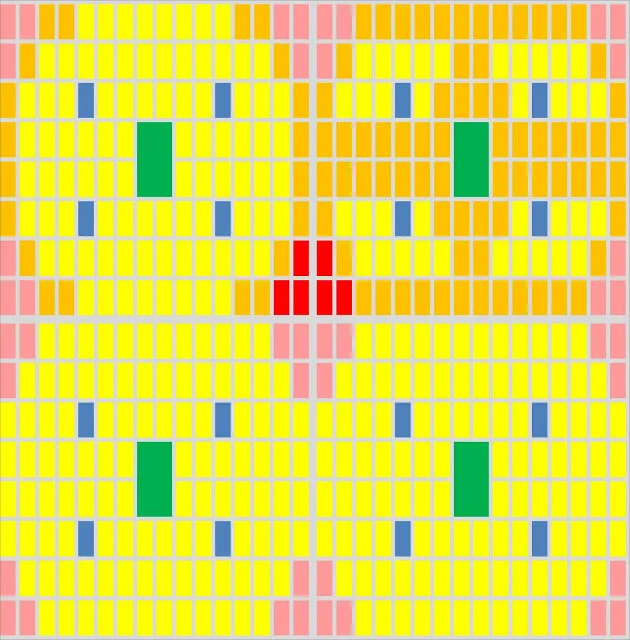
The provision of car lines along arterial streets provides logical places for businesses and other institutions that rely on a lot of traffic to emerge.  Here's some thinking Mr Saunders engaged in, putting together four square miles put together on streetcar suburb principles.  I think it works better as a single square-mile urban section, with principal streets about half a mile apart, and each of them has a car line.  If that sounds a lot like much of Milwaukee or Chicago, it should, as the principal streets originated as section roads.


Computer graphic retrieved from Strong Towns.

In his color coding, the more red, the more commercial, the more yellow, the more residential, the churches are blue and the parks are green.  The quarter-section to the northeast might be closest to the central business district or a major employer.
Overall, you end up with a community that is efficient in its design, dense but not overwhelmingly so. This area could potentially house as many as 41,000 people in its mix of single-family and multifamily units, giving it a mix that is rarely achieved in most American cities and suburbs. As a four-square-mile area with nearly seven residential units per acre, it is able to be adequately served by public transit. The 40/60 single-family/multifamily unit split means that there should be units available in the area, making it affordable to a broader range of residents. The concentration of mixed uses and multifamily uses near the commercial center means there is a ready and sizable market nearby to support retail and services. Even as there are vibrant areas that would rely on pedestrian traffic, there are nearby single-family enclaves that can be refuges to those who want space, peace and quiet.
It's emergent, organic, and scales. I'm not sure who Mr Saunders is addressing as an audience: that you get Chicago or Milwaukee style neighborhoods strikes me as a feature.  I'd only note that the churches would more likely be along the mile roads, and some of the parks might have frontage along the car lines.
I understand the critiques that may come from people regarding these schemes. Those who know Chicago very well may see the city in these designs; I admit that. Others may say that the strong grid orientation isn't feasible everywhere, and that's true, too. Still others will say that the methodical implementation of the design is boring; I can't disagree with that, either, if it's implemented without ways to break up the grid in interesting ways.

Ultimately, as community retrofitting, particularly suburban retrofitting, starts to happen throughout the nation, communities should consider the three principles of the streetcar suburb mentioned at the outset: Create commercial centers, don't be afraid of mixed uses and multifamily uses, and set aside buffered single-family enclaves for those who want them. Do that, and we vastly improve the quality of our built environment.
Perhaps the best way to "create" might be to offer fewer guidelines and zoning restrictions, not more.

28.4.25

EMERGENCE CANNOT BE NUDGED.

There's an interesting planned use development called Culdesac, which is itself an ironic choice for a development that has none, in the midst of an Arizonan transit desert.
We’re building the first car-free city in the U.S., starting with our first neighborhood - Culdesac Tempe. Located 2 miles away at 2025 E. Apache, it’s a 1000 resident car-free neighborhood that is the first of its kind.

We’re dedicated to building people-first cities by combining technology, real estate, and human connection to improve our quality of life. By removing parking and shifting towards micro-mobility, we create ample space for people to experience life at their front door and live in a vibrant community designed specifically for them, not cars.
The "first of its kind" refers to the car-free by design, such as it is.  It's possible to live car-free in a major city, and to some extent in the right kind of smaller town.  Strong Towns contributor Edward Erfurt notes that point, as well as several other objections.
Culdesac has drawn disproportionate criticism from two groups: those who can't imagine a car-free community in a city like Phoenix, and those who dismiss the project as more of a playground than a practical, scalable model.

It’s easy for those accustomed to car dependency to question a development that intentionally removes cars from the equation. What happens when you leave Culdesac? How do you get around then? But these questions aren’t unique to Culdesac; they’re asked in cities like New York, Boston and Philadelphia, where many people navigate daily life without a personal vehicle.

As for those who think Culdesac is just a flashy experiment, there’s a good reason Culdesac is in a league of its own: Developments like it are nearly impossible to replicate. Creating something like Culdesac requires reforming parking mandates, relaxing zoning restrictions to be more permissive, and challenging the entrenched systems that prioritize stroads, strip malls and parking lots. Without those changes, the process would be prohibitively expensive. Those added costs don't just burden developers — they are ultimately passed on to future residents, who pay the price for restrictive policies.
Well, yes, the best thing for government to do in many allegedly collective action situations is to do less, as Mr Erfurt noted to begin his story.
For the past 80 years, development in North America has been shaped by a suburban experiment so pervasive that it now feels like the only way to build. But this approach — dictated by rigid zoning laws, parking mandates and car-centric infrastructure — is a radical departure from the traditional, incremental growth that shaped cities for centuries.

Instead of interconnected neighborhoods, we've built isolated subdivisions, oversized roadways, and commercial districts that separate daily needs from where people live. This pattern has strained local economies, made car dependency unavoidable, and eroded the social fabric of our communities. Now, as cities struggle with mounting infrastructure costs, failing retail corridors and housing shortages, more and more people are questioning whether this approach is sustainable. The signs of failure are hard to ignore.
Those rigidities might have followed from mistaken thinking.  The Levittowns that took shape on farmland at some distance from the major rail or rapid transit routes made use of Fordist manufacturing techniques applied to building houses at scale.
Purchasing mass acreage, “subdividing” lots, and contracted crews to build countless homes at economies of scale, Levitt offered affordable suburban housing to veterans and their families. Levitt became the prophet of the new suburbs, heralding a massive internal migration. The country’s suburban share of the population rose from 19.5% in 1940 to 30.7% by 1960. Homeownership rates rose from 44% in 1940 to almost 62% in 1960. Between 1940 and 1950, suburban communities of greater than 10,000 people grew 22.1%, and planned communities grew at an astonishing rate of 126.1%.
Technocracy allegedly tamed the Great Depression, technocracy produced the implements of winning the war, so why not try technocracy to plan land use?

And thus the conditions that make the likes of Culdesac so intriguing, and perhaps so quixotic, began.  There were all those look-alike houses on those slightly larger than urban lots with a driveway and space for at least a car-port because it was cheaper to build them that way.  "Construction workers were trained to do one step at each house (which were spaced 60 feet apart) instead of building each house up from scratch individually."  One man sets the stud on the sole-plate, another toe-nails it, a third sets the door-frame ... 

14.12.19

TODAY'S STAKHANOVITES ARE THE ONE-PERCENTERS.

Four months ago, I professed to be less than impressed with Yale's Daniel Markovits, who apparently clawed his way to the top of the status hierarchy only to complain about the struggles to get there.  I've subsequently acquired and read his The Meritocracy Trap: How America's Foundational Myth Feeds Inequality, Dismantles the Middle Class, and Devours the Elite.  I don't have much reason to change my impressions (based, as they were, on a shorter article) but will use Book Review No. 12 partially as social science and partially as reminiscence.

Mr Markovits divides his argument into three parts: Meritocracy and its Discontents, where he focuses on the striving and the positional jockeying, rather than the failures of the Best and the Brightest; How Meritocracy Works, where, again, he does more to lament the culture of overwork than to consider the possibility that the worst people are thus incentivized to get on top, and a concluding The New Aristocracy, suggesting that the ways of getting on top rely more on heredity than on effort.

28.4.16

GOVERNMENT FAILURE.

In the midst of the troubles Washington D. C. is having keeping Richard Nixon's Moscow envy running, Metro rediscovers the Capital's lost streetcar subway.
In the 1951 sci-fi movie "The Day the Earth Stood Still," pedestrians are seen descending staircases on the edge of Dupont Circle in Washington, D.C. These days, the stairs are still there, but now they’re blocked off. They led to a once-busy 75,000-square-foot below-ground streetcar station built in 1949. The station has been closed since 1962.

Dupont Circle’s ghostly streetcar station is another reminder that America once had an extensive and efficient interurban transit system. Now, as cities from Buffalo to San Diego look to light rail — today’s iteration of the streetcar, which itself evolved from the horse-drawn omnibus — it’s worth thinking about the astonishing transit system we built and then threw away.
Private capital built the streetcar systems.  Rent-seekers destroyed them.
A century ago, there were nearly 34,000 miles of streetcar tracks connecting neighborhoods to downtowns, and towns to neighboring towns. (I’ve been told that it was possible to travel from Pittsburgh to Philadelphia on local streetcars and trolleys, although that would have been one long and unpleasant trip.)
In fact, it was once possible to ride local streetcars and interurbans from somewhere near Albany all the way to Elkhart Lake, Wisconsin. The fastest running was between Cleveland and Toledo, and again in the Chicago area. But only an intrepid adventurer would essay such a trip. There may be such an account in the rudimentary rail enthusiast press of the day.
Overwhelmingly, those tracks were built by private investors. In the late 19th and early 20th century, it was streetcars, not automobiles, that created the first suburbs.

If you live in an urban area, the evidence is all around you. I live in D.C., not far off Connecticut Avenue, which is broad and gently graded because of the streetcars that once ran along it. The Chevy Chase Land Co. built Connecticut Avenue across miles of farmland to take people from the suburb that still bears the company’s name to downtown D.C., eventually linking up to that now-deserted Dupont Circle station.

Connecticut Avenue’s streetcar tracks are long gone, but down in Georgetown, you can take a bumpy car ride along blocks of cobblestoned side streets where trolley rails remain in place.
Look at video of the John Kennedy funeral. The march from the White House to the parish church is along Connecticut, and the tracks are visible.  Seeking a streetcar suburb?  One still exists, complete with the cars.  Shaker Heights in Ohio used to be served by Shaker Heights Rapid Transit, now an authority.

12.2.24

THIS WEEKEND IN LEFTIST LUNACY.

I read the lefties to calibrate my internal compass.  OK, that's right up there with reading Playboy for the articles.  Sure, there's calibration, but then there's fun.

29.3.18

IT DIDN'T BEGIN WITH DONALD TRUMP.

Just before the electoral vote was cast, I teased the Clinton campaign and the data-driven wizards of smart for not taking the campaign into friendly territory.  "Comrade Putin had to encourage Hillary Clinton to tie up traffic raising money on Manhattan and in Hollywood, and then go back to Chappaqua for a nap, rather than to Wisconsin, where a friendly audience might be had in Madison, or at Serb Hall in Milwaukee, which used to be traditional for Democrats."

I don't remember if Our President had an event at Serb Hall (but never on a Friday, that would antagonize enthusiasts of their fish fry) but populist Republicans began contesting the territory a long time ago.  Let Milwaukee politics guru Bob Dohnal tell the story.
When Ronald Reagan walloped Jimmy Carter in the 1980 presidential election, political experts “discovered” those voters for the first time: traditionally Democratic, working-class whites in Northern industrial states whose swing to Reagan blew open what had looked like a close election.

I could have told them about the Reagan Democrats months earlier, because I helped organize their coming out party. It took place on March 26, 1980, at the American Serb Hall on Milwaukee’s Southwest Side.

As chair of Reagan’s 1976 and 1980 campaigns in Wisconsin’s old 4thCongressional District, which covered the southern half of Milwaukee County, I was convinced this traditional Democratic stronghold was ready to respond to Reagan.

I had a drug store in West Allis, a predominantly Democratic blue-collar suburb, and dealt every day with the people who eventually became the Reagan Democrats. They were plumbers and workers at factories like Allis-Chalmers and Kearney and Trecker. They tended to be very patriotic. Many had served in the military. They were hunters and liked to fish. They drove pickups, something country club Republicans in Milwaukee never did.

Previous Republican presidential campaigns had been reluctant to reach out directly to these voters. But as far back as Richard Nixon’s successful races, I knew that a GOP candidate speaking at Serb Hall, where no Republican office-seeker had ever tread, would have a tremendous impact on southern Milwaukee County.

“Serb Hall,” former vice president Hubert Humphrey said in 1972. “If these walls could talk, what stories they could tell of the great Democrats who have campaigned here.”
Those pickup trucks were practical, how else schlep tool boxes and coils of wire around and bring home the deer in November?  Mr Dohnal had to cue his Republican regulars to code-shift without seeming condescending.
Before they came, I told the people from Brookfield—a strongly conservative, upscale suburb—“don’t come in a suit.” We didn’t want to look like the John Anderson crowd that had met elsewhere on the south side the week before.

Describing the south siders who packed Serb Hall that night, [Reagan biographer] Craig Shirley remarked that the Milwaukee telephone directory was “jammed with listings of people whose names looked as if they’d gone through a Mixmaster. The scions of the Republican Party didn’t want these people with funny last names traipsing around their country clubs. These people drank cheap beer and ate kielbasa! Slavs who could or should have been Republicans were not, largely because the snobby Republicans didn’t want them.”

Donald Pfarrer wrote in the Milwaukee Journal that “it wouldn’t be accurate to say that Reagan had tailored his speech to the Serb Hall crowd. He struck the same themes and adopted the same tone as on earlier campaign stops in Wausau, Waupaca and Neenah.”

But that didn’t matter. As Pfarrer wrote, “the place was as jammed as it had been that night in 1972 when the campaigns of Humphrey and George McGovern met there. If there was a so-called country club Republican among the 500 or 600 working people, he had left his Harris tweeds at home.”
You'll find a lot of consonant clusters, Pabst-drinkers, and eaters of kielbasa or bratwurst in Wausau (paper mills), Waupaca, and Neenah (garbage trucks and manhole cover lids).  Mr Reagan's message likely was "the Democrats left me," and these days the coastal deplorable-shamers might not belong to country clubs, but they've brought the snobby attitude to the Democrats.

15.12.21

STILL NO PLANS TO RESTORE THE ROARIN' ELGIN.

Streetsblog Chicago made an observation that might in other weeks merit mention as a Friday short take. "This Tribune article about a new study that found (surprise!) Chicagoland congestion is horrible mentions traffic-inducing expressway widening as a possible 'solution,' but does not contain the words 'transit,' 'public transportation,' 'CTA,' or 'Metra.'"  That's the Tribune referring to the same study I noted here, the one in which the Sun-Times editors at least alluded to extending the rapid transit beyond Oak Park.

Tribune editorial writers offered a correction after the various non-car commuter advocates sounded off.  That didn't help.  What the Streetsblog reaction suggests, however, is that there's nothing quite like the prospect of sticking somebody else with the bill (which is what porkulus transportation bills do, bipartisan infrastructure talk or not) causes people to take leave of their senses.
There are also some good points about the need for better suburb-to-suburb transit; more frequent off-peak Metra schedules; and smoother Metra-CTA transfers. The piece also questions the wisdom of the state paying $6.5 billion to subsidize a dubious “transit hub” at the proposed One Central development.

But among the many inane statements in the new Tribune piece is the suggestion that reserving lanes on the Eisenhower for bus riders and car-poolers wouldn’t do anything to address congestion, while in reality it could help take cars off the road. (However, according to IDOT spokesperson Maria Castaneda, the department has also proposed letting solo drivers who pay a toll use these lanes, which would likely prevent there from being a major time-savings for transit riders and car-poolers.)

The Tribune article also implies that “people who want to improve things for drivers” and “activists who want to motivate people to get out of their cars and onto transit or a bike” have equally valid POVs. In reality only the latter approach is going to take us where we need to go in terms of reducing congestion, crashes, and emissions. The editorial also complains that building protected bike lanes “costs traffic lanes,” when they’re really an example of reallocating part of the roadway from a traffic-clogging mode to a space-efficient one.

The piece goes on to call for spending lots of money to build a redundant train to O’Hare for elites (didn’t Chicago already decide that was a foolish idea?), and reviving the Crosstown Expressway, a destructive highway boondoggle proposal from the 1970s. The writers also rail against, uh, articulated buses. Pretty silly stuff overall.

But the Tribune certainly didn’t corner the market on asinine statements about transportation this week. Here’s Governor J.B. Pritzker (who, in fairness, generally has a decent record in this department) boasting on Twitter that “Illinois is a leader in the fight for a green planet,” and then going on a few hours later to celebrate the expansion of a highway by 50 percent, which will induce more driving and worsen the climate situation.
High-occupancy toll provisions on carpool and bus lanes, properly priced, have the effect of reducing congestion and increasing economic welfare, although treating expressways as productive assets and applying congestion charges to traffic entering downtown have more potential.  Although a hyperloop from downtown Chicago to O'Hare looks like a massive boodoggle, a railroad improvement project in the fashion of London's Heathrow service (which uses Paddington Station and a spur off the Great Western Main Line) running from Union Station to O'Hare using a spur off the Wisconsin Central has promise.

11.8.16

THE TRADE-OFFS OF SNOB ZONING.

In Marietta, Georgia, a complex that used to be starter apartments, back when real incomes were lower and real housing prices higher, has turned into cheap rentals.  Thus, the Wise Experts have it removed, to the dismay of City Commentary's Joe Cortright.
Along the way, the economic and and racial makeup of the apartments transformed from nearly 90 percent white in 1980, with a poverty rate around five percent, to 20 percent white in 2010, with a poverty rate of nearly 25 percent.

Despite the usefulness of filtering, which increased the diversity of suburban Marietta, the city perceived these units as growing concentrations of poverty and, thus, a problem. So it used the proceeds of a voter-approved bond measure to purchase and begin demolishing the housing complexes. It’s worth noting that no one ever claimed that the buildings themselves were a problem, despite their age. Rather, it had everything to do with the demographics of their occupants.
In Mr Cortright's narrative, it's more class snobbery at work.
In any large city—say New York, Los Angeles or Washington—the wholesale demolition of affordable housing to provide discounted land for new businesses would undoubtedly be treated as the most pernicious form of gentrification. But because it happens in a suburb, somehow it doesn’t count, or at least isn’t objectionable.

Perhaps this reflects a deeply ingrained but seldom-voiced bias in our views about place: Suburbs are for rich, mostly white people. Cities are for poorer people and people of color. Anything change that runs counter to this worldview (like gentrification of a Brooklyn neighborhood, or efforts to build affordable apartments in suburbs like Marin County) is an affront to the order of things. The apparent prevalence of this outlook shows just how hard it will be to make progress on economic integration.
Gentrification, we have noted previously, is emergent and complex and not amenable to interventions by Wise Experts let alone by boutique multiculturalists.  And perhaps the willingness of this suburb to rid itself of potential Section 8 housing is the predictable fruit of fifty years of do-your-own-thing and situational ethics and the bad habits of poor people being excused as "their culture" or "a response to conditions" or the most pernicious of all, "authenticity."  Thus, there are people behaving badly, irrespective of race, color, national origin.

In a world in which "why are they allowed" becomes just another ratchet downward, what else would you have the remnant do?

There is one bit of good news, though.  The apartment complex will be redeveloped as corporate welfare for a professional soccer team.  The team will pay $1 a year "for the first ten years of a thirty year lease."

What's the over-under on Atlanta United holding up another community for an improved practice field in 2027?

25.10.16

COLERAIN IS THE NEXT FERGUSON.

Strong Towns frequently feature communities that were once vibrant manifestations of car culture and suburban affluence.  Many of them, including Colerain, Ohio, a Cincinnati suburb, have turned into swamps of public squalor amid private destitution (to tweak an old J. K. Galbraith phrase.)  It goes beyond the downscale people attempting to cross the butt-ugly stroads, which is the focus of the post.  "What are the options for the folks who find themselves standing on the side of Colerain Avenue? They can work part time at one of the fast food outlets. They can scrape by month to month with payday loans and pawn shop transactions. Or they can join the military which is by far the best career option, although it comes with certain risks."  The author's thesis, consistent with Strong Towns writers' emphasis on the suburban growth ponzi scheme, is that these once-promising bedroom suburbs have become obsolete and the strip malls and tract houses have trickled down to people less capable of taking care of what they have.
Back in the 1950’s, Colerain Township was the recipient of a wave of respectable prosperous families who were crossing the municipal line out of Cincinnati. They drove through Mount Airy Forest and left behind high taxes, high crime, lower quality public services, old unfashionable buildings, and poor black people. If you couldn’t afford a brand new home and a car… you clearly didn’t belong.

The schools were new. The shopping centers and office parks were new. Tax revenue poured in. Police, teachers, and administrators were hired. Parks were created. Libraries opened. Life was very good.

Fast forward sixty five years. Everything that used to be shiny and new is now aging – not all of it well. There are now decades of accumulated salaries, pensions, and health care obligations for municipal workers, past and present. The roads, water pipes, lift stations, sewerage treatment plant, and public buildings are all in need of expensive maintenance. Tax revenue is in decline. This town like nearly every other town of its vintage is functionally insolvent.

There are now newer suburbs farther out where the homes are larger and the neighborhoods more exclusive. Mason and Beavercreek are where the prosperous families are migrating to these days. Young, educated people and wealthy empty-nesters are heading back to rapidly reviving inner city neighborhoods in Cincinnati. Colerain Township now has declining property values and is experiencing an influx of lower income residents. In the big scheme of things this post war suburb was disposable.
What we see are the errors in suburban development, as summarized in one photograph.


The central crossroads, Colerain Township, Ohio.
Retrieved from Strong Towns on 25 October 2016.

The colorful circle at the crossing is a recent war memorial.  The author wishes to emphasize the difficulty of stopping to reflect at the memorial, or to pause while walking to the pub or the coffee house or the toy store.  And the retail spaces elsewhere seem lost amonsgt those vast, empty parking craters.

Perhaps Colerain is doomed, thanks to a combination of the blue social model and misinformed intelligent design.  That's what author Johnny Sanphillippo suggests.
The memorial park is sitting in a sea of low-value surface parking lots, empty buildings, and buildings that are only occupied because they were bribed into existence with subsidies and tax abatements to keep up appearances. Meanwhile millions of dollars worth of public infrastructure sit underutilized.

Ultimately, Colerain has two options. It can reduce its physical infrastructure and default on its promises to municipal employees, which is the de facto path most post-war suburbs are on. Or it can add significant amounts of higher value private development to the existing public infrastructure chassis to generate more revenue. There are no other options.

I doubt the good people of Colerain are interested in transforming their old parking lots and dead strip malls into a thick Main Street downtown full of mixed-use buildings with shops on the ground floor and offices and apartments upstairs. I don’t think they’d even know how to build that sort of thing if they tried. They’re too obsessed with parking ratios and flower beds that look like the prosperous suburbs they no longer are. I’m not even sure there’s even a market for that kind of thing in this location. So I see continued decline and more desperate attempts at resurrection by pure faith. So be it.
And why, Mr Sanphillippo, are you relegating the current residents of Colerain to the Slough of Despond?  With the disappearance of the middle class upward and downward, are you arguing that there is insufficient demand to rebuild the commercial spaces as the kind of thick urban spaces that sell well, and to convert some of the empty spaces and some of the residential sites just off the main roads into larger lots with larger houses?

Or are we getting more Fergusons and fewer Hinsdales because there's too much prole drift, and too much deconstruction of the mores of the upper middle class?

25.9.25

THINKING REALISTICALLY ABOUT URBAN TRANSIT.

Streetsblog's Hayden Clarkin offers an instructive "What I've Learned From Getting Transit Wrong."  It's worth reading in full.  Let me highlight a few observations.  He first tackles a myth, "people choose not to ride transit."  Sorry, no.  "Years ago, I believed that if someone drove instead of taking the train or bus, it meant they were rejecting transit. That not riding was an active choice against it."

Look no further, dear reader, than any of the Chicago "expressways," several of which have rapid transit lines in the median strip (at the cost of stations the riders have to play Frogger to get to) and a few of which have a Commuter Rail line close alongside.  Those people who are stuck in traffic when the expressways aren't expressing aren't blind to those trains going past: rather, they'll put up with the traffic rather than whatever is less appealing about the L trains or the scoots.  As Mr Clarkin puts it, "Transportation isn’t a binary; it’s a marketplace. People weigh their options and pick what works best for them in that moment, whether that’s transit, a car, a bike, or walking."  He notes that Metro-North's New Haven line serves some of North America's richest suburbs, and people of means use it.  (We'll leave go for the moment the presence or lack of subscription club cars and bar cars.)

7.1.07

CHEDDAR CURTAIN FREE TRADE ZONE. The Milwaukee Journal-Sentinel sees advantages in expanding interstate trade even if that turns Cedarburg into the northernmost suburb of Chicago.
Some Wisconsin natives have long viewed with disdain Milwaukee's relative closeness to the Windy City. The FIB acronym and the phrase Chicago-style politics are not compliments.

But new homes and businesses continue to fill some of the undeveloped gaps between the two cities. Although Milwaukee and Chicago likely will retain their separate identities - no rooting for the Bears in the playoffs - there's a growing sense among many business and government leaders that southeastern Wisconsin should better exploit the economic ties with northern Illinois, home to the nation's third-largest metropolitan economy (after New York and Los Angeles).
The article recognizes a bid-rent curve at work in housing prices the farther one locates from Chicago. But new residents north of the State Line are likely to be surprised when the Law of Peak Hour Traffic Congestion catches up with them.
Karin Hembrock's interior furnishings business, From Afar, draws at least one-third of its business at its Walker's Point store from northern Illinois.

Four years ago, Hembrock opened a second store, in the Chicago suburb of Winnetka, which has helped push more Chicago-area residents to her Milwaukee location. Her Illinois customers tell her it's easier to drive from the northern Chicago suburbs to Milwaukee than to downtown Chicago. Once they're here, they can combine shopping with a trip to the Milwaukee Art Museum or other attractions, she said.
The availability of fast Hiawatha service from Mitchell Field to Glenview is also inducing North Shore travelers to fly out of Milwaukee (or is it the availability of chocolate chip cookies on Midwest Express?) Some people are boosting the Milwaukee-Racine-Kenosha commuter service.
Many area business operators support the rail project, said Karl Ostby, president of Kenosha-based Southport Bank. A region tied together by commuter rail would allow southeastern Wisconsin companies to draw employees from a much larger talent pool, said Ostby, the transit authority's chairman.

The creation of rail stations also would stimulate development, said Richard Hansen, president of Racine-based Johnson Financial Group, which operates Johnson Bank.

"You look at every Metra stop, it turns into a great growth area," Hansen said.
In proper public-choice fashion, the bankers appear to like the idea of being located close to a commuter train stop on a train line that somebody else paid for. What happened to the idea of the trolley company building the electric park to keep the cars active on Sundays or stringing transmission wires in order to sell more lightbulbs and appliances. (Consider the full implications of The Milwaukee Light Heat & Traction Company.)

On the other hand, perhaps the recognition of a Cheddar Curtain Free Trade Zone will convince Wisconsin policymakers to give their indentured-servitude-tuition break (which Inside Higher Ed picked up, two months after we had it, and which the dean at Anonymous Community has trashed) the burial in an unmarked grave it deserves.
What the Wisconsin plan utterly fails to grasp is the nature of the educated worker. If you want to attain a critical mass of young creative-class types, you won't do it by trapping them. You'll do it by attracting them, until they start attracting each other. Pour the money that would have gone into tracking down those miscreants who moved at age 28 for a spouse or a job into something actually useful, like maybe upgrading a second campus to Madison level or upgrading some Madison programs to the next level, or even strengthening the academic transfer core programs at Wisconsin cc's. Maybe refurbish some downtowns or improve some light-rail systems or slow the rate of tuition increases generally or cut somebody's taxes. But don't try to clip the wings of ambitious young people whose idea of the world stretches beyond the state line.
Now you are beginning to catch on.

And never mind spending that money on downtown or on restoring the interurbans: the tollway, Metra, and the Hiawathas are a good place to start. The Journal-Sentinel has a public forum going on the crossborder phenomenon, and one participant has an interesting wish list.
I hope it creeps right up into the Fox Cities. A high speed rail would hugely benefit both Wisconsin and Illinois. Imagine if you could take a high speed train from Appleton or Green Bay or Milwaukee to downtown Chicago. You could theoretically live in Wisconsin and work in Chicago or vice versa. It certainly works on the East Coast. We have so much to offer in Wisconsin from the Illinois border to Green Bay - let's take advantage of our benefits and tie the two states together for mutual economic advantage. I am generally opposed to taxes, but even I would support a huge sales tax increase to fund high speed rail between pretty much anywhere in Wisconsin and Chicago. Let's do it!
I'd recommend building it by increments, the way Illinois and Wisconsin have been doing it on the St. Louis, Carbondale, and Milwaukee lines. First, get the 110 mph track working between Dwight and Springfield, then give the Hiawathas free rein to 110 the way K. F. Nystrom and C. H. Bilty intended, then put the second track and the 110 back in on the Illinois Central, then get something resembling the old 400 corridor started north of Milwaukee. (Perhaps a photo essay on vanished Midwestern corridors is in order.)

30.7.06

AN IRRELEVANT ALTERNATIVE? Capital Times editor Dave Zweifel reviews the National Strategy to Reduce Congestion.

The federal government's Transportation Department has just issued a "white paper" on reducing traffic congestion in the country and guess what? It doesn't include a word about how improvement of either passenger or freight rail in America might be able to help.

Once more, the powers-that-be in Washington are determined to put all the nation's transportation eggs essentially in one basket more and bigger highways with a small sop to improving some airport traffic control systems.

Mr Zweifel would like to see more reliance on the railroads.
Why leaders of this administration can't understand that to put 500 people on a train essentially removes 500 cars from the highway is nothing short of perplexing unless, of course, road builders just have better connections and more money.
I'll yield to nobody in my enthusiasm for passenger rail. All the same, I'll not let that enthusiasm blind me to bad policy analysis. First, 500 people on the train need not be the equivalent of 500 cars on the highway, allowing for families traveling together. Second, under the circumstances most favorable to that one-to-one correspondence, namely the morning commute, 500 cars might not be on the highway to the central business district, but those cars are probably headed to a parking lot near the train station. (In Chicago, even if Metra were able to path a few more Naperville Zephyrs of a weekday morning, it is unlikely that many additional passengers would be able to locate parking near the train. And parking lots represent idle capacity and environmental degradation of a different form than the traffic jam.) Outside of the few cities where one might speak of a central business district, the investment in new commuter trains and latter-day interurbans might be misguided (insufficient travel to the few destinations the service touches to be cost-effective or to have much of an effect on traffic.)

A more comprehensive analysis of congestion released by the Federal Highway Administration suggests that two perpetual sore points with me, maltimed traffic lights and work zones, contribute more to road congestion than the few hundred people who might have occasion to ride a train to work. The former are often a consequence of ill-thought-out privatization (a developer builds a shopping center and helpfully pays for the traffic lights controlling mid-section access to the parking lots, but those lights are never timed with the timing of the signals on the existing section roads.) The latter is often a consequence of public decisions to rebuild an obsolete highway network under traffic. Why obsolete? Consider some observations by Samuel Staley of the Reason Foundation.

Travel demand has outstripped road building by 3 to 1 since 1980. Simply bringing capacity up to current levels of demand will go a long way toward reducing congestion.

But this is only part of the solution, and perhaps not even the most important. Simply laying more asphalt won't pave our way out of our slowing productivity and congestion mess. We need to pay a lot more attention to what kinds of roads we build, where we build them, and when they get built.

This is a bigger job than most people realize. In essence, it calls for a whole scale reconfiguration of our regional highway system.

The basic design of the current system—its DNA—was established by the federally funded Interstate Highway System laid on top of incremental expansions of local roads. This established a "hub and spoke" design, where large volume highways (spokes) would funnel people into a central employment center (the hub). Often, an outer beltway (rim) was created to connect the spokes leading to the hub.

I'm going to be a bit harsher than that. The Interstate Highway System we have today is the trunkline railroads of the 1920s. Think about it: Pennsylvania + Rock Island + Union Pacific + Southern Pacific = I-80. New Haven + Pennsylvania + Richmond, Fredericksburg & Potomac + Atlantic Coast Line = I-95. (The rest of the map is left to the reader as an exercise.) As Mr Staley notes,

This highway system served the needs of the mid-20th century city well when most people still worked and lived in the central city. The post-World War II era of suburbanization changed all that.

Now, fewer than 20 percent of travelers during peak periods are commuters. Most of those trips are not even going into the central city. Suburb-to-suburb trips dominate travel patterns. Central cities are no longer the economic drivers of regional economic growth. Indeed, the growth of suburban cities and "edge cities" has created more balanced regional economies.

Our transportation system and network needs to be similarly balanced. The hub and spoke system isn't suited for a modern economy where technology and employment allows for flexibility and decentralization, and where travel decisions are based on personal needs accommodated by the customized travel flexibility offered by the automobile.

That last sentence notes the real problem passenger rail advocates face. If there is a train headed for Real Chili in time for lunch, or toward the museum campus with convenient return times when the kids are ready for a nap, or to and from the office in a central business district, there is a potential public interest in providing those trains, or at least in not providing inefficiently many (or inefficiently few) roads. But it's a bit much to attribute the preferences of a study of traffic congestion to malice on the part of the highway lobby.

6.1.23

WERE CAIRENES MORE CHARITABLE THAN CHICAGOANS?

During the Festive Season, a non-profit organization opened its message with "We were warned that soldiers were coming to kill us, and we had to leave our homes in haste."  Ukrainians fleeing Russians?  Central Americans fleeing drug gangs?  No.  That message invoked the Flight into Egypt, and it appeared to be from an organization seeking to reclaim of the Social Gospel.

Those people fleeing into the United States?  No room at the inn, and the money is running out.
Chicago Mayor Lori Lightfoot is asking Illinois state legislators for $54 million to help fund emergency services to asylum-seeking individuals and migrants.

Lightfoot made the request in a letter to state legislators from Chicago, obtained by the Tribune. She noted that Gov. J.B. Pritzker’s administration sent a letter to the city saying the state is “out of funds and will no longer be able to support city migrant services efforts as of February 1, 2023.”

“The city is grateful to the state of Illinois for its partnership and collaboration on this mission to date, but we are simply unable to provide migrant services at today’s levels after February 1, 2023 if the state withdraws its financial support,” Lightfoot wrote in the letter, dated Thursday.
Declaring yourself a sanctuary city costs nothing, as long as you have a national government that is protecting its borders.  Let the national government change its policies, and all of a sudden, accusing state governors who are bearing the brunt of the illegal crossings as "racist" doesn't do anything for the material or moral condition of the people who request transportation to Chicago.

14.1.25

CALIFORNIA BURNING.

In 1998, Mike "Ecology of Fear" Davis offered "The Case for Letting Malibu Burn."

Sometimes the easiest questions have the hardest answers, e.g. "Many of California’s native ecosystems evolved to burn. Modern fire suppression creates fuels that lead to catastrophic fires. So why do people insist on rebuilding in the firebelt?"

23.12.10

STOP ENABLING FAILURE. It may be semester break, but there's a lot of commentary about the continuing disaster in education. Start with a reaction to one Victor Davis Hanson column by Joanne Jacobs.
With well-behaved, ready-to-learn students, the public schools worked, Hanson writes. Today's families are sending more poorly behaved children -- anti-social, rude, disruptive -- than the schools can handle.

Hanson dreams of creating "a shame culture in which the worst sort of social transgression (far worse than smoking) is to burden the public schools with children that were neither raised nor tamed."

Is it possible to change parents who don't feel ashamed of their children's bad behavior?
That's not the course the schools are taking. In Evanston, writes Steve Chapman, the problem of the duller students holding everyone else back is likely to be solved, because the school system will be residually inhabited by the duller students.
A case in point is Evanston Township High School in Evanston, Ill., a racially and economically mixed suburb of Chicago that is home to Northwestern University. It recently decided to eliminate a high honors freshman English course aimed at challenging the top students.

Henceforth, these youngsters will be grouped with everyone else in a regular "honors" class in humanities. Next year, the same may be done with biology. Your kid is an honor student at ETHS? Heck, everyone is an honors student at ETHS.

It's hardly the only school in America where grouping students according to their ability is in disrepute. There is a widespread impulse to treat all kids as equally able and willing to learn. But the results often fall dismally short of the hopes.

When the Chicago public schools scrapped remedial classes for ninth graders and put everyone in college-prep courses, "failure rates increased, grades declined slightly, test scores did not improve and students were no more likely to enter college," according to a study by the Consortium on Chicago School Research at the University of Chicago. Among average and above-average students, absenteeism rose.

The danger in putting the brightest kids in general classes is that they will be bored by instruction geared to the middle. But their troubles don't elicit much sympathy. Brookings Institution scholar Tom Loveless told The Atlantic magazine, "The United States does not do a good job of educating kids at the top. There's a long-standing attitude that, 'Well, smart kids can make it on their own.'"
Evanston administrators, well-versed in the language of inclusion, see things differently.
School administrators in Evanston insist the change is aimed at making the curriculum more demanding, even as they make it less demanding for some students. Thanks to the abolition of this elite course, we are told, "high-achieving students" will profit from "experiencing multiple perspectives and diversity in their classes to gain cultural capital."
It's probably impolite to suggest that more than a few students will develop resentments against those perspectives, hardening their attitudes. Or perhaps they won't develop resentments, or cultural sensitivities, because they're not there.
Shortchanging gifted teens creates the risk of another unwanted effect: inducing their parents to leave. Families in Evanston can always move to neighboring suburbs with good schools, or they can opt for several fine private and parochial alternatives. Average students don't gain from being in the same classes as exceptional ones if the exceptional ones are not there.

We as a society have not been very successful at turning average students into high achievers. Maybe we'll have better luck doing the opposite.
Higher education is complicit in turning the high average students into drones, notes Victor Davis Hanson.
[W]ithout citizens broadly informed by humanities, we descend into a pyramidal society. A tiny technocratic elite on top crafts everything from cell phones and search engines to foreign policy and economic strategy. A growing mass below lacks understanding of the present complexity and the basic skills to question what they are told.

During the 1960s and 1970s, committed liberals thought we could short-circuit the process of liberal education by creating advocacy classes with the suffix "studies." Black studies, Chicano studies, community studies, environmental studies, leisure studies, peace studies, woman's studies and hundreds more were designed to turn out more socially responsible youths. Instead, universities too often graduated zealous advocates who lacked the broadly educated means to achieve their predetermined politicized ends.

On the other hand, pragmatists argued that our future CEOs needed to learn spread sheets at 20 rather than why Homer's Achilles does not receive the honors he deserved, or how civilization was lost in fifth-century Rome and 1930s Germany. Yet Latin or a course in rhetoric might better teach a would-be captain of industry how to dazzle his audience than a class in Microsoft PowerPoint.

The more instantaneous our technology, the more we are losing the ability to communicate with it. Twitter and text-messaging result in an economy of expression, not in clarity or beauty. Millions are becoming premodern — communicating in electronic grunts that substitute for the ability to express themselves effectively and with dignity. Indeed, by inventing new abbreviations and linguistic shortcuts, we are losing a shared written language altogether, much like the fragmentation of Latin as the Roman Empire imploded into tribal provinces. No wonder the public is drawn to stories like "The Lord of the Rings" and "The Chronicles of Narnia" in which characters speak beautifully and believe in age-old values that transcend themselves.
His conclusion:
America has lots of problems. A population immersed in and informed by literature, history, art and music is not one of them.
And so I persevere.