LET THE JUBILEE ROLL. Weaver Models received its shipment of Small Jubilees, and one is being broken in on the test stand.
The Canadian Pacific kept a small stable of these at Saint John, N.B., and every so often one will make its way into Boston's North Shore, at least in the alternate universe a-building down cellar.
29.10.08


EXPORTING THE RECESSION. Has "Buddy, Can You Spare A Dime" been set in Chinese?
Despite the troubles, China's government anticipates moving the toy and other low-end manufacturing work to the country's interior in order to deploy the experienced industrial work force of the coast on higher-end projects to be built.Unemployed worker Wang Wenming was angry at his boss for shutting down a massive Chinese factory this week that made toys for Mattel Inc., Hasbro Inc. and other American companies.
But the assembly line worker was also furious at the United States.
"This financial crisis in America is going to kill us. It's already taking food out of our mouths," the 42-year-old laborer said Friday outside the shuttered Smart Union Group (Holdings) Ltd. factory in the southern city of Dongguan.
The company, which has struggled as global growth has slowed in recent months, employed 7,000 people in mainland China and Hong Kong. It wasn't immediately clear how many have lost their jobs.
Economic upheaval in the U.S. is already changing and shrinking China's vast manufacturing hub in the southern province of Guangdong, long regarded as the world's factory floor. However, factory closures won't just be a China problem -- shoppers will feel the effect in malls and stores in the U.S. and Europe.
"When these companies go bust, the outcome is higher prices," said Andy Xie, an independent economist in Shanghai. "Labor costs have gone up 70 to 100 percent in the last three or four years. But these guys have not been able to raise their prices because Toys "R" Us, Home Depot and Wal-Mart are saying no price increase. How is that possible?"
For years, there were too many factories competing to win bids from foreign buyers demanding prices that were often unrealistically low. The winners were American and European consumers, who enjoyed rock-bottom prices.
But many factories were scrimping on materials and stiffing their suppliers just to survive, Xie said. The financial crisis will be the final culling factor that forces many wobbly factories to go belly up and end an unsustainable situation, he added.
Already, China's toy industry is hurting. The official Xinhua News Agency reported this week that 3,631 toy exporters -- 52.7 percent of the industry's enterprises -- went out of business in 2008. The causes: higher production costs, wage increases for workers and the rising value of the yuan, the report said.
A DRIVE-BY SHOOTING? At Central Arkansas University, the investigation of Sunday night's shootings continues.

The university's latest statement lists the charges brought against the suspects.Prosecutors charged four young men with two counts of capital murder each and a host of other felonies in connection with Sunday's attack. They also acknowledged a particularly disturbing aspect of shootings: The victims might not have been the targets of the gunmen.
"This is an incredibly heinous case," Prosecutor Marcus Vaden said at a news conference. "When you have a situation where it appears some, if not all, of the victims were innocent bystanders, that's bad."
The gunmen apparently had been on campus for several minutes before driving toward a group of students near the Arkansas Hall dormitory, campus police Lt. Preston Grumbles said. They fired at least eight rounds from a semiautomatic pistol at the group, he said. He declined to say whether multiple handguns were used.
Investigators declined to offer further details of the shootings or a motive.
Two counts of Capital MurderOur students organized a vigil.
One count of Attempted Capital Murder
Eight counts of Terroristic Act
One count of Possession of Firearms by Certain Persons
One count of Discharge of a Firearm from Car
One count of Possession of Handgun on Public School Property
Those who attended were given candles and an opportunity to sign a banner dedicated to the University upon their arrival.
[Huskies United member Ryan] Sego said Huskies United would go to the University of Central Arkansas to dedicate the banner.
Brent Keller, president of the Student Association, offered his respects concerning both the victims of the University of Central Arkansas and the victims of Feb. 14 at NIU.
"We have gathered here to let the university know that they are not alone,” Keller said.
THERE'S A HIGHER EDUCATION BUBBLE. But one must look in the right place for its evidence. Excess demand by itself is not evidence.
(Via Phi Beta Cons, where Candace de Russy inadvertently alerted me to Mr Snowling's howler.
The excess capacity is in access-assessment-remediation-retention, and perhaps in wannabe upscale colleges that invested heavily in student amenities and slighted their faculties. A paragraph from the article mischaracterizes the flight to quality as evidence of the bubble.The crunch [as the bubble deflates] will be particularly bitter for the institutions that drained coffers to build "country club colleges" complete with luxury dormitories, spas and top of the line sports complexes to lure choice students, hoping that a sharper crowd would lead to more accretive diplomas, entering a profitable cycle of more successful alumni and increased donations.
Many had little choice. "If a college decides we're not going to have fancy dorms or build a shiny new gym, students are not going to that college," says [Skidmore College's Sandy] Baum. "People are not choosing the lowest price college, and that's a consumer issue, not a public policy problem."
Adds William Powers, the president of the University of Texas at Austin: "The market is choosing quality regardless of incremental costs."
It's a scenario familiar to anyone who watched the housing bubble blow. "We are at a trend line that cannot be sustained," says Matt Snowling, an analyst at Friedman, Billings and Ramsey, who covers the student loan industry. "Tuition must go down, or there will be limited demand at high-priced private schools."There's ample evidence that the highest-priced and highest-regarded private schools are pricing to generate excess demand (thus boosting their selectivity: what the rating services reward they get more of) and shuffling resources among students (thus boosting their perceived diversity). Those demand curves will have to shift inward in a nontrivial way before the high-priced and high-performance private universities change their behavior. The University of Texas recognizes this.
At UT Austin — a public university in a state with a $12 billion budget surplus and a football program that brings in $5 million a year — the only cuts Powers is looking to make involve thinning out the number of five- and six-year undergraduate seniors on his campus. Getting students to graduate "expeditiously" saves a bundle, he says.One can work on that overhang of fifth- and sixth-year seniors in at least two ways. One can look at the transcripts and determine how many of those students spent their first year or two in remediation. And one can look at the majors and determine how many of the students have schedule completion troubles because their major departments are being denied resources. Those are not the adjustments one would expect of a bubble-economy hustle.
(Via Phi Beta Cons, where Candace de Russy inadvertently alerted me to Mr Snowling's howler.
POSTPONING DEBT WITH DEBT. Debt-squeezed students consider graduate school as short-term fix.
The return on investment becomes more negative for most of those graduate students.More students took the Graduate Record Examinations in September than in any month in the last eight years, Educational Testing Service spokesman Mark McNutt said.
The increase in grad school interest comes as students are finding it harder to pay their high debt burdens.
Debt levels for seniors graduating from four-year schools have more than doubled from 1993 to 2007, from $9,250 to $20,098 on average, according to data from the Project on Student Debt, part of the nonprofit Institute for College Access and Success.
College graduates still earn more than those with only high-school degrees. But while the cost of college has risen 83% in the last decade, wages for college graduates haven't kept pace, growing 38%.
There are other ways to defer loan repayments, many of which provide the government with cheap labor.Still, career counselors and financial aid experts wince at the notion of students going to graduate school purely to escape the job market or debt.
"In my experience, it's such a bad choice," said Laura Kestner, director of the career center at Marquette University. "When students come and talk to me about it, I try to talk them out of it. . . . The worst thing a student can do is go to graduate school and take on more debt without having a direct intentional career goal."
Graduate school is a wise choice for students who know they need that degree for their dream jobs, Kestner said. But many go straight to graduate school only to find they have not increased their earning potential and still have no marketable work experience.
When the class of 2002 faced a tight labor market, for example, Kestner saw students flock to graduate school.
"After 2002-'03, we had so many overeducated, underexperienced job seekers," she said.
Some counselors suggest other options. Certain public-service programs - such as AmeriCorps, the Peace Corps, Teach for America or Volunteers in Service to America - provide stipends while the government defers and in some cases forgives portions of federal student loans. The government also offers some loan forgiveness for military service or for doctors, nurses or teachers working in high-need areas.There's some profundity here about misuse of the public interest, but I'm too tired to think of it at the moment.
SPELLING OUT YOUR LOSS FUNCTION. Reason's Jacob Sullum evaluates the downside risks of electing either of the major party candidates.
Unfortunately for me, the Illinois Republican Party has been sufficiently inept that I don't have good choices to protect myself from a Democratic president. On the other hand, the state Democratic Party has been sufficiently inept that it is the taxpayers' best protection against its majority.The extent of the president's powers, although hardly mentioned during the general election campaign, is probably the most important consideration in choosing between McCain and Obama. It is tied to all the other major issues, including the Iraq war, the fight against terrorism, and the government's response to the current economic situation.
The crucial question is which matters more: a president's theory of executive power or the political environment he faces. If the former, Obama is the less risky choice. If the latter, McCain is, since he would face a less compliant Congress. In that case, the Republicans' sorry performance during their six years in charge of the executive and legislative branches, by highlighting the virtues of divided government, may be the best argument for their nominee.
IT WILL TAKE MORE THAN ONE SUMMER. I propose to fight it out on the same line anyway. Here's Joanne Jacobs.
Colleges need to publicize how many students from local high schools end up in remedial classes. How many were “B” students?I made a similar suggestion two summers ago. (The post is titled "I'll Never Lack for Work" and there are a few pictures in that archive that will load and shift the text on you: be patient.)
Perhaps the most salutary reform the public universities could obtain would be to announce something like "Effective 15 April 2007, admission to Enormous State University (flagship, land-grant, compass-direction alike) is contingent on passing the mathematics and writing placement tests. Enormous will no longer offer no-credit remedial mathematics, writing, and speaking courses for high school graduates who have not really received a high school education. Furthermore, Enormous State's Office of Institutional Research will report placement test passage rates by school district."I added,
As part of the reform, bill the school districts for those remedial courses and reimburse the community colleges. Principals now have a choice: offer token academic courses and suffer a budget cut, or spend money to improve their academic content. Some school districts might choose to outsource those classes directly to the community colleges. Fine. Outsourcing is a way of exploiting comparative advantages. Economics again.There's a further discussion here. I crossed the Potomac into this Wilderness three years ago. I have seen no evidence since then that would persuade me to back off.
A COMMUNITY IS MISSING ITS ORGANIZER. John Kass.
Unfortunately, here's what will happen. The 2nd grader's death shrine will be cleared. The politicians will forget Julian's name. The out-of-town reporters will leave. And the shorties and the big dogs will return and claim their place.Chicago is the Railroad Capital of the World. It is likely to host a presidential victory party next week. It might be home to the 2016 Olympics. There are parts of it that are dangerous. Many families that don't have a relative as well known as recent "American Idol" winner Jennifer Hudson have had to deal with a dead child, often collateral damage when the shorties and the big dogs have a dispute over turf, or over the succession.
27.10.08
CENTRAL ARKANSAS.

Two students died and a third person is injured Sunday evening at the University of Central Arkansas.
Four suspects have been arrested. The university statement characterizes the shootings as "not random."
We send our condolences now. There will be time for analysis later.

Two students died and a third person is injured Sunday evening at the University of Central Arkansas.
Four suspects have been arrested. The university statement characterizes the shootings as "not random."
We send our condolences now. There will be time for analysis later.
IF IT HAD THAT POWER. Pakistan is asking for help from the International Monetary fund, which elicits the usual complaint from the usual suspects.
An IMF bailout would also represent a further blow to the Pakistani elite's legitimacy. Under conditions where the US is regularly carrying out military actions within Pakistan in defiance of the stated wishes of the Pakistan government and military, Pakistani economic policy is now to be dictated by the US-dominated IMF.In your dreams. The Fund cannot attach conditions such as "Hand over bin Laden and all the other al-Qaeda holdouts in the tribal areas or there's not a penny for you," appealing though such an outcome might be.
AMEN. Streetwise Professor talks smack to those oh-so-precious academicians who fear a research center named for Milton Friedman.
Coming from the academic left, charges of politically influenced scholarship are richer than Peking duck. I mean really people, look in the ‘effin mirror. Anyone who denies that political agendas–and mainly leftist ones–don’t pervade the humanities and social sciences is a liar. The only question is whether they lie to themselves, or only favor the great unwashed with their falsehoods.Via Atlantic Blog, where there's a list of seventeen precious academicians at the University of Chicago who have gone on record in opposition to the Milton Friedman Institute and in support of a third-rate deaducationist at the University of Illinois at Chicago.
TALK DOWN THE OPPOSITION. The Constitution does not permit do-overs, although this national election is one in which I'm displeased with all the choices on the Illinois ballot.
Perhaps the party loyalists are in the same position.
Here's Jennifer Rubin at Contentions.
Paul Soglin sees reason to worry about the Republicans.
It's more likely that he's recognizing the emptiness of the Democratic alternative. When the oceans fail to recede and the planet fails to heal and the stock markets react to Illinois-style dynamics in the national Democratic government, the average Joe, Jane, or John will have reason to be disgusted with that government. A Mr Soglin expecting Democratic success will not have to worry about a right-populist challenge in 2010.
Perhaps the party loyalists are in the same position.
Here's Jennifer Rubin at Contentions.
Obama was sharing Socialism 101 with radio listeners just seven years ago. At the same time, he was sitting on the board of the Woods Fund, going to Trinity United Church, and a enjoying a robust professional relationship with Bill Ayers. Has he given all that up? We don’t know, because no one in the media has taken seriously Obama’s intellectual and professional development. No one has asked him basic questions about the past (e.g. Did he share the ideological vision of the Woods Fund grant recipients? Did he agree with Ayers’ radical educational theory?) or even his current economic philosophy. Doesn’t he still believe in spreading the wealth? He certainly did seven years ago.The post, as one commenter notes, offers no reason to vote for the Republicans, let alone any other ticket, other than to not vote for Socialism 101, or for a Department of Education in which trendy gutting of the common schools will continue.
Paul Soglin sees reason to worry about the Republicans.
Since a religious-populist party is unlikely to appeal to the libertarian and business elements of the Republican coalition, and the national-greatness Neocons might split if a genuine third party arose, it's not the fractures in that coalition that bother Mr Soglin.The problem for the Republicans is that Palin owns the "god, guns, and gays" element of the Republican Party. She locked up the base the way John McCain, Mitt Romney, George W. Bush or even Ronald Reagan could only pretend to embrace. They engaged the abortion issue, guns, and the religious right, and the hatred for American institutions becasue it was politically exepedient.
Sarah Palin is a true believer and the base can tell the real thing.
Now she can lock up a presidential nomination for 2012.
Even if the moderate Republicans can hold her off, Palin can bolt, and form her own Populist Party, and relegate the GOP to third party status.
The Neocons are at a loss as to what to do with her. Wall Street must be saved and they know that Communism is a phony issue.
For the rest of us, the challenge is stopping her and a movement with deep roots in American history that claims to appeal to the average Joe, Jane, or John Doe, be they plumber or not.
It's more likely that he's recognizing the emptiness of the Democratic alternative. When the oceans fail to recede and the planet fails to heal and the stock markets react to Illinois-style dynamics in the national Democratic government, the average Joe, Jane, or John will have reason to be disgusted with that government. A Mr Soglin expecting Democratic success will not have to worry about a right-populist challenge in 2010.
26.10.08
CORRECTING THE EXCESS. It's old news, but when Sharper Image seeks bankruptcy protection, perhaps there's hope that the era of wonderful nonsense is coming to an end.
TURF THEM OUT. Reason's Radley Balko:
There is a discussion of Mr Dionne's column at University Diaries.
The Republican Party has exiled its Goldwater-Reagan wing and given up all pretense of any allegiance to limited government. In the last eight years, the GOP has given us a monstrous new federal bureaucracy in the Department of Homeland Security. In the prescription drug benefit, it's given us the largest new federal entitlement since the Johnson administration. Federal spending—even on items not related to war or national security—has soared. And we now get to watch as the party that's supposed to be "free market" nationalizes huge chunks of the economy's financial sector.He's not taking a lesser-of-two-evils stance.
While I'm not thrilled at the prospect of an Obama administration (especially with a friendly Congress), the Republicans still need to get their clocks cleaned in two weeks ...Then the housecleaning.
And the shape of the world to come.If they do lose, the GOP would be wise to regroup and rebuild from scratch, scrap the current leadership, and, most importantly, purge the party of the "national greatness," neoconservative influence. Big-government conservatism has bloated the federal government, bogged us down in what will ultimately be a trillion-dollar war, and set us down the road to European-style socialism. It's hard to think of how Obama could be worse. He'll just be bad in different ways.
The truth is, unless you vote for a third-party candidate (which really isn't a bad idea), you don't have much of a choice this November. You can either endorse the idea of a massive, invasive, ever-encroaching federal government that's used to promote center-left ideology, or you can endorse the idea of a massive, invasive, ever-encroaching federal government that's used to promote center-right ideology.
Sadly, if the GOP does lose, it's likely to be interpreted not as a repudiation of the GOP's excesses, but as an endorsement of the Democrats'. When the only two parties who have a chance at winning both have a track record of expanding the size and scope of government, every election is likely to be interpreted as a win for big government—only the brand changes.
Which brings me back to why the Republicans need to get throttled: A humiliated, decimated GOP that rejuvenates and rebuilds around the principles of limited government, free markets, and rugged individualism is really the only chance for voters to possibly get a real choice in federal elections down the road.That is, if those principles can be implemented. Washington Post columnist E. J. Dionne suggests they can't.
Conservatism has finally crashed on problems for which its doctrines offered no solutions (the economic crisis foremost among them, thus Bush's apostasy) ...Mr Dionne is hardly the best analyst of Republican troubles, although he has noted the unwieldiness of a majority combining traditionalist and national security elements with advocates of limited government who might be skeptical of government as punisher of victimless crimes or as enforcer of an international order.
There is a discussion of Mr Dionne's column at University Diaries.
TAKE THE BENEFIT, BEAR THE BURDEN. The Political Environment suggests a change of focus in Wisconsin. The provocation for this post is a proposed widening of the central artery from Madison to Beloit.
The Tollway, on the other hand, has plenty of money for upgrades, with the Tri-State being widened from the Wisconsin line to O'Hare, and the Reagan being widened through Naperville. Yes, all of this is being done under traffic, making the "congestion relief" signs particularly annoying as one copes with the existing congestion making do with narrower lanes. And when the work is done, the widened roads will still be congested.
It's time for the highway commissioners to consider building some new roads, rather than perpetually patching and widening the existing ones. North of the Cheddar Curtain, asking the people who will benefit from the roads to pay for them, meaning tolls, makes a lot of senxe.
It's also time to consider building some new rail capacity. On a public affairs radio show, I listened to a candidate for public office expressing opposition to CNR's purchase of the Chicago Outer Belt, because it would shift rail freight congestion from Chicago to some of the more upscale suburbs and hamper development of a circumferential commuter train line (something many of those constituencies also oppose, sometimes for the predictable, if silly, reason, that the train service would bring criminals to the neighborhood.)
It will take money, but the net benefit of doubling and trebling the Outer Belt and grade separating it and putting freight and passenger trains on it is likely to be higher than the net benefit of incremental improvements for one type of service or the other. And any railroad that asks for public funds for infrastructure improvements ought participate in passenger train service. Are you listening, Union Pacific?
In Illinois, the all-Democratic state government is unable to come to an agreement on a capital budget, which has not helped the transit authorities. I have documented the potential service cuts on Metra and the removal of seats from some Chicago Transit Authority cars and hinted at damage to the Amtrak service.The only way the I-39/90 stretch could get done, and some of the other state projects, too, is through tolls.
As in toll roads.
All those in favor of having paid for roads through local, state and federal taxes, then paying again with a Wisconsin version of I-Pass, raise your hands.
Everyone else: hold onto your wallets, then sit down and write WisDOT a letter telling them to pay more attention to the real world, like potholes, better
buses and new trains.Let Illinois be Illinois; Wisconsin needs to commit to fixing the roads we have and investing all additional funds into transit.
The Tollway, on the other hand, has plenty of money for upgrades, with the Tri-State being widened from the Wisconsin line to O'Hare, and the Reagan being widened through Naperville. Yes, all of this is being done under traffic, making the "congestion relief" signs particularly annoying as one copes with the existing congestion making do with narrower lanes. And when the work is done, the widened roads will still be congested.
It's time for the highway commissioners to consider building some new roads, rather than perpetually patching and widening the existing ones. North of the Cheddar Curtain, asking the people who will benefit from the roads to pay for them, meaning tolls, makes a lot of senxe.
It's also time to consider building some new rail capacity. On a public affairs radio show, I listened to a candidate for public office expressing opposition to CNR's purchase of the Chicago Outer Belt, because it would shift rail freight congestion from Chicago to some of the more upscale suburbs and hamper development of a circumferential commuter train line (something many of those constituencies also oppose, sometimes for the predictable, if silly, reason, that the train service would bring criminals to the neighborhood.)
It will take money, but the net benefit of doubling and trebling the Outer Belt and grade separating it and putting freight and passenger trains on it is likely to be higher than the net benefit of incremental improvements for one type of service or the other. And any railroad that asks for public funds for infrastructure improvements ought participate in passenger train service. Are you listening, Union Pacific?
TONIGHT'S RAILROAD READING. The Make A Difference Day Express is a project to raise money to enable kids in New York State to ride a special train.
What was amazing; seeing kids in costumes and the smiles those costumes brought to sooo many faces! We would never have been able to do or accomplish so much if it were not for the Pioneer Pro club, Arcade Boy Scouts, Matt Williamson Photography, United Church of Christ, Fish group, Operation Lifesaver, Arcade and Attica Railroad, Erik and Stacey Taylor, Christine Sullivan and her class, Joanne Lana, Stone's Buddies, Bona Buddies, Cameryn's Crusaders(you go little lady!!), McDonald's, Highlights magazine,Josh, and all those donations!!The project began with a young man collecting recyclable cans to raise money.
25.10.08
SUMMARIZE IN ONE SENTENCE.
Lenin, Stalin, and Hitler: The Age of Social Catastrophe captures a lot in nine words. I will keep Book Review No. 44 short, because the material author Robert Gellately presents is covered in greater detail in works illustrated below, some of which have been subjects of previous reviews.

If your library is well-stocked with works devoted to the 1918-1953 era you might find the book's treatment of that era superficial. It does offer a readable summary of the era's events, without editorializing or stretches to cram the information into a "theoretical" (the way the humanities types abuse the word) framework. Start with this work, then ask me where to look for deeper insights. (Many of the answers to that question are visible on the shelves. Just enlarge the picture.)
The book suggests the Germans were closer to surrounding Moscow in October of 1941, and changing the subsequent war in the east, than I was aware. More surprising, though, was the effort the author, who holds an endowed chair at Florida State, made to apologize to colleagues for including Lenin in the Unholy Trinity. The myth of the Communist Revolution being started by the "good" Lenin (Polymorphous perversity! No-fault divorce! Priests at hard labor! Bankers and commodity speculators against the wall!) and betrayed by the "bad" Stalin (Socialist-realist painting and music(*)! Your neighbors at hard labor! Old comrades against the wall!) dies hard. What's that Orwell line about ideas so crazy only an academic would believe them? The Communist machinery of oppression began with Lenin. If you don't believe Professor Gellately, I have a wall of books you can browse.
(*)But for Stalin, Prokofiev and Shostakovich would be two more obscure writers of soporific and un-listenable tenure music is as a feather to a trainload of Powder River coal in weighing Stalin's record.
(Cross-posted to 50 Book Challenge.)
AN INSTRUCTIVE VISUAL. The following figure, from King at SCSU Scholars, engages the assertion that the stock market is discounting an Obama presidency.
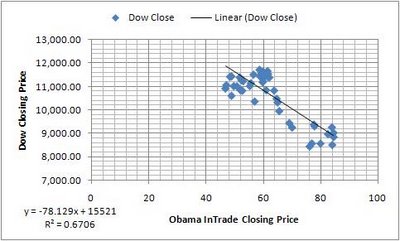
The more likely explanation:
The more likely explanation:
Go there for information on obtaining the files and additional commentary.If you just assume away the weekends, as I did above, it's more likely that the Dow leads the Obama contract than vice versa*.
Falling Dow is a leading indicator of a sour economy, the sour economy favors the party out of (executive) power.
*Uses Granger Causality test, two lags, for those who want the econometrics. EViews file available.
THE ELECTROLINERS WENT TO PHILADELPHIA. Coincidence?
Philadelphia won a World Series in 1980, while tbe Electroliners still saw occasional service on the Norristown High Speed Line. There is one Electroliner held hostage in Pennsylvania, although I'm not sure whether that's in Pirate or Phillies country.It was a malady that plagued the Milwaukee Brewers throughout the 2008 season, playing a significant role in getting the manager fired with two weeks remaining.
Now, at the worst possible time, the Philadelphia Phillies have contracted it.
Hitting with runners in scoring position, the very essence of performing in the clutch with a bat in your hands, has gone AWOL for the National League champs. In the first two games of the World Series, the Phillies have exactly one hit in 28 at-bats with RISP.
And that was an infield hit in the fourth inning of Game 2 by Shane Victorino that did not deliver a base runner.
GRIPE OF THE WEEK. Arnold Kling tells us what he thinks about academic macroeconomics.
The absence of a market test for scholarly research makes excursions into unreality, whether it be representative-agent models in which the agent is lender and borrower, or Lacanian readings of deservedly obscure female novelists, possible.
Bad economic ideas, however, cost people money. (Anybody remember Long Term Capital Management?) Although the academic ideas fall short, there are incentives for people to further improve the models so as to lose less money, or to make money. The academicians don't have the incentives to improve those models, but nobody's stopping mathematical-minded investment managers from doing their own work.
There's something similar behind a research project that I'm making painfully slow progress on. There are plenty of arguments for the optimality of a single-price policy and for the equivalence of rationing methods. These appear to rule out high occupancy toll lanes and self-selecting tariffs for amusement parks. But we have high occupancy toll lanes (the Illinois Tollway is considering some) and self-selecting tariffs at amusement parks. Demonstrating the incompleteness of the received economic models is a challenge.
He's not the first to make these claims. Deirdre McCloskey's comments about A-Prime, C-Prime and the Social Engineering Vice are similar. Before those, there was William Allen's "Midnight Economist" who once complained about "diddling elegance and doodling rigor" in research written solely for the purpose of attaining academic tenure (and, if one is skillful and well-connected, prestige appointments and Clark Medals).My main beef with economists is that standard macroeconomics does such a poor job of describing what is going on. The textbooks models are pretty much useless. Where in the textbooks is "liquidity preference" a demand for Treasury securities? Where in the textbooks does it say that injecting capital into banks is a policy tool?
Graduate macro is even worse. Have the courses that use representative-agent models solving Euler equations been abolished? Have the professors teaching those courses been fired? Why not?
I have always thought that the issue of the relationship between financial markets and the "real economy" was really deep. I thought that it was a critical part of macroeconomic theory that was poorly developed. But the economics profession for the past thirty years instead focused on producing stochastic calculus porn to satisfy
young men's urge for mathematical masturbation.
The absence of a market test for scholarly research makes excursions into unreality, whether it be representative-agent models in which the agent is lender and borrower, or Lacanian readings of deservedly obscure female novelists, possible.
Bad economic ideas, however, cost people money. (Anybody remember Long Term Capital Management?) Although the academic ideas fall short, there are incentives for people to further improve the models so as to lose less money, or to make money. The academicians don't have the incentives to improve those models, but nobody's stopping mathematical-minded investment managers from doing their own work.
There's something similar behind a research project that I'm making painfully slow progress on. There are plenty of arguments for the optimality of a single-price policy and for the equivalence of rationing methods. These appear to rule out high occupancy toll lanes and self-selecting tariffs for amusement parks. But we have high occupancy toll lanes (the Illinois Tollway is considering some) and self-selecting tariffs at amusement parks. Demonstrating the incompleteness of the received economic models is a challenge.
POETRY CORNER. Neo-Neocon hosts a discussion of Rudyard Kipling's "The Gods of the Copybook Headings."
WHEN TRICKERY BACKFIRES. Last year, Chris Lawrence posted video of Trinity beating Millsaps with a lateral-rich kick return. Today I saw what can go wrong with such trickery. Northern Illinois kicker Mike Salerno put the Huskies ahead with seconds remaining. Bowling Green had plans to play catch-and-run on the runback, but the play was a bit slow developing and one Northern Illinois player got a hand on the first pass and a second one came down with it. On the next play somebody false started from the victory formation, not that first-and-fifteen rather than first-and-ten with under five seconds to play matters.
Northern Illinois won the toss and deferred. They received to start the second half, with Bowling Green deciding to defend the windwardmark goal. There's nothing like using over ten minutes of the third quarter to beat to windward score a go-ahead touchdown. Sometimes the logical decisions backfire too. (Who said "get a good start and sail on the lifted tack" didn't apply to football?")
Earlier in the day, Chief Runs-from-Huskies stumbled in a badger hole.
Northern Illinois won the toss and deferred. They received to start the second half, with Bowling Green deciding to defend the windward
Earlier in the day, Chief Runs-from-Huskies stumbled in a badger hole.
21.10.08
I FAIL TO SEE THE PROBLEM. It's no longer the case that the State of Washington is contemplating banning home car-washing.

The wash water adds phosphates to the grass and returns to the water table, rather than draining into the storm sewer and making its way to New Orleans.
Admittedly, this is not an option for people who live in high-rises or apartment complexes, but they're probably at the mercy of the commercial car washes in any event.
But the state of Washington is telling its local governments they must prohibit home car washing unless residents divert the wash water away from storm drains, where they say it causes water pollution.Perhaps the legislation is rent-seeking by commercial car washes that treat and reuse their wash water. But there's an easy way to comply with such a law.

The wash water adds phosphates to the grass and returns to the water table, rather than draining into the storm sewer and making its way to New Orleans.
Admittedly, this is not an option for people who live in high-rises or apartment complexes, but they're probably at the mercy of the commercial car washes in any event.
SCRATCHBUILDING ON A GRAND SCALE. My observance of the end of regular steam operation on British metals, 40 years ago, gave Tim Hall at Where Worlds Collide occasion to note that the proliferation of preserved British steam locomotives reflected the country's relative prosperity at the end of steam, along with one scrap merchant's slow pace at recycling kettles into railings. That's all true, and I do have some meditations on some of the projects recycling kettles into different kettles for another day.
For today, though, we note that the British created, from scratch, a brand-new A1 Peppercorn Pacific, which is named Tornado, not Gordon. The engine has been undergoing running tests including some with passenger loads.
Now, if I could convince the local steam enthusiasts that an F7 Hiawatha is worth giving up a bottle of beer a week for ...
For today, though, we note that the British created, from scratch, a brand-new A1 Peppercorn Pacific, which is named Tornado, not Gordon. The engine has been undergoing running tests including some with passenger loads.
Now, if I could convince the local steam enthusiasts that an F7 Hiawatha is worth giving up a bottle of beer a week for ...
TAKING ON SEVERAL ESTABLISHMENTS. Imagine a political family, newly arrived on the national scene, with protected-status minority ancestry, and children with unusual names including a recently pregnant teenage daughter. The ancestry is African, the names faux-Franco-African, and the father of the baby is missing.
Angry with me? Accusing me of a bait-and-switch? Reconsidering your frame? In Black Rednecks and White Liberals, Thomas Sowell suggests that there's little substantive difference between the white redneck culture those white liberals sneer at, and the authentic black culture those white liberals will affirm. (There may be a generalization of the quick-to-anger and anti-intellectual elements of the projects -- the black rednecks -- and the council houses -- the yob version of the Anglo-Scots hillbilly, but stopped by the Pennines rather than the Appalachians -- to Islamic honor killings, but that is left as a future exercise.) Go beyond the polemics, however, and you discover Professor Sowell's anger with the liberal establishment's embrace of that phony authenticity, at the expense of more functional ways of dealing with very real oppression in a more positive way. That anger, backed up by inspection of the historical record, provides a structure to the essay that gives the book its title, as well as a chapter on black education and a concluding essay, "History versus Visions," that revisits the author's earlier work on the tragic vision and the contrast of social with cosmic justice.
Those chapters would stand alone and provide instructive, if provocative, reading. We have a longer Book Review No. 43 because either Professor Sowell or the editor at Encounter asked for more content. Thus we get a chapter on the ubiquity of slavery before the European colonial powers took a stand against it, a chapter on middleman minorities, and an essay about Germans. These give Professor Sowell the opportunity to take on the entire post-multi-diversi-establishment, although they turn the book into a collection of points. As the author has written more focused works on each of those topics, the summaries are likely to annoy readers more familiar with the in-depth work and risk distracting casual readers.
(Cross-posted to 50 Book Challenge.)
Angry with me? Accusing me of a bait-and-switch? Reconsidering your frame? In Black Rednecks and White Liberals, Thomas Sowell suggests that there's little substantive difference between the white redneck culture those white liberals sneer at, and the authentic black culture those white liberals will affirm. (There may be a generalization of the quick-to-anger and anti-intellectual elements of the projects -- the black rednecks -- and the council houses -- the yob version of the Anglo-Scots hillbilly, but stopped by the Pennines rather than the Appalachians -- to Islamic honor killings, but that is left as a future exercise.) Go beyond the polemics, however, and you discover Professor Sowell's anger with the liberal establishment's embrace of that phony authenticity, at the expense of more functional ways of dealing with very real oppression in a more positive way. That anger, backed up by inspection of the historical record, provides a structure to the essay that gives the book its title, as well as a chapter on black education and a concluding essay, "History versus Visions," that revisits the author's earlier work on the tragic vision and the contrast of social with cosmic justice.
Those chapters would stand alone and provide instructive, if provocative, reading. We have a longer Book Review No. 43 because either Professor Sowell or the editor at Encounter asked for more content. Thus we get a chapter on the ubiquity of slavery before the European colonial powers took a stand against it, a chapter on middleman minorities, and an essay about Germans. These give Professor Sowell the opportunity to take on the entire post-multi-diversi-establishment, although they turn the book into a collection of points. As the author has written more focused works on each of those topics, the summaries are likely to annoy readers more familiar with the in-depth work and risk distracting casual readers.
(Cross-posted to 50 Book Challenge.)
THE CASE FOR PEER REVIEW. University Diaries republishes a bar chart frpm Ph.D. Comics. It purports to show inequities in higher education, with 2008 dollar denominated median salaries for university presidents of $321K, compared to a median for provosts of $243K and deans of $189K for deans. It then shows mean salaries, of $95K for tenured male and $86K for tenured female professors, and $70K for untenured male and $66K for untenured female professors. Then comes a bar for football coaches with a value of $1m.
The footnotes, however, suggest that more careful research is required. The calculations for adminstrators and professors rely on three surveys, of which at least the American Association of University Professors salary survey is self-selected and self-reported. The blending of overlapping data, if such exist, is not described.
A comparison of the few current holders of the top rung on a tournament ladder in a winner-take-all market with an aggregate among holders of several rungs on a career ladder in an incompletely-competing-groups market misleads.
The calculation for football coaches relies on a USA Today article on compensation of current Division I coaches. That article might have cherry-picked its data for shock value. Yes, there is a positional arms race in college football, and yes, the football bubble is likely to pop. On the other hand, I have not heard of any advisors dissuading aspiring Ph.D.s and suggesting that they take a football theory course from Kinesiology in order to moonlight as an assistant coach at a local high school. Yes, I'm repeating myself.
To suggest, however, that there's money in football coaching is to neglect important differences in the career ladders. In this era of serial administrators, there are probably a few Joshua Lawrence Chamberlain types who do a hitch as college president and return to faculty. Suppressing a rebellion hasn't been required.
That faculty salary probably aggregates academic superstars, successful grant-getters, individuals with opportunities in business or government or consultancies with journeyman professors.
The footnotes, however, suggest that more careful research is required. The calculations for adminstrators and professors rely on three surveys, of which at least the American Association of University Professors salary survey is self-selected and self-reported. The blending of overlapping data, if such exist, is not described.
A comparison of the few current holders of the top rung on a tournament ladder in a winner-take-all market with an aggregate among holders of several rungs on a career ladder in an incompletely-competing-groups market misleads.
The calculation for football coaches relies on a USA Today article on compensation of current Division I coaches. That article might have cherry-picked its data for shock value. Yes, there is a positional arms race in college football, and yes, the football bubble is likely to pop. On the other hand, I have not heard of any advisors dissuading aspiring Ph.D.s and suggesting that they take a football theory course from Kinesiology in order to moonlight as an assistant coach at a local high school. Yes, I'm repeating myself.
To suggest, however, that there's money in football coaching is to neglect important differences in the career ladders. In this era of serial administrators, there are probably a few Joshua Lawrence Chamberlain types who do a hitch as college president and return to faculty. Suppressing a rebellion hasn't been required.
That faculty salary probably aggregates academic superstars, successful grant-getters, individuals with opportunities in business or government or consultancies with journeyman professors.
PASSENGER TRAIN ADVOCATES, NOT NECESSARILY RAIL PROFESSIONALS. A Destination: Freedom reporter attends Berlin's InnoTrans.
The correspondent takes too limited a view of investment.
I have to hammer reports like this because passenger rail advocates who take the government and the freight railroads to task without understanding how very different the technologies and the business models are make their own work, and my work supporting their efforts, more difficult.
This was not a trade show merely with booths and displays, and well-dressed, smiling, multi-lingual models; this trade show had dozens of full-sizes pieces of equipment, including a dozen or more complete trainsets from manufacturers all over the world, including the Russians, who proudly unveiled their version of the TGV at the show, and, surprisingly given our recent history, from North America, whose ElectroMotive Diesel, formerly a part of General Motors, is selling highly reliable freight locomotives by the score to European logistics companies.This correspondent is so obsessed with scoring political points that the presence of the world-conquering Type 66, an SD-70 modified to fit Britain's interurbanish clearance diagrams, is occasion for Euro-snobbery. Those vaunted European express trains come with an opportunity cost: the complete neglect of Europe's freight railroad network. A trade fair for rolling stock manufacturers is not the place to find out that those "logistics companies" are sometimes private companies spun off from the nationalized railroads with management and working capital provided by North American companies. It is no accident that Estonia's freight diesels and Britain's EW&S Class 66 units have the same general paint scheme.
The correspondent takes too limited a view of investment.
The trip was also designed to investigate some of the important advances in transportation technology and applications made by the Europeans in recent years, which, if America decides at last to invest in its own infrastructure once again and end the decades of neglect that have helped bring about the present economic calamity, may play a role in jump-starting and then sustaining our revival.In this correspondent's world, the 70 mph replacement for the Kate Shelley bridge, the quadrupling of the Powder River line, and the doubling of the Santa Fe from Kansas to California never happened, because Congress never appropriated the funds.
I have to hammer reports like this because passenger rail advocates who take the government and the freight railroads to task without understanding how very different the technologies and the business models are make their own work, and my work supporting their efforts, more difficult.
19.10.08
OCCASION TO BE CHEERFUL. The university that invented homecoming celebrates.
The Packers also win.
Last week's Michigan-killer Toledo was this week's defeated opponent. That sets up some comparative performance possibilities if any of Michigan or Wisconsin get a win that affects the national championship pairings.A highlight Saturday afternoon was the sale of the Huskies on Parade dogs, which were painted by sponsoring local businesses this spring to raise money for the Forward, Together Forward Scholarship Fund, established in memory of the five students killed in the Feb. 14 campus shooting.
About 25 miniature Huskie pups — their larger counterparts remain scattered about DeKalb and Sycamore — were lined up in a tent for shoppers and admirers.
The Packers also win.
SUPPLY CURVES SLOPE UP. To get a good job, consider the compensating differential.
Some of those options offer high pay, but they're not for the weak of mind.For years, there’s been a rumor going around that Ralph Keller would like to see quashed: that you need a bachelor’s degree to get a good job.
“My own feeling is that a lot of kids would be better off going into a skilled training program and becoming a tool-and-die maker or a CNC machine operator than going to college and getting a degree in general studies and still not being sure what they want to do as a career,” he said.
“They get an entry-level job at $20,000 or $30,000 per year and have tens of thousands of dollars in educational loans,” he continued. “If they had gone into a training program instead, ... they could get a job making $50,000 to $60,000 per year as a base wage, plus overtime, as a skilled manufacturing person.”
Keller is the president of the Arlington Heights-based Association for Manufacturing Excellence, and he’s frustrated by what he calls the “college lock step,” in which vocational training is all but ignored as high school students are ushered off to pursue four-year degrees. Those who decide college is not for them too often end their education after high school, limiting their earning potential without even realizing that other options exist, he said.
Perhaps it's the summer-camp aspect of college life that's missing from the apprenticeships?Donna Larkin, human resources coordinator for Sycamore manufacturer Driv-Lok, said recruiting skilled workers is increasingly difficult.
“Typically, you may get 100 résumés, but only one or two of those people actually have the skills to do the job you’re trying to fill,” she said. “Some of our machines are very specialized. ... There seems to just be a shortage of people with the necessary skills.”
Lozeau attributed some of the workforce gap to the number of retiring baby boomers, who are not being replaced by new workers coming out of trade and technical schools, she said.
Employers regularly contact Kishwaukee College looking for skilled workers ready to graduate from one of its 25 occupational programs, which include manufacturing technology, nursing and automotive technology, said Sara Pohl, dean of the school’s career technologies division.
“I think we need to do a better job of helping parents understand there are some great opportunities you don’t really need a four-year degree to pursue,” she said. “And there are many points during a student’s time at Kish they can decide to go on and transfer (to a four-year school) if they want to do that.”
THE FOLLY OF AVERAGING. Bardiac poses a question.
Bardiac suggests the rewards are lower in the women's sports.
The career ladders, however, are different. The expected return to coaching women's basketball is probably lower than the expected return to earning a Ph.D. in English, with a greater variance. Follow me on this: one takes an average of coaching salaries at Rockton Hononegah (a high school) and Northern Illinois and Vanderbilt and Kansas State (to consider Deb Patterson's c.v.) and weights by all the aspiring Deb Pattersons in high schools and mid-majors and sub-mid-majors and power conferences. Then one takes an average of salaries offered to English Ph.D.s by Kansas State and Northern Illinois and Wisconsin-Whitewater and Harvard and weights by all the aspiring Bardiacs both in tenure-track slots and adjuncting. I conjecture that the reward to English Ph.D.s is on average larger, and the variance lower, than the reward to basketball coaches, with this conjecture being stronger for the women's game, where the rents are lower, than it is in the men's game, where the variance is almost certainly greater, but the average might also be.
I haven't yet begun to consider comparisons among those "average" professors, some of whom might be journeyman researchers in the evergreen disciplines, others might be in fields such as finance or engineering with the prospect of commercial employment, and others might be successful at grant-writing and thus mobile.
What the professors have in common, however, is two things: they serve students who are able to appropriate more of the gains from a degree to themselves, and they compete in job markets with a less skewed reward structure than that of college coaching. The success of any coach is predicated on the failure of other coaches. The success of any academician is not. Sure, Watson and Crick might have beaten Pauling to the double helix, but Pauling had other successes in his career. Likewise, Krugman might have done a more effective job of selling central place theory than other economists, but that doesn't count against any other economist working in that field.
Market Power's Phil Miller notes that some parts of the mission generate rents that are not appropriated by the beneficiaries.Question of the day: this assistant coach (basketball) contributes more to the mission of education at Kansas State thank how many associate professors?
The article says he earned $400,000 last year. Let's pretend that the average (mean) salary of an associate professor at Kansas State is $80,000. (That's probably a very high pretend average associate prof salary, from my experience.)
So he's contributing five professor's worth to the mission of Kansas State. And this is an assistant coach. Imagine what a contribution to the mission the head coach must be making.
But the labor market for college basketball talent, although very competitive, is anything but typical because the top players cannot receive payment anywhere close to their value. So their value gets captured somewhere down the line, most likely by the coaches with the ability to recruit them.To complete the analysis, note that the nature of the competition in college basketball is of the winner-take-all nature, rather than the discovery of parity implicit in the equilibrium of an atomistically competitive market, such as that in retail or steel manufacture or many of the academic disciplines. Because the players don't get a piece of the action, the pay for performance goes to the recruiter. Because college basketball culminates in a championship, a conference tournament, and a tournament of tournament winners, the reward for performance is skewed, with half of the teams below average (for each winner there is a loser) and most of the coaches and players below average (thanks to the power rule at work in determining the champions and the players drafted to the professional leagues.)
Bardiac suggests the rewards are lower in the women's sports.
I bet the coach or coaches for the women's basketball team aren't making quite the same money, either.True, because the rents to be appropriated by making the national tournament and having players drafted to play in Europe or in the WNBA aren't as great. At the same time, Deb Patterson, the women's head coach, is probably contributing 2 or 3 "average professors" worth to Kansas State's mission.
The career ladders, however, are different. The expected return to coaching women's basketball is probably lower than the expected return to earning a Ph.D. in English, with a greater variance. Follow me on this: one takes an average of coaching salaries at Rockton Hononegah (a high school) and Northern Illinois and Vanderbilt and Kansas State (to consider Deb Patterson's c.v.) and weights by all the aspiring Deb Pattersons in high schools and mid-majors and sub-mid-majors and power conferences. Then one takes an average of salaries offered to English Ph.D.s by Kansas State and Northern Illinois and Wisconsin-Whitewater and Harvard and weights by all the aspiring Bardiacs both in tenure-track slots and adjuncting. I conjecture that the reward to English Ph.D.s is on average larger, and the variance lower, than the reward to basketball coaches, with this conjecture being stronger for the women's game, where the rents are lower, than it is in the men's game, where the variance is almost certainly greater, but the average might also be.
I haven't yet begun to consider comparisons among those "average" professors, some of whom might be journeyman researchers in the evergreen disciplines, others might be in fields such as finance or engineering with the prospect of commercial employment, and others might be successful at grant-writing and thus mobile.
What the professors have in common, however, is two things: they serve students who are able to appropriate more of the gains from a degree to themselves, and they compete in job markets with a less skewed reward structure than that of college coaching. The success of any coach is predicated on the failure of other coaches. The success of any academician is not. Sure, Watson and Crick might have beaten Pauling to the double helix, but Pauling had other successes in his career. Likewise, Krugman might have done a more effective job of selling central place theory than other economists, but that doesn't count against any other economist working in that field.
BOUGHT WINS BECOME MORE EXPENSIVE. Northern Illinois and Wisconsin reconfigure the football schedule.
I forgot. It's amateur athletics. It has nothing to do with money.
The agreement between the two schools called for three games, one in 2007 in Wisconsin, one game in DeKalb or Chicago in 2009 and another in Wisconsin in 2011. Originally, next year’s game was to be played in DeKalb.That game will be in Madison, with the 2011 game at Soldier Field.
Wisconsin will get a million for playing at Soldier Field. The way things are going there, it's not obvious which team is buying wins or boosting its attendance figures.Had the series gone on as originally planned, NIU would have received a $300,000 payout for coming to Wisconsin in 2011.
Payouts are the sums college football programs pay to secure competition from different conferences. NIU is in the Mid-American Conference, and Wisconsin is in the Big Ten, a Bowl Championship Series conference.
Now, the Huskies will receive an $800,000 payout for going to Madison in 2009.
I forgot. It's amateur athletics. It has nothing to do with money.
THE IDEA DIFFUSES. I claim there's a subprime sector in higher education. Econ Log's Bryan Caplan comes to a similar conclusion.
[M]any "investments" in education end in foreclosure - also known as "dropping out".He extends the argument.
If the rate of return for a completed year of education is 10%, but 6% of students who start a year don’t finish (and waste a year of their lives plus tuition), the expected rate of return is only 3.4%!The economics is straightforward.

15.10.08
LIQUIDATION SALE. In Red Storm Rising, Tom Clancy has the USSR occupying Iceland to secure a land-grab in Europe. Reality might involve rubles on the herring-barrel, which gives Quid Plura the chance to meditate on Latin's use of proto-Germanic forms that evolve to such constructions as Chapman and Kaufman and Kaupthing.
WISHFUL THINKING? The Milwaukee Journal-Sentinel publishes its interpretation of the Midwestern high-speed rail proposal, which I analyzed in detail two weeks ago. The newspaper focuses on the Wisconsin components of the project, which include speeding up the On Wisconsin to 110 mph (something that could be done on the Milwaukee stretch almost immediately but would take some work on to Madison), followed by improving the Madison - Portage- Twin Cities section, and finally restoring the Valley 400 line through West Bend, where some of the tracks have been lifted, and pushing on to Green Bay.
Now look carefully at the Illinois section of the map. The 79 mph line to Omaha via Des Moines is illustrated as diverging from the Burlington north of Princeton and striking out for the Quad Cities. My railroad atlases show two abandoned Burlington lines, one diverging at Mendota and another at Zearing, joining to pass through Ronald Reagan's birthplace of Tampico and joining the still-operating east bank line of the Burlington to reach the Quad Cities. Because the map shows an existing stop about where Mendota is, the Zearing connection is the more likely resurrection of an old rail corridor, if the map is accurate. Might those be some of the real estate plays John Stilgoe alludes to in Train Time?
If the plan envisions keeping trains on one corridor for as long as possible, as is the case with Britain's West Coast Main Line throwing off connections to Birmingham or Manchester or Liverpool from the main stem through Milton Keynes and Crewe and Carlisle, the simpler expedient would be a connection from the Burlington to the Rock Island at Wyanet, which is west of Princeton and near the Hennepin Canal.
Sometimes, what is unseen is as instructive as what is seen. Note the feeder us service to Cedar Rapids from Iowa City (oh, for a lightweight interurban) and from Des Moines to Ames and Fort Dodge. Project a line east from Ames through Cedar Rapids: you find Northern Illinois University. You've also uncovered a 90 mph capable railroad that, going west, has a 70 mph crossing of the Des Moines River. Regular readers will recognize me calling out, once again, the passenger-train-unfriendly Union Pacific, which has of late taken to running long, slow stack trains through DeKalb on interurban headways.
Then locate Kirksville, Missouri, reached by a feeder bus from Quincy. Kirksville is on another 90 mph capable railroad, the Santa Fe's Kansas City-Chicago mainline, which at one time had an emerging-corridor level of passenger train service.
I continue to endorse these high-speed rail plans, but the Sprecher stays in the cooler until the cartel-era speed restrictions are repealed and the track upgrading begins.
Now look carefully at the Illinois section of the map. The 79 mph line to Omaha via Des Moines is illustrated as diverging from the Burlington north of Princeton and striking out for the Quad Cities. My railroad atlases show two abandoned Burlington lines, one diverging at Mendota and another at Zearing, joining to pass through Ronald Reagan's birthplace of Tampico and joining the still-operating east bank line of the Burlington to reach the Quad Cities. Because the map shows an existing stop about where Mendota is, the Zearing connection is the more likely resurrection of an old rail corridor, if the map is accurate. Might those be some of the real estate plays John Stilgoe alludes to in Train Time?
If the plan envisions keeping trains on one corridor for as long as possible, as is the case with Britain's West Coast Main Line throwing off connections to Birmingham or Manchester or Liverpool from the main stem through Milton Keynes and Crewe and Carlisle, the simpler expedient would be a connection from the Burlington to the Rock Island at Wyanet, which is west of Princeton and near the Hennepin Canal.
Sometimes, what is unseen is as instructive as what is seen. Note the feeder us service to Cedar Rapids from Iowa City (oh, for a lightweight interurban) and from Des Moines to Ames and Fort Dodge. Project a line east from Ames through Cedar Rapids: you find Northern Illinois University. You've also uncovered a 90 mph capable railroad that, going west, has a 70 mph crossing of the Des Moines River. Regular readers will recognize me calling out, once again, the passenger-train-unfriendly Union Pacific, which has of late taken to running long, slow stack trains through DeKalb on interurban headways.
Then locate Kirksville, Missouri, reached by a feeder bus from Quincy. Kirksville is on another 90 mph capable railroad, the Santa Fe's Kansas City-Chicago mainline, which at one time had an emerging-corridor level of passenger train service.
I continue to endorse these high-speed rail plans, but the Sprecher stays in the cooler until the cartel-era speed restrictions are repealed and the track upgrading begins.
EINTOPFESSEN UND WINTERSHILFE. It sounds less appetizing in the original German. During tough times, however, casserole and hot dish and assorted other one-pot meals are commonsense frugality, and the recipes (via Instapundit) have become more imaginative.
I'm the son of Depression babies and a veteran of Midwestern church suppers. Perhaps I'll post a few of the classics from my collection as a statement of social solidarity.
I'm the son of Depression babies and a veteran of Midwestern church suppers. Perhaps I'll post a few of the classics from my collection as a statement of social solidarity.
RECRUITING IS NOT PERMITTED. Years ago, Milwaukee Hamilton's boys' basketball team won a state championship (keep scrolling) with students from the neighborhood. In the early 1990s, two different teams made it to Madison but did not advance to the title game.
Now comes something close to a recruiting scandal. The man who coached a northwest side school, Milwaukee Vincent, to five victories in seven appearances in the finals, lives near Hamilton. He recently became the head basketball coach there, in part because of illiquidity in the housing market and high fuel prices.
Milwaukee families have some choice in the schools their children attend, and sometimes that choice depends on athletic opportunities.
It was much simpler years ago, when the independent (read: religious) high schools might have been stronger in sports thanks in part to Catholic Youth Organization junior basketball programs and selective philanthropy that somehow made it possible for tall, coordinated, and poor kids to attend Marquette University High or Racine St. Catherines or, on occasion Stevens Point Pacelli or Manitowoc Roncalli (if you wish to study the papacy, start with the names of the Wisconsin Catholic high schools.) Sports boosters in the City Conference would lament the lack of interscholastic competition in junior high and residency requirements.
Now comes something close to a recruiting scandal. The man who coached a northwest side school, Milwaukee Vincent, to five victories in seven appearances in the finals, lives near Hamilton. He recently became the head basketball coach there, in part because of illiquidity in the housing market and high fuel prices.
Milwaukee families have some choice in the schools their children attend, and sometimes that choice depends on athletic opportunities.
At Bay View, coach David “Lou” Chapman was replaced because, like [Custer, as in George Armstrong, coach Marc] Mitchell, he lacks certification. Apparently, much of the Bay View program left with him: Star guard Johnnie Lacy left for a prep school in Massachusetts, two players reportedly transferred to Milwaukee Pulaski, and eight — yes, eight — young players transferred to Hamilton. Five of them are ranked by various scouting services as players to watch in the Class of 2011. Many of the eight play on the same AAU summer team.The school board's investigation turns up no impropriety in those transfers to Hamilton. The eight players obviously wanted to enroll at a high school that has a planetarium.
It was much simpler years ago, when the independent (read: religious) high schools might have been stronger in sports thanks in part to Catholic Youth Organization junior basketball programs and selective philanthropy that somehow made it possible for tall, coordinated, and poor kids to attend Marquette University High or Racine St. Catherines or, on occasion Stevens Point Pacelli or Manitowoc Roncalli (if you wish to study the papacy, start with the names of the Wisconsin Catholic high schools.) Sports boosters in the City Conference would lament the lack of interscholastic competition in junior high and residency requirements.
13.10.08
A PUBLIC SERVICE ANNOUNCEMENT. Recorded message on the answering machine today: Please call 1-800-SUM-TING with regard to credit restrictions on your account. No company name given. It's almost certainly a new 'phone scam taking advantage of peoples' anxieties about the credit crunch, particularly with stories of possible downward adjustment in revolving lines of credit. Look closely at your most recent credit card bills, there is likely to be a request to give the bank two or three weeks for the check to clear before assuming your line of credit has been raised by the amount of your payment. It's called using your cash for free, but the banks have had a bad month.
QUOTE OF THE DAY. Give us your honest opinion, Captain Capitalism.
The only thing that is going to fix this and the "global" problems of the world is that Americans grow up, become real adults, pay back what they owe and do what they say they're going to do. Americans are going to have to go old school and instead of blaming their problems and complete lack of production or responsibility on disabilities, poverty, peanut allergies, latex allergies, sex, race, religion, discrimination, Haliburton and George Bush, they are going to have to accept the fact they are ultimately responsible for their own actions and, by golly, doing something as simple as paying back your FREAKING loans is not only adult, but damn well expected, if not 1st grade level elementary. Americans will have to re-earn their title of being "Americans" which means you work, you produce and you kick ass. And until then I will refer to Americans as turkeys on the grounds anybody cannot seriously soar with you and you financial deadbeats are nowhere near earning the title of "eagle."
WE ALREADY KNEW THIS. It's official.
Norfolk State representatives are idiots. Let's move the station away from Campus and on the other side of a major intersection. What world do I live in???The explanation given by university officials (the same ones who have been zealous in the name of access-assessment-remediation-retention) reminds me of the transit-brings-criminals canard.
NSU officials requested the change because they feared for students’ security with a mass-transit stop so close to campus. Michael Townes, HRT CEO and president, said the request was accommodated because “they’re a partner in this project.”More usually, that's an objection raised by wealthy types who fear the trains will bring crime to their neighborhoods, as if the lowlives are going to schlep stolen property elsewhere on a trolley, particularly if there's a transfer to another trolley or a bus involved.
RECOGNITION FOR REGIONAL SCIENCE. Paul Krugman is this year's Nobel Prize recipient for Economics. Ryan Avent summarizes some of the work so recognized.
There's a brief summary of Professor Krugman's work at Marginal Revolution, and a longer explanation by Harvard's Edward Glaeser.
At the time those late 1970s papers were published, policy types were interested in industrial policy, and some of Professor Krugman's work appeared to suggest room for governmental sponsorship of strategic trade policies.
Back when I was first getting into economic geography, I read The Spatial Economy, which was co-written by Krugman, Masa Fujita, and LSE’s Tony Venables. It develops some “basic” economic geography theory from the ground up, and it’s fascinating reading–right up until they start dropping equations on you.The Spatial Economy is in the stack of books to read and review. Perhaps I should move it up, particularly if I want to say anything intelligent about the economics of suburbs.
There's a brief summary of Professor Krugman's work at Marginal Revolution, and a longer explanation by Harvard's Edward Glaeser.
Mr. Krugman published two seminal papers in 1979 and 1980 that made sense of the fact that Toyota sells cars in Germany and Mercedes-Benz sells cars in Japan. Mr. Krugman started with a variant of Edward Chamberlain’s model of monopolistic competition. In this model, every firm sells a slightly different good — an Infiniti is not exactly the same thing as a BMW. There are fixed costs of production, which means that producers get more efficient as they sell more. Finally, consumers like variety, so that even if they live in the Land of the Rising Sun, with its abundant well-made cars, they still occasionally want something a little more Teutonic.That "monopolistic competition" reference is inaccurate. It leads Atlantic Blog's Bill Sjostrom to a gripe.
These ingredients came together and provided a framework than can match the world’s trade patterns better than the 19th-century framework of David Ricardo, or the mid-20th-century models of Eli Heckscher, Bertil Ohlin and Paul Samuelson. The fact that two out of three of those 20th-century giants are themselves Swedes should remind us of how seriously the Swedes take their trade theory, and what a big deal it is for them to admit Mr. Krugman to the pantheon.
I have not paid attention to it since I encountered it as a student. It struck me at the time as tacking vastly overrated monopolistic competition models on to trade theory, so I stopped paying attention. Trade theorists who have actually paid close attention to his work, on the other hand, consider it extremely important.It's more accurate to describe Professor Krugman's work as use of central place theory, and there is potential to develop the work further to incorporate economies of scale and scope. Combine indivisibilities in the production of cars with the absence of cost complementarities in automobile production lines (although General Motors did a lot of work at overcoming those complementarities, perhaps to forestall an antitrust suit) and you get the counter-intuitive cross-hauling of different kinds of cars among countries that produce (some types of) cars for export while importing (other types of) cars.
At the time those late 1970s papers were published, policy types were interested in industrial policy, and some of Professor Krugman's work appeared to suggest room for governmental sponsorship of strategic trade policies.
FAMOUS LAST WORDS? Newmark's Door has a thesis nailed to it.
State legislatures have treated the required contributions to state pension funds as emergency money to be deferred to later.
Headquarters has circulated a memorandum from the State University Retirement System.
Developing.
Guess the state, and guess which political party is currently running it.Hint. Emil Jones, Mike Madigan, Rod Blagojevich :: Harry Reid, Nancy Pelosi, Barack Obama.
State legislatures have treated the required contributions to state pension funds as emergency money to be deferred to later.
Dating to the 1970s, state lawmakers pushed off the yearly payments they were supposed to make to cover the “normal costs” of pensions, or how much employees earned that year in benefits. These so-called holidays added up, and the debt multiplies over time.The generalization to the Social "Security" Trust Fund is left to the reader as an exercise.
Headquarters has circulated a memorandum from the State University Retirement System.
Members of the Illinois state retirement systems can rest assured that their retirement benefits remain secure despite the current volatility in the global financial markets. The benefits delivered by the state pension systems are constitutionally protected and cannot be reduced due to investment losses or for any reason. Those protections also exist under the contracts clause of the U.S. Constitution.What the letter does not tell readers is of the referendum, on the general election ballot, to call a constitutional convention for Illinois.
Developing.
12.10.08

A-PRIME, C-PRIME, SUB-PRIME. Deirdre McCloskey criticizes much of the economics research effort, including the modification of assumption A in a model to an assumption A' such that the original model's conclusion C becomes the opposite conclusion C'. Now comes Econ Log's Arnold Kling, suggesting that the effort has crowded out work on more useful things, such as understanding the nature of financial panics as they might actually exist.
At the same time, many perfectly competent economists who were not Members in Good Standing of the back-scratching society disengaged, if they didn't change their own research efforts to imitate the latest fads, or adopt the fallback position that multiple articles in journals that nobody reads are better evidence of scholarly productivity than fewer but better articles in journals that a few scholars read, even if those journals are the back-scratchers' playing fields.
I've been thinking more about Joe Stiglitz's valid criticisms of what I call the Lost Generation of macroeconomists, and I'm getting more and more steamed. If you stacked up everything written by the leading macro folks of my generation and later (actually, starting a few years earlier also), you would have nothing but an enormous baloney sandwich. Ordinarily, I don't dwell on the fact that these people who were no smarter than me back-scratched each other into the best journals, the prestigious professorships, the important conferences, etc. But sometimes, especially now, I think about how badly they have failed intellectually. They are the precise academic equivalent of Wall Street executives who enjoyed golden parachutes while bankrupting their firms.The cynicism about academic back-scratching has grown in recent years, although ProfScam alerted readers to its presence 20 years ago. If the back-scratching were a real-world Glass Bead Game, with no consequences, perhaps we could live with it. But while the humanities messed about with postmodernism and post-structuralism, the abolition of academic standards as oppressive social constructs fostered a collapse of elementary and secondary education and a positional arms race with elements of a flight to quality in higher education. And while macroeconomists modeled representative agents (part of the Stiglitz complaint is that a representative agent is both lender and borrower) and perfect risk-neutral hedges, and used transversality conditions to preclude rational expectations hyperinflations, actual investors who never heard of Merton or Sargent or Ito or Brock blundered into unfamiliar positions.
At the same time, many perfectly competent economists who were not Members in Good Standing of the back-scratching society disengaged, if they didn't change their own research efforts to imitate the latest fads, or adopt the fallback position that multiple articles in journals that nobody reads are better evidence of scholarly productivity than fewer but better articles in journals that a few scholars read, even if those journals are the back-scratchers' playing fields.
MORE FUTURE RESEARCH. Anybody else notice that the just-before-closing-time price drops on the U.S. exchanges didn't happen on Friday, the first day in two weeks when traders who took short positions could cover their shorts? Ed Driscoll notes assorted conspiracy buffs who suggested those late-day-drops were deliberate, and suggests the maxim that I believe is due to Frederick the Great (never attribute to malice that which is simple incompetence) is the better explanation.
Perhaps so, but I'd be surprised if economists who know how to use the Center for Research in Security Prices and are conversent with the latest time-series economic tricks aren't this very evening getting estimates of the welfare losses from that ban.
Perhaps so, but I'd be surprised if economists who know how to use the Center for Research in Security Prices and are conversent with the latest time-series economic tricks aren't this very evening getting estimates of the welfare losses from that ban.
11.10.08
TO HONOR AND REMEMBER. Distinguished Flying Cross recipient George Washington Bamberger, Betsy Newmark's father, Craig Newmark's father-in-law.
ANOTHER SUNNY WEEKEND IN PARADISE. Reduced daylight has triggered the winter routine for the trees.

That looks like a cavalry troop in blue uniforms under this other stand of trees.

The 33rd Illinois Volunteer Regiment Band plays "When Johnny Comes Marching Home".
Under that stand of trees in the first picture is a battery of Confederate artillery.

There are Confederate cavalry nearby, and a battle begins.

A Confederate infantry unit gives the rebel yell and takes the field.

A United States unit, accompanied by a physician, drives the Rebel unit back.

The battle, an event at this year's Shadows of the Blue and Gray in Princeton, Illinois, ended as a draw, with both sides agreeing to a truce to collect casualties, and retaining possession of their grounds.
The Princeton battleground is less hilly than the Stockton battleground I visited two years ago.
The presidential campaign has turned very nasty, and I have heard talk of civil war, both in conversations with people and in exploring some corners of the internet. I don't view the differences among us as sufficiently irreconcilable as to require resolution by force of arms. Whether I will be as optimistic in six months or a year remains to be seen.

That looks like a cavalry troop in blue uniforms under this other stand of trees.

The 33rd Illinois Volunteer Regiment Band plays "When Johnny Comes Marching Home".
Under that stand of trees in the first picture is a battery of Confederate artillery.

There are Confederate cavalry nearby, and a battle begins.

A Confederate infantry unit gives the rebel yell and takes the field.

A United States unit, accompanied by a physician, drives the Rebel unit back.

The battle, an event at this year's Shadows of the Blue and Gray in Princeton, Illinois, ended as a draw, with both sides agreeing to a truce to collect casualties, and retaining possession of their grounds.
The Princeton battleground is less hilly than the Stockton battleground I visited two years ago.
The presidential campaign has turned very nasty, and I have heard talk of civil war, both in conversations with people and in exploring some corners of the internet. I don't view the differences among us as sufficiently irreconcilable as to require resolution by force of arms. Whether I will be as optimistic in six months or a year remains to be seen.
10.10.08
HIGHER EDUCATION'S SUBPRIME CARRIERS. Robert Weissberg, formerly of the University of Illinois, calls out The Noble Lies of political correctness.
Professor Weissberg then notes the boodlers whose livelihood depends on a pool of underachieving students.
The paradigmatic example would be a President of an elite university telling assembled students and faculty that university admission standards were color blind so blacks and Hispanics on campus were just as qualified as whites and Asians. This would then be followed with "these minorities strengthen intellectual life and enhance education for everyone." Though we are not mind readers, it is inconceivable that listeners believe this rhetoric. As Graucho Marx put it, "who are you going to believe---me or your eyes?"Years ago, Charlie Sykes, at p. 261 of ProfScam, contended
[I]t is increasingly obvious that the burden of the failure of academia tend to fall not on the elites, but on the large middle class and on students at the lower end of the economic spectrum for whom a college education is the only hope for upward advancement. To a large extent, the middle class is stuck in the academic gulags created by the professors' culture.In 1988, Mr Sykes and much of the rest of the commentariat had not discovered the connection between what he referred to then as "the professors' culture" and the subsequent capture of the university by the forces of access-assessment-remediation-retention. The positional arms race (that started about the same time) to get into the fifty universities claiming top twenty status is unlikely to be independent of the faith-based rhetoric Professor Weissberg attributes to a president at one of those universities, which he could with equal validity attribute to a president at many other universities, including the ones Mr Sykes might characterize as "academic gulags."
Professor Weissberg then notes the boodlers whose livelihood depends on a pool of underachieving students.
Listeners daily encounter struggling blacks and Hispanics, hear about the expensive remedial programs to keep them academically afloat, see them gravitate towards easy-to-pass "ethnic" classes (which they often skip) while their classroom utterances often exhibit embarrassing ignorance or are just ideological rants. Ironically, campus race/ethnic group leaders openly admit these deficiencies and argue that such students be admitted despite their deficits. These advocates, unlike the university's president, happily document that blacks average 200 points less than whites on the SAT or that without resource-draining support services they would never graduate. Here honesty is rational since cataloguing shortcomings is vital to securing assistance, including their own jobs.That honesty, however, induces resentment that Dinesh D'Souza summarized at pp. 240-241 of his 1991 Illiberal Education (hardcover edition).
The new bigotry is not derived from ignorance, but from experience. It is harbored not by ignoramuses, but by students who have direct and first-hand experience with minorities in the close proximity of university settings. The "new racists" do not believe they have anything to learn about minorities; quite the contrary, they believe they are the only ones who are willing to face the truth about them. Consequently, they are not uncomfortable about their views, believing them to be based on evidence. They feel they occupy the high ground, while everyone else is performing pirouettes and somearsaults to avoid the obvious.Yes, it's polemical. The intervening 20 years of denying the tradeoff of Diversity for Excellence have not produced any great strides in academic achievement or enhanced regard for university graduates, depressingly many of whom require further remediation under the rubric of "on-the-job-training." Higher education's sub-prime providers are unlikely to be missed if they evaporate. Those trillions of dollars in national wealth gone with the various other bubbles have offsetting entries elsewhere on the balance sheet. We don't know yet which of these entries will be erased.
THINGS WE TAKE FOR GRANTED. One of the ways in which medieval shippers were able to divide risks and price them separately was to create the letter of credit, in which the shipper could be assured of payment for delivery of the commodity, thus reducing the commercial risk. Without radio, or telegraph, or couriers faster than the fastest ships, these letters posed a non-trivial problem to merchants, and they required substantial trust.
We now have methods of communication faster than the fastest ships, but without the trust, the goods don't get loaded and the ships don't sail.
We now have methods of communication faster than the fastest ships, but without the trust, the goods don't get loaded and the ships don't sail.
Christmas is already on the rails (if it isn't in the stores) but those fresh vegetables in January might be harder to come by.By way of background, letters of credit of various sorts are essential for trade. For instance, imagine the difficulty if you are, say, a Chinese manufacturer who wants to sell his wares to buyers overseas. How can he be sure the goods he ships will ever be paid for? Imagine the considerable difficulty and cost of chasing a deadbeat in a foreign country. Letters of credit. issued by banks, assure payment. They can also serve to finance the shipment (ie, fund the inventory while it is in transit).
Not only are banks now leery of lending to each other for much longer than overnight, they are also starting to refuse to honor letters of credit from other banks.
Subscribe to:
Posts (Atom)




