Think about it, dear reader, if there is a giant sucking sound of manufacturing jobs going to Mexico, why is there immigration through Mexico into the United States?
Showing posts sorted by relevance for query broadly shared prosperity. Sort by date Show all posts
Showing posts sorted by relevance for query broadly shared prosperity. Sort by date Show all posts
4.4.25
THE POLITICAL ECONOMY OF TARIFFS: POPULAR MYTHS.
If Ross Perot had been correct in 1992, Donald Trump would not have his principal issue in 2016 or last year.


19.1.08
PATH DEPENDENCE.
It's been my karma to grow up in Milwaukee and work in Detroit and Greater DeKalb during an era of great economic change. There was probably no better seat to observe industrial decline than that of a tenure-tracker at Wayne State. Now comes former Chicago Tribune reporter and Chicago Council on Global Affairs senior fellow Richard Longworth with Caught in the Middle, one observer's perspective on those changes. Mr Longworth suggests that Thomas Friedman's world-flattening is manifesting itself in anything but a level manner in what he calls the Midwest but what might more accurately be called the North Central states (if I remember my Census regions correctly). This Book Review No. 4 will concur in part and dissent in part with Mr Longworth's findings, interpretations, and recommendations.
27.8.13
DEFLECTING THE DECLINE.
On Sunday, American Flyer and Chicago Cub enthusiast George Will describes an also-ran that's less-than-lovable.
You have a city, 139 square miles, you can graze cattle in vast portions of it, dangerous herds of feral dogs roam in there. 3 percent of fourth graders reading at the national math standards, 47 percent of Detroit residents are functionally illiterate, 79 percent of Detroit children are born to unmarried mothers. They don't have a fiscal problem, Steve, they have a cultural collapse.Katrina Vanden Heuvel offered a different interpretation.
I find that really insulting to the people of Detroit. I think there is a serious discussion about the future of cities in a time of deindustrialization. But in many ways, Detroit has been a victim of market forces.Richard Longworth was not on the panel. That victimization was with the complicity of the commercial and political establishments of the Rust Belt.
Mr Longworth argues that both leaders and the Midwestern work force took the persistence of broadly shared prosperity based on manufacturing and farming for granted. Because those lines of business were subject to business cycles, sometimes of great amplitude, many interpreted the turmoil in autos and steel that began in the late 1970s as simply one more nasty recession (to some extent it was) that would pass (but some things changed permanently). Those lines of business enjoyed protection from the rest of the world: with the full power of the government in the case of farming, by default in the case of autos and steel, with that era of broadly shared prosperity the prosperity of a temporarily closed market extracting rents from others. (But if you say that too loudly, people will squawk.)The next day, Ed Schultz returned to daytime television with a segment devoted to "What an Evil Person George Will Is." Among the ripostes, the ever-prissy Joan Walsh noted that bastardy rates among whites have reached the level the Moynihan Report viewed with alarm among blacks, early in the Great Society. Yes. "One could as easily argue that a crass and degraded popular culture, again, long before Jerry Springer and Jersey Shore, meant more guardrails removed from people who might not have been properly socialized to the guardrails by parents or schools." In such a crass and degraded popular culture, there's more to poverty and inequality than the machinations of hedge-fund managers.
10.12.18
WE WANT BETTER CHOICES.
Salena Zito takes stock of the recent string of mid-term repudiations of the party of the sitting President.
Between the time Barack Obama took the oath of office in 2009 and the time Donald Trump took the oath in 2017, Democrats lost nearly 1,000 congressional, state House, and Senate seats in nearly every nook and cranny in the country. They also lost the majorities in the state legislatures, governors' offices, and statewide elected offices.We're likely to see such gridlocking phenomena as long as "voters think a vote for one of the Other than Democrat, Other than Republican candidate is a futile and stupid gesture."
Two years into the Trump presidency, Democrats swung nearly 380 — about one-third — of those state House and Senate seats back into their column. They also flipped seven governors' seats their way as well as 40 congressional House seats, additionally regaining several of the statewide elected offices.
9.9.25
A MILLION BUCKS DOESN'T GO AS FAR AS IT USED TO.
Common Dreams contributor Paul Buchheit has long provided us with entertainment, and, despite retiring from his academic gig, he's still amusing. "A Challenge for Democrats: Getting the Stockholders to Embrace a Stockholder's Tax." By which he's referring to that misnamed "income tax" in Monopoly, in which the player can decide to fork over $200 to the bank, or work out his net worth. Apparently it's prudent to fork over the $200 rather than make the calculation after the third trip past Go.
Paulie thinks it's a good idea. "There are many good reasons for stockholders to welcome a modest annual tax on stock holdings, chief among them that this would be an investment in America. But somebody is going to have to make that argument."
Why? Follow the money.
The wealthiest 10% of Americans own 93 percent of the stock market. (The richest 10% of U.S. adults approximately matches the number of U.S. millionaires.) And fortuitously, for them, most of their windfall has derived passively as the S&P 500 has gained a pre-inflation average of over 10 percent annually over the past half-century.Put another way, there's been enough inflation that just about anybody who salted any money away was in a position to become a millionaire. That pre-inflation increase in the value of stockholdings? Not so spectacular.
7.3.23
REDISCOVERING THE MEDIAN VOTER.
American Thinker contributor John Green responds, favorably, to Ruy "Liberal Patriot" Teixeira's wisdom. "Democrats have embraced radical positions, because leftists have oversized influence on the party. That influence is driving the Democrat party to lose touch with the normies, who are still the vast majority of American voters." That column distills from three long essays. In one, Mr Teixeira suggests Democrats Must Move to the Center on Cultural Issues.
The idea that Democrats can just turn up the volume on economic issues and ignore their unpopular stances on sociocultural issues is absurd. Culture matters and the issues to which they are connected matter. They are a hugely important part of how voters assess who is on their side and who is not; whose philosophy they can identify with and whose they can’t.Put simply, end the faculty lounge politics and name and shame the deplorable shamers.
Instead, for many working-class voters to seriously consider their economic pitch, Democrats need to convince them that they are not looked down on, that their concerns are taken seriously and that their views on culturally freighted issues will not be summarily dismissed as unenlightened. With today’s Democratic Party, as we have seen, this is very difficult. Resistance has been, and remains, stiff to any compromises that involve moving to the center on these issues, a problem that talking more about economic issues simply ignores.
In a second, he suggests Democrats Must Promote an Abundance Agenda. That used to be second nature, the so-called progressives were in favor of what they called "broadly shared prosperity," never mind that they dissipated the Victory Dividend on all sorts of technocratic follies. Mr Teixeira understands that prosperity can mean making better use of what you have. "Abundance means just what you think it means: more stuff, more growth, more opportunity, being able to easily afford life’s necessities with a lot left over. In short, nicer, genuinely comfortable lives for all." Markets deliver that sort of abundance, and wring out waste and resource depletion along the way. Bragging about passing legislation sounds hollow in contrast.
The idea is for Biden and administration surrogates to fan out across the country to give voters the good news about the investments in their three big bills (the bipartisan infrastructure bill, the CHIPS and Science Act and the so-called Inflation Reduction Act (IRA)) and how they are bringing/will bring prosperity and good jobs to their communities.It's not as if we've forgotten how previous "transformative" legislation has run afoul of the Law of Unintended Consequences and other reality checks.
In a third essay, he commits heresy. Democrats Must Embrace Patriotism and Liberal Nationalism. Yes, those scurrying feet were the Obama types heading toward the nearest fainting couch. "Nor is it unknown for progressive commentators to grudgingly admit there are—or at least have been—some good things about America before they return to their preferred theme of the country’s abundant and appalling sins. But they just don’t seem very enthusiastic about the actually-existing country of America." How can you govern a country you don't like? As an occupying power would? That will not turn out well. "[Democrats] will if they want to become once again the party of the ordinary American, rather than the cultural elites who would find all this stuff distinctly uncool, if not outright reactionary. We shall see."
What's interesting is that Mr Teixeira draws heavily on work by Noah Smith and Brink Lindsey, not your usual sort of Democrat court intellectuals. With both major parties seemingly in thrall to their most vocal fringes, all either major party has to do is come off as not crazy, and that's a quality not forthcoming from leaders of either at the moment.
20.8.11
DON'T YOU HAVE TO WIN THE WAR? Cold Spring Shops has long been a site for skepticism about a causal connection between the United States war effort and the subsequent broadly shared prosperity.
It's fitting to revisit that skepticism in light of a recent suggestion by a regional economist somewhat better known than me that a worldwide project to prepare for an alien invasion might end the recession.
I leave it to more imaginative minds than mine to envision the surviving allocations of productive capacity after a victory over aliens. After a defeat, the remaining productive capacity is useful only as forage for the space invaders. That's what a summer show, Falling Skies, teaches. There is supposed to be a second season. I keep humming "Cherokee Nation" when I contemplate the ending of the first season.
It's fitting to revisit that skepticism in light of a recent suggestion by a regional economist somewhat better known than me that a worldwide project to prepare for an alien invasion might end the recession.
The World War II years were a time of shared privation, with virtually every item that we take for granted today either rationed: e.g., meat, gasoline, sugar, clothing; or not available at any cost: e.g., new cars, appliances, etc. The American standard of living throughout World War II remained at an excruciatingly low level that no 21st century American would accept. Meanwhile, unemployment disappeared simply because 16 million able-bodied people were sent to war, paid below-market rates and subject to danger, death, and maiming they may not have preferred to unemployment.The prosperity of the United States, after the victory, reflected the paucity of productive capacity elsewhere. Britain's victory didn't provide any immediate dividends, and it took Germany and Japan a long time to get back to where they were before the two World Wars.
I leave it to more imaginative minds than mine to envision the surviving allocations of productive capacity after a victory over aliens. After a defeat, the remaining productive capacity is useful only as forage for the space invaders. That's what a summer show, Falling Skies, teaches. There is supposed to be a second season. I keep humming "Cherokee Nation" when I contemplate the ending of the first season.
3.3.08
INEFFICIENCY BEGETS PROSPERITY? An American Prospect article by Lawrence Mishel and Richard Rothstein notes that access to education, while useful for broadly shared prosperity, is not the sole policy instrument.
Of course we should work to improve schools for the middle class. And we have an urgent need to help more students from disadvantaged families graduate from good high schools. If those students do so, our society can become more meritocratic, with children from low-income and minority families better able to compete for good jobs with children from more privileged homes. But the biggest threats to the next generation's success come from social and economic policy failures, not schools. And enhancing opportunity requires much more than school improvement.They observe,
Rephrase that: inefficiently many college graduates are purchasing a high school education that their high schools failed to deliver. Rather than hint at a conspiracy among the sales managers and the corporate offices to keep the engineers and teachers poor, consider the continued lamentations from the personnel department about the lack of skilled workers, who have to be purchased with better pay packets (and I keep beating the drums for more favorable hours of work).Rising workforce skills can indeed make American firms more competitive. But better skills, while essential, are not the only source of productivity growth. The honesty of our capital markets, the accountability of our corporations, our fiscal-policy and currency management, our national investment in R&D and infrastructure, and the fair-play of the trading system (or its absence), also influence whether the U.S. economy reaps the gains of Americans' diligence and ingenuity. The singular obsession with schools deflects political attention from policy failures in those other realms.
But while adequate skills are an essential component of productivity growth, workforce skills cannot determine how the wealth created by national productivity is distributed. That decision is made by policies over which schools have no influence -- tax, regulatory, trade, monetary, technology, and labor-market policies that modify the market forces affecting how much workers will be paid. Continually upgrading skills and education is essential for sustaining growth as well as for closing historic race and ethnic gaps. It does not, however, guarantee economic success without policies that also reconnect pay with productivity growth.
American middle-class living standards are threatened, not because workers lack competitive skills but because the richest among us have seized the fruits of productivity growth, denying fair shares to the working- and middle-class Americans, educated in American schools, who have created the additional national wealth. Over the last few decades, wages of college graduates overall have increased, but some college graduates -- managers, executives, white-collar sales workers -- have commandeered disproportionate shares, with little left over for scientists, engineers, teachers, computer programmers, and others with high levels of skill. No amount of school reform can undo policies that redirect wealth generated by skilled workers to profits and executive bonuses.
College graduates are, in fact, not in short supply. A background paper for the Tough Choices report (but not one publicized in the report itself) acknowledges that "fewer young college graduates have been able to obtain college labor market jobs, and their real wages and annual earnings have declined accordingly due to rising mal-employment." In plain language, many college graduates are now forced to take jobs requiring only high school educations.
While it's popular to blame the U.S. education system for the lack of skilled workers and to look at elementary and secondary schools as the place to solve the crisis, manufacturers can't refute that lower turnover is one of most potent salves to this problem, and the ingredients to this salve are better working conditions, higher pay and more training. And, these challenges are more easily addressed than an overhaul of the U.S. education system.That strikes me as more likely to succeed than raising wages by restricting output, as Mr Mishel and Mr Rothstein would have us do.
Left unstated: that those unionized factory jobs were the consequence of closed markets and little global competition after the second World War. Oligopolistic prices above competitive levels made possible the union scale wages based on the resulting marginal revenue product, and the substitution of more productive technology induced by those union wages meant fewer people shared in the prosperity. Consumers, understandably, balked at paying the higher prices for the products, and substituted the first chance they saw.Another too glib canard is that our education system used to be acceptable because students could graduate from high school (or even drop out) and still support families with good manufacturing jobs. Today, those jobs are vanishing, and with them the chance of middle-class incomes for those without good educations.
It's true that many manufacturing jobs have disappeared. But replacements have mostly been equally unskilled or semiskilled jobs in service and retail sectors. There was never anything more inherently valuable in working in a factory assembly line than in changing bed linens in a hotel. What made semiskilled manufacturing jobs desirable was that many (though not most) were protected by unions, provided pensions and health insurance, and compensated with decent wages. That today's working class doesn't get similar protections has nothing to do with the adequacy of its education. Rather, it has everything to do with policy decisions stemming from the value we place on equality. Hotel jobs that pay $20 an hour, with health and pension benefits (rather than $10 an hour without benefits), typically do so because of union organization, not because maids earned bachelor's degrees.
It is cynical to tell millions of Americans who work (and who will continue to be needed to work) in low-level administrative jobs and in janitorial, food-service, hospitality, transportation, and retail industries that their wages have stagnated because their educations are inadequate for international competition. The quality of our civic, cultural, community, and family lives demands school improvement, but barriers to unionization have more to do with low wages than does the quality of education. After all, since 1973 the share of the workforce with college degrees has more than doubled; over 40 percent of native-born workers now have degrees beyond high school. Additionally, the proportion of native-born workers that has not completed high school or its equivalent has decreased by half to just 7 percent.
4.4.16
THE COMPARATIVE ADVANTAGE OF THE UNITED STATES.
Historically, that has been in producing knowledge-intensive products using advanced technology. The "broadly shared prosperity" of The America that Worked(TM) was in some ways an aberration, as the routine production of primary metals such as steel or aluminum, or of consumer durables, such as automobiles and appliances, had been codified enough as to become routine, and production could be undertaken almost everywhere, including countries rebuilding after the war, and new countries rendered independent as a consequence of the peace.
Apparently, the comparative advantage remains in the production of knowledge-intensive products using advanced technologies. Patricia Cohen of New York's Times files a report from The Cities on the Sunny Side of the American Economy.
Apparently, the comparative advantage remains in the production of knowledge-intensive products using advanced technologies. Patricia Cohen of New York's Times files a report from The Cities on the Sunny Side of the American Economy.
“It’s pretty clear that some metropolitan areas are doing really well,” said Andrew McAfee, an economist at the Massachusetts Institute of Technology. “The ingredients to that formula seem to be some combination of great research universities and knowledge-intensive industries, whether it’s high tech on the West Coast, biotechnology here in the East or clusters of technology and robotics in places like Pittsburgh.”The good news about today's advanced technologies is they're not as place-bound as textiles early in the nineteenth century or consumer durables early in the twentieth. It helps, though, for civic leaders to recognize the economic environment changing.
The Denver metropolitan area has become a showcase of the sunnier side of the American economy. While the region has some inherent advantages, like a spectacular landscape that beguiles outdoor enthusiasts, Colorado had long been held back by a dependence on natural resources as its economic base.
Its transformation into one of the most dynamic economies in the country was led by local business leaders and government officials, who took advantage of existing assets while also raising taxes at times to invest in critical transportation links, development-friendly policies and a network of colleges and universities.Perhaps, as this article is in the house organ for gentry liberals, there's a hint of cheerleading for Creative Class and Smart Growth nostrums. Or perhaps, in the spending on rail transit and entertainment comes an understanding that among the biggest government failures of the past half century we must include Big Highways and Big Sports.
“It’s the outcome of really about 30 years of diversifying our economy” away from fossil-fuel industries and military contractors, said Tom Clark, chief executive of the Metro Denver Economic Development Corporation. “In the 1980s, we were Coors, carbon and the Cold War.”
With a history of boom-and-bust commodity cycles, Colorado hit bottom in the mid-’80s, when energy prices collapsed. Nearly a third of the office space in downtown Denver, the state’s oil-and-gas headquarters, sat empty. Many of the city’s cultural institutions teetered, and a cloud of brown smog smeared the horizon.
Several measures helped things along. A new rail line that will connect the airport to the downtown and serve outlying industrial parks and a push to support cultural institutions “required people to vote to raise their taxes,” Mr. Clark of Metro Denver said. “This wasn’t something done by the elites.”The challenge is in maintaining taxation at a level that is symbiotic with commerce.
What Denver and its surrounding cities share with other boomtowns is an appealing environment for a skilled work force, which has increasingly meant the difference between prosperity and stagnation.
Such places have become business incubators and magnets for educated millennials. The lifestyles that 20- and 30-somethings often seek depend on a medley of urban living, public transit and lots of entertainment options (which in Colorado includes marijuana, legalized for recreational use since 2014).
19.12.07
FIFTIES NOSTALGIA TO THE LEFT OF ME.
Not for saddle shoes or tail fins; rather, for broadly shared prosperity, which Robert Kuttner's The Squandering of America argues is the consequence of a coordination failure whereby the institutional restraints that at one time impeded the creation of wealth (unionized oligopolies, closed economies, and increasing marginal tax rates) were dismantled in such a way as to make the wealth creation easier and more readily appropriated by trading houses. That sentence doesn't quite stand by itself as Book Review No. 34. I note, however, that there are chapters titled "Wall Street Rules" (because a number of Depression-era laws were amended or repealed); "Financial Engineering and Systemic Risks" (where hedge funds are "a time bomb of risk"); "The Casino Continues" (referring to even more esoteric investment inventions); and "The Return of Speculative Global Finance." Mr. Kuttner may be right that trading markets have the potential to over- or under-correct, or to get caught up in rational expectations hyperinflations (more popularly known as "speculative bubbles"). It does not follow, however, that the Depression-era regulations will prevent such things. Complex adaptive systems do what they darn well please.
That noted, Mr Kuttner makes his case for that Fifties-style welfare state consensus. See pages 272-73:
You can put the entire Republican ideology on a bumper sticker: Markets Work, Governments Don't. This easy-to-grasp economic philosophy is complemented by a simple social philosophy: Poor People Reflect Poor Values. ...Let us praise Franklin, Lyndon, and the Croly Ghost.
This dual credo may have elements of truth when it comes to a small minority of dissolute poor, but it offers nothing to a broad, well-behaved working and middle class that finds itself working harder for less, in an era when markets often reduce security and living standards.
Markets are useful engines of economic growth, but they are not reliable at providing employment security, much less decent wages, retirement, education, or health care. Nor can we trust markets to police the honesty of financial institutions, the cleanliness of air and water, the safety of workplaces, or the stability of the economy as a whole. So alongside markets, we need social investments financed with progressive taxation, as well as public regulation of the market's self-cannibalizing tendencies. A well-managed economy operated according to these principles can be at least as efficient as a laissez-faire one (which underinvests in people) -- and a lot fairer.A now retired colleague would put the above in a bumper-sticker formulation: Liberals Protect People. The policy debate, however, must focus on the details. The deregulation and privatization of the 1970s and 1980s followed a painful coming to consciousness of the ability of a government to mismanage the economy -- thus stagflation and ever poorer performance of the common schools and ever-greater efficiency losses in the regulated industries. That "can be" is a claim; it is not a promise. Public policy, moreover, requires voters to consent to bundles of policies. As Mr Kuttner notes, Republicans bundle cultural populism with Friedmanian economics; Democrats bundle cultural idealism bundled unevenly with Pigouvian economics (the latter watered down in order to attract metrofexuals with trust funds.) He concludes with a warning.
[T]he failure to seriously engage with the downside of globalism has its own set of alarming political dynamics. As living standards fall for ordinary people, especially for socially conservative white male, blue-collar workers, the know-nothings gain more influence. We've already seen this in an anti-immigrant backlash. In the absence of a managed economy that offers balanced opportunity and security, vulnerable workers scapegoat foreigners and minorities. The elite, globalist Right is playing with social dynamite by not paying attention.As, for some time, has been the elite, Europeanist Left. Mr Kuttner has just demonstrated the logic of Ronald Reagan's "I didn't leave the Democratic Party, the Party left me." We'll consider the influence of the "know-nothings" in a review yet to come. The book has much to offer for policy wonks of all persuasions. It is extensively researched, although the absence of explicit footnotes annoys me.
11.9.12
REDISCOVERING POVERTY.
It's present even with a Democrat in the White House. Our President is hearing about it from his left.
A report from Fairness and Accuracy in Reporting, in noting the absence of reporting on poverty, proposes a perplexing hypothesis.
[Professor Cornel] West and [commentator Tavis] Smiley aren’t without their detractors, and both expressed concern that personal attacks will get in the way of the work they hope to accomplish through this tour.The two intend to offer a view of poverty distinct from what they describe as "the prevailing public discourse" of, effectively blaming the victim. Whether they will push Our President to move more in the direction of spreading the wealth around, or in the direction of providing conditions conducive to broadly shared prosperity, remains to be seen.
“Get the focus off of us, and put the limelight on our precious fellow citizens who don’t have access to a decent job, decent housing, and decent healthcare,” said West. “I think that’s a challenge for every journalist today, because the problem right now is we live in a country where conservative discourse has made it fashionable to be indifferent or have contempt toward poor people. If you focus on the messenger then you never have to confront the suffering and the misery of the poor people that we are highlighting with our work.”
Smiley also noted the negative reactions they have received for their critique of President Obama.
“I get sick and tired of people who believe that just because you’re pushing the president, that somehow you’re hating on him, or you’re aiding and abetting the other side,” said Smiley. “How do you push a president? You can’t push him by being silent. You can’t push him by not pressuring him on the things that really matter. We are not going to stop pushing, but it doesn’t mean that we hate Barack Obama.”
“What we hate is the contempt and indifference toward poor people that is found in both Republican and Democratic parties—less so in the Democrats, but both parties suffer from it,” West added. “So this issue of class, of poverty, of economic injustice is one that we will continue to highlight in a very serious way.”
A report from Fairness and Accuracy in Reporting, in noting the absence of reporting on poverty, proposes a perplexing hypothesis.
In the current election year, when neither the incumbent Democratic president nor any of his challengers in the GOP primary have been making poverty even a minor issue, such “rules” are relegating tens of millions of struggling citizens to virtual invisibility.It's unlikely that Our President is going to mention poverty frequently, lest the Republicans' flacks resurrect the food-stamp president meme. The Republican economic message has a different focus: it is the incoherent fiscal policies of the administration that keeps the poor poor, and puts more of the middle class at risk of poverty.
9.8.13
BEFORE THE UNIONS OR THE NEW DEAL.
Nailed to Newmark's Door is Amity Shlaes on middle-class life in the Roaring Twenties.
In 1920, 35 percent of households had electricity. By 1930, that share was 68 percent. Electricity brought appliances into homes, including electric irons and washing machines. The old drudgery was reduced; women began to enjoy free time. They could even fool around with another great innovation, the typewriter. In short, being stuck in the middle class became more enjoyable in the 1920s.Herbert Hoover's "chicken in every pot and a car in every garage" wasn't wishful thinking. But, in much the same way that Friedrich Engels would lament the creation of a "bourgeois proletariat" in England, the Enlightened of the Twenties found much to dislike in the creation of a more broadly shared prosperity.
To see America’s 1920s middle-class experience in context, it helps to consider how we think of the rest of the world today. Specifically, it is important to ask what material benefit symbolizes arrival in the middle class elsewhere in the world. Indians have chosen their definition, one that makes sense to the rest of us: indoor plumbing. If a family has an indoor toilet, it is, or is becoming, middle class. The 1920s were the decade when America enjoyed the transformation that India has just enjoyed. At the decade’s start, 2 in 10 American homes could boast indoor flush toilets. By 1930, more than 5 in 10 did.
The general sense was that if the rich prospered, the rest might do better than before. This attitude was validated by tax data. The Wilson, Harding and Coolidge administrations all cut tax rates. Following these cuts, more revenue than the authorities had expected flowed in. But, crucially, the wealthy also paid a greater share of the taxes.So many years, so little learned, so often the same arguments repeat.
This happy, middle-class decade did not please all, especially those in the progressive movement. Progressives had anticipated that the 1920s would be a decade of radical reform, involving nationalization of key industries like hydropower.
A special shock to radicals was the 1924 presidential election, in which the very middle-class and middle-brow Calvin Coolidge won, beating the Progressive Party’s Robert La Follette and the Democratic candidate John W. Davis.
The Progressives rightly began to perceive this healthy middle class and its conservative voting habits as an existential threat. Around the time Fitzgerald was writing “Gatsby,” another author, Sinclair Lewis, was dedicating a whole book to creating the Babbitt character, an indictment of the middle class. Lewis wrote of his antihero, George Babbitt: “He had enormous and poetic admiration, though very little understanding of all mechanical devices. They were his symbols of truth and beauty.” Yet later, Lewis attacked Coolidge directly, in a book about the banality of the bourgeoisie. Lewis titled the book, a rant against the average American, “The Man Who Knew Coolidge.”
That book sold poorly. Then, as now, Americans preferred Gatsby, seeing in the figure not just falsehood, but also the possibility that they, too, might become rich. Fitzgerald’s book itself, as opposed to the film, also offers such a possibility.
7.1.16
A FOURTH TURNING TRILOGY.
J. Robert Smith of American Thinker speaks to the recently released Shattered Consensus.
Kristen Soltis Anderson contemplates the "depressing" electoral landscape.
A Fourth Turning? Bring it.
It’s possible that the collapse of the postwar (liberal) political order opens the way for further degradations of liberty, greater statism, and a more thorough debauching of the culture and society. Or it could lead to further fragmentation and ruptures, resulting in the breakup of the nation.That's the nature of a saecular crisis, it's a chance to start over, but the starting over is emergent and unpredictable. And the current political leadership isn't inspiring confidence. Consider Jeff Jacoby, rounding up Democrats who don't see much broadly shared prosperity after eight years of hope and change.
In truth, a depressing array of "metrics" shows an economy that has yet to get back on its feet, notwithstanding the unprecedented sums spent by Washington in the form of "stimulus," bailouts, and gargantuan budget deficits.Ya think?
Kristen Soltis Anderson contemplates the "depressing" electoral landscape.
A Fourth Turning? Bring it.
[A]s technology improves our lives in countless ways, the ineptitude and inefficiency of Washington looks even worse in contrast.That same technology gives voters, particularly younger voters, a high-definition view of the desiccated talking heads nattering on about the same irrelevancies in front of the same backdrops.
When we now carry dozens of gigabytes in our pockets and can store a terabyte of data for a couple of bucks, the fact that the government has a cave in Pennsylvania where paper records on government retirees are stored is maddening.
When citizens can get anything from a safe ride home to the latest Hollywood blockbuster with the touch of a button, waiting weeks or months for a government agency to act or respond to a request seems even more ludicrous. We expect better services and better products and use Yelp or TripAdvisor to tell the world about our experiences, but there's no way to give "one star" to a disastrous government policy or program.
The growth of the Hispanic population, the decline of marriage, the rise of the millennial generation all have given rise to new challenges, new opportunities and new preferences from voters who want an agenda that meets the needs of their lives, and neither party at present seems primed to address these needs.Desiccated talking heads, forsooth. Turf them out!
America has changed rapidly, leaders have failed to keep up and voter anger is boiling ever hotter.
Disgust and disdain at Washington may manifest itself in a whole host of ways, for good or for ill. But like many illnesses, those unpleasant symptoms are often part and parcel of the process of being cured.Induce vomiting to treat some kinds of poisoning.
10.4.16
I HAVE SEEN THE FUTURE, AND IT SUCKS.
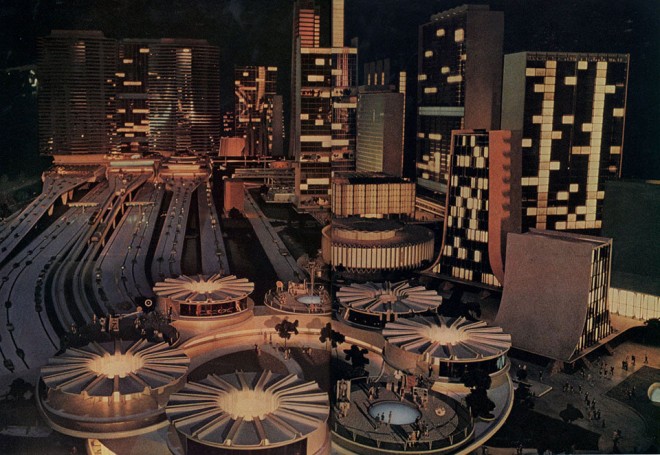
Once upon a time, wide, limited access highways, and high-rise office and apartment blocks, perhaps with parking on the lower levels, were the very model of modern living. The idea started with the General Motors Futurama exhibit at the 1939-1940 New York Worlds Fair.

The notions of better living through private transportation and broadly shared prosperity combined with the Technocratic Imperative in Building that Better Future, something that was popular in those late-Depression days.

Those look like Chicago's notorious outside ramps in the middle of that expressway. They work well on a model with spacing-controlled slot cars. Less so in practice, particularly if the Hubbards Cave area is full of trucks.
The buildings anticipate the Jetsons, in which the orderly traffic in the cartoon flows in three dimensions. If you're the only person with a flying car, you're above it all, but mass-produce them ...

These days, however, people are conversant enough with the Law of Peak Hour Expressway Congestion to understand that running a Futurama-width road through a city doesn't deliver the benefits. It's Soviet-style queuing, with the concomitant frustration, and the aesthetics don't look so good.

Futurama's builders, at least, put in lots of futuristic high rises (Trump Towers, anyone?) in vacant spaces. Here, a wider road is drawn in through the existing road corridor, with the existing collection of vacant lots, a parking deck, and Birmingham's current buildings treated as givens. "In Alabama, the highway department is proceeding with the plan to expand I-20/59, even though business groups have come out against it and a nonprofit has filed a lawsuit against it." The rent-seekers must have their rents, whether the public interest is protected or not.

Life illustration retrieved from Chad Rossouw's Art the Art.
The notions of better living through private transportation and broadly shared prosperity combined with the Technocratic Imperative in Building that Better Future, something that was popular in those late-Depression days.
[Display designer Norman] Bel Geddes vision of the future was exclusive and evasive, there were no slums, the poor were not represented, the miniature scale made little provision for human relations and the rural villages were centralized around a church. (Marchand 1992:40). In Bel Geddes script for the audio accompanying the ride explicitly states that “whenever possible the rights of way of the express city thoroughfares have been so routed as to displace outmoded business sections and undesirable slum areas” (Cogdell 200:230). In a contemporaneous review by Stuart Chase he found Futurama to be a “civilization which had been cleaned, garnished, and ordered. Waste, clutter and ugliness were out of it.”(Cogdell 200:230)Yeah, that turned out so well, but General Motors were able to push the same rent-seeking vision at the 1964-1965 Worlds Fair, which closed a month after the Watts riots suggested social engineering the undesirable slum areas away did not have the consent of the people so cleared.

Unattributed image retrieved from the O Gauge Railroading Forum.
Those look like Chicago's notorious outside ramps in the middle of that expressway. They work well on a model with spacing-controlled slot cars. Less so in practice, particularly if the Hubbards Cave area is full of trucks.
The buildings anticipate the Jetsons, in which the orderly traffic in the cartoon flows in three dimensions. If you're the only person with a flying car, you're above it all, but mass-produce them ...

Illustration retrieved from Slashgear.
These days, however, people are conversant enough with the Law of Peak Hour Expressway Congestion to understand that running a Futurama-width road through a city doesn't deliver the benefits. It's Soviet-style queuing, with the concomitant frustration, and the aesthetics don't look so good.

Alabama Department of Transportation rendering retrieved from City Lab.
Futurama's builders, at least, put in lots of futuristic high rises (Trump Towers, anyone?) in vacant spaces. Here, a wider road is drawn in through the existing road corridor, with the existing collection of vacant lots, a parking deck, and Birmingham's current buildings treated as givens. "In Alabama, the highway department is proceeding with the plan to expand I-20/59, even though business groups have come out against it and a nonprofit has filed a lawsuit against it." The rent-seekers must have their rents, whether the public interest is protected or not.
20.5.25
THERE THEY GO AGAIN.
The Democrats, whether they're attempting to deflect attention from the lies that kept Dementia Joe in national politics or not, are nothing if not predictable.

Last year, it was "Yes, without food, healthcare, and safety initiatives, Americans will die or get sick, whether they voted for Trump or not."

Last year, it was "Yes, without food, healthcare, and safety initiatives, Americans will die or get sick, whether they voted for Trump or not."
This year, it's more of the same. "The Republican War Against the Working Poor Continues." Because all that social spending has worked so well at enabling a more broadly shared prosperity. But the populist froth can be so frothy, can't it? "They hate people who need benefits. Those people are a drag on the ability of rich people to not pay taxes." Don't you dare say "stop enabling dysfunction, you'll get less of it!" It's so much easier to keep the punishment cycles going by asserting "Republicans hate you."
And if that fails, "children and minorities hardest hit" might work.
All who participate in Medicaid and SNAP would be at risk, including people with disabilities, seniors, and low-wage workers at jobs without affordable health insurance—but children would be disproportionately hurt: 44% of all American children benefit from Medicaid or SNAP, compared to 23% of adults under age 65."Gotta bring that moocher base back into the fold!
The publication notes that "these budget reconciliation proposals threaten children of all races and ethnicities, but Latino families and others from historically marginalized communities are in particular danger. Two-thirds of the children who participate in Medicaid or SNAP come from communities of color, placing them at heightened risk from proposed cuts."
"A cautionary note about the numbers in this report is important: They significantly understate the number of children who benefit from Medicaid and SNAP," the report adds. "Our estimates are based on the best available national survey data, but survey respondents significantly under-report their participation in Medicaid and SNAP. If administrative data from these benefit programs was available with enough detail to answer the questions posed in this report, our numbers would be both higher and more accurate."
12.8.25
STOP ENABLING DYSFUNCTION, YOU MIGHT GET LESS OF IT.
It's unlikely that any influential Democrat will take advice from Cold Spring Shops.
Last year, it was "Yes, without food, healthcare, and safety initiatives, Americans will die or get sick, whether they voted for Trump or not."They might do well to pay attention to Ruy "Liberal Patriot" Teixeira, who when his coalition of the ascendant failed to ascend checked his premises and rediscovered the median voter. Now, he's noticing that the values regime of the Great Power Saeculum has crumbled, in no small part as a consequence of the academy's denial of coherent beliefs and the experts getting a lot wrong.
This year, it's more of the same. "The Republican War Against the Working Poor Continues." Because all that social spending has worked so well at enabling a more broadly shared prosperity. But the populist froth can be so frothy, can't it? "They hate people who need benefits. Those people are a drag on the ability of rich people to not pay taxes." Don't you dare say "stop enabling dysfunction, you'll get less of it!" It's so much easier to keep the punishment cycles going by asserting "Republicans hate you."
If the social order problem is as serious as these quotes and survey findings suggest—and I think it is—it raises troubling questions about the current state of the Democratic Party. It’s bad enough that favorability toward the party has hit a 35-year low and that 70 percent of voters think the Democratic Party is out of touch with the concerns of most people in the country today. And that swing congressional district voters feel Democrats are “more focused on helping other people than people like me”, don’t respect work, don’t share their values, don’t look out for working people, don’t care about people like them, and don’t have the right priorities. And that working-class voters prefer Republicans to Democrats on representing their values, focusing on the issues they care about, valuing hard work and being patriotic.Sooner or later it dawns on the losing skipper that the loss was not the fault of the wind or of the crew or of the course.
What’s worse is that Democrats don’t recognize that underneath these views is the roiling crisis of the social order and voters’ sense that Democrats are utterly useless at resolving it. Why on earth would voters believe Democrats will restore and rebuild the social order when they have seemed so oblivious to the problem, both in their governing practices and in their norm-shattering cultural radicalism and contempt for common sense? Democrats embody the “social and moral detachment” of educated elites alluded to by Brooks, whereby these elites preside over the deteriorating social order and then blame those affected for lashing out in unapproved ways.
That’s why so much of Democrats’ attempt at “reform” rings so hollow. They’re not even asking the right question—how to rebuild the social order—so naturally their solutions see woefully inadequate. Typically they amount to little more than fervently opposing Trump and promising to be a bit less crazy and bit more populist the next time they’re in control. This is not nearly radical enough for the situation. As Brooks also points out, Republicans and Trump, despite their chronic overreach, are at least in the game. Democrats aren’t even on the field.Whether there is any voice in national politics that can make the case for a values regime some sort of national majority will accept remains an open question. The Trump presidency brought a lot of irregular voters to the polls, but whether they will participate post-Trump is yet to be determined. And the to-ing-and-fro-ing of slim legislative majorities that attempt as much of their fervent base voters' wish lists and erasure of the opposition's fervent base voters' wish list doesn't build confidence in electoral politics. Mr Teixeira has anticipated that. "Things fall apart and Democrats are currently just poking around in the wreckage. Only fearless, open debate that admits of no heretics has a prayer of moving forward."
Naturally, this leads to suspicion in voters’ minds that most Democrats are basically okay with their place in the broken social order, so they just aren’t that motivated to fix it. This suspicion is justified. Democrats’ revealed preference is for the very social order—or lack thereof—that ordinary voters, especially working-class voters, despise. That is why what passes for radicalism in Democratic ranks is advocating more generous—preferably free—social programs, twinned with bracing calls to “fight the oligarchy” and (somehow) bring down the cost of living. The daunting task of rebuilding the social order is simply ignored.
That won’t work going forward, no matter how badly Trump screws up. Sure, Democrats can eke out some narrow electoral wins but the fundamental problem will remain: Democrats aren’t offering voters a social order they want to be a part of. Instead, they are insisting voters must adapt to the currently broken social order and make their way as best they can (with Democrats’ help of course). That is an offer many millions of voters will never accept.
Suggest that the best thing for the national government to do is to govern less, though, is not in the nature of Democrats.
1.5.16
WAS THE VICTORY DIVIDEND A RESOURCE CURSE?
Belmont Club contemplates the Venezuelan collapse, then draws parallels to what's going on in the United States.
"Countries that rely on natural resource exports may tend to neglect education because they see no immediate need for it. Resource-poor economies like Singapore, Taiwan or South Korea, by contrast, spent enormous efforts on education." The more reliant a country on found wealth the more vulnerable it is to the siren song of revolutionary firebrands and apocalyptic ideologies.The broadly shared prosperity of the late 1940s and 1950s that the idiot left did everything possible to mock until it was gone had in common with the resource curse a reliance on found wealth (well, the absence of competing industrial bases that had been bombed, or subject to communist planning) and a neglect on education bordering on anti-intellectualism. Thus, Venezuela.
The resource curse duly gave Venezuela the expected succession of corrupt and incompetent governments. But when the Venezuelans sought relief from the ordinarily corrupt governments in a Marxist named Hugo Chavez, they found it was possible to go from bad to worse. A Marxist government, disastrous in itself, was supercharged by the culture of corruption and the availability of ready money. The joint effect was disaster.
The lights didn't go out in Caracas all at once. The wiring was stolen bit by bit; the turbines had been neglected year by year; the engineers had departed plane by plane until Earth Day came down like a shroud and without apparent end.Closer to home, ominous signs proliferate.
3.8.08
BARRIERS TO MOVEMENT. Last month, I noted, "Higher transportation costs have the same effect as tariffs." The self-styled newspaper of record just figured it out.
Cheap oil, the lubricant of quick, inexpensive transportation links across the world, may not return anytime soon, upsetting the logic of diffuse global supply chains that treat geography as a footnote in the pursuit of lower wages. Rising concern about global warming, the reaction against lost jobs in rich countries, worries about food safety and security, and the collapse of world trade talks in Geneva last week also signal that political and environmental concerns may make the calculus of globalization far more complex.Trade-offs everywhere. On the one hand, more costly transportation means more local production, which the article would have readers believe would restore the "broadly shared prosperity" of the 1950s. On the other hand, more costly transportation means only local consumption, which is a hard constraint on consumers.
[A] study, published in May by the Canadian investment bank CIBC World Markets, calculates that the recent surge in shipping costs is on average the equivalent of a 9 percent tariff on trade. “The cost of moving goods, not the cost of tariffs, is the largest barrier to global trade today,” the report concluded, and as a result “has effectively offset all the trade liberalization efforts of the last three decades.”Higher energy prices are incentives to use less energy, and that is likely to check the ambitions of some of the newly industrialized countries.
It's also likely to redefine "upscale".The spike in shipping costs comes at a moment when concern about the environmental impact of globalization is also growing. Many companies have in recent years shifted production from countries with greater energy efficiency and more rigorous standards on carbon emissions, especially in Europe, to those that are more lax, like China and India.
But if the international community fulfills its pledge to negotiate a successor to the Kyoto Protocol to combat climate change, even China and India would have to reduce the growth of their emissions, and the relative costs of production in countries that use energy inefficiently could grow.
That is, if the knowledge to produce these things hasn't all been pensioned off. Then there's food.What may be coming to an end are price-driven oddities like chicken and fish crossing the ocean from the Western Hemisphere to be filleted and packaged in Asia not to be consumed there, but to be shipped back across the Pacific again. “Because of low costs, people were profligate,” said Nayan Chanda, author of “Bound Together,” a history of globalization.
The industries most likely to be affected by the sharp rise in transportation costs are those producing heavy or bulky goods that are particularly expensive to ship relative to their sale price. Steel is an example. China’s steel exports to the United States are now tumbling by more than 20 percent on a year-over-year basis, their worst performance in a decade, while American steel production has been rising after years of decline. Motors and machinery of all types, car parts, industrial presses, refrigerators, television sets and other home appliances could also be affected.
Next, some relative price movements. If storage is expensive relative to local labor or to transportation, business logistics take a very different form than they do if storage is relatively cheap.Higher shipping rates could eventually transform some items now found in the typical middle-class pantry into luxuries and further promote the so-called local food movement popular in many American and European cities.
“This is not just about steel, but also maple syrup and avocados and blueberries at the grocery store,” shipped from places like Chile and South Africa, said Jeff Rubin, chief economist at CIBC World Markets and co-author of its recent study on transport costs and globalization. “Avocado salad in Minneapolis in January is just not going to work in this new world, because flying it in is going to make it cost as much as a rib eye.”
Ultimately, the results will leave everybody poorer.In addition, the sharp increase in transportation costs has implications for the “just-in-time” system pioneered in Japan and later adopted the world over. It is a highly profitable business strategy aimed at reducing warehousing and inventory costs by arranging for raw materials and other supplies to arrive only when needed, and not before.
Jeffrey E. Garten, the author of “World View: Global Strategies for the New Economy” and a former dean of the Yale School of Management, said that companies “cannot take a risk that the just-in-time system won’t function, because the whole global trading system is based on that notion.” As a result, he said, “they are going to have to have redundancies in the supply chain, like more warehousing and multiple sources of supply and even production.”
“Despite everything, the American economy is still the biggest Rottweiler on the block,” said Jagdish N. Bhagwati, the author of “In Defense of Globalization” and a professor of economics at Columbia. “But if it’s expensive to get products from there to here, it’s also expensive to get them from here to there.”We make economics majors sweat out isoquant maps and reciprocity conditions of dual cost functions precisely so that they understand how inescapable Professor Bhagwati's logic is.
6.7.15
THE ULTIMATE FIRST-WORLD PROBLEM.
Froma Harrop discovers she has to share the tourist hot-spots of the Old World with other people.
It started years ago, when the state parks began fitting campgrounds with electrical outlets. People would bring their self-propelled campers into the parks, plug in, and -- watch television.
But when the national parks could only be reached by wagon and team from trackside, that was too elitist.
On a recent June day, about 24,999 other tourists and I squeezed into the Vatican’s Sistine Chapel. Seeing the Vatican and its museums is one of the most visually magnificent experiences on Earth.And it's available to more Earthers now than it was in the days of Louis XIV, or even of King George VI.
Hypertourism has degraded sightseeing’s five-star experiences. As the word suggests, hypertourism refers to the crush of transients into places built for more intimate encounters. Although the long lines and chaos surrounding such venues as the Louvre Museum in Paris and the Duomo in Florence are legendary, hypertourism is growing everywhere there’s a bucket-list site, including in America’s national parks.Sometimes, though, there are excellent alternatives to the traditional must-see places. And somewhere, Thomas Malthus is watching.
The factors fueling the phenomenon are obvious. Not only are more people inhabiting the planet, but many more of them have the wherewithal to travel. Add to that cheaper airfares and easy online booking.And even that doesn't guarantee solitude, now that armchair tourists can fly photo-drones over areas that are hard to walk to, or sneak an all-terrain scooter into the forest.
Hypertourism can endanger the sights themselves. The famous ruins at Peru’s Machu Picchu are under assault by the more than 2,500 visitors a day. The sacred Inca city doesn’t have the facilities to handle all that human waste.
At the Vatican, the crowdsbreathing out carbon dioxide and emitting body heat are so tough that they are threatening the glorious Renaissance frescoes that drew them in the first place. Vatican officials are trying to limit the damage through climate-control systems, but also by reducing the number of people coming through. The latter is a painful step for a holy place reaching out to all humanity.
In this country, anyone who visits Bear Lake in Rocky Mountain National Park on a warm day knows that our national parks are not immune to the discomforts of hypertourism. The national parks have a lot of space, but they also are supposed to provide wilderness experiences. It can be hard to find solitude in a park that last year saw 3.4 million visitors – unless you’re prepared to hike far from the beaten track.
It started years ago, when the state parks began fitting campgrounds with electrical outlets. People would bring their self-propelled campers into the parks, plug in, and -- watch television.
But when the national parks could only be reached by wagon and team from trackside, that was too elitist.
No one visits New York City for a wilderness experience – “wild” is another matter – but even in the land of hustle-bustle, the crowds are getting oppressive. Huge jets from every continent are now disgorging millions of summer tourists. Pedestrians have to walk into Fifth Avenue traffic to get around the throngs taking selfies and preparing Facebook posts in front of Tiffany’s flagship store.It's a different kind of broadly shared prosperity these days.
The gorgeous Grand Central Terminal has rightly become a must-see on the New York tour, but it’s still a train station. Commuters now struggle to get around tourists commandeering staircases for group photos.
17.1.15
THE DOWNSIDE OF BROADLY SHARED PROSPERITY?
I'm deliberately using an expression popular on the left to note a new outburst of sectarianism on the left.
The conclusion that the world's dominant economic model—a globalized form of neoliberal capitalism, largely based on international trade and fueled by extracting and consuming natural resources—is the driving force behind planetary destruction will not come as a shock, but the model's detailed description of how this has worked since the middle of the 20th century makes a more substantial case than many previous attempts.Some days its tough to be trendy and radical. The 1950s went from an era of Babbitry (the immediate perception) to an era of less inequality and union contracts generating middle class incomes (a more recent perception) to capitalism sowing the greenhouse gases of the planet's destruction. And globalization -- the Perpetually Aggrieved are troubled more by the losses of purchasing power in the Rust Belt than they are by the emergence of two or three United States's worth of middle classes elsewhere -- is now a contribution to that destruction.
A worrying trend, notes the paper, is how a growing global middle class—exemplified by those in the BRICS nations of Brazil, Russia, India, China, and South Africa—is an increasing threat to the planet as the consumer mindset established in the OECD nations, particularly the U.S., spreads.Reason's Ronald Bailey proposes that people contemplate a trade-off. "Is the energy and climate debate really an argument about morality, pitting those whose standard is a flourishing humanity against those whose standard is a burgeoning natural world?" Perhaps, or perhaps it's the Perpetually Aggrieved, making yet another "see that big house, see all those little houses" assertion.
Before the Industrial Revolution, human societies were mainly powered by human muscles. The average person burns 2,000 calories per day. A gallon of gasoline contains 31,000 calories, the amount energy a human body burns in 15 days. The machines that Americans use every day to power their homes, commute, work, and play, consume about 186,000 calories per person—the equivalent of 93 human servants consuming 2,000 calories daily.Here's one calculation (I have not reviewed the model or studied the footnotes) of the effects of continued fossil energy use in the presence of anthropogenic warming.
Without climate change, people in 2100 would supposedly be 10 times richer. It is really more just for people today with global average per capita incomes of $10,000 to sacrifice so that people living in 2100 will have average incomes of $100,000 instead of only $80,000?Or for people, worldwide, to go cold turkey on fossil fuels, and return to those thrilling days of yesteryear, when knighthood was in flower and life, even for the titled nobility, was solitary, poor, nasty, brutish, and short?
Subscribe to:
Posts (Atom)