GETTING THE OBJECTIVES RIGHT. Megan McArdle is taking requests, including
"Why does [passenger] rail suck?" Some of her post focuses on the government's schizophrenic role in funding on the one hand and doing environmental protection on the other hand, and there is a
followup on the peculiarities of fully allocated cost accounting as well as a
response to
Chris Lawrence weighing the costs and benefits of a less
dirigiste structure for government. Vermont Tiger's Geoffrey Norman offers a
less cheerful view of public servants.
When the Chris Dodds of the world are running the railroads, they'll get sleepers and eat off good china in the dining car.
The rest of us will be packed into boxcars and eating stale bread.
That's not far from the perception many Midwesterners have of
Acela Expresses for Boswash and standing-room-only three car Horizon rakes in Illinois and Indiana.
But it's a response to the lead-in to Chris Lawrence's post inviting me to weigh in that I'll work on here. Consider the
example Ms McArdle uses to introduce the procedural thicket.
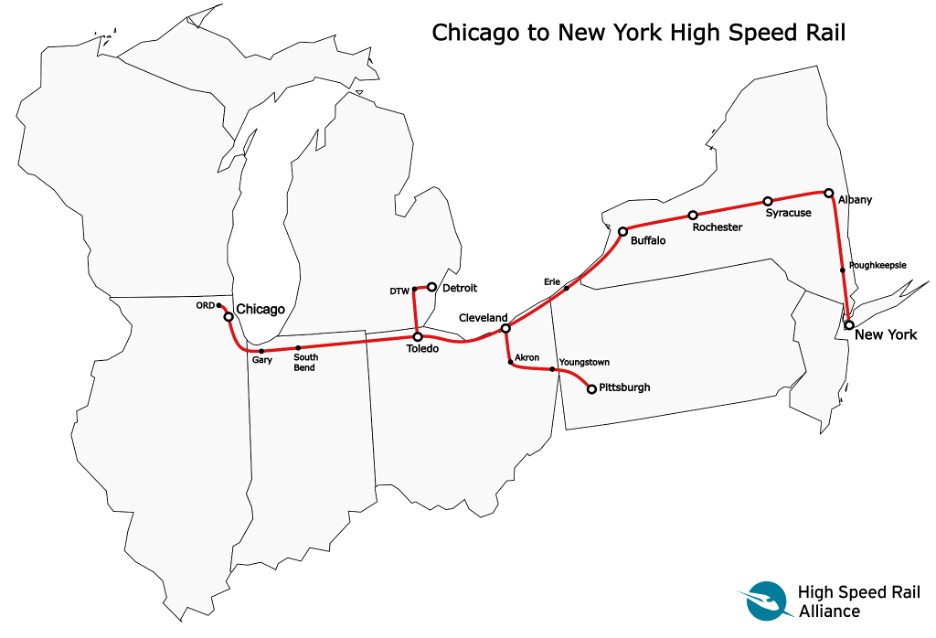
Why isn't there a high speed train from New York to Chicago? Well, first of all, this would greatly anger legislators from New York and Michigan, who like the fact that the Chicago train must pass through Buffalo and Detroit, even if this assures that almost no one with a job will actually use it.
She rules out partial privatization of Amtrak.
Amtrak can't be even partially privatised, because then who would run trains from New York through Buffalo and Detroit to Chicago in a speedy eighteen hours?
Here's why the objective of the rail system matters. At one time, The Pennsylvania Railroad and the New York Central reached New York from Chicago in
sixteen hours (for one brief shining moment, in 15:30) with steam power. (The Pennsylvania had the more direct route, but east of Pittsburgh comes The Mountain, while New York Central used Lake Erie and the Mohawk and Hudson Rivers to run a longer distance at a faster speed.)
Going the great way around struck some railroad promoters as silly, particularly because that New York Central train headed west by way of Albany, which left the passenger at a greater air distance from Chicago than he or she was at Grand Central Terminal.
Thus, the figure of merit for a genuine high-speed train service linking Chicago and New York begins at
ten hours.

If your objective is to provide a high-speed rail line that permits ten-hour timings, your railroad will be an undertaking of
Biblical proportions.
Ev'ry valley shall be exalted, every hill made low, the crooked straight, and the rough places plain.

On the other hand, that's only a 90 mph railroad. Upgrade it for field-shunted Electroliners and you're in New York about 7 1/2 hours after you've left Chicago, and if you give it the fourth-generation Electroliner treatment and you can have your coffee in New York and meet a client for lunch in Chicago. On the other hand, you've laid out a railroad that misses the intervening cities, precisely the problem that would prevent politicians in those cities from committing public monies to be treated as a third-rail equivalent of flyover country.
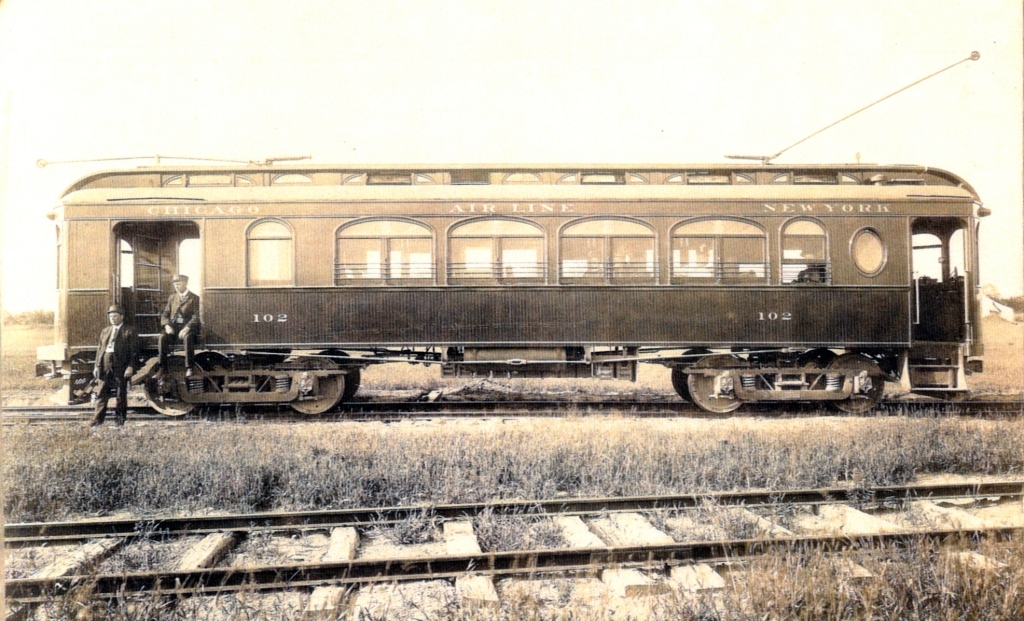
(A historical note before I get back to the objectives: there really was an attempt to build the Chicago-New York Electric Air Line, which rather cheekily advertised its initial service between Gary and La Porte, Indiana. The aforementioned Mary MacLane has assembled a comprehensive Air Line website, including a page of contemporary images of its ruins. La Porte County in Indiana is home to two historical associations that include Air Line material on their websites.)
The problem of blending long-distance and short-haul corridor services has long challenged railroads. Those sixteen-hour flyers tended to be overnight sleeping car trains that called at Pittsburgh or Buffalo at times used by the military to begin invasions, and New York Central's Twentieth Century Limited, perhaps the most famous of the flyers, rolled through Cleveland without stopping. In the year or so leading up to the Penn Central merger, New York Central conducted a speed test with a jet-assisted rail diesel car, announced its plans to restructure its passenger train service, discontinued the Twentieth Century Limited, and introduced a memory-pattern service between Buffalo and Grand Central Terminal. No other corridors were set up at that time. The Pennsylvania Railroad discontinued the Broadway Limited and renamed the General as the Broadway Limited. After the merger, the resulting railroad was too overwhelmed with other problems to be able to set up promising corridors such as Pittsburgh-Cleveland-Detroit, Pittsburgh-Columbus-Indianapolis-St. Louis, Cincinnati-Indianapolis-Chicago, or Cleveland-Columbus-Cincinnati. A Trains speed survey of the era noted that those cities would have merited Trans-Europ Express service, the precursor to the TGV and ICE and Eurostar and Great North Eastern. Even with the skimpy offerings, the Penn Central timetables offered more frequent New-York Chicago services over more routes (via Pittsburgh on The Pennsylvania Railroad, via St. Thomas and Detroit west of Buffalo on the Michigan Central, and via Cleveland and Toledo on the Lake Shore and Michigan Southern). The grubby day trains that remained in Ohio and Indiana all died before Amtrak, although the memory pattern service east of Buffalo persists under the same Empire Service label.
And thus the problem facing people who wish to expand Amtrak. That north central corridor service in the region west of Pittsburgh and Buffalo and east of St. Louis and Chicago would be a very different service from one predicated on longer distance high-speed service, such as Denver-Chicago (doable dawn to dusk with existing technology) or Chicago-New York. But perhaps people who wish to expand the passenger rail network as a way of coping with (permanently?) higher gasoline prices would do well to study old timetables. Thanks to that Vermont Tiger post, we discover editorialists at The Brattleboro Reformer doing just that.
It's 1938 and you want to take a weekday trip from Brattleboro to New York City. A glance at the Boston and Maine Railroad's turntable shows six trains to choose from.
The Washingtonian, the top overnight train run jointly by the Central Vermont, Boston and Maine, New Haven and Pennsylvania railroads between Montreal and Washington, D.C., leaves Brattleboro at 3:30 a.m. and arrives at Penn Station at 8:12 a.m.
If you're not that much of an early riser, Train 74, the Connecticut Yankee, leaves Brattleboro at 4:35 a.m. and gets you to Grand Central Terminal by 9:45 a.m. -- the quickest train to the city. Or you could catch Train 78, which leaves Brattleboro at 5:52 a.m. and arrives at Grand Central at 11:40 a.m.
If you're sleeping in ...
They conclude,"
There is no reason for rail service to be worse today than it was in 1938." That was a very good year. The Milwaukee Road introduced the world's fastest steam locomotives. But perhaps there are good reasons for the rail service to change (somehow the Boston and Maine enlarging Hoosac Tunnel for double-stacks, which hadn't yet been invented, strikes me as an improvement in rail service.) All the same, the renewed focus on passenger rail is reason for advocates and policy makers to review the best practices, and the errors, of the late steam era.