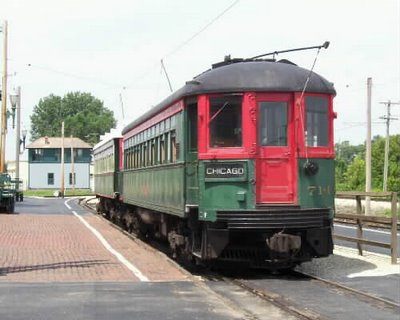
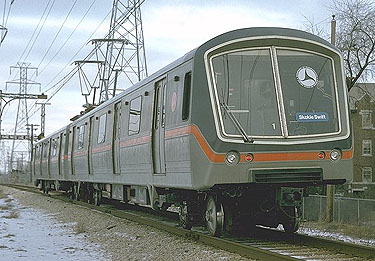
Showing posts sorted by relevance for query electroliner. Sort by date Show all posts

20.8.20

LET'S GO FOR A TRAIN RIDE.

Glen Brewer had opportunity to observe the Chicago Aurora and Elgin and the North Shore Line in the declining years of the interurban era.  Some of the rolling stock, and, on occasion, the ride and the feel, of those cars, is still available at the Illinois Railway Museum.  In particular, the Electroliner is back in running condition, although the plush seats are incompatible with quarantine restrictions, and it might be a while before passengers can again board.
At the North Shore’s small main station on the Loop elevated at Adams and Wabash, I caught the 8:00 am, bright salmon and turquoise stripped Electroliner for Milwaukee. We traveled over the sooty Loop structure with its contrasting bright silver rails around some pretty tight curves, then on to the straight, fast, ground level Skokie Valley line, one of Insull’s costly improvements.
At the Milwaukee end, he revised his travel plans.
The trip was swift and uneventful, but on it I noted that the ideal place for a railfan like me was the first seat on the first car – just to the left of the motorman’s tiny compartment.

In Milwaukee I had one hour to wait for the return of the same Electroliner. My original plan had been to wait for two hours over lunch in order to take a conventional train back. But now I was determined to stake out that perfect seat.

The first few miles out of the Milwaukee terminal were street running complete with traffic lights. I was surprised that the Electroliner had a foot-operated bell, just like many slow, conventional trolleys I have seen.

Then we entered private right-of-way, and the speed began to rise.
Yup, that sounds about right.
I kept my seat for quite awhile fascinated by the speed and the view. A little boy joined me, his father remaining in the seat behind. The boy sat transfixed, staring into the window, as I snapped the camera shutter, hand rolled the film ahead and lined up the next subject — always in a hurry to be ready when the next opportunity presented itself. I photographed the other Electroliner and conventional trains we met, but it was past lunchtime, and I was anxious to sample the famous Electroburger in the Tavern/Lounge.
I hope the 'burger was good. Apparently the induction stoves in the tavern are not up to code; thus, although the restored 'Liner will have a stove, it will not be operable.
I have often wondered if that young interurban enthusiast remembers to this day that blazingly fast ride and the privileged view we enjoyed together. I wonder if the experience changed him for life; I know I’ll never forget my only ride on the Electroliner.
I cannot claim to have been THAT young interurban enthusiast. I can claim to have been in that situation.


Find yourself a preservation railroad, and support it.  They're operating again, if under safe distancing and limited capacity restrictions.

14.7.26

DOES ANYBODY KNOW WHAT TIME IT IS?

Fittingly, a troupe that debuted as Chicago Transit Authority (the eponymous agency brought legal action to get that name changed) asked that question.  For years, the South Shore Line, properly the Chicago South Shore and South Bend, issued all-year-around printed timetables, advising that all published times shown were those in effect in Chicago.  When both Indiana and Illinois were on Standard Time, the South Bend passenger had to mentally add an hour; for that part of the year when Illinois and the Indiana Region observed Central Daylight Time, the South Bend passenger might not have had to make any changes, as Indiana was far enough west in the Eastern Time Zone for those counties on Eastern Standard Time to stay on Eastern Standard Time.  Those changes might not have inconvenienced too many passengers on the east end of the railroad, as, well into the 1960s, the railroad offered a memory pattern schedule with hourly South Bend Limiteds, with Gary Expresses on the half hour.  Conditional and positive stops for the morning Limiteds sufficed to serve any passengers from LaLumiere or Hudson Lake or New Carlisle for Bendix or downtown South Bend.  These days, the conditional stops are gone, although with all trains pulling out of Michigan City to form South Bend departures, there are morning departures for any local passengers so inclined.

Conditions were more complicated on the North Shore Line, the much-lamented and more than a little bit missed Chicago North Shore and Milwaukee.  Yes, the railroad operated entirely in the Central Time Zone.  After the War, though, Illinois observed Daylight Saving Time whilst Wisconsin did not.  So much for agricultural interests favoring Daylight Saving Time.  The cock crows at sunup, irrespective of what's on the clock, and farm kids know about morning chores before they head off to school.  Thus, when Wisconsin did adopt Daylight Saving Time, that ended on the final Sunday in September, whilst Illinois stayed with it until the final Sunday in October.

8.7.13

RECALLING THE NORTH SHORE LINE.

The last runs of the North Shore Line occurred in January of 1963.  Local preservation railroads offered their commemorations under more favorable weather conditions.

A former museum group operating out of East Troy, Wisconsin, once had a fleet of operable North Shore steel cars.  The current operating group recently acquired 761 from a museum in Michigan.  It's not ready to operate, however, it was rolled out for inspection on 22 June.  Preservation railroads are a good place to come to grips with allocating scarce resources among competing uses, a particular challenge with rolling stock often pushing the hundredth birthday and Fordist era technology.


Corrosion at the anti-climber is common on North Shore cars, which dealt with Milwaukee road salt each winter, and a weekly exterior washup with muriatic acid.  The car was converted to a Silverliner, although the decorative skirting has been stripped away, correct for the Greenliner colors.

The largest collection of North Shore stock is at the Illinois Railway Museum.  This past weekend featured their Trolley Pageant on Saturday and a North Shore commemoration on Sunday.

At the conclusion of the trolley pageant, it's total recall, with a five car Milwaukee Limited sharing a high level Chicago Transit Authority platform with an Electroliner.


The next day, to handle additional large crowds, the Silverliners ran as a Milwaukee Limited in its common north-of-Edison Court formation of two cars, while the green cars ran as a Waukegan Local via the Shore Line Route.

The interurbans made a side trip from the main line into the L station to allow patrons a look at the Electroliner, which still requires extensive electrical, mechanical, and interior work.  Scarce resources and competing uses, again.


Museum volunteers were giving talks about the North Shore Line and the Electroliner in one coach section, and the tavern-lounge, both of which had chilled air piped in.  An air-conditioned train with malfunctioning air conditioning is no place to be on a hot day, and the weekend's heat identified another competing use, the air conditioning in parlor-observation Juno on the Nebraska Zephyr, which was also running that weekend.


A few North Shore cars that don't ordinarily operate were in use.  The Milwaukee Limited used combination car 251 and coach 757, once operated at East Troy.  Inside 251's baggage compartment, those trunks are overflow seating capacity as well as props.


The car was badly damaged in a grade-crossing wreck in Wisconsin and rebuilt as a Silverliner (one of only three with the upper window sash, the other two being converted diner 409, also damaged in a derailment, and tavern-lounge 415, the spare diner used when an Electroliner was in the shop).  Inside, the seating sections of 251 and the 757 in background reflect the lowered ceilings of the Skokie Valley and Silverliner modernizations.


On the Waukegan Local, one of the more recently restored steel coaches, 749, was operating.  The usual North Shore Line local is the 160-714 when the schedule calls for a North Shore train.  The 749 was never rebuilt as a Silverliner, although it has the lowered ceiling of the Skokie Valley modernization program.


Excellent workmanship.

The Electroliner looks pretty good on the outside, during a quiet moment.


Some North Shore Line veterans are present for the occasion.


There's more North Shore Line preservation from the past fifty years to report on, probably before the fall semester begins.

22.1.23

LEARNING THE TRAGIC VISION YOUNG.

Ferroequinologists developed the locution, "E-T-T-S," to note the depressingly common phenomenon of something good in railroading going away.  To outsiders, what the enthusiasts lamented might have been karma after a century of the railroads acting like the worst sort of rent-seekers, or it might have been a simple lack of enlightenment.  After the War, the promise of Route 66 or the perpetual fun side of high school the Beach Boys were singing about made lamentations about trains being discontinued or streetcars replaced by buses so last year, to use a locution not yet in common parlance.  And, from sixty years ago, the congestion to come on the expressways was something to be fixed by smart roads, and the possibility that all that public money spent on building the road network would ineluctably lead to additional public money being spent on a "wonderful transition" to something not a public road network, and sold under the rubric of building back better would likely have been laughed off as delusions.

19.1.13

FIFTY YEARS AGO.

The last passenger trains on The North Shore Line tied up early on the morning of January 21, which was also a Monday that year, and that weekend featured some extremely cold weather.

We see the North Shore Line in action in the latter part of the 1950s.  Most of the railroad was double track, but there was never money to double the bridge over The Milwaukee Road at Sixth and Morgan.  There are southbound and northbound trolley wires.


That's the Town of Lake water tower in the distance.  It still decorates the grounds of a Milwaukee water treatment plant.  The North Shore Line initially built pile trestles between Austin Avenue and Harrison Avenue in Milwaukee, later filling them in.  That's why much of the embankment along the east side of Sixth Street is still in place.  It's just not cost-effective to reclaim the fill for use elsewhere, for example in futilely widening the interstates to make the traffic jams go away.

Past the Town of Lake, the railroad cut through a ridge.


An Electroliner ducks under Norwich Street.  There was a local car stop here once.


These Silverliners are passing under Wisconsin Electric's Lakeside Belt Line.  On maps of the era, this railroad was still The Milwaukee Electric Railway and Transit Company, and loads of coal were still being received from The Milwaukee Road at Powerton, five blocks to the west.  The spur track in the foreground might have been useful for recessing a line car or other work equipment, but it had no obvious industrial purpose.


An Electroliner at Ryan Road, early in 1959, with snow on the ground.


Racine, as viewed from an Electroliner, 28 September 1957.


The same place, in September 1958, with a northbound conventional train arriving.


Kenosha, 29 September 1957.  This must have been an outing.  The next northbound train will be an Electroliner.


The Electroliners generally met somewhere between North Chicago Junction and Waukegan Edison Court.


Illinois Railway Museum, August 2006.

The North Shore Line quit business at a time when railway preservation efforts were active, and a lot of the rolling stock and more than a little of its tradition survived abandonment.  That will be material for a subsequent post.

6.10.14

AN INVESTMENT WORTH MAKING.

Electroliner repairs might require until 2017 to complete.
The [Illinois Railway Museum's] Electroliner received an external restoration when it returned to Illinois in the 1980s, but problems with the train's eight electric motors prevented the streamliner from returning to operation. Work is now under way to return the luxury streamliner to operable condition within the next three years. In addition to work on the motors, work is needed on the wheels, trucks, air brakes and air conditioning before it can be operated.
Until then, here are a few illustrations of Electroliners in action.


Norwich Street, September 1958.


Ryan Road, early 1959.


Best seat on the train.  Racine, September 1958.

The other Electroliner, in preservation as a Liberty Liner in Pennsylvania, is operable, although it requires electrical work and the museum intends to undertake major body work.

24.1.22

MODERNIZING THE BONNER RAILWAGON.

Some creative types with Space X experience have been thinking about providing retail intermodal by putting containers on battery-powered bogies.  Union Pacific seem to be interested.
The concept under development by Parallel Systems would see intermodal containers carried by pairs of powered battery-electric wheelsets, moving in “platoons” of cars, but capable of splitting off to individual destinations en route. The company went public with its plan this week, saying it has raised $49.55 million for construction of the vehicles, as reported by CNBC, Fast Company, and other media outlets.

“We are interested in the Parallel System’s technology. We are familiar with it, and it is of interest. It’s of keen interest,” Union Pacific CEO Lance Fritz told investors and analysts on the railroad’s earnings call Thursday. “Candidly there are a lot of hurdles in front of that technology for deployment. Having said that, it could potentially be a game-changer if it proves out to be effective and workable. So I’d say keep your eye on it. We’re keeping our eye on it.”
The Parallel Systems proposal also merited interest from Ars Technica and the Institute of Electrical and Electronics Engineers, to a skeptical Instalanche.  The Ars Technica description provides the bridge between historical railroading and the proposed method of moving individual containers.
Parallel Systems isn’t just taking an existing freight train and swapping its diesel-electric locomotive for a battery version. Instead, it’s taking the traction motors and distributing them to every car on the train. It’s how many electric passenger trains operate, but it's a system that has been slow to migrate to the freight world.

Parallel Systems is going a step further, though. Each of its rail vehicles consists of a battery pack, electric motors, four wheels, and a package of sensors that allow it to operate autonomously. And since a large portion of the world’s freight is shipped via 20-foot containers, Parallel Systems is using the containers themselves to complete the car, bridging the gap between the sets of wheels at either end of a train car, also known as bogies.

Here’s how it works: two vehicles position themselves far enough apart to support the container, which is lowered by a crane. The vehicles then use their short- and long-range cameras to navigate the rails. Because each rail vehicle has everything it needs, it doesn’t have to be part of a long train. In theory, one container supported by two Parallel Systems vehicles could move from origin to destination by itself. In reality, though, they’ll likely end up traveling in platoons. (Parallel Systems doesn’t call them trains because the individual cars aren’t coupled.)
The Institute's writeup explains how platooning by these latter-day merchandise despatch cars differs from the drafting behavior of truckers.
In a traditional platoon, efficiency is unequal since the leader takes the brunt of the aerodynamic forces to make things easier on all of the following vehicles, and obviously rotating leaders won’t work on rail. But Parallel Systems’ vehicles can go bumper to bumper and push each other, meaning that overall energy use can be equalized. Neat!
I made that interurban reference for a reason, dear reader.  The North Shore Line's Electroliner had the seating capacity of three heavy interurban cars, but because it was lighter, it had only eight of its ten axles powered.  There are some constraints of traditional motor control circuitry that contributed to providing them in groups of four.  A train of three powered heavy interurban cars had twelve axles powered, and it had a higher balancing speed than the Electroliner.  Why?  The lead car split the wind, and the additional motors on the following two cars had more oomph to overcome the wind resistance compared to the Electroliner.  But adding a fourth car didn't add more speed, as the current draw of four more motors on a trolley wire of fixed capacity worked against them.  The Parallel Systems people are aware of that problem.
“We think our platoon sizes are ideally between ten and 50 cars,” Matt Soule, CEO of Parallel Systems, told Ars. “With ten, you’re sharing the aerodynamic load over multiple cars, and the benefits of that kind of asymptote out around ten cars. But on the business case side, in terms of serving the volumes that might be there, we think moving in platoons of up to 50 is the max.”
"Asymptote out" is that balance speed phenomenon.  But if your platoon is fifty platforms, aren't you really in the realm of a train, as commenters on all the posts have noted.

6.2.04

ULTIMATE TRAINS? Compare and contrast.

The latest in Japanese Shin Kansen bullet trains, 2004, via Transport Blog

The restored North Shore Line Electroliner, built 1940, at the Illinois Railway Museum. (The picture of the streetcar comes bundled with the picture of the Electroliner at this Electroliner page

12.2.13

GET 'EM OFF, GET 'EM ON, GET 'EM OUT OF TOWN.

The Shore Line Interurban Historical Society obtains a transcript of a WBBM Radio retrospective of the North Shore Line, 50 years after it quit running.
Decades before the Obama Administration began talking about speeding up Amtrak, the North Shore was a railroad without speed limits – just occasional restrictions.

“There was something in the air about the North Shore,” said Tom Jervan, who rode its streetcars in Waukegan as a child and later worked for the railroad. “There was a period in the existence of that railroad where it was the super-interurban in the country. It was the fastest. It had the facilities like nobody else had. It did everything in superlatives.”
Let the record show that the railroad coaxed 111 mph out of an Electroliner on a test run.  The smart guys said no electric railroad using trolley poles and simple catenary could do that.  It's all in good maintenance.
Even in its final months, the North Shore operated expresses that hit 80 miles an hour between stations on the main line, the Skokie Valley Route, to Waukegan and on a branch to Libertyville and Mundelein, in addition to the limiteds that ran hourly from 6 a.m. until midnight to and from Milwaukee. The two top-of-the-line Electroliners ran every three hours, back and forth between Chicago and Milwaukee. Much of the line was served by four trains an hour, meticulously cleaned and cared for.

“There was an espirit d’corps,” Jervan said at a reunion of North Shore employees, the most recent of which took place in November. “We kept the darned thing running. Our on-time performance was usually around 95 or 96 percent. In your dreams, Amtrak. In your dreams, Metra.”

At its peak, the North Shore reported 99.26 percent on-time performance, and it did so with equipment that, except for the two 1941-vintage Electroliners, pre-dated the Great Depression.

“Our oldest rolling stock was built in 1915,” Jervan said. “They were all still running, racking up in many cases millions of miles each. The Highwood shop, if you were to look at that shop and compare it with a modern (railroad repair) shop, you’d say, ‘How did anybody get any work done in this prehistoric cave?’”
With the abandonment order subject to judicial review, rolling stock due for scheduled maintenance was disassembled on Friday awaiting part replacement that never came on Monday.
The North Shore used to boast in its advertisements that you could set your watch by its trains. Jervan said snow never stopped the North Shore for long. Neither did bitter cold. And he said its trains moved up and down the line with dispatch. Its trains never sat in stations.

“The dwell time (time stopped) at our stations was negligible,” he said. “The dwell time that Metra has at its stations is a total joke. In this time and age, in the 21st Century, they need to look back at an interurban line that ran with cars built in 1915 on how to run a railroad.”
In defense of Metra and Amtrak, those sailors on liberty weren't schlepping their sea-bags with them, intercity travellers weren't burdened with those roller bags, and commuters didn't have laptops and smart 'phones.  All the same, the North Shore assigned enough collectors (assistant conductors) to be able to load and unload through all the doors.  On the other hand, an Electroliner had seats for 150 passengers or so, about the same carrying capacity as one Metra gallery coach.
The [Skokie Swift] is the only operating remnant of the North Shore, but many of its historic interurban cars still can be found today in museums, including the Illinois Railway Museum, in Union, which has more than a half-dozen operating North Shore cars and one of the Electroliners. The Fox River Trolley Museum, in South Elgin, has two operable North Shore cars and Wisconsin’s East Troy Electric Railway Museum is restoring a North Shore “Limited” car. Other North Shore cars reside in museums as far away as Iowa, Connecticut and Maine.
We'll look at some of those preservation efforts in the near future.

22.4.14

RESURRECTION.

The Central Electric Railfans' Association offer a photo essay on the fiftieth anniversary of the Skokie Swift.  In its first incarnation, ancient Rapid Transit cars ran into empty country, even after the Second World War.


Central Electric Railfans' Association archive photo.

I wonder if that white two-story store building is still there, or if that went for something newer.  Readers? Bueller?

The intermediate Rapid Transit stations remained until the North Shore's abandonment, to be removed before the opening of the Swift.  The above-track headhouse at Asbury remained as a business until sometime in the 1970s.


Central Electric Railfans' Association archive photo.

Both Electroliners are in preservation (one in its Philadelphia incarnation, in Pennsylvania).  Other curved-side articulated cars also ran on the Swift.


Central Electric Railfans' Association archive photo.

I have to do an essay on the Jitterbugs.  All four of them went into preservation, but one was scrapped when a museum encountered financial troubles (this happens) and another is to become a parts source for the Illinois Railway Museum to restore its unit to operation.

These units had nearly the coach seating capacity of an Electroliner.  The fourth section of the Electroliner had the tavern-lounge.  You can't get a Smokie Link on the Skokie Swift.  That's an airfoil on the power collector.  No conductor putting the trolley pole on the wire on the fly the way the North Shore did: the operator hit a button in the cab to lower the collector inbound, or to raise it outbound, and the airfoil helped maintain contact between collector shoe and wire.

A recent Chicago History Today essay on the Swift illustrates that sometimes the remote control didn't work.


J. R. Schmidt photo courtesy Chicago History Today.

That damaged stucco above the southbound track wasn't from the Polar Vortex.  Apparently North Shore collectors would sometimes have troubles getting the pole down, and it would smack into the Asbury station.  The motorman on a Swift car didn't have the positive signal from the conductor (and on longer North Shore trains, the collector [trainman, in North Shore-speak]) and his first clue that the (electrical) collector was still up would be a loud BANG on the roof.  But Transit Authority shop forces could sometimes find repair parts for Swift pantographs and collectors on the ground at Asbury.

21.10.24

STEAMING INTO INDIAN SUMMER.

I'm referring to a series, "Steam in Indian Summer," in Trains nearly seven decades ago.

The first frost arrived in DeKalb about on time, last week, although it was kind of anomaly in the midst of a prolonged late summer warm, dry spell.  (No, I'm not going to wish for rain, you have to be careful what you ask for these days.)

The preservation railways, though, have been wrapping up their summer season, and getting into fall harvest mode.

28.7.14

RAILROAD PRESERVATION NEWS.

Among twelve winners of this year's National Railway Historical Society National Railway Heritage Grants is the Illinois Railway Museum, for repair work on the Electroliner.


That's one in service, at Norwich Street in Milwaukee's Tippecanoe neighborhood.

"The Mysterious Train" is a study of Electroliner images employed by the North Shore Line in visual design and branding.

29.6.17

BEFORE THERE WERE LIGHTS AT WRIGLEY FIELD.

There was a Chicago L, and the various flag hoists adjacent to the scoreboard revealed the standings in the National and American Leagues, plus there were distinctive flags to communicate the outcome of the day's game to straphangers going by.


Yes, if you were riding the Electroliner, you'd likely be seated, perhaps in the bar car.

The straphangers had to make do with more utilitarian accommodation.


A Loyola Express might stop at Addison on its way north.  Back in the day, "VIA L LOOP" meant the train didn't originate or terminate at the old Water Street terminal, the wood cars would not use the subway.

There is a genuine Rapid Transit station, complete with floor-level platforms, on the museum grounds, but the switches at the station throat are hand-thrown, thus the train loads at the East Union station through these gangways.  There is a wheelchair lift available.

Here's where the straphangers would hang out.


That's inside the powered car, 1767, which suffered a fire during service on Chicago Rapid Transit and received upgrades to the lighting and straps.


The old style lighting and straps are in the as-yet-unpowered 1268.  The car cards are mostly replicas of originals, and they provide insights into what was acceptable and what was not back in the day.


The Illinois Railway Museum has not finished filling out its string of vintage L cars.  You don't just buy fittings at Farm and Fleet, but you can use stock lumber.


Yes, that's an Electroliner lead car at left.

There's an additional restored L car, 24, with open end platforms.

21.1.18

THE INSTITUTIONS WE'VE LOST.

The North Shore Line ceased operations early in the morning, 55 years ago.  Here is the fiftieth anniversary abandonment tribute.


That's the way it was, in September 1958.  The railroad had already filed for permission to abandon.


Work continues at the Illinois Railway Museum restoring an Electroliner to operable condition.


Illinois Railway Museum are able to roll out a long North Shore train on occasion.  Single cars are in operation elsewhere in the country.  Perhaps one of these years the Seashore Trolley Museum will be able to re-enact the Substitute Electroliner.  They have the conventional diner-lounge car and a Silverliner coach.

11.8.08

ELECTRO LUXE. Could we speak of the coastal regions of the Scandinavian countries as a North Shore? Destination: Freedom has a report on a new electric car.
Research and development of the “Green Train” started in 2005 and is expected to continue until 2010/2011. Using the Bombardier Regina train for the demonstration, Bombardier and partners are developing a new generation of high-speed trains that meet the special technical and traffic requirements in the Nordic Countries. It is also part of Bombaradier’s ECO4 technology work to develop energy efficient trains.
The article reports the train set a Swedish speed record of 295 km/h, presumably with the field tap equipment working.


There's something compelling about the design. My first reaction was that the Electroliner design is classic.


Electroliner, September 1, 2007.

The design also evokes the Department of Transportation's State of the Art rapid transit car.


Photograph courtesy Chicago L from the Joe Testagrose collection.

8.10.07

RELIABILITY MORE IMPORTANT THAN RAPIDITY. The standards for high speed trains have been set higher.
“The global rail industry now defines ‘high speed’ as starting at 150 mph,” [Texas Rail Advocates' Paul Mangelsdorf] said. “The newest TGV line in France has a cruising speed of 198 mph. Britain is considered a laggard in the high-speed rail movement.”
That may be, but the British trains clip along at those laggardly speeds on infrastructure dating to Isambard Kingdom Brunel and George Hudson. Electroliner envy is fun, but is it necessary?

In Britain, Mangelsdorf noted, the national government owns and maintains the track and signal network, but train operation is conducted by private businesses that compete for long-term rights to use the track based on their service levels and the amount of their revenues they are willing to return to the government. Virgin Rail, owned by Virgin Group owner Richard Branson, holds the London-Coventry franchise along with several other routes.

“Many of Virgin’s trains bring passengers from the English Midlands or Scotland to Gatwick or Heathrow airports for easy transfer to international flights,” Mangelsdorf said. “Service is fast, frequent and increasingly popular. When service began the Virgin trains had a 30% share of the domestic market and air carriers had a 60% share. Now these percentages have flipped. The only steady number is 10% for automobiles.”

Mangelsdorf said that in Manchester the air carriers actually are “delighted that Virgin trains are taking business away.”

“The airlines urgently need more gates for international flights at Manchester Airport-- that’s where the profits are,” he said. “When domestic passengers switch to rail, that leaves more gate capacity for wide-body planes that make money.”

The same phenomenon has surfaced in the U.S., where Amtrak’s high-speed Northeast Corridor now carries the bulk of shuttle traffic between New York and Washington, Mangelsdorf said.

By all means, let's introduce public funding for corridor trains as an alternative to continued corporate welfare so that the operators of flying puddle-jumpers cannot so easily make common cause with large corporations and aviation hobbyists to raid the public purse. But let's not get too carried away with the Electroliner envy. The Metroliner began to divert passengers from The Wings of Man back in Penn Central days when the Electras and Constellations came out on busy days. That on Reconstruction Finance Corporation infrastructure good for maybe 110 mph in some stretches in New Jersey and Delaware. The Hiawatha has the potential to make Glenview a suburb of Milwaukee for State Line residents who'd like a chocolate chip on the way to Las Vegas. Sure, there's a time value in faster trains, but there's a lot of potential for making more expeditious use of the existing infrastructure. Take Texas. Please.

“And the same thing could be happening between Dallas-Fort Worth and Houston and Dallas-Fort Worth and San Antonio if we had the right tracks and signals,” [Mangelsdorf] said. “Texas isn’t the frontier anymore. It’s one of the nation’s most densely populated and busy collections of intercity corridors. The Texas economy would grow faster and in a healthier way if people weren’t forced to choose between flying and driving in the Texas Triangle.”

The most appealing thing about the Texas Triangle, Mangelsdorf says, is that it’s essentially compact and densely populated.

Its demographics, city pair locations, and topography are very similar that of France. The French TGV high speed trains have made travel very easy and pleasant.

“We could connect the seven biggest cities in the state with only seven hundred miles of track,” he says. “You could travel from the DFW Metroplex to Houston or Austin in two hours, talking on your cell phone or using other electronics the whole way with minimal security inconveniences. In addition to the big-city-end points, the trains would serve intermediate stops such as Waco and Bryan/College Station, something that planes can’t do. You could get to Oklahoma City in about an hour and ten minutes.”

That's seven hundred miles of new track? I submit that more cost-effective methods exist.

By contrast, Mangelsdorf says, current transportation infrastructure proposals such as the Trans Texas Corridor represent retrogression to 1950s thinking.

“The TTC backers are doing a great job of helping Texas get ready for the 20th century,” he says. “However, we should be more forward thinking as many Asian countries have done when it comes to transportation improvements.”

There are economies of scope in combining intermodal trains with passenger trains on the same track, and a good dispatcher ought to be able to keep a two- or three-track line fluid. A debate between the dedicated high-speed passenger line advocates and the advocates of less costly combined freight-passenger-toll truckway projects brings with it the risk that no rail improvements will be forthcoming. That leaves Texas with the impossibly slow Heartland Flyer and Eagle and the try-weakly Sunset Limited, all of which made better times with handfired Harriman Standard 4-6-2s and their counterparts.

3.4.07

JUICED. If you want to go fast on rails, go electric. The French have set a new rail speed record (via Best of the Web) with a specially equipped TGV train.


(AP Photo from the Indianapolis Star.)

You don't just switch a random consist out of the coach yard and turn it loose. There's this little thing called back electromotive force to overcome, which more voltage will do.
For its mission to break the speed record, the train was modified with a 25,000-horsepower engine, and adjustments also were made to the track, notably the banking on turns. The rails were treated so the wheels could make perfect contact, and electrical power in the overhead cable was increased from 25,000 volts to 31,000 volts.

The V150 was equipped with larger wheels than the normal French TGV - or "train a grande vitesse" - to cover more ground with each rotation, said Alain Cuccaroni, in charge of the technical aspects of testing. French TGVs normally cruise at about 185 mph.
I wonder if somebody in France learned about the field shunt tests (another way of overcoming that back electromotive force) with the Electroliner in which a train got up to 111 mph on jointed rail at nominal line voltage collected through a trolley pole. After the test, master mechanic Henry Cordell (what's French for who vas th' motorman?) had the field shunts disconnected: the train was too fast for the road crossing protection, and the relatively small wheels were turning too fast in Mr Cordell's judgement. (The bigger wheels squeeze more velocity out of the same motors: there is this phenomenon called "balance speed" at which additional power is exactly offset by additional back electromotive force and the motors spin no faster, but if the motors are spinning bigger wheels, the train goes faster, provided the added rotating mass isn't a burden.)

Despite improvements in train technology, some things don't change.
Outside, the train roared by like a jet, sparks spit from the overhead power lines and a trail of dust sprayed out behind.
On the Chicagoland interurbans, that's often a trail of snow. But I like this Electroliner image from a book I just received, Chicago North Shore & Milwaukee: Point of No Return (not enough text for a book review.) Also check out Streetcars and Electroburgers by the same author.


The book also mentions the late Lew Burdette. It's a sobering thought, Cub fans, that two different Milwaukee teams have lost the World Series since the Cubs last played in one. Look closely at the picture: those are the National League and American League standings on the flag hoists. None of this divisional stuff: one league, one pennant race, one World Series, and North Shore Line liberty specials to Great Lakes. Back to the speed record ...

It's still obligatory to have the fourth estate chasing trains with aircraft.
Then, near the village of Le Chemin, we hit the record of 357.2 mph. The train was speeding far faster than a passenger jet taking off. In fact, we kept up with planes flying overhead taking photos.
That used to be easier.


The context for the picture appears in an essay about the Cincinnati and Lake Erie interurban line that was part of the 2001 Interurban Symposium.

It is time to hoist a Sprecher Doppel Bock in tribute to the French speed record, and to Middle America's traction pioneers who started the tradition of fast running, electrically.

26.8.06

PROJECTS. On a recent visit to the Illinois Railway Museum, I had reason to think about the upcoming model-building season. (Classes are back in session, it's getting dark before 8 pm, and we're supposed to be free of the heat and humidity eventually.)

In the back of a bus barn is a Pullman-built trackless trolley, Milwaukee & Suburban's 350, in somewhat rough shape.


A Wisconsin transit enthusiast commissioned a series of models from the St. Petersburg Tram Collection, including the 350 in 7 mm = 1 foot.


There may be a way of engineering a drive system for this, although it was not built with a removable floor. Perhaps a magnet underneath it and a moving magnet underneath a diorama?

Under roof and receiving some attention is the experimental aluminum Chicago streetcar 4001.


Chicagoland Hobby had a series of these built by St. Petersburg in O Scale. The model has a removable floor, and powering it is a possibility. As with the museum, the issue will be budgeting time and money to work on it.


In another barn, Milwaukee Electric parlor car Menominee, which has received a cosmetic restoration.


Walthers made sides for this car, which I used as a steam railroad coach for a while. I have the components to build the parlor car, again, time permitting.


I had a clear view of Milwaukee Electric dump car D13, which has been used in work service at the museum. It came from East Troy, Wisconsin, where it was the spare motive power for the electric freight railroad.


A little fettling, a little gluing? I have the components for the cab interiors. It would be a shame not to put the control and brake stands and a stool in such plain view.


The first Electroliner has been out of revenue service for some time, to receive further mechanical work as well as repairs on the interior. (The museum removed the extra doors Philadelphia Suburban cut into the train, and now has to return the seats to those locations.)


Here's a Locomotive Workshop kit of the Electroliner as built for the North Shore Line.


While I was taking these pictures, it occurred to me that the museum has a number of Layout Design Elements that one could apply to a British-style layout. The movement of cars on the demonstration railroad is end-to-end, making it completely honest to have cars or trains go to the end of a track and reverse direction. Better, most of the operating collection is under roof. One could conceal the fiddle yard in a car barn, and simply shuttle cars back and forth on whatever schedule seems suitable. That most model railroaders have an excess of equipment, some of which is anachronistic to whatever one's principal interests are, makes the creation of a museum-themed layout even more attractive.