Showing posts sorted by relevance for query peak hour congestion. Sort by date Show all posts

3.3.07

BUILD IT AND THEY WILL COME.

Earlier this week, I expressed skepticism about Phoenix's super-wide super-highways doing anything meaningful about traffic jams. The basis for my skepticism is Anthony Downs's Still Stuck in Traffic: Coping with Peak-Hour Traffic Congestion, which I picked up in order to map the theoretical foundations of high-occupancy toll lane pricing. (The phenomenon appears to have emerged despite the lack of any formal analysis. That I haven't linked to a working paper of my own yet might tell you something about the cumbersomeness of the necessary and sufficient conditions.) I finished the book anyway and offer Book Review No. 2.

About the same time that the Edens Expressway strangled the North Shore Line, Traffic Quarterly published Mr Downs's "The Law of Peak-Hour Expressway Congestion." In those days, the law was dismal enough: a limited-access highway capable of moving commuters more rapidly than they could move on the existing arterial streets would attract commuters until the marginal commuter was indifferent between using the limited-access highway or sticking to the existing street grid. In Stuck, the Law becomes the principle of triple convergence.
Thus even greatly widening any major commuter expressway cannot long reduce peak-hour congestion there. Additional drivers will shift onto that improved road from other routes, other times, and other modes (such as walking or public transit) until movement on it is just as slow as the movement on alternative routes. Since those other routes are less direct than the expressway, such equalization means expressway traffic is usually crawling at the peak hour. Even most wholly new roads will soon fill up during peak hours.
(Stuck, pp. 327-328). At best, the expansion reduces the duration of the most congested times of the day, but even that is not a given. Meet the principle of the swamping effect.
[R]elatively small reductions in initial traffic congestion in a rapidly growing metropolitan area will be fully offset within a few years by the arrival of more people, jobs and vehicles there.
(Id. at 328.) The book provides an extended inquiry into the nature and causes of traffic congestion, and a near-encyclopedic evaluation of possible policies to deal with congestion. There's a useful summary table at p. 348. Capacity expansion, whether augmenting existing expressways, with or without separate carpool or truck lanes, or of public transit service, grades out as "moderately effective, costly." The "most effective" policies are also those most difficult to sell to the public: peak-hour pricing of all expressways and arterial streets, possibly including satellite tracking of vehicles to enforce time-of-use tolls (invasions of privacy be hanged?); higher gasoline taxes (conscripting soccer moms into the Pigou Club?); expressway expansion in the form of high-occupancy toll lanes only; and surcharges on long-term parking in the morning. The policies favored by technocrats tend to be "very ineffective": concentrating jobs in clusters in new-growth areas; driving bans based on license plate numbers; zoning to put jobs closer to houses; higher automobile licensing fees; growth limitations. I am pleased to note that synchronized green lights receive a "relatively effective" grade. The existence of rapid-response crash teams to remove road obstructions is also relatively effective. The book is a 2004 revision of Stuck in Traffic: one item that escaped greater scrutiny is distracted drivers. Mr Downs notes that congestion is a consequence of a difference between individual and collective costs (the driver sees the delay created by all the vehicles in front, but is not required to compensate all the vehicles in rear for getting in their way.) Is a similar wedge at work when drivers take advantage of the delays to multi-task, thereby leading to inefficiently high levels of distraction and more crashes?

12.2.19

HE MAY WAIT FOREVER IN THE STREETS OF BOSTON.

That is, if Charlie gets off the MTA, and he's got lots of opportunities to get caught on the MTA, er, MBTA, what with light rail, subways, trolley buses, commuter rail, plus Amtrak service to the north and south and lots of walkable residential areas AND all the intellectual firepower of Harvard, MIT, BU, BC, Tufts and the Mother Church of Christ, Scientist near to hand.  And yet, the worst gridlock in the US is in Boston.
Analyst Trevor Reed said the Inrix ranking shows how quickly traffic deteriorates during rush hour. A smaller, older, and more compact region such as Boston, he said, simply just wasn’t built to handle a sudden influx of cars.

“When you have older street networks like Boston, they clog much faster than in a city that was built around the automobile,” Reed said. “It doesn’t lend itself well to moving vehicles.”
Thus, Boston might be a traffic jam all day, but because it's a small metro area, people are stuck in traffic for 100% of a commute that lasts at most fifteen minutes. In the Chicago area, people might be stuck in traffic for 25% of an hour-long commute.  For traffic congestion, Chicago is not the Second City.
INRIX's scorecard finds Boston to be the most congested city in the country. Drivers there spend 164 hours (nearly a full week) in rush hour traffic each year. A close second is Washington, D.C., where commuters are losing 155 hours to gridlock.

Chicago, New York, Los Angeles, and Seattle fill out the rest of the top six in INRIX's rankings—which weigh time lost to congestion against a city's population—with drivers in these metros wasting between 128 and 138 hours a year in traffic. On average, commuters are losing 97 hours a year because of congestion.

INRIX develops these rankings by comparing travel times during peak hours to those during free flow conditions when there is no traffic. The difference between the two figures is the amount of time lost to traffic congestion.
There has to be a way to capture the effect of congestion on housing prices in central cities.  Chicago's Gold Coast high-rise condominiums, for example, might be even more valuable because they're at best a short, if aggravating, drive, or a quick, if sometimes hazardous, L train ride, to the Loop, relative to larger quarters in the suburbs, which, when things go wrong, can be several hours drive away.
The INRIX report cites research showing that whatever the levels of traffic congestion, people are generally only willing to spend one hour a day commuting—half an hour each way—with most people moving closer to work to cut down on travel times.

The more congestion limits where you can travel within that 30 minutes, as well as the employment and leisure opportunities you'll be able to comfortably access — limiting the advantages of living in an urban area in the first place.

Congestion, says Baruch Feigenbaum, a transportation analyst at the Reason Foundation (the nonprofit which publishes this website) is at its core a supply and demand problem. "Congestion is when you have more people than you have road space," Feigenbaum tells Reason, saying that the problem is a mix of adding congestion pricing to current road space and adding new lane miles.

The idea behind congestion pricing—variable tolls that rise and fall depending on the number of cars on the road—is that by charging drivers for the space they take up, they can be incentivized to take less congested routes or to travel in off-peak hours when traffic is lighter, improving road conditions for everyone.
Road commissions could apply congestion pricing to existing roads, and that might obviate the additional lanes, but that's for another day. (In Boston, where could you put the additional lanes, but I digress.)
"Cities that have not been investing in their roadways at all, and not building any new lane capacity, are very high up on this list compared to their overall [population] size," Feigenbaum tells Reason. Road-adverse Seattle, he notes, is the 15th largest U.S. metro area by population, but manages to have the sixth-most congested roads, and travel speeds in the inner city nearly as low as New York City.

By contrast, Houston—the fifth largest metro in the U.S. and one that has continued to add more roadways to accommodate its growing population—ranks 13th on INRIX's scorecard.

Expanding roadways is not a cure all for congestion. More lanes can induce more driving, meaning more trips are taken but actual traffic flows stay about the same. Measures of roadway congestion can also understate urban mobility if a city has well-functioning transit options. INRIX's gives London as an example of a place where congestion has gotten much worse, but expanding transit options may well have increased overall urban mobility.

Feigenbaum says that transit can play a role in improving mobility in some American cities, provided it's the riders, not the taxpayers in general, that are paying for it. Improving congestion, however, he says, requires treating road space more like normal market goods, where prices rise and fall, and supply expands to meet demand.
The benefit principle? For roads (or other infrastructure)?  There's a generalization to other government services, left as an exercise.

13.9.13

THEY ARE BEGINNING TO CATCH ON.

The Cold Spring Shops position on highway construction is that widening existing roads is often not cost-effective.
There's something called the Law of Peak Expressway Congestion that suggests road improvements divert traffic from other roads, until travel times are the same on the improved road as they are on the unimproved roads. (Indifference at the margin, anyone?) An elaboration of the law suggests that additional capacity shortens the duration of the peak subject to the same indifference condition, which makes sense as long as the total volume of trips stays the same, but a shorter crush hour serves as an inducement for more people to relocate.
A recent guest column in the Milwaukee Journal-Sentinel, in objecting to providing additional lanes on the original East-West Freeway, makes precisely that point.
Even though people are driving less, it's possible to get them to drive more. How? Build more lanes. Whenever capacity is expanded, more driving is induced. Don't take it from me; listen to the most recent newsletter from HNTB — one of the nation's biggest road builders:

"Conventional wisdom suggests that we simply need to build more capacity. Adding lanes, however, will never fully solve the congestion problem. When new general-purpose lanes are built, they immediately fill up. They may help compress rush hours slightly, but the congestion problem remains."
Precisely.  Ribbon-cuttings are fun.  Implementing policies that work, less so.
The "most effective" policies are also those most difficult to sell to the public: peak-hour pricing of all expressways and arterial streets, possibly including satellite tracking of vehicles to enforce time-of-use tolls (invasions of privacy be hanged?); higher gasoline taxes (conscripting soccer moms into the Pigou Club?); expressway expansion in the form of high-occupancy toll lanes only; and surcharges on long-term parking in the morning. The policies favored by technocrats tend to be "very ineffective": concentrating jobs in clusters in new-growth areas; driving bans based on license plate numbers; zoning to put jobs closer to houses; higher automobile licensing fees; growth limitations.
To his credit, the columnist shows the garlic to the vampire.
If needed, use price signals to control traffic. One example would be to charge large trucks a fee for using the freeway during peak congestion — that would send a signal to use an alternative route or an alternative time, reducing congestion on the highway. There are many other non-structural, cost-efficient ways to better manage traffic. This would all cost a lot less than adding a lane.
The problem with a special toll for trucks is that National Avenue is available for the elephants to pound to pieces. It's a start, though: a political coalition of environmentalists and libertarians and investors in freight railroads can find common ground in identifying just how much corporate welfare is present in the ability of the truckers to cause havoc with 53 foot trailers everywhere.

24.1.16

DISTINGUISHING TRAFFIC TAMING FROM CONGESTION CREATION.

Samuel Staley of the Reason Foundation suggests that greater traffic congestion hampers the working of labor markets.
The time spent stuck in traffic or on a slower commute or journey is time not spent shopping, eating at home with family, playing or working.

Longer commutes limit the size, scope and depth of labor markets. Firms have less access to workers because workers generally don't look for jobs far from where they live. And it's well established among urban economists that workers will accept lower paying jobs in order to avoid too long of a commute.
He concedes, though, that there are two different types of congestion. There's the kind of generalized highway crowding that additional lanes can not ameliorate, and there are the local traffic-taming measures to make commercial districts safer for bicyclists and pedestrians.
Traffic congestion's localized impacts, however, may not be quite as negative for certain types of neighborhoods. The key is understanding the difference between regional and localized congestion. And different strategies for disparate mobility problems may be necessary.

John Norquist, CEO of the Congress for New Urbanism, recommends that traffic analysts distinguish between "through traffic" and traffic intended for local destinations, citing a case in Milwaukee where city officials preserved several city blocks of retail business instead of widening the road to improve traffic circulation. On the block level, congestion may be a sign of economic success, but the congestion itself still inhibits mobility and circulation. Congestion still has a negative impact. The question is whether congestion can be reduced, or even eliminated, while also preserving the features of the block that make it economically successful. On the block level, eliminating congestion may not be practical or feasible.

But what is good for the block is not necessarily good for the region. Most transportation policymakers focus on regional congestion, not the relatively isolated nodes or places that many planners envision when they consider the supposed benefits of low circulation. Congestion relief is typically focused on improving traffic flows along miles of congested roadway and intersections.
Perhaps there are some busy nodes that might be better served by an interurban, or full-fledged commuter trains.  Public money spent on improved exurban roads might well be a regressive transfer.

And Reason's Robert Poole suggests that the expressways might work well as for-profit enterprises.
Despite America’s 19th-century history of privately franchised toll roads, most people have trouble seeing highways as businesses. If they have been exposed to economics, they think of roads as classic examples of “public goods,” which must be provided by government because there’s no way to exclude those who won’t pay for them. While that might be mostly true for city streets and boulevards, it is not a problem for limited-access highways, where entry can only occur at certain points and charging for use is easy thanks to 21st-century electronic tolling, which is eliminating toll booths altogether. Just as electric utilities can charge variable rates to encourage customers to not use power-hungry appliances during periods of peak demand, expressway companies can charge more during rush hour to encourage motorists to shift nonessential trips to off-peak times.

In light of ever-worsening congestion, America’s urban freeways constitute a massive case of government failure. They do not give their customers reliable mobility, and their method of financing (via flat-rate fuel taxes) vastly undercharges urban users (especially during rush hours) and generally overcharges rural highway users, whose roads cost far less to build. And without market pricing, we don’t know how much urban expressway capacity people would be willing to pay for.
Per corollary, we don't know how much Passenger Rail capacity people are willing to pay for, either.  But the rent-seeking truckers continue to collect their subsidies.
Chronic freeway congestion ought to be intolerable to Americans. It’s a crude form of rationing, based on time instead of money, like Soviet bread lines. The idea that everyone should be equally miserable, stuck in congestion, is similarly un-American. HOT lanes and toll concessions have given us a glimpse at a better future.
Indeed.

29.9.06

SEPARATING EQUILIBRIUM. There's an instructive bull session in progress at 11-D on the merits, or lack thereof, of high-occupancy-toll lanes, inspired by a Dissent article suggesting that those lanes don't really solve the metropolitan transportation problem.
What to do about traffic is a political issue of growing importance. The cost of road-building is increasing, and a growing body of research shows that sprawl development stimulated by new highways quickly makes new roads just as congested as the old ones. Should congestion nevertheless be relieved by continuing to add more road capacity? Or should investment be shifted toward mass transit?
There's something called the Law of Peak Expressway Congestion that suggests road improvements divert traffic from other roads, until travel times are the same on the improved road as they are on the unimproved roads. (Indifference at the margin, anyone?) An elaboration of the law suggests that additional capacity shortens the duration of the peak subject to the same indifference condition, which makes sense as long as the total volume of trips stays the same, but a shorter crush hour serves as an inducement for more people to relocate.

25.7.14

MORE WISDOM FROM ED TENNYSON.

This tribute at Light Rail Now includes a picture of Mr Tennyson at Speedrail.


Here's his response to embattled Toronto mayor Rob Ford, who apparently enjoys getting high and trashing streetcars.
A lane of autos waiting at traffic signals can move only 900 passengers per hour, not enough to keep a city busy or healthy. I do not know the streetcar headway, but with 56,700 weekday passengers, it sounds like 4,500 one-way in the peak hour, 5 times auto capacity. With 90 people per 4-axle car, that would require a 1.2-minute headway, 50 cars per hour. With articulated cars, a 1.8-minute headway could handle it.

The point is, who wants to allow 900 [Mayor Rob] Ford supporters to block the movement of 4,500 people per hour? Polls will not move anyone, but those 800 automobiles with 900 people will block 4,500. That is stupid, uneconomical, and grossly unproductive. When gridlock gets bad, transit speed falls to three (3) miles per hour. A streetcar costing $235 per hour will cost $78 per mile at three miles per hour; but at 6 miles per hour, which might be possible with no autos, the streetcar cost falls to $39 per mile, a saving of 50 percent for farepayers and taxpayers. If the media had the integrity and equity to explain it that way, I am sure the polls would change drastically in favor of streetcars.

[Misguided] politicians like Mayor Ford were running the U.S. Congress in 1959 when they banned streetcars from the District of Columbia [i.e., Washington, DC]. They did it to speed auto travel, but it did not work that way. It sped auto travel, all right — away from the city instead if into it.

Back then, Washington’s streetcars were almost as busy as Toronto’s streetcars. They made a profit to subsidize bus service, but they annoyed motorists. Traffic engineers wanted the streetcar lanes for auto left turns, a very low-volume use. Traffic engineers were trained at the Eno Foundation, then subsidized by General Motors. They were required to teach the need to eliminate streetcars.

The last [Washington] streetcar ran in 1962. Buying new buses escalated fares drastically and drove away most riders. Many downtown department stores went out of business. People with good jobs moved out of the city to escape auto congestion caused by automobiles, not streetcars.
Yes, and those left-turn lanes only contribute to further traffic congestion, as each traffic light now gets a left-arrow cycle to go with the conventional stop-go cycle.

One gripe: it's up to the Passenger Rail and Rail Transit advocates to make the case in such a way that people will get it.  At best, a reporter exists to report.  But you have to think of a reporter the same way that you think of a computer, or any other moron.  Garbage in, garbage out.  Clarity is not optional.

4.8.10

PEOPLE RESPOND TO INCENTIVES. When fuel and tire taxes and general revenue funds aren't enough to pay for the roads, congestion pricing is the logical policy response.

Already plagued by the nation's third-worst traffic congestion with little hope of building a way out of gridlock, Chicago-area motorists need to seriously consider whether they're willing to pay more to avoid traffic jams, transportation experts say. A new study by the Metropolitan Planning Council and the Illinois Tollway suggests it's time for Chicago to embrace "congestion pricing."

The strategy imposes the supply-and-demand model on traffic conditions. Expressway motorists pay a fee - or a premium toll on the tollway -- to use a particular lane or lanes during peak-demand periods. The fee would vary, depending on traffic -- maybe about $5.39 for [law student Mario] Reed's commute on the inbound Stevenson -- and lane usage would be "managed" to guarantee steady traffic flow.

"The public understands that unpredictable traffic conditions make everyday driving like a game of roulette," said Joseph Schwieterman, an urban transportation expert at DePaul University. "Congestion pricing is about the only weapon we have in our arsenal to encourage more efficient use of our expressways [and tollways]."

Proponents say the strategy creates incentives to travel during less-crowded times, encourages carpooling and transit use, and cuts wasted time and money from motorists stuck in traffic. Congestion-priced lanes also have been shown to improve traffic flow in adjacent lanes, backers say.

To some extent, traffic conditions are more predictably bad than Professor Schwieterman would have readers believe. The absence of congestion pricing, however, attenuates the incentive employers and workers have to negotiate start and end times at work other than the standard eight to 4.30.

The idea of imposing more tolls on area drivers will be a tough sell, some believe. Many still bristle at paying for an Illinois Tollway bureaucracy they consider self-perpetuating.

But DePaul's Schwieterman said, "Worsening financial problems have pushed our backs to a wall, so policymakers have an incentive to listen."

Experts say morning rush hour traffic is expected to increase by more than 12 percent over the next 20 years, and the region's economic competitiveness and quality of life are at risk unless innovative strategies are implemented.

In its draft comprehensive plan for the region, Go to 2040, the Chicago Metropolitan Agency for Planning sounded the call for congestion pricing.

The strategy is vital because the region's highway system can't match population growth and because state and federal governments can't be relied on for enough money for new roads, said Randy Blankenhorn, the agency's executive director.

New revenue is needed to maintain and build expressways. The study suggests that congestion-pricing the Kennedy's reversible lanes could provide more than $23 million a year.

"Is everyone going to be happy with paying more? No," Blankenhorn said. "But money isn't going to continue to drop down on us from Springfield and Washington. ... Infrastructure is not free. We want to make it fair and user-based. Users should pay for the system."

That includes, by the way, the over-the-road truckers who avoid the time-of-day tolls by using the remaining U.S. and the state highways, slowing traffic on roads they progressively destroy. And congestion pricing might help put Passenger Rail on the track to self-sufficiency.

Since travel does not morally require government intervention, the second issue is easier to understand. Like food, computers, housing, and the many other goods and services that Americans enjoy in abundance, roads should be built and maintained by the private sector — for profit.

Legislators in Richmond and Annapolis should consider selling existing roads in the metropolitan area to private owners, and leave future road projects to be negotiated between roadbuilders and area landowners. This would have immediate and unexpected positive consequences.

That's the Future of Freedom Foundation, taking a libertarian stance on the provision of internal improvements.
First, gridlock would very likely become a thing of past. At present, the use of roads is effectively “socialized,” with everyone paying virtually the same amount for the roads despite how often or when he drives. Like any other publicly owned commodity, overuse becomes the norm.
It's more accurate to say "like any common-property resource." There is a price that will ration the use of a road, or of a canal, or of a camping area.

Profit-minded road owners, however, would want traffic to move smoothly to avoid osing paying customers. During peak travel times, the price for driving could go up to reflect increased demand, essentially pricing large numbers of potential drivers out of the market, freeing up road space, and cutting down on traffic jams. Fewer cars would also mean less automobile pollution — and better air quality.

The rising price of travel would undoubtedly increase the popularity of mass transit systems, as well. People will still need to travel, but Metro rail and bus services would appear much more attractive. Carpooling, too, would gain popularity to offset rising driving costs, and bicycle paths could be further developed. Walking might even make a comeback! In addition, urban sprawl might be slowed as demand for more localized housing escalated to avoid expensive commutes.

Left unsaid is whether the transit authorities would be able to raise sufficient revenue.

With government in charge, nothing is likely to change — at least not for the better. The issue is politicized, so competing “interests” constantly jockey for control to impose their view on everyone else. Passionate factions form, making progress nearly impossible. Meanwhile, the traffic snarls continue and commuter tempers rise.

Instead, local commuters should begin taking individual responsibility for their use of travel resources. Road users shouldn’t be forced to subsidize rail travel, and passenger-rail advocates shouldn’t have to pay for roads to be built.

Highways in the Washington-area could run smoothly and efficiently, Metro could (finally) turn a profit, and air quality in the region could radically improve, and all without any tax hikes or political battles. Private roads are the route forward. All that’s needed is the political will; the free market will show us the way.

It's refreshing to read a libertarian argument about transportation policy that recognizes the highway lobby as just another collective of rent-seekers. Total privatization of the roads will, however, involve transaction costs: do we have to re-live the era of robber barons on the Rhine?

27.4.17

PRICES ALLOCATE RESOURCES.

Recently, Kentucky and Indiana rebuilt the Interstate 65 bridge at Louisville, and implemented tolls thereon.  The nearby Second Street Bridge remained without tolling.  Conventional wisdom: traffic diverts to the free bridge until the marginal disamenity of the congestion compensates for the marginal outlay on tolls.  In reality, total crossings went down.
As we reported in February, the initial month’s worth of data on bridge traffic shows that adding tolls (which run from $1 to $4 for cars) have caused traffic levels to fall by almost half, from about 122,000 vehicles per day to about 66,000.  We included photographs from area traffic-cams that show rush hour traffic on the tolled bridges almost empty, while traffic was fairly thin on the free Second Street Bridge.
More recently, Louisville closed the Second Street Bridge in connection with a riverfront event (not the Kentucky Derby, which is a week away yet.)
What these images suggest is that, even with the nearby free alternative closed, there’s way, way more capacity on I-65 than there is peak hour demand for travel. You can compare these photos to ones we captured two months ago when the Second Street Bridge was open to traffic at rush hour. While ostensibly the crossing was widened from 6 lanes to 12 to eliminate congestion, the real congestion-fighting investment was the decision to ask users to pay just a portion of the cost of widening the road. With tolls in place, drivers have voted with their feet (or perhaps, wheels) that they didn’t really need additional capacity.
Yes, and there's a lesson to traffic engineers, who take traffic flows as a given. The generalization to the Congressional Budget Office, when it comes to evaluating tax revenues, is straightforward.
It isn’t just that traffic has shifted to the “free” alternative. It's that, with tolling in place, apparently many other trips just simply evaporated. The tendency of traffic to disappear when there’s a toll is an indication that people have much more flexibility about when, where, and how much they travel than is usually contemplated in policy discussions or travel demand models. The mental model that says traffic levels are some inexorable natural force like the tides, which must be accommodated or else, is just wrong.
The fun will begin when the tolls turn out to be inadequate to finance further road construction.
The financing of the widened I-65 crossing (and another beltway freeway crossing several miles to the East) hinges on tolls generating enough revenue to repay the bonds that Kentucky issued to pay for the project. If toll revenues don’t grow fast enough in the years ahead, the state will have to find some other source of funds to make these payments, which could make this particular experiment in transportation behavior a particularly expensive one.
More expensive than issuing the bonds and hoping for enough gasoline taxes and general revenues from strip malls at the major interchanges, the more usual model of overbuilding road capacity?

8.7.08

FAREBOX RECOVERY. The Texas Department of Transportation concedes that motor-vehicle-specific taxes do not cover the cost of roads.
Applying this methodology, revealed that no road pays for itself in gas taxes and fees. For example, in Houston, the 15 miles of SH 99 from I-10 to US 290 will cost $1 billion to build and maintain over its lifetime, while only generating $162 million in gas taxes. That gives a tax gap ratio of .16, which means that the real gas tax rate people would need to pay on this segment of road to completely pay for it would be $2.22 per gallon. This is just one example, but there is not one road in Texas that pays for itself based on the tax system of today. Some roads pay for about half their true cost, but most roads we have analyzed pay for considerably less. To conclude, in the SH 99 example, since the traffic volume for that road doesn't generate enough fuel tax revenue to pay for it, revenues from other parts of the state must be used to build and maintain this corridor segment. The same is true across the state, meaning that, as revealed by the tax gap analysis, overall revenues are not sufficient to meet the state’s transportation needs.
Note: this is Texas, not the sort of state where substitution to hybrid cars reduces the tire and gasoline tax revenues allocated to road building. The Overhead Wire notes,
And this isn't from some liberal think tank or a transit fanatic saying it, it's the organization that builds and collects taxes for them. And this is just the subsidy for the road, not the oil itself! So when simplistic folks from the Reason foundation propose building roads to relieve all congestion, you ask them who is going to be paying for that ...
Road construction cannot relieve all congestion, as the Law of Peak Hour Congestion is a binding constraint. On the other hand, road construction as a regressive transfer (possibly more regressive than the construction of rapid transit or commuter rail?) has potential commonalities for liberals and libertarians.

13.8.07

TAKE TWO DEEP BREATHS.

Please. There's a right way and a wrong way to use the Minneapolis bridge collapse to make the case that public moneys can be allocated more efficiently.
Last week’s tragedy in Minneapolis, as terrible as it was and is for those directly involved, should come as a surprise to no one. Readers will remember past editorials here and elsewhere about the sorry condition of America’s infrastructure – roads, airline systems, and, especially, the decrepit freight and passenger rail system --- and even the very same, somewhat offensive headline, cribbed from that 1992-election-campaign’s related, “It’s the economy, stupid.”
Decrepit freight system? Not in my experience. The reference to past editorials detracts, sounding much like "told you so." There are more substantive problems with the essay.

When I-35’s westbound span hit the waters of the Mississippi last Wednesday afternoon, ending the lives of many and ending as well any illusions that we can continue to ignore the maintenance of our infrastructure.

The problem is, of course, we’ve built more highways than we can maintain, and we continue to build them even though it is clear that highway congestion can not be cured by more ribbons of concrete: there are more miles of cars than there are miles of highways, and pretty soon after they are built/widened/lengthened/ or “improved,” highways fill up again. One recent example: in Boston we just spent $16 billion on the so-called Big Dig traffic improvement program, which buried the old Central Artery and all its exit ramps and entrances under the city. The result: within two years of the opening of the road, starting at 2 p.m. every day, the Southeast Expressway begins to back up, and stays backed up for about six hours. Your tax dollars at work!

I'll not disagree with the Law of Peak Hour Traffic Congestion. I will disagree with the assertion that "we've built more highways than we can maintain." When revenues from taxes specified as sources of funds for the Highway Trust Fund are commingled with other funds in order for the government to report a smaller deficit, it's not an issue of "can maintain," it's an issue of "failure to maintain." Or to build -- one cannot encourage greater labor force participation by women and immigration without preparing for more commuting.
In Minneapolis, five people (at least) died because a bridge that had for decades been officially labeled “deficient” was never properly repaired, or even maintained. And it is not alone. You can be sure that, in a neighborhood near you, a similarly neglected span sits similarly awaiting the day when the “deficient” rating makes it into the local headlines, along with a few fresh obituaries. It doesn’t have to happen. But it will. To change that fate, which others will share, requires several steps, which we (once again) call for here today:
  • Raise the gas tax by at least 50 cents a gallon and create a true infrastructure (not “highway” trust fund). That tax will produce an extra $100 billion a year, less than we are spending in Iraq but still, better than a poke in the eye with a sharp stick. Won’t that tax hurt people? Well, we have $3-$4/gallon gasoline right now, up from $.99 a few years ago; and all of it is going to a part of the world perpetually in flames. The law of supply and demand, like the law of gravity, still works. With a serious Infrastructure Tax, consumption will drop over time, along with oil’s base price. Then, the extra money will stay in America and build its future infrastructure – and rebuild our ability to compete in the world --- rather than go overseas to further enrich Sheik Yamani Or-Ya-life.
Wow. Talk about a hodge-podge of points. Defunding oil exporters with ties to the jihad is a different objective than raising money for infrastructure repair. It does not have to follow that a higher tax will bring in more revenues -- indeed, the editorialist is betting on the kind of substitution that would reduce gas tax revenues, particularly as the rail projects come on line, and there is no reason to rule out governments appropriating less money from general revenues for infrastructure improvements.
  • Then, spend some of that money --- not all! --- to fix the roads and bridges that already exist, and the rest to build modern high speed freight and passenger lines across the country, not for long distance luxury trains – although some markets will see that --- but for goods and people. The existing freight railroads own that track right now, except for Amtrak’s Northeast Corridor, and have largely exclusive access to it. They will lose their exclusivity of access --- and their ability to gouge captive shippers --- but gain capacity at no expense to themselves. If they really do know how to run a railroad, not just extract money from hapless “captives,” they and their shareholders can profit hugely from this, as will states and the U.S Treasury from taxes paid on those profits. Some will oppose this idea, because they would rather have captive shippers than operate in a competitive environment. Too bad!
Again, a jumble of points. Why not use the tax money to build passenger-only railroads? In some ways, using a freight railroad to run passenger trains is akin to using a reheat furnace to bake pizzas. Or does the editorialist envision something like Britain's Network Rail offering franchises to train operating companies? What would prevent the railroads from engaging in rent-seeking behavior such as, for example, Dakota, Minnesota and Eastern proposing a granger corridor service in order to be able to tap the Powder River coal traffic? That infrastructure investments are case studies in indivisibilities and irreversibilities does not automatically render them the province of government.
  • Reform the Congressional committee structure, so that the House Transportation and Infrastructure Committee, and the Senate Commerce Committee, are organized around geographic regions rather than different modes of transportation. We don’t need separate plans for roads, tracks, and ports. We need a transportation system. Some fear this would lead to geographical divisions and fights. Well, it would, to some degree. But despite years of mismanaged government mixed with mendacity, Americans still have a basic sense of fair play and some very talented political leaders in Congress such as Jim Oberstar, Gerry Nadler, and Bob LaTourette in the House and Frank Lautenberg and Trent Lott in the Senate. That kind of leadership can make this work. You’ll notice we don’t mention their political parties, because transportation has long been a bipartisan concern.
Catch the Utopian Wonkery? There will be partisan fights, but we'll manage? Government has mismanaged transportation policy, but it's the proper instrument for change?

9.6.07

BUILD IT AND THEY WILL COME. From time to time, I have noted that highway construction lags miles driven, and I have long favored timing traffic lights in order to reduce frustration and pollution. These positions receive some support in The Road More Traveled, which will be Book Review No. 1516. To some extent the work is polemical, and its main focus appears to be to rebut those aesthetes who find suburbia ugly. It does make some points about the potential usefulness of additional road construction, although the authors quietly concede that the Law of Peak Hour Expressway Congestion does bite and there are limits to alleviating congestion by providing more lanes. They note, however, that very few cities approach the size and population density to support widespread use of rapid-transit, and that people reveal preferences for greater mobility and less crowded spaces with their purchases of stand-alone houses and automobiles.

The extent to which such purchases reflect public subsidies (garrisoning the Middle East, subsidizing ethanol factories, tax preferences for mortgage interest) does not merit mention in The Road More Traveled, although the unresponsiveness of a government to taxpayer preferences for more roads (particularly in those jurisdictions captured by foes of auto-focused living patterns) does come in for some criticism. The parts most useful for transportation policy are those that emphasize relatively simple methods of reducing congestion and the pollution induced by more frequent starts and stops. Those simple methods include time-of-day pricing of roads, using open-road tolling methods rather than toll booths, as well as time-sensitive parking rates, and synchronized traffic lights. I wonder, though, whether the advocates of road pricing ever butt heads with civil-libertarian colleagues who see the potential for abuse of the data required in order to bill drivers for the use of the road.

3.10.07

A COMMON PROPERTY PROBLEM. Collective ownership of the air corridors and the airports means a tragedy of the commons, in which no stakeholder is able to claim sufficient ownership of the problem to be able to solve the problem.
The airline industry and the Federal Aviation Administration blame the delays on outdated air traffic control technology, bad weather and increasing passenger traffic. Analysts say commercial airlines' use of smaller planes is partly to blame for increased congestion in the skies and on runways, as is an increase in general aviation aircraft used by corporate travelers.
These problems exist because each stakeholder sees the solution as one somebody else ought to pay for.

[Transportation Secretary Mary] Peters asked airlines to form a plan to improve scheduling at New York's John F. Kennedy International Airport, one of the nation's busiest. Without an industry solution, the department is prepared to issue a scheduling reduction order, she said.

The government also could force a so-called congestion pricing model upon the industry, Peters said, but airline executives last week told Congress that raising flying costs during peak periods would simply result in higher fares.

The final sentence does not have to follow from the antecedents. Consider the bilevel Commuter Streamliners in Chicago. These came into being because the Burlington wanted to add seats to its commuter trains without having to pay additional terminal charges, which at Chicago Union Station were by the car, let alone sponsor a lengthening of the platforms. Perhaps the airlines might offer fewer peak-hour flights with larger planes and no effect on individual fares.

The airlines and the FAA are pressing for a new, satellite-based air traffic control system that will cost about $15 billion and take nearly 20 years to complete. Airline traffic is projected to double by 2025.

The FAA in late August awarded ITT Corp. a contract worth up to $1.8 billion to build the first portion the system, known as NextGen. The agency on Tuesday said it wants all planes to be equipped to use the new navigation technology by 2020.

"NextGen is pie in the sky. What about Now-Gen?" Patrick Forrey, president of the National Air Traffic Controllers Association, quipped Tuesday in a conference call with reporters.

The union says delays will worsen unless the government hires more members and pays them better. The FAA and the union have been locked in a contract dispute since the agency declared an impasse last year.

Why does it not come as a surprise that the manufacturers of navigation technology become adversaries of the air traffic controllers in vying for federal dollars? Might a different set of institutional arrangements turn technology vendors, controllers, and airlines into partners looking for more effective ways to serve passengers? The current institutional arrangements bring to mind that Bastiat quip about using the state to live at the expense of others.

Commercial airlines are battling corporate jets and small plane operators over what share of the cost they each should shoulder.

The commercial airline industry and the White House say a House-passed FAA funding bill does not fairly link fees to system use.

Put simply, the commercial carriers, the corporate carriers, and the hobbyists would each like somebody else to pick up the tab. Years ago, the Washington Monthly pointed out that none of these constituencies were exactly poor, although their editors didn't see fit to call for privatization of the air traffic control system at the time, something that strikes me as manageable. The use of public moneys to operate airports and air traffic control systems for the benefit of commercial airline passengers, corporate carriers, and hobbyists strikes me as taxing everyone to provide benefits for people who are relatively well off already.

1.12.19

IF MASS TRANSIT REDUCES TRAFFIC CONGESTION, SHOULDN'T MASS PACKAGE DELIVERY ALSO DO SO?

Perhaps not, particularly in the big cities.
An Amazon order starts with a tap of a finger. Two days later — or even in a matter of hours — the package arrives.

It seems simple enough.

But to deliver Amazon orders and countless others from businesses that sell over the internet, the very fabric of major urban areas around the world is being transformed. And New York City, where more than 1.5 million packages are delivered daily, shows the impact that this push for convenience is having on gridlock, roadway safety and pollution.

Delivery trucks operated by UPS and FedEx double-park on streets and block bus and bike lanes. They racked up more than 471,000 parking violations last year, a 34 percent increase from 2013.
Put another way, the mass transit vehicles get reserved spaces, while the mass parcel delivery vehicles have to make do as best as they can, on roads that are not rationed by price.
While the rise of ride-hailing services like Uber has unquestionably caused more traffic, the proliferation of trucks has worsened the problem. As a result, cars in the busiest parts of Manhattan now move just above a jogger’s pace, about 7 m.p.h., roughly 23 percent slower than at the beginning of the decade.

Neighborhoods like Red Hook, Brooklyn, are being used as logistics hubs to get packages to customers faster than ever. At least two million square feet of warehouse space is being built in New York, including what will be the largest center of its kind in the country. Amazon added two warehouses in the city over the summer.
Gosh, that Manhattan traffic was moving at all of about ten or eleven m.p.h. at the beginning of the decade, which was also during that era of macroeconomic torpor we call the Obama recovery.

20.8.18

MORE TRAINS, MORE COVERAGE, MORE THINGS TO SEE.

Florida's Brightline service has added more frequency, now that there are additional tracks to keep the freight trains out of the way, and they're thinking about where to terminate in Tampa.
Following the completion of switch and signal cutovers that permit more fluid freight and passenger operation, weekday schedules have been expanded from 11 to 16 round trips. After an existing 5:30 a.m. West Palm Beach departure, trains now leave every hour on the hour from 6 a.m. to 9 p.m., except 1 p.m. Going north, trains now leave Miami at 13 minutes past every hour from 7:13 a.m. to  11:13 p.m., missing only the 3:13 p.m. trip.

Weekend schedules remain unchanged at eight round trips Saturday and seven Sunday with every-other-hour service, but timings have been adjusted to conform with the weekday “memory” schedules at all three stations.

The most significant addition is the 6 a.m. West Palm Beach departure, which expands options for commuters headed for downtown Miami.

Meanwhile, the Tampa Bay Times reports that Brightline is evaluating three possible sites for a station in downtown Tampa, Fla., should the company win a competitive bid to extend its proposed Orlando International Airport “Phase 2” terminus. Three locations where local officials have detected interest are the site of a former jail near an existing bus transit center, land adjacent to Tampa Union Station (where Amtrak’s Silver Star stops), and an older 370-unit apartment complex whose owners could be persuaded to sell, according to observers.
Ben Porritt, Brightline corporate affairs vice president, told the Times in a statement “We’re analyzing a set of options that will work with the alignment of the proposed route and offer unique development opportunities, which will help establish this as a destination.”
Put another way, the development-oriented transport model they follow will not be abandoned in a rush to serve the rest of the state.  There are now four companies submitting proposals for the Orlando to Tampa leg of the service. As far as those commuter-friendly schedules, we'll see how long until those fixed formation train sets become incompatible with peak-load pricing or building ridership.

24.7.13

INCENTIVES MATTER.

There's a congestion tax on motor vehicles coming into some parts of London, and commuter train crush loadings are common.
Hundreds of thousands of people are forced to stand on over-crowded trains every day, with some carriages more than 65 per cent over-capacity.

The government warned train companies they had to do more to tackle the problem when commuters keep facing inflation-busting rises in fares.

More than a third of trains arriving into London Waterloo in the morning rush hour were over-crowded, latest figures showed.

The number of rail journeys has doubled since rail privatisation, from 735million in 1994-95 to 1.5billion in 2012-13.

But much of the increase has been accommodated by squeezing even more people into packed commuter services into Britain’s biggest cities.

New figures from the Department for Transport show more than 100,000 London-bound rail commuters - a fifth of the overall total - had to stand at the busiest times of the morning rush-hour.
A table accompanying the article shows that a number of extended suburban services including Portsmouth to London and Birmingham to London are regularly overcrowded.

The use of fixed-formation trains probably precludes easy strengthening of consists for peak loads, and the tight loading gauge prevents the use of gallery cars.  But those improvements can only work so far.  In Chicago, bilevel formations often stretch the length of the passenger platforms, including the extra-long ones the Chicago and North Western provided for the Overland Limited of days long gone.

New York's Grand Central Terminal and Pennsylvania Station similarly runs out of platform space during the busiest hours.

The London Telegraph coverage of the overcrowding report considers policy implications.
Passengers on First Great Western, the line running out of Paddington, fared worst of all, with rush hour services carrying an average of seven per cent more commuters than the trains’ official capacity, including standing.

As previously disclosed by The Daily Telegraph, commuters on the most crowded services are travelling in conditions which would be illegal under EU animal welfare laws.

Even though the latest figures from the Department for Transport, covering 2012, represent an improvement on the previous year, they will still cause outrage among commuters who can pay several thousand pounds a year for their season ticket and are facing another year of above inflation fare rises.
Are passengers as important as pigs?

Seriously, though, are commutation fares in Britain inefficiently low?
"These statistics show rail is vital to the economy, getting millions of people to work every day. But it also shows many commuters are faced with an unacceptable combination of overcrowded trains and spiralling ticket prices,” said Richard Hebditch, Campaigns Director, Campaign for Better Transport.

“Government needs to give rail passengers a fair deal by ending above inflation ticket price hikes and making sure franchise holders tackle overcrowding."
Tackled by whom? Blank-out.
Bob Crow, the leader of the RMT transport union, blamed the private train operators for commuters’ plight.

“While passengers are forced to pay through the nose to stand, crammed in on sweltering, overcrowded trains, the private companies running these services are making huge profits in the safe knowledge that the whole racket of rail privatisation is a one-way ticket to the bank,” he said.

“Until our railways are run as a public service, under public ownership and control, this scandal of the British paying the highest fares in Europe to travel on some of the worst services will continue unchecked.”

Norman Baker, the local transport minister added:"Climbing on to a very crowded train is an unpleasant experience and I sympathise with passengers using these services.

"I urge train operators to do what they can on these particular trains. The Department is working closely with the industry to ensure this issue is tackled.”
Unfortunately, there may be no spare multiple-units to augment the formations, and there may be no platform space at Waterloo or Paddington or even Marylebone to handle either the longer trains, or additional trains.  Arguably, though, the commutation fares are still cheaper than the alternative including parking charges and congestion-zone permits, whilst not high enough to finance additional rolling stock let alone enlarged stations.

2.8.12

TRAIN YOURSELF TO RELAX.

At The Christian Science Monitor, Andrew Holland suggests that building additional roads is unlikely to reduce traffic congestion.
In our biggest cities — also the source of the greatest portion of our wealth creation — the highways and transportation systems are becoming more jammed by the day. It should be obvious that more transportation infrastructure options are needed in America’s densely packed regions.

The Interstate Highway System has been successful in linking the country together, but I’m afraid that it promotes sprawling, auto dependent development — which essentially outsources a major cost (fuel) to consumers. More highways, even if they could be built to meet capacity, are not the answer for dense regions because they have proved to only encourage more oil-dependent sprawl.

I believe that High Speed Rail (HSR) is the way to build dense, interlinked cities and regions.
It is true that vehicle ownership has increased by a greater proportion than has new road mileage. All the same, the Law of Peak Hour Expressway Congestion will continue to bite, as road commuters will take the benefits of new roads in the form of sleeping in a few more minutes.

That noted, High Speed Rail is likely to be the long term solution.  In the immediate run, faster running times for commuter and regional intercity trains, better connectivity among trains, and strategic placement of third tracks and interlockings to keep local trains out of the way of limited and express trains will entice riders out of their cars.  As that ridership grows, political sentiment may follow.  The answer to "Why can't we have faster trains in Indiana the way they have in Michigan?" is going to be very different than "Why can't we have passenger trains here the way they have in Europe (or China or Japan)?"  Regular readers know that the answer to the latter question is "Neither the Europeans nor the Chinese have stack trains or 125 car coal and grain trains."

6.9.08

NEITHER MOLECULES, NOR BUGS. Many years ago, a colleague wrote a paper about the distribution of traffic speeds in which he suggested that drivers sorted themselves into the fast and slow lanes, rather than reacting in ways that could be simulated with fluid dynamics. Now comes Tom Vanderbilt's Traffic: Why We Drive the Way We Do (and What It Says about us.) The author also operates a traffic weblog that was the recipient of an Instalanche in mid-August.
There's a lot in the book that's routine at Cold Spring Shops, meaning a short Book Review No. 39 tonight. I'll just take it idea by idea. Mr Vanderbilt starts with "Why Does the Other Lane Always Seem Faster?" The answer is, when all lanes are equally congested, it doesn't. Queuing, however, is a behavior for which the social norms, or governing institutions if you insist, aren't well defined. Thus McDonald's can get away with its chaotic system in which you might be served next (or not) while banks (notorious for sending dial-up customers through voice-mail obstacle courses) and the post office (enough said) use a single queue for the next available agent. On the road, the norm is even less well-defined, leading to the single greatest source of anger on the roads, the lane closure. Most people immediately get into the lane that will remain open, which slows it down, and a few optimists sail ahead in the lane that will close, in order to barge just before the barricade. That behavior exacerbates the congestion at the choke point, and it breeds enough ill-will that truckers and some operators of other large vehicles will position themselves in such a way as to block the lane that will close behind them.

Mr Vanderbilt's analysis of the situation is straightforward enough (he suggests staying in the lane that will close and participating in a zipper merge at the barricade). He neglects an economic incentive that might help, namely the Principle of Indifference at the Margin. (The bargers expect more than enough time saving from going to the choke point to compensate from any antagonism when it comes to barging. If both lanes are equally unattractive, there's no point in barging. His suggestion, if followed by all drivers, would take away that incentive. I belabor this because he's going to be led astray later for not understanding the principle.)

He then explains "Why You're Not as Good a Driver as You Think You Are" (the task is generally not challenging, which leads people into difficult situations) and "How Our Eyes and Minds Betray Us on the Road" (our reactions being selected over millennia for walking speeds). Then come the bugs. "Why Ants Don't Get into Traffic Jams ..." It's complicated. In a swarm of locusts, the bugs toward the rear might be nibbling on each other because the front of the swarm has eaten all the food. The problems, again, are lack of social norms, here reinforced by lack of methods for drivers to communicate information-rich messages to other drivers. It's easy to signal irritation (the analog to biting another locust in the leg) but not to signal other information about road conditions. Next comes "Why Women Cause More Congestion Than Men." It's prosperity, overscheduled kids, and subdivisions without sidewalks, not the second income or the second car alone. Next, "Why More Roads Lead to More Traffic." Obvious. But here's where Mr Vanderbilt could use a refresher on the Indifference Principle, He tells a parable of a slow, narrow street that guarantees you a 1 hour trip, and a (wider? he doesn't specify) road that, when not crowded, gets you there in half an hour. He proposes that a traffic cop direct traffic onto the narrow road or onto the wide road in such a way that some people will get the faster trip. That sounds like a good way to breed contempt for the law, a funny thing to be advocating given a later correlation he draws between corruption and bad traffic, as well as a logically silly idea. In equilibrium, travel times will be equal, or the narrow road might get you there faster but with more traffic lights or wear and tear on your car. He also misinterpreted an interesting peak-shifting phenomenon in which a higher toll for a high-occupancy toll lane led more drivers to use it, because they inferred a severely congested substitute. There's definitely room for more research on high-occupancy tolling, a policy that emerged without any formal economic models to help the road commissioners implement it. Perhaps that's for the better.

A chapter with the provocative title "When Dangerous Roads Are Safer" surveys some of the traffic-taming methods we've reviewed previously. One of these days, the road commissioners will discover that simpler is better, and perhaps they'll be more inclined to synchronize traffic lights when there are fewer of them.

(Cross-posted to 50 Book Challenge.)

11.7.21

FREQUENCY, CONNECTIVITY, AND SCARCITY.

Matt "Dean Dad" Reed makes a case for funding colleges that starts with a transportation story.  "Transportation scholars probably have a more elegant term for this, but 'induced nondemand' at least gets to the gist of it." It's probably simpler to treat his story as the contrapositive to Field of Dreams.  They won't come if you didn't build it.  But when you don't have the ghost of Babe Ruth assuring you that carving that base-ball diamond out of that corn field is a winning proposition, you'd better have a solid case that going to the trouble of providing it was worth doing.  There are some general principles applicable to government provision of transportation or education alike, and an exegesis of Talmudic proportions will commence beyond the jump.

11.6.09

TO UNCLOG THE EXPRESSWAYS, FIX THE ARTERIALS. I've been making this point for years.
There's something called the Law of Peak Expressway Congestion that suggests road improvements divert traffic from other roads, until travel times are the same on the improved road as they are on the unimproved roads. (Indifference at the margin, anyone?) An elaboration of the law suggests that additional capacity shortens the duration of the peak subject to the same indifference condition, which makes sense as long as the total volume of trips stays the same, but a shorter crush hour serves as an inducement for more people to relocate.
In Milwaukee, Patrick McIlheran discovers the effect, in reverse.
People flock to freeways in preference to even wide surface arterials because on most, you have to stop at least every half-mile. More than a couple miles of that, and you'll take your chances on expressway roulette.
His column focuses on spending some money (the porkulus?) to widen the arterial streets, and grade-separate some of the busier crossings (which might be more effective than dedicated left-turn lanes with arrows, an approach that makes synchronizing the green lights harder, but probably less effective than rotaries, which obviate traffic lights).

He's also got some advice for transit's advocates.
The farther you can commute in a tolerable time, the more job options you have. Economists find that faster commutes equate to considerable increases in productivity. So when planners accept rising congestion - even welcoming it as a way to drum up business for transit - they're cutting into a city's wealth.
That's worth considering. Faster transit can also produce productivity gains, although its advantage is on limited-stop service where higher speeds are possible. It's higher gasoline prices and higher parking charges that will induce more transit ridership.

10.4.16

I HAVE SEEN THE FUTURE, AND IT SUCKS.

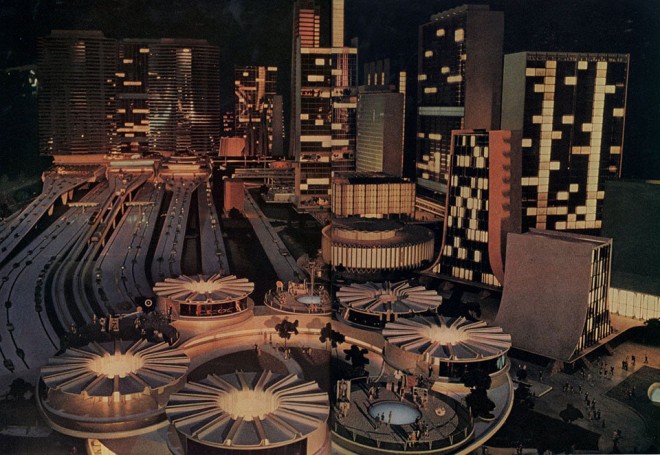
Once upon a time, wide, limited access highways, and high-rise office and apartment blocks, perhaps with parking on the lower levels, were the very model of modern living.  The idea started with the General Motors Futurama exhibit at the 1939-1940 New York Worlds Fair.


The notions of better living through private transportation and broadly shared prosperity combined with the Technocratic Imperative in Building that Better Future, something that was popular in those late-Depression days.
[Display designer Norman] Bel Geddes vision of the future was exclusive and evasive, there were no slums, the poor were not represented, the miniature scale made little provision for human relations and the rural villages were centralized around a church. (Marchand 1992:40). In Bel Geddes script for the audio accompanying the ride explicitly states that “whenever possible the rights of way of the express city thoroughfares have been so routed as to displace outmoded business sections and undesirable slum areas” (Cogdell 200:230). In a contemporaneous review by Stuart Chase he found Futurama to be a “civilization which had been cleaned, garnished, and ordered. Waste, clutter and ugliness were out of it.”(Cogdell 200:230)
Yeah, that turned out so well, but General Motors were able to push the same rent-seeking vision at the 1964-1965 Worlds Fair, which closed a month after the Watts riots suggested social engineering the undesirable slum areas away did not have the consent of the people so cleared.


Those look like Chicago's notorious outside ramps in the middle of that expressway.  They work well on a model with spacing-controlled slot cars.  Less so in practice, particularly if the Hubbards Cave area is full of trucks.

The buildings anticipate the Jetsons, in which the orderly traffic in the cartoon flows in three dimensions.  If you're the only person with a flying car, you're above it all, but mass-produce them ...


These days, however, people are conversant enough with the Law of Peak Hour Expressway Congestion to understand that running a Futurama-width road through a city doesn't deliver the benefits.  It's Soviet-style queuing, with the concomitant frustration, and the aesthetics don't look so good.


Alabama Department of Transportation rendering retrieved from City Lab.

Futurama's builders, at least, put in lots of futuristic high rises (Trump Towers, anyone?) in vacant spaces.  Here, a wider road is drawn in through the existing road corridor, with the existing collection of vacant lots, a parking deck, and Birmingham's current buildings treated as givens.  "In Alabama, the highway department is proceeding with the plan to expand I-20/59, even though business groups have come out against it and a nonprofit has filed a lawsuit against it."  The rent-seekers must have their rents, whether the public interest is protected or not.