10.6.05
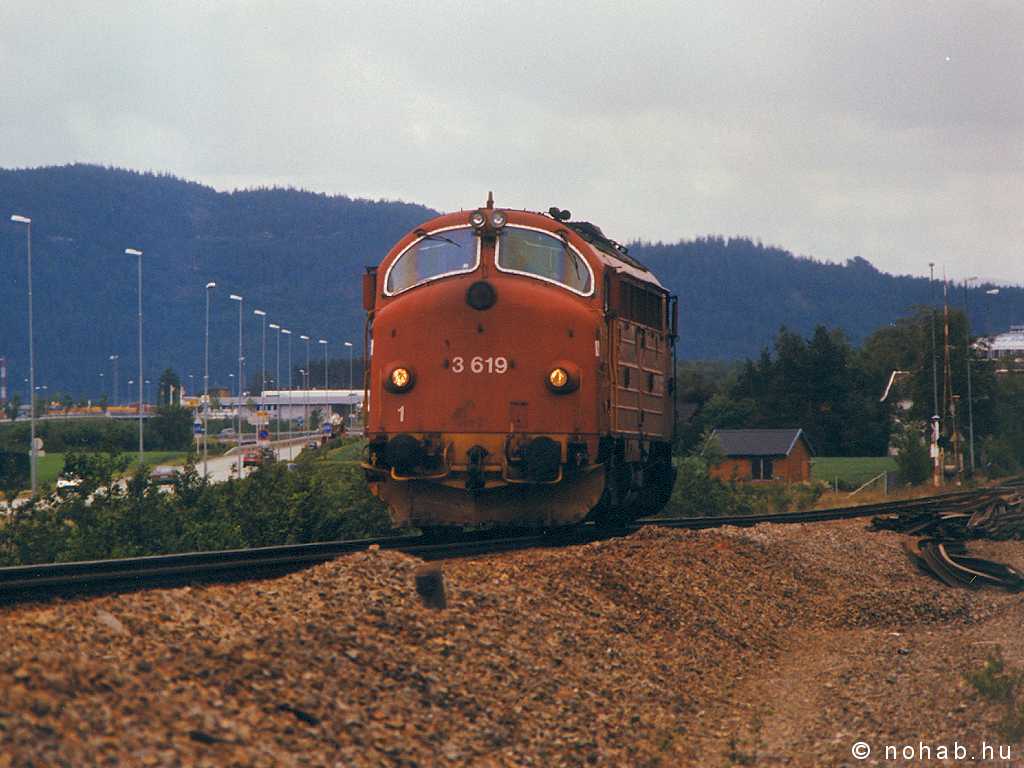
ENTRANCE OF THE GEEPS INTO VALHALLA. A treat in the mailbox when I got home: a special edition of Eisenbahn Journal on the history of the NOHAB diesels ("Rundnasen and Kartoffelkäfer") which turn up in several of the Scandinavian countries, all over the Low Countries, and in Hungary. The issue includes some drawings and specifications (imagine F unit noses and BL2 windows) and some pictures of similar power in Australia, including a unit for Australia's West Coast Railway (scroll down, there's also something reminiscent of the latter-day Boston and Maine) that is just BEGGING for the shield and wing treatment on each nose. (Well, why not? The Victoria's painting is a shameless borrowing from the Erie.) The real clincher, however, is a picture that I will have to scan and post, featuring a preserved G12 demonstrator in multiple with a Norwegian Di 3 (there is video of these motors, order it here; it's GM-lok i Norge.) And when Hell freezes over, those 567s will just keep a'comin!


THE SUPERINTENDENT KNOWS HIS EMUS. Last fall, I characterized the high-speed trains of Europe (Eurostar, ICE, TGV, Thalys, Pendolino) as third-generation Electroliners. Today I was catching up on some railroad reading (what better place to do some railroad reading than on a train?) including a Railway feature on the Pendolinos. (Memo to IPC Group: there might be money in selling content on-line.) I will quote the relevant bits: if you have the October 2004 issue onDeadTree (TM), verify that at p. vi of the centerspread is this.
A Pendolino is in fact a pair of trains coupled back-to-back -- each four cars long and with identical electrical equipment. Much of the equipment is distributed through the four vehicles and the sets are not capable of running with any vehicles missing. The slight exception to this is the extra, ninth, vehicle which has been added to the centre of each set.The Electroliner in the Superintendent's back yard appears to be four cars articulated over five trucks, but it is numbered 801-802. Why two numbers? Because for control purposes, it is set up as two four-motored 75 person cars, one motor per axle, running in multiple and controlled from an XMA-1 sixteen-point controller at either end. (The center truck is not powered. The train provides the capacity of three conventional cars with the power demands of two.) One way to keep a 'Liner moving is to cut out the motors on one unit.
PUSHING PRODUCTIVITY TOO FAR. Northern Illinois University is another institution of higher education that has gone to a four-day week during the summer session (the rationale is to spend a lot less on electricity and air conditioning; one of these days the private sector will discover the backward-bending supply curve and end the work week at noon on Friday. Those of you with long memories will recall when the work week ended at noon on Saturday for most people; the Fair Labor Standards Act simply institutionalized an economic phenomenon in progress. But I digress) which meant I had no guilt slipping away to explore the newest exercise in intermodalism: the Amtrak Hiawatha to Milwaukee's Mitchell Field. There is a special timetable in force making allowances for Form B work (engineering possessions, for my continental readers, which can be done under traffic in North America) keeping the corridor in shape for 79 mph running as well as providing some additional crossovers (one pair has been installed near the old A-68 interlocking at Caledonia, and another might be installed on the Milwaukee side of the airport station, which is one platform on the east track occupying space formerly devoted to the eastbound siding at Lake.) Those possessions, however, can lay out trains. I did a bit of exploring this time; riding from Chicago to the airport station, getting lunch at the airport (where the trains are listed on the arrival and departure boards, and where passengers have to walk farther from curbside to United's puddle-jumpers than they have to walk to the trackside, despite the station being laid out like an airport, with the long side perpendicular to the tracks) and then unloading at Sturtevant to watch a few freight trains. But here is the productivity problem: train 335 off Chicago at 1.05 is a half hour late at Sturtevant (2.34, which puts it into Milwaukee at about 3.00, the time that equipment is supposed to leave Milwaukee as 338.) The crew did a good job turning the train and kept their good humor, leaving Sturtevant at 3.45 and arriving Chicago at 4.59, again, about 30 minutes late with eight minutes to turn the train to leave as 339 at 5.08. The commuter train services were a minute or two off as well, but that morning drill with two or three trains arriving at the south end within five minutes, and another two arriving at the north end in the same time interval.
9.6.05
MAY THE FARCE BE WITH YOU. I took the opportunity to watch the much-ballyhooed Star Wars prequel and must register my disappointment. Why, in the vacuum of space, would one have to open gun-ports and run out a broadside (what's the analog to firing on the up-roll?) from a man-of-war that sounds a bit like a DC-7? And what is the strategic value of capturing the galaxy's largest slag dump? But the movie will clarify "He's more machine than man" from one of the real movies.
REVIEWING THE INTERCHANGE REPORT. Doxagora finds my roller coaster story, also catches the brass at the New York Times crying with their mouths full. Samantha at The Torch has a spot-on observation on Oregon's cultural competency initiative.
[Oregon's] President Frohnmayer said that “to me [cultural competency] means that we are able to effectively reach all of the students who have demonstrated their competence to be in the university but for whom, because of cultural background, traditional techniques of teaching may not be as effective as others” (emphasis added). If you cut through the politically correct newspeak in that quote and think about what Frohnmayer seems actually to be saying, his comment is ridiculous and patronizing. It is bad enough that this patronizing attitude prevails at American colleges and universities; the fact that the University of Oregon now wants to coerce its professors into sharing this attitude is unconscionable.There's more on my mind about developments at Oregon and elsewhere around the academy, but that's for the weekend.
RESISTANCE IS FUTILE. Tim at Where Worlds Collide does not disapprove of the latest offering from Dapol, the overseas version of an SD70 known as the Class 66, or, pejoratively, "Shed." Which they spend less time on than the representative Euro diesel.
The odds are, if you see a freight train, it will have one of these locomotives on the front. They are now the second most numerous main line British diesel of all time, after the class 47. They're going to be the backbone of freight haulage for the forseeable future.And if they hold up as well as the GP-9, which Atlas will be reissuing in O Scale, they will be good on a model railway of any era from the late 1990s to the early 2030s.
RECOGNIZE SABOTEURS, WRECKERS, AND ENEMIES OF THE PEOPLE! Via Public Brewery, a transportation safety poster in best socialist realism style from the Maryland commuter rail system (where the tracks are too hot to highball, at least on the old Baltimore and Ohio tracks today.)
8.6.05
DO I KEEP READING? Next up is One Nation Under Therapy, which Theodore Dalrymple reviewed for New Criterion (additional observations at Arma Virumque.) I suppose I'll keep slogging, but anecdotes like this, from p. 18, are troubling.
An eighth grader named Steve is supposed to give the prime factors of the number 34; instead he lists all the factors. It is not easy for the teacher to be affirmative about Steve's answer. But she finds a way, "Okay. Now Steve you're exactly right that those are all factors. Prime factorization means that you only list the numbers that are prime. So can you modify your answer to make it all only prime numbers?"If he gave anything other than 2, 17 there's something wrong with the teacher's understanding, and if he also gave 1, 34 the teacher has failed to impress on the students that the identity factors are a waste of time.
HARMONIC DIVERGENCE. Stalking the Riemann Hypothesis, recently reviewed, offers an interesting starting point for the creation of the zeta function, namely, the reciprocals of the primes. Start with the harmonic series, 1 + 1/2 + 1/3 + 1/4 + 1/5 + 1/6 + 1/7 + 1/8 + 1/9 + ... This series diverges. Intuitively, one can see this: 1/3 + 1/4 > 1/2; 1/5 + 1/6 + 1/7 + 1/8 > 1/2; the sum of the next 8 exceeds 1/2, ad infinitum; see this (.pdf) for details. On the other hand, 1 + 1/2 + 1/4 + 1/8 + ... converges to 2; but what about my red terms, 1 + 1/2 + 1/3 + 1/7 + ... That series diverges, but the linked file and this site will reveal that it is not easy to demonstrate it.
The book reveals a commonality between the Riemann hypothesis and some work in physics. I read on p. 177, "the numbers that describe the primal waves of the prime counting function are much like numbers that describe the energy levels of the fundamental wave functions of an 'average' heavy nucleus." Theoretical physicists and number theorists are working on related problems, forsooth.
There's also this instructive passage at p. 216. "Research in mathematics is frustrating. If it's not frustrating, you're probably tackling problems that are too easy ... your steady state is that you are stuck." But you persevere and you'll often make progress.
On to Book Review No. 15, which returns to my blue terms, the reciprocals of the squares? That yields 1 + 1/4 + 1/9 + ... which converges to the circular constant pi squared over 6, or pi2/6. Now we're into e: The Story of a Number, which is a history of a number of related problems, including squaring the conic sections (the rectangular hyperbola posed a number of problems, but Gregoire Saint-Vincent, using methods proposed by Pierre de Fermat, noted that the rectangles he used to approximate the area were all of equal size -- unit elasticity! There's also an excerpt from George Cheyene's 1734 Philosophical Principles of Religion that must have offered the typefetter some challenges. It's illustrated, and this description is priceless.
And thus the connections among various subseries of the harmonic series. To obtain the natural base e, add 1 to 1 + 1/2 + 1/6 + 1/24 + ... and get 2.718281828... (there is a limiting value but it is not the solution of any polynomial); there is a connection between 1/x (integrating out the rectangular hyperbola) and the natural logarithms, and e raised to the power ix, where i is the square root of negative 1 and x is any number, equals cos(x) + i sin(x), two trigonometric functions.
What occurred to me upon reading this book was how badly my high school math teachers exposed me to the idea of radians and polar coordinates. We begin measuring angles in degrees, and these correspond to what we can do on a map. No skipper in my experience has ever ordered, "Helmsman, steer a course of pi over 6 relative to magnetic." Is there a more intuitive way to expose beginning students to the circular functions and the exponential by playing with the sub-series of the reciprocal series rather than all of a sudden dropping radians on students?
The book reveals a commonality between the Riemann hypothesis and some work in physics. I read on p. 177, "the numbers that describe the primal waves of the prime counting function are much like numbers that describe the energy levels of the fundamental wave functions of an 'average' heavy nucleus." Theoretical physicists and number theorists are working on related problems, forsooth.
There's also this instructive passage at p. 216. "Research in mathematics is frustrating. If it's not frustrating, you're probably tackling problems that are too easy ... your steady state is that you are stuck." But you persevere and you'll often make progress.
On to Book Review No. 15, which returns to my blue terms, the reciprocals of the squares? That yields 1 + 1/4 + 1/9 + ... which converges to the circular constant pi squared over 6, or pi2/6. Now we're into e: The Story of a Number, which is a history of a number of related problems, including squaring the conic sections (the rectangular hyperbola posed a number of problems, but Gregoire Saint-Vincent, using methods proposed by Pierre de Fermat, noted that the rectangles he used to approximate the area were all of equal size -- unit elasticity! There's also an excerpt from George Cheyene's 1734 Philosophical Principles of Religion that must have offered the typefetter some challenges. It's illustrated, and this description is priceless.
Let (as before) AC, AH be the Afymptotes of any Hyperbola DLF defined by this Equation yxn=1, in which the Abfciffa AK=x and Ordinate KL=y, and n is fuppofed either equal to or greater than Unity.There's also an imagined conversation between Johann Bernoulli the elder and J. S. Bach on the use of the logarithmic spiral and the tempering of the musical scale. (The major scale has two half steps and five full steps in an octave ... 1 - 1 - 1/2 - 1 - 1 -1 - 1/2; the chromatic scale thus has twelve half steps in an octave, and the frequencies of each recurrence of a note an octave higher are twice as great. But if one attempts to provide all smaller intervals as integer multiples one runs into problems.)
And thus the connections among various subseries of the harmonic series. To obtain the natural base e, add 1 to 1 + 1/2 + 1/6 + 1/24 + ... and get 2.718281828... (there is a limiting value but it is not the solution of any polynomial); there is a connection between 1/x (integrating out the rectangular hyperbola) and the natural logarithms, and e raised to the power ix, where i is the square root of negative 1 and x is any number, equals cos(x) + i sin(x), two trigonometric functions.
What occurred to me upon reading this book was how badly my high school math teachers exposed me to the idea of radians and polar coordinates. We begin measuring angles in degrees, and these correspond to what we can do on a map. No skipper in my experience has ever ordered, "Helmsman, steer a course of pi over 6 relative to magnetic." Is there a more intuitive way to expose beginning students to the circular functions and the exponential by playing with the sub-series of the reciprocal series rather than all of a sudden dropping radians on students?
5.6.05
PORCINE COSMETOLOGY. University Diaries finds either a climbdown or an obfuscation by Oregon president David Frohnmayer, providing more material for Herrn. Schneider u. Schwarz.
On the opposite coast, Harvard's president, Larry Summers, continues his climbdown, with results noted by Heather Mac Donald (via Power Line; see also Discriminations.)
Who says it has to be about cultural background? Are we talking about differences in learning styles? Is this the latest iteration of the role model argument? And if the objective is effective teaching, why the focus on queer theory and the entire universe of alternative lifestyles in the draft plan? Why not put some Turing and some Keynes on the reading lists? Strikes me as a lot of trouble to just find one more way of determining that a tenure-tracker's teaching is below average.Cultural competency, Frohnmayer said, is a straightforward concept.
"To me it means that we are able to effectively reach all of the students who have demonstrated their competence to be in the university but for whom, because of cultural background, traditional techniques of teaching may not be as effective as others," he said. "A good teacher is always open, I hope, to ways to increase teaching effectiveness."
On the opposite coast, Harvard's president, Larry Summers, continues his climbdown, with results noted by Heather Mac Donald (via Power Line; see also Discriminations.)
Though the administration announced the outcome in advance—it wanted, at a minimum, a call for a new high-placed diversity bureaucrat and for more affirmative-action hiring efforts—the creation of task forces, complete with paid staff, is by now an ironclad ritual whereby colleges and universities demonstrate their deep concern for pressing issues.The existing programs haven't worked. Let's have more of them. See why I call it the Diversity Boondoggle.
Precisely. One has to develop the feedstocks at one end of the Ph.D. pipeline in order to take delivery of Ph.D.s at the other end. Harvard and similar institutions, by the way, did snap up many such colleagues at the beginning of the affirmative action era. Wayne State, a Detroit area public research university, was at one time a source of such faculty; the Wayne administration did everything it could except raise salaries and admission standards to obtain a comparably diverse faculty after those raids occurred.First, its purpose is to recommend the identical set of actions that the institution, whether academic or corporate, has already been doing. Every college in the country has been frantically pursing “diversity” in hiring and admissions for decades. The task force itself commends the diversity policies of 17 rival colleges—the mere tip of the iceberg—without drawing the obvious conclusion.
The second obstacle follows from the first: there is nothing more that can be done. If untapped pools of highly qualified female and minority candidates existed out there, schools would have snapped them up long ago—if not your college, then its dozens of competitors, just as desperate to placate the quota gods. (The one course of action that might, in the case of black and Hispanic faculty recruitment, bear long-term results is the one that elite college personnel are least likely to choose: intensive mentoring of young students and the jettisoning of all “progressive” pedagogy in the schools.)
The only new hires that diversity initiatives generate are in college administrations, already overloaded with sinecures. The Harvard task force demands the creation of a most remarkable new position, a Senior Vice Provost for Diversity and Faculty Development.That sounds like the same sort of thing Oregon might currently be considering. I have some lurid samples of what the local office of Faculty Development does: although the people who run it are good people, their efforts do everything except the most logical way to develop a faculty, which is to provide the proper inducements for people to do their jobs well.
And just in case the lesser functionaries in the provost’s office still don’t appreciate the exalted status of the new Senior VP for D, the task force provides that “she” (the report’s choice of words) “be given priority in terms of office space.” So much for non-hierarchical, anti-patriarchal collaborative sharing of collective resources. Naturally, the Senior VP for D will “also be supported by a group of dedicated staff.”But there won't be any paper for the diversified faculty members to produce class handouts, or any additional classes on the works of inter alia Turing and Keynes. There's a lot more in the article; I'm just hitting the low spots. Here's more porcine cosmetology, in this case renaming the diversity incentive fund. It doesn't matter what you call it, any institution of higher education has one.
In an unusual collision with the truth, the task force acknowledges that “there was a sense that candidates hired with support of the [existing] funds are somehow less qualified.” Someone slipped up big-time here, because admitting the poisonous stigma that affirmative action efforts impose on their “beneficiaries” is something that diversocrats must never ever do. But the task force’s encounter with reality is brief. It appears fully satisfied with the idea that renaming the Outreach Fund will eliminate the stigma of race and gender preferences.Heh.
Harvard’s millions will guarantee that it can rout all competitors for female nuclear physicists, but its competitors will undoubtedly up their own antes to stay in the game. There must be better ways to spend the millions of dollars that schools will dedicate to poaching “diversity” trophies from rival institutions—buying books for libraries, for example, or grooming scholars in neglected fields such as the American founding, or producing operas on campus, or capping tuition hikes.All totally pointless, as the return on investment in a degree from a name college is lower than the return on investment in a degree for a comparable state-located or less well-known college.
Harvard has just dumped $50 million down a bureaucratic sinkhole tells you all you need to know about why attending Harvard for eight months costs more than most families earn in a year. Eventually, students and parents may start asking why anyone would want to.It's called a market test, baby.
AT THE NINTH DECIMAL PLACE? Danica Patrick has an advantage racing Indy cars because she's lighter than the average guy driver? Illustrated bull session in progress at Catallarchy.
SORTING ALGORITHMS. Book Review No. 14 is mathematician Dan Rockmore's Stalking the Riemann Hypothesis. There's some cool number theory in there that I wish to address another day; for now some brief observations on the logic of the book, which presents approaches to finding the nontrivial zeros of the Riemann zeta function by mathematicians and by physicists who are chasing a related, or possibly the same, fundamental knowledge. The mathematics is pretty elementary, if one does not know what a "zeta function" is this book won't help. It does draw some intellectual parallels in the style of Gödel, Escher, Bach for the reader that likes to make connections among seemingly unrelated things.
One of the connections involves Stanislaw Ulam's work on sorting algorithms, which occurred to him as he was putting bridge hands together. He produced a result defining the fewest moves used to sort a hand of cards as "the size of the hand less the length of the longest rising sequence," where a rising sequence is "any (ordered) subset of the cards that are in the correct relative order." This example, from pp. 252-253, illustrates such a sorting of thirteen cards (numbered here for simplicity) and dealt in the following order:
2 5 1 13 7 6 11 4 10 9 3 8 12
Professor Rockmore uses the term "cycle" to refer to each repositioning of a card; I will use the term "move" for reasons of my own that I will expand upon later. Each move is the repositioning of ONE card, hence, with 13 cards and a longest rising sequence of length 5 (2, 5, 6, 8, 12) the cards can be blocked in station order (oops, giving the game away) placed in consecutive order in eight moves, hence:
1 2 5 13 7 6 11 4 10 9 3 8 12
1 2 3 5 13 7 6 11 4 10 9 8 12
1 2 3 4 5 13 7 6 11 10 9 8 12
1 2 3 4 5 7 6 11 10 9 8 12 13
1 2 3 4 5 6 7 11 10 9 8 12 13 (*)
1 2 3 4 5 6 7 10 9 8 11 12 13
1 2 3 4 5 6 7 9 8 10 11 12 13
1 2 3 4 5 6 7 8 9 10 11 12 13 (*)
Where red denotes a move to the left (port) and green a move to the right (starboard) and the asterisked moves have an equivalent move in the opposite direction, e.g. 6 7.
As I was reading this example, it got me to thinking about sorting a cut of freight cars, where one cannot simply pluck a car out of the middle of the cut and place it on the end, but one has to sort it, moving cars from one track to another, something like this: Again, suppose the cars come in in the following order. (For the moment I will treat each number as a destination; there are some complications involving cars or blocks of cars headed to the same destination at different locations in the train that I don't want to get into at the moment.)
2 5 1 13 7 6 11 4 10 9 3 8 12
Here's our crusty conductor, who recognizes you can't use any Giant Hand Assistance.
"Cut behind two. One in, ten out."
1
2 5 13 7 6 11 4 10 9 3 8 12
"One in, eleven out."
1 2
5 13 7 6 11 4 10 9 3 8 12
"Cut three ahead of the engine, one in, two out."
1 2 3
5 13 7 6 11 4 10 9 8 12
"Cut behind five, one in, four out."
1 2 3 4
5 13 7 6 11 10 9 8 12
(If these cars had been blocked elsewhere on the same railroad, there'd be one unhappy crew as there are two strict falling sequences in proper reverse station order. There is no wye track -- triangle, if you will -- nearby.)
"Two in, seven out."
(I use this next trick on the Fox Valley all the time. It blows the minds of people who haven't seen it before.)
1 2 3 4 5 13
7 6 11 10 9 8 12
"Cut off. One out, tie on, cut behind one, one in, six out."
1 2 3 4 5 6
7 11 10 9 8 12 13
"One in, six out."
1 2 3 4 5 6 7
11 10 9 8 12 13
"Cut behind three, one in, two out."
1 2 3 4 5 6 7 8
11 10 9 12 13
"Cut behind two, one in, two out.
1 2 3 4 5 6 7 8 9
11 10 12 13
"Cut behind one, one in, two out.
1 2 3 4 5 6 7 8 9 10
11 12 13
"Three on and stretch 'em."
I've probably reinvented some well-known algorithm in combinatorial theory or operations research, if anyone has investigated the properties of what I call strict falling sequences, but if not, there might be some way of evaluating the optimality of correctly blocking cuts of cars as they proceed through the railroad network, such that trains do not have to be completely re-marshalled several times.
FITTING. Here's to Illinois, the land of lucrative personal injury lawsuits and famous rent-seeking ward heelers, and also the port of entry for the world's largest catfish.
THE PRODUCTIVITY PSYCHOSIS. Bill Hendrick of the Atlanta Journal-Constitution (it's a newspaper, if you know how to reach the Superintendent and about Swindon's last King, you can get in, if the story doesn't get archived) has been interviewing the pshrinks.
It's also a world in which our political masters have used tax money intended to provide more capacity on the roads to conceal the extent of their funding of rent-seekers, in which our universities fret over "cultural competence" whilst researching invented spelling and invented math in the common schools, which raises the incompetence tax we pay, in which businesses tell us that the latest voice-mail limbo or service retrenchment is an improvement.Do you seethe in traffic, just waiting for some nut case to cut you off? Or grind your teeth in office meetings when the same old fawning ladder-climbers gush out their aim-to-please drivel? Or feel your face flushing when the guy blabbing away on his cellphone keeps holding the brakes after the light turns green, refusing to budge until you honk?
If so, you may well have a problem with anger, which seems to be rising faster among the teeming masses than the jet you just missed while waiting in the cattle line at Hartsfield-Jackson International Airport.
Researchers say many Americans aren't just stressed, but are boiling with anger and could blow like a volcano at the least provocation.
We live in a fast-paced, high-tech world where we're forced to rush, rush, rush on the job and off, which is why many people turn into ticking time bombs as soon they get behind the wheel or in line at the grocery store or movie theater only to see others cut in.
SIGNAL-JAMMING. Brainster is unimpressed with a New Yorker article seeing something positive in abolishing the office of valedictorian. He focuses on that part of the article in which aspiring valedictorians take advantage of the rules, something which the article suggests is contrary to the spirit of the award, but for which he correctly notes,You wanted to be valedictorian pretty much forever, but you never thought to find out what the rules were?The article offers readers some other useful information, however. Two academicians did some ethnography on valedictorians.
Dedicated to the well-rounded ideal—to be a valedictorian, after all, you must excel in classes that don’t interest you or are poorly taught—the valedictorians had “used their strong work ethic to pursue multiple academic and extracurricular interests. None was obsessed with a single talent area to which he or she subordinated school and social involvement.” This marks a difference, [coauthor Karen] Arnold said, from what we know about many eminent achievers, who tend to evince an early passion for a particular field. For these people, Arnold writes, a “powerful early interest evolves into lifelong, intensive, even obsessive involvement in the talent area.” She goes on, “Exceptional adult achievers often recall formal schooling as a disliked distraction.” Valedictorians, by contrast, conformed to the expectations of school and carefully chose careers that were likely to be socially and financially secure: “As a rule, valedictorians relegated their early interests to hobbies, second majors, or regretted dead ends. The serious athletes among the valedictorians never pursued sports occupations. Most of the high school musicians hung up their instruments during college.”Not many model railroaders, or dabblers in number theory? And here's an interesting nugget for observers looking for those missing men in college.
In the nineteenth century, young women largely outperformed young men in American high schools. They generally won more prizes, graduated at higher rates, and displayed lovelier penmanship. At graduation, girls would read while sitting or standing on a low step, since it wasn’t considered proper for them to speak from a platform.Plus ca change. Despite the somewhat downbeat findings of her research, Professor Arnold defends the office of valedictorian.
“Over the past ten years, a lot of school districts have been abolishing the valedictorian, and I’m against that,” Karen Arnold told me. “On the day we allow anybody who’s always wanted to be a quarterback to play on the high-school football team, then we can get rid of valedictorians. If we rank anything, we ought to rank what we say is most central to school, which is to say, academic learning.”Quite. Current thinking in the common schools, however, is to do less ranking off the field. Kimberly at Number 2 Pencil links to Chicago Tribune coverage of that phenomenon. She focuses on the greater difficulty universities that admit large classes on the basis of scant information will face in the absence of class rankings. A close reading of the article suggests the absence of class rank will encourage more aggressive positional arms races.
[The story continues with some anecdotes about valedictorian-gaming. Don't mess with economists.] Break this down ... the policies generally specify that a student graduating in the upper 50% (or some other cutoff) of any high school class gets in, but absent any information about class rank (which may be rendered meaningless by grade inflation in any event) admissions directors will reveal a preference for graduates from reputable high schools. Watch for house prices in such districts to rise further."Everyone is familiar with a New Trier," [Ohio State admissions tsarina Mabel] Freeman said.
"You can't just make assumptions about all high schools."
Other admissions directors, however, said they often agree with a high school's decision to abandon rank.
Simply put, "there are some very competitive high schools where class rank hurts the students," said Molly Arnold, director of admissions at Illinois State University, one of the schools that participated in [Lincolnshire] Stevenson [High]'s pilot study [to provide percentile rather than class rank information.]
Arnold said 10 percent more Stevenson applicants were accepted this year when class rank wasn't included.
Removing class rank also can benefit students applying to Indiana University, said admissions director Mary Ellen Anderson, who said that generally only students in the top half of their classes are admitted.\
That can be difficult at competitive Highland Park and Deerfield High Schools, so officials voted in 2004 to eliminate rank beginning with next school year's senior class, said District 113 Supt. Ann Riebock.
That means Megan Dayno will be one of Deerfield High School's last two valedictorians when she graduates Thursday with a 3.99 unweighted GPA after getting an A-minus in AP economics. The school also has a valedictorian with the highest weighted GPA.
NOBODY PAYS LIST PRICE. Via Cranky Professor, Scott Inside Higher Ed finds a university president who doesn't like "leaving money on the table."
Value of service pricing, don't you love it? President Cooper does.William E. Cooper, the president at Richmond, says he realizes that his university’s cost increase “superficially seems outrageous.” But he said that he became convinced that Richmond “was about $7,000 underpriced” and that the additional revenue would allow for more financial aid and improvements in facilities and academic programs. “We could dink around with this and ramp it up a little each year, but we decided it was better to bite the bullet, to realign this and stay in place, rather than looking confused.”
But what of student choices, and the widespread public and political fear that high prices discourage students? With certain student segments, that’s flat out false, Cooper says. Richmond found, he said, that it was losing students to more expensive institutions and enrolling students whose parents were willing to spend more than Richmond was charging.
“We were leaving money on the table,” Cooper says. “We had all these people with a kid at Dartmouth or a kid at Syracuse, and a kid here, and we were the cheap school.”
“One of the strong philosophical bents of this change was the price insensitivity of people who really care about higher education,” Cooper says. “Just like people buy the best cappuccino maker if they really care, so with higher education. If you really care, a couple thousand bucks isn’t in the decision maker and that’s the student and family we want.”That last sentence appears to be garbled, but it's classic positional arms race. But is that a sustainable strategy for private universities that aspire to be exclusive, given the absence of any premium to a degree from a more famous university (many of which appear to be engaging in the same kinds of false economies and misguided diversity initiatives of their state-located competitors?)
4.6.05
HANDS IN THE AIR, FEET OFF THE FLOOR. A local newspaper released its June entertainment guide and guess who made the centerfold?
Stephen Karlson sits down for a topic that permeates both his professional and personal interests, and has since a visit to what then was called Mariott’s Great America in 1977. It’s enough to energize an NIU associate economics professor after grading piles of final exams.But that's not just for fun.
In addition to published works with titles like A Positive Theory of Immigration Amnesties, Karlson looks at the ways parks attempt to find a balance between attractions and prices.To be specific,
Yup. Must. Remember. That. Resolution.Wherever 200-foot-high investments meet throngs of ticket-buying consumers, there’s bound to be economic implications. Karlson first let his enjoyment seep into the office when what he heard from economists at the time wasn’t reflecting what he experienced at the park.
Lately, that interest has created a unique parallel in Karlson’s mind. Parks such as Great America offer “cut” tickets, designed for patrons to pay extra for the privilege of jumping to the front of the line at certain times of day. Meanwhile, in places like southern California and the Washington, D.C. beltway, state officials are reconfiguring high-occupancy (or carpool) lanes into high-occupancy toll roads, where drivers can pay an additional cost with something like Illinois’ I-PASS to use a less-congested lane of traffic. Officials with the Virginia Department of Transportation in April agreed to upgrade Interstate 495 in such a way, and other states have commissioned studies proposing similar parallel toll-roads.“I’d like to shed a little light on the economics of these things,” he said, hoping to complete his research by the time school starts up again in the fall.
A REAGAN WORKOUT. The Midwest is not known for earthquakes or hurricanes but those summer thunderstorms can disrupt a day. About 1 pm Saturday afternoon one decided to do a bit of tree-pruning in the neighborhood, leaving part of my neighbor's tree in my driveway and part of my tree in a different neighbor's patio. Rang the police to let them know about some 'phone lines arcing where a tree had found them, rang the tree service, rang the insurance company, waited for the rain to stop, then broke out the crosscut saw and pruning shears and got cutting. A neighbor came by with a chain saw later, and took care of the bigger pieces. Lots of stuff for the chipper which the city will be running through the neighborhood, but everything's pretty well tidied up. More storms in the forecast, however.
SECOND SECTION. No tornado, but lots of damage in the nearby blocks. More coverage at the DeKalb Chronicle.
SECOND SECTION. No tornado, but lots of damage in the nearby blocks. More coverage at the DeKalb Chronicle.
2.6.05
BUNDLING. At Fly Bottle, a bull session on whether the argument that Social Security is really a form of insurance (regular readers will be familiar with the Superintendent's contention that bundling a bad insurance policy with a bad investment plan is not a virtue) that ought not to be treated as equivalent to an investment plan. In the Corner Solution, a request to stop quibbling over the definition of the program and get down to the specifics of fixing it in some way. Via Newmark's Door, some observations from Germany by Ralph Peters on what's in store if the fix (and also to Medicare and Medicaid) are deferred too long. Angry Europeans looking for somebody to blame ... haven't we heard that before?
TO REMEMBER. Marquette Warrior points to a fine collection of Memorial Day editorial cartoons compiled by the Marquette Office of Homeland Security.
Subscribe to:
Posts (Atom)