27.5.12

IT IS UP TO THE PROFESSOR TO MAINTAIN STANDARDS.

At Inside Higher Education, John Warner, deputising for Oronte Churm, reacts to Janice Fiamenco's Unteachables post.  Mr Warner concurs with a Cold Spring Shops diagnosis in part, then dissents in part.
It would be hard-to-impossible to argue that the “everyone gets a trophy” mentality hasn’t resulted in some, let’s say, excesses of self-esteem that occasionally rear themselves in ugly ways in the classroom. I don’t think this concern is limited to traditionalists or conservatives, however, as you can hear this lament in the hallways of the most liberal of institutions.

I think it’s just as reasonable, however, to argue that the attitude of entitlement is rooted in the corporatization of higher education, where a degree is a commodity, and students (and parents) are customers.
There's plenty of blame to go around, but you'd think that higher-education-as-business might recognize what the graduate programs in business do, namely, that the customers are the employers who hire tables at the job fairs, not the students.

Keep reading, though.
Ultimately, though, that debate isn’t all that interesting to me. Whatever the cause, many of us agree on the result that winds up in our classrooms.

What piqued my interest is her conclusion that these students are somehow “unteachable,” because my experience is the opposite, and the notion that today’s generation of students is somehow any more “unteachable” than any other is total horseshit.
Indeed. Teaching is a lot like farming, although the growing season begins in late August.
When I look at my classroom at the start of each semester, particularly in a freshman writing course, I realize that I’m looking at a room of people who, in reality, don’t really know what it is we’re there to do.

I know this because I was them. My hunch is that Professor Fiamengo was not. Professor Fiamengo is assuming our students to be familiar with things they can’t possibly know, or, even on her own terms, are too warped by their progressive educations to understand.

If our students don’t know something we think they should, it is our job to teach them.
The column is instructive, particularly for beginning professors, heck, for veteran professors who would like to encourage student achievement without shamelessly becoming undemanding (which the students will see through in any event.)
When it comes to grading, I tell them that grammar and mechanics and accuracy count because in this class, the ideas are inseparable from the way they are expressed. I explain my attendance policy (there isn’t one), my loathing of cell phones, why I don’t allow computer-aided note taking, what to do if they miss class. I briefly describe all the assignments they’ll be doing. I inform them of my teaching philosophy, of my grading standards, and even the historical distribution of grades in the class.

In sum, I inform them of all the things that I believe are important in the course and discipline we are studying, and I am inviting them on board the train as it leaves the station.

Does everyone get on board? Of course not. Do I still get disgruntled and upset students in my office? Of course I do. But when they’re there, it’s not to try to move me toward their standard, it’s to understand what they should be doing differently to succeed at mine, something I’m willing to spend as much time as necessary doing.

What I am doing, is offering them access to a kind of power, a freedom, agency over themselves and the world.
I like the reference to getting on the train. Some years ago I heard someone offering two different visions of teaching styles, using the 'bus as a metaphor.  Do you keep the 'bus on time, or do you make sure the people get on the 'bus?  It's a rare semester that I don't apologize to a class for scheduling too much stuff, then cut out a topic or a reading, rather than cause unnecessary stress.  The main material is challenging enough, whether I get through all the subtleties or not.

20.5.12

ELIMINATE THE IMPOSSIBLE.

The Excessively Complex, too, particularly if you wish to solve mysteries.  First read The Sherlock Holmes Handbook: The Methods and Mysteries of the World's Greatest Detective.  It's Book Review No. 14.  The contents will be left to the reader as an exercise.  I did like one of the Holmes quotes from the end of the work.  From "The Adventure of the Copper Beeches" comes a theme for a model railroad display now a-building.  "The lowest and vilest alleys in London do not present a more dreadful record of sin than does the smiling and beautiful countryside."  Why else would Holmes and Watson be coming and going from Paddington Station or Victoria Station?

(Cross-posted to 50 Book Challenge.)

RECALLING THE ZIPPER.

The Chicago and Eastern Illinois Railroad provided a Chicago connection for Louisville and Nashville passenger trains to New Orleans, Atlanta, and Florida destinations.  For a time, the carrier also offered its own passenger train between Chicago and St. Louis.  This service included a day train called The Zipper (connecting downstate with a motor train called The Egyptian Zipper to Thebes) and a night train called Silent Knight.  These trains all vanished with the coming of Amtrak, although Amtrak's Floridian returned to C&EI rails, missing Louisville,  for a few months in 1974 and 1975.

In the 1960s, the railroad became a takeover candidate, with both Missouri Pacific and Louisville and Nashville seeking a Chicago entrance for their freight trains.  The resolution involved what Trains magazine referred to as the wishbone, with Missouri Pacific taking ownership of lines south and west of Woodland, Illinois, Louisville and Nashville taking ownership of lines south and east, and the carriers jointly owning the two-track mainline north of Woodland into the Chicago area.  Subsequently, Missouri Pacific became part of Union Pacific, and Louisville and Nashville part of CSX Transportation, but the joint operation remains.

Thus, when Amtrak and Union Pacific have engineering work on the Alton Route through Bloomington and Springfield, there is a detour route available for passenger trains.  Typically the Texas Eagle for beyond St. Louis detours, with the St. Louis corridor trains turning at Springfield, or replaced by buses.

This spring, there have been several such detours, often announced well-in-advance, as improvements on the Alton to make possible 110 mph operation proceed.  One such detour took place just after the end of the academic year, and I took advantage of the information to secure sleeper space to Longview, Texas, which seemed like a good place to spend a day and turn back.

A rider with a greater taste for adventure can attempt a turnback in Dallas, although there's not much time in town between trains, and the margin for error in case of trains running late is too small.  Another possibility is to ride the detour only, with an overnight in St. Louis, or create a Chicago - St. Louis - Kansas City - Chicago circle tour out of it, with ample time for sightseeing or dining in either St. Louis or Kansas City (the trains aren't frequent enough to create blocks of time during business hours in both cities.)  In October, 2010, rail enthusiasts Otto Dobnick, Dave Ingles, and Rick Moser did the St. Louis turn on a previous announced detour.  Their trip log is amply illustrated.

An Amtrak detour has ample potential for adventure, simply because of the day-to-day challenges (which also affect freight trains) of getting a train from Chicago's Union Station to the operating railroad.  My use of the locution "Chicago area" reflects those challenges.  Amtrak dispatchers regularly use backward induction to get a train out of Chicago, first asking the CSX or CNR or Norfolk Southern dispatcher if he'll take a train; upon getting that commitment telling the dispatcher of the line connecting to CSX or CNR or NS that the train will be able to move to that line; then work backward in like manner until the line connecting to Union Station has accepted the train, and then the train moves on time.  When the dispatchers haven't worked together in that manner, trains can wait, and wait, and wait, as was my experience in the summer of 2001 when a Cardinal headed for Washington, D.C. was held off the CSX line to Indianapolis until the dispatcher could find a path for it.

Amtrak 21 Texas Eagle, Chicago to Longview, Texas via C&EI detour, 16-17 May 2012: diesel 53, transition sleeper 39008, sleeper 32018, buffeteria car 37010, Sightseer Lounge 33031, coaches 31044-31010-34041.  Seasonable temperatures and dry rail.  Space in lower level of 32018.  Go 1.45, stop at coach yard, go 1.53, easy transition from PRR to C&WI, also used by Metra's Southwest trains and Amtrak's Cardinal; stop at 80th St 2.25, freight train crossing, go again 2.30; stop 2.35 pm at 115th St.


Here's 22 with 164 and 8 cars, both trains move at 2.38, pass milepost 16 at 2.42; stop Dolton (now on ex-C&EI trackage not used by other Amtrak trains) 2.52 "awaiting a signal", go 3.10.  From here our progress is mostly at 60 mph and freight trains are generally out of the way.  Pass Watseka (TP&W crossing) 4.17; Woodland Junction 4.23, overtake stack train 4.50; dinner call at five; overtake mixed goods 5.22, Villa Grove 5.30, pass Tuscola (IC crossing) 5.40.

I made mention of a buffeteria car.  That's a Milwaukee Road locution.  Amtrak calls its reconfigured dining cars "Cross Country Cafe" cars, and one such car served as the dining car on this night's 21.


One end is set up as a self-service area and an attended buffet.  The other end is set up as a diner, and there are apparently different configurations of these cars.  The point of this configuration is either to offer a dining service with a smaller crew, as is being done on this run, or to offer an economy food service out of the buffeteria.  Despite the economy setup, the diner offers a deluxe menu, with steaks grilled to order, or lamb shanks, or chicken, or a few other items, and apart from the vegetarian special, patrons can choose either potatoes or rice.  Fewer people are served at each seating than is possible with a fully-staffed Superliner diner, although we will see the carrier introducing other economies, including seating in half the diner, in subsequent reports.  Out of view to the left is the table commandeered by the crew for their mobile office.  There has to be a better way of providing crews with a work space than a practice that gives lounge patrons the impression that the train exists for the benefit of the crew.

Pass Findlay (where the Egyptian Zipper used to connect with the Zipper) 6.12, pass Pana (which used to be where the C&EI used New York Central double track into St. Louis, and the crossing of the Illinois Central Charter Line) 6.34, meet eastbound stacks Hillsboro 7.03, Vierling Junction 7.50, Venice 8.10, arrive St. Louis 8.31.


The hotel and assorted other buildings block any view of the Gateway Arch.  There's time for a stroll, and for smokers to smoke, and the locomotive to be fueled and the southbound passengers to board.  Leave St. Louis 8.55, room made down, shower at Texarkana 6.30 on the 17th, pass Atlanta 7.10, protracted station work at Marshall hand-throwing switches, recrewing, then taking passengers, leave 8.14, arrive Longview 8.39, almost on time.


Longview is where the Amtrak passenger destined for Houston or for Shreveport changes to a bus.  There's more to say about Longview, and about the value of connectivity among the long-distance Amtrak trains, to come.

YOU ARE PAID TO SAY NO AND UPHOLD STANDARDS.

Janice Fiamengo of Ottawa dreads encounters with incompetent grade-grubbers.
Meetings about bad grades are uncomfortable not merely because it is unpleasant to wound feelings unaccustomed to the sting. Too often, such meetings are exercises in futility. I have spent hours explaining an essay’s grammatical, stylistic, and logical weaknesses in the wearying certainty that the student was unable, both intellectually and emotionally, to comprehend what I was saying or to act on my advice. It is rare for such students to be genuinely desirous and capable of learning how to improve. Most of them simply hope that I will come around. Their belief that nothing requires improvement except the grade is one of the biggest obstacles that teachers face in the modern university. And that is perhaps the real tragedy of our education system: not only that so many students enter university lacking the basic skills and knowledge to succeed in their courses — terrible in itself — but also that they often arrive essentially unteachable, lacking the personal qualities necessary to respond to criticism.
Yes, that behavior is learned, and yes, there is much to say about so-called progressive education depriving young people of the reality checks they will encounter only later, in harsher forms. And yet, it is your duty as a professor to say no and uphold standards.  Catching up on technical papers or your reading, and writing your own technical papers is also part of the job, but without the saying no, tactfully, to incompetent grade-grubbers, there is no reputation for selectivity to exploit when your research competes with that of others.

THE LIMITATIONS OF GOVERNMENT.

We have from time to time observed the maturation of Tom Brokaw.  In 2007 came a conjecture.
There was enough of a consensus that a midwestern graduate of a state university and a graduate of one of the Ivies could hold the same positions. In Boom, however, Mr Brokaw repeatedly (is it unwittingly?) suggests that shared consensus was one of an out-of-touch elite.
By August 2011, in the middle of Our President's contrived debt-ceiling crisis, came evidence that Mr Brokaw was beginning to recognize reality mugging him.  His The Time of Our Lives might have also been recognition that Reliance on Washington has reached its limits, although in that book he still keeps the notion of a Vital Progressive Center alive.

THE LIMITS OF FLY-BY-WIRE.

Designers can build safeguards into planes, but the mechanical assistants can only be designed with experience in mind.  Sometimes that experience comes the hard way.
Airline pilot Denny Fitch was hitching a ride home on a DC-10 in 1989 when heard an explosion somewhere in the back of the jet. He soon made his way to the cockpit to see if the crew needed help.

Inside, he found three men desperately trying to keep the giant plane in the air after losing all hydraulic power needed to control direction and altitude. Fitch took a seat in the only space available – the floor – and helped operate some of the only equipment still working – the wing engines – to try to land the aircraft carrying nearly 300 people.
Mr Fitch survived that crash, and his recent obituary reminds readers that he bought himself and some of the passengers additional years of life.
When the crippled plane crash-landed in Sioux City, Iowa, more than half of the passengers survived – one of the most admired life-saving efforts in aviation history.

After the accident, aviation experts conducted simulations in which test pilots and trainer pilots tried to land similarly stricken aircraft.

"I'm not aware of any that replicated the success these guys had," said Mike Hamilton, a United pilot who flew with Fitch. None of the simulator pilots were able to make a survivable landing.

"Most of the simulations never even made it close to the ground," Hamilton said.

And the teamwork of Fitch and the others on the flight deck is still a model for the industry.

15.5.12

SO MUCH FOR CONNECTIVITY.

As part of the security measures for the NATO Summit taking place in Chicago over the weekend, Metra is prohibiting large luggage and drinks on trains for the duration.

The last day of the conference will be Monday, May 21, and it will surely be an ugly Monday with no morning coffee on the trains.  (Because of heavy passenger loadings, the bar cars have all been converted for passenger use.  I wonder if the ban also applies to the one remaining subscription parlor car.)

On Saturday and Sunday, there may be Amtrak passengers connecting to and from Metra, and their luggage has to be left at Union Station, or ???  (As if the Metra or Amtrak schedules pay much attention to connectivity anyway.)

NO CHILD GETS AHEAD.

Ralph Nader contemplates the social waste that is the United States recruiting the best and the brightest from other countries.
Our companies need these skills. The foreigners have these skills and we want them here where they can flourish, and create profits and jobs. Never mind that our country has plenty of people waiting to have the same opportunity. By reducing tuition barriers, overcoming historic discrimination (e.g. lack of women engineers), reducing the 40 percent dropout rate from colleges, and working with youngsters on a one-on-one basis so that they are not left behind or skewered by misguided multiple-choice standardized test regimens, are all great ways to reach out to Americans.

Also, what about having ready and able specialists here who may have to be paid more than their overseas counterparts? These Silicon Valley corporations are making huge profits, pay few taxes, and receive subsidies known as R & D tax credits.

Now we see the grossest of contradictions. We have an agency for International Development (USAID), economists and politicians saying that developing countries desperately need these same skills or what they call “human capital.” They need engineers for their transportation, hydraulic and soil systems, physicists for their universities and modern industries, physicians for their sick and injured, nurses for hospital care, public health specialists for eradicating systemic diseases, and entrepreneurs to jumpstart businesses that deal directly with the necessities of life. Through many columns, the globetrotting Tom Friedman has urged developing countries to retain such native talent to build their economies. Yet he has also written that students from abroad receiving U.S. PhDs in the hard sciences be given immediate permanent U.S. residence en route to citizenship. Well, you can’t have it both ways. There is not a large surplus of such talent that we can drain them from developing countries building their own societies.
It's up to education policy makers in the United States to develop that human capital, rather than do things that impede its development, including the obsession with standard tests.  At the same time, it ought to be policy, or practice, in the United States to continue to build that city on the hill, and if that city on the hill attracts talented people from other countries, so be it.

WELCOME VISITORS.

The road to Cold Spring Shops is nailed to Newmark's Door.  Hello, and thanks.

LOSING THE POSITIONAL ARMS RACE.

The longer the wait from the end of the season, the more expensive it gets to keep the football team in camp.
In 2010, Northern Illinois had to wait two weeks between its loss in the Mid-American Conference Championship game and its victory against Fresno State in the Humanitarian Bowl in Boise, Idaho.

This past season, the Huskies had more than a month from their MAC title win in Detroit on Dec. 2 to the GoDaddy.com Bowl victory over Arkansas State on Jan. 8 in Mobile, Ala. That also meant players had to spend more time on campus and more money on meals. 
Helping kick off Mardi Gras in the cradle of Mardi Gras might have been fun, but the bowl revenues weren't that great.  Selling wins to Big Ten teams with large alumni bases in Chicago isn't always lucrative enough.
NIU received $431,680 in total revenue from the GoDaddy.com Bowl. Total expenses were $593,238, which resulted in the loss.

The internal athletic funds used to cover the loss include revenue from the Huskies’ game against Wisconsin at Soldier Field on Sept. 17, 2011.

NIU received about $850,000 in revenue from the Solider Field contest, NIU spokeswoman Donna Turner told the Daily Chronicle on Wednesday. That number falls short of expectations of $1 million. Wisconsin was paid the first $1 million in revenue, with NIU keeping whatever revenue was left, according to the game contract.

Included in the revenue figure from the GoDaddy.com Bowl was the $400,000 payout the school received from the MAC, as well as $31,680 in ticket revenue. NIU sold 738 tickets. The school distributed 1,708 tickets, which included free tickets for students and player comps.
Headquarters is of the view that the football visibility is worth it.

Just under three months to the next season, which will begin in Chicago, with Iowa playing the role of the visiting team.

10.5.12

DONE.

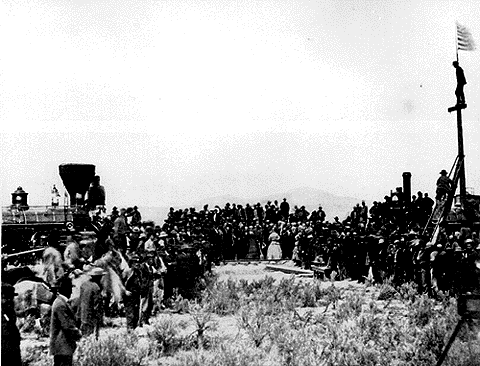
Union Pacific celebrates its sesquicentennial.  There's a steam train touring the railroad's historic territory (not including North Western and Missouri Pacific and the other lines that have subsequently become part of the system).

May 10 is significant to the carrier's history, as on that day in 1869, the last spikes were driven.


Happy 143d to the Transcon, and let the stack trains roll.  (And the coal.  And the corn.  And the pigs.  And the ethanol.)

GET RID OF THE TRAFFIC LIGHTS.

The Transportationist introduces naked streets.
In 2007, the Dutch city of Drachten did away with street lights in 20 four-way intersections, installing traffic circles instead. The shift caused a dramatic decline in the number of traffic-related deaths: one intersection went from 36 in the four years before the shift to two the year after. And vehicles now cross the junction 20 second faster.

"The idea is to create space where there is mild anxiety among everyone so they all behave cautiously. No one thunders along at 30mph on a high street thinking that they have priority," Owen Paterson, the Dutch Transport Minister, told Jalopnik. "Instead of the State laying down the rules, we need to give responsibility back to road users."
I hesitate to generalize from a small sample, but a few days ago a traffic light with a 90 second cycle was on the blink.  That 90 second cycle includes the left arrow, common in Illinois.  A lot of cars can back up in 90 seconds, particularly if the left arrow is in effect for the better part of a minute itself.  But cars don't arrive at that corner in packs because these aren't the busiest streets in town, and because it isn't near a shopping center with its out-of-synchronization access signals that generate packs of traffic.  So when the light is on the blink, drivers treat the flashing reds as a four-way stop, and with relatively infrequent arrivals of cars at the corner, wait times are a few seconds instead of up to two minutes.   Something similar might be at work to the advantage of drivers arriving at those Drachten rotaries.

A related article notes that there is a right way and a wrong way to time the traffic lights, in those areas where the traffic might be heavy enough to require signalling.
David Goldberg of Transportation for America says timed signals can be dangerous if they encourage drivers to speed through lights, and force pedestrians to wait too long for an opportunity to cross. He, like Flocks, is an advocate of systems like HAWK, which empower pedestrians to cross safely.

Flocks says timed lights can work if they're used correctly. She warns against systems that encourage drivers to speed up to get through as many lights as they can.

But some lights are designed to incentivize the opposite, she says. The key is the timing. If traffic lights are designed so that you have to speed a little to get through them all, then that's what drivers will do. But some cities have a system in place that punishes speeding drivers. Drivers going five to ten miles over the speed limit are stopped every third light. If you're going exactly the speed limit, you'll cruise down the road.
Those lights that favor the speeders are probably accidentally timed, if at all. There used to be several stretches of Warren Avenue in Detroit that somebody going 40 or faster could get a green at Grand and sail all the way to Wayne State without stopping, while somebody obeying the posted 30 (never enforced, even in those days) would encounter reds at each controlled corner. I encountered a stretch of U.S. 1 from Trenton to New Brunswick where I in my rental car was behaving myself and the locals were going 65 to 70 and making all the greens while, once again ...

Pedestrians are likely to be safer if the engineers make the effort to time the greens to encourage adherence to the speed limit, rather than putting signals in haphazardly with speeding-encouraging patterns that regular drivers discover.

SELECTIVE OUTRAGE.

The Perpetually Aggrieved in the academy can get annoying voices silenced.   It doesn't follow that the Perpetually Aggrieved refrain from stereotyping or in-group references in order to provide good examples for debating controversy.
What Riley did do was express a viewpoint on a very sensitive and controversial topic in academia, and a huge chunk of academia mobilized not simply to argue with Riley about the issue, but to ensure that she no longer had a platform upon which to express her opinions. It wasn't enough to simply convince people that they were right and the dissenter was wrong; as in so many FIRE cases, the dissenter had to be silenced in favor of those with the "right" opinions. Until our higher education culture rids itself of this compulsion, it will continue to poorly serve our students and our society at large.

The petition urging The Chronicle to fire Riley ended with the words "Viva civility!" If, in America, "civility" comes to represent banishing your opponents from the field of debate rather than debating them openly and fairly, this nation is going to have a very serious problem.
Liberating tolerance isn't that liberating, is it?

INTERCOURSE BECOMES CLOTHED WITH A PUBLIC INTEREST WHEN IT AFFECTS THE PUBLIC AT LARGE.

You get headlines like that when an economist schooled in public utility economics encounters a National Review editorial calling for a restrictive view of marriage.
The only good reason to have marriage laws in the first place — to have the state recognize a class of relationships called “marriage” out of all the possible strong bonds that adults can form — is to link erotic desire to the upbringing of the children it can produce.

We have already gone too far, in both law and culture, in weakening the link between marriage and procreation. To break it altogether would make the institution of marriage unintelligible. What possible governmental interest is there in encouraging long-term commitments with a sexual element, just as such?
A previous editorial addresses objections other commentators raised to that position.  A sentence toward the end raises a critical question. "The symbolic message of inclusion for same-sex couples — in an institution that makes no sense for them — would be coupled with another message: that marriage is about the desires of adults rather than the interests of children." Implicitly, it is the state, and not the culture, that is protecting the interests of children.  Doesn't that imply a competence for the state in protecting the interests of children that it has not demonstrated when it comes to providing education, or school lunches, or safe neighborhoods?

Put another way, the culture is doing just fine in protecting children -- in neighborhoods where the adults act responsibly, and not so well -- in neighborhoods where the adults don't.  Maybe it's time for the editors at National Review to unbundle government from culture, or Caesar from Christ?

9.5.12

UNIVERSITIES ARE FAILING AT THEIR MISSION.

The house organ for Business as Usual in Higher Education invites journalist Naomi Schafer Riley to participate in their Brainstorm forum, and she says some unkind things about area studies dissertations,  and the Perpetually Aggrieved do what they perpetually do, so the editor continues Business as Usual in the expected way.  Constructive self-criticism is collegial these days.
Since Brainstorm was created five years ago, we have sought out bloggers representing a range of intellectual and political views, and we have allowed them broad freedom in topics and approach.  As part of that freedom, Brainstorm writers were able to post independently; Ms. Riley’s post was not reviewed until after it was posted.

I realize we have made mistakes. We will thoroughly review our editorial practices on Brainstorm and other blogs and strengthen our guidelines for bloggers.
Long Live Comrade Stalin.

Minding the Campus has a list of recommended readings, from a variety of perspectives, on the post and the subsequent reaction.

Peter Wood, who holds the title of Most Favorite Administrator at Cold Spring Shops, has not yet been purged from the Innovations forum, but he's clearly showing sectarian and deviationist tendencies.  (Sorry, that doesn't sound so good in English.  There's a reason the murderer in Crime and Punishment is named Raskolnikov.)
So why did Riley’s opinion arouse such fury? It fell within the category of unspeakable observations in higher education—unspeakable because to voice them is almost certain to provoke outrage. The outrage is all the hotter because many people share Riley’s view that “black studies” and its variants are intellectually shallow and academically superfluous. To criticize, let alone mock, fields like this touches on higher education’s troubled conscience.

And higher education’s conscience is troubled because of the history behind such fields. Their rise owes less to signal intellectual accomplishments than to university administrators seeking to appease vocal constituencies. We have a collective pretense that the fields (black studies being the preeminent example) that combine identity group solidarity, a program of social change, and a fair amount of advocacy are “real” academic disciplines. It is impolite to call such pretenses into question because doing so unsettles some of the tacit agreements that undergird identity politics in American higher education.
Political correctness contributing to the failure of higher education? Where did we hear that first?

But the people calling for Ms Riley to be purged and exiled do a more effective job of illustrating those failings.  Poet Gina Barreca, hoping not to have to provide a Creative Response to Just Criticism, offers an uncreative response whose ending disclaimer fails to impress Benjamin Plotinsky, who has a real Ph.D. from a real university.
What I can say is that, as poetry, it’s an embarrassing failure — the work of a writer who doesn’t understand the first thing about verse, comic or not. The first stanza is a badly scanning limerick. The second and third stanzas abruptly change the meter and rhyme scheme to something resembling Lewis Carroll’s The Hunting of the Snark. The final stanza shifts abruptly again: It’s a quatrain with an AABB rhyme scheme and four lines of anapestic tetrameter. The one formal characteristic that unites the poem is how badly it scans throughout; I’d call your particular attention to the lines beginning “Where no one paid her” and “Poor NSR chewed off,” both of which utterly fail to be the anapestic trimeter that they’re supposed to be.
I suppose, though, that because his reaction is in National Review, it can be dismissed as so much bourgeois formalism.  So too must it be with The Wall Street Journal, which has called the house organ of Business as Usual the Comical of Higher Education.
That last sentence encapsulates the intellectual corruption of academia, a profession that ought to encourage intellectual adventurousness, not pander to those who are unable to withstand the "distress" of having their ideas challenged. But we've been irremediably cynical about academia since our undergraduate days. In our own field of journalism, however, we still recoil at a display of perfidy.

It is sometimes a useful exercise to take the things that people say at face value, especially when that is counter to their intended construction. Let's apply that technique to McMillen's post from last night.

According to McMillen--whose bio informs us she has been with the Chronicle for over a decade and has been its top editor for nine months--she was ignorant of the publication's "basic editorial standards" until a thousands-strong mob set her straight in the course of seeking to silence one of her writers.
Subsequently,the Journal goes after The Cravenness of Higher Education.
It is hard not to note the context in which Ms. McMillen dismissed Naomi Riley for committing speech.  Now more than ever, too many college graduates discover that their expensive higher educations send them into a modern workplace with skills that few employers want or need.  The graduates sit home, unemployed and unemployable.  Meanwhile, back inside the school walls, the Chronicle of Higher Education stands ready to eliminate any writer who causes distress to the modern generation of scholars who teach these students.
I invite the Journal's recruiting team to one of our job fairs.  Perhaps they're paying too much attention to the culture wars in the Ivies, and a visit to the land-grants and the mid-majors might counteract the daily running of the Occupy gauntlet of spoiled kids that is coloring their attitudes.

A FISH WITHOUT A BICYCLE.

As long as Julia has Barack Obama, she can get by without a man.

There's a hilarious send-up of the presentation, which has been laughed unto scorn all over the internet, at Reason.  Here's Jennifer Rubin, unimpressed by those fish.  "I would briefly note the irony of the liberal feminists’ idealized single woman: no husband and utterly dependent on government. This is progress?" She endorses a William Bennett reaction.
Julia's entire life is defined by her interactions with the state. Government is everywhere and each step of her life is tied to a government program. Notably absent in her story is any relationship with a husband, family, church or community, except a "community" garden where she works post-retirement. Instead, the state has taken their place and is her primary relationship.
Indeed so, but Mr Bennett notes it takes something more substantive than Not Obama to replace Our President. "Conservatives must be able to provide Julia an alternative vision for a better future. Without it, Julia might have nowhere else to turn but to the government, and that is nothing to laugh about." Puts the continuing Culture War circuses in perspective, doesn't it?

CHICAGO, WISCONSIN.

An instructive book titled How the States Got Their Shapes explains that Pennsylvania, Indiana, Illinois, and Minnesota all received special consideration by Congress in obtaining a Great Lakes coast.

In Illinois, a man named Nathaniel Pope merits mention on a historical marker, located on approximately the original Wisconsin border, Plankinton, er, Ogden Avenue.
Along Route 34 between Somonauk and Sandwich is the Sannauk Forest Preserve, and in the middle of that 72-acre woodlands is a state historical marker placed there in 1989. It reveals how this county and 13 others in northern Illinois almost ended up in Wisconsin. I just came across this bit of trivia last week and went to the library to learn more about Nathaniel Pope’s influence on Illinois.
It's possible that Mr. Pope, and not the elder Mayor Daley, invented the Illinois tradition of keeping dead people on the voting rolls, in his case in order to have sufficient people enumerated within the borders of the proposed state to qualify as a state.  But in so doing, he created a free state with a southern boundary south of Richmond, Virginia.
[Pope] wrote an article for the Western Intelligencer newspaper explaining his maneuvers in Congress. It turned out to be a brilliant plan because it gave Illinois a better foothold on the Great Lakes to help commerce, added thousands of acres of fertile farmland, and because half the population lived in this northern section, it later proved valuable in assuring the state would vote to stay in the Union and oppose slavery.
Perhaps in that transaction is the beginning of the Chicago and Downstate split. South of Plankinton, er, Ogden Avenue, Illinois takes on a more southern tone, complete with loyalties to the Cardinals rather than the Cubs or White Sox.  Cairo, however, had great value as a jumping-off place for Grant and Sherman.

TONIGHT'S RAILROAD READING.

Salem, Massachusetts, will be getting a new commuter train station with additional parking capacity.  Site preparation for the parking deck has uncovered the foundations of the Salem roundhouse.  The article helpfully explains what a roundhouse is.
The roundhouse is a remnant from the steam locomotive days. It was a large brick building with a turntable in the center, surrounded by a dozen stalls where locomotives were repaired and stored at night.

The locomotives were driven onto the turntable, which would rotate, allowing the trains to pull into a stall. The building had a coaling tower and water tank. At night, workers called "hostlers" fed the boilers to keep the steam engines running.
The noun, hostler, originally referred to the stableman who made sure that flesh-and-blood horses were not put away wet after being ridden hard. The iron horse required similar care and feeding.

It's unfortunate that relatively few turntables have made it onto preservation railroads.  There's drama in bringing a steam locomotive out of its stall, balancing it on the turntable, then turning it to move to the ready track and thence to station or yard.

The archaeological report Massachusetts will receive promises to be of use here, as a model Salem engine terminal is part of the model railroad still a-building down cellar.

TAX INCIDENCE.

Some thoughts on taxing corporate income as personal income from Laura Tyson.
According to conventional wisdom, the corporate-tax burden is borne principally by the owners of capital in the form of lower returns. But, as capital becomes more mobile, relatively immobile workers are bearing more of the burden in the form of lower wages and fewer job opportunities. That is why countries around the world have been cutting their corporate-tax rates. The resulting “race to the bottom” reflects intensifying global competition for capital and technological knowhow to support local jobs and wages.

Moreover, a high corporate-tax rate is an ineffective and costly tool for producing revenues, owing to innovative financial transactions and legal tax-avoidance mechanisms. A company’s legal residence and geographic sources of income can be and are manipulated for such purposes, and the incentives and scope for such manipulation are especially large in sectors where competitive advantage depends on intangible capital and knowledge – sectors that play a major role in the US economy’s competitiveness.
Via Greg Mankiw. Collegiality exists among veterans of the Council of Economic Advisors.

Learn Liberty contributes a video primer on tax incidence.


It's been featured by Coordination Problem and Professor Munger asks, "Are Corporations People?"

NO FISHING OFF THE COMPANY PIER.

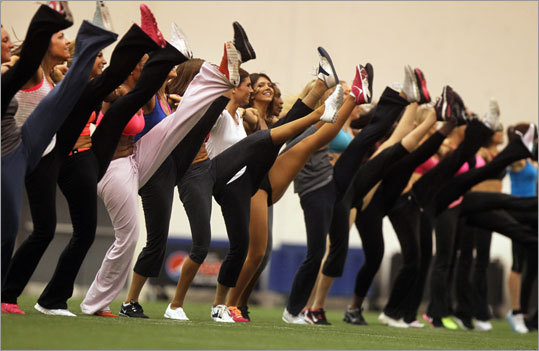
The Boston Globe sends a reporter to boot camp for Patriot cheerleaders.


Boston Globe photograph by Stan Grossfeld.

Yes, go to the story for the eye-candy, but scroll through for the news.  Cheerleaders serve for no more than three years, and they are not allowed to socialize with the players.

7.5.12

WORKING HYPOTHESES CANNOT BE AD HOC.

Cold Spring Shops posts have used the label "fourth turning" in reference to events that might lead to a major change in established institutions or the Way Things Ought Be Structured.  The label is simply a label, and ought not be freighted with any inference of precision.

So, too, must it be with generational analysis generally, if recent attempts by pop culture mavens and marketers to typecast the current cohort of babies is any indicator.
"No one knows who will name the next generation," says Neil Howe, who, along with his deceased co-author and business partner, William Strauss, is widely credited with naming the Millennials, a generation he figures spans from about 1982 to 2004. Millennials, he says, lived during a huge cultural change in how to nurture children. It was the era of the Baby on Board stickers. Cocooning. Over-protected kids.

And, arguably, he's got early dibs in to name the next generation, as well. His company sponsored a website contest in 2005, and folks voted overwhelmingly for the "Homeland Generation." That was not long after 9/11, and one fallout of the disaster was a nation that felt more safe staying home.

But he's not set on that name. "We're not totally wed to it," he says. "We've resisted the temptation to name the next generation until we think the Millennial Generation has run its course." That will be a while, he says, because the heart of the next generation is still mostly in nursery school.

Even then, he says, others are trying way too hard to slap a name on them. "Names are being invented by people who have a great press release. Everyone is looking for a hook."

He knows why. Naming the Millennial Generation back in 1989 has been a boon for his own business, though he downplays it. It's made him relatively famous. His best-selling book,Millennials Rising: The Next Great Generation, was published in 2000, and he is now a must-book speaker in demographic circles.
Millennials Rising followed The Fourth Turning, but before The Fourth Turning was Generations: The History of America's Future, 1584 to 2069, the subject of this evening's Book Review. No. 13.  Generations prefigures The Fourth Turning (the churlish will note that many of the most colorful passages in Turning are lifted verbatim from Generations) but it also suggest that generation-naming, and epoch-naming, are ad hoc at best, and as a theory of social development, it might work best retrospectively.

Thus Generations begins with a comparison of President Kennedy's inaugural parade with that of President Bush the elder.  Both Presidents served with distinction in World War II, and their inaugural parades were slices in time of the G. I. Generation in rising middle age and in elderhood.  Working hypothesis: epochal events shape cohorts of individuals, in the case of the G.I.s a massive coming of age challenge combining economic distress and global war.

The complementary proposition, however, of cohorts of individuals shaping the epochal events, is less persuasive.  The most destructive epochal event of the Anglo-American saeculum, namely the secession crisis and Civil War of the late 1850s and early 1860s, is an anomaly in the Generations framework, in which there is neither a four-cohort (Idealist, Reactive, Civic, Adaptive) stratification of the population nor a four-duodecade (Awakening, Inner-Driven, Crisis, Outer-Driven) divison of the lifespan.  (In Fourth Turning, these terms are clarified as respectively Prophet, Nomad, Hero, Artist cohorts and Awakening, Unraveling, Crisis, High eras.)

Increased lifespans, the authors suggest, also have the potential to change the interaction of cohorts.  With relatively few sixtyish or older members of the currently oldest cohort, a generation's hold on positions of elder influence attenuates quickly.  The authors do not explore all the possibilities of those longer life-spans for disrupting or modifying the historical cycles, although their discussion (from the early 1990s) of the G.I. Generation (Civic or Hero, came of age during World War II) notes their long tenure in the Presidency (1961-1993, as subsequent events prove.)  They project Baby Boomer presidencies commencing in 2000 until 2020, with Thirteenth Generation presidencies after 2020.  In reality, two Baby Boomers, neither noted by the authors as prominent politicians (the smart money was on Albert Gore the younger and Newt Gingrich in those days) served eight year terms commencing in 1993, and Barack Obama, more like a Thirteener than a Baby Boomer, began his first term in 2009.  Perhaps some future analysis will suggest the Boomers and the Thirteeners ascended to national office too soon, although what those officeholders did has to be viewed against the events they reacted to.

Those events included the hung election of 2000, the September 11 terrorist attacks, the collapse of exotic finance commencing in 2007, and the unraveling of the European monetary union.  Generations anticipates a secular crisis commencing around 2010 (a little late) with a resolution in the late 2020s.  The public response has been a mix of internal dissension (characteristic of the 1960s), deferral and calls for compromise (characteristic of the early 1990s), and exaggeration of the threat and calls for consensus (worked after Pearl Harbor, not at all characteristic of the early 2000s).

Whether we are looking at the first draft of a logical hypothesis, or a pop-culture distraction, will be left to the reader as an exercise.

(Cross-posted to 50 Book Challenge.)

COMPARE AND CONTRAST.

Three economists suggest that the continued to-ing and fro-ing of Washington politics keep the capital on the sidelines.
When businesses are uncertain about taxes, health-care costs and regulatory initiatives, they adopt a cautious stance. Because it is costly to make a hiring or investment mistake, many companies will wait for calmer times to expand. If too many businesses wait, the recovery never takes off. Weak investments in capital goods, product development and worker training also undermine longer-run growth.

So how much near-term improvement could we gain from a stable, certainty-enhancing policy regime? We estimate that restoring 2006 levels of policy uncertainty would yield an additional 2.5 million jobs over 18 months. Not a full solution to the jobs shortfall, but a big step in the right direction.
The way forward, though, depends on your perspective.  Victor Davis Hanson suggests that resolving the certainty in favor of President Obama and the Democrats' vision of forward will keep the resources idle.
The only thing more discouraging to investors than class warfare generally is a certain type of class warfare: a hypocritical crusade that emanates from the upper classes and selectively targets enemies on the basis not of wealth, but of the degree to which they have failed to buy exemptions with their wealth. Meanwhile, on the other end, the message is more weeks of unemployment insurance, vastly more food-stamp recipients, and constant promises of mortgage-debt relief, credit-card-debt relief, and tuition-debt relief. If one were to dream up a perfect way to destroy incentives on both the top and bottom ends, one could do no better than what we have seen since 2009.

The net result is that those with capital, even if they are small businesses, do not believe that the Obama administration likes them. They feel that regulations will increase, that taxes will increase, that energy costs will increase, and that as they pay more to government and keep less, government will nevertheless become even more arrogant and inefficient — and they will become even more demonized. When people pay over 50 percent in payroll, federal, state, and local taxes and are still caricatured as “not paying their fair share,” a sort of collective shrug follows and bodes ill for the economy at large. One need not be liked to make money, but the constant presidential harangues finally take their toll in insidious ways.

Countless times each day, a contractor chooses to hire only a part-time electrician, a CEO hoards cash rather than opens a new plant, a renting family declines to buy a reasonably priced new house, an indebted graduate heads home to kick back and wait until “something turns up,” and an unemployed worker wonders whether it is not wiser to receive all two years of federal benefits before reentering the work force.

I don’t know whether Mitt Romney’s economic package will bring instant prosperity. But I suspect that the fact alone that it is not what we have seen and heard for the last four years will unleash a pent-up energy of the sort we have not seen in a long time. In short, President Obama has achieved the impossible — he has convinced millions of rational, profit-minded Americans eager to invest, buy, and hire that he doesn’t worry much whether they do.
Robert Reich disagrees.
[Stock prices] are up because corporate profits are up, and profits are up largely because companies have figured out how to do more with less.

Payrolls used to account for almost 70 percent of the typical company’s costs. But one of the most striking legacies of the Great Recession has been the decline of full-time employment – as companies have substituted software or outsourced jobs abroad (courtesy of the Internet, making outsourcing more efficient than ever), or shifted them to contract workers also linked via Internet and software.

That’s why most of the gains from the productivity revolution are going to the owners of capital, while typical workers are either unemployed or underemployed, or else getting wages and benefits whose real value continues to drop. The portion of total income going to capital rather than labor is the highest since the 1920s.
There is, unfortunately, no compromise between those conflicting visions, out of which a modicum of policy consistency might emerge long enough for some of those idle resources to be put to use in a sustainably productive way.

FAREWELL TO FOOTBALL?

A number of writers come to the same conclusion: tackle football is hazardous to the health of young people.  Never mind that there's nothing more American than episodes of violence interrupted by committee meetings.

Here's Buzz Bissinger in The Wall Street Journal.
In more than 20 years I've spent studying the issue, I have yet to hear a convincing argument that college football has anything do with what is presumably the primary purpose of higher education: academics.

That's because college football has no academic purpose. Which is why it needs to be banned. A radical solution, yes. But necessary in today's times.
The analysis is cold-blooded: participating in the positional arms race is crowding out resources from the rest of the academic mission.
The average student doesn't benefit, particularly when football programs remain sacrosanct while tuition costs show no signs of abating as many governors are slashing budgets to the bone.

If the vast majority of major college football programs made money, the argument to ban football might be a more precarious one. But too many of them don't—to the detriment of academic budgets at all too many schools. According to the NCAA, 43% of the 120 schools in the Football Bowl Subdivision lost money on their programs. This is the tier of schools that includes such examples as that great titan of football excellence, the University of Alabama at Birmingham Blazers, who went 3-and-9 last season. The athletic department in 2008-2009 took in over $13 million in university funds and student fees, largely because the football program cost so much, The Wall Street Journal reported. New Mexico State University's athletic department needed a 70% subsidy in 2009-2010, largely because Aggie football hasn't gotten to a bowl game in 51 years.
There's no academic analogue to Ronald Reagan calling the Bowl Championship Series an evil empire yet, in order that the mandarins of big time football can be properly mocked.  But there is much to mock.
The president there, Wallace D. Loh, late last year announced that eight varsity programs would be cut in order to produce a leaner athletic budget, a kindly way of saying that the school would rather save struggling football and basketball programs than keep varsity sports such as track and swimming, in which the vast majority of participants graduate.

Part of the Maryland football problem: a $50.8 million modernization of its stadium in which too many luxury suites remain unsold. Another problem: The school reportedly paid $2 million to buy out head coach Ralph Friedgen at the end of the 2010 season, even though he led his team to a 9-and-4 season and was named Atlantic Coast Conference Coach of the Year. Then, the school reportedly spent another $2 million to hire Randy Edsall from the University of Connecticut, who promptly produced a record of 2-and-10 last season.
Sunk costs, or throwing good money after bad?  Coach Friedgen, however, has been on double-secret probation ever since his team went into DeKalb ranked 15th in the country and lost in overtime in the "Immaculate Interception" game.  Ever since then, the administration at Northern Illinois has sought greater visibility in football, most recently lining up private financing for an indoor practice field, ostensibly to be made available to all students.  (A Cold Spring Shops source within the athletic department suggests that the field may be made available to other student-athletes, as the locution goes, on a space-available basis, which suggests little or no availability to students for indoor exercise or Ultimate Frisbee.)

Mr Bissinger refers to public recognition of the medical consequences as further reason to scale football back.  Last Friday, Rush Limbaugh reacted to a related column by detecting new Fabian gradualism at work.
My point with this is just that I know who these people are, and now that this is being speculated about on a tech blog, wait 'til the forerunners of the liberal sports media get hold of it.  Even though their bread is buttered with this stuff, I know these people.

Some of them are leading the charge and don't even know it with the way they're covering the sport.  Some of them are leading the charge for getting the game banned and  they don't even know it! By the way they're covering it.  They're demanding this and demanding all these new safety features, safety regulations, safety rules. Empowering the government to police the game.  They're begging for it, and they don't even realize it.  They, in their naivete, think they're working hard to make the game safer and so forth, and all they're doing is paving the way for the game to be banned.
Not a tech blog, by the way, a sports site with economists on retainer, occasionally Instalanched.

Moviemaker Sean Pamphilion also concludes, after a good deal of work with football players, that the game is poisoning the common culture.
I interviewed the principal of my son's junior high school today because they just eliminated their tackle football program. I am not personally advocating for the banning of football on any level. However, this is a public health concern and needs to be taken seriously.
There's the opening for the Fabian gradualism. Rooting football out, however, will take time, as it is well-established.
It's about the culture. Everything trickles down. I've seen coaches in amateur football, like young kids, speak in a way that you should not speak to children. I've seen high school coaches scream and curse at these kids for making a mental error—well, what if a kid makes a mistake on a math test? Does the teacher get to start screaming, "You're fucking up!"

Why do we give these football coaches this anointed position? What other sport besides football do these guys get to treat our children like pawns? One of the things I asked people throughout making the film was, "Should coaches be vetted the way we vet teachers? Or should they just be guys with football experience?"

To me, [Saint defensive coordinator Gregg] Williams was the height of this mentality. People say that's just a part of football culture. Well, the culture needs to change. It has to change.
University Diaries asks, probably in jest, "What would our universities do without it?" I've been known to tell new administrators, when we cross paths at one of the football related university meet-'n-greets, that there have been a lot of good things going on here long before the BCS run of 2003, or the 2011-2012 mid-major championships.

There will be a New York University Ban College Football debate on May 8.  The event is sold out, but there will be a web-cast.

3.5.12

TONIGHT'S RAILROAD READING.

Once a week, the Vivek Express transits the east coast of India.  It's not the East Coast Champion, as an Economist report reveals.
SPENDING four days on a crowded, grubby train as it trundles over 4,200 kilometres, past 615 stations, and through eight states in India, is a lesson in endurance. Splash out 2,500 rupees (around $50) and you may board the newly inaugurated Vivek Express, the world’s eighth-longest train ride. A weekly service, for the first time it connects directly, by rail, the far north-east of the subcontinent—the seven poor and neglected states stuck on the wrong side of Bangladesh—through “mainland” India and down to its southernmost tip, at Kanyakumari.
There's no mention of dealing card games with the old men in the club car, but you have to pass the paper bag that holds the bottle.
The middle-aged, the men, pass their hours furtively swigging on bottles of rum and whisky and then subsiding into sozzled sleep. This is strictly against train rules so they cower behind curtains when pouring their shots. “The tipsy train”, observes a laconic young Indian novelist, along for the ride.

A telling detail is the beep of mobile phones. Not only does everyone appear to have one, the coverage along the entire journey is unbroken. For a Briton used to wretched phone reception on a densely populated small island, the triumph of Indian telecoms is self-evident.
India is thickly settled enough that there's no place for a train to run out from cellular coverage, which can happen on Amtrak's long-distance trains, sometimes to the annoyance of people who have to be wired, even if there's a pinochle game in progress.

Some truths are universal.  To learn something about a country, ride its cross-country trains.
Fellow passengers, of course, offer the most. A companion in your correspondent’s cabin, who boarded in Dibrugarh, rides all the way south to Kerala. He calls himself Mr Kamil, tells stories of being a trader in coconuts and “small things”, and of roaming the country for work over the past 27 years.
That's true on the City of New Orleans and the Sunset Limited and any other long-distance train.

ENGINEERS IN MOTION.

On a recent visit to the Milwaukee School of Engineering's art collection, I learned that the dance team had performed at a Milwaukee Bucks basketball game.

That's one way to turn engineering and business into something other than a male preserve.

HISTORIANS, NOT RE-ENACTORS.

But the First Brigade Band provided excellent music to drive Old Dixie down.
From 1861-'62 and again in 1864-'65, the Brodhead musicians played quick steps, or marches, to move soldiers and materiel, they serenaded troops in camp and at send-offs, and provided music at ceremonies, balls and Sunday worship services. They joined Gen. Sherman in Savannah, Ga., for the march through the Carolinas, playing "The Anvil Chorus" from Verdi's opera "Il Trovatore" as South Carolina's capital fell to the Union Army.

No Brodhead band members were killed or wounded, but many became ill, common in unsanitary military camps.
From that perspective, even the re-enactors are really historians, as there's little interest in re-enacting diphtheria.

Historians, re-enactors, or conservators of original instruments, the First Brigade Band is busy during the Sesquicentennial.

ANOTHER CUBAN MISSILE CRISIS?

The secret deal that ended the 1962 standoff involved the USSR publicly agreeing to remove its nuclear missiles from Cuba, with the USA subsequently removing some obsolete missiles from Turkey.

There are more modern missiles in Turkey, and the heirs to Khrushchev, heck, to the Romanovs, aren't pleased.
The U.S. repeatedly has said the European missile-defense system is designed to fend off an attack by Iran, but Russia has insisted that the system would blunt its own arsenal. Moscow has proposed to jointly operate the missile shield, but NATO has rejected the offer.
No automatic alliance with Cuba to provoke an arms reduction agreement by basing missiles there, and no Ronald Reagan to consider joint use of a strategic defense system, which elicited no end of scorn from Democrats when he proposed to do so.

1.5.12

THANK YOU FOR LOOKING IN.

The usual summer slump, not unusual for an academic-themed weblog.  Then traffic begins to recover during the academic year.


Posting will continue during the summer months, although Higher Education provides less day-to-day material, and the election cycle loses interest until Labor Day.

PERPETUALLY TIRED IS PERPETUALLY UNPRODUCTIVE.

Here's a nineteenth-century perspective on fair labor standards.


It's a sentiment honored in the breach in the contemporary positional arms race called outworking the competition, but that positional arms race is a costly coordination failure.  (Via Economics Education.)
Research shows that consistently working more than 40 hours a week is simply unproductive.

For many in the entrepreneurship game, long hours are a badge of honor. Starting a business is tough, so all those late nights show how determined, hard working and serious about making your business work you are, right?

Wrong. According to a handful of studies, consistently clocking over 40 hours a week just makes you unproductive (and very, very tired).
The article is well-researched, and one of its sources suggests that business interests saw a gain in limiting the work week, all that talk from the labor unions about "fighting" for the weekend notwithstanding.  And it's time, that source suggests, for people to recognize the diminishing returns to long hours. "[T]he single easiest, fastest thing your company can do to boost its output and profits — starting right now, today — is to get everybody off the 55-hour-a-week treadmill, and back onto a 40-hour footing."

WISCONSIN MUST BE IN PLAY.

Our President's re-election theme for this year is "Forward."


It's in the song.  So is "Champion of the right," but that is probably not a political allusion.

Or perhaps he intends to secure the Northern Illinois University vote, or a law school post.


In that song, there's victory in view.

To the partisans, though, the motto takes on a different cast.


Here's Victor Morton in the Washington Times, and a morning roundup at Betsy's Page.

COMPARE AND CONTRAST.

Watching other people identify your life's major accomplishments looks like this.


Writing down your life's major accomplishments for other people looks like this.


30.4.12

NICHT KLECKERN, KLOTZEN!

Adolf Hitler himself countermanded one of Heinz Guderian's principles of armored warfare, with the intention of more quickly dividing the Allied forces in Belgium from those in France in order to prepare an encirclement of the remaining French armies south of the Somme, in order to avoid a replay of 1914-1918.  It worked.  Whether that countermand made Hitler sure enough of his instincts as to make him contemptuous of his generals when the military situation got worse historian Ronald Powaski doesn't say.  His Lightning War: Blitzkrieg in the West, 1940, tonight's Book Review No. 12, is a readable, relatively short account of the proper implementation of the Schlieffen Plan.  (First, you make a temporary alliance with the Russians.)  The accounts from the Belgian, British, French, German, and Netherlands point of view appear in their turn.  There are several useful maps.  Professor Powaski is careful about drawing inferences about missed opportunities, the most significant event being the British evacuation of Dunkirk.  Yes, another Hitler countermand arises.  All the same, Dunkirk was close enough to Britain for the Royal Air Force to contest the skies, for the Royal Navy to operate under cover of British shore defences, and perhaps the British were losing the war faster than the Germans could win it, dashing panzer columns notwithstanding.

(Cross-posted to 50 Book Challenge.)

THE SEVENTY-SEVEN CENT CANARD.

It's easier for hack journalists to repeat soundbites than to analyze the facts.  Here, Rachel Maddow finds meaning in the comparison of medians. The video is not for the faint of heart.


Kay Hymowitz notes that those median differences conceal tough tradeoffs, and more generous family leave policies in Scandinavia accompany countries with differences in median income by sex.  (Note carefully: "accompany" carries no implication of cause or effect.)

But it's so much easier to smirk, "Listen, this is not a math is hard type of conversation."  Republican strategist Alex Castellanos's response, "If so, every greedy businessman in America would hire only women, save 25% and be hugely profitable" ought be deployed whenever misconceptions about pay inequities come up.  But to the women of the fevered brow, passing a law with a high-sounding title means there is a problem and it has been fixed.
But given that some of us believe that women are getting paid less than men for doing the same work, there is something called the Fair Pay Act.  There was a court ruling that said the statute of limitations, if you're getting paid less than a men, if you're subject to discrimination, starts before you know that discrimination is happening, effectively cutting off your recourse to the courts.  You didn't know you were being discriminated against.  You can't go.

The first law passed by this administration is the Fair Pay Act. 
That the short title says it is such an act does not make it such an act. That is where market tests do come in.

NO ORPHANED TRAINS IN ILLINOIS.

Although Wisconsin's almost-finished and not-quite-big-enough Talgo trains may never turn a wheel in revenue service in the midwest, Illinois and California are combining their purchase of coaching stock for the accelerated service on Illinois lines out of Chicago and augmented California service.
The $551 million request for proposals was announced by the Federal Railroad Administration, which is coordinating a California-led effort to purchase standardized bi-level rail fleets for use on Amtrak routes in California, Illinois, Michigan, Missouri, Indiana and potentially Iowa.

California will acquire 42 of the 130 new rail cars, which will be equipped with seating on two levels, WiFi and other customer amenities, officials said. The Midwest states will share use of 88 rail cars.
The existing California cars, on the San Diego and Bay Area services, are impressive. They're also capable of giving Britain's long-serving 43 Class Inter-City 125 trains a run for their money.
Existing Amtrak locomotives would be used initially to propel the new rail cars at speeds of up to 110 mph.

Bids will be let later to purchase new high-performance diesel locomotives capable of sustaining 125 mph, as well as for single-level passenger cars, officials said.
That "propel" might be a solecism, or it might anticipate push-pull operation. Is it too much to hope that the California cars might not go faster with a dual-mode electric under catenary?

ESCALATE THE POSITIONAL ARMS RACE.

The University of Wisconsin - Milwaukee provides college for more Wisconsin residents than Madison does.  It has long been the Cold Spring Shops position that UWM continue to raise its academic posture, rather than reposition itself in the sports world.

Nothing, though, has the staying power of a bad idea.
A 30,000-enrollment school must be called the University of Milwaukee for proper athletic branding. It certainly doesn't hurt in places such as Memphis, Cincinnati, Louisville, Houston and Pittsburgh.
Pittsburgh has a long academic tradition, it's across the street from Carnegie-Mellon, which also has a long academic tradition, and Pittsburgh's Cathedral of Learning inspired the Stalinist pile that houses Moscow State University.  If that's part of the branding, fine.  There are solid academic programs at the other institutions, although these names usually come up in late February or early March as "good basketball schools," not necessarily a compliment.

It's not enough, though, to raise the basketball profile.
Finally - and this is where the new [athletic director] cannot be afraid of butting heads with small-thinkers in this town - UWM should restore football.

Adjacent Shorewood High School is almost ready-made for a small, start-up non-scholarship program. Have a fundraiser for bleachers that would seat about 5,000. Better yet, find a stadium that is about to be razed and buy its seats on the cheap.

Hire UW-Whitewater coach Lance Leipold, who has built the best Division III program in the country. He does it without scholarships and with players from suburban Milwaukee, Madison and Northern Illinois. You're telling me he couldn't make it work at a place that deserves to be called the University of Milwaukee?
Thus does the quest to become the next Northern Illinois which aspires to be the next Boise State, never mind the expense, begin.

Those secondhand seats?  Look for the latest high school to upgrade its athletic plant.

29.4.12

ONE MORE SUMMER, ONE MORE LINE.

Genl U. S. Grant famously described his 1864 Overland Campaign with a line, "I propose to fight it out on this line if it takes all summer."  That campaign took more than the summer, but ended the war, at a lower human toll than that levied by his predecessors in the east.  Twenty years later, the now past-President Grant lent his name to a Ponzi scheme (as events transpired) set up by Gilded Age hustlers Ferdinand Ward and James D. Fish.  The Ponzi scheme unraveled, and Mr Grant contracted a cancer.

To provide his survivors with an income, he, in partnership with Mark Twain, contracted to write his memoirs.  Grant's Final Victory: Ulysses S. Grant's Heroic Last Year, is the account of that writing.  Book Review No. 11 will note that it is a lot more.  Samuel Clemens, for instance, deserted to Nevada from a Missouri Rebel unit that was being pursued by the 21st Illinois Regt, then under the command of Col Grant.  President Grant expressed regret about the conquest of the Southwest from Mexico, and anticipated the potential of the U.S. as a world military and commercial power.  The reader will also learn of a Presidential appointment of a three-year-old grandson to West Point (yes, there was a Genl Ulysses Grant in service in both World Wars) and of other contemporary military histories of the Civil War that might make for instructive reading.

(Cross-posted to 50 Book Challenge.)

WE EXPECT THIS OF URBAN WARD-HEELERS.

Waukesha County clerk Kathy Nickolaus does not fit the profile of an urban ward-heeler.  Several vote counts from Waukesha, however, have looked like something the elder Mayor Daley would have organized.
Nickolaus drew criticism last year during a tight state Supreme Court race when she announced nearly two days after the election that she failed to include 14,000 votes from Brookfield in her unofficial totals. The error helped lead to a statewide, taxpayer-financed recount and flipped what appeared to be a close loss for Justice David Prosser to a 7,000-vote victory.

A state Government Accountability Board investigation found Nickolaus violated state law in how she reported election results, but without criminal intent.

Results have been slow in other races, as well. During the April 3 election, Nickolaus failed to post timely election results online and update them periodically for the public, as promised.
She will not be standing for re-election.