21.8.12

FAILING THE MARKET TEST.

Kiplinger describes anthropology as the worst college major for your career.
Many of today's anthropology grads are studying a culture they didn't expect: the intergenerational American household, as seen from their parents' couch. New anthropology majors face stifling unemployment, forcing nearly a third to take low-paying office or sales jobs. More dramatically, recent grads stand to make a mere $28,000 per year – less than the median pay for someone with only a high school diploma. If foreign cultures are your thing, a major in international relations promises both a higher salary and lower unemployment rate.
Snark begets snark, and Living Anthropologically sees the advantage in not being a corporate tool.
Anthropology is the worst college major for immediate career, but anthropology is the major most likely to change your life. And anthropology may help you change the world, although standard disclaimers about “starving artists” apply. But anthropology is also a great major to acquire lifelong learning skills–language, culture, thinking, writing, analysis–that enables success in several careers. Perhaps paradoxically, anthropology is a great major for analyzing corporations and capitalism, and you probably have just as much chance–if not more–of landing in the top 1% as an anthropology major as you do with any of those Kiplinger top 10 college majors.
Once upon the time, the first two years of college, when it was still a liberal arts core curriculum, rather than a general education cafeteria, served that purpose.  Somewhere, though, anthropology narrowed its focus, turning the attempt to understand the varied ways in which people interact into yet another manifestation of identity politics and vulgar Marxism.
Of course, changing capitalism is an arduous task, and there are the practical realities of needing a job, of wanting to do something vaguely interesting, of repaying student loans. But here, a rigorous anthropology major should provide skills to navigate a changing world in which graduates will have several careers, not just one.
The unstated premise is that capitalism is something that has to be changed. There might be case studies, not to mention models, of human interaction, that do not rely on division of labor and cash incentives in the way industrial economies do. But emergence and evolutionary stability might provide better explanations of the creation of those societies than some sort of vanguardism.  Apparently the powers that be in anthropology still aspire to be vanguardists.
It is 2011 and I'm sitting in the Palais des Congres in Montreal, watching anthropologists talk about structural inequality.

The American Anthropological Association meeting is held annually to showcase research from around the world, and like thousands of other anthropologists, I am paying to play: $650 for airfare, $400 for three nights in a "student" hotel, $70 for membership, and $94 for admission. The latter two fees are student rates. If I were an unemployed or underemployed scholar, the rates would double.
The notorious job meetings, which can be an expensive proposition if a job-seeker goes to the conference with no interviews lined up.  It becomes an even more expensive proposition because the association has a preference for booking hotels in cities with living wage ordinances.  Better, I suppose, to stand on principle than to cut the job-seekers a break.

COOPERATING WITH THE INVESTIGATION.

Northern Illinois University welcomes the State's Attorney to the investigation of the coffee fund.
We welcome the continued involvement of DeKalb County States’ Attorney Clay Campbell in the ongoing investigation of the allegations regarding the existence of an NIU coffee fund account. Mr. Campbell’s office has been kept appraised of the investigation by NIU law enforcement, as his (Mr. Campbell’s) cooperation and assistance has been essential to proceed with the investigation. After all, the investigation itself was initiated by the university within less than two hours of receiving the allegations.

The integrity of this great university is not at issue. For over 110 years, thousands upon thousands of students’ lives have been transformed as a result of the educational opportunities they received at NIU. NIU will not cease investigating this allegation or any further allegations that may arise until a thorough and complete investigation is performed, no matter where it leads.

Right now, an investigation is underway by law enforcement into allegations of the existence of a coffee fund — these allegations are unproven and unsubstantiated until law enforcement concludes its investigation.

This university was built on values including integrity, fairness, due process and equality of opportunity. We remain patient and will continue to resist a “rush to judgment” until the investigation is complete.
Students are returning to campus, and it's likely there will be an episode of incivility in which the rush to judgement will precede the investigation. That's the job description for the Sensitivity Monitors.


The Daily Chronicle reports that a paper trail exists.
University officials responded to a Freedom of Information Act request from the Daily Chronicle on Thursday seeking any documents related to the coffee fund bank account. NIU spokeswoman Kathryn Buettner provided an interim report stating that “no university bank statements or accounts have been located with the name ‘coffee fund’ contained therein.”

Several canceled checks, one written as recently as June 30, have deposits made out to the coffee fund and were endorsed by a materials management employee “for deposit only.”
The paper does not stipulate that the payee or the endorsement account is referred to as coffee fund.

17.8.12

FREQUENCY AND CONNECTIVITY

Public officials in a number of Illinois cities are asking for more passenger trains. "'We’re not looking for high-speed rail, we’re just looking for more cars from Amtrak,' [Macomb state representative Norine Hammond] said."  Online (in the railroading sense of the term) colleges and universities provide much of the ridership.
Quincy Mayor John Spring talked of the huge increase in ridership along the corridor when the Carl Sandburg service was added to that provided by the Illinois Zephyr.

“This (adding the Carl Sandburg) was one of the best bipartisan pieces of legislation the state has ever embarked on,” Spring said. “Our part of the bargain was to provide the ridership.”
Now there are wishes for an expanded downstate service.
There was talk of expanding the coalition once it has a chance to get up and running. [Peoria state senator Darin] LaHood said he’d welcome an expansion to the Peoria area. [Gilson state representative Don] Moffitt talked of cities working together to someday persuade Amtrak to connect the Quad Cities, Galesburg, Peoria, Normal-Bloomington, Champaign-Urbana and Danville. He called it an “educational loop” that would provide service to at least 12 colleges.
Expanded rail networks aren't yet large enough that one line steals business from another. Participants in the meeting get that.
Officials were asked if they are concerned about plans for Quad Cities Amtrak service taking away ridership from the Chicago-Quincy corridor. Spring said the service is not seen as a threat.

“The Quad Cities, Rockford, we want more Amtrak service in this state,” he said. “We need to get these other cities connected. Ultimately, if we want to get rid of some of the congestion in this country, we need to put more people on trains.”

Spring said someone looking at license plates at the Quincy depot would see vehicles from Iowa and Missouri, as well as Illinois. He said he’d like to see Hannibal, Mo., eventually become part of the coalition.
Meanwhile, a railroad track currently capable of supporting 90 mph passenger trains is gloriously freight-only west of Elburn through DeKalb and on to Clinton and Cedar Rapids.

There are also encouraging developments in Florida.
Florida East Coast Industries is pursuing its plan to operate hourly passenger service between Miami and Orlando by 2014, reports the Miami Herald. The service would be privately owned and operated without any direct government subsidies.

The passenger service will utilize the Florida East Coast Railway main line and an additional 40 miles of track to be built to Orlando. Intermediate stops would include Fort Lauderdale and West Palm Beach. FECI expects to start construction in early 2013.
We'll be watching for developments there.

In California, however, budget constraints -- some of which reflect reduced fuel tax revenues account more hybrid and electric cars in operation -- have led to a reduction of service in the Capitol Corridor.
Effective Aug. 13, train No. 553 is being re-designated as train No. 551 and two westbound trips, previously scheduled to leave Sacramento at 6:40pm and 7:40pm, will be merged into train No. 549, which will depart Sacramento at 7:10pm. The last westbound departure from Sacramento will remain at 9:10pm.
Nice to have enough frequencies that passengers are inconvenienced by no more than an hour at quitting time. One eastbound train will be replaced by a bus.

THE CON THAT IS CONTEXT.

I was catching up on some magazines that piled up over the past few years, and in the January 2007 Reason was a meditation by Cheryl Miller on the pretensions of transgressive artists.
It’s hard to see the fight over [Richard Serra's] Tilted Arc as one of [author Michael] Kammen’s “healthy controversies.” If anything, the debate showed what a fraud so much “public” art is. As the critic Mark Stevens once put it, “If public art commemorates anything…it’s the artist himself.” Sorry, Henri [1920s artist Robert] —I’ll stick to drinking.
There's no shock value when that's the only technique the sculptors and painters have left.

16.8.12

ESCALATING THE POSITIONAL ARMS RACE.

The University of Wisconsin at Milwaukee, which local wags refer to as UCLA (University Close by the Lake Almost),  aspires, despite my misgivings, to raise its profile in sports.  As part of that aspiration, the university has enticed Ohio State's Andy Geiger out of retirement as the latest athletic director.   New basketball practice facility on campus, a bigger home arena, a baseball field.  As yet, no plans for football.

BENDING THE COST CURVE.

The latest phony controversy to sully the presidential race involves $700bn that has supposedly been taken from Medicare as part of the health care reform.  Several weblogs, scattered around the political spectrum, have recommended a Washington Post analysis as the best explanation of the missing money, if any.
The whole idea of Medicare Advantage was to drive down the cost of health insurance for the elderly as private insurance companies competing for seniors’ business.

That’s not what happened. By 2010, the average Medicare Advantage per-patient cost was 117 percent of regular fee-for-service. The Affordable Care Act gives those private plans a haircut and tethers reimbursement levels to the quality of care administered, and patient satisfaction.
I'm troubled by the casual use of the term "cost".  There is no such thing as price discovery in medical care, and insurance reimbursement rates are probably not even noisy signals of marginal cost.  Case in point: a recent statement I received from my insurer.  Provider sent insurer a bill for $253.  I am unlikely to receive a detailed statement of the services and supplies that add up to $253, as the insurer will pick up the full discounted rate of $152.46 for these services.  A subsequent statement for some additional lab work had a larger initial bill, and a proportionately larger discount.  I don't know if there's a standard discount for all insurance reimbursements, or a different billing rate for insured patients, or if a cash-paying patient would have to pay $253, or whether cash on the counter gets the same service for $100.

With that in mind, the pie chart illustrating the supposed cost reductions the health care will provide, with no loss in benefits to Medicare recipients, might be as promising as the sideshow's offer of a horse with his head where his tail should be.


Washington Post chart.  No source details provided.

Apparently, the government wishing that hospitals and clinics accept a greater discount, or requesting hospitals and clinics to lower their usual and customary charges, is by some magic transmuted into lower outlays for taxpayers.  Whether fees rise for cash patients or for participants, if any remain, in private insurance plans, is apparently for another day.

A Bloomberg analysis illustrates the challenges in evaluating the competing policy proposals.
Another way the Affordable Care Act lowers the Medicare budget is by trimming payments to private insurers’ Medicare Advantage plans, which are generally more expensive than Medicare’s because they lack its negotiating leverage. About a quarter of beneficiaries belong to Advantage plans, and they are billing the government 107 percent of the cost of traditional Medicare -- a 7 percent bonus. By eliminating the extra payments, the health-care-reform law saves $156 billion (out of the $716 billion).

Because Ryan’s premium-support idea builds off the Advantage concept, there’s reason to wonder whether it would actually save money. We just don’t know; the Congressional Budget Office says the plan is so complicated it can’t tell, though reduced access to care could result.

Democrats and Republicans agree on this much: Medicare must be put on a diet. Both Obama and Ryan would cap annual spending growth at gross domestic product plus 0.5 percent. From there, it’s easy to see how the Affordable Care Act and premium support might work hand-in-hand. If Obama’s law can push doctors to provide more effective care, track patient progress better, use less expensive technology and coordinate with one another more, then consumers could have more control over their own spending, so premium support would have a better chance of working.
Adverse selection and information asymmetries are undoubtedly present in markets for medical care, and yet the insurers and advisory boards strike me as imperfect, and possibly worse, replacements for price discovery.

BURDENED BY BAD IDEAS.

But the self-styled progressives continue to look for the magic words that will persuade the electorate.  In a rambling broadside, laced with solecisms, John Atcheson suggests the magic is available in a book entitled Language Intelligence.
It’s become almost a staple of John Stewart to show clips of talking points working their way around the conservative political circles and into the conservative media, and finally into the broader culture. Talk about repetition: the entire rightwing establishment regularly rings out in unison in a 24 hour chorus leaving indelible echoes reverberating in our collective national ears.
It's also a staple of Rush Limbaugh, with a different set of media establishment and Democratic spinmeisters repeating each other. Two examples are not proof.  And the self-styled progressives already have George Lakoff offering advice on the choice of words.  It's not the words, it's the ideas, or the lack thereof.
If the conservatives have been effective in using language to move people, the progressives have been failures.
Contrary to what Mr. Atcheson asserts, it's not language intelligence that's missing, it may be any new ideas, whether properly framed or not.
Even leaving aside the popularity of fevered figures such as Noam Chomsky, one can point to a number of serious thinkers on the Left such as Michael Walzer, or John Rawls and his acolytes, or Rawls’ thoughtful critics on the Left such as Michael Sandel.  However, the high degree of abstraction of these thinkers—their palpable distance from the real political and cultural debates of our time—is a reflection of the attenuation of contemporary liberalism.  Whereas the left-liberal spectrum once had a vision of the good society based on large ideas accessible to the general public, today liberalism comes to sight more often as pure snobbery, a set of formal values adopted in place of serious political thought, perhaps best expressed in Thomas Franks’ unintentionally hilarious title What’s the Matter with Kansas?  Franks wonders why lower and middle class voters align with Republicans when this is purportedly against their economic interests, without ever perceiving the irony of Upper East Side voters overwhelmingly choosing against the party that wants to reduce their income tax burden substantially purely as a cultural statement.  Duh.
Beverly Gage, who would like to have a set of ideas to frame, offers a plausible list of policy intellectuals.
In my Yale seminar on liberalism and conservatism, I try to assign some plausible candidates: Arthur Schlesinger, Reinhold Niebuhr, Betty Friedan, Michael Harrington, Martin Luther King, John Kenneth Galbraith. Undoubtedly many people reading this essay can come up with alternatives, and register strong objections to any of the above. But liberals rarely ever have the conversation. Putting together the conservative side of the syllabus is always vastly easier than putting together the liberal one, in part because conservatives themselves have put so much time and energy into the selection process.
If one sticks to economics, the Welfare Economics Paradigm is much more codified for teaching, whether in the latter chapters of Paul Samuelson's Principles, or in the successors to Musgrave and Musgrave's work on public finance. The foundations of libertarian and conservative political economy are nowhere near as well-packaged.  The obsession with diversity and inclusiveness might militate against putting together such a reading list.
Nobody wants to return to an era in which politics and political ideas were dominated by a handful of white men, however thoughtful. Yet we rarely pause to consider what liberals have lost by neglecting a common intellectual heritage and by attempting to win political success without a political canon. At its best, a canon helps people put the pieces together, offering long-term goals and visions that sustain movements through periods of trial and defeat. Without those visions, liberals have no coherent way of explaining where we’re headed, or of measuring how far we’ve come.
It doesn't have to be that difficult, there are a lot of newer scholars with the requisite genetics who are derivative disciples of Croly or of Marx.

15.8.12

TOO MANY DEMSETZ AUCTIONS?

In Britain, Train Operating Companies bid for the right to operate trains on rights-of-way still owned by the government.  The idea may have come from commercial pilot R. Jay, who wrote an essay in the March 1967 Trains, suggesting that Uncle Sam own the railroad tracks and lease space to the railroads.  At the time, the future did not look at all good for United States railroads.  Penn Central and Burlington Northern were still tied up in litigation, and Union Pacific's bid for Rock Island was unraveling.  The Powder River Basin, unit coal trains, and doublestacks were still in the future.

The idea thus was overtaken by events in the United States, but became policy in Britain.  The Conservative winding up of ownership of the Commanding Heights had many of the elements of a libertarian fantasy, including the dis-integration of power companies into generating and transmission enterprises, and the sale of the tracks to a private owner who would sell paths for trains on the rail network.  The private owner of tracks failed to make a go of it, for reasons too complex to evaluate here, but individual train operating companies, sometimes with subsidy from regional Passenger Transport Authorities, have to bid for the right to operate train services.

Richard Branson's Virgin Group have been operating the London Midland and Scottish West Coast Main Line between London and Glasgow via Carlisle, where the Pendolino trains have proven worthy heirs to the Duchesses, as well as a number of other cross-country services, too many of which make do with the less impressive Voyagers.

From time to time, though, the franchises get put up for bid, which involves adjustment costs, and in the most recent round, First Group (which also operates the school buses in DeKalb) outbid Virgin Trains for the West Coast franchise.  The business editor of London's Daily Telegraph characterized both companies' bids as "absurdly optimistic".
[Mr Branson has] done his best to recreate the golden age of steam ever since it got out that his days as operator of the West Coast Main Line rail franchise were looking decidedly numbered. But, any day now, we’ll know whether FirstGroup really has bid as much as £7bn for the joys of running the London to Scotland line for the next 14 years – outbidding Virgin Rail by up to £1bn.
But First propose additional seats -- somebody has to buy that fourth car for the Zephyr seventh car for the Acela extra middle cars for Pendolinos and Voyagers.  Or perhaps build a long-distance Adelante set for the diesel routes.  They propose new direct services between London and Telford (hello, Guildex!), Shrewsbury (is that via the old GWR out of Swindon, why not just extend the Telford service by way of Birmingham and Wolverhampton?), Blackpool (used to be Rebuilt Scots and Black Fives lifting excursionists out of Euston) and Bolton.

Mr Branson is likely to take an appeal.
We also did not want to risk letting everybody down with almost certain bankruptcy at some time during the franchise as happened to GNER and National Express who overbid on the East Coast mainline. Sadly the Government has chosen to take that risk with First Group and we only hope they will continue to drive dramatic improvements on this line for years to come without letting everybody down.

We won the franchise in 1997 with an agenda to change radically the way people viewed and used the train. At the time the track was run-down, staff demoralised, the service riddled with delays and reliant on heavy subsidies. We set hugely challenging targets to dramatically speed up journey times with modern tilting trains, increase the frequency of the service, improve the on-board experience; as well as double passenger numbers and return the line to profit.

We were told it was "Mission Impossible" and our plans were laughed at by critics. However 15 years later, despite continued problems with the track, we have achieved our targets. Passenger numbers have more than doubled to over 30 million, the fastest growth in the UK and world leading. We have the highest customer satisfaction of any long distance franchise operator and dominate the air/rail market between London and Manchester. It has been a remarkable achievement by an outstanding team who have successfully delivered on our promises.
Apparently the government have contingency plans against the event of First failing to fulfill the contract. Mr Branson suggests Virgin will no longer be bidding for Passenger Rail operating franchises.

ZING!

The Supreme Court is considering a suit against the University of Texas affirmative-action policy.  In one paragraph, Roger Clegg gets to the heart of the matter, in reacting to an amicus brief from Big Business that claims benefit for using different admission standards so as to diversify the student body.
Cultural competence? But, again, upper-middle-class American blacks are not a different species than upper-middle-class American whites, and dealing with either is not much like dealing with, say, South Korean trade officials. Learning to treat all other people like human beings? Surely that lesson can be — and should already have been — learned outside of college. And if the idea is to teach white and Asian students that they ought not to assume that African Americans and Latinos are less academically qualified than they are, then the last thing schools should be doing is creating an environment in which white and Asian students are systematically exposed to black and Latino students who are less academically qualified than they are.
Indeed. At one time, "plays well with others" was part of the kindergarten progress report.

There's no mention in the article of whether cultural competence in business includes a less judgmental approach to job-seekers with visible tattoos on their necks and ears.

STEP OUT OF LINE AND DISAPPEAR.

Northern Illinois University announces the conditions under which two high officials will retire.
Separation agreements for two former Northern Illinois University administrators show they were paid tens of thousands of dollars and were under investigation for misconduct when they quit.

Robert Albanese, former associate vice president of the Division of Finance, Facilities and Operations, and John Gordon, former director of the Convocation Center, submitted signed letters of resignation July 19 and July 20, respectively. The two were on paid leave status from the time they submitted the letters until July 31.

In the agreements, obtained through the Freedom of Information Act, the university agrees to stop the administrative process of “prospective dismissal from service for cause” against both men “for reasons directly associated with serious and substantial allegations of misconduct.”

The university provided $45,000 to Albanese at the time of his resignation, the agreement shows. University spokesman Paul Palian said the amount was based on his annual salary of $198,553.

The university provided Gordon with six months of health insurance and three months’ salary when he resigned, which amounts to roughly $36,240 total.
An employee who is facing dismissal enjoys the presumption of innocence.


But the university has brought back many retired employees, particularly from the faculty, to fill vacant positions on a temporary basis.  Not Mr Albanese nor Mr Gordon.
Albanese and Gordon are barred from future employment with NIU as part of the agreements. They also agreed not to discuss “internal operations, personnel matters related to the university, the division and any internal departments with employees, media reporters, the public, and former and future employees.”
Still developing.

THIRTY YEARS AGO

The Milwaukee Brewers lost in the late innings to the Toronto Blue Jays.  That turned out to be the last game my dad and I enjoyed at County Stadium, as well as the last major league game I attended there.

At the time, the Brewers were 4 1/2 games ahead of the Red Sox and seven games ahead of the Orioles, and bullpen hiccups were relatively rare, not the normal event they have now become.

14.8.12

THE ICONS NO LONGER BRING RELIEF.

According to Arthur C. Clarke, a sufficiently advanced technology is indistinguishable from magic.  Thus emerged the cargo cults of the South Pacific.
After World War II anthropologists discovered that an unusual religion had developed among the islanders of the South Pacific. It was oriented around the concept of cargo which the islanders perceived as the source of the wealth and power of the Europeans and Americans. This religion, known as the Cargo Cult, held that if the proper ceremonies were performed shipments of riches would be sent from some heavenly place. It was all very logical to the islanders. The islanders saw that they worked hard but were poor whereas the Europeans and Americans did not work but instead wrote things down on paper and in due time a shipment of wonderful things would arrive.

The Cargo Cult members built replicas of airports and airplanes out of twigs and branches and made the sounds associated with airplanes to try to activate the shipment of cargo.
Six decades after the end of the war, most of the believers lost faith, although ceremonies persist in a few places. There's a lesson for people who might consider themselves more advanced than Pacific Islanders.
Renowned physicist Richard Feynman coined the phrase “cargo cult science” based on such cults. The term draws a metaphor for research which is polluted by the mind’s tendency to cherry-pick evidence that supports the desired outcome. Though it is tempting to look down on these islanders for their misguided assumptions, they are simply an extreme example of this very human bias. For them it was easier to believe that the control towers, headsets, and runways were the cause of the cargo-carrying airplanes rather than an effect, so they closed their minds to alternative explanations.
The Cult of the Presidency might be such an example in contemporary U. S. politics.  A guest essay by Roger Berkowitz at Via Media pronounces a heresy, particularly in an Election Year.
What [author Jeffrey] Tulis forces us to confront is the possibility that the very kind of rhetorical leadership that makes Barack Obama and Paul Ryan such compelling politicians leads to a transformation of politics in which passions and fictive worlds replace the sober discussion of policy. As appealing and promising as such rhetorical leadership appears, it too frequently spends its power on populist slogans that translate poorly into real legislative transformation.

There is a strange disconnect between the rise of a rhetorical presidency and the common sense of an increasingly cynical public that thinks the choice of president seems to move the needle very little. While the papers and blogs are filled with assurances that now, with Paul Ryan, the election is serious (a necessary belief to sell papers and drive traffic), the citizens don’t always agree.

At a time of mediated and fragmented politics, the promise of bold political leadership is ever less likely. Given the apparent abdication of leadership throughout our politics, we must ask: Does the President Matter? This seems an absurd question as we confront what is imagined to be such a consequential election. And yet, as the country is about to elect a president, it is a pressing question.
Keeping in mind that the fields are about to be cleared for runways, and the torches placed alongside, and the bamboo airplanes and control towers to be built.

THE CASE FOR SCHOOL CHOICE.

Flight from the common schools is not limited to the United States, according to Janet Daley, no relation to Hizzoner, of the London Daily Telegraph.
Since the collapse of standards in state education there have been a disproportionate number of private school people succeeding in every walk of life.
That includes Olympic gold medals. The British brag on more gold medals per capita than any other country in the recently finished games.

Perhaps the common schools have scaled back physical education and sport in order to save money, or to have more time for their students to fill in work sheets. But perhaps if the common schools would stop enabling mediocrity, they'd get less of it. And some of the people with means would enroll their children in those schools.

(Via Newmark's Door.)

READY TO RECEIVE STUDENTS.

It's been less than two years from the announcement of a new residence hall at Northern Illinois University to its dedication.
The new residence hall at Northern Illinois University comes with a construction price tag of $80 million. And from the looks of Monday’s ribbon-cutting ceremony, it looks as if the school spent every penny of it.

Unlike most of the dorm rooms on campus, the new hall consists of all single bedrooms. Each student shares a bathroom suite with another, and 12 of these single bedrooms would share a common space – or a “cluster” as NIU’s housing officials call it – that contains a study area, a small kitchen, and a flat screen, 55-inch TV.

Complex coordinator Connie Storey said the decision to make all of the new hall’s 1,008 rooms single bedrooms was a deliberate one.

“Everybody is always requesting single rooms and private bathrooms,” Storey said. “I think it’s more – for a lot of this generation, a lot of them didn’t have to share rooms and so a lot of people are very apprehensive about sharing rooms – keeping up with the times and what the students want.”

The still-unnamed hall is separated into a west and east hall. In the center hall, the residents can lay around in the new wireless lounge, complete with a fireplace.

Next to the wireless lounge is the recreation facility, stocked with new, Cybex-brand exercise machines. Residents will have exclusive access to this facility, although Storey mentioned that this restriction could be relaxed in the future. The new food court, however, will be open to all students.

It’s not cheap living in the new hall. With the cheapest meal plan, a student pays $6,482 a semester.
Other improvements to the residence halls are coming, including the conversion of Gilbert Hall, hard by the art and music complex, back to a dorm.

Whether there will be a faculty of sufficient size to serve the additional students headquarters expects to attract to these facilities remains to be seen.  The requests to be added to closed classes have already begun.

GLOBALIZATION IS GOOD.

Sometimes, one finds insights in unusual places.  Common Dreams is a place to go for information on the latest protest against the international plutocracy.  On the other hand, here is Dean Baker of the Center for Economic and Policy Research, explaining in the course of a commentary on the record of Republican vice-presidential hopeful Paul Ryan that trade barriers restrict output in order to enrich some people and impoverish others.
[Rep. Ryan] has also never spoken up against the professional and licensing restrictions that protect doctors in the United States from international competition. As a result of these protectionist barriers we pay our doctors more than twice as much as what doctors earn in Western Europe. If free trade lowered doctors pay to Western European levels it would be equivalent to a tax cut of $1,200 a year for an average family of four.
The gravamen of Mr Baker's column is that the representative is not as libertarian in the matter of corporate welfare as some of the Republican coalition would hope.

The generalizations from physicians' pay to steelworkers' pay, or auto workers' pay, or retail clerks' pay, are left to the reader as an exercise.  Extra credit for working out the general equilibrium implications.  This is an open-book test, and Paul Krugman's Pop Internationalism is a good place to start your research.

NOTHING GOOD HAPPENS AFTER MIDNIGHT.

Milwaukee Journal-Sentinel columnist Michael Hunt fears festering off-field problems at the University of Wisconsin.
As it has been reported, several UW players were involved in a fight the week before [running back Montee] Ball was attacked. Not only are those players at risk of criminal charges, their behavior may have caused one of the country's best players to become a target for retaliation.

That's not exactly what the defending Big Ten champion needs here at the start of camp. It brings into question such critical intangibles as locker-room chemistry and the overall attitude of the team. Are these the kind of guys you want representing Wisconsin?

Based on all my time around the program, Barry Alvarez didn't recruit problem kids. Neither has Bielema. There have been isolated bad acts and notable incidents, including the Brent Moss arrest and assorted bar fights and low crimes and misdemeanors over the years.

But that happens everywhere, and usually at a higher percentage rate within the general student body. That is no excuse whenever it happens at Wisconsin, but it has always seemed that the Badgers have had fewer off-the-field problems than your typical Enormous U. football program.
That's what people thought about Penn State for years.

13.8.12

WHEN THE LAND-GRANTS AND MID-MAJORS OFFER BETTER VALUE.

Peter Wood, the current president of the National Association of Scholars, and prior to that Cold Spring Shops's Favorite Academic Administrator, contemplates the college bubble, with an intriguing prophecy.
The academics reading this have few tears to shed for people earning upwards of a quarter of million dollars a year. But it is not sympathy that I would summon; it’s self-interest. In the ecology of higher education, these families are the sequoias. They provide the canopy and the shade in which much of higher education flourishes. That is, they pay those high tuitions for their children to attend the supposedly elite institutions, and in so doing they validate the principle for everyone else that those extraordinary high prices are legitimate. The family earning $100,000 a year and willing to scrape and borrow to pay tuition does so in confidence that it is buying something that is worth a lot. And much of that confidence arises from seeing that the (relatively) wealthy are willing to pay for it too.
The dean at Anonymous Community notices an influx of Summer People who are completing college more quickly with good cheap credits.  Scroll through his posts and you get the sense that some of the positional arms racers are considering the community college for academic year credits, and a transfer as well.  Peter Wood observes the same forces at work, and fears for the future.
The affluent finding themselves less so will reassess whether the prestige of well-regarded college and university degrees is worth the price. The somewhat less affluent will notice the defection and wonder whether they too have viable alternatives. The students primarily interested in workplace credentials will find that online education is good enough. And the result will be a humiliating decline in what once seemed an impervious institution.
In the course of his argument, Mr Wood suggests that College for All is a bad idea. Not surprisingly, beneficiaries of the current order disagree.  The problem, dear reader, begins in kindergarten.
The students least well served by our educational system are those who come from the least affluent backgrounds, and those are also the students for whom higher education provides the greatest advantage. According to the Pew Charitable Trusts, 62 percent of children from the bottom income quintile who attain a college degree escape poverty, compared with less than one-third of those without a college degree.
Sure. Finish high school, stay attached to the work force, if you start a family, get married and stay married, you're unlikely to stay poor. Children should start learning those skills in kindergarten. College is simply a further manifestation of the life-management skill implied by completing high school.
We need more Americans, not fewer, to have easier and more affordable access to higher education. For our failures in this area higher education must bear some of the blame, as must public officials who have systematically disinvested in higher education over an extended period of time and those who are spreading the gospel of education for fewer.
Wrong, and wrong. Easier access means more disengaged and unprepared students in college, whose existence makes work for administrators who proliferate to harass the faculty and eat out their substance. It has nothing to do with disinvestment.

Mr Wood offers a response, including a point relevant to this post.
We pursue education in many ways: by reading, conversing, solving problems, arguing out propositions, researching, writing essays, and—sometimes—having the opportunity for disciplined study in a community of scholars. But the last is neither necessary nor sufficient. And it is an opportunity that is plainly of little value to the third or so of college students who graduate (according to Arum and Roksa’s study based on the Collegiate Learning Assessment) with the same level of intellectual skill they had as entering freshmen.
The best that might be said of those students is that the presence of unprepared, remedial, and disengaged students don't degrade the skills of the seniors unchanged from freshmen. (I have Academically Adrift on the stack of books to review, although that awaits a visit to the working papers and articles on which Adrift might be based.)

In a related post, Richard Vedder asks Chronicle of Higher Education readers to consider the opportunity costs.
Thus admitting students with little realistic prospect for success is pretty costly to taxpayers, as AT THE MARGIN the proportion of the less-good students admitted who graduate is doubtlessly quite small.

The moral of the story is that there are no free lunches. Lofty aspirations, like “everyone should have a chance at college,” come at a cost, not only to taxpayers and to society, but also to individuals who sometimes directly suffer significantly from the unintended consequences of some well-intended policy discussions.

Charles Murray is dubious about “everyone going to college” on intellectual capacity grounds. Jackson Toby is dubious about open admissions in terms of its impact on academic quality and declining high-school standards. I have been dubious on the grounds of labor market imbalances and high costs. Harry Stille’s data provide further support for those whose raise a caution light if not a stop sign with regards to the “College for Everyone” movement.
Regular Cold Spring Shops readers don't have to have "at the margin" shouted at them. He's shouting at Chronicle readers without a proper economics background. It might have been more felicitous for him to explain that taxpayer aid to weak students means seven years of subsidy money down the drain.

That is, if the student even finishes, four or six or seven or ten years later.
If we hold on to the first value that everybody gets a chance both to go to college and to finish, even if in unremarkable fashion (I think you probably need a 2.0 overall and a 3.0 in your major at most schools), then we ARE going to graduate people who will not be able to compete with their more talented or more committed colleagues; they will not be significantly successful in their fields, and it will be hard to pay off those student loans working service industry jobs.

And now we have a second value (accompanied by a nation-wide hue and cry in the last year or so) that education should be affordable, and that the job you can get with the degree should allow you to pay off your student loans without undue distress. But I think these two values are banging into each other. I am not sure which of them we should relax.

Should the university have passed the marginal student through? Accumulating more debt along the way? This is not a hypothetical -- we have encountered this at Southwestern College, and it is an enormously difficult and painful question, and pulls you in the counter-directions, depending on which value gets ahold of your heart and mind's steering wheel at any given moment.

Perhaps at some point the academic bar in the U.S. should be raised so that the large student debt problem is diminished. If we continue to allow marginal students to barely pass through, do we really expect they will find satisfying work in their field, great jobs that pay well? Is that who you are looking to hire? I'm not. Is this not an ethical and moral issue in relation to which American higher education's leadership should challenge itself?
Again, the idea of tradeoffs is instinctive to economists. Production possibility frontiers and indifference curves are all about not being able to have your cake and eat it too. As the concluding paragraph of the excerpt notes, there are market tests. The weak universities will likely have job placement records that are spotty at best, or generally ultra-cyclical.

IDEAS HAVE CONSEQUENCES.

Carol Iannone summarizes in two sentences the pernicious effect of treating institutions as social constructs, without rules of construction.
One of the machinations of the Left has been to pretend to a more capacious reading of America, American values, American history, in national politics, and to work to undermine the country at subsidiary levels. In a way, Obama did us a favor in dropping the pretense and revealing the disdain in which he and his fellow leftists hold the ideals of our country, in this case, belief in individual initiative and merit.
That's part of a longer meditation on path-dependence and the trendy academic notion of privilege. We await, however, the emergence of cooperation, and business, and comity in politics, under other rules of construction.

ALL ABOUT PERCEPTION?

Jonathan Chait comments on the Romney-Ryan ticket.
The only real question left was how to handle the optics of [a Republican economic policy based on the Ryan budget, or Bowles-Simpson]. The original operating plan of the Romney campaign was to run against the bad economy, and then implement the Ryan Plan, which of course is a long-term vision of government unrelated to the current state of the labor market.
That description also applies to the first two years of Democratic majorities working with President Obama, in which the stimulus bill and health care reform both spoke to long-held party goals, and in which the attempts to placate the environmental and identity-politics elements of the party coalition might have attenuated the stimulative effects of the spending.

THE CASE FOR THE BAR CAR.

Destination: Freedom discovers another railroad that operated a profitable food service.
In the 1960s when nearly all the railroads were private sector, exactly one made profit on its food and beverage service --- the serially bankrupt New York, New Haven and Hartford Railroad, which made money selling gallons of alcohol to Connecticut-bound commuters headed toward their Fairfield County homes – a service continued today by MNCR/C-DOT. Neither Santa Fe’s outsourced “Meals by Fred Harvey” nor Southern Pacific’s “Automat” cars made money for those railroads.

On the other hand, Amtrak could easily add espresso and better grade pastries on Acela, where the market is less price sensitive, and more willing to buy quality food.
A bar car is somewhat cheaper to operate than a grill car or a full diner, even if a trainman (to use the proper steam-era job title) isn't assisting with the dishwashing.

Southern Pacific's Automat cars were an attempt to reduce costs in the dining department.  They also had the effect of discouraging passengers by degrading the service.  The Interstate Commerce Commission and the railroad locked horns over whether the regulator had the authority to impose service standards.  That wrangle was mooted by the passage of legislation creating Amtrak, which included requirements for food service on overnight and longer-haul trains.  Food service, however, is satisfied by the provision of a single cafe car providing microwaved food with Gate Gourmet's indirect cost return included.  Substituting better pastries, or adding espresso, might heighten the appeal of Acela first class service.


The Pacific Parlour Car on the Coast Starlight.

The provision of a full lounge car on more trains, so as to provide those libations to stressed Masters of the Universe, might do more for ridership and revenues.  And Amtrak could take another page from the New Haven commissary manual, and sell advertising space on the menus.

12.8.12

WATCH THIS SPACE.

Five years in the making.


The first trackbed takes shape.  That's going to be a No. 10 switch in the foreground.

CERTAIN ETERNAL VERITIES.

Mervyn King, the governor of the Bank of England, offers suggestions to the business community, based on the recently completed Olympic Games.
Are there lessons from the success of the Games for the British economy? I’d take three from the experience of the past fortnight.

First, and most important, we have been reminded that an objective that is worth attaining, like a gold medal, requires years of hard work. Success does not come overnight.  That is as true of our economy as it is of sport.
Time on task, focus, deferred gratification.
The success of our economy in the years ahead depends on the foundations we lay today. That means focusing on improving education and skills so that we are equipped to face the challenges from competitors around the  world. And it means reforming our banking system so that banks focus less on making money in the short term, and more on building businesses to serve their customers’ interests over the longer term.
Whether a more regulated banking environment, or one subject to more market tests, remains for a subsequent paper. I don't know how deposit insurance works in the U.K. I am sympathetic to the hypothesis that regulation plus deposit insurance gave bankers a put option to insure their more outrageous products.
Yes, for many years, our financial sector sustained the illusion that it was possible to become a millionaire overnight by buying and selling pieces of paper. But we have seen how paper fortunes in financial markets can disappear overnight. Things need to change. The Government’s plans to build a wall between banks’ risky trading on one side, and their lending to businesses and families on the other, will help. As will the injection of new competition into our banking system. And, as recent scandals have shown, banks could  learn a thing or two about fair play from the Olympic movement.
The accusations of doping will trickle out. The greater challenge, however, is in introducing competition in such a way that regulatory arbitrage doesn't occur.  In the States, disintermediation of assets from regulated banks into money market funds diffused as a way to offer small investors higher returns on their investments, and the path to repeal of Glass-Steagall had a certain logic to it.
The second lesson is that motivation does not come from financial incentives alone. Again, the financial sector has done us all a disservice in promoting the belief that massive financial compensation is necessary to motivate individuals. Look at the success of the volunteers whose presence at the Olympic Park and around London did so much to create the atmosphere of happiness that pervaded the Games, and who represented all of us so well when greeting and helping the many visitors from overseas.

Motivation is more than mere money. Over the years, the people who have impressed me most in business have been those motivated primarily by the desire to show that their products are the best. By being passionate about what they produce, and the customers whom they serve, they achieve success, and, in so doing, they make money, almost as a by-product. There is no substitute for passion and commitment to one’s sport or business.
True, up to a point. The athletes might all be inspired by the shot at a medal -- akin to a big bonus -- and the theory of tournaments applies to the sports arena and the trading floor alike. And I hope in those paragraphs is not a plan by the head banker to cut staff wages. Yes, a lot of people did pro bono work well. The timer at the fencing matches was a 15 year old volunteer.  That didn't work out so well.
The final lesson from the Olympics is that competitive team sports – and all the athletes in London belong to a team – are an essential part of children’s education. Learning to play in a team, the importance of trusting others in order to find success, how to cope with victory and defeat, are all preparation for the world of work.
Also true, up to a point. I was struck by how many mentions of U.S. universities came up during the Parade of Nations. Perhaps other countries outsource their sports development to the NCAA, and the downside of athletic competition -- the double standards, the courtesy courses, the brain coaches -- are invisible and therefore irrelevant.

ON THE MIDWAY.

What, carnival games are rigged?
After three decades of the same carnival company running the midway, the Wisconsin State Fair this year is operating it itself, joining a half-dozen state fairs that do it this way. The fair handpicked 35 operators to run 52 rides and 31 games at what they're calling SpinCity on the north end of the grounds.

"No ride owner has games, and no game owner has rides. They're completely separate. These are professionals at what they do," [Wisconsin State Fair director Rick] Frenette said.

And they must follow the rules laid out by the fair. Those rules, posted in the midway, say the games "must be fair and must provide the player with an opportunity to win."

"That means we don't have any oval basketball hoops. All the hoops are round" and regulation size, and the balls are properly inflated, Frenette said.

There's still plenty of opportunity to lose, of course. The operators agree to pay out $25 worth of prizes for every $100 spent at their game booths.

Background checks are done on the mobile amusement workers (the term they prefer to carnies), and they're told how they must run the games, how to dress (no sideways caps), and even where to sleep (not on or under the rides and games).

The idea is to class the joint up a little and make it family friendly without destroying the illusion of danger and risky possibilities that makes a midway a midway.
Once upon a time, Royal American Shows brought the attractions, and the workers, to the fairgrounds on a train, complete with sleeping quarters for the crews. There has to be a research note on the rationale for separating the ownership of rides and arcade games.

IT'S NOT THE CRIME, IT'S THE COVER-UP.

Daily Chronicle commentator Jason Akst also works for Northern Illinois University, where there might be misappropriation of state property.
I love NIU, and I love and need my NIU job. So, I won’t intentionally investigate or sensationalize news originating from NIU. Also, I can barely see the loop from where I work. I’m certainly not in it.

On the other hand, I’m a journalist and a journalism educator, and I hate cowards, so it’s unacceptable to duck commentary on bad news if such commentary is legitimate. If I did that, I should be fired anyway.

It’s a fine line.

I urge the Daily Chronicle to vigorously pursue 1) last week’s revelations of a “coffee fund” (aka slush fund) paid for by selling NIU scrap metal to a local merchant, and 2) the substantial hierarchical reorganization of NIU senior leadership.

Meanwhile, I applaud NIU officials in saying they’re taking the coffee fund investigation seriously. I hope they follow the advice of every worthwhile public relations book ever written: get in front of the storm and tell the unvarnished truth, though there likely will be negative consequences.
In Mr Akst's view, the negative consequences of telling the truth will be less negative than those of not telling the truth.


Alas, universities often avoid this path until disclosure is forced. Look no further than Penn State. Notable exception: NIU won a national PR award for its handling of the shootings in 2008.

What I recommend is irrelevant anyway. Thousands of NIU employees and area residents already seem to think there’s more to the story, and they’re suspicious.
It gets harder for the publicists, the more bad news that dribbles out.
Answering the demand for honesty and transparency is likely going to cause short-term damage. There’s a notion in public relations that for every negative mention an organization receives in the news media, the organization must achieve three dozen positive mentions to overcome it.

If the investigation proves to be lengthy and/or sensational, you can do the math. It’s not just an NIU phenomenon. The luster of higher education in America is wearing off. Fast.
Yes, universities are failing at their mission, and the concluding paragraphs of the column identify failings that matter, whether or not a few shelf brackets get into pickup trucks without a property control slip.
Just over a year ago, the Pew Research Center conducted national surveys of the public’s attitude toward higher education in America. The results are depressing:

• 57 percent of Americans say the U.S. higher education system fails to provide students with good value for the money they and their families spend.

• 75 percent say college is too expensive for most Americans to afford.

• 42 percent say a college education is required to succeed in the world.

• 38 percent of college presidents say academe is headed in the wrong direction.

So NIU needed last week’s news, which inevitably will continue as the stories unfold, like a hole in the head. What we really need is to achieve several consecutive crisis-free years.
I believe he's referring to public relations crises, or an absence of afterparty violence, or a clean academic year for the sports programs.  Many of the items on the bullet list are administrative failures, often under the rubric of attempting to be all things to all matriculants, and obsessing over diversity, or over access-assessment-remediation-retention.  Shaking up the buildings and grounds department does nothing about those deeper problems.

8.8.12

TEMPERING THE CREATIVE DESTRUCTION.

Nouriel Roubini and Stephen Mihm collaborated on Crisis Economics: A Crash Course in the Future of Finance.  Book Review No. 27 will be brief and favorable.  It's readable, and intuitive.  Despite that, it clarifies some of the subtleties of complex financial products.  Apparently, there are some conditions under which even a properly-weighted portfolio of subprime mortgages -- one in which there's a conservative estimate of how much principal and interest will be forthcoming to support the gilt-edged tranche -- can be catastrophically undone.  In addition, traders were active constructing portfolios of portfolios, up to some order greater than two, and these were subject even more to relatively small hiccups in the housing market.  Looking forward, the authors suggest that in order for labor and capital markets to foster greater resource mobility and creative destruction, greater government involvement in job retraining, unemployment insurance, and portable health insurance is desirable.  That debate is properly left to other authors.

(Cross-posted to 50 Book Challenge.)

THEY MAY BE NON-REVENUE CARS.

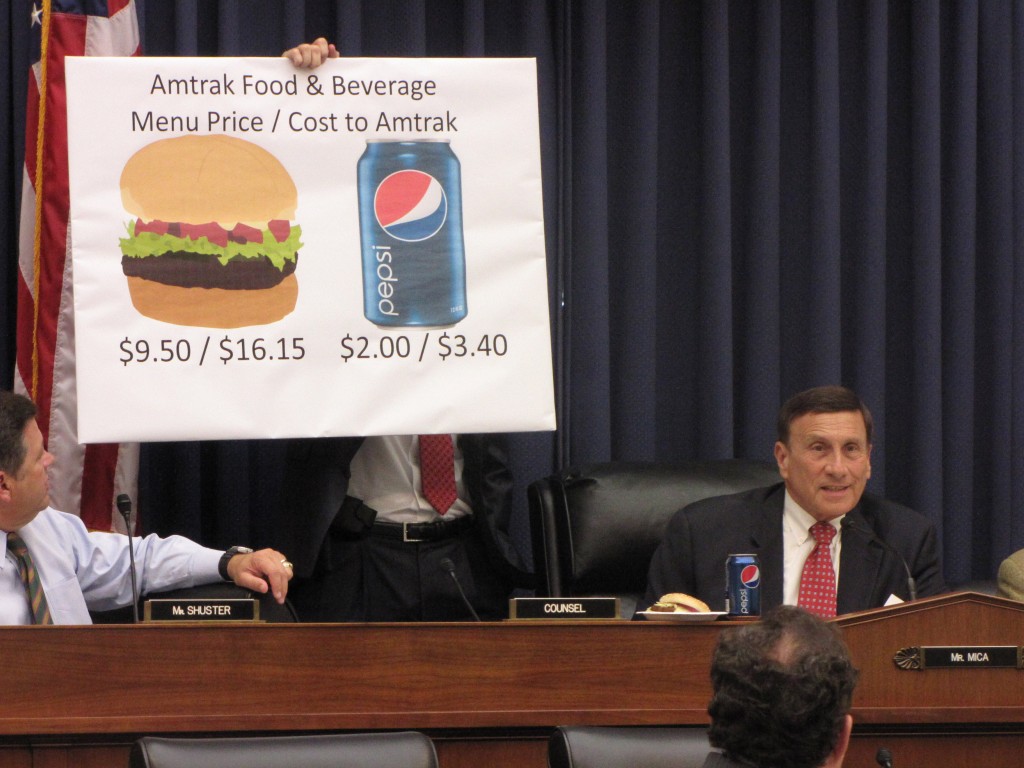
But there's something wrong when Amtrak loses the kind of money it does on food service.


Congressional hearing.  Image courtesy The Heritage Foundation.

Representative Mica might not be the most dependable critic of Amtrak, as he'd apparently like Passenger Rail to go away.  Bloomberg's Josh Barro comments.
Selling edible food at a profit is not rocket science. Even the airlines have increasingly figured out how to do so. If Amtrak can't do it itself, it could outsource its food service operations to a company like Gate Gourmet that has expertise in travel catering.

Why doesn't Amtrak do this? Nick Rahall, the ranking Democrat on the House Transportation and Infrastructure Committee, has one answer. He says Amtrak food service jobs are well-paying, and we shouldn't eliminate them, even if the food service is expensive and terrible. “It’s a whopper of an idea, trading good-paying jobs for cheaper hamburgers,” said Rahall.
In order of rising complexity, three observations. First, putting "edible food" within sixty words of "airline" strains credulity.  Second, there might be a job description constraint that's raising reported food service costs.  The superintendent of dining services for the North Shore Line reported that his department operated at a modest profit, right to the end.  Perhaps the assistance of the collector in drying glassware and putting it away at the end of the run helped, as the transportation department paid the collector's wages for the trip.  It might do something for Amtrak's goodwill, though, if housekeeping help from the assistant conductor would allow the snack-car attendant to remain open until the end of the run. The practice of keeping the snack-car closed until the train is well out of its originating station and closing it an hour out of the terminating station doesn't make the carrier many friends, no matter how helpful that clean-up time is to the attendant.  And Rep. Rahall has a point.  Food service attendants have to understand train safety in a way that the minimum wage kid at a bun-'n-run doesn't.  Third, Amtrak's outsourcing might be the root of the problem.  The Governmental Accountability Office report that has provided the material for Rep. Mica's recent hearing, and the accompanying grandstanding, identifies problems with internal controls and audits of Amtrak's contract for catering from ... Gate Gourmet.  See page 82.  Never mind all the verbiage about lack of a strategic plan or shortcomings in internal controls.  The simplest explanation might be ... government contracting.  Gate probably get indirect cost returns on each case of pop or cooler-pack of microwaveable hamburgers, and that has to contribute to the $3.40 Pepsi, the same way that a fighter-plane toilet seat becomes a $800 purchase.  Amtrak could get its pop and chips more cheaply by issuing cash to snack-car attendants who would purchase cases of pop and chips from the grocer, an emergency measure that snack-car attendants sometimes use when supplies run out, and the method the North Shore Line used for some Electroliner provisions.  Might even work as a small-business stimulus, a little bit of indirect cost return borne by the dining department, and a little bit borne by local householders, all over this land.  The difficulty there, though, is that the same government report suggests there is some nest-feathering by some food service employees.

TIME FLIES WHEN YOU'RE HAVING FUN.

A brain is a resource with finite capacity, and resources have opportunity costs.
Working memory capacity is the aspect of thought responsible for simultaneous storage and processing of information. It allows us to juggle mental tasks, focus on what’s most important and act in the moment. A high working memory capacity has been shown to be closely related to high IQ and academic performance.
There's the germ of another study in the details.
Those who had scored highest for working memory capacity were significantly more accurate in solving the math problems but did poorly at determining how much time had elapsed. They typically exceeded the allotted duration – or lost track of time.

Participants with lower scores for working memory capacity were less accurate on the math problems but better at keeping track of the time.
All those Strict Parents who told their kids "If you spent half the time working the problem that you do fussing about the work" might have had a point. And it boils down to scarcity and opportunity costs.
“Generally it would have been thought that individuals with high working memory would perform better at both tasks – the mathematical problems and keeping track of time,” [psychology doctoral student James] Woehrle says. “But our results suggest an interesting tradeoff, which we had hypothesized.

“We showed that an individual’s ability to control his or her attention affects how he or she perceives the passage of time,” he adds. “Since the math problems were clearly identified as the primary task, the findings appear to support other research suggesting that individuals with higher working memory capacity have better attention control.”

The researchers believe the experiment results would be even more pronounced with more difficult and time-consuming tasks and that people who possess high working memory capacity are likely to experience the time-flies phenomenon more often.

“The punch line is it gives people with a high working memory an excuse for being late,” Woehrle laughs.
The research also suggests that multitasking is counterproductive, akin to shifting focus from the math problems to the clock to the problems...

BE CAREFUL WHAT YOU ASK FOR.

Paid advocate Chris Matthews concludes his 7 August show with a list of Republicans he'd like to see address the national convention, as a warning to voters about "the screeching of bedlam" that could await the Republic.

Visit NBCNews.com for breaking news, world news, and news about the economy

I note only that neither Mr Matthews nor his almost as hyper colleague Lawrence O'Donnell, nor a few of the more egregious urban ward-heelers in Congress, are likely to be prime-time speakers at the Democratic convention, despite the truth in packaging their presence would present.

Nor should either party put its truest believers on display.  It is not for their benefit that there are prime-time convention speeches, which are properly for the persuasion of the median voter, unless the true-believers have quadratic loss functions.

6.8.12

OPUS POSTHUMOUS.

Isaiah Berlin and Hugh Trevor-Roper have crossed the final summit, and yet their students continue to assemble research notes into books.  Adrian Wooldridge sees in the popularity of dead academics a flaw in the incentives facing living academics.
IT IS HARD to gaze on the mounting pile of books by Berlin and Trevor-Roper without worrying that they tell us something about the state of modern academia. The world employs more academics than ever before. Most of these academics believe that they are engaged in a progressive project, producing fresh research, advancing the frontiers of know-ledge and putting their predecessors, ever so gently, in their places. And yet many of us prefer to read the work of a couple of dead Oxonians whose minds were formed in the 1930s.

The modern university is governed by an ever-proliferating thicket of rules, some of them invented by the professors themselves, to regulate admission to the guild, some of them imposed by a suspicious public. Aspiring academics must get a licence to operate in the form of a PhD (which can take up to a decade) and then publish in the right specialist journals. They must doff their caps to the lords of their particular universes and genuflect before the latest modish theorems. Academic bureaucrats tell them how to deliver their lectures and interact with their pupils. Yet other bureaucrats, some of them based in universities and others in government, assess their “productivity” and award money or promotions accordingly.
I concur in part, and dissent in part. The Ph.D. is a research degree, and it signals that the holder has produced a first attempt at research that meets the standards of the student's committee, and one well-placed wag in economics wrote advice for the Ph.D. on the job market including the quip that the committee has lower standards for the paper than the student does.  Think about it.  But the degree is at best a noisy signal of the holder's teaching ability, and in an environment where the scholar produces and transmits knowledge, getting the teaching right matters.  Thus one set of bureaucrats, although it makes no earthly sense to have those bureaucrats in thrall to the latest modish ideas of one set of researchers.  And the research is at best a noisy signal of the author's contribution, thus the obsession with impact factors and the like.  And yes, priors matter.

That noted, Mr Wooldridge's tribute reminds me of a Sibelius bon mot, about the fashionable composers of the day serving champagne cocktails, while he was offering glasses of clear, cold spring water.

WHERE EVERYBODY KNOWS YOUR NAME.

At one time, the corner tavern was an antidote to drunken driving, as it was a short walk down the block and a short stumble home.  Some of the major streets on the south side of Milwaukee gave the impression of three taverns and a church every four blocks.  But no more.
For decades in Milwaukee, the corner tap - often owned and operated by the same family - was the neighborhood gathering place. It helped earn the city a reputation as a hard-drinking town. The city's website notes that "places that serve alcohol are a part of the fabric of Milwaukee. From corner bars to crowded beer halls and nightclubs, this is, after all, a town that's been called 'Brew City.' "

But the family-owned tavern is beginning to give way to bigger and splashier bars. The new places are larger and often focus on sports, with dozens of big-screen TVs, or games, or music. Or anything in between.

"People who come in now for a license want something that is cool and extremely successful," said Ald. Terry Witkowski, whose district includes the Plainfield Pub. "That means a large place. A big business. That's the kind of people who are coming in now."

In some areas near the south side there used to be a bar on every corner, added Ald. Jim Bohl, who served on the Common Council's licenses committee for 12 years. But now aldermen are sensitive to arguments that there are too many bars in neighborhoods.
The article suggests changing demographics and preferences.
Consumer tastes have changed, as well. Bohl, the alderman, observed that older people who may have been more inclined to frequent the corner tap have moved out of the city. In contrast, more and more young people are moving to the city. They, in general, prefer the sights and sounds of N. Milwaukee, Water and Brady streets.

That leaves family taverns with a declining and aging customer base. Seibel said her customers range in age from 40 to 90.

"It's getting harder and harder to make it," [Plainfield Pub owner Deb] Seibel said. "The cost of licenses keeps going up. You need permits for everything. The breweries increase their prices every February. A couple of years I made a profit, but it wasn't much."
Preferences might evolve, but so, too, the social institutions.  In the era of the corner bar, the Catholic Youth Organization was for identifying potential sweethearts, and high school followed by a factory job was for sealing the deal.  Say the vows on one corner, hold the post-reception party on another.  A six-stool bar with the bowling trophies by the door and a color TV tuned to the Braves or Packers (no Cubs on WGN in those pre-cable days) would serve.  But with date-and-mate prolonged or postponed into career-establishing time, a thicker meet market makes more sense, thus the larger bars clustered in the neighborhoods where the cliff-dwellers dwell.

LOOKING LIKE A FOOL WITH YOUR PANTS ON THE GROUND.

Spirit Airline still maintain minimal standards of decorum.
A man was kicked off a Spirit Airlines flight atO'Hare International Airport over the weekend after he became "verbally abusive" to flight attendants who asked him to pull up his sagging pants, an airline spokeswoman said.

The man and the woman he was traveling with Sunday morning threatened physical harm to flight attendants who had asked him to pull up his pants, which were "excessively low," hanging below his buttocks, Spirit spokeswoman Misty Pinson said. The man was boarding the Orlando, Fla.-bound plane when flight attendants spoke to him, she said.

Crew members may ask customers to comply with various requests if they are in "the best interest" of the other customers, Pinson said.

When law enforcement officers arrived, the two Spirit customers gathered their things and left the plane.
The airline rebooked the pair, presumably more suitably attired to travel, on a subsequent flight.

THERE'S A LITTLE TIN BOX.

It's emptied to buy coffee, according to the DeKalb Daily Chronicle.
A local scrap metal company employee says his business has paid thousands of dollars to Northern Illinois University employees selling scrap metal from the university, who then deposit the money in an account known as “the coffee fund.”

Bill Kunkel, head of transportation for DeKalb Iron and Metal Company in DeKalb, said that for years he’s been writing checks to what’s called the “coffee fund,” an account NIU spokesman Paul Palian said university officials weren’t aware existed.

Kunkel said several employees, mainly from NIU’s Physical Plant, have sold scrap metal from the university to DIMCO on and off for at least the past 25 years. The company’s electronic records date back to February 2005, and checks from [DeKalb Iron and Metal] since that time have totaled more than $13,000.
Senior administrators say there is no record of such a fund, but they are investigating.

2.8.12

YEAH, LET'S GET RID OF MATHEMATICS.

David Foster comments on the difficulties, recession or no, businesses have finding workers with quantitative skills.
Journalists and academics often blame the missing-skills problem on what they claim to be the higher skill levels required by today’s technology, but I think this aspect of the situation is overstated. I doubt that a present-day manual for an alarm system is really a more complex document than, say, a maintenance manual for a piston-powered airliner circa 1950. And while a modern CNC machine tool does require (at least) a knowledge of decimal arithmetic to program or probably even to set up, a true machinist on traditional equipment also needed this knowledge. It is possible that the average mix of verbal and mathematical literacy requirements for jobs has shifted somewhat upwards as a result of advancing technology and increased management focus on worker involvement, but I think the main problem is not that the skill requirements have become dramatically higher but rather the skill levels of the prospective workers coming out of the schools have gotten lower.
That doesn't stop some people from suggesting that school completion might be enhanced by reducing the obstacle to completion called algebra.

TRAIN YOURSELF TO RELAX.

At The Christian Science Monitor, Andrew Holland suggests that building additional roads is unlikely to reduce traffic congestion.
In our biggest cities — also the source of the greatest portion of our wealth creation — the highways and transportation systems are becoming more jammed by the day. It should be obvious that more transportation infrastructure options are needed in America’s densely packed regions.

The Interstate Highway System has been successful in linking the country together, but I’m afraid that it promotes sprawling, auto dependent development — which essentially outsources a major cost (fuel) to consumers. More highways, even if they could be built to meet capacity, are not the answer for dense regions because they have proved to only encourage more oil-dependent sprawl.

I believe that High Speed Rail (HSR) is the way to build dense, interlinked cities and regions.
It is true that vehicle ownership has increased by a greater proportion than has new road mileage. All the same, the Law of Peak Hour Expressway Congestion will continue to bite, as road commuters will take the benefits of new roads in the form of sleeping in a few more minutes.

That noted, High Speed Rail is likely to be the long term solution.  In the immediate run, faster running times for commuter and regional intercity trains, better connectivity among trains, and strategic placement of third tracks and interlockings to keep local trains out of the way of limited and express trains will entice riders out of their cars.  As that ridership grows, political sentiment may follow.  The answer to "Why can't we have faster trains in Indiana the way they have in Michigan?" is going to be very different than "Why can't we have passenger trains here the way they have in Europe (or China or Japan)?"  Regular readers know that the answer to the latter question is "Neither the Europeans nor the Chinese have stack trains or 125 car coal and grain trains."

FAT, DUMB, AND DRUNK IS NO WAY TO ROW.

The Milwaukee Journal-Sentinel introduces a local Olympian with an unusual lede.
Megan Kalmoe wanted to make a change after her freshman year at the University of Washington, when she filled the gaps between "partying myself and my waistline into oblivion" with a whole lot of nothing.

On the scale of slug to Olympian, she was much closer to slug.

Kalmoe, a native of St. Croix Falls, Wis., decided to do something totally out of character as a sophomore and walked onto the school's rowing team.
College is supposed to be about second chances, and Ms Kalmoe has surely done well with hers. All the same, is there nothing the university can do to diminish the incentives to party to oblivion?

1.8.12

STROKE, STROKE, STROKE.

The United States eight, with the James twins aboard, finished just outside the margin of error.
The 2012 Olympic edition was one of the most exciting of all time, with all six boats finishing within about a length of one another.

Overwhelming favorite Germany took the gold in 5:48.75. Canada slipped past Great Britain in the last few hundred meters to snatch silver with a time of 5:49.98, while the British in 5:51.18 barely held off the hard-charging Americans. The U.S. clocked in at 5:51.48.
With the start of a new semester approaching, I'm considering how to turn three-tenths of a second short of a medal into three-tenths of a point short of a B.

BILLIONS OF DOLLARS, AND NOT A STACK TRAIN TO BE SEEN.

Fox Business interprets China's increased spending on railroad tracks as an economic stimulus project.
In its latest bond prospectus published on Chinabond, an official website for debt issues, the railway ministry said Monday it plans to spend 470 billion yuan (US$73 billion) on infrastructure investment this year, up from the CNY406 billion stated in a prospectus issued earlier this month.
The Association for American Railroads reports that freight railroads have invested a total of $500 billion dollars (these are probably non-comparable current dollars) on permanent way improvements since 1980.  Those moneys have produced a 70 mph Kate Shelley Bridge in Iowatwo main tracks through the Abo Canyon, and up to four tracks for fluid movement of coal trains in the Powder River Basin.

SPREADING THE WEALTH AROUND.

It's usually good news to be the fourth-best gymnast in the competition.  Unless the second- and third-best are also on your team, and you're at the Olympics.
It’s an emotional day for this American team, which has just delivered a remarkable performance and set the score to beat in the qualifications of these Olympic Games.  But it’s a shocking heartbreak for America’s national and world champion, and one of the favorites to win the biggest prize of all here in London. 
I don't know the origin of this quota for country qualifiers. Wouldn't it be karma if the rule was pushed through with the urging of the U.S. Olympic Committee during the Cold War as a way of limiting Soviet medals?