29.2.12

NO CONFIDENCE.

Members of the University of Illinois faculty take responsibility for their administration's errors.
More than 125 of the University of Illinois’ highest profile faculty members have said they have “no confidence” in school President Michael Hogan and have called for his removal.

Their letter, sent Monday to the Board of Trustees, is the faculty’s latest clash with the beleaguered president, whose standing began unraveling earlier this year when his chief of staff and top adviser resigned after anonymous, inflammatory emails sent to a key faculty group were traced to her computer.

Hogan has been president for less than two years, brought in to heal a campus bruised by an admissions scandal. Instead, he is now embroiled in an internal crisis that has preoccupied the state’s flagship public university. He has clashed with faculty on student enrollment strategies and what some are calling an arrogant leadership style.

“In our view he lacks the values, commitments, management style, ethics, and even manners, needed to lead this University, and his Presidency should be ended at the earliest opportunity,” the letter states.

The faculty members contend Hogan has lacked financial discipline; usurped duties usually assumed by the campus chancellor; tried to bully faculty and the chancellor on enrollment issues; and generally has had a “failure of ethical leadership,” a criticism levied by the Urbana-Champaign faculty Senate earlier this month.

The 130 faculty members who signed the letter make up about two-thirds of the named and endowed professors and chairs on the Urbana-Champaign campus. Their titles indicate they are some of the most accomplished scholars in their fields and are key to attracting students, other faculty and funding to the university.
Note what is missing from that "key". No directors of diversity, no coaches, no strategic planners.

What's encouraging about the article is news of faculty resistance to enrollment initiatives, branding, and directives that originate from the president rather than from the faculty.

EVERYBODY IS IN THE SAME BUSINESS.

Young people who used to think of a state-flagship university or a converted normal school as their safety school are discovering community colleges.
Relatively affluent young students are typically better-prepared academically and have a good chance of earning a degree. They are also more likely to attend full-time, require less remediation than their peers and can be cheaper for community colleges to educate.

But this group is also demanding, as traditional-age students want a full campus experience with amenities like fitness centers and extracurricular activities, which can mean new buildings and strained student service budgets. They are also more likely to seek out counselors, experts said.
The dean at Anonymous Community, in a reaction to that article, notes that community colleges are in the same business as the more visible residential colleges.
If community colleges start to serve people who could afford to go elsewhere, that bodes well for their institutional survival.
Put another way, if community colleges start to serve people who expect what the pricier institutions offer, that bodes well. By continuity, this argument applies to the land-grants and mid-majors as well.
And that will redound to the benefit of all the students here, particularly including the less wealthy ones.  If the daughters of privilege start demanding the services that “real” colleges offer, then the single moms who come here will have access to those, too.  We won’t have students showing up in tears, asking to be treated like real college students.  They’ll finally be treated as the real college students that they actually are.
Indeed, although whether those single moms he refers to, and the academically marginal students and life-management-difficulties cases and GED holders might find the competition with "real college students" another source of frustration.

I wonder, though, whether additional extracurricular activities, and sports teams, might make community colleges less available as spacious places with ample parking for weekend train shows.  (I'll be at this one Saturday.  Look for a middle-aged white guy.)

FREQUENCY, RELIABILITY, CONNECTIVITY.

The additional frequencies on Illinois corridor trains, combined with ever-more-aggravating driving conditions, lead to increases in ridership.
Illinois Department of Transportation Secretary Ann L. Schneider says ridership is up and high speed rail will be a hit with passengers. At remarks yesterday at the City Club of Chicago, Schneider said state-supported Chicago-St. Louis Amtrak service has seen an increase in ridership of 210 percent over the last five years, WJBC Radio reported. “And that is on old, outdated equipment with spotty reliability and few rider amenities. When the Chicago-to-St. Louis route is complete, the trains will become more reliable, more convenient, and with the new equipment, there will be added amenities leading to enhanced passenger experiences,” she said.

The department is working with Amtrak and Union Pacific to begin 110-mph service on 18 miles of the Chicago-St. Louis route between Pontiac and Dwight, Ill., by the end of this year. Higher speed service will be extended to other portions of the 285-mile route, as track is upgraded and new signals installed. Schneider said she expects the higher speed service to be a hit with passengers.

Schneider said ridership on Amtrak routes supported by the state of Illinois is up 85 percent over the last five years. She expects demand to grow with the start of high speed service and the rising price of gasoline.
Much of that increased ridership probably reflects additional frequencies, with Carbondale and Quincy getting double-daily service, and St. Louis getting an additional train on a business-friendly schedule.  Faster running will attract additional passengers.  Is it too much, though, to ask for tavern-lounge cars or proper first class accommodation in what Amtrak calls Business Class?

IF METRA RAN TO DEKALB?

Northern Illinois University announces a series of Undergraduate Information receptions, in Crystal Lake, Glen Ellyn, Springfield, and ... Milwaukee?  Displaced cheeseheads.  I like it.  I'd like it more if those students had the option of Metra DeKalb to Chicago and a convenient connection to a Hiawatha.

FOOTBALL IS BLOCKING AND TACKLING.

Packer coach Mike McCarthy continues to channel Vince Lombardi.
“We’re going to be a better tackling team,” McCarthy said in a press conference at Lucas Oil Stadium on Friday. “Our turnover stats reflect the investment we made. Our tackling does not reflect that. Our tackling will be better next year.”

How does a team become better tacklers, he was asked?

“You practice it,” McCarthy said. “We have to be a little more creative in our drill work.”

Heading into a draft evaluation season that’s expected to focus on improving the Packers defensively, McCarthy put his finger on a problem that was prominent on several occasions this past season. His comments harken memories of Bucs running back LeGarrette Blount’s long touchdown run, and of the Packers’ loss to the Giants in the playoffs, when Giants wide receiver Hakeem Nicks bounced off a defender at midfield and turned a short pass into a long touchdown play.
If the National Football League continues its Thursday opening day tradition, the Packers will have an opportunity to return the favor to the Giants.

IT'S CUSTARD, DARN IT.

Tornadoes to the south of me, lake effect snow blowing across the Frozen Tundra to the north, and wind preceded by thunderstorms preceded by a blanket of wet snow.

Never mind any of that.  Ollies is open.
Sitting at a picnic table in front of the business, DeKalb residents Paula Hastings, Heather Freund and Jill and David Downs acknowledged it was a bit funny to sit outside wearing coats or sweatshirts while eating frozen custard.

The temperature was just above 40 degrees, but customers said enjoying the creamy treats again was worth it. Some took frozen custard back to their cars to eat.

“We were very excited about opening day,” Hastings said.
The Federal Reserve is not anticipating any general inflation, but relative price changes still matter.
Ollie’s will be experiencing some changes this season, said co-owner Joe Cranden, including the sampling of some new flavors in May, opening up a side window in the summer to get the line moving faster and increasing some of the prices for certain items.

“We’ve had to raise prices due to the cost of goods,” Joe said. “The cost of goods has sky-rocketed in the last couple of years. We’re doing our best to keep prices as low as we can.”

Even with price increases, however, Joe said Ollie’s customers are extremely loyal. The establishment had a customer waiting for 20 minutes before their window opened Wednesday.
The loyal customers channel Patrick Henry.
The precise combination of creamy custard and assorted toppings, keep customers coming back each year.

“Never close down or we’ll die,” said Bekah Walker, Kishwaukee Community College student.

Walker said going to Ollie’s, especially in the summer, is a tradition with her and her friends.

“We’re looking forward to a fun season, serving our customers a superior product,” Joe said.
Earlier this week came the first rollout of Mint Chocolate Chip, a Cold Spring Shops favorite.

21.2.12

FASCHING IST.

MARKET FAILURES DO NOT WARRANT GOVERNMENT INTERVENTION.

A. C. Pigou said as much.
It is not sufficient to contrast the imperfect adjustments of unfettered enterprise with the best adjustment that economists in their studies can imagine. For we cannot expect that any State authority will attain, or even wholeheartedly seek, that ideal. Such authorities are liable alike to ignorance, to sectional pressure, and to personal corruption by private interest. A loud-voiced part of their constituents, if organized for votes, may easily outweigh the whole.
At Knowledge Problem, Michael Giberson wonders where the market-failure-warrants argument came from.
Maybe someone has researched the question carefully. In the absence of someone setting me straight, I'll blame Paul Samuelson.

Samuelson's influential Foundations of Economic Analysis refers to Pigou several times, according to the book's index, but so far as I noticed just once it mentions that the presence of Pigou's external costs means "there is of course need to interfere with the 'invisible hand'." (p. 196)
And at Kids Prefer Cheese, Michael Munger suggests that market "failure" is the warrant of last resort, if it is a warrant at all, for government action.
Why would you think that the government can get prices right for externalities? Why do you think the government WANTS to get prices right, given how much money there is to be made from campaign contributions from rent-seekers?
Particularly where there are countervailing rent seekers?

THE POWER OF MUTATION AND SELECTION.

You can't fool Mother Nature.
Silicon based solar power is never going to amount to much: how arrogant do you have to be to not realize that nature had 4.6 billion years to come up with silicon-based solar cells, and instead came up with trees.
But perhaps you can take advantage of the accumulated power of selection.

Didn't Milton Friedman once observe that tree leaves positioned themselves so as to obtain maximum exposure to the sunlight?  He wasn't making that argument in order to help technocrats be more technocratic.

RIDING THE BLINDS.

A Dutchman stows away on a passenger train.
The man apparently boarded the Warsaw-Amsterdam overnight, train number EN 446, in Berlin Hauptbahnhof by climbing into the area above the train couplers / buffers between the locomotive and the first car in the train while no one was looking. The end doors on the first and last cars of these locomotive hauled trains are always locked-out by a key operated control in order to prevent anyone other than the train crew from opening them. There is a door ledge which is perhaps 40 cm or 15 inches long. At the end of this ledge is open space over the train couplers to the locomotive. On the locomotive itself are a couple of hand-holds and a small foot ledge for use by maintenance personnel when they wash the windshields, replace the headlights / taillights or windshield wipers and connect or disconnect the electric cables from the locomotive to the rest of the train when stationary. In other words – not exactly luxurious accommodations, and barely enough standing space in the end doorway to hang-on for dear life when the train is at speed.

Although the man had tried to prepare himself for his open-air ride to Amsterdam by dressing with heavy winter clothing, gloves, and boots, he quickly found out how the principal [c.q.] of wind chill works. The train at first accelerated to approximately 80 km/h (50 mph) as it wound its way through western Berlin, then after gliding through Berlin-Spandau station at about 45 minutes after midnight it smartly accelerated to its cruising speed of 200 km/h – the next scheduled stop would not come for another 90 minutes and 280 km (174 miles) later in Hannover. With an air temperature that night of about -5°C (+23°F) and the wind whipping wildly around him in the gap between the locomotive and train at hurricane-like speed, the wind chill factor soon went below -20°C. The sound levels from the unrelenting wind and the rapidly spinning traction motors and wheels just a few meters from his feet pushed well past the 130 dB range. The young man began to fill with fear and numbing cold.

The conductors began moving through the train to check the passengers tickets a few minutes after departure from track 14 in the glass-roofed Berlin Hauptbahnhof. As one of the conductors made her way to the very front of the train, she could not believe her own eyes . . . is there a person trapped outside between the end door and the locomotive??? Indeed there was, and he was hanging precariously from the hand-holds mounted on the rear end of the locomotive.
Hobo lore has riding the blinds as a relatively safe place to stow away.
'Riding the blinds' meant to ride the front platform of the baggage car on a passenger train. Because baggage was piled up inside, thus blocking the door between cars, it was a relatively secure place to sit. However, if detected, the rider was an easy target "for water hoses or showers of coal or hot ash from the more sadistic firemen."
On the Eastern Trunk Lines, during the winter, during the Steam Era, the blinds were a very dangerous place to be, sadistic firemen or not.  The eastern trunk lines expedited their trains by providing track pans in order that the tender could be refilled at speed.
Even through the windows closed against the bitter night, a scream was heard in the house alongside the track pans. The occupant, a railroad man, knew exactly what it meant, and he grabbed for the phone to have the eastbound freight flagged down at the next tower. There, the body of a tramp was found frozen against the back end of the tender. Hitching a ride “in the blind” hanging on the back of the tender, the tank filled from the trough, and overflowed down the back of the tender, soaking the man in water that rapidly turned to ice. He screamed but dared not let go, and died.
As Destination: Freedom notes, stowing away on a train is a dangerous adventure.
Riding on the outside of trains in other countries, especially in South Asia (India, Pakistan, and Bangladesh), parts of South and Central America and a few other areas in the developing world may be common, but in Europe this practice can be extremely hazardous to your health and your police record, assuming you survive long enough to even see the police. And it puts the train crew into a bad mood.
Even a train crew armed with a cell phone, rather than a scoop of ashes.

20.2.12

THE WORK GOES ON.

The DeKalb Chronicle commends Northern Illinois University for its most recent memorial observation.
It’s a day that must annually be remembered, and NIU has done an outstanding job of making sure to respectfully honor Gayle Dubowski, Catalina Garcia, Julianna Gehant, Ryanne Mace and Daniel Parmenter while making sure the tragedy does not define the university. As NIU President John Peters said, the “cherished five” lost that day must always be remembered.
Short speech, followed by a wreath-laying.


Different this year:  Cole Hall is again open for business, with students coming and going.


JUMP DISCONTINUITIES.

The standard Black-Scholes-Merton option pricing equation doesn't include them, and trouble follows.
Any mathematical model of reality relies on simplifications and assumptions. The Black-Scholes equation was based on arbitrage pricing theory, in which both drift and volatility are constant. This assumption is common in financial theory, but it is often false for real markets. The equation also assumes that there are no transaction costs, no limits on short-selling and that money can always be lent and borrowed at a known, fixed, risk-free interest rate. Again, reality is often very different.

When these assumptions are valid, risk is usually low, because large stock market fluctuations should be extremely rare. But on 19 October 1987, Black Monday, the world's stock markets lost more than 20% of their value within a few hours. An event this extreme is virtually impossible under the model's assumptions.
Oops.
Large fluctuations in the stock market are far more common than Brownian motion predicts. The reason is unrealistic assumptions – ignoring potential black swans. But usually the model performed very well, so as time passed and confidence grew, many bankers and traders forgot the model had limitations. They used the equation as a kind of talisman, a bit of mathematical magic to protect them against criticism if anything went wrong.
It's probably too soon to expect any dissertations on the topic, but an option trader with an understanding of Poisson event arrivals (the jump discontinuities of the title) might be making a lot of money trading against traders who use the ordinary stochastic processes.
The Black-Scholes equation has its roots in mathematical physics, where quantities are infinitely divisible, time flows continuously and variables change smoothly. Such models may not be appropriate to the world of finance. Traditional mathematical economics doesn't always match reality, either, and when it fails, it fails badly. Physicists, mathematicians and economists are therefore looking for better models.

At the forefront of these efforts is complexity science, a new branch of mathematics that models the market as a collection of individuals interacting according to specified rules. These models reveal the damaging effects of the herd instinct: market traders copy other market traders. Virtually every financial crisis in the last century has been pushed over the edge by the herd instinct. It makes everything go belly-up at the same time. If engineers took that attitude, and one bridge in the world fell down, so would all the others.

By studying ecological systems, it can be shown that instability is common in economic models, mainly because of the poor design of the financial system. The facility to transfer billions at the click of a mouse may allow ever-quicker profits, but it also makes shocks propagate faster.

Was an equation to blame for the financial crash, then? Yes and no. Black-Scholes may have contributed to the crash, but only because it was abused. In any case, the equation was just one ingredient in a rich stew of financial irresponsibility, political ineptitude, perverse incentives and lax regulation.

Despite its supposed expertise, the financial sector performs no better than random guesswork. The stock market has spent 20 years going nowhere. The system is too complex to be run on error-strewn hunches and gut feelings, but current mathematical models don't represent reality adequately.
Perhaps not. But while regulators seek to impose order and write rules, traders and modellers look for more effective ways to make money.

(A gripe about the bridge metaphor.  There's no arbitrage condition among bridges.  When London Bridge falls down, the traffic doesn't all instantaneously divert to Blackfriars Bridge.   Money migrates among assets more rapidly.  This is true, whether an epidemic model accurately describes its migration or not.)

SCRAPING THE BOTTOM OF THE BARREL?

George Leef of Phi Beta Cons recommends an essay by long-time Ball State economist Norman Van Cott. What happens when the minimum grade a student earns in honors principles exceeds the mean grade in principles?
As far as outcomes are concerned, the two courses were effectively two different courses. In my opinion, based on my experience in both classes, the writing component had only a slight influence on the students’ performance.

Should political efforts to spike college enrollments “succeed,” the above performance gap will only worsen. In addition, the performance range within the regular student population will also increase.

It isn’t surprising that Honors students perform at a higher level than their regular student counterparts. They’re Honors students precisely because they have higher levels of academic ability and engagement. But what level of polarization is acceptable? Or do administrators even think about that?
The essay comes complete with confidence intervals and a sensitivity analysis.  Expanding college enrollment, however, isn't going to mean more people going to Harvard or Wisconsin or Northern Illinois or enrolling in honors sections at Ball State.  The people who can make the cut there are there already.   Sounds like a recipe for greater social stratification, with the added cost of frustrated graduates or near-graduates.

INSTITUTIONS EVOLVE TO REDUCE TRANSACTION COSTS.

Lynne Kiesling summons the all-stars to point out the Errors of the Technocratic State.
Yes. Hayek’s Pretence of Knowledge meets Smith’s “man of system”Tullock’s rent seeking, and Olson’s concentrated benefits and diffuse costs. Regulatory complexity creates benefits for politically-powerful special interests, but it creates costs for everyone else, and this ongoing process feeds the egos of our elected representatives who believe they can engineer, design, and manipulate society to achieve their desired outcomes.
It's an approving reaction to an Economist editorial suggesting that process-worship stifles initiative and preempts creativity.  The editorial, however, starts with an illustration of regulatory overreach that isn't as absurd as it seems.
The Federal Railroad Administration insists that all trains must be painted with an “F” at the front, so you can tell which end is which. Bureaucratic busybodies in Bethesda, Maryland, have shut down children’s lemonade stands because the enterprising young moppets did not have trading licences.
I'll let University Diaries deal with Bethesda lemonade stands.  The front end of a locomotive is not always as obvious as the wiseacres would have you believe.  Nobody sets up road-switcher diesels to run long-hood-first any more, which induces a lot of people to generalize from their own experience.  But it's not required that a locomotive have only one cab.


Here's Amtrak's 604, a General Electric E60C.  The wheel closest to the camera is therefore wheel R1, and you count back to wheel R6 under the fireman's seat in the second cab.  That's right, dear reader, second cab.  It's common practice on electric locomotives to have a control stand at each end.


In this more recent picture, we are looking at the non-front end of Amtrak 925.  Sure looks like a headlight turned on in anticipation of a move.  There's no evidence of a train behind, so let's keep looking.


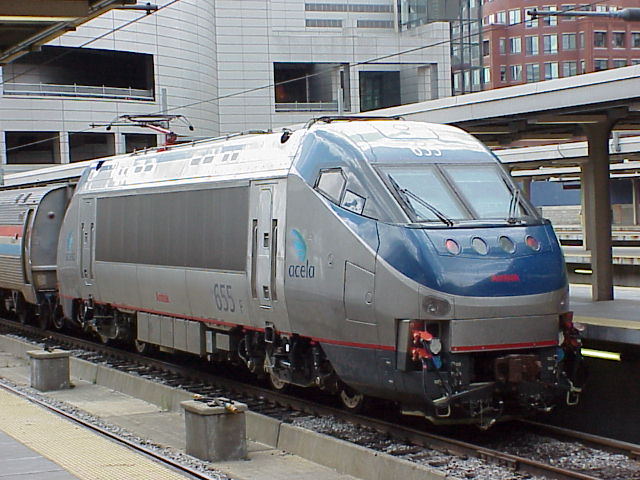
Here's Amtrak 655 on the head end of an Acela Regional train at Boston's South Station.  The wheel closest to the camera is wheel L4, in the event of sticking brakes or some other defect.  A locomotive leading a train, but the front end of the locomotive is trailing.

So where did the convention of using F originate?  It was in use on The Pennsylvania Railroad as early as 1964, in which the F end of a GG-1 is the end that houses the steam generator.  The Federal Railroad Administration codified the use of the letter F on double-ended locomotives and multiple-unit cars to refer to the end that held the electrical cabinet.  The notation is also useful on cabless locomotives (a few of which are still in use) so as to provide a reference for locating the electrical cabinet or the alternator.

It's amusing that Union Pacific suggested that the Federal Railroad Administration abolish the F requirement.


That's a one-off 4500 hp gas-turbine-electric locomotive with two cabs.  Perhaps Union Pacific is cold-turkey on double-ended locomotives after its experience with the unit shown above, but should it ever electrify and use double-ended motors, the shop crews will appreciate some help locating the electrical cabinet.

The reader might find other parts of 49 CFR 229 more instructive.  The language on designating a front end of a locomotive is straightforward.  The language covering onboard toilets and train horns is bureaucratic in the extreme.


16.2.12

CONSIDERING THE IMPLICATIONS.

The news reaction is coming in to the debut of 110 mph trains across southwestern Michigan.  Sources suggest that trains are routinely running at these speeds, although a new schedule has not yet been issued.  With the slow running east of Dearborn and the inattentive dispatching of Norfolk Southern, perhaps the additional speed allows for recovery of some lost time, or of a cushion against delays west of Porter or east of Kalamazoo.

The Trains news wire recognizes that additional steps must follow.
“This is just the beginning,” said Joseph Szabo, the Federal Railroad Adminitrator. Szabo said work is under way to boost speeds on the Chicago-St. Louis line to 110 mph as well, using federal high speed rail grant money. “This is the first step in a buildout of a great system in the Midwest,” he said. “In the next three years you’ll see 80 percent of the Chicago-Detroit line and 80 percent of Chicago-St. Louis at speeds of 110 mph.”
Wisconsin, we're waiting to hear from you.

The same article quotes the director of Michigan's department of transportation, Kirk Steudle, who correctly identifies the value of a train.
Michigan’s Steudle said this incremental approach was the right way to go. “Economic development is huge along this corridor. A 200-mph bullet train would have meant you’re going to bypass all of these communities and there’s no way they could benefit. This makes more sense for us.” The state expects to complete its purchase of the Kalamazoo-Dearborn, Mich., portion of the corridor from Norfolk Southern by the middle of this year, which will pave the way for track and signal upgrades east of Kalamazoo.
Reliability is more important than rapidity, which the state seeks to remedy by purchasing the former Michigan Central to Dearborn, and the value of a train ... any train ... is in its ability to make intermediate stops that don't involve the time costs implied by "holding pattern," "boarding process," and "in line for takeoff." (The air carriers well might be happy to be shy of some of the shorter hops that now exist for lack of train service.)  Now can Amtrak and Metra coordinate their schedules in order that Huskies Fans might be able to take in a game at Western Michigan or Eastern Michigan and celebrate in the lounge car?

A Chicago Sun-Times report also makes points Cold Spring Shops readers already grasp.
When the Pioneer Zephyr — better known as the Silver Streak — made its historic run from Denver to Chicago in 1934, the diesel-powered passenger train now on display at the Museum of Science and Industry topped out at 112.5 miles per hour, which at the time was only slightly off the world land speed record.

What then are we to make of Wednesday’s official Amtrak kickoff for its first “high speed rail” corridor outside the Northeast — on which trains traveling between Chicago and Kalamazoo, Mich., will now reach top speeds of 110 miles per hour?

Bring back the Silver Streak?
That 112.5 is a reference to a claimed New York Central record kept alive by the Museum of Science and Industry, which is current owner of a locomotive that allegedly reached that speed in 1893.  The first steam locomotive to achieve that speed is Milwaukee's Two-Spot, on May 15, 1935.  Regular readers will understand, however, why the "Bring Back the Silver Streak?" appeals.


The report also makes a point about the high incremental cost and low incremental benefit of additional speed.
As the train reached its top speed, Amtrak spokesman Marc Magliari relayed speedometer readings from the engineer in a manner reminiscent of the scene from “The Right Stuff” when Chuck Yeager breaks the sound barrier.

“We are now at 90 miles per hour … We’ve now reached 100 miles per hour en route to 110 …We’ve now reached our maximum speed of 110 miles per hour,” Magliari said in the smooth voice of the radio reporter he once was.

Surprising to me, though, the 110-mph speeds take only 10 minutes off the one-way trip, officials said.

That’s because trains on the route were already going as fast as 95 mph before the most recent improvements that involved installing a high-tech train control system.

Also, the top speed is permitted across only 80 of the 138-mile distance. The slowest portions are between here and Porter, Ind., where the 97-mile “high speed” corridor begins — and then almost immediately slows as it passes through Michigan City.

The longest continuous stretch of 110-mph rail goes for 42 miles through Michigan, which you can cover in 23 minutes at that speed — a good way to put an expanse of snowy Michigan farmland behind you in a hurry, I can now attest.
I'm not in the mood to go into rectangular hyperbolas and asymptotes this late on Thursday evening. Note, though, that a German style Neubaustrecke between Porter and Kalamazoo knocks only another ten minutes off of that stretch, less if there's a stop at one end or both.  That's a lot of money for relatively little payoff.  The existing trains, running to schedule, beat the drive time and they have lots of electrical outlets for computers (something that wasn't true in 1984-1985, when I got some looks snagging the seat near the vacuum cleaner power supply and firing up my Model 100.)  Additional frequencies ... here's where the Acela and the Empire Service excel ... have greater value than the next increment of speed.

Several television stations had crews on the test train.  Here's a report from WGN.

PIGOUVIAN TAXES ON THE STRIPPERS' POLE.

I'm not making this up either.
The legislation is in an early form and could change, but it would require strip club owners who serve or allow liquor to be consumed on the premises to pay the $5-a-person tax. The money would go into a special new state sexual assault prevention fund, and the state would make grants to organizations that provide community-based programs designed to reduce sexual assault or help to crime victims.

During the past few decades, Chicago and suburban towns have passed a series of ordinances to close topless bars and push those that remain into industrial areas. The patchwork of rules means some establishments can operate only if they don't serve booze, others permit alcohol to be brought in and the amount of nudity varies as a result.
As with any corrective tax, there's a tension between raising revenues and reducing the externality-producing activity.  Take as a working hypothesis that the presence of gentlemen's clubs objectifies women, and some of the clientele aren't gentlemen.  A tax reduces the provision of gentlemen's clubs -- in the article, those clubs operating on slimmer margins, which tend to be smaller establishments -- are raising the most objections to the proposal, and there might be a provocative paper on raising rivals' costs (here's a variant involving pollution markets) that might be corroborated by the silence of larger clubs on the issue.

On the other hand (in economics, there is always the other hand), the absence of gentlemen's clubs does not imply the absence of cads and yobs, suggesting the crime reduction and victim assistance programs will still require resources.  The harder problem, left to the reader as an exercise, is to produce conditions less conducive to the production of cads and yobs.

THE ROMANTIC-INDUSTRIAL COMPLEX.

I just quote what I read.
There is a romantic-industrial complex that nets billions of dollars from Valentine’s Day and weddings, and it needs you to “buy into” outdated ideas of love and marriage. The more you express your love through candies, chocolates, diamonds, rentals and registries, the more the RIC makes! Valentine’s Day is only one manifestation of the RIC: Americans spend $70–80 billion on weddings each year. With the average American wedding costing $27,000, marriage itself has become a luxury item. This is more than a struggle between old and new traditions—this is about money.
It has long been a working hypothesis of mine that the likelihood of a marriage failing varies proportionately with the money spent on the reception.  To the women of the fevered brow, that's excessively simpleminded.
So it was that I drove by the church with the billboard that said “Jesus is God’s Valentine to You” and smirked with the ironic distance of my truly analytical feminist brain. But that smirk was quickly wiped off my face as I listened in on a local radio station’s Valentine’s Day special: a real live wedding. Of course it was incredibly predetermined in its presentation—the young high-school friends who were meant to be together but went their separate ways, reunited on Facebook, now marrying live on the radio. Of course their vows said all the right things about for better or for worse as if they were unaware that a lot of marriages don’t really get through the worse times. Of course they played every single cheesy love song in the background as the radio host narrated the bride’s descent down the stairs, the flower girl’s throwing rose petals in her path, the ring boy, the bride’s son from a previous relationship, looking forward to his new life in the “sanctuary” of his new family.

I could have written this scene in my sleep it was so overdetermined by historical, economic, cultural, and narrative forces. And yet I was crying as I listened to it. Why did I cry?

I asked my students in my course on the Sociology of Heterosexuality this very question. “Because,” one of them ventured, “you find their inability to be analytical about the hegemonic discourse of romance depressing?” Yes, of course I do, but that doesn’t explain my tears.
All presented, straightforwardly and without irony, by the house organ of academic decline as High Theorizing.  Higher education might be in bad odor in the general culture, and some of that odor is self-inflicted.

15.2.12

FIRST STEPS.

Amtrak and the Michigan Department of Transportation offered the press a demonstration of 110 mph running  between Porter, Indiana, and Kalamazoo, Michigan.


Revised timetables have not yet been issued. Michigan officials sound like they intend to offer the first 110 mph running west of Schenectady before Illinois service begins, later this summer.

ALL WORK AND NO WORKOUTS

... makes for a toxic workplace.
Supervisors answered questions about how often they exercised and about their levels of workplace stress; for example, “working my current job leaves me little time for other activities,” or “I have too much work and too little time to do it in.”

The researchers found that, as expected, when supervisors were stressed, their subordinates felt more victimized.

However, analyses also showed that when supervisors experienced stress, but engaged in exercise, their subordinates reported lower levels of abusive supervision.
The research, based on a survey of MBA students and their supervisors, might have small-sample and selection biases, but it reinforces a long-held suspicion at Cold Spring Shops, that stressing an organization for its own sake is more akin to destructive testing than it is to work-hardening.

Put another way, those go-getter venture capitalists and hedge fund managers who go through two wives, three coke dealers, and four therapists by the age of forty might not be the best models of business leadership.

13.2.12

A DISSENTING VIEW ON SCHOOL FAILURE.

Historiann suggests that the failure of the common schools to do their job might reflect a lack of funding, accompanied by a lack of respect, from public officials.
When I read stories like this b!tching about the low 4-year graduation rates at universities in my state, and at the same time the high rate of remediation our high school graduates require, why doesn’t anyone point out that hack politicians and businessmen have made war on K-16+ education for years, attacking public education at all levels in particular as wasteful and ideologically suspect, and in general doing their best to withdraw public sympathy and taxpayer support for any kind of education?  At the same time, they’ve also conspired to pass laws that offer incentives to corporations for taking their money and their jobs offshore to chase the cheapest labor around the planet.   Now, all of a sudden, they’ve seized on the idea that College for Everyone is the way to save the U.S. economy–because the factory and manufacturing jobs are gone and because construction is in the toilet, everyone needs to be a knowledge worker now.  So whose responsibility is it to turn everyone into knowledge workers?  The K-16+ teachers and proffies, of course, who need to be tested, monitored, and surveilled at every turn to prove that what they’re doing works.  They also must take on the burden of saving the U.S. economy without any more resources, because as “we” all know, “you can’t just throw money at the problem!”  No, money solves all manner of business problems, but it can never, ever be used to solve problems with education.
The challenge is in obtaining more potential knowledge workers from more potential sources.  The Ivies and the other claimants to be the twenty or fifty best institutions of higher learning do not produce enough people to staff all the currently-existing high-end knowledge worker jobs, and that would not be changed if all the graduates of those institutions switched their concentrations to FIRE or STEM fields.  The way forward, however, is to devote more resources to teaching and scholarship, and fewer resources to monitoring and assessing.  I predict, however, that administrators will see in legislative pressures for greater accountability (or whatever the next fad word will be) reasons to add more to the ranks of deanlets and deanlings.