3.2.14
STINGY DEFENSES TEND TO GET THE RINGS.
I said it, but so convincingly? In the preliminaries to the game, Green Bay Packer representatives Aaron Rodgers and Clay Matthews delivered their lines of the Declaration of Independence from the National Railroad Museum in Green Bay, with a GG-1 in the background. Too bad New Jersey Transit no longer has any. (I'll be getting to that.) Coverage of the game included a cut to Seahawk general manager John Schneider, a Green Bay native with Packer experience who opted to hire big cornerbacks after observing the trouble smaller cornerbacks in Green Bay sometimes had with big receivers. There's plenty of oomph in the current Packer offense. Getting the other team off the field, though, requires work.


2.2.14
A COLD WEATHER SUPER BOWL.
I believe the record for coldest game-time outdoor temperature at a Super Bowl remains with Detroit, where the Pontiac Silverdome hosted the January 18, 1982 game.
In those pre-hyper-security days, the common folk and the press alike could take a train to the game, and ferroequinologists could go to trackside and take pictures without encountering Iron Curtain America.
I did my train-spotting at Royal Oak, Michigan.

That station included a train order office. Amtrak make do without the station building.

The concrete pad marks the site of the station. The reservation at left is for a projected four-track, electrified commuter line as far as Birmingham, or perhaps Durand.

Amtrak passengers make do with this pathetic halt. At least the 110 mph trains have proper stations at Niles, Dowagiac, and Kalamazoo to call at.
In 1982, though, Detroit still had commuter train service, and the opportunity to get some revenue from otherwise idle equipment appealed to the authority and the Grand Trunk Western.

The first train was available to any fan holding game tickets. It comprises two of the usual commuter train consists. Note at left the train order signal correctly displayed for a closed office. By 1982, it's unlikely the day agent would be handing up many Form 19 orders any more.

There's power on both ends to facilitate train movement in and out of the spur track adjacent to the Pontiac Silverdome. I'm grateful to another ferroequinologist who suggested that I keep my camera (a relatively new Canon AE-1) inside my coat between shots in order to protect the battery.
Because it was almost as cold that day as it was the day the North Shore quit, and there was a wait of a few minutes until the second train, which was chartered by CBS Sports (what's with the ominous attack-ad music CBS use for football coverage these days?) to get its crew and distinguished guests from downtown hotels to the stadium.

Back in the consist, an Amtrak lounge-observation (number, provenance unknown) running ass-end to.

Road switchers, steam-heated rolling stock, 19 and 31 train orders, snow and ice, all we need is Eddie Sand to OS the train, and Harry Bedwell to chronicle it. Despite the weather, the railroad always runs.
The Super Bowl? 'Niners 26, Bengals 21. Joe Montana got away from Bart Starr, and Forrest Gregg succeeded Bart Starr. Those steps of the giant ...
In those pre-hyper-security days, the common folk and the press alike could take a train to the game, and ferroequinologists could go to trackside and take pictures without encountering Iron Curtain America.
I did my train-spotting at Royal Oak, Michigan.
That station included a train order office. Amtrak make do without the station building.
The concrete pad marks the site of the station. The reservation at left is for a projected four-track, electrified commuter line as far as Birmingham, or perhaps Durand.
Amtrak passengers make do with this pathetic halt. At least the 110 mph trains have proper stations at Niles, Dowagiac, and Kalamazoo to call at.
In 1982, though, Detroit still had commuter train service, and the opportunity to get some revenue from otherwise idle equipment appealed to the authority and the Grand Trunk Western.
The first train was available to any fan holding game tickets. It comprises two of the usual commuter train consists. Note at left the train order signal correctly displayed for a closed office. By 1982, it's unlikely the day agent would be handing up many Form 19 orders any more.
There's power on both ends to facilitate train movement in and out of the spur track adjacent to the Pontiac Silverdome. I'm grateful to another ferroequinologist who suggested that I keep my camera (a relatively new Canon AE-1) inside my coat between shots in order to protect the battery.
Because it was almost as cold that day as it was the day the North Shore quit, and there was a wait of a few minutes until the second train, which was chartered by CBS Sports (what's with the ominous attack-ad music CBS use for football coverage these days?) to get its crew and distinguished guests from downtown hotels to the stadium.
Back in the consist, an Amtrak lounge-observation (number, provenance unknown) running ass-end to.
Road switchers, steam-heated rolling stock, 19 and 31 train orders, snow and ice, all we need is Eddie Sand to OS the train, and Harry Bedwell to chronicle it. Despite the weather, the railroad always runs.
The Super Bowl? 'Niners 26, Bengals 21. Joe Montana got away from Bart Starr, and Forrest Gregg succeeded Bart Starr. Those steps of the giant ...
ANOTHER DUMB IDEA THE RAILROADS ALREADY USED?
Anthony Grafton reviews, for The New Republic, Louis Menand's The Marketplace of Ideas: Reform and Resistance in the American University. Might make for interesting reading, although it might be better for my blood pressure to extend retirement from teaching to include retirement from academic politics. The review suggests I'd find its thesis congenial. The humanities, after all, are cubicle zero of the rot that has lowered higher education.
Our space is shrinking: only one-third of American undergraduates still major in the arts and sciences, and less than a third of them in the humanities. We get no respect: the media stick to covering our dysfunctions, from the Paul de Man affair to the butchering of Robert Frost’s notebooks. (All good editions are alike, perhaps, and every bad edition is bad in its own way.) But our worst enemies are ourselves: from William Chace, who argues that we helped to drive away our own students by dismembering the curriculum and substituting “for the books themselves a scattered array of secondary considerations (identity studies, abstruse theory, sexuality, film and popular culture),” to Mark Taylor, who declares that disciplines are obsolete and that “there is no longer a market for books modeled on the medieval dissertation, with more footnotes than text,” to William Deresiewicz, who complains that we cannot talk to plumbers.A lot of academic writing is bad because people whose tenure depends on reading and understanding it are the only people who have to make the effort to read it. Put it out before people who have other things to do, and don't be surprised if those people cherry-pick the egregiously lunatic bits and laugh them to scorn. Professor Menand, however, appears to be interested in preserving those parts of higher education that are worth preserving.
Some of the complaints are silly. Chace and Taylor tell us most scholarship is worthless, but how do they know? How could they know? And why should we listen to someone who condemns whole worlds of thought and writing that he cannot possibly have examined? Some of the complaints are wrong.
Menand focuses on the elite institutions that still concentrate on providing an education in the arts and sciences, and argues that they have failed to respond to these and other painfully obvious problems because they remain stuck in patterns that were set a century and more ago. In the late nineteenth and early twentieth centuries, he explains, scholars set out to create a limited free space in which they could set standards for the fields they practiced and for undergraduate and graduate training--a professional space dedicated, like the legal and medical professional spaces that took shape at the same time, to pursuing the general good rather than personal gain.Put another way, the ability to distinguish the profound but poorly-posed from the nonsensical matters. In higher education, future attorneys and future grocery store managers alike benefit from knowing those things. There's another history to be written about how a core curriculum became "distribution requirements" with rent-seeking that would do K Street proud.
University administrators, such as Harvard’s Charles William Eliot, cooperated. They supported academic specialization, creating independent departments in which professors could pursue and pass on their research interests. They insisted that no one should enter professional study, in law and medicine as well as in the disciplines, without first having studied the liberal arts as an undergraduate.
The traditional college and university reached its peak after World War II, thanks to the baby boom and the Cold War. Graduate education grew even more quickly than undergraduate education, as universities expanded thanks to showers of federal and state money. But the peak was sharp as well as high, and by the 1970s the ground beneath it began to shift. In some respects, the results were positive: as the baby boom ended and colleges had too many places to fill with white males, they opened up to women and non-white people of both genders. But the financial crises of the time set limits to what had looked like permanent expansion, and the massive group of faculty who obtained permanent positions in the 1960s suddenly had few jobs to offer their successors. With stunning speed, the Land of Cockaigne became the Slough of Despond.Yes, in those days, there was money for the study of poverty or for the development of rocket scientists, or for applied mathematics for military purposes. Prosperous times, though, make for wishful thinking: we can have the broadly shared prosperity, without the academy's complicity in the military-industrial complex.
Wracking intellectual crises followed these social and institutional changes. Critics--Kuhn, Geertz, Rorty, White--reared in the old disciplines taught generations of younger scholars that the boundaries of their fields were arbitrary. By doing so, they helped to create Theory--even if a number of them felt, when they saw what became of their ideas, like Milton’s Sin after she gave birth to Death. Meanwhile, younger scholars and students insisted on exploring and settling new territories: social history; literature by women, by people of color; the collaboration of social scientists with government. By a familiar paradox that Menand nicely brings out, the harder anyone tried to defend the old boundaries of the disciplines, the more arbitrary they now appeared. Innovation took root outside the disciplines--in programs and centers, rather than departments--places where scholars from varied disciplines could meet, teach, and debate, and that were vested with glamour and drama, but usually did not become power bases with jobs to fill. And after the anti-disciplinary revolution came the settlement: a mixed one, with interdisciplinarity reigning in English, an eclectic postdisciplinarity in anthropology, and many flowers blooming in history--and traditional rigor in philosophy.In a generation, we go from "Power to the People" to "Would you like fries with that?"
FOOTBALL IS BLOCKING AND TACKLING.
Packer quarterback Aaron Rodgers wins the Bart Starr Award. "Around for roughly a quarter century, the Bart Starr Award annually recognizes one NFL player for outstanding character and leadership on the field and in the community." The Eau Claire Leader-Telegram characterizes the award as passing the torch.
The Bleacher Report tots up the numbers.
The Bleacher Report tots up the numbers.
Starr was 9-1 in 10 games, and his teams won five NFL championships, which also include the first two Super Bowls.Regular readers know some of this. Yes, it's useful to have Three or Four or Five or Fifteen or Twelve (A) or Twelve (Z) taking snaps. The other side of the line requires 52 or 66 or 92.
Rodgers so far is 5-4 in postseason play in nine games, and only one of his teams have won an NFL title.
Starr obviously has outplayed Rodgers, right? No, not really. In fact, their production in the postseason has been very similar.
Starr is the highest-rated quarterback in NFL postseason history with a 104.8 mark.
Rodgers is second in that category with a 103.1 rating.
Starr threw 15 touchdown passes versus just three picks for 1,753 yards in those 10 games.
Rodgers, meanwhile, has thrown 19 touchdown passes versus just five picks for 2,489 yards in his nine games in the postseason.
In the 10 games that No. 15 led the Packers in the postseason, the team scored 253 overall points. In the nine games that No. 12 has led the Pack in the playoffs, the team scored 261 overall points.
The defenses behind Starr allowed 121 points in 10 games, or an average of 12.1 points a game.Much as it pains me to say it, Seattle have the stronger defense in today's game. Denver may be the sentimental favorite. Stingy defenses tend to get the rings.
On the other hand, the defenses behind Rodgers allowed 242 points in nine games, or 26.8 points a game.
30.1.14
ARE YOU NOT SATISFIED WITH RUINING THE HUMANITIES?
A panel at the Modern Language Association proposes to ruin environmental science as well.
A panel at the Modern Language Association’s annual meeting in Chicago on environmental sustainability and its role in English literature featured Foothill College’s Scott Lankford, Geoffrey Martin of the Harry S. Truman College, Moravian College professor Theresa Dougal and University of New Hampshire graduate student Molly Hall.It's the Modern Language Association, and the expected word-noise follows.
Martin claimed that the “metacognitive” work at community colleges remains important as the community college is now in a position to change education. He admitted that employability needs to be a bigger part of a college education and the possibility of enabling “students to move across disciplinary boundaries” should be considered more than ever. He felt there was too much “segregation between the sciences and the humanities” within the learning community and wanted to emphasize “relationship between mind, body and spirit.”We used to have a core curriculum for that.
That decline is due in large part to the fact that humanities professors themselves reject the traditional values underlying those disciplines. As for social sciences—economics, political science, sociology—the paper should have looked at whether their scholarship is fostering analytical thinking. It is widely recognized, for example, that overemphasis on the mathematical side of economics has diminished attention to economic principles.Indeed. Higher education has not yet learned the lesson of the railroads. Rip up too much track, and when the traffic returns, there's no place to put it. But the panelists at the Modern Language Association want to stand fast at their indefensible position.
Martin said that his method of teaching was influenced by something call “disciplinary literacy,” where “necessary political access needs to accompany” change and reform. His “hardly radical revisionary education” fosters “a cooperative learning environment,” but to teach this learning curriculum is “a dance of virtue [and] value.” Martin actually complained that his courses are prerequisite classes at his college, where students would find out about it after-the-fact. He wanted to be selected by popular demand.If the Vice President's predictions (no polar ice by 2013, to cite one) are not true, where does that leave the sustainable humanities? And to what extent does the preachy, identity-politics tone of these panelists turn off students who might be reached by logic and content. But when you're steeped in Roland Barthes, and coherent beliefs are mere constructs, you're screwed.
He said, “We can’t run with the narrow ideology of what sustainability is,” saying that it is up to the professors to “connect those emerging fields to scholarship and learning” to eventually give students “political power in debates.” He sought out to “debunk the myth that sustainability is bourgeoisie and whiteness,” although Martin confessed that there is an “overrepresentation of whiteness and portrayals of environment.” He called this the “reality of environmental non-white engagement with the world” and said that “students need to see themselves and their communities as stakeholders in these debates” and “need to be pushed” to that knowledge.
Theresa Dougal declared that she has tried to “integrate my longstanding environmentalism into my teaching,” even when it proves difficult. She proudly “emphasizes the admirable canon of environmental literature” in her classroom, but was disappointed about the “deficiency” of “ecologically literate” students. Dougal provided anecdotes about her environmentally-conscious students becoming movers and shakers in the environmental industry, without citing statistics. She wondered aloud that “if what Al Gore said was true”, then why are the “sustainable humanities” failing to gain traction?
Professors and scientists must find “more environmental ways for manufacturing” because, {Molly Hall] said, “Scientists can develop and research all they want, but without engaging” others, it will fail. Hall ended her remarks and concluded that there is “a way to remain relevant in an academic culture that insists on our worthlessness.”Good luck with that. The fault, dear readers, lies with the over-reach of the humanities types.
The real cause of the job misery is the agenda for privatization and defunding public expenditures orchestrated by the global economic system that has been producing misery and suffering for millions of lives around the world as socioeconomic inequalities continue to magnify.It's really very simple. Universities are failing at their mission, and the Modern Language Association is the point of origin of that failure.
Part of old America still abides by absolute truth and falsity. A door is either hung plumb or not. The calibrations of the Atlas rocket either are accurate and it takes off or inaccurate and it blows up. Noble intentions cannot make prime numbers like five or seven divisible.Panels at the Modern Language Association can rail against market tests and deny market tests, and their disciplines and their members will continue to fail market tests for as long as the denial goes on.
A PROPER CIRCUS HAS PACHYDERMS AND A TRAIN.
Regular readers know that.
Only Ringling Barnum travel by train (two trains, actually, the red unit and the blue unit) any more.
Circus Spectacular will be bringing the tigers, and the pachyderms, to DeKalb on March 4.
The circus does not appeal to ladies and gentlemen of a certain cast of mind.
Only Ringling Barnum travel by train (two trains, actually, the red unit and the blue unit) any more.
Circus Spectacular will be bringing the tigers, and the pachyderms, to DeKalb on March 4.
The circus does not appeal to ladies and gentlemen of a certain cast of mind.
Some students and faculty are hoping a petition could stop an upcoming circus show at the Convocation Center.There's no desperate ringmaster making too liberal a use of the bull hook, and yet there's a controversy about animal acts.
Anthropology assistant professor Mitch Irwin created a petition to “Cancel the ‘Circus Spectacular’ scheduled for March 4” because it features animal performers.
Irwin, who has worked with animals professionally, said it’s not fair for the animals to perform.The Convocation Center has turned into a cash drain for the university. I await a resolution from University Council and one from the Student Association requesting that circuses, religious conventions, and other politically incorrect activities be excluded from the Convocation Center, and that student fees be raised, or faculty pay increases further deferred, to make up for the revenues lost.
“I feel ... when we treat animals cruelly I think it’s not ethically, morally defensible now that we know how much they suffer,” Irwin said.
Circus Spectacular spokeswoman Ashley Hawkins said the circus’ animals do not suffer.
“We take care of our animals, and we don’t believe in mistreating the animals at all,” Hawkins said.
Hawkins said Circus Spectacular follows recommendations from the American Humane Society when taking care of the animals. This includes keeping the animals well fed and making sure they have enough space.
Still, Michael Wilson, senior mass media productions major, said animals have been abused at circuses, which is why he signed the petition.
“It’s just hard to wrap my mind around being an animal and having to be shoved into a truck and being transported around the country just to be gawked at,” Wilson said.
Similarly, freshman nursing major Justice Blythe, who signed the petition, said circuses do not have the proper tools to take care of wild animals.
“I would want the circus to be canceled because of the animals and the show,” Blythe said. “I think the petition would help because it would prevent people from buying tickets, at least to this show.”
Hawkins said Circus Spectacular would never make its animals do anything harmful or dangerous.
“We use verbal cues; we do not use any kind of violence against the animals. They’re basically part of our family,” Hawkins said.
Irwin said the petition will show NIU that having the Circus Spectacular perform is not supported by all staff and students.
“... I feel the university really belongs to the students, the staff and faculty who work and the alumni, and if a few people in [a] position of power made the choice that this is an acceptable thing than I think that we need to show them in numbers that a lot of us disagree,” Irwin said.
28.1.14
PAGING EUGENE DEBS?
Northwestern University's football players seek union representation, for reasons that echo those of railroad workers seven score years ago.
“Despite the progress [the National College Players Association] has made, college athletes continue to be subject to unjust and unethical treatment in NCAA sports despite the extraordinary value they bring to their universities,” said [association president Ramogi] Huma, a former linebacker at UCLA. “They’re too often left to pay for medical expenses during and after their college careers, they can be stripped of their scholarship for any reason, including injury.”A railroad man who lost fingers or a hand setting the pin on nineteenth-century rolling stock would be without compensation, or without income going forward. It's instructive that Northwestern, a university with a football team (unlike Miami of Florida, Oklahoma State, or, troublingly, North Carolina, where it's the other way around) becomes the test case. Current Northwestern director of athletics Jim Phillips (formerly of Northern Illinois) recognizes as much.
Huma filed the petition in Chicago on behalf of football players at Northwestern, submitting the form at the regional office of the National Labor Relations Board to recognize a new union, the College Athletes Players Association.
"We are pleased to note that the Northwestern students involved in this effort emphasized that they are not unhappy with the University, the football program or their treatment here, but are raising the concerns because of the importance of these issues nationally.Compensation in kind, which is what tuition waivers and priority scheduling and a chance at playing on Sunday are, is compensation, and the lawyering-up over what constitutes an employee has only begun.
"Northwestern believes that our student-athletes are not employees and collective bargaining is therefore not the appropriate method to address these concerns. However, we agree that the health and academic issues being raised by our student-athletes and others are important ones that deserve further consideration."
CASTLING INTO IT.
Microsoft tycoon Bill Gates recently played speed chess with World Champion Magnus Carlsen.
Business Insider offers instant analysis.
Irregular Opening
Gates Carlsen
1. e4 Nc6
A good speed chess move. The champion has given time and move odds, with Mr Gates having the white pieces and two minutes to the champion's 30 seconds.
2. Nf6 d5
Here Mr Gates could have transposed into the King's Indian Attack with 2 d3 followed by 3 Nd2. The problem with such a move in speed chess is that forced tactical variations and combinations are few and far between, and the player choosing such a line risks losing on time.
3. Bd6?? Nf6
I recorded the notes off the video before Craig Newmark kindly linked to the Business Insider analysis. That's my evaluation of the move.
Here's the chess primer from Business Insider.
4. ed Qxd5!
Why not? In master play, "come hither and let me snare you" has been a line ever since Alekhine and Nimzovitch.
5. Nc3 Qh5?!
Mr Gates has a chance to run clock with 6 Be2 followed by moving the d-pawn and activating the queen-side Bishop.
6. O-O? Bg4
Craig Newmark: "Bill castled, but it still didn't help."
7. h3 Ne5!
"Either exchange or retreat, but declare your intentions." I intend to checkmate you!
8. hxg4 Nf6xg4!
9. Nxe5 Qe7++
Not that 8 Nxe5 or 8 Re1 offers much relief!
Business Insider offers instant analysis.
Irregular Opening
Gates Carlsen
1. e4 Nc6
A good speed chess move. The champion has given time and move odds, with Mr Gates having the white pieces and two minutes to the champion's 30 seconds.
2. Nf6 d5
Here Mr Gates could have transposed into the King's Indian Attack with 2 d3 followed by 3 Nd2. The problem with such a move in speed chess is that forced tactical variations and combinations are few and far between, and the player choosing such a line risks losing on time.
3. Bd6?? Nf6
I recorded the notes off the video before Craig Newmark kindly linked to the Business Insider analysis. That's my evaluation of the move.
Here's the chess primer from Business Insider.
You see, while his bishop is in fact protecting his king pawn, his bishop is now hemmed in with virtually nowhere to move.In speed chess, one can run out the clock with iterated moves that require the opponent to recalculate, but this move doesn't do that, particularly against the world champion.
His bishop is also blocking his own queen pawn, which prevents a forward move of that pawn to attack the center. And because he can't move his queen pawn forward, Gates is blocking the development of his own queen bishop.
So in one move, he puts his bishop on a horrible square, blocks his own pawn, and blocks his other bishop. A complete tactical and strategic disaster.
4. ed Qxd5!
Why not? In master play, "come hither and let me snare you" has been a line ever since Alekhine and Nimzovitch.
5. Nc3 Qh5?!
Mr Gates has a chance to run clock with 6 Be2 followed by moving the d-pawn and activating the queen-side Bishop.
6. O-O? Bg4
Craig Newmark: "Bill castled, but it still didn't help."
7. h3 Ne5!
"Either exchange or retreat, but declare your intentions." I intend to checkmate you!
8. hxg4 Nf6xg4!
9. Nxe5 Qe7++
Not that 8 Nxe5 or 8 Re1 offers much relief!
27.1.14
BARACK VLADIMIROVICH VOLODIN.
The last work of the school of Tom Clancy to have had the master's approval of the final draft is Command Authority, written with Mark Greaney. I started the 2012 Fifty Book Challenge with a review of their Locked On, in which I suspected that today's events got into the plot. Book Review No. 2 for 2014 has little to add to that observation, particularly in light of a Soviet Russian president with background in KGB, er, CVS (no, that's a drug store, the acronyms are hard to follow at times, FSB!) that only gives interviews to sympathetic journalists, particularly leggy ones. But with something resembling a rebellion brewing in Ukraine and the only first lady with intellectual chops remotely resembling those of Lady Catherine Ryan, M.D., F.A.C.S. nearly anointed as the Democrat nominee, perhaps the fiction is close enough to the truth to warrant a read.
I purchased the book at the W. H. Smith in North Western Station, where it was promotionally priced, and finished reading it during last Monday's train riding.
(Cross-posted to 50 Book Challenge.)
I purchased the book at the W. H. Smith in North Western Station, where it was promotionally priced, and finished reading it during last Monday's train riding.
(Cross-posted to 50 Book Challenge.)
EVERYTHING OLD IS NEW AGAIN.
Glenn Reynolds's colleague Wendy Bach has a paper, "The Hyperregulatory State: Women, Race, Poverty and Support," forthcoming in the Yale Journal of Law and Feminism.
The journal title is perhaps more evidence of academic hyper-specialization.
The abstract is instructive.
The journal title is perhaps more evidence of academic hyper-specialization.
The abstract is instructive.
The Hyperregulatory State argues that, for women who have no choice but to avail themselves of the safety net (think welfare or public housing) and who by their sheer geographic exposure to the mechanisms of government systems (think over-policing of poor communities of color, public hospitals and inner city public schools) find themselves subject to government intrusion (think child welfare agencies and the criminalization of poverty) the state does not merely fail to respond to their needs. In fact, crucial interactions between poor women and the state are characterized by a phenomena here termed regulatory intersectionality, defined as the means by which state systems (in the examples herein, social welfare, child welfare and criminal justice systems) interlock to share information and heighten the adverse consequences of unlawful, deviant, or noncompliant conduct. At every juncture these punitive mechanisms are, in effect, targeted by race, class, gender and place to subordinate poor African American women, families and communities. The state is, in this sense, hyperregulatory. This article describes in detail the specific phenomena of regulatory intersectionality and contextualizes it within a larger schema of hyperregulation. Paying careful attention to regulatory intersectionality and hyperregulation would revise the theories of vulnerability and the responsive state in two crucial and related ways. First, it serves as a practical warning. If the current social safety net is so profoundly characterized by mechanisms that interlock to impose escalating punishment, the road to a supportive state that does not function in this way is likely to be long and complicated. Second, in attempting to realize the vision of the supportive or responsive state, a crucial first step is restructuring and building support systems to enhance rather than undermine the autonomy of poor women, poor families and poor communities. If we fail to center and prioritize those realities and those tasks, then this particular and crucial part of political and legal theory is again in danger of leaving behind those who are, by virtue of race, gender, class, and place, among the most vulnerable.To land an article in a post-modern, multi-cultural journal, you have to write that way. To make the identical point to Playboy readers, Milton Friedman puts it this way.
I remember how impressed I was, six or eight years ago, when a young man who was writing a book on welfare programs in Harlem came to see me. He said, “You know, I’ve been reading Capitalism and Freedom, where you talk about the extent to which government bureaucracy interferes with the freedom of individuals. You really don’t know the extent of this. Your freedom hasn’t been much interfered with; my freedom hasn’t been much interfered with. When do we meet a government bureaucrat? Maybe when we get a parking ticket or talk about our income taxes. The people you should have been talking about,” he said to me, “are those poor suckers on welfare. They’re the people whose freedom is really being interfered with by government officials. They can’t move from one place to another without the permission of their welfare worker. They can’t buy dishes for their kitchen without getting a purchase order. Their whole lives are controlled by the welfare workers.” And he was absolutely right. The freedom of welfare recipients is terribly restricted. Whether we’re doing this for good purposes or bad, it’s not a wise thing to do. Not if we believe that individuals should be responsible for their own actions.It's probably good for my intellectual development that I read the Playboy interview before I read William Ryan's Blaming the Victim. Although Ryan's book usually serves as advice to look beyond the individual to the milieu within which the individual makes choices, it also serves as a case study of how government officials interfere with peoples' freedom, or interlock to share information and heighten adverse consequences, depending on how the observer cares to describe it.
A TRENCHANT OBSERVATION FOR A CHILLY DAY.
David Peter Alan of Destination: Freedom expresses his frustration with the all-weather mode letting people down.
Joseph M. Clift, former Director of Planning for the LIRR and now Technical Director of the Lackawanna Coalition, expressed his concern about how people would perceive their transit when it cuts service on a snowy day: “This current approach to rail service after a snowfall also adds to the existing negative strategic perception that the Tri-State area is a lousy place to live, if you have a significant commute.” Sevener also noted the irony in the situation: “Ironically, it is precisely in snowy times when public agencies urge people ‘not to drive and to take public transit’!”It's a long way from "But the railroad always runs.
"Last week, this column discussed the status of rail travel as the “all-weather mode” of transportation, and how Amtrak has not always met that standard lately. The same is true of regional and local rail operations. It is becoming more difficult to go anywhere in severe winter weather, even on rail. An informed source told this writer that transit providers would rather furnish a low level of service rather than promise more service and take a chance on being unable to deliver on that promise."Getting enough funding" is a problem in resource allocation. You can't efficiently fund for something other than conditions of ordinary demand (in Chicago, the lack of funding for the expressways changes what ordinary ridership on Metra looks like, and the parking charges downtown lead to full trains at weekends) but it's easier to note that the train in the station has sufficient cars to take care of the regular riders, and it's standing room only, but it will leave on time and run close to time.
As was mentioned in this column last week, [link added by the Superintendent] rail travel has its “foul weather friends” as the crews on the old New Haven Railroad called them a half-century ago. Both Amtrak and local rail providers have these riders; people who only take the train on snowy or severely-rainy days. Still, the more people who ride even occasionally, the better a reputation the transit provider has. If a transit agency can operate its railroad at or near full capacity even in the worst weather, everybody can rely on it to take them where they want to go, when they want to go there. Given the recent difficulties that essentially all transit providers have had with getting enough funding during the past several years, it appears to be in their interest to assure all potential riders that they can deliver service in any kind of weather.
THEY'LL TURN US INTO PAUPERS BECAUSE WE'RE EASIER TO PLEASE.
To the libertarian, an image out of Atlas Shrugged.

Robert Reich has his own ideas about how the dynamic worked.
"First, the working class is paralyzed with fear it will lose the jobs and wages it already has."
In Secretary Reich's world, it's union busting and globalization at work, not regulation and rent-seeking.
"Second, students don’t dare rock the boat."
The activism of the Sixties was against a background of total victory in World War II and a Cold War economy that kept the military-industrial complex in work.
"Reformers and revolutionaries don’t look forward to living with mom and dad or worrying about credit ratings and job recommendations."
Let alone antagonizing the current tenured radicals by seeming to appear too conservative?
"Third and finally, the American public has become so cynical about government that many no longer think reform is possible."
Phrased slightly differently, "How's that hopey-changey stuff working out?"
And yet, the commentariat cannot let Chris Christie's traffic jam or Hillary Clinton's nomination alone. Might the governing class opt to do more by doing less?
Werner Schuch, Two Riders of the Thirty Years' War and Farmers, 1881, oil on canvas.
Painting from the collection of the Grohmann Museum at Milwaukee School of Engineering.
Robert Reich has his own ideas about how the dynamic worked.
"First, the working class is paralyzed with fear it will lose the jobs and wages it already has."
In Secretary Reich's world, it's union busting and globalization at work, not regulation and rent-seeking.
"Second, students don’t dare rock the boat."
The activism of the Sixties was against a background of total victory in World War II and a Cold War economy that kept the military-industrial complex in work.
"Reformers and revolutionaries don’t look forward to living with mom and dad or worrying about credit ratings and job recommendations."
Let alone antagonizing the current tenured radicals by seeming to appear too conservative?
"Third and finally, the American public has become so cynical about government that many no longer think reform is possible."
Phrased slightly differently, "How's that hopey-changey stuff working out?"
And yet, the commentariat cannot let Chris Christie's traffic jam or Hillary Clinton's nomination alone. Might the governing class opt to do more by doing less?
RETURNING TO LARAMIE.
Union Pacific have successfully moved Big Boy 4014 from Pomona's fairgrounds (Fairplex? That's so 1980s) to a maintenance base in Colton.

The Big Boy will be available for public viewing, each of the next two weekends.

Photo courtesy Southern California Chapter,
Railway and Locomotive Historical Society.
The Big Boy will be available for public viewing, each of the next two weekends.
Big Boy, also known as engine No. 4014, will be on public view at Union Pacific’s Colton yard from 9 a.m. to 4 p.m. Feb. 1-2 and Feb. 8-9, said Union Pacific spokesman Aaron Hunt. Visitors should enter the rail yard at 19100 Slover Ave. in Bloomington.The locomotive still must be moved dead-in-tow to the steam shops in Wyoming, where Union Pacific contemplate five years of work converting her to burn oil and restoring her to steaming condition.
“Visitors will be permitted in the display area for No. 4014 only. There will be no other rail yard access,” he said.
26.1.14
THE RAILROAD ALWAYS RUNS.
In immoderate weather, things can go wrong. Conditions in the State Line are similar to those the weekend the North Shore Line quit, and the South Shore Line has already cancelled trains east of Michigan City, substituting a bus. No service to Hudson Lake. The funky f - Stops on signal. Use light at night stations are long gone. Metra has alerted riders to expect delays.
Amtrak have also annulled a number of regional trains.
Trains will be operating at reduced speed, if necessary, to reduce stress on the rails, and boarding is expected to be slower due to the low temperatures, so passengers should allow extra time, Metra said.With the schools mostly closed, and authorities ranging from the TV weathercasters to government officials recommending that everyone stay home ("shelter in place" having taken on a different meaning now-a-days), there are likely to be fewer foul weather friends on the rails.
Amtrak have also annulled a number of regional trains.
The following trains will not be running Monday: Lincoln Service trains No. 300, 301, 306 and 307 running between Chicago and St. Louis; Hiawatha Service trains No. 329, 332, 333, 336, 337 and 340 running between Chicago and Milwaukee; Wolverine Service trains No. 350 and 355 running between Chicago and Detroit; Illinois Zephyr & Carl Sandburg trains 382 and 383 running between Chicago and Quincy and the Saluki & Illini trains No. 392 and 393 running between Chicago and Carbondale.On the St. Louis line, the first departures in the morning and the last departures of the evening from each end of the line will not run. On the two university corridor lines, the evening schedules in each direction will not run. Better plan for an overnight in Chicago if you're holding a ticket on the morning up trains; likewise make plans to lay over if you were planning a day trip out of Chicago. In issuing these annulments, Amtrak avoids having to annul or run extremely late a train account crew rest, or unavailability of equipment that's still out on the line. That's probably the rationale for annulling 350-355, a turn that originates in Chicago and returns from Pontiac. The Milwaukee line cancellations are the trips of the rake that begins the day in Chicago.
HACK, HACK.
Now it's Michaels Arts and Crafts whose records might have been visited by identity thieves.
Michaels clerks ask shoppers for their electronic mail address at checkout. Perhaps the best reason for the company not to do so is that customers can legitimately say "No, I don't want some teenager in Piter with a 'fridge full of vodka getting it."
Michaels clerks ask shoppers for their electronic mail address at checkout. Perhaps the best reason for the company not to do so is that customers can legitimately say "No, I don't want some teenager in Piter with a 'fridge full of vodka getting it."
STURTEVANT IS BETTER CONNECTED THAN CINCINNATI.
Jim Loomis both operates Travel and Trains and writes the All Aboard rail travel guide. In the course of revising the guide, he muses on the Most Beautiful Passenger Rail Stations With Few or No Trains.
Cincinnati residents have less train service than Erie, Pennsylvania, another overnight stop served by a single Amtrak train. At least the Lake Shore runs daily.
Mr Loomis puts it simply: double the frequency, triple the ridership.
In 2013, a total of 15,213 passengers arrived or departed the Cincinnati station on the Cardinal. The train runs three days a week in each direction, so that’s six trains a week, times 52 weeks, or a total of 312 arrival/departures. Total number of passengers divided by total number of trains equals 48.76.That's as opposed to the approximately 61,000 passengers boarding at Sturtevant, Wisconsin, in 2006. Sturtevant residents have Milwaukee's airport about a 20 minute drive or 15 minute train ride to the north, and O'Hare an hour-plus to the south.
In other words, over an entire year, an average of about 49 people got on or got off every time the Cardinal pulled into Cincinnati. All things considered, that’s damn impressive!
Cincinnati residents have less train service than Erie, Pennsylvania, another overnight stop served by a single Amtrak train. At least the Lake Shore runs daily.
Mr Loomis puts it simply: double the frequency, triple the ridership.
24.1.14
DEVELOPING THOSE YOUNG ARTISTS.
The Economics Concepts Poster Contest now has a December 31 filing date, and the 2013-2014 gallery will be released sometime after spring break, weather cooperating or not. Metra Rail have continued theirs. Because of the immoderate weather that has been plaguing the area, the closing deadline is now February 14. (A train running that late would lose its timetable authority.)
I DON'T WANT TO PLAY TWENTY QUESTIONS JUST TO BUY STUFF.
It's long been a gripe of mine that store clerks ask customers for their zip codes (give 90210 or something equally implausible). Some stores have become more brazen, asking for 'phone numbers (212-736-5000 is a good way of sowing confusion) or email addresses (myob@kgb.ru) or a postal address.
The good news is, people who believe in privacy have won class-action suits in California and Massachusetts against corporations imitating the Ministry of the Interior.
The good news is, people who believe in privacy have won class-action suits in California and Massachusetts against corporations imitating the Ministry of the Interior.
In Massachusetts, a single law firm has filed at least seven ZIP code class actions in the past 10 months, with three of them — against Kohl's, J.C. Penney and Williams-Sonoma — naming the same customer as plaintiff.The article also offers an instructive observation from Marquette Law's Bruce Boyden.
Frequent-shopper cards, which don't fall under the statutory restrictions on credit-card purchases, provide a rich lode of data on the specific purchases by specific customers.I've taken to declining such offers by growling, "No thanks, I already have the government tracking me." Usually it's good for a smile.
"A lot of consumers don't realize this, but when you sign up for those discount cards and then you use them, you're essentially trading your personal information in return for a few cents off, or a dollar off, the products you're buying," Boyden said. "It's not something they're giving away for free. You're engaged in a transaction there."
EVERYTHING OLD IS NEW AGAIN.
Here's how the British protected Buckingham Palace from Fatso Hermann's Luftwaffe:

These days, microprocessors allow for smaller radars and stand-off triangulation for missile defenses.
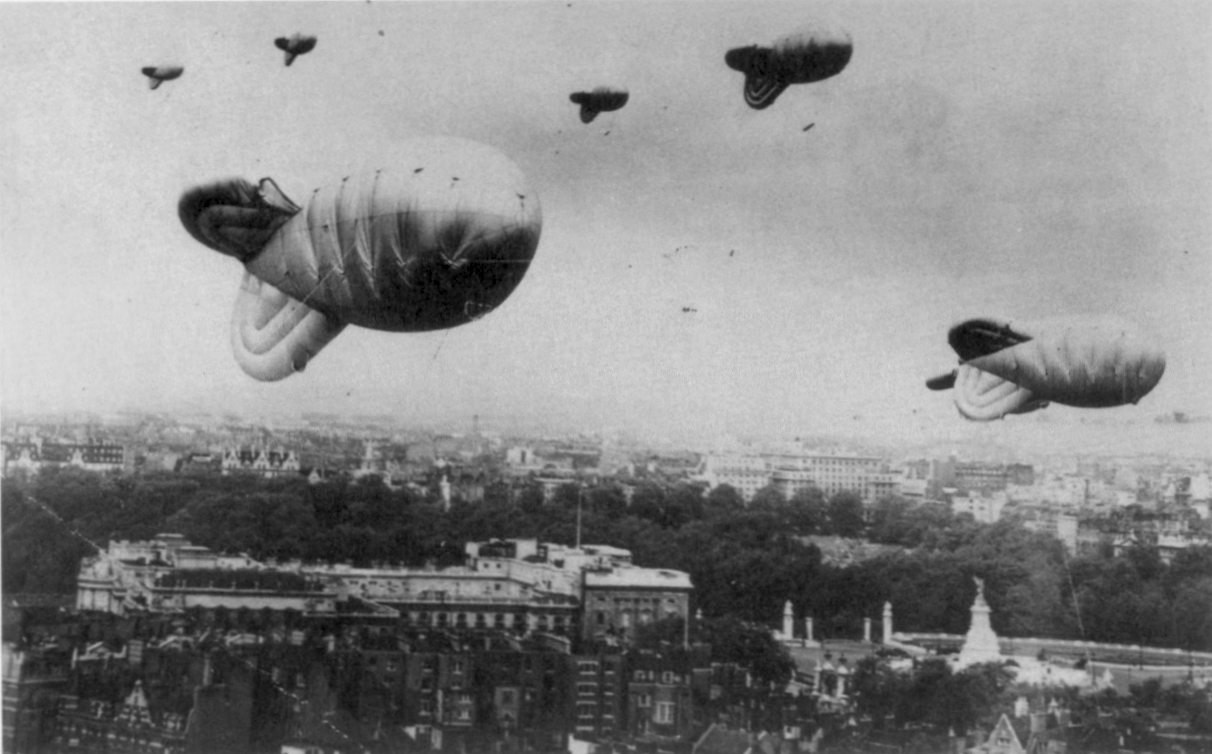
Wikimedia Commons image from Royal Air Force, photographer unknown.
These days, microprocessors allow for smaller radars and stand-off triangulation for missile defenses.
Starting this fall, two blimps will float at 10,000 feet over the Army's Aberdeen Proving Ground in Maryland in an attempt to develop a defense for the nation's capital against cruise missiles fired from ships offshore.Microprocessors also, notes Insta Pundit, allow for higher-resolution cameras high in the skies.
The Army, though it did not rule out the possibility of mounting these cameras, reportedly said it has no current plans to install them.Yes, and in an era of "stroke of the pen, law of the land," the absence of a limitation on government's powers bothers civil libertarians.
The Washington Post reported that the Army said in a letter to the newspaper that it did not conduct a Privacy Impact Assessment because there is no intention of collecting any personally identifiable information.
Officials insist they have no plans to put cameras on the blimps, but Christopher Calabrese of the ACLU points out there's no law against it.With the proliferation of security cameras, haven't the citizenry implicitly consented to be followed?
"Right now there are no rules," he said. "There's nothing that bars us from having high-powered cameras monitoring our every public movement."
Subscribe to:
Posts (Atom)




