28.2.06
POWER FAILURE? In the identity politics calendar, March is for the women of the fevered brow. The local theme for this year is "Re-Imagining Sisterhood." A quick review of the full schedule suggests that imagining Rosa Luxemburg or Betty Friedan might have gotten a few things wrong is out of bounds.


REVEALED PREFERENCES. I recently received the following in a mass-electronic-mailing.
On the other hand, the mailing is a bit slow in coming.
NIU's Presidential Commission on Sexual Orientation and Gender Identity has limited travel funds available to help support faculty, staff and students who wish to attend conferences, workshops or seminars for the purpose of learning about or presenting scholarship on lesbian, gay, bisexual or transgender topics.With all the other potentially crucial research people are working on, there's a special pot of money for ... ??!? What's the intended audience?
On the other hand, the mailing is a bit slow in coming.
Individuals requesting funds will be asked to submit a PCSOGI Request for Travel Support form, including a breakdown of costs and other sources of funding support. All travel must take place in the current fiscal year (July 1, 2005 to June 30, 2006).By now, the abstract deadlines for spring and early summer conferences has passed. That makes me only slightly less unhappy that my reimbursement for the Boston recruiting trip in January has not yet reached me.
ADJECTIVE CLAUSES, ANYONE? In the following question, what did I have to clarify most often?
An airline must own at least one airplane, a special machine that costs millions of dollars, and it must have landing rights at at least two airports, which requires that it apply to two airport authorities. Of the two prerequisites, which do you see as the more severe barrier to entry facing new airlines, and why?The only kind thing to do is explain that yes, "special machine" modifies "airplane." What has happened to taking it for granted that upper-division students ought do this almost as easily as breathing?
NOT HOUNDED OUT. Last year, we were following the travails of Southern Utah University's Stephen Roberds, who at the time claimed to have been relieved of his tenure for political reasons. Professor Tufte of Voluntary Xchange reports the professor has left, but the threatened legal action has not materialized.
In the meantime, SUU has not been overrun by brownshirts, speech codes, the John Birch society, or Mormons intent on suppressing 21st century culture.The university administration properly treats the details of the case as confidential.
NO BAD IDEA GOES AWAY. Thom Hartmann rediscovers mercantilism.
The old concept was that if there was a dollar's worth of labor in a pair of shoes made in the USA, and somebody wanted to import shoes from China where there may only be ten cents worth of labor in those shoes, we'd level the playing field for labor by putting a 90-cent import tariff on each pair of shoes. Companies could choose to make their products here or overseas, but the ultimate cost of labor would be the same.Yes, New England was a more prosperous place when shoes came from factories in Lynn, Massachusetts, and there were dairy farms along Route 128.
The result [of free trade agreements] has been an explosion of cheap goods coming into our nation, and the loss of millions of good manufacturing jobs and thousands of manufacturing companies. Entire industry sectors have been wiped out.By Jove, erase all those office parks and restore the shoe factories and dairy farms. Now!
That reminds me of a remark attributed to President Lincoln on the desirability of using our dollars to buy railroad rails in the United States, so that we could have the rails and the dollars, rather than having rails from British companies that now held the dollars. Isn't it the case that buying a corporation means buying the opportunity to sell things other people want to buy? Were the situation as dire as Mr Hartmann would have us believe, wouldn't we see those holders of dollars seeking to unload them for, well, very few euros or yen on the dollar, rather than buying assets that produce future income streams denominated in dollars?Because our so-called "free trade" policies have left us with an over $700 billion annual trade deficit, other countries are sitting on huge piles of the dollars we gave them to buy their stuff (via Wal-Mart and other "low cost" retailers). But we no longer manufacture anything they want to buy with those dollars.
So instead of buying our manufactured goods, they are doing what we used to do with Third World nations - they are buying us, the USA, chunk by chunk. In particular, they want to buy things in America that will continue to produce profits, and then to take those profits overseas where they're invested to make other nations strong. The "things" they're buying are, by and large, corporations, utilities, and natural resources.
Back in the pre-Reagan days, American companies made profits that were distributed among Americans. They used their profits to build more factories, or diversify into other businesses. The profits stayed in America.
BEFORE THIRTEEN GREAT STATES COULD BE LINKED. February 28 marks the 179th anniversary of the chartering of the Baltimore and Ohio Railroad. Although the railroad itself is now part of CSX Transportation, its Old Main Line combines contemporary muscular freight railroading with early nineteenth century infrastructure.
25.2.06
CREEPING SCHAUMBURGIZATION? Will Sycamore soon be the site of a major shopping mall?
The analogy is incomplete. Schaumburg has the commuter train. There are no tracks in Sycamore. The Elburn service is convenient (watch for a trip report) although somewhat of a strain on the train crews as the turn cycles are different.
The analogy is incomplete. Schaumburg has the commuter train. There are no tracks in Sycamore. The Elburn service is convenient (watch for a trip report) although somewhat of a strain on the train crews as the turn cycles are different.
THE CONTROVERSY BLOWS OVER? One reaction to the Danish cartoons on Wednesday and two on Thursday.
SECOND SECTION: Score one for Northern, notes Illini or Huskie? A columnist at Syracuse compares two student newspapers in the flatlands.
SECOND SECTION: Score one for Northern, notes Illini or Huskie? A columnist at Syracuse compares two student newspapers in the flatlands.
MARKED OFF. Limited posting until the stack of blue books is full of red marks and then returned to their authors. It takes a bit longer when I have to count to ten rather than mark down an answer that inserts an extra "e" into "debatable," when the instructions spell out that the statement is true, false, or debatable.
QUOTE OF THE DAY. A colleague deals with mobile phone abuse in class.
Cell phone use in my class has not been an issue. I make it clear to my students it will not be tolerated, and they should turn their phones off in class. If students are talking on the phone in class, it is only because the instructor is allowing it to happen.A student recognizes the source of the problem.
I think teachers are starting to tolerate cell phones more, but it's annoying because they have rules that aren't being enforced.
21.2.06
CONVENIENT COMMUNICATION? The New York Times finds something else not to get bothered about.
Atlantic Blog has a commendable perspective on proper use of electronic mail.
At colleges and universities nationwide, e-mail has made professors much more approachable. But many say it has made them too accessible, erasing boundaries that traditionally kept students at a healthy distance.One of the professors quoted in the article has already posted a clarification at her site. Kieran at Crooked Timber has inspired his readers to come up with examples of particularly amusing student e-mail handles. (I have already covered this.) Acephalous imagines a plea for assistance in instant messenger patois. Daniel Drezner, Easily Distracted, and University Diaries wonder what all the fuss is about.
Atlantic Blog has a commendable perspective on proper use of electronic mail.
That's effectively my position. A stern "hereafter, treat electronic mail as official Northern Illinois University business" generally suffices to secure subsequent communication in the approved form, without erasure or interlineation. I'll also announce that my last check of electronic mail the night before an exam will be at 10 pm, and almost never will an inquiry arrive in the in-box sometime between 10 and the next morning.For the most part, I have no problems with student emails, with two caveats. First, I do not respond to emails written in the jargon of text messages. Partly this is a matter of manners. Text message jargon is appropriate for conversations with friends. It is not appropriate for people who are not your friends, where you are obliged to be clear. Which connects to the other part of my reason: I do not understand them.
Second, I once got an indignant email from a student, upset that I had ignored his previous email, which he forwarded to me. A quick glance explained the problem. The message had been caught by the spam checker, because the subject line was "Hey dude". I am not making that up.
LOCAL REACTION, DA CAPO AL FINE. Tuesday's three letters to the Northern Star reiterate earlier reaction, some favorable, some not, to the publication of the Danish caricatures.
20.2.06
CONTEMPLATING MERITOCRACY. The Arizona Cardinals recently named Gary Zauner as special teams coordinator. Mr Zauner left a similar post at the Baltimore Ravens to rejoin Dennis Green, who he worked with as Vikings special team coordinator from 1994 to 2001.
Mr Zauner's college coaching resume includes stints at Long Beach State, New Mexico, San Diego State, and Brigham Young, where the Cardinal publicist claims he was intercollegiate football's "first full-time special teams coach."
His collegiate experience included the opportunity to kick eight extra points (for River Falls, Wisconsin, State, as it was then known) against Winona State on September 11, 1971. I don't know if the Wisconsin State Universities (as they were known at the time) had athletic scholarships. In high school, he was Milwaukee Hamilton's first place kicker, for the 1967 season only. (Students were administratively reassigned to Hamilton beginning in January of 1966. Whether he had an opportunity to play as a sophomore elsewhere in fall 1965 I don't know.)
Put the pieces together: one season as high school place kicker, a collegiate career well out of view of Big Media, numerous collegiate coaching stints, ultimately recognition as a placekicking guru. (Charlie Brown could use some pointers...)
Granted, one story does not a tendency confirm, but compare the path to success in the academy. Another Econ Hopeful links to research on Ph.D. completion and subsequent research productivity. The paper investigates the admission decisions and subsequent performance of Princeton Ph.D.s. A favorable recommendation from a star economist at a well-known undergraduate program is a strong indicator of future success, measured as at least one publication in a leading journal. Here's how Econ Hopeful summarizes.
Question: is the academy more or less meritocratic than professional football? Could a kid who went from Milwaukee Hamilton to River Falls and discovered an academic vocation there gain admission to a strong graduate program on the basis of good grades, a 99th percentile quantitative GRE, and reference letters from journeyman academics? Or would that kid be passed over for someone with a slightly lower grade-point average, a 90th percentile quantitative GRE, and favorable reference letters from Carleton or Swarthmore faculty, to name two colleges known as cradles of economics Ph.D.s?
A project: take the past 20 years of college football rankings. Construct an index of program strength based on those rankings. Now take the past 20 years of U.S. News prestige rankings. Conduct a similar index of academic strength. (Neither of these are trivial tasks. I'm working on other research. Looking for a dissertation topic? Get going.) My conjecture: on average, the prestige ranking of professors and senior administrators by university of terminal degree in any chosen sub-sample of higher education will be higher than the program strength ranking of players by university and coaches by collegiate affiliation in professional football. College coaching staffs are likely to show more variety of prior affiliation or playing experience than their faculties.
Mr Zauner's college coaching resume includes stints at Long Beach State, New Mexico, San Diego State, and Brigham Young, where the Cardinal publicist claims he was intercollegiate football's "first full-time special teams coach."
His collegiate experience included the opportunity to kick eight extra points (for River Falls, Wisconsin, State, as it was then known) against Winona State on September 11, 1971. I don't know if the Wisconsin State Universities (as they were known at the time) had athletic scholarships. In high school, he was Milwaukee Hamilton's first place kicker, for the 1967 season only. (Students were administratively reassigned to Hamilton beginning in January of 1966. Whether he had an opportunity to play as a sophomore elsewhere in fall 1965 I don't know.)
Put the pieces together: one season as high school place kicker, a collegiate career well out of view of Big Media, numerous collegiate coaching stints, ultimately recognition as a placekicking guru. (Charlie Brown could use some pointers...)
Granted, one story does not a tendency confirm, but compare the path to success in the academy. Another Econ Hopeful links to research on Ph.D. completion and subsequent research productivity. The paper investigates the admission decisions and subsequent performance of Princeton Ph.D.s. A favorable recommendation from a star economist at a well-known undergraduate program is a strong indicator of future success, measured as at least one publication in a leading journal. Here's how Econ Hopeful summarizes.
The paper goes on later to say that the best advantage one can have in admissions it to go to an elite school because it is much more probable to get a letter of recommendation from a prominent scholar.(Via Newmark's Door. Tyler at Marginal Revolution comments on the interpretation of coefficients.)
Question: is the academy more or less meritocratic than professional football? Could a kid who went from Milwaukee Hamilton to River Falls and discovered an academic vocation there gain admission to a strong graduate program on the basis of good grades, a 99th percentile quantitative GRE, and reference letters from journeyman academics? Or would that kid be passed over for someone with a slightly lower grade-point average, a 90th percentile quantitative GRE, and favorable reference letters from Carleton or Swarthmore faculty, to name two colleges known as cradles of economics Ph.D.s?
A project: take the past 20 years of college football rankings. Construct an index of program strength based on those rankings. Now take the past 20 years of U.S. News prestige rankings. Conduct a similar index of academic strength. (Neither of these are trivial tasks. I'm working on other research. Looking for a dissertation topic? Get going.) My conjecture: on average, the prestige ranking of professors and senior administrators by university of terminal degree in any chosen sub-sample of higher education will be higher than the program strength ranking of players by university and coaches by collegiate affiliation in professional football. College coaching staffs are likely to show more variety of prior affiliation or playing experience than their faculties.
THE LOCAL REACTION CONTINUES. Two opinions Monday on the Northern Star's publication of the Danish cartoons.
19.2.06
RATIONING BY PRICE? Despite rising returns to a university degree, observers fear that rising tuitions are pricing bright but poor students out of the University of Wisconsin.
Even when they are better qualified, students from low-income families are less likely to enroll in the system than their upper-income peers; 44% of low-income students with ACT scores higher than 28 enrolled in 2004, compared with 54% of high-income students with ACT scores between 20 and 23.Merit scholarships anyone? To what extent is that cohort of well-to-do but less academically promising students the reason for Jacuzzi U amenities, frustration with I-pod distracted cluelessness, and that high defect rate? Perhaps a higher list price accompanied by more generous merit scholarships will achieve an optimal separating equilibrium, with a larger proportion of the former cohort and a smaller proportion of the latter cohort in the entering class.
INSIDE, OUTSIDE. Good things happen when you move the basketball.
Better things happen when you prevent the other team from scoring.[The Lady Huskies] (10-14, 6-7) shot an impressive 54 percent (27-of-50) from the floor against the Chippewas, who came in ranked second in defensive field goal percentage, allowing just 39.5 percent in MAC games.
The hot percentage from the floor was attributed to getting the ball inside to the post for high-percentage shots. NIU used the high-low combination of Stephanie Raymond and Kristin Wiener to pound the ball inside. Raymond threw an entry pass over the top to Wiener on at least four different occasions to score easy two-point baskets for the Huskies. NIU outscored Central Michigan 32-12 on points in the paint.
[T]he Huskies' defense kept them in the game by holding the Chippewas (14-10, 5-8) without a basket for the first 5:27. The Huskies held CMU to 15 points in the first half and forced 23 turnovers.“I don't think we were worried,” Wiener said about the slow start. “With our defense we held them to one point, it was 1-0 for a long time. We finally got something to fall. We knew if we kept our defense up that something had to fall sooner or later.”Play smart, win. I like that.
AND MORE LOCAL REACTION. Friday's letters to the Northern Star express support for the publication of the Danish caricatures of Mohammed. The fourth letter raises an instructive point: not all practicing Moslems accept the Wahhabi traditions let alone the martyrdom heresies properly lampooned in the cartoons. The obligations of believers to marginalize the nuttier among them are, however, not well defined, even here.
Elsewhere around the academy, Wisconsin's chancellor John Wiley defended the Badger Herald's publication of the cartoons, noting, "[The Great State University of Wisconsin] has for more than 100 years championed the cause of free and open debate." He left it up to the newspaper editors to deal with any offended readers. (The Herald staff are unlikely to shrink from that. Years ago a columnist described the recently deceased Mao Tse-Tung as a "moon-faced murderer," something that brought the local com-symps out to protest.) Presumably, pace Marquette Warrior, the Daily Cardinal has the same obligation to deal with any offended Christians.
Marquette's Triumvirate is following the theoretical contortions required by the Bishop of South Bend and Fort Wayne to square academic inquiry with Catholic identity in deciding what offenses are beyond redemption, in this instance Eve Ensler's view of sexuality being contrary to Catholic teachings. Per corollary, Danish cartoons of Mohammed might be contrary to Moslem teachings, and subject to proscription.
Neither Northwestern nor Illinois at Urbana, two nearby universities that have avoided publishing, or have punished editors for publishing the caricatures, are so constrained.
SECOND SECTION: Steve at Left2Right has been thinking about the conflict of values inherent in proscribing Eve Ensler.
Elsewhere around the academy, Wisconsin's chancellor John Wiley defended the Badger Herald's publication of the cartoons, noting, "[The Great State University of Wisconsin] has for more than 100 years championed the cause of free and open debate." He left it up to the newspaper editors to deal with any offended readers. (The Herald staff are unlikely to shrink from that. Years ago a columnist described the recently deceased Mao Tse-Tung as a "moon-faced murderer," something that brought the local com-symps out to protest.) Presumably, pace Marquette Warrior, the Daily Cardinal has the same obligation to deal with any offended Christians.
Marquette's Triumvirate is following the theoretical contortions required by the Bishop of South Bend and Fort Wayne to square academic inquiry with Catholic identity in deciding what offenses are beyond redemption, in this instance Eve Ensler's view of sexuality being contrary to Catholic teachings. Per corollary, Danish cartoons of Mohammed might be contrary to Moslem teachings, and subject to proscription.
Neither Northwestern nor Illinois at Urbana, two nearby universities that have avoided publishing, or have punished editors for publishing the caricatures, are so constrained.
SECOND SECTION: Steve at Left2Right has been thinking about the conflict of values inherent in proscribing Eve Ensler.
The better way is to publicly discuss the strengths and weaknesses of the Vagina Monologues from a Catholic perspective. A public image of censorial tendencies is not good for Catholic education, and censorial Catholic education is not good education.Take that last sentence. Delete the two occurrences of "Catholic." Live by it.
17.2.06
FRIDAY TRAM BLOGGING. You're looking at a very limited edition offering from the St. Petersburg Tram Collection.

The prototype is the Pacific Electric double-ended suburban PCC. During World War II, Pacific Electric painted two in Navy blue with recruiting slogans.
The St. Petersburg Collection has expanded over the last eight years or so. I'm not sure what prompted an entrepreneur in St. Petersburg, Russia, to produce and sell quite detailed models, initially of Soviet and Russian trams in 1:43 scale, later expanding to models of traction and motor transport worldwide, including an extensive North American line in 1:48.
ACHIEVING OFF THE COURT. Among the nuggets about the women's basketball team.
On the court, the team still must learn how to beat opponents with winning records.
Three players achieved the 4.0 for the semester.NIU women's basketball team has the highest grade point average of all NIU sports.
For fall 2005 the team's collective GPA was 3.5.
On the court, the team still must learn how to beat opponents with winning records.
AND MORE LOCAL REACTION. A mixed bag of letters to the Northern Star, some offended by the decision to print the Danish cartoons, some pleased to learn what all the fuss is about.
In other censorship news, the university will offer Eve Ensler's play in March, despite the potential for offending the Cardinal Newman Society.
In other censorship news, the university will offer Eve Ensler's play in March, despite the potential for offending the Cardinal Newman Society.
QUOTE OF THE DAY. Miss Manners is unimpressed with the evolution of senior prom. (I remember when this was junior prom.)
Her objections to it are that the prom has become crass, and that it serves as a training ground for even crasser weddings.What brought the institution to this pass?
And so the pattern for that anachronistic institution, the prom, is taken from the lives of pop celebrities -- the suddenly enriched who go wild.And what ought the young aspire to?
A hint: It is not riding around town in an impossibly long and expensive car, throwing up.Quite.
15.2.06
SELF-SEGREGATION. Joe at Winds of Change recommends a Tech Central Station essay on class solidarity and social stratification. Key quote:
Fat, happy teachers' unions, in solidarity with class-conscious suburban parents, conspire to keep vouchers out of the hands of poor families, ensuring the perpetuation of two Americas while singing the praises of our unifying public system.A year ago, I identified a related thesis topic for readers. It's still an open topic.
GOOD, FAST, AND CHEAP. PICK TWO. That hasn't occurred to the American Association of State Colleges and Universities.
The answer is simple, the places and populations that are harder to serve and the programs that add value to society but not institutions’ bottom lines will be left behind. The promise of opportunity for all and partnerships for the public good will be broken.Via Inside Higher Ed, also offering a longer column addressing academic accountability.
And a growing number of college leaders (though not all) also agree that higher education institutions, individually and collectively, must do a better job proving to the public that they are successfully educating students — partly because the current political and economic climate demands it, and partly because it’s the right thing to do.Is it impolite to mention that 70% defect rate?
ART IMITATES LIFE. No Oil for Pacifists shows Captain America, Superman, and Batman modeling proper behavior toward tyrants.
QUOTE OF THE DAY. Mungowit's End reminds readers, "Work is what we do BETWEEN meetings."
Meaning that if you spend all day in meetings, you were doing NOTHING. Sure, you were AT work, and you were not having fun, but you didn't WORK.The entire post is instructive, particularly the advice about what to do rather than reprise developments so far for the benefit of late arrivals.
PUT A DIAPHRAGM IN IT. Marquette University denies a student group permission to use university facilities to perform "Vagina Monologues." Marquette's GOP3.com links to a Cardinal Newman Society statement that characterizes the play as "offensive." Marquette Warrior offers perspective (scroll around for updates).
We personally don’t favor banning any production, no matter how hateful, but then we don’t favor banning a Klansman who might want to speak on campus. The feminist “Vagina Monologues” types, of course, would ban anybody they thought guilty of “hate speech” in a second. So we shed no tears when they get the same treatment they would happily mete out to others.This site has long maintained that advocates of speech codes and other machinery of repression give themselves no powers that they wouldn't want their worst enemy to have. Apparently the right not to be offended is not exercised only by feminists or Moslems.
RELENTLESSLY ON TO BOSTON. That's a banner Badger fans would hang in the Coliseum in the days when the Boston Garden was the traditional site of the collegiate hockey championship. Different era, different tournament location, different players. But the Wisconsin women's hockey team has clinched the regular season title. Now to do something about increasing the attendance at the games. SIEVE!
The women's tournament is in the Twin Cities, in a conflict with the Midwest Economics Association, with the weekend of preliminaries preempted by the March Meet.
The women's tournament is in the Twin Cities, in a conflict with the Midwest Economics Association, with the weekend of preliminaries preempted by the March Meet.
THE REACTION COMES IN. Today's letters to the Northern Star object to the reprinting of the Danish cartoons of Mohammed as "offensive" and "tasteless." The Badger Herald at Wisconsin also reprinted the cartoons. Reaction there shows greater diversity.
14.2.06
WHY STANDARDS MATTER. The value of rigorous education in developing strong life-management skills elaborated at A Constrained Vision, the difficulties of selling the university as a summer camp cataloged at SCSU Scholars. As the footnote would put it, see the references cited therein. (Do I have to go Jack Bauer and say NOW!)
THE WHEEL TURNS. Years ago, a feminist collective at my high school (yes, we had such things, as well as state-champion caliber basketball and baseball) issued a manifesto that included a characterization of "free love" as less than desirable for the female in the couple, who, the manifesto alleged, "paid for the 'free.'"
It appears as though participants in the rabbit culture are learning a similar lesson.
It appears as though participants in the rabbit culture are learning a similar lesson.
Via Newmark's Door.Hooking up happens, so what happens after hooking up? It isn't always as carefree as it seems.
"What happens is usually one of two partners becomes attached," [Washington Post reporter Laura] Stepp said. "It becomes for that person more than a hookup. But, they won't call it something else."
Stepp added that the attached person is normally the female in a heterosexual hookup.
"The culture really benefits men. It gives men what they want without women getting what they want," said senior Anthony Moniello, who took Stepp's class. "A lot of times, a girl will hook up with a guy, but then she'll want to see him again. For men, it will be a more physical thing."
THEY PRETEND TO PAY US, WE PRETEND TO WORK. The dean at Anonymous Community uncovers sick-leave abuse.
Sometimes crummy morale is simply jerkism. Sometimes it has a deeper cause.
First, perhaps these colleagues have noticed the propensity of their students to press every point of leverage. Here's a lament from comments to a Joanne Jacobs post.
Second, although its not the case at Anonymous Community that student litigiousness has expanded apace (it's correlation, not causation) with big time sports, elsewhere resources are forthcoming for new locker rooms, and scholarship athletes provided with ample opportunities to skate on the academic standards. Despite protestations that athletic fundraising efforts tap a different source of funds than the academic programs, resources have opportunity costs. Does it surprise if some people might game a system that others have been gaming?
Now assume that one professor has shifted his gaze to another part of the contract. There, it says that using three or more sick days in a row requires a doctor’s note. This professor has accumulated plenty of days over the decades, and is spending them now at the rate of two a week. Since the contract sets the threshold for verification at three consecutive days, he can do this and get paid for it until the cows come home.Russian Violets discovers something similar.
This is NOT a corporate-type situation in which someone else can fill in. It's not a "use 'em or lose 'em" situation either; unused sick time is banked toward retirement. And seriously, it's the same people all the time. Some of us drag our sorry asses in here when we're deathly ill; these creeps call in sick with a hangnail.I'm tempted to weigh in with a bump-to-the-top. The only awards I won in junior high and high school were for perfect attendance. Much of what I have accomplished in the years since has been a matter of showing up. All the same, let me attempt to make sense of this behavior, without excusing it.
Sometimes crummy morale is simply jerkism. Sometimes it has a deeper cause.
First, perhaps these colleagues have noticed the propensity of their students to press every point of leverage. Here's a lament from comments to a Joanne Jacobs post.
I'm a college professor, and yes, it does seem to be getting worse over time. I've had students ask me if I give them "bonus points" for showing up to class on days when a lot of the rest of the class decided to take the day off. (FWIW: I'm 37.) It's frustrating to deal with people who have such a mismatch between what they actually DO and what they expect to RECEIVE in return...if I leave academia (which, honestly, is a career I love on the good days, and think I'm at least slightly better than mediocre at), it will be because of the inflated senses of entitlement that a small (perhaps 15%) fraction of the population has.The legalese that turns the humble course outline into what University Diaries calls the Syllabum Omnium is a reaction to such behavior. Anonymous Community apparently holds the line on enforcing conditions laid down in the course outline. That's also true at Northern Illinois. As I peruse other academic weblogs, I'll occasionally see complaints about administrators ignoring or over-riding perfectly valid course requirements. Those complaints typically are not sufficiently specific for me to test the hypothesis that the over-rides are coming from the proliferation of associate provosts, assistant deans, and coordinators whose responsibility is to shepherd the aimless through to graduation, whether or not any value-added is produced in the intervening six years. The proliferation, however, is real, as is the expansion of administrative payroll during a period of skimpy merit increases. Does it surprise if some people might game a system that has been playing them for suckers and second-guessing their standards?
Second, although its not the case at Anonymous Community that student litigiousness has expanded apace (it's correlation, not causation) with big time sports, elsewhere resources are forthcoming for new locker rooms, and scholarship athletes provided with ample opportunities to skate on the academic standards. Despite protestations that athletic fundraising efforts tap a different source of funds than the academic programs, resources have opportunity costs. Does it surprise if some people might game a system that others have been gaming?
GETTING NOTICED. Tim Blair compares and contrasts the Northern Star's publication of the controversial Mohammed cartoons with reaction elsewhere.
13.2.06
DELIBERATELY PROVOCATIVE. The Northern Star publishes the controversial Danish cartoons "on the basis of their news value." (.pdf) I will advise readers of the reaction.
11.2.06
ON THE FROZEN TUNDRA. When my dad was courting my mom, they watched her brother play an outdoor hockey game in Green Bay.
The tradition of outdoor hockey in Green Bay just grew. The University of Wisconsin hosted Ohio State on a rink set up in Lambeau Field. It was newsworthy enough that the local TV station, which otherwise only notices a Wisconsin hockey team when it wins the national title, showed some tape of the game-ending empty net goal. Badgers 4, Buckeyes 2, 40,890 fans. This was a non-conference game as Ohio State along with Michigan and Michigan State would rather not spend the money traveling to North Dakota and Colorado let alone Madison to be beaten. SIEVE!
The tradition of outdoor hockey in Green Bay just grew. The University of Wisconsin hosted Ohio State on a rink set up in Lambeau Field. It was newsworthy enough that the local TV station, which otherwise only notices a Wisconsin hockey team when it wins the national title, showed some tape of the game-ending empty net goal. Badgers 4, Buckeyes 2, 40,890 fans. This was a non-conference game as Ohio State along with Michigan and Michigan State would rather not spend the money traveling to North Dakota and Colorado let alone Madison to be beaten. SIEVE!
ON MY WORKBENCH. Here is a clearer photo of the Andreyev backhead, using conventional ASA 200 film.
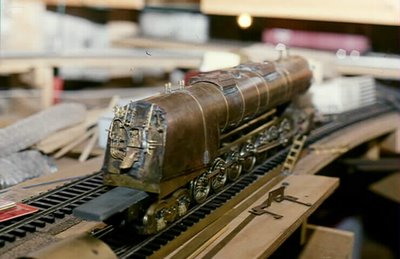
(The cheap digital camera has another limitation, an extremely volatile memory. I took it to O Scale West last weekend and took a few pictures. Somewhere between the last layout and DeKalb some electrical transient or a hiccup or some jostling in my pocket wiped out all the images.)

(The cheap digital camera has another limitation, an extremely volatile memory. I took it to O Scale West last weekend and took a few pictures. Somewhere between the last layout and DeKalb some electrical transient or a hiccup or some jostling in my pocket wiped out all the images.)
THERE IS AN ALL-WEATHER MODE. The Weather Channel crews are all excited over the latest snowstorm to roll into the Official Region. Airports closed, flights already cancelled, Chicago's airports likely to be more fouled than normal tomorrow. Highway department drivers anticipating overtime. But one of the Weather Channel reporters recommended that people who really had to travel in the Official Region use Amtrak.
THE UN-NATURALNESS OF NATURAL MONOPOLY. Another Wisconsin water war is brewing. This time, it's the city of Green Bay and its suburbs, both of which use Lake Michigan water piped from an intake at the base of the Door Peninsula. (The water in the Fox River and Green Bay is too warm in summer and too full of paper-mill runoff to be economically treated for use.) There are scale economies in building and sharing a larger pipe, but applied allocation of common costs is anything but easy.
At the time the city of Green Bay first built the main, the suburbs decided that the stand-alone costs of using well water from local aquifers would be less than the costs of participating in the pipeline.
But city governments, apparently, don't think like economists.
At the time the city of Green Bay first built the main, the suburbs decided that the stand-alone costs of using well water from local aquifers would be less than the costs of participating in the pipeline.
Green Bay asked the nearby communities of Allouez and De Pere to join the effort. They declined, and that is not surprising. With their bigger brother no longer sucking from the shared aquifer, there would be plenty of well water left for the region's smaller communities.The well water has too high a radium content to meet new water quality standards. The natural monopoly argument suggests one pipeline for Green Bay and its suburbs would be the cheapest way to bring in more lake water. But any agreement on sharing the costs of a shared input is costly to reach.
The problem was Green Bay and the suburbs could not agree on the price the suburbs should pay. Both sides worried that they would end up with a deal that subsidized the other.Strictly speaking, any payment by the suburbs to the city of Green Bay that is less than what the suburbs would have to pay for their own pipeline is subsidy-free from the city's perspective. It's also Pareto-improving from the suburbs' perspective, unless they fear some robber baron in the mayor's office cutting off the water.
But city governments, apparently, don't think like economists.
Green Bay, like Milwaukee, worries about its suburbs sucking away its life - and tax base. Green Bay suburbs meanwhile, like Milwaukee suburbs, worry that the big city in the middle will do whatever it takes to strangle growth on its outskirts.I must confess, however, that the notion of a city going out of business is a bit jarring, which is where this competition metaphor leads. (In the private sector, there is an efficient level of business failure.) On the other hand, that fate might be indicated for Detroit and New Orleans.
LOOKING WITHOUT SEEING. This building along Chicago's Wabash Avenue had to have witnessed the first trips of the Electroliners.

It never registered with me until last December, when I noticed the steam vent in the top cupola. There's a lot more character to it than to most of the postmodern boxes and tubes in the Loop.
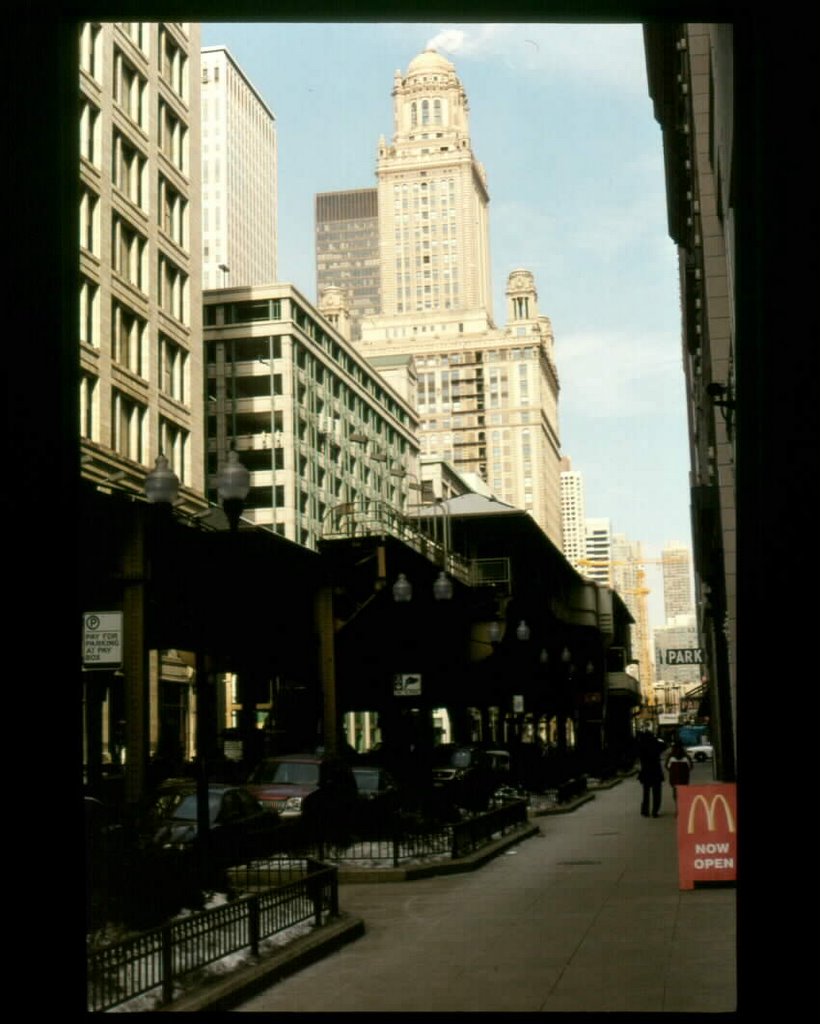
It never registered with me until last December, when I noticed the steam vent in the top cupola. There's a lot more character to it than to most of the postmodern boxes and tubes in the Loop.
I'LL NEVER LACK FOR WORK. A few days ago I mentioned a lengthy essay on "The Post-Welfare State University." I have now had time to read it in full. It exemplifies the limitations of scholarly inquiry untrammeled by any obligation to develop refutable implications or engage data. The proposal of five epochs of evolution of the university as well as the taxonomy of five identifiable forms that books about the academy might take is perhaps of some use. But when I dig into the analysis, I start to see problems. Start with the source of The Crisis in the Humanities.
But never let a few inconvenient facts get in the way of a good rant.
Oh, that's right, Anne Rice or Tom Clancy couldn't get tenure.
But it's when Professor Williams attempts to deconstruct economics that he really gets into trouble.
Furthermore, the 1990s witnessed a convergence of several phenomena: the questioning of the welfare state university was one, the lower enrollments as the smaller Thirteenth Generation slouched through college another, the business fad of downsizing (despite the loss of institutional memory and flexibility) a third. But to lay all the blame on a (poorly foreseen?) combination of events during the late 1980s and early 1990s is, again, to overlook evidence. University administrators have long viewed "tenure depth" as an intolerable rigidity. They have a number of strategies to deal with it. The most famous departments are often large enough to make multiple hires in a year, with perhaps one person qualifying for the prize. The smaller departments might run afoul of a tacit tenure quota or be authorized only a temporary appointment.
It is when the essay attempts to make policy recommendations that the writer's limitations become clear.
The professor has a different idea, free tuition.
If anything, the coexistence of large graduate school debts and small tenure-track prospects are a signal to prospective Ph.D.s to look into other endeavors.
It is now clear that the Golden Age waned through the 1970s and 1980s. Although some of the terms are still fuzzy, the university was part of the strategic defunding of the welfare state from the Reagan Era onwards, and universities have come to operate more as self-sustaining private entities than as subsidized public ones. This has taken a number of paths, most familiarly the pressure for donations, private grants and capital investments (business "partnerships"), and other sources of external funding. Three in particular stand out as departures from the welfare state model. First, the production of directly marketable goods (even if called "knowledges"), enabled by innovations such as the Bayh-Dole Act of 1980, which permits universities to hold patents and thus profit from them. (Before, they reverted to the granting agency and were publicly held.) Second, the exponential increase of tuition, construing higher education more like any other service that requires consumers or clients to "pay as you go." (Before, the state subvented far larger percentages of tuition.) And third, the casualization of labor, largely through the use of temporary faculty, who now staff, by some estimates, 60% of courses.It didn't begin with Ronald Reagan. Ominous signs proliferated. James Michener's Kent State suggested that the use of temporary faculty, particularly graduate assistants, was tantamount to using "sweated labor." The Progressive, looking beyond the prisons, Latin American plantations, and packing houses that usually provide its material, concluded a 1975 article with "Ph.D., the new migrant." Economics research on the regressivity of tuition subsidies by state universities began in the late 1960s.
But never let a few inconvenient facts get in the way of a good rant.
For faculty, the so-called Reagan Revolution overwrote the Academic Revolution. The shift in labor has had the most impact on the traditional liberal-arts disciplines like English, where we rarely garner significant grants or produce commodifiable products. Given that their primary source of revenue is tuition or full-time equivalencies (FTEs), disciplines like English and foreign languages have resorted to a bipartite system of one-half permanent faculty to maintain and administer departments, and one-half temps (without benefits, at low salaries, and so forth), whether called teaching assistants, adjuncts, or lecturers, to cut costs.So where is the National Endowment for the Humanities or National Endowment for the Arts money going? Wouldn't a best-selling novel or some readable poems be "commodifiable?"
Oh, that's right, Anne Rice or Tom Clancy couldn't get tenure.
For those fortunate enough to hold permanent positions, the university has internalized the market protocol of intensified productivity, in the humanities through the largely symbolic productivity of books and articles (hence the inflation of publication requirements for tenure), as well as the ensuing pressure for service, given that there are fewer fully franchised faculty mmbers to keep departments running, to make curricular or staff decisions, and other sundry tasks that faculty invisibly do.That might play with a non-academic audience, but tenure criteria originate with faculty committees, as do changes in catalog language and the drawing up of short-lists for the job meetings. The former are vetted by college and university committees, the latter by all manner of administrators. Buy me a coffee if you want stories about campus politicians whose profundity is in inverse proportion to the length of their statements in meetings. The most productive thing some of them might do is zip it. (This Inside Higher Ed column has some concluding suggestions that recognize faculty responsibility for some of the university's problems.)
But it's when Professor Williams attempts to deconstruct economics that he really gets into trouble.
The most misguided commentary, it is now clear, was about academic jobs. Despite the rollback of full positions from around 1970, there were still projections, most notably the William G. Bowen report Prospects for the Faculty in the Arts and Sciences: A Study of Factors Affecting Demand and Supply, 1987–2012 (1989), that there would soon be not only an increased number of professorial jobs but a shortage of Ph.D.s to fill them. As Marc Bousquet has shown in "The Waste Product of Graduate Education" (2002), Bowen mistakenly relied on the shibboleth of supply and demand; given the demographic projections that the World War II generation would retire and that the children of the Baby Boomers would crowd college classrooms through the 1990s, the reasoning went, there would be a marked increase in demand for professors. What happened, of course, is that the iron law of supply was reconfigured in plastic ways, and many full positions had been replaced by casual positions. I would add that the problem with Bowen's predictions was not only the assumption of the sanctity of the market but the tacit expectation of the welfare state university.No. It is one thing to construct a model of a phenomenon judging it entirely by the tightness of its reasoning. It is quite another to produce one that makes sense of empirical phenomena. (Philosophers, literary critics, and some Austrian-libertarian economists have trouble passing that second test.) There is no "shibboleth" of supply and demand; rather, it is a model that explains behavior tolerably well as long as one accepts its limitations. One such limitation is its difficulty in explaining adjustment to a new equilibrium. Lyapunov's methods provide sufficient conditions for convergence. At best, they will provide a phase space, but not a solution for a trajectory.
Furthermore, the 1990s witnessed a convergence of several phenomena: the questioning of the welfare state university was one, the lower enrollments as the smaller Thirteenth Generation slouched through college another, the business fad of downsizing (despite the loss of institutional memory and flexibility) a third. But to lay all the blame on a (poorly foreseen?) combination of events during the late 1980s and early 1990s is, again, to overlook evidence. University administrators have long viewed "tenure depth" as an intolerable rigidity. They have a number of strategies to deal with it. The most famous departments are often large enough to make multiple hires in a year, with perhaps one person qualifying for the prize. The smaller departments might run afoul of a tacit tenure quota or be authorized only a temporary appointment.
It is when the essay attempts to make policy recommendations that the writer's limitations become clear.
Part of the problem might be the protocols of criticism. We are trained, when we look at poems or cultural phenomena, to "read" them, spotting unities or unpacking inconsistencies. We do not expect to fix them or to offer prescriptions for poets to follow. We tend to take a similar stance toward the university: we read and interpret the events and ideas they suggest, spotting inconsistencies or showing how ideas deconstruct. We need to switch stances, I believe, to a more pragmatic, prescriptive mode. In some sense, even the archetype of formalism, Aristotle's Poetics, is unabashedly prescriptive, because it sees poems as human products that humans make in better or worse ways. I am content to leave poems to poets, but, for the university in which we work and have a stake, we need to distinguish how it is made and what would make it better—without the conceit that only we hold the true ideal but with the confidence that it might be a more democratic institution.Blah, blah, blah. I have a proposition for English faculty. Teach students to write, so I don't have to. Let the economics department think about the incentives.
An overriding problem of the university, as I hope no one forgets after reading this, is student debt. I have adduced some of the statistics about student loans, but we should consider what debt actually means in students' lives and how it impacts their futures. If they are traditional college ages of 18–22, their debt will weigh them down until they are 37 (41 if they take the maximum forbearance). If they are older—and the average age of college students has gone up to the late 20s—then they will be encumbered until they are well into their 40s or 50s. Debt permeates many of their lives not only with the shackle of monthly payments but also with the possibilities that it delimits, governing the kinds of jobs they might take and the careers they might imagine. It enforces a rational choice not to become a schoolteacher making $21,000 per year, nor a social worker making $26,000, nor a fledgling writer or artist waiting tables for $12,000 to have writing or studio time during the day. Rather, it enforces the rational choice of going to business school or law school instead of graduate school in literature, so that they will start at a sizeable salary with prospects of yet more. The death of the humanities and the disciplines that promote "thought"—the majors in which have declined in real terms to less than 10% of college majors, with business expanding to 22%—results not from a loss of interest in the humanities but from the material interests that confront students.Working backwards: A simple explanation might be that what goes on in the humanities is neither interesting nor remunerative. Alternatively, the current compensation for one composition or drawing course as an adjunct pays about the same as that table waiting, without the obligation to dress well or be kind to a demanding but potentially big-tipping diner, and with the writing and painting time available on days the class isn't meeting. Do I really have to remind readers that perhaps that $21K starting salary for schoolteachers, as well as the obligation to "accommodate" unruly students, might contribute to the teacher turnover, particularly in weak districts? Begin at the beginning. Hasn't Professor Williams conceded that the benefits of a degree are private benefits? Why not get the state out of the business of subsidizing people to get rich?
The professor has a different idea, free tuition.
My own variant on [author Adolf] Reed's proposal would be to extend [free tuition] to graduate students and to establish a national job corps or other form of public service linked to the abatement of undergraduate and graduate student loans. In North Carolina, where I taught for a number of years, there was a program through which students received a full scholarship and living expenses in return for teaching for three years in understaffed public schools. On the postgraduate level, there are similar programs for medical doctors, who receive tuition or loan abatements in return for practicing in areas without sufficient healthcare. This is particularly urgent for graduate students, since postbaccalaureate debt is now estimated at around $50,000. This would also benefit faculty, not just to do the right thing but in terms of our own labor. The university experienced better labor conditions after World War II not because it adopted a better idea but because so many people went to college, found it useful, and thus valued it.Again, working backwards. What people valued was a somewhat more rigorous experience than the therapeutic mush that has displaced the core curriculum. And, to use Professor Williams's metaphor of debtors prison, his proposal really does turn a university degree into a form of indentured servitude.
If anything, the coexistence of large graduate school debts and small tenure-track prospects are a signal to prospective Ph.D.s to look into other endeavors.
THE HOME OFFICE OF EDUCATIONAL MEDIOCRITY? Alan Greenspan is not certified to teach high-school macroeconomics. Ashbrook Center's Terrence Moore sees a problem with that certification.
(Ashbrook link courtesy Constrained Vision.)
Some education professors have never taught in a school but rather have committed themselves to educational research. These are the high-flyers who every year come up with or at least spread the good news of a new strategy for revolutionizing education, whether involving "multiple intelligences" or "student-centered learning" or "taxonomy." These professors with their new ideas have presided over the steady decline of students’ learning during the last half-century.According to Mr Moore, the economics component of the social science teacher certificate is a stumbling block for many.
The subject or subjects the prospective teacher will teach, such as economics, are relegated to the Limbo of one’s "content area." Content courses are the bitter pill one must swallow to get to be a teacher. How bitter can easily be seen by taking a look at the transcript of most any graduate of an ed-school. Every year I receive about a hundred job applications from fully certified teachers for open positions at my school and therefore about a hundred college transcripts, and the story is almost always the same: straight A’s in education courses; multiple C’s, D’s, F’s, and W’s ("withdrawn," i.e. the course is too hard so let’s try it again later or with an easier professor) in one’s content area.It's difficult to generalize, let alone recommend changes in public policy, on the basis of one search committee's experience. I've had elementary education majors get through my introductory price theory course in good shape, and I work with the local economics teachers in the common schools. We will be putting up the poster contest winners for this year in March. (The poster I show also won the state competition.) On the other hand, many of the entries come from well-to-do neighborhoods. (What was I saying about the common schools failing to socialize?)
(Ashbrook link courtesy Constrained Vision.)
WORKS WELL WITH OTHERS. Scott at Inside Higher Ed interviews sociologist Carrie Young Costello on some field work she has done with social work and law students.
Costello finds that there is an undeclared yet unmistakable WASP accent to the professional roles that students are training to acquire. Along with technical expertise, they have to assimilate the necessary demeanor and attitude. For students of some backgrounds, that presents no real difficulties — so they can, as Costello puts it, “focus on the intellectual tasks of professional school with little distraction.” But for those with “a mismatch between the personal identities they possess upon entering their professional programs and the professional roles those schools proffer,” there can be a jarring dissonance.Once upon a time, our common schools attempted to inculcate habits of punctuality, dependability, and a respect for evidence in everybody. Might a misplaced "affirmation" of bad habits as cultural characteristics be setting up people for future failure?
Race and gender aren’t the only factors making for identity dissonance in professional schools; so is strong religious commitment. “Particularly at risk in my sample were evangelical Christian women who used a ‘what-would-Jesus-do’ standard to guide all of their behavior and decisions,” notes Costello, “but students from other religious backgrounds whose religious dictates took precedence over other commitments could also be at risk.”No easy answers.
IF YOU BUILD IT THEY WILL COME. Rip Track notes some impressive increases in passenger train riding. He poses a question:
Who would have thought twenty years ago that railroads would be a growth industry?I think Fortune and Business Week had noticed the growth of the freight side by mid-1986, with coal and double-stack traffic grabbing the headlines. Future development of the commuter and corridor service is likely to involve replacement of tracks lifted in downsizings of the 1960-1980 era or agreements between commuter authorities and the freight carriers to provide additional tracks (such as the third track Randall Road to Elburn on the Union Pacific) and higher-speed interlockings.
AROUND THE WORLD IN UNDER 80 HOURS. Make that Cape Canaveral to Bournemouth with a circumnavigation thrown in. Steve Fossett walked away from an emergency landing with the Virgin Atlantic Global Flyer (will a Pendolino receive that as a nameplate?) and a new distance record for solo circumnavigation.
9.2.06
ON THE LIGHTER SIDE. Iowahawk:
Like a pot of bratwurst left unattended at a Lambeau Field pregame party, simmering tensions in the strife-torn Midwest boiled over once again today as rioting mobs ...Via Charlie Sykes. Enjoy.
MARKET TESTS, INSUFFICIENT? Panel Explores Standard Tests for Colleges.
Kati Haycock, a commissioner who is director of the Education Trust in Washington, which has supported standardized testing, said in an e-mail message: "Any honest look at the new adult literacy level data for recent college grads leaves you very queasy. And the racial gaps are unconscionable. So doing something on the assessment side is probably important. The question is what and when."Those literacy and numeracy deficiencies begin well before those students reach college. (Via University Diaries.)
MAKE NO SMALL PLANS. Amtrak now seeks rental income from Chicago Union Station.
Developing.As originally conceived and designed, Chicago Union Station was to be a high-rise structure, but was never completed. The station was initially designed by famed Chicago architect Daniel Burnham and completed by Graham, Anderson, Probst and White, the successor to D.H. Burnham & Co. after Burnham’s death. The building is an historically significant element of Chicago’s transportation heritage and the project would restore, refurbish and enliven a building envisioned by Burnham.
The plan by Jones Lang LaSalle and its partner calls for the preservation of the exterior elevations, rooflines and Great Hall - including the 300-foot-long barrel-vaulted skylight that soars 115 feet over the room - and adds an 18-story tower in a project totaling approximately $250 million.
YOU HAVE UNDERPAID YOUR TUITION. The Northern Star summarizes a summary of The State of Working Illinois. Several of the points in the university's summary mislead. It does not surprise that lower wages would accompany Hispanic in-migration, or that the continuing shakeout of dinosaur steel and automobile capacity would lead to fewer manufacturing jobs.
A bar graph accompanying the print edition of the paper, using 2003 Current Population Survey estimates, gives median earnings of workers with a high school diploma as $31,456, with median earnings for holders of the baccalaureate at $51,084. We're not extracting anywhere near $20,000 a year over four years from our students.
A bar graph accompanying the print edition of the paper, using 2003 Current Population Survey estimates, gives median earnings of workers with a high school diploma as $31,456, with median earnings for holders of the baccalaureate at $51,084. We're not extracting anywhere near $20,000 a year over four years from our students.
THE PRINCIPLE OF COMPLEMENTS AT WORK. Make Northern Illinois students commute to buy bongs, get a ceteris paribus left shift of the demand curve for weed.
OILING AROUND. Public Brewery has resumed posting. When I noted suspension of service there, the owner assured me of a return before the Sunset Limited resumed operation east of New Orleans. Mission accomplished.
ARBITRARILY CLOSE TO QUACKERY? The local Office of Faculty Development offers a workshop on cultural competencies.
There's something suspect about the fashionable bundling of "teaching and learning" popular in colleges of education these days.
This program listing does not inspire confidence.
As we integrate multiculturalism into our courses and transform our curricula, how do we know if we are meeting our learning objectives and institutional goals? Participants in this workshop will work together to identify aspects of cultural competency, develop an instrument to monitor student development and discuss applications of cultural competencies in the classroom. The discussion will range across disciplines and with an expected result of a modifiable tool for use in the classroom and curricula.Don't you love that "expected result?" The statement of objectives does not meet the standards of the university's assesment plan. It does not make clear whether there is a received theory from which identifiable aspects will emerge. It does not provide sufficient structure for "discuss applications."
There's something suspect about the fashionable bundling of "teaching and learning" popular in colleges of education these days.
Judy Silvestrone is Dean of the Center for Excellence in Learning and Teaching and Professor of Clinical Sciences at New York Chiropractic College. Her interactive, outcome-oriented workshops, featuring best practices in teaching and learning, have been offered at such conferences as National Quality Education and Professional and Organizational Development Network and the State University of New York’s Conference on Faculty-Student Partnerships.Not even a personal page?
This program listing does not inspire confidence.
8.2.06
A STACK OF BOOKS ABOUT THE UNIVERSITY. Carnegie-Mellon's Jeffrey J. Williams read a bunch and reviewed them as "The Post-Welfare State University" for American Literary History. The historical perspective is instructive. His policy prescriptions will provoke some debate. Here's his conclusion.
There is a maxim, attributed to Dostoyevsky, that you can judge the state of a civilization from its prisons. You can also judge the state of a civilization from its educational institutions and how it treats its young and those entering fully franchised adult life. The practice of encumbering our young with mortgages on their futures is a return to the draconian practice of debtors' prisons. One lesson of the GI Bill is that it created conditions that far exceeded the expectations of those who conceived it. It exceeded their expectations not only in the number of people who took advantage of it, but in the social and economic return.Two quibbles. First, a student loan offers far more freedom of action than an indentured servantship or an apprenticeship, historical analogues more accurate than the debtors' prison or the workhouse. Second, I sometimes wonder about the true effectiveness of the GI Bill. Consider any of the other victorious powers in World War II. Would any of those powers have achieved the same sort of prosperity the U.S. saw simply by providing a college voucher to veterans? The foundations for the middle-class society of the 1950s were laid as early as the 1880s with the flooring in place by the mid-1920s. There's more to dig into in the essay, but not tonight.
DESPERATELY SEEKING TESTABLE IMPLICATIONS. Daniel at The Valve and Richard at Unlocked Wordhoard react to a lengthy review in Policy Review by Peter Berkowitz of Theory's Empire, which is not currently on the stack of books to review. I'll focus on a few sentences toward the beginning of the review.
But there's something else afoot.
Literature takes time, but these days women as well as men work long hours, and for many, the satisfaction they derive from their jobs provides an essential component of happiness. Literature requires leisure, but more and more adults, to say nothing of children, live frenetically paced, ruthlessly scheduled lives and learn to survive by multitasking — on the job, at home, out on the town, on the road. Literature needs sustained concentration, but TV and film have conditioned us to take our entertainment in one helping: Even in the movie theater, which shuts out distraction, we grow antsy if the tale requires more than two hours to move from beginning to middle to end. Literature calls for calm, reflection, and the ability to be alone with oneself, but the telecommunications revolution, proceeding from telegraph and telephone through radio and film to TV, cassette tapes, video, CDs, DVDs, email, Internet, cell phones, instant messaging, and podcasting, enables us to surround ourselves with an endless flow of entertaining stimulation that serves as a buffer between us and our thoughts.Arguably, so does installing a decoder in a model locomotive, or playing interactive Diplomacy. (Then, there's the tradeoff. The state of calm and reflection is arbitrarily close to the state of sleepiness. I'm going to antagonize some people and recommend Jane Austen to make the transition.)
But there's something else afoot.
In these circumstances, it would be advantageous if our universities provided a haven from the forces so inimical to the love of literature. To do this, they need only live up to their official mission, which includes safeguarding knowledge of the cultural and intellectual treasures of the past, transmitting an appreciation of them to today’s students, and, at the same time, equipping students to challenge authoritative interpretations and think for themselves. Unfortunately, the teaching of literature at our universities today routinely makes matters worse, burying knowledge of the classics, deadening students’ literary sensibilities, and demanding students’ assent to a partisan, dogmatic, and incoherent system of beliefs.Sometimes, it's worse than that. The economics major includes a capstone paper requirement. I strongly suspect that for many of our seniors, that capstone paper is the ONLY writing they have done. I'll leave it to others to argue over whether modern methods of criticism have crowded out careful thinking and writing.
HARBINGERS OF SUMMER. The Milwaukee radio station I frequently listen to now makes its after-dark power reduction at 5.15 pm.
A CORRECTION. I pulled the trigger too soon. Programming audible until 5.30!
A CORRECTION. I pulled the trigger too soon. Programming audible until 5.30!
UNITY IN DIVERSITY. Joanne Jacobs:
Sometimes the best way to promote social justice is to teach reading, 'riting, 'rithmetic, physics, civics and calculus.Alas, that presupposes there are teachers who understand algebra (for the arithmetic) and logic (for the calculus) and both (for the physics.) There's an instructive bull session at Kitchen Table Math on the difficulties of teaching algebra to future schoolteachers.
SOME WHIMSICAL RAILROAD READING. Thomas the Tank Engine is popular with the younger set. (The "Day Out with Thomas" events at the Illinois Railway Museum lead to stroller traffic jams all over the station. But I am not carping. If one or two percent of those kids become model railroaders or train buffs the hobby will continue.)
Adults tend to ask somewhat more practical questions, as the operating practices of the animated Island of Sodor railway are, well, idiosyncratic. Tom at Marginal Utility addresses the economics, and Lance Mannion engages in some drama criticism, including, as is likely where trains are concerned, some manifestations of E-T-T-S.
The rolling stock in the Thomas series has its origins on British metals. The last time I looked at a display of the cast-metal toys, I noticed some new reality-based steamers. Arthur might be based on a Fowler Large Tank or the Ivatt Medium Tank, for which the wheel arrangement is correct. Murdoch looks like a War Department 2-8-0, or perhaps a 9F with some artistic license where the driving wheels are concerned. The context (and silver paint) for Spencer suggests he's a Gresley A4 (although he then should have the same bogie as Gordon) although his wheel arrangement is correct for a streamlined V2. (Somebody help me out, didn't Gresley also streamline some 2-8-2s?)
Adults tend to ask somewhat more practical questions, as the operating practices of the animated Island of Sodor railway are, well, idiosyncratic. Tom at Marginal Utility addresses the economics, and Lance Mannion engages in some drama criticism, including, as is likely where trains are concerned, some manifestations of E-T-T-S.
The rolling stock in the Thomas series has its origins on British metals. The last time I looked at a display of the cast-metal toys, I noticed some new reality-based steamers. Arthur might be based on a Fowler Large Tank or the Ivatt Medium Tank, for which the wheel arrangement is correct. Murdoch looks like a War Department 2-8-0, or perhaps a 9F with some artistic license where the driving wheels are concerned. The context (and silver paint) for Spencer suggests he's a Gresley A4 (although he then should have the same bogie as Gordon) although his wheel arrangement is correct for a streamlined V2. (Somebody help me out, didn't Gresley also streamline some 2-8-2s?)
RETHINKING TIME ALLOCATION. I have not yet downloaded and read "Measuring Trends in Leisure: The Allocation of Time over Five Decades," referenced supra. Others have done so, with a variety of reactions. Herewith takes from Marginal Utility and Daniel Drezner and Tim Worstall and Don at Cafe Hayek and the Chicago commentator for The Economist, complete with a suitably provocative Daniel Hamermesh quote.
WHAT'S WRONG WITH THIS PICTURE. North Carolina State's womens' basketball team (I will refrain from feminizing "wolfpack") goes to Tallahassee with a 12-9 overall record, 3-5 in conference, and a No. 24 ranking in the country?? Host Florida State is unranked at 13-7 with a 4-3 conference record. I'll give veteran NCSU coach Kay Yow the last word.
"I'd just like to say that definitely the best team won today. Florida State really, I felt, just outplayed us."Makes one wonder if the lower ranges of the rankings are as noisy as the lower ranges of the U.S. News collegiate rankings.
--... ...-- .-.-.- .-- . ... - . .-. -. ..- -. .. --- -. .... .- ... -.. . .-.. .. ...- . .-. . -.. .-.. .- ... - - . .-.. . --. .-. .- -- .-. . .--. --- .-. - ... .--. .... --- - --- -. -.-. --- ..- .-. .. . .-. .-.-.-
.-.. .. -. -.- ... .-. . -- .. -. .. ... -.-. . -. -.-. . --- -. . .... .- -. -.. -.-. .-.. .- .--. .--. .. -. --. .-.-.-
.-- .... .- - -.. . ...- .. -.-. . .-- .. .-.. .-.. .... .- ...- . --. .-. .- ...- .. - -.-- --- ..-. .-- .. .-. . --- .-. .-.. --- -. --. -.. .. ... - .- -. -.-. . .. -. -.-. .-.. .- ... ... .. -.-. -- --- ...- .. . ... ..--..
.-.. .. -. -.- ... .-. . -- .. -. .. ... -.-. . -. -.-. . --- -. . .... .- -. -.. -.-. .-.. .- .--. .--. .. -. --. .-.-.-
.-- .... .- - -.. . ...- .. -.-. . .-- .. .-.. .-.. .... .- ...- . --. .-. .- ...- .. - -.-- --- ..-. .-- .. .-. . --- .-. .-.. --- -. --. -.. .. ... - .- -. -.-. . .. -. -.-. .-.. .- ... ... .. -.-. -- --- ...- .. . ... ..--..
2.2.06
QUOTE OF THE DAY. The making of Grad Student Madness.
But, as for the lousy students, I just don't care anymore. It seems like, when you do that, you end up playing this stupid game with them. You assign some reading, then they don't do it and then you worry that they're going to fail and don't know what to do, and so you try to think of tricks to get them to learn the stuff some other way, which is just lame. I've decided that what you should do is just fail them. I mean, I can't think of any job in which a boss would say: "Joe, you haven't been doing your work, and so... I've thought of some ways to encourage you to do it." Remember: These are College students.Read and understand.

THIS DEFIES PARODY. Via King at SCSU Scholars.
Oxford University has taken steps to protect itself from disgruntled students by drawing up contracts that will oblige undergraduates to work for their degrees.His reaction.
The problem seems to be much more simple: Students think grades depend on input. They do not. I fear this proposal makes that expectation more likely, and for that reason I would not use them. My students learn what I expect of them and what they can expect from me in a syllabus. Of course they lose them, and don't read them, even when I place them on the web.
IT GOES ON YOUR PERMANENT RECORD. An important thesis, nailed to Newmark's Door.
Some students find that posting inappropriate material on their Facebook pages hurts their chances of getting a job.Yours, too.
1.2.06
LEARNING TO WIN. In three overtimes, the Lady Huskies disposed of the Buffalo Sabres Lady Bulls 81-70. Both teams were so tired that each team scored three points in the second overtime and the Sabres Bulls scored all of two in the third, with Northern Illinois making most of their free throws in that period. Conditioning pays.
This site generally leaves the sports commentary to others more expert, but the tactics ofSabre Buffalo coach Linda Hill-McDonald assigning Tim Horton a reserve to shadow Stephanie Raymond until the latter left the game with an injury and resting Horton that reserve for most of the second half were a disgrace to basketball.
This site generally leaves the sports commentary to others more expert, but the tactics of
QUOTE OF THE DAY. University Diaries, sounding the tocsin.
Read and understand.If your job is to stand up and pronounce information to a large audience able to get it online or in books, you’re about to be replaced by for-profit information providers. If you can inspire students with the sight of your brain and personality engaging in real time with the depth of the things you know, you might be able to hold on to your job. If your lecture plus discussion course is about letting students blab, you’re endangered. If you can maintain a significant exchange, you might be okay.
The only person who can make a case for the university is the professor.
I'LL NEVER LACK FOR WORK. It's easier to be an energy economist when the Chicago Tribune's coverage of the State of the Union address is Bush: U. S. 'addicted to oil.' Andrew Sullivan has thoughts about the implicit philosophy behind the remark. Arnold at Econ Log is unimpressed.
I suppose there are those who will argue, per corollary to "only Nixon could go to China," that "only Bush and Cheney could take on the oil interests." But why turn a phrase that's popular with some of the loopier environmentalists? Addiction? To a substance whose price, until recently, was historically low? To a substance whose recent price changes ended the sport-ute craze to the dismay of the old Big Three?
I should not cry with my mouth full. Another five minutes of fame ...
Indeed, it has come to this. While Iran pursues nuclear weapons, our President rhapsodizes about wood chips, stalks, and switch grass.At Econobrowser, some thoughts on the historical decline of energy prices.
I suppose there are those who will argue, per corollary to "only Nixon could go to China," that "only Bush and Cheney could take on the oil interests." But why turn a phrase that's popular with some of the loopier environmentalists? Addiction? To a substance whose price, until recently, was historically low? To a substance whose recent price changes ended the sport-ute craze to the dismay of the old Big Three?
I should not cry with my mouth full. Another five minutes of fame ...
Subscribe to:
Posts (Atom)



