21.8.06

QUESTION OF THE DAY. Juan Williams in the Washington Post.
The real question is how one does battle with the culture of failure that is poisoning young people -- and do so without incurring the wrath of critics who say we are closing our eyes to existing racial injustice and are "blaming the victim."
(Via Sean Hackbarth. Read and understand.)

That people who have lived through the struggles for civil rights legislation are taking up the call against the "authenticity" of street culture and noting many of the youngsters' failure to take advantage of the rights secured in Brown and the Voting Rights Act will do more to achieve the goals of those policies than anything my posts can add or detract.
PRAISING THE ELBURN 400. Destination: Freedom notes that Elburn used the opening of Metra service as the theme for this year's Elburn Days, a Lions Club fundraiser. The festival was Saturday-Sunday, which I treated as two good days to work around the house with The Sounds of Freedom overhead.
DON'T EAT YOUR SEED CORN. It's literally the basis of life as we know it.
The great edifice of variety and choice that is an American supermarket turns out to rest on a remarkably narrow biological foundation comprised of a tiny group of plants that is dominated by a single species: Zea mays, the giant tropical grass most Americans know as corn.
Via Stuart Buck with an assist from Katie Newmark.

Economics puzzle: to what extent does the industrial use of corn, whether as a starch or as a motor fuel, affect the price of food? I will contemplate an answer to this, during the upcoming Corn Fest.
A WORTHY RAIL PRESERVATION EFFORT. The latest issue of First and Fastest arrived in today's mail, with mention of a new Milwaukee transit archives and museum.
THE UNIVERSITY OF SOUTHERN WISCONSIN AT DEKALB? I've sometimes joked about Madison influences on life and work at Northern Illinois University, but there's a serious point. One way to look at the expansion and diversification of the State Line's economy is as cross-border integration. A more ominous interpretation might be the expansion of the Chicago suburbs north of the Cheddar Curtain.
Wisconsin should think about marketing itself "as a metro area, with proximity to Chicago with a lower-cost-of-living advantage," said William A. Testa, senior economist at the Federal Reserve Bank of Chicago.

When it comes to providing support services for business, such as lawyers and accountants, the work increasingly will flow to downtown Chicago's Loop, he said.
In some ways, the suburbanization of southeastern Wisconsin has already begun. It's an easier trip to Great America from Milwaukee or Waukesha than from many parts of greater Chicago and the Fox Valley, and the expanded Hiawatha service makes Mitchell Field an option for North Shore travelers.

That cost-of-living advantage? My colleague at the Fed is certainly aware the bid-rent curve hasn't been abolished.
SAFETY IS OF THE FIRST IMPORTANCE. Railroaders use the term "cornfield meet" to describe the consequences of a train crew misunderstanding, or ignoring, orders or signals such that trains encounter each other where they're not supposed to. The term is a form of railroad gallows humor, as the consequences are anything but pretty.
One commuter train ignored a stop signal and slammed into another Monday, killing at least 58 people and injuring more than 140, authorities said.

The crash took place about 7 a.m. at the edge of a cornfield outside the town of Qalyoub, 12 miles north of Cairo. The trains were carrying commuters from the towns of Mansoura and Benha.

The train from Mansoura was going at least 50 mph when it sped through the stop signal before a crossing, police officials said on condition of anonymity because they were not authorized to give statements to the media. The signal was still blaring Monday afternoon.
I wish reporters would be more accurate about what the railroad's hardware does. As far as I know, the signal will be displaying a red aspect, but, as the block is occupied by two trains, at least one of which was NOT supposed to be there, that's not conclusive of anything. If there's an Egyptian counterpart to the National Transportation Safety Board, there will be a finding of causes of the collision, and perhaps recommendations for improvements. The fault may not be with the train crew or with the signals.
Egypt has a history of serious train accidents, usually blamed on poorly maintained equipment. Many of those incidents have occurred in the Nile Delta.
The train might have been going 50 mph because the engineer missed the signal (that has happened in prosperous Chicago) or because the braking malfunctioned (an express train went into the basement of Washington Union Station in early 1953) or because the signal was not displaying a restrictive aspect (that has also happened in the Chicago area.) The police are correct not to make any statements, because they'd be guessing. Let them do the emergency response work, and let the accident review assess the circumstances.

20.8.06

THE SOUNDS OF FREEDOM. We got rid of the overcast and the humidity, and it has been a gorgeous day for B-17 overflights.

Ah, the sound of four turning overhead. (I miss the Boeing Stratocruiser ...)
WHAT'S MISSING FROM THIS PICTURE? USA Today columnist Julianne Malveaux laments the rising price of a college education.

Compounding the problem for students: The increases aren't limited to tuition. Books have become such an exorbitant expense — often approaching $1,000 a semester — that some students share books or do without them. As USA TODAY reported Thursday, 15 state legislatures are looking at ways of getting the costs under control. Lab fees are on the rise, too.

Students are lugging the financial burden well after graduation. Even worse, perhaps, is that they're being forced to make untenable choices about their future. A public service career, for example, may take a back seat to a higher-paying job because of this debt issue.

The "good people make bad career choices" argument is an old one, but perhaps public sector employers ought pay competitive salaries? But that's a minor quibble.

In Phi Beta Cons, George Leef takes issue with part of Ms Malveaux's argument.

Malveaux writes that "education is supposed to be an equalizer," but doesn't grasp that the attempt to make college education nearly universal will only exacerbate the problem of credential inflation. We can't educate ourselves to equality, but the attempt to do so will feed the expansion of the education establishment and depress academic standards.

We're already past the point of diminishing returns on higher education when many graduates end up taking "high school" jobs that don't call for any large degree of intellectual acumen. Instead of more "investment" in higher education, we need educational reforms that will enable students to master—and demonstrate their mastery—the basic language, math, and reasoning skills that are the building blocks to success.

Mr Leef's post addresses part, but not all, of the problem. To the extent that college becomes the new high school, but with student and parent choice, universal access (and the concomitant push to "retain" the recruits) stimulates positional arms races that drive up the prices at universities atop the league tables (no matter how those tables are structured.) Furthermore, the expansion of government aid to students is unlikely to ameliorate the textbook prices (which I have rebelled against whenever possible by using University-produced course packs, and which my students have rebelled against by shopping for used books online) because that adds to the third-party incentives already at work. Visit some of my sources of Company Mail, and visit some of their sources, and you'll very quickly discover weblogs maintained by faculty at expensive private colleges where students have access to Daddy's plastic, hence the price of a textbook (or a new set of Uggs?) is no big deal. Government grants and loans (what's the latest default history on those?) are the taxpayer deputising for Daddy.
CREATIVE DESTRUCTION. Times change, and so does the Allis-Chalmers manufacturing complex in West Allis.

Today, about 5,500 people draw paychecks on the site, but their typical task has morphed from forming metal at a lathe to processing data at a computer. Only about 10% of them still manufacture things - complicated, specialized things, such as the massive industrial kilns produced by a dozen well-paid employees of the A-C Equipment Services Corp.

So it is with Wisconsin as a whole. Pushed by the forces of globalization, the state's economy is evolving at an increasing pace, with service companies becoming more important as less-skilled manufacturing jobs move overseas. But as with all evolution, the best of the future builds on the successes of the past.

Manufacturing, now backed by increasing amounts of technology on the surviving factory floors, still provides the steel of Wisconsin's economic backbone, just as it did a quarter-century ago in the recession-racked year of 1981.

Connect the dots in those paragraphs. "Less-skilled manufacturing jobs move overseas" and "increasing amounts of technology on the surviving factory floors." That's called comparative advantage. But it doesn't come for free. As the article notes, Wisconsin (and the United States) was once a more dependent on agriculture. But the manufacturing that drew workers from the farm fields was the high-technology of its day. The surviving manufacturing jobs make use of the high technology as of today. Tractors? Automobiles? Steel castings? Routine. The premium for math-intensive degrees in the current labor market suggests that the long-standing U.S. comparative advantage, in knowledge-intensive, leading edge products is still there.

19.8.06

IT GETS FOGGY ON SODOR, TOO. Here's a grab shot from the Illinois Railway Museum's Spaulding Tower webcam. Somebody has a wicked sense of humour coupling a Missabe Road coach immediately behind Thomas, who has had some bad experiences in mining country.

NOBODY PICKED UP THE WILD CARD. The teams in contention for the National League's at-large playoff berth appear to be playing for leaster. The Milwaukee Brewers, despite having a terrible May, June, July, and beginning of August, are no worse than four games out of the wild card, with current frontrunner Cincinnati in their division. At the Wisconsin Sports Bar, an observer suggests the young players are still committed to the cause.
What I really enjoyed was the display of real emotion that was on display after they won the game. Prince [Fielder] spiked his helmet and the rest of the team acted like they had just won the division. Nice to see they still care I had been starting to have some doubts lately since they have sleepwalked through a few games.
THE LEAGUE TABLES ARE OUT. U.S. News classifies Northern Illinois University among the "national universities, fourth tier," whatever that means. There are also Washington Monthly classifications available (noted by Joanne Jacobs) in which the Mid-American members are also clustered together. More on the implications as time permits.

18.8.06

HEADING FOR DEKALB? The Chicago Tribune's Ends of the Line series visits Elburn.
Metra is providing 300 parking spots at the station, with plans to ultimately add another 1,300. This is because of its projections that, between 2000 and 2030, the Elburn area will grow more than 650 percent.
When the service began in January, the parking lot was less than half full. On my most recent exploration of Metra, the lot was over two-thirds full at mid-day on a Friday.
But you can plan for it -- that's what Metra is doing by extending its lines farther out with the possibility of extending farther still -- and someone is to blame--everyone who wants more house for the money, less congestion, a place in the country.
It's only fourteen railroad miles to DeKalb, but that's in another county. For now, images of trains passing Midwestern dairy barns are still possible. (The photo gallery is up for Elburn, although the gallery archives are incomplete for the summer series.)


For the present, Elburn still has the look of small-town Illinois, although careful readers of the photo gallery will see what the future holds.
But for now, the Kane County village is a fair representation of what Elburn was. The Gliddon Drug store is still on Main Street as it has been since 1946. The newspaper clippings posted on the store's prescription counter make a sort of throwback blog, letting local people know things of interest to the community. And Mayor Jim Willey just oozes small-town, laid-back charm on his site, www.elburn.il.us/mayorsblog.html, where he has posted shots of citizens.
The pedestrians are taking advantage of an infrequent gap in traffic on Highway 47. In the background is the butcher shop from which my bratwursts come.


Next week: Harvard, which is also a difficult destination for a day-tripper out of DeKalb.
PASSENGERS ARE ADVISED NOT TO TRESPASS UPON THE RAILWAY. Sad news from the Rock Island line. This morning, one trespasser was run down by a train, and the relief train to pick up passengers on that train ran over a bicycle abandoned to its fate, just in time, by another trespasser.
RIDING FOREVER 'NEATH YOUR STREETS. Via Live from the Third Rail, a service that will allow you to display the rapid transit mileage you've ridden.


Got at b3co.com!


As several commenters to the post have noted, the menu is incomplete. In time perhaps there will be buttons for the Liverpool subway and the Manchester and Sheffield limited tramlines as well as San Diego and a number of inland cities in the western U.S. and Canada.
NEW GOLDEN CHICKEN DELIVERY VANS? OK, I should cut Marquette University some slack as it appears their basketball team will play Wisconsin-Milwaukee, but news of a fleet of yellow Hummers for the use of the men's and women's coaching staffs is too delicious to resist. Marquette Warrior recommends some investigative reporting by The Triumvirate. The chairman of Marquette's Board of Trustees is a graduate who has done pretty well by selling ... Hummers.

Seems simple to me. Even logical. I don’t really agree with tuition dollars being spent in this way, even if the H3s are from Bergstrom’s dealership and are extremely discounted. It seems to conflict with Marquette’s constantly professed “social justice” effort, not to mention common fiscal sense in this time of high gas prices.

This is much like the recent coffee coersion incident, if you are basing your decisions on sound business logic (maybe these Hummers will help bring in talent?), great, but realize that you are speaking out of both sides of your mouth when you preach an almost socialist strain of social justice and rely on capitalist cost benefit analysis.

Whether Marquette athletics is a separate corporation or still an administrative unit of the university, the provision of this motor pool is not likely to sit well with some of the faculty, particularly those who might agree with this.
THE SOUND OF FREEDOM. Sentimental Journey, one of a few B-17s still capable of flying, has been visiting DeKalb this week. DeKalb Chronicle coverage includes a video presentation of the plane's arrival.


A proper warbird has nose art.


There will be some sightseeing flights offered over the weekend, which will offer east side residents the opportunity to hear the sounds of freedom as the plane takes off and lands.
WHEN THE WIND DOESN'T BLOW. August regatta season makes for challenging weather conditions in the State Line. Monday featured strong northwesterlies, the first harbingers of fall frostbiting, and there were still good winds Tuesday. But then comes in the high pressure and the winds swinging around to the south and then ... quitting. If you can't sail, play beanbag. No guns, no protests, no throwouts!


Unattributed Inland Lake Yachting Association photograph
Lake Geneva Yacht Club, 17 August 2006.

I still suspect that beanbag is as popular as it is among the twentysomethings because they never had the chance to play casual bag toss games as eight year olds; in this picture probably eight year olds with summers full of Optimist dinghies and Cub class sloops.

One thing Lake Geneva never had was a beachfront twister (think Coney Island Cyclone or Bay Beach Greyhound or Belmont Giant Dipper). The C-Scow sailors improvised something close to a beachfront twister. (If you've never been to Lake Geneva, be advised that the club is at the bottom of a 75 foot high ridge. Southerly breezes coming over the higher spots can make for some challenging sailing close to the docks.) Note that some marks are to be left to port and some to be left to starboard. My source tells me the noodles were used for fending off.


Unattributed Inland Lake Yachting Association photograph
Lake Geneva Yacht Club, 17 August 2006.
NOBODY PAYS LIST PRICE. The bursar at Wisconsin - La Crosse is simply being a bit more explicit about it.
The University of Wisconsin-La Crosse would charge students $1,320 over three years on top of annual tuition increases to expand and diversify its student body under a pilot program approved Thursday by the UW System Board of Regents.
Such things have been going on for a long time, policy statements notwithstanding.

Until now, all of the state's public universities - with the exception of UW-Madison and UW-Milwaukee - have charged the same level of tuition. The money has gone toward instructional costs only.

Under UW-La Crosse's program, which must be approved by the governor and Legislature, a quarter of the $15 million generated would go toward financial aid. Half of 1,000 new students admitted would be minority or low-income.

Note the conjuring trick from the first paragraph to the second. Everybody might see the same tuition, but not everybody sees the same scholarship or grant or work-study opportunity or loan, and some of those scholarships and grants have "financial need" or "historically underserved" earmarks. That more of the money might have come from legislative appropriations I do not dispute, but not all matriculants at La Crosse or Platteville or Oshkosh paid list price. In that respect nothing has changed.

The proposal, however, is properly stimulating a debate over the public and private benefits of higher education.

While the regents rallied around the pilot program, a leader of the United Council of UW Students said implementing it across the system would be a mistake. He said it would saddle students with too much financial burden.

"I think it would be a disaster," said David Glisch-Sanchez, the organization's director of academic affairs. "It would send the message that the entire university should be funded by students and their families."

Break that last claim down: to the extent that the university is funded out of general revenues, people who do not qualify for admission are paying to support it, including the climbing walls and Oktoberfest and the summer ritual of throwing stuff away. It's certainly in the students' interest to have their higher education take less out of their pockets, but let's evaluate the public and private benefits and the possible regressive transfers first.

There's also the Parkinson's Law phenomenon at work.

The additional money would go toward the UW System's "growth agenda" - roughly $50 million in new initiatives that include $10 million for research at UW-Milwaukee and 2,000 new full-time students, most of them in the UW Colleges and statewide extension.

Under the UW-La Crosse pilot program, tuition would increase $220 each year for three years starting in 2008. That would be on top of the annual tuition increases approved by the regents for all of the schools in the UW System.

The university, which saw its state support cut by $6.3 million over the last six years, plans to use the money to add 1,000 students and 100 faculty members over six to seven years.

Ronald Lostetter, UW-La Crosse's vice chancellor for administration and finance, said such an expansion is needed to address the growing demand for the university and to improve the quality of education. Nearly 6,400 applicants vied for 1,750 spaces in the freshman class this fall, he said. The student to faculty ratio is 23:1.

"We want to increase quality for all students," Lostetter said.

But the expansion goes beyond class sizes. A major focus of the program is bringing in more low-income and minority students, of which UW-La Crosse has few. The university would hire new staff to help recruit and retain 500 such students. It would use $3.8 million to fund scholarships and other forms of financial aid.

"We are targeting two particular groups," Lostetter said. "Students from the bottom two income quintiles and students of color."

He said UW-La Crosse needs more diversity to prepare its students for a multicultural work force.
Ryan VanLoo, president of UW-La Crosse's student association, said he supports the pilot program even though it would mean higher tuition bills.

"This will move us forward in the right direction by bringing in full-time faculty and staff and diversifying our student body," he said.

So even if the expected minority enrollments don't show up, because Madison and Milwaukee and Platteville and Oshkosh and St. Cloud (reciprocity) and Northern Illinois (we have some Cheesehead Specials) are also pursuing those more diverse student bodies, there will still be things to spend the money on. And notice the other goodies in the list. If population pressures are causing Madison to tighten their standards, LaCrosse and Milwaukee (and, per corollary any other Wisconsin public college) will argue that their programs ought to be worthy of students good enough to get into Madison, and their faculty ought to get research support more like Madison's, and for all I know more technology corridors and football teams. And thus the dilemma of public higher education: more emulation of the flagship universities leading to more proliferation of doctoral programs turning out more future baristas?

17.8.06

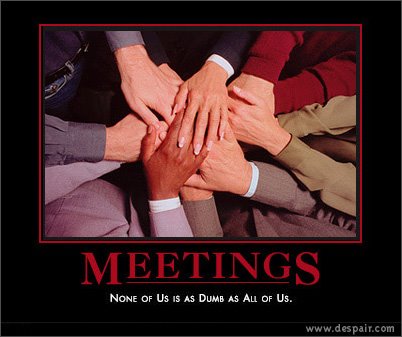
THE NEW ACADEMIC YEAR BEGINS. The Northern Illinois University calendar specifies that the week of August 21-25 is for faculty meetings, and the Committees of the University booklet is thicker than an Amtrak timetable (and somewhat more precise about the timekeeping!)

From Despair, Inc., a little reminder to colleagues at Northern Illinois and elsewhere.


Teach your students well. Keep Michael Munger's words in mind. It's what goes on between meetings that counts.