On the other hand, if a forest fire takes down a major viaduct, it helps to know where some spare spans are. Let's start with a picture.

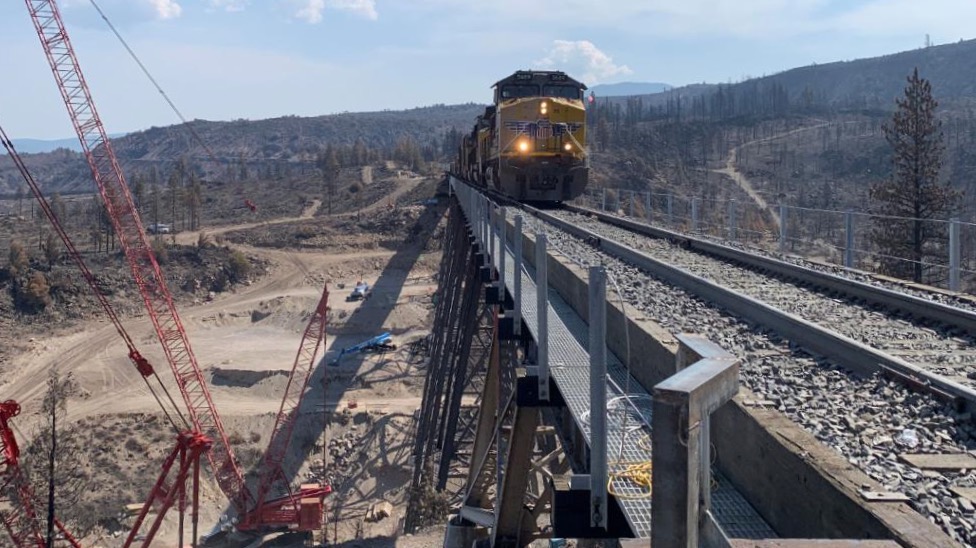
The first train rolls across the repaired Dry Canyon Bridge just 34 days after the span sustained severe damage from the Lava Fire. Reconstruction of the bridge was one of the topic’s of UP’s presentation Thursday at the NRC Conference in Phoenix.
Union Pacific photograph retrieved from Trains.
That's right, just over a month, and several of the spans in place at the time of the fire, as well as all the crossties, and, as you see, the walkway, had to be replaced.
The project, which replaced a major fire-damaged trestle in Northern California in 2021 — about a month faster than was originally projected — has been much discussed and is justly held up as a matter of great pride by UP [see this article on the railroad website, and “Analysis: Union Pacific bridge repairs …,” Trains News Wire, Aug. 10, 2021].On the investor-owned railroads, the incentives align in such a way to get the bridge repaired and back in service more quickly.
But Shane Keller, the railroad’s senior vice president of engineering, provided some additional details on the work on Thursday during his presentation on UP’s capital plan for 2022 at the 43rd National Railroad Construction & Maintenance Association Conference — like the information recalled by one veteran employee that helped speed the project along.
The project required replacing 18 of the 19 spans of the 1,200-foot-long, 150-foot-tall bridge. Those spans measured 80 or 40 feet. The 80-foot sections were rebuilt on site. But what about the 40-foot spans?
“One of our more seasoned individuals said, ‘Back in the 80s, we took out this bridge in Nebraska,’” Keller said. “’And those spans are sitting in Cheyenne, Wyo., right now, in the weeds. And we were going to scrap those this year. Why don’t we have somebody take a look at those?’”
A review showed those spans were still structurally solid. “We had to modify a few things,” Keller said, “but we ended up taking the spans that we took down in 1980 and ended up reinforcing them and putting them up on this bridge. All the spans that are on top of the towers are actually from an old bridge we had a long time ago. We said it was going to take 60 days to get it open, and we did it in a little bit more than a month.”
In the political world, the value of institutional memory appears to be in slagging on people who did not vote for some boondoggle, or who did not properly inspect the bridge. And thus, when Pittsburgh's Fern Hollow bridge collapses just before the doddering ficus shows up to tout his latest porkulus, he can point to money in that porkulus being available to rebuild the Fern Hollow bridge. That will take somewhere around a year.
It is not the infrastructure that is failing people, it is the government-funded infrastructure that is failing people. I bet the gas main the falling bridge damaged will be repaired and back in service in less than a year.
That's after public officials in Pittsburgh repeatedly passed on opportunities to fix that bridge, as well as on opportunities to finance its upkeep.
While the bridge certainly needed to be replaced, there was no indication it was going to fail in the short term. Bridges are rated on a scale of zero to nine, with zero being a bridge that is unsafe for vehicles. The Fern Hollow Bridge was rated a four, according to the National Bridge Inspection Standards, indicating it was structurally deficient but supposedly not in danger of collapse.There's no way for the Federal Reserve to create enough money to replace Fern Hollow and all the other bridges where maintenance is being deferred.
Of the $1.1 trillion infrastructure bill, about $36 billion goes toward bridges. Of that total, about 15% is set aside for ‘off-system’ bridges, or those owned by counties or cities like the Fern Hollow Bridge. States are allowed to flex billions more in Surface Transportation Block Grant and Highway Safety Improvement Program funds for bridges.All that the periodic porkulus bills do is prolong the fiction that somehow we can rob from Peoria to fix Pittsburgh, while we rob Pittsburgh to fix Peoria.
Pittsburgh has more bridges than any other city in the world and federal funding in the infrastructure law is not going to come close to being enough to bring all of the city’s bridges into a state of good repair.
Thus, the problem isn’t that Pittsburgh lacks the funding to fix bridges. Rather, the problem is the way the city spends so much of its annual budget on other things and chooses to spend so little of its money maintaining its roads and bridges. The city has known its deficient bridges were a problem but has not prioritized fixing them.That might mean private-public partnerships, or it might occur to city officials that their roads and bridges are productive assets, and price them accordingly.
It is time to find ways to fix Pittsburgh’s bridge problems. First, Pittsburgh needs to reevaluate its bridge inspection standards. Most bridges receive only a visual inspection, but bridges showing clear signs of wear receive more in-depth analysis. The city needs to increase the number of bridges that receive more thorough inspections.
Second, Pittsburgh needs to reprioritize its capital budget and spend more of its money repairing and replacing bridges each year. For example, the city could start to trim spending, like the $163 million dedicated to the finance department, by reducing the number of administrative assistants and other potentially non-essential positions. Pittsburgh spends $6 million on its permit office, which requires and authorizes permits for a variety of things, including pool tables. Perhaps some of that type of taxpayer funding could be better spent on bridge repairs.
Third, the city needs to use innovative delivery methods to finance bridge reconstruction projects. The state needs to ensure that Pittsburgh has the authority to enter into public-private partnerships that could be used to speed up the financing, reconstruction, and/or replacement of certain bridges.
You know, the way Union Pacific tariffs generate the revenue to move spare bridge spans from Wyoming to California to get the Dry Canyon bridge back in service ahead of expectations.




No comments:
Post a Comment