
Looks like everything east of Cicero and north of Cermak to about Grand would be gone, should such a fire catch on in a thickly settled city with lots of solid brick buildings.
We observe Fire Prevention Week early in October because that famous Chicago fire occurred the same day as a much larger fire, one that claimed some 1,200 lives and consumed 1.2 to 1.5 million acres of woodlands.

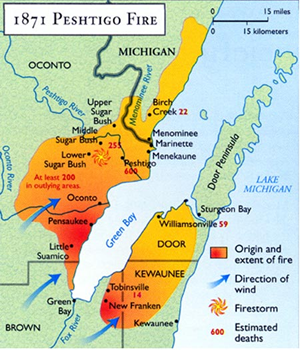
Peshtigo Fire map retrieved from National Weather Service.
And yes, researchers consider that to be one fire, which got started near Pensaukee and went downwind into Peshtigo as well as across one of the larger estuaries in the world into Southern Door County.
It had been an unusually dry summer, and the fire moved fast. Some survivors said it moved so fast it was "like a tornado."Purchasing power calculators work only back to 1913, where that $169M pencils out as $5.2B in losses.
The sudden, convulsive speed of the flames consumed available oxygen. Some trying to flee burst into flames.
It scorched 1.2 to 1.5 million acres, although it skipped over the waters of Green Bay to burn parts of Door and Kewaunee counties. The damage estimate was at $169 million, about the same as for the Chicago Fire.
The fire also burned 16 other towns, but the damage in Peshtigo was the worst. The city was gone in an hour. In Peshtigo alone, 800 lives were lost.
"What most researchers find so fascinating is the effect it (the Peshtigo Fire) had on people's lives. It was so horrific," Anderson said. "Some people thought it was the end of the world."
The fire produced countless stories of heroics and tragedy, which are collected at the research center, as well as the Peshtigo Fire Museum in downtown Peshtigo.
There's the story of a man carrying a woman to safety he thought was his wife. When he found out it wasn't her, he went crazy. People said the Peshtigo River was the only haven from the fire, and one 13 year-old German immigrant girl said she held onto the horn of a cow all night in the river to survive.
In The History Channel's brief description of the Peshtigo Fire we read this. "While the Wisconsin fire was overshadowed by the Chicago fire, it is still studied by forest managers and firefighters, who use it as an example of bad forestry practices and the power of unpredictable wildfires."
What went wrong in 1871 is as relevant today.
Peshtigo's logging industry was partially to blame for the disaster. In an era before responsible forest management practices, loggers simply stripped the land without regard for potential fire hazards they created. They dumped refuse from logging operations in large piles of tinder that became perfect fuel for the October 8 fire. And railroad operations cleared land using small fires, leaving piles of leftover wood behind them.The Los Angeles fires provide another opportunity to take stock of things Cold Spring Shops have long paid attention to. Those posts are in preparation. Let us be grateful the death toll in California is nowhere near what it was in timber country 150 years ago.
The town itself was a tinderbox waiting to ignite. Most of its structures were made of wood, as were its sidewalks. Even the streets were paved in wood chips.
Weather was the match that turned those dangerous conditions into an unprecedented fire. Smaller wildfires had raged in the area for days, but on the night of the 8th, winds whipped up and the flames reached Peshtigo.





No comments:
Post a Comment