13.6.16

POVERTY IS WINNING.

Something has gone very wrong, notes Dean Dad.  "In America, having 'only' 38 percent of public school kids require financial aid for lunch is considered good."  Well, the objective conditions haven't been very good in the past seven years.  "In the wealthiest country in the world -- the one undisputed superpower, the global hegemon, the winner of the Cold War, coming off a seven-year economic expansion, a country so rich that it pays farmers not to grow food -- more children can’t afford lunch than can."  Yeah, there's lots of political hay to make there.  What seven year economic expansion?  Not once in the era of hope and change has the gross domestic product managed a three percent annual growth.  Very rarely have there been more than a quarter million new jobs in a month.  Wealthiest country in the world?  Depends how you measure it.  And brain-brothers of the people who thought Ronald Reagan's "evil empire" meme was helping Yuri Andropov still in charge?  No wonder the kids in government schools have it rough.

But the concentration of the poor in the government schools has been long in coming.  I was just clearing out more old magazines, and found "The Newest Minority," printed in The Atlantic Monthly in 1993.  It's about the women having no children, and the men losing reason and faith.  Starting in Belmont, Massachusetts.  (Yes, that Belmont.)  It's written by then Massachusetts state senator Michael Barrett.
The very community that was such a good place to raise a family in the 1960s is the most likely to have a large complement of empty-nesters in the 1990s, many of whom will be less interested in the schools than they once were.

The district I represent in the Massachusetts state senate includes Belmont, a middle-class and upper-middle-class suburb of 24,720. Belmont is a wonderful town, home to many people, once blue-collar, who have moved out over the years from the urban environs of Cambridge and Boston, and to others who hail from around the country and have been drawn to professional opportunities in the nearby cities or along the Route 128 technology belt.

Belmont takes great pride in both the reputation and the appearance of its gracefully landscaped high school, complete with duck pond, which lies near the town center. More than 90 percent of the school's juniors and seniors take the SATs, the average combined verbal and mathematics score is over a thousand, and 87 percent of the graduating class at least begin a four-year college education.

But the Belmont schools are caught in the demographic squeeze. In 1960, the postwar influx having supplied a stream of young settlers, 42.0 percent of the households had children under eighteen. Ten years later the figure had declined to 35.7 percent. It was down to 28.7 percent by 1980 and 26.4 percent by 1990. Outside observers would hardly call Belmont a retirement community, yet sometime around 1975 it reached a watershed for an American town: the proportion of its households containing people over sixty-five exceeded the proportion of its households with children under eighteen.
The electoral math, Mr Barrett argues, works against Belmont's government schools.
Belmont is a healthy, thriving place, and it may well be that the citizenry will rally behind its tradition of fine education. But the going will be tough, because the problem remains: in cities and towns across the country a demographic bulge once operated to keep the schools at the center of community life, and now it is gone. Today the presence of kids in every other house on the street is something out of the past, and the parents of schoolchildren, middle-class and poor alike, are the country's newest minority group. At a historic moment when the schools need to be better than ever, they are instead treading water, even slipping back a bit, and by world standards genuine excellence is a long way off.

One has to wonder, then: Will communities like Belmont, composed of growing proportions of nonparents and empty nesters--people more likely to insist on quality health care than on quality education--continue to support their schools? To put the matter simply, will the votes be there? And if they are not, what does American democracy do then?
Mr Barrett (yes, it's what you'd expect an elected official to do) suggests that the national government increase its contributions to local school funding.

I fear, though, that the intervening quarter century of ethnic balkanization, identity politics, trendy and failed educationist fads, residential self-segregation, and homeschooling are going to make any reversal of government schools as schools of last resort, with all the attendant challenges that accompany such a status, a long time in coming.

Start with a recent report from New York City, where there are more applicants for the charter schools than there are seats.
City charter school operators will open 16 new facilities in the coming school year, bringing the total number of city charter schools to 221.

Mayor de Blasio has brawled with some operators of the privately run, publicly funded charters over funding, oversight and classroom space for their schools.

City Education department spokeswoman Devora Kaye said all city kids deserve quality educations.

“Every student deserves access to a great school, whether district or charter,” Kaye said.
That may be, but people, whether they have enough votes to get the local schools funded properly or not, prefer a choice, notes Stephen Moore.
We know in Washington, D.C., where voucher programs already exist, voucher kids are more likely to graduate and go on to college than those stuck in the public schools.

The unions hate vouchers because it means fewer jobs and union dues for the labor bosses. But who are the schools for? The teachers or the kids?

Thanks to the Obama administration’s radicalism, millions of children will be now stuck in schools that the parents believe are unsafe and immoral. Millions more are stuck in failing schools that are racially segregated. Fifty years ago George Wallace wouldn’t let minority poor children into the public schools. Now the unions and others on the left won’t let minorities and poor children out. ‎It’s hard to know which is worse.
Via Craig Newmark.

How much longer can the Democrat nachalstvo claim to "fight" for the rainbow coalition and the teachers' unions and the boutique multiculturalists whilst actually rendering people helpless by Democrat policies, and sending their spawn to the likes of Sidwell Friends rather than have them associate with their constituents.  None of which will immediately help the kids getting their government issued crappy lunches to go with their government issued simulacrum of schooling.

HISTORY RHYMES.

Austin Bay comments on a planned Atlantic Alliance exercise to be conducted in the old Livonia.
Anaconda 2016 is the largest—though annual exercises by Polish military forces and Romanian military forces could conceivably be larger in absolute numbers. It is very probable that this is NATO’s largest field exercise in Europe east of the current German-Polish border since 1992. The Guardian seems to recognize that this is “the biggest movement of foreign allied troops in Poland.”

Anaconda is big: 31,000 soldiers from 24 countries are exercising for ten days, with 14,000 American troops participating.
Mr Bay focusses on the message the exercise sends to Tsar Vladimir.
The U.S. Army Europe map of Anaconda 2016 is very likely an act of information war that supports NATO political goals. Note phase three on the U.S. Army Europe exercise map. Phase three is scheduled for execution on June 10. Alliance troops and vehicles will cross the Vistula River and enter Lithuania. Come one, come all. Lithuania is a NATO member.

However, the maneuver explicitly cuts off Russia’s Kaliningrad Oblast. Kaliningrad was once the Prussian city of Konigsberg. Russia kept the city and its environs as a special Kremlin reward for winning World War Two.

Anaconda 2016’s conclusive fictional thrust isolates and surrounds Kaliningrad.

NATO officials may deny that the exercise is designed to send that message. Let them do so. However, the maneuver delivers a useful political warning. The Russian exclave can be taken by NATO military forces. So hey there, Vladimir Putin of the tight tee shirts, don’t miscalculate. Putin, you seized the port of Sevastopol in Crimea and then swallowed the entire Crimean peninsula. Would a Polish-controlled Kaliningrad on the Baltic Sea be a fair trade?
Early on in the history of Cold Spring Shops, I alluded to Anaconda in a brief reference to the proposed expansion of the Atlantic Alliance into southeastern Europe. Perhaps something similar is still at work.

The ongoing exercise might be a warning to Tsar Vladimir, or perhaps it reflects the permanent interests of Poles and Lithuanians, or is an opening gambit for a restoration of Prussia, or not, is for experts in international relations (two countries screwing each other) to parse.

Focus, dear reader, on the exercise name.  In United States military practice, it dates to Winfield Scott and Gideon Welles, and it was implemented by Farragut, Grant, and Sherman.

A SPIFFY FRONT PORCH ON A SHOTGUN SHACK.

Jeremy Harper of something called Underdog Dynasty talks sense about the deflating college football bubble. The Idaho Vandals did the right and brave thing, and Eastern Michigan should follow.

There are a number of connections (including the use of unconstitutional speech codes)between Northern Illinois and Idaho, with current president Doug Baker previously serving in administration there, and Idaho's football team, parlous reputation or not, sometimes playing the spoiler, and sometimes serving as a pre-conference crash test dummy (that is, to the extent we can speak of any Mid-American team scheduling crash test dummies.)

But when a writer at a sports weblog notes that professors might have a gripe when it comes to spiffing up that front porch, perhaps reality is dawning, even among the True Fans (who often have much to learn about generalizing from their own experience.)
First of all, the campus faculty is almost always the group opposed to unchecked athletics. After all, it's the professors working in 1970s-era science labs and moldy classrooms with wheezing AC. You can't blame professors for feeling marginalized at what is supposed to be an institution of higher learning.
The reality also dawns on Doug Baker's successor.
Which lead us to the University of Idaho, who recently announced its intentions to drop from FBS- to FCS-level athletics. "Our relevance will be complemented by our football program," said University President Chuck Staben, "not defined by it."

When the Sun Belt declined to bring Idaho into the conference early this March, it clamored the death gong for a program too small and too isolated to find another FBS conference or go it alone as an independent. The Vandals grabbed their football and returned to the Big Sky.

For 20 years, the football Vandals have averaged less than 4 wins per season and were left out in the cold (along with New Mexico State) when the WAC dissolved in 2012. The Vandals accepted a less-than-ideal "football only" invite to the Sun Belt, only to see the arrangement fold once conference officials fully absorbed the weight of the Vandal problem: Idaho was too damn far, didn't win enough, and it didn't spend enough money (about $19M annually).
The author suggests the weakest prop in the Mid-American, Eastern Michigan, observe and emulate.
Idaho did what many of us, for lack of fortitude or forethought, cannot: step back into a situation that fits. About 2,100 miles east of Moscow, Idaho, the Eastern Michigan Eagles are considering following Idaho's lead. The Eagles spend about $34M, which is roughly the standard in the MAC, but it is subsidized more than 80 percent.

For the past 19 years, the Eagles have enjoyed one winning season. One! In 2009, they were a perfect 0-12. Eastern Michigan joined the MAC in 1972, but it has just one conference championship (1987) to show for it. Last year, the Eagles reported the lowest attendance of any FBS program: 4,897 souls per game. The Eagles aren't winning, and there are no fans to care.
More on Mid-American subsidies, and Eastern Michigan serving as crash test dummy, in my archives.

Mr Harper suggests, however, that Eastern Michigan administrators clinging to their football (perhaps because they don't want to write off their indoor practice facility, which served as a reason for Northern Illinois to build one) are living in Wolkenkuckucksheim.
If you're an FBS program, you are, technically, a member of the same fraternity as Oregon and Michigan and Alabama and Texas. It would punch quite a dent in your ego to admit that you simply cannot afford to drink with these guys every night.

But consider the slope EMU must climb to be relevant even in its own city. Michigan, the Horrendous House of Harbaugh, is a 16-minute drive. The state of Michigan is home to five FBS football programs, two of which play in the mighty Big 10. Securing the second-best or third-best or even fourth-best talent in the state is a Herculean task. Even in football-rich Michigan, that has to suck. Why not drop down and enjoy the thrill of competing?

It's hard to give up that BMW. Take another look at EMU's statement in response to calls for dropping down: "(We) have the opportunity to compete at the highest levels with neighboring institutions in the Midwest."  The Eagles haven't competed since the 1980s! Real Sports just made your campus look like a soup kitchen!
No joke about the soup kitchen ... there's a food bank for students, which the article calls "unfunded."

I have to wonder how much the deanlets and deanlings spent on that "education first" tagline, which the administration's revealed preference for athletics gives the lie to.

Our universities are being run by stupid people.

8.6.16

STILL AT A DISTANCE FROM EQUAL JUSTICE UNDER LAW.

Until yesterday, putative Republican nominee Donald Trump appeared more interested in getting a judge disqualified than in, oh, making political hay about the continued non-recovery economic recovery, in which the unemployment rate decreases by subtracting discouraged workers from the work force.

There might be something else at work.  Here's Neil Steinberg, in Chicago's Sun-Times, calling out Mr Trump's error in suggesting there's a connection between a judge's ancestry and his ability to conduct a fair trial.
What Trump is too stupid to understand is this: if we begin to denounce our fellow citizens as being incapable of doing their jobs because their parents were Mexican immigrants, or because they’re Muslim, or Catholic, or whatever lineage or credo is disagreeing with Donald Trump at the moment, then the country unravels and we become just another balkanized hellhole.
Perhaps that ship has already sailed: see nominee Sonia Sotomayor, Wise Latina.

Or perhaps the ship has not yet docked: see Foster v. Chapman.  The prosecutor shalt not disqualify all potential black jurors when a black man is on trial (the case is out of Georgia; that might be material.)

And yes, there's a history of Most-Favored-Nationality legislation in the country's history.  But codifying hierarchies of Privilege, Oppression, and Protected Status cannot end well.

Jonah Goldberg notes, though, that demonstrating the absurdity of essentialist identity politics by using essentialist identity politics is an absurdity too far.
Trump is not battling identity politics here, or even undermining it. Trump is capitulating to it, and bringing the Republican party along with him. Sure, it’s interesting, even entertaining, to watch Trump use the logic of identity politics against its entrenched practitioners. But he’s not condemning this way of thinking, he’s embracing it.

By all means, conservatives should use this episode to point out the fallacies and contradiction of identity politics. But Trump is not a hero in that effort, he’s a cautionary tale.
He has links to commentators who suggest that the reductio is more serious, or more purposeful, than that, in case you're interested.

ECONOMIC RECOVERY, OR LESS IMMIGRATION?

Pick one, might be what Michael Barone is arguing.
Data from the Census Bureau’s American Community Survey has shown how the picture changed from the pre-recession years of 1998-2007 to the most recent two-year period, 2014-2015.

In the earlier period, immigration from Mexico averaged 429,000 a year, nearly one-third of total immigration. More recently, it averaged 170,000 a year, just 11 percent of the total. But immigration from the rest of Latin America has increased significantly, from 269,000 annually pre-recession to 439,000 most recently. That leaves total Latin migration down by some 90,000.

Immigration from East and South Asia has more than made up for this, rising from a pre-recession average of 337,000 to 566,000 in 2014-2015. Immigration from Africa and the Middle East is also up, from 101,000 to 205,000.

The ACS data does not categorize these immigrants by skill level. But past patterns suggests that current immigrants on average have higher levels of education and skills than was the case in the surge of immigration in the quarter-century from 1982 to 2007. In that respect it may resemble more closely the Ellis Island immigration of 1892-1914.
"Past patterns suggest" isn't the same thing as "Current research confirms."  But as I've suggested before, you can't be talking simultaneously about jobs going overseas and immigrants overwhelming the country, or limiting that to the social services.

But fine-tuning immigration so as to favor skilled workers, as Mr Barone suggests?  Not so easy.
There’s a strong argument for a revised immigration policy, like those of Canada and Australia, which would prioritize high-skill immigrants and reduce the number of low-skill people admitted under extended family unification provisions.

The reduced flow of migrants from Mexico and increased flow from South and East Asia is producing results closer to such a policy than what we saw during the 1982-2007 surge of immigration.

Trump’s incendiary statements don’t point directly toward that kind of immigration reform. But Clinton’s advocacy of what amounts to open borders for the unskilled points in the opposite direction — and it’s far from clear that’s what most voters want.
I'm not sure how to evaluate that policy proposal. On the one hand, job descriptions and pay packages that might not attract domestic skilled workers might look generous to immigrants.  That's why the presence of overseas graduate students gives the lie to claims university professors are underworked and overpaid.  On the other hand, the anecdotal evidence of companies firing skilled workers who are first compelled to train their replacements, brought in on H1-B visas has enough purchase to help the Trump campaign.

7.6.16

DESTROYING HOPE IN THE EMPIRE.

That's an awkward allusion to Anatole Shub's An Empire Loses Hope, a textbook study of life behind the Iron Curtain, or perhaps as much of a study as was possible in those days, in which the loss of hope is the 1968 Warsaw Pact invasion of Czechoslovakia.  Anne Applebaum's Iron Curtain: The Crushing of Eastern Europe 1944-1956 is able to make use of records that have come to light since liberation, in order to detail the ways in which Stalin and his lackeys imposed their own version of Soviet society in the conquered territories, many of which, thanks to Lebensraum and war, were devoid of civil society, sometimes of habitable communities, and accordingly, ripe for reconstruction along Stalinist lines, complete with ethnic cleansing, corrective labor camps, khrushchobas with a snitch on every floor, mandatory celebrations, mandatory work days, and windy speeches.

I could confine Book Review No. 15 to a single remark from page 55 by useful idiot Jean-Paul Sartre to useful idiot Albert Camus.  "Like you I find these camps intolerable.  But I find equally intolerable the use made of them every day in the bourgeois press."  Would that contemporary apparatchiks in student affairs be as candid.  That takes me to page 181.  "Russian cultural officers observed that the combination of ideology and culture didn't always work. ... They grew suspicious that attempts to lighten ideology would simply water it down."  Well, it didn't work, and logic and content, plus a smattering of backbone from the civilized world, carried the day.  That despite politically correct youngsters being able to take control of doctrine early in the establishment of the evil empire.  Per corollary, there is yet hope for the United States.

But the transition out of captivity was not easy, and the lesson the Warsaw Pact nations learned ought be understood by anyone who throws around "Wise Experts" or "social construction" willy-nilly.  Page 468 ought be required reading for any such person.
As a result of this civilizational damage, postcommunist countries required far more than the bare institutions of "democracy" -- elections, political campaigns, and political parties -- to become functioning liberal societies again.  They also had to create or re-create independent media, private enterprise and a legal system to support it, an educational system free of propaganda, and a civil service where promotions are given for talent, not for ideological correctness.  The most successful postcommunist states are those that managed to preserve some elements of civil society throughout the communist period.  This is not an accident.
Institutions are emergent.  Emergence is messy.  Deconstruct at your own risk.

(Cross-posted to Fifty Book Challenge.)

THE COMMUNISTS WERE PRO-ABORTION AND FAVORED EASY DIVORCE.

That might have been what kept social conservatives in coalition with libertarians for so many years.

Ronald Reagan might have told a Reason interlocutor that "the very heart and soul of conservatism is libertarianism," but he offered a nod to the technocratic impulse within the Republican coalition. "I cannot go along with the libertarian philosophy that says that all of the sin laws can be ruled out as simply trying to protect us from ourselves."

We might subsume the law in the rubric of evolutionary stable strategies: adherence to this code of conduct confers advantage to the adopter, and it's robust to adoption by somebody outside the current set of adherents.

But now we have a hostile takeover of the Jesus Teaches wing of the governing class, and the Jesus Teaches part of the old conservative coalition are not happy with either Donald Trump or Gary Johnson as least-bad presidential choices.
Given the choice of voting for Donald Trump, an objectively unacceptable candidate not simply to many conservatives but a majority of Americans; Hillary Clinton, another unacceptable candidate, though for reasons different than Trump; or Gary Johnson, who told Fox News this weekend that he would get rid of the Department of Education and many other parts of the federal government, conservatives still see themselves as homeless.

Especially if you are anti-abortion, which has always made Johnson "a nonstarter for social conservatives."
The advocates of the "sin laws" (social conservatives, if you will) seek simply to make regular, however, a different set of market failures than those addressed by, e.g. the environmental laws.  Put another way, Technocratic Expertise is not flawed per se; rather, Technocratic Expertise in the service of Godly Goals rather than Sinful Goals is desirable.

DECLINE BEGETS DECLINE.

Wisconsin's highways are in rough shape, in many cases worse than their connecting roads in Illinois, which is a major reversal of fortune from three decades ago.  Perhaps some of that deterioration is conscious divestment: as is the case in Iowa, there's more road than there is traffic to use it, let alone to pay the user fees to maintain it.

But when a pipeline delivering the motor fuel to the distribution terminals fails, emergency actions to allow overweight trucks to make deliveries only contribute to the deterioration.
Fuel trucks with a registered gross weight of 50,000 pounds or more that operate in the state are authorized to carry up to 15% more than standard gross vehicle weight limits through June 4, Wisconsin State Patrol Capt. Brian Ausloos said.

A five-axle semi-tractor and tanker that normally hauls 80,000 pounds would be authorized to increase the load up to 92,000 pounds gross weight, Ausloos said.
All of these emergency measures, and similar ones in Michigan, to ensure that vacationers during the Memorial Day weekend would not be inconvenienced.

That is, not inconvenienced for lack of fuel.  Inconvenienced for lack of passenger trains, or of roads in a state of good repair?  That's another matter.

6.6.16

THISTLE 'N-DIXIE.

Seems like a lot of "neo" stuff on Cold Spring Shops lately.  Book Review No. 14 will recommend Neo-Confederacy:  A Critical Introduction.  It's a book that has ample opportunities to become a diatribe against all things conservative, and a cast of contributors including contrarian sociologist James (Sundown Towns) Loewen and staffers at the Southern Poverty Law Center.

And yes, the adherents of the Southern Rebellion are part of the yeomanry's push-back against the gentry.  One essay cites (p. 83) an adherent attaching symbolic value to the Confederate Battle Flag.  "It says 'NO' to gun control, abortion, Third World immigration, moral deviancy, feminism, paganism, radical environmentalism, exorbitant taxation, globalism, crass consumerism, and big government."

That passage says more about the schisms in the conservative coalition that appeared after the Evil Empire closed up shop, than it does about any generalization of Confederacy nostalgia to the body politic.  Yes, the neo-Confederacy the authors study argue that boutique multiculturalism and celebrations of transgressivity for some but not for others are not healthy; and yet, there are objections people can raise that do not involve tattered gray uniforms, let alone hoods and burning crosses.

But rather than go down the rabbit hole of Godwin's Law corollaries that tempt, the authors offer a discussion of culture studies that might serve as a prototype for serious work on the other differences that provide research material in literature, music, sociology, not to mention economics and political science.

Consider the implications of a passage at page 144.
Another legacy of the civil rights movement is the concept of multiculturalism, the meaning and import of which continues to be debated.  For some, multiculturalism promises greater equality, while for others it is merely a conduit for maintaining the status quo (i.e. white privilege), albeit with a surface-level recognition of a multiracial society.
Emergence is messy, and one-size-fits-all ideologies, whether propounded in the common room or by the light of a burning cross, are likely to fracture, if not to fail outright.

Likewise, the book's exploration of the supposed ties between an ancient Anglo-Celtic honor culture and Southern beliefs (from whence I cribbed this review's title) might be a clinic of the ways in which a scholar can question simpleminded notions of "authenticity."  The dead hand of a nostalgia for the Highlands holds back contemporary adherents to the Confederacy.  Generalizations to nostalgia for indigenous ways in the Americas or African ways lost to the slave trade, or to third world honor cultures taken broadly, are left to the reader as exercises, or for future research.

Finally, for an academic work, the writing is refreshingly readable.  Yes, there is a "hyper-masculine discourse" here, and a reference to Louis Althusser there, and yet, dear reader, you won't be reaching for strong coffee at page three, as might more conventional and ponderous academic tomes compel you to do.  The authors note, toward the end, that it is to highlight the possible contributions of neo-Confederate beliefs to more mainstream political discourse that motivates their work.  And yet, they offer insight rather than incite.

(Cross-posted to Fifty Book Challenge.)

MARKETS ARE HEALTHY, CARTELS ARE NOT.

Jeff Jacoby has fun with yet another lame joke.  "Ayn Rand, Rand Paul, and Paul Ryan walk into a bar. The bartender serves them tainted alcohol because there are no regulations. They die."  Not exactly the best publicity to get on the opening night of the bar, or the best way to serve customers on the bar's last day.  But, whether controlled substance laws protect the public interest, or simply are another way for insiders to exclude outsiders, the potential for insider abuse is present.
The private sector is replete with certifying, rating, and accrediting bodies that can attest to the qualifications of almost any occupation and product. The internet empowers consumers as never before with timely information about vendors, professionals, and service-providers of all kinds. From Angie's List to Yelp, from Uber to TripAdvisor, the market promotes transparency and reveals quality with a nimble persistence no state agency can ever match.

If baristas, illustrators, and journalists can operate free from government licensing, hair braiders, painting contractors, and acupuncturists can too. It's fine to walk in to the Libertarian Bar. Your drink will be safe, even without a government certificate on the wall.
Yes, the denouncing of creative-destruction-stifling regulation was part of the neoliberal manifesto once advocated by The Washington Monthly.

There's a roundup of the ways regulation stifles creative destruction nailed to Newmark's Door.  It's summer, don't trash him for stopping short of 95 theses.  Reason's Ronald Bailey summarizes.

It's the Regulations, Stupid!

Take that seriously, though, and it puts the comprehensive-reform-bipartisan-consensus crowd out of business.

A PLETHORA OF NEO-DOCTRINES.

There's something called "neo-reaction" out there, which Marginal Revolution's Tyler Cowen attempts to understand.  The tussle -- it's over culture -- might be beyond resolution, let alone being transcended, as it's about what it means for a set of institutions to have emerged in an evolutionary stable way.  Start with Professor Cowen's first organizing principle.  "'Culturism' is in general correct, namely that some cultures are better than others. You want to make sure you are ruled by one of the better cultures. In any case, one is operating with a matrix of rule." I'm troubled any time somebody attempts to pathologize an emergent phenomenon by tacking "-ism" to a phenomenon. That might have worked for "racism,"  as the answer to a positive question, "Why are people who are different from us poor?" led to a normative elaboration, "We're better and we'll limit their options For Their Own Good."  (Just for fun, see how well ante-bellum rationalizations for slavery track with contemporary advocacy of Governance By Wise Experts.)

As culture is emergent, it ought not come as any surprise that some matrices of rule confer evolutionary advantage to adopters, but strict evolutionary stability requires that such matrices be open to use by others, and that use raises the possibilities of mutation, adaptation, and selection.

That appears to be Professor Cowen's second organizing principle.
The historical ruling cultures for America and Western Europe — two very successful regions — have largely consisted of white men and have reflected the perspectives of white men.  This rule and influence continues to work, however, because it is not based on either whiteness or maleness per se.  There is a nominal openness to the current version of the system, which fosters competitive balance, yet at the end of the day it is still mostly about the perspectives of white men and one hopes this will continue.  By the way, groups which “become white” in their outlooks can be allowed into the ruling circle.
Here's where the tussle begins. Reduced to caricature, it's the identity-politics multiculturalists throwing out all that is good in the current matrix of rule, because there's intentional or implicit or perceived or hallucinated privilege therein, which must be rooted out.  Never mind that it's the conventions of the matrix of rule that make it possible for the outsiders to participate, and to raise the possibilities of mutation, adaptation, and selection.  The neo-reaction might be a primal response to too much mau-mauing of the people who have respected the matrix of rule, and that response might have a little "make a positive case that there's a better way, rather than guilt-tripping us" to it.
I think it is a category mistake to dismiss neo-reaction on the grounds of racism or prejudice.  There exists a coherent form of the doctrine perfectly consistent with the view that different races are intrinsically equal in both capabilities and moral worth, even if such a variant tends to get pushed out by the less salubrious elements.  Furthermore calling neo-reaction racist, as a primary response, seems to personalize the debate in a Trump-like way, ultimately playing into the strengths of neo-reaction and distracting the liberals, in the broad sense of that term, from building up the most appealing vision of their philosophy and doctrine.

Liberalism isn’t actually an automatic emotional default for most people on this planet, so being a scold is in the longer run a losing strategy.  I believe many current “democratic mainstream” thinkers genuinely do not understand how boring and unconvincing they are, as they live in bubbles filled with others of a similar bent.
That doesn't surprise me.

I'd sometimes explain to beginning economics students that thinking about exchange and arbitrage and the rest had in common with schooling a fish about water the property that going shopping and working for wages, like swimming, were things that people could do without having to think much about them.

That matrix of rule is to the inhabitant of a liberal society as the water is to the fish.  How easy is it for a fish to escape water that is starved of oxygen, or for an inhabitant to escape a now toxic common culture?

In two thousand years, did we get these things right?

That's neither a boring nor an easily answered question.  And yet, it is one, dear reader, to pose to the neo-reactionary or the deconstructionist alike.

FIRST, GET HIGH SCHOOL RIGHT.

Three-quarters of the country's private, non-profit colleges rate a classification of "dropout factory," notes Third Way.  A New York Times Upshot column (via College Insurrection) provides the details.
Colleges that have high graduation rates tend to be more selective and tend to have students who are more affluent and more academically prepared. Colleges with lower graduation rates tend to admit a higher percentage of students with Pell grants, which usually go to lower-income students.

This is why graduation rates are so tricky: The colleges that have the lowest rates are the very same ones that are taking the biggest chances on students. Is it worth it to admit the students on the margins of educational success when you know half of them will drop out?
In case anybody wonders why U.S. News sells those rankings, the answer is in the first sentence of the excerpt.  Dip into the Third Way report, and you see that inter alia Harvard, Stanford, and Columbia offer students of modest means good value for money, if they get in.  For many of the students on the margins of educational success, that's not an option, and there's the intake of Distressed Material for the dropout factories.  There's work to be done, and the Third Way report overlooks one part of the work.
If America’s high schools had the same outcomes as these 1,027 institutions, there would be an outcry. But for college—and in this case four-year colleges taking in high school graduates who have been accepted through an application process designed to weed out students that are a poor fit—it is met with a shrug of the shoulders. And too often, the implication is that it is the student, not the institution, who is at fault.
Do we know that the admissions offices at these colleges are in fact weeding out students who are poor fits?  Or is enrollment, in order to keep the student fee money coming to cover the losses of athletics and the mortgage on the administration buildings more important?

And although there are policies in place by which Washington can intervene (for all the good it does) in underachieving high schools, and there are efforts in a few states to identify the high schools that are turning out the Distressed Material, there is still a lot of work to be done equipping young people with the intellectual and cultural capital to stay on task in university.

5.6.16

THE UNSEEN UNEMPLOYMENT OF A TRADE WAR.

Perhaps a return of some manufacturing to these shores will mean employment opportunities for some people.  But the people who make the stuff we trade for manufactured goods will be out of work.  As will the people who haul the traded goods.  "Omaha, Nebraska-based Union Pacific has a growing business serving cross-border trade with Mexico, and over the past decade has reported increased shipments of containers full of consumer goods, many of which come from Asia." Yeah, a continued slow economic recovery, and improvement-in the-unemployment-rate-by-subtraction-of-discouraged-workers sounds like a formula for making America great again.

BEFORE NEOLIBERALISM BECAME A DIRTY WORD.

I've referred to that dynamic en passant.  Mahablog has an in-depth exegesis that will reward careful study.

In particular, though, read and understand Charles Peters's Neoliberal Manifesto, which appeared in The Washington Monthly during the beginning of the Reagan Renaissance.  (I might still have the paper copy in the Cold Spring Shops archive, which, with the expansion of online archives, might quickly become the Cold Spring Shops recycle box.)

It's encouraging when a Court Intellectual of the Washington Cartel calls out his allies for their errors, which came as four main points.

1.  Don't say anything bad about the good guys, meaning the public schools, government employees, and industrial unions, all of which had, as the victory dividend resource curse started to bite, morphed into conservatives, in the Burkean sense.  (And thus we find ourselves with Hillary Clinton being the conservative candidate, not for any love of free minds, free markets, or the right to keep and bear arms, but for continuing the policies of the Obama administration.)

2.  Pull up the ladder.  Once upon a time, serious industrial economists fretted about rising industrial concentration, and tacit collusion (this later became rational cooperation) but that's what made the Treaty of Detroit possible, with the concentrated industries generating monopoly rents and the unions dissipating them.  Until the other industrial countries rebuilt their industrial bases, and the unions and the companies kept as much of the treaty intact as they could by favoring workers with higher seniority and screwing the new hires.  (That made for some interesting class discussions, recall, dear reader, I was teaching economics at Wayne State in those days.)

3.  The more the merrier.  Measure the benefits of a Federal Program by how many recipients it creates.  Until you run out of other people's money.

4.  Politics is bad, and politicians are worse.  And we still have Wise Experts and their talking points and at-the-end-of-the-day patter.

But read the essay.  There's more than a little anticipation of the Trumpening in it.  "The snobbery that is most damaging to liberalism is the liberal intellectuals' contempt for religious, patriotic, and family values."  Note:  long before Murphy Brown's bastard child, or same-sex marriage, or the Potty Wars.  Plus an anticipation of Thomas (Listen, Liberal) Frank.  "Liberalism has become a movement of those who have arrived, who care more about preserving their own gains than by helping those in need."

That is, if there's anything permanent for those in need out of the New Deal or the Great Society or Hope 'n Change or whatever.
When government intervenes in the free economy, bureaucrats and politicians spend most of their time undoing their own handiwork. To repair the damage of provision A, they pass provision B. Then they find that to repair provision B, they need provision C, and to undo C, they need D, and so on until the alphabet and our freedoms are exhausted.

The pass-a-law syndrome is evidence of a misplaced faith in the political process and a reliance on force, which are anathema to a free society.
How long, though, until sufficient voters recognize that they're being played for fools by the political class?

HIGHER EDUCATION IN ILLINOIS IS DYING.

So lamenteth an opinion columnist to New York's Times.
Public universities were founded on the notion that all students, regardless of their socio-economic status, should have access to a high-quality education. Like the twin towns of Champaign-Urbana, our public universities are cultural oases — intellectual watering holes where students of all backgrounds can gather in the pursuit of education and knowledge. But these oases are drying up while Springfield continues its interminable standoff.
That would be true, if all the state universities perceived themselves as being in the same business as the University of Illinois, or Northwestern and the University of Chicago. Insta Pundit notes, they are not.  "Chicago State, with a 12.8 percent graduation rate, richly deserves dismantling."

There are glum faces at Kishwaukee College and Northern Illinois University.
The university has not filled a number of staff positions and travel reimbursements remain restrictive. The university even decided that, starting next school year, it won't subsidize costs for students to print reports, papers and other class-related items, as it had done for years.

[University president Douglas] Baker said despite the latest setback in Springfield, NIU's fall semester will start on time come Aug. 22.

Kishwaukee College didn't fare the same. The two-year college only recently got $1.1 million in state aid -- of the $5 million it budgeted. With the holdup in state aid and declining enrollments, college officials laid off 24 workers in March, increased tuition starting with the current summer semester, cut back on 2016-17 academic and athletic scholarships and made other austerity decisions to hold on fiscally.
It used to be that students bought their own typewriters and corrasable paper (yeah, I'm showing my age.) In an earlier austerity measure, headquarters asked departments to cut back on their use of duplication. I encouraged students, if they wanted paper copies of course outlines, to print them off on university printers, as they were paying, if indirectly, for that service.

Now that students are being made more reliant on their own printers and printer paper supplies, I can only anticipate the variety of excuses for late submissions that will surface come fall.

WHEN CIVIL SOCIETY CRUMBLES.

Two sobering fourth turning perspectives.

Start at City Journal with The Riot Ideology, Reborn.
The West Baltimore rioters of 2015 didn’t call for more LBJ-style antipoverty projects but for less policing. In a “keep off our turf” version of belligerent multiculturalism, the rioters see police as both to blame for black criminality and as an embodiment of bourgeois white values. The old riot ideology referred to mostly white urban police forces as occupying armies; the new version sees even Baltimore’s integrated police force, under the leadership of the city’s black mayor and (until recently) a black police chief, as an occupying army. Withdrawing the police from black neighborhoods is the only acceptable solution.
Understandable, though, given how well the Technocratic Vision worked.
The city’s dominant political figure post-1968 was the colorful William Donald Schaefer. A meld of old-style machine pol and new-style harvester of federal funds, Schaefer served as mayor from 1970 to 1987 and then as a two-term Maryland governor. Under Schaefer’s mayoral leadership—and with the help of Senators Paul Sarbanes and Barbara Mikulski—Baltimore became, in effect, a second Federal City, cadging a disproportionate share of federal subventions that produced numerous but invariably ineffectual antipoverty efforts. “Bureaucrats lived well off the anti-poverty programs,” explains Baltimore writer Van Smith, “without enhancing the lives of the poor.”
You mean that Ann Coulter schtick about "mascots" is valid? Or that the clerisy is about rent-seeking and keeping the grants and conferences coming?  By their fruits shall ye know them.  "West Baltimore has, for the time being, been liberated from American morality."

The rot is not confined, however, to communities rendered uninhabitable by Democrats.  Here's Richard Fernandez.
If political columnist Ron Fournier is right about this election cycle, it is less about achieving incremental policy change than precipitating a radical institutional change.  In that case the current unpopularity contest can be seen as an deliberate process to increase instability by hoping the worst man wins, not in order to continue the status quo but to tear things down and start afresh.
A Fourth Turning is a situation in which an old saecular order comes apart and a new one emerges. But whether you identify the turning as beginning with either the hung presidential election of 2000 or the September 2001 terrorist attacks, or with the financial meltdown of 2007 - 08, apparently neither National Greatness Conservatism nor Hope 'n Change have convinced enough people to get on board with one or another of the legacy political parties' less incrementalist agenda (that being the usual emergent phenomenon, as in the New Deal or Emancipation or Independence, although none of these were preordained.)
This dynamic suggests that no candidate will win the election.  The divisions are now too stark for the old modus vivendi to be established on the former terms.  Whoever succeeds to the presidency in 2017 will preside over a deeply divided country, without a mandate because the system itself now has a legitimacy deficit; a kind of caretaker over a Republic no longer one thing yet not yet another; a kind of hapless driver of a runaway team of historical forces.
Perhaps it's time to dip into Emerson.
Things are in the saddle,
And ride mankind.

There are two laws discrete
Not reconciled,
Law for man, and law for thing;
The last builds town and fleet,
But it runs wild,
And doth the man unking.
Here's how Mr Fernandez proposes we deal with the wild-running events.   "The sole lesson we can learn from it is that waiting for history requires intelligent anticipation and doing our best. Some things you just have to wait for."

I add only, "intelligent anticipation" neither implies nor is implied by "intelligent design."

3.6.16

ULTRA SECRETS BEFORE ULTRA.

Erik Larson writes interesting twists on historical events, such as the World's Columbian Exposition (The Devil in the White City) and the diplomatic intrigues of early Nazi Germany (In the Garden of Beasts.)  His Dead Wake: The Last Crossing of the Lusitania, our Book Review No. 13, delivers such twists.

I'm familiar with Lusitania's sinking, thanks to the Scholastic Book Service selling Hoehling and Hoehling's The Last Voyage of the Lusitania to junior high students.  Many of the people who provided recollections to the Hoehlings also feature in Dead Wake.

But then there's the matter of the British cracking German codes, and having to deploy forces in such a way as to not provide the Germans with reason to suspect that the British were cracking their codes, and Winston Churchill viewing the Balkans and Asia Minor as the Central Powers' "soft underbelly" whilst hoping for something to happen that would bring the United States into the war on Britain's side.  Plus President Wilson behaving like a lovesick adolescent.

Did these developments contribute to Lusitania being torpedoed and sunk?  Read the book.

(Cross-posted to Fifty Book Challenge.)

IT TAKES SOMETHING TO BEAT NOTHING.

Likely Democrat presidential nominee Hillary Clinton used a foreign policy address to trash Donald Trump.

It didn't play well on the right.

Legal Insurrection:
In fact, the bulk of the “national security” address was merely a tirade against Donald Trump. To say that Clinton was scripted would be an understatement. Her address was a droning fantasy, clearly read from a teleprompter, of how awesome her credentials are.

The few times she was enthusiastic and actually showed some spark was when she vigorously attacked Trump — not even ISIS or Iran was the focus of such rhetorical ire.
For "spark," read "dialed up the strident."  And people got bored and left early.

Thomas Lifson offers links to Legal Insurrection and assorted other reactions.  "Hillary, in contrast, offers more of the same, which hasn’t been working very well."

Kevin Gosztola, somewhere to Mrs Clinton's left, also objects to "more of the same."
The United States has taken the “lead” in countries like Iraq, Afghanistan, Libya, Somalia, Yemen, and Syria, and in all of those countries, the military action taken has fueled chaos and enabled the rise of terrorist organizations, including al Qaida affiliates.

That is not to say that Trump has the answers, but to point out that American “leadership” does not have a stellar record of preventing chaos, particularly when mounting operations under the umbrella of the war against terrorism.
There is an opportunity for the Republicans, or the Libertarians, if they would but take it.

THE BLUE SOCIAL MODEL BLUES.

Investor's Business Daily spins it as "Best-Run States Are Heavily Republican, Study Finds."  The Mercatus Center  study authors are more circumspect.
Even states that appear to be fis­cally robust—perhaps owing to large amounts of cash on hand or revenue streams from natu­ral resources—must take stock of their long-term fiscal health before making future public policy deci­sions. These fiscal pressures point to areas for policymakers to direct their efforts. They also highlight areas where improved financial reporting could give the public a clearer picture of states’ fiscal health.
Much more in the details.

SPELL OUT THE TRADEOFF.

Mark Bauerlein, "When Diversity Dictates Lower Quality Hires."
[Faculty and administrators] have attempted affirmative action of the official and unofficial kind for a long time, but gains in the percentage of professors of color in elite departments have been disappointing.  If you listen to them, you can hear a rising dismay in their voices.  They want so much to have more non-white colleagues, but the years pass and nothing seems to change.

This is a case of bad faith.  People are in bad faith when they think and act in way that deny the reality of what they otherwise enjoy.  The behavior is to demand more non-white hiring and promotion and retention.  The reality is a combination of the meritocratic system of selective schools plus the limited pool of minority candidates.
No trade-off, no controversy.

But when higher education is in bad odor already, can pretending there are no standards really work?
I don’t think it will be too long, however, before the scruples of administrators in these kinds of situations soften.  the identity demand is growing too shrill, and in the humanities, research is increasingly meaningless.  Who cares whether someone has just published the 4,210th essay on literary transnationalism?  Soon, administrators will ask themselves whether it is worth it to insist upon strict standards of published research when they run against the diversity mandate, incense other professors, and bring on bad publicity.  A simple and quiet acquiescence can make it all go away.
Perhaps at the top of the U.S. News rankings, where the students are savvy enough to fend for themselves and disregard the grievance-mongers and their idiocies, it won't matter.  Or perhaps people will be motivated to question the research myth.

It's going to be the students at the land-grants, mid-majors, regional comprehensives, and formerly segregated colleges and universities who will suffer.  "Put another way, don't be surprised if an obscure program dedicated to the latest academic fads attracts less competent faddists."

A DECADE AGO.

Maybe I could call this post Nostalgia Trip to a Nostalgia Trip.

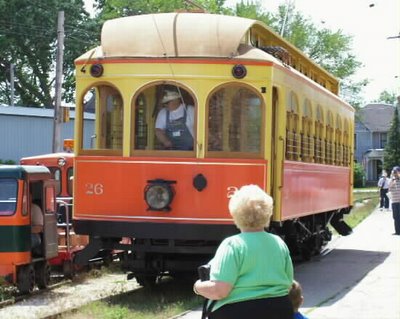
The East Troy Electric Railroad rolled out recently restored Sheboygan interurban 26.


With all the discussion recently about positive train control, and dispatchers overriding signals, leading to broken trains and dead people, perhaps a refresher on the fundamentals of the rights of trains is in order.


A train shall not occupy the East Troy to Phantom Woods section without the proper token, referred to on that railroad in those days as the "donut."

2.6.16

THE RENT-SEEKING OF THE CLERISY.

Regular readers are familiar with my suggestions that the victory dividend leading to the American High might have functioned much like a resource curse, that Democrat politicians in poor neighborhoods benefit more from the continued destitution of their voter base than they do from those voters prospering, and recently I've been suggesting that the Ruling Class might be more interested in protecting their position than in fostering conditions conducive to people improving their condition.

And thus does Donald Trump win the Massachusetts primary.

Thus, Thomas (What's the Matter With Kansas?) Frank's recent Listen, Liberal: Or, What Ever Happened to the Party of the People? makes for an intriguing Book Review No. 12, as he addresses, from a different perspective, many of the same phenomena.  The key to his criticism of the clerisy appears at page 40.  "[F]or the liberal class, [complexity] is an indicator of sophistication.  Complexity is admirable in its own right."  Precisely.  That's why it's so important to have Four of Five Experts Agree This Is For Your Own Good, and what keeps the talking heads on the Sunday shows uttering their commonplaces.

INSTITUTIONS ARE CIVILIZATION.

Don "Cafe Hayek" Boudreaux summarizes.
To understand the limits of economics is to avoid the error of assuming that economic success requires only that monetary incentives — prices, wages, profits, rates of return — be correct. Tariffs, minimum wages and other government interventions that distort monetary incentives do indeed make economic performance worse than it would be otherwise. But the success of even the freest market requires that people respect each other's property rights, that people keep their promises and that people behave responsibly toward their family, friends and own future selves.

A society dominated by adults who never look beyond today will never become wealthy, no matter how free the market might be.

If the culture says “Live only for today!” then too few people will reduce their pursuit of immediate pleasure; too few people will have the discipline to sacrifice today's certain pleasures for the always-uncertain prospects of a brighter future.

Markets that are at least reasonably free are a necessary condition for prosperity. But free markets are not a sufficient condition. This fact is why deregulation alone or free trade alone or tax-cutting alone should not be expected to spark and sustain widespread economic growth.

The case for free markets presumes the existence of a culture that encourages people to care about their families and their futures and that discourages people from looking with scorn upon entrepreneurs and merchants. Under these cultural pre-conditions, prosperity will indeed occur if markets are free.

Without these cultural pre-conditions, however, the economic situation is hopeless. People whose cultural norms prevent economic growth from occurring through markets will prevent economic growth from occurring through governments — even if, by some miracle, politicians possessed enough knowledge to successfully “grow” an economy.
Put another way, you can say all you want about the tax code, or trade, or making good deals, but if you enable dysfunction, you won't get rich.

THE FACULTY ARE THE STEWARDS OF THE UNIVERSITY.

I characterized the way by which Missouri's Board of Curators rid themselves of cliche troublemaker professor Melissa Click for her disorderly conduct at a protest as an administrative usurpation.
I still maintain that academic freedom too often serves as cover for trendy grievance scholarship, and that the diversity boondoggle is creating an academic environment devoid of intellectual diversity, none of which is consistent with the public interest, I must also object to Missouri's board of curators conceding powers to a legislature that will almost certainly be used in a situation where curricular integrity, rather than excessively zealous protesting, is at stake.
The American Association of University Professors have completed their evaluation.
This report is primarily concerned with two issues: whether Professor Click was afforded the protections of academic due process called for under AAUP-recommended standards and whether the action taken against her was the result of overreach by the university’s governing board and of inappropriate political interference, by members of the Missouri legislature, into the university’s disciplinary process and into the university’s affairs more generally.
It's a lengthy report. Well, not as lengthy as The Decline and Fall of the Roman Empire, but those of you with smartphone attention spans will probably be hitting TLDR pretty soon. Of course, those of you with smartphone attention spans probably don't hang out here that often.

THIS IS HOW ASSIMILATION WORKS.

Muslim Scouts pursue an American tradition — in an America wary of Muslims.
To Muslim American parents, tapping into the patriotic tradition meant as much as the other incentives for putting kids in Scouts: getting them off the couch, offline and outdoors. The parents also thought Scouting complemented lessons of service, charity, good deeds and upright character taught in the Koran.
It's called buying into America, and the Scouts and Scouters are figuring it out, even if some of their neighbors haven't yet caught on. Sometimes, all it takes is a cookie table.
“What we’re trying to teach our children is, there is no dichotomy between being Muslim and being American,” Kouthar Muttardy said. “A lot of people who hold these [negative] opinions have never met a Muslim. You should use every opportunity when you interact with others to set the record straight.”

She said she reminds her children of the unique position they occupy: “As a Muslim, you have many amazing things to contribute to American society. As an American, you have more opportunities than most Muslims around the world.”
Yes, and understanding checks and balances, part of the civics education that accompanies Scouting, provides the youngsters with a better inoculation against the presidential cult than many of the gentry commentariat have.
Farooq Syed, another Scout leader and Osman’s uncle, was sitting next to Osman and saw what he wrote.

“The nation is not one person,” Farooq said. “The Constitution protects you as a Muslim.”

“Okay,” Osman said.

He then wrote: “However, due to the democratic system of government in America, one man cannot make drastic change. Because of the checks-and-balance system in place, one branch cannot have all the power. Because America protects me and my family’s rights, I am positive we will be all right regardless of the presidential election outcome.”

Closing the discussion, Rahiq Syed said that, compared with other countries, “America is one of the safest places ever for Muslims, really.”

After the meeting, he was still thinking about the Scouts’ Trump fixation: “Muslim families all over are very anxious. You can see that in the kids.”
Anxious, and yet, as Scouts and Scouters, better equipped to handle a messy reality, or a camp trailer stuck in the mud. Go, read, understand.

OPPORTUNITY COSTS.

Good intentions, or faith, are subject to the rules of conservation of scarce resources.  Six years ago, No Child Left Behind meant No Child Gets Ahead.  Nothing has changed since then.

ALL SYSTEMS GO AT EGLINTON.

Here's a Throwback Thursday video from High Speed Rail Canada.


Space-age imagery, but check out the telemetry.

1.6.16

LUCK IS THE RESIDUE OF DESIGN.

Cornell's Robert H. Frank has a deserved reputation as an advocate for teaching economics creatively and for encouraging students to identify and understand economic anomalies.  In his work as a public intellectual, he has researched, extensively, winner-take-all markets and positional arms races.  His Success and Luck: Good Fortune and the Myth of Meritocracy revisits those themes.  I'll keep Book Review No. 11 brief: if you're familiar with his earlier Luxury Fever and The Winner-Take-All Society, you're well along the way to grasping the policy recommendations of Success and Luck.  Because sumptuary laws are somehow illiberal, while taxing income doesn't yield the government enough revenues, perhaps taxing consumption will yield more revenues as well as moderate those positional arms races.  Complete with the obligatory Utopian Wonkery(TM).  Here a sample from page 121.  "A progressive consumption tax would, however, reduce the share of national income consumed while increasing the share invested.  The growth sparked by that greater investment would increase future incomes."  Don't get lost in the woulds.  Perhaps, also, complete with misplaced confidence in a theory.  A study Professor Frank describes in chapter 8, "Being Grateful," suggests that the person who concludes an autobiography with "I appreciate the help of others" is more likely to be thought of as kind, or as a potential friend, than one who concludes an otherwise identical statement with "I worked my butt off to get here."  (I paraphrase, but you get the idea.)  Perhaps it's not so much about attitudes as it is about evolutionary stability: the former concluding statement is modest and mannerly, the latter not, and those bourgeois conventions might have more force than you'd expect after fifty years of deconstruction.

That noted, the book does confirm a conjecture of mine: the likelihood of a marriage failing varies in proportion to the lavishness of the ceremony.  That's luxury fever to Professor Frank.  Business as usual with June upon us.

(Cross-posted to Fifty Book Challenge.)

WHY POLITICAL ECONOMY IS DIFFICULT.

Mark Thoma raises a common objection to the standard model of economics.
This model of perfect competition describes a world that agrees with Republican ideology. In this model, there is no role for government intervention in the economy beyond setting the institutional structure for free markets to operate. There is nothing government can do to improve the ability of market to provide the goods and services people desire at the lowest possible price, or to help markets respond to shocks.

The great majority of economists, Democrats and Republicans alike, believe in the ability of markets to perform the “magic” of coordinating the desires and productive activity of millions and millions of people without the need for a central authority to guide them, and to provide the correct incentives for innovative, robust economic growth. Thus, in order to make the case that there is a role for government, one must first provide a strong case that there is a significant market failure that results in a departure from the assumptions needed for markets to work their magic, and then explain how government policy can improve upon the outcome.
Loosely, that's the normative implication of the first optimality theorem.  But the creation of mediating institutions, such as property rights and rules of contract, also raises the possibility of governmental involvement.  Thus, without those mediating institutions, and perhaps without sound money, there are no market responses.

The greater challenge, however, is in that "significant market failure" and then the "government policy can improve."  Does a set of facts on the ground contrary to the sufficient conditions constitute the market failure?  Or is the failure in a demonstrable allocative inefficiency that follows directly from the facts on the ground, e.g. the canonical textbook monopoly?  Then, if there is a demonstrable allocative inefficiency, does it follow that a specific government policy corrects it?  Much more easily done on a chalkboard, than in practice.  That's the controversy.  Perhaps Professor Thoma correctly argues that the controversy is not being taught properly.
There is a substantial and influential block of mostly conservative economists who always stand ready to defend the idea that markets work best when they are left alone. They will acknowledge that market imperfections exist, but they argue that given enough time market forces will fix the problem. If government tries to help through regulation or more direct measures, it will undermine these forces and make things worse.
That concluding sentence might be too strong.  Because what the Welfare Economics Paradigm identifies as "market failure" often involves an allocative inefficiency, the presence of that inefficiency provides an incentive for self-interested agents to harvest the unexploited gains from trade.  Social engineering by Wise Experts might work well on a chalkboard, but that may not be the only, or even the transaction-cost-conservingest, way, to create a Pareto improvement.

It's up to the professor, though, to teach the controversies.

HILLARY IS THE REAL ENEMY.

The lesser of two evils is evil.  Kurt Schlichter asks his #NeverTrump drinking buddies to contemplate the greater evil.
Trump may have shrugged his shoulders at the idea of transgender potties, but that's not the kind of idea that he would ever come up with. He doesn’t care. However, it's exactly the kind of obnoxious, intrusive idea libfascists like Hillary come up with. Trump just wants to sit around being rich and famous. Hillary wants to improve people like me and forcibly morph us into her neutered vision of the new socialist beta male she's been dreaming of since she was an embittered last call five at Wellesley.

Trump may be kind of thuggish, but he'll leave me alone. Hillary's going to come looking for me, and she’s foolish and clueless enough to push and push until we normals get tired of it and start to push back. I, for one, prefer my country not to be sucked into a second civil war because some former president’s angry wife is playing out a freakish psychodrama revenge fantasy against all the guys who have rejected her, from her father to Bill to those of us male-identifying men who laugh at her cankles. Advantage Trump.
That's a message to the #NeverTrump folks to pay some attention to the races elsewhere on the ticket,  the better to continue the gridlock.  Mr Obama is petulant, but in a laid-back sort of way.  Mrs Clinton will commence the screeching upon her inauguration.

THE COLD SPRING SHOPS CORPORATE DEAD POOL.

That used to be a provocative teaching device I used.  "I sometimes offer odds on a large corporation going out of business sometime in the next ten to twenty years. To be really provocative, I sometimes roll out supposedly solid companies including Apple or Microsoft or Wal-Mart."  The Cafe Hayek version features Don Boudreaux and his collegiate son Thomas.
Thomas and I were driving back from lunch and our conversation turned to McDonald’s.  Thomas correctly noted that McDonald’s has suffered some difficult times in recent years.  My son and I agreed that he – and possibly even I – will live to see the day when McDonald’s either declares Chapter 7 bankruptcy, is ignominiously absorbed into some other thriving firm (possibly a firm that doesn’t now even exist), or is transformed into an enterprise very different from what it is today.  Thomas and I agreed also that the same fate awaits Wal-Mart and, likely further down the road of time, Amazon.com, Apple, Google, and almost all of the other of today’s thriving commercial successes.

Thomas knows enough history to know that today’s commercial behemoths – the firms that today seem destined to survive forever, unbeatable, blessed with the touch of Midas – are tomorrow’s pathetic also-rans.  That’s the nature of market competition.  Think Pullman, Western Electric, Woolworth’s, K-Mart, Sears, Kodak, PanAm, RCA, and General Foods – to name only a few, and only national American, once-giants.
Too often, though -- and here Professor Boudreaux extends my argument -- it is when creative destruction catches up with the legacy companies (this has been the experience of the so-called Rust Belt) that the survival of those companies is in the public interest.
To criticize the success of private firms in competitive markets is to display a failure to understand that these firms’ high profits reflect their unusual success at improving the lives of countless input suppliers (including workers) and consumers.  And to seek to use government force to prevent the demise of firms being driven into bankruptcy by market forces is to seek to use government force to enable firms to continue to use resources inefficiently – that is, to use resources in ways that worsen the lives of many input suppliers (including workers) and consumers.
I wonder if that job-preservation might be a consequence of the low esteem that's attached to poverty programs.  Unemployment insurance and trade adjustment assistance and the like might be methods of helping people get back on their feet, and they might be more cost-effective or less inefficient than preserving failing businesses.  But ...

WHY DON'T THEY HAVE FREIGHT TRAINS LIKE WE HAVE?

The Silk Road Railroad is now open for business, but the operators still haven't figured out how to run Z trains, or even the fast symbol freight.
In November 2014, China expanded an old cargo train line that linked Germany to China to transport car components to Spain, creating a 13,000 km railway with the aim of increasing exports from China and bringing Spanish food to Chinese consumers. The trip takes 18 days, crossing France, Germany, Poland, Belarus, Russia, and Kazakhstan.

It is part of the massive “One Belt, One Road” commercial and military initiative launched by China in late 2013. OBOR, as it is known, includes a maritime route that would link Asia with East Africa and Europe through the Suez Canal; and an inland route following the old Silk Road that would cross Central Asia to Europe.
They're still seeking their J. Edgar Thomson, E. H. Harriman, or James J. Hill.
The problem is, there’s really no need to use trains to increase commerce between Europe and China. Sea cargo transportation is much cheaper, and companies already rely on it. More than 19,000 containers can be placed on a single cargo ship, and they only take 30 days from Europe to reach China.

The railway’s cost is only getting more prohibitive as sea shipping rates go down, thanks to an ongoing glut of shipping capacity.
The advantage of rail is in the speed, if the carriers are capable of moving the trains. Why else would Prince Rupert or Seattle exist as container ports in addition to those at Oakland or Los Angeles - Long Beach.

It helps, also, that the western transcontinentals still run trains through territories with some respect for the rule of law.
Yes, the railway is faster than a shipping container, but is also riskier because it goes through a few unstable countries and can be interrupted by extreme weather, terrorist attacks, and politics, [University of Hong Kong economist Chenggang] Xu said. “The Russian government is not very happy about the Central Asian link,” he added. “In their view they should dominate Central Asia.”
What, for all his mob ties, Tsar Vladimir isn't able to come to a modus vivendi with the local bandits?

As far as those extreme weather interruptions, I offer Kicking Horse Pass or Donner Pass.  The trains get through.

DE PAUL NEEDS TO STRENGTHEN ITS COMMITMENT TO FREE SPEECH.

The place long suffers from a censorious impulse, and the recent verbal terrorism engaged in during a protest of a Milo Yiannapoulos event is too much even for the editorial board at Chicago's Tribune.
The issues of the day are fraught, and students, raised on social media, are politically engaged and eager to espouse their beliefs. That's wonderful for society, and crucial for the future. But the tripwires are still there, among them learning the hard lesson that being offended is part of life in the public spaces of a democracy. How each of us responds to the insults and indignities counts for a lot.
But the snowflakes have long been enabled, with the connivance of Student Affairs and the Diversity Weenies, that giving offense is allowed for some but not others, and taking offense is a privilege for some and a burden for others.  When the burdened are neither subject to campus speech codes, nor disposed to meekly go along, we have what Tribune columnist Eric Zorn discovers. Milo Yiannopoulos protesters at DePaul only make Trump's message stronger.
A troupe of actors hired to parody the worst excesses of the speech-suppressing hothouse flowers on American university campuses couldn't have done a better job of seeming to ennoble Yiannopoulos and validate the anti-political-correctness sentiment that's helping drive voters to Trump.

Take it from me, you don't have to have Republican leanings to be angered by the enforcement of liberal conformity at our institutions of higher learning. You don't have to believe a single snide, catty, white-privileged word Yiannopoulos says to defend his right to say them to a crowd of willing listeners.

And you don't have to be a sophisticated political analyst to realize that exhibiting shrill intolerance for the rights of others to speak undercuts the idea that the presidency of the authoritarian Trump would truly place freedom in jeopardy.
Perhaps the snowflakes have to be outrageous because the evidence, after eighty years of the Ponzi scheme called "Social" "Security" and fifty years of a failed War on Poverty, and the two lies for the price of one bundled as patient protection and affordable care, all that is left is the shrill intolerance.

All the same, Mr Zorn would like to protect the right of people who do not hold his positions to speak, as a way of securing the identical courtesy for himself.
Those who find that they can't ignore the provocations of marginal haters ought to counter them with speeches and presentations of their own, if not because it's the right thing to do, then because it's the smart thing to do.

Shouting someone down makes you and your contrary ideas appear weak. It fuels your opponents and repels those who might be persuadable.

Fellow liberals: We can't win, we won't win, by trying to muzzle the opposition or drown them out with melodramatic umbrage. Not this fall. Not ever.
Indeed.