21.1.11

THE SOCIOLOGY OF A LIGHT BEER COMMERCIAL.

Stony Brook sociologist Michael Kimmel seeks to understand contemporary coming of age of young men.  The result of his example-gathering is Guyland: The Perilous World Where Boys Become Men: Understanding the Critical Years Between 16 and 26.  Perhaps I could reduce Book Review No. 5 to an epigram: if the subtitle has a subtitle, you probably know what the conclusion is.  The shame is that Professor Kimmel concludes with a laudable proposal.
In the end we need to develop a new model of masculinity.  Young men must understand on a deep level that being a real man isn't going along with what you know in your heart to be cruel, inhumane, stupid, humiliating and dangerous.  Being a real man means doing the right thing, standing up to immorality and injustice when you see it, and expressing compassion, not contempt, for those who are less fortunate.  So much of Guyland encourages cowardice -- being a passive bystander, going along with what seems to be the crowd's consensus.
John Wayne and Spencer Tracy got that, but we're not going there.  The opportunity to rebut the Susan Faludi of Stiffed or the Christina Hoff Sommers of The War Against Boys, two volumes that got into the Cold Spring Shops library before the Superintendent got into the Fifty Book Challenge is there, but apart from brief mention of their arguments, there is little systematic or organized reaction, let alone rebuttal, to their suggestions respectively that the information economy upends some of the ways once available to men to demonstrate their usefulness, or that expanding opportunities for women too often has a zero-sum basis in which the men must be held back.  Professor Kimmel notes the yob phenomenon, something that Yob Nation notes involves destructive behavior by men and women, but his excursion into Guyland looks at a different social phenomenon than soccer mobs, public shagging, and excessive drinking.
It's easy to observe "guys" virtually everywhere in America -- in every high school and college campus in America, with their baseball caps on frontward or backward, their easy smiles or anxious darting eyes, huddled around tiny electronic gadgets or laptops, or relaxing in front of massive wide-screen hi-def TVs, in basements, dorms, and frat houses.  But it would be a mistake to assume that each conforms fully to a regime of peer-influenced and enforced behaviors that I call the "Guy Code," or shares all traits and attitudes with everyone else.  It's important to remember that individual guys are not the same as "Guyland."
In fact, my point is precisely the opposite.  Though Guyland is pervasive -- it is the air guys breathe, the water they drink -- each guy cuts his own deal with it as he tries to navigate the passage from adolescence to adulthood without succumbing to the most soul-numbing, spirit-crushing elements that surround him each day.
Not that there's anything new about spirit-crushing elements.
Society everywhere is in conspiracy against the manhood of every one of its members. Society is a joint-stock company, in which the members agree, for the better securing of his bread to each shareholder, to surrender the liberty and culture of the eater. The virtue in most request is conformity.
In Professor Kimmel's view, the conformity so obtained is not that virtuous: beer, sports, babes, sports, internet smut, beer, sports, video games, beer, crude music, babes, gadgets, sports, beer.  The closest approximation I can come up to for a working hypothesis behind such apparently self-destructive behavior is the identity-politics notion of resentment.  See page 166.
They're tired of "being made to feel like losers," as many of them put it.  They're tired of feeling that the game is over before they've even started to play.  They're tired of putting the damned toilet seat down every time, of saying "he or she" on their term papers, of calling people of color "people of color."  They're tired of feeling like there's no mobility -- or if there is, someone else is climbing over them on the ladder of success.
As if affirmative action didn't exist.  As if mandatory rape awareness sessions didn't exist.

And as if the Sixties didn't happen.  Much of Guyland focuses on the minefield that is male-female interaction in the era of the hook-up.  The young ladies have lots of opportunities, and lots of confidence.  But too many of them for Professor Kimmel's liking still play the roles assigned to them by the light beer commercial, and his new age sensibilities apparently predispose him to ignore the possible evolutionary stability of Guyland.
Professor Laurie Rudman, of Rutgers University in New Jersey, said: 'Our findings demonstrate that men encounter prejudice when they behave modestly.'
They also raise the possibility that men may avoid behaving modestly because they risk backlash when they do.
Changes in gender roles that have afforded women more financial independence have not yielded relaxed demands for men.
'Men are still required to uphold masculine ideals that require chronic exhibitions of strength while avoiding signs of weakness.'
Likewise, his discontent with the b**ch or slut dichotomy of the Guy Code fails to recognize the possible influence of the Sixties.  Abortion and contraception were never primarily about rape, incest, or life of the mother: women say yes to men who say no was an antiwar slogan.  Under the new dispensation, a Guy has no reason to believe that a babe who turns him down is doing so as a general principle.

Ultimately, then, Professor Kimmel's sensibilities are likely to keep Guyland from changing many people's minds.  Collect the grossest examples of fraternity initiation rituals and call them homoerotic: a reader with older notions of propriety and perversity is unlikely to be more favorably disposed to the new dispensation.  Show your new age bona fides:  a reader who gets the point of Rush Limbaugh's new castrati schtick will nod.

(Cross-posted to 50 Book Challenge.)
UNIVERSITIES ARE FAILING AT THEIR MISSION.  Retired political scientist Abraham Miller is not surprised at the reaction to Academically Adrift.  The failure begins with the parents.
Look — if your child did well in high school, got excellent SAT scores, and signed up for a demanding major, you have nothing to worry about, except the price tag. And if that’s not a problem, you can stop reading right here.
But plenty of you parents know you have children who rarely cracked a book, got mediocre high school grades, and really have no interest in the demands of a real college learning experience. They got into less demanding schools or curricula, or you’re paying out-of-state tuition money for the privilege of sending your kid someplace he couldn’t have gotten into if he lived in-state.
The walking tour revealed what those parents really wanted.
I’ve been on the orientation tour with you, as the young man and young woman decked out in their school-spirit sweat shirts took you around the campus. And what kinds of questions did you ask? When you went to the library, you were inspired by the building. You asked not a word about the collection or the on-line computer stations. You wanted to know about the social life, the shopping, and how well the athletic teams were doing. When was homecoming, so you could plan your visit?
I remember when one set of parents asked how much people studied per class, what the intellectual demands were, and were there a lot of term papers in the liberal arts courses. The tour guides were dumbfounded, and the rest of you looked at this couple like they were the biggest bunch of party poopers. You kept some distance from these parents during the rest of the tour, as if they had a visible case of leprosy. Their son was an engineering major, and he did very well in school. By the way, they were sufficiently disgusted with the guides’ lack of intellectual concern that they wrote a letter about it to the faculty.
One wishes, however, that Professor Miller had taken more responsibility for straightening out his students.
Your son probably ended up in my class. He was the kid who slouched in his chair and sat in the back entertaining himself with his Nintendo or cell phone. At least, that’s how he behaved when he bothered to show up for class. Sometimes he disrupted class by coming late and being sure to walk across the front of the lecture hall to draw attention to himself. I wished that on such occasions he had the grace to have pulled his Levis above his underwear. But that was too much to ask.
The next time you think the Superintendent is cranky, read the rest of the post.
A CHEDDAR CURTAIN HAS COME DOWN.  USA Today visits Chicago and Green Bay.
Green Bay and Chicago share proximity to Lake Michigan, Midwestern grit and bluntness and a zeal for sports, but not much else.
Chicago's population dwarfs Green Bay's, 2.8 million to 101,412. Green Bay's tallest building is the nine-story Bellin Building; Chicago has the 110-story Willis Tower. Chicago has the Bulls, the Blackhawks, the Cubs and the White Sox. Green Bay has the Packers and a unique connection to the team, which is owned by the community.
All three million of those Chicagoans vacation in Wisconsin, many of them maintaining second homes in the two northernmost counties of Illinois, Vilas and Door.
"There's a natural connection between Illinois people and Wisconsin people, not always pleasant," says [author David] Maraniss, who has homes in Washington, D.C., and Madison, Wis. "Wisconsin people are always complaining about Illinois drivers coming up for summer vacation and ruining their state. On the other hand, they're putting money in Wisconsin. They need the Illinois people. And Chicago is really the big city for Wisconsin."
Illinoisans need the Wisconsin people, too.  Well-off parents in Illinois send their spawn to the University of Wisconsin to stretch their minds, and Illinois businesses and universities hire Wisconsin graduates to show the flatlanders the proper use of their minds.  (The biggest Wisconsin alumni chapter outside Wisconsin is in Chicago.)

A related article notes that three of the NFL's Final Four do not have cheerleaders.
The [Packers' since disbanded] Golden Girls were drawn from a dance studio, and included some national champions in baton twirling. They are in the Packers Hall of Fame, but the team did away with cheerleaders in 1988, after a TV station poll found fans were split 50-50 on whether they were needed.
What for?  Football is supposed to be played on a fall afternoon, with perhaps a hint of snow in November, with a blast furnace or paper mill in sight of the stadium.

There is still a blast furnace not far from the Napoleonic Wasteland of Soldier Field.

20.1.11

HIGHER EDUCATION AS IF IT MATTERED.  Inside Higher Ed interviews Richard Arum, co-author of Academically Adrift, from the early reactions to it a likely candidate for a book review.
Arum said that the problems outlined in the book should be viewed as a moral challenge to higher education. Students who struggle to pay for college and emerge into a tough job market have a right to know that they have learned something, he said. "You can't have a democratic society when the elite -- the college-educated kids -- don't have these abilities to think critically," he said.
It helps if headquarters considers students as potential critical thinkers, rather than as a revenue source.
And the book acknowledges that many college educators and students don't yet see a crisis, given that students can enroll, earn good grades for four years, and graduate -- very much enjoying themselves in the process. But in an era when "the world has become unforgiving" to those who don't work hard or know how to think, Arum said that this may be a time to consider real change.
The culture of college needs to evolve, particularly with regard to "perverse institutional incentives" that reward colleges for enrolling and retaining students rather than for educating them. "It's a problem when higher education is driven by a student client model and institutions are chasing after bodies," he said.
The analysis in the book stresses that there is significant variation within institutions, not just among institutions, with students in some academic programs regularly outperforming others at the same campuses. Arum said this suggests that institutions can improve student learning by making sure that there is some consistency across disciplines in the rigor of requirements. "You need an internal culture that values learning," he said. "You have to have departments agree that they aren't handing out easy grades."
Further, he said that colleges need to shift attention away from measures of "social engagement" (everything that's not academic) and toward academic engagement, even if some of those measures of non-academic engagement help keep students engaged and enrolled. "It's a question of what outcome you want," he said. "If the outcome is student retention and student satisfaction, then engagement is a great strategy. If, however, you want to improve learning and enhance the academic substance of what you are up to, it is not necessarily a good strategy."
Minding the Campus also notes publication of the book.
Since our copy of the book arrived only today, we haven't finished reading it, but we assume that its huge welcome in educational circles has a lot to do with the many books and articles deploring the lack of study on our campuses, the large number of college grads working at low-level jobs, books arguing that partying is the main activity of a great many collegians, and articles such as Peter Sacks' here reporting on the all too common disengaged and academically tone deaf college students of today. We will have more to say later about Academically Adrift.
Years ago, my economics colleagues at Wayne State argued that a time of budgetary stringency offered an opportunity for the university to cut costs by raising standards, enrolling fewer students in the first place, and devoting fewer resources to a retrospective of high school.  It has been a thirty years' war, but the logic and the fiscal circumstances again align.
CROSSING THE FIFTY.  Just north of the Illinois-Wisconsin border is State Highway 50, which, at least in Kenosha County, separates the Bear zone from the Packer zone.  The boundary is probably fuzzy: at last night's basketball game, there were more than a few green coats and stadium blankets (when the Convo is relatively empty, it's chilly) in view.

Sunday's game is not the first time the Bears hosted the Packers for an opportunity to play in the league championship game.  The same thing happened on December 14, 1941.  The Chicago Sun-Times offers a recollection, including a box score.

That Bear team had most of the same personnel who ran up the score on Washington, 73-0, the previous season.

18.1.11

OUCH. A video, possibly from Taiwan, noting the visit of the mainland's president Hu Jintao to Washington, D.C.

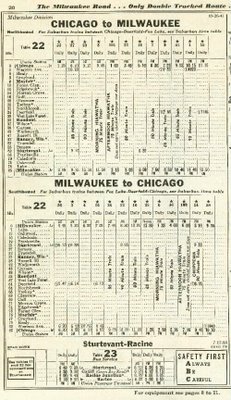
GIVE THEM FREE REIN TO 110. A Milwaukee Journal-Sentinel report acknowledges the potential for faster Hiawathas. Proposed running times will be the fastest ever.

Here is the 1941 train schedule.


The proposed timings with some infrastructure improvements between the Airport station and the beginning of Metra territory, inclusive of intermediate stops, are encouraging.


The article envisions additional trains.
A separate $12 million federal grant, unaffected by the Milwaukee-to-Madison controversy, is already paying for upgrades to the platform at the Mitchell International Airport station and to the Hiawatha tracks, and the state can use the remaining $2 million from the larger grant for Hiawatha upgrades.

With a third train, the Hiawatha could add an eighth, and perhaps even a ninth, daily round trip, Beitzel said. Hiawatha ridership has grown more than 99% since Amtrak and the state added a seventh round trip in late 2002.

Jay Sorensen, a Shorewood-based transportation consultant, said the Hiawatha attracts an even higher proportion of affluent business riders than his former employer, Midwest Airlines. He says authorities could double the Hiawatha's frequency "and demand would rise to meet that.... They could make it so blindingly convenient, by having trains every half-hour, that people say, 'Why am I driving?'"
That's probably wishful thinking, even the North Shore Line, before Highway 41 was doubled through Racine and Kenosha County, offered hourly service.  Journal-Sentinel editors endorse the train, and the Hiawatha line makes Metro's list of most promising rail corridors.
IN THE APPROVED FORM WITHOUT PUNCTUATION ERASURE OR INTERLINEATION.  THE BOOK OF RULES IS STRICTER ABOUT THE FORM OF TRAIN ORDERS THAN SHAKESPEARE IS ABOUT THE FORM OF A SONNET

THE DISCIPLINE OF WRITING A SONNET DEVELOPS STUDENT SKILLS
MAKE THE STAKES HIGHER.  The first two years of college: a waste?
Nearly half of the nation's undergraduates show almost no gains in learning in their first two years of college, in large part because colleges don't make academics a priority, a new report shows.
You think that third party payments and enrollment for its own sake and enabling the high schools' failures might have something to do with it?

A longer version of the article gives reason to question yet another fad.
The study also showed that students who studied alone made more significant gains in learning than those who studied in groups."I'm not surprised at the results," said Stephen G. Emerson, the president of Haverford College in Pennsylvania. "Our very best students don't study in groups. They might work in groups in lab projects. But when they study, they study by themselves."
Group projects: yet another manifestation of the tragedy of the commons.
It is fascinating to see A students put their names on papers that they would never dream of submitting for individual assignments. The most common explanation for those occurrences is that the A students do their portions to their standards, and then they sit back and assume that the rest of the team will do their part.
I envision that the previous sentence will lead some readers to say that such results are not a big deal – I’m the professor; I should grade according to performance. If students submit poor work, they should receive their low grade and sleep in the bed that they made. I agree, but there is also no such thing as a perfect assignment. There are other issues in play.
If one student takes charge of a team project, that student will inevitably contribute more to the project than other students. In turn, professors navigate those waters by building in a peer evaluation system to align the final grade with student effort.
Interesting, also, how relative prices matter.
While many students submit team projects below their individual standards, the collaboration rarely results in F-level work. It takes a real effort to fail a team project because one member usually does not let that happen. Because these projects often pass, they do more to bolster the grades of weaker students than help the stronger students. I have witnessed F’s become D’s and D’s become C’s because of team project performance. Thus, I regrettably pass weaker students onto other professors solely because someone else’s work helped them get through my class.

When I raise the grade inflation issue with others, they tell me that I should weight the project low enough that it cannot cause such a grade enhancement. But in doing that, the lower weighting invites poor performance, and students devote their energy to other assessments that matter more towards their course average (I call this the insanity of weighting something 10%).
The article considers a number of strategies professors might consider to encourage and elicit the right kind of effort.

It helps if headquarters considers students as potential critical thinkers, rather than as a revenue source.

17.1.11

I READ THE NEWS TODAY, OH BOYRonald Reagan, religious freedom, and vanguardism.
Michael Petrov, president of the Digital Edge data management firm in Staten Island, notes that in his opinion, the Democrats are “micro-managing the economy,” and that “Government is affecting small business more and more. It’s the same as what's happening in Russia.” Petrov identifies Democrat-supported policies restrictive of business as fundamentally akin to the Soviet Union’s brutal centrally-planned command economy, where the state controlled and owned the means of production, assets, and investments, resulting in massive inefficiency, corruption and socioeconomic stagnation, with an eye toward the “just allocation” and the “redistribution of wealth.”
Never mind seeing Russia from Wasilla, they can see it from the Narrows.
SOMEBODY HAS TO DO THE HEAVY LIFTING. Book Review No. 4 takes up David Coates's A Liberal Tool Kit: Progressive Responses to Conservative Arguments, is a Praeger offering that has been promoted in mailings to academicians and it's on offer at academic prices (read: higher than the prices Morning Sun charge for full-color railroad picture books. There are no guaranteed student loans or $700 book allowances for train-spotters.)

The book crosses the line into polemics. Professor Coates admits as much, by way of making a case for the necessity of his work, at page 7.
Debating [powerful conservative arguments] is a serious and important endeavor. But there are other arguments out there too -- arguments of less force and value -- that need to be cleared away first. These arguments have a different purpose. They exist less to stimulate debate than to close it down, and they are disseminated less by intellectuals within the conservative movement than by their more populist outriders, who collectively make up a kind of right-wing "heavy brigade." We eventually will have to compete with the pedigree conservatives, but first we need to deal with their rottweilers.
Leave aside the sloppy mixing of metaphors and the lack of knowledge of matters military in that excerpt: the shame is the opportunities the book misses.


The introduction promises more:
  • We need to deal with the alternative point of view in all its complexity.
  • We need to balance complexity in argument with clarity in presentation.
  • We need to design arguments that can run the gamut from sound bites to theses.
  • We have to anchor our case in solid and reliable evidence.
  • The problem specification has to be superior
  •  ... and the logic has to be tight.
That's what frustrates about the book. On the one hand, in some chapters it recognizes that there is diversity of perspective on the Right (Heritage is different from Cato); on the other hand, when it reverts to dealing with the rottweilers, it gives the impression that Lou Dobbs or Rush Limbaugh or Michael Savage are the frontier of conservative thinking.  (Tes, I'm referring specifically to immigration policy; it's that unit where drawing a distinction between Heritage and Cato, as well as distinguishing pro-market from pro-business policies would be particulary fruitful).

Furthermore, Professor Coates fails to engage the greatest challenge to the progressive project: the culture of failure that contributes to persistent poverty and underemployment.  In urban slums, that culture provides reliable Democratic voters; in hardscrabble suburbs and rural communities, the Christian right.  Thomas Sowell's Black Rednecks and White Liberals gets closer to the heart of that policy challenge.

(Cross-posted to 50 Book Challenge.)

ENROLLMENT MANAGEMENT ENCOURAGES STUDENT AFFAIRS.

I'm inverting the title of a real university office as a way of returning to the subject of sex imbalances on campus. "How many women entering higher education realize they are going to de facto Women's Colleges?" The topic has provided material for lots of commenters over the last few years. There's a useful summary at 11D:
One downside to having college campuses that skew female is it kills dating. If you take out the social misfits and the guys with girl friends, there are slim pickings indeed. And the slim pickings end up setting the rules. Even this guy with the zit on his neck.

Because there is a huge competition for the few datable men on campus, male dating rules win. The article describes a woman grabbing a strange guy in a bar and dragging him onto the dance floor to get his attention. Women sleep with guys right away, in order to get noticed. No guy needs to settle on one girl, when he has sororities of girls desperately throwing themselves at him with the hope of getting noticed.
That analysis is superficial, as the poster notes in her conclusion.
My first job after college was working as an editor of computer books. I went to the COMDEX conference to showcase our books. The other editors and I were the only women among the sea of computer nerds. I liked that ratio. Too bad they were all geeks.
Put another way, contemporary mating practices and admissions policies might not be evolutionarily stable. That doesn't stop commenters from drawing all sorts of Deeper Implications.
THE WORLD'S FASTEST DIRT TRACK RAILROAD.    The Milwaukee Road ran its Hiawathas behind steam locomotives running on jointed rail in some places ballasted by sandstone.

The Chinese fast electric trains might be continuing the tradition.
Stephen Chen, in the South China Morning Post, writes this past week that there are “Judgment Day” Fears for Chinese High-Speed Rail:

“Construction of the mainland’s massive high-speed rail network is in danger of becoming a victim of its own success. The breakneck speed at which track is being laid means engineers are likely to have to sacrifice quality for quantity on the lines’ foundations which could ultimately halve their lifespan. The problem lies in the use of high-quality fly ash, a fine powder chemically identical to volcanic ash, collected from the chimneys of coal-fired power plants. When mixed with cement and gravel, it can give the tracks’ concrete base a lifespan of 100 years.

According to a study by the First Survey and Design Institute of China Railways in 2008, coal-fired power plants on the mainland could produce enough high-quality fly ash for the construction of 100 kilometers of high-speed railway tracks a year. But more than 1,500 kilometers of track have been laid annually for the past five years. This year 4,500 kilometers of track will be laid with the completion of the world’s longest high-speed railway line, between Beijing and Shanghai. Fly ash required for that 1,318-kilometre line would be more than that produced by all the coal-fired power plants in the world.”
Milwaukee was able to keep the trains rolling by installing heavy rail and employing lots of track walkers.  China is still notionally a socialist country, and keeping comrades employed as track walkers with shovels and lining bars is in that tradition.

16.1.11

LIFE AFTER COLLEGE IS THE REVENGE OF THE NERDS.  Astronaut Bernard Harris speaks truth to high schoolers.
Harris says many youngsters don’t have voices of encouragement in their lives.“I’m here to remind you that geeks—the people with knowledge and education—rule the world,” Harris tells the Baton Rouge students. “If someone teases you about being smart, look them in the eye and say, ‘Someday, you’re going to be working for me.’”
His words had some effect on at least one student.
Listening in the auditorium is eighth-grader Tanayri Rodriguez, who afterward says her encounter with Harris has her rethinking her career plan to work in a hair salon.  “Maybe a marine biologist!” she says. “I’d like to go down to the bottom of the ocean and see if I can find something new there.”
It's likely that she will, should she persevere.  We have better maps of the back side of the Moon than we have of the bottom of the Atlantic Ocean.

PUSHING THE LIMITS OF WISHFUL THINKING.

There is a Fourth Turning section at Cold Spring Shops, and sensible thinking along generational lines occasionally gets its due. On the other hand, there's Tom Osenton's Boomer Destiny: Leading the U.S. through the Worst Crisis Since the Great Depression. Book Review No. 3 is not going to be complimentary. Imagine potted Strauss and Howe meeting Obama hagiography in the style of a business writer, with the intellectual coherence that suggests.


Mr Osenton suggests that President Obama, born in 1961, will be the late Baby Boomer that organizes the other Boomers to do the hard things to Save The Nation, in the same way that Franklin D. Roosevelt organized the Harvard Alumni Club Missionary Generation to ...  (Yes, I've heard the same sort of thing from Democratic Party cheerleaders and from academicians, some of whom should know better, but the former are to be understood for what they do and the latter sometimes marshal an argument with refutable propositions).
PAYBACK.  A few years ago, Michael Vick and the Atlanta Falcons ended the Packers' home playoff undefeated streak.

The Packers have had to work some to get into the playoffs, and so far the work is paying off.  Michael Vick is now with the Eagles, and he had his team in a position to win late in the game.  Tramon Williams picked him in the end zone.

That earned the Packers a trip to Atlanta.  The offense put together four straight touchdown drives, and Tramon Williams ended the first half with an interception return for a touchdown.

By game's end, the stadium was occupied by Wisconsinites.  Joseph Johnston could not be reached for comment.

13.1.11

PAY FOR PERFORMANCE. The recently concluded American Economic Association job meetings included policy-relevant sessions.
Chairman Bernanke is by no means the only prominent economist worried about the fiscal outlook and how it will affect our economy. The American Economic Association devoted a great deal of time to the subject at its annual meeting that concluded Sunday. International Monetary Fund First Deputy Managing Director John Lipsky said the U.S. must “lay out the basis for credible medium-term fiscal adjustment” soon. He praised the proposal from the Bowles-Simpson Fiscal Commission. CBO Director Douglas Elmendorf discussed the bleak fiscal outlook and pointed out that there are no easy solutions.
The recently concluded Modern Language Association job meetings included a lot of play value.
I tried, but it is nearly impossible to parody the Modern Language Association (MLA) Convention’s yearly orgy of political correctness, anti-capitalism, and Theory, just concluded in Los Angeles. Rumor was that the MLA had “gotten better,” but if so, I didn’t hear it. Wondering “why literature matters,” I heard that the possibility that Helen actually sent a double to Troy shows how much “we need simulacra that are then exposed” and how “wars are fought and people die for illusion” and how “they also die for the narrative.” That’s how you use apparent literary analysis to (wink, nudge) criticize the Iraq War (as though the whole golden apple-Aphrodite deal was real in the first place).
There's more, including a Che Guevara tee-sighting.
LIFE IMITATES FATE IS THE HUNTER. No stalling out on the beach this time.
A United Airlines flight from Chicago to Germany was forced to make an emergency landing in Canada after a pilot spilled coffee on the plane's radio equipment.
I had this news item flagged to post once my internet connection was restored, but in the interim I discovered another news reporter who also remembered his classic movies.
A Transport Canada report said United Flight 940 was diverted to Toronto late Monday and landed safely at Pearson International Airport. In a twist reminiscent of the plot of the 1964 Glenn Ford movie 'Fate Is the Hunter', the coffee spill caused distress signals to go out, including code 7500, which means hijacking or unlawful interference.
Well done, Rob Gillies.
NEITHER MENCKEN NOR MISES. There is much to ponder about the persistence in prosperous, technology based division of labor societies of ancient superstitions and belief in the implausible. It was with that in mind that I purchased Charles P. Pierce's Idiot America: How Stupidity Became a Virtue in the Land of the Free. The back cover was provocative enough. Herewith the Three Great Premises of Idiot America:
  • Any theory is valid if it sells books, soaks up ratings, or otherwise moves units.
  • Fact is that which enough people believe. Truth is determined by how fervently they believe it.
  • Anything can be true if someone says it loudly enough.
Ah, perhaps we get, in this slim volume, a deconstruction of the fundamental tenets of social constructivist theories, which, stripped of the sesquipedalian words, scare quotes, and run-on sentences postulates precisely as above.

I suppose, given that the book was on offer in a railroad station bookstore, it might have been of the same heft as the business-fad paperbacks snapped up by on-the-make sales managers in the airports. The introduction, however, is intriguing enough.
The foundations of Idiot America had been laid long before. A confrontation with medievalism intensified a distressing patience with medievalism in response, and that patience reached beyond the politics of war and peace and accelerated a momentum in the culture away from the values of the Enlightenment and toward a dangerous denial of the consequences of believing nonsense.
So, perhaps we will have an elaboration on the consequences of losing the good of the intellect, or of the denial of coherent beliefs of any kind. Perhaps so. That puts us in the realm of Mises's Human Action, albeit in fewer pages and without the challenges of rendering in English thoughts laid out in German.

Nope. We get some free association, in which the follies of James Madison (yes, he might have been instrumental in ordaining and establishing the Constitution of the United States, but he also picked an unnecessary fight with King George and got the People's House burned in the bargain), the proto-new-agey writings of Ignatius Loyola Donnelly, sometime politician and town planner (Nininger, Minnesota never rated a Hiawatha stop), and the commercial success of a Creation Museum in which club-wielding cavemen herd dinosaurs in the best Fred Flintstone style become the basis for a lament about the success of the Tea Party or the popularity of Sarah Palin or Glenn Beck's television ratings or George W. Bush winning re-election, or something.

Thus it's not Mencken either, nor will it help wonks win elections. It did, however, make for a quick Book Review No. 2, as I was able to read it in the course of a frustrating quest for hobby shops and have time for a nap on the train home.

(Cross-posted to 50 Book Challenge.)
PUSHING ON A STRING. Once upon a time, an endorsement of probity would characterize a person as sounder than The Roman Catholic Church, The Pennsylvania Railroad, or The Republican Party. Those institutions are shrunken, or gone, but thanks to United States monetary policy, U. S. corporations look relatively stronger.

For the first time on record, investors are demanding a smaller premium to own U.S. corporate bonds than global company debt.

Bondholders demanded 166 basis points more in yield to hold U.S. investment-grade company debt instead of Treasuries at the end of 2010, compared with an average 169 basis-point spread worldwide, according to Bank of America Merrill Lynch data. On Dec. 3, 2008, companies issuing debt in the U.S. paid 653 basis points more than Treasuries while corporations selling around the world paid 503 basis points more than sovereign governments offered investors in their debentures.

The shift highlights confidence in North America’s economic recovery as companies across the Atlantic in Europe contend with the cost of bailing out Greece and Ireland while waiting to see whether the fiscal crisis ensnares more countries. The U.S. economy is forecast to grow faster this year than either the euro region or Japan, according to Bloomberg surveys.

“In the U.S. you have a little more optimism while in Europe you have more concerns about the sovereigns,” said Greg Venizelos, a credit strategist at BNP Paribas SA in
London. “The sovereign issues are holding back spreads in Europe.”

The Federal Reserve’s second round of so-called quantitative easing will boost returns for U.S. bond investors, said John Brynjolfsson, chief investment officer of
Aliso Viejo, California-based hedge fund Armored Wolf LLC. The program, also known as QE2, calls for the central bank to buy $600 billion in Treasuries through June.

‘Strong Stimulus Package’

“With the strong stimulus package and QE2, I expect 2011 to be a relatively strong economy and corporate bonds tend to do pretty well in that environment,” Brynjolfsson, who oversees $362 million, said Dec. 3 on Bloomberg Television. “Even if corporate yields rise a little bit it’s likely spreads tighten, which corporate bond managers like to see.”

Whether those rising yields are anticipations of inflation remains for future research.
