23.10.17

CONTEMPLATING MULTIPLIERS.

Professor Mankiw tackles the effect of a change in the capital tax rate t on wages w.

A correspondent, Casey Mulligan, using the analytics of a simple aggregate production function, written in intensive form as y = f(k), derives

(1)   dw/dx = 1/(1-t),

where dx = -kf'(k)dt is the static cost of the tax cut per worker.

The details are in Professor Mankiw's post, and under some circumstances reducing the tax rate on capital increases the wage rate.

There's more intuition at Professor Steven "Big Questions" Landburg, and Professor John "Grumpy Economist" Cochrane works through the algebra at length.  Plus a disquisition on the role of the algebra.
The example is gorgeous, because all the production function parameters drop out. Usually you have to calibrate things like the parameter α and then argue about that.

This is not the same as the Laffer curve, which I think causes some of the confusion. The question is not whether one dollar of static tax cut produces more than a dollar of revenue. The question is whether it raises capital enough to produce more than a dollar of wages.

This is also a lovely little example for people who decry math in economics. At a verbal level, who knows? It seems plausible that a $1 tax cut could never raise wages by more than $1. Your head swims. A few lines of algebra later, and the argument is clear. You could never do this verbally.
And Professor Mankiw's invocation of the single sector macroeconomics model suggests a way forward to answer a commenter question at Grumpy Economist.  "What does the government do with the tax money?"

There might be a way to capture the essential elements of taxation and government activity modifying either the Uzawa two sector growth model or the Lewis dual sector development model.

The challenge is to set things up in a way that doesn't too explicitly force the results, and I haven't done anything formal, this is just thinking at the keyboard.  Suppose that some part B (honoring John Kenneth Galbraith's "bezzle") of aggregate output Y gets embezzled.  But law enforcement activities  -- OK, mediating institutions generally, including the rules of contract and property -- can reduce (albeit never eliminate?) the bezzle.  Governing is financed out of taxes, and there appears to be the possibility of taxing beyond the level at which the bezzle can no longer be reduced, thus we get rent seeking.

There might be some elements of this presentation of the two sector growth model that will reward careful study.  Consumers pursue maximum utility, where their per capita consumption is y-b-t.  As workers, they allocate their effort between the goods sector, where their compensation is the value of their marginal product, and the governing sector, where their compensation is ... to be determined without forcing the results.

There's probably some of this elsewhere in the research, but I'm not aware of it.  I'd be pleased to hear of any systematic thoughts on political economy and taxation that can clarify the conditions for governance being symbiotic with commerce rather than parasitic on it (rent seeking), or with commerce becoming parasitic on governance (old style corruption.)

22.10.17

THE CRAFTSMANSHIP OF COLD SPRING SHOPS.

The original, that is.


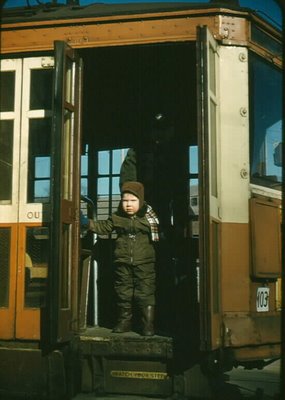
Four workmen are posing for the company photographer.  They are rolling a maximum traction truck under a rebuilt 700 class streetcar.  These cars were delivered as center door cars, later rebuilt with doors at the car ends.  Why the original trucks went back under the cars I don't know: the maximum traction idea was to save money by putting one bigger motor with a bigger drive wheel on each truck rather than put two smaller motors on each truck.  It was an evolutionary dead end.

I don't know the history of this picture, it's undated, unattributed, and a purchase at a swap meet.

That's an 800 or 900 class streetcar, Milwaukee's newest type, at left, and the car at right is interurban 1120 in a 1940s modern image paint job the locals referred to as the "Spitball Car."

WHAT HAPPENED.

Yes, that's the title of a new book by a failed presidential candidate, but the impression I have gathered of it is that she continues to blame everyone but herself, and life is short.

But when two members in good standing of the vast right wing conspiracy offer widely differing polemics on the outcome of the same election, perhaps I should devote Book Reviews No. 21 and No. 22 as a brief compare-and-contrast.

IT'S NOT ABOUT THE GUNS.

Columnist S. E. Cupp (who now has an evening talk show on CNN's Headline News that impresses me as more edifying, plus it skews younger, than the Fox News and MSNBC offerings running in that hour) understands what Constitutional Principles currently mean, and what standing on principle means.
It’s Democrats and the gun control lobby that lack the courage. Because the only intellectually honest and consistent proposal for curbing gun violence is a ban on all guns. If Democrats are serious about putting an end to mass shootings, or gun deaths in Chicago, or gang violence, they should fight to take every last gun off the street. They should stand up and say they want to repeal the Second Amendment. Anything short is either a shortsighted fallacy or political window dressing.
Leaving aside, for the moment, the problem that Chicago already has stringent restrictions on gun ownership, but those restrictions might be undone by smuggling, or by scratch building.  (The British Sten gun, for instance, comprises components that a reasonably competent machinist could build at home, something that might have been necessary had fighting on the beaches and the landing grounds and in the Midlands become necessary.)

But the smuggling allowed NBC's Chuck Todd to deflect Representative Steve Scalise's invocation of Chicago's gun deaths by alluding to the less restrictive laws just east of the state line.  "But they'll tell you, you just go in Gary, Indiana. So I mean, you just go across state lines. And you can have all the tough gun laws you want in the world, but if you cross state lines, I mean, this is, that's why they argue for a federal law."  On the other hand, there's more at work than the relatively greater availability of firearms in Indiana.  Gary, despite its own Murder City reputation, has recently beaten Chicago out for at least one business project, and I have no evidence of a similarly violent war of drug lords in progress in Indianapolis or Frankfort or Kokomo.  Meanwhile, the violent crime rate has been falling nationwide for some years.

Perhaps, if it's angry people committing mass shootings that's the policy challenge, it's identifying and containing the angry people before they act out.  Was it really the best public policy, upon discovering the conditions in the mental hospitals to treat institutionalizing people as anathema, rather than improving the conditions?

SUMMONING THE ECHOES.

Members of Chicago's Iron Workers Local #1 offer a tribute photograph.


Retrieved from Curbed Chicago.

21.10.17

FOOTBALL IS BLOCKING AND TACKLING.

Green Bay Packer spokesman Mike Spofford notes, "Protecting the football is job one."

There are still some coaching points beyond equipping new quarterback Brett Hundley with a game plan.
I loved the fact that, going against the media grain of the day, [coach Mike McCarthy] wanted to focus his remarks on his team’s poor play that had nothing to do with Rodgers’ injury. He was borderline sick to his stomach after watching the film. That’s a coach and a leader, through and through. Even though we might all feel better if the Packers were 5-1 right now, losing that game might have been the best thing for the Rodgers-less Packers.
Furthermore, any reserve is one injury away from being sent in.  Prepare and act accordingly.
What message does that send to the other 52 players on the roster? How do young players develop if the coaching staff and organization aren’t behind them 100 percent to succeed? This is professional football.
Take care of the blocking and tackling, and the wins will take care of themselves.

17.10.17

A PROGRESSIVE SEEKS TO TURN THE CLOCK BACK.

The progressive in question is E. J. Dionne, and the setting he wants is "Eisenhower Republican."

And I could end Book Review No. 20 simply by giving the title Why the Right Went Wrong: Conservatism - From Goldwater to the Tea Party and Beyond, and let it go at that.  And it transpires that he had to come out with a revised edition in November (my copy has a purchase date of 22 January 2016, and it was obsolete effective 20 January 2017) with a new title, Why the Right Went Wrong: Conservatism - From Goldwater to Trump and Beyond, and he's likely walking back one of his themes: that the Republicans might have little future as a presidential party, which surfaces at page 10. "A right-leaning Republican Party is in a strong position to rally a coalition of discontent among older white Americans who dominate the electorate in the off years.  But absent a change in its approach, the conservative coalition is threatened with long-term minority status in presidential elections, where a younger, more culturally and ethnically diverse electorate holds sway."  Oops, and Mr Dionne's recognition that this electorate is clustered in a few places is something that's going to be in the political discourse going forward.  And we no longer have the Victory Dividend to enable a Dwight Eisenhower to consolidate the gains with interstate highways, and Lyndon Johnson dissipating them in any number of ways.  The problem with politics may less be a disorderly conservatism than it is widespread manifestations of ineffective technocratic expertise.

And there might be Mr Dionne's greatest insight, page 14. "I offer this book in part because I continue to believe that a healthy democratic order needs conservatism's skepticism about the grand plans we progressives sometimes offer, its respect for traditional institutions, and its skepticism of those who believe that politics can remold human nature."

Alas, dear reader, that's missing from much of what passes for conservatism these days -- there's another book or two on that score sitting on my desk -- and it's unfortunate that when the skepticism manifests itself, it might be in a disrespectful way.  Page 309, from a Tea Party inspired town hall in South Carolina, quoting an unidentified hospital worker.  "I also have had many years of experience seeing the result of government intervention in the private sector.  The result of that government intervention has been mostly the result of what I call the reverse Midas Touch.  That is, whatever government touches through its control, it mostly turns to crap."  Yes, and if you like your doctor, you can keep your doctor, and your good government school comes bundled with a granite counter top.  There is a lot of work left to do,  But somehow Mr Dionne's calls for "a more moderate brand of politics" ring hollow.  He's more on point at page 450.  "But to challenge the gridlock created by the two electorates, progressives will need to win back white working-class voters who look to government to reduce economic insecurity and expand opportunity -- yet have lost confidence in government's ability to succeed."

Yes, somewhere between a quarter-century of rent-seeking by the Davos set, and a half-century of technocratic conceits will do that to voters.

(Cross-posted to 50 Book Challenge.)

GIVING UP ON RETAIL RAILROADING?

At the same time Norfolk Southern is cooperating with regional railroads on intermodal movements, CSX appears to be concentrating its intermodal resources on fewer routes.  Goodbye, Columbus.
CSX told customers on Oct. 12 that it would be dropping outbound service from Columbus to nearly two dozen locations. Only a handful of inbound lanes are being eliminated, the railroad said.

The announcements come on the heels of reductions in intermodal service to Detroit as well as Louisville, Ky., as CSX prepares to scale back container sorting operations at its hub in North Baltimore, Ohio.

The terminal opened in 2011 as the linchpin of a new intermodal strategy. The $175-million Northwest Ohio Intermodal Terminal was designed to support CSX’s hub-and-spoke approach to serving smaller intermodal markets.

By sorting container shipments at North Baltimore, CSX could build the density required to provide new or more frequent service to places such as Louisville, Detroit, and Columbus.
Developing.

FOOTBALL IS BLOCKING AND TACKLING.

A week ago, we were savoring a Green Bay Packer rally in Dallas: 75 yards in 62 seconds for the win.

Thursday, which is now unaccountably the beginning of the new football week, (North) Carolina Panther quarterback Cam Newton and team had two minutes to go about seventy yards for a win.  That team went four and out for a loss.

Sunday, Packer quarterback Aaron Rodgers left the game with a clavicle fracture.

The offensive line is also full of walking wounded, but the rest of the receivers and the running backs are available.  That puts the signal calling in the hands of Brett Hundley.
Hundley was sacked four times and knocked to the ground eight more.

As a result, a good deal of time will be spent in the classroom talking with the offensive linemen about protections, particularly center Corey Linsley, who is in charge of making calls for the offensive line.

“It’s all about talking, it’s all about conversing, making sure we’re on the same page, making sure we all know what everyone is thinking,” Linsley said. “That’s the biggest thing.”

It will be a challenge because the statuses of right tackle Bryan Bulaga (concussion), left guard Lane Taylor (ankle) and left tackle David Bakhtiari (hamstring) are uncertain. The game plan probably will reflect which linemen are in and which are out.
Yes, although the important part is in executing the plan, or carrying out the coach's intentions.
More than anything, [Packer head coach Mike] McCarthy said, the team needs to perform much better than it did against the Vikings. The most support Hundley can get is if the players around him are performing.

“We need to clean our own house,” McCarthy said. “I think it’s clear what we need to do. Our basics were not good enough, and that’s what our focus is on.”
Another October, another opportunity to focus on doing things the hard way.  Developing.

AIDING A PRODUCER TO THE DETRIMENT OF ITS CONSUMERS.

Cafe Hayek links to an instructive Wall Street Journal commentary by a member of a trade association whose interests were at odds with those of the American Iron and Steel Institute.

The Institute, understandably, make all sorts of national-security arguments for not being dependent on foreign steel, and all sorts of injured-innocence arguments about dumping, and they got much of what they asked for.

But the imports might have served a purpose, and who knows what sort of expense-preference behavior is at work when deliveries of steel from overseas are more dependable than deliveries from the local mill.
By the late 1980s, high steel prices and quota-induced shortages were undermining factory efficiency as just-in-time processes gave way to just-in-case workarounds. Unconcerned, the steel industry demanded five more years of even tighter quotas.

That launched a political fight sometimes called the Steel Wars. A robust coalition of American steel users—led by Caterpillar, where [author Bill Lane] worked—was formed to push for an end to the quotas. Big companies provided much of the political access, but what carried the day was the hundreds of small metal-bending concerns represented by the Precision Metalforming Association. Congress quickly learned that 30 times as many people worked in factories using steel than in mills making it—and they were mad. Most of them seemed to be located in the same congressional districts as steelworkers.
And thus does the rent-seeking of the Institute provoke the formation of another coalition of rent-seekers, the Coalition of American Steel Using Manufacturers.  That coalition had more potential voters than the Institute, as the local mill was slow to deliver steel to fabricators not far from the plant gate.  There are agglomeration economies in having the fabricators close to each other, as well as locational advantages in having a ready supply of prompt industrial scrap to recycle.  There's been plenty of creative destruction at work in steel manufacturing, which ought to provide cheaper, better steel to the fabricators, as well as incentives to, oh, deliver the sheets and bars when the fabricators are expecting them.

NOT THE ONION.

Rick Pitino has just been named Academic Provost at the University of North Carolina!

R-E-L-A-X.

But Power Line's Paul Mirengoff suggests there's truth behind the tease.  "The sham courses were, indeed, available to all students."

Cold Spring Shops does not endorse all of Mr Mirengoff's continuation.
Many of the University’s athletes in high profile sports, especially football and basketball, fell into that category, and why not? They were admitted with inferior academic credentials (grades and/or test scores) and had to deal with the pressure and demands of competing in big-time sports.

But the athletes weren’t the only students admitted with inferior academic credentials. Students admitted to the University pursuant to race-based preferences also fit this description. Naturally some, and probably many, of these students would struggle if required to take a full load of real courses.

Thus, the sham courses were a natural (though particularly egregious) consequence of race-based admissions preferences. Their existence can be explained without positing a desire to help athletes inl particular. It’s quite possible — I would say probable — that this desire also existed. However, the determinative factor was likely a desire to relax standards for students admitted to the University pursuant to racial preferences. In other words, the sham courses were more an adjunct to the preferential admissions program than an adjunct to the athletics department.
Your Superintendent is not surprised, however, to learn that students might be left undereducated on a diet of access-assessment-remediation-retention.

14.10.17

THE POSSIBILITIES FOR RETAIL RAILROADING?

The Milwaukee Road and The Pennsylvania Railroad announce a new route for agricultural exports.  "The Chicago, Fort Wayne & Eastern Railroad and the Indiana & Ohio Railway will provide [Canadian Pacific] with a route from the Windy City to an intermodal terminal in Jeffersonville, Ohio, which is within easy striking distance of Columbus, Cincinnati, and Dayton."

Yes, I deliberately used the old names for the United States parts of the routing.  The grain will be destined overseas by way of the Port of Vancouver.  (Don't anybody tell Our President this movement is likely easier thanks to the North American Free Trade Agreement ...)
The 90-acre terminal is owned and operated by a corn and soybean producer, Bluegrass Farms of Ohio.

International containers — which come to North America filled with consumer goods — often return to Asia empty. But North American farmers have seen growing demand for exports to Asia, and the empty containers represent a welcome opportunity for shippers, steamship lines, and railroads.
And the alliance of the Canadian transcontinentals with Midwestern regional railroads to expand the reach of container service continues.

START A CULTURE WAR, PREPARE TO FACE GRANT OR PATTON.

Glenn "Insta Pundit" Reynolds offers the Trenchant Lament of the Day.  "I’ve warned the left for years of the incentives their unprincipled behavior was creating; perhaps now that people are starting to react to those incentives, they’ll finally listen, instead of denouncing civil society and free expression as obsolete bourgeois values."  Yes, and better to seek terms now than face your own Dresden later.  "You get Hitler because of Weimar, and you get Weimar because the liberals are too corrupt and incompetent to maintain a liberal polity."  And make no mistake, it is Weimar.  "The liberals wanted a culture war. They just didn't expect that we would fight back."  It could get worse.

WIN THE BATTLE OF IDEAS.

No affirmative action for conservatives, urges Jay Schalin.
Legislating a problem away is an extremely tempting option, when available. Why not try to fix the most intractable problem in public higher education—its intensifying politicization—with a single stroke of a pen, if you hold the ultimate authority through legislative majorities?

And so, the cry arises to institute affirmative action for conservative scholars in academia. At first glance, it seems to satisfy the need to rebalance the Ivory Tower from its leftward lurch, but such legislative overreach is actually a desperate act that should be employed only if less extreme measures prove ineffective.

That universities are politically one-sided is beyond question today. Whether one looks at voter registrations or faculty publications, or merely scans online headlines to see how academia keeps pushing further to the left, the radicalization is all too obvious. The problem is most pervasive in those disciplines that are concerned with culture, politics, and society; academia at times seems intent on driving a polarizing wedge into the American people with little concern for what may happen when the nation is ripped apart.
Give no legislative majority a power you would fear in the hands of a different legislative majority.
The academic ideal is to promote the spirit of open inquiry and the free market of ideas, a sentiment that has the support of right-thinking intellectuals on both sides of the political aisle. Legislating the inclusion of specific views in public universities will undermine that openness; it may seem reasonable when addressing the lack of conservatives on campus but could set a disastrous precedent should a shift to the left in state electoral politics occur.
The challenge, as I have noted, repeatedly and at length, is for the proper stewards of higher education -- the faculty, not the conscience-cowboys in Human Resources or the Vice Presidents of Morale Conditioning -- to assert their role as stewards and teach the controversies.  Does it really have to take an entire generation of unprepared clueless graduates and ever more intrusive legislative oversight before that stewardship emerges?  (And if it takes that long, it will be mostly ignored.)
The nation is going through a period of heightened political awareness, with an increasing realization that traditional Western thought and free market economics must be defended in academia if our way of life is to continue. If conservatives—politicians, trustees, alumni, students, and parents—work together, they may be able to restore political balance without throwing away the spirit of free inquiry through intrusive legislation such as affirmative action.
So mote it be.

UNEXPECTEDLY.

That was the frequent, ironic, Pajamas Media post title when Hope and Change manifested itself as bad news.

But there might be something to the snark. Consumer Sentiment in U.S. Unexpectedly Surges to 13-Year High.
The jump in sentiment, which was greater than any analyst had projected, may reflect several trends: falling gasoline prices following a hurricane-related spike; repeated record highs for the stock market; a 16-year low in unemployment; and post-storm recovery efforts driving a rebound in economic growth.

The advance in the main gauge spanned age and income subgroups as well as partisan views, according to the report. Almost six out of every 10 consumers thought the economy had recently improved in early October, the university said.
One of these years, we might have business and economic reporting that fights shy of the broken window fallacy.

10.10.17

THE CRAFTSMANSHIP OF COLD SPRING SHOPS.

The Illinois Railway Museum laid on a Milwaukee Transit Day last Saturday.


For many years after the interurbans and streetcars quit running, the electric motors brought coal to Lakeside Power Plant.


There was also a streetcar to bend the corner around.


Set the Way-Back Machine to 1967.


Set the Way-Back Machine to 1958.

Hicks Car Works have additional photographs from the day.

After the electric cars pulled in, the Steam Department moved some of its collection outside for cleaning.


There's more treasure to the east.


We don't often get to see a slide-valve American Standard with a Russia Iron boiler jacket in full sunset.  Study the evolution of the early twentieth century steam locomotive.


Before the Metra Electric, these Small Tank Engines moved the masses, including to the World's Columbian Exhibition.  Among the engineers, one John Luther "Casey" Jones.


In Milwaukee parlance, this is a trackless trolley car, and yes, trackless trolley cars ran past the North Shore Line's Milwaukee Terminal, which is where the sign came from.

INDOCTRINATING A FREE PEOPLE IS DIFFICULT.

Dispatches from Campus Reform.  "A group of professors recently warned college administrators that 'diversity educators' risk 'burnout and compassion fatigue' from 'the emotional weight' of their job." No, I didn't make this up, it might even be peer-reviewed.
Universities increasingly call upon employees to educate campus community members on diversity, yet the experiences of these educators are rarely addressed. Via scholarly personal narratives, a team of diversity educators at a predominantly White research university shared their experiences facilitating diversity trainings while attempting to maintain self-care, including their processes of (a) navigating resistance through intersectional identities, (b) proving legitimacy as diversity educators, (c) experiencing burnout, and (d) validating and supporting each as other cofacilitators.
Yeah, it has to be hard to be a Morale Conditioner, when the Enemies of the People reject the notion that they have committed a thought crime.  Now, let's translate: "scholarly personal narratives" means "we compared notes at a coffee house on the nasty frat boys who mocked us, then summarized the discussion using longer words."  "Proving legitimacy" is harder now that we find ourselves at Compass Direction State or Rural County Community than it was at, say, Oberlin or Evergreen State or Kenyon.  ("I am glad Kenyon students try their best not to offend one another, but it has begun to undermine our education.")

Burnout happens when students will not have their education undermined.  But that's not how the Morale Conditioners see it. "[B]urnout is caused by diversity educators’ 'consistent exposure to various microaggressions' from unruly students, [author Ryan] Miller explains, noting that microaggressions have been conceptualized by some scholars 'as forms of assault and torture.'"  He continues, "Diversity educators also grappled with feeling 'not qualified' and the constant desire to 'prove their legitimacy to others,' Miller notes, suggesting that senior administrators could counter such sentiments by paying diversity educators higher salaries and giving them more 'recognition.'" Yes, a leather jacket and a small pistol would come in handy, or perhaps some medals.

A statement from Kenyon is germane.  "Freedom of expression applies to views and ideas that most members of the college may consider mistaken, dangerous, or even despicable." But being a Morale Conditioner means you can think of your captives as deplorable.

The answer to dangerous ideas, dear reader, is more dangerous ideas.

For one:  In two thousand years, did we get these things right?

Are the Morale Conditioners attempting to squelch discussion by calling ideas "problematic," or some invented -ism or -phobia?  Are the Morale Conditioners still engaging in privilege-shaming or in thoughtless constructivism?  Are they inadequately prepared to handle the difficult questions?  If so, they should be fired, not offered pay increases.

Informed unruliness.  I like the thought.

TWO LIES FOR THE PRICE OF ONE.

Short title:  The Patient Protection and Affordable Care Act.  "McHealthcare Deluxe," argues Kevin Williamson.
The Affordable Care Act has not worked as advertised. That is the fundamental fact around which the debate should be organized. The ACA did not result in lower premiums but in the opposite; it did not result in more competitive insurance markets but in the opposite; it did not result in superior health-insurance plans but, at least in many cases, the opposite; it has not resulted in universal coverage. Among the major promises made on behalf of the ACA, only one of any significance has been delivered on: It is the case that more Americans have health insurance today than they did in 2009. But the ACA has underdelivered on that point, too.
But that's excusable, because Good Intentions, and Evil Objectors.
The defects of the ACA are plain for all to see. Everybody knows what they are. But what has been the Democratic response to attempts to fix them? Screeching that Republicans are cruel, that they hate poor people, or that they are influenced by obscure financial motives. What those financial motives might be is not obvious: The biggest financial players in the health-insurance industry, the insurance companies themselves, generally supported ACA and generally opposed recent Republican reform efforts, especially the repeal of the mandate that obliges every American to buy the products the insurance companies sell. And the insurance companies like the Democrats’ current big idea on health-insurance reform: burying the insurance companies in bailout money to cover up the problems created by the ACA.

This situation sometimes results in amusing developments: When Graham-Cassidy was being debated, progressives circulated a list of industry groups opposed to it — as though deferring to corporate interests were self-evidently good policy from a progressive point of view. It’s part of an argument that, in total, doesn’t make any sense — “Corporate special interests want to stop Republicans from selling the People out to corporate special interests!” — but the argument isn’t about the argument. It’s about pointing to the other side and shouting: “Bad!” If you think about it, Donald Trump hasn’t invented a new kind of politics but has simply stripped our existing political discourse down to its fundamentals.
He continues, "The ACA does not work."  And the attrition continues.

How far must the unraveling go until our political masters consider trade-tested betterments?

THE SECOND TIME AS FARCE.

Donna Karan appears to have excused Harvey Weinstein's piggish behavior by blaming the victim.
“How do we display ourselves? How do we present ourselves as women? What are we asking?” she said. “Are we asking for it by presenting all the sensuality and sexuality?”

The designer continued, “You look at everything all over the world today, how women are dressing and what they’re asking by just presenting themselves the way they do. What are they asking for? Trouble.”
She has walked it back.  "My statements were taken out of context and do not represent how I feel about the current situation concerning Harvey Weinstein."

Forty years ago, a Madison judge got himself recalled for a similar sort of statement.  "Whether women like it or not they are sex objects. Are we supposed to take an impressionable person 15 or 16 years of age and punish that person severely because they react to it normally?"  A juvenile rapist got a suspended sentence.  I cringed, and the ladies I hung out with at the time were ... steamed.

I lifted that quote from a longer essay identifying something called Debased Compassion Syndrome.
Are fashions today often provocative? Yes. Are we supposed to take an impressionable person 15 or 16 years of age and punish that person severely because they react to it normally? Yes. We expect you to deal with provocative clothing styles appropriately, as the price for living in this society. That is what we define as "normal." If you choose not to, we will put you into a setting where you won't get the opportunity to respond inappropriately. Is it difficult? Maybe. Do we care? No. There are rules for appropriate conduct, and you will follow them. There are more of us who support the rules than there are those of you who want to violate them, and our opinion counts and yours doesn't. If it stresses you out, chew your fingernails, scream into your pillow or punch your teddy bear. But you will keep your hands out of places they don't have permission to go, and the discussion is over. Women have a right to go about their business without being assaulted, and how you feel about it is of no consequence whatsoever.
That's a second-order argument: there are rules, and people adhere to those rules, because adherence thereto confers an evolutionary advantage.  There's a lot more at the post I quoted.  By all means, read it, understand it, enjoy it.

Post scriptum: if Ms Karan's remarks get people rethinking the pass trashy fashions and epater le bourgeois authenticity get in the service of Progress, good.

9.10.17

BINDLE STIFFS, BULLS, AND SIDE-DOOR PULLMANS.

That's the language of riding the rails, hobo-style, which was a thing during the Great Depression, and there's apparently a little of it going on on U.S. rails to this day.

It's become a way of movement for refugees in Europe.
[S]ome are taking a second gamble with their lives by jumping on freight trains to get to destinations such as Germany.

Between July and mid-September, more than 200 people were found on such trains.

In comparison, there were hardly any such stowaways in 2016, and only around 20 cases in the first half of this year.

Police say the new route arose after Schengen countries reimposed border controls in the wake of the 2015 migrant crisis.

Asked why they were risking their lives again, the stowaways said that they were desperate to leave Italy as they didn't feel welcome, or because they wanted to make money or learn a trade.

Others said they want to rejoin their families who are already in Germany, [Raubling police spokesman Rainer] Scharf said.

"But it's still extremely dangerous," he stressed.
Particularly exposed to the elements on a spine car, which appears to be the carriage of choice.
To travel undetected, the migrants lie in the small gap between the goods container and the flat-bed of the train carriage, remaining immobile for hours.

"A wrongly calculated move could result in them falling on the rails while the train is running at full speed. And that's not even taking into account the fact that the trains travel through the mountains where it can be very cold, even in the summer," said a policewoman.
Perhaps, though, there aren't many box cars or auto racks running on the migrant routes. (Yes, U.S. authorities are aware of these things. The end doors of auto racks are locked to protect against stowaways seeing the U.S.A. in somebody else's Chevrolet.)