17.1.25

WOKE IS A MENTAL DISORDER.

Margaret "University Diaries" Soltan asks, "Who can be surprised that some of the foulest bigots and misogynists among us turn out to be DEI professionals?"

Let's leave aside whether "DEI professional" is a contradiction in terms and consider the mental strain on having to be properly sanctimonious all the time.
You are surprised? Really? Familiar with the phrase return of the repressed? If your very livelihood forces you to suppress the routine mildly derogatory/belittling shit we all express now and then as a perfectly healthy social outlet, it’s liable to come out — and eventually it will come out — in an explosive extreme form onaccounta the power of all that repression.

It’s normal and necessary for women among themselves to occasionally laugh and call men assholes; it’s just as normal and necessary for men among themselves to demean women. All affinity groups produce a certain amount of derogatory discourse about other groups; it’s called letting off steam. But if your vocation won’t let you – if you always have to pretend to have none of these non-DEI thoughts – then eventually, like Mount Etna, it’s all gonna come rushing back from your depths of resentment at having to deny it.
And the Intersectional Catechism makes no provision for confession, penance, or redemption.  Off to gulag you go!  And the Normies swear in Donald Trump.

16.1.25

AND THIS ONE IS OVER.

That's how Bob "Mr Baseball" Uecker would note the end of a game.  Sometimes it was preceded by an out recorded for the Brewers, sometimes by a game-winning hit, and on occasion the other team would earn the win.  Reality always bats last.  "Today marks one of the most difficult days in Milwaukee Brewers history as the Club mourns the loss of the beloved Bob Uecker who passed away early this morning at his home at the age of 90."

Milwaukee radio station WTMJ, which carry Brewer games, have compiled all of today's tribute clips.

Unfortunately, this February's transition to spring training will not be the same.
With the professional football season running as long as it does, we count the days from Lombardi Trophy being hoisted to spring workouts beginning.  And we note some classics are still among us.  Last week, Stephen Kruiser included in his Morning Briefing a referral, "My friend Stephen Green provides some great analysis of this lunacy here, replete with more acerbic gems than some Bob Uecker color commentary from a 17-inning baseball game back in the day."  You can't sneak that sunrise past this rooster!

"Back in the day" might include a few special broadcasts from Spring Training.  We might have a president who is a few apples shy of a picnic, but Mr Baseball is still fully with us and may be getting his swimming in during training camp, and calling a game or two.  He's still slated to call Brewer home games.
Which he was able to do, into the playoffs, and he hoped to be back in February, but the cancer had other plans.  He became an accidental institution in Milwaukee, and the baseball gods are sardonic indeed: his one World Series ring came with the Cardinals, and guess who figured in that game seven "And this one is over?"  R.I.P.

A CARDIGAN FOR JOHN GILL.

Our President offered his parting remarks Wednesday night.


The White House has now released the cleaned up transcript.  Cameron Henderson of London's Telegraph files the closest thing to an objective report I have been able to find, although his lede is provocative.
Joe Biden warned of a new tech “oligarchy” that “threatens our entire democracy” in his farewell speech before he leaves the White House.

Speaking from the Oval Office, the outgoing US President criticised social media bosses who are “giving up on fact-checking” and burying Americans in an “avalanche of disinformation and misinformation”.

Mr Biden’s comments will be interpreted as a thinly veiled attack on Elon Musk and Mark Zuckerberg, the billionaire owners of X and Facebook, who have scrapped fact-checkers on their platforms, claiming they hinder free speech.

Channelling President Dwight Eisenhower, Mr Biden warned of the “potential rise of a tech industrial complex” threatening to undermine US democracy.
That's rich, coming from a guy who awarded George Soros a Presidential Medal of Freedom and who received in-kind support from those social media types when they characterized information about his wayward son's business dealings as misinformation.  And he left out the third leg of President Eisenhower's military-industrial-academic triad, perhaps because the sort of hindering of free speech we see on campus is the kind he likes.  But then, the Pope Linuses of this world have always wanted the Unauthorized Voices to recant or be excommunicated, haven't they?

A SANCTUARY STATE FOR CALIFORNIANS?

The smoke is clearing in some burned-over neighborhoods of Los Angeles and environs, and what remains is pretty well wrecked.


Josh Edelson photograph for Getty Images retrieved from Daily Caller.

The photograph accompanies Ron Hart counting coup on all the ways Californian politicians failed to protect their constituents, and he couldn't resist another dig.  "With Gavin’s policies in California, the state might get onboard to build a wall. This one would keep more disgruntled taxpayers from escaping to Tennessee and Texas."

But why not pick up and move to Illinois?  No, seriously.  Hollywood Life ran a series of photos of houses that belong to people you might have heard of, as has Realtor.  And I got to looking at what several million dollars bought you, and how small some of the properties are, and how tightly packed in they are.

EVIDENCE CONSISTENT WITH A HYPOTHESIS?

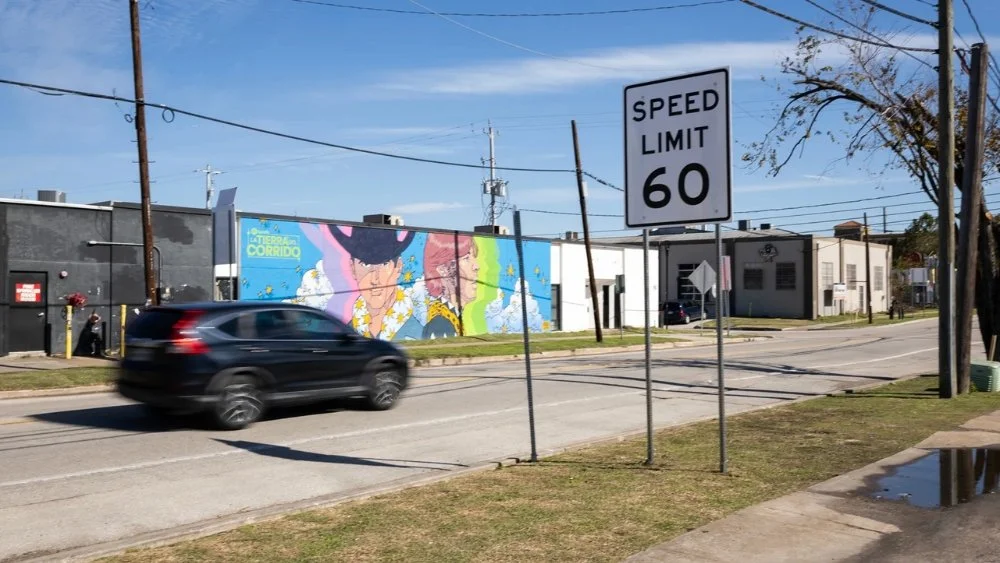
A Strong Towns post asks, "What Does It Mean When a Prank 60 Mph Sign Goes Unnoticed?"


Face it, dear reader, that one is pretty well executed.  More commonly, somebody uses electrical tape to turn a 3 into an 8.

Strong Towns posts have long been confirming something that has bothered me for nearly forty years.
Eric Olson explains the phenomenon to readers of DeKalb's Daily Chronicle.
After driving long enough on a regular basis, people tend to develop a kind of intuition about what the speed limit should be in an area just by surveying how many lanes there are, what kind of pavement there is, how many stoplights there are, whether the road is in the country or in town.
What intrigues him is the proposal by Sycamore authorities to reduce the speed limit on a stretch of road that's signed for 45 yet winds around in such a way as to appear more safe at 40 or so.  What's more commonly the case in Illinois is roads that provide visual cues to go faster.  Such roads, which perhaps might better be described as stroads, have speed limits that appear to be too low.
So it proves to be, deep in the heart of Texas.
The challenge is real — set speed limits too low, and drivers ignore them. Set them too high, and pedestrians and cyclists are left vulnerable. A recent incident in Houston drives home the point that signs alone are not the solution.

As originally reported by Akhil Ganesh with Houston Landing, on a quiet stretch of Polk Street, a mysterious plastic sign appeared, raising the speed limit to 60 mph — double the actual limit. Drivers didn’t react. Most didn’t even seem to notice. It was business as usual, with cars moving at their usual pace. The city quickly replaced the sign, but the incident revealed a deeper truth: Signs don’t change behavior. Design does.

Street design dictates how fast people drive and how safe they feel. A wide, straight road invites speeding, regardless of the posted limit. Narrower lanes, tighter corners, and visual cues like trees and streetlights naturally slow traffic. Yet, many professionals remain stuck relying on ineffective signage instead of redesigning streets for safety.
At the risk of getting social-sciency, might that stretch of stroad be the one where people sneak a peek at their devices while transiting the relatively free space between traffic lights?

15.1.25

JUST A LITTLE BIT OUTSIDE.

Two years ago, a company called Freshpet might have hit a culture-wars nerve.  Apparently, when it comes to keeping the puppy chow fresh, it's beyond impolite to call attention.


Make of that what you will.

MARKETS ALLOCATE RISKS. GOVERNMENTS MASK THEM.

Michael Smerconish opened last Saturday's show with his assessment of the effect the latest round of Los Angeles fires might have on public attitudes toward climate change.  In doing so, though, he captured, precisely, the way in which government actions mask risk.  It would probably be too much to ask that a CNN talker get into the details of how that masking of risks misallocates resources.


About a minute and a half into his talk, he notes that insurance companies are updating their assessment of the risks of floods or fires, and changing premiums accordingly.  That's a phenomenon we've been noting for some time.  In July, 2023, Common Dreams regular Brett Wilkins sounded the alarm.  "Farmers Insurance Quits Covering Florida Property as Climate Crisis Worsens."  Several other insurers have stopped writing policies in Florida.  Common Dreams being Common Dreams, though, it's not the risk management that matters, it's that insurance companies hold a diverse portfolio of assets and insure a variety of properties.
Carly Fabian of the consumer rights group Public Citizen noted in a statement [last year] that "as Farmers Insurance exits Florida due to concerns over increasing risk from severe weather, the insurance industry continues to prop up the fossil fuel industry."

"Farmers has held significant investments in fossil fuel companies, and its parent company, Zurich, remains a top global insurer of oil and gas," she noted.//"Insurers pulling out of vulnerable markets continue to prioritize fossil fuels over homeowners and auto insurance policyholders, creating a crisis," Fabian continued. "This is reckless behavior by an industry that the public will be increasingly reliant on as the climate crisis intensifies."

"Regulators must push insurers to mitigate climate-related risks by reducing the industry's financing and insurance of the fossil fuel industry," she added. "Florida regulators and elected officials continue to stick their heads in the sand by criticizing financial firms who move away from fossil fuels."
That makes no sense. Would she rather that the insurance companies stopped insuring oil producers?

Mr Smerconish called attention to insurance companies no longer writing policies, or changing the terms of policies, in four states, namely Florida, Louisiana, North Carolina, and California.  Those changes preceded this summer's hurricanes.  San Jose Mercury-News reporter John Woolfolk filed a story in March of 2024.
As home insurers flee California, the state’s last-resort insurance plan is warning that it’s being pushed toward insolvency, forced to cover a rapidly growing number of properties that have lost traditional coverage and unable to collect enough in premiums to cover potential losses.

The number of homes and commercial properties in high-risk wildfire areas covered by the California FAIR Plan has more than doubled, from 154,000 in 2019 to 375,000, and liability exposure has ballooned from $50 billion in 2018 to $336 billion in February, its president told lawmakers at an insurance committee hearing last week.

“These are huge numbers,” California FAIR Plan President Victoria Roach told the committee. “And they continue to grow. … As those numbers climb, our financial stability comes more into question.”

Roach added that one bad wildfire or even a series of smaller fires could overwhelm the plan’s resources, forcing it to bill all the state’s insurers for liabilities it cannot cover, which they in turn would pass on to all their insured home and business customers as higher premiums.

“It’s a gamble,” Roach said. “We are one event away from a large assessment, there’s no other way to say it, because we don’t have a lot of money on hand, and we have a lot of exposure out there.”

The FAIR Plan’s financial instability has emerged as collateral damage from the state’s insurance market meltdown. Major carriers have discontinued or restricted coverage in recent years following a series of costly wildfires — 14 of California’s 20 most destructive wildfires burned the state in the last 10 years. That’s forced property owners who’ve lost coverage onto the FAIR Plan in rapidly growing numbers — with 1,000 applications now every work day.
And there, dear reader, is the first masking of the risks.  Mr Smerconish noted that Californian insurers do not have the freedom to raise rates; in his talk he suggested that Oklahomans were paying higher premiums in part to cover losses in California.  That's probably inaccurate: Oklahoma is tornado country, even in years when Hollywood is not making movies about storm chasers, and to the extent a changing environment changes the risk of tornadoes, wouldn't premiums in Oklahoma change to reflect that?

IS STAMP COLLECTING A HOBBY?

Free Press contributor Jack Baruth offers a provocative claim.  "Shopping Is Not a Legitimate Hobby."

There appears to be class conflict, or something related, structuring his essay.
The most notorious curators, especially in the male-centric interests of watches, firearms, and sports cars, are finance people, who are highly compensated but can’t make time for traditional, effort-intense hobbies. Curation can be done via the web while you attend a meeting or wait for an email. You need not leave your job to participate. When you do eventually get home, a simple picture of what you’ve bought will get you the requisite kudos on social media, at which point you can put the item in question away and get back to work.
Curating is a highfalutin' version of hoarding.
Curation is considerably simpler than most traditional hobbies. There might be 20 different skills involved in building a wooden cutting board, but curators need and, indeed, can only have but two: the ability to buy and the ability to choose. The former is measured in dollars, and it determines the scope of your curation. The latter is usually measured in the approval of others within the “hobby,” and it determines your curation’s makeup. You don’t need to actually use the things you buy—in many cases, this detracts from their resale value. Ownership is the ostensible point, and that exciting frisson of purchase is the hit that keeps the marks coming back for more.
The ownership he focuses on is stuff that people manufacture for the purpose of selling to speculators: mass-production wristwatches, Funko Pop dolls (don't ask) and possibly Lionel trains that the owners never take out of the box.  That might be different from collecting stamps or coins, although to the extent that mints coin (and extract considerable seigniorage therefrom) special mint-grade or proof coins whose purpose is solely to curate, er, collect, and possibly to show off, or to swap with other curators.
The most common nineteenth- and twentieth-century idea of “hobby” was as an activity with some room for creative effort, demonstrated physical mastery, or a combination of both. Woodworking, painting, acoustic guitar, Civil War reenactment—that sort of thing. One takes joy first in doing it at all, later in the accomplishment—or perhaps the hope—of doing it well. It’s possible to be bad at a hobby, which is not to say that one does not enjoy it still. Often the goal is to create something unique, or at least individualized.
Model railroaders, you all may now R-E-L-A-X.  The painting hobby of some last century person might become the curation project, to use the more restricted sense of the word, of contemporary art museum directors.

14.1.25

WERE THERE ROAD-RUNNER CUTS IN THE MEAT CHILLER?

Coyote found hiding in Humboldt Park Aldi’s refrigerated section.  This one did not take a tumble into the Grand Canyon.  "The coyote did not appear to be injured, but it was placed in the care of Flint Creek Wildlife. Their personnel will assess the coyote before releasing it back into the wild."  Meep! Meep!

CALIFORNIA BURNING.

In 1998, Mike "Ecology of Fear" Davis offered "The Case for Letting Malibu Burn."

Sometimes the easiest questions have the hardest answers, e.g. "Many of California’s native ecosystems evolved to burn. Modern fire suppression creates fuels that lead to catastrophic fires. So why do people insist on rebuilding in the firebelt?"

PERHAPS THERE IS LITTLE REASON TO PANIC.

We closed 2024 taking stock of the year's hurricane season.  Most of the North American action involved the North Atlantic.  "Then there was the curious matter of the Pacific hurricane season."  How curious?  "New Evidence Reveals 30 Year Global Drop in Hurricane Frequency and Power."

It is unfortunate, dear reader, that hurricanologists behave like shrieking sophomores triggered by inconvenient evidence.
Green Blob-funded cheerleader the Guardian chipped in with the obligatory “cyclones are getting worse because of the climate emergency”. Almost unnoticed, it seems, among all the Net Zero dooming and grooming was a science paper published during December by Nature that found no increase in the destructive power of cyclones – the generic term for typhoons and hurricanes – in any ocean basin over the last 30 years. In the South Indian basin, the location of cyclone Chido, there was a dramatic decrease in both frequency and duration in recent times.

Reality rarely gets much of a look-in these days when fanatical Net Zero activism is afoot, but the paper, written by a group of Chinese meteorologists, makes its case by considering the facts and the data. The scientists apply a “power dissipation index” (PDI) which they consider superior to single measure indicators since it combines storm intensity, duration and frequency.
Put another way, there are anomalies in any data set, and those ought to be studied properly.
The point of academic research, no matter how recondite, is to be a part, no matter how small, of that continual and fearless sifting and winnowing by which alone the TRUTH can be found. To participate means to accept the possibility that subsequent researchers will find improvements to, or suggest errors in, your research. (I recently had the opportunity to review a paper extending a result I published 25 years ago. People are that hard-up for topics?)
The dynamics of hurricane formation strike me as an area of study that will yield more than a few more than minimal publishable units, and that work has a better chance of being debated, extended, and evolving into a quasi-consensus if all involved shy away from the epistemic closure of the doomsday environmentalists.

HIGHER EDUCATION HAS LOST ITS WAY.

The house organ for all wokeness, all the time, with no sense of irony or embarrassment, calls for "Creating Space for Disagreement on Campus."

Um, that used to be the campus.
The late Richard "Underground Grammarian" Mitchell put it directly.  And that’s what a university is, if it is a university, and not a jumped-up trade school, or a conditioning station for docile citizens, or a pulpit of ideology. It is a place devoted to the study and preservation and nurture of whatever human wisdom can be found that pertains to everybody who lives, or has lived, or ever will live, on Earth."
Implicit in that "study and preservation and nurture" is, of necessity, a lot of disagreement.
Maybe, just maybe, it's time for the careerists who run the universities to rediscover their proper calling. "Faculty members who have been especially focused on defending their freedom of speech need to be paying more attention to the quality of it."  If the donors are shopping for favorable mentions in the curriculum, they're not that serious about the proper role of the university, are they?
That's where the public get a say.  Use your academic status to make a silly argument, on a non-private platform or wherever, brace yourself for the incoming. "We don't refute people like this. We mock them. And we pity the students in their classes."
And perhaps we pity the donors who labored under the impression that dispassionate inquiry was the way of the universities.
Never mind any of that, Inside Higher Ed's "Student Success Reporter," one Ashley Mowreader, who has written for The Thousand Oaks Acorn, is on the job, with a full reservoir of ideas.  "Forty-three percent of Student Voice survey respondents think a designated area on campus for civil dialogue would help with free expression."  Because their predecessors with their non-negotiable demands and calls for relevance served the academy so well, didn't they?

13.1.25

TRAINWATCHING TO BUILD MODELS BY.

The powered display track at Cold Spring Shops headquarters went into operation first, in part to provide a place for running-in motive power before installing remote control and placing it in service, and in part to provide train-watching while the work of assembling cars or building trackwork goes on.

I've compiled another series of various trains, not all of which are thematically proper for the main layout, going through their paces.


There are certainly a lot of things going on in the world to fret about.  Occasional winter relief is good.  Enjoy.

YOU'RE GOING TO NEED A MUCH BIGGER MAP.

Joe "View from North Central Idaho" overlays a map, calibrated to acreage, of the ongoing Los Angeles fires on Chicago.


Looks like everything east of Cicero and north of Cermak to about Grand would be gone, should such a fire catch on in a thickly settled city with lots of solid brick buildings.

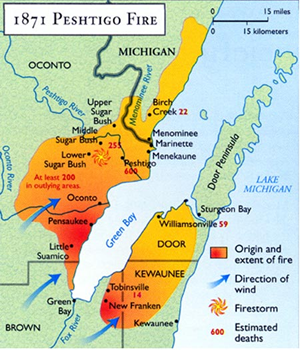
We observe Fire Prevention Week early in October because that famous Chicago fire occurred the same day as a much larger fire, one that claimed some 1,200 lives and consumed 1.2 to 1.5 million acres of woodlands.


And yes, researchers consider that to be one fire, which got started near Pensaukee and went downwind into Peshtigo as well as across one of the larger estuaries in the world into Southern Door County.
It had been an unusually dry summer, and the fire moved fast. Some survivors said it moved so fast it was "like a tornado."

The sudden, convulsive speed of the flames consumed available oxygen. Some trying to flee burst into flames.

It scorched 1.2 to 1.5 million acres, although it skipped over the waters of Green Bay to burn parts of Door and Kewaunee counties. The damage estimate was at $169 million, about the same as for the Chicago Fire.

The fire also burned 16 other towns, but the damage in Peshtigo was the worst. The city was gone in an hour. In Peshtigo alone, 800 lives were lost.

"What most researchers find so fascinating is the effect it (the Peshtigo Fire) had on people's lives. It was so horrific," Anderson said. "Some people thought it was the end of the world."

The fire produced countless stories of heroics and tragedy, which are collected at the research center, as well as the Peshtigo Fire Museum in downtown Peshtigo.

There's the story of a man carrying a woman to safety he thought was his wife. When he found out it wasn't her, he went crazy. People said the Peshtigo River was the only haven from the fire, and one 13 year-old German immigrant girl said she held onto the horn of a cow all night in the river to survive.
Purchasing power calculators work only back to 1913, where that $169M pencils out as $5.2B in losses.

In The History Channel's brief description of the Peshtigo Fire we read this.  "While the Wisconsin fire was overshadowed by the Chicago fire, it is still studied by forest managers and firefighters, who use it as an example of bad forestry practices and the power of unpredictable wildfires."

What went wrong in 1871 is as relevant today.
Peshtigo's logging industry was partially to blame for the disaster. In an era before responsible forest management practices, loggers simply stripped the land without regard for potential fire hazards they created. They dumped refuse from logging operations in large piles of tinder that became perfect fuel for the October 8 fire. And railroad operations cleared land using small fires, leaving piles of leftover wood behind them.

The town itself was a tinderbox waiting to ignite. Most of its structures were made of wood, as were its sidewalks. Even the streets were paved in wood chips.

Weather was the match that turned those dangerous conditions into an unprecedented fire. Smaller wildfires had raged in the area for days, but on the night of the 8th, winds whipped up and the flames reached Peshtigo.
The Los Angeles fires provide another opportunity to take stock of things Cold Spring Shops have long paid attention to.  Those posts are in preparation.  Let us be grateful the death toll in California is nowhere near what it was in timber country 150 years ago.

MEDIOCRITY IS A CHOICE.

A year ago, I asked, "Is it too much to ask that somebody make Northern Illinois basketball great, heck good, again?"

January began promisingly enough.  "The Northern Illinois University women's basketball team won its Mid-American Conference opener for the first time in six seasons Wednesday, hanging on for a 59-58 win over the Toledo Rockets at Savage Arena."  Toledo, breaking in a new head coach, had lengthy home winning streaks against all opponents and against conference opponents.

Then Ohio came to DeKalb.  Quoth the coach,  "We let Ohio get hot early from deep, and we talked a lot about not letting that happen."

Next, the local kids played at Akron.  Quoth the coach,  "The defensive intensity in the last five minutes was a lot better than the 35 minutes before.  It's a tough lesson but we needed to be better in the first 35 minutes to not let them get hot."

Then Western Michigan came to DeKalb.  Quoth the coach,  "You have to give Western Michigan credit. They were disruptive on the defensive end and we knew that coming in. There are some possessions we want back and, once we lost the lead, they did a great job of making things difficult."

It's not as if there wasn't a New Year resolution to be made.  Illinois-Chicago played in DeKalb during the non-conference season.  Quoth the coach, "Any time you have a one to two possession game you are going to look back at the consistency and the attention to detail at times.  There were a few times where we felt like we could have been better maximizing our lead and minimizing their stretches. I think we are trending in the right direction and getting better."

At best, that team is consistently inconsistent and consistently at the bottom of the conference standings.  Enough, academic performance notwithstanding.

10.1.25

TRADITION IS THE PRESERVATION OF FIRE.

Heritage Foundation president Kevin D. Roberts made a presentation, "Populist Conservatism and Constitutional Order," at Hillsdale College.  It is not the most orderly presentation of ideas, although its opening paragraphs suggest the ways in which the old values regime breaks down.
The top-down, elitist brand of politics that has dominated the United States since the end of the Cold War—under Republican and Democratic administrations alike—has failed. Yes, we are materially richer than we were in 1991, and our largest corporations are more profitable. But we are militarily and strategically weaker, fiscally endangered, and spiritually enervated. As a result, public trust in the vaunted institutions that our elites control—political, scientific, journalistic, educational, religious—has evaporated. And populism—especially on the conservative Right—is on the rise.

Although I will focus on the U.S., this rise of populism is widespread. From Argentina to Italy to France to the United Kingdom to Hungary, there are similarities. The new populism tends to be economically and politically nationalistic. It tends to be culturally patriotic and socially conservative. It tends to sympathize with workers over corporations. It is also self-consciously, defiantly—often mockingly—anti-establishment.

It is not a coincidence that so many of the West’s populist leaders—Javier Milei, Jair Bolsonaro, Viktor Orbán, Giorgia Meloni, and Donald Trump—have, shall we say, colorful personalities. Their political swagger may threaten elite politicians almost as much as their policy agendas do, because it punctures the bubble of credentialed, institutional authority that insulates elite power from public scrutiny.

With few exceptions, the Left as we know it today has rejected populism out of hand, embracing instead Big Government, Big Business, Big Banks, Big Tech, Big Pharma, Big Labor, Big Ag, Big Media, and Big Entertainment. For the most part, today’s Left is hard at work fortifying the power these institutions wield against the rigors of democratic accountability.

Thus the only hope for a sustainable, democratically legitimate populist reform movement today is on the Right. The question is whether the leaders of the movement can harness the highly negative energy from which the populism emerges and channel it toward a coherent, positive politics of national renewal and reform.
From time to time, that spectre of a new international movement emerges to let the ruling classes tremble, doesn't it?  It's not clear, though, that the establishment's rejection of the current populist currents is necessarily a movement of the left.  Pronoun protocols in the human resources departments and women in the corporate suite implementing the latest management fad do not strike me as the sort of thing to bring the proletariat to the barricades.

FRIDAY short TAKES.

Buckle up.  "There are a lot of tectonic plates shifting beneath our feet this year."

Pray this is the first.  "The crisis of democratic government then, is actually a crisis of progressive government. People seem to feel that they have been taxed, regulated, bossed around and intimidated by left-of-center politicians for decades — but the results are bad and have been getting worse."  I mean, when Our Intellectual Betters have lost Fareed Zakaria!  "On the other side, if Democrats do not learn some hard lessons from the poor governance in many blue cities and states, they will be seen as defending cultural elites, woke ideology and bloated, inefficient government. That might be a formula for permanent minority status."


Biden is a disgrace.  "Everyone in America should be grateful that this man will not serve a second term."  The thoughtless three-hour delay of the dignified transfer ceremony at Dover is simply emblematic of his reignGoodbye.  "Joseph Robinette Biden Jr. will still be the one-term president responsible for Donald Trump's return to the White House."

Practically?  "Practically every terrible idea eating away at America’s soul originated with some academician whose philosophy gelled while writing his PhD dissertation."

Jimmy Carter.  "How far have we declined when the president of the United States can't pay for coffee?"  R.I.P.

Buckwheat.  "She did not even lie well. Check out the blinking and the stuttering and stammering. She is not, and will never be, a smidgen good at her job."  Democrats are sort of cute when they’re out of power.


The weekly round-up of mostly pithy elaborations on traditional Cold Spring Shops themes resumes.

CAROLS IN THE SQUARE, TRADEOFFS EVERYWHERE.

Christmas and Hanukkah overlapped this year, which motivated Free Press contributor Eli Lake to meditate on "Why Jews Wrote Your Favorite Christmas Songs."

His opening paragraphs refer, directly, to the title of the post.
I love Christmas—the parties, the spirit of charity, the lights glowing on modest row houses, the tree at Rockefeller Center, even the schmaltzy movies. What I really love, though, is the music.

I am Jewish, so you won’t find me dragging a small Douglas fir into my living room. I will not attend midnight mass or keep an advent calendar. On Christmas Day, I eat wonton soup and sweet and sour chicken at a Chinese restaurant, as is my people’s tradition. But the music of the season is a balm and a bop. And it’s not only infectious; it’s secular.
What we understand as "caroling" got its name from the Medieval French custom of singing in public with musical accompaniment.  And longtime Christmas carol maven William Studwell, late of Northern Illinois University, would recognize the sacred and the secular alike in his "Carol of the Year" series.  "The complete list includes Adeste Fideles and Stille Nacht, as well as a few favorites of a less religious nature."

9.1.25

PROTECTING COMPETITORS DOES NOT PROTECT COMPETITION.

The Federal Trade Commission, in all its majesty, seems bent on resurrecting the structure-conduct-performance paradigm only with new actors.  Not too long ago, the Jarrett regency's appointees blocked a merger of Albertsons with Kroger, to the predictable hallelujahs from Common Dreams types.
Antitrust advocates on Tuesday welcomed a pair of court rulings against the proposed merger of grocery giants Kroger and Albertsons, which was challenged by Federal Trade Commission Chair Lina Khan and multiple state attorneys general.

"The FTC, along with our state partners, scored a major victory for the American people, successfully blocking Kroger's acquisition of Albertsons, "said Henry Liu, director of the commission's Bureau of Competition, in a statement. "This historic win protects millions of Americans across the country from higher prices for essential groceries—from milk, to bread, to eggs—ultimately allowing consumers to keep more money in their pockets."

"This victory has a direct, tangible impact on the lives of millions of Americans who shop at Kroger or Albertsons-owned grocery stores for their everyday needs, whether that's a Fry's in Arizona, a Vons in Southern California, or a Jewel-Osco in Illinois," he added. "This is also a victory for thousands of hardworking union employees, protecting their hard-earned paychecks by ensuring Kroger and Albertsons continue to compete for workers through higher wages, better benefits, and improved working conditions."
I'm not sure which price scissors are at work in order that Kroger and Albertsons simultaneously compete wages up and grocery prices down.  The genealogy of Albertsons suggests things might not be that easy.  Direct your attention, dear reader, to that "Vons in Southern California."  Years ago, Vons attempted a merger with another Southern California grocer called Shopping Bag.
In the 1950s, competition in the Los Angeles grocery market intensified. Small grocers were acquired by large companies, and large companies greatly increased their numbers of stores in the city. From 1948 to 1958, for example, the number of stores owned by Von’s Grocery Co. (Von’s) (defendant) increased from 14 to 27. Shopping Bag Food Stores (Shopping Bag), which competed with Von’s, increased its number of stores from 15 to 34. Together, Von’s and Shopping Bag controlled 7.5 percent of the grocery market. In 1960 Von’s acquired Shopping Bag by purchasing all its stock and assets. The United States government (plaintiff) sued Von’s, alleging that its acquisition of Shopping Bag violated § 7 of the Clayton Act. The government argued that the acquisition was likely to worsen the trend of large grocers obtaining greater market share to the detriment of small grocers. The government sought a temporary restraining order, which the district court denied. Eventually, the district court held that the acquisition did not violate § 7 because there was not a reasonable probability that it would create a monopoly or substantially lessen competition. The United States Supreme Court granted certiorari.
I take issue with that "competition intensified" passage.  It changed in form, with sole proprietorship grocers served by Commission Row distributors or jobbers being replaced by vertically integrated grocery chains that organized their own logistics.  To the Supreme Court of the era, the disappearance of the sole proprietors and the combinations into chains were the substantial lessening of competition the authors of the Clayton Antitrust Act had in mind.
Held. The merger of two of the largest and most successful retail grocery companies in a market area characterized by a steady decline, before and after the merger, in the number of small grocery companies, combined with significant absorption of small firms by larger ones, is a violation of § 7 of the Clayton Act. Pp. 384 U. S. 274-279.

(a) By the enactment of the Celler-Kefauver amendment to § 7 in 1950, Congress sought to preserve competition among small businesses by halting a trend toward concentration in its incipiency, and, thus, the courts must be alert to protect competition against increasing concentration through mergers especially where concentration is gaining momentum in the market. Pp. 384 U. S. 276-277.

(b) This case presents the precise situation which Congress intended to proscribe, where two powerful companies merge to become more powerful in a market exhibiting a marked trend toward concentration. Pp. 384 U. S. 277-278.

(c) Section 7 requires not only an appraisal of the immediate impact of the merger on competition, but a prediction of the merger's effect on competitive conditions in the future, to prevent the destruction of competition. United States v. Philadelphia Nat. Bank, 374 U. S. 321, 374 U. S. 362. P. 384 U. S. 278

(d) Since the appellees were on notice of the antitrust charge, the judgment is reversed, and the District Court is directed to order divestiture without delay. P. 384 U. S. 279.

233 F. Supp. 976, reversed.

Page 384 U. S. 271
Forty or so years ago, economists, particularly those of the creative-destruction-competition-is-discovery school scorned the Court's analysis as missing, completely, the irrelevance of those sole proprietor groceries to the real action, which was the emerging supermarket chains.  Where Vons and Shopping Bag were relatively minor players compared with Safeway.  And yes, a previous generation of structure-conduct-performance economists raised precisely the same objections to Safeway that they raise today about Wal-Mart.
[Once upon a time] there was a middle-class-friendly economy in which large manufacturing firms produced goods in unionized factories. Wal-Mart is the leading edge of a proletarianized economy in which large retailers squeeze those manufacturers while doing everything possible to drive down wages. Tapped's Ezra Klein spells out those behaviors in more detail.

Perhaps I'm showing my age, but at one time the populist political economy saw those large manufacturing firms as building blocks of a monopoly capitalism that practiced conscious parallelism, which reduced efficiency by restricting output and raising prices, and the unions as accomplice residual claimants to the monopoly profits thereby obtained. The retailers of the era were complicit in that monopoly capitalism, with a concentrated food packing industry and often vertically integrated supermarkets profiting by the inflated price of bread, although, again, food and commercial workers' unions participated as residual claimants. Because firms could practice conscious parallelism without calendars to keep track of the phases of the moon or meetings in the back room at Dirty Helen's, antitrust action could do nothing about the resulting inefficiencies, although Wal-Mart could.

But when Wal-Mart goes after those inefficiencies, that's bad. Mr Klein summarizes in a few sentences what several chapters of the book spell out in more detail.
What's funny about the case at hand today is what happened to yesteryear's Wal-Mart.  Safeway are (checks notes) an Albertson affiliate, part of one of those vertically integrated grocery chains I alluded to at the start of this post.  "We support our stores with 22 distribution centers and 19 manufacturing plants."

8.1.25

THE DEMOCRATS SAY FAREWELL TO A PRESIDENT.

It has been over fifty years since the Democrats last buried a president, Harry Truman in the early 1970s.

The recently deceased President Carter served as a foil for Ronald Reagan during his Capitol ceremony, and the eulogies for the elder President Bush combined Cold War triumphalism with some affirmation of the so-called rules-based international order.