It could take days before the first piece of the massive wreckage is cut and lifted out of the way, according to Scott Spellmon, commanding general of the US Army Corps of Engineers. More than 1,000 engineers in Baltimore and across the country are studying the wreckage piece-by-piece to figure out the best plan to remove the wreckage.It's apparently all hands if you own floating cranes right now. The first order of business is to get the navigation channel open.
“I believe it will be several more days of this type of analysis before we can start cutting and lifting members,” Spellmon told CNN. “There is a massive steel truss bridge going across that channel and at the bottom, 50 feet down, there are possibly some containers and other heavy debris that we have to get off the floor.”
He added it could take weeks for the channel to reopen. “I don’t think we’re talking days, I don’t think we’re talking months … I think we’re talking weeks,” he said. “I just can’t put a number on it yet until we get our analysis complete.”
Demolition workers may be able to clear a channel large enough for ships to pass through as soon as a month after the required equipment arrives at the scene, according to an expert in the field familiar with ongoing discussions.Sometimes, expediting the movement means getting the jackasses out of the way.
The expert, who spoke to CNN on condition that his name not be used, said it will likely take longer than that to remove all the debris. But clearing the 1,200-foot area between the two pillars that supported the bridge’s main span will be enough to reopen the port to traffic.
Over 2,400 feet of boom has also been deployed to contain any potential pollution leaks from the ship, Moore said.
National Transportation Safety Board investigators have said 56 containers on the vessel contain hazardous material, mostly corrosives and flammables, as well as some lithium-ion batteries.
The Army Corps will cover the full cost of clearing the channel where the bridge collapsed.
The United States still considering itself at peace, and being governed by unserious people, these days the jackasses walk upright and bray in English.
Federal transportation officials will provide the $60 million requested by Moore as a “down payment” toward clearing and rebuilding the Key Bridge, the governor said. The funds will go toward removing debris, rerouting traffic and ultimately rebuilding the bridge.We're talking about a toll bridge, the ship owner carries insurance, and the lawyers and process-worshippers will get to wet their beaks.
Maryland can request additional funding later, and the state’s congressional delegation said they would press fellow lawmakers to fund the rebuilding project.
President Biden vowed Tuesday that the federal government would cover the massive cost of rebuilding the Francis Scott Key Bridge, a major artery feeding the Port of Baltimore, one of the busiest shipping lanes in the country. The bridge was struck by a cargo ship, almost 1,000 feet long, that lost power as it was leaving Baltimore Harbor and drifted into a support pile in the early hours of Tuesday morning.In the wrangling, perhaps we see why Congress enjoys those government-shutdown-continuing-resolution follies.
Biden’s proposal is already winning praise from a number of Democrats, especially those in Maryland, who say the port’s value transcends the state, making the repairs an issue of national importance.
Only the federal government, they argue, has the resources to accomplish the task.
Yet the idea has sparked an immediate backlash from conservative spending hawks, who are already up in arms over Congress’s recent approval of a massive 2024 spending package and maintain that Washington simply can’t afford to pile more money onto the national debt.
Key Bridge, they argue, is a regional matter to be tackled by regional governments.
Republicans are not the only critics. Some liberals are also questioning Biden’s proposal, arguing that the blame for the tragedy lies, at least in part, with the owner of the cargo vessel, which should bear some portion of the repair costs.In that final paragraph, note a bundle of policies that have non-intersecting, noisy cheering sections. None of them can survive an up-or-down vote. "Bipartisanship" means assembling a crap sandwich with just enough sprinkles to satisfy each cheering section. An earmark for Baltimore's Key Bridge is one more sprinkle.
“Let’s be clear about the tragedy in Baltimore. That bridge didn’t just collapse. There was no earthquake. The bridge was knocked down (apparently) by a private ship that lost control. Shouldn’t they be at least partly responsible for fixing it?” said Jamal Simmons, a Democratic strategist and Vice President Harris’s former communications director.
Treasury Secretary Janet Yellen said Wednesday on MSNBC that she expected insurance payments to cover part of the cost to rebuild the bridge.
The debate is sure to get only more spirited after Congress returns to Washington in mid-April following the long holiday break; party leaders will already be grappling with a number of radioactive issues, including an extension of the government’s domestic spying authority and military aid for Ukraine and Israel.
Given the certain resistance from the right, some Democrats are already voicing concerns that approving a federal fix will be a heavy lift in Congress, not least because Maryland is a relatively blue state, dominated by Democrats, which could sap the GOP appetite for the emergency funds.I remember a concept called "mitigating your damages" that might apply here: you
With that in mind, some lawmakers are already floating the idea of attaching the bridge funding to a foreign aid package, including new military help for Ukraine, which Speaker Mike Johnson (R-La.) is vowing to take up when Congress returns to Washington in mid-April after the long holiday recess.
“It could certainly be piled on, and if we’re going to move the national security supplemental, why not do that?” Rep. Jim Himes (D-Conn.) said Wednesday by phone. “I don’t think that that has a lot of political sway. There’s not a lot of Republican senators from Maryland, so I would certainly not object.
“Sadly, it’s hard to get anything done. So if we need to get the bridge rebuilt, which we do, why not put it as part of the larger supplemental?”
As the debate evolves, some surprise voices have emerged in support of a federal fix.
Rep. Tim Burchett (R-Tenn.), a spending hawk who hammered GOP leaders over 2024 funding, noted that the federal government should step in because an interstate highway — which is maintained by the U.S. Department of Transportation — was destroyed.
Burchett also argued that Washington has a vested interest in rebuilding the bridge given the importance of the port to national commerce and international trade. Any legal fights with the shipping company, he added, can take place afterward.
“My first inclination would be to — yes, that the federal government would pay for it and then they’d collect on the insurance,” he said. “Commerce would suffer ‘till we get our act together.”
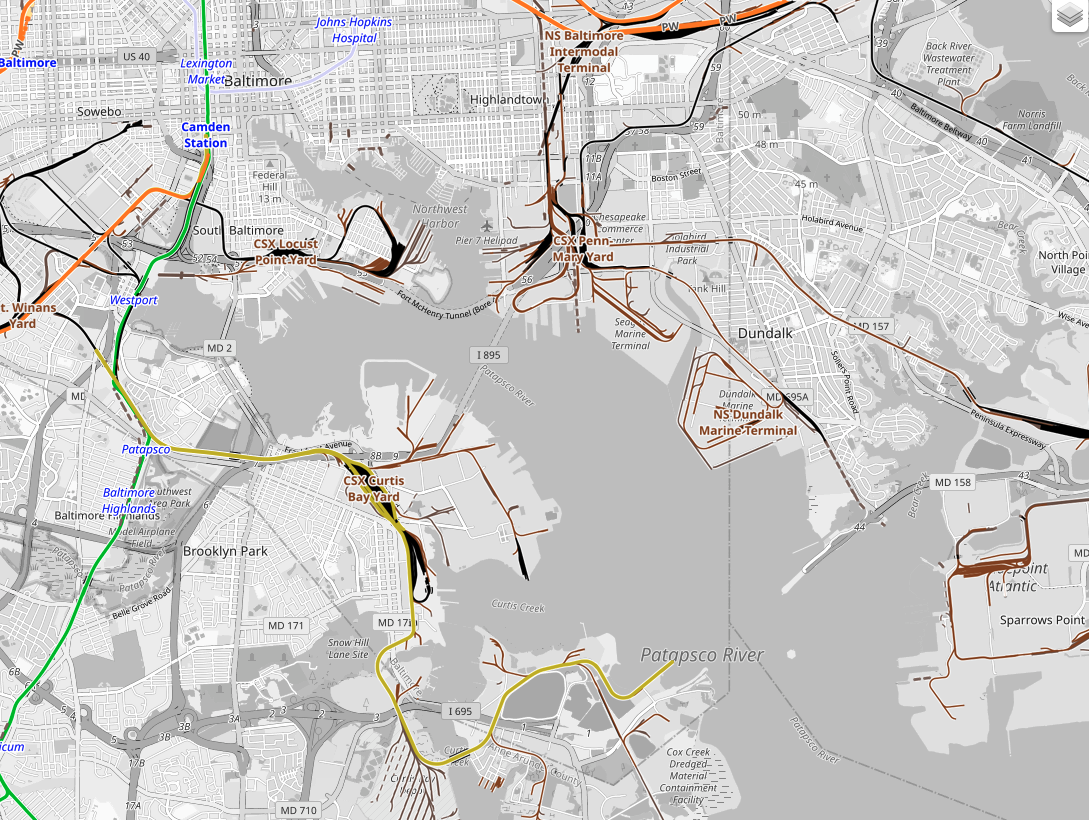
Meanwhile, the goods have to keep moving. The Port of Baltimore includes four distinct harbor facilities, the former Baltimore and Ohio coal pier at Curtis Bay; the Seagirt container terminal with a transfer facility; the Fairfield automobile terminal, where the bulk of imported cars for the east coast come ashore; and the Dundalk Marine Terminal for general cargo. Ships currently in the harbor cannot leave; ships outside can sail elsewhere, if they are able to off-load there, and truckers and railroads are able to redirect consignments to other ports, and perhaps to transfer goods and containers currently awaiting shipment from Baltimore to those ports.

Baltimore harbor and railroad map retrieved from Trains.
Trains contributor Bill Stephens sought comment from local railroaders, who, unlike their political counterparts, are serious people.
“This is a major disaster and will create significant problems on the U.S. East Coast for U.S. importers and exporters,” says Lars Jensen, a maritime trade expert.Norfolk Southern's response is similar. In the past forty years, the railroads have removed many of their secondary main lines, a few of which might come in handy, particularly for CSX seeking to reroute export coal shipments to Newport News rather than Baltimore.
“The bridge collapse will mean that for the time being it will not be possible to get to the container terminals — or a range of the other port terminals — in Baltimore,” he says. “In 2023 the terminals handled 1.1 million TEU. This is some 21,000 TEU per week which now has to be routed through other ports in the region.”
TEU, or twenty-foot equivalent units, is the common measure of international containers. Baltimore’s container volume is dwarfed by the Ports of New York and New Jersey, as well as the Port of Virginia. In the fourth quarter, for example, Baltimore handled 265,000 TEU compared to 2 million at New York/New Jersey and 850,000 at Norfolk, Va.
“Should the Baltimore cargo be spread solely on the two nearest major container ports, NY/NJ and Norfolk, this would result in a throughput increase for those ports of just under 10%,” Jensen says. “The perhaps more critical question is to which degree truck and rail infrastructure can rapidly absorb such a 10% increase.”
CSX told customers to expect delays in the wake of the bridge collapse. “While freight traffic has not been entirely halted in the region, certain commodities have been affected by the incident. CSX is actively communicating with customers to provide updates on their shipment statuses as the situation evolves,” the railroad said in a statement.
CSX said it has the capacity to dispatch additional trains to CSX-served coal terminals in Baltimore. “Contingency plans are being implemented and CSX is in contact with existing coal customers through these terminals,” the railroad said. “The company currently intends to keep its Curtis Bay Coal Pier facility operational but will continue to assess the circumstances to determine appropriate actions moving forward.”
All international intermodal shipments destined for Baltimore have been suspended, CSX said: “The CSX team is working with International customers to identify alternative solutions to support cargo movement to and from Baltimore. It’s important to note that domestic intermodal traffic on CSX destined for local Baltimore remains unaffected.”




No comments:
Post a Comment