19.5.05

BY THE SHORES OF GITCHEE GUMEE Via Sykes Writes, a Michael Hunt column on the follies of renaming the Marquette Not-Yet-The-Golden Porcupines without giving offense.

Up at the Lac du Flambeau Public School, on the Lac du Flambeau reservation in the northern part of the state, the athletic teams go by the nickname Warriors. The logo is a profile of a Chippewa Indian.

The school district is virtually all Native American, including the Ojibwa tribe. There is an academic and values achievement program called the Warrior Challenge. It's about prideful self-determination.

Right. No pseudo-nostalgia by Rich White Guys here, which casts a shadow on the logic of the rest of the column.
Maybe the sight of Chief Osceola riding a horse onto midfield and planting a burning spear into the ground before Florida State Seminoles football games is offensive to some. FSU has assured the NCAA that it has the full support of the Seminole tribe; even if that were not the case, the NCAA must allow Florida State and others - Illinois and the halftime-dancing Chief Illiniwek come to mind - to determine their identities without Big Brotherism run amok. Schools should have the right to appear silly or dignified, insulting or representative, all by themselves.
On the other hand, perhaps the entire college sports enterprise is silly and insulting, not to mention money-losing.

Marquette was way ahead of the sensitivity curve all on its own.

It dropped the offensive Willie Wampum character without being prodded. Hank Raymonds personally asked the state's 11 tribes years ago whether they considered the use of Warriors to be insensitive (none did). Thing is, Marquette's athletic teams are currently nameless and its people are embarrassed because the school had the freedom to make a divisive, unilateral decision without NCAA intervention.

So did Wisconsin when it adopted a hypocritical and meaningless policy on
nicknames. The Badgers will not play a school with a Native American nickname unless it is already in the conference, such as Illinois of the Big Ten and the North Dakota Fighting Sioux of the Western Collegiate Hockey Association. Bowl games (the Badgers played the Utah Utes in the 1996 Copper Bowl) are also exempt. But hey, outside of necessity and money, no go.

Even at that, the Badgers and the No-Longer-The-Warriors are a drain of resources. Even with indentured servant labor.
Besides, the NCAA has more pressing matters, like explaining why a kid who makes it millions can't have pizza money.
Perhaps the time has come to end the amateur sports sham.
A SOCIAL SECURITY ROUNDUP. This one is nailed to Newmark's Door.
JUST SUCK IT UP. Professor Munger offers some additional thoughts on getting published.
Any moron can write stuff and get it published. Many do. It may not be good, but at most universities that doesn't matter at all. The old saying is that "Deans can count, but they can't read." There are quite a few "major" universities that have social science departments that just attach weights by journal quality and pages published to figure out raises. But the modal number of citations of articles in Web of Science? 0, bagel, bupkes, nada. Publishing stuff just takes patience and hard, focused work. You just have to face the terrors of the blinking cursor, instead of eating muffins and reading the NYTimes on the pretext you have to stay informed.
What does this say about the value-added of research? Steak 'n Shake advises, "In Sight, It Must Be Right." Can observers of the academy make the same inference? "Professor Throckmorton (thanks, John) is the author of fifty articles in Rivista Internazionale Numere Due di Bovini." Patience and focus? Perhaps. But the same thing can be said about one-theme Usenet trolls. Is Professor Throckmorton a better teacher, or a better colleague, or makes better contributions to promotion boards? Or did the Pines of the Janiculum give it up in vain?

And what about the top journals?
If anything, they publish more junky, narrow schlock than ever before. If you talk to journal editors, they say they would love to get more good papers, even the kind of papers they expected routinely 5 years ago. It is just as likely, or even more likely, for a GOOD paper to get published now as it was 20 years ago. (b) relatedly, the papers sent out for review by junior people today are shockingly, apocalyptically bad. No attempt at lit reviews, worthless narrow data sets, cases selected on the dependent variable, no model of any kind, the wrong method. As grad students, everyone gets patted on the head for the sake of building self-esteem, and then when you have to go out into the big bad world people are MEAN to you. Boo hoo. I get papers to review that wouldn't get a B in one of my undergrad classes. My reaction is not friendly.
I go to the linked ruminations and concur in part and dissent in part.

One way to fail is to study something until you understand it, but then drift to something else without writing it up. This happens all the time: a scholar teaches him/herself until some learning (type #3) has actually taken place, but the "write it and publish it" (type #4) never happens.

The other way to fail is less excruciating to watch, but more painful to read. Since we put so much emphasis on publishing, lots of young people start writing about a subject before they have learned much about it. Learning #3 MUST precede #4. But I often get papers to review for journals where it is clear that the author needs to go think about the subject for a few months, and learn the stuff himself.

But there is a tradeoff between completeness and speed, and three-year reviews often place a great premium on getting things out quickly. (Nothing new there, by the way: one cynical graduate student who finished about the same time that I did wanted to get as many things into Bovini as quickly as he could: there is something to be said for trading a little quantity for a lot of quality.)

I did like this point.
(a) If you have five papers you have presented at conferences, but have not yet sent to journals, you ought to just abandon pretence and buy an inflatable doll. All you are doing is pleasuring yourself. You ain't working. Finishing is work. Starting a paper and having dinner with friends at conferences is fun, but not work. I specifically look at the ratio of conference papers to published papers on c.v.s I receive for junior people when we have a position. If the ratio is >3/1, I put them in the reject pile. In academics, like in every sport, finishing is what matters, and finishing is what so many people, even smart people, cannot do.
Summer resolution: finish some of the current conference papers and ship them out. Go in the basement, and finish some of the unbuilt kits before opening any new ones. (I have the same problem as a model railroader that I do as an economist, in that it is sometimes more fun to start a new project than to grapple with the hard bits of an ongoing one. Deirdre McCloskey is right: sneak up on the unfinished project, apply rump to seat and pencil to paper -- hopelessly reactionary, I admit, but the tech types know the corollary -- and get it done. This site will be a bit less active over the next few months accordingly.)

The rest of the advice to beginning academics is sound. I would add only this: competing in the profession might be more important than competing to satisfy the local campus politicians. There is a nasty principal-agent problem in there somewhere, but I did resolve to finish the irreversible investment papers and the immigration policy papers first.
NO GOING OVER TO THE LEFT SIDE. From The American Mind comes news of a Star Wars Photoshop Contest. The Superintendent's favorite is from Llama Butchers.


This wall down tear!

18.5.05

LOSING THAT INSTITUTIONAL MEMORY. Two colleagues at Big Ten universities that have not scheduled a football game with Northern Illinois post some thoughts about external referees for promotion.

Last year an administrator at one of our institutions pushed his glasses down his nose, looked wisely over them, and asked “Is Penn State really a peer institution?” A department at another college had to reject the possibility of using a letter from an internationally renowned sociologist at Louisiana State University because the university was considered no match for his own. Then of course there are the apples and oranges matches: How do you compare a small, distinguished liberal arts college to a megauniversity?

Our own universities are hardly unique in employing such practices. Precisely because they are so common across the academy, the time has come for a national meditation on the procedures commonly associated with promotion and tenure. We begin with letters of recommendation because they are one of the more conspicuous and egregious components of a system in dire need of an overhaul. That’s what we want to advocate here: a reform of the practices associated with awarding tenure and promotion to younger faculty and an equally serious reform of the procedures employed in promoting tenured associate professors to the rank of professor.

The referees are not really the problem. It's what the internal college committees do with the referee reports that is the problem.
In some ways the rampant insanity of the process is even more striking in the latter case, where a lifetime employee is implicitly told: “You’ve done a great job, and we want to promote you. But over the next year we want you to assemble a lengthy dossier about yourself while we seek out poorly paid — or unpaid — experts to prove to us that you’re worth it. Meanwhile, we may raise unpredictable and demeaning doubts about your qualifications. After we’ve finished with a ritual that makes fraternity hazing seem compassionate by comparison,we’ll let you know if you’ve met the grade.”
Maybe there's treasure buried on Mt. Hollywood. An anecdote does not a trend make, but pettifogging obstructionists are out there, if this example from my neighbors generalizes.

After berating the philosophy department head for even proposing the promotion, the college committee voted against promotion. An appeals committee reacted in obvious anger, urging that the dean write a strong letter endorsing the promotion. Another committee is now reviewing the decision.

Why did the college executive committee act with such cruelty and irrationality? Why humiliate a faculty member who already has tenure? Why chip away at a case in which the faculty member has met all objective criteria?

Why, indeed?
The answer may have come from a dean at Indiana, who remarked recently that wholesale retirements over the last few years have made it impossible to appoint a competent college committee. There just aren’t enough sane senior faculty members available to make up a committee with a sense of institutional history, a rational sense of fairness and an in-depth knowledge of campus standards. It is hard to rely on a college executive composed of three chimpanzees, a scorpion, a pit viper, and a coma patient.
Keep this in mind the next time you're tempted to call the Superintendent acerbic. The down side of downsizing in the corporate sphere is a loss of institutional memory; as universities are themselves institutions with institutional memory, the obvious generalization makes sense.
Meanwhile, they are egged on by empty demands from provosts and chancellors to ratchet up “standards.” At some point ratcheting up the standards for outside letters merely means institutionalizing paranoia. For many years we have argued that the scholarly achievements and status of the individual referee should be the basis of comparison. No sale.
But it might make it easier for the same administrators to pull tenure track lines as a way of obtaining greater flexibility with cheap and contingent appointments. Never mind that tenure trackers will see through the plan and adjust their efforts accordingly.

The essay considers a number of reforms to the internal promotion boards and to the responsibilities of external reviewers. The Fundamental Theorem of Economics even surfaces.

External reviewers who are expected to read a substantial amount of work and write detailed letters of evaluation should be compensated financially, as the Modern Language Association recommends. At present, humanities reviewers read much and write detailed letters. Scientists read much less and often write a perfunctory paragraph or two of confirmation.

Our own departments pay about a $100 for an evaluation — far better than not paying, which is unfortunately the option most colleges choose, but still far less than adequate. The University of Minnesota pays $300 and makes it clear that it expects a thorough, detailed report. The University of Notre Dame provides $200 and expects the same.

Chump change, to be sure, but the accomplished professors at peer or better institutions likely have multiple requests for reviews, because everybody within the discipline knows who the accomplished professors are.

There is a bull session in progress.
TELLING TALES OUT OF SCHOOL. The Phantom Professor's escapades have received attention elsewhere around the internet, including some observations not usually on the wheel report that might be of interest. Steven D. Krause summarizes the difficulties with attempting to secretly call attention to unpleasant things.
I've written in my blog many times before about how I just don't get the whole anonymous blogging thing; if you're curious, see here, here, and here. I perfectly understand the concept of wanting to complain about things, about venting, about even "whistle-blowing." I just don't think that the blogosphere, which reaches potentially anyone with an internet connection, is a particularly good place to publish these sorts of writings. Among other things, as is (apparently) the case here with the Phantom Prof, it is entirely possible that your secret identity isn't so secret after all, and then the reason for creating a secret identity in the first place collapses around you like a house of cards.
Locating the line between letting the sun shine in and taking gratuitous swipes is a bit of an art form. In an earlier post, Professor Krause frames it this way.

As I have mentioned before, I keep both this official blog (where I post things about academia) and an unofficial blog (where I post things about the rest of my life), and I try to divide up what I post where accordingly. I don't think much about job security based on what I post in either place because of issues and traditions of "academic freedom" and tenure and because EMU is pretty mellow about these things.

However, that doesn't mean I should or do say anything. I don't make overtly negative comments about my students or colleagues, for example, not because there's nothing bad to say (nothing is perfect, right?) but because that strikes me as both incredibly unprofessional and, well, dumb. About the only thing I've really vocally and negatively critiqued about EMU is the whole President's House fiasco, but that was very much a topic in the public media/domain, and I was pretty confident that they weren't going to fire a tenured faculty member over complaining publicly about the house.

In any event, I suppose you could say that what I'm doing is exercising "self-censorship." But I prefer to think of it as "sense."

That post has some suggestions about the role of voice, or of exit, for people maintaining anonymous web-journals. One such anonymous journal offers a counter-point.
I think a lot of that academic conservatism and timidity comes from what would in other circumstances be laudable instincts: trying to be student-centered (not wanting to get sued by undergrads' parents; worrying about making students feel that the faculty judges them harshly), or wanting the university to have a congenial relationship with the wider public. But of course, on the other hand, there's that pesky ideal of intellectual truth and the ideal of intellectuals as thinkers and leaders--an ideal that admittedly leads to some of the grossest snobbery, neurosis, and hierarchical bullshit, but let's not throw the baby out with the bathwater.
(There is a lively bull session in progress.) That conservatism has nothing to do with a sudden infusion of libertarians in the English department; rather it is a conservation of the existing (and increasingly ineffective?) ways of doing things, despite the accumulating evidence that the existing ways are not working. That parenthetical brings up the notion yet again of social distance. Must. Post. On. That.

The most instructive observations come from Cranky Greg. First, some impressions of Phantom's university.
SMU is a rich kids school. All the kids drive BMW's, fancy SUV's, cute little convertibles and other vehicles that cost more than the average yearly income of the typical American worker. Daddy's credit card is usually the most important item in an SMU student's possession.
Then the truth about the administration's reaction.
Because they know that Prof. Liner's observations are true!
Yup. Sounds like the place has a marketing problem. (But then, is that not the case with the entire academic establishment, where binge drinking and the rabbit culture provide cause for Official Concern, although the Nash Equilibrium in professorial research strategies and student recreation is stable and the graduation rates meet Amtrak performance standards?)

17.5.05

STEVE COMMENTS ON STEVE AND STEVE. Book Review No. 13 is Levitt and Dubner's Freakonomics (details and weblog). The book does not meet my standard for a general interest economics book, which is, "Can I find enough good imponderables in it to use it as a supplemental book for a principles class?" Yet another Steve, Landsburg to be specific, wrote Armchair Economist years ago, and I'm still using it as such a book. (My introductory course is probably a bit thin on graphs and formulas, but people leave grasping opportunity costs and incentives, and the best get comparative advantage and arbitrage.) Freakonomics is a quick read; I was able to finish it during exam-proctoring time last week.

I concur with the objections raised by Paul at Electric Commentary and by Gordon at Conglomerate Blog, who raises a serious set of laymanlike objections to the chapter on parental performance, which is structured around a series of properties of parents that lead to better test scores of children.

The basis of that chapter is an empirical investigation of test scores based on the contents of the Early Childhood Longitudinal Study. (I will skip the slide with the title and co-authors' names, and the hard-to-read slide giving the means of 100 variables, and the even-harder-to-read slide with six columns of regression coefficients, a few of which have the proper sign and sufficiently many asterisks by it.) Let me focus on the description of the method, from p. 162.
Regression analysis is the tool that enables an economist to sort out these huge piles of data. It does so by artificially holding constant every variable except the two he wishes to focus on, and then showing how those two co-vary.
Provided a bunch of other technical stuff, some of which you can check, and some of which you must take on faith, is true, and provided the rounding error in the computer doesn't get the better of you. The real devil, however, is in that "holding constant."
In the case of the ECLS data, it might help to think of regression analysis as performing the following task: converting each of those twenty thousand schoolchildren into a sort of circuit board with an identical number of switches. Each switch represents a single category of the child's data: his first-grade math score, his third-grade math score, his first grade reading score, his third-grade reading score, his mother's education level, his father's income, the number of books in his home, the relative affluence of his neighborhood, and so on.
Yes, then there's this other unobservable switch called the "error term," which God, or Nature, or the shade of Karl Gauss throws, and that throw affects only the test score without affecting the affluence of the neighborhood or mother's education. Subject to that stipulation the following paragraph is accurate.
Now a researcher is able to tease some insights from this very complicated set of data. He can line up all the children who share many characteristics -- all the circuit boards that have their switches flipped the same direction -- and then pinpoint the single characteristic they don't share.
Why?
What we really want to do is measure two children who are alike in every way except one - in this case, the number of books in his home - and see if that one factor makes a difference in his school performance.
That's where the role of that unobservable switch begins to matter. Regression analysis does not require the researcher to find two children in all other respects alike with different family libraries. Rather, it provides estimates of the partial effects of neighborhood, mom's education, size of library, earned-run average of the local baseball team (or is that subsumed under "Nature's switch?") on test score. The usual term of art in applied economics is "controlling for" these phenomena, as Leavitt and Dubner explain on p. 164. Popular books don't like to use footnotes, but that's what this parenthetical is.
(To control for a variable is essentially to eliminate its influence, much as one golfer uses a handicap against another. In the case of an academic study such as the ECLS, a researcher might control for any number of disadvantages that one student might carry when measured against the average student.)
That all sounds very scientific, but in practice a researcher often "controls for" something by what I learned as "dummying it out." In Freakonomics speak, perhaps for one kid the switch called "Black" is flipped on, and for another, the switch called "Latino" is flipped on, and for some the switch called "Female" (and mislabelled "gender;" that's technically a "sex" proxy for something else, but the audience is the lay reader) is flipped; then for each kid there is a slide switch counting the books in the family's library. Under that specification, the partial effect of books on scores is the same irrespective of the kid's ancestry or gonads. Sometimes the researcher will set up a more complicated model, in which there is one slide switch for size of library and another slide switch for the size of library in a Black household and another slide switch for the size of library in a Latino household; that's called "interaction" and that becomes hazardous for two reasons. First, additional terms in the regression analysis use up degrees of freedom, which can be fatal to the project if there are more effects to estimate than there are observations to infer from, and which increases the standard error of the estimate, which can be fatal to sign and significance, and that's hard to get even on your six columns of specifications that worked best. Second, all statistical inference using a computer involves approximating rational numbers in base 10 (that's true even with exponential and logarithmic specifications; Mr. Spock had the right way to distract a computer years ago) with integers in binary or some other power of two, and more complicated switchboards such as my multiple-slide-switches create what we call "sparse" matrices with lots of zero values. The effect on the machinery is a combination of rounding problems and conditioning problems. Specification is thus a tradeoff of sufficient richness against economy of computing resources. It's possible to make inferences all the same, but it is not as easy as Levitt and Dubner make it sound. And to compare it to a golf handicap -- which is not that easy to work out -- is still to oversimplify. The Performance Handicap Racing Formula for bluewater keelboats is more like it. (Nuts to that stuff. In the Laser fleet, second place is first last; there's no time compensation for the prize committee to work out at the yacht club over Cuttys later.)

Thus endeth the technical rant.

There are a few goodies in the book.

A few days ago I alluded to the downward mobility of Ashley. That's from a chapter on parental accomplishments and children's names. California, apparently, tracks residency and parental education on birth certificates in such a way as to allow a researcher to stratify names by parental accomplishment. From 1990, Ashley is the fifth-most popular "middle-income white girl" name and the most common "low-income white girl" name. The new high end girl names are Alexandra, Lauren, Katherine, Madison, and Rachel. "Steve" is 10th best at signifying low-education parents, with mothers of "Steve" averaging 11.84 years of education; but in the endnotes, "Stephen" signifies some college, with mothers averaging 14.01 years of schooling.

Earlier today, I speculated that some participants in tenure tournaments might be opting out. That's informed speculation, based (loosely) on the investigation of sumo wrestling tournaments. In such tournaments, the grandmaster norm is eight wins out of fourteen matches. There are prizes for overall winners. Here is a hypothesis, from p. 41.
A final-day match between two 7-7 wrestlers isn't likely to be fixed, since both fighters badly need the victory. A wrestler with ten or more victories probably wouldn't throw a match either, since he has his own strong incentive to win.
But wrestlers with 7 wins (haven't made their norm) win about 75% of their matches with wrestlers with 8 or 9 wins (made norm, unlikely to win tournament) and tend to lose more than half the time in later matches with those same opponents when they are not competing for norms at the end of the tournament.

Might there be a corollary proposition for tenure-track faculty at institutions known for high rates of tenure denials?
THE GUNS ARE STILL LOADED. Publius Pundit, who posted a roundup of "protest babes" earlier this year, has a roundup of developments from Uzbekistan, where the bullets have been used in preference to the flowers. Winds of Change is also following the story, as is Gateway Pundit.
BACKWARDS THE SUPPLY CURVE BENDS. Tyler at Marginal Revolution turns up an estimate of the lost output from workers making the Star Wars premiere an excuse for a personal day. $627 million? Out of an economy with a daily output reckoned in tens of billions? Is that more costly than the basketball tournament, or the opening of deer season? Or, for that matter, the early Friday getaways during the summer months (your Superintendent was busy with deadlines and neglected to call attention to his first hearing of that traffic call, two weeks ago.)
NO HIPPIE COMMUNES TO SANCTION? Alan at The Torch discovers a new anathema at California-Berkeley.
Berkeley, where pot smoking was a basic civil right in the sixties, has banned drinking in the fraternities, turning its sights on demon rum in the hands of the wrong kinds of students. Berkeley: Be sure to wear some flowers in your hair, but watch out for Carrie Nation, Big Brother, and Big Sister. How would that have sounded during the Revolution? “Hey, Mario Savio and you kids from SDS, put down that beer or get busted!”
The university's statement is itself amusing.
"Throughout the school year, and especially in the last few weeks, we have seen an alarming increase in problems with alcohol abuse, hazing, fights and badly managed parties at all types of Greek organizations," said UC Berkeley Dean of Students Karen Kenney. "We need to address those issues to ensure student safety."
Right. Apparently double secret probation hasn't gone away yet. Is there any evidence that the incidence of fights and badly-managed parties is greater among the Greek-letter organizations, or, to reiterate, are some forms of diversity worthy only of marginalization?

RUNNING EXTRA. Closer to home, Greek-letter organizations have regained leave to serve adult beverages at what the article calls "third party venues," meaning commercial establishments that have liquor licenses. A ban on serving adult beverages at house parties remains in effect pending additional training.
FOURTH TURNING ALERT. Professor DeLong links to an American Prospect article (by two Cato guys -- see things turn!) suggesting U.S. preference for the current status of Taiwan might prove costly.
Clearly, the X factor for China is potential U.S. intervention. But China’s strategists think they may have the key to overcoming the United States: sinking a U.S. aircraft carrier. Chinese Major General Huang Bin explained the reasoning: “Once we decide to use force against Taiwan, we definitely will consider an intervention by the United States. The United States likes vain glory; if one of its aircraft carriers should be attacked and destroyed, people in the United States would begin to complain and quarrel loudly, and the U.S. president would find the going harder and harder.”
Prospect's libertarian guests would like to avoid war-war with jaw-jaw.
The prospect of potentially serious naval losses should elicit an open discussion in the United States about Washington’s Taiwan policy. Americans should begin asking themselves how high a cost they are willing to pay in order to provide for Taiwan’s independence. At this point, Taiwan’s political actions are making a confrontation more likely.
Professor DeLong suggests a different reading of history.
I would advise General Huang Bin and China's other military strategists to very carefully study the mistakes of Tojo Hideki and the history of the 1940s. Very carefully.
Spirited bull session in progress.
CLIMBING THE STAIRWAY TO VALHALLA. Rose at No Credentials returns from sabbatical.
"Stairway to Heaven," with its patchwork pagan motifs, stirred my twelve-year-old soul just as strongly as Siegmund's ode to his sister stirred my nineteen-year-old one...
There is a lesson, dear reader.

All of which makes me wonder if the vast amounts of attention today's crop of arts (especially literary) critics pay to the ideologies enmeshed in the works they study isn't, perhaps, a little misplaced. Alright, almost completely misplaced. Perhaps gorgeous art can put a few more rivets into someone's already-sealed-up ideology, but I think their thesis is that the ideology embedded in the music/literature/sheet-wrapped-building/whatever reproduces itself in the otherwise innocent heads of the audience. And I think that's flat wrong. It's not the ideology that's interesting: Ideology is relatively easy to isolate and describe. Ideology is a hitchhiker, a freeloader, a remora sticking gracelessly to the mysterious, dangerous shark of art.

Personally, I'm much more interested in the shark.

Sure. But as soon as you embark on a quest for symbolism, allegory, hidden meanings, what have you, won't ideology provide a template for organizing what you find?

Personally, I'll play the Ring -- although Bach and some Brahms goes better with math -- and scribble equations. (Granted, the CD player that comes with modern computers is great for doing the scribbling on Maple...) Work songs are good for working on the railroad.
QUOTE OF THE DAY: Professor Munger suggests that there might be more to difficulties getting tenure than academic politics and picky referees.

I'll never finish. When I finish this, I have to do something else. The advantage of being an academic is that you can schedule the 70 hours you work anytime you want during the week. But that doesn't change the time commitment, and that is what so few people see.

I keep hearing from junior people that it has gotten harder to publish, and that it is now harder to get tenure. Maybe...but I doubt it. As far as I can tell, the work habits of junior faculty is what has changed. People watch TV, play with their kids, do almost anything except sit in their office and work. The first couple of jobs I had, nearly everyone (but certainly the junior people) were all in their offices by 9:30 am....on SATURDAY. Having a shared work ethic, and time together, made a difference. Now, lots of senior people rarely use their offices except for office hours. So junior people don't get the sense of how hard, long, and often you have to work.

Break this down. First, the "the new people don't have the same commitment we did" is an old one. Let me quote Professor R. M. Neal of the University of Missouri School of Journalism.
Sometimes I've felt that way about my world -- wondered why today's young instructors aren't as fiery eager to work themselves to death as were the men of my generation when we were just starting.
High Green and the Bark Peelers (1950: 120.) Yes, it's an obscure reference but how many academicians did ethnography on late-steam railroads in those days? Second: has the dispensation changed? Between the family-leave laws and the increased labor-force participation of women, workers (whether in the academy or elsewhere) might be less ashamed to show that they have a life (is it hip to be a homebody?) Third: have the incentives changed? The tournament model suggests that disproportionately large prizes to the winners elicit more effort. But might those same tournaments discourage the mid-rank contestants from competing as hard? (Perhaps: details to come.) To the extent that the name universities have a reputation for tenuring few or no assistant professors, might the incentive be to learn what one can from the rich and famous, while preparing a dossier for eventual tenure at a mid-major? (That's a dangerous strategy, by the way: there are plenty of intense people at the mid-majors, some motivated by a desire to show the name universities up for not considering them.) Fourth: have the signals changed? I keep on getting memoranda from headquarters, many of them focused on ethics and doing political work on company time. (Political work on company time in Illinois??!?) Some of them note that each state employee has an obligation to be working 37 hrs 30 min per week. By that logic, I have given Northern Illinois 30 years already since August 15, 1986. If I wanted to be punctilious about measuring inputs, not outputs, in this way, I could justify not meeting any of the deadlines for timely submission of grades and other reports or not spending Friday (!) and Sunday afternoons at the office.

RUNNING EXTRA: Public Brewery has more observations on tap. Money quote:
Also, to the extent that junior faculty are not putting in the same number of hours, that trend may in many cases reflect the decline of "faculty wives," the increase in junior faculty members who are also mothers, and (maybe) the increasing involvement of male junior faculty members in childrearing. If those things are part of the explanation, then I think that the corresponding decline in hours-at-the-office is a good thing, not a bad thing. More generally, my perception is that academic departments are often not terribly family-friendly and that they should strive to be moreso. I don't have a child (yet), but I get the impression that it demands more than just playing.
There is a followup comment from Professor Munger.
BLUSHING. Foolish me. Stephen was right. Thank you. Now go read the rest of Mr Bruce's post. He's been discovering that some of the problems in the academy have been with us for a long time. Sample:
This guy was warned about [the dismal job market for PhDs in English] sometime around 1960? When colleges and universities were just staffing up for the baby-boomers? When everyone was scared of Khrushchev and Sputnik and thought we'd need lots more education to beat the Reds?
Ayup. I've been doing some reading on related topics and will take time during the summer research months to pass some of it along. Meanwhile climb Mt. Hollywood and stretch your mind.

13.5.05

CAN'T YOU HEAR THAT WHISTLE BLOWING? In time for exam week comes news of an adjunct faculty member at Southern Methodist (alma mater of Forrest Gregg, who left a Packer team that couldn't play to become head coach of a team coming off an NCAA death sentence, but I digress) whose contract was not renewed for reasons that are not clear (that, dear reader, is a characteristic of Hard America called "employment at will") although this Scott Jaschik post at Inside Higher Ed suggests her tell-all weblog is a contributing factor.

Phantom’s university was one where many adjuncts, like the author of the blog, felt invisible and ignored — not exactly an unusual quality.

But at SMU, at least some students and faculty members (and the university’s legal office) did become aware of the Phantom Professor and the many similarities between incidents at the Phantom’s campus and at SMU. And in SMU’s Department of Corporate Communications and Public Affairs, people recognized themselves and their colleagues. And word got around that the author was probably Elaine Liner, a popular writing instructor and a theater critic for a local alternative newspaper.

At about the same time this spring that people were guessing that Liner was the Phantom, she was being told that the university no longer needed her services after the spring semester. Liner and her many student fans think that SMU is punishing her for expressing pointed opinions about the university.

The administrators, as is the nature of political creatures everywhere, want to have it both ways.

University officials don’t see it that way. They won’t talk about the specific decision not to continue offering courses to Liner, who had taught at SMU since 2001, but they say it had nothing to do with the blog and that they didn’t know for sure that the author was Liner. But they acknowledge that they were worried about the blog.

Rita Kirk, the department chairwoman, says that she received complaints about the blog from students and parents, and that she consulted with university lawyers about what to do about it. Kirk describes herself as a strong First Amendment supporter, but she says she worries that the blog violated students’ privacy rights and upset some students. “People need to remember that words can hurt,” Kirk says.

The spin that follows, however, is priceless.
While Kirk declines to say why Liner wasn’t being asked back, she says that the department was trying to replace adjuncts with full-time professors. But she acknowledges that the department will still be using adjuncts and that it is not clear that a full-time professor will be picking up Liner’s writing courses.
The entire post is worth your attention, and there is a lively bull session going on there. The story has received attention elsewhere. At Critical Mass, the expertise in things literary combines with the recognition of the spin.

Liner is clearly playing the edge with her blog, which relies heavily on the transgressive quality of posts devoted to the sorts of things professional decorum dictates teachers avoid discussing in public--the private lives of their students and colleagues, the private opinions a teacher may harbor about either students or colleagues, the unsubstantiated stuff of the local rumor mill. That SMU decided her blog crossed the line is not particularly surprising.

SMU both does and does not admit to firing Liner for writing such a revealing -- and inevitably damning -- blog: Though administrators deny that the decision to renew Liner had anything to do with the blog, even going so far as to deny having ascertained that Liner was really the author of the blog, they also admit that they were deeply disturbed by the blog, that they had received complaints about it, and that they had gone so far as to consult lawyers about it. As an adjunct, Liner has no job security, and effectively does not enjoy even the semblance of academic freedom; SMU is free to choose not to continue to employ her, and it is free, too, not to offer her any explanation. As it happens, SMU administrators are offering an explanation that is patently unbelievable--they say they discontinued Liner because they want to begin replacing adjunct professors with full-time tenure-track professors, but they have no plans to assign Liner's course to someone on the tenure-track.

Blogs for Industry has also been following the story, with some careful thinking about the line between whistleblowing, which is defensible conduct, and gossip or innuendo, which is not ethical.

Do the rest of us gossip and make fun of our colleagues and students over Friday beers? Mea culpa. But as you might guess from what I wrote above, the default for serious matters discussed during office hours or in class is that it's confidential. The onus is not on the student to force a nondisclosure agreement on the prof. I think Liner violated that, especially since she did not take into account the fact that if her cover was blown (as it ultimately was), many of the students, including some who haven't graduated yet, could be either identified or misidentified from her posts.

By blogging this kind of material anonymously, Liner was also undermining the student/faculty relationships at SMU and possibly elsewhere. If students don't know which prof will be posting their emails all over the internet this seems to me to be likely to have a chilling effect on what students will email to their profs. Worse, Liner seems to have decided to encourage students to send her gossip that she can use for her blog/book. This seems like a pretty clear case of disrupting the operation of the employer. Liner should be free to be a muckraker about academia...just not from within the faculty.

King at SCSU Scholars also notes that sunlight ought to shine on the muckrakers as well.
There have been questions about authorship of this blog from time to time. I remind readers that I a) am tenured; b) a department chair; and c) quite willing to let you see my professional webspace.
Indeed. And I don't see any dishing on individual students who are having coping problems over there. The Phantom, on the other hand, seemed to thrive on that. Some of it is pretty standard stuff. Consider an excerpt from a pop-quiz on spelling, grammar, and general knowledge.
Most common answer to "What is a nonagenarian?" was "a person with no age." Funniest answer: "Someone too old to date."
OK, I've done that too, and editorialized (with somewhat higher hopes, and more than a few of the kids didn't let me down) on the results; and Milt Rosenberg has frequently mentioned on his radio show the outcome of one of his quizzes, where his favorite answer to "Who wrote Tosca?" is "Toscanini." So far, I'm as guilty. There's this observation, from the Phantom's recently-resurrected greatest hits page.

The title thing goes both ways. I remember a time when college teachers addressed students formally by their last names, as in "Do you have a question, Miss Farquhar?" and "That's an excellent observation, Mr. Fenster."

I liked the formality of that. It kept a certain level of decorum in the proceedings and it was way easier to tell one Ashley from another that way. But that was long ago, in the olden days when girls didn't show up for class with their bellybuttons exposed and boys didn't wear caps in class because their mommas had taught them it was rude and disrespectful.

Again, that's been a common theme around the Shops, where the Superintendent has long maintained that teachers and professors have contributed to their profession's loss of respect by giving up some of the social distance they used to maintain. (A sidelight: Northern Illinois does not object to professors putting a no hats rule in a course outline, along with sanctions for misuse of electronic shackles during class.) There will be more on the social distance topic in the upcoming week, when posting time ceases to be procrastinating from grading exams, some of which look quite good, and some of which might provoke the kind of whinge Phantom deals with here.

Yeah, toots, now that the semester is over, suddenly you have time to do some work? Darling, sweetie. Our business has concluded. Your grade is chiseled in stone. You made a B-minus. You deserved a C and I was feeling generous because you actually stopped by my office a few times to bring me a Starbucks nonfat latte and dish a little campus dirt. I reward that. It's good PR for students to make these little gestures occasionally. But extra credit after the fact? I owe you nothing beyond the 14 weeks we spent together in my classroom. By next week I will have forgotten your name. By next month I will have forgotten your face.

This is the tenth student from the fall term to protest his or her final grade. To paraphrase the immortal Mr. T, I pity the fools who hire these young idiots for jobs in the real world.

I've had some such thoughts many times (don't even think about the latte or the dishing) and I get the kind of emails that require a similar if more tactful and more firm response, but as those aren't comments on the contents of Cold Spring Shops, they're not fodder for posting. (There is plenty of more public news to hold forth on.) Likewise, this.

I'm a tough grader. I've written "This stinks" on student assignments. I tell students when I think they're B.S.'ing me or when I think they've gotten lazy. I push and prod to get them to work harder. I give them D's and F's when they deserve it. And when I do, I always tell them "It's not personal. It's about the work."And boy, do they NOT take it well. I've had young men and young women in my office sobbing over a grade or over a comment on a paper. They say, "I always got A's in high school!" And they run through every excuse, from ADD to eating disorders to writer's block (which I don't believe in, even for real writers).

I've had to learn how to criticize creatively so that I don't have to face the nervous breakdowns. And I blame parents for this. Trying so hard to be their children's pal, they forgot how to toughen them up for real-world criticism. Too many pats on the back for stupid stuff: "Way to stand at the plate, Travis!" "Good job finishing that sandwich, Ashley!" The kids don't know what it feels like to actually accomplish something worthy of praise.

Perhaps there are different challenges at a state-located mid-major. Our student affairs division did some research including a question in which the most popular choice of Northern Illinois students to complete "If I were a car, I would be ..." is "a beater." (This is likely a multiple-choice question.) The extremely upscale "Ashleys" (a name which is headed downscale; details to come) of Southern Methodist aren't that common around here (although your Superintendent wouldn't recognize a $1500 handbag if someone clouted him with one) and many of our students will take an education from comments ("this stinks" could be a bit over the top; it maps non-commutatively as "wrong" or "superficial" in my commenting style. But I'm an economist. Substance matters.)

These observations on the late-middle-age male professoriate are painfully accurate, however.
Cute male professors are in scant supply at this place. The men at this campus tend to be middle-aged (or older), rumpled, bald or getting that way, unfit and uncaring about their appearance. The youngish ones are a really squirrelly bunch. They prefer khaki Dockers -- a fashion faux pas no student would commit -- and every nerd's fave accessory, the pocket protector. The older ones, subscribing to that age-old wardrobe statement of college professors everywhere, scuff around, fall, winter and spring, in well-worn corduroys and saggy sweaters. They hide their weak chins behind scraggly beards. Their bifocals tend to be unfashionably framed and exceptionally smudgy.
Is it sailing season yet?
AT THE EXPRESS DESK. Ralph at Cliopatria has a collection of links involving the life of the mind. Electric Commentary has discovered that Darth Vader has a weblog.
SOMEONE'S BEEN BUSY. The Public Brewery, quartered along the No. 10 carline not far from the Oakland Station, has commented on the 2005 Pew Research Center Political Typology (which is worth a few minutes of your time to play with; in common with any survey it can be criticized for classifying on the basis of insufficient alternatives.) You'll also find (along with some Sprecher on tap?) links to other comments on the survey and the typology. Well worth your time.

I took the survey and am not too surprised with my classification, which remains classified information in order to make my job teaching policy classes a bit easier. I do not want students attempting to slant their answers in the hope of finding a more sympathetic reader (and note that such efforts are usually pretty self-evident and ineffective in any event.)
THE QUOTE OF THE DAY. An Advanced Placement Government teacher at an award-winning high school sees the lack of spelling ability even among the most able.
Some of my best students are spelling neanderthals. I have so many pet peeves about mistakes. Kids can't get straight spelling homophones such as "its" and "it's" or "they're, their" and "there." I see those mistakes all the time, and yes, I see them a lot on the Internet. Oh, there's another one that drives me up a tree. How come kids today never seem to learn that "a lot" is two words and there is no such creature as "alot"? I even see some kids who extrapolate that there must be such a word as "alittle." Perhaps in a hundred years there will be at the rate we're going. Here's another spelling rule that doesn't seem to be taught: y changes to i when you add an ending. So, I get papers full of mistakes such as "tryes" or "activityes." And these are mistakes from my AP students! I don't have time to teach grammar or spelling. I usually write a note in the margin and say something like "Ack! Please learn the difference between affect and effect before you graduate and enter college."
Yes. Please. We are going to begin docking for spelling, at least on research papers, and I might do so on exams.

Villainous Company, in a reference to Betsy's Page as well as to this, for which thanks, picks up the Fundamental Theorem of Economics (Incentives Matter, for those who will have to repeat a course).
Children are surprisingly rational decision-makers. Why then do we expect them to behave differently than adults? Presented with fluff in the classroom and no penalties for lack of performance, it contradicts everything we know about human nature to expect the majority of American students to value hard work and academic excellence.
And, in a perversion of the maxim, victory has a thousand fathers, there is plenty of responsibility for this outcome, which at Villainous Company becomes misplaced pride in accomplishment.
This problem did not originate with teachers. It is reinforced by an education culture that believes failure is unacceptable; not because the student has not tried hard enough, but because the system has somehow failed him. Parents don't make the process any easier: rather than insisting on a challenging curriculum they complain if their child has to work "too hard" or has too much homework. Teachers who try to hold the line are rarely supported by the administration.
That brings us back to the Fundamental Theorem.
Paradoxically, when we refuse to allow failure we devalue success and remove any disincentive for poor performance. To me, the most disturbing implication of today's poor test scores is that perhaps American students are just listening to what the adult world has told them about what matters in life.
(Or perhaps observing the university establishments spending on everything but improvements to classrooms and hiring additional tenure-track faculty?)

12.5.05

WHY NOT THE GOLDEN PORCUPINES? Take heart, Marquette students and faculty: while your trustees are preoccupied with coming up with an acceptable team name that is Not The Warriors (as Charlie Sykes notes, "we care what you think, but up to a point") they are not addressing their six-year graduation rate of about 76% of matriculants (that six year figure is still too much an Amtrak definition of "on time" for me) by hiring more advisors and calling for more assessment or otherwise avoiding providing faculty with the resources to do right by qualified students. And they are making themselves look foolish, even though nobody has made a case for the deck of cards.

One Marquette based (but not endorsed) site puts in a suggestion for the Jumping Jesuits (particularly after a bowl of Real Chili hot with beans?) or the restoration of the old Golden Avalanche. (With a St. Josaphat elsewhere in Milwaukee, and the glaciers well to the north neither of those names work really well.) Badger Blog Alliance proposes the Carebears. I'll stick with the porcupine.
IN ORDNUNG, GANZ ABGEFICKTE. The Great Zulauf Space Grab is under way, final exam week notwithstanding. What was that line about amateurs studying tactics, professionals studying logistics? There are two rather cranky elevators in this building. Professional movers cannot be lined up on extremely short notice. Colleagues offering summer courses will be expected to have some sort of office up and running to consult with students, but there are plans to repaint the offices and install new desks supposedly before the 2005-2006 regular semesters begin. But the vendor for the desks has not yet been identified.

Left to the reader as an exercise: are we observing the behavior of amateurs or of professionals?
TAUNTING? Two exams today, so I show up in jeans and an open-neck sailing team shirt. I don't have to perform ... your turn.

What does this tell me? In the first exam, the only people who had to take a trip to the loo were guys?

10.5.05

ON THE INTERCHANGE REPORT. Two new sources of Company Mail have come to the Superintendent's attention. At Ernie's 3D Pancakes is more on course evaluation and professorial performance, expanding on this post. The Public Brewery reports from Milwaukee that internet telephone directories are sometimes overtaken by events, and the Golden Chicken has fled the UWM campus (a metaphor, perhaps?) How things change ... the Superintendent was going to ask the Master Mechanic to send a few spare cars to the Oakland Station, but that is also no more.

9.5.05

WILL JACUZZI HIGH BE NEXT?

Survey: High school fails to engage students. Read it and weep.
A majority of high school students in the USA spend three hours or less a week preparing for classes yet still manage to get good grades, according to a study being released today by researchers who surveyed more than 90,000 high school students in 26 states.
Remember this? Keep that as context for what follows in the article.
The team at Indiana University in Bloomington calls the findings "troubling." The first large study to explore how engaged high school students are in their work, it adds to a growing body of evidence that many students are not challenged in the classroom.
Just 56% of students surveyed said they put a great deal of effort into schoolwork; only 43% said they work harder than they expected to. The study says 55% of students devote no more than three hours a week to class preparation, but 65% of these report getting A's or B's.
Hmm, learning the new college lack-of-try in high school.
Surprisingly, 18% of college-track seniors did not take a math course during their last year in high school. That could help explain why studies show that 22% of college students require remediation in math.

The Indiana study also found that 82% of students said they planned to enroll in some form of post-secondary education, and most said they expected to earn at least a bachelor's degree. But the study says "a substantial gap exists" between what students do in high school and what they will be expected to do in college.

Martha McCarthy, a senior professor at Indiana University who directs the research project, says the results should serve as "a wake-up call. There is a need for students to work harder and do more rigorous coursework" if they are going to be ready for college. Research has found that one-quarter of students in four-year colleges require substantial remedial work.
Yes, and it is not unknown for the universities to find virtue in adversity. I offer for your consideration a promotional poster from my own increasingly expense-preference-ridden university.

Want a better GPA???
Take a study strategies course!!!

LTRE 190: College Reading and Study Strategies is open for Spring 2005! Specially designed to help you become a better college student, this 3-credit hour course counts as an elective toward graduation! Classes are closing ... Register NOW!!!!

(This is an offering from the College of Education's Department of Literacy Education, and not a single intensifier has been sacrificed in the transcription.) Why bother the high schools with college preparation if the colleges will offer COLLEGE CREDIT FOR COLLEGE PREPARATION? As Dave Barry would put it, I don't have to make this stuff up.

The article goes on to note that conditions get easier the further one gets into high school. (To an extent this is true of universities as well.)
The study found that as students advance through high school, they are less likely to feel challenged to do their best work. Researchers also found that a higher proportion of students are likely to spend four or more hours a week doing personal reading online than doing assigned reading for their classes.

McCarthy says students' positive attitudes toward school were highly correlated with coming to class prepared, participating in discussions and getting prompt feedback from teachers. But 56% of students said they never or only sometimes get prompt feedback.
Students do notice, colleagues, whether they get their assignments and examinations returned quickly or not, and it does affect their performance. To the folks more interested in measuring output and costs, however, careful and prompt grading and preparation are less important than lower costs per credit hour. Here's how the Northern Star covers that side of the story.
Instructors cost half as much as professors and are four times more cost effective, said John Dickerman, instructor in biological sciences and grievance officer for the instructors’ union.

A full professor makes about $76,912, while an associate professor makes about $58,768 and an assistant professor makes about $51,641. An instructor makes about $32,768 a year, according to NIU’s 2003-2004 Data Book. This is the reason for the increase in instructors and decrease in professors, Dickerman said.

A full-time instructor teaches eight classes per year, while professors teach about four to five classes per year because they are involved with research and publications, he said.

People assume professors are better teachers, Dickerman said, but instructors are more focused on teaching and spend more time in the classroom.

Dickerman does not see the increase in instructors as necessarily a bad thing for students."Instructors are not treated as professionals and colleagues here, there is a prejudice against instructors." he said. "Instructors are full-time teachers, that’s what we do."
The article neglects to note that many of the instructors are active in their own research programs, despite a general neglect by the university of that part of their professional development. It also neglects to note the many committees that can distract faculty members, and the many forms that have to be filled in in order to measure the easily observed.
Sophomore accountancy major Silvia Delcarpio, said instructors get better with time. Some tenured professors are not doing a good job, but because they have tenure, nothing can be done to change them, she said.
From the administration ... to repeat, words are plentiful, deeds are precious.
Due to state budget cuts, NIU has suffered a great deal in the last four years, withstanding a $40 million cut from the budget, said Ivan Legg, executive vice president and provost. This created a hiring freeze on tenure and tenure-track faculty.

[Human Resources vice-president Steve] Cunningham said he does not believe the decrease in state funds and faculty is all negative without.

"NIU has very lean numbers of staff and faculty to cover the scope of the university," Cunningham said. "That’s a good thing, that’s the model that we seek to achieve- leanness and efficiency."

However, he cautions this affects faculty and students because of the strain it may put on the faculty teaching too many classes and students who should be getting the best possible education.The problem of decreasing tenure and tenure-track faculty needs to be dealt with quickly, he said.
Right, by confining the social science departments to the broom closet and hiring additional advisors to find those open sections of Study Strategies.
SHIFTING THE PEAK. In Minnesota, a transponder system to permit people to use the car-pool lanes for a fee that varies with the load is coming.

Starting next week, the state plans to do just that. The HOV lanes will become HOT lanes — for high-occupancy toll. Solo drivers on an 11-mile portion of I-394 will be able to drive in “MnPass” lanes formerly reserved for car pools, as long as they're willing to pay electronic tolls that vary dramatically depending on traffic volume.

When traffic is light, the toll might be 25 cents. When traffic's at a standstill, the toll could hit $8. The tolls will vary up to 20 times an hour depending on traffic. Car-poolers, motorcycles and buses can still use the lanes for free.

The article provides little information on how the highway authority will enforce the pricing. Presumably there are occupancy cameras on this stretch of road. It's a bit more complicated than line-jumping privileges at the roller coaster. But let's keep congestion pricing distinct from incremental cost pricing, which the article misses.

•The federal gas tax, which pays for upgrades to the nation's aging freeway system, is inadequate. The tax, set at 18.4 cents a gallon since 1993, is not tied to inflation, and Congress is reluctant to raise it. “Our current system of fixing roads is really breaking down,” says Kenneth Orski, publisher of the newsletter Innovation Briefs, which reports on roads and transit and supports HOT lanes. “The gas tax is not working.”

•The federal gas tax is levied per gallon, and automobile engines are getting more miles to the gallon. That means vehicles are wearing down highways faster than money is being generated to repair or replace them. Converting HOV lanes to HOT lanes raises money, and it's less expensive and more efficient than building new lanes.

That's an inadequate discussion of the highway-funding problem. The national excise taxes on gasoline and on tires are supposed to be used for road improvements, but the so-called Highway Trust Fund has been in surplus for a number of years while Congress and the President engage in discretionary spending and deficit-reduction fiddles made possible by the fungibility of money. Furthermore, it's not those lighter cars that are breaking the roads. The most obnoxious of passenger trucks doesn't come close to inflicting the wear an empty 53 foot trailer with tractor does. (If I really wanted to ask a nasty public choice question -- it is exam week -- it might involve evaluating the efficiency and equity consequences of subsidized trucking and Wal-Mart's productivity-enhancing strategy of running some trucks with less than a full load.)
SIXTY YEARS AGO. Sgt. Karlson has time to write a letter home from Muldenberg. An excerpt.
It is again a beautiful day, too warm for these wool shirts but that's all we have. I am sitting on a little grassy mound in front of our house over-looking a very pretty valley in which a small town is scattered haphazardly about. The house definitely 4th rate but the lights work. The hills across the valley are all wooded in pine and look beautiful in the evening sun. The scattered quilted pattern of cultivated fields break up the spaces between the houses. The evening air is still and quiet, the closest approach to a tranquility that I haven't seen for a long time. Birds are singing. Looking across at the woods I must again remark about how beautiful they are and how beautiful they are all over Germany.
European war over, winter over, short rations still the order of the day; time to smell the flowers.
LURKING AT THE BLUE LINE. College hockey is better than professional hockey in a number of ways, and that's true even when there is a professional hockey season. There is less fighting, and the offside-pass rules are different. A fast-break pass from the defensive zone to a player near the opposing blue line is legal and often results in a goal. SIEVE! The U.S. hockey team gave Sweden a clinic in the fast break during the weekend.
On the first goal, New York Islanders goaltender Rick DiPietro connected on a 110-foot pass to German League standout Yan Stastny, who seemed to catch the pass, drop the puck to the ice and then score on a breakaway.
And, speaking as a onetime goal-tender, I applaud "Assisted by DiPietro!" SIEVE!

8.5.05

PROTECTING COMPETITORS IS NOT PROTECTING COMPETITION. That is, unless you're worried about ruinous and destructive competition in gasoline prices. Katie at Constrained Vision picks up the story: apparently Maryland is one of several states (the People's Republic of Wisconsin is another; something along these lines happened there before I opened the Shops) with a minimum mark-up law preventing retailers from selling goods below their cost. (Repeat after me: bygones are forever bygones.) Thus, a gas station that buys gasoline from the jobber at $2.049 gallon cannot sell it for $1.999 a gallon, and if the average of recent jobber prices is $2.049, neither can a station that bought it at $1.999. In a nutshell, that's the classic tradeoff of antitrust: the lower prices are beneficial to consumers, but the lower prices are not in the public interest if they lead to greater concentration in retailing. Presumably the lawmakers fear an "everyday low prices" retailer growing complacent once all its rivals are gone for a long time. Mike at Knowledge Problem is also following the story; his post includes some links in case anybody wants to comment to the policy makers, or to the retailer that invoked the statute in preference to obtaining a good-faith price cut from his own supplier, a lawful competitive response.
THE HAMSTERS ARE EXHAUSTED TONIGHT. Slow response time on the 'Net, lots of Google searches screaming "term paper research" on the Sitemeter; must be exam time.
GOLD GOES BETTER WITH BLACK. I spent the weekend north of the Cheddar Curtain celebrating numerous family milestones and discovering that my eight year old nephew thinks like a Cheesehead (where at first impression everyone who is not Catholic is Lutheran.) Faith or no, there is near-unanimity about the Marquette "Gold." Give it three How! and an Ugh! And give Milwaukee Journal-Sentinel sports commentator Michael Hunt an economics lesson.
That said, I cannot blame the administration for its hard-line position that the nickname stands - at least until the next president gets the urge to leave an unwanted legacy. The only thing more embarrassing for Marquette than its decision to go Gold would be another nickname mulligan.
Even the brightest among you will benefit from a modicum of repetition. "Bygones are forever bygones." Will Marquette's REMFs spend additional goodwill to retrieve goodwill that cannot be retrieved?
There's been way too many of those during school history, leaving Marquette without a stable personality. No wonder 92% of its alumni and 62% of its students cling to Warriors as if it were some kind of security blanket against identity theft.
Yeah, well, at least one Marquette graduate would like to claim some special understanding of Schadenfreude. And several observers have suggested that inter alia the University of Wisconsin Badgers are the major beneficiaries of this administrative folly. Let's put a few things in perspective, folks. Perhaps during the Al McGuire years, Marquette was the best-known university in the state of Wisconsin, that is, if you weren't reading Nobel Prize awards. But despite the Journal having to remind readers via a full page tribute to the other NCAA champion in Wisconsin in 1977 (SIEVE!), and despite the recent gift to the communications department, Marquette is best known as a basketball school. The beginning of the end of the Soviet Union began on a hockey rink (SIEVE!) in 1980.

But it is not to that old rivalry that I wish to speak. Rather, I want to suggest as the real beneficiary of the Marquette trustees' foolishness the University of Wisconsin-Milwaukee. That's true on the basketball court, where the "Golden Chicken" meme provided stories in the 2004 and 2005 NCAA tournaments. (It is easy to get Golden Chicken delivered to the UW-Milwaukee campus!) It's likely to be true in the classroom as well. The current chancellor, Carlos Santiago, is a labor economist out of Cornell who worked to keep the undergraduate economics program at Wayne State strong despite all sorts of administrative difficulties; he's unlikely to see Milwaukee as a Wayne State in a slightly better neighborhood to be turned into an expensive community college.

RUNNING EXTRA: Via Electric Commentary, a related thought from a Milwaukee Brewer.
SIXTY YEARS AGO.

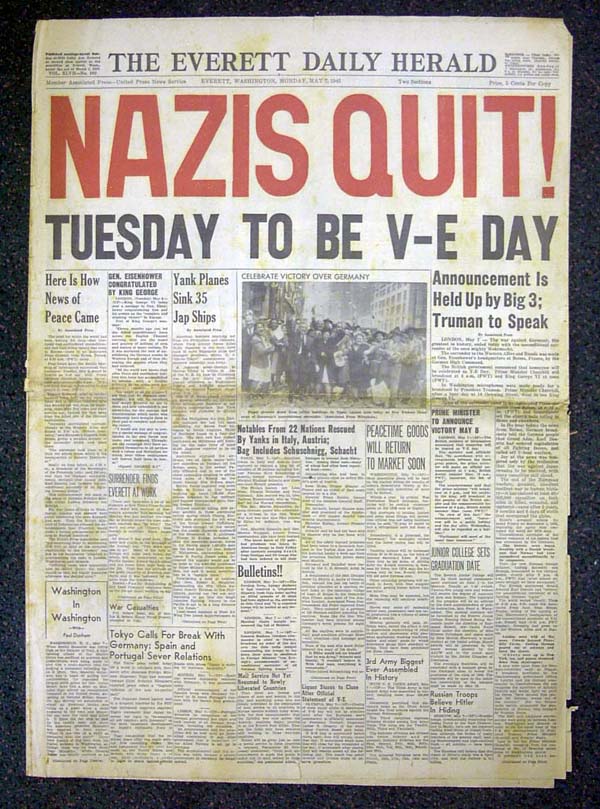
NAZIS QUIT!

is the headline in the European theater edition of Stars and Stripes. Sgt. Karlson's unit has moved to Muldenberg, a few kilometers from Hammerbrucke.


ABILITY TO PAY PRICING? At JMPP's place, a variant on value-of-service pricing.
If colleges and universities want to keep college affordable to everyone with ability yet still have enough funding, they should jack up tuition really high while simultaneously increasing need-based financial aid.
I think that's a comment on the state-tolerated institutions, which are (sometimes deservedly) targets for legislative budget-cutters. The private universities operate this way already (although some of the students and families who pay full price note an unwillingness of such universities to draw on their endowment income) with, for example, Harvard undergraduates from families with annual income of less than $40,000, if memory serves, paying no tuition. (Whether such individuals would find the full ride adequate compensation for the culture clash is another matter. There have been two rather sobering reminiscences from the Ivies in recent issues of the Atlantic. The challenges of being a kid with relatively modest means living among upscale trust-fund babies can be daunting.)

The policy dilemma, however, is fine-tuning the tuitions and the subsidies in such a way as to elicit effort from students (bringing the side benefit of greater retention?) Subsidies, whether from the state or from parents bring with them an incentive to shirk, noted here.

5.5.05

WALKING TO THE SPRECHER. Once this week is done, I owe myself two. Brewers 4, Cubs 3.
THERE IS NO JOKER IN A SHEEPSHEAD DECK. If the rules of Schafskopf did provide for a joker, the chairman of the Marquette University board of trustees, one John F. Bergstrom, would certainly have qualified, for agreeing to rename the Marquette Golden Eagles the Marquette Gold, (sorry, Ted, that's as bad as some of the WNBA team names) but apparently not, as one caller to Charlie Sykes, speculated, because Marquette's new basketball conference already includes another Jesuit university with Golden Eagles. Sean at The American Mind has been following the story closely; scroll up. Jib at the Badger Blog Alliance hoists a protest flag on the multiculturalists (weren't Jesuits chaplains to the conquistadores?)
I'm just asking. I mean, after all, it was Catholic Spaniards who relieved the Inca of all of their Gold in the 16th century, as well as decimating the Inca population. Surely that weak association between a Catholic university and gold would seem to be more insensitive than a culturally neutral word like Warriors.
Lots of other reaction at that site. Combine this with some knowledge from south of the Cheddar Curtain, and perhaps the yet-to-be-named mascot ought to be a porcupine.

Meanwhile, the assessment of the obvious continues at Marquette. Here's Marquette Warrior (who did weigh in on Gold) on administrative follies persisting in the face of logic.

How course based assessment could still be alive in the face both of fierce faculty opposition and the explicit directions of the North Central is a mystery.

Why anybody would want an assessment of dozens of individual courses when the (say) social science part of the assessment could be done as part of a broader process applying to all students is another mystery.

Perhaps, pace University Diaries, academicians have reasons other than their failure to sell the Crolyist Vision to be miserable. Mascots may come, and mascots may go, but the expense-preference behavior goes on forever.

3.5.05

IN MEMORIAM. Northern Illinois president John Peters and provost Ivan Legg notified the university today of the death of Liberal Arts dean Fred Kitterle. There are some youngsters who will miss their grandfather.
INSUFFICIENT OPTIONS IN THE ECONOMICS SURVEY? Jim at Blogs for Industry has taken a careful look at the National Council on Economic Education's Economics Literary Survey, and found some of the questions wanting.

Jim's post identifies some of the omitted options in the multiple choices offered that I was hoping to address. Head out to College Station and check Jim's work.
BOOK REVIEW IN PROGRESS. Laura at 11-D is doing a review-in--progress of Thomas Frank's What's the Matter with Kansas? (details or compare prices.)
Fifty pages into the book, I'm having a love-hate relationship with it. There's some interesting theories about class in America. However, Frank writes with journalistic flair full of opinion and florid adjectives, which is fun, but sometimes grates against my formal, academic training. He also isn't shy about displaying his aversion to suburban, middle class America. Sometimes I'm guilty of those same snobberies, but I at least fight them.
I won't spoil the ending for you, Laura, but compare and contrast your findings with these and this.

RUNNING EXTRA: Via Newmark's Door, some observations from David Frum. There might be some common ground.
Could there be a more perfect cartoon of everything that's wrong with affluent liberalism than the delusion that the Democrats could compensate for being soft on defense, weak on terrorism, wrong on marriage, etc. etc. etc. by ... denouncing the country's most popular retailer for offering excessively low prices?
Ah, but there is a public policy issue here. Convicted monopolists generally achieve their dominance by offering lower prices. The tradeoff is of the benefits of consolidation against the benefits of choice, "in spite of possible cost," to quote from a landmark antitrust ruling.
SIXTY YEARS AGO. Sgt. Karlson's unit reaches the Czech border.
ONLY A VIRTUAL SPRECHER TONIGHT. Duty calls, thus no Sprecher tonight, notwithstanding the Milwaukee Brewers 4-1 win over the Cubs.
NO CRYING WITH YOUR MOUTH FULL. The latest edition of the Gauge O Guild Gazette arrived today. Among the newest temptations are ready-to-run Great Western Kings painted and lettered from Sunset Models, or unpainted with a choice of detail bits, from Tower Models. My scratchbuilding skills are much better after wrestling with the Oakville kit for the King and the Locomotive Workshop kits for the Boston and Maine R-1 Mountain, also recently delivered from Sunset, and the Boston and Albany Suburban Tank, coming soon from K-Line. Scratchbuilding, however, is time-intensive. I trust that the model builders have correctly calculated the available disposable income for ready-to-run trains in O Scale, as these products will suit me just fine.
THIS IS A BIT OF A SURPRISE


Your Inner European is Irish!


Sprited and boisterous!

You drink everyone under the table.


Via Shot in the Dark.

1.5.05

DOES EDUCATION PRODUCE SOCIALISTS? Bryan at Econ Log is not so sure.

More educated people think more like economists. It's one of the big findings in my piece in the 2001 Journal of Law and Economics. And that's controlling for income, income growth, job security, gender, ideology, and party. It's a big effect, too: Every step up a 7-point educational scale matters about 9.3% as much as an economics Ph.D.

Those of us who hang around universities (well, other than GMU) find this hard to believe. "All the Ph.D.s I know are socialists!" This is a classic case of selection bias. Left-wingers with lots of education hang around universities; the rest get out while the getting is good.

There is more research to come.
WHAT'S WRONG WITH THIS PICTURE? An apprentice finds the Prisoner's Dilemma in the Chicago Split.

Sometimes when you go out to a bar with friends, somebody will break out the MasterCard and start a tab for the whole group.

By the end of the night...you're much too drunk to figure out how much each person individually owes, so you just divide the whole thing up by the number of people in your group....now you're each paying the same amount.

The friend who was telling me about his night was upset that one of his friends drank the same number of $5 imported beers while the rest of the group ordered the special (usually cheap beer that officially qualifies as one step above piss...but it still gets the job done)....and I said...."Well...can you blame him? How many people were in your group?"

"Five."

There is something suspect about this story. If it's five guys, and the bill comes to $33, each tosses in a ten (perhaps somebody tosses in a twenty and takes back a ten) and the server gets a rather large tip.
A TESTIMONIAL. Unsung Heroes.
Since the 1980s, there has been a handful of faculty members who have sacrificed time, energy, peace, and, too often, fair treatment, in order to stand up for the rights of their students and their colleagues. It is hard to imagine their colleges and universities without them. They bear witness to the deepest values of critical mind, liberty, legal equality, and fairness. They speak truth to campus power. They rally opposition to tendentious or invidiously discriminatory programs. They do everything they can to hold administrators to the promises of academic freedom to which those administrators subscribe in theory, but, alas, subscribe so rarely in practice.
Read and understand.
A CONCERT REPORT. Despite the continued early-spring conditions around here, the Northern Illinois University Steel Band offered its annual concert to the annual packed house, last Sunday, April 24. The Ambassador of Trinidad and Tobago was unable to attend, but she sent a delegate who might be campaigning for a permanent appointment to that duty, and the kids from Baltimore were back. The concert: more arrangements of classical pieces, as well as the latest calypsos from the competitions on the islands. A pleasant time was had by all.
THANK YOU FOR YOUR CONTINUED SUPPORT. Despite the summer recess and the fall sabbatical, both of which distracted me from the academic follies and day-to-day economics puzzles, sufficiently many readers stuck with me that as the tempo picked up, the word of mouth did, and April 2005 readership reaches a new high.


With the end of the semester approaching, posting is likely to be a bit less frequent in the coming weeks. That is not an invitation for academicians to act foolish. I am watching, and I will hail "Protest" if provoked.