and WTF
  " moments.
It's not my fault that the party of FDR and JFK is turning into the party of LOL😂 and WTF🤦♂️. pic.twitter.com/gpdAY4vhEV
— Bill Maher (@billmaher) January 29, 2022
Enjoy.
and WTF " moments.It's not my fault that the party of FDR and JFK is turning into the party of LOL😂 and WTF🤦♂️. pic.twitter.com/gpdAY4vhEV
— Bill Maher (@billmaher) January 29, 2022
My last terrible flying experience was a trip from Columbus to St. Louis. There are no direct flights between these to major cities, so you can drive 6.5 hours, bus 7.5 hours, or spend 4.5 hours flying through Chicago.Columbus, Ohio, is one of several state capitals without a passenger train of any kind, and the direct passenger service for St. Louis quit with the Carter malaise taking down the National Limited. The latest wish list for the North Central states is still too much a hub-and-spoke system.
Since we were just spending three days in St. Louis, we chose to fly. Our flight departed 40 minutes late and then spent 45 minutes on the tarmac in Chicago. We ran to our connection and saw the airplane still attached to the jet bridge, but alas, they didn’t let us board. The gate was closed. A customer service agent told us the problem was coded as “weather” — so no compensation — and the earliest flight we could get on would be 1pm the following day. Our three day trip turned into a two day trip.
Unfortunately, the proposed alignments still don’t have a direct route from any Ohio cities to St. Louis. Instead, the proposal recommends a hub-and-spoke system where nearly everything runs through Chicago. Much of it is not really a high-speed rail network, more like “higher” speed. Only on “Core Express” corridors will train speeds exceed 125 mph, while the “Regional” sections will be in the 90 mph to 125 mph range under the FRA plan. An incremental upgrade on the Chicago to St. Louis segment is already under development and last month saw speeds on some segments increase to 90 mph and will see some 110 mph sections once it’s done. When that corridor will achieve its planned “Core Express” status, with speeds above 125 mph, is not yet clear. As of now, the total travel time is 5.5 hours to cover 284 miles.Get some additional lines, such as a corridor-style service linking St. Louis to Pittsburgh or Cleveland by way of Indianapolis and Columbus, and people might use it.
Drive when you can. We draw a six-hour drive circle around our house. If we’re within six hours, we’re in the car. The airport experience and the hassles associated with flying these days make driving a much less stressful trip. That’s true even with gas prices where they are today.That's advice from a retired airline pilot. The train likely isn't in his mind because, apart from the current Chicago regional network, such as it is, the Northeast Corridor, and possibly Southern California, there's not much of a circle. But a train cruising at 110-125 will be able to get people to many of those destinations within the six hour driving circle in three to five hours.
When President Joe Biden met with U.S. governors at the White House on Monday, he was the only one given a glass of water — lest anyone else remove their mask to take a drink.The precautions aren't a good look.
The president was seated more than 10 feet from everyone, including Vice President Kamala Harris and members of his Cabinet.
A White House staffer who was wearing a surgical mask when Biden entered the room was quickly handed an N95 version.
It’s no surprise that unusual steps are taken to protect any president. But the strict precautions could also threaten to undercut the Biden administration’s own efforts to tell Americans — especially those who are vaccinated and boosted — that they can get on with something closer to their normal lives in the face of the omicron wave.The de facto president, who is even older than the de jure president, favors those precautions. Deal with it.
The voice is friendly, intimate, measured, detail-oriented, and humorous. There is a hint of non-venomous, non-judgmental snark. It’s your favorite, funny, smart colleague you might Slack with a couple times a week, if you’re in the business.Watch the video, and judge for yourself whether the producer got the tone right.
What Nichols seems to be suggesting is that there is something wrong with the fact that many Americans are aware that, say, Jonathan Taylor is the 2021 rushing leader but do not know that the House Minority Leader is a fellow named Kevin McCarthy. I am not familiar with any public polling that attempts to compare knowledge of or interest in professional football with the Schoolhouse Rock understanding of politics whose absence Professor Nichols laments, but my sense is that many millions of Americans will find themselves on the receiving end of his implied censure.Food for thought there. Perhaps the parties have gotten so good at drawing Congressional districts, for instance, that even if the representative from that person's district was the influential voter in a close vote, that person would most likely approve of the outcome (whether that person voted or not).
But what is he actually complaining about? Is it really such a strange thing to think that for the vast majority of people in this country, football is simply more important than politics, especially in the narrow electoral sense of the word? Readers of this website are far more likely to be interested in politics than the average American, but I would pose to them the following question: When was the last time an action or decision made by a member of Congress—your own representative in the House or any other—meaningfully altered you and your family? I suspect that very few would be able to answer the question, and that even fewer still would say that an elected official had done anything in living memory that inspired joy, awe, longing, envy or any of the other emotions (save perhaps despair) that millions of us experience weekly, indeed even hourly, during football season.
This is to say nothing of the fact that politics in the sense meant by Professor Nichols is something its followers mostly enjoy at precisely the level on which football fans engage with their sport. Being “informed” does not mean understanding why it is that store shelves are empty or being able to make the case for giving nuclear weapons to Ukraine (one of the esteemed professor’s hobby horses); it means watching the Red Team beat the Blue Team and vice versa.That is, if your participation is engaging only on social media, or you get your information from watching cable news squabbles, you're delegating the thinking, such as it is, to others, who are paid by the sound bite, not by the insight.

The governors who are having the most trouble are the ones having trouble taking "yes" for an answer. That is, the people began taking quarantine measures before the governors acted, the observed cases and deaths occurred, but in magnitudes far less than those that would overwhelm the hospitals and clinics, and instead of thinking about ways to offer some time off for good behavior, the governors extended their orders.In the case of Illinois,
Restrictive public health measures were sold as temporary trade-offs of liberty for safety from infection. The pitch was that, if we give up freedom of movement, trade, and normal social interaction for a short time, we could beat COVID-19 and then get back to living. But from day one (as Reason has emphasized) the costs to liberty and prosperity have been high for uncertain return. And now researchers present new evidence that the world got very little benefit for the freedom that was taken away.In addition, it's possible that public health authorities got caught up in a management fad, only masks took the place of twee invocations of quality.
One of the study’s more depressing findings is that lockdowns appear to have been heavily driven by intergovernmental peer pressure. “In short,” the authors note, “it is not the severity of the pandemic that drives the adoption of lockdowns, but rather the propensity to copy policies initiated by neighboring countries.”There's a win for the economic way of thinking, if only people will recognize it.
“[Lockdown policies] have contributed to reducing economic activity, raising unemployment, reducing schooling, causing political unrest, contributing to domestic violence, and undermining liberal democracy,” the damning report insisted.We can count, dear reader, on politicians being politicians.
“Such a standard benefit-cost calculation leads to a strong conclusion: lockdowns should be rejected out of hand as a pandemic policy instrument,” the authors said of the “ill-founded” measures.
A real scientist will revise his priors. A politician, not so much, although the consequences for the politician might be more final. [Reason's Eric] Boehm concludes, "In fact, we're long past that point [where the politicians admit their error and lift their ukases]. But it's good to see some politicians catching up."But even now, they'd rather spin. The latest howler from the coot and Raggedy Ann is something about "we've never advocated lockdowns." No, never with those words, but haven't I seen Giftzwerg fretting about superspreader events at football games ever since the season kicked off?
Now we have further evidence that enormous incursions into civil liberties and economic prosperity have done little to reduce deaths from COVID-19. We've had an awful lot taken from us in return for very little, if any, gain.Particularly with political leaders saying stupid things like "I have the freedom to kill you with my corona." Or pretending that they have to Do Something. "Driven to use the tools they have, the Biden administration has been forcing boosters on younger and younger children, even though we know that (a) they are at little risk of severe disease and virtually no risk if already vaccinated, (b) there is little evidence the boosters help young people at all, and (c) FDA officials are resigning in protest."
"Overall, we conclude that lockdowns are not an effective way of reducing mortality rates during a pandemic, at least not during the first wave of the COVID-19 pandemic," the Johns Hopkins paper's authors add. "Our results are in line with the World Health Organization Writing Group (2006), who state, 'Reports from the 1918 influenza pandemic indicate that social-distancing measures did not stop or appear to dramatically reduce transmission.'"
There's a lesson here, though it's not just about the ineffectiveness of the most intrusive efforts to address the COVID-19 pandemic. It's a caution that any benefits the political class promises in return for disrupting our lives may be illusory. We'll have to fight to regain our liberty and prosperity, and we may never fully regain what we had.
Of 893 nominally qualified candidates, 679 were eliminated solely due to insufficiently woke diversity, equity and inclusion statements. In other words, Berkeley used a political litmus test to eliminate over three-quarters of the applicant pool.If the remaining quarter were still Nobel-worthy or at least capable of generating the indirect cost returns that keep the deanlets in wine and cheese, California still might be fine. But there are ominous signs. "Ideological conformity may also result in a narrowing of research questions, with negative consequences for intellectual pursuits."


The U.S. Environmental Protection Agency does not have indoor air quality standards for nitrogen oxides, but the researchers found that the government's 100 parts per billion limit for one hour of outdoor exposure is "regularly exceeded if stoves are used without adequate indoor ventilation," such as not having a hood or not turning it on while cooking.If all you're doing is boiling water for mushy vegetables, or heating up canned goods, I suppose that electric stove is good enough. Maybe Jess depends on her companions to do the cooking.
"I don't want to breathe any extra nitrogen oxides, carbon monoxide, or formaldehyde," Jackson said in a statement. "Why not reduce the risk entirely? Switching to electric stoves will cut greenhouse gas emissions and indoor air pollution."
The highest emitters were cooktops that ignited using a pilot light instead of a built-in electronic sparker. Methane emissions from the puffs of gas emitted while igniting and extinguishing a burner were on average equivalent to the amount of unburned methane emitted during about 10 minutes of cooking with the burner. Interestingly, the researchers found no evidence of a relationship between the age or cost of a stove and its emissions. Most surprising of all, more than three-quarters of methane emissions occurred while stoves were off, suggesting that gas fittings and connections to the stove and in-home gas lines are responsible for most emissions, regardless of how much the stove is used.Those pilot lights, going all the time, are releasing combustion products all the time. Maybe it's time for some stove owners to upgrade to the units with igniters. Those leaky connections? Can you say fire hazard?

Socialists around the world are condemning the trucker freedom protest in Canada as the working class unites to defend their human rights.Beware of Mounties riding angry moose!
"When workers of the world unite against overbearing government mandates, that's literal fascism," said a sobbing socialist Prime Minister Justin Trudeau from deep within his top-secret bunker underneath Washington, D.C. "True, compassionate socialism is when the government partners with private corporations to force experimental drugs on the populace and threaten their very livelihoods if they don't. Everyone knows that."
According to sources, socialists were initially thrilled by the trucker convoy, as they had mistaken it for a bread line. To their dismay, they soon found out that it was a toxic freedom march organized by the working class against the Canadian bourgeois.
The outrage here is a prestigious academic institution failing to stand up for intellectual freedom, not a couple of inartful tweets. A school condemning a highly accomplished professor and university leader for expressing an opinion well within his field of expertise is extremely problematic. And doing so in a way that implies he’s a bigot is simply beyond the pale.At Minding the Campus, John "Discriminations" Rosenberg also went there.
The coming debate over this selection criterion is sure to be as entertaining as it will be heated. I look forward, for example, to hearing how those who believe the Court is a representative body will explain why nominating a black woman—a member of a group that makes up about 6.5% of the U.S. population—will make the Court look more like America than a Hispanic man, who represents about 9.5% of the population.Those are the usual suspects. Eugene Volokh questions the wisdom of the president limiting himself to less than seven percent of the population (and perhaps an even smaller percentage of the pool of potential justices) in that way.
In any event, it appears virtually certain that the Court will soon be joined by a new Justice selected from candidates limited by race and sex, just as it is about to decide how much latitude universities have, if any, to use race in admissions. How odd, and how insulting to the new Justice, the only one on the Court who will always have an asterisk next to her nomination.
I think it's also relevant here that the "objective" factors are really quite subjective. It's hard to accurately evaluate the quality of people's legal minds, and especially to predict their likely work product on a nine-member Supreme Court. That doesn't of course dispose of the question of whether we should consider identity factors; for instance, I don't think race, religion, or sex should play a role in ordinary government hiring or student admissions, even when qualifications are hard to measure and success is hard to predict. But if I'm right that for high-level positions considering identity factors is permissible, then it's hard for me to say confidently that considering those factors would yield a materially less qualified candidate, given that the qualifications are so hard to pin down.Years ago, it might have been straightforward to put forth the Thurgood Marshall who argued Brown v. Board of Education, and I don't recall him ever being called a token. In like manner, it might have been straightforward for the current president to identify somebody who had argued a key case, or had written rulings that conformed to Supreme Court guidance whilst applying the Constitution in a way Democrats like. Or there are other ways to screen for the high bench.
Having the opportunity to serve the law at that level is a great accomplishment whatever the bases for the appointment; and the way to make it greater is simply to do more with it. Earl Warren, like him or not, is remembered as an especially important Chief Justice because of what he helped do on the Court, and no-one diminishes that on the grounds that he was appointed in part for political reasons stemming from the 1952 election.Again, though, that's an intramural conversation among libertarians and conservatives.
If you want to argue that she’s an ignoramus who shouldn’t be given several hours a day on network television to pontificate on current events, I’m incredibly sympathetic. Then again, as best I can tell, ignoramuses giving uninformed opinions is the raison d’être of The View and has been a successful formula for more than a quarter-century.Yes, and whenever I see supposed "opinion" programming including clips from The View, or a few other kaffeeklatsches masquerading as serious work, I cringe.
"This is what's interesting to me, because the Nazis lied," said Goldberg. "It wasn't [about race]. They had issues with ethnicity, not with race. Because most of the Nazis were white people and most of the people they were attacking were white people. So for me, I'm thinking, how can you say it's about race if they were fighting each other? It all really began because I said how will we explain to children what happened in Nazi Germany. I said, this wasn't racial, it was about white on white."That's how we understand ethnicities, or nationalities, now, going so far in our affirmative action or human resources reporting as to categorize all manner of people as "Asian." That's not how people thought in the 1930s. Reason's Robby Soave doesn't grasp that.
There's a kernel of an interesting point here, in that the Nazis very deliberately pioneered the idea of a single white race that was set apart from—and in their view, superior to—all other races. Prior to the 20th century, various peoples we would all consider white by today's standards did not identify as part of the same racial tribe: There was no broad, united consensus that the Italians and the Irish, for instance, were racially linked. People of different European countries, even different neighboring countries, were often considered part of the generic other, no matter how alike they looked. The Nazis had different ideas.Almost. The Nazis had this notion of Aryan-pure supermen, "sooper dooper soopermen" and they might have held off on investing England out of some sense of Anglo-Saxon-Aryan solidarity. That was not too much of a stretch from social science thinking of the era, which sometimes wrote of an "American" race or distinguishing the "Italian" from "Slavic" or "German" races, that later becoming "nationalities."
They certainly considered Jews to be part of an inferior, non-white racial group, however. Their anti-Jewish rhetoric was starkly racial. That's where Goldberg's comments really go off the rails.If the relatively young Mr Soave can recognize that there have been changes in the understanding of race, why didn't that register with the Baby Boom educated Ms Goldberg?
She's right that in a world where racial categories have been expanded to include all white-looking people in the same bucket, modern children might have difficulty understanding why Jews—who are now frequently considered to be white, even though many of them are not—suffered racial genocide at the hands of people who more or less look similar to them. But that doesn't mean the Holocaust was somehow devoid of racial motivations. It was very much about race.
A key issue is timing. Our checklist includes time on board (no less than ten hours, please!) and sensible departure and arrival times. Salzburg to Venice sounds like a decent proposition, surely a route which might attract good overnight traffic in the tourist season. But Venice-bound travellers cannot actually join the train in Salzburg until well after midnight. Some carriages are ready for boarding at 00.20, the rest not till about 45 minutes later.The article does not make clear whether some of those cars are Salzburg adds and others are available space on trains originating elsewhere on the railroad. And clearly there are no setout sleepers for Venice. There's a similar lacuna on Amtrak's sorta-restarted Night Owl, which once upon a time did feature Washington to New York cars dropped or added in The Pennsylvania Station.
The pleasure of the night train is having some daylight hours on the train, and not being forced to wake unreasonably early. One wonders if passengers who ride the night train from Vienna really do find any hint of romance on the railway platform in Verona when they alight at 05.51 on a winter morning.
Making an occasion of a journey is all about making time for a journey. The decadence of a leisurely evening on board, sleeping well and enjoying time on the train in the morning are key factors. In an ideal world, every night train would depart around 19.00, have a proper restaurant car for a relaxed dinner, and no-one would be turfed off the train until well after breakfast next morning. The same applies to overnight ferries.So much for that Broadway Limited or Twentieth Century leaving New York around five for an eight a.m. arrival in Chicago, although that sort of timing might have worked for a Fort Pitt or the Cleveland cars of the Ohio State Limited, and the Pioneer Limited sort of satisfies those criteria, and, at one time, offered a St. Paul for or from Milwaukee car.
It doesn’t always work out thus. A pragmatic compromise is “board by 20.30, alight after 09.30.” It’s a good rule of thumb which works for us. The new thrice-weekly Paris to Vienna night sleeper fits the bill perfectly. As will the new route from Berlin to Graz which starts in June – that one will allow well over 15 hours on board. The Caledonian Sleeper from London to Fort William gets full marks with boarding from 20.30 and arrival in its Scottish Highland destination at 09.57.
The other key thing in our decision to take or avoid a night sleeper revolves around the scenery we might miss while sleeping. Does it not make more sense to cover long hops through less scenic areas by night and then reserve the more scenic stretches for daytime legs? A night train from Hamburg or Amsterdam to Zürich might become even more memorable if on the morning of arrival one continues on by slow trains through the Alps. Sleeping through the Alps by night just doesn’t quite seem right.Yes, although the business traveller on that line might prefer to arrive in time for the morning meeting. And the re-enactments of the Orient Express are upscale cruise trains these days, and those might have the mountainous bits on the timetable by day.
Remember, remember January Sixth in November,No doubt that's selling well in Madison and on the Vineyard.
The Republican Treason and Plot,
I know of no reason
Why the Republican Treason
Should ever be forgot.
Penzey acknowledged this allegation had cost his business a substantial number of newsletter subscribers.Sorry, no. Not that the troubles of a communist spice merchant bother me, I'm capable of growing my own. But look at the awkward construction of a Monica Showalter essay mocking his discomfiture.
“After starting the year with All Republicans are Republicans and following up with Republicans are Racists we’ve set a nice little Boycott Penzeys! surge in motion,” he admitted. “It certainly wasn’t unexpected, but if it’s within your means, you picking up a small stack of Gift Cards would help.”
Penzey informed supporters that his “Republicans are Racists” email cost his newsletter 40,005 subscribers—approximately 3 percent of its total. While this was offset by 30,000 new fans, he explained, he still needs to make up for the lost business and is offering a deal on Penzey’s Spices gift cards to lure them in “with the hope this might make it a bit easier for you to share some and possibly get a few good new customers to replace the ones we’ve lost.”
Doofus here from riot-burned Wisconsin and not far from riot-hit Minneapolis was telling us MLK Jr. was a racist? This goes beyond typical wokester dumbassery. And it was a very, very, very big and direct insult to a lot of potential customers on the Republican end. It was not just the minor wokesterism that comes out of most business executives.Why that Minneapolis reference? Can't anybody locate Milwaukee on a map? (Hint: Bucks, not Timberwolves. Brewers, not Twins.)
Republicans have tolerated leftist views for years from the executives of the companies they buy from. We all love Martha Stewart and can safely assume that she donates to left-wing causes, but there is no reason to boycott her — she puts out a quality product, and it's her money to do with as she pleases. What she doesn't do is target and insult her customers, effectively declaring she doesn't want their money. That's what Penzey did, unleashing a boycott on his products that he anticipated, no less, which turned out to be biting off more than he could chew.Let Penzey be the first, but not the last. But then she gets this dig off. "It's weird stuff for an executive of a global spice company, which must source from all over the world, to be acting as if he's never been out of the wokester part of Minneapolis."
While we knew Milwaukee had some good coffee options, best coffee city in the U.S.? That is a surprise.And yes, the tradition of hand-the-transfer-out-the-window lives on.
But according to the ranking website listwithclever.com, Brew City is the top coffee city in the country, coming in before Portland at 2, San Francisco at 3 and Buffalo at 4.
The ranking weighs variety of coffee shops as well as the best prices. The website states their top 15 coffee cities have an average of 18 cafes per capita, an average about 1.4 times compared to average U.S. metros.
Milwaukee, according to the ranking, deserves to be first because it is "best at balancing affordable brews with a growing coffee scene."Summer, and perhaps a return to road trips, is coming. There's something jarring, though, about basing a city's coffee credibility in part on the price of a cappuccino, either as a raw number or as a share of local average annual earnings.
They note the city's low cost of living gives cafe owners the "flexibility they need to create a unique experience for cafe-goers." And the city's coffee scene allows new faces to break into the specialty coffee scene, "making it America's best coffee city," according to the ranking.
Milwaukee residents spend about $926 per year on coffee, about 1.5% of their annual income. That makes Brew City one of five cities where the cost comes in below $1,000, according to listwithclever.com.
Asians are worried about public safety and leery of a Democratic party that has become associated with “defund the police” and a soft approach to containing crime. Another is that Asians, like Hispanics, are a constituency that does not harbor particularly radical views on the nature of American society and how it must be remade to cleanse it of intrinsic racism and white supremacy, a viewpoint increasingly identified with Democrats. They are far more interested in how they and their families can get ahead in actually-existing American society.These demographic aggregates bother me. "Asian" includes people from the subcontinent and the 'stans and China and the neighboring islands and peninsulas whose traditional writing uses characters, but don't call them Chinese. You can do similar disaggregations on "black" or "Hispanic" or "white." And there are plenty of opportunities for those recent arrivals to put that academic excellence to work. Glenn Loury, who knows a thing or two about human capital (and technology diffusion) called attention to those opportunities.
Which brings us to the key issue for many Asian voters: education. It is difficult to overestimate how important education is to Asian voters, who see it as the key tool for upward mobility—a tool that even the poorest Asian parents can take advantage of. But Democrats are becoming increasingly associated with an approach to schooling that seems anti-meritocratic, oriented away from standardized tests, gifted and talented programs and test-in elite schools—all areas where Asian children have excelled.
Let them come. I mean, in fact, that’s the only way we’re going to survive the challenge of the Chinese behemoth going forward another generation or two, because if I look at what’s going on in the legacy population — white and black — of the United States of America, I see a lot of mediocrity, I see a lot of laggardliness, I see a lot of decay and corruption and so forth, of people not realizing the full human potential […] I don’t know what the alternative is.He made those statements in the middle of a conversation with traditionalist law professor Amy Wax, who saw in the immigration that same Democrat plot to change the demographics so better to win elections, never mind that "soft on crime" and "your business is not essential" and "you can afford to pay more taxes" aren't exactly winning arguments with law-abiding or successful people. She raised a slightly different objection to importing human capital.
It doesn't mean that the influx of Asian elites is unproblematic. I actually think it's problematic. I think it's because there's this danger of the dominance of an Asian elite in this country, and what does that mean? What is that going to mean to change the culture?I'm inclined to bet on emergence. People emigrate to the United States because living here is less unpleasant than staying where they came from. As long as the new arrivals buy into the country, and the country buys into the new arrivals, the cultural changes strike me as more likely to be for the better than not. Take it away, Fiona Harrigan. "When we welcome foreigners to our soil—either because of the persecution they are fleeing or the skills they bring with them—we preserve our competitive edge and ensure that the best ideas and talent can prosper within our borders."
In one instance (pictured) President Lisa Freeman went maskless while cheerleaders and band members were forced to wear masks.Meanwhile, if you're College of Law nomenklatura, you get to shed your Biden muzzles at the "holiday" reception (which we used to refer to as the Christmas party.)
The university and alumni association deleted most of the albums, videos and photos after Fix inquiries.
A January 11 email [click over -- Ed.] from Yolanda King, the law school’s associate dean, criticized the bare faces she saw while on campus.

Cassandra Hill, the law school dean, is in the middle of faculty and staff. At the end of the row appears to be law school Chief of Staff Melody Mitchell and to Hill’s immediate right is Kellie Martial, the assistant dean. At the far right on the end is librarian and Assistant Professor Matthew Timko.It's not enough that high university officials defy Illinois's corona tyrants, they cross state lines and defy Michigan's.
The Fix identified the faculty using the College of Law’s directory, though not all employees have photos.
King did not respond to requests for comment on if she attended the luncheon and the potential she violated the university and state mask mandate. Dean Hill did not respond to a request for comment either.

Freeman enjoyed a breakfast buffet in Detroit before NIU took on Kent State in the Mid-American Conference football championship at Ford’s Field on December 4. Despite an alumni association admonition that all events would follow Centers for Disease Control and Prevention guidelines requiring masking indoors, Freeman’s bare face is visible in some photos.Meanwhile, the continued virtual learning isn't.
One law school student, required to take online classes, said the mask situation is part of a broader problem of the university not serving its students: “[T]his time the administration…has gone too far.”Should university officials explain, we'll cover it.
The student decried the quality of online learning he and his peers have experienced at NIU thus far, citing a general lack of preparedness and professionalism by both students and professors when classes are online, and valuable time wasted on arguments over people not turning their cameras on and general technical issues.

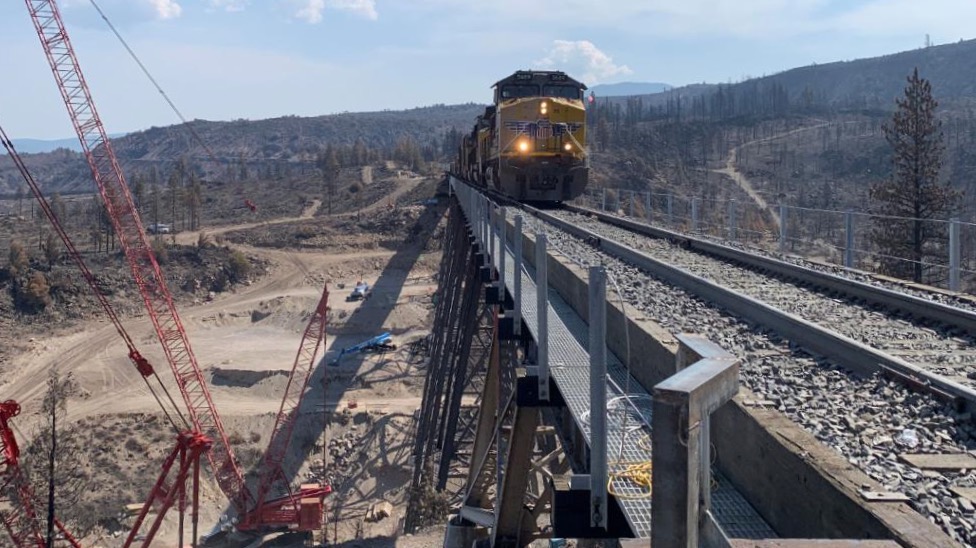
The project, which replaced a major fire-damaged trestle in Northern California in 2021 — about a month faster than was originally projected — has been much discussed and is justly held up as a matter of great pride by UP [see this article on the railroad website, and “Analysis: Union Pacific bridge repairs …,” Trains News Wire, Aug. 10, 2021].On the investor-owned railroads, the incentives align in such a way to get the bridge repaired and back in service more quickly.
But Shane Keller, the railroad’s senior vice president of engineering, provided some additional details on the work on Thursday during his presentation on UP’s capital plan for 2022 at the 43rd National Railroad Construction & Maintenance Association Conference — like the information recalled by one veteran employee that helped speed the project along.
The project required replacing 18 of the 19 spans of the 1,200-foot-long, 150-foot-tall bridge. Those spans measured 80 or 40 feet. The 80-foot sections were rebuilt on site. But what about the 40-foot spans?
“One of our more seasoned individuals said, ‘Back in the 80s, we took out this bridge in Nebraska,’” Keller said. “’And those spans are sitting in Cheyenne, Wyo., right now, in the weeds. And we were going to scrap those this year. Why don’t we have somebody take a look at those?’”
A review showed those spans were still structurally solid. “We had to modify a few things,” Keller said, “but we ended up taking the spans that we took down in 1980 and ended up reinforcing them and putting them up on this bridge. All the spans that are on top of the towers are actually from an old bridge we had a long time ago. We said it was going to take 60 days to get it open, and we did it in a little bit more than a month.”
Someone might pick a nit by insisting that, if some of the tax revenues extracted from the corporation are used to build infrastructure, to subsidize genuine education, to supply an honest court system and effective law enforcement, or even to pay customs officers who shield a corporation from foreign rivals, then the state does indeed provide effort to improve the firm’s return. Yes.The first paragraph identifies government functions that might be symbiotic with the goals of that business. The second paragraph is a challenge for additional research: might the loss in private value be more than offset by gains elsewhere in the civilization? The third paragraph is a tougher challenge: is the use of public money for charitable works a form of parasitism, a sop to rent seekers, or something else? My formulation is admittedly less subtle: when I had parasitism in mind I had the sort of low corruption, log-rolling, and rent-seeking that is the ordinary stuff of politics.
But almost none of the tax revenues are so earmarked. Many of these revenues are used in ways that are either not at all helpful to the firm from which they are extracted, or are positively harmful to the firm – such as, for example, when the tax revenues are used to fund customs officials who obstruct the firm’s access to lower-cost or higher-quality inputs supplied by foreign sellers. Realistically – and even if the state were to use every cent of the tax revenues in socially valuable ways – the value that the firm derives from the use of tax revenues extracted from it is generally much less than is the value that those funds would have produced for the firm had they not been taxed away.
Suppose that a thief each month steals $1,000 from the mom’n’pop store that you own and operate. Suppose further that this thief then, each month, spends $100 in ways that produce some positive value for your firm, and spends the remaining $900 doing magnificently wonderful charitable works all across the town, but works that yield to your firm no value. Under these circumstances, the thief is effectively a shirking partner – a partner who gets from your firm more in value than he or she contributes to it.
No wonder Joe Rogan says Canada is in “revolt” — no blood, no violence, just a massive “NO!”We have the free states, and those serve in part as a safety valve for people who have had too much of the technocrats' micromanagement. In Canada, apparently, the professional-managerial class in Ottawa calls the shots, and that's not going well everywhere.
America, where are you? Can’t we, too, do something like this, which is non-violent, liberty-oriented, and incredibly powerful?
One more thing: As you look at those truckers, remember that non-violent protests by shipyard workers in the Polish city of Gdansk started the domino effect that pulled down the entire Soviet Union.
Few events in modern times have revealed the vast chasm that exists between the ruled and rulers, especially as it pertains to class. For nearly two years, the professional class has experienced a completely different reality than the working class. In the US, this only began to change once the highly vaccinated Zoom class got Covid anyway. Only then did we start seeing articles about how there is no shame in getting sick. It appears that in many countries, the working class that was forced into early confrontation with the virus are saying that they aren’t going to take it anymore (and many are playing that song to make the point).The Polish government finally ran out of ways to placate the dockers in Gdansk. The past two years of corona tyranny quickly exhausted the truckers' patience right from the beginning. If indoor dining is closed, what happens to the rest rooms and shower stalls at the truck stops? (That's just for openers.) We'll see whether this is, as Jeffrey Tucker claims, truly a saeculum-rocking event. "This is setting up to be one of the most significant clashes in the world in the great battle between freedom and those governments have set out to crush it."
It’s a massive workers’ strike but not the kind of communist dreams. This is a “working class” movement that stands squarely for freedom against all the impositions of the last two years, which were imposed by an overclass with almost no consultation from legislatures. Canada has had some of the worst, much to the shock of its citizens. The convoy is an enormous show of power concerning who really keeps the country running.
The convoy is being joined by truckers from all over the US too, rising up in solidarity. This is easily the most meaningful and impactful protest to emerge in North America. It is being joined by as many as half a million Canadian citizens, who overwhelmingly support this protest, as one can observe from the cheers on the highway along the way. Indeed, it’s likely to break the record for the largest trucker convoy in history, as well as the most loved.
Supply chain issues are already causing shortages north of the border. Canada imports almost 90% of its winter fruit and vegetables from the U.S. Now that unvaccinated American truckers are no longer allowed into Canada, Canadians are starting to feel the crunch. That doesn’t seem to have had an impact on approval of the truckers, though, as thousands are showing their support. Holding a sign is nice but some people are preparing food for the truckers.Britain's corona tyranny is coming to an end. Denmark's less intrusive mitigations will be ending. Why are North Americans still letting the likes of Justin Trudeau and Anthony Fauci call the shots?

Treating all persons as individuals, not as part of a subset of Americans, is the means to vanquish group injustice. Though a stifling political class represses duty, honor, wholesomeness and faith, these traits are the heart of America: Their beat is strong for those who have ears to listen. We are for them.He concludes, with a question the coot lacks the capacity to answer, "Will you change course, sir, or will you preside over the collapse of our principles, our traditions and our civil society?"
Republicans realize freedom is in jeopardy, for the self-anointed ruling class that bankrolls the Democratic Party to cloak their own greed does not understand liberty. These usurpers pocket the hard-earned money of citizens or print it, causing inflation, the most regressive of taxes. The cost of basic goods ─ food, gas and shelter ─ constitute the greatest proportion of wages for working Americans who do not have letters after their names.
Yes, metropolitan suburbs were the site of the party’s greatest down-ballot reversals during the Trump era, in congressional and legislative seats. These losses cost the GOP control of the U.S. House in 2018 and somewhat reduced the party’s power in state capitals (although Republicans still comprise 55 percent of state lawmakers, down just two points from their 2016 share, and continue to control many more state governments than Democrats do). Contrary to the hopes of Democratic leaders and to the fears of their GOP counterparts, however, these Trump-era losses in metropolitan areas did not constitute a lasting partisan realignment. The suburbs remain intensely competitive — and Republicans are feeling increasingly confident that they’ll snatch back many of these lost seats in the 2022 midterms. If they do, it won’t be by peddling conspiracy theories about the 2020 presidential election. It will be by employing tried-and-true conservative messages on taxes, crime, schools, and other issues that matter most to soft partisans and swing voters.