Showing posts sorted by relevance for query alaska railroad. Sort by date Show all posts

18.6.08

PAGING AMERICAN FLYER. The elder Walter Dorwin Teague, who design historians tend to recognize for his work on consumer goods and airliners, also worked with Pullman's Osgood Bradley division and the New Haven Railroad to design a fleet of streamlined passenger coaches that were on northeastern rails a little bit ahead of the Union Pacific's and Burlington's motor trains and well ahead of the Hiawatha (or the Coronation). The largest fleet was on New Haven, with Bangor and Aroostook and Boston and Maine also using the design. (A few railroads outside New England also bought such cars.)


The design allowed for easy tooling in a tin shop, with New Haven's A.C. Gilbert quickly turning out S (and later O-27) approximation of the cars, which may be the first time in ferroequinology that a fleet of prototype cars received a nickname based on a model. (Yes, American Flyer put names on incorrect cars: only Bangor and Aroostook had Teague baggage cars.)

I just received the 40th anniversary issue of Passenger Train Journal, which included an intriguing article on the Alaska Railroad's passenger trains, including an interior shot of what looked like an updated American Flyer car. The article mentioned some Pullman-design cars licensed to Daewoo. I did a bit more research and came up with some exterior shots.


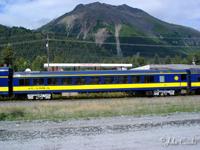
Going shot of a train Near Denali, from the Alaska Railroad gallery.

Here's a roster shot.


I suppose the roof had to be squared-off for manufacturing practicality. Now, if Amtrak ever had a proper capital budget, wouldn't a rake of these look good on the Downeasters or the Northeast Regionals? Heck, I wouldn't mind some being assigned to the Hiawathas and the Illinois service. The Passenger Train Journal article noted that Daewoo built the cars for Alaska in order to establish a presence in the North American rolling stock market.

31.8.08

A NEW REPUBLICAN AMTRAK POLICY? Alaska's governor Sarah Palin has her very own passenger railroad. The Alaska Railroad belongs to the state and it runs intercity passenger trains that are neither commuter trains nor part of the Amtrak network, using coaches (keep scrolling) that ought to be running in the Lower 48.

23.7.19

"CORE SYSTEM" MEANT LIQUIDATION.

I remember that term from the shakeout of the Midwestern railroads in the late 1970s.  The Official Region had Conrail, with Amtrak running the Northeast Corridor, and part of the plan for Conrail was to get rid of duplicate trackage, starting with the Erie west of Akron, parts of the two Penn Central lines from Cleveland to St. Louis (the Pennsylvania east of Indianapolis, the New York Central west) and even the Fort Wayne Division of The Pennsylvania Railroad was redundant.

Our Political Masters were beginning to think of the granger roads as serving Flyover Country, and thus the Rock Island was sold off piecemeal to the supposedly stronger carriers; thus Chicago and North Western were able to get rid of the one piece of Chicago Great Western they wanted (the line from the Cities to Kansas City) in favor of Rock Island's parallel line, which they called the Spine Line, and it's in good enough shape today to handle Big Boy.  When The Milwaukee Road filed for bankruptcy, the trustees came up with what they called the core system, which meant no more Pacific Extension, shared trackage on Chicago and North Western through Iowa, and no more operation in four time zones (the trackage through southern Indiana to Louisville went, as did anything in the Pacific time zone).

4.11.22

IT COULD BE THE PERFECT STORM.

Two of the railroaders' unions have already rejected the contract the bargaining committees, railroad managements, and federal officials put together.  Now come the shippers, praying for Congressional action.
Agricultural shippers have urged Congress to prevent a national railroad strike or lockout, which they said would have “devastating consequences to our national and global food security.”

A railroad network shutdown would exacerbate agricultural shipping challenges, which include rail congestion on the big four U.S. systems, record low water levels that have brought Mississippi River barge traffic to a halt, and a shortage of trucks, the National Feed and Grain Association and 192 other members of the Agricultural Transportation Working Group told Congress this week.
If that correlation of forces isn't adverse enough, the aviators also want a life away from the extra board.
The Allied Pilots Association (APA) said on Wednesday that its board of directors rejected a tentative agreement (TA) for a new contract with American Airlines by a vote of 15-5.

The proposal would have increased pilot pay by 12 percent on the date of contract signing with a 5 percent raise the next year and a 2 percent raise the year after. However, after pilots have been working for three years under the old contract with no wage increases during the coronavirus pandemic, and with annual inflation topping 8 percent, this 19 percent raise is insultingly low.

“We cannot vote to approve a [tentative agreement] that does not adequately address the quality-of-life items of our airline pilots,” APA officials at Dallas/Fort Worth International Airport said in a letter to pilots. “The Company has returned a proposal that is not only subpar in these areas, but it also demonstrates a complete lack of understanding how important these issues are for you.”

There are growing signs that a significant movement is underway among airline workers and pilots, in particular. The APA, which covers approximately 15,000 American Airlines pilots, rejected the TA only one day after United Airlines pilots voted down a TA by 94 percent, and two days after 15,000 Delta Air Lines pilots voted to go on strike by 99 percent. Earlier this year, pilots at Alaska Airlines also voted to authorize a strike, although they voted to accept a new three-year contract earlier this month.

Earlier this year, pilots and flight attendants held informational pickets at airports across the country. Internationally, strikes by air crews have also taken place at Eurowings in Germany and Ryanair in Spain.

The main issue for AA pilots is overwork and unpredictable working schedules. These have worsened over the course of the pandemic, which has compounded a pilots shortage that has been building for years. Over the summer, American saw the number of pilot fatigue call-ins increase to quadruple the normal rate, APA spokesman Dennis Tajer told AINonline.
What that story won't tell you, because it steps on the Zero Corona Is Attainable Under Trotskyism narrative still on offer by the World Socialist Web Site, is that the staffing problems on the flight deck reflect in part the reluctance of pilots to keep being injected with a vaccine of dubious efficacy.  It's not as if the air carriers have a large reserve army of unemployed aviators to draw on.
Staff shortages were already a chronic problem before the pandemic but were exacerbated by tens of thousands of workers leaving the industry and not being replaced.

Workers are also pressing for their demands in other critical transportation industries. On the major US railroads, 120,000 workers are pressing for strike action and the rejection of sellout contracts reached with the involvement of the White House. As with pilots, erratic scheduling and overwork is the number one issue for rail crews, who are on call 24/7 and have no guaranteed sick days. Workers in three out of the 12 rail unions have already rejected their tentative agreements.

Both the railroad and airline industries are under the jurisdiction of the notorious Railway Labor Act, which severely limits the right to strike and prohibits contracts from expiring.
If the next month of labor relations in transportation aren't going to be challenging enough, that "incredible transition" has so disrupted domestic crude oil extraction that inventories of the heavier crude used to produce diesel fuel, which the trains and trucks use, and heating oil, which is still in use in the northeast and New England, are in short supply going into winter, and a problem with the refineries that extract those grades of fuel will have unpleasant consequences.

20.7.22

NEW, PRIVATELY FINANCED COACHING STOCK.

Florida's Brightline have been calling attention on social media to the delivery passage of the next two sets of Siemens diesel trains, ready to go into service once trains begin running from Miami to the Orlando airport station, at this writing they hope that will be early in 2023.

Meanwhile, Pennsylvania's resurgent East Broad Top recently took delivery of the first of four new steamcoaches.  "Although constructed of modern materials, the car resembles EBT’s circa-1890 rolling stock used during the first half of the 20th century."  The builder has had practice building similar steamcoaches for the White Pass and Yukon tourist railroad that meets cruise ships at Skagway, Alaska.

Although the railroad was mostly left fallow after its 1956 closing, the passenger service had been reduced from the Depression on, and the passenger car fleet was smaller at that closing than it once was.  "Additionally, EBT’s roster contains three 19th-century wooden-body cars, but they are well-worn and are in various stages of restoration."  Some of those cars once ran on a Boston area commuter railroad, and they were rendered surplus by an electrification.
The Hamilton coaches are patterned after, but don’t exactly mimic, EBT cars No. 14 and 15, which the line bought secondhand from the Boston, Revere Beach & Lynn Railroad in 1916. The other existing EBT coach is No. 8, also bought from BRB&L the same year.
If you want to see Boston area wooden coaches in action, you have to go to the East Broad Top for a narrow gauge one, and a Boston and Maine coach or two are still in action on the (standard gauge) Strasburg Rail Road.

I understand there are some Siemens coaches and diesels similar to those Brightline purchased going into regional service on Amtrak, but they're not exactly calling attention to it.

6.1.15

TRAVEL READING.

The last time I published an entry in the Fifty Book Challenge, it was October, and I was about to go on yet another road trip.  Thus last year ended with only ten books reviewed, and a large stack of books awaiting review in the study.  Thus an impromptu New Year's Resolution to work off the backlog of books awaiting review, whilst taking advantage of the sunny cold days when there's no reason to go outside, to read some more books, and, with proper self-discipline, post the reviews this year.

And thus, let us start the New Year, Orthodox style, with Ian Frazier's Travels in Siberia.  The shorter version of what Mr Frazier relates to us is summarized in a brief P. J. O'Rourke passage from a Daily Beast essay on all the ways Vladimir Putin might go wrong.
“Exiled to Siberia” says everything about Russian economic and social development in that land of mountains, lakes, and forests with a climate, in its lower latitudes, no worse than the rest of Russia’s. I’ve been across it on the Trans-Siberian Railroad. If this were America, the route from Irkutsk to Vladivostok would be lined with vacation homes and trendy shops, and “exiled to Siberia” would be translated as “exiled to Aspen.”
That was my impression of the Ulan Ude to Irkutsk section.  On the shores of Lake Baikal are some excellent resort grounds suitable for ski resorts in winter and 500 slip marinas for summer.  And the Buryats might preserve their wigwams and teepees and at the same time set up casinos in the best Ho-Chunk tradition.


Mr Frazier's travels, however, sometimes unauthorized excursions from Alaska, sometimes in winter, give the reader a sense of what Siberians are up against, and that even if the Decembrists had used their exile to Irkutsk as an opportunity to develop lumbering and mining businesses rather than investing in simple palaces and salons, making a go of it on the permafrost might not have been easy.

Thus, the first review.  Let us see if we reach the fifty.

(Cross-posted to 50 Book Challenge.)

28.1.08

SEEKING BETTER RAIL ADVOCATES. Destination: Freedom continues to stir up a scandal in the National Surface Transportation Policy and Revenue Study Commission report. It might help to have commentators who rely on logic on content.
This is the story of what may turn out to be another chapter in the nearly 90-year-long crusade by the Highway Lobby to stifle dissent on the part of anyone who dares to challenge its right to the mindless paving over of America. What is at stake: America grinding to a virtual halt, as our enemies use oil to blackmail us to our knees.
That genuflection is voluntary, as long as there is no development of oil resources in Alaska, the Gulf of Mexico, the Great Lakes, and a moratorium on further construction of nuclear power plants.
Behind its closed doors, however, the commission has been plagued by bitter controversy. On the one side has been what amounts to an all-highways all the time faction led by Transportation Secretary Mary Peters. The other faction believes that with overcrowded airport runways, delayed flights, and increasingly unacceptable congestion on city streets and inter-city highways, it is well past time America put more emphasis on the third leg of the transportation stool — the nations’ railroads — freight and passenger.
That third leg is doing quite well, thank you, without Washington's help. A day's drive from here I can find a three-and-four-track railroad that never sees a passenger train. (Hmm, road trip?) Last Friday, I went to a retrospective on the abandonment of the North Shore Line that reminded me the Skokie rapid transit line took a year to build, and only another year to reach North Chicago to connect with existing trackage to Milwaukee. And we'll see the CTA at Old Orchard when?

Perhaps that, too, is the consequence of a massive conspiracy.

Regardless of who or what factors led to the deletion of Weyrich’s section of the report, one can understand why some highway interests would view it as too hot to handle.

The General Motors legend Alfred P. Sloan back in the twenties hatched a plot to destroy America’s electric rail systems in cities all across America (for which his company was ultimately convicted in 1949 and given what amounted to a slap on the wrist). Highway interests meanwhile have moved heaven and earth to see that Americans were denied development choices that were hospitable to anything other than auto transport. You want to pick up a prescription or a quart of milk? Chances are you have no choice other than to haul up to a couple of tons of steel and rubber to do it. In pre-World War II America, most Americans could conveniently walk to accomplish small errands. Walkable neighborhoods are transit-friendly, especially when that transit mode is rail. You may be old enough to remember when there was an electric “trolley” line (called “light rail” in its present incarnation) in your town that was destroyed.

Please. Whatever n was in this post, it is now n+k. And it discredits Mr Weyrich's redacted minority report to tie it, even tangentially, to that Roger Rabbit story.

18.1.21

IS IT TIME TO RETHINK THE UNION?

Reason's Bill Kauffman looks at the history, and wonders if that's the only fix.
If, say, a libertarian-tinged state of the Rocky Mountain West should seek to leave the Union, the rebels surely would be smeared as meth-manufacturing, child-abusing white supremacists. Or if Portland, Oregon, taking a cue from Fernando Wood, the Civil War–era mayor of New York City who proposed making Gotham a free and independent city-state, should declare an independent Portlandia, President Trump might well introduce those angry-faced white girls throwing Molotov cocktails and hissy fits to the M1 Abrams Tank.

Unlike in 1861, there is no sectional fault line along which the union could cleave. A likelier scenario is the fissioning of states, as mammoth entities such as California and New York, whose rural and small-city populations are powerless outlanders, fracture into more comprehensible units. Lose the Last Frontier and the Aloha State, gain Alta California and Upstate New York. You don't even need to redesign the flag.

I hope Richard Kreitner's book gains a wide readership, especially on the thoughtful left. A loose federation of states, as existed under the Articles of Confederation—or even a continent of smallish republics—would be preferable to the current madness.
Perhaps I've grown timid in my old age, but perhaps having the governing structure spelled out in Article I, Section 8 and Article IV of the Federal Constitution is worth keeping, if within reason.  The national 55 mph speed limit was an abuse of the general welfare provision, and the practice of getting a president into office to sign executive orders that appeal to some sections of the country only to have a subsequent president signing countermanding orders is getting old.  On the other hand, Puerto Ricans have approved a referendum for statehood, and there might be some sort of compromise to expel Chicago from the rest of Illinois, or keep the communists west of Interstate 5 along the Pacific Coast.  Or something along the lines of what David Solway is contemplating might be in the works.
A feasible secession movement would likely have to begin with Texas. The terms of Texas’ admission to the Union are complex and debated, but the legal right to secede was embedded in its prior agreement to enter the Union. Moreover, Texas is ideally positioned to entertain the prospect of secession, possessing its own gold depository, owning 95% of state land, and blessed by an independent spirit.

As I wrote several weeks ago, the map tells an interesting story. Florida, South Carolina, Alabama, Nebraska, Mississippi, Louisiana and other southern-central red states, even Georgia, could align with Texas to form a powerful and coherent nation, say, the Free States of America (the FSA), with two open coastlines, a vast energy sector, adherence to the original Constitution, and a local industrial, agricultural and maritime base. Other non-contiguous states, such as Alaska and South Dakota, could opt to join the new Union.

Confirming these speculations, Texas lawmaker Kyle Biedermann has recently suggested a process similar to Brexit, pointing out as well that other states, under Article V of the Constitution regarding the Convention of States, have shown themselves interested in joining the process. Biedermann has outlined the series of steps leading toward the desired result, with Texas as bellwether. The initiative appears to be gathering momentum, as should have been expected. It worked for Brexit; it may work for Texit.
Kurt Schlichter keeps warning his readers that his novels aren't supposed to be manuals, and yet ... Sasha Issenberg asked, four years ago, "The country is hopelessly split. So why not make it official and break up?"  He continues,
It may be time to take the country apart and put it back together, into a shape that better aligns with the divergent, and increasingly irreconcilable, political preferences of its people — or at least to consider what such a future might look like, if for no other reason than to test our own resolve. An imagined trial separation, if you will. Or perhaps in contemplating a future apart we might stumble upon a few ideas for some new way to live together after all.
I suspect that was being considered as tongue-in-cheek.  I would welcome the Permanent Government losing its power, even if Mr Issenberg thinks the loudest voices would somehow replace them.
The most vocal opposition comes from fixtures of the Washington, D.C., Establishment and permanent bureaucracy, which fear a permanent loss of power. Both Fox News and MSNBC, on the other hand, herald the New Era of Good Feelings. For the first time ever, Gallup records three in four Americans declaring themselves satisfied with the way things are going in the United States — a supermajority that cuts across partisan and demographic divides.
Imagine no more national drinking age, no more mask mandates, no 55 mph speed limits. It's easy if you try. On the other hand, then it gets weird.  "After Illinois led a Blue Fed initiative to upgrade its rail service, the Red Fed ended all cooperation with Amtrak, even adjusting gauge size along the Mississippi River to prevent passage of passenger trains from one side to another."  Seriously?  Wouldn't the limited power residing in Washington, D.C. still have control over Amtrak's routes?  With fewer rural representatives standing up for the long distance trains, couldn't Illinois and the other thickly settled states continue the support of their regional trains, just the way Amtrak was funded in 2016?

It gets better.
A Blue Fed requirement that certain freight classes travel only by all-electric truck fleets had nearly doubled the cost of transporting products to the interior west. Frequent work stoppages by West Coast longshoremen emboldened by their labor-friendly administration affirmed a strategy agreed to by titans of Red Fed industry: They needed their own Pacific port.

Red Fed leaders negotiated a deal with Mexican authorities for operating control of the Port of Lázaro Cárdenas, in Michoacán state, investing some of its energy trust funds. A new terminal, staffed by American Customs officials, connects directly with a spur of the Kansas City Southern railroad. There, nonunion laborers load ships with minerals mined through the American West, including lithium and soda ash, heading largely to East Asia, and unload bananas and smartphones from Ecuador and China heading for the landlocked states of the Red Fed without ever once passing through Blue Fed territory.
The coastal states gave up on their freight railroads when the central states regauged their tracks? Seriously? And who pays for regauging the Mexican railroads?

It's probably a good thing that the dreamers about partition don't understand the transportation networks better.