Showing posts sorted by relevance for query chicago olympics. Sort by date Show all posts

7.8.09

CHICAGO, CHICAGO. A special panel investigates the candy store in Urbana.

To start, the Illinois Admissions Review Commission urged the university's trustees to resign and had harsh words for the top administrators -- President B. Joseph White and Chancellor Richard Herman -- for acting unethically by enabling an admissions process that allowed subpar students sponsored by powerful people to get into the state's most prestigious public campus.

"The University now finds itself in a full-fledged crisis purely of its own making," the report states. "Public confidence in the University and its leadership has eroded, and the University must set out in earnest to regain the public's trust and repair the damage done to its reputation."

One can generalize the report either to consider the deleterious effect generally of preferential admissions, or to contemplate the pervasiveness of influence trading in Illinois.

Preferences first.

The findings come in the wake of a Chicago Tribune investigation that found more than 800 undergraduate applicants received preferential treatment over the last five years because of their connections to elected officials, generous donors or university trustees. Dozens more benefited from special consideration at the law school and other programs. While it is unknown how many patronage applicants would have gotten in on their own, their acceptance rate is higher than for the entire applicant pool even though they had lower average ACT scores and class ranks, records show.

"The admission of substandard applicants resulted in other, more qualified applicants being denied admission," according to the findings, reached after reviewing about 9,000 pages of documents and hearing more than 40 hours of testimony from dozens of people.

The panel refuted the contention that U. of I. acted no differently than every other selective university, a point argued by White after the Tribune revealed the preferential treatment.

"Over time, a process that may have begun as a seemingly innocuous way to 'track' inquiries from prominent individuals evolved (or devolved) into a 'well-oiled' machine that was perhaps unparalleled among universities in its level of formality and structure," it wrote.

"The admission of substandard applicants resulted in other, more qualified applicants being denied admission." The generalization to legacy admissions and to affirmative action as practiced is straightforward.

The same print edition of the Chicago Tribune that carried this story also carried a story about clout admissions at Chicago's best public high schools.

Federal investigators are trying to determine whether public officials clouted students into Chicago's highly competitive selective enrollment high schools, according to a subpoena the Tribune obtained Thursday.

The July 21 federal grand jury subpoena seeks documents related to how applicants were admitted to the city's nine elite public high schools through a process that allows principals to handpick 5 percent of students.

Prosecutors want city school leaders to turn over correspondence related to the principal selection process, including who applied, who was accepted, what public officials weighed in, as well as test scores, evaluations and recommendations.

Federal investigators also are seeking all policies and guidelines that principals are supposed to use to pick students and an "organizational chart for the central office of the Chicago Board of Education."

The investigation has just begun. Our President will not be named in this investigation as a parent: his children attended the University of Chicago's Laboratory School in Hyde Park, where the black and the white stand shoulder to shoulder against the poor. His role as community organizer is yet to be determined.

Favors for favors, however, are just another day at the office in the Chicago Public Schools.

Earlier this year, [developer Michael] Scott's roles as school board president and as a member of the city's Olympic committee stirred controversy.

In May, he asked all of the city's school principals to form plans to promote the Olympics. Teachers and union officials said Scott's tactics were heavy-handed and they feared retaliation if they did not support [Chicago nmayor Richard] Daley's quest for the Games.

Daley first floated his vision of bringing the Olympics to Chicago in 2005 after previously dismissing the idea as too costly. He assembled an exploratory committee in mid-2006 that included Scott.

Mr Scott then went on to make some strategic land purchases.

Developer Michael Scott Sr., an early member of the mayor's Olympic committee, leads a group planning a residential and commercial project on lots kitty-corner from the proposed Douglas Park sporting venues, a location where land values could jump if the city gets the Olympics.

The plan -- which would include a Nike store -- already has gotten crucial support from the local alderman, who has set aside the lots for Scott and his group.

The city generally sells taxpayer-owned lots for $1 apiece for affordable housing projects, and in other cases negotiates land prices.

The article does not explain how the city came to own the land, whether by sale for delinquent taxes or by eminent domain.

18.4.19

WHAT DIFFERENCE, AT THIS POINT, DOES IT MAKE?

The new mayor of Chicago is Lori Lightfoot, and the identity politics crowd are claiming all sorts of "firsts" for her.
You’ve probably heard the big news out of Chicago: the city just elected Lori Lightfoot as the next mayor. Moreover, she will be the only black lesbian mayor to ever run the city, and Chicago will be the biggest city to have an openly gay person at the helm.

But there’s more here than a victory for the identity politics crowd. Lightfoot’s win represents a victory for populism in Chicago, the nation’s third largest city.

Now don’t get me wrong here. Lori Lightfoot is no conservative, and she’s no populist in the Donald Trump mold. But her victory means that the days of the Chicago Machine may be over.
If true, it's true in part. I live far enough from Chicago that I can tune out the mayoral election.  One evening, WGN's talkers were talking about a mayoral forum in which several of the candidates stated that if they couldn't vote for themselves, they'd vote for Mx Lightfoot.  I later learned that in a previous forum, the modal choice was one of the Machine aldermen who subsequently got caught up in another corruption investigation.  (You profess surprise, dear reader?)

There's probably something for students of ranked voting in that story, in that Mx Lightfoot was a narrow winner in the primary and a dominant winner in the run-off: how many voters strategically picked a second choice in the primary on the expectation that their first choice wouldn't get through?

The reaction among the punditry is instructive.  Rick Moran of Pajamas Media, an Illinoisan, notes,
Winning the mayoral race in Chicago is not exactly like being elected captain of the Titanic, but it's close. Lightfoot will face a pension bomb waiting to detonate, out of control gang violence, massive mistrust of police by the black community, crumbling schools, a disappearing tax base, and neighborhoods that resemble war zones.

But the bigger story in the city might be the defeat of several incumbents by self-identified socialists and progressives, who successfully preached the gospel of change in order to defeat several long-time city hall incumbents.
Chicago is still fifteen square miles of privilege surrounded by the Third World, and with the improving weather will come the wilding.


What's interesting, though, is that the new mayor is going to catch hell from her left flank.
"I'm excited to say we are going to have our first black female mayor in the city of Chicago," Christopher Cook of 100 Black Men, a group that mentors the city's black youth, told In These Times last week. "But when that's all said and done, what changes are they going to make? We can't really predict right now, but we can hold them accountable."

Key priorities for progressives include pushing Lightfoot to address Chicago's infamously discriminatory policing, beleaguered public education system, growing pension debt, tax policies that prioritize corporations over low-income residents, and underserved South and West Sides.
The post from which I'm extracting these quotes includes a number of Twitter images and additional response. For example,
"Will she embrace [outgoing mayor Rahm] Emanuel's public safety policy of criminalizing communities of color, or change course to prioritize neighborhood investment, mental health services, and jobs?" asked Abbie Illenberger, deputy director of the political group Grassroots Illinois Action.

"Will she fulfill her campaign promise to end rip-off development deals like the Lincoln Yards TIF?" Illenberger added. "Mayor-elect Lightfoot's commitment to change will be quickly tested."

Others were more immediately critical. In a series of tweets, Charlene Carruthers, a Chicago-based black, queer feminist community organizer and writer, expressed frustration with the excitement over Lightfoot's win, arguing that "we are going to have to fight the Lori Lightfoot administration tooth and nail."
There's nothing quite like an intersectional Oppression Olympics, is there?
Carruthers also highlighted the #StopLightfoot campaign, launched by "a group of young black, brown, native, white queer, trans, and gender-nonconforming organizers and people who love Chicago, and have worked for years on issues of police violence, immigrant justice, LGBTQ liberation, and more."
The newly-elected "democratic socialists," who don't come off as flatland versions of sewer socialists, are also ready to rumble. Lucie Macias and Leonard Pierce lead the Chicago cadre, with the following calls.
With at least five and as many as six socialist aldermen, Chicago’s politicians and the ultra-wealthy, from the mayor’s office to corporate boardrooms, need to understand that business isn’t going to continue as usual in this city.

The new socialist aldermen are going to fight for an agenda of expanding affordable housing, protecting immigrant rights, fully funding public schools, expanding public services and more. That agenda will be paid for not by raising taxes on working people, but by taxing the rich.
Their constituents live outside the fifteen square miles.
For too long, Chicago has been governed by Democrats who have been happy to give the city away to wealthy real estate developers and other corporations while gentrifying neighborhoods, privatizing public services and carrying out a brutal agenda of austerity.

Tuesday’s election results show that it’s a new day in this city. Chicago’s new democratic socialist and progressive aldermen are ready to fight that austerity agenda tooth and nail, to win a city for the many — not the few.
Inside Higher Ed's Eboo Patel wonders if intersectionality hasn't become an impractical rabbit hole.
I visit about 25 campuses a year, and increasingly I see situations where students know exactly which character to play when they step into the theater of ‘the diversity program’. People of color talk about how oppressed they are, everyone else nods along sympathetically.

But many students are smart and honest enough to know that this is chiefly a performance – everyone is playing a part, including the professional leading the program. And at least some of those students, some of the time, are like the young woman I met a few days back. They worry whether a paradigm that was supposedly designed to advance them is having its intended effects.

Absolutely we live in a world where structures of racism, sexism, etc advantage some and disadvantage others. But after you have called those structures out, what do you do next? Is constantly telling stories about how oppressed you are really preparing you to be a powerful agent in the world? A good doctor or nurse? A successful entrepreneur? An effective attorney? The next mayor of Chicago?

Me, I’d put my money on the advice given by Ann Lightfoot: meet challenges, take advantage of opportunities, be strong and fearless, prepare yourself to be in charge.
It's the conservative commentators, who live outside Chicago or recognize they have no say in the governance of Chicago, that wish the new mayor well.

Victory Girl Kim Hirsch, "Congratulations to Lori Lightfoot. She beat the Chicago Machine, and I hope her victory is the start of better days for Chicago. The city needs all the help it can get."

John Kass, a Chicagoan.  "Good luck, Mayor Lightfoot. Chicago needs you now."

The editorial board at Chicago's Tribune are optimistic.
How Lightfoot embraced running for mayor, and how Chicagoans citywide embraced her, brought refreshing change to Chicago politics. She broke the typical campaign template and won. We think she’ll govern just as capably.
She takes office shortly.

23.3.07

IT'S OFFICIAL. Huskie Stadium will be one of the soccer fields included in the Chicago Olympics portfolio.

Officially announced Thursday after weeks of speculation, the Board of Trustees approved what it called an "intergovernmental agreement with the City of Chicago."

This agreement makes NIU the host of the preliminary rounds of Olympic soccer. However, this will only occur if Chicago is selected to host the 2016 summer Olympics.

There are unspecified upgrades to the athletic facilities, as well as unspecified sources of money for those upgrades, still to be worked out, that is, if Chicago becomes the site for the 2016 Games. Los Angeles, as well as unspecified cities in other countries, are also chasing this event.

If Chicago is chosen as the Olympic host, those improvements would be discussed, [athletics director Jim] Phillips said.

"That's coming, if [Chicago] gets the bid," Phillips said of facility upgrades. "That's the next round of conversation."

As of the Finance, Facilities and Operations Committee meeting Mach 8, expenses pertaining to the event had not yet been discussed, [vice president for finance and facilities Eddie] Williams [U.S.N.R.] said.

"It has not [been discussed]," Williams said. "I don't know if I want to make any public comment, but we are looking at a mutual beneficial agreement."

Can we put some indirect cost return into the proposal for upgrades of classroom buildings?

15.2.07

AN OLYMPIAN HIAWATHA? Chicago has been chasing the 2016 Olympics, and the neighbors want a piece of the action.
A Chicago Olympics would likely bring more than a half million people to the Windy City. A few events could end up within a short drive of Milwaukee, including the possibility of mountain biking at Kettle Moraine State Forest's southern unit. But most of the competition would take place in and near downtown Chicago, and most visitors would probably book hotel rooms as close as possible to those venues.

Still, with that many people pouring into town, there would be a spillover into southeastern Wisconsin, said Patrick Sandusky, spokesman for the Chicago 2016 Committee, which is organizing the city's Olympics bid. Even Milwaukee, which is 90 miles away, could benefit, in part because of the Amtrak trains that run several times a day between the two cities, he said.
No train service is likely to be available, unfortunately, to a potential playing field for the soccer preliminaries.


By 2016, construction on the locker room should be finished. I suspect that the end-zones will not be converted into terraces so that the yobs will feel at home.

3.10.09

MOVING ON. Chicago Tribune columnist Dennis Byrne wrote, last Tuesday, If we end up losing ...

Keep the name -- Chicago 2016 -- signaling the community's intent to create a bright new city, without the motivation of securing the Olympics. Prove that Chicago is the kind of global city that Daley apparently thinks we're not (he keeps saying we need the Olympics to prove that we're a world-class city).

Imagine if the same levels of skill and determination were put to use raising bushels of cash for the things that Chicago hasn't been able to afford. Money for cash-strapped civic and charitable institutions. Money for badly needed new ones. Not only would these institutions no longer have to worry about their own revenues from charitable contributions getting gobbled up by the Olympics, but also they would enjoy additional funds from the New Chicago 2016 effort.

Instead of waiting around for federal and state funding, raise money to put the CTA in shape. The idea will appall some of you, but where is it written that private money can't be raised to set the CTA on the right track? Money for repairing sidewalks and repaving streets in some of the worst neighborhoods. Money for crime prevention and safety. Money for hospitals and schools and elder care and kid care.

Speaking of schools and crime: The violent young male population in Chicago that is responsible for so many of the recent killings and beatings is the consequence of generations of boys being raised without fathers and significant male role models. To give them what they truly need, send every public school male to all-boys high schools staffed entirely by men to replace the grossly failed coed schools. Get these boys into an environment that provides a clue about how real men should behave. One that allows those who want a quality education to get it without interference from bullies and gangs.

He doubts we'd see the same level of civic involvement in such projects. I'm imagining the pushback from the school establishment and the colleges of education if anybody seriously proposed including gentlemanly ways in the curriculum.

A Think Progress essay suggests that the U.S. immigration service might have been the bureaucracy that sank the Olympic bid. The headline attempts to pin the responsibility on President Bush and his homeland security initiatives. Some changes in visa policy were likely no matter what party was in power in the wake of those student visa renewals issued to a few dead September 11 terrorists. But the current treatment of tourists by immigration is shameful. I discovered a new procedure in place on my last sojourn to England. Passengers holding other than U.S. passports now receive a green form with their boarding pass, that they surrender to the gate agent at boarding. KGB knows they don't have to track those subversives anymore. What's next, a two-part paper visa so our Border Guards Directorate doesn't have to stamp passports? On my return, I was apologizing and teasing the British passport holders at the same time, suggesting that they'd still be standing in the customs line by the time I was halfway to Schaumburg. It might have even been true.
The average wait for a US visa has risen to about three months. Brazil, which will host the 2016 Olympic summer games in Rio de Janeiro, has a reciprocal visa policy with all countries. US tourists are required to have a $130 advance visa before entry into the country and are fingerprinted and photographed upon arrival — matching US requirements for Brazilians.
Perhaps by 2016 we will do better.

The New York Times Weekend Opinionator has a roundup of the more reasonable give-and-take on the politics of presidential pitches for entertainment events.

22.6.26

TRANSPORTATION MIRACLES REQUIRE PREPARATION.

Reason contributors, including Liz Wolfe, have a troubling blind spot where road socialism is concerned.  "New Jersey Transit is preparing backup ferries to help with demand as fans try to make it to the World Cup. I kind of love how they assume public transit will buckle under the pressure."

Not-a-tall.  I heard one senior law enforcement official describe the World Cup as "multiple Super Bowls" in multiple cities in three countries over six months.  Let's bear in mind that the National Football League unaccountably scheduled a Super Bowl for the Meadowlands, and more people than New Jersey Transit anticipated rode the trains.  Lesson learned.

It is not, however, the World Cup, or the Super Bowl, or New Jersey Transit that concerns me.  Rather, it is a centennial.  "In 1926, the North Shore Line built a much larger temporary station, and borrowed rolling stock from the Chicago Rapid Transit Company, for a one-day International Eucharistic Congress at Mundelein.  A rainstorm provoked an early departure for many pilgrims, and the railroad handled it."


In less than ten score years, Chicago went from "mission" territory to birthplace of a Pope.  Strictly speaking, the aforementioned XXVIII International Eucharistic Congress took place in Chicago and at St. Mary of the Lake seminary, then east of a village called Area (pronounced a-REE-a) and subsequently renamed for George Cardinal Mundelein, who made no small plans.  Neither did the seminary, now known as the University of St. Mary of the Lake, not to be confused with the California university that keeps turning up in intercollegiate sports tournaments.  Nor did Samuel Insull, whose country farm was near the seminary.  For that matter, the cardinal offered the Vatican the use of St. Mary of the Lake as emergency quarters during the War.  The Pope might not have had any divisions, but he was no coward.

11.1.24

SOME OF THEM, I SUPPOSE, ARE GOOD PEOPLE.

The discontent the big city mayors have caused among their traditional constituents with their posturing about being sanctuary cities, which flared nearly a year ago in the Woodlawn and South Shore neighborhoods of Chicago, has only become more pronounced, Festive Season and a reprise of the polar vortex notwithstanding.

The current fireworks started in a meeting of ... an Illinois chapter of a civil rights organization.
NAACP Illinois State Conference President Teresa Haley was recorded in a virtual meeting calling migrants “savages” and claiming they are raping people in the Chicago-community.

In an interview with The Daily Beast Wednesday, former NAACP DuPage County President Patrick Watson said top NAACP leaders throughout Illinois met for a meeting on Oct. 26. Haley, who also leads the Springfield chapter, presided over the meeting.

“The comments came up when some of the Chicago-based presidents started to talk about the migrant crisis, the funding that was going into neighborhoods, and they had differing opinions from my own. It's OK to have differing opinions,” Watson said. “They had different opinions about some of the resources that were going to the community, that resources weren't going towards individuals within the community, even though those resources are coming from different sources. …That's okay to have a different opinion. But President Haley engaged in what I would call absolute hate speech.”
Ms Haley did not have a gilded escalator as prop for her speech.
“What’s happening in Chicago is a shame,” Haley says, “and it’s a crime,”

She and others explain how the Black community of Chicago is lacking resources; meanwhile, they claim migrants receive more attention and care from state and federal authorities.

“The busloads are coming, and we’re seeing families on the street,” Haley says.

She pointed out that homeless Black people have not received the same help as migrants because of stereotypes of Black people on the streets as “drug addicts” and people battling mental health issues.

Oddly enough, then Haley dishes her own set of negative generalizations about migrants.

“But these immigrants we got coming over here, they been raping people, they been breaking into homes. They’re like savages as well,” Haley says. “They don’t speak the language, and they look at [Black people] like we’re crazy because we were the only people in America who were brought over here against our wills and were slaves, sold into slavery.
There's nothing like a little Oppression Olympics to go with your pumpkin pie, is there?

It's interesting, though, how quickly the political dynamics changed when the border-state governors started providing transportation to those northern destinations, isn't it?  When the secret flights were being organized by the Jarrett regency, and Raggedy Ann was deflecting and spinning, those big-city mayors kept their own counsel.

3.10.09

DUMBEST OLYMPIC FALLOUT HEADLINE. Milwaukee-Madison rail route still on track despite Olympic vote, in the Milwaukee Journal-Sentinel.

High-speed rail proponents had been talking about the need for the line in conjunction with three Olympic cycling events coming to Wisconsin.

"We thought we had a very strong application even without the Olympics," Madison Mayor Dave Cieslewicz said of the state's federal rail application. "The fundamentals of that route are very strong and the Olympics would have sealed the deal."

Maybe the Mayor gets credit for the Dumbest Transportation Policy Statement. If the fundamentals of the route are strong, a two-week surge in ridership affects nothing. If the fundamentals of the route are weak, a two-week surge in ridership seven years in the future does not strengthen them. Chicago's Metra Rail proposed to meet the surge of Olympic traffic by hiring coaches and locomotives from other commuter authorities, exactly as other commuter authorities have done when they had to plan for an Olympics. (Hey, Rio gets to pick a domestic exhibition sport. Anybody for train-surfing?) The North Shore Line did not build its Skokie Valley Route just to move pilgrims to Mundelein for the 1926 Eucharistic Congress, it hired extra coaches from the Chicago Rapid Transit for the day.

The greater problem facing the Madison extension is the constraint, imposed by the environmental impact statement required of shovel-ready projects, that the service terminate at the Madison airport, along the route to Minnesota that has received a finding of no significant environmental impact, rather than at the foot of Capitol Hill or near the Kohl Center.

The emphasis on sport bicycling strikes me as odd also: the industrial-era cities of Janesville, Beloit, and Rockford might benefit by frequent rail access to the office parks of Madison or Barrington as well as to the Loop, thus providing the hypotenuse to the right triangle formed by the Chicago-Milwaukee-Madison line.

23.3.09

YOUR TAX DOLLARS AT WORK. Wisconsin governor Jim Doyle would like to use federal infrastructure money for improved passenger train service.

State officials are seeking federal stimulus money to pay the full $519 million cost of a proposed 110-mph Milwaukee-to-Madison passenger train line, not just part of it, Gov. Jim Doyle says.

If the grant is approved, trains could be running as soon as late 2012 or early 2013, cutting the travel time between Wisconsin's two largest cities to 1 hour, 7 minutes, officials say. That's about 20 minutes faster than the same trip by automobile, depending on traffic.

Service would start with six daily round trips, connecting Milwaukee's downtown Amtrak-Greyhound station with a new station at Madison's Dane County Regional Airport, with additional stops in Brookfield, Oconomowoc and Watertown.

At the same time, service on Amtrak's Milwaukee-to-Chicago Hiawatha line would increase from the current seven daily round trips to 10, with all of the Madison-to-Milwaukee trains continuing to Chicago. If Chicago wins its bid for the 2016 Olympics, the trains would provide a link between the main Olympic sites and the cycling venues in Madison.

But even without the Olympics, authorities expect the Milwaukee-to-Madison trains to carry 1.08 million riders a year within a couple years after service starts, said Randy Wade, the state's passenger rail chief. Hiawatha ridership jumped 24% last year, to 766,167.

That traffic forecast strikes me as wishful thinking. There's a lot more potential on the existing line, and the airport station offers south siders a 75 minute trip to the Loop as well as a convenient airport for residents of the northern suburbs of Chicago. Perhaps a more realistic forecast (maybe even one that would be exceeded by events) would help make the case for additional projects, and there are additional items on the wish list, including 110 mph operation on the C&M and through trains to the Cities and Green Bay.
Upgrading the Wisconsin portion of the current Hiawatha route to 110-mph service would cost $419 million, serving the existing stations downtown, at Mitchell International Airport and in Sturtevant and Glenview, Ill. Once that's done, service would jump to 17 round trips daily, with seven trains continuing to Green Bay and 10 continuing to Madison, with six of the Madison-bound trains continuing to St. Paul.
There's also an intriguing proposal for a freight bypass.

Previously, the state had planned to apply for $137 million to upgrade tracks on just a portion of the route, from Milwaukee to Watertown, and to build a freight rail bypass to improve passenger service on the Hiawatha line.

But that was when state officials thought the stimulus bill would include a little more than $1 billion for high-speed rail. After they saw that figure had soared to $8 billion in the final deal, they set their sights higher.

With so much money available from the federal government, Doyle said, Wisconsin has a good chance of getting money to upgrade tracks all the way to Madison. Stimulus money also may be available for preliminary work on the next stage of the line, which would go to St. Paul.

I'm going to want to talk about that "stimulus" line in a future post (this week, I'm in grading jail) as permanent improvements ought be viewed differently from fiscal stimulus. For the moment, that freight bypass intrigues. There once was a relief line from Brookfield that passed the fairgrounds and the stadium before entering the Menomonee Valley, and the freight bypass from the Valley to Florida Street is in place. There's a connection to the old North Western at Washington Street, and a freight-only line from St. Francis to Bensenville. Freights off the old Milwaukee get on that freight line south of Northbrook. I wonder if the plan is for something else.

The article includes a disclaimer.
Technically, the Midwestern trains wouldn't meet the international standard for high-speed rail, which is closer to 220 mph, well above even the 150 mph top speed of America's fastest train, Amtrak's Acela line in the northeast, said Rick Harnish, executive director of the Midwest High Speed Rail Association. Leaders of the Midwestern effort have said 110 mph service would be more affordable than true high-speed rail.
It's also doable with the current infrastructure, and a train service that included a few additional stops (Gurnee for Great America, Rondout for transfers to the suburban trains) would not be able to exploit 150 or 200 mph capabilities anyway. A 62 minute timing with stops at Airport, Sturtevant, Gurnee, Rondout and Glenview and 110 mph maximum speeds is feasible, at least on my computer.

28.9.09

THE CHICAGO WAY. Don't mention Chicagoans for Rio. And prepare to board the gravy train.

As the organizers of Chicago’s 2016 Olympics bid sprint for the finish line, NIU Professor of Management Christine Mooney says that it’s time for local business to begin thinking about ways to become part of the Olympic team.

If Chicago gets the nod, the announcement will be the starting gun for a massive race to prepare, and local companies stand to be big winners if they act wisely, says Mooney, co-author of a paper studying how businesses can benefit from “mega events.”

Those who find ways to successfully insert themselves into the network behind events such as the Olympics can continue collecting gold long after the last medal is presented.

Or not.

The key, says Mooney, is looking beyond the finish line from the very start. “Dedicate resources to building trust so those relationships will continue after the event. Building the network is the real payoff, and you can’t assume those relationships will continue just because you worked together.”

Also, she cautions, don’t jump into the Olympic pool if it isn’t a good fit for your business. “You have to assess the costs of membership now and whether benefits outweigh the costs,” she says. “Just as an impressive Olympic performance can vault a company forward, failing can disqualify it in the future.”

A sidebar suggests the consequences of what I fear, which is Chicago taxpayers taking a large hit from the games.
If the games are a big success, you are on the winning team. If they go down in history as a boondoggle, you are forever associated with their failure.
On the other hand, to use another cliche, you took one for the team.

21.1.09

THE CASE FOR THE CAPITAL 400. I hinted at it. James Rowen asks for it.

Passenger rail used to run from Madison through Milwaukee to Chicago, but was killed off, like so much train service in the US.

Telling media, Olympic visitors and competitors to come to the games in Chicago, then take the train to Milwaukee before switching to a bus or rental car to get to Madison will make Wisconsin look bush league.

A commenter proposes the more direct course.

At least they should be able to get a 2 hr 15 Madison to Chicago train into place in 7 years. The Chicago and Northwestern [c.q.] Railroad 400 trains made this haul in that time frame 60+ years ago.

If we can't run trains at least as well as in the 1940s, it will prove we are unworthy of hosting the Olympics.

A few years ago, Amtrak got as close as the south side of Janesville, on a schedule designed for the convenience of the Chevrolet factory. The Milwaukee Road had a three hour timing, with eight intermediate stops, up to April 30, 1971. The North Western had a two hour thirty minute timing in the summer of 1954, with stops in Beloit and Janesville. Although the midwestern high-speed rail wish list includes Chicago-Milwaukee-Madison-Twin Cities, running the Olympic service, if any, by way of Milwaukee is going the great way around. The Milwaukee Road gave up on that routing well before Highway 30 became Interstate 94.

13.7.26

THERE'S NO CORRUPTION LIKE OLD CORRUPTION.

Volokh conspirator Ilya Somin sees the bright side of previous rents generated and dissipated.
I have long been critical of the Olympics and the World Cup for a variety of abuses, such as massive stadium subsidies that victimize taxpayers, forcible displacement of people in order to build stadiums, and providing a propaganda showcase for repressive authoritarian regimes, such as Russia and Qatar (hosts of the last two World Cups). Fortunately, this year's World Cup - co-hosted by Canada, the US, and Mexico - has mostly avoided these problems, at least when it comes to the United States. Though not quite entirely, as we shall see.  The key factors are that the US host cities used existing stadiums, and that strong protections for freedom of speech largely foreclosed the censorship and repression common in authoritarian host states.
Those existing stadiums, which do not include either Chicago's Soldier Field, or the new stadium yet to be built either in Arlington Heights or Hammond or Kenosha, are a return on previous manifestations of corporate welfare that traffic under the rubric of stadium subsidies.
[H]ost cities have used existing stadiums, obviating the need to build new ones. This eliminates by far the biggest cause of the World Cup's exploitation of taxpayers. There have still been some public expenditures on things like traffic management and security. But protecting people against crime and terrorism, and managing public infrastructure are basic functions of government that the state provides for events of all kinds. There is no good reason to exclude major sporting events. Anarchists (including libertarian ones) can consistently condemn such spending. But that goes to philosophical issues that go far beyond sports events.
How fortunate that you can fit a footie pitch inside the dimensions of a professional football field, and that led to a missed opportunity when Argentina eliminated Switzerland, as the player who scored a breakaway goal late could have done a Lambeau Leap, had he known of such things.

11.6.08

FASTER, PLEASE. An Olympiad in Chicago means Olympian Hiawathas.
If people could get from downtown Milwaukee to downtown Chicago in one hour on Amtrak, there would be a lot of Olympics spectators who would prefer to book hotel rooms in the Milwaukee area, [Chicago 2016 chairman Patrick] Ryan said. That trip currently takes about 90 minutes.


Olympics or not, 60 minute trains on memory-pattern two hour headways are laudable policy goals. The last 75 minute timing on that line was 50 years ago.

24.2.09

BE CAREFUL WHAT YOU ASK FOR. A correspondent alerted me, some time ago, to the bath London is going to take on the 2012 Olympics. Now comes The Sports Economist with news of waste on a massive scale from China.

I've been skeptical of Chicago's Olympic bid (despite the opportunity to argue for a restoration of 75 minute Hiawathas and 150 minute On Wisconsins) and have to wonder whether the only thing worse for Chicago than not getting the 2016 Olympics will be to get them.

20.2.17

THE DEFLATING SPORTS BUBBLE.

The city of Chicago, having received the fewest votes, did not host the 2016 Summer Olympics.  Rio de Janeiro got the honor, and the World Cup, and the financial hangover.
Around two years ago, the state government started delaying civil servants’ salaries and pension checks. Right now public employees, such as professors from the State University of Rio de Janeiro, are still receiving part of their wages for December, with no expectations for a year-end bonus. There are many reports of state employees who don’t have enough money to pay rent or buy food. For a while now, state hospitals have been unable to afford equipment, supplies and salaries. The education budget has also been slashed. Even police officers and firefighters have threatened to strike over late paychecks.
The State of Illinois has been stiffing vendors for years, but so far the first responders are getting paid. And that's without the extra burdens of building Olympic facilities for short-term use.
The budget disaster in Rio could be attributed to many factors, such as the fall in the oil prices, the expansion of the government payroll and the general recession. But there’s no doubt that reckless spending on the World Cup and the Olympics played a role. The city of Rio will be paying off the debts it amassed for years, while it also now has to maintain the arenas it built.
For all of Chicago's troubles, at least the three Stanley Cup celebrations and one World Series celebration since 2009 have made use of existing infrastructure, although the rent-seeking in Wrigleyville is getting out of hand.  Plus an America's Cup qualifying race on better water.  But perhaps, Clout City and the Combine notwithstanding, Brazilians still do corruption better.
As a result of all this, Rio’s governor is trying to pass more than 20 austerity measures. He seems to have decided that the population had effectively joined the party and now wants to split the cost of the beer. The measures include salary reductions and higher social security payments for civil servants, tax hikes, an increase in public transportation fees and the end of many social programs such as rental subsidies for the homeless. The state has also signaled it will sell off the public water supply and sanitation department to private investors.

Meanwhile, it keeps granting significant tax exemptions to telephone companies and other businesses. According to a report from the Agência Pública, a Brazilian investigative journalism agency, just 50 companies received $8 billion of tax exemptions between 2007 and 2010. They include luxury jewelry brands, beauty salons and massage parlors. Others are online retailers that barely generate jobs. The suspicion is that these companies have given big donations to political campaigns.
The New York Times assures us that Carnival will go on as scheduled, anyway.

9.3.14

THE CYNICS CALLED URBAN RENEWAL "NEGRO REMOVAL."

Cleaning up the neighborhood for the Olympics is much the same.
Countries that host Olympic games are always eager to show the world their best sides and in the case of the residents of Sochi that meant a number of people living in towns near Olympic facilities contributed to the redevelopment of Sochi in order to help it become the magnificent venue it was.
Take Vesyoloye. Please.
On Akatsiy street, for example, the residents have for years had neither running water nor a sewage system. The communal outhouse that the residents enjoyed using was ordered to be torn down by a judge because authorities said it was an eyesore, being adjacent to the new super highway being built. (The judge ordering its destruction told the residents to get an eco toilet. Some residents told reporters they were using buckets instead.) The $635 million highway that was built to get people in and out of Sochi cut many of Vesyoloye’s residents off from the city center. One resident on that street told a reporter: “Everyone was looking forward to the Olympics. We just never thought they would leave us bang in the middle of a federal highway!” Thousands of people in Sochi were dislocated and promised new homes that three weeks before the beginning of the games had not been provided. Some Sochi residents who had not been displaced had a new neighbor in the form of a dump that was created to contain Olympic construction waste. Construction waste has polluted rivers and streams. Although the affected residents contributed to the success of the Olympics in their modest ways, none of them was given tickets to any of the events. It should not be hard to organize a group to visit Rio in order to tell its citizens what to anticipate. They may be too late.
So far, of the BRIC emerging countries, only India has opted out of the Olympic hosting derbies. That Chicago lost out to Rio led to more than a few sighs of relief in Illinois. The plans for additional facilities did involve planned slum-clearing, if not on the Brazilian scale.
In some areas where the government has made efforts to relocate residents so the slums can be redeveloped in preparation for the World Soccer Cup and the Olympic games, residents have resisted. Commenting on events, Christopher Gaffney, a professor at Rio’s Fluminense Federal University said: “These events were supposed to celebrate Brazil’s accomplishments, but the opposite is happening. We’re seeing an insidious pattern of trampling on the rights of the poor and cost overruns that are a nightmare.” Evictions are taking place in slums all over the city. In some places those who refused to move continue to live in the rubble left when their slum dwellings were destroyed. The owner of one slum dwelling that was razed to make way for an express way was told by the government she could accept $2,300 for her house when adjacent residences were selling for $50,000, accept an apartment in a distant housing project or take nothing. The replacement apartment she was given is 35 miles from the center of Rio.
Urban renewal, Model Cities, hero projects, public-private back-scratching partnerships.  Unfortunately, there's no expression in Portuguese or Russian for Takings Clause.

13.11.07

MAKING THE CASE FOR A CORRIDOR. The editors of the Milwaukee Journal-Sentinel hope to harvest a few spillover benefits, no doubt at somebody else's expense, from a Chicago Olympiad.

In addition, the Olympics bid could finally jump-start long-overdue improvements in rail transportation, including the possibility of a high-speed rail link between the two cities.

On that score and others, Chicago Mayor Richard Daley, Milwaukee Mayor Tom Barrett, Milwaukee County Executive Scott Walker and the congressional delegations need to read from the same playbook. A seamless and reliable transportation system is key.

That is, if the International Olympic Committee awards the 2016 summer games to Chicago. Whether that happens or not, there are developments on the Hiawatha corridor. The aesthetes at the paper have been down on the 1960s design of the Milwaukee station for some time. That station has received a makeover, and architecture critic Whitney Gould suggests there can never be enough of that Penn Station-style open space in a railroad station.

Gone are those elongated, cartoonish arches and that overbearing porte-cochère. Gone is the silly bell tower. No more broken doors and stick-on bathroom tile.

In their place is a luminous atrium that extends the building 30 feet north to the street, adding 7,500 square feet of space to the waiting area. Architect Greg Uhen has created a soaring, 50-foot-high room whose lively structural elements - crisscrossing white beams - express the sense of movement and connection embodied in a terminal for trains, buses and, perhaps someday, commuter and light rail (a prospect that seems less far-fetched as oil prices edge toward $100 a barrel).

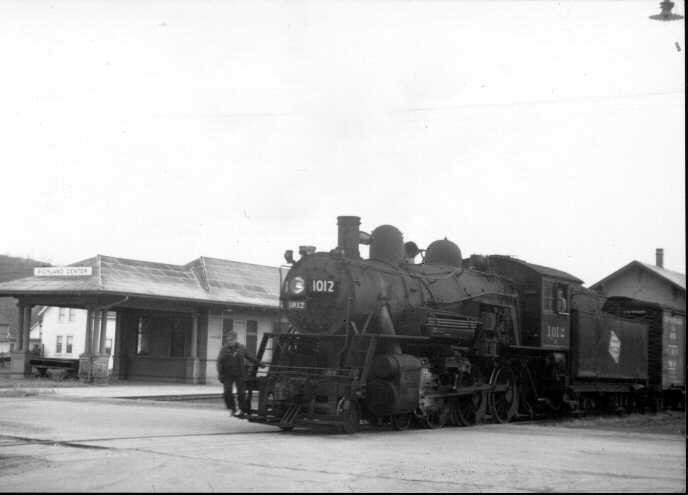
Those arches ("modern renaissance" on the outside, echoed over the ticket windows inside) were state of the art in 1965, and that "silly bell tower" was characterized by Trains as "a nod to its 1886 predecessor" which had a full clock tower. The porte-cochere came in handy for transferring to taxis on a rainy day, as well as honoring a Milwaukee Road tradition (see the new and old Sturtevant stations, as well as Milton, or Richland Center with its canonical porte-cochere.) All the same, the station upgrade is good to see.


Let me take this occasion to remind readers, and Journal-Sentinel editorialists, what speeds used to be routine on that railroad.

27.3.24

IT'S A LITTLE LATE TO DEVELOP A CONSCIENCE.

University of Illinois at Chicago sociologist Barbara Risman gets mugged by reality.  "Does UIC want to outcompete the Ivies for antisemitism?"  She thought her liberalitas would get her a free pass from the Thought Police.
I came to the University of Illinois at Chicago as head of sociology, expecting to spend the rest of my career here. Committed to the university’s social justice mission honoring diversity, equity and inclusion, I co-chaired the universitywide committee on faculty equity for more than a decade. UIC has been my beloved academic home.

Then came Oct. 7. Across the country, support for Palestinians quickly escalated into ripping down posters of hostages and committing hate crimes against Jews. Members of Congress held hearings about antisemitism at Ivy League schools. Lawmakers spotlighted bias at elite institutions, but I’d bet UIC could compete with the Ivies for ranking in the top 20 for antisemitism.

As an adamant defender of free speech. I support the right of everyone on campus to voice opinions about Israel. To critique the Israeli government isn’t antisemitic at all. Israelis do it often and loudly, even during war.

Individual free speech and university programs declaring their political positions using state resources, however, are radically different. When university resources are used to support some and alienate others, a hostile environment is bound to emerge.
Bound to emerge? How epistemically closed is the sociology common room?  "Back in the day, the common room might have people who would respond to a contrarian viewpoint with "How can you say that???"  Often, though, you could talk them off the ledge.   Sometimes, though, they never learned how not to be stupid about being smart."  I wrote that post in the spring of 2022, and continued, "It takes a bit of nerve to defy conventional wisdom.  When being stupid about being smart goes from doubt to hectoring to condescension to outright rudeness, the epistemic closure might have unintended consequences."

16.2.26

DON'T BRING GRANDMA'S O-CEDAR ANGLER TO THE BONSPIEL.

As surely as the East German judge will screw over the American figure skater and somebody will wipe out on the ski slopes, the coverage of curling during the Olympics will inspire wiseacres to find a slippery flat surface and something that will slide and parody the sport.  This year's wiseacres have used a Roomba or a teakettle or a baby in a basket.  The infant appeared to enjoy the experience.
Dig out your squidgy mop, a few pots and pans — or a robotic vacuum if you have one — and a pair of slippers.

It’s curling time!

Social media has been ablaze with people deploying common household wares to mimic what the world’s top curlers are doing at the Winter Olympics.

“Every four years, it blows up,” American curler Tara Peterson said. “Everyone’s like, ‘We want to do it,’ and then, yes, they get creative with things, so it’s awesome.”
Whether any of those social media attention hounds actually take up the sport I don't know.  It's not that hard to get involved, particularly if you live in a northern city.  The local curling club probably occupies a nondescript building in an industrial area of town, unless the town is Green Bay, where the nondescript building is literally in the shadow, at least during summer sunsets, of Lambeau Field.  And yes, there are some light industrial buildings as well as several sports bars you might have heard of nearby.

Curling has distinctive jargon, which means they'll refer to a tournament as a "bonspiel."  That sounds Teutonic but judging by this announcement from Milwaukee, the theming is Scottish.  Logical, the sport probably got started when somebody wondered if he could slide a chunk of granite across Loch Ness on a boring winter day with not much sunlight.  There's a full schedule of such tournaments, some for the club members and some open for other clubs, in Chicago.  Milwaukee's club claim to be the oldest club in continuous existence in the States, although not in continuous existence at one location, as is true of a model railroad club in Sudsville.

Grandma's O-Cedar Angler enters the conversation because in this year's Olympic coverage, I didn't see anything that looked like you could use it on the kitchen floor or to remove snow from switch points.  In previous years, I recall pictures of competitors holding something like that.  That got me wondering, were the competitors using association-sanctioned tools?

8.8.15

DO THE RESEARCH.

"No Irish Need Apply" is real.  A middle school student was able to find evidence that peer review, in this instance with The Oxford Journal of Social History, agreed didn't exist.
Rebecca Fried had no intention of preserving the record of a persecuted people whose strife was ready to be permanently written off in the eyes of history as exaggerated, imagined, or even invented.
But with the internet, it's relatively easy to fact-check even peer-reviewed research, in this example by retired Illinois-Chicago historian Richard J. Jensen.
The fact that Irish vividly "remember" NINA signs is a curious historical puzzle. There are no contemporary or retrospective accounts of a specific sign at a specific location. No particular business enterprise is named as a culprit. No historian, 2 archivist, or museum curator has ever located one 3; no photograph or drawing exists.4  No other ethnic group complained about being singled out by comparable signs. Only Irish Catholics have reported seeing the sign in America—no Protestant, no Jew, no non-Irish Catholic has reported seeing one.
Such a story might have potential, as the Daily Beast article notes, to change the nature of the contemporary Oppression Olympics.  But it's the way Ms Fried found evidence to the contrary, and the academy's reaction, that I wish to address.
After only couple of hours Googling it, Rebecca, a 14-year-old, had found out these signs had, in fact, existed all along. Not only in newspaper listings—in which they appeared in droves—but, after further research, in shop windows, too.

The Irish were persecuted in the American job market—and precisely in the overt, literally written-down way that was always believed.

All of this would have been written off as a myth if it weren’t for Rebecca Fried, a rising high school freshman—who one of the preeminent scholars on the Irish diaspora in the United States now calls a “hero” and “quite extraordinary”—and who simply couldn’t believe it, either.

Rebecca never set out to prove the thesis wrong. She was just interested in an article her dad brought home from work one day.
Parents: engage your childrens' brains. Good stuff can happen.  Ms Fried is at Sidwell Friends but it's just as important if your youngsters are at DeKalb High or Milwaukee Hamilton.
“Now and then I bring home stuff for the kids to read if I think they will find it interesting or will convey some lesson,” says Michael Fried, Rebecca’s father. “Half the time they don’t read them at all. Sometimes they’ll read something if I suggest it. Nothing has ever come of any of these things other than this one.”

Rebecca wasn’t even trying to disprove her dad—let alone an academic at the University of Illiniois-Chicago. She just figured she’d Google the words and see what came up over 100 years ago.

“Just for the fun of it, I started to run a few quick searches on an online newspaper database that I found on Google,” she says. “I was really surprised when I started finding examples of NINA ads in old 19th-century newspapers pretty quickly.”

So she started collecting a handful of examples, then dozens, then more. She went to as many newspaper databases as she could. Then she thought, somebody had to have done this before, right?
Evidently not, and after a few struggles (read the article and note the way Professor Jensen threw an identity politics card on a colleague who was advising Ms Fried) there's a peer-reviewed note in The Oxford Journal of Social History written by a high schooler.

Well done, and it's consistent with stories I heard out of Detroit.  Small sample, but two young ladies independently reported that their grandparents had dropped the leading O'- from their family names, the better to pass as Not Irish.