12.8.12

IT'S NOT THE CRIME, IT'S THE COVER-UP.

Daily Chronicle commentator Jason Akst also works for Northern Illinois University, where there might be misappropriation of state property.
I love NIU, and I love and need my NIU job. So, I won’t intentionally investigate or sensationalize news originating from NIU. Also, I can barely see the loop from where I work. I’m certainly not in it.

On the other hand, I’m a journalist and a journalism educator, and I hate cowards, so it’s unacceptable to duck commentary on bad news if such commentary is legitimate. If I did that, I should be fired anyway.

It’s a fine line.

I urge the Daily Chronicle to vigorously pursue 1) last week’s revelations of a “coffee fund” (aka slush fund) paid for by selling NIU scrap metal to a local merchant, and 2) the substantial hierarchical reorganization of NIU senior leadership.

Meanwhile, I applaud NIU officials in saying they’re taking the coffee fund investigation seriously. I hope they follow the advice of every worthwhile public relations book ever written: get in front of the storm and tell the unvarnished truth, though there likely will be negative consequences.
In Mr Akst's view, the negative consequences of telling the truth will be less negative than those of not telling the truth.


Alas, universities often avoid this path until disclosure is forced. Look no further than Penn State. Notable exception: NIU won a national PR award for its handling of the shootings in 2008.

What I recommend is irrelevant anyway. Thousands of NIU employees and area residents already seem to think there’s more to the story, and they’re suspicious.
It gets harder for the publicists, the more bad news that dribbles out.
Answering the demand for honesty and transparency is likely going to cause short-term damage. There’s a notion in public relations that for every negative mention an organization receives in the news media, the organization must achieve three dozen positive mentions to overcome it.

If the investigation proves to be lengthy and/or sensational, you can do the math. It’s not just an NIU phenomenon. The luster of higher education in America is wearing off. Fast.
Yes, universities are failing at their mission, and the concluding paragraphs of the column identify failings that matter, whether or not a few shelf brackets get into pickup trucks without a property control slip.
Just over a year ago, the Pew Research Center conducted national surveys of the public’s attitude toward higher education in America. The results are depressing:

• 57 percent of Americans say the U.S. higher education system fails to provide students with good value for the money they and their families spend.

• 75 percent say college is too expensive for most Americans to afford.

• 42 percent say a college education is required to succeed in the world.

• 38 percent of college presidents say academe is headed in the wrong direction.

So NIU needed last week’s news, which inevitably will continue as the stories unfold, like a hole in the head. What we really need is to achieve several consecutive crisis-free years.
I believe he's referring to public relations crises, or an absence of afterparty violence, or a clean academic year for the sports programs.  Many of the items on the bullet list are administrative failures, often under the rubric of attempting to be all things to all matriculants, and obsessing over diversity, or over access-assessment-remediation-retention.  Shaking up the buildings and grounds department does nothing about those deeper problems.

8.8.12

TEMPERING THE CREATIVE DESTRUCTION.

Nouriel Roubini and Stephen Mihm collaborated on Crisis Economics: A Crash Course in the Future of Finance.  Book Review No. 27 will be brief and favorable.  It's readable, and intuitive.  Despite that, it clarifies some of the subtleties of complex financial products.  Apparently, there are some conditions under which even a properly-weighted portfolio of subprime mortgages -- one in which there's a conservative estimate of how much principal and interest will be forthcoming to support the gilt-edged tranche -- can be catastrophically undone.  In addition, traders were active constructing portfolios of portfolios, up to some order greater than two, and these were subject even more to relatively small hiccups in the housing market.  Looking forward, the authors suggest that in order for labor and capital markets to foster greater resource mobility and creative destruction, greater government involvement in job retraining, unemployment insurance, and portable health insurance is desirable.  That debate is properly left to other authors.

(Cross-posted to 50 Book Challenge.)

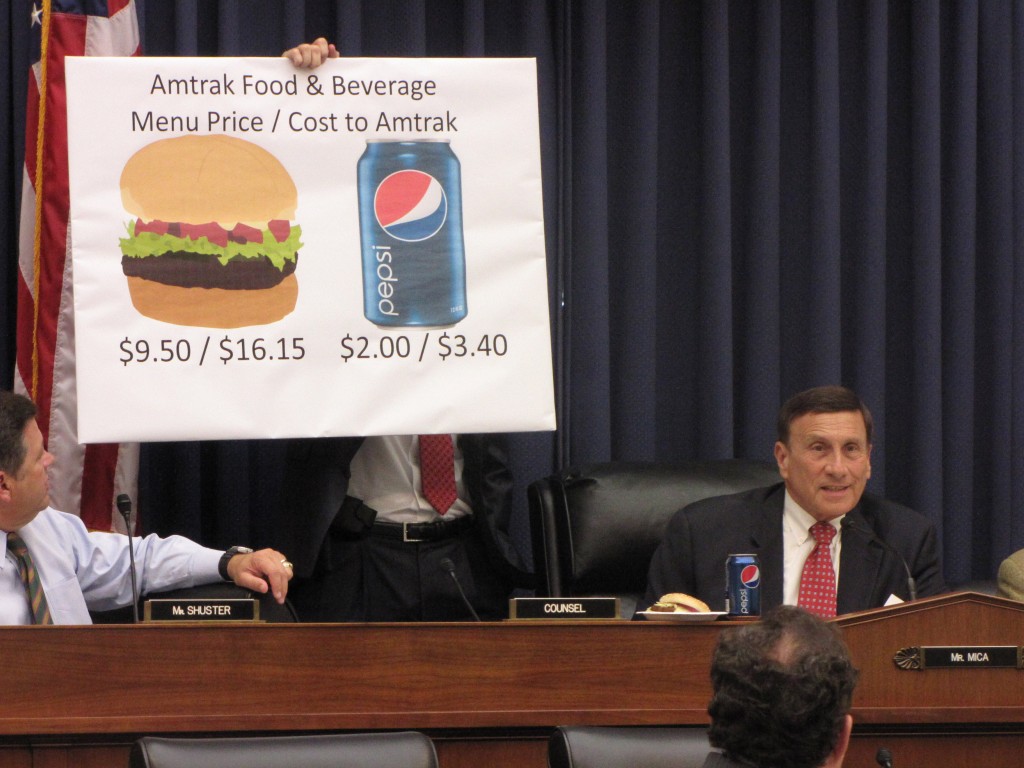
THEY MAY BE NON-REVENUE CARS.

But there's something wrong when Amtrak loses the kind of money it does on food service.


Congressional hearing.  Image courtesy The Heritage Foundation.

Representative Mica might not be the most dependable critic of Amtrak, as he'd apparently like Passenger Rail to go away.  Bloomberg's Josh Barro comments.
Selling edible food at a profit is not rocket science. Even the airlines have increasingly figured out how to do so. If Amtrak can't do it itself, it could outsource its food service operations to a company like Gate Gourmet that has expertise in travel catering.

Why doesn't Amtrak do this? Nick Rahall, the ranking Democrat on the House Transportation and Infrastructure Committee, has one answer. He says Amtrak food service jobs are well-paying, and we shouldn't eliminate them, even if the food service is expensive and terrible. “It’s a whopper of an idea, trading good-paying jobs for cheaper hamburgers,” said Rahall.
In order of rising complexity, three observations. First, putting "edible food" within sixty words of "airline" strains credulity.  Second, there might be a job description constraint that's raising reported food service costs.  The superintendent of dining services for the North Shore Line reported that his department operated at a modest profit, right to the end.  Perhaps the assistance of the collector in drying glassware and putting it away at the end of the run helped, as the transportation department paid the collector's wages for the trip.  It might do something for Amtrak's goodwill, though, if housekeeping help from the assistant conductor would allow the snack-car attendant to remain open until the end of the run. The practice of keeping the snack-car closed until the train is well out of its originating station and closing it an hour out of the terminating station doesn't make the carrier many friends, no matter how helpful that clean-up time is to the attendant.  And Rep. Rahall has a point.  Food service attendants have to understand train safety in a way that the minimum wage kid at a bun-'n-run doesn't.  Third, Amtrak's outsourcing might be the root of the problem.  The Governmental Accountability Office report that has provided the material for Rep. Mica's recent hearing, and the accompanying grandstanding, identifies problems with internal controls and audits of Amtrak's contract for catering from ... Gate Gourmet.  See page 82.  Never mind all the verbiage about lack of a strategic plan or shortcomings in internal controls.  The simplest explanation might be ... government contracting.  Gate probably get indirect cost returns on each case of pop or cooler-pack of microwaveable hamburgers, and that has to contribute to the $3.40 Pepsi, the same way that a fighter-plane toilet seat becomes a $800 purchase.  Amtrak could get its pop and chips more cheaply by issuing cash to snack-car attendants who would purchase cases of pop and chips from the grocer, an emergency measure that snack-car attendants sometimes use when supplies run out, and the method the North Shore Line used for some Electroliner provisions.  Might even work as a small-business stimulus, a little bit of indirect cost return borne by the dining department, and a little bit borne by local householders, all over this land.  The difficulty there, though, is that the same government report suggests there is some nest-feathering by some food service employees.

TIME FLIES WHEN YOU'RE HAVING FUN.

A brain is a resource with finite capacity, and resources have opportunity costs.
Working memory capacity is the aspect of thought responsible for simultaneous storage and processing of information. It allows us to juggle mental tasks, focus on what’s most important and act in the moment. A high working memory capacity has been shown to be closely related to high IQ and academic performance.
There's the germ of another study in the details.
Those who had scored highest for working memory capacity were significantly more accurate in solving the math problems but did poorly at determining how much time had elapsed. They typically exceeded the allotted duration – or lost track of time.

Participants with lower scores for working memory capacity were less accurate on the math problems but better at keeping track of the time.
All those Strict Parents who told their kids "If you spent half the time working the problem that you do fussing about the work" might have had a point. And it boils down to scarcity and opportunity costs.
“Generally it would have been thought that individuals with high working memory would perform better at both tasks – the mathematical problems and keeping track of time,” [psychology doctoral student James] Woehrle says. “But our results suggest an interesting tradeoff, which we had hypothesized.

“We showed that an individual’s ability to control his or her attention affects how he or she perceives the passage of time,” he adds. “Since the math problems were clearly identified as the primary task, the findings appear to support other research suggesting that individuals with higher working memory capacity have better attention control.”

The researchers believe the experiment results would be even more pronounced with more difficult and time-consuming tasks and that people who possess high working memory capacity are likely to experience the time-flies phenomenon more often.

“The punch line is it gives people with a high working memory an excuse for being late,” Woehrle laughs.
The research also suggests that multitasking is counterproductive, akin to shifting focus from the math problems to the clock to the problems...

BE CAREFUL WHAT YOU ASK FOR.

Paid advocate Chris Matthews concludes his 7 August show with a list of Republicans he'd like to see address the national convention, as a warning to voters about "the screeching of bedlam" that could await the Republic.

Visit NBCNews.com for breaking news, world news, and news about the economy

I note only that neither Mr Matthews nor his almost as hyper colleague Lawrence O'Donnell, nor a few of the more egregious urban ward-heelers in Congress, are likely to be prime-time speakers at the Democratic convention, despite the truth in packaging their presence would present.

Nor should either party put its truest believers on display.  It is not for their benefit that there are prime-time convention speeches, which are properly for the persuasion of the median voter, unless the true-believers have quadratic loss functions.

6.8.12

OPUS POSTHUMOUS.

Isaiah Berlin and Hugh Trevor-Roper have crossed the final summit, and yet their students continue to assemble research notes into books.  Adrian Wooldridge sees in the popularity of dead academics a flaw in the incentives facing living academics.
IT IS HARD to gaze on the mounting pile of books by Berlin and Trevor-Roper without worrying that they tell us something about the state of modern academia. The world employs more academics than ever before. Most of these academics believe that they are engaged in a progressive project, producing fresh research, advancing the frontiers of know-ledge and putting their predecessors, ever so gently, in their places. And yet many of us prefer to read the work of a couple of dead Oxonians whose minds were formed in the 1930s.

The modern university is governed by an ever-proliferating thicket of rules, some of them invented by the professors themselves, to regulate admission to the guild, some of them imposed by a suspicious public. Aspiring academics must get a licence to operate in the form of a PhD (which can take up to a decade) and then publish in the right specialist journals. They must doff their caps to the lords of their particular universes and genuflect before the latest modish theorems. Academic bureaucrats tell them how to deliver their lectures and interact with their pupils. Yet other bureaucrats, some of them based in universities and others in government, assess their “productivity” and award money or promotions accordingly.
I concur in part, and dissent in part. The Ph.D. is a research degree, and it signals that the holder has produced a first attempt at research that meets the standards of the student's committee, and one well-placed wag in economics wrote advice for the Ph.D. on the job market including the quip that the committee has lower standards for the paper than the student does.  Think about it.  But the degree is at best a noisy signal of the holder's teaching ability, and in an environment where the scholar produces and transmits knowledge, getting the teaching right matters.  Thus one set of bureaucrats, although it makes no earthly sense to have those bureaucrats in thrall to the latest modish ideas of one set of researchers.  And the research is at best a noisy signal of the author's contribution, thus the obsession with impact factors and the like.  And yes, priors matter.

That noted, Mr Wooldridge's tribute reminds me of a Sibelius bon mot, about the fashionable composers of the day serving champagne cocktails, while he was offering glasses of clear, cold spring water.

WHERE EVERYBODY KNOWS YOUR NAME.

At one time, the corner tavern was an antidote to drunken driving, as it was a short walk down the block and a short stumble home.  Some of the major streets on the south side of Milwaukee gave the impression of three taverns and a church every four blocks.  But no more.
For decades in Milwaukee, the corner tap - often owned and operated by the same family - was the neighborhood gathering place. It helped earn the city a reputation as a hard-drinking town. The city's website notes that "places that serve alcohol are a part of the fabric of Milwaukee. From corner bars to crowded beer halls and nightclubs, this is, after all, a town that's been called 'Brew City.' "

But the family-owned tavern is beginning to give way to bigger and splashier bars. The new places are larger and often focus on sports, with dozens of big-screen TVs, or games, or music. Or anything in between.

"People who come in now for a license want something that is cool and extremely successful," said Ald. Terry Witkowski, whose district includes the Plainfield Pub. "That means a large place. A big business. That's the kind of people who are coming in now."

In some areas near the south side there used to be a bar on every corner, added Ald. Jim Bohl, who served on the Common Council's licenses committee for 12 years. But now aldermen are sensitive to arguments that there are too many bars in neighborhoods.
The article suggests changing demographics and preferences.
Consumer tastes have changed, as well. Bohl, the alderman, observed that older people who may have been more inclined to frequent the corner tap have moved out of the city. In contrast, more and more young people are moving to the city. They, in general, prefer the sights and sounds of N. Milwaukee, Water and Brady streets.

That leaves family taverns with a declining and aging customer base. Seibel said her customers range in age from 40 to 90.

"It's getting harder and harder to make it," [Plainfield Pub owner Deb] Seibel said. "The cost of licenses keeps going up. You need permits for everything. The breweries increase their prices every February. A couple of years I made a profit, but it wasn't much."
Preferences might evolve, but so, too, the social institutions.  In the era of the corner bar, the Catholic Youth Organization was for identifying potential sweethearts, and high school followed by a factory job was for sealing the deal.  Say the vows on one corner, hold the post-reception party on another.  A six-stool bar with the bowling trophies by the door and a color TV tuned to the Braves or Packers (no Cubs on WGN in those pre-cable days) would serve.  But with date-and-mate prolonged or postponed into career-establishing time, a thicker meet market makes more sense, thus the larger bars clustered in the neighborhoods where the cliff-dwellers dwell.

LOOKING LIKE A FOOL WITH YOUR PANTS ON THE GROUND.

Spirit Airline still maintain minimal standards of decorum.
A man was kicked off a Spirit Airlines flight atO'Hare International Airport over the weekend after he became "verbally abusive" to flight attendants who asked him to pull up his sagging pants, an airline spokeswoman said.

The man and the woman he was traveling with Sunday morning threatened physical harm to flight attendants who had asked him to pull up his pants, which were "excessively low," hanging below his buttocks, Spirit spokeswoman Misty Pinson said. The man was boarding the Orlando, Fla.-bound plane when flight attendants spoke to him, she said.

Crew members may ask customers to comply with various requests if they are in "the best interest" of the other customers, Pinson said.

When law enforcement officers arrived, the two Spirit customers gathered their things and left the plane.
The airline rebooked the pair, presumably more suitably attired to travel, on a subsequent flight.

THERE'S A LITTLE TIN BOX.

It's emptied to buy coffee, according to the DeKalb Daily Chronicle.
A local scrap metal company employee says his business has paid thousands of dollars to Northern Illinois University employees selling scrap metal from the university, who then deposit the money in an account known as “the coffee fund.”

Bill Kunkel, head of transportation for DeKalb Iron and Metal Company in DeKalb, said that for years he’s been writing checks to what’s called the “coffee fund,” an account NIU spokesman Paul Palian said university officials weren’t aware existed.

Kunkel said several employees, mainly from NIU’s Physical Plant, have sold scrap metal from the university to DIMCO on and off for at least the past 25 years. The company’s electronic records date back to February 2005, and checks from [DeKalb Iron and Metal] since that time have totaled more than $13,000.
Senior administrators say there is no record of such a fund, but they are investigating.

2.8.12

YEAH, LET'S GET RID OF MATHEMATICS.

David Foster comments on the difficulties, recession or no, businesses have finding workers with quantitative skills.
Journalists and academics often blame the missing-skills problem on what they claim to be the higher skill levels required by today’s technology, but I think this aspect of the situation is overstated. I doubt that a present-day manual for an alarm system is really a more complex document than, say, a maintenance manual for a piston-powered airliner circa 1950. And while a modern CNC machine tool does require (at least) a knowledge of decimal arithmetic to program or probably even to set up, a true machinist on traditional equipment also needed this knowledge. It is possible that the average mix of verbal and mathematical literacy requirements for jobs has shifted somewhat upwards as a result of advancing technology and increased management focus on worker involvement, but I think the main problem is not that the skill requirements have become dramatically higher but rather the skill levels of the prospective workers coming out of the schools have gotten lower.
That doesn't stop some people from suggesting that school completion might be enhanced by reducing the obstacle to completion called algebra.

TRAIN YOURSELF TO RELAX.

At The Christian Science Monitor, Andrew Holland suggests that building additional roads is unlikely to reduce traffic congestion.
In our biggest cities — also the source of the greatest portion of our wealth creation — the highways and transportation systems are becoming more jammed by the day. It should be obvious that more transportation infrastructure options are needed in America’s densely packed regions.

The Interstate Highway System has been successful in linking the country together, but I’m afraid that it promotes sprawling, auto dependent development — which essentially outsources a major cost (fuel) to consumers. More highways, even if they could be built to meet capacity, are not the answer for dense regions because they have proved to only encourage more oil-dependent sprawl.

I believe that High Speed Rail (HSR) is the way to build dense, interlinked cities and regions.
It is true that vehicle ownership has increased by a greater proportion than has new road mileage. All the same, the Law of Peak Hour Expressway Congestion will continue to bite, as road commuters will take the benefits of new roads in the form of sleeping in a few more minutes.

That noted, High Speed Rail is likely to be the long term solution.  In the immediate run, faster running times for commuter and regional intercity trains, better connectivity among trains, and strategic placement of third tracks and interlockings to keep local trains out of the way of limited and express trains will entice riders out of their cars.  As that ridership grows, political sentiment may follow.  The answer to "Why can't we have faster trains in Indiana the way they have in Michigan?" is going to be very different than "Why can't we have passenger trains here the way they have in Europe (or China or Japan)?"  Regular readers know that the answer to the latter question is "Neither the Europeans nor the Chinese have stack trains or 125 car coal and grain trains."

FAT, DUMB, AND DRUNK IS NO WAY TO ROW.

The Milwaukee Journal-Sentinel introduces a local Olympian with an unusual lede.
Megan Kalmoe wanted to make a change after her freshman year at the University of Washington, when she filled the gaps between "partying myself and my waistline into oblivion" with a whole lot of nothing.

On the scale of slug to Olympian, she was much closer to slug.

Kalmoe, a native of St. Croix Falls, Wis., decided to do something totally out of character as a sophomore and walked onto the school's rowing team.
College is supposed to be about second chances, and Ms Kalmoe has surely done well with hers. All the same, is there nothing the university can do to diminish the incentives to party to oblivion?

1.8.12

STROKE, STROKE, STROKE.

The United States eight, with the James twins aboard, finished just outside the margin of error.
The 2012 Olympic edition was one of the most exciting of all time, with all six boats finishing within about a length of one another.

Overwhelming favorite Germany took the gold in 5:48.75. Canada slipped past Great Britain in the last few hundred meters to snatch silver with a time of 5:49.98, while the British in 5:51.18 barely held off the hard-charging Americans. The U.S. clocked in at 5:51.48.
With the start of a new semester approaching, I'm considering how to turn three-tenths of a second short of a medal into three-tenths of a point short of a B.

BILLIONS OF DOLLARS, AND NOT A STACK TRAIN TO BE SEEN.

Fox Business interprets China's increased spending on railroad tracks as an economic stimulus project.
In its latest bond prospectus published on Chinabond, an official website for debt issues, the railway ministry said Monday it plans to spend 470 billion yuan (US$73 billion) on infrastructure investment this year, up from the CNY406 billion stated in a prospectus issued earlier this month.
The Association for American Railroads reports that freight railroads have invested a total of $500 billion dollars (these are probably non-comparable current dollars) on permanent way improvements since 1980.  Those moneys have produced a 70 mph Kate Shelley Bridge in Iowatwo main tracks through the Abo Canyon, and up to four tracks for fluid movement of coal trains in the Powder River Basin.

SPREADING THE WEALTH AROUND.

It's usually good news to be the fourth-best gymnast in the competition.  Unless the second- and third-best are also on your team, and you're at the Olympics.
It’s an emotional day for this American team, which has just delivered a remarkable performance and set the score to beat in the qualifications of these Olympic Games.  But it’s a shocking heartbreak for America’s national and world champion, and one of the favorites to win the biggest prize of all here in London. 
I don't know the origin of this quota for country qualifiers. Wouldn't it be karma if the rule was pushed through with the urging of the U.S. Olympic Committee during the Cold War as a way of limiting Soviet medals?

31.7.12

YOU GET EXCELLENCE WHERE YOU EXPECT EXCELLENCE.

The people who wash out of Navy SEAL training are by no means slouches.
The seven or eight out of ten men who fail or quit SEAL Training in the Navy are not just average guys walking the streets today, their the best the Navy has.

These are guys who have worked their asses off to get to BUD/S. The best runners, the best swimmers, above average intelligence, superior eyesight and physical strength.

These are the guys who quit or fail training and not some regular clown that thinks it looks cool.

Why do they fail? Simple... They are completely unprepared to be thrown in the Arena at BUD/S. They have no idea how hard it is, they have no idea what kind of guys become SEALs, they have no idea of the commitment, and they have no idea of the life style.

In short, they think they know, but what the really know is next to nothing about being a SEAL and they quit. Fast...
As I type this, the Games of the XXX Olympiad are in progress, and it's a good bet that many a young man with dreams of the Dream Team will not put enough effort into making free throws to make the junior high junior varsity.  Football training camps are open, and more than a few linemen will be cut for not getting started on the snap-count.

Put it together: there's no question about doing whatever it takes to get the best Special Forces, where the stakes are very high, or the best athletic teams, never mind the stakes.

But getting the best quantitative thinkers?  Retired political scientist Andrew Hacker views the attrition from middle school algebra with dismay.
A TYPICAL American school day finds some six million high school students and two million college freshmen struggling with algebra. In both high school and college, all too many students are expected to fail. Why do we subject American students to this ordeal? I’ve found myself moving toward the strong view that we shouldn’t.
Let's focus on the substance of his argument, rather than the tangential possibility that many of those students, particularly in middle school, don't bother with algebra because the school culture has teachers looking the other way, particularly where promising athletes are concerned.
Making mathematics mandatory prevents us from discovering and developing young talent. In the interest of maintaining rigor, we’re actually depleting our pool of brainpower. I say this as a writer and social scientist whose work relies heavily on the use of numbers. My aim is not to spare students from a difficult subject, but to call attention to the real problems we are causing by misdirecting precious resources.
The misdirection is probably someplace else. Is the military depleting its pool by making Special Forces training so hard?
Mathematics, both pure and applied, is integral to our civilization, whether the realm is aesthetic or electronic. But for most adults, it is more feared or revered than understood. It’s clear that requiring algebra for everyone has not increased our appreciation of a calling someone once called “the poetry of the universe.” (How many college graduates remember what Fermat’s dilemma was all about?)

Instead of investing so much of our academic energy in a subject that blocks further attainment for much of our population, I propose that we start thinking about alternatives. Thus mathematics teachers at every level could create exciting courses in what I call “citizen statistics.” This would not be a backdoor version of algebra, as in the Advanced Placement syllabus. Nor would it focus on equations used by scholars when they write for one another. Instead, it would familiarize students with the kinds of numbers that describe and delineate our personal and public lives.
Perhaps so. On the other hand, Jason Fertig suggests a rebuttal, based on efforts elsewhere in the liberal arts to make the material more accessible.
Why not cut history and literature while we’re at it? How vocational are those subjects? Also, many students get away with subpar writing in non-quantitative classes; if that writing were assessed with more rigor, we would see failing numbers akin to what we see in calculus classes.
Quite possibly true.  Daniel Willingham (via Marginal Revolution) offers a more scholarly rebuttal.
The inability to cope with math is not the main reason that students drop out of high school. Yes, a low grade in math predicts dropping out, but no more so than a low grade in English. Furthermore, behavioral factors like motivation, self-regulation, social control (Casillas, Robbins, Allen & Kuo, 2012), as well as a feeling of connectedness and engagement at school (Archambault et al, 2009) are as important as GPA to dropout. So it's misleading to depict math as the chief villain in America's high dropout rate.
That's tangential to tonight's argument, although it's consistent with the Cold Spring Shops theme that inculcating middle-class habits might be the most important thing the common schools can do.
But the explicit teaching of abstractions is not enough. You also need practice in putting the abstractions into concrete situations.

Hacker overlooks the need for practice, even for the everyday math he wants students to know. One of the important side benefits of higher math is that it makes you proficient at the other math that you had learned earlier, because those topics are embedded in the new stuff.
We take it for granted that Special Forces take target practice every day, and the basketball Olympians spend an hour a day shooting free throws. It somehow becomes abusive for U. S. schools to expect similar perseverance, never mind that Professor Hacker attributes Finnish and Canadian math performance to perseverance?
Who will learn higher math in Hacker's ideal world? He's not clear on this point. He says he's against tracking, but notes that MIT and Cal Tech clearly need their students to be proficient in math. Does this mean thateveryone gets the same vocational-type math education, and some of those going on to college will get access to higher math?

If that were actually implemented, how long before private vendors offer after school courses in formal mathematics, to give kids an edge for entrance to MIT? Private courses that cost, and to which the poor will not have access.
Indeed.  But perhaps it requires parents, teachers, school administrators, and students to insist that children get the kinds of opportunities to develop their intellectual capital, and the grooming of talent, that everyone appears to take for granted when it comes to the sports program.  With sufficient thrust, pigs fly just fine.

SITUATIONALLY UNAWARE.

Eyes on the sidewalk, people.
On city streets, in suburban parking lots and in shopping centers, there is usually someone strolling while talking on a phone, texting with his head down, listening to music, or playing a video game. The problem isn’t as widely discussed as distracted driving, but the danger is real.

Reports of injuries to distracted walkers treated at hospital emergency rooms have more than quadrupled in the past seven years and are almost certainly underreported. There has been a spike in pedestrians killed and injured in traffic accidents, but there is no reliable data on how many were distracted by electronics.
There has to be an update of this old trademark of the Long Island Rail Road, showing contemporary device-thumbing commuters crashing into each other, or, worse, walking into the path of a train.


We used to say of a klutz that he couldn't walk and chew gum at the same time. Walking and texting is more difficult.
A study by researchers at Stony Brook University in New York compared the performance of people asked to walk across a room to a target — a piece of paper taped to the floor — without distractions and then again next day while talking on a cellphone or texting. The group that talked on the cellphone walked slightly slower and veered off course a bit more than previously, but the texting group walked slower, veered off course 61 percent more and overshot the target 13 percent more.

“People really need to be aware that they are impacting their safety by texting or talking on the cellphone” while walking, Eric Lamberg, an associate physical therapy professor who conducted the study, said. “I think the risk is there.”
The world we live in, however, is a world in which using public resources to protect people from themselves becomes the default policy option.
State and local officials are struggling to figure out how to respond, and in some cases asking how far government should go in trying to protect people from themselves.

In Delaware, highway safety officials opted for a public education campaign, placing decals on crosswalks and sidewalks at busy intersections urging pedestrians to “Look up. Drivers aren’t always looking out for you.”

Philadelphia officials are drafting a safety campaign that will be aimed in part at pedestrians who are looking at their devices instead of where they’re going. “One of the messages will certainly be ‘pick your head up’ – I want to say ‘nitwit,’ but I probably shouldn’t call them names,” said Rina Cutler, deputy mayor for transportation and public utilities.
Hey, it's Philadelphia, where Eagle fans boo Santa Claus. "Nitwit" is polite.  For those decals to work, people have to notice them, which they aren't doing if they're playing Angry Birds.  London's "Look Left" or "Look Right" curb markings work, in part, though, because pedestrians visiting from much of the rest of the world grasp that British street use is a survival of the days of mounted swordsmen.

30.7.12

A NOISY SIGNAL OF SOCIABILITY?

Truthdig's Chris Hedges doesn't like beer-'n-circus.
Fraternities, sororities and football, along with other outsized athletic programs, have decimated most major American universities. Scholarship, inquiry, self-criticism, moral autonomy and a search for artistic and esoteric forms of expression—in short, the world of ethics, creativity and ideas—are shouted down by the drunken chants of fans in huge stadiums, the pathetic demands of rich alumni for national championships, and the elitism, racism and rigid definition of gender roles of Greek organizations. These hypermasculine systems perpetuate a culture of conformity and intolerance.  They have inverted the traditional values of scholarship to turn four years of college into a mindless quest for collective euphoria and athletic dominance.
Makes for a good polemic, and against the background of football practice beginning and probation officers returning from summer vacation, it might be timely. But the article fails to test any hypotheses.
The corporate world sees football players, fraternity brothers and sorority sisters as prime recruits. They have been conditioned to join the team, to surrender moral autonomy, to accept and carry out acts of personal humiliation, to treat with contempt those who oppose them or who are different, to define their life by an infantile narcissism centered on greed and self-promotion and to remain silent about crimes they witness or take part in. It is the very ethic of corporations.

The ruling elite sees in Greek organizations and football programs the training ground for the amoral class of speculators, bankers and corporatists who pillage the country.
Perhaps a small sample drawn from Dartmouth College will convince some readers. But more formal investigations are possible.
The fraternity and students value wages and fraternity socializing values. We provide sufficient conditions under which, in equilibrium, most members have intermediate abilities: weak students apply, but are rejected unless they have high socializing values, while most able students do not apply to avoid taint from association with weaker members.
In the Bayesian equilibrium, fraternity membership is at best a noisy signal of ability, valuable to sociable but low-ability students, but therefore poison to high-ability students, the more sociable of whom would be offered membership in the fraternity, if they bothered to rush.  In a full-information world, there is a separating equilibrium in which only high-sociability individuals apply and only mediocre or high academic individuals pledge.   Perhaps that cohort is "amoral": there's always another research question to ask.

The working-paper version of the article offers additional evidence on fraternity membership patterns at the University of Illinois.  The probability that a student is a fraternity member, conditional on grade point average, increases for grade-point averages below 3.5, decreasing thereafter.

That evidence is not in the published article, but the supporting data are available at the American Economic Association website.

RECLAIMING THE CULTURE?

In a nation of moochers, epater les bourgeois is out of fashion, according to Glenn Reynolds.
In today’s culture of immediate reward, a work ethic centering on self-discipline and the ability to defer gratification is almost, to use a favorite term of the avant-garde, transgressive. Hmm: With so much of our economy and politics now based on the absence of those characteristics, maybe it really is a bit transgressive.

But those mores just may be making a comeback in these tough times. The fact is, self-discipline and the ability to defer gratification really do help you get ahead, avoid debt and feel more in control of your life.

In boom times, even slackers can do well enough (or borrow enough to seem to) to make those rules seem old-fashioned and unnecessary. But when the bust comes, reality reasserts itself and those trite sayings (“waste not, want not,” “neither a borrower nor a lender be,” etc. — Kipling’s “Gods of the Copybook Headings”) turn out to be not so much trite, as true.

At any rate, we can hope that saving money, avoiding debt and treating friends and family with consideration are now edgy enough to become trendy.
Perhaps so, although those strivers might be the remnant in a country increasingly occupied by Romulans.  In Victor Davis Hanson's neighborhood, trendy California is no longer the California of the Beach Boys.
The internet, video games, and modern pop culture translated into a generation of youth that did not know the value of hard work or a weekend hike in the Sierra. They didn’t learn  how to open a good history book or poem, much less acquire even basic skills such as mowing the lawn or hammering a nail. But California’s Generation X did know that they were “somebody” whom teachers and officials dared not reprimand, punish, prosecute, or otherwise pass judgment on for their anti-social behavior. Add all that up with a whiny, pampered, influential elite on the coast that was more worried about wind power, gay marriage, ending plastic bags in the grocery stores — and, well, you get the present-day Road Warrior culture of California.
And nobody is clever enough to maintain the roads.
If one were to drive on the 99, the main interior north-south “highway” from the Grapevine to Sacramento, one would find places, like south of Kingsburg, where two poorly paved, potholed, and crowded lanes ensure lots of weekly accidents. Can a state that has not improved its ancestors’ highway in 50 years be entrusted to build high-speed mass transit? Can a state presently $16 billion in arrears be expected to finance a $100 billion new project? Can a state that ranks 48th in math field the necessary personnel to build and operate such a postmodern link?
More to the point, would a latter-day Charles Crocker, E. H. Harriman, or Fred Gurley approve the investment in such a project? Or would those investors view most of California as a revenue desert?
One of the strangest things about Road Warrior was the ubiquity of tattooed, skin-pierced tribal people with shaved heads and strange clothes. At least the cast and sets seemed shocking some thirty years ago. If I now sound like a reactionary then so be it: but when I go to the store, I expect to see not just the clientele, but often some of the workers, with “sleeves” — a sort of throwback to red-figure Athenian vase painting where the ink provides the background and the few patches of natural skin denote the silhouetted image. And stranger still is the aging Road Warrior: these are folks in their forties who years ago got pierced and tattooed and aged with their sagging tribal insignia, some of them now denoting defunct gangs and obsolete popular icons.
One expects such a description of Thirteenth Generation crude from a Tory. To read something similar in Common Dreams suggests there might be something more afoot.
Every tattoo I’ve ever seen manages to detract from the person’s appearance. In truth, seeing that crap plastered on people’s bodies makes me think of graffiti spray-painted on an overpass.
Expectedly, the author there frets about the potential for Romulans to sell advertising space on their bodies, and, expectedly, the there's-no-such-thing-as-deviancy-to-define-down crowd doesn't like his essay.  Whatever.  It will be difficult to reverse the polarization and social stratification of the U.S., or any other large industrial country, without equipping young people from difficult backgrounds with the tools to interact with people who inherited, or saw the wisdom of acquiring the intellectual and commercial skills that characterize a productive person.

CONCENTRATING THE BETA CAROTENE.

Milk is white, and many cow's-milk cheeses are yellowish.
After a cow chews the cud, beta-carotene dissolves into the animal’s fat stores and ends up in fat globules in its milk. However, protein clusters and the membranes that surround fat globules in milk conceal the pigment’s color, reflecting light in a way that makes milk appear white and opaque. But during the cheesemaking process, the pigment is released: After bacterial culture and rennet have been added to milk and the coagulated mixture is cooked, the fat membranes dissolve and the protein clusters loosen so they can’t reflect light anymore. The beta carotene is made visible, and it also becomes more concentrated, since the the lean liquid component of the milk, called whey, is drained off. It follows that the fattiest cheeses, and those from cows grazed on open pasture, tend to have the deepest natural color.

More acidic cheeses, like cottage cheese and feta, retain their dense protein structures and so continue to appear white.
Orange cheese has other artificial colors in it, which might be an attempt to pass it off as something better, or to maintain product consistency.
Today, many supermarket cheddars are still colored to satisfy consumer’s expectations of what cheese should look like. (Research has shown that color preferences influence how people shop for cheddar.) But inconsistent cheese color isn’t much of a problem anymore, since large-scale confinement farms have come to dominate dairy production over the last 30 years. Cows kept in confinement and fed a carefully formulated mix of grains, protein supplements, and dried grasses tend to turn out milk with virtually no irregularities. Milk from confined cows also contains considerably less beta carotene than milk from pastured cows—hence the need for dye.
Good aged Wisconsin cheddars are beige shading to white. But the Slate columnist asked an expert at the University of Wisconsin's Center for Diary Research, your reference source for all things social.  Proofreaders must have gone to sleep again.

29.7.12

UNIVERSITIES ARE FAILING AT THEIR MISSION.

It has been 25 years since the publication of The Closing of the American Mind.  There's a long recollection by Andrew Ferguson at The Weekly Standard.
The crisis was​—​is​—​a crisis of confidence in the principle that serves as the premise of liberal education: that reason, informed by learning and experience, can arrive at truth, and that one truth may be truer than another. This loss of faith had consequences and causes far beyond higher ed. Bloom was a believer in intellectual trickle-down theory, and it is the comprehensiveness of his thesis that may have attracted readers to him and his book. The coarsening of public manners, the decline in academic achievement, the general dumbing down of America​—​even Jerry Springer​—​had a long pedigree that Bloom was at pains to describe for a general reader.

“The crisis of liberal education,” he wrote, “is a reflection of a crisis at the peaks of learning, an incoherence and incompatibility among the first principles with which we interpret the world, an intellectual crisis of the greatest magnitude, which constitutes the crisis of our civilization.”
Professor Bloom did not write his book as a political manifesto, and yet Jennifer Rubin suggests it might have diagnosed a failing in political thinking.
In sum, the left systematically has dumbed its side down, to the point where supposedly well-educated elites are untrained and unaware of our country’s history and constitutional traditions. The left thinks words have no fixed meaning (health care and health insurance, are close enough, so they insist we can define the latter to be the former.) The liberal elites have a poor grounding in market economics so they swallow the idea that health-care insurance is “unique” because others’ purchases affect your cost of goods. (Surprise: all markets operate this way.)
Although Mr Ferguson embellishes the cultural-decay hypothesis at length, an observation elsewhere in his article, suggesting that the United States of today is in many ways richer than the country of 1987, raises the possibility that people don't have to work as hard at thinking about Big Ideas now as they did then, as the cost of not thinking is no longer as great.  That is, if the country is, in fact, richer.

MARKET TESTS?

What good is universal health care without practitioners?  The New York Times discovers that in economically stressed areas, and in specialties that the technocrats would like to keep affordable, there are doctor shortages.
“We have a shortage of every kind of doctor, except for plastic surgeons and dermatologists,” said Dr. G. Richard Olds, the dean of the new medical school at the University of California, Riverside, founded in part to address the region’s doctor shortage. “We’ll have a 5,000-physician shortage in 10 years, no matter what anybody does.”
Food for thought there. On one hand, perhaps that's the evil rich outbidding everyone else to make it remunerative to become a high-end cosmetologist. On the other hand, perhaps that's evidence of regulatory and insurance complications trying the idealism of otherwise public-spirited medical students. Or, as the article continues, because difficult patients in rough neighborhoods can be as morale-sapping to health care practitioners as they are to teachers.
But the growth in the number of physicians has lagged, in no small part because the area has trouble attracting doctors, who might make more money and prefer living in nearby Orange County or Los Angeles.
And prices still function to allocate demand.
Physician compensation is also an issue. The proportion of medical students choosing to enter primary care has declined in the past 15 years, as average earnings for primary care doctors and specialists, like orthopedic surgeons and radiologists, have diverged. A study by the Medical Group Management Association found that in 2010, primary care doctors made about $200,000 a year. Specialists often made twice as much.
Should be interesting work for health economists, evaluating the national government's ability to bend the cost curve and realign the incentives so as to produce more primary care physicians and fewer specialists.

NOTES ON A NEW TIMETABLE.

I recently picked up and leafed through the most recent Amtrak national timetable, or, in the case of the eastbound Empire Builder, a reference point for a worst-case scenario.

In the Northeast, the southern end of the Corridor is now somewhere in Virginia, with a comprehensive schedule of day trains running between Richmond and New York City or Boston, and two regional trains between Springfield, Massachusetts and Lynchburg, Virginia.  Passengers may have the option of changing from regional trains to Acela Expresses to expedite their journey, as a number of the northbound regional trains leave Philadelphia a few minutes before an Acela that overtakes the regional train somewhere around Trenton.   To the south, there is something resembling a corridor into North Carolina.  On the West Coast, a corridor is beginning to emerge, although a traveller hoping to go from Sacramento to San Diego or make an international excursion into Vancouver, B.C. has to look at the background shadings carefully to determine how much of the trip is by train and how much involves a connecting bus.

There are a lot of connecting buses in the timetable, including a service that runs Quad Cities - Galesburg - Peoria - Bloomington - Champaign - Danville - Indianapolis timed to connect with a number of the trains radiating from Chicago, and an echo of a Soo Line day train connecting Milwaukee to Wausau by way of Appleton and Stevens Point, nowhere as fast as the old North Woods Hiawatha service through New Lisbon.  Unaccountably, the schedule does not mention a bus to Green Bay that leaves Milwaukee a few minutes after the noon arrival of a Hiawatha Service train from Chicago.

The timetable no longer includes a table of arrivals and departures at Chicago, probably because such a table would frustrate riders identifying all the non-connections among the corridor trains.  The arrival times for long-distance trains are guesses most days, anyway.  A quick look through the midwestern schedules shows the first departures of the day for Pontiac, Mich.; St. Louis; and Quincy leaving before any inbound trains arrive.  The first arrival (except Sunday) from Milwaukee offers a feasible connection to the first departure for Carbondale, and the second arrival (first Sunday) arrives nine minutes after the second departure for St. Louis.  I could go on.  The last arrivals from Pontiac, St. Louis and Quincy are after the last departures of the evening.

Amtrak might realize savings from servicing as many train sets as it can in its Chicago yards, and those first-morning-outward, last-evening-return services are a round trip of a single set from Chicago.  Unknown, though, is the revenue lost to the carrier because each corridor exists unto itself, without regard to the lost Sturtevant to Springfield or Kalamazoo to Macomb or Urbana to Ann Arbor or Indianapolis to anywhere ridership the current schedule implies.

There's another reminder of how things have changed on the cover of the timetable.  Look closely at that red nose illuminated by the bumping post in Washington.  Two tracks over is a Pennsylvania Railroad E unit, in tuscan red with the later single gold stripe.  That paint job might have been a symbol of decline, and yet, it brings memories of through sleeping cars from Boston to Pittsburgh, and train service from Chicago to Florida by way of Louisville.

A VICTORY AGAINST POVERTY, A DEFEAT FOR DEMOCRATS?

In City Journal, Fred Siegel suggests how that happens.
The Obama administration’s pursuit of electoral victory in 2012 seems to be based on abandoning private-sector middle-class and white working-class voters. As Thomas Edsall rightly argued recently in the New York Times, the Democrats have become a top-bottom coalition comprising, at one end, highly educated professionals—many of whom work for government or are beneficiaries of government subsidies—and, at the other end, low-income recipients of government welfare benefits. But this isn’t a new model. New Yorkers who remember John Lindsay’s mayoralty from 1966 to 1973 will recall the devastating impact that a similar top-bottom strategy had on the city.
You'd think rent control would have done something to keep affordable housing in New York, but that's not what happened.
Only those at the top and the bottom could fully recognize, albeit for different reasons, the sins of American middle-class society. Liberalism had become a matter of style, and the rich were becoming part of the liberal coalition. The middle class was the problem—and soon enough, the middle class had a problem with New York liberals. The city, which hemorrhaged 600,000 jobs in the wake of Lindsay’s second term, suffered a massive emigration of middle-class residents during the 1970s. New York careened into the fiscal crisis of 1975 and near-bankruptcy. The city recovered from those calamities eventually, but the Left’s top-bottom approach in New York has never really changed since.

Now, under President Obama, the top-bottom alliance has gone national. Though the president may, like Lindsay before him, find a way to get reelected, the Democrats will pay a steep price for alienating the middle class.
Manhattan might be home to wealthy people, including more than a few recipients of farm subsidies. But many of the finance and trading house jobs are now in Jersey City, as are the homes of many of the workers.

27.7.12

PAGING NIKOLA TESLA

Among the goodies at this year's Oshkosh Air Show, battery-electric airplanes.
A two-day electric flight symposium continues on Friday with speakers from NASA's Langley Research Center, Argonne National Labs and electric aircraft designers.

[Chip] Yates, the entrepreneur behind the world's fastest electric motorcycle, made the 16-minute maiden flight of his electric aircraft July 18 in California. A few days later, he brought to Oshkosh his vision and his plane - a Long-EZ homebuilt aircraft - outfitted with a 258 horsepower liquid-cooled, brushless electric motor and 453 volt, 600 amp battery pack.

"We're sort of tired of hearing electric flight is not feasible, and we're tired of people blaming battery manufacturers," Yates said Thursday.

Before he can fly Lindbergh's 3,500-mile nonstop route, though, he and his team must figure out how to recharge the batteries - in air.

Yates will need to recharge the battery pack five times while recreating Lindbergh's route, which he hopes to do in 2014. He's talking to the Navy about using aerial drones to recharge or possibly a probe from an aircraft, similar to the military's air refueling planes, or even docking with another aircraft in midair, said Mike Beadle, mechanical engineer on Yates' Flight of the Century project.
Now, if only J. P. Morgan hadn't withdrawn funding from Tesla's Wardenclyffe Tower project because effective ways of monitoring and metering consumption didn't yet exist ...  But at MIT (where, according to a physics student, the Tesla notebooks are in an archive) a team has illuminated a lightbulb at a distance, using Tesla-style induction coils.  Lightbulb, battery charger, beam me up!

THE EVOLUTION OF COOPERATION.

Keith Hennessey reacts to Our President's "You Didn't Build That" theme.  He highlights a line from the speech that provides the context Our President claims his critics are overlooking. "The point is, is that when we succeed, we succeed because of our individual initiative, but also because we do things together." In his column, the phrase is a dog-whistle expression.
“You didn’t build that,” and “You didn’t get there on your own,” and “blessed” and “fortunate” have one thing in common.  They deemphasize the idea that success is earned.  This makes it easier for President Obama to justify taking more from those who have succeeded.
Perhaps, but the Opposition could as easily take on the President on the proper institutional arrangements to secure cooperation among individuals. There's a famous Adam Smith quote from which the last two sentences often get used out of context.
But man has almost constant occasion for the help of his brethren, and it is in vain for him to expect it from their benevolence only. He will be more likely to prevail if he can interest their self-love in his favour, and show them that it is for their own advantage to do for him what he requires of them. Whoever offers to another a bargain of any kind, proposes to do this. Give me that which I want, and you shall have this which you want, is the meaning of every such offer; and it is in this manner that we obtain from one another the far greater part of those good offices which we stand in need of. It is not from the benevolence of the butcher, the brewer, or the baker that we expect our dinner, but from their regard to their own interest. We address ourselves, not to their humanity but to their self-love, and never talk to them of our own necessities but of their advantages.
Advantage can imply, but need not equate, to using the police power of the state to take from some to provide to others.

NOT YET THE WEEKEND.

Instapundit suggests that there is little political hay to be made over the absence of gun laws in Chicago, because there are already strict gun laws in Chicago.  Legal Insurrection notes that there are parts of Chicago probably more dangerous than a movie theater, and as Friday dawns, there's already been more death than one bad day at Cole Hall brought.

STUCK IN TRAFFIC?

Years ago the Bonhomie and Hattiesburg Southern Railway urged shippers to Save Time and Money by Missing Bedlam and Confusion.  I think Bedlam and Confusion are left-side slip-ramps on the Dan Ryan and Eisenhower Expressways, and commuters are saving their time and money by taking the commuter trains instead.
The 2011 Urban Mobility Report makes clear that without public transportation services, travelers would have suffered an additional 796 million hours of delay and consumed 303 million more gallons of fuel. Had there been no public transportation service available in the 439 urban areas studied, congestion costs for 2010 would have risen by nearly $17 billion from $101 to $118 billion.

“This report clearly shows as our economy rebounds, expanding public transportation use is key to reducing traffic congestion,” said American Public Transportation Association (APTA) President William Millar. “Even if you don’t ride public transportation, there are clear benefits in supporting expansion of public transit options. Better public transportation in your community means less congestion on the roads.”
That's a lot of New York minutes, according to the tabular data, and the report confirms a suspicion of mine, that Metra's weekend fares probably induce a lot of substitution away from the roads for families headed to the Chicago museums.


Indeed.  Never mind that ad executives of the Mad Men era had little reason to like George Alpert.


THE FUNDAMENTALS.

A former Secretary of State offers some reasons for continued U.S. leadership. Beyond the expected meditations on diplomacy and military affairs, comes this.
Our talent has historically come from every part of American society, without regard to class and economic circumstance. But when a child’s zip code determines whether she will get a good education, we are losing generations to poverty and despair. The crisis in US education is the greatest single threat to our national strength and cohesion.
That crisis has multiple causes. Whether or not it has ever been the case that open admission to leadership positions existed, there is truth in the bundling of good schools with good neighborhoods.  Whether the schools can overcome the unraveling of institutions elsewhere remains to be seen.

POUND A PAN

Northern Illinois graduate Lincoln Douglas is the Minister of Arts and Multiculturalism for Trinidad and Tobago.
Douglas, most recently the minister of state in the Ministry of the People and Social Development, is among several new cabinet appointments Prime Minister Kamla Persad-Bissessar announced Friday, June 22.

“I sought to get the most out of the best fit possible,” Persad-Bissessar said during a live televised address to the nation about the reconfigured government.

Persad-Bissessar likened the changes to “the most iconic symbol of change there could be, an oil drum, hammered out into the only musical instrument in the world developed in the last century: the steelpan.”

“Over the next few years Trinidad and Tobago will undergo a similar transformation borne out of the same ingenuity, creativity and innovativeness which our people have become so famous for. It is time to reclaim that self-belief,” she said.
Look for additional Distinguished Visitors at the steel pan concerts.

26.7.12

WHEN YOU COME FROM TROUBLE.

Sometimes trouble follows you.  Northern Illinois linebacker Devon Butler, who was injured in a retaliatory shooting a year ago, recently was injured again in a fight, and has now been released from the football team.
Butler’s Twitter account, which has since been taken down, showed tweets about hosting a two-day party Friday and Saturday night on the 800 block of Regent Drive.

[Football coach Dave] Doeren made it clear that Butler’s release wasn’t just because of the weekend incident, saying it was “the tip of the iceberg.” Doeren later referenced having previous conversations with Butler regarding the linebacker’s conduct.
Summer practice has begun. We have much to look forward to.

25.7.12

THE LADY PROTESTS TOO MUCH.

Economics is about trade-offs, and one of the central trade-off of life is that between achieving at work and enjoying the life that achievement makes possible.  To some high achievers, there is no trade-off: the professional success is reward itself.  And an individual's willingness to take on additional tasks, including covering for colleagues who have a day-care pickup or a Little League game to attend, might be a signal of responsibility and perhaps of ambition.  To Elinor Burkett, however, that signal is a manifestation of workplace abuse.  Thus we have The Baby Boon: How Family-Friendly America Cheats the Childless.  Book Review No. 26 suggests we have a polemic, and a not-necessarily well-argued polemic at that.  Ms Burkett has a long history in feminist circles, and parts of her book read more like an attempt to settle scores therein, rather than mount a coherent public policy argument.  Yes, there might be unattached or child-free workers who receive more than their share of burdensome assignments in order that parents can get away on time, and some of those workers might resent it.  More likely, though, such workers are signalling their ambition, or perhaps putting away a reserve in anticipation of being able to support a family, or a retirement hobby, or fund a business in the future.  And yes, policies that protect family leaves in the workplace do little for the working poor or the long-term welfare recipient.  On the other hand, Baby Boon strongly suggests that the women who rise to high corporate rank are less likely to have children, and it notes that career men have long had to neglect their home life in order to rise.  And it ought come as no surprise to any reader with an academic career that a tenured post at a highly-regarded university might be destructive of one's home life.  But nowhere in this book, which is now a teenager, is there any anticipation of what has actually transpired since its publication.  Ambitious people, whether with children or not, are looking to scale back the demands of their work, and we note again that once President Obama ceases to do for the economic recovery what the Brewer long-relievers have been doing for the pennant chase, the separation statistics are not likely to favor the all-work-all-the-time employers.

(Cross-posted to 50 Book Challenge.)

YOU DIDN'T BUILD THAT.

Our President asks successful entrepreneurs to acknowledge the government's role in building the roads and bridges that bring customers and employees to those businesses.  That may be common practice today, but not always.  Not far from Cold Spring Shops headquarters is the first seedling mile of the Lincoln Highway, an attempt by early twentieth-century entrepreneurs to build a paved highway from coast to coast.  The effort was as much an attempt to lobby for federal funds as it was to improve the roads.  But that lobbying begets both a highway trust fund, and more lobbying, and there's no assurance that the public moneys will necessarily put the roads in the right place, or that customers and employees will be inconvenienced by traffic or by construction to the mutual disadvantage of the entrepreneur and his trading partners.  Go back into history: the internal improvement we know as the land-grant railroads might also have been a misallocation of money that gives critics of corporate welfare from left or right common ground to criticize the policy.

DESTRUCTIVE GENERATION.

It wasn't the hippies.  Their next-elders, too young for Korea, too old for Vietnam, and inheritors of the Pax America, had plenty of opportunity to make mischief without having to face the consequences.  Ed Driscoll has a link-rich indictment of that cohort, which we have, for almost as long as this weblog has been publishing, called to account for a variety of evils including non-judgementalism and enabling the hippies.

THE EMERGENT AND THE ORGANIZED.

In anticipation of the upcoming academic year, here is a Newmark's Door summary of contested territory  between state action and individual action in creating the conditions for individual prosperity.  Richard Posner's 1980 paper on the emergence of law in primitive society (academic readers, log on through your university account) might offer deeper background.  In economics, there's relatively little work on the emergence of government as a provider of goods and services.  We have endowments, and we have exchange economies, and we have production economies.  Presumably, in a two trader, two good world, trust is sufficient?

ADDRESS THE SYMPTOM, NOT THE CAUSE?

Via InstaPundit, a Clayton Cramer essay on the consequences of de-institutionalization.  Some years ago,  a Mike Royko column covered similar ground, suggesting a causal link from releasing people from mental institutions to the growing population of street beggars in Chicago.  Yes, those state hospitals were often unpleasant places, but was the public interest, let alone the interest of those beggars, served, by releasing people onto the streets.  Or leaving them alone to deal with their demons?  "The mainstream media, of course, are using this tragedy in Aurora as an argument for restrictive gun control. But the core problem — the deinstitutionalization of the mentally ill — is simply being ignored."

DROUGHT RESISTANT.

Wisconsin garlic farmers are bringing in a harvest.  The article describes a number of garlic varieties, offers recipes, and provides links to sources of exotic garlic.  Apparently the Cold Spring Shops patch includes a hardneck variety, and each year's patch uses seeds from the plant tops.  The buds can also be put in the ground for seed, but the point of the buds is to peel them and use them in cooking.

15.7.12

DON'T KNOW MUCH ABOUT HISTORY.

Charlie Schroeder, who makes a living covering sports for National Public Radio, discovers the world of military reenactments, and writes about it in Man of War: My Adventures in the World of Historical Reenactment.  He admits to drawing some inspiration for his efforts from Tony Horwitz's Confederates in the Attic, reviewed here.  What he learns about deficiencies in his own historical knowledge provide the material for a brief Book Review No. 25.  By the time he's done, he's found reenactors, some performing at public events such as medieval faires or encampments, others engaging in their hobby -- craft? -- out of public sight, on private grounds, sometimes with the use rights not as well established as the participants have been led to believe.  These people present -- subject to the limitations of the modern world -- conflict spanning the years from the Roman Empire in northern Europe to the Fall of Saigon.  The Vietnam era is too recent, though, to be as uncontroversial a public reenactment as Civil War reenactments have become.  The interests of reenactors of other eras also intrigue ... the most exotic possibly being the seventeenth century Polish Winged Hussars, whose warbonnets served to confuse horses acclimated to the idea of mounted humans, even humans wielding weapons, and whose lances were longer than those carried by other warriors of the day.  Mr Schroeder's education culminates when he works out that there was a Los Angeles before the Beach Boys and the freeway, and he plans his own re-enactment based on the peregrinations of the Spanish monks.

There's probably a Deep Implication in Man of War about deficiencies in the standard school curriculum.      Here the reader encounters people who didn't always do so well in school, and who often lack the author's establishmentarian credentials, yet who grasp deep currents of world history in ways the author had no prior awareness thereof.

(Cross-posted to 50 Book Challenge.)

AFTER THE OIL BOOM.

In my report on an Amtrak detour ride in May, I suggested that Longview, Texas, merited mention as a destination for a train traveller, should that traveller have a more serious purpose than choosing a logical place to make a round trip without too much fretting about late trains and missing the return.  Longview is in northeast Texas, the connection for Shreveport, Louisiana (ah, for a connection to the Flying Crow at Texarkana) and at one time it was the commercial center for a major Texas oilfield.


Yes, that's a large, empty office building called The Petroleum Building, and it's for lease.  Longview, however, is most assuredly not a ghost town, and a little walking around reveals some possibilities for the  visitor.  The train gets in before most of the businesses and museums open for the day.  There is, however, a sandwich shop and coffee house with some local art on the walls, aesthetically akin to our House Cafe, to provide sustenance and obtain some local knowledge.


Several of the downtown streets have been prettied up with brick Lone Stars and decorative crosswalks. These intersections are controlled by traffic lights or stop signs, but wouldn't that star be a logical place to establish a rotary?

A class of fifth-graders was waiting to enter the Gregg County Historical Museum, and the staff allowed me to shadow them.  There's a cautionary tale here for municipalities that seek to save money by holding back the pay of public officials.


There's also some background on the reason the Texas Railroad Commission might have had to emerge as what the Organization of Petroleum Exporting Countries hoped to be.


Nothing humble about this oil company.

Recruitment and student retention are not new problems for higher education, either, although the approach Kilgore Junior College took to expanding female enrollment and fostering male student engagement might have had unintended consequences.


The Rangerettes might have been the prototype for the Dallas Cowboy Cheerleaders, or more generally for the production values of southern college football, and the effect of those production values on tailgatin' and boozin' might have been to increase, rather than decrease, both.  Kilgore itself is a community near Longview, which during the oil boom featured oil derricks on house and commercial lots through town.

The museum also had Ice Age and Indian lore material, and a staffer expert on these topics, who confirmed something I had heard here in the North, about Mississippian pyramid builders establishing a trade route delivering copper from what is now Michigan's Upper Peninsula to Mexico.

There's also a Museum of Fine Arts, which during my visit featured Charlie Brown's all-stars.


That's the first time Snoopy emerged as a shortstop, and possibly the explanation Lucy moved to right field.


Look closely, that's a real Joe Shlabotnik bat.

The downtown is walkable, although the train station is a respectable hike from downtown, and a number of the eateries observe the old tradition of closing between breakfast and lunch or lunch and supper, so do your scouting and plan your sightseeing accordingly.

THIRTY YEARS AGO.

Major League Baseball still offered the odd day doubleheader (none of this day-night, everybody clear the stadium after the first game and come back on a new ticket barbarism) and the Milwaukee Brewers, then in the American League, took two at County Stadium from the White Sox to go a half game ahead of the Red Sox.

NO PRICE DISCOVERY?

"Aid-eligible institutions raise tuitions to maximize aid."  That ought not come as much of a surprise to anyone who has studied economics, although a recent NBER working paper by Stephanie Riegg Cellini and Claudia Goldin might add some institutional heft to the argument.
The authors only examined programs that award associate's degrees and nondegree certificates in fields including business, computer sciences and cosmetology. They didn't look at tuition charged for bachelor's degrees or at public and private nonprofit universities, which together educate roughly 90% of postsecondary students.
That's a topic for future research, as the non-profits are a more heterogeneous sample to evaluate. And it's heartening to see Professor Goldin, who made her Wisconsin teaching debut having to put up with me and a few friends in her class continuing to investigate topics of national import.