15.5.14

INCENTIVE COMPATIBILITY CONSTRAINTS.

Megan McArdle thinks about the allocation of space in airliners that are increasingly flying tenements (unless you're prepared to pay three adult fares for a drawing room).  First, a history lesson.
Let's recall that back in the good old days of flying, most people didn't. They couldn't; it was far too expensive. An airline flight was something you might do once in a very long while, for a special occasion like a honeymoon or a graduation.

As deregulation pushed prices down, more people flew. After the invention of travel websites, a lot more people flew -- and based their flying decision entirely on price.

The result is what you see today: To stay price-competitive for tourists, airlines have ruthlessly slashed services so that the headline price they see on Expedia will be as low as possible. They've crammed as many seats as they can into the back section, where those tourists sit. And they've used increasingly sophisticated software to make sure that the planes are always as full as possible.
That many of the economy travelers are Wal-Mart people and the business travelers remember Marshall Field doesn't help much.

But there's an economics lesson in the pricing and amenities of the first-class section, and it goes back to the days of those three adult fares for a drawing room.
The premium charged for first class is much more than proportional to the extra space they take up. Which means that folks buying first-class tickets are subsidizing those of us forced to sit back in the bleachers. If first class went away, again, who would lose out? The poorest fliers who can least afford the higher ticket prices.

Yes, this is somewhat complicated by the fact that many people in first class are elite fliers. But again, the elite fliers are less price-sensitive than the tourists -- which means that they, too, subsidize those who shop only on price. You can think of planes as being filled with basically three kinds of people: coach fliers who only look at the price tag; elite fliers, who will pay extra for a seat on their preferred airline as long as the damage is not too bad; and first-class fliers, who apparently have some sort of money tree in the backyard. The latter two groups are the reason that the proletariat gets such good ticket prices. And because the elite fliers do generally have to spend some time in coach, they're also the reason that the airlines don't actually stack the rest of us like cordwood.
In a deregulated environment, airlines have to be careful about extracting too much subsidy from the first-class passengers lest those passengers look into chartering jets, or buying their own jets, or lest some entrepreneur set up a first-class only airline (the business model is similar to my deluxe tickets-priced-by-the-hundredweight suggestion).  Hell, you get somebody to build the Sleepy Hollow legrest seat and install them in 2+2 configuration the way the Mid-Century Empire Builder did and you might have something a venture capitalist will fund.

At the same time, the differences in amenities and the prices of types of seats must be calculated in such a way that the carriage trade will accept the higher price rather than ride in the cheap seats, while the bargain hunters will not pony up the fare for the premium seating.  Part of that calculation involves making the cheap seats unpleasant.
The proper change would have been to have let fares alone, but to have given the present first-class accommodation for the present second-class fare, and then introduced an improved first-class carriage for those whose desiderata are quiet and comfort.  The companies err by not giving enough quiet and comfort for the additional prices which they now charge to first-class passengers as compared with second and third-class.
Graduate students working on industrial economics or regulated industries learn the logic of self-selection in class.  I should think that the space-management systems of airlines (which are more valuable than the planes) are quite up to correcting the error Walter Bagehot noted.

WE'LL BE JUST A LITTLE LIKE DIVISION I.

Union College vice president for student affairs Therese McCarty thinks she's keeping Union College out of the intercollegiate sports arms race.
Our league, the Liberty League, has done a good job of supporting all of its member institutions in integrating academic and athletic life. The big surprise at Union has been our success in adapting the Division III model to Division I hockey.

Union College completed its men’s hockey season this year by defeating the University of Minnesota for the national title at the Frozen Four, in Philadelphia. That is, a liberal-arts college—with 2,200 students, one National Hockey League draft pick, and no athletics scholarships—versus a major university, with 34,500 undergraduates on its flagship campus alone, 14 NHL draft picks, and 18 men’s-hockey scholarships. To play at this level, Union has followed the road less taken to competitive success, a path that relies on a strong academic-athletic partnership. Along the way, we have had ample opportunity to reflect on the relationship between athletic and academic priorities.

Athletics teams are the anti-MOOC. Membership is limited and competitive, not massive or open. Teams can’t play online. And, to state the obvious, in spite of their potential contributions to learning, athletics competitions are not courses. Rather, a team is an extracurricular activity that is grounded in a particular place and which is personal, with each player’s identity reflected in a particular role.
Yes, and wait until the basketball coaches start touting the visibility that participation in March Madness will bring Union.

ARBITRARY MANAGEMENTS ARE THE BEST UNION ORGANIZERS.

In the project box I found a Naomi Schaefer Riley essay from 2011 expressing doubts about faculty unionization.  At one time, perhaps, a unionized faculty was an unserious faculty.
In a study for the Carnegie Commission on Higher Education, Seymour Martin Lipset and Everett Ladd concluded that faculty of "low scholarly achievement give greater backing to the principles of collective bargaining." But higher education looks a lot different than it did in the 1970s. For one thing, it is much larger and less exclusive today. The growth of community colleges and four-year colleges that include a great deal of remedial and vocational training has diluted the traditional academic snobbery.
That expansion of remediation and thirteenth grade is by design.  But I digress.

Ms Riley focuses on the downward-leveling impulse implicit in unionization.
Stony Brook's $6,000 tuition is about $5,000 lower than that of flagship universities in nearby states, and many faculty there think it's time they charge students what a Stony Brook education is worth, not what a Fredonia State education is worth. But the union still opposed the legislation. It doesn't want to see distinctions made among better and worse campuses and, thereby, among the better and worse faculties. Those distinctions would undermine union solidarity.

Indeed, students, parents and taxpayers should think twice about how unionization affects the quality of higher education in America. As John Simpson, president of the University of Buffalo, told me, "Unionization runs contrary to what you're socialized to do if you're a researcher. The notion of belonging to a herd seems on the face of it inappropriate."
Yes, provided the Buffalo administration protects its faculty to do what the better universities do.  The sub-priming of state flagships and comprehensives, whether under the rubric of "efficiency" or under the rubric of "access" wrecks faculty morale, and, for lack of any better alternatives, makes the union look good.

14.5.14

HAMFISTED, CAPRICIOUS, SECRETIVE.

Quinnipiac's administration commits a restructuring that leaves the dean at Pioneer Valley Community embarrassed.  There's no mention of whether the hockey team, a national runner-up not too long ago, might be an expensive luxury.

INFRASTRUCTURE WITHOUT FACULTY?

Whether the state legislature puts up resources to create another Big Ten-quality university in Illinois or not; whether Northern Illinois University will be selected as such or not; there are grand plans afoot to create a more unified campus that may or may not be walkable in ten minutes (with a little help from large electric golf carts masquerading as trolleys).
One of the larger changes is to make Lucinda Avenue what [design consultant Ron] Walters called “a great Main Street” for NIU. With the approved demolition of Douglas Hall, Lucinda will be extended to become a connection from one side of campus to the other. Students will be able to walk from the Convocation Center to the Music Building without winding through walkways and around buildings.

“It’s clear place is having an impact on our ability to recruit and our ability to retain,” Walters said. “There’s a lack of positive impressions and connections on campus.”

The university also plans to plant 2,018 trees to coincide with the graduation year of incoming freshmen, and NIU is considering planting a tree for every returning student to focus on retention.

Food Truck Fridays may also be implemented by next semester. If the event series is implemented, there will be a featured food truck placed at different spots each Friday to bring together students at areas around campus.
Yes, the west-central campus is mostly aesthetically-challenged 1960s office-park modern, and creating an avenue along the northern border of that campus leading back toward the sports complex might serve the function of a grand driveway to the front porch.  Whether Douglas Hall will in fact be gone by the start of football season remains to be seen. Stevens has been closed for renovation for all of 2013-2014 with no evidence of renovation in progress.

Residents along the street that will lead to the new grand driveway are less than enthusiastic about the added traffic.
College Avenue, which runs through the heart of the Ellwood neighborhood, has been floated as the main connection between campus and downtown DeKalb, with a tram service to help students get there. NIU officials also want to create internship and learning opportunities for students to serve those living in the Hillcrest neighborhood.

Residents in DeKalb’s historic Ellwood and Hillcrest neighborhoods are concerned that the university came up with these ideas without consulting them first.

The Ellwood neighborhood is home to some of most unique and beautiful older homes in the city. Its winding roads, some of them paved with brick, are shaded by a canopy of mature trees. Some of the houses have a long history of use as multi-tenant or multi-family buildings; some are vacant because people in the area tend to move frequently.
The university invited suggestions from students and staff.  I took some pictures of the message boards that were set up for comment.  Orange dots mean "Dittos."  The theme of this board appears to be to provide amenities in order that people be able to interact outside of classes or meetings.


But there's more than one vision of that bright future.  One person's renovation is another person's gentrification, and in a world where not everyone has the life-management skills of the upper-middle-class, creating a university that looks more welcoming to the upper-middle-class can be scary.  The fix, however, is not the university's to provide.


The role of the Greek-letter organizations is also subject to debate.


There are diverse conceptions of diversity.  Look through all the boards, though, and you see strong sentiment for extending Metra to DeKalb.  (Good luck with that.  It was ten years away when I got here in 1986.)


This exhibit also provided a map of the existing campus, with opportunities for people to suggest improvements.


This excerpt of the map shows a useful suggestion, a pedestrian and bike way under the Union Pacific to the nature trail that runs along the south side of the tracks through what passes as an arboretum, and provides a route to the disc-golf course in the park.

All of the above, though, offers no presumption of resources either for construction, or for adequately staffing the classes to serve the students whose aesthetic sensibilities are no longer disrespected by the construction.

INCOME EFFECTS MATTER.

I've long done my part to get people thinking that working longer hours when each hour worked is more productive is individually subobtimal, and likely to be misused by employers.  Now comes Matt Ridley suggesting that people stop fretting about the "job-destroying" effects of automation.
If the worst comes to the worst, and the androids take over absolutely every kind of work, providing all our daily needs so cheaply and efficiently that we just don’t need people at all, not even as politicians — why, then what’s the blooming problem? The point of work is so we can consume, not vice versa. Do not forget that the poor benefit more than most from automation — as consumers of ever cheaper goods and services.
Yes, although the current dispensation recognizes the value of mutually beneficial trade. The transition from a primitive division of labor based on hunting, gathering, and cultivating to a richer division of labor based on specialization, invention, and exchange might bring with it elites and masses, workers and shirkers, hosts and parasites, and the underlying causes and incentives are still not well understood by economists.  Nor is the evolution of the new division of labour likely to be within the ken of any one person, or any National Society of Serious People to design.
Keynes predicted that we would eventually have more stuff than we needed and would start to ration work down to 15 hours a week. When you consider that we work far fewer days a year and hours a week than in his day, and make allowance for the fact that we spend much longer in education and retirement, we are already there in a sense. As Arthur C. Clarke put it, “the goal of the future is full unemployment so we can play”.
Perhaps so, although ensuring that the internet of things doesn't get caught in a Hofstadter - Moebius loop or recognize that its human controllers  are superfluous might also concern the Serious People.
In 1700 nearly all of us had to dig the soil from dawn to dusk or everybody starved (and some did anyway). Technology liberated us from that precarious and awful world. If it does so again, so that our grandchildren never have to think in terms of “jobs” at all, but merely in terms of how they can fill their days fulfilling their wishes and helping others, mixing bits of work with bits of leisure, while drawing on the output of Stakhanovite machines for income, will they envy us our daily commutes and our office politics? I don’t think so.
Yes, we are all underemployed compared to our ancestors, and people put a lot of money into steam traction engines for the sociability of it, not because they are the most effective way to help God give us our daily bread.

NOTHING NEW ABOUT INVASIVE SPECIES.

At Quid Plura, we learn that Creeping Charlie used to be a cheap way of flavouring ale.
Meet Glechoma hederacea, the mint-like ground ivy called “creeping Charlie” in the United States and known, at least around my place, as “existence’s bane.” Rampant, sinister, nigh-unstoppable, this weed was brought to North America by early European settlers, who presumably appreciated its value as ground cover and its not-unpleasant scent.

Medieval people found Glechoma hederacea medicinally useful, as shown by a drawing of the stuff in a tenth-century manuscript from Constantinople. At the Metropolitan Museum of Art, you can buy a watch and other jewelry based on its depiction in a 15th-century woodcut, gifts apparently intended for people who’ve never torn intractable fistfuls of the stuff from the contumacious earth.

More interesting is its etymology in England, where it’s known as Gill-on-the-ground or, intriguingly, alehoof. Britten and Holland’s 1886 A Dictionary of English Plant-Names claims the word comes from “‘Ale-hoove,’ meaning that which will cause ale to heave,or work,” because in an era sans hops, the Anglo-Saxons used the plant to give their ale its bitterness.
I've heard that the stuff is common in the midwest because early farmers used it as chicken feed.  Whatever its provenance, it's only slightly less prolific than kudzu, a Southern invader whose presence at these latitudes may be another indicator of warming.

BEYOND BOURGEOIS.

Peter Lawler challenges the instrumentalist view of higher education. That's a long-established line of argument, perhaps best stated by the late Richard Mitchell in "The Curriculum from Hell," and it's utterly predictable that the very people who devote most of their effort to deconstructing the higher tradition occasionally discover that their salaries depend on defending the higher tradition.  Professor Lawler's argument is more radical.
Being middle class falls between being an aristocrat and being a slave. It’s to be a free being who works. The middle-class American is free, like an aristocrat, to work like a slave. Unlike an aristocrat, he has no one to work for him. He’s very judgmental about work: nobody has a right not to work. What the aristocrat calls leisure, he calls laziness. And, as we see today, he can only pity the poor if they are “working poor.” Ensuring that all have the equal opportunity to better themselves through work is the foundation of the American idea of justice and prosperity. Aristocracies were poor by comparison to us, Americans know, because none of their members worked for themselves.

So middle-class education is education for freedom, for being able to work for oneself. Tocqueville found in America universal literacy and lots of techno-vocational education. Education, he observed, was largely achieved through apprenticeships to professions, and even science was studied in the spirit of a trade. Freedom was to be won through the rational and industrious deployment of tools and machines.

But that sort of education for freedom isn’t “higher education,” and it doesn’t bring the kind of intellectual and spiritual self-determination we associate with liberal arts education. So Tocqueville claimed to find almost no higher education in America, and little genuine concern for the leisurely cultivation of the soul. His main criticism of middle-class democracy was that it lacked a leisure class with the time and inclination to be an audience and patron for books, art, and music. The middle class, in this sense, is too busy and in love with money to have much real class.

Tocqueville observes that middle-class education produces middling brains. Democracy can turn even art and literature into industries, and push language in such a technical direction that the words conveying the truth about metaphysics and theology simply disappear. The middle class imposed a techno-orientation of thought that amounted to intellectual tyranny, pushing its pupils toward the “how” at the expense of the “who,” the “why,” and the “what.” It amounted to intellectual tyranny, preventing theoretical innovation and cross-cultural speculation about the merits of various forms of human flourishing.
Or, as Richard Mitchell puts it, "What purpose could there be in the study of Hell?" The answer is not as glib as "Hell is other people."
Go back now and read again the epigraph. Carefully. Notice, for instance, that we are among those who have lost not intellect, which readily lends itself to anything we want to do, but the good of intellect, which must be something else. Wonder what that something else might be. Ask: is there some special Roman Catholic notion hidden here, some at least religious notion, some notion that would be foreign and abhorrent to the Chinese perhaps, or the Martians, or some notion suitable to men only?

Ask yourself this: where could you go, today, to find yourself surrounded by strange utterances, horrible pronouncements, and accents of anger, all making an endless, gritty tumult, like whirling sand in the turbid air? If you are at a loss to answer, watch the news tonight.
In Professor Lawler's formulation, the products of that careerist training have lost the good of the intellect: "One downside of living in a country ruled, more than ever, by a meritocracy based on productivity (think Silicon Valley) is that our class of leaders tend to have no class, none of the sense of responsibility for one’s fellow citizens and creatures that should come with great power and influence." Perhaps, though, that's by design.  The networking opportunities for the young take place at the great universities, but in the fraternity houses and M.B.A. programs, not in the senior colloquium or the debating society.  Ross Douthat offers a cynical explanation for that development.
“Paying for the Party” is also a story about the socioeconomic consequences of cultural permissiveness — about what happens, who wins and who loses, when a youth culture in which the only (official) moral rule is consent meets a corporate-academic university establishment that has deliberately retreated from any moralistic, disciplinary role.

The losers are students ill equipped for the experiments in youthful dissipation that are now accepted as every well-educated millennial’s natural birthright. The winners, meanwhile, are living proof of how a certain kind of libertinism can be not only an expression of class privilege, but even a weapon of class warfare.

By this I mean that an upper class that practices and models bourgeois virtues — not only thrift and diligence but chastity and sobriety — will be more permeable, less self-protected and self-perpetuating, than an upper class that tells the aspirational that they can’t climb the ladder unless they join the party first.

Especially if no one mentions, until the tab comes due, that they’ll be the only ones who really pay for it.
Professor Lawler suggests a restoration of "the basics." In his essay, that's a call to remove climbing walls and all the other accoutrements of summer camp.  In Mr Douthat's forumlation, the bourgeois virtues are the basics.  I'll let Professor Mitchell summarize. "Which is freedom, the power to stand, or the intoxication of flying with the wind?"  Particularly with no idea how to properly trim the sails and sail the boat.

13.5.14

HISTORIANN HOISTS THE PROTEST FLAG.

I had my reasons for hoisting Code Flag BAKER.


A telephone solicitation for a contribution to her employer set her off.  Note, though, we have some complaints in common.
Here’s my thinking: at least 50% of my pique comes from the fact that faculty at my university are dramatically underpaid compared to our “peers” at our own “peer institutions.” I also didn’t get a dime’s worth of a raise between 2008 and 2012, and when I finally got a raise in 2012, it was a measly $1,860!  Seriously.  Another 25% of the rest of my irritation stems from all of the unpaid labor I do that the university doesn’t even recognize (like donating time to the university archives, one of the causes I was asked to support tonight on the telephone!), and the remaining 25% or so comes from the fact that my research agenda has largely been self-funded.  Yes, that’s right:  humanities faculty end up paying for the privilege of doing more work, because we end up without any meaningful research or travel funds to help us move our projects forward.

My feeling is that I’m so underpaid for my education, experience, public outreach, and publication record that at least 50% of my job is volunteer labor.  So, there you go, Baa Ram U.:  this year, I’m giving you nearly $67,000!
A More or Less Bunk post extends the argument.
Assuming you have the power to determine your own schedule (and most of you professors out there reading this probably do), then do more of what you enjoy and less of what you don’t. This is hardly the same thing as going on strike, but if more of us assert the prerogatives that we’re supposedly paying for through the opportunity costs of doing meaningful work, it may have the same effect.
Withdraw your sanction. Withdraw your support. And if your electronic mail account has an autoreply function, put a strong hint of I WANT THINKING TIME in that message, particularly at summer and inter-session research time, and don't apologize for it.

HARVARD REDISCOVERS COMMON COURTESY?

Apparently, eight-year-olds, who no longer have unstructured time for bean-bag and have turned it into a collegiate drinking game, didn't have unstructured time to play church either.  You know the drill: borrow some dark clothes, arrange the dining room table seats into rows, put a tall cardboard box in front of the seats, somebody holds up a Ritz cracker and says hocus pocus dominocus.  Maybe the parents will light some tapers to add to the atmosphere.

In college, however, the ethos of transgressivity turns playing church into the Satanic Mass.  That form of play doesn't sit well with serious Catholics.  Judge for yourself why a "Cultural Studies Club" might have such an event, rather than a reading of protest poetry from six continents.

There is good news.  Among the Harvard administration, official pronouncements suggest there are limits to epater les bourgeois.  First up, a dean of students, Robert Neugeboren.
We do not agree with the student group’s decision to stage an event that is so deeply disturbing and offensive to many in the Harvard community and beyond. While we support the ability of all our students to explore difficult issues, we also encourage them to do so in ways that are sensitive to others.

To that end, the Harvard Extension School has worked with the club’s student leaders to address specific concerns that have been expressed. For instance, we have ensured that no consecrated host will be used as part of the reenactment. Also, in an effort to help broaden the educational nature of this series, the Harvard Extension School has urged the Cultural Studies Club’s student leaders to reach out to Catholic student organizations on campus to foster a positive dialogue about the Catholic faith. The club’s student leaders have agreed to this proposal.

We hope these efforts and this dialogue will help address some of the most severe concerns about the event, while also helping students in the Cultural Studies Club better understand the perspective of many Catholics on these and other issues.
Gosh, transgressiveness for its own sake might be a gratuitous stick in the eye to normal people? And Somebody in Authority at Harvard gets it?

Harvard's president, Drew Faust, attempts to square two principles that may be irreconcilable.
Vigorous and open discussion and debate are essential to the pursuit of knowledge, and we must uphold these values even in the face of controversy. Freedom of expression, as Justice Holmes famously said long ago, protects not only free thought for those who agree with us but freedom for the thought that we hate.

But even as we permit expression of the widest range of ideas, we must also take responsibility for debating and challenging expression with which we profoundly disagree. The 'black mass' had its historical origins as a means of denigrating the Catholic Church; it mocks a deeply sacred event in Catholicism, and is highly offensive to many in the Church and beyond. The decision by a student club to sponsor an enactment of this ritual is abhorrent; it represents a fundamental affront to the values of inclusion, belonging and mutual respect that must define our community. It is deeply regrettable that the organizers of this event, well aware of the offense they are causing so many others, have chosen to proceed with a form of expression that is so flagrantly disrespectful and inflammatory.

Nevertheless, consistent with the University’s commitment to free expression, including expression that may deeply offend us, the decision to proceed is and will remain theirs. At the same time, we will vigorously protect the right of others to respond—and to address offensive expression with expression of their own.
I wonder if a Roman Toga Party on Greek Row would receive such diplomatic chastisement.  It is a marker, however, in favor of free inquiry and the possibility of changing minds, and in opposition to letting the current consensus on what is justice trump that inquiry.  Good.

The response from the Let's Play Church caucus of the Cultural Studies Club is instructive.
“While it is unfortunate that many people took personal offense at rituals for which they have little or no understanding of their context, what we find most disturbing have been the demands that the rituals and beliefs of marginalized members of society be silenced,” the club wrote in the emailed statement. “It is gravely upsetting to us that some people feel vindicated on the basis that they have disingenuously mischaracterized our invited guests as being part of a hate group.”
Sometimes marginalization is efficient. Sometimes the shibboleths and incantations of political correctness lose their magic power. Good.  And the Cultural Studies Club learns that the Perpetually Aggrieved do not have a monopoly on the use of manufactured hate crimes as a weapon against those who disagree.  Even better.

GETTING THROUGH CHICAGO.

Years ago, Robert R. Young's Chesapeake and Ohio Railroad tweaked the establishment.  "A hog can cross the country without changing trains, but you can't."  For a brief time in the 1970s, Amtrak ran Milwaukee trains through to or from St. Louis or Detroit, but these days making a connection at Union Station is frustrating or impossible.  And if Amtrak passengers at least have the amenities, such as they are, of Union Station waiting their layovers out, regional commuters have to get from North Western or Union to La Salle or Randolph Street without the benefit of Parmelee Transfer.

Against this background, the CrossRail Chicago concept, bringing electrified commuter trains -- can we hope, in future, for turquoise-and-salmon Talgo trains with a better looking power car? -- through Union Station and onward to Rockford or Milwaukee, is a brave, if perhaps overly optimistic, proposal.

THE BRAZEN PREVARICATIONS OF DIVERSITY HUSTLERS.

Without a constituency rendered unemployable by "progressive" education and the minimum wage, there'd be no victims for the administration at Chicago State to claim to protect.
There is only one permissible multi-part narrative for Chicago State: [president] Wayne Watson as champion of the African American students, opposed by “disgruntled white faculty”; Wayne Watson as the infallible great leader; frankly, Wayne Watson as the heroic educational “reformer”. Any deviation from that party line by anyone risks severe consequences. Neither Willie Preston nor Brittany Bailey [dissident students active in student government] subscribe to that narrative and the administration has responded accordingly.

According to the pleading, [the dissidents having sued the university] the administration’s abuses begin with a conversation between [presidential aide-de-camp] Angela Henderson and Preston in Fall 2011. After the “Occupy Cook” event in November of that year, Henderson asked Preston to meet with her. Demonstrating that she viewed Chicago State’s students as a bunch of weak-minded fools, Henderson advised Preston (who she apparently believed had just fallen off the turnip truck in front of the school) that “faculty members were using students to attempt to hurt the President who she said was fighting every day to ensure African American students had just as many opportunities as white students across the state.” Henderson warned Preston that “he should not let a ‘bunch of white, Communist, atheist professors’ trick him.”
Wow.  That's coming from an administrator of color who fancies Chicago State to be an Experimental Prefigurative College of Transformation for the impoverished of Chicago.

As the post's author goes on to note, the totalitarianism isn't in the faculty alone.
Someone who disagrees with the administration of Wayne Watson, someone who attempts to exercise the right of free expression, is warned, threatened, harassed with judicial affairs complaints and subjected to arrest and prosecution. I suppose this is what the university means when it talks about “progressive discipline.”
But without the professors properly exercising their responsibilities and their rights, the learning environment at Chicago State will not improve.  If the pretensions of the diversity hustlers in the administration get exposed along the way, so much the better.

WHY IT MATTERS.

Higher education, properly viewed, is a profoundly conservative enterprise.
As we consider ways to reform higher education in our country, it’s important that we look past job markets and financial gains, and consider the qualitative benefits that higher education can still offer to students. As we’ve seen—via the information provided above, and through other studies—colleges and universities don’t always live up to their promises. But the student who desires to learn, for its own sake, will always receive benefits from college—and, if the Gallup survey is correct, from the working world, as well.
Late in my career, I discovered Andrew Delbanco's College, wherein he quotes (p. 29) Oxford moral philosopher John Alexander Smith. "Gentlemen, nothing that you learn in the course of your studies will be of the slightest possible use to you in after life -- save only this -- that if you work hard and intelligently you should be able to detect when a man is talking rot, and that, in my view, is the main, if not the sole, purpose of education."  My instincts have been correct all these years.  Without the Oxoninan background, I've been counseling my charges to develop working jive detectors, a skill that, if anything, is more valuable in the presence of presentation software that makes the display of virtual lipstick on real pigs easy for even the most primitive of prevaricators.

COMPARE AND CONTRAST

Western Ontario's John Palmer reminds readers of the Fatal Flaw of Vanguardism. "[T]he sad, simple fact is that the more power gubmnt and politicians have over resources, the greater the incentive for individuals to try to influence gubmnt policy, politicians, and the behaviour of bureaucrats."  Perhaps, one day, Ralph Nader will figure it out.
Someday, I imagine, someone will organize a “national society of serious people” that can put this hedonistic corporatism on the nation’s table so we can examine its destruction of human potential and what we convey to our posterity.

We can start by asking why the corporatists – those most sensually exploitative institutions – can so often get away using, for free, our own commonly owned property (public airwaves, the public lands, the internet, the trillions of dollars of taxpayer research and development given to corporations) against the interests of “we the people” and, most cruelly, our children.
That's what the kiddie corps at MSNBC imagines itself doing.  But nobody is listening.  And somehow, holding yourself forth as Serious People who Care, and who Know Better, isn't likely to change many minds.  Or, for that matter, have any lasting effect.  Grousing about the exploitation of the average Joe is an effective road to power.  Exploiting the average Joe is easier to do, once one has that power.

12.5.14

THE PROTEST FLAG COMES DOWN.

Under the Racing Rules of Sailing, a yacht that believes she has been fouled by another yacht on the water requests a hearing by displaying the Protest Flag.  Traditionally, the Protest Flag is Code Flag BAKER (using the Old Navy phonetic alphabet) although under the current rules, any red flag will suffice.


This protest flag has a handy Velcro closure for affixing to a side-stay.  In my office, the control lever for the blinds deputised for the side-stay.

The legislature has not chosen to fund the universities adequately, nor has it corrected the ham-handed pension reform that has driven about one-fifth of the faculty and staff, along with the institutional memory carried therein, into retirement.

The university has not chosen to properly staff the academic departments, nor has it recognized that making increased demands on the fewer remaining faculty in the absence of any merit money is unlikely to yield enthusiastic participation on committees or a harvest of high-quality publications.

And the subtle denigration of mainstream white guys as less desirable hires or as majors continues.

But I no longer have the opportunity in meetings or other forums to argue against those follies.

Nor need I be complicit in them any longer.

THE UNION OF FISH WITH BICYCLE IS BARREN.

Unfortunately, in the real world, there is bastardy.  Those kids will have a harder time making it in the world than their counterparts growing up in traditional households.
Fathers still earn a good portion of household income in married families, and are thus able to contribute to a child’s education via investment in good school districts, educational activities, and college tuitions. Additionally, [W. Bradford Wilcox's] studies have shown that fathers are more likely to introduce their children to a work environment, athletic activities, civil society, and politics. They’re also more likely to encourage their children to be independent and to take risks (not to say mothers can’t encourage such activity—he just meant fathers, statistically speaking, are likely to encourage such things).
Mr Wilcox participated in a panel organized by the American Enterprise Institute. Yes, the findings are unlikely to convince the Perpetually Aggrieved, as they are likely to consider the venue a nest of hegemonic biases.
How to solve this problem? The panelists agreed that, at root, parental absences are often tied to marital issues. Though we do want to provide support to single-parent homes, regardless of the marital situation at hand, it’s important to note that stable marriages often lead to stable parent/child relationships.
Never mind that what the Perpetually Aggrieved are doing to what little remains of The America that Worked (TM) is not leading to demonstrably a better world.

BECAUSE I NEVER NEEDED TO WORK HARD, I NEVER LEARNED HOW TO.

Read and understand.  (Via College Insurrection.)

11.5.14

DONE.

A cup of coffee, and the last stack of bluebooks of my tenure.


PRIVILEGE IS CIVILIZATION.

Credit philosopher Alfred North Whitehead for the first part of the argument.  "Civilization advances by extending the number of important operations which we can perform without thinking of them."

Here's Amptoons for the second part. "Privilege Is Driving a Smooth Road And Not Even Knowing It."  Let's suppose, for the sake of argument, that the Perpetually Aggrieved would like to extend the set of automatic operations to offering employment or retail assistance or endorsement without regard to race, creed, color, national origin, family circumstance, or university degree.  Then there'd be less reason to call attention to flawed politically correct arguments, because there'd be fewer flawed politically correct arguments in the first place.

THE DEVOUT MUST BE IN JERUSALEM FOR EASTER.

The secular Rite of Spring called the NFL Draft must be in Green Bay.
Count Green Bay mayor Jim Schmitt in. On Thursday, Schmitt made it clear that he'd love for the NFL Draft to come to Green Bay, Wis. -- and he believes the city could handle the event.

"We’re going to be all over this," Schmitt said by phone. "We’re going to do whatever we can to make this a reality.”

The realistic venue to him would be the Resch Center, located across the street from Lambeau Field. The Resch, which hosts the UW-Green Bay men's basketball games, the USHL's Green Bay Gamblers and various concerts, has a capacity of 9,877. The Radio City Music Hall currently holds 6,015.

It's unknown what the NFL would be looking for in a future site. On The Rich Eisen Podcast, Goodell said Los Angeles and Chicago have been the most "aggressive." Both cities could offer larger venues.

"We’re looking at the potential of moving out of New York,” Goodell said on the podcast. “Radio City’s been a great place for us but there’s a lot of cities that are interested in having us in the future and we’re looking at that. The two most aggressive probably are Chicago and Los Angeles but we’ve heard from a few more mayors also.”

Schmitt's office has already begun taking steps toward bringing the draft to Green Bay, somehow.
Amen.

GETTING STEAMED UP.

The summer of 2014 is turning into an early Christmas for devotees of Big Steam.

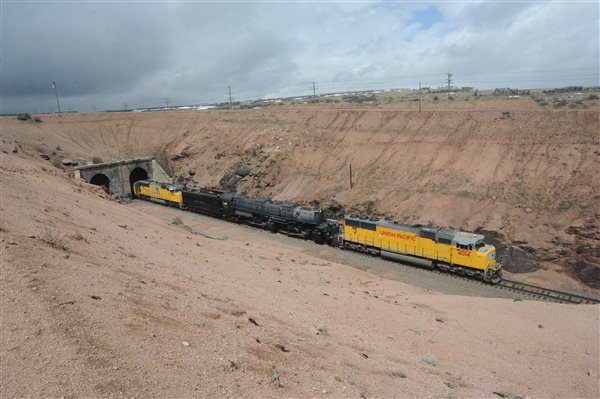
Union Pacific's Big Boy 4014 is in the roundhouse at Cheyenne for restoration to service.


Hermosa Tunnels.  Trains photograph.

A relatively new Chesapeake and Ohio Mallet Compound 2-6-6-2 is going from the Baltimore and Ohio Museum to the Western Maryland Scenic for restoration.  The Mallet will fit the Scenic's turntables.


Unattributed photograph courtesy Railway Age.

The same article notes that restoration of Norfolk and Western 611 continues.  And 611 will have company in the operating streamlined steam category.  The Coalition for Sustainable Rail will use a streamlined cladding similar to that on a sister Santa Fe 4-6-4 on its demonstration locomotive.


Coalition for Sustainable Rail artwork.

Closer to Cold Spring Shops, the Illinois Railway Museum have announced steam days on which 1630 will pull trains.


Yes, she will be in steam Independence Day weekend.

ENOUGH.

Bardiac laments That Time of Year. "It's that time of year when I'm really ready to be done with stupid excuses, both from students and administrators."  Demoralization often comes from being tired of, particularly if it's the same old counterproductive stuff from the same crop of fools.
I'm tired of administrators putting up hoops, and then saying that we have to make our hoops or someone else will make them for us.  And I'm tired of fellow faculty deciding to hold the hoops up as high as possible for other faculty so that they can look like proper hoop makers and holders for the administrators.
Withdraw your sanction. Withdraw your support.

8.5.14

THE INCENTIVES CHANGE.

Once upon a time, a collegian could make expenses at a state university with a summer factory job, and a school-year part time job.

The equation has changed in the past half-century.  Technical progress eliminates some of the factory jobs, and employer preferences for internships eliminates some of the job seekers.
Local hiring experts say the outlook for temporary summer jobs at factories — an important source of income for students in the past — isn't very promising because many of the positions now require technical skills someone in school wouldn't have, and factory automation has reduced the number of workers needed.

"Years ago, it was very commonplace to bring on the sons and daughters of regular employees for summer jobs. But that summer-help job category doesn't really exist anymore in manufacturing," said Jim Golembeski, director of the Bay Area Workforce Development Board in Green Bay.

The Georgia-Pacific Corp. paper mill in Green Bay used to hire hundreds of students for the summer, as did other mills and factories in the Fox Valley.

"I had some of my kids work there. It was a great opportunity for them," said Georgia-Pacific spokesman Michael Kawleski.

Now, the Green Bay mill has about half the number of employees it had a decade ago. The machines are bigger and more efficient.

Even with fewer people, the mill can produce as much or more than it previously did, Kawleski said.
There are a few companies that continue the tradition of summer employment as a variation on offering scholarships to the children of employees.
Still, the summer job tradition continues at manufacturers like Exacto Spring Corp. in Grafton, which hires the children of employees for summer jobs such as work in the shipping department.

Exacto makes springs used in everything from medical devices to military helicopters. The company has made springs for a prosthetic hand strong enough to lift a chair yet gentle enough to hold an egg.

Students employed for the summer may spend time learning about engineering and product development, along with their jobs in the shop washing and boxing parts.

"We are not bringing the summer help in to run machines. We get caught up on work that's more labor intensive, and there are a lot of people on vacation, so this fills in the gaps," said Exacto President Greg Heitz.

"We try to give opportunities to the kids of our employees, or people somehow connected to Exacto. That is always number one," Heitz said.

The students also get to work with their peers.

"We try to put them all together so that we don't have an 18-year-old hanging out with a 55-year-old," Heitz said.

At Wagner Companies, a Milwaukee manufacturer of light fixtures, hand rails and metal products, children of employees or their relatives also get first crack at summer jobs, CEO Bob Wagner said.

"We have done it for years, and it has worked out very well," said Wagner, who as a youth spent his summers in various jobs at the company.

"Some of the (summer employees) have come to be with us much longer," he said.

Wagner's summer employees must complete a workplace safety program, the same as other new hires, and there's little tolerance for poor behavior such as being late for work.

"Two strikes and they're in trouble....There are other people who are waiting in line for jobs," Wagner said.

Some of the summertime work is in the office, and some of it is outdoor maintenance. "You may get some paint on your hands," Wagner said.

Briggs & Stratton Co., the Wauwatosa manufacturer of gasoline engines and outdoor power products, hires dozens of students as summer interns. They're placed in jobs throughout the company, not only in their field of study but sometimes in areas that will broaden their experiences.

Briggs spends a lot of time nurturing its summer interns, and sometimes it offers them jobs after they graduate from college.

"We see a great value in adding them to our workforce whenever possible," Briggs spokeswoman Laura Timm said.
Those internships, paid or otherwise, take on greater salience these days.
A short stint at a manufacturing plant can be a way to sharpen your workplace skills and enhance your chances at getting permanent employment. But for college students, it's not a substitute for an internship in the field of their studies.

[Marquette business professor Douglas] Fisher suggests that college students get at least two internships.

"I can tell you, quite frankly, that companies that come to hire our (Marquette graduates) will put the resumes in two piles — those with internships and those without. They will be equally polite to both groups, but only one gets their attention.

"It's a lesson these kids have to learn," Fisher said.
True enough. Learning that there are consequences to not showing up, and that working well with others isn't just for grade school, also matter.

MASTERING ENTROPY.

Stop enabling the yobs, Carol Iannone suggests. You might see fewer of them.
But observing [bourgeois conventions] was something men at all levels once held to as a matter of honor and was a mark of genuine equality among them. As opposed to the phony “equality” that arises when traditional rules are scotched, when young men and women are thrown together and prompted to have sex, and when progressives are presented with the opportunity to fashion draconian mandates to control other people’s lives and give meaning to their own.
Yes, and by their fruits, or their freakazoids, shall ye know them.

GOES AROUND, COMES AROUND.

Liberating tolerance hits higher education.
The campus sexual revolution began with students’ demand to be free of any intrusive parietal oversight from college officials; now, in a bizarre turnaround, the children of that revolution want colleges to actually write rules for sex and police their enforcement. The colleges are only too happy to comply.
It's delicious, because it's being crammed down by the Hope and Change folks, as part of a destructive unfunded mandate whose effects are becoming clear.  And it illustrates what happens when nobody wants to take on the collegiate rabbit culture.
The alleged campus-rape epidemic could be stopped overnight if women’s advocates sent a simple message to girls: Don’t get drunk and get into bed with a guy whom you barely know. Keep your clothes on and go home to your own bed at night. And most controversially: Demand that any boy court you long enough to reveal his character and his respect for yours before you even think about having sex with him. The feminist advocates are more interested in preserving the principle of male fault, however, than in protecting females from regretted sex. And so rather than sending an unequivocal message of personal empowerment and responsibility, they put the entire onus of sexual responsibility on males, treating females as the invariably helpless victims of the male libido.

The colleges under investigation by the Department of Education may have sustained a public-relations black eye, but sadly, they will suffer not the slightest drop in their endowments or enrollments. They will even continue to coddle their students’ melodramatic oppression fantasies. The Title IX investigations, triggered by student complaints, are premised on the preposterous conceit that colleges are creating so hostile an environment for females that those females are actually prevented from learning. Here’s how the colleges should respond:

“Are you kidding me? Get a grip. This is the most welcoming, safe, lavishly endowed community ever created in human history, where students with the desire to absorb wisdom can do so in leisure, surrounded by supportive faculty and well-meaning administrators. There are millions of girls in Asia who are studying ten hours a day to gain the privilege of learning on an American campus; if they were to come to this ‘hostile’ environment, they would seize every educational opportunity available to them.”

Instead, however, the colleges’ student-services deans and rape counselors, who live precisely for these moments of conflict, will grovel before their accusers and promise to make amends. The New York Times has been hawking an article from Columbia’s student newspaper that purported to expose the college’s inadequate response to sexual assault. The original article triggered campus protests against the administration and penitence from the grown-ups. What it mostly showed, however, was the hold of the gender-studies mentality on far too many students. The student journalists were outraged that the school’s sexual-assault policies refer to “rape” “euphemistically” as “non-consensual sexual intercourse,” and to alleged “rapists” as “respondents.” One “survivor” — “Natalie” (a pseudonym) — complains that a Title IX investigator used abbreviations in taking down her story, resulting in “holes” that made her account not “sound like a strong case” (it probably wasn’t) and keeping her “from having ownership over the retelling of her history with emotional and sexual violence.” Natalie had been in a “fragile state” from a previous “emotionally abusive relationship,” and promptly entered into another “‘destructive and unhealthy’ physical relationship” with another male that was “confusing at best.” That male, the article explained, “often forcefully pinned [Natalie’s] arms back against the mattress during sex; [she] would cry during and after they slept together. Not until months after their break up did Natalie recognize this as non-consensual intercourse.” If Natalie was unhappy with their sexual relationship, she would have been wise to have put an end to it. The Columbia student article provided no evidence of flawed assault policies, beyond the mere fact that the school did not issue guilty findings in Natalie’s case (which she did not fully cooperate with) and one other. The article did, however, reveal the chaotic state of campus couplings in the absence of any normative restraints on casual intercourse, a situation that will claim only female emotional victims.
The unintended consequences of heavy-handed Washington intrusion are not likely to be good for higher education.
Should not parents and schools do more to alert young women to the risks of casual sex and intoxication? Isn’t prevention preferable to prosecution?
Too judgmental. Federal intervention is warranted.
As usual, the possible harm from imposing government mandates and oversight on American institutions and industries that are functioning well – our colleges and universities are the envy of the world – may exceed the likely benefits.

Some damage has already been done. The Department of Education published a list of 55 colleges and universities under investigation – the first time such a disclosure has been made voluntarily. The targets include schools where students have filed a complaint with the DOE’s Office of Civil Rights, and some where there has been no such charge.

Being stigmatized as a campus where sexual assault is a problem could prompt anxious parents – especially those from Asia, for instance, who historically have favored all-women’s schools like Wellesley - to steer their daughters elsewhere. Funders may also shy away, questioning school leadership.
Perhaps a few faculty and administrators will be radicalized, in a libertarian way.

As Milt Rosenberg puts it, 'tis a consummation devoutly to be wished.

7.5.14

LEARN NOT TO GENERALIZE FROM YOUR OWN EXPERIENCE.

That's a general principle for learning how to think.  It's a principle often distorted.  Consider the way in which "Easy for you to say" as a way of suggesting that an individual is taking for granted advantages that others might enjoy has mutated into the somewhat more intellectual-sounding "check your privilege."  That's apparently become a term of art among the Perpetually Aggrieved at the Ivies  -- perhaps there, students do not struggle with "divestiture" or "obviate" -- and a Princeton student suggests that some users of the phrase are themselves profiling others.
Behind every success, large or small, there is a story, and it isn’t always told by sex or skin color. My appearance certainly doesn’t tell the whole story, and to assume that it does and that I should apologize for it is insulting. While I haven’t done everything for myself up to this point in my life, someone sacrificed themselves so that I can lead a better life. But that is a legacy I am proud of.
A Salon columnist responds to that column in a nasty tone that is unlikely to make anyone not predisposed to accept her argument accept her argument.  That despite her making the correct point that not everyone experiences the same obstacles in the same way.  It's a missed opportunity, as any time one of the Perpetually Aggrieved begins an argument with an "As a ..." the logical error of generalizing from a small sample is sure to follow.

I'll give John McGinnis the final word.
If your underlying argument is flawed, you do need a force other than logic and evidence to sustain your position.  Political correctness is an admission of intellectual frailty.
Indeed.

WITHOUT IRONY.

Oh, those funny folks at Georgetown.

"Although the current 24-year-old free speech policy does not clearly restrict free speech to Red Square, the Georgetown University Police Department still enforces the policy as if it does."

Thanks to College Insurrection.

WHY IT MATTERS.

Peter Lawler offers A Simple Fix for the M.B.A.
Big ideas and self-knowledge can't really be effective add-ons to M.B.A. programs.  But who can deny that leaders who hope to be more than "specialists without spirit" need them?

There's an obvious solution. M.B.A. programs should only accept students who have flourished in excellent and relatively traditional "humanities" majors such as literature, philosophy, or political science.  They should not require that their students have taken any business courses at all.  That technical training is what the M.B.A. is for.
Perhaps so. But M.B.A. programs are to aspiring vice-presidents what Schools of Government are to aspiring highway commissioners: networking opportunities interrupted by occasional bouts of Technocratic Conceit and the latest Attempt to Trick People Disguised by Wordnoise.

Yes, I'm being cynical.  But if conglomeration had worked, so would the Soviet Union have, and there would be no need of corporate raiders or hedge funds.  And Vladimir Putin might be General Secretary rather than the second coming of Tsar Alexander III.

And outside of a few M.B.A. programs in the upper reaches of the U.S. News league tables, it's a bad investment.  The ambitious junior executive might get a better return on investment from a membership at the East Bank Club or its equivalents in other cities, and doing a good job of working the weight room.  And knowing some economics, and, Mr Lawler notes, getting a proper university education.
Undergraduate business degrees devote too much time to PowerPoint presentations, collaborative projects, and narrowly technical problem solving. They seem to do everything they can to divert the student from thinking about himself or herself as a particular person.  They're not about cultivating the souls of leaders.  And that lack of cultivation, it's pretty darn clear, can't be remedied "at the M.B.A. level."

There's a simple remedy for the struggle M.B.A. programs have in getting students to think big yet personally and beyond "the bottom line":  a rather old-fashioned undergraduate liberal arts education.  And recovering the proper relationship between liberal and technical education for emerging leaders is one way among many of thinking clearly again about what undergraduate education is for.
Indeed. But defenders of the liberal arts have trouble tempering the instrumental with the profound.

6.5.14

IT'S A HARD-KNOCK LIFE.

Over the weekend, nine performers in the Ringling Barnum Blue Unit were injured when a D-ring holding the human chandelier failed during a Providence, Rhode Island matinee.  At this writing, all remain in hospital.  A former trouper offers a tribute.
These aerial acrobats go through years of training and auditions before their big break such as touring with the Ringling Bros. Circus. Although bumps and bruises can happen at rehearsals, broken limbs and deaths should never unfold...

So next time you take your kids, grandchildren or even your parents to the circus, please keep in mind that the artistry can be spectacular, the acts can be death-defying, and the show must go on... The performers thrive on your cheers and yes, standing ovations. These beloved Ringling Bros. aerialists risk their lives everyday, entertain us for generations, raise young children for the "family business," and most of all, delight us with phenomenal memories of The Greatest Show on Earth!
And, dear reader, do not grow your hair long, tie it into a ponytail, and attempt this stunt at home.
Experts say the rare performance art – in which acrobats literally hang from the scalp as they fly through the air and perform various tricks – is practiced by fewer than a dozen circus families around the world, although it has existed for more than a century.

“It’s a very unique, traditional circus act. And most circus schools that I’m aware of don’t teach it,” said Elsie Smith, the artistic director at the New England Center for Circus Arts.

Each acrobat’s hair is wrapped around a steel cable ring attached to rigging that hoists the performer upward. And therein lies the secret: The specific technique used to secure the hair to the rigging is closely guarded.

“We all keep it to ourselves how we tie our hair and how we do it,” said Christopher Williams, a 24-year-old hair hanger who counts some of the injured performers among his friends. “No one really knows the secret.”
Do it wrong, risk a disfiguring injury. Do it right, it still hurts.

The danger comes with the job.  The performers in hospital, however, hope to see you down the road.

SHUT UP AND SELL ME MY STUFF.

For some years, I've griped about businesses that make me play Twenty Questions rather than simply ring up the transaction.

My e-mail address?  myob@kgb.ru

My zip code?  You're not the post office.

Rewards card?  Isn't it bad enough the government is tracking me?  (This sometimes elicits a chuckle from the counter help.)

Round up to the next dollar for charity?  I'm doing you a favor bringing my business to your store.

Thank you very much.

In so doing, I was continuing a tradition started by Chicago Tribune columnist Mike Royko, who singlehandedly ended Radio Shack's asking everyone for 'phone numbers.  (I wonder if the sales help ever made unauthorized use of the numbers of dateworthy customers.)

Earlier today, Charlie Sykes devoted most of the 11 am hour of his show to callers venting about this corporate abuse of valued customers.  A few callers expressed their surprise about being able to refuse those requests, or about seeing other people refuse those requests.  And a store clerk noted that yes, it is an added burden to customers.

So, retailers, brace yourself to your duties, and just sell me my stuff.

5.5.14

CHECK THOSE CLEARANCES.

Somebody at Union Pacific mistakenly sent a stack car loaded with an Arrowedge onto the old Chicago and North Western to Butler, and the out-of-gauge load damaged three bridges in Milwaukee.  The railroad will make good the repairs.
On March 12, a train equipped with the ArroWedge had left Joliet, Ill., headed for Los Angeles. As the train was moving through rural Illinois, railroad officials determined the rail car underneath the ArroWedge needed repairs, so the car was pulled out and repaired.

Sometime between March 12 and March 23, the repaired rail car was exchanged among three railroads within the Chicago area.

"We believe the other railroads improperly classified the rail cars empty instead of being classified as a double-stacked intermodal rail car," [Union Pacific spokesman Wesley] Lujan said.

On March 23, the ArroWedge-equipped rail car was delivered back to Chicago and became part of a larger train headed for Butler, Wis. Lujan said for classification purposes, the rail car was considered to be empty and not a double-stacked intermodal rail car unit.
Something is missing from the story. The photographs of the crash scene show the Arrowedge, somewhat the worse for wear, dislodged from its car.  There had to have been a container underneath the Arrowedge.  The container might be traveling empty, but if trains being classified for Butler have to be made up entirely of single-stacked containers, somebody in a yard had a chance to notice.

Properly placed, the Arrowedge serves the same function on a stack train that the nose cone on a truck trailer does, reducing wind resistance on the leading car of the train.

RESTIVE FACULTY AT CHICAGO STATE.

Sometimes, the only thing a faculty can do is withdraw its sanction for administrative excess.
I ask you to consider if the university would succeed without faculty participation in a number of joint faculty-administrative endeavors. Would we have received accreditation without faculty participation? Without faculty participation, would our students progress through programs? would they earn their degrees? would they go on to other pursuits? I am not suggesting that we withhold our participation in those kinds of efforts, they clearly benefit the university and our students. Could our administrators run Chicago State all by themselves?

Some time ago, I made the decision not to participate in any committees on this campus that were strictly “advisory.” As we know, “advisory” actually means superfluous, since recommendations from those kinds of committees are almost never considered by the administration. This top-down administrative structure that Watson has attempted to impose on this campus brooks no dissent, tolerates no disagreement and operates in a way that is simply antithetical to the academic effort. Let us stop participating. Let us go to no more pointless dog-and-pony shows (like the laughable “town-halls” the empty suit is so fond of holding); let us participate in no more meaningless committee work; let us attend no more “listening tours” at departmental meetings; let us stop allowing our chairs and deans to do the administration’s dirty work of intimidation and subterfuge; let us simply stop wasting our time on nonsense.
I have withdrawn my sanction in the strongest possible terms.  I reserve the right, though, to bring to your attention the struggles of embattled faculty to reclaim rights and responsibilities more properly theirs.

FINIS.

At spring break, The Becker-Posner weblog announced a sabbatical. Apparently Professor Becker was ill, and he died of complications after surgery on May 3.  Around the economics blogosphere, here are recollections by Greg Mankiw and Tyler Cowen and David Henderson.  The editorial board of the Chicago Tribune aptly summarizes.  "In his 83 years, Becker never stopped learning."  So mote it be.

THE RUSSIANS ARE COMING.

Oops, got fooled by those infantrymen riding on the sides of the armoured car.  That's the Boston police.


Image courtesy Common Dreams.

Interesting times.  The identity-politics left in Boston sounds increasingly like the patriot militia.
When federal and local funds are used to militarize police, the result is increased police violence in our neighborhoods, which further stigmatizes, isolates and criminalizes individuals instead of addressing the root causes of violence at the community level. It results in the continued profiling, surveillance and targeting of Muslims, immigrants, people of color and dissidents of all backgrounds.
"Militarize police" is a polite way of saying "jack-booted government thugs."

Federal and local funds are also used to make rent-seekers rich.  It's usually the little people who get re-settled (yes, I am being provocative) whether it's to make room for an expressway or a casino or a stadium or a nature preserve.

The challenge for people who seek to limit the power of government from the left or from the right is to recognize that limiting the power of government is a more compelling common interest than any fear of the Other's ethnicity or religion.

4.5.14

THANK YOU FOR LOOKING IN.

My Site Meter referral logs probably understate the volume of traffic, as I occasionally discover by other means links that Site Meter doesn't identify.  But the annual traffic review goes on on a consistent basis from year to year, despite Site Meter going to these bar charts instead of the more intuitive line charts.


I intend to make some changes in focus, and perhaps in volume of posting, based on the composite traffic reports I piece together.  There will, however, be continued content.  Thanks for looking in.

ILLINOIS IS WHAT DEMOCRATS DO.

Perhaps the easiest way for Democrats to win re-election is to drive all the strivers out.
Half of Illinois residents say that if given the chance, they would like to move to another state. Connecticut (49 percent) and Maryland (47 percent) were close behind on the list of states where residents would leave if they could, with all three of those states essentially evenly divided between people who would stay and people who would leave.
Poll analysis suggests work opportunities elsewhere, and bad weather, might be the primary drivers of the exodus.  But residents have lost faith in their political masters.
So, we have to hand it to the Illinois Democrats and their weak sisters in the feckless Illinois Republican Party. You folks have done a great job utterly destroying one of the greatest states in the union. Great job to the dictator Michael Madigan, the hapless and ignorant Pat Quinn and the rest of the worthless set running the state into the ground.
A number of things went wrong for the state, but the tax-and-spend types taxed the productive and mis-spent the money.
The seeds of this problem were sown many years ago.  When manufacturing started going offshore, Illinois was hard hit.  A Center for Government Studies report shows that between 2000 and 2010 the number of people employed in Illinois actually declined by 115,000 (1.5%).  Farming, wholesale and retail trade jobs fell by 135,000.  But far worse was the decline in manufacturing jobs, which dropped by a whopping 311,000.  Those were jobs which had been Illinois’ growth foundation for 60 years.  And they were the employers who provided the network effect of business-to-business growth that kept the state’s virtuous circle spinning.

Despite the obviousness of this shift in employment – from manufacturing to services – the state reacted timidly to replace manufacturing employment with another growth vehicle.  In an era of growing financial services, Illinois failed to develop a strong banking sector, and in fact watched First Chicago/Bank One become JPMorganChase and leave – along with almost all its other large brethren.

Despite leading engineering universities (University of Illinois Chicago, University of Illinois Urbana/Champaign, Northwestern, Illinois Institute of Technology, Northern Illinois, etc.) Illinois failed to develop a vibrant angel investing or venture capital community, and digital entrepreneurs were pushed toward the coasts for funding – and increasingly the talent followed them out of state.
Yes, and that's with a College of Engineering being established at Northern Illinois about the time I arrived, and the signs along Illinois Highway 5 (now Interstate 88) bragging about the Illinois Research and Technology Corridor.  It's enough to give the cheeseheads some Schadenfreude to go with their Sprecher.
Yes, we like having some fun at the expense of our neighbors to the south — the Cubs and the Bears and all that — but sometimes you have to feel downright sorry for them.
Not sorry enough, though, to turn down flatlander tourist dollars.

BE CAREFUL WHAT YOU ASK FOR.

Harvey Wasserman proposes a public buyout of professional sport franchises.
Like so much else under the laws of today’s Gilded Age America, our sports franchises are public assets that we have allowed to be owned by private rich people. That is, to vastly understate the case, wrong, wrong, wrong.

However nice or otherwise they might be, these owners have been gouging out public subsidies for stadiums, tax breaks and too much else over the decades. How else does a franchise like the Clippers leap in value from $12 million when Sterling bought it in 1981 to $575 million today?

It’s time to take these teams back. We are the rightful owners, not the latest random robber baron to want his or her very own courtside seats, where the players, coaches, fans and broadcasters can kiss the owner’s ring. Not the latest temporarily solvent corporation that wants to stick its logo in our faces while talented young men and women play their hearts out.
It is true, as Mr Wasserman notes, the Green Bay Packers do not have an owner, meddlesome, opinionated, or otherwise; and the team cannot relocate to another city because the articles of incorporation require the team to be liquidated should it fail to make its nut.  Even so, the taxpayers of Wisconsin are on the hook for some of the improvements to Lambeau Field, in much the same way that students enrolled at Mid-American Conference universities have to put up with activity fees and week-night games in order for conference teams to come closer to making their nut.  And there's plenty of potential for municipal franchises to become playthings of rent-seeking politicians.  It was bad enough that retailer Herb Kohl ran Don Nelson off the Milwaukee Bucks, imagine what Senator Kohl might be able to do.  Want that appropriation for freeway improvements, or a passenger train?  Fix that team first.  In summation: public ownership of entertainment businesses with winner-take-all tournaments confers no immunity from positional competition or rent-seeking.  It's unlikely that the Archdiocese and the American Legion will get the proceeds from the sale or liquidation of a municipal team.

On the other hand, taxpayers do have the option of telling the rent-seekers of pro sports to stuff it.  That's how the Seattle Super Sonics went to wherever they went to.

PLUSHIES THAT REQUIRE TROLLEY POLES.

I may have missed the Skokie Swift commemorative run with Chicago Transit Authority's 4271-4272.

Another pair of 4000s is in preservation in Milwaukee Electric territory, at East Troy.


First weekend of the season, still more like early spring than summer, and a pair of closed cars come in handy.