11.4.16

OUR NEIGHBORS ARE NOT HOLDING THEIR OWN.

Last month, we reviewed the Distressed Communities Index, as evidenced by the condition of the neighborhood.  Milwaukee Journal-Sentinel contributors John Lettieri and Steve Glickman
look through the index numbers in Milwaukee, where Hope and Change have not reached Our President's most loyal voters.
Economic growth and recovery has too often failed to reach the neediest communities. In fact, the country's worst-off ZIP codes experienced double-digit losses in employment and business closures while the most prosperous enjoyed booming double-digit growth.

In light of these findings, it is clear why so many Americans feel anxious and disconnected from the overall growth of the U.S. economy. Policy-makers must evaluate how to systematically attract new sources of capital, a new generation of entrepreneurs and new skilled workers to bring economic opportunity back to Wisconsin's distressed communities — and to make sure opportunity endures in more prosperous ones.
The state, as a whole, has "done quite well by many measures," with eight percent of state residents living in distressed neighborhoods as contrasted with the national average of fifteen percent. Perhaps there might be some connection between Wisconsin's governor surviving a recall election and a re-election campaign despite all the efforts of the Angry Left to frustrate his legislative initiatives.  The Peoples Republic of Madison underachieves relative to the state, with 25 percent of the populace living in distressed zip codes.  Milwaukee, now several generations removed from the era of blue collar aristocrats, has 95 percent of its residents living in distressed zip codes.  Here's the interpretation from Messrs. Lettieri and Glickman.  "In Milwaukee, the slow transition to the new industries of the knowledge economy, the lack of a robust entrepreneurial ecosystem and endemic segregation have contributed to the economic distress of half of the city's ZIP codes."  Some specifics.  My old neighborhood, 53219, is still relatively prosperous, although when I last met up with Milwaukee Hamilton graduates from my time there, I recall none still living in the city.  My grandparents' old neighborhood, 53209, is highly distressed and the most severely distressed tracts are just the other side of Capitol Drive.

But Messrs. Lettieri and Glickman can't do any better than passive-voice wishful thinking when it comes to recommending policy.
Economic growth and recovery has too often failed to reach the neediest communities. In fact, the country's worst-off ZIP codes experienced double-digit losses in employment and business closures while the most prosperous enjoyed booming double-digit growth.

In light of these findings, it is clear why so many Americans feel anxious and disconnected from the overall growth of the U.S. economy. Policy-makers must evaluate how to systematically attract new sources of capital, a new generation of entrepreneurs and new skilled workers to bring economic opportunity back to Wisconsin's distressed communities — and to make sure opportunity endures in more prosperous ones.
Opportunity endures in prosperous communities that continue to respect bourgeois norms.  It flees communities, including formerly prosperous communities, where the mores of the hippie commune and the trailer park prevail.  The tax code matters, yes, but more fundamental things matter more.

10.4.16

VIGNETTES OF CULTURAL DECAY.

Passenger Rail advocate Jim Loomis is enroute to a meeting on the east coast, which involves a cross-country train ride.  Here's breakfast on the California Zephyr.
Sitting in the lounge car waiting for the 6:15 dinner seating to be announced, I noticed a conductor remove his cap before entering and passing through the dining car. By contrast, today at breakfast, a 40ish man, who evidently has a very good job with a high-tech company, wore a baseball cap throughout the entire meal.
It's not as if breakfast on Amtrak, with its etiolated menus, is a high social occasion, and prole caps are everywhere, whether despite or because of big-time sports and hip-hop presentation.  So far we have to go to restore bourgeois decency.

The conductor, however, might have been properly trained.  Here's a paragraph from Rule 903 of the Chicago and North Western System Book of Rules.  "Uniformed employees, except conductors while taking up transportation, will remove cap while passing through dining cars."

The more usual practice these days is for the conductors to "take up transportation" at trackside while passengers board, the delays to passenger handling notwithstanding.

WHAT'S THE CAKE?

Here's Chris Matthews signing off last week Monday, asking a trenchant question about Mrs Clinton's candidacy.  "What is Hillary offering?"  Listen carefully, he's skeptical of the usual nostrums about "working together to solve problems."  It's particularly difficult for Mrs Clinton to speak of "bringing people together" as it raises the question, "Who divided us?"


Perhaps, as Reason's Nick Gillespie notes, it's the cult of the presidency, rather than the contents of the cake, that's the root cause of the problem.
As it happens—and as a libertarian—I think the conservative and liberal, and the Republican and Democratic, agendas are misguided, incoherent, and destined to fail. But I was never the intended audience for such loose talk and false promises. The folks who were are the ones willing to burn down the two parties that have failed them so completely and so utterly.
When Mr Matthews and the rest of the presidency-worshippers start calling out the candidates for their conceptions of ever richer cakes, perhaps the serious business of reclaiming government from the political class can get under way.

ASSIMILATION IS A TWO WAY STREET.

The editors of Charlie Hebdo have had enough of the self-despising multiculturalists in their midst.  "In reality, the attacks are merely the visible part of a very large iceberg indeed. They are the last phase of a process of cowing and silencing long in motion and on the widest possible scale."  The Federalist's M. G. Oprea elaborates.
The Charlie Hebdo editorial correctly points out that in Europe the dominant liberal culture has pounded into us that we must adapt to Muslims who come to our country, and never ask them to adapt to any of our ways. Doing so would be colonialist and wrong. It’s a double standard, of course. As the welcoming countries, Europeans must suppress their own culture and ideals for those of the Islamic immigrant population.
There's a simple revealed preference counter-argument, of course.

You're here because where you left, things sucked.  Have you considered that things don't suck here because we got a few things right?
Asking immigrants to assimilate doesn’t mean white-washing their culture and religion, asking them not to wear the hijab, or demanding that they eat pork. But it does mean asking them to accept, to some degree, the culture of the country to which they have willingly moved. These are things like women’s rights, tolerance, free speech, or criticism of religion. It also means not having to apologize for having a culture of one’s own.
That's a more tactful way of putting "have you considered that things don't suck here because we got a few things right."  Left for future research: will immigrants who accept some of the cultural norms of their new country have an evolutionary advantage over those who stick with the familiar?

TO BREAK THE HARVARD CARTEL, BEAT THEM AT THEIR GAME.

A recent Ben Casselman column in Five Thirty-Eight proposes that observers of the collegiate scene Shut Up About Harvard, a proposition that Dean Dad heartily endorses.  (In White Sox terms, put it on the board ... Yes!)  The point is a familiar one, that most of the higher education goes on at the land grants and the mid-majors and it frequently involves the kind of economic and cultural diversity that the admissions boards at the name institutions struggle to achieve.  But, as is also a familiar point, what passes for higher education outside the ivy walls (and too often inside the ivy walls) is anything but.

An American Interest reaction to the enrollment feeding frenzy, as documented in The Atlantic, suggests that the credentials chase is a reaction to market forces.  (And yes, each spring the leading journals of opinion and the policy shops love to brag on the interns they've indentured for the summer, and predictably, you know where they're enrolled, and it generally isn't Northern Illinois or St. Norbert.)  But there might be some unappreciated talent at those job fairs at the land grants and mid-majors, and perhaps the recruiters ought to cast their net widely.
The good news is that there are better approaches for bringing admissions madness under control. The most important change would be to attack what Freddie DeBoer calls “the Ivy League premium”—that is, make it matter less where a person went to college. Part of this change would need to be cultural: elites, and the institutions they run, would need to put less weight on fancy degrees. But there are also policy steps that could help encourage this shift.
Perhaps, as a first approximation, we might have employers engaging in a different form of affirmative action: rather than recruiting diverse candidates from the same few institutions, start recruiting diverse candidates from a broader set of institutions.  The Spielberg Effect might be at work, and employers might be pleasantly surprised.  Or, we might have employers pushed away from recruiting at the same few institutions because the graduates are entitled, whiny, and clueless.

The article goes on to propose that the prestige institutions deal with the excess demand they have created by, oh, expanding output.
There is no reason why the quality of education offered by Stanford or Princeton should not be scalable, and yet the number of slots at most of these institutions has held steady for decades, despite the extraordinary resources they have at their disposal.

The horribleness of the Ivy League admissions for 17-year olds is just one small symptom of a higher education landscape that is distorted all around. To fix it, we will need to come up with more creative and ambitious solutions than simply asking colleges to put more emphasis on this or that character trait as they cull 95 out of 100 students from the pile. And those solutions won’t always be the same as the ones preferred by the gatekeepers themselves.
As long as anxious parents and striving students perceive the less famous institutions as offering defective education or a deficient college experience in some way, the U.S. News premium will exist.  And as long as U.S. News rankings depend in part on selectivity, it's easy enough for an institution to appear selective by quoting a low list price, underwritten as financial aid from hedge fund returns endowment income, thus generating a lot of applicants, and rejecting most.

Thus it may be up to the land grants and the mid-majors and the rest to lift their game, maybe dipping into their foundation income to strengthen a few solid programs in order to become more like Michigan or Stanford.  Alas, a Washington Post analysis of what's going on outside the pages of U. S. News suggests the highly regarded institutions are winning by default.
Half of the colleges and universities in the United States have become less selective during the past 50 years, according to research by Stanford University’s Caroline Hoxby.
That perception helps generate the excess demand for the prestige degrees.
Even for students and parents who know the higher-education world exists beyond Amherst, Princeton, and Yale, the perception that success in life is tied to your undergraduate alma mater unnecessarily raises the anxiety level of high-school seniors every year. That idea is just plain wrong.
Wrong it might be, and the state flagships and land grants and mid-majors might, as the article argues, serve many students well.  And yet those institutions are not taking steps to poach students and faculty from the U. S. News leaderboard.
We tend to view all of higher education through the prism of private institutions (the vast majority of the top 25 national universities in the U.S. News & World Report rankings are private). Yet, 80 percent of American students go to public colleges and universities.

This focus on elite privates during the past decade or so has masked the massive downward shift in taxpayer support for public colleges. Ten years ago, college students and their families paid for about one-third of the cost of their education at public colleges. Today, in nearly half of the states, they pay for more than half of their education.

Even among the publics, the state flagships seem to get all the attention, particularly in state houses. But 40 percent of all undergraduates in the United States attend regional public colleges. There are nearly 400 of them, many tucked into out-of-the-way corners of their states. By comparison, the better-known public flagship universities enroll just 20 percent of students.
Yes, the state legislatures have been stingy.  But expense-preference behavior by administrators, expanding the ranks of deanlets and deanlings while freezing faculty hiring or replacing tenure-line faculty with contract employees does nothing to loosen legislative purse strings or to compete for the U. S. News - reading potential students.

I HAVE SEEN THE FUTURE, AND IT SUCKS.

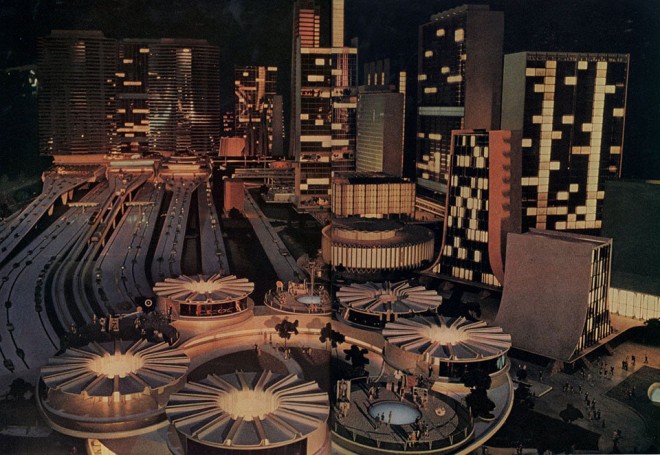
Once upon a time, wide, limited access highways, and high-rise office and apartment blocks, perhaps with parking on the lower levels, were the very model of modern living.  The idea started with the General Motors Futurama exhibit at the 1939-1940 New York Worlds Fair.


The notions of better living through private transportation and broadly shared prosperity combined with the Technocratic Imperative in Building that Better Future, something that was popular in those late-Depression days.
[Display designer Norman] Bel Geddes vision of the future was exclusive and evasive, there were no slums, the poor were not represented, the miniature scale made little provision for human relations and the rural villages were centralized around a church. (Marchand 1992:40). In Bel Geddes script for the audio accompanying the ride explicitly states that “whenever possible the rights of way of the express city thoroughfares have been so routed as to displace outmoded business sections and undesirable slum areas” (Cogdell 200:230). In a contemporaneous review by Stuart Chase he found Futurama to be a “civilization which had been cleaned, garnished, and ordered. Waste, clutter and ugliness were out of it.”(Cogdell 200:230)
Yeah, that turned out so well, but General Motors were able to push the same rent-seeking vision at the 1964-1965 Worlds Fair, which closed a month after the Watts riots suggested social engineering the undesirable slum areas away did not have the consent of the people so cleared.


Those look like Chicago's notorious outside ramps in the middle of that expressway.  They work well on a model with spacing-controlled slot cars.  Less so in practice, particularly if the Hubbards Cave area is full of trucks.

The buildings anticipate the Jetsons, in which the orderly traffic in the cartoon flows in three dimensions.  If you're the only person with a flying car, you're above it all, but mass-produce them ...


These days, however, people are conversant enough with the Law of Peak Hour Expressway Congestion to understand that running a Futurama-width road through a city doesn't deliver the benefits.  It's Soviet-style queuing, with the concomitant frustration, and the aesthetics don't look so good.


Alabama Department of Transportation rendering retrieved from City Lab.

Futurama's builders, at least, put in lots of futuristic high rises (Trump Towers, anyone?) in vacant spaces.  Here, a wider road is drawn in through the existing road corridor, with the existing collection of vacant lots, a parking deck, and Birmingham's current buildings treated as givens.  "In Alabama, the highway department is proceeding with the plan to expand I-20/59, even though business groups have come out against it and a nonprofit has filed a lawsuit against it."  The rent-seekers must have their rents, whether the public interest is protected or not.

THERE'S MORE THAN THE TAX CODE BEHIND INCOME INEQUALITY.

The down side of sitting through coverage of the basketball tournament and the presidential debates and the Chicago first responders trilogy and Vikings is sampling the commercials.

It's true that H. L. Mencken, long ago, japed, "Nobody ever went broke underestimating the intelligence of the American public."  It's also true that advertisements enabling the crude vulgar culture and that the tendency of advertisers to portray men as bumbling (or not) is contested enough territory to have a weblog dedicated just to that phenomenon.

Perhaps, though, those advertisements simply appeal to the level of competence the writers perceive in the public.  What happens when uneducated American young people go through college and enter the workforce?  It's not pretty.  "That a growing percentage of U.S. workers are incompetent is consistent with declining labor force participation compared to other countries"  (Source.)  Consistent with, but perhaps not a complete explanation.  "Over the long term, fewer prime-age people in the workforce could bring down the country’s growth potential and make it difficult for the economy to support the coming explosion in baby boomer retirees."  If the participants are less productive because less capable, that difficulty gets worse.

7.4.16

WHERE THE MEDIATING INSTITUTIONS STILL WORK.

In the past couple months, popular social science pundits have discovered that Donald Trump polls well among the unprotected people, particularly among those who used to live by the rules, only to be sneered at by Democrats and ignored by Republicans.  Professor Bainbridge sees the Trump phenomenon as a beta test for rebellion.  Ben Domenech elaborates.
The old order is breaking down, thanks to Iraq. Katrina. The financial crisis. The failed stimulus. Obamacare’s launch. The Tea Party. Occupy Wall Street. Sanders. Trump. The American people are trying to find a new way, and they are looking for outsiders to lead them through the wasteland.

To the establishment, this breakdown looks like chaos. It looks like savagery. It looks like a man with a flamethrowing guitar playing death metal going a hundred miles an hour down Fury Road. But to the American people, it looks like democracy. Something new will replace the old order, and there are a host of smart, young leaders on all sides who must prove they have the capability to figure out how to create or retrofit institutions that can represent and channel this new energy.
It's an idea I've been following since last summer.


Subverting the dominant paradigm and being transgressive isn't for the critical studies people only.

Now comes The American Conservative's Gilbert Sewall, suggesting the same thing.
How could this happen, the nation’s elites are wondering. They still have no idea how their arrogance spawned Trumpism or why someone with so many defects has kept against all odds trending up.

Fifty years of liberal campaigns to make American society inclusive and “fair” with exacting standards have backfired. The rump of middle-class, salt of the earth, white America realizes it’s been abandoned and humiliated. For the ruling class, connection and concern for flyover America—and for that matter the nation—is tentative or less. Donald Trump is a demagogue made to order for the dispossessed.
Stated briefly, we squandered the peace dividend on experiments against reality.
Movies, advertisements, lectures, awards, history months, and news stories keep the narrative in motion, shaming anyone who does not openly spurn America’s white, straight middle class that clings to religion, guns, and more.

Since Lasch wrote, liberal elites have solidified their public and private institutional control, wielding political power through the Democratic Party. They expect affirmation, not only compliance. On campus, Black Lives Matter, rape culture, curriculum witch-hunts, and a lengthening list of ideological tests overwhelm the pursuit of knowledge and quality. On and off campus, elites with assets and institutional power have the luxury to be high-minded. It is in their interest not to rock diversity’s boat but to steer it instead.

Said Lasch, the new American elites insist on sanitizing society according to their own moral precepts. On one hand, they want to set rules of enlightened thought and interpersonal relations. At the same time, they unwisely seek to “extend the range of personal choice where most people feel the need for solid moral guidelines.”

For America’s winners, compassion is abstract, as Lasch realized. As often as not, up-market altruism is staged to signal virtue and magnanimity. Emotional causes and feel-good politics keep all-important dopamine and self-esteem levels healthy and high.

Yeoman America is not protected or rich enough to be abstractly high-minded. It gets panhandled at the 7-Eleven. It travels Economy Class Group 3. It doesn’t get the scholarships or set-asides. It lives too close for comfort to seedy section 8 neighborhoods. Loose cultural standards and industrial decline have coarsened many who are prisoners of celebrity culture.
But those prisons -- thus those National Review columns noting the cultural collapse in the hinterlands have some purchase -- can be self-made.  Now comes a Washington Examiner report from Wisconsin's dairy country, strongly suggesting that some combination of solid institutions and economic prospects keep some people from imitating the worst features of celebrity culture.
In the rural parts of the state, the economy is weaker. More importantly, and related — the culture is crumbling too. Donald Trump says that our country is falling apart, the American Dream is dead, and that a strong national leader is needed to "Make America Great Again."

The economies are stronger near Milwaukee, as shown by the tiny shopping centers that dot the shore of Lake Michigan north of the city. Also, the culture is stronger. Each of those three counties are below the state average on divorce rates and the rate of disability among the working-age population.

Where social cohesion is stronger, as my colleague Michael Barone has suggested, Trump support is weaker. Upper-middle class suburbs tend to have intact families and good public schools, yielding high social capital — and low Trumpism.

Besides high income and highly educated yuppie parents, there's another way to innoculate a place from Trumpism: To be German or Dutch.
That exaggerates, slightly. I'm not going to ask readers to join me in a chorus of Heil Dir im Siegerkranz, although if you're in the neighborhood, there's Sprecher or Spotted Cow in the cooler, and we practice Prussian Wisconsin Nice at Cold Spring Shops.


It's not so much the Teutonic roots, it's more the kinship ties and the mediating institutions.
Oostburg is 47 percent Dutch and 38 percent German. The statistics show a strong community — the divorce rate of 4 percent among men is less than half the national average. The disability rate of 4.5 percent among working-age population is also less than half the national average.

Oostburgers, while modest, don't hide their pride in their community. "What I really like about this community is they stick together," Dan, a mechanic at the nearby dairy and wheat farm tells me at [local cafe] Judi's. "The community really backs their children."

Dan recounts the recent spring concert by Oostburg public schools where his children attend. Both showings were at capacity, because the whole village came, not just parents and grandparents but also neighbors and other locals.

It's not the German or Dutch blood that makes communities like Oostburg so healthy. The churches are essential. They have active missions and ministries that reach out to the needy in their community and out to poorer neighborhoods.
Institutions are civilization. And the village that does not combine the redeeming features of a hippie commune and a trailer park raises its children, and takes in the immigrants' children, more effectively.

THAT'S SOME D**N LOOSE RAILROADING.

Sunday morning, two operators of a backhoe died when they, contrary to all the protocols of safe railroading, occupied a live track on the Northeast Corridor near Chester, Pennsylvania.  Along came Amtrak 89, heading for Savannah and expecting men and equipment to be in the clear.  The Federal Railroad Administration has requested that maintenance personnel enroll in Railroading 099.  Yes, a remedial course, for no credit.
The FRA ordered Amtrak late Wednesday night to require all railroad maintenance workers and their supervisors to review safety rules applicable to their jobs. The regulatory agency also required Amtrak to review the rules governing communication between rail workers, their foremen and dispatchers. FRA also recommended that the rail agency conduct a similar safety review for all safety sensitive workers.

In the case of rail incidents the FRA conducts its own investigation parallel to one underway from the National Transportation Safety Board. The FRA issued the directive because of information received during its investigation, which is ongoing.
Amtrak succeeds Conrail, which succeeds Penn Central, which succeeds The Pennsylvania Railroad.  And all the Crusty Old Roadmasters who reinforced the Prime Directive, Safety is of the first importance in the discharge of duty, have crossed the final summit.

HOW CLOSE READING WORKS.

Margaret Soltan has posted the first of her Georgetown Public Library poetry lectures.  Get past the blue-state smug, and dig into the substance.  "Poetry at its best will never give you the code, the key, all the answers (and note that all the answers as given are almost always redemptive) to all the questions. It will set out all the difficult paradoxes beautifully and fully and with intellectual and emotional honesty."  The rest is in the details.
It’s worth noting that Mario Cuomo, to return to another very public man not above using “campaign poetry,” also was able to describe life in this way:

“You go from stone to stone across the morass.”

This is pure undistilled Samuel Beckett, and while The Big Shortfraudsters might hate its elegiac sadness, people who take poetry seriously are liable to appreciate it – not only its compelling imagery, but its approach to important truths.

Poetry is one art form that allows us to experience simultaneously ecstatic communion with an over-generous world, and stony despair. It tempers our too-muchness – organizes our sensibility – so that we can remain in excess and in the truth.
Go. Read. Understand.  And note, in the presentation and the examples, the absence of pomo-speak.

COMING TO GRIPS WITH NAGASAKI SYNDROME.

An unsigned American Interest post invites readers to look at the redeeming features of the Pax Americana.
For 70 years this strategic approach has prevented the outbreak of devastating wars like those of the first half of the twentieth century. That we did so at an affordable, though not an insignificant, cost, is a triumph of strategic thinking and of American foreign policy.

Weak leadership and a failure of strategic intelligence now threatens the success of the most successful world strategy of modern times, a strategy whose success has been the root cause of American prosperity and global stability for two generations. There is no enemy powerful enough to destroy the Pax Americana today, except for the greatest of all great powers in human affairs: the power of stupidity.

We will know that American foreign policy has started to work again when military budgets around the world go down, while ours remains at an affordable level. Those are the metrics we are looking for; right now, we seem to be getting the opposite.
That's an extremely high-level view of the international order.  Where the ability of the Eurosclerotic social democracies to provide limited "free" medical care follows from not having to spend much tax money on defense, or on pharmaceutical research, people in the United States might have reason to fret about free riding, and it ought not come as a surprise to see panderers like Barack Obama or Donald Trump pandering to that sentiment.  Where the limited wars, from Vietnam to the Middle East, blight the lives even of troops who come home uninjured, without destroying the lesser enemies, it ought not come as a surprise that people question whether the strategy is affordable.  War is cruelty, notes Marine Lieutenant Colonel Kent S. Ralston, and ought not be entered into lightly, but ought be conducted accordingly.

BE CONSIDERATE OF THE NEXT PATRON. FLUSH AFTER USING.

In the grand scheme of things, the fact that the use of public privies becomes a major skirmish of the culture wars serves as a reminder that, despite the slow economic recovery, the presence of unassimilable migrants in Western Europe and the United States, and the propensity of Illinoisans to serve bratwursts with yellow mustard, we've got it pretty good.  Here's Reason's Steve Chapman suggesting that there's already a lot of crossing going on in the loo.
[T]ransgender men generally go unnoticed in men's restrooms, for the simple reason that they appear to be men. In fact, the odds are very good that at one time or another, you have unwittingly done your business alongside someone who is transgender—with no ill effects.
There are deeper policy questions, involving the state of knowledge in abnormal psychology, that aren't so easily dealt with. Privacy, transgressiveness, live-and-let-live, get-out-of-my-face.
[T]he traditional norm for people with gender dysphoria has been to deny, suppress or hide their true nature—so that everyone else could operate in comfortable denial.

The traditional norm these people could expect if they were found out has been hostile and often violent.
It is not to that I wish to speak. Rather, there's an instructive passage in a Northern Star article about repurposing the one-stall restrooms (and there are more than a few, even at a large university) as available to anybody.  (Be considerate of the next patron.)
Molly Holmes, director of the Gender and Sexuality Resource Center, said she has been pushing for gender-inclusive restrooms. The Gender and Sexuality Resource Center has a gender-inclusive restroom, located on the first floor, that can be accessed by anyone regardless of their gender identity.

“I think it’s better to call them gender-inclusive because they’re not necessarily for [non-binary] people, but say that a dad needs to take his daughter to the restroom and he can now just do that without having to go home,” Holmes said.
It's likely that the case of the dad with a tender-age daughter, or the mom with a tender-age son, comes up a lot more frequently as an awkward situation in the loo than the presence of a crosser.  For the present, those will be the one-seaters.  The multiple-seaters will take more thought.

THE CASE FOR BILLING THE HIGH SCHOOLS.

Cold Spring Shops has for a long time suggested that Distressed Material turning up at college requiring refresher courses in ciphering and writing is the fault of underachieving high schools, which ought to be made accountable by reimbursing the colleges and universities for the expense of teaching high school again.

Now comes a School Report commentary. "College remediation is not just a problem for those ‘other’ kids."  It's as I suspected.  High school is everywhere a joke.
More than half a million college freshmen—approximately one in four students who enter college the fall after high school graduation—had to enroll in remedial coursework during their first year of college, costing their families nearly $1.5 billion annually.

My bet is a lot of parents read these kind of reports about struggling students and education problems and think: That’s a bummer, but that’s someone else’s problem.

That someone else being, um, low-income families or kids of color? Students in chaotic urban schools or remote rural schools? Or maybe new immigrants or students with disabilities? All those students not “cut out” for four-year-colleges?

Pick your “other,” but the problem is not about you or your kid, not about anyone comfortably striving or hailing from the honor roll of all those so-called good high schools, right?

Wrong, in this particular case.
The report is not detailed enough, yet, to identify the school districts that invest heavily in sports facilities as egregious offenders.  But the initial estimates of the bills the colleges would have to send to underachieving school districts look like figures that might concentrate some minds.
Not only does college remediation cut across all income levels, it’s also not a problem confined to community colleges. Nearly half – 40 percent – of remedial students were enrolled in public and private four-year colleges.

While underprepared students average two remedial courses each during their first year, higher-income students at private four-year colleges take more remedial classes than lower-income students at those same colleges, suggesting these schools enroll many lower-achieving but higher-income students.

Which means this: If your kid attends an expensive private university but isn’t ready to write college papers or pass a college math class, you will be paying an extra $12,000 for material he or she should have learned in high school.
Let's focus on that "higher-income students at private four-year colleges take more remedial classes than lower-income students at those same colleges, suggesting these schools enroll many lower-achieving but higher-income students." Revenue matters more than learning.  That's one of the symptoms of a bubble.  I'm repeating myself, but repeat myself I must.  "But there is no point in allocating resources to fund institutions that admit unprepared students and call it access. Fix the common culture and the common schools first."  Here's School Report, linking to The Education Trust's "Meandering Toward Graduation."  Academically Adrift was already taken.
The Education Trust, a D.C.-based advocacy organization, found that almost 70 percent of high school graduates do NOT complete a “college-ready” course of study, a set of classes typically required for entry at many public colleges—like Algebra 2, foreign languages, chemistry and physics. The study, Meandering Toward Graduation, was based on an analysis of a representative sample of high school transcripts from 2013 graduates.  (High schools aren’t preparing students for career tracks, either, with only a fraction taking the kind of health, technology or business courses that would pave a path for job training.)

The problem is not just that students get low grades (below a C+) and never master the material. It’s that more than half never even enroll in the classes needed for college readiness.
Parents with the means might be able to cover the expense, although you'd think that a "good" school that comes bundled with a granite countertop would do the college-prep job right.  But profiling the poor kids as enrollment risks is a mistake.  "So, we’ve got students who aspire to college, but aren’t being challenged in high school with the kind of courses that make that a realistic option. And we’ve got a nation of parents who desperately want to believe that remediation is something that happens to other people’s children." And the erroneously-stereotyped other people's children also lose out.  "Meanwhile striving students who lack the finances or the social connections to get into an institution where some of their classmates might be smart and motivated, even if the curriculum is coreless or trendy, end up in the academic gulags."

There are days when all I want to do is work on the railroad.  But the opportunities to influence, or perhaps to reinforce, people who are still in the fight, and still have a chance to win, keep me on these themes.

6.4.16

THE RAILROAD TRACK IS NO PLACE TO PLAY.

Union Pacific Railroad's "You Wouldn't Take Your Senior Photo Here" safety campaign takes a bronze medal in the 2016 Telly Awards, a recognition for independent broadcast media produced outside the realm of  Big Entertainment.

If you're smart, you don't play in traffic, or use the roads to take selfies.  That's also true on the railroad tracks.  Kindly be governed accordingly.

HARVARD'S CASE FOR TAX PREFERENCES.

Last week, it was Yale's lobbyist defending the trickle-down benefits of the tax breaks on its hedge fund.  This week, it's Harvard's president, Drew Gilpin Faust (again with the middle names!) suggesting that the tax breaks on its hedge fund are morally superior.
Fundamentally, as with all tax-exempt organizations, Harvard’s non-profit status guarantees to its supporters and the larger community that its resources are dedicated to its charitable mission and larger societal benefits rather than to profit-making.
Marinate in the smug.

Let's test that hypothesis.  To what extent does producing future partners in Eastern Establishment law firms, and hedge fund managers, and aspirants to national office produce net social benefits, and in what way are those larger than those generated by investments in railroads or steel mills or applications for smart 'phones?

PRIORS AND POSTERIORS

Here's a Heterodox Academy post on the usefulness of constructing stylized facts, or stereotypes.

"Stereotype" is a loaded word, often conflated with "prejudice."  Thus, the careful researcher uses them carefully.
For some time now, the term stereotype has connoted one aspect of prejudice, and this linkage between stereotyping and prejudice isn’t altogether unfair. Most people can recall at least one instance when someone applied a stereotype to them, assuming something that was untrue, unflattering, and unfair. Nonetheless, there is another side to stereotypes—it can be rational to apply them when they’re generally true.
A more formal way of dealing with the distinction between a prejudice and a stereotype is to think of a prejudice as a possibly naive prior belief (and that becomes particularly fraught in the social sciences, where being wary of strangers is an inherited and evolutionary stable strategy) while a stereotype can either be a prior confirmed by evidence, or a prior updated or discarded on the basis of evidence.

Yes, that can get mathematical, but all the intuition appears in the first sentence of the following passage.
Taking a step back, we widely accept that the process of having beliefs about the world, interacting with it, and then updating these beliefs is a fundamental component of learning.

Well, computing the posterior from the prior with Bayes' theorem is simply a mathematical formulation of updating your beliefs. In fact, these ideas are at the core of Bayesian statistics, so it's well worth your time becoming familiar with the mechanics of working with them.
Thus when the boutique multiculturalists let some people act badly and call it authenticity, the resulting outcome actually confirms the very prejudices the Diversity Weenies would like to root out.  Why are they allowed to do things that we're not allowed to do?

Perhaps, as a first step, the Diversity Weenies ought to understand the logical basis of both central tendencies, which are a big part of social science, and confirmed stereotypes, which is a more pejorative way of describing a central tendency.
To my knowledge, no critic of stereotype accuracy research has leveled the same criticisms against social science in general even though the parallels are clear. In a number of social sciences, this is how you make a generalizable scientific claim. First, you advance a hypothesis. “Men are taller than women” is a good example. Second, you conjure an opponent, the null hypothesis. In this case, the null is: “Men and women are equally tall.” Third, you collect and measure a large sample of women and men and test for an average difference in height. You then plug that average difference into a formula that tells you whether it’s likely you would have found that difference if your opponent (the null hypothesis) were right.
There's more to it than "plug in" and a careful researcher must be conscious of the margin of error and the power of his test.  But the productive way to deal with pejoratives is in a logical way. Back to Heterodox Academy.
If we can develop imperfect but reasonably good conventions for what constitutes a valid scientific finding, we can also develop imperfect but reasonably good conventions for what constitutes stereotype accuracy. Establishing these conventions can also spur research to establish which stereotypes are inaccurate. The “how do we measure it” school doesn’t note that if we simply give up on accuracy measurement, we have to give up on both accuracy and inaccuracy. When only stereotype accuracy is held to a higher standard, that’s an indication of political bias. In a fairer world, we would treat both scientific validity and stereotype accuracy similarly—as problems that have pragmatic though imperfect solutions.
Simpler, still, though, and more pragmatic, to treat generalizations of any kind, whether given the status of stylized fact or of stereotype, as supported tolerably well by evidence, or not.

ENCOURAGE NEW ARRIVALS TO BUY INTO AMERICA.

The European social democracies that Senator Sanders would have the United States emulate are turning into places Victor Davis Hanson (and what is it with all these columnists using their middle names?  I should imitate an angry parent and only use all three names when I'm calling them out) sees as troubled and unsustainable.  The root cause of those countries' problems may not be the immigration itself, they may not be the bitter fruit of self-despising multiculturalism; it might be what you expect of advanced tribal societies.
Europe’s immigration policy is a disaster — and for reasons that transcend the idiocy of allowing the free influx of young male Muslims from a premodern, war-torn Middle East into a postmodern, pacifist, and post-Christian Europe. Europe has not been a continent of immigrants since the Middle Ages. It lacks the ingredients necessary to assimilate, integrate, and intermarry large numbers of newcomers each year: There is no dynamic and fluid economy, no confidence in its own values, no belief that class and race are incidental, not essential, to one’s persona, no courage to assume that an immigrant made a choice to leave a worse place for a better one. And all this is in the context of a class-bound hierarchy masked and excused by boutique leftism.
Europe's migration problem is worse to the extent that the self-despising multiculturalists enable third worlders to continue to behave badly and not prosper, and in like measure, provide evidence of the absence of cosmic justice and cause for further social reform.  In the United States, migrants become mascots for ward-heeler politicians.  We know well how ward-heelers operate.
There's a symbiosis between desperate people who like having a ward-heeler "fighting for them" and a ward-heeler who mau-maus the rest of the polity about the continued parlous condition of his or her constituents.  A ward-heeler cannot call out the constituents for engaging in self-destructive behavior, nor get re-elected in a district in which constituents discover, or re-discover bourgeois habits.  Better to have constituents rendered helpless by years of Democratic policies.
It's easy enough, Mr Hanson suggests, to expand the population of desperate people in order to mau-mau the productive parts of the polity, and accordingly to deflect attention from the failures, and they continue, of tax and tax, spend and spend, rent-seek and rent-seek.  And the failures are many, yet Mrs Clinton is able to pledge to "bring the country together" and "work for the common good" as if the past seven years were just more Republican misrule.
Without open borders, the Democrats would have had to explain to Americans how and why more taxes, larger government, more subsidies, less personal freedom, racial separatism, ethnic chauvinism, and a smaller military make them more prosperous and secure. Yet importing the poor and the uneducated expands the Democratic constituency. The Democrats logically fear measured, meritocratic, and racially and religiously blind legal immigration of those who want to come to America to seek freedom from statism. If a poor Oaxacan, who crossed into the U.S. three years ago — without education, legality, or knowledge of English — does not have a good car, adequate living space, and federalized health care, then the Koch brothers, Wall Street, Fox News, or the Chamber of Commerce — fill in the blank — is to blame, and legions of progressives are available to be hired out to redress such social injustice.
Eventually, though, you run out of productive people to mooch off of. Or perhaps the women have no more children, and the men lose reason and faith.
Demography is Europe’s bane. One engine of unchecked immigration has been the need for more bodies to do the sorts of tasks that Europeans feel are no longer becoming of Europeans. Demographic implosion is an old and trite observation; but more curious is the reason why Europe is shrinking — the classic and primary symptom of a civilization in rapid decline.

Europeans are not having children for lots of reasons. A static and fossilized economy without much growth gives little hope to a 20-something European that he or she can get a good job, buy a home, have three children, and provide for those offspring lives with unlimited choices. Instead, the young European bides his time, satisfying his appetites, as a perpetual adolescent who lives in his parents’ flat, seeks to milk the system, and waits for someone to die at the tribal government bureau. After a lost decade, one hopes to hook up with some like soul in her or his late thirties. The last eight years in the U.S. have seen an acceleration of the Europeanization of America’s youth.
And yet, the political campaigns continue as if business as usual, and the shrinkage of the United States work week to 29 hours has not yet led to employers or potential employees rethinking what a full time job or a middle class income is.

CHEER UP, IT COULD BE WORSE.

So I looked at this Hit and Run post from March 2010.  Things got worse.  "[H]igher ed may be heading into its final series of convulsions."  But despite business as usual being unsustainable, business as usual is still routine.  "[A]s the rising rate of defaults indicates, borrowers are not making twice as much as new graduates were making ten years ago. There is too much money going into this asset, not enough value coming out, and a massive taxpayer liability for the difference."  And yet, taxing whoever qualifies as rich to pay for free college for everybody continues to play well on the campaign trail.

5.4.16

WORKING ON THE RAILROAD.

Cold Spring Shops stood down for the weekend in order to show off the railroad during the March Meet in April layout tours.  About forty people stopped by between the Friday night and Sunday afternoon open houses.  The trains depicted on the video were running.


I had hoped to run the Andreyev 4-14-4 but there's a short circuit somewhere.  That's de rigueur for model railroads, they run fine when nobody's watching, but when observers are present ...

Got lots of compliments from visitors wishing to see more at a future open day.  Back to work.

IN CASE YOU WANT TO TEST SOME HYPOTHESES.

The University of California at Santa Barbara has long been a hot-house for trendy scholarship, including the political geography of ... Girl Scout Cookies?  Steven Hayward of Power Line thinks the abstract of Smart Cookies: The Gendered Spaces of Labor, Citizenship, and Nationalism in the Girl Scout Cookie Sale is funny enough to quote, without elaboration.

It might be more productive to parse it, to deconstruct it for its own biases, perhaps to identify the opportunities for future research, or the lacunae a careful reviewer ought to identify.
Each year thousands of Girl Scouts sell cookies to friends, family, and neighbors to raise money for their troops and local councils. Lauded as the largest girl-led financial literacy program, the annual Girl Scout cookie sale not only teaches girls important business and leadership skills but also prepares girls for their roles as American women in a neoliberal and capitalist society.
Straightforward enough. An economist might take more interest in whether cookie-pushing is more productive than Junior Achievement or participating in Financial Fitness for Life or simply making the basketball team as a way of developing those business and leadership skills.  A doctoral dissertation is supposed to be a manageable project, and perhaps extracting those Minimal Publishable Units out of a dissertation in a sub-field of geography requires the use of trendy radical terminology, thus "neoliberal and capitalist."  Likewise, perhaps the author takes the existing social structure as given, although she and her advisors might do well to reflect, perhaps with a well-read political philosopher, perhaps aided by good coffee or even strong drink, on whether learning business and leadership skills are evolutionary stable.
Girls learn the importance of ‘giving’ through multiple spaces of the cookie sale. Scouts learn to give and care for others under the veil of market capitalism, neoliberalism, and American nationalism, which seeks to reproduce hegemonic gender roles regarding labor, education, and citizenship.
Institutions are civilization.  They won't go away, or take preferable forms, just because you describe them pejoratively.  "Put in secular terms, the problem with a rule is not in the privileges it confers per se, but whether adherence to the rule confers evolutionary advantages to adherents, and whether those advantages can be shared by adherents and by new adopters."  Simple economics question: do girls who sell cookies as Scouts live better as adults than similarly-situated counterparts who did not?  (It would take a brave dissertator, in any field, to want to consider a finer breakdown of the population than Scout or non-Scout.)
Based on a two-year study on the Girl Scout cookie sale, using qualitative methods and rooted in feminist methodologies, this project seeks to understand how ‘spaces of giving’ emerge in the cookie sale and how these spaces shape social constructions of gender, citizenship, and national identity.
Jive alert: that "qualitative methods" and "feminist methodologies" strongly suggest a lot of confirmation-of-priors without much effort devoted to seriously addressing the evidence that might lead the author to a different conclusion.  Easier to speculate about social constructions than to consider that constructions will fall down if they don't confer evolutionary advantages.

DILUTING THE TOXIC CULTURE.

A recent Strong Towns post summarizes recent research on the way dysfunction is less likely to be contagious in mixed-income neighborhoods.
Even the small steps—like lowering the poverty rate in a kid’s neighborhood from 75 percent to less than half—pays clear economic dividends.

But we also need to remember that integration isn’t just about moving around people with low incomes. We can reinvest in neighborhoods of concentrated poverty in ways that improve quality of life and enhance opportunity in place.
Sometimes that reinvestment takes the form of gentrification.  "[Y]our place, wherever it is, will be a more livable place if you and your family are capable of living competently, and more so if your neighbors also are."  Conscious efforts at neighborhood redesign are likely to smash into the Law of Unintended Consequences, and ought be used only with great care.  Unfortunately, though, some neighborhoods and communities might already be irretrievably lost to the yobs.

A FINANCIAL TRANSACTION TAX FOR THE LITTLE PEOPLE.

I've suspected, just reading between the lines in Donald Trump speeches, that he was going to raise the funds for his border wall by interfering with remittances.  Sure enough.  National Review's Jim Geraghty was thinking along these lines nearly a year ago.
A Trump administration could erect a lot of legal, regulatory, and logistical obstacles to transferring money from the U.S. to Mexico. But those moves would enrage the banks and financial institutions that make money off the transfers, and probably spur interest in transfer methods that escape the attention and grasp of law enforcement.
But you don't have to make the banks, and the check cashing services, and the poverty industry generally, angry, cathartic though that might be.
To some Americans, Mexican workers’ remittance payments represent a fundamentally unjust financial transfer. While $22 billion to $30 billion is a drop in the bucket for the $17 trillion U.S. economy, it’s a matter of principle for these folks. In their eyes, illegal immigrants from Mexico effectively steal from the United States by entering the country, offering unethical employers a labor force that isn’t covered by wage, workplace safety, and other laws, getting paid under the table, and then sending the money out of the country.

But mitigating this perceived injustice might not require grandiose promises to “impound” the money. A simple tax on wire transfers might offer the path of least resistance.
Like any other constraint on behavior, though, it will produce incentives to avoid the constraint.  The generalization to Mr Sanders's proposed transaction tax on the big financiers is left as an exercise.

Furthermore, as Reason's Nick Gillespie notes, there can be imports of goods from Mexico, or migration of people from Mexico, but not simultaneously.
Build a wall now and you're only trapping folks here who are moving en masse back to a country that's offering them a better life than the sluggish U.S. economy.

Of course, start a trade war with Mexico and help kill its economy, increase joblessness, and...Mexicans will start heading north again....That sounds about right for government, doesn't it, whether it's directed by conservatives or liberals? Address a problem that is declining, implement policy that reverse that decline, and then declare your stupid, pointless intervention is exactly what was needed!
There's still room for research on the political economy of remittances. Start here.
United States policy is consistent with the behavior of a rich country facing a somewhat elastic supply of potential providers of cheap labor subsidies to its underground economy. The relatively ineffective border enforcement and the periodic debates about "guest workers" are consistent with a policy of probabilistic amnesty that's sufficiently tempting to keep the cheap labor coming without turning illegal immigration into a net sink of public benefits.

A tougher question that I haven't tackled yet is the role of emigration in fixing the economic conditions in the source countries. Perhaps remittances are a source of funds for such countries, but the onus is on their governments to provide the transparent institutions that might turn the remittances into a source of local income. Perhaps sufficient out-migration of people will induce local employers to offer workers more.
Your challenge, dear researcher? Disentangle the wage-raising effects of out-migration from the wage-raising effects of investment chasing supposedly cheaper labor.  No shortage of interesting research projects, if you're ambitious enough.

SUPERIOR EFFICIENCY IS NEVER POPULAR WITH THOSE WHO MUST COMPETE AGAINST IT.

Tonight, the college basketball season ends with the women's tournament, and once again ZooConn are the prohibitive favorite.  The talent pool in that sport appears to be skewed, with a relatively few teams regularly appearing in the round of four, and often the winner is named Connecticut if it's not Tennessee.  ZooConn's current success was too much for sports pundit Dan Shaughnessy, who is getting bored with blowout wins deep in the tournament.  (Until the Power Five conferences decide to end the fiction of amateur sports, there will be ritual sacrifices of surprise conference tournament winners that qualify with a seeding in the teens.)

Because Mr Shaughnessy griped about a successful women's team, he's taking stick, in that there have been strong men's teams that, in hindsight, didn't get criticized for being too good.  Perhaps not, but the stuff shot was illegal in collegiate and high school basketball for about ten years, in part because Lew Alcindor (now Kareem Abdul-Jabbar) had so many opportunities to use it.  Superior efficiency is never popular with those who must compete against it.

There were, however, enough promising college players to permit expansion of professional basketball in such a way that it became more than the Celtics and the Lakers.  That might take longer in the women's game, but that's the inducement.  Recruit better, redshirt cleverly, develop effectively.  Villanova might have inspired witticisms directed Mr Shaughnessy's way, and yet another March Madness will be upon us in a year.

TO THE MARQUETTE PRESIDENT: NUTS!

Marquette University president Michael Lovell recently offered political scientist John "Marquette Warrior" McAdams what he thought were generous terms of surrender.

That isn't going to happen.  Here's the full text of Professor McAdams responding to Mr Lovell.  The Marquette Warrior post on developments notes that legal action is to follow.

4.4.16

THE TRAINS CONTINUE TO ROLL.

Despite the budget standoff, the Chicago area corridor trains will continue to run.
Proponents of expanded Amtrak service in Illinois are meeting today in Chicago and despite the state’s budget woes, they’re talking expansion.

It’s a far cry from a year ago, when Gov. Bruce Rauner threatened to cut the state’s Amtrak subsidy by 40 percent — and service by half. After months of negotiation and pressure from downstate officials, the Illinois Dept. of Transportation in February agreed to hold the line on funding.

Now, Midwest High Speed Rail Association Executive Director Rick Harnish has a renewed goal.

“We should be talking about expanding, and I am satisfied that the state is continuing to talk about expanding,” he said. “We’re going to expand Amtrak and we need to do it sooner, rather than later.”
Union Pacific must want that upgraded Alton Route for priority intermodal trains, as the Free Rein to 110 for the Lincoln Service will extend beyond Pontiac.
Harnish has a commitment from the Rauner administration to provide 110-mile-an-hour service between Chicago and St. Louis — or, more properly, between Joliet and Alton — next year.

Harnish said the widely-held belief that passenger rail is Democratic issue and opposed by Republicans is a “misconception.”

“It isn’t really that clear-cut,” he said.

He said Republicans including Rauner, Indiana Gov. Mike Pence, Michigan Gov. Rick Snyder and even Wisconsin Gov. Scott Walker — who killed high-speed Amtrak expansion between Milwaukee and Madison upon taking office — are all “moving forward important passenger rail expansion programs” in their states.
We noted the plans to add frequencies between Chicago and Milwaukee.

THE CASE FOR ENDING THE PRESIDENTIAL CULT.

Commentary's Peter Wehner notes, Hillary Is a Horrible Candidate.
With so much attention being directed at Donald Trump, for perfectly understandable reasons, it’s important that we not lose sight of the Democratic race and the front-runner for the nomination, Hillary Clinton.

She is an unusually, even an extraordinarily, weak candidate.

Mrs. Clinton is one of the rare politicians who gets worse, not better, the more she campaigns. As a candidate, she comes across as inauthentic, mechanical, and joyless. While she’s a fairly good debater, her speeches are painful to listen to – pedestrian, usually without elegance or eloquence, and tonally grating. (She thinks yelling is a way to convey passion.) She has no compelling rationale for her candidacy. Mrs. Clinton simply believes it’s her turn, her right after having been humiliated by her husband for so many years and on so many occasions. Her supposed strength, governing experience, is actually a weakness since her main “legacy” issues – HillaryCare, the Russian “reset,” the Libyan invasion, and the “Arab Spring,” to name just a few – are colossal failures. And she doesn’t inspire her supporters, who seem more dutiful than anything else. The passion and energy in the Democratic Party are for Bernie Sanders, not Hillary Clinton.
It's not as if we haven't had plenty of warning.


And even people who might ordinarily be Ready For Hillary aren't having any of Elphaba's cult of personality.  "But I think that if you’re going to march around proclaiming that so-and-so has fought hard for her constituents and gotten stuff done, you ought have half a clue of what she actually did."

Mr Wehner, however, fears that the Republicans are going to make an even worse mistake.
What Republican primary voters may learn at the end of this process is that as bad as Mrs. Clinton may be – and she is bad — nominating Donald Trump is viewed by most voters as worse. If they do, historians may well ponder why Republicans decided to kick away such a crucial and winnable election, against such a flawed candidate, on such a frivolous and dangerous man.
Perhaps that sort of conventional wisdom is still pertinent.  On the other hand, this may be a year in which the conventional nostrums cease to be relevant.  My version.  "What is the benefit of your deep well of knowledge where complex adaptive systems tend to do what they darn well please??"  Or, worded more simply by a caller to Rush Limbaugh today.
You keep electing these politicians -- whether they're Republican or Democrat -- and we keep ending up with the same thing," or in the case of the last eight years, nothing.  So it's about time. Let's try a businessperson.
Seven months to run.

STUDENT PERFORMANCE COMES BUNDLED WITH GRANITE COUNTERTOPS.

Because state legislatures have been tying funding of colleges and universities to student performance, some institutions of the higher learning have been limiting the intake of Distressed Material.  But because it's not straightforward to identify Distressed Material on the basis of transcripts and test scores, Inside Higher Ed's Paul Fain suggests the policies create incentives to enroll fewer low-income students. "State performance funding formulas lead to small decline in Pell revenue per student, new study finds, suggesting public colleges may be gaming formulas by enrolling fewer low-income students."  There are opportunities for additional research.  There's also, as you might expect in higher education, fretting about whether performance-based measures unintentionally make institutions "too selective" and less welcoming to "underserved populations."

But tweaking completion formulas to recognize the challenges of bringing up to college standards students whose preparation might have been adversely affected in a lousy government school in a lousy neighborhood doesn't get to the root cause of the problem.
[Once,] the common schools understood their mission to include preparing informed citizens and inculcating the habits of the upper middle class. Yes, that America was more sanguine about young people who didn't develop those habits opting out. On the other hand, forty years of enabling fecklessness and calling it inclusion puts us in a position where a respected public policy shop is calling for federal money to make community colleges more effective at doing what the high schools used to do as a matter of course. Perhaps the liquidity constraint that is going to bite on the government will encourage policymakers to look at restoring the older order, for lack of resources.
The liquidity constraint continues to bite. Fix the common culture.

THE NCAA IS CHICAGO.

National Review's David French characterizes the collegiate basketball cartel as "oppressive progressives."  Yeah, pretty much.
As the NCAA itself is so fond of pointing out, [most athletes, scholarship or not] “go pro in something other than sports.” At the height of their athletic achievement, they are denied any share of the wealth they generate.

Oh, and did I mention that the NCAA is imposing these rules on athletes who are disproportionately poor and minority? It’s much like one of our progressive-dominated urban enclaves, where a small, rich liberal elite maintains economic and political power by exploiting the votes and labor of a large black and Hispanic underclass.
On the other hand, the genius on a merit scholarship can consult with a knowledge-intensive employer and work his way through college and then some, with no upper bound on "extra benefits."

THE COMPARATIVE ADVANTAGE OF THE UNITED STATES.

Historically, that has been in producing knowledge-intensive products using advanced technology.  The "broadly shared prosperity" of The America that Worked(TM) was in some ways an aberration, as the routine production of primary metals such as steel or aluminum, or of consumer durables, such as automobiles and appliances, had been codified enough as to become routine, and production could be undertaken almost everywhere, including countries rebuilding after the war, and new countries rendered independent as a consequence of the peace.

Apparently, the comparative advantage remains in the production of knowledge-intensive products using advanced technologies.  Patricia Cohen of New York's Times files a report from The Cities on the Sunny Side of the American Economy.
“It’s pretty clear that some metropolitan areas are doing really well,” said Andrew McAfee, an economist at the Massachusetts Institute of Technology. “The ingredients to that formula seem to be some combination of great research universities and knowledge-intensive industries, whether it’s high tech on the West Coast, biotechnology here in the East or clusters of technology and robotics in places like Pittsburgh.”

The Denver metropolitan area has become a showcase of the sunnier side of the American economy. While the region has some inherent advantages, like a spectacular landscape that beguiles outdoor enthusiasts, Colorado had long been held back by a dependence on natural resources as its economic base.
The good news about today's advanced technologies is they're not as place-bound as textiles early in the nineteenth century or consumer durables early in the twentieth. It helps, though, for civic leaders to recognize the economic environment changing.
Its transformation into one of the most dynamic economies in the country was led by local business leaders and government officials, who took advantage of existing assets while also raising taxes at times to invest in critical transportation links, development-friendly policies and a network of colleges and universities.

“It’s the outcome of really about 30 years of diversifying our economy” away from fossil-fuel industries and military contractors, said Tom Clark, chief executive of the Metro Denver Economic Development Corporation. “In the 1980s, we were Coors, carbon and the Cold War.”

With a history of boom-and-bust commodity cycles, Colorado hit bottom in the mid-’80s, when energy prices collapsed. Nearly a third of the office space in downtown Denver, the state’s oil-and-gas headquarters, sat empty. Many of the city’s cultural institutions teetered, and a cloud of brown smog smeared the horizon.
Perhaps, as this article is in the house organ for gentry liberals, there's a hint of cheerleading for Creative Class and Smart Growth nostrums.  Or perhaps, in the spending on rail transit and entertainment comes an understanding that among the biggest government failures of the past half century we must include Big Highways and Big Sports.
Several measures helped things along. A new rail line that will connect the airport to the downtown and serve outlying industrial parks and a push to support cultural institutions “required people to vote to raise their taxes,” Mr. Clark of Metro Denver said. “This wasn’t something done by the elites.”

What Denver and its surrounding cities share with other boomtowns is an appealing environment for a skilled work force, which has increasingly meant the difference between prosperity and stagnation.

Such places have become business incubators and magnets for educated millennials.  The lifestyles that 20- and 30-somethings often seek depend on a medley of urban living, public transit and lots of entertainment options (which in Colorado includes marijuana, legalized for recreational use since 2014).
The challenge is in maintaining taxation at a level that is symbiotic with commerce.

NO PUBLIC BROADCASTING PLEDGE DRIVES IN GERMANY.

Whether you own a radio or not, you are subject to tax.  Declining to pay taxes for political reasons doesn't play any better there than it did forty years ago in the United States, when Vietnam era protestors opted not to pay a federal excise tax on telephone service.  Apparently some of the same people, and their bastard spawn, revived the protest during the Iraq war.

During the Vietnam War protests, tax delinquents could not be sent to jail.  It's not so comfortable in Germany.
[Sieglinde Baumert] was marched off to a police station and then to jail in Chemnitz, Saxony – and a notice that she was being let go from her job followed soon after.

But the broadcaster fee refusenik, who stopped paying in 2013, believes that her cause is just.

She and other opponents of the fees argue that public TV channels ARD and ZDF and radio broadcaster Deutschlandradio are massively overfinanced and have overstepped the bounds of the “basic service” the law calls on them to provide.

“For example, I can't understand football at all,” Baumert said. “When I then read: one minute of the 'Sportschau' [sports news show] costs €40,000, then I ask myself why I should invest a single cent towards that.”
In Germany, people used to be taxed on the basis of how many receivers they owned, the same way the British radio tax works.  But now, each taxpayer is presumed to own a receiver and thus subject to taxation.
The fee has long been a source for contention, especially when authorities changed the policy in 2013 to imposing a blanket charge on all households, regardless of whether they have a television or radio.

Previously, collecting agencies had sent inspectors to visit each household to determine the number of televisions or radios in possession, which led some people to avoid paying the fee by not answering the door, or hiding their devices.
The root cause of the problem is the government operating radio and television stations.  To do so is censorship per se, whether the public broadcasting is as patently a way of confirming the gentry in its prejudices, which is what the Corporation for Public Broadcasting is all about, or not.  In a world where less restrictive options such as privately owned radio stations and advertisers sponsoring programming, the nonexclusive and partially nonrivalrous nature of broadcasting does not preclude market provision.