That got me thinking, though. How many of the submitted brackets got the round of sixteen right? On the men's side, it's Them That Has Gets. The Sweet 16 invite is for power-conference programs only. But when I ask the Google search engine "How many bracket contestants correctly identified the round of sixteen?" or variations thereon, I mostly got information about the rarity of "perfect" brackets. Recall one guy got the first 48 men's games right in 2019, and somebody has done so in the ongoing women's tournament. The fellow who got the first two rounds bang on did not do so well getting to the round of eight and the title. So it goes, as America's Newspaper of Record notes. "Woman Unable To Distinguish Between Basketball And Hockey About To Smoke Your March Madness Bracket Again."
24.3.26
ALL BRACKETS ARE BUSTED. SOME BRACKETS ARE MORE BUSTED THAN OTHERS.
By the time the field of sixteen had been determined, all of the brackets submitted in the men's tournament had at least one game incorrectly picked, and all but one of those submitted in the women's tournament, where there's still enough by way of inequity that picking the higher seed puts you in a pretty good place to win the office pool. Thus, the over-under on all the brackets being imperfect by the end of the round of 32 is "Under 48." (Not to be confused with Proto:48).


23.3.26
IT'S A GREAT DAY FOR HOCKEY.
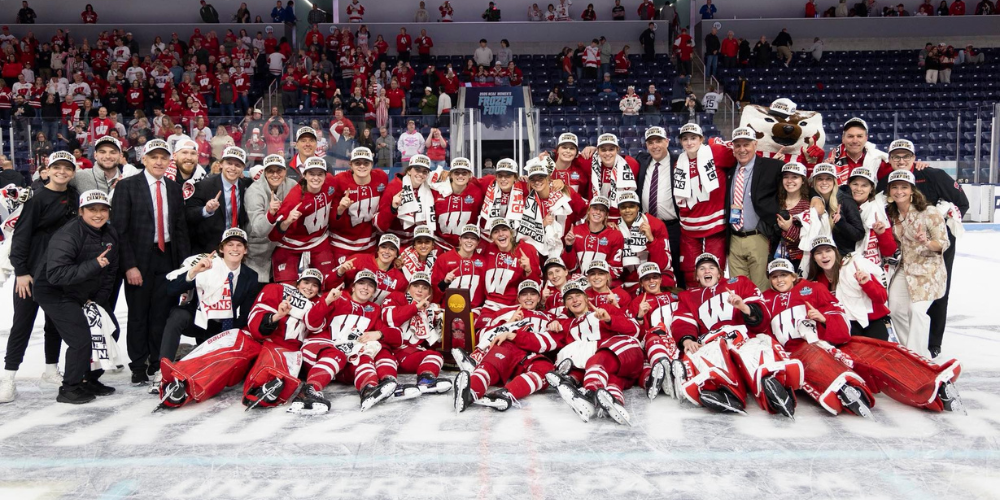
Current and past players for Wisconsin and Ohio State competed on Team Canada and Team U.S.A. for a gold medal in women's hockey. Team U.S.A. secured that gold. Then the current players returned to college, where Wisconsin secured the regular-season championship in the Western Collegiate Hockey Association (the conference alignments in Olympic, or "non-revenue," if you will, sports are bizarre) after which Ohio State won the conference tournament. Thus when the national championship bids were issued, Ohio State were the top seed and Wisconsin the second seed. They met again for the national championship.


University of Wisconsin official photograph retrieved from WTMJ.
Wisconsin's women won their ninth national championship, and if you thought Connecticut versus Tennessee was too frequent a final in women's basketball, it has been either Ohio State or Wisconsin skating with that trophy you can't drink from each of the last four years.
And those sports pundits who had reservations about Kirsten Simms being on Team U.S.A? All she did this tournament is get Wisconsin back to the finals with an overtime goal against a scrappy Penn State team. And 1980 Team U.S.A. most valuable player and current Wisconsin coach Mark Johnson is conference coach of the year.
Well done, kids.
20.3.26
DON'T CRY WITH YOUR MOUTH FULL.
That's been Cold Spring Shops advice literally from our beginning in September 2002. National Review's Charles C. W. Cooke frames it as "Enough with the long faces. America is not, in fact, a hellscape."


Eric Sailer Nighthawks parody retrieved from National Review.
His elaboration: don't cry with your mouth full.
Could we perhaps dial down our angst just a little? If, as is mercifully common, you have been spared one of the handful of genuine problems that your grandparents might have recognized as such, then “Cheer up” is pretty solid advice, all told. I know, I know. You don’t like the president? Neither do I. And you wish that some of the laws that bind you were different? Me too. And you think that things could be better than they are? You’re right. They could. But is that really a reason to be so down on your country? Surely one doesn’t need to be a Stoic to conclude that doom and gloom are to be avoided until avoiding them proves impossible rather than embraced as a lifestyle choice.His column continues with what might best be understood as the reality of the Tragic Vision.
The United States has many problems at present. But this was also true in 1980, 1950, 1920, 1890, and at each and every earlier juncture. Pick a date at random since 1776, and one will invariably discover all manner of cultural, social, political, and economic issues attached to it. Why? Because America is run by people, and because people are flawed. Because there are no solutions in statecraft, only trade-offs. Because democracy is a process, not a guarantee of perfection. It is, of course, virtuous for a free people to attempt to improve the country they inherited. But it is a grave mistake to believe that anything short of the establishment of heaven on earth represents failure. What we have in the United States right now — it’s not a matter of if or when or after or before, but right now — is a miracle. >This country — as it is. This economy — as it is. This culture — as it is. This constitutional order — as it is.He is nowhere arguing that This is all for the best in this, the best of all possible worlds.
GREYLOCK NEXT TO TUMBLE.
As I wrap up the week's posting, ESPN note that of the over twenty-six million men's tournament brackets submitted in their challenge, some 3,714 entries are still in contention. In Thursday's games, a lot of chalk had to be erased with six lower seeds winning, and the "upsets" continue today.
That title? In the depths of the Depression, the Boston and Maine Railroad offered a contest in which lineside school children could name locomotives, including the 3700 series of medium-heavy Pacifics, and the judges selected Greylock for 3714. One of those steamers is still in preservation, fittingly 3713, named Constitution. Whether she will ever steam again remains to be seen.
So what's the over-under on all the brackets broken by the end of today's games? Note: less-than-perfect brackets are still in contention for identifying the eventual champion.
FINISH THE JOB.
Former Trump administration national security advisor Matt Pottinger suggests Our President intends to do exactly that.

In the four years I worked for him during his first term, I learned that Trump sees the threat posed by the Iranian regime—to U.S. national security, regional stability, and even to Trump personally—as being categorically different from that posed by other U.S. adversaries. “Look, they’re just evil,” was how he put it last Tuesday while hosting German chancellor Friedrich Merz. “It’s not the politics; it’s their whole philosophy.”Well, yes, rile up your base to chant "death to Israel, death to America" for 47 years, and maybe you can see a categorical imperative there, or perhaps phrasing that's not easy to deconstruct. I'll leave the nuclear deal in abeyance for future scholars to investigate.
The only other nation Trump regarded in remotely similar terms was North Korea. But then he tested his assessment of the threat by meeting North Korean dictator Kim Jong-un in person three times in 2018 and 2019. I accompanied Trump for the first two encounters and believe he came away with a sense that Kim could be deterred. Trump, with good reason, concluded long ago that the Iranian regime cannot.
Trump gave Tehran plenty of opportunities to prove this instinct wrong. This administration has made good-faith efforts to reach a nuclear deal with the Islamic Republic.

I suspect, though, that letting your negotiator taunt Donald Trump's negotiator with "we have enough uranium for eleven (or is it thirteen) bombs" is not likely to intimidate. It has been a long and winding road, that leads to Victor Hanson's office door.
Under the camouflage of Shiite puritanism and otherworldliness, the ayatollahs proved even more corrupt (and far more incompetent) than the Shah’s entourage. They fought a destructive eight-year war with Saddam Hussein’s overrated Iraqi dictatorship and showed they were mostly just as militarily incompetent.One should never make the mistake of viewing a regional power as militarily incompetent based on a regional war. Finland, the Soviet Union, and the Greater German Reich have joined the conversation.
Over decades, they killed and wounded thousands of Americans by bombing U.S. embassies, barracks, and bases in the Middle East—without directly confronting the American military. For years, they sent lethal shaped charge IEDs to the Shiite insurgents to slaughter and maim thousands of Americans in Iraq and to the Taliban to do the same in Afghanistan.
At the first sign of popular protests, the regime never hesitated to gun down thousands of unarmed protesters. And, of course, they were abject hypocrites—hating the West, damning the Great Satan—and sending their pampered children to universities in America. The apparat proved quite earthly in its desire for money, estates, foreign travel, and the good life.
19.3.26
TRADE THEORY IS TRANSPORTATION THEORY.
Higher transportation costs have the same effect as tariffs. The academic study of international trade and finance generally considers a different class of problems than the academic study either of industrial location or of transportation. In part that is because some problems of international trade and finance are tractable using a general equilibrium framework, while problems of industrial location and transportation involve nonconvexities that foul the works where general equilibrium is concerned. Paul Krugman, qua regional economist (rather than in his court-intellectual-for-Democrats role) has done good work on urban and regional economics that exploits some of the insights from trade theory.
General equilibrium models of trade tend to abstract from transportation costs in contemplating the effects of tariffs or factor intensity or factor price equalization. To a first approximation, though, we can evaluate the effects of space on wage and price differentials in the same way that we'd evaluate a tariff: prices differ by transportation costs, and a tariff has a further effect on price differences on the dock of the exporting country and offloaded at the importing country. Heck, "tariff" refers both to a schedule of import duties and a table of transportation rates.
IRANIAN MODERATES.
Forty years ago, Ronald Reagan's foreign policy team was under the impression such people existed, and the United States could treat with them to get some hostages held elsewhere in the Middle East freed, but not in exchange for weapons. That unforced error came to light, it might have contributed to the Republicans losing a Senate majority in November 1986, and to this day there are moonbats of a certain persuasion who will use "Iran-Contra" as a talisman to discredit the entire political bundle of lower taxes, deregulation, and military strength.
Now comes Eldar Mamedov, a Brussels resident who works for something called the Quincy Institute, fretting about the sequential removal of high Iranian officials. "By killing moderate voices, the US and Israel are paving the way for the most extreme hardline factions to fill the void."
A WORLD CHAMPIONSHIP FOR SOME MILWAUKEE BREWERS.
Over the past nearly twenty years, the Milwaukee Brewers have been within striking distance of the playoffs, or in the playoffs, sometimes posting the best regular season record, and once or twice coming within a few outs of playing in a World Series. But the last time a Milwaukee team won a World Series you could take a streetcar to County Stadium.
I confess to paying little attention to the country of origin of baseball players. Sometimes sport transcends politics: despite the ongoing slanging matches between Venezuelan Marxists and Stateside conservatives, a fair number of Venezuelan players sign major league contracts, and three of the Milwaukee Brewers suited up for the Venezuelan nine that just won the World Baseball Classic. "Venezuela is a big source of Major League Baseball players, and much of its roster was made up of MLB-affiliated athletes, so it was hard not to cheer on your favorite players no matter which side they were on."
The Major League season, United States style, begins next week Wednesday or Thursday, and for once in a long time the Brewers will open the season at home. I've never understood the logic of not scheduling most of the early home games for northerly teams in stadia with domes or retractable roofs.
18.3.26
THE FAILURES OF ROAD SOCIALISM.
Kea Wilson's "What If The Rising Costs of Car Dependency Were As Visible As Gas Prices?" in Streetsblog is a couple weeks early to be an April Fool post. There is imaginative editing of gas station signs and message boards to accompany a secondary headline reading "Gas station billboards remind U.S. residents every day that driving is getting more expensive. What if they told a different message about the high costs of our autocentric transportation system?"
THE PURITY TEST TAKES PRECEDENCE.
Until yesterday, Joe Kent directed the National Counterterrorism Center. No, that's not a plotline from 24, it's a real government agency with real bureaucrats. And if you're Brett Wilkins with Common Dreams, when a bureaucrat steps down citing reasons that a big chunk of Common Dreams readership probably concur with, it's more important that said bureaucrat's shortcomings matter more than his change of heart.
National Counterterrorism Center Director Joe Kent announced his resignation Tuesday, accusing President Donald Trump of being manipulated by Israel into launching a war on Iran.He could have noted another instance of sloppy personnel policy in the Trump presidency to a Right on! from the True Believers and let the Militant Normals engage in recriminations. But no, it's important that the people who object to the major combat operations in Asia Minor be beyond reproach. "While Kent’s resignation drew praise from many opponents of Trump and the illegal US-Israeli war of choice in Iran, others focused on his troubling record and associations."
“I cannot in good conscience support the ongoing war in Iran. Iran posed no imminent threat to our nation, and it is clear that we started this war due to pressure from Israel and its powerful American lobby,” Kent—a former Army Ranger and CIA paramilitary officer often described as a white nationalist and conspiracy theorist—wrote in his resignation letter to Trump.
16.3.26
LET'S PUT A PIN IN THIS, TOO.
It has been our practice, the last few years, to note the hurricane projections at the beginning of summer for later evaluation at the beginning of Advent. Perhaps it's time to highlight the doom-saying of doomsday environmentalists. Take Bill McKibben. Please? "It’s About to Get Even Hotter—Can We Learn From It?" He has to introduce his doomsaying with a lot of contextualizing.The good Lord willin', the crick don't rise, and the mullahs don't nuke, we'll see more frustration for Bill McKibben, heir to Paul Ehrlich in the "good doomsday copy that's wrong" class of celebrity experts.
It’s already hot, all over the world and here in the United States. That’s been a little hidden these past months, because the country’s population and power center—the northeast corridor from Boston to DC—has had a cold winter; until the last few days of rapid-onset mud season it’s felt like an old-school winter in New England (with sublime skiing, which has kept me sane). And Minnesota, the source of much of the year’s news so far, was cold too, at least in bursts. But we’ve been the exception: in fact, it was the second-warmest winter on record in the continental US, and that’s because the West broke every possible record.That air masses might not be respecters of calendars or political boundaries might be of secondary importance, and we'll see how this latest dose of polar vortex to the northeast and heat dome to the southwest (I apologize for using the doomsday environmentalists' new euphemisms for what I've always understood as "cold snap" and "heat wave") plays out and let's get to the projection I want to pin down.
All this is happening during a La Niña “cool phase” of the Pacific, something that will soon change. I alerted you exactly a month ago to the likelihood we were going to see an El Niño kick off sometime this summer; in the last few weeks the chances of that have grown stronger, and more to the point it looks like it could be an exceptionally strong “super” version of the warming current. The normally cautious-almost-to-a-fault climate scientist Zeke Hausfather came out with his new forecast Thursday afternoon.Because extrapolation models are so good at extrapolating. Let's take stock around Oktoberfest.
- We’re going to see temperatures unlike any that humans have seen before, which means we’re going to see chaotic weather unlike humans have seen before.
- I do not think it’s fear-mongering to warn that fire may be a serious danger this season in the West.
- All I’m saying is, the next six months could be the ultimate in teachable moments, with rapidly rising prices for oil, and rapidly rising temperatures.
IF NOT NOW, WHEN?
When a country initiates major combat operations against another country, that means it's time for the serious people to be serious. Such is not necessarily the case: apparently over the weekend the latest process-worshipping talking point is to the effect that currently the mullahs have neither a nuclear weapon nor the ability to deliver one to the United States. A Substack operator called Elders of Ziyon notes how unserious that stance is. "The Anti-War Argument Is Actually a Pro-War Argument."

An irrational actor that is also becoming militarily untouchable is not a problem that diplomacy resolves; it is a crisis that diplomacy defers until the moment of maximum danger.Unfortunately, it has been the position of the United States government that talking the mullahs off the ledge, or perhaps waiting them out, is preferable.
The anti-war logic, followed to its own conclusion, is a pro-war logic. It establishes that Iran is dangerous, unpredictable, possibly theologically motivated, and immune to the kind of rational calculation that makes deterrence work. Having established all of that, it then argues for giving such an actor more time, more missiles, more infrastructure, and eventually the conventional umbrella behind which it completes a nuclear program.
The conclusion doesn’t follow from the premises. It contradicts them. If Iran is irrational, and it is getting more powerful, then the only rational choice is to stop it earlier rather than later.

Elder of Ziyon is a guy with a substack who concludes, "The lesson they should have drawn — and that events are now teaching — is that you don’t wait for such an actor to become more powerful. You act while the cost is still bearable." Now comes one David Boies, longtime eminence in Democrat circles, recognizing the same thing.
Every past president since Bill Clinton, Republican and Democrat alike, has declared that Iran couldn’t be permitted to develop nuclear weapons. Not one acted to prevent it.Presumably, to the process-worshippers, not until there's actionable intelligence demonstrating the existence of the intercontinental missile and the hot rocks, acting to stop their development is premature. Mr Boies has none of it. "If [Donald Trump] hadn’t acted, his successor would have been left with an even more dangerous choice than his predecessors left him."
Every president since Ronald Reagan has condemned Iran’s role in terrorism against American citizens, interests and allies. Not one acted to stop it.
Instead each president left his successor with a more dangerous Iran and a more complicated threat to address.
CLIMATE CHAOS IN THE STATE LINE.
If you don't like the weather, go to the next county. The Sunday morning map of watches and warnings had the springlike stuff to our southeast and fulfillment of the groundhog's fears to the northwest.


By evening, the groundhog's forecast was verifying here, although one might be forgiven for thinking "early spring" south toward Bloomington and Springfield, with another day of tornadoes.

This morning, DeKalb was in the "blizzard warning" area, not for any new snow, but for the prospect of high winds and light powder being blown around. Local authorities were recommending against travel. The sun is high enough and strong enough now that getting concrete surfaces mostly clear suffices to keep the blowing and drifting stuff under control.

Snow cover through most of Advent, cold with little snow cover through January and into February, now the sort of snow with almost enough moisture to congeal in the snow-thrower, and if it's a little deeper, can bring on cardiac events.
To the north, Wisconsin got it, with Weather Channel storm-reporters braving the blizzard conditions in downtown Green Bay. Amtrak's trains between Chicago and Milwaukee were running. I'm not sure about the trains toward the Cities and the Dakotas.

That's Amtrak 334, close to time, and lost in the snow cloud is an older B32-8 pushing. I was hearing radio chatter about one of the trains' newer Charger diesels, like the one leading, having troubles.
We are now on Daylight Saving Time, which will bring us the weird phenomenon of sunset around 7 pm and heavy snow on the ground.
14.3.26
THE ALGORITHM GOT IT ABOUT RIGHT.
After those unrelentingly gloomy Saturday posts, perhaps a more cheerful Saturday bridge column is in order. Of-times, the algorithms get high on their own supply, and what happens next is not amusing. Not in this example, where the declaring bot's shortness worked out just right. East deals.


Human player is always sitting South in these simulations. I hesitate to bid One No Trump on a 5-3-3-2 distribution, although that Club Ace and a sequence in Spades offers protection. West's Two Spades has nothing to do with Spades and North bot's Three Spades means hearts and a minor. Three No Trump works with balance, and North bot declares with Six Diamonds. East leads the ♠ Five. Think about the resources from North's perspective: void in Spades, with but three Diamonds including the Ace held by the opposition, one Spade ruff is manageable. Three top tricks in Hearts, but the Jack, Ten, and Nine are out against them. The Club Queen isn't useful as an extra winner on the board. West, though, helps the cause by covering South's honor with the Ace and then discovers the bad news at the cost of the Diamond Three. Produce another void in hand by leading the ♣ Six to the ♣ Ace. From the board, lead the ♦ Two which drops the ♦ Nine and the ♦ Jack drops the Ace. One trump outstanding, and East helps the cause leading the ♣ Seven: Queen, King, ruff low. Lead ♦ Five, East gets rid of a Spade, Queen, Ten, and all the trumps are drawn.
REQUIEM FOR AN OBSOLETE INTERNATIONAL ORDER?
You'd expect a past president of the Council on Foreign Relations to object, and Richard Haas does so for readers of The (Not Detroit) Free Press with an essay in ten observations.The title of his essay is "A War the U.S. Didn’t Need," and some of those points are true of any war, whether or not it is approved of by an Act of Congress or a United Nations resolution.

- The war weakens the global norm against preventive war.
- The war highlights the costs of being an ally of an increasingly unilateral United States.
- The war is a boon for Vladimir Putin and Russia.
- It is an even bigger boon for China.
- Contrary to conventional wisdom that the war will dissuade nuclear proliferation, it may actually increase incentives for countries to acquire nuclear weapons.
- Because the war began while negotiations were taking place, it may complicate the future role of negotiations in advancing peace.
- The war weakens the norm against political assassination as a tool of national security.
- All wars involve human costs, and this one is no exception.
- All wars also entail economic costs.
- The war will strengthen isolationism in the United States.

That "international order," and those international norms and institutions, such as they are, serve as convenient props for members of the Professional-Managerial Class hanging onto whatever authority they have to boss Normals around. Simultaneously, they have never been effective in taming the sort of tribal squabbles and regional wars that we have had with us, undiminished, since the end of the Cold War; nay, since the end of the War.
STOP ENABLING DYSFUNCTION, GET LESS OF IT.
That's long been a Cold Spring Shops theme.

Here's University Diaries, commenting on the latest spring break atrocity out of Panama City. "Allow certain ingredients to be put together in a concentrated way in a specific location, and you can actually destroy civilized life." Quite. The extension to the Experimental Prefigurative Communities of Tomorrow masquerading as the multiculturalist university is left to the reader as an exercise.Today's ingredients, concentrated in a specific location, are Moslems in Dearborn. The editors of National Review identify the resulting destruction. "We have a significant problem with radical Islam in this country, and unlike the September 11 hijackers, all of the perpetrators in these attacks were U.S. citizens — Ghazali, Jalloh, and Diagne were naturalized citizens, while the Gracie Mansion duo were children of naturalized citizens."

Point such things out, and brace yourself for the cancel mob.
13.3.26
STILL NOT GETTING THROUGH.
It wasn't even Friday the Thirteenth, and Amtrak's Chicago to California trains were the medium-sized trains that couldn't.
Late arrivals are, to a degree, preordained for Amtrak’s long-distance trains on the first weekend of Daylight Saving Time — but not to the extent experienced by the California Zephyr and Southwest Chief.The spring clock change was incidental. The dependability of those trains has been questionable all winter, and the same problems surfaced again last weekend.
When clocks advance by one hour every spring (except in Arizona, which does not observe Daylight Saving Time), Amtrak trains that may be on time at 2 a.m. local time become one hour late, unless a special schedule is implemented, using a different train number, that accounts for the time change. In that case, times are adjusted by one hour at stations the train serves after 2 a.m. Sunday.
Service marginally impacted by last weekend’s hour loss includes eastbound of the Empire Builders arriving Tuesday, March 10, and today (March 11) in Chicago. Both had their already-short 5½-hour equipment turnarounds reduced by an hour, reflecting tardy westbound arrivals that dealt with high wind warnings and freight congestion. Both departed two hours behind schedule; Tuesday’s arrival in Chicago was at 8:14 p.m., 3 hours, 29 minutes late.
Southwest Chief No. 1003 that departed Chicago on Saturday, March 7, was another story. The train was given an extra hour to get to Los Angeles, with a scheduled arrival of 8:57 a.m. Pacific Daylight Time on Monday, March 9. The fact that it arrived at 10:40 p.m., 13 hours, 43 minutes late, is symptomatic of increasing issues of breakdowns en route for the long-distance trains.That was the worst outing, but not the only bad outing. Conditions were little better for the California Zephyr.
Troubles began at Albuquerque, N.M., according to alerts shared with passengers. The lengthy stop, a 1,500-mile inspection point, is where “equipment adjustment and removal” took place. The resulting 90-minute pause, however, was dwarfed by a five-hour, 15-minute stop at Gallup, N.M. Another two-hour delay came between Gallup and Winslow, Ariz., and three hours more were lost at Kingman, Ariz., while the train waited for an operating crew to relieve compatriots whose federally mandated hours-of-service limits had expired.
An Amtrak alert also revealed that an “ongoing mechanical concern” befell the westbound California Zephyr departing Chicago on March 6. The train was delayed four hours between Green River and Provo, Utah, “and will be met at Salt Lake City by the mechanical team who will further evaluate this concern,” according to the unusually candid alert. The train arrived Sunday morning at 4:55 a.m. and departed at 8:15 a.m., by then seven hours, 35 minutes late.I wonder if the online trainwatchers who like to hang out on the Galesburg channel stayed up to watch these moves, which included at least one bad-ordered car cut at Galesburg. It's frustrating enough when a westbound California train leaves Chicago with low water in the dining car (take care of other things during a foreshortened turnaround in Chicago and top up the water at Galesburg) and if anything the troubles are getting worse. There's only so much the yard crews can do to keep aging stock rolling.
While the beleaguered westbound Zephyr was in the Salt Lake City station, its eastbound counterpart No. 1006 arrived early, but departed two hours, 20 minutes late, following “equipment adjustments and removal.”
Trains asked Amtrak for more specifics on the issues of both trains on Monday, March 9, but the railroad has yet to respond.
The fact the vast majority of Amtrak trains leave their terminals in good shape and operate on time is a testament to mechanical forces that keep the company’s aging rolling stock in motion. But last weekend’s events show that an increasing number of significant breakdowns en route are disruptive on a far-flung network that has few current options for equipment substitution.But Amtrak hope to scrape together enough stock to strengthen formations for the summer.
Adding one car to every Southwest Chief, for instance, requires five cars of that type. The 30- to 45-year-old equipment typically gets cycled through periodic maintenance when demand is lighter. The Chief, which has been running since the New Year holiday with a single sleeping car plus roomettes in the train’s transition sleeper, has been a tough ticket. Chicago-Los Angeles roomette fares through March 15 range from $806 to $1,438 (four rooms were left at this price for March 14 as of Thursday). There is also one date where roomettes are sold out.The Scouts travel in patrols and troops and there's not enough sleeper space, nor does "Be Prepared" include "to pay sleeper fare." Thus they ride coach.
But later this month, another full sleeping car is being added to every Southwest Chief through the summer, along with a full baggage car. A third coach will be added in April, once Colorado’s Winter Park Express finishes its season. This will help accommodate campers destined to and from the Philmont Scout Ranch, a bus ride away from the train’s stop in Raton, N.M.
PROGRESSIVISM PRODUCES PENURY.
In "The Iran War Reveals a Global Chokepoint," Common Dreams contributor Richard Heinberg admits as much. "The current fixation of world attention on the Strait of Hormuz should remind us of the inherent brittleness of an economy in which our food and energy security, and our livelihoods, are intertwined with depleting and polluting resources and expectations of perpetual growth." If you don't ask too much of his essay, there is wisdom in it. "The more extensive the market, the finer a division of labour is possible. That's generally for the good, but what happens when the s**t hits the fan?"
That question of the delivery trucks not coming turned from online musings to messy reality a couple years later, when the politicians panicked and cities had to make do with stocks of toilet paper, and sometimes foodstuffs, on hand. But if you're contributing to Common Dreams, you think that reducing the carbon footprint of the civilized word is a good thing for its own sake. Helium and fertilizers, as well as sweet crude oil, transit the strait, and what's left of the mullahcracy seems bent on flipping their remaining drones and antiship missiles that way. Now is the time, this Heinberg fellow asserts, to reduce our dependence on shipping through the strait.
These developments underscore a message that we at Post Carbon Institute have been repeating for over two decades. Oil and other fossil fuels are the basis of the modern industrial economy. They’re polluting, but they’re also depleting. And in the case of oil (and, increasingly, natural gas) they’re internationally traded at massive scales, raising geopolitical risks. This is a system destined to fail.pppIt wasn't. But the real kicker comes at the end of the essay.
But when? During and shortly after the US invasion of Iraq in 2003, the all-time peak in world conventional oil production seemed to be at hand.
The current fixation of world attention on the Strait of Hormuz should remind us of the inherent brittleness of an economy in which our food and energy security, and our livelihoods, are intertwined with depleting and polluting resources and expectations of perpetual growth. More chokepoints loom.Reduce the extent of the markets, reduce the division of labor, revert to the living standards of the early nineteenth century, before steamships and railroads. So it always is with these environmentalist true believers. Hard pass.
As always, we advise community resilience as the best strategy for coping with what’s coming. Localize production and consumption, reduce your dependency on global supply chains, and get to know your neighbors.
WOKE, BROKE?
Portland State University have long been on our "shake out the suboptimal capacity" list.
Perhaps it's time for Portland State to think about its mission and purpose. It sometimes gives the impression of being a state-supported version of Brown (or Reed) without the starlets paying bribes to get their underprepared spawn in, or perhaps of Oberlin with a less upscale food court, or perhaps Evergreen State with a broader offering of courses.That despite, or is it because, of a trolley running through the middle of its student center. The only sane thing you find in some self-styled progressives is their respect for things that run on rails.
10.3.26
MARCH IS FOR MODEL RAILROAD SHOWS.
The Karlson Brothers Circus regularly show at Delavan's Train Show. "The train show and swap meet season tends to run from November into March. The Karlson Brothers Circus showed at last weekend's Delavan (one of two Wisconsin towns claiming to be midwestern home of the itinerant circus) for the first time in five years. That ballyhooed March 2020 show never happened, because the politicians panicked."


The past two or three years the show has participated with several other State Line O Scale modellers and at the request of the Mayor, our display is in City Council chambers.

As is our practice, it's up to children of all ages to notice some of the sight gags.

In the past two or three years, the collection of college mascots in the menagerie has expanded.

The Circus World Museum in Baraboo has a short orange wagon with monkey bars in the ceiling, and if you look closely, there is a monkey hanging from the monkey bars. Yes, some people did contort themselves to get a closer look into the wagon and see that yes, indeed, there's a set of monkey bars up there.
The circus train continues to draw interest from model railroaders. The locomotive is a Saginaw bronze casting from before the War, fitted with brass wheels and a modern transmission, and the onboard power and sound are now working.
Next up, the big Chicago area O Scale show in another week.
Subscribe to:
Posts (Atom)