23.3.10

WHAT'S THE DOMINANT STRATEGY? Connecticut basketball coach Geno Auriemman unloads on tightfisted administrators.

"Until more women's coaches are held accountable for wins and losses and style of play, there is nothing we can do about it. It's proven that the more programs that do that, the more people will come out and watch," Auriemma said. "Every men's program in men's basketball is trying to make the tournament. That's not the case with women's basketball. Until that happens, the sport will be in a little bit of a holding pattern.

Auriemma said the top players coming out of high school are going to a wider range of schools.

"The programs who might rank from five to 45 in the game are much more competitive than they once were. So the game is slowly getting there," Auriemma said.

Auriemma said any perceived stagnation of the game's growth is the fault of university presidents and athletic directors who do not respect women's basketball enough for it to succeed.

"What has to happen is that enough athletic directors and university presidents need to make more of a commitment to the women's game so they will put more pressure on their coaches to coach better. They don't put enough money into the programs to demand from their coaches that they play at that level."

All they are doing is fulfilling their obligation by having a women's program and making sure the kids graduate. They tell [the women coaches] they have enough trouble dealing with men's basketball and football, so don't bother me. So [administrators] would rather status quo remained. That would be unacceptable on the men's side, but they let it happen on the women's side."

There's accumulating evidence that the universities are losing money on the positional arms races called men's basketball and football, and the way to make the women's tournament something other than Stanford and Tennessee and Connecticut is to ... get into another positional arms race?

Um, Coach Auriemma, is the University of Connecticut attempting to be competitive with Northern Illinois in accounting or Michigan State in engineering or Wisconsin in chemistry or Penn State in economics? I leave the generalization of your argument to the reader as an exercise.

(Via Women's Hoops.)
MY BIOLOGICAL WEAPONS LAB. Kids Prefer Cheese reports on the Indian military weaponizing chili peppers.
The Indian military has a new weapon against terrorism: the world's hottest chili. After conducting tests, the military has decided to use the thumb-sized "bhut jolokia," or "ghost chili," to make tear gas-like hand grenades to immobilize suspects, defense officials said Tuesday.

The bhut jolokia was accepted by Guinness World Records in 2007 as the world's spiciest chili.
With a national security question.
5. Will India ban exports of this pepper due to national security?
Too late:


I'll sign a nonproliferation treaty, if asked.

I have plans to make my already deadly chili even deadlier. My source of jolokia seeds, as well as Charleston Hots (which are effective against nematodes, although I'm not sure that's a problem here) is a South Carolina arms dealer pepper vendor named Pepper Joe.
CONGRATULATIONS. Lou Bartig's scratchbuilt Y6 model, shown here, won best of show at the March Meet. One modeler observed it's a shame to paint a model this good.

22.3.10

WHY IT MATTERS. Joanne Jacobs reports on a Rug Rat Race. The apparent motive: parents equip their kids to compete for the scarce slots in good colleges. And university administrators worry about being too selective.
IMPOSSIBLE TO PLEASE EVERYBODY. Destination: Freedom reports on a rail summit in LaCrosse, Wisconsin at which advocates for several rail routes met with transportation officials in Minnesota and Wisconsin to contemplate the routing beyond Madison to the Twin Cities of the faster trains.

Amtrak's current routing is Milwaukee - Portage - La Crosse - Winona - St. Paul.

The Wisconsin Talgo can pick up the current routing (which was once home to the world's fastest passenger trains) at Portage, or with some trackwork north of Baraboo, at Camp Douglas. Representatives from Eau Claire made their case for continuing the service through their city and into Minnesota at Hudson. There is a lot of congestion on Interstate 94, but that routing misses several Minnesota population centers. Rochester also wants in on the train, although that would be going the long way around. (The article claims Rochester never had direct train service to the Twin Cities. Strictly speaking that is not true, although a Chicago Great Western Rochester - Randolph doodlebug connecting with a Hayfield - Minneapolis doodlebug isn't exactly Hiawatha service.)

The value of a passenger train network is in its connectivity, and the old Chicago and North Western service to the area had it almost right, with trains connecting at Wyeville. Unfortunately, there is probably not yet sufficient traffic to run limited-stop trains via Eau Claire and Madison, exchanging passengers at Camp Douglas with expresses via Winona, La Crosse, Portage, and directly to Milwaukee. And if I propose to supplement the expresses with semi-fasts from Madison calling at Watertown, Oconomowoc, Brookfield and the existing Hiawatha stops (plus Gurnee) and other semi-fasts from Madison calling at Stoughton, Janesville, Beloit, Harvard, and Barrington you'll ask if I've had some kind of mushroom.
DIFFERENT WAYS TO MAKE THE CASE. Power Point presentations, particularly in the potted form popular with academicians, impede learning.

University Diaries lays out the case against them at length.

Angus at Kids Prefer Cheese puts it plainly.

REPEAL BY DEFAULT. The House, Senate, and President Obama have a medical insurance reform bill that appears close to becoming law. Republicans are making hopeful noises about repealing some of the provisions. But major public entitlements, once in place, are difficult to repeal as their beneficiaries become constituents for its preservation.

That's not to say entitlements can't be undone.


St. Petersburg, July 1997.

Bolsheviks only stormed through that arch in the movies. But behind the walls is an instructive lesson. No, not the Hermitage art galleries, in which the Tsar's collection of impressionist works was Khrushchev's degenerate art. Not the stonework in those galleries, which might be artistically more significant than the paintings. Rather, it's the elderly ladies serving as security in each gallery. At the time of my visit, Russia was in depression, with one third of the Yaroslavl working class officially listed as unemployed, accompanied by a hyperinflation in which a half-liter bottle of Pepsi went for several thousand rubles. Metal kopecks, let alone one- or five-ruble notes, didn't exist. Those ladies were receiving a paycheck to supplement defined-benefit pensions of a few hundred rubles a month.

With Social Security administrators selling the Treasury bills it holds as trust fund assets into a weakening market for Treasuries and Walgreens declining further Medicare patients, the issue is not necessarily one of repeal.
1234 WINS, 567 LOSSES. That outcome, with no special effort on my part, was the Free Cell tally on the Cold Spring Shops computer. I suspect my tally would be better than 69% if I weren't so insistent on getting clean wins, with the four kings in the four right slots. Sometimes the best thing to do is just clear the cards out.

21.3.10

IN PLACE OF WEST MILWAUKEE. The North American assembly plant for Talgo trains will be in the former A. O. Smith auto frame complex near 27th and Capitol on the north side of Milwaukee, and along one possible passenger train route to Green Bay.
Wisconsin has a $47.6 million deal with Talgo to build two 14-car trains for Amtrak's Milwaukee-to-Chicago Hiawatha line, with an option to buy two more for a planned extension of that route from Milwaukee to Madison. The federal government has awarded the state $810 million in stimulus money for the Milwaukee-to-Madison route, which will start service at 79 mph in 2013 and reach 110 mph by 2015, plus another $12 million for upgrades on the Milwaukee-to-Chicago route.

But the picture changed when the Oregon Department of Transportation announced [February 26] that it would be buying two 13-car trains made at the new factory "with a majority of American-made components" for Amtrak's Cascades line, which runs from Eugene, Ore., to Vancouver, B.C., Canada.

If more states start buying Talgo trains, the number of jobs at the new plant would rise sharply, said Bauman, who once ran a company that produced rail cars.
The decision by Wisconsin to buy Talgo trains involves opportunity costs. Milwaukee commuter car assembly company Super Steel has filed for receivership, an outcome possibly unrelated to the choice of Talgo. State commuter rail authorities haven't been placing many orders recently. Super Steel might provide components for the Talgo trains. The Wisconsin award to Talgo, under a no-bid contract provision, has become an issue in the Wisconsin gubernatorial election.

That mention of other states considering Talgo trains intrigues. A low center of gravity train (articulated like a Prior and Church roller coaster train) isn't reqired for fast running on the Wisconsin service. From LaCrosse to St. Paul, yes. Along Puget Sound, which is curvy trackage, yes. But then there's the historic stomping grounds of Patrick McGinnis's early-version Talgos (noisy, rough-riding, uncomfortable.) The Acela Expresses are approaching their half-life, and an extended Boston to Brunswick, Maine service offers ample opportunities for a comfortable, flexible train to strut its stuff.
ADAPTIVE REUSE. The retort house of the old Milwaukee Gas Light Company offers all sorts of open space for offices.

Like other former industrial buildings from the early 20th century, its features include brick construction, high ceilings and dozens of large windows.

But unlike many of those buildings, this one isn't marked by support columns, which tie up usable space. Instead, the building's roof is supported by steel arches that rise 50 feet above the floor. Those arches made room for a huge industrial oven where coal was baked to produce gas for streetlights, factories and homes until being replaced by electricity and cheaper natural gas. The building, constructed in 1902 and 1903, had its gas-making oven shut down in the 1950s, and most of the gas company complex is now used for storage.

Apparently, despite the retort producing byproduct coke and coal chemicals as well as the coal gas stored in the now-demolished telescoping gasholders, the building is not toxic.
CORNELL AND VERMONT ALSO SKATE. I still view participation by Wisconsin basketball teams in March tournaments as unusual. March is for hockey in the Boston Garden. Oh well.

But with Cornell excusing the men and Vermont excusing the women, the last major sport dancing is hockey, opening at Minneapolis against Vermont, and Cornell in the road to the title.

20.3.10

WHERE'S PRESIDENT TRUMAN? The weather earlier this week was conducive to bike riding, but my evasive skills are a bit rusty, leading to a fall and a strained left arm. For typing purposes that makes me a one-handed economist. Judge my recovery by the frequency and bandwidth of future posts.
WILL THEY FOLLOW UP WITH EXTERNALITIES AND ADVERSE SELECTION? Eclect Econ recommends a Fraser Institute video contest winner that begins the economic education of an all-too-well-scrubbed cadre of revolutionaries.


It's entertaining, particularly when the performers self-refute their own claims.

I note, however, that a full rebuttal of the claims of self-styled progressives requires stronger stuff than specialization and competitive markets alone can provide.
BEGINNER'S LUCK. Our President correctly picked last season's NCAA basketball champ. He won't do that well this year.
President Obama filled out his final four brackets for the men's NCAA tournament. He told ESPN he was choosing Kansas, Kansas State, Kentucky and Villanova to make the final four.
Score another one for the mid-majors, with Northern Iowa (UNI, not to be confused with NIU) ousting Kansas and candidate America's Team St. Mary's (I may have to watch them -- do any of their players genuflect before shooting a free throw?) excusing Villanova.

Has anybody noticed how many Big East teams are out? How is that hopey-changey stuff working?
I'M NOT RUNNING AN ADVICE COLUMN. The Trenchant Observation of the Day comes from an advice column.
I can’t be in a relationship with a woman who is only into makeup, diets, and marriage. I’m sure there are men out there who can be, much the way I know there are women who only want dudes who are into banking, saunas, and not working.
We'll contemplate the hypothesized supply curve of trophy wives in a future post.

19.3.10

COMING TO TERMS. Northern Illinois University president John Peters releases the February 14 report.
No institution can ever be completely prepared for such a horrible event, but hopefully by sharing our experience others may better prepare and respond to the needs of their campus communities during times of tragedy.
The report is a 322-page .pdf file with numerous appendices. It will take me some time to read and understand it.
As difficult as it is to re-live the events of that day, it also serves as a reminder of how grateful we are as a university community. In our time of greatest need, thousands of people from all over the world would reach out to help us. From the local law enforcement officers and emergency medical technicians who were on the scene within minutes providing invaluable assistance; to the hundreds of counselors from across the Midwest who dropped everything and answered our call for help; to members of our DeKalb County community who welcomed our students back with cookies and hugs – all provided aid, support and comfort during a very difficult time. Their actions have much to teach about the value of preparedness, cooperation, neighborliness, and humanity.
As I noted at the time, the goodwill will help us.
THE RECORD STANDS. Only one Milwaukee Hamilton basketball team has gone undefeated in conference or won a state title. Sometimes it is better to be the surprise.
THE REAL MARCH MADNESS. Victor Matheson of The Sports Economist makes the Trenchant Observation of the Day.
South Africa has spent at least $6 billion in preparations for this summer's World Cup. How can a poor but developing country like South Africa afford to host such an extravagant party? Simply put, it can't.
We leave the generalization to aspiring mid-majors and other institutions of higher learning sports as an exercise.
THE COMPANY STORE WILL NOT OWN MY SOUL. Representative Paul Ryan (R-Wisconsin) gave a radio interview in which he noted that the authority to determine reimbursement rates would be vested in the Secretary of Health and Human Services (it's just a matter of time before Welfare gets Cabinet status the way Education once did) under the Democratic bill supposedly to be voted on this weekend.

Under the proposal, the Department of Health potentially becomes a monopsonist. (The skeptics tend to take that position, the proponents aren't persuaded.) A monopsony can improve resource allocation in a bilateral monopoly situation, although the applicability of that model to medicine is limited by the ability of physicians to opt out.
MID-MAJORITY. Mid-American tournament winner Ohio (a 14 seed) ousts three-seed Georgetown. I hear brackets shattering all over the country.

15.3.10

REPRISING THE CAPITOL 400. The requirement that demonstration faster train projects be shovel ready led Wisconsin's Department of Transportation to propose the Milwaukee to Madison leg of a planned Chicago to the Twin Cities service as an economic stimulus project. The weak point of that project has been the terminus at the Madison airport, inconveniently far from Capitol Hill, the University of Wisconsin, and the sports arenas. Some Madisonians have advocated for the Yahara Station, somewhat closer to downtown. The Political Environment reports on a second proposal for a terminus, called Gateway Station, at Williamson and Blair Streets. Look closely at the photographs. The roofline of the Madison Gas and Electric headquarters is in the background of the picture looking toward Capitol Hill. The lobby of that headquarters building is the headhouse of the Chicago and North Western passenger station. As a Madison terminus, it works well, although a train bound for the Cities would have to reverse direction. (That works well enough for some Trans Pennine trains at Manchester Piccadilly, and any through train at Frankfurt am Main.)

14.3.10

I PERSEVERE. It took 25 years for my inquiry about a roller coaster at Bay Beach Amusement Park to catch on, and I have been beating the drums for faster Hiawatha service for at least five years. On and off, I have been informing readers about the form school choice takes in the U.S.
And note the way in which school choice with government schools works. You do have school choice, provided you're willing to pay the premium for the house in the better school district. And the right preschool?
And when Megan McArdle took it up, I was able to go one better. Here's the McArdle version.
Actually, this makes me think that a lot of the opposition to vouchers is about that affluent suburbanite's need to maintain the delusion that they care about inner city public schools. Memo to suburban voucher opponents who "support public education": you're already sending your kid to private school. You're just confused because your tuition fees came bundled with granite countertops and hardwood floors.
And my extension:
That reminds me of McCormick, Shughart, and Tollison's 1984 "The Disinterest in Deregulation," wherein the rents are concentrated and the welfare gains small and costly to collect. And yes, genuine competition among school districts is likely to bring in its train some capital losses to current homeowners whose mortgages include that test-score premium in the house price.
Now, via The Bellows, comes a conversation that touches on all these points.
Kevin Drum highlights a really regrettable defense of public schools that goes as follows. School systems are neighborhood-based, and so the benefit of good schools is capitalized into home prices. Households that care about education are willing to pay for good schools while those that don’t, aren’t. Freedom! Or something.
It's not that simple. Prices ration access to scarce resources. It's quite possible that the price of a bundle consisting of that McMansion and a good school district is high so as to encourage self-selection. (It might have been Walter Bagehot who made a similar observation about first- and third-class train fares in England, although in that case he claimed the railroads, er, railways, degraded the third-class service so as to discourage the richer passengers from riding on the cheap.) There's analysis along those lines in The Bellows.

The conversation about education policy appears to have begun here.
That is, parents have the right to settle in whatever school district they choose. (They also have a constitutional right to send their children to private school if they wish.) Predictably, therefore, those families willing to pay the most for a good education gravitate to the best schools, the “price” of which is reflected in the cost of real estate and local property taxes, while the families that care the least about education gravitate to the worst. Meanwhile, the extent to which parents value education itself enhances (or degrades) school quality, as schools are always more likely to thrive when they can attract the families with the highest social capital. Thus, good schools and “good” (that is, education-valuing) families cluster together. So long as Americans enjoy freedom of movement, supply and demand will always tend to produce a huge gap between successful and failing schools. The outcome is basically fair and not altogether inefficient.
It's not clear that there has to be a huge gap between successful and failing schools. There's nothing inherent in Tieboutian competition among jurisdictions that requires a wide range of outcomes. (An educational establishment that aggravates tension between education-valuing families and families with other objectives by mainstreaming slow learners and troublemakers, or by enabling disruptive behavior as a cultural difference, will produce more pressures to outmigrate.)
School vouchers, for example, a favorite policy of “accountability” proponents, punish those very school systems that have already worked very hard, thank you very much, to attract the best students and most civic-minded parents. (It’s no surprise that vouchers have proven to be politically unpopular, including if not especially among Republican voters.) Similarly, shutting down failing schools and redistributing their students punishes those schools that have performed marginally better and thereby attracted marginally better students and parents. The “accountability” movement, in short, wants to equalize the quality of educational products, no matter the price paid for them. Whatever this merits of this policy, it surely does not show much faith in the free market.
And here, the author conflates two effects. Vouchers have the potential to inflict capital losses on homeowners who are currently buying a Tieboutian bundle including good schools, with those higher College Board scores capitalized into the house prices. They also have the potential to encourage favorable self-selection. At the margin, vouchers and transfers need not transform the equivalent of a Milwaukee Hamilton of the early 1970s into the dropout factory that it is today, basketball success or not.

This essay gets to the heart of the matter.
If we really want better schools in the areas that have the poorest results, we’ll have to fix communities first. And communities will need to do that from the ground up, not Washington down. That’s no simply task, but it is at least more realistic than thinking we can fix schools through federal legislation or by issuing standardized tests or pushing all students toward higher education or by sucking money from the public schools and redistributing it into private ones.
To do so would require the colleges of education to lose their fascination with Rousseau and understand their objective as preparing teachers to develop the habits of the middle class in youngsters. Oppressive as that sounds, it is less oppressive than allowing youngsters to believe that anything goes.

It appears as though Kevin Drum at Mother Jones is catching on.
Or, on a more serious note, we could fund poverty and educational interventions with proven track records, allow schools more leeway to deal with incorrigible students, encourage our best teachers to work in our most challenging schools and allow principals to fire the ones who fail, promote experimentation via charter schools, and make sure every school is adequately funded. Feel free to add your own favorite ideas to this list. It's a little messy and it's no silver bullet — it's a long, hard slog, if you will — but these are the sorts of things that will eventually make a difference. Best of all, some of it is even politically feasible.
It's more important that the right things be done than that I get credit for it.
BUYING THE RIGHT TO DISENGAGE. In the middle of a meditation on the use and abuse of laptop computers, University Diaries at Inside Higher Ed lays the smack on the it's-my-money-I'll-do-what-I-want justification for slacker behavior.
The student is indeed an adult, but unless she's financially autonomous, her tuition is paid by some combination of the university, her parents, and the American taxpayer. She's wasting a good deal more than her own chance at an education -- she's thumbing her nose at the generosity of well-meaning people. And her behavior harms more than her financial sponsors. Her indifference to the professor and her fellow students, and the public nature of her screen images, add up to something distracting, demoralizing, and angering for other people.
The Prussian in me leads me to endorse laptop bans. The Pigouvian (as one would expect of an economist with a Wisconsin Ph.D.) wonders if there isn't an optimal tax on laptop use.
QUOTE OF THE DAY. King Banaian:
I doubt many of us think much these days of the great discovery of the refrigerated railroad car. We have the Germans to thank, who wanted refrigeration for their beer. (We have beer to thank! We must always thank beer!)
The Superintendent endorses the sentiments, although in the interest of historical accuracy, refers readers to John H. White's The American Railroad Freight Car for the history of the refrigerated box car, and for the privately operated meat reefers: the railroads being reluctant to invest in special-purpose cars that would be operated empty at least half the time. If you'd like some early twentieth century corporate special pleading with your Sprecher, there's a new reprint of Jonathan Ogden Armour's The Packers, The Private Car Lines, and the People (think of it as the anti-Jungle) available.

The brewers, prior to Prohibition, probably had more colorful billboard refrigerator cars than the meat packers.
BLAGO: I CAN'T RECALL. Posting is a little slow as I'm paying some attention to "Celebrity Apprentice." Trump spy Joan Rivers reports to headquarters that food was getting to tables cold as one of the celebrity waiters, former Illinois governor Rod Blagojevich, was talking to other diners enroute to his station. How the show turns out I don't know; how his trial will go ...
SOMETIMES BETTER TO BE THE SURPRISE? Milwaukee Hamilton returns to the Elite Eight.

Be afraid of the Milwaukee Hamilton boys basketball team. Be very afraid.

And not just in 2010, but in 2011, too.

On Saturday night, the Wildcats laid the foundation for becoming a monster team by routing Racine Park, 88-66, in the WIAA Division 1 sectional final at Greenfield. Hamilton (20-3) advances to the state tournament for the first time since 1992, and only the fourth time in school history.

Hamilton coach Tom Diener started five juniors and watched them dismantle the speedy, athletic Panthers in the first half. In a red-hot second quarter, the Wildcats outscored Park, 26-14, took an 18-point halftime lead and then coasted to victory before a packed Greenfield gymnasium. The crowd never got the tight, hotly contested game they expected between two of the state's top teams.

The first time, in 1972, the team surprised most of the pundits. The 1990 trip was tainted by a legal challenge. Here's how the Racine press reported the game.

The free-wheeling swagger that so typified the disposition of the Park High School boys basketball team during this unforgettable season slowly eroded. In its place were expressions of concern and, ultimately, somberness.

The Panthers finally met their match Saturday night, losing to Milwaukee Hamilton 88-66 in a WIAA Division 1 sectional championship at Greenfield. For the sixth time since they made their last state tournament appearance in 1960, the Panthers advanced this far, only to fall just short.

And while Park (15-11) forfeited 10 victories in late February because of truancies, this was the first time this season it actually came up on the short end on the scoreboard.

When Hamilton won that 1972 title, there were two state tournaments, one for the government schools and one for the independent schools. The two athletic associations have since merged. Hamilton's first opponent in Madison will be Milwaukee Marquette, the old Marquette University High School (where promising basketballers used to get tuition waivers.) Milwaukee King and Milwaukee Washington have both been excused. And, recalling that 1972 tournament, first-round opponent Antigo and final game opponent Neenah are again in the field.
LEONHARD EULER IS NOT AVAILABLE FOR COMMENT. Today is π Day. Google gets in on the act.


The comments to the article include a call for 2π Day on 6/28, and Casual π Day (otherwise known as Indiana Legislature π Day) on 22 July.
WHAT WE ASPIRE TO. The March Meet moved to a new location in Lombard. All the traders were in one ballroom. Although the aisles were crowded, there might have been fewer shoppers. The contest room, however, included some treasures.


A Norfolk and Western modern compound Y6, with auxiliary water tender, scratchbuilt in nickel silver. I've been told that the modeller makes his own machine screws. My 4-14-4 is crude by comparison, but I've not been working at these as long, and I'm not ashamed to use commercial machine screws.


This Milwaukee Road late-pattern H16-44 started as a Lionel Train Master body shell. There are a few of these shells in my pile of projects. It's encouraging to see how well they can turn out.


A Milwaukee Electric interurban, rebuilt with steel sheathing at the original Cold Spring Shops from a wood deck-roof car. This car was assigned to special runs as its field taps would cut in a little faster.

The Fox Valley O Scalers had an open day after the show.


A USRA Heavy Mike with the long-distance tender will fit the Spechts Ferry turntable, if it's positioned properly.

12.3.10

EUROSTAR: PENN CENTRAL MEETS THE AIRLINES. Two issues of Railway recently reached Cold Spring Shops. The April issue details the winter failures of Eurostar trains after ice crystals got into the power cars, then to melt in the warmer (25oC - 75oF) conditions inside the Channel Tunnel. Eurostar have provided a report (89 pages, .pdf) and an instructive summary (en francais).
A number of aspects of train reliability should be considered. These range from establishing why the snow filters proved inadequate and what caused electronic failures on board, through to examining what lessons can be learnt from train operators in other countries who run trains in extreme cold weather, as well as in warm, underground conditions.
Apparently The Pennsylvania Railroad was not previously worthy of study.

But there are older lessons to relearn.
The failure of the air conditioning caused serious discomfort and distress to passengers and the Review has recommended that this issue be addressed as a priority. This should be done by reviewing how the pantograph can be raised safely and independently.
Under some circumstances, when a train fails, a circuit automatically lowers the pantograph, and that's the end of power for the air conditioners and the galleys and possibly the toilets. And if the pantograph is raised by compressed air and the air has bled off ...

There was a railroad running electric trains through the mountains in winter as early as 1915. Look closely at pictures of their locomotives, and you will see a small trolley pole. It's fused, so you can't draw enough power through it to run the train. But it does allow enough current to flow so that you can start the air compressor, and raise the main pantograph, and boot up the locomotive. It's spring-loaded, and you control it with a rope.

The recommendations for informing passengers are also instructive.
Where the service is suspended, we recommend Eurostar should provide information on alternative means of transport for passengers, as well as providing its own limited coach service for passengers where necessary and providing links to other transport operators from its website
The Rules Examiner asks the Superintendent to remind readers of Rule 870 (Train employes must give attention to the comfort of passengers ...) and Rule 890 (Train employes must familiarize themselves with the instructions governing heating, lighting, ventilation and airconditioning ...). An older Rules includes in its General Notice "The good will and friendship of the communities served by this railroad are its most valuable assets; and the strongest recommendation for promotion an employe can possibly have is the fact that by uniform corutesy and kindly accommodation of patrons he has secured for himself and for the railroad the good will and friendship of the community he serves."

Some versions of the Rules include provisions for notifying passengers when the service becomes disarranged.
LET'S GET TO THE HEART OF THE MATTER. Glenn Reynolds proposes a dynamic for government failure.

The once-heady brew of American freedom has become watery and
unsatisfying.

In fact, when I think of the federal government's brand now, I think of Schlitz beer. Schlitz was once a top national brew. But, in search of short-term gains, it began gradually reducing its quality in tiny increments to save money, substituting cheaper malt, fewer hops and "accelerated" brewing for its traditional approach.

Each incremental decline was imperceptible to consumers, but after a few years, people suddenly noticed that the beer was no good anymore. Sales collapsed, and a "Taste My Schlitz" campaign designed to lure beer drinkers back failed when the "improved" brew turned out not to be any better. A brand image that had been accumulated over decades was lost in a few years, and it has never recovered.

The federal government, alas, finds itself in much the same position. The political class sold its legitimacy off in drips and drabs. As "smart politics" has come over the past decades to mean not persuasion but the practice of legerdemain, the use of political deals, cover from a friendly press apparat and taking advantage of voters' rational ignorance, the governing classes have managed to achieve things that would surely have failed had the people known what was going on.

But though each little trick may have slipped by the voters, the voters have nonetheless noticed that the ultimate product isn't what it used to be. The end result, as with Schlitz, is a tarnished brand.

In the matter of Schlitz, there's a Cold Spring Shops connection, and a restoration of the old formula but only after much trouble.

In the matter of public policy, the road to restoration is more challenging. Disabusing the electorate of the notion that government exists to Solve Problems is difficult. Instilling in aspirants to state and national office a proper modesty about being able to Solve Problems is orders of magnitude more difficult.

More on that last point to come.

11.3.10

I LOVE UNINTENDED CONSEQUENCES. Airlines Threaten to Cancel Flights.

Airlines are pushing back against new rules that give fliers more rights.

They are threatening to cancel scores of flights in response to a new rule that would prohibit airlines from keeping passengers on the tarmac for more than three hours without giving travelers the opportunity to get off the plane. As of April 29, carriers that break the rule would face steep fines of up to $27,500 per passenger, or more than $4 million on a full Boeing 737 or Airbus A320.

Carriers say that to avoid those fines, they will aggressively cancel flights before and during storms—even if the bad weather never materializes. The threats could foreshadow significant changes in air travel, making it even less reliable for millions of road warriors and vacationers. By canceling flights, it could take days for all travelers to get home when storms strike.

What's missing from this singularly instructive article is any hint that the air carriers will add more capacity, whether as additional planes or additional gates, or additional runways.

The three-hour limit doesn't mean flights must be canceled at three hours or face fines, just that airlines and airports have to find a way to get people off of an airplane if they want off. That can mean returning to a gate to unload passengers or rolling up a staircase and busing passengers back to terminals. Pilots have to agree that it's safe to unload people and air-traffic controllers have to agree that it wouldn't be disruptive to operations—both major caveats likely to limit disruption from the new rule.

Getting people off flights can be a major disruption for airlines and airports. One major penalty: Air-traffic controllers take flights first-come, first-serve, forcing them into long lines and punishing them for leaving the line and returning to a terminal. And sometimes when flights return to a gate pilots become ineligible under federal duty rules to continue that trip.

Procedures like returning to gates or using portable stairs and buses are uncommon in the U.S. (Remote parking and busing passengers is far more common in Europe.) But airports and airlines are working on new procedures and options for flights that face long delays, including more buses, stairs and reserving gates for quickly unloading customers.

The benefit-cost calculations for cross-country fast trains, and the Midwestern passenger rail network, look better all the time. Three hours should be Chicago to Springfield (why fly?) or Wisconsin Dells (you can't fly there) or Iowa City or Oshkosh (hee!)
INDUSTRIAL STRENGTH WII. I had the opportunity to observe a virtual reality simulation of a blast furnace at a recent technical session of the Association for Iron and Steel Technology. The simulation is a project of Purdue-Calumet's Center for Innovation through Visualization and Simulation. Some of the applications being demonstrated can be steered by motion sensors on goggles or by hand-held controllers. Never mind martial arts or bowling, I want to create a break-out.

10.3.10

AN EXCHANGE ON HIGH SPEED RAIL. Newmark's Door lists connections to two articles expressing skepticism about California's proposed service. California High Speed Rail offers rebuttals to similar criticisms.
COMPARATIVE ADVANTAGES. One of the inefficiencies of the push to get more people into university stems from the mixing of prepared and unprepared students.

For example, 25 percent of all tuition increases [in the North Carolina system] will be dedicated to expanding special programs to increase retention and graduation rates, primarily for students with weak academic backgrounds.

The focus on such special programs gives out mixed signals about how to deal with the problem of low graduation rates. For, at the same time plans are being formulated to expand these programs for students who are unprepared to begin college, university officials are also considering addressing the same problem by an opposing tactic—limiting enrollment and thus allowing only relatively prepared students to enter.

On the other hand, offering a premium service (no special education students to drag everybody down) is an opportunity to charge premium prices. But I digress. Perhaps, as the column suggests, there are more cost-effective ways to identify those late bloomers.
The second approach [the first being even more special ed] to improving graduation rates encourages academically weaker students to start at the community college level rather than at the four-year universities. This measure is particularly important now, because of the economic downturn. The cost of educating a student at a university is usually between two or three times the cost at a community college. With six-year graduation rates for students who start their college careers at the universities hovering below 60 percent, many students drop out without markedly improving their skill level. This is not only a drag on the state’s economy, but there is little benefit to the dropouts as well.
Under this proposal, the social waste (which actually begins in K-12, but I can only tilt at a few windmills today) is still present, but it's less costly. There might be some gains from specialization and division of labor. The columnist correctly recognizes that professors who have research degrees and obligations to publish original research might not be the best high school teachers.

Another problem is that CHEER requires that highly-paid, university-system tenure-track Ph.D. professors teach at the high school remedial level, when community college teachers with lesser degrees are perhaps more suited for the task—and far less costly to taxpayers.

Perhaps some sort of scaled-down “boot camp” approach would make more sense if implemented at the appropriate level—the community colleges. The universities are not the place to re-teach high school subjects and to teach basic social skills. They exist to impart higher knowledge to serious students, and to create new knowledge through research.

What is it about remediation and acronyms? CHEER is "Creating Higher Expectations for Educational Readiness". Northern Illinois has CHANCE, which at one time was formed from "Complete Help & Assistance Necessary to Complete Education" or something to that effect, and some functionaries here insist on turning the adjective "smart" (describing a classroom with a document camera, computer with internet access, and a whiteboard) into all caps, although I've never seen that version expanded into a slogan.

The National Association of Scholars diagnoses program and adminstrator proliferation.

In our view public higher education across the country does face some deep financial problems. Those problems are rooted in vast overexpansion of colleges and universities in the last several decades. We in fact agree with at least one part of the AAUP’s diagnosis: “institutions have increased their relative investment in administrative positions and expenditures, and decreased their relative investment in educational positions and expenditures.” There has been a bewildering expansion of supernumerary administrative positions, including diversity officers, identity group deans, directors and staff of women’s centers, sustainability officers, residence life curriculum developers, outcomes assessors, and campus therapists of every conceivable brand. It is not clear that the AAUP realizes that it has wandered into the territory of agreeing with the NAS. But if the AAUP is serious about the problem of administrative bloat, it will need to take on all those fashionable PC annexes to the basic educational mission of the university.

We may also have some common ground with the AAUP in its worry about “a restructuring of the academic workforce from a largely full-time tenure-track faculty to one that is overwhelmingly contingent on managerial discretion and whim.” Some of what is indispensable to a genuine liberal arts education depends on having a faculty that is full-time and fully dedicated to the students in its charge. The danger, however, doesn’t come from “managerial discretion and whim.” It comes from scaling up university enrollments past the point in which it is financially feasible to sustain the curriculum on the basis of a mostly full-time tenured faculty.

Indeed. If your preference is to work with those underserved populations, or to teach high school to twentysomethings, there might be opportunities even in this economy.

A terrible confession: although the majority of the math sections taught at most cc's fall into the developmental or intermediate categories, full-time faculty frequently aren't hired with an eye to that. Generally -- with noble exceptions -- you'll find higher concentrations of adjuncts at the lower end of the curriculum, even though that's where the students need the most (and best) instruction. Depending on where you are, it may be typical to require a master's degree in math to teach any level of math at all.

For the record, I consider this insane.

A master's degree is not necessarily the right credential. A Ph.D., which is a research degree, is a serious misallocation of resources.
The short answer is that a PhD may help, but so could a lot of other things. And if a community college gig is what you really want, the reward for time and effort getting a PhD is likely to be a bad bargain. (I won't address universities, since they inhabit a different niche.)
The details:

I'd like to say that cc students are more motivated, but the truth is more complicated. They range from highly motivated to clearly not, with all levels in between. We all enjoy working with highly motivated students; the real craft comes in working with those who aren't quite sure what's going on. The best professors I've seen at the cc level have managed to show respect for students even while challenging them, somehow convincing them that they're more capable than they think they are. That's no small feat, and the people who can do that day in and day out are rare and valuable.

Given the mission of the community college, it wouldn't make sense to get the second- or third-best research faculty. We want the best teachers. Frequently, those teachers also have fairly active research agendas, even if the forms that research takes wouldn't count for tenure at an R1. That's fine with me. If you can show that you love teaching, you keep current in your field, and you can relate to all kinds of people, you'll leapfrog untold numbers of Ph.D.'s.

Keep in mind, however, that a Ph.D. class at Harvard has, by definition, middling and weaker students as well as stars. Getting the second- or third-best researchers into a research department poses challenges of its own. But asking research-minded faculty to take up special education is probably the worse mistake.

9.3.10

ECONOMICS IS THE DISMAL SCIENCE. Phil Miller discovers a sibling spat (something about it looks like a setup) with game-theoretic implications.
Since I am a professional economist, it is my job to take all the fun out of things. So here goes.
Details there.
OBSERVATION OF THE DAY. Diane Ravitch questions the current course of K-12 reform.
On our present course, we are disrupting communities, dumbing down our schools, giving students false reports of their progress, and creating a private sector that will undermine public education without improving it. Most significantly, we are not producing a generation of students who are more knowledgable, and better prepared for the responsibilities of citizenship. That is why I changed my mind about the current direction of school reform.
I'm on spring break and don't intend to comment at length. Go, read, understand.
THAT SOFT BIGOTRY OF LOW EXPECTATIONS. Southeastern University, in Washington, D.C., closes after it loses its accreditation.

Southeastern was spending more on fund-raising than it was receiving in donations, the accreditor noted. The school’s graduation rate was a paltry 14 percent. Overall student pass rates on six exams administered through an allied health program were, respectively, 0, 0, 0, 16, 33, and 40 percent. The university had only six full-time faculty for more than thirty academic programs. Not courses—programs. One of the six was also the registrar. Middle States "found no evidence that students have knowledge, skills, and competencies consistent with institutional and appropriate higher education goals."

The letter is proof that accreditation standards do exist; despite the wide latitude institutions receive to define and evaluate their own success, it is possible to be bad enough long enough to lose accreditation. But Southeastern also illustrates just how low those standards are and how long they can be defied. Given the university’s multidecade history of loan defaults, financial struggles, and scandal, it’s fair to assume that similar letters could have been written years before.

Why, then, did Middle States wait so long to pull the plug? Surprisingly, the accreditor provided an entirely plausible answer at the end of the letter: "Ever since Southeastern University’s initial accreditation … in 1977, the Commission has recognized the University’s mission of serving diverse and underserved student populations. It is largely as a consequence of this recognition that the Commission has been so forbearing in its actions to date."

It was a masterpiece of perverse logic. Of all students, those from diverse and underserved backgrounds are most in need of a high-quality college education. They live at the margins of economic opportunity and often attend substandard K–12 schools. They are at the greatest risk of dropping out and are least likely to have social networks and college-educated parents who can help them evaluate institutional quality. Nobody needs the protection of a strong regulatory body more. And yet Middle States lowered its standards for Southeastern to near-subterranean levels precisely because the university served vulnerable students.

And Southeastern is not alone.

Isn't the failing really in those substandard K-12 schools? To repeat: as long as institutions like Southeastern substitute self-congratulation, to borrow a Thomas Sowell expression, for substance, the U.S. News rankings will have value as ambitious students and their parents seek to avoid the institutions where academic content is inversely proportional to proclamations of access, or of diversity.

8.3.10

SOME KIDS MIGHT BE ABLE TO MANAGE CREDIT. The winning and honorable mention entries in the Northern Illinois University regional Economics Concepts Poster Contest are available for viewing.


The gallery changes each year, although the Superintendent's favorite, not necessarily a regional or state winner, remains available for 2005, 2006, 2007, 2008, or 2009 in the Cold Spring Shops collection.
I'LL NEVER LACK FOR WORK. There are discouraging words [link revised by the Superintendent] nailed to Newmark's Door.
Finally, the majority of Americans lack basic numeracy and knowledge of fundamental economic principles such as the workings of inflation, risk diversification, and the relationship between asset prices and interest rates. There is also a sharp disconnect between self-reported financial knowledge and financial knowledge as measured by financial literacy quizzes. Even those who give themselves high knowledge ratings score poorly on the quizzes. Moreover, while many believe they are pretty good at dealing with day-to-day financial matters, in actuality they engage in financial behaviors that generate expenses and fees: overdrawing checking accounts, making late credit card payments, or exceeding limits on credit card charges. Comparing terms of financial contracts and shopping around before making financial decisions are not at all common among the population.
In Illinois, the latest unfunded mandate confronting the universities involves financial literacy. With college matriculations far exceeding college graduations, and with dropout rates rising in the high schools, a lot of students, quite possibly a lot of the students who could use this preparation most, will not get it. But we persevere.

7.3.10

A DAY TRAIN FROM NEW YORK TO CHICAGO. Midwest High Speed Rail recommends a Larry Joyce column in Pennsylvania's Patriot-News.

It has long been recognized that a more direct route through central
Pennsylvania is needed.

A number of proposals were offered through the years, but the most targetable was the proposed construction of the New York, Pittsburgh and Chicago Railroad in 1907. Approval was granted for construction, but the economic panic of 1907 and the start of World War I made financing the project doubtful.

That refers to targetable as a high-speed passenger rail line. There have been other proposals to build a low-grade, if somewhat curvier, freight line to avoid having to go over the Alleghenies or around them.

The proposed NYP & CRR would have been a truly high-speed railroad with grades of less than two-tenths of one percent and curvature of less than two degrees. The mileage of the existing route between New York and Chicago would be reduced from 924 miles to 780.

The mileage of the existing route between New York and Pittsburgh would be reduced from 444 miles to 355 miles. This reduction was achieved by eliminating direct service to Philadelphia and by straightening the railroad through central Pennsylvania.

Even with maximum speed of only 110 mph, travel time from New York to Chicago could be reduced from the existing 19 hours to less than 12 hours, and the time between New York and Pittsburgh could be reduced from 9 hours to less than 5 hours.

The trick is providing the financing for such a project. There was an even more ambitious project, starting out of Chicago, for which the intended running time was ten hours Chicago to New York. Had such an infrastructure existed, subsequent generations of electric trains could have reduced those times to five or six hours. But the project burned through a lot of cash bridging one relatively small stream just east of Gary, Indiana.
Rail passenger travel would become an attractive alternative to flying because of the reduction in travel time between cities. In addition, it would be attractive for freight express shipments by providing overnight delivery between major cities.
Possibly using the power cars for the same electric trains to haul container cars. Or you could modify some of the passenger trains as freight-only cars. I think that's something the interurbans did years ago.

5.3.10

IT'S NOT A SAFE PRACTICE, BUT IT'S NOT UNPRECEDENTED. The air traffic controller who brought his kids to work and let them issue clearances is in trouble, as is his supervisor.

How many stories are there of railfans, or of working railroaders, who got the railroading bug as volunteer assistant to a station agent or tower operator, handing up the orders, working the telegraph, and on at least one occasion that came to the Superintendent's attention, dispatching the trains?
JUST SLIGHTLY AHEAD OF MY TIME. Remember last week's sermon?
Repairs to the yellow and blue highways will involve local and state taxes. Perhaps, though, hard budget constraints for state and county highway commissions will concentrate the mind.
Liberalized axle load limits certainly concentrate the damage.

New laws allowing heavier trucks on lower-grade roads are keeping county crews busy.

They’re busy posting lower limits on most county roads in the system, restricting truck weights to the former 73,280-pound limit instead of the new 80,000-pound limit.

Why? Because 80,000 pounds is just too much, DeKalb County Highway Department Director Bill Lorence said. The difference may seem small, but Lorence said that damage becomes exponential with each additional pound.

The new weight limits that went into effect Jan. 1 eliminate the difference between designated highways – state highways and interstates – and non-designated highways, which are municipal, township, county and lower-grade state roads that didn’t meet the criteria to be designated.

Those Passenger Rail projects look relatively less expensive, once pothole repairs and congestion costs figure in.

Infrastructure is also a concern for Jim Linane, who has taught truck-regulation enforcement to local agencies – including some in DeKalb County – for 35 years.

Linane has proposed forming a committee of state and local road officials, government officials, law enforcement officers and trucking industry representatives to discuss issues that have arisen with the new
laws.

“Lower-weight roads were not designed to take that size of truck, that length of truck; they will cause more damage if they go unchecked,” he said.

This places the burden on the local road districts to make repairs, he said.

The Highway Trust Fund is not the only source of road funding that's being robbed to free resources for other government projects.

The truck-regulation changes are within the Video Gaming Act and Budget Implementation Act, passed into law last July. Part of the legislation doubles the penalty for overweight violations, with the extra amount funding state capital projects.

An increase in fees is also going to the state, similar to when lawmakers enacted the 80,000-pound limit for state highways years ago to match the interstate standard. Then, local agencies weren’t affected because the changes were on state roads, Lorence said.

“Now, we’re getting the trucks but no money,” he said.

The Video Gaming Act? The Highway Lobby and its useful idiots in libertarian circles would have us believe that the road network is self-supporting.
STILL WRANGLING OVER THE ROUTING. The Chicago to Dubuque passenger train, should it ever return, might use the old Illinois Central line through Genoa, with a stop in South Elgin, or not.

At a Thursday meeting of the Genoa Economic Development Committee, city administrator Joe Misurelli urged committee members to reach out to everyone they know and ask them to contact state officials to express support for the Genoa option.

A new facet to the Canadian National route is the revelation that a station would be added in South Elgin, Misurelli said, opening the rail corridor up between Rockford and western DuPage County.

“It took 30 years to get this far, so why would you not want to give it the best chance of success from the beginning?” Misurelli said. “Make it more sustainable, give it the most ridership available. Rockford and Belvidere ridership is still served with this spacing, but you add 600,000 potential riders (with the station spacing on the Genoa route.)”

State Rep. Robert Pritchard, R-Hinckley, is trying to get supporters of both routes to come together and reach a compromise, he said. IDOT has said it hopes locals can reach a consensus on the preferred route, he said.

“People feel passionate about it,” Pritchard said. “I don’t know what that compromise would look like, because they’re different routes with different benefits. But I’d like to see if we can compromise and come up with something beneficial to everyone in our area.”

Pritchard noted that a study completed by Amtrak in 2007 found the Genoa route would be the best and most direct line for the service, which is why he supports it, he said.

“This was the fastest to get up and going, had the potential to get the most riders and it’s the cheapest to do,” Pritchard said. “Those are rational concerns in this time of federal and state budget problems.”

State Sen. Brad Burzynski, R-Rochelle, however, said he has always supported the Belvidere option. He said he is looking at long-term possibilities for the region, and sees the Amtrak line as a potential precursor to commuter rail service to Rockford.

“If we’re going to be upgrading tracks, let’s do it once in one location rather than doing it twice,” Burzynski said. “It makes more sense to do that. ... If I do see commuter rail coming back to DeKalb County, I think it’s going to be through Elburn, not through Genoa.”

That Elburn routing involves the Union Pacific, which shares Chicago and North Western's historic allergies to passenger trains.
ONE GAME AT A TIME. The top seed in the Wisconsin basketball tournament understands the implications of single elimination.
There are some who say Milwaukee Hamilton is the favorite to win the boys state basketball championship.

Tom Diener, the second-year coach of the Wildcats, isn't one of them.

"No, I would never say that," Diener said. "I think most years, to be honest, there's usually around five teams I think can put it together and win six or seven in a row. Usually there are four to five teams that are capable of winning the state championship. I think it's that way again this year.

"I think we are one of the four or five teams that can do that. Having said that, there's probably 10 teams that can knock you off on your way to get there. When you look at the state championship, I don't think you can say there's a team that's favored."
True enough. The smart money was on Madison West in 1972.
THIS IS NOT DEVELOPING CHAMPIONS. NIU wrestlers charged in assault.

NIU junior Brad Dieckhaus and sophomore Mason True are accused of assaulting University of Iowa sophomore Trent James, leaving James with a bloody nose and mouth and extreme bruising to the face. James’ father, Jeff, wrote in an e-mail to the Daily Chronicle that his son has a fractured nose.

True, 20, also was charged with public intoxication. Dieckhaus and True were scheduled to have preliminary hearings on Thursday in Johnson County Court in Iowa.

NIU wrestling coach Dave Grant released a statement on Friday, announcing the indefinite suspensions.

2.3.10

STAND ON THOSE LIBERTARIAN PRINCIPLES. Reason's Robert Poole is consistent about separation of powers.
A key to fixing the problem is to identify what should be federal and what should be state and local responsibilities. In principle, only the interstate highways - our key arteries for interstate commerce - should rise to the level of the federal government. Other highways, streets, sidewalks, bike paths, local transit lines, etc., are more properly state and local concerns.

Reserving the federal Highway Trust Fund just for highway improvements would mean a 25 percent boost in federal highway investment - about $11 billion per year, a good start toward repairing our aging infrastructure.
Good start is not the same thing as finishing the job. Repairs to the yellow and blue highways will involve local and state taxes. Perhaps, though, hard budget constraints for state and county highway commissions will concentrate the mind. And $800 million for 150 miles of faster passenger trains rather than an additional pair of lanes for 150 miles of interstate at upwards of $2 billion might be a bargain.

There's another source of revenue that Mr Poole overlooks.
The bottom line is that our interstate system is deteriorating, which could be devastating to our economy. Trucks haul 66 percent, by value, of all goods moved in America on these highways, and projections show that this volume will increase 2.5-fold by 2035. We can't continue to siphon money away from them.
He has to evaluate that percentage by value, because by ton-miles, it's advantage freight railroads -- the trucks move the goods over relatively short distances from large warehouses or intermodal yards. That's freight railroads that have come up with more productive methods of renewing the tracks, and capacity expansions that have not involved any federal money.

Passenger and freight railroading is sufficiently different that mixing the two types of traffic hampers the performance of both. The freight pays its own way. The freight railroads understandably object to handing over control of their capacity to Amtrak or to commuter rail authorities.

The trucks Mr Poole frets about are sources of congestion as well as hazards to automobile drivers. (The automobile drivers are also hazards to truckers.) But the trucks do not bear the full cost of the roads they congest and pound to pieces. So much for siphoning money. Privatize the highways, put the right tolls on the trucks. It's the libertarian thing to do.
THE INVESTMENT ASSOCIATION TOOK UP HEALTH CARE. The objective was to identify likely good and bad investments as a consequence of a reform in insurance, with knock-on effects in medicine itself. The discussion turned to the merits of reform itself, with the modal position being skepticism, although not necessarily this skeptical.
THE MACROECONOMICS MIDTERM WAS TODAY. There's an excellent analysis of the economics of Keynes and Hayek at Daily Kos. Think of it as program notes for Fear the Boom and Bust. It's difficult to do introductory macroeconomics without a lot of history of thought. Multiplier-accelerator models and rational expectations hyperinflations pose tougher challenges for the professor, let alone the librettist.

1.3.10

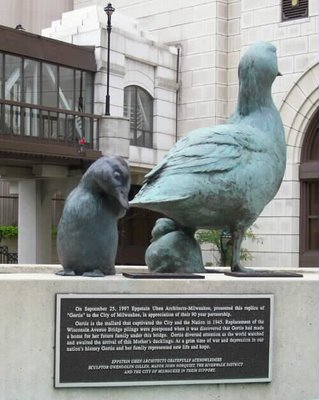
A STORYTELLER PASSES. The Milwaukee Journal-Sentinel reports the death of Nick Georgiady, co-author of Gertie the Duck.


The story behind the story is worth retelling.

In the 1940s, Milwaukee native Nick Georgiady was serving with the U.S. Army Air Forces when he discovered a story from back home in Stars and Stripes.

The star of the story became known as "Gertie the Duck." In the war-weary spring of 1945, Gertie laid her eggs atop a piling on the Milwaukee River in downtown Milwaukee. She became instant news - including on the wire services and in Life magazine - attracting throngs of enchanted and sometimes worried duck-watchers.

Years later, schoolteacher Georgiady became the co-author of a bestselling "Gertie the Duck" book. He created the book with Louis Romano, a buddy from Milwaukee. Romano also served with the Army Air Forces and became a schoolteacher in the Milwaukee area.

"Anything catching the more human side of living was a nice relief," Georgiady later recalled of those war days.

QUOTE OF THE DAY. Milwaukee mayor and Democratic gubernatorial hopeful Tom Barrett understands the strings that come with Federal capital grants.
Recalling the construction of the interstate highway system, Barrett said, "I'm glad that the governors in the 1950s did not say 'no' to President Eisenhower because the federal government did not pay for snowplowing."
The Republican hopefuls, former Representative Mark Neumann and current Milwaukee county executive Scott Walker, don't want to spend money to run the trains, although they've not ruled out taking the $800 million to upgrade the Milwaukee to Madison segment of the future Chicago to Twin Cities fast line.

To put that $800 million in perspective, the upgrade to 110 mph running between Milwaukee and Chicago (probably K.K. Draw to Mayfair) will take $12 million. Repeal or amend some of the excessive safety regulations and that upgrade is much cheaper. On the other hand, to provide a full interchange between the Tri-State Tollway and Interstate 57 in the southern suburbs of Chicago, a subsidy to the trucking companies, will run $570 million, with relatively little increase in road speeds. The Chicago area received $300 million in stimulus money to improve a number of railroad junctions where freight trains interfere with commuter trains, an expenditure that probably has a much higher benefit-cost ratio.
DOWNSIZING HAS CONSEQUENCES. Northern Illinois University had promised a report on the February 2008 shootings by the end of February 2010. The report has been further delayed.
A number of unexpected events at NIU during February is the reason for the delay, [spokesman Brad] Hoey said.

The first was finding out the school was receiving a $7.5 million federal grant to create a Regional Extension Center to help doctors throughout the state adopt digital health information records that can be shared quickly and securely. A news conference was held Feb. 17 to announce that.

NIU staff then had to focus on another grant, as it learned last week that the county would be receiving about $13 million in state and federal funds to expand high-speed Internet access in the area to about 60 anchor institutions, including schools, hospitals, libraries, public safety entities and government agencies.

DeKalb County will administer the project, known as the DeKalb Advancement of Technology Authority, or DATA. NIU will design the infrastructure and network, and DeKalb Fiber Optics LLC will maintain the fiber cable and provide services over the infrastructure. NIU staff helped coordinate the Feb. 19 news conference at which that grant was announced.

And on the morning of Feb. 19, the campus had to respond to a shooting outside of the Stevenson North residence hall towers. NIU student Zachary Isaacman has been charged with shooting Brian Mulder, 24, of Marengo in the leg around 3:30 a.m. that morning.

“It put us a little bit behind in coordinating and getting things together so that we can get the report out,” Hoey said of those unexpected events. “It is coming, and it is coming rather quickly.”

The university still is getting the hard copy of the report together and determining a delivery mechanism, Hoey said.
So much for downsizing being a way to boost productivity: there comes a workload that will overburden the most dedicated corps of remaining workers.

The editorial board of the Northern Star, which, while engaging in Ahab-like pursuit of campus police chief Donald Grady, has done excellent work uncovering family ties in the administration and reporting on the cost of the football positional arms races, disagrees.

Following the Northern Star’s editorial calling for Donald Grady’s removal as NIU Police Chief, the university announced that a three-person review panel would investigate the situation.

For weeks, NIU officials said the panel would conclude around Thanksgiving.

On Nov. 24, 2009 the university announced that the panel had submitted its report.

Pay attention to the date. Nov. 24 was the Tuesday before Thanksgiving.

It was not only the last day before Thanksgiving break, but it also comes at a time when the NIU community is not worried about the goings-on of the university, but how much food they will eat over the
weekend.

Then, when NIU announced that Grady would be reinstated, they did so on Dec. 11: the Friday of finals week.

Clearly, NIU has an issue with timing. When it comes to good news, it has no problem telling the whole world.

But when it comes to “bad news,” like releasing important reports or raising tuition, NIU prefers to do it at a time when no one’s paying attention.

Which brings us to this week. On Dec. 11, the university announced that it would be releasing the University Police’s report on the Feb. 14 shootings at the end of February.

The editors are betting on a Friday release. They have asked for a Wednesday release. The Star's last issue before spring break will be published Thursday.
A CHOPIN BICENTENNIAL. With program notes. (Via.)
THINGS THAT MAKE YOU GO HMMMM. Liberalism, atheism, male sexual exclusivity linked to IQ. The accompanying photo suggests the last of those points might be making a virtue out of a necessity: despite some administrators in higher education (who aren't thinking about their core mission) fretting about too much female competition for too few males, it's the math and science guys who stereotypically have the most trouble getting a date. (Via.)
USHERING WINTER OUT. Near full daylight at 6 pm, and Ollie's is open.