Showing posts sorted by relevance for query hiawatha 110. Sort by date Show all posts

23.3.09

YOUR TAX DOLLARS AT WORK. Wisconsin governor Jim Doyle would like to use federal infrastructure money for improved passenger train service.

State officials are seeking federal stimulus money to pay the full $519 million cost of a proposed 110-mph Milwaukee-to-Madison passenger train line, not just part of it, Gov. Jim Doyle says.

If the grant is approved, trains could be running as soon as late 2012 or early 2013, cutting the travel time between Wisconsin's two largest cities to 1 hour, 7 minutes, officials say. That's about 20 minutes faster than the same trip by automobile, depending on traffic.

Service would start with six daily round trips, connecting Milwaukee's downtown Amtrak-Greyhound station with a new station at Madison's Dane County Regional Airport, with additional stops in Brookfield, Oconomowoc and Watertown.

At the same time, service on Amtrak's Milwaukee-to-Chicago Hiawatha line would increase from the current seven daily round trips to 10, with all of the Madison-to-Milwaukee trains continuing to Chicago. If Chicago wins its bid for the 2016 Olympics, the trains would provide a link between the main Olympic sites and the cycling venues in Madison.

But even without the Olympics, authorities expect the Milwaukee-to-Madison trains to carry 1.08 million riders a year within a couple years after service starts, said Randy Wade, the state's passenger rail chief. Hiawatha ridership jumped 24% last year, to 766,167.

That traffic forecast strikes me as wishful thinking. There's a lot more potential on the existing line, and the airport station offers south siders a 75 minute trip to the Loop as well as a convenient airport for residents of the northern suburbs of Chicago. Perhaps a more realistic forecast (maybe even one that would be exceeded by events) would help make the case for additional projects, and there are additional items on the wish list, including 110 mph operation on the C&M and through trains to the Cities and Green Bay.
Upgrading the Wisconsin portion of the current Hiawatha route to 110-mph service would cost $419 million, serving the existing stations downtown, at Mitchell International Airport and in Sturtevant and Glenview, Ill. Once that's done, service would jump to 17 round trips daily, with seven trains continuing to Green Bay and 10 continuing to Madison, with six of the Madison-bound trains continuing to St. Paul.
There's also an intriguing proposal for a freight bypass.

Previously, the state had planned to apply for $137 million to upgrade tracks on just a portion of the route, from Milwaukee to Watertown, and to build a freight rail bypass to improve passenger service on the Hiawatha line.

But that was when state officials thought the stimulus bill would include a little more than $1 billion for high-speed rail. After they saw that figure had soared to $8 billion in the final deal, they set their sights higher.

With so much money available from the federal government, Doyle said, Wisconsin has a good chance of getting money to upgrade tracks all the way to Madison. Stimulus money also may be available for preliminary work on the next stage of the line, which would go to St. Paul.

I'm going to want to talk about that "stimulus" line in a future post (this week, I'm in grading jail) as permanent improvements ought be viewed differently from fiscal stimulus. For the moment, that freight bypass intrigues. There once was a relief line from Brookfield that passed the fairgrounds and the stadium before entering the Menomonee Valley, and the freight bypass from the Valley to Florida Street is in place. There's a connection to the old North Western at Washington Street, and a freight-only line from St. Francis to Bensenville. Freights off the old Milwaukee get on that freight line south of Northbrook. I wonder if the plan is for something else.

The article includes a disclaimer.
Technically, the Midwestern trains wouldn't meet the international standard for high-speed rail, which is closer to 220 mph, well above even the 150 mph top speed of America's fastest train, Amtrak's Acela line in the northeast, said Rick Harnish, executive director of the Midwest High Speed Rail Association. Leaders of the Midwestern effort have said 110 mph service would be more affordable than true high-speed rail.
It's also doable with the current infrastructure, and a train service that included a few additional stops (Gurnee for Great America, Rondout for transfers to the suburban trains) would not be able to exploit 150 or 200 mph capabilities anyway. A 62 minute timing with stops at Airport, Sturtevant, Gurnee, Rondout and Glenview and 110 mph maximum speeds is feasible, at least on my computer.

6.10.08

SPEEDING UP THE TRAINS. The Federal Railroad Safety Improvement Act includes substantial moneys for safety improvements and provision for the equipment to permit faster running by Amtrak.

Modern, comfortable, double-deck trains with wide seats and large windows would churn along at top speeds of 110 m.p.h. The faster trains would shave hours off trips, delivering passengers from one downtown to another hundreds of miles away.

Amtrak trains in most of the Midwest now operate at up to 79 m.p.h., although average speeds are much slower, especially around Chicago due to freight traffic.

Driving, which results in more than 40,000 fatalities a year, would take a back seat as a transportation choice, proponents say.

So, too, would air travel as consumers factor in the time it takes to go through airport security, the hassle of flying and the time spent traveling from outlying airports.

Travel times of almost 51/2 hours on Amtrak's route between Chicago and St. Louis would be cut to 3 hours and 49 minutes on a high-speed train, according to preliminary estimates.

In the past year, more than 501,000 rides were taken on Amtrak's Lincoln Service route between Chicago and St. Louis, a 284-mile trip, a 15 percent increase over the previous year. Some 1.2 million rides a year would be taken when the route is served by high-speed trains, according projections by the Illinois Department of Transportation.

In addition to the congressional action, the Federal Railroad Administration last week approved grants to Illinois to install train-control and cab-signaling systems on part of the route to facilitate high-speed trains.

A high-speed rail line between Chicago and the Twin Cities could be running within five years, according to U.S. Rep. James Oberstar (D-Minn.), chairman of the House Transportation Committee. The roughly eight-hour trip on Amtrak from Chicago to St. Paul would be cut to about 51/2 hours under the working proposal.

Planners envision the line running from Chicago up through Milwaukee, Madison, the Twin Cities and eventually Duluth, while separate routes from Chicago would extend east to Detroit, Cleveland and Cincinnati.

It's apparent there would be a strong market. Even today, with slow service and a poor on-time performance record, Amtrak finished fiscal 2008 last week with its sixth straight year of ridership growth.

I've provided an image of a traditional bi-level streamlined train capable of 90 mph operation. The news article has a graphic giving the anticipated travel times after the upgrade. It has no historical context. I've augmented that graphic's presentation of current and proposed running times with best running times from my April 1951 Official Guide. From Chicago to

  1. St. Louis (110 mph line) 5:20 current, 3:49 proposed; 5:10 in 1951. Some of the track on this line is good for 110 and the alley tracks through Springfield have been improved. I'll be nice and not mention an electric air line proposal from the early 1900s for this route.
  2. Milwaukee (110 mph) 1:29 present, 1:04 proposed; 1:15. Regular readers know where I stand on this service. That accelerated timing is four minutes slower than a Milwaukee Road proposal in 1938, using streamlined 4-6-4s, that was shelved under an agreement with the Chicago and North Western, a competing carrier that could match a 75 minute timing but could not manage a 60 minute timing.
  3. Detroit (110 mph) 5:36 current, 3:46 proposed; 5:10. There's some 100 mph track in western Michigan already. There is more potential on this line at some of the intermediate stops, including Dearborn and Birmingham for business travelers and Ann Arbor and Kalamazoo for student traffic than there is in Detroit itself.
  4. Cleveland (110 mph) 6:24 current, 4:22 proposed; 5:47. The map suggests a routing along the old New York Central, which calls at South Bend and Toledo and some small cities.
  5. Cincinnati (110 mph) 8:10 current (triweekly), 4:08 proposed; 5:30 using the New York Central's route via Indianapolis.
  6. Carbondale (90 mph) 5:30 current, 4:22 proposed; 4:32. The Illinois Central used to run extra sections of trains at college breaks, on a 100 mph railroad. Corporate downsizing included removing the safety appliances and much of the second main track.
  7. Omaha (79 mph) 8:37 current, 7:02 proposed; 8:57 using the proposed Rocky Mountain Rocket via Des Moines, the Denver Zephyr made it in 7:30 on the current Amtrak route, and the Midwest Hiawatha took 8:30 on trackage that has since been torn out. The Des Moines route is more thickly settled. It requires work.
  8. St. Paul (110 mph) 8:05 current, 5:31 proposed; 6:15 on the Afternoon Hiawatha or the Morning Zephyr. The high-speed plan includes a Watertown-Madison-Portage diversion from the current route. Will there be a European-style reversal of direction in Madison, or will the station be somewhere on the east side of town, remote from the university and the capitol?
I'm enthusiastic about this proposal, although I'll believe it when I see it implemented.

19.8.13

ADVANTAGE, COLD SPRING SHOPS.

It's easy being a prophet when one pays careful attention to the fundamentals.  Wisconsin's Department of Transportation continues to work on upgrades to its existing Amtrak routes.
Trains from Milwaukee to Chicago and St. Paul, Minn., may be faster and more frequent in the near future, as Amtrak and transportation departments in Wisconsin and neighboring states study the possibility of expanding service on regional routes.

Encouraged by ridership that has doubled over the past decade and standing-room-only conditions on some trains, the Wisconsin Department of Transportation has plans to add three express trains to the Hiawatha route, boosting the number of trips a day from seven to 10.

The express trains would skip local stops, serving only Union Station in Chicago, Mitchell International Airport and downtown Milwaukee, and reach a maximum speed of 90 miles per hour, compared with 79 mph now, decreasing travel times by 11 minutes.

"The department really feels that people are becoming aware of the Hiawatha service and its convenience, and are looking for alternative modes of transportation," said DOT spokesman Brock Bergey.
That's converting 89 minute trains to 78 minute trains. The Cold Spring Shops Free Rein to 110 campaign involves spending additional money on signalling and crossing protection, compared to boosting train speeds to 90 (yes, yes, the Hiawatha used to Reduce to 90 for Rondout and the State Line curve).  "The Cold Spring Shops position, however, is that incremental improvements -- where incremental can mean getting rid of those post-war Interstate Commerce Commission regulations that ended 110 mph running on block-signalled railroads with jointed rail -- will build ridership in such a way that subsequent upgrades to bullet trains make more sense."
In a 2011 survey by the Texas Transportation Institute, more than half of Hiawatha passengers on weekdays were commuting or making a business trip, while about three in four weekend passengers were visiting family or taking a trip for fun. A significant number of passengers, 14%, said that if the train weren't available, they would not have made a trip. Avoiding highway congestion was the primary reason people took the train.

A recently completed project has paved the way for added trains by making it easier for passenger and freight trains to bypass one another on the tracks and stay on time, Bergey said. New crossovers, which allow trains to switch tracks, and other infrastructure went into operation in January, according to Canadian Pacific Railway Ltd., a publicly traded freight company that owns the tracks.
Let's hope that the added schedules permit shifting one of the 89 minute trains ... 85 minute trains? to late evening, for those Summerfest or Lyric Opera or just out for dinner on the Mag Mile or in East Towne to go on a date and return the same evening.

But wait, there's more ...
Ridership growth is also driving plans for a second daily train on the Empire Builder route, which grew by 16% from 2011 to 2012, that links Chicago, Milwaukee, the Twin Cities and stops to the west, including Seattle, Amtrak spokesman Marc Magliari said. Amtrak is conducting the study.

"A second round-trip is a significant improvement for passengers by providing more same-day trips without overnight stays and by making it more likely our scheduled arrivals and departure times meet their travel needs," Magliari said.

A draft of a feasibility study should be available in December, and would focus on adding a second train at current speeds, 79 mph. It would terminate in St. Cloud, Minn., instead of continuing on to Seattle as the existing route does.
A Minnesota planner refers to the St. Cloud train as a "baby step" toward increased service.  Or toward restoring what used to be. "Consider a network consisting of Chicago - Madison - Portage - LaCrosse - Rochester, Chicago - Milwaukee - Portage - LaCrosse - St. Paul, possibly continuing to St. Cloud, Fargo, and Grand Forks." Leave the Chicago - Madison - Portage for another day.  I give you the April 10, 1974 Amtrak system timetable.  Westbound, the North Coast Hiawatha operated daily Chicago - Minneapolis, and tri-weekly west of there, leaving Chicago at 10.30, Minneapolis (the now-demolished station) 7.00, calling at St. Cloud 8.15 and arriving Fargo at 11.20.  The Empire Builder operated via Willmar in those days, leaving Chicago at 2.30, Minneapolis at 10.45, and arriving Fargo 3.25 and Minot at 9.00.  Eastbound the Builder left Minot at 7.55, Fargo 1.25, overnight to Minneapolis with a 7.00 departure, and arriving Chicago 2.50.  The triweekly Hiawatha left Fargo at 6.40, St. Cloud 10.15, made a 45 minute stop at Minneapolis (on the days it operated, it switched in additional coaches there), leaving at 12.30 with an 8.20 arrival in Chicago.  Make use of some of that faster track on the Old Milwaukee Road and these schedules can be tightened.
Several groups in favor of expanding the Hiawatha and Empire Builder routes say both lines have had proven success and would be a boon for the economy.

The added trips on the Hiawatha, in particular, would be positive for economic development, strengthening a vision of southeastern Wisconsin, Chicago and northwestern Indiana as one mega-metro area, said Metropolitan Milwaukee Association of Commerce spokeswoman Julie Granger.

"The stronger connections we have to what is a huge thriving city can only benefit the region," Granger said.
Frequency, connectivity, convenient times, reliable schedules.  Build it and the riders come.

31.3.11

FREE REIN TO 110, IN MY LIFETIME?  Wisconsin's governor wasn't interested in speeding up access to Madison from Chicago's northern suburbs, or to Chicago from Oconomowoc, but he's happy to take federal money to achieve the fastest running time ever for Milwaukee trains.
Gov. Scott Walker's administration announced Tuesday that the state will seek at least $150 million to add equipment and facilities for Amtrak's Hiawatha line.

Walker said the money would be used to upgrade service on the Hiawatha line, as a step toward increasing the speed of the trains to nearly 110 mph and reducing the trip time from 90 minutes to one hour. If the improved service draws more riders, the number of round trips could be increased, he said during a news conference in the Milwaukee Intermodal Station.

The governor said he expected Illinois, Michigan and Missouri would join in the application for the federal dollars, part of the $8 billion rail element of President Barack Obama's administration's stimulus package.

In a bizarre twist, some of the money that Walker now seeks originally was allocated for the Milwaukee-to-Madison route he previously turned down. That money is available because a fellow Republican governor rejected it as well.

Walker said the money would allow Wisconsin to buy two more train sets and eight locomotives and to build a maintenance facility for that equipment and two train sets now under construction.

But speeding up the trains would require additional track improvements in future years, said Reggie Newson, executive assistant to state Transportation Secretary Mark Gottlieb.

The locomotives, train sets and maintenance base would have been covered by the earlier $810 million grant. But the maintenance base, originally envisioned as a $52 million facility in Madison, now would be a $60 million facility at the Talgo Inc. train plant in the Century City complex on Milwaukee's north side.
Cold Spring Shops endorses the faster running times, and the enhanced frequency.


The newspaper, no fan of the new governor, notes that his decision to seek federal money for the Hiawathas creates a political controversy.
Asked about the apparent reversal in his position on rail initiatives, Walker said he always had supported improvements to the Hiawatha. It's a popular and established service, without the local opposition that complicated the Milwaukee-to-Madison link he campaigned against.

"This is not inconsistent with the position I took in the past," he said.

Milwaukee Ald. Robert Bauman called the governor's pursuit of federal stimulus money for the Hiawatha "rank hypocrisy."

Walker criticized federal stimulus spending during his campaign and rejected federal money that could have been used for the maintenance building on the city's north side. The state will pay more for that facility than if it had accepted the initial $810 million, Bauman said.

The Hiawatha provides the Midwest's most frequent and heavily used Amtrak service. It's one of the top 10 routes nationwide, nearly doubling ridership in the past eight years, to a record 792,848 last year. Ridership has continued to rise, notching gains of almost 8% each in January and February, on a pace to exceed 850,000 this year.
The choice of a fixed-formation train, the Talgo, that cannot easily be strengthened by adding cars, seems unwise in light of the increasing ridership, and the likely further increases induced by more frequent trains, later into the evening, and by rising fuel prices.  The current Hiawathas are six-car rakes, up from the four cars that protected each trip in 2004.

The 75 minute trains of 1951 frequently ran with up to a dozen cars, inclusive of parlor cars and tap-lounges or dining cars.


The Alco diesel set at the right would have been capable of protecting a 60 minute schedule, something that was envisioned for the 1938 steam Hiawathas.


THIS TRAIN REACHED CHICAGO 75 MINUTES AFTER LEAVING MILWAUKEE.
IT WAS CAPABLE OF GETTING THERE IN 60 MINUTES.

Faster, please.

10.5.11

PAYBACK?  The Hiawatha service will not receive any of the latest round of federal rail improvement grants.  The money sought is for additional trains, locomotives, and a maintenance base.
The money Wisconsin was seeking in Monday's round of funding would have been a step toward high-speed rail but would not have covered track improvements needed to speed up the Hiawatha from 79 mph to 110 mph.
The track in question was quite capable of supporting 110 mph train operation, without special tilting trains, or, for that matter, diesel locomotives.  The national government, however, was directing money toward states where faster conventional trains could act as the next step toward something more like an electric bullet train, or perhaps the next generation of High Speed Trains in the British style.
Other Midwestern states shared $672.3 million, or one-third of the dollars handed out Monday. In addition to the $268.2 million for train sets and locomotives for Illinois, Michigan and Missouri, the grants included $196.5 million to Michigan to upgrade tracks for 110-mph service between Chicago and Detroit, and $186.3 million to Illinois to upgrade tracks for 110-mph service between Chicago and St. Louis, plus smaller amounts to plan a 110-mph Minneapolis-to-Duluth line, a Michigan train station and a Missouri railroad bridge.
The Alton Route is a logical candidate for faster trains, and it's time for a progress report on that service, once grading is finished. A faster train from the Cities to the Head of the Lakes intrigues, although there's little by way of a network for the rail traveller into or out of the Cities.  (Minnesotans once enjoyed a Passenger Rail network with multiple frequencies to Winona or Fargo or Winnipeg.)  The article suggests that contemporary passengers still value frequency and connectivity.
Helen Wiedeman would have liked to see more round trips. Wiedeman lives in rural Missouri and drives to Quincy, Ill., to catch the train to Chicago before transferring to the line to Milwaukee.

"I think Amtrak is important. It would be nice to get some more trains," Wiedeman said. "The last train to Chicago is 3 p.m. My daughter and future son-in-law often take it to Chicago, and an improvement of equipment would make a big difference."
The last train from Milwaukee that connects to the Illinois Zephyr, into Quincy in the late evening, is the 3 pm departure.  Right up to Amtrak Day, Burlington Northern offered a late evening departure from Chicago, overnight to Kansas City, which once upon a time was the American Royal Zephyr.  Ms Wiedeman would arrive in eastern Missouri at an hour more suitable for a special-forces operation on that routing.  And Amtrak, and its Congressional paymasters, remain ambivalent about first-class and overnight accommodations.

Editorial writers at the Milwaukee Journal-Sentinel claim the state "deserved better" and also suggest the Obama Administration is paying Wisconsin Governor Walker out for returning the money to extend the Milwaukee train to Madison.  Enjoy the four-buck-a-gallon gasoline and the work zone that is Interstate 94.

20.7.11

PENNY-WISE, POUND-FOOLISH.  The Wisconsin legislature appropriates money for upgrades to the Hiawatha service.
Wisconsin taxpayers could wind up paying more to keep existing passenger train service from Milwaukee to Chicago than they would have paid to run new high-speed rail service from Milwaukee to Madison, according to a Journal Sentinel analysis of state figures.

The Legislature's budget committee voted 12-2 Tuesday to spend $31.6 million in mostly borrowed state money on Amtrak's Milwaukee-to-Chicago Hiawatha line, costs that could have been paid largely by an $810 million federal grant that would have extended the Hiawatha to Madison.

But Tuesday's vote doesn't cover all the spending that will be needed to keep running the Hiawatha, a growing service that carried nearly 800,000 passengers last year.

State transportation officials have estimated they would need millions more for locomotives, signals and a new maintenance base, even without expanding service beyond the current seven daily round trips.

And, like the spending approved Tuesday, all or most of those new costs would have been covered by the federal grant spurned by Gov. Scott Walker last year. That's because the Milwaukee-to-Madison service would have operated as an extension of the Hiawatha, as part of a larger plan to connect Chicago to the Twin Cities and other Midwestern destinations with fast, frequent trains.

Taken together, state taxpayers' share of the Hiawatha capital costs that would have been covered by the federal grant could total as much as $99 million, significantly more than the $30 million they would have paid for 20 years of operating costs on the Milwaukee-to-Madison segment, as estimated by former Democratic Gov. Jim Doyle's administration.

Walker had cited those operating costs as his main reason for opposing the 110-mph extension. Federal money would have paid all of its capital costs. And that doesn't count the other potential benefits that high-speed rail supporters have cited from the Milwaukee-to-Madison line, such as jobs, economic development, expanded tax base and improved freight rail tracks.

Conversely, high-speed rail opponents contend the Milwaukee-to-Madison extension could have cost taxpayers more than budgeted, even though the $810 million grant included a cushion of more than $150 million to cover inflation and unexpected cost overruns. They have questioned estimates on ridership, revenue and operating costs, as well as projections for economic development and job creation.

That debate played out Tuesday in the Legislature's Joint Finance Committee, as Democrats backed the passenger rail measure but said it showed that the Republican governor's decision to cancel the high-speed rail line had cost the state thousands of construction jobs, lower service levels and - in the short term, at least - money. They pointed to an estimate from the Legislature's nonpartisan budget office that found that the federal funds would have covered at least $22.4 million of the additional costs approved by the panel Tuesday.
The legislature is on the hook for more money for a number of reasons, some political, some self-inflicted. In anticipation of the stimulus money for the Madison extension, the state department of transportation previously committed money for four fixed-formation Talgo trains that will replace the existing variable-formation Horizon and Amfleet consists on the line.  The maintenance base and train upkeep will therefore be for orphan trains, the nearest copies of which are in the Pacific Northwest.  Those trains are still under construction, although there are cost overruns and logistical difficulties.
Train cars: Under Doyle, the state borrowed $47.5 million for its no-bid contract with Spanish train manufacturer Talgo Inc. to build two 14-car train sets to replace aging Amtrak-owned passenger cars on the Hiawatha line. Spare parts and design changes - such as adding wireless Internet service for passengers and improving sight lines for the crew - could boost the cost by $3.6 million, plus another $6.9 million to pay a British consulting company to oversee manufacturing.

After using $800,000 from lower-than-expected fuel costs, the committee agreed to borrow the remaining $9.7 million. Doyle's former transportation secretary, Frank Busalacchi, has said the $810 million federal grant would have covered those costs. Current state and federal transportation officials disagree with Busalacchi, although the Legislative Fiscal Bureau found the federal aid might have covered some of the consulting contract with British-owned Interfleet Technology Inc.

Maintenance bases: The state's contract with Talgo requires it to provide a maintenance base for the company to service the trains it builds. State officials have already spent $3.2 million to retrofit Talgo's plant in the Century City complex as a temporary maintenance base, and equipping that base will cost another $8.5 million. All sides agree the federal grant would have paid that $11.7 million, which the panel agreed to borrow.

But the north side plant, formerly home to Tower Automotive, can only be used as a maintenance base for three years, because of restrictions imposed by the freight railroad that owns the tracks connecting it to the downtown Amtrak-Greyhound station, the fiscal bureau said. Earlier this year, state officials asked the federal government to cover $48.1 million of the $60.1 million cost of turning the Talgo plant into a permanent base, plus $27.6 million for track upgrades.

With that request rejected, state officials now seek to build a permanent base closer to the station, Newson said. He said the new base would cost "much less than $60 million" but declined to predict a new price range.
It's probably asking too much to propose a maintenance base at Oconomowoc or Brookfield, where the trains could load passengers for Glenview and Chicago with a minimum of deadheading. Some faster running times west of Milwaukee and through Milwaukee would be required, though, otherwise Waukesha County residents have a shorter travel time driving to the airport station.

It's probably asking too much to make transportation funding decisions on the basis of benefits and costs rather than out of political pique.
There's plenty of blame to go around for the fact that Wisconsin taxpayers - and not the feds - will be paying $31.6 million on the Milwaukee-Chicago Hiawatha rail line. But in the end, it's the political games played by both sides that are to blame - games that should take a back seat when it comes to such issues.

Gov. Scott Walker started this mess when he unwisely shot down a federal grant for passenger rail service from Milwaukee to Madison that also would have covered a hefty chunk of the money for the Hiawatha work.

In fact, a Journal Sentinel analysis found that Wisconsin taxpayers could end up paying more to keep existing passenger train service from Milwaukee to Chicago than they would have paid to run new high-speed rail service from Milwaukee to Madison.

Turning down the grant was a big mistake - the funding could have paid for upgrading fast rail from Chicago to Madison as part of a Midwest rail network to keep the region more economically competitive with other parts of the country - and could have brought more jobs to Wisconsin.

On its face, rail transportation is not a conservative or liberal issue. Former Gov. Tommy Thompson, for example, was a huge rail backer. It's an issue that should be decided by objective factors involving need, cost and technology.
Objective factors? That takes all the fun out of it.

18.1.11

GIVE THEM FREE REIN TO 110. A Milwaukee Journal-Sentinel report acknowledges the potential for faster Hiawathas. Proposed running times will be the fastest ever.

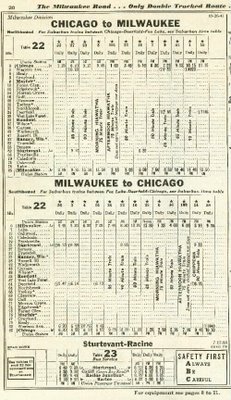
Here is the 1941 train schedule.


The proposed timings with some infrastructure improvements between the Airport station and the beginning of Metra territory, inclusive of intermediate stops, are encouraging.


The article envisions additional trains.
A separate $12 million federal grant, unaffected by the Milwaukee-to-Madison controversy, is already paying for upgrades to the platform at the Mitchell International Airport station and to the Hiawatha tracks, and the state can use the remaining $2 million from the larger grant for Hiawatha upgrades.

With a third train, the Hiawatha could add an eighth, and perhaps even a ninth, daily round trip, Beitzel said. Hiawatha ridership has grown more than 99% since Amtrak and the state added a seventh round trip in late 2002.

Jay Sorensen, a Shorewood-based transportation consultant, said the Hiawatha attracts an even higher proportion of affluent business riders than his former employer, Midwest Airlines. He says authorities could double the Hiawatha's frequency "and demand would rise to meet that.... They could make it so blindingly convenient, by having trains every half-hour, that people say, 'Why am I driving?'"
That's probably wishful thinking, even the North Shore Line, before Highway 41 was doubled through Racine and Kenosha County, offered hourly service.  Journal-Sentinel editors endorse the train, and the Hiawatha line makes Metro's list of most promising rail corridors.

27.11.05

APPLIED HIAWATHA RESEARCH.

All this posting about Hiawatha steam speed records or not inspired me to take a mental health day riding a Hiawatha. Hey, the weekend pass is good for two days, and the stack of homeworks to be returned Monday will be the most travelled set of homeworks I've graded, with one Hiawatha, two commuter trains, three stations, a coffee house, and an airport Starbucks offering working space.

Today's connecting concourse is Chicago's Union Station.


The waiting room has thus far avoided being "redeveloped" as an office tower or an apartment complex, and it stands in all its Pennsylvania Railroad grandeur. (It also serves as a gathering area for some Amtrak passengers as we shall see.)

The conductor of the 10.20 "Morning" Hiawatha (hey, the real Morning Hiawatha used to leave at 10.30) was a bit impatient on the radio. "C'mon, 'Casey,' let's highball!" (Name changed.) So when the conductor collected my ticket, I was in the mood for some teasing. "Could 'Casey' get us from Glenview to Milwaukee Airport in 45 minutes?" (No.) But at one time, such running would be possible.


This schedule was in effect when Pearl Harbor was bombed. Trains are much faster, although today's service is better spaced throughout the day, with something resembling a memory pattern of two hour headways. Several of the services shown here continued to Green Bay, the Twin Cities, and the Pacific Coast. Note that the speed restrictions in effect today are bureaucratic constraints, not technological constraints. No automatic train stop, centralized traffic control, welded rail, or dead-man petals in 1941.

The northbound trip was fast and on time into the airport. Amtrak strengthened the formations with a business-class dinette car (hey, hire a cafe attendant and make that a regular feature.) There is work in progress at Highway 20 building what looks like a new Sturtevant-Racine station (what will happen to that funky witch's hat station at Sturtevant?) Lake Yard, and the interlocking tower that stood there until recently, are gone.

The weather isn't conducive to flying.


I'm not sure whether these posts are a security measure or simply recognition that some drivers will mistake any wide paved surface, including a sidewalk leading to a passenger platform, for a road.


Let the record show that there was at one time a closer train stop to Mitchell International.

The line of trees marks the right-of-way of the North Shore Line, and the Milwaukee Division locals would make a flag stop at Grange Avenue, although whether any adventurous souls made an intermodal connection hiking into the airport from there may remain an eternal mystery.

Inside the airport, which offers a shuttle bus to the train station (and lots of air travelers were making connections today) this cluster of maps shows the weather and the current position of airplanes inbound to Milwaukee. The maps might have assuaged some people on this foggy day.


(Again, the cheap digital camera reveals its limitations.)

The southbound 3.0 Hiawatha was a few minutes late into Airport Station, probably delayed in Milwaukee receiving transfers from a late-running Empire Builder that blasted up Lake Hill just ahead of the corridor train. Once all the airport passengers were loaded, it was off to the races, with an on-time arrival in Chicago, and plenty of time to turn the train and get the northbound hordes away at 5.08. (That's WITH strict adherence to the 79 mph speed limit. Give them their head to 110, I say.) Other trains were also busy, with the State House and Pere Marquette strengthened but away on time, the Capitol Limited loaded and away on time, a long Illinois Zephyr into the station with little time to load and away on time (passengers requested to queue outside the departure lounge.) Only the Twilight Limited was delayed, account late arrival of the inbound equipment, and those passengers were requested to assemble in the Great Hall to be marched to their train when it was ready. But considering the crush of passengers and the limitations of the concourse, which was "redeveloped" in 1969 for commuters only, the late afternoon departures went quite smoothly. That also appeared to be the case on the suburban services, including the 6.40 to Elgin, which was also full of shoppers, holiday-makers, and a few transfers off of Amtrak.

19.10.12

PASSENGER RAIL PROGRESS.

In March, we noted a plan for privately-operated passenger trains in Florida.  My assessment at the time noted, "the freight railroads would like to have the kind of control over scheduling and reliability that comes from common mechanical standards, dispatching, and scheduling."  That's evident from the All Aboard Florida filing with the Surface Transportation Board, as reported in Trains.
The passenger train operator will rebuild a second track along the Florida East Coast Railway between Miami and Cocoa, Fla., and build entirely new track on right-of-way leased from the Florida Department of Transportation and Orlando-Orange County Expressway Authority. This would place about 40 miles of new rail line alongside or in the median of state Route 528, which runs between Cocoa and the Orlando airport and is operated by the OOCEA.

All Aboard Florida will not seek public operating subsidies for the project, but is exploring the possibility of obtaining construction financing through the Federal Railroad Administration's Railroad Rehabilitation and Improvement Financing Program. Through the program the railroad can apply for direct loans and loan guarantees through the FRA.

The filing stipulates the new passenger service will not be a part of the interstate passenger rail network and should be exempt from federal oversight. All Aboard Florida will not participate in any through ticketing program with Amtrak. It also says no freight service will be operated by All Aboard Florida, or over the new right-of-way to Orlando. It does say that, for flexibility in operations, FEC dispatchers will have the option of using either track on the shared right-of-way for freight and passenger traffic.
It's intriguing that the operator wants to be freed of Congressional meddling with Amtrak, which is the cynic's interpretation of "exempt from federal oversight."  The stipulation that the new trackage will be Passenger Service Only likely calms fears at the CSX Railroad of freight competition.  The absence of joint ticketing, or any mention of connectivity, troubles me.  The value of a Passenger Rail network is in being able to make connections.  Admittedly, Amtrak's Florida service is a pale shadow of what Seaboard Coast Line operated almost up to 30 April 1971, and the Miami to Orlando service has more promise as a boat train connecting cruise ship passengers to the theme parks and Grapefruit League stadia.

In Illinois, passenger trains are again rolling at 110 mph.
The demonstration included a 15-mile segment of 110 mph running between Dwight and Pontiac, Ill., for Illinois Gov. Pat Quinn, U.S. Sen. Dick Durbin, U.S. Transportation Secretary Ray LaHood, Federal Railroad Administrator Joe Szabo, Amtrak Chairman Tom Carper, and a host of local politicians and reporters.

Heritage-painted GE P42 No. 66 led the special train out of Chicago to Normal, Ill., along with Amtrak No. 63. Both units are equipped with the Incremental Train Control System already used on Amtrak’s 110 mph Michigan Line trackage between Porter, Ind., and Kalamazoo, Mich., as well as UP’s cab signals. This is the first installation that joins ITCS’s ability to verify that quad-gate highway crossings are clear and operational with the UP cab signal system. Although higher speeds up to 150 mph are routinely attained on the grade-separated Northeast Corridor, the cab signal-ITCS combination launched in Illinois fulfills the requirements of positive train control in highway grade crossing territory.
The test run offered the public officials a chance to do what comes naturally.
At Normal, while the politicians were giving speeches, the diesels ran around the train on a passing track and coupled up to [Amtrak official car] Beech Grove for the trip back to Chicago.
Too bad the train doesn't cut as attractive a figure at 110 mph as the Nebraska Zephyr would.


The Associated Press reporting on the Illinois test run does nothing to counter the suspicion that mainstream journalists are Democratic operatives masquerading as journalists.
In a modest milestone for President Barack Obama's high-speed rail vision, test runs will start zooming along a small section of the Amtrak line between Chicago and St. Louis at 110 mph Friday.

The 30-mph increase from the route's current top speed is a morale booster for advocates of high-speed rail in America who have watched conservatives in Congress put the brakes on spending for fast train projects they view as expensive boondoggles. But some rail experts question whether the route will become profitable, pose serious competition to air and automobile travel, or ever reach speeds comparable to the bullet trains blasting across Europe and Asia at 150 mph and faster.

U.S. Transportation Secretary Ray LaHood and Gov. Pat Quinn are scheduled to be on board when an Amtrak train hits 110 mph for the first time in Illinois. But it will only maintain that speed for a short time, somewhere along the 15 miles between Dwight and Pontiac, before braking back to more normal speeds.
Governor Quinn has publicly hailed the 110 mph speed (a Global Positioning System speed estimate hit 111; that's likely an approximation error) as a first "outside the Northeast." In the Amtrak era, that's true, although the Pioneer Zephyr's dawn-to-dusk run included some Illinois mileage at 112; the 1935 Hiawatha test train maintained 112.5 for several miles across the Wisconsin sand country, and speeds in that range were routine for the 75 Minute Trains between Milwaukee and Chicago until 1950.  Let the younger generations enjoy the higher speeds, as they've had no previous experience of them.

There's also enough repaired and renovated rolling stock on hand to provide Thanksgiving relief trains on the Michigan corridor.
One round trip, Nos. 356 and 359, will make a same-day turn at Ann Arbor on Wednesday, Nov. 21, and the following Friday through Sunday. No. 356 will leave Chicago at 9:20 a.m., 2 hours after the departure of morning train No. 350 to Detroit and Pontiac, and return from Ann Arbor at 4:05 p.m., more than 3 hours prior to afternoon train No. 355’s westbound stop.

A shorter round trip, Nos. 358 and 357, leaves Chicago at 10 p.m. Wednesday through Sunday, remains overnight on Amtrak-owned trackage in front of the station at Kalamazoo, Mich., and returns to Chicago at 6:15 a.m. the following morning, Thursday through Monday. Amtrak tested this schedule over Labor Day weekend in 2010. The four additional trains can be operated with only one additional set of equipment, though the consist will be exchanged with other Midwest operations to allow for maintenance in Chicago.

The holiday service expansion in Michigan can serve as a prototype for expanded frequencies on this corridor, a national network route where only agreements with Norfolk Southern and Canadian National, not states, are needed. Those host railroads approved the temporary service expansion because normally heavy freight traffic would be reduced on a holiday weekend. It is also in a region that has sufficient operating and onboard crews available to staff the additional trains, which will all offer business class and café car amenities.
That freight train interference is salient on the former New York Central main line between Porter and Englewood; less so on the trackage east of Kalamazoo that Norfolk Southern will be conveying to Michigan for Passenger Rail purposes.

The pathing of the relief train indicates a weakness of the network east of Ann Arbor.  I'm referring to the early summer timetable, in which trains require about 4 hours 30 minutes for the 243 miles Chicago to Ann Arbor, and two hours for the 61 miles Ann Arbor to Pontiac.  Thus, the eastbound relief train meets the westbound midday train 353 somewhere in western Michigan, turns on a wheel at Ann Arbor, and meets the eastbound evening train 354 either on the fast rail or on Norfolk Southern's two main tracks.  The regular westbound evening train doesn't get away from Pontiac until after 4 pm.

It's progress, though, compared to what Amtrak inherited from Penn Central.

16.11.18

NO, YOU CAN'T OUTRUN THE HIAWATHA.

Railroad artists Gil Reid and Howard Fogg go joyriding in a Pontiac.
Howard is about to introduce me to his dad’s green Pontiac and a three-mile stretch of highway right next to the Milwaukee Road’s Chicago–Milwaukee main line. Howard and I are seated in the car, which his dad called the Green Hornet after the then-popular radio serial, parked beside Waukegan Road near the West Lake Forest (Ill.) station. We’re facing south, with the railroad on our right, listening for the sounds of a Chicago-bound Hiawatha.

The tension in the car is intense, for we will have to gun that old Pontiac in order to get a good start ahead of the oncoming speedster to pace her.
You couldn't attempt that stunt today, as Waukegan Road is much more congested, and there's a school zone entering Bannockburn.
A braying air horn from the north is the signal. Now! Howard floors the Pontiac. We are on our way, and none too soon, for in an instant a plume of smoke and steam is tornadoing above the treetops. It’s a streamlined 4-6-4 in full forward motion, with the Hiawatha tied to her tail. We get up to 75, with the Hi closing fast.

We approach an intersection. “Hey, Fogg, how about that traffic light ahead?!” I yell. Through clenched teeth Howard says not to worry, the light will go to green for us when the crossing signals start.

For a moment, the Hudson is beside us, its 84-inch drivers a blur. We are determined to keep abreast of the charging monster, but already the fireman is amused, signaling us to get going. Get going?! Holy mackerel—we’re already at maximum speed! The traffic light does go green and we sail through the intersection. The road is ours, but the Hiawatha disdainfully leaves us in its wake.

The Deerfield curve is ahead. Toeing the brake, Howard yells, “See the railroad speed-limit sign? Ninety for passenger!” He quotes the freight limit too, but I don’t catch it—we’ve got to slow down! By now we’re on the outskirts of Deerfield, and the Hi is gone. The race is over.

Of all the times we raced a Hiawatha and other Milwaukee fast trains on that stretch of road, nothing will ever beat that first ride with Howard Fogg in the Green Hornet.
In those days, Deerfield was not yet a crowded suburb, although a few scoots turned back there.

June 2006.

In the distance, that's the curve that the steam-powered Hiawatha had to slack to ninety for.  Is it too much to ask for Free Rein to 110 for today's diesel trains?

28.12.04

COST OVERRUNS? Projected cost of high-speed trains doubles.

The projected cost of a proposed Midwestern network of high-speed trains has more than doubled over the past six years, to $7.7 billion, including about $1.2 billion in Wisconsin alone, a new report shows.

But the federal government has yet to show any interest in putting up its $6.2 billion share of the nine-state Midwest Regional Rail Initiative, and supporters agree the 110-mph train plan won't get out of the station without federal money.

On the other hand, federal money is available for rebuilding the Marquette interchange in central Milwaukee, and continuing to operate the St. Lawrence Seaway. The problem, I suspect, is that this Midwestern network would not offer sufficient pork for northern-border state Senators and Representatives to get on board. First some details.

Planners originally sought four round trips daily at 79 mph, with stops in Neenah, Appleton, Oshkosh, Fond du Lac and either Allenton or West Bend. The revised plan seeks seven round trips daily at 110 mph.

Because the Milwaukee-to-Green Bay leg would be a continuation of the existing Chicago-to-Milwaukee route, service between Milwaukee and Chicago also would rise from the originally planned 14 round trips daily to 17.

The Chicago-Milwaukee frequency would still fall a bit short of the frequency once offered by the North Shore Line alone, but would exceed the frequency offered by either the Milwaukee Road, which Amtrak uses, or the Chicago and North Western during the 1930s and 1940s. There is one additional wrinkle: what happens if Wisconsin works with Chicago's Metra Rail to extend the local train service from Kenosha to Milwaukee, along the old Chicago and North Western 400 route.
Amtrak's Hiawatha line now runs seven daily round trips at 79 mph, covering the distance in about 11/2 hours, with stops in Sturtevant and Glenview, Ill. The boost to 110 mph would cut the trip by about 25 minutes, the report says.
That's a long-sought improvement over the best running time, which was 75 minutes until the late 1950s.

Of the 17 trains on the Chicago-to-Milwaukee route, 10 would continue to Madison, another destination not currently served by Amtrak. At 110 mph, the Milwaukee-to-Madison trip would take about an hour, with some trains stopping in Brookfield, Oconomowoc and Watertown.

Plans have long called for the Milwaukee-to-Madison route to be one of the first in the Midwest network, because of its potential to attract new riders. In June, Amtrak urged Congress to jump-start the route, predicting that extending the Hiawatha to Madison and adding more trips would more than double ridership, to 1.09 million by 2008.

This Madison service would also be a significant boost in frequency compared to the 1930s and 1940s. Now comes the rub.
Of the 10 Milwaukee-to-Madison trains, six would continue to the Twin Cities. That service would replace Amtrak's once-a-day Empire Builder, which now links Chicago, Milwaukee, Minneapolis-St. Paul and the Pacific Northwest on a route that bypasses Madison.
And thus the problem. That northerly train does a little bit of ferrying college kids to St. Cloud or Fargo or Grand Forks, as well as hauling excursionists to Glacier Park. The second function might properly be farmed out to a Nostalgie Orient Express type operation, but that might spell finis to any votes for Amtrak from Minnesota, the Dakotas, Montana, or eastern Washington.

We are, incidentally, speaking of a Neubaustrecke for this service. There is a Milwaukee Road line leaving the current Empire Builder route (which was a 100 mph railroad until 1960) at Watertown and going to Madison, but to continue three trains from Madison to the Twin Cities involves either new construction or an upgrade of a line from Madison to Portage, where it rejoins the old 100 mph railroad. But either there will be a reversal of the train's direction in Madison or a new station somewhere on the east side of the city.

The shopping list for that 12" = 1 ft hobby store runs like this:

The plan now estimates track improvements would cost $227 million between Milwaukee and Madison; $285 million from Milwaukee to the Illinois state line; $243 million from Madison to La Crosse; and $311 million from Milwaukee to Green Bay, Wade said.

New trains for the Milwaukee-to-Madison route would add another $89 million, bringing the total cost of that route to $316 million, with $253 million from the federal government and $63 million from the state, Wade said. For the rest of the Wisconsin routes, trains would cost $152 million, but Illinois and Minnesota would share part of that cost, he said.

Probably a cheaper investment than some of the highway improvement projects in other transportation bills.
Although the overall plan hasn't been approved, more than $100 million has been spent on engineering and on facilities that could improve existing service even if the full network isn't built.
Additional economies could be achieved with a little understanding of history. Those 75 minute trains of years ago were pulled by steam locomotives -- not necessarily built especially for speed -- on jointed rail past semaphore signals that were not repeated in the cab. One does not require space-age electronics and global positioning systems to run fast trains.

28.1.12

ACCUMULATING SMALL ADVANTAGES.

On a Passenger Rail corridor, frequency and capacity matter, more than dramatic increases in speed.
Amtrak’s Chicago-Milwaukee Hiawatha Service set a ridership record in 2011, carrying 823,163 passengers. According to the Wisconsin Department of Transportation, that is a nearly 4 percent increase from 2010 when ridership totaled 792,848.

Amtrak’s Hiawatha Service includes seven Chicago-Milwaukee round trips Monday through Saturday and six round trips on Sunday. A one-way 86-mile trip from Chicago to Milwaukee takes about 90 minutes.

In addition to the calendar year record, monthly records for the service were set in every month but August of last year. According to Amtrak’s 2011 fiscal year data, the Hiawatha is the busiest Amtrak corridor in the Midwest and the sixth busiest in the country.  

Hiawatha Service began in 1989. It is jointly funded by the states of Wisconsin and Illinois. The service was to be extended from Milwaukee to Madison, Wis., but last year Wisconsin Gov. Scott Walker refused the federal money that would have paid for the extension.
That 1989 reference is to the state support from Wisconsin and Illinois for operating additional trains, boosting the frequency from three round trips a day to the current six daily and a seventh except Sunday.  At Amtrak's inception, there were two round trips daily and a third except Sunday, a few of which offered lunch-lounge service in Tip Top Taps once in use on the Afternoon and Olympian Hiawathas.  Today's trains are six-car formations, with beverage service from a cart on selected trains.

The California corridors have received new cars in the last few years, the Northeast Corridor has the Acela Expresses, and there are stretches of the Empire Corridor capable of 110 mph speeds.  The Hiawatha and Downeaster services make do with Amfleet or Horizon coaches and top out at 79 mph, yet the riders keep coming.

Another Midwestern corridor that is doing well is the Chicago-St. Louis by way of Normal and Springfield. I understand that Northern Illinois University faces stiff competition for students from Illinois State, one reason given for the marketing and branding initiatives.  Perhaps the prospect of fast frequent trains to Normal matter more.  Whether the absence of a train connecting the northern suburbs of Chicago to Madison affects Wisconsin's recruiting efforts is a topic worthy of further investigation.

3.8.19

THE CONCEPT IS CORRECT, THE EXECUTION, NOT SO MUCH.

Trains Passenger Rail pundit Malcolm Kenton suggests these might be the good new days for Ontario residents who would like more rail options.  Among other things, there is now a Kitchener to Waterloo latter-day interurban.  It's not quite the second coming of the old Grand River Railway and Lake Erie and Northern that offered connecting service as far south as Brantford and Port Dover.  It's a start.

More encouraging is what the Passenger Rail authorities would like to accomplish with the Toronto - Ottawa - Montreal service.
[The authority] won a significant victory to advance its plan to build a new high-performance passenger-only rail line between Toronto, Ottawa, Montreal and Quebec City. The Canada Infrastructure Bank’s decision last week to spend $71 million CAD to begin engineering and economic analysis on the project, while remaining open to helping fund its construction provided that the analysis returns favorable results, gives VIA [the authority -- ed.] confidence that it can attract private investment to help the government-owned corporation complete the project.

Keep in mind that the proposed line is not world-class high-speed rail — it would be a conventional line allowing conventional equipment to operate at up to 110 mph with numerous grade crossings. Nevertheless, it would cut travel times by up to one third less than current schedules and offer much greater reliability by not being shared with freight. This milestone, along with Virgin Trains USA’s expansion to Orlando proceeding apace, proves that modern passenger rail projects in North America don’t have to be grade-separated bullet trains or use some flashy new technology like maglev or hyperloop in order to attract private-sector participation and deliver tremendous utility to the traveling public and to local and regional economies.

If VIA can overcome the hurdles of political will and resistance on the part of its host railroad Canadian National, and if its urban regions continue to develop and modernize rail transit, Ontario’ populous southeast and southwest regions would be well-positioned to continue providing a high quality of life to their growing populations as energy and other resources inevitably become scarcer with climate change and growing global demand. Many locales stateside could learn from this success.
In fact, given the state to which Passenger Rail has fallen, as well as the nature of the high-density corridors in North America, including the Richmond to Portland stomping grounds of Amtrak's Northeast Corridor services, Free Rein to 110 with contemporary diesel trains is the more sensible way to start.

The plan to separate passenger and freight trains between Montreal and Toronto makes sense on paper.  It's also a way to provide for even faster running later, if the tracks are surveyed and laid out with a subsequent installation of electrified running in mind.

In practice, though, Bill Stephens, who is also a Trains columnist, has doubts.
There’s much to like in VIA’s so-called high frequency rail plan. Transit times on the new corridor, VIA says, would be 25% faster than the current schedules, which cover Toronto-Montreal in about 5 hours. The new corridor would permit 110 mph operation, up from the current maximum of 100 on some sections of CN. VIA could provide more frequent service without begging CN for permission to run additional trains. And VIA projects 95% on-time performance on its own tracks.

But the whole plan falls down in the busy terminal areas in and around Toronto and Montreal. That’s where VIA’s trains would still have to negotiate trackage thick with freight and commuter traffic.

Transport Canada’s solution to this problem is laughable. “VIA Rail Canada would work with track owners to conclude necessary agreements and ensure that both freight and passenger operations can go smoothly,” a spokeswoman says.
Perhaps a few overpasses in the right places (would you believe one will be built in the area of Tower A-2 in Chicago?) might help. That, and people who know how to move trains.
VIA has said that passenger trains and freight trains are simply incompatible. What’s required, the thinking goes, is separate routes for passenger and freight. That’s never been true. If it were, Amtrak’s Hiawatha trains would not have clocked 96% reliability last year on Canadian Pacific trackage between Chicago and Milwaukee.

Keeping passenger and freight trains on time takes a combination of operational discipline, the right track capacity, and a willingness to make it work. CN takes pride in its operational discipline, and executives say the Eastern portion of the railroad, between Chicago and Halifax, is underutilized. What’s missing, it seems, is a willingness to expedite VIA trains.

VIA needs a cooperative host railroad more than it needs a new route that would bypass intermediate population centers, face opposition from the not-in-my-backyard crowd, take years to build, and in the end would still have to rely on shared trackage in key areas.
Yes, the current seven Hiawatha trips a day are generally reliable (although on occasion a rake misses an entire trip: if it doesn't run at all, it can't be late?), but getting back to ten trips is proving to be difficult, and separate passenger and freight routes well might be the way to go.  (Stay tuned.  I'm working on that one.)  Yes, it's on public officials to sell internal improvements: we have not-in-my-back-yard sentiments in part as a reaction to the excesses of eminent domain over the years.  The point of internal improvements, though, is to introduce trade-tested betterments, that is to say, Pareto improvements.

Perhaps we begin by suggesting that provincial transportation authorities run the assets they have as businesses.  Here's a question for discussion: what are the current tolls on the Queen's Expressways?

29.3.16

FIRST THE FREQUENCY.

I'm going to continue to beat the drums for better connectivity in Chicago, and for free rein to 110.

But increasing Amtrak Hiawatha service from seven round trips a day to ten is encouraging.


Here is the 1941 train schedule.


Ten distinct schedules, throughout the day, offer residents of the North Shore multiple opportunities, including the possibility of a day, or an evening, in Milwaukee or in Chicago.  At this time, it's probably too much to ask for overnight service to the Twin Cities, or to the Wisconsin Valley, or to Green Bay and the Copper Country.

But that second frequency for and from the Twin Cities is still on the wish list.
The Hiawatha planning is in line with the state’s current strategy of maintaining and improving existing passenger rail corridors, [Wisconsin Department of Transportation passenger rail manager Arun] Rao said. A study also is underway to add a second daily train run on the Empire Builder route that runs from Chicago to the Twin Cities, with a stop in Milwaukee.
We used to know that as the Morning and Afternoon Hiawatha.  The current Empire Builder echoes the old Olympian Hiawatha schedule, which in later years combined with the Morning eastbound and Afternoon westbound.  For a short time in the middle 1970s, Amtrak restored two trains.

The next item on my wish list is extending the corridor through St. Cloud to Fargo or perhaps all the way to Winnipeg.

13.6.12

A CLARIFICATION FROM THE VATICAN.

Britain's Railway is the longest-published ferroequinology magazine in the world.  They've recently released a number of single-theme short books (bookazine is the latest barbarism perpetuated as a neologism) on a number of subjects, including a Flying Scotsman Travelogue.  That work made reference to s previous offering, World's Fastest Steam Railway:  London King's Cross to Edinburgh Waverley.

Yes, a number of fast steam locomotive trials took place on the East Coast Main Line, but turn to page 79 for an intriguing passage from the Defenders of the Faith.
On July 20, 1934, Chicago, Milwaukee, St. Paul and Pacific Railroad 4-6-4 No. 6402 was tested in order to show that a high-speed service was feasible.  Heading a regular service train from Chicago, to Milwaukee, it hauled the 380-ton train over the 85 minutes [c.q. -- 85.5 miles from Union Station to the Everett Street Depot] in 67 minutes and 37 seconds.  A maximum speed of 103mph was reached.

It also averaged 89.92mph for a 68.9 mile length.  British author Bryan Benn believes it is the first claim of more than 100 mph (in which the surviving documentation strongly indicates its accuracy), and therefore it may be deemed by some to have beaten Flying Scotsman by a few months.  The success of the test run led to the railroad launching its 'Hiawatha' express in 1935.
Count Cold Spring Shops among the "some".  For partisans of British steam performance, however, the next paragraphs are instructive.
At the time, the 'Hiawatha' was the fastest scheduled express train in the world.

A recorded run with a dynamometer car behind locomotive No. 2 on May 15, 1935, from Milwaukee and Wisconsin [Milwaukee to New Lisbon, actually -- there is still a wye to turn a steam train at New Lisbon] saw 112.5mph recorded over a 14 mile stretch [this figure out of deference to the claimed speed record of New York Central 999, which Chicago's Museum of Science and Industry still unaccountably credits with that speed].  As such, it would have been the first steam locomotive to  officially exceed 110 mph.

They were followed in service by the six F7 streamlined 4-6-4s which were introduced in 1939 and ran at speeds in excess of 100mph on a daily basis.  One was recorded at 125mph on a run between Chicago and Milwaukee after managing an average of 120mph for 4 1/2 miles, a whisker short of Mallard's record.  The F7s were also recorded as running to the fastest scheduled speed between stations; the 'Twin Cities Hiawatha' [Morning Hiawatha] had to cover the 78 miles from Portage to Sparta [other way] in 58 minutes at an average of 81mph.
All as we have informed readers for years.  We await the opportunity to declare a new North American steam speed record.

That noted, the Flying Scotsman Travelogue clearly describes a more colourful railroad than the Route of the Hiawathas.  Dauntless dive-bombers flying out of Glenview or off lake steamers converted to practice aircraft carriers and on occasion crashing in Lake Michigan aren't quite as exotic as Zeppelins brought down by rifle fire, and Abraham Lincoln's stolen horse in Portage not as wild a political story as Cromwell or Mary Queen of Scots.  It's also hard to conceive of a camp train headed for a college of wizardry and witchcraft loading from any odd-numbered track in Chicago's Union Station.

7.8.09

BUILD THE STATIONS WHERE THE PASSENGERS ARE. Brookfield, an upscale suburb in automotive-addicted Waukesha County, wants an Amtrak stop.
The proposed station would be located in the Village Area along Brookfield Road near River Road. Construction costs, which would be covered by federal stimulus funds, would include a new station, a 300-plus-stall parking lot and train platforms, said Dan Ertl, the city's director of community development.
The old station, at the west end of the split-grade line out of Milwaukee, still stands.

In Madison, an organization called Dane Alliance for Rational Transportation suggests a station in the wye connecting the Watertown Sub with the Portage Sub to set passengers down closer to Capitol Hill and the University. The station is not as close to the capitol as the Alton gets in Springfield or to the University as the Illinois Central gets in Champaign, but it is a lot closer than the station at the airport. The proposal is for a station on a curve, which is less of a problem with a fixed-formation train, at a location where a signal to allow the train onto the Portage Sub might be restrictive, but it envisions a relatively short platform. There's more conversation about this proposal at Trains for America.

The recession has reduced ridership on the existing Hiawathas.
In recent years, Hiawatha ridership nearly doubled, from 397,518 in 2002 to 766,167 last year, with a 24% jump in 2008 alone. That 93% ridership boost wasn't enough to convince the Legislature to authorize an eighth daily round trip in the 2009-'11 state budget, but it seemed to bolster the administration's case for buying the two Talgo train sets, which will increase capacity from 350 to 420 passengers on each trip.
I'm worried about Wisconsin repeating the McGinnis mistake of buying relatively spartan trains.

To help attract riders, the Talgo trains will offer amenities the Hiawatha doesn't have now, [Ron] Adams [of the Wisconsin Department of Transportation] said. Seating will be "first-class for everyone," with wider, more comfortable seats and more leg room, he said.

State officials also want to provide Wi-Fi service on the new trains, Adams said. Other improvements, such as bicycle racks, are still under study, he said. Baggage space will be similar to current trains, and the state doesn't plan to add café cars, he said.

[Republican state senator from River Hills Roberta] Darling remains skeptical.

"People love the Amtrak, they just love the Hiawatha, but I have never heard them demanding that we upgrade the trains so they will ride them," Darling said.

State officials have said the Talgo trains' lightweight construction and tilt-train technology - which lets them take sharp curves at high speeds - would be advantages for 110-mph service on the Milwaukee-to-Madison line and for a planned upgrade to high-speed service all the way from Chicago to Minneapolis-St. Paul.

There's still a lot of work to do to get back to what was routine once. Bear in mind that an eight-coach traditional Hiawatha (.pdf) offered 420 "wider, more comfortable seats and more leg room" ahead of the Super Dome, which had a tap lounge in the bomb bay, and the Super Dome was marshalled ahead of the dining car and at least one parlor car with genuine first-class seating behind the diner. For busy periods, the coach yard could cut in another coach or two.

1.11.10

IN THE SPIRIT OF BILTY AND NYSTROM. The national government spends $3.7 million on internal improvements in the Cold Spring Shops neighborhood.
“That money will be used to replace two railroad bridges, which the U.S. Department of Transportation said would lay the groundwork for eventually raising the speed on the route to 110 mph. Earlier this year, the federal government granted the state $810 million in stimulus money to extend the Hiawatha from Milwaukee to Madison, a 110-mph leg that could one day be part of a Chicago-to-Twin Cities route and a larger Midwestern network of fast, frequent trains,” wrote Sandler.
It's more accurate to say that the infrastructure improvement might be a step toward restoring 110 mph speeds on the line, however regular readers have seen my "give them their head to 110" campaign for some time, and infrastructure improvements that allow Hiawathas, whether powered by butt-ugly P-series diesels or by the world's fastest steam locomotives, to mingle with freight trains the way The Milwaukee Road did it during World War II has a benefit-cost ratio that merits the small addition to the national debt it incurs.

The comments to the Milwaukee Journal-Sentinel article include the observation that the current 89 minute trains get people from Milwaukee into Chicago much faster than drive time, and a tribute to the gentleman who offers the trolley service of beverages and snacks on selected trains. (It is a shame, however, that Amtrak can't roll out a Super Dome with downstairs bar, or a buffeteria car, or a Skytop Lounge, let alone a seventh car when loadings are high.)

In related news, the current Wisconsin government has reached an agreement with the national government to commit the entire capital budget for upgrading the tracks from Milwaukee to Watertown and building passenger-capable trackage from Watertown to Madison. One candidate for governor has pledged to stop the Milwaukee to Madison train project. Neither the opponents nor the proponents of the Madison service in Wisconsin have thought things through. The opponents suggest that the money might be better spent on patches to the interstate highways; the proponents fail to stress the usefulness of a Madison to Chicago train that would enable Brookfield residents to get to Chicago without driving to the Airport station, Sturtevant residents to view the antiques and the fall colors in Watertown, or, horrible dictu, north suburban flatlanders to get to college in Madison.

The news tends to speak of Passenger Rail improvements in isolation. Chicago is a logical hub for a midwestern train network, heir to the Rockets and Zephyrs and Hiawathas and Arrows, provided the resulting trains are scheduled with a view toward connectivity.

17.2.10

THE HIAWATHA, OR THE VIKING? The sparring between LaCrosse and Eau Claire over which route will be selected for the continuation of the Chicago to the Twin Cities high speed line beyond Madison makes the evening news. La Crosse already has the trains.
The [La Crosse] route follows Amtrak's Empire Builder route from Madison through Tomah. It runs into La Crosse and across the Mississippi River. The route heads north through Winona, Red Wing, and into St. Paul. It's known as the river route.

Supporters say it only makes sense that La Crosse be the choice since it already has the Amtrak service.

"It is the most successful long distance train service in the whole Amtrak system," says Jim Hill, coordinator of the Empire Builder High Speed Rail Coalition. "So you're building on success. All solid business models start with building on success."
Strictly speaking, the La Crosse route picks up the current Empire Builder route at Portage. But you have to like the name of the coalition's coordinator. The Mississippi River routing poses challenges to going fast, however.
High speed rail would require upgrades to existing tracks. They are currently designed to handle speeds of 80 miles an hour. A high speed line requires the capability to handle 110 miles an hour. Some analysts believe it may cost anywhere from $2-4 million per mile to replace the tracks.
There are a lot of curves on the River Division west of La Crosse, and the best a steam-powered Hiawatha could do there was short sprints in the low 80s with checks for the curves and the towns. East of La Crosse, the tracks were once capable of 110, although to provide more miles of that speed requires extensive earth moving through the ridge between Sparta and Tomah, and some line relocations near the Wisconsin Dells.

Eau Claire advocates base their case on congestion on nearby I-94.

"We see the bottlenecks on I-94 crossing the St. Croix River at Hudson, so we know the demand is there," says [high-speed rail advocate] Scott Rogers.

If the interstate is being over-used, Rogers says the current track is definitely underutilized. A hand full of freight trains come through Eau Claire on any given day. A high speed passenger rail line would mean 6-8 round trips daily.

Many years ago, a fairly high speed passenger and freight line ran through the area according to Rogers.

Fairly high speed is an understatement. The problem policymakers face is that one route cannot serve both cities, and a network of lines connecting in the Camp Douglas area would drive the highway lobby and their shills nuts, that despite Interstates 90 and 94 dividing not far from there.

Closer to home, there is a tussle over whether the Dubuque service should run via Genoa or via Belvidere, complicated by whether the goal should be more frequent commuter train service or the Amtrak service to the North West Frontier. What intrigues about the possibility of Metra operating commuter trains is that once DeKalb County becomes part of the Metra tax district (yes, the Passenger Rail authority collects taxes) the Overland Route through DeKalb becomes eligible for Metra trains.