14.9.15

LOSE THE HAT AND THE ATTITUDE, PULL UP YOUR PANTS, AND GET A JOB.

Students and faculty at Dillard University are learning.
Yes, 19-year-old males, who typically prefer t-shirts and caps and jeans and cargo-shorts and other middle-school-appropriate attire, are urged to dress up and look like professional men.  The initiative originated not in the administration, either.  It was the conception of a Dillard senior, one Jerome Bailey, who realized at the end of his undergraduate career in 2012 that he didn’t realize at the beginning the meaning and value of proper deportment, including the type of clothing you wear.

The goal of the program is “to elevate the standard for the appearance and image of Dillard men.”  That adds a peer-pressure factor to the idea, which probably ensures its success more than would faculty and administrative support.  For entering students who have no suit or tie, the school keeps a shared “closet” from which they can borrow the apparel they need. Professors and upper-classmen will assist them in learning how to tie a tie, too.
The life-management skills of the bourgeoisie confer an evolutionary advantage.  Presenting one's self properly also does.
We might add another justification for sharp dress besides decency and manliness. When organizations query employers about the deficiencies they see in younger workers and candidates for jobs, the respondents often highlight poor “soft” skills. One poll by CareerBuilder asked them to name the skills recent college graduates lack the most. Topping the list was “Interpersonal or people skills,” which drew 52 percent. Math skills came in at only 15 percent, computing and technical prowess at 13 percent.

Another CareerBuilder poll reported that 77 percent workers report witnessing adolescent behaviors on the job, including whining, pouting, gossip and tattling, cliquishness, and outright tantrums.

Managers are worried, and any evidence of adolescence they see during the screening of candidates will be a disqualification. Another survey by the National Association of Manufacturers found that among the “most serious skill deficiencies” in the workplace was “Inadequate basic employability skills (attendance, timeliness, work ethic, etc.).
No doubt, the Perpetually Aggrieved are already whining about "privilege" and "hegemonic biases" and all the rest.  By their fruits shall ye know them.  Evolutionary stable strategies confer evolutionary advantages, and adopters can do better by adopting them.
Males coming into college live largely in a world of pseudo-masculine youth culture. It is anti-intellectual, anti-eloquent, sloppy, irresponsible, and irreverent. Dillard is a historically black college, so we should add the hip-hop culture of misogyny and aggression to the mix. The values that go with it are contrary to the values of most workplaces. You can’t talk in young male lingo in a job interview, and you can’t dress that way. Everything must change—posture, diction, and manners. Put a young male in a suit and tie, and we see that process begin to happen.
Start the socialization in kindergarten!

One of these days, social scientists will be able to evaluate, rigorously, the way in which so-called social constructions confer evolutionary advantages, or not, and persist, or not, and that will be the end of the conceit that rules or norms can be deconstructed or abandoned at will.

Let us also look forward to the day when social science carefully compares and contrasts market-based and kinship-based rules of allocation.  I strongly suspect that the same ties that lead to kinship-based sharing also lead to what the identity politics crowd calls "othering" (presumably one of the lines of attack for deconstructing bourgeois norms.)

The article notes that young people who get away with transgressivity or authenticity or all the other enablings of yobbishness in the education system often reveal themselves as unemployable.  What sort of evolutionary advantage does that confer?

TO REALLY FOUL THINGS UP REQUIRES AN ACT OF CONGRESS.

The editorial board at Chicago's Sun-Times make a strong case for delaying the positive train control deadline, which if enforced in its current form, will lead to the railroads shutting down.
Congress enacted the legislation ordering the installation of positive train control in 2008. Setting a deadline at the end of 2015 simply wasn’t realistic.

At the start, there were delays just writing the rules. More time went by as railroads waited to get their plans approved. Railroads had to go through a cumbersome Federal Communications Commission process to get radio spectrum (Metra still doesn’t know if it has enough). And the technology had to be designed; it wasn’t something they could go buy at Radio Shack.
Not to mention that shopping for components at Radio Shack is increasingly something only people of a certain age get.  It's also a good bet that whatever train control network is in place at year's end will be obsolete in the technological sense within five years.  But railroads persevere.  A major junction in the Metra network still moves trains with The Pennsylvania Railroad's electropneumatic interlockings from the Calvin Coolidge era.

The editors, however, have the policy implications right.
Forcing the system to grind to a halt on Jan. 1 won’t do us any favors. Nor should Metra be forced to waste time making contingency plans. Extend the deadline now.
Right now, my over-under is on Congress either doing nothing until the railroads issue their embargoes around Thanksgiving, which will start to bite around Christmas, or Congress doing nothing until the trains stop running.

If you're really into the political scenarios, might Our President take a page out of Harry Truman's book and nationalize the railroads, ordering the National Guard to run trains, train control in place or not?

THE WORLD TURNED UPSIDE DOWN.

Athletic directors at the so-called power conferences might have to think carefully about buying wins from the Mid-American Conference.
With Bowling Green's 48-27 win over Maryland from the Big Ten, the MAC has won a regular season game vs. Big Ten opponents in each of the last nine consecutive seasons (2007-2015), the longest streak in MAC history.  In 2014 the MAC had three wins vs. Big Ten opponents — Purdue, Northwestern and Indiana — and had an overall 3-8 record in 11 regular season games.  The most wins in a single season by the MAC over Big Ten opponents is four games (2008).  During this nine year stretch, MAC teams have defeated 10 different Big Ten teams—Illinois (1); Indiana (5); Iowa (1); Maryland (1); Michigan (1); Michigan State (1); Minnesota (2); Northwestern (1); Penn State (1) and Purdue (4).  A total of 18 wins during this stretch.

Toledo's 16-12 win at No. 18 ranked Arkansas marked the MAC's first win vs. an SEC opponent since 2004 (Ohio 28-16 win at Kentucky on Oct. 2, 2004).  The last time Toledo defeated a top 25 ranked team was in 2012 with a win over Cincinnati at the Glass Bowl.

Kent State kicker April Goss (Aliquippa, Pa.) became the second female ever to score in FBS game during the Golden Flashes' 45-13 win over Delaware State.  Goss kicked a successful PAT with 4:30 left in the second quarter after running back George Bollas' five yard touchdown run for a 29-6 Kent State lead.
Arkansas coach Brett Bielema, who left Wisconsin for the dubious charms of the Southeastern Conference, may have been worrying more about his conference being disrespected than about his game (Arkansas having to take a page out of the Mid-American book and scheduling a game off campus in a big city??)
In taking a shot at Ohio State’s schedule earlier this week, Arkansas’ Bret Bielema touted the fact that his Razorbacks still had eight ranked teams left on their schedule and that the top-to-bottom strength of the SEC is “unprecedented.”  Ummm, whoops?

In one of the most karmic turn of events in recent sports history, Toledo — not one of the eight ranked teams of which Bielema spoke, incidentally — went into Little Rock and stunned the Hogs, with the Rockets of the MAC heading back to Ohio with a 16-12 win.  It was the Rockets’ first-ever win over a current SEC team in four attempts.
A CBS Sports pundit,  Jerry Hinnen, noted that Toledo received a $1m guarantee for the game.  That, and the Little Rock attendance, will go a long way toward compensating for those empty stadia on chilly school nights in November.  Then there's good advice about preparation.
Bret Bielema should maybe focus on the team from Ohio his team is actually playing. No one outside of Toledo proper is happier about watching Bielema's team go down than Ohio State fans, who've seen Urban Meyer targeted by public jabs from the former Wisconsin coach for years. The most recent came just last week, when Bielema pointedly complained about the number of ranked teams on the Buckeyes' schedule when compared to the number on Arkansas'.

A tip for Bielema: Maybe next time, don't take a shot at the unranked teams on someone else's schedule when your team isn't prepared to handle the ones on its own.
Ohio State will be hosting undefeated but currently unranked Northern Illinois on Saturday.

10.9.15

AGAINST THE ODDS.

It's difficult for the owners of a lakefront amusement park to resist the offers of developers who would like to sell upscale waterfront dachas or condominiums.  Call the roll:  Waukesha Beach, Muskego Beach, Crystal Beach, Nantasket Beach, Revere Beach, complete the list as an exercise.

Conneaut Lake Park, which we visited (fearfully for its future) last year, reopened, to the delight of day-trippers.
The park, which is open on Fridays, Saturdays and Sundays, appears to be gaining traction with its $10 ride pass. Several visitors said they decided to visit after reading about this year’s lower price on the Internet.

The Internet helped deliver Jodie Terlisner and her two sons, ages 8 and 10, to the park Friday afternoon. Ms. Terlisner, who lives in Atlanta, was staying with her family near Chautauqua Institution when they decided to visit the park.

The nonexistent lines at Conneaut Lake Park — the Blue Streak was running less than half full Friday — are both part of the park’s appeal and one of its biggest challenges.
Yes, there still is a Chautaqua Institution, just off the relatively new Southern Tier Expressway (Interstate 87) that soars across the southern end of Lake Chautaqua.  But the legal tangles confronting Conneaut Lake Park remain.
At a hearing Tuesday simulcast in U.S. District Court in both Erie and Pittsburgh, Chief Judge Jeffrey Deller of U.S. Bankruptcy Court of Western Pennsylvania said Trustees of Conneaut Lake Park has 14 days to file a revised, more detailed disclosure statement with the court on how the amusement park will reorganize its debts. Deller will set a hearing on the revised disclosure statement approximately one or two weeks after the filing.

Attorneys for the amusement park's creditors, meanwhile, object to the disclosure statement and have called for a liquidation of the park's assets to satisfy its outstanding debt.

Trustees is the nonprofit corporation that oversees operations of the park, which is a public trust. Trustees filed for federal bankruptcy protection in December 2014 to reorganize the amusement park's debts, which total approximately $3.9 million. The park's debts include overdue real estate taxes, interest and penalties that now totals more than $1 million.

"I see no reason why a resolution can't be had in this case," Deller told all sides at the conclusion of the hearing.

Trustees' proposed reorganization plan would use $611,000 in insurance proceeds from a 2013 fire that destroyed the Beach Club night club and the sale of some waterfront property to satisfy the outstanding real estate tax debt and emerge from Chapter 11 bankruptcy.
The waterfront property in question is north of the midway and the Conneaut Lake hotel. Whether the owners of waterfront dachas will want even a small amusement park to their south remains to be seen.

Thus, for Throwback Thursday, a visit to Conneaut Lake Park in July, 1984, before the ballroom and Beach club burned.


Here's where I picked up the variant spelling of carroussel.  Yes, I procured tickets.  At the time, there was still the remnants of a brass ring dispenser, something that's only in operation at Knoebels Grove any more.


A few riders are procuring tickets.  The games of skill are in operation behind, down toward the lake.


Hell Hole is one theme for the Rotor, a rubber-lined spinning drum for which the thrill is the sudden dropping of the floor once there's sufficient centrifugal force.  These attractions also provide a gallery for the less-daring members of a party to observe the daring ones spin around.


The train, in better days.  It's not the generic Chance C. P. Huntington locomotive.  Slightly non-standard crossbuck.  And it looks like I only get to Conneaut Lake Park on rainy days.


One of the unique roller coasters at Conneaut Lake Park was a wood-framed Wild Mouse.  There were a few of those permanent installations once, but as far as I know they're all gone.


On board, it's the canonical Wild Mouse snap-hairpin-turns topside and a few big drops on the way back to the station.  The Wild Mouse tradition lives on, but the latest trick, as at Waldameer Park nearby, is revolving cars.

The Blue Streak roller coaster, which is highly regarded even in a world of linear induction motors and 400 foot vertical drops, once had a model board in the station showing the progress of the train.


On board, there are three air-time hills on the way out, and good low-profile coaster action on the way back.


It's the fate of the Blue Streak that keeps coaster enthusiasts involved in attempts to keep Conneaut Lake Park operating.  That it's a human-sized amusement park, where riders are not subjected to television commercials while they're waiting in line (Six Flags accommodate long lines by providing pop stands at the 30 minute point) is also reason to hope for a resolution of the bankruptcy that doesn't involve the auctioneer.

THE WAY TO DEMONSTRATE THE FOLLY OF A RULE IS TO COMPLY WITH IT.

You'd think a Congress with Republican majorities in the House and in the Senate could, by now, have drafted appropriations for each of the Cabinet departments and passed them along for Our President to sign.  But no.
As Congress gets back to work this week, it's facing a nearly unprecedented number of deadlines and political dramas. The government needs to be funded by Sept. 30, but Congress is way behind in passing the series of spending bills necessary to pass a full budget. Instead, lawmakers will probably try to pass a short-term budget extension that basically keeps spending levels the same as last year and keeps the government open.

But even that's going to be tough. Lawmakers on both sides of the aisle are using the budget process to push their ideological agendas on everything from abortion to military spending to international nuclear deals. And there's a presidential campaign going on, complicating the decisions and actions of the five senators running for the White House. (And in the Senate, sometimes it only takes one.)
So here we go again with the possible government shutdown.  This time, some of the Republican culture warriors want to eliminate Planned Parenthood's appropriation, something that would be possible had there been separate funding bills for each department.  In the presence of a looming continuing resolution, that's a hill the Republican leadership doesn't want to die on.
The once-normal process of approving a stopgap bill that keeps the federal government operating on the previous year’s fiscal budget has become anything but routine during House Speaker John A. Boehner’s five-year tenure. This latest showdown, like its recent predecessors, is another example that brinksmanship — involving countdown clocks and advisories to federal workers about the possible expiration of funding on Sept. 30 — is the new normal.

Boehner (R-Ohio) said Wednesday that there was “widespread support” among House Republicans to approve a stopgap bill well into the fall to allow for more time to negotiate final budget numbers with President Obama. But, he acknowledged, GOP leaders have not decided how to handle the large demand for language in the funding plan that would strip Planned Parenthood of the small amount of federal funds it receives each year following the release of undercover videos alleging that some agents of the group sell body parts of aborted fetuses.
And how things change, years ago President Reagan plopped a thick continuing resolution on the desk during a State of the Union and threatened to veto the next one he got, now Our President gets away with threatening to veto continuing resolutions with the wrong kind of favors-for-favors in it and blaming Congress for shutting the government down.

NO GUARDRAILS.

Laura Hollis contemplates the increased use of psychological counseling by collegians.  Perhaps it's time for responsible adults to say, "Toughen Up, Buttercup."
If we want to know why young people today are drowning emotionally, when young people in earlier generations were not, we might start by asking what’s different. It isn’t economic privation. Previous generations of young people lived through World War I, the Great Depression and World War II. Immigrants arrived here with nothing. There have always been those in dire economic circumstances.
But perhaps there are no responsible adults any more.  The column notes, intriguingly, that students spend more time in class in the United States than they do in those supposedly sensible European and Asian countries with school all year around.
[T]he sit-at-your-desk-all-day method of schooling is detrimental to learning and overall brain health, as is the elimination of recess, gym and other “non-academic” outlets during the school day. After-school time is filled with structured activities. Parents worry -- with good reason -- that their children are “overscheduled.” Why are we insisting that children do so much? Because of our expectations for them? Because there is no one at home to take care of them?
Between increased labor force participation by women and no-fault divorce, the answer to that final question might be straightforward.  But the overscheduled kids, and the positional expectations of parents, whether in traditional families or living alternative lifestyles?  How much of that shall we lay off on the U.S. News problem, and the kids stressed to get into the universities that haven't fully deteriorated into access-assessment-remediation-retention or the subprime party school?  And recess eliminated because too many playgrounds are close enough to gangland that fifteen minutes of kickball can mean collateral damage?  (Thus, if recess is unsafe at some schools, all schools within the district lose recess.)

Then there's the conflict between celebrating transgressivity and lifting the lid on the id.
If we wonder why we have a “culture of sexual assault” on college campuses, maybe it is because we don’t speak up when everything in our culture treats sex like recreation, or a spectator sport. And we would certainly never say, “Well, kids are going to smoke anyway, so let’s give them filtered cigarettes,” or “They’re going to drink and drive, so let’s just put roll bars on the car.”

Why are we putting our children through this -- any of it? We’ve been doing whatever we like and telling ourselves for several decades now that “the kids are all right.” Clearly, many of them are not all right.” And it’s time we stopped denying our role in it.
Quite.

9.9.15

LONG TO REIGN.

Great Britain's Queen Elizabeth II goes about becoming the longest-reigning British Monarch by undoing, in part, one of the more controversial line closures of the Beeching era on British Railways.


Unattributed BBC photograph.

Tweedbank is along the old North British Railways line popularly called the Waverley Route between Edinburgh and Carlisle.  In some ways it's a Caledonian Chicago Great Western, a mountain railway in a prairie country through a traffic desert, which is probably why the Beeching Report recommended it be closed.

But Passenger Rail advocates pushed, almost from abandonment, to have the line restored.  At least one family has resulted: two interns met during the publicity drive, subsequently married, and gave their first daughter the middle name Waverley.

The first timetable offers a half-hourly service with a 55 minute running time, give or take a minute.  Tweedbank is just south of Galashiels, about 33 miles from Edinburgh Waverley.  The length of the line is comparable to that of the Burlington Racetrack, where the base service is hourly, using larger trains, and there's an intensive rush hour service.

But puddle-jumpers over Falahill Bank are not the only service, nor Tweedbank the end of the line.  There will be steam service along the line, hinted at with the use of Union of South Africa on the Royal Train for the opening festivities.  She doubleheaded with Tornado on the equipment move to Edinburgh.

And there is evidence of Union of South Africa (Gresley Streak 60009) in service on Carlisle and Edinburgh passenger trains in the Cold Spring Shops archives.

At one time, Carlisle Citadel station was where a through Edinburgh and London St. Pancras service exchanged steam locomotives between the London and North Eastern and the Midland.  (Up from Carlisle the service ran on the Settle and Carlisle via Leeds.)


A passenger in a hurry would almost certainly prefer the Flying Scotsman non-stopper or the other limiteds along the East Coast Main Line.  But some people are pushing for a restoration of the Waverley (through the Whitrope tunnel?) onward to Carlisle.  At the moment the objective appears to be local ridership and tourism, might a freight bypass also be in the works?

SHUT UP ABOUT YOUR GOOD INTENTIONS.

Noah Rothman of Commentary has had enough of bad policies being so excused.
The left congratulates itself for evincing an abundance of empathy. It’s a poor substitute for embracing policies that end crises. In power, the left presides over triage, mitigates the harshest effects of their shortsighted policies, and is congratulated by fellow travelers in the press for their courage.

The left scarcely deserves the benefit of the doubt they receive from the public. Their hearts may be in the right place, but their hearts are distinctly poor governors. It is time for liberals to take stock of their disastrous records, and that can only happen when the public and the press stops excusing the left’s abject failures because they believe their intentions are noble.
That's the peroration, read the whole thing.

HARVESTING AN ECONOMY OF SCOPE.

Evan Soltas constructs a shared-interest crosstabulation based on the declared interests of economists affiliated with the National Bureau of Economic Research.
Some things immediately popped out at me. NBER members that were interested in monetary economics, for instance, also tend to be interested in economic fluctuations and growth. Those that are interested in the economics of education also tend to do work on labor economics. Both of those connections make a great deal of sense!

The areas where economists seem to pick and choose are also fascinating. Labor economists seem to dislike asset pricing. Those interested by economic fluctuations and growth stay away from education. And so on.
That second paragraph strikes me as too strong.  It's not so much that people who do labor economics dislike asset pricing as it is that the nationally representative surveys providing material for regression analysis contain a lot of correlations among income, health, and education, but not a lot that can be cross-referenced to the security price data.  For the same reason, industrial organization skills transfer more readily to environmental and energy topics (hi!) than they do to, say, the effect of obesity on childhood depression.  Likewise, the state of the art in the microfoundations of human capital formation doesn't aggregate up easily.

8.9.15

TIME TO GET DOWN TO BUSINESS.

Green Bay Packer coach Mike McCarthy probably gives Chicago Bears and Old Style-swilling widebodies something to grouse about.
Mike McCarthy had jokes to defuse his statement, but he wasn't backing down from the promise he offered during the Green Bay Packers' annual Welcome Back Luncheon last week.

McCarthy told the audience his Packers would make them proud when they "kick Chicago's (butt)" during the team's opener Sunday. He smiled when asked about it Monday.

"I don't really talk to our football team the way I talk to the Chamber of Commerce," McCarthy said. "It was all in fun, but I think it's really just an example of why you shouldn't say things like that in public. The reality of it is, it is really the way the game is looked upon. It's a great rivalry. I'm sure a lot worse is said in private about the opposing teams and so forth, but it is with great respect.

"It's the oldest rivalry in the National Football League. In my opinion, I think it's the best rivalry game that I've played in. so playing down there opening day, it's going to be a lot of fun. It's a big challenge."
New Bear coach John Fox (I believe the fourth successor to George Halas in the Cold Spring Shops era) is treating the remarks straight up.
“I looked at the tape,” Fox said. “They should be confident.”

Despite Fox’s outward calm, expect McCarthy’s words to be posted around Bears headquarters this week.

The Packers visit Soldier Field at noon Sunday.
The heck with the presidential race. Are you ready for some football?

THE SHAPE OF THE FOURTH TURNING TO COME.

Victor Davis Hanson, Is the West Dead Yet?
Western elites deny their own exceptionalism, and deny any reason for their own privilege other than the easy private guilt of citing the Holy Trinity of “race/class/gender.” They dare not associate Islam with the self-professed Islamists of ISIS who wreck the world’s archaeological treasures and who behead, burn alive, drown, and dismember Christians and supposed heretics. Indeed, Western op-ed writers go so far as to offer heated advisories that we must not confuse the source of this nihilist furor with radical Islam.
Yes, self-despising multiculturalism enables all sorts of freakazoids. This, too, will pass.
At least for now, we are in a cycle of Western decline, waiting either for another Churchill, Thatcher, or Reagan to scold us out of it — or for an existential enemy, foreign or domestic, of such power and danger that all our progressive pieties will dissipate in the face of danger. If, God forbid, Putin moves into the Baltic states, if Iran launches a nuke into Israel, if North Korea shoots chemical shells into Seoul, if China absorbs Taiwan, if, in another 9/11, a dozen 757s take down the Sears Tower, if the interest rate on a soon-to-be-$20-trillion national debt hits 7 percent, if Social Security checks start to bounce, or if Wall Street trumps its 2008 implosion, then Miley Cyrus will go the way of Britney Spears, Barack Obama the way of Jimmy Carter, and Black Lives Matter the way of It’s a Black Thing, You Wouldn’t Understand. Then the televised presences of Caitlin Jenner and the Kardashians would vanish as the decadent indulgences of a society that could no longer afford them.

Bounty to boredom to decadence to panic to reawakening to ascendance has always been the cyclical way of the West.

Its curse has been that the cycles of nihilism are as long as they are unnecessary.
Yes, although each ascendance might bring with it conventions for the next cohort of the bored or the decadent to push against.

CONSERVING THE GOOD THINGS.

William Lind and Glen Bottoms argue that includes Passenger Rail.  First, the general principle.
At root, conservatism is about preserving good things from the past and, where they have been lost, restoring them. Conservatives know that life in the past was in many ways better than life at present; morals and manners both come to mind. So, as some of us are old enough to remember, was travel.

The word “travel” itself suggests a better time and better experiences getting from one place to another than those we now suffer. Travel, where the journey itself is part of the pleasure, has been displaced by “transportation.” Like so many bandboxes or birdcages, people too are now packages and shipped. Whether crammed into an airline seat designed for garden gnomes, your baggage thoroughly (or not) searched in case you are a terrorist, or stuck in heavy traffic behind the wheel of a car, enjoying the journey is not in the script. Your highest hope is to get through it quickly and safely and forget about it as soon as possible.
Well, yes, that's The America That Worked(TM), and yet, transgressive, post-modern, non-judgemental America might be more bearable if travellers could get to know the people who are riding with them, rather than, as on the road, wishing they'd GET OUT OF THE WAY!!!, or, in the air. resenting their hogging the arm-rest or grabbing all the carry-on luggage space or battering away on a laptop.


Bless me, this is pleasant, riding on the Rail!
Passenger trains offer comfortable travel the middle class can afford. On long-distance trains, most of which use Amtrak’s double-decker Superliner cars, a reasonable coach fare gets you a better seat than domestic flights offer in first class. You have a big window and interesting things to see from it. You can look out, read, work, or nap, all with plenty of room. You can get up and walk around, including to a lounge car with wraparound glass and, for now, to the dining car for a meal with real food. The train can be social if you want it to be; it is easy to meet people. If your trip is overnight, for a somewhat steeper fare, though usually less than first class by air, you can get a private room with a bed at night and a comfortable chair or sofa during the day.
Just as I've been pointing out for years.


But there's something about a train, particularly a partially tax-funded train, that annoys Republicans in ways tax-funded roadways and airways and sewers for invasive species waterways do not.
Congressional Republicans explain their hostility to Amtrak with two arguments. First, Amtrak is subsidized, and second, it runs trains no one rides.

Yes, Amtrak is subsidized. So are all competing forms of transportation. Highways cover only 51 percent of their costs from all user fees, including the gas tax. The rest is paid by subsidies of one form or another, especially from local property taxes. Airlines receive massive subsidies in the form of airports and the air traffic control system. The day after 9/11, the airlines ran to Capitol Hill and were immediately given billions of dollars in additional taxpayer money, no questions asked.
And Amtrak operate all-reserved-seat trains on most lines because otherwise they'd be engendering ill will with all the standees.


Congress in its wisdom however will not appropriate money for new coaching stock, despite historically low interest rates and potentially high returns on investment.  Mr Lind and Mr Bottoms suggest such behavior is anything but conservative.
What is the Republican Party in Congress about? Whom do the Republicans represent and serve? The middle class, who enjoy traveling by train and can afford to do so—or just the 1 percent, people who travel by private jet and write large checks as campaign contributions?

Ultimately, the Republican Party’s efforts in Congress to deny Americans the choice of travel by rail come down to two different visions of America. The first is a vision of the America we once had and conservatives still want, an overwhelmingly middle-class country with lots of nice things available at prices the middle class can afford. The other is an America where the 1 percent lounge in Neronian splendor while the middle class sinks into poverty, where everything they can afford is unpleasant. With its efforts to destroy Amtrak, the Republican Congress casts a vote for the latter.
And renders difficult any effort to create a serious, national, Passenger Rail network.  Yonah Freemark of City Lab is of the view that absent National Action, there never will be high speed trains in the United States.
It's time for the US to commit to national planning, funding, coordination, and prioritization of rail investment.

Intercity transportation systems require active federal engagement to guarantee the development of routes that reflect national needs and national priorities. Yet without political consensus on the need to develop national goals and focus investments, high-speed rail will remain a pipe dream for decades to come.
Not necessarily, The Pennsylvania Railroad provided interstate service in The Official Region for years, and three railroads raced between Chicago and the Twin Cities, until that active federal engagement we know as the Interstate Highways wrecked it.  But there will be neither a national commitment (spending of tax moneys) to high speed rail nor a transportation policy with less dependence by the modes on tax moneys, which would also be favorable to high speed trains, as long as "trains are a metrofexual hallucination" is part of the Republican mind-set.

CHASING THE PRODUCTIVE PEOPLE OUT.

Americans for Tax Reform claims, Taxpayers Fleeing Democrat-Run States for Republican Ones.  "Only one-third of states with Democrat governors gained taxpayers, compared to three-fifths of states with Republican governors." Rick Moran amplifies.
It’s no accident, either, that those top 5 blue states losing population are also among those in the worst fiscal shape. Four of the bottom six states in fiscal solvency are New York, Connecticut, Massachusetts, and Illinois. California is number 44 with Kentucky — a red state governed by a Democrat — coming in at 45. New Jersey is number 49.
For years, advocates for taxing Illinoisans more heavily point to the relatively low flat income tax (which works off of Federal adjusted gross income, i.e. prior to all the federal exemptions, exclusions, deductions, and credits.)  But property taxes, sales taxes, and user fees are substantial.

REMEMBERING DIESEL.

Northern Illinois University bring a genuine Siberian Huskie to football games and some other events.


In the upper right is Diesel, here shown with Victor E. Huskie at a bowl game in Mobile, Alabama.


Northern Illinois University photograph, Victory album.

Last year, the university promoted Diesel to Mascot Emeritus, introducing Mission.


Diesel had been suffering from canine lymphoma, for which chemotherapy is available.  He was present at Saturday night's opening victory over Nevada - Las Vegas, then took a turn for the worse and departed this life on Sunday.
“He loved being there with the fans. He loved NIU football,” said Tom Bonnevier, Diesel’s owner. “He was in his element on Saturday, just being with everybody. He just looked so happy.”

“I couldn’t have wished for a better last day for him,” Bonnevier added.

6.9.15

THE CONFEDERACY OF THE FRUSTRATED.

That's a line from an Evan Osnos essay in The New Yorker on the Donald Trump phenomenon.  There's some truth to it, and a number of perspectives on What It Means.

Sometimes it's simple.  Here's a flag sales tent at a Midwestern threshing bee.


The more censorious the Perpetually Aggrieved become, and the more in-your-face the rainbow coalition is in the entertainment industry, the more Gadsden flags and POW-MIA flags and Confederate battle flags will sell.  Subverting the dominant paradigm and being transgressive isn't for the critical studies people only.

THE POINT OF PUBLIC SERVICE IS TO SERVE THE PUBLIC.

I've long suspected that the Illinois Department of Transportation doesn't consider the lives of local citizens when it schedules road work.  Rockford public officials provide confirmation.
In an effort to help motorists and the roads they drive on, Stateline Leaders are trying something different with the Illinois Department of Transportation.

It’s summer which means road construction can be seen all throughout Rockford. In order to make sure we stay up to date on these current and future projects, State Representative John Cabello believes we need to have better communication with the Illinois Department of Transportation.

“When there’s issues on a construction site, like there have been in certain areas of this city, we can streamline fixing those problems, but we can’t do that if we don’t know each other,” says Cabello.

That’s why Cabello is holding an open house at RMAP on North Main Street, so both the public and city leaders could meet IDOT’s Region 2 engineer Paul Loete.

“It’s important for us to make sure the public understands that when we select a project, we select it based on need and the level of traffic that’s on the roadway,” said Loete.
Apparently, though, without regard to the rhythms of daily life in the neighborhood.  We can count on projects beginning in the DeKalb area sometime in August, making the return to Northern Illinois University more difficult.  But all summer, it's uninterrupted travel on lightly travelled roads.  And a few years ago, the I-DOT, in its wisdom, decided to repair severa east-west mile roads in the northern suburbs of Chicago simultaneously.    (And too often, the department responds to "need" by adding extra lanes that are soon congested, and installing more traffic lights that will delay you for two minutes at each intersection, but boy do they provide the left turn lanes for the backed-up traffic.)

5.9.15

AT THIS FOR THIRTEEN YEARS.

Yes, I like that number.


That's an M Scow I sold a few years before Cold Spring Shops opened.

Thanks for looking in.  It seems as if the same windmills are still around to tilt at.

3.9.15

THE WEAKEST LINK IN THE NETWORK?

Another #ThrowbackThursday,  a continuation of recollections of last year's train journey through the Southeast.  Previously, we got from Washington to Birmingham and Birmingham to New Orleans.  The Crescent is overpurposed as a day train west of Atlanta and a night train east.  At least it runs each day.  The Sunset only runs thrice a week, which makes trip planning more difficult.  Stay longer in New Orleans or San Antonio, for instance?  (Hotel rates are much lower in San Antonio.)  Use the Eagle home on a day that it's carrying Los Angeles cars, or not?  (Cheaper space when the train originates in San Antonio, midweek.)  Why not just go straight to Chicago on the City of New Orleans?  (Because when you're retired, there's no rush to get back to work.)

Amtrak 1 Sunset, New Orleans to San Antonio, 25 October 2014:  Genesis diesels 171 - 19, baggage 1759, transition sleeper 39022, sleeper 32118, diner 38088, lounge 33046, coaches 31030 - 34103.  Conductor checks coach passengers in and assigns seats, train comfortably full out of New Orleans.  As the scheduled arrival time San Antonio is about my bedtime, I booked a coach seat on this stretch.  Leave New Orleans 9 am, on time.  Train has to ascend the Huey P. Long bridge to gain the Sunset Route.


Port facilities in the distance, Buffalo Wild Wings probably serve nearby Tulane University.


Over the river.  Soon to go through the woods, but first there's the west approach to descend.


Motor vehicles are over-powered and over-braked compared with trains, thus they can descend to ground level more quickly.

The Sunset runs on the historic Sunset Route, which Southern Pacific conveyed to BNSF a few years ago.  The Louisiana and Delta Railroad also have a presence in the area.


Plenty of time to contemplate this waterway, probably capable of providing cottonmouths and alligators.  Train makes abrupt stop, sound of emergency brake, it's near a grade crossing, think the worst.  Broken airhose.  Stop 9.55, go 10.05, Schriever 10.45 - 10.49.  Railroad is close to Interstate 10 and U.S. 90 most of the way across Louisiana.  Not much chance of blowing the doors off the motor vehicles the way Train 90 from Nürnberg to Hamburg did along the Autobahn in the neighborhood of the Fulda Gap.


Here are the roads crossing the Atchafalaya River, possible future course of the main stream of the Mississippi, near Morgan City.  Pass Morgan City 11.28.  We're into Tabasco country.  Double stop at New Iberia, 12.23 - 12.24 and 12.25 - 12.28.


Time for a few group pictures before these youngsters get on the train.


The interstate, a frontage road, and the Lafayette regional airport (appears to cater to small scheduled planes.)  Lafayette 12.54 - 1.02.  At least not losing more time.


Looks like a former Southern Pacific station back there, the facilities for passengers on this side of the street are rudimentary.  But with one train thrice a day, what's the point?  Pass Crowley 1.28, Lake Charles 2.22 - 2.26, Sabine River is the state line.


Kansas City Southern's Port Arthur main line is the superior road coming into Beaumont, and they behave accordingly.  Wait 3.30 - 4.07, crew change and smoke stop at Beaumont 4.16 - 4.32.  Sun angle doesn't favor photography.  Next stop Houston, 82 rail miles and 150 minutes away.  Ach du Lieber!  Houston 6.23 - 6.55, another smoke stop, chance for people so inclined to go into the station, which you wouldn't mistake for Chicago Union Station or London Paddington.  There's enough recovery margin to be in five minutes late and away on time.  And there won't be another westbound train until Monday.  Next scheduled stop is San Antonio, 210 miles and 310 minutes away.  Pass Seguin 10 pm, fuel stop at Kirby yard outside San Antonio, 10.52 - 11.06, into San Antonio 11.16.  The old rule about not passing a time point before your time must no longer apply.  But I'm to my hotel and thinking about turning in before the train's scheduled arrival time.  No inclination to hang around the station for 21 and the connection.

GOING BEYOND THE WIRES.

The trackless trolley coach enabled street railway companies to continue to amortize their investment in overhead wire, whilst being able to remove track, and perhaps the obligation to pay for street maintenance.  But the trackless trolley lost out to the infernal combustion bus, which could run beyond the overhead.  And creating a dual-mode bus, as Newark did. introduced unnecessary cost and complexity.


Newark Trolleybus Photos, photographer unknown.

But with improvements in batteries, the possibility of a plug-in trackless trolley that doesn't lug a spare power plant along arises.  A year ago, I was in Hamburg, but the Siemens plug-in trolley coach wasn't yet in service.  They can be recharged quickly at each end of the line.


Note that the recharging rails on the power stanchion lower to connect with terminals on the roof of the bus.  It's also possible to recharge trackless trolley coaches by induction, in the manner of a rechargeable toothbrush.  Such is the practice with trackless trolleys -- perhaps, legally, electric busses -- at the University of Utah.
To date, a typical bus battery reliant on wires for a charge weighs about 10,000 pounds, or about a third of the vehicle's weight. WAVE's battery comes in at about a quarter of that, or 2,500 pounds.

The U. bus is expected to run from the school's TRAX stop on South Campus Drive through the center of campus sometime next year. The 50 kW shuttle will power up at the route's final stop near the Huntsman Cancer Institute. There, a small battery pad on its underside wirelessly picks up small amounts of "trickle" charge from an in-ground plate. The station isn't delicate: It can be plowed and shoveled over.

Officials sought the battery-powered bus for that route because they didn't want a typical diesel engine sputtering and polluting the heart of campus, said spokeswoman Annalisa Purser.
There's potential for such buses elsewhere. Imagine the Huskie Line with recharging stations at the bus turnaround, a piece of real estate currently in use as the bus terminal and not much else.  And that Hamburg Hochbahn paint job works well just as it is.

THE LIMITS TO DOWNSIZING.

Memo to people who fret about student-credit-hours-per-faculty.  If you fail to provide the faculty and the learning space, that figure goes to zero.  So provide the chemistry labs.
One in five UW-Madison students who need an organic chemistry class likely took the lab course at another university or college over the summer because it's difficult to get into the smaller lab courses they need to graduate on time, according to Robert McMahon, a chemistry professor and department chair. That concerns McMahon, who says it's better for students to take the lecture and lab at the same time, and on the same campus, for continuity.

"For 20% of our students going elsewhere for labs, it's embarrassing on one hand, and it distorts what we're trying to do within our curriculum," McMahon said. "We didn't appreciate how pervasive that was until last spring. But students are resourceful."
News flash: you can't repurpose administrative spaces as laboratories or cheaply convert presentation rooms set up for business into demonstration halls for chemistry or physics. So there's finally money for building more lab space in Madison, with construction to begin in LaCrosse and Stevens Point.  (But with the prospect of no pay increases, will there be faculty to cover the classes and support the graduate assistants?)
To deal with crowding, UW-Madison a few years ago began eliminating half of the required labs for freshman Chemistry 103 and 104, so they have a lab every other week instead of every week.

The next level chemistry class has weekly labs but most go well into the night to accommodate high demand.
What an every-other-week lab does to the accounting for credit hours I do not know, and part of me suggests it's better I don't know.

MAYBE OUR POLICY MAKERS WILL REGRET THE PUBLIC UTILITY HOLDING COMPANY ACT.

We've been following, with some interest, the emergence of a private venture to build a proper high-speed railroad Deep In the Heart of Texas.  One way for the project's developers to cope with opposition (are a few trains an hour really more annoying than jets flying over or a crowded superhighway) is to build along existing utility corridors.
The U.S. Department of Transportation and Federal Railroad Administration released a report Aug. 10 supporting Texas Central Railway’s decision to use that pathway for the 240-mile line.

“TCR identified this corridor to take advantage of relatively straight, existing long, linear infrastructure easements between Dallas and Houston,” the report says. “The Utility Corridor would follow the Centerpoint Energy and Oncor Electric Delivery high-voltage electrical transmission lines.”

Essentially, this would prevent TCR from having to condemn more land, since utility rights of way already exist, than it would if it had to go through the Interstate 45 corridor, for example.
Thus the connection back to the Public Utility Holding Company Act, a bit of misguided social progress that in protecting investors from pyramided stock, broke all ties between power companies and electric railways.

Look around, dear reader, and you'll see evidence of how that tie made the provision of electric railways easier.  The last interurban was once part of Samuel Insull's Midwest Utilities.


Power line and rail line together at Beverly Shores, Indiana.

If the Skokie Swift ever gets north of Dempster Street, there's another utility corridor, once shared by The North Shore Line and the Commonwealth Edison portion of Midwest Utilities.


Harmswoods Station at Golf Road, looking southeast.
George Krambles photograph from B-107 Route of the Electroliners.

And The Milwaukee Electric Railway and Light Company made the affiliation explicit.


The tracks ran directly under high-tension transmission lines, with one steel structure supporting both the high-tension wires for the Power Company, and the trolley wires for streetcars and interurbans.  A few stretches of the original transmission lines remain in the Milwaukee area, perhaps praying for the return of the interurbans.


Light your candles to the Patron Saint of Interurbans that Texas gets it right.

OUR NEW NEIGHBORS.

There's a new mosque in DeKalb, apparently a joint effort of the Islamic Student Organization.
Mohammed Labadi, Islamic Society of NIU president, said funds were raised for the building by students, alumni and other community members.
I wonder if that means "ecumenical."
“It was the most beautiful thing … because ministries are usually responsible for building mosques,” Labadi said. “It was a lot of people coming together to build the mosque.”

Labadi said between 10 and 20 visitors come to the mosque daily, and its most busy day is Friday, when up to 100 people come to pray.
The building's design is ecumenical also. The description of the "basement multi-purpose room" would be familiar to anyone who has been to a church supper.  Space for students to study is also available.   Welcome to the neighborhood.

2.9.15

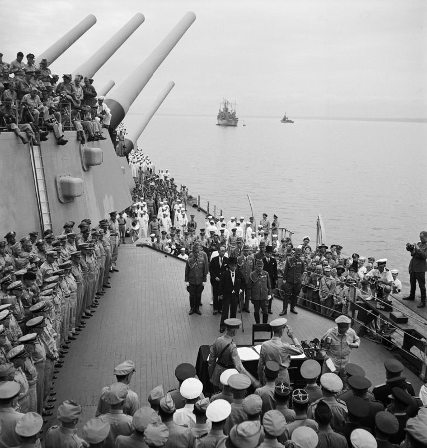
SEVENTY YEARS AGO.

This is what victory looks like.


USS Missouri in Tokyo Bay.
Unattributed photograph retrieved from Ace of Spades.

Here's Richard Fernandez of Belmont Club on why it matters.
Power means the last word on things.  It is not as if some future Republican president can reverse Obama and re-attempt a civil society in the Middle East the way America did in Europe and Japan at the end of World War 2.  Obama demonstrated the American Left can veto any attempt to resist imposing its vision upon the nation.  It has the will to throw away any victory,  however complete, to have the last say.

The mistakes of Obama’s policies are secondary to the principle that a certain point of view should prevail.
For now, no. It's above my pay grade, but I sometimes wonder if the foreign policy of the victorious powers doesn't suffer from Nagasaki syndrome, namely, imposing the last word means a victory the winners don't want to live with.  (And there was a World War II in part because of the indecisive re-set of a civil society after World War I, a re-set that gave us Weimar decadence and a carve-up of the Ottoman Empire.)  Mr Fernandez suggests that, perhaps, conditions calling for more decisive use of power are still taking shape.
Until the main issues are resolved or at any rate understood, many events will continue to unfold in the curious condition of irrelevancy.  They will be important yet strangely peripheral, in the same way that the Chinese stock exchange meltdown was a only manifestation of something larger.  Until the underlying issues are settled,  the spotlight will remain where it is while behind it, barely glimpsed in the background, great shapes move silently ready for the next act.
Note, though: fundamental transformation will be emergent, not something that can be managed or administered. Complex adaptive systems ...

THE MAN OF SYSTEM.

With the return of collegians to classes, it's useful to remind participants in dorm-room bull sessions (if there are such any more) that complex adaptive systems tend to do what they d**n well please.  This fall's lesson is courtesy National Review's Kevin Williamson.
Politicians tell us what a policy is supposed to do, what it is intended to do, and they ask to be judged by their intentions. The so-called Affordable Care Act, we were assured, was intended to make health insurance a better value and to make health-care institutions give their customers better service at better prices. Never mind the unspoken premise that is the law’s foundation — “We can radically increase demand for health-care services while reducing costs and improving quality because politicians are magic!” — and its inescapable contradictions. “We meant well,” they say, and that is supposed to be enough.

It isn’t.
But that's why I never lacked for work.
It falls largely to persnickety, unpleasant eat-your-spinach types, and to certain happy souls blessedly liberated from the romance of politics by events and experience, to document that what is supposed to happen and what happens are not the same thing. Britons and Canadians and Americans can go on all they like about their “right” to health care, but calling something a right does not make it any less scarce (indeed, it is absolutely meaningless to proclaim a “right” to any scarce good), and whether you choose an anything-goes free market or an Anglo-Soviet single-payer monopoly model, there is going to be rationing, normally through the instrument of price. The only question is whether you get to make that decision for yourself or whether an Orwellian [official] makes it for you. You can raise wages at Walmart in the naïve expectation that there will be no consequences — in much the same way that all manner of bad decisions begin with the exhortation, “Here, hold my beer.” But there will be consequences. You can loot California until the only people comfortable living there are too rich to care or too poor to care, but the people between those limits have cars, and they know where the local U-Haul office is.
I think Mr Williamson mischaracterized Paul Krugman on the matter of inflating a housing bubble as a way of offsetting a popping dot.com bubble, because, he, too, is aware of the presence of tradeoffs, and of unintended and unanticipated consequences to policies that sound so good when debated in Congress.

1.9.15

LIBERATE US FROM LIBERATING TOLERANCE.

Once upon a time, a syllabus was the brief description of a course's content, published in the college catalog, and the course outline specified the topics and readings in the order in which they would appear, perhaps with some estimate of when.  Now, what students get, often stuffed into a course management system online, looks more like Conditions of Carriage, and liability-conscious deanlets and deanlings keep tacking additional stipulations into the conditions.

The latest idiocy appears to be instructors of record attempting to frame the course direction by pronouncing anathema on bad words.


It's the ultimate post-modern sideshow, in which all of the words on the bannerline are triggering, or micro-aggressive, or will get your grade lowered.

Sometimes, all you have to do is make the follies public, and the impresario backs down.
Over the weekend, we became aware that some faculty members, in the interest of fostering a constructive climate for discussion, included language in class syllabi that has been interpreted as abridging students’ free speech rights. We are working with these faculty members to clarify, and in some cases modify, course policies to ensure that students’ free speech rights are recognized and protected. No student will have points docked merely as a result of using terms that may be deemed offensive to some. Blanket restriction of the use of certain terms is not consistent with the values upon which this university is founded.

Free speech and a constructive climate for learning are not incompatible. We aim to cultivate diversity of expression while protecting individual rights and safety.

To this end, we are asking all faculty members to take a moment to review their course policies to ensure that students’ right to freedom of expression is protected along with a safe and productive learning environment.
That would be easier if all students were previously socialized into bourgeois norms of argumentation and debate, which isn't feasible because hegemony.  Sometimes, though, it suffices to remind students of those norms.
We all have differing opinions, beliefs and practices. The course materials may challenge your personal beliefs or opinions, and this is an open space to discuss these disagreements in a civilized, academic manner.
I could go purist on you and suggest that a course that doesn't challenge each student's world view at least once a day isn't worthy of college credit.  Just go read and understand University Diaries.
UD doesn’t know how long this syllabus will remain online. But for now you can feast your eyes on one of the strangest documents UD has seen in awhile. If you told me it was written by a bitter washed-up person who’d been the relentless object of her students’ contempt for decades, I’d say well okay… I can see how a lifetime of abuse would inspire this sort of long angry welcome to my classroom, assholes out to destroy me …
The author is a young person. Probably marinated in grievance politics and subjected to the legal-speak from the deanlets and deanlings who want their teaching faculty to provide for every possible contingency in the conditions of carriage.  What Higher Education could use is a Grumpy Old Rules Examiner.  There are a number of situations where Rule 108 applies.

In case of doubt or uncertainty, the safe course must be taken.

(Yeah, that also describes the behavior of to self-selected conscience cowboys and Greek Row, in a different way, but I digress.)

Here's University Diaries, again.
This is the Kindergarten Teacher/Mao Zedong multiple personality type we do sometimes see in certain courses of study in American universities. The problem is that the professor wants to be nice but wants at the same time to subject her reactionary charges to the harsh re-education process the little fuckers deserve.

The results of this muddle are reliably funny ...
A lot more expensive, though, than an afternoon at the circus.

GIVE US YOUR HUDDLED MASSES YEARNING TO BREATHE FREE.

Oh, and Reason notes, if they're born here, raised there, then allowed re-entry as adults, the United States gains, and the country of their parents loses.
Anchor babies don't exist in any meaningful sense. Birth tourism, however, does. And that's a good thing.

No super-reliable figures are available, but the number commonly bandied about puts birth tourist babies at a mere 35,000 annually. Unlike the poor, unauthorized Latino parents of mythical "anchor babies," birth tourism involves relatively well-off couples, the vast majority from China, who come to America when it comes time to give birth so their kid will score U.S. citizenship.

Another benefit for these Chinese couples: Beijing's autocrats don't count children born with other nationalities against a couple's one-child quota. No doubt, a U.S. passport for their newborn is a huge attraction. But America is not the only destination for couples trying to dodge China's draconian birth control policies. Mainland Chinese couples also flock to Hong Kong (all of which the pro-life, pro-family conservative editors of National Review Online should understand and applaud rather than running confused pieces like this conflating "anchor babies" and birth tourists to promote their anti-birthright citizenship crusade).

Immigration restrictionists love to deride "anchor baby" parents for being in the United States illegally. But that's not true with birth tourists. They come here legally.
Per corollary, Reason's arguments apply with equal force to children carried in the United States by surrogate parents under contract to Chinese nationals.  (In case anybody doubted I was mocking the use of the term anchor baby in that previous post, keep reading.)  And the administrative difficulties in a child being able to secure immigration rights for his or her parents, 31 years hence, strike Reason's Shikha Dalmia as pretty weak incentive.

That is not what I wish to address.  Rather, it's this.  Birth tourists do not turn up at the emergency room, the way the social-services-folklore has it for the children of illegal immigrants.
[N]one of that applies to birth tourists, who, with few exceptions, pay for the entire cost of delivery out of pocket. In fact, the agency that formed the cornerstone of the Bloomberg story went out of its way to ensure that its clients don't use public money, and keep copious documentation to prove that.

More to the point, birth tourist babies go home to be raised during their most expensive phase—only to possibly return to America after their 18th birthday, during their most productive phase. In effect, birth tourism allows America to outsource the raising of its citizens, resulting in enormous savings, given that it costs a whopping $300,000 to raise a child in a middle-income family in America today.

Every adult immigrant, even poor Latinos, constitute a windfall for America, given that America reaps the dividends of another society's investment in them. (Indeed, immigration is arguably a far cheaper way than having children for a society to maintain its population level.) But birth tourist babies are a special boon because they are the product of super-ambitious parents who are obviously sparing no expense or effort to build their child's full potential and give him/her options.
And it says something about those parents' perceptions of the future of their countries. To repeat, crony socialism plus dirty air plus bubble economy not good enough?

The movement of people from places that suck to places that don't suck is one way to reduce global suckitude.  It must have sucked to grow up Protestant in Catholic Willenberg, East Prussia.

Thus migration into the United States, which remains a land of opportunity despite the efforts of the political class to turn it into another Greece and the efforts of the academy's deconstructionists to pronounce anathema on the phrase.

THE CASE FOR EMERGENCE.

Charles Marohn contemplates Brainerd, Minnesota, recognizing that taxing its way to a state of good repair isn't likely to happen.
We're not meant to have big guns, we're not meant to have big budgets, unless they are the outcome of many small, difficult steps. When we skip the hard part -- when we attempt to theoretically engineer the right outcome from the top down without the necessary (yet painful) intermediary feedback in all the steps along the way -- we blow ourselves up.

Regardless of what my city does -- hold taxes steady or increase them by 50% -- next year's budget will be a transaction of decline, an attempt to hold on, just a little while longer, to what we perceive that we have. To patch things together in a seemingly pragmatic way, doing difficult work in what many will say was the best that could be done given what we had to work with.
You mean it's not a matter of Wise Experts mandating that everything be done according to Consensus Best Practice?

Somebody tell the legions of pundits and strategic planners and all the other men, women, and whatever of system to look for new work.