9.10.17

DAK CAN'T SMACK CARDIAC PACK OFF TRACK.

That was an interesting Sunday afternoon.

In the first half, the Packers defense had trouble getting off the field, including Dak Prescott flipping the field on a third-and-thirteen on the opening possession.

It's a sixty minute game.  The Packers rallied from fifteen points down to take their first lead early in the fourth quarter.  Cowboys answered with a field goal, then forced a punt.  Then Damarious Randall executed a pick-six.


Yes, that's the same Damarious Randall who was banished to the locker room during the victory over the Bears two Thursdays ago.  "It was Randall’s first pick-six since intercepting Oakland quarterback Derek Carr in December 2015 as well as a step in the right direction for the former first-round pick after being sent to the locker room against Chicago a little more than a week ago."  If memory serves, that was part of another rally that turned a close game into a rout.  Mr Randall was also flagged for unsportsmanlike conduct, tossing the ball at Mr Prescott.  Sometimes the X and O is the least important part of coaching.

Then the Cowboys ran most of the clock off and Mr Prescott sold an excellent play fake, into the end zone on a keeper,  Cowboys up by four with 73 seconds to play.

This morning, though, there are Monday morning quarterbacks suggesting he should have taken a knee at the one, setting up a first and goal.  That's being too clever by half.

But 73 seconds is plenty of time when Mr Rodgers and his supporting cast know what they are doing.
“Very proud of Aaron Jones,” [head coach Mike] McCarthy said. “He earned the opportunity to start today and he produced. That’s what you look for. This was his first chance to take a big load in the run game, and I thought he played outstanding. I love his running style.”

So does Rodgers, who had no qualms with the rookie being his pass protector in the backfield with the game on the line. Rodgers (19-of-29, 221 yards, three TDs, 122.9 rating) even called Jones’ number on the final drive, giving him a handoff out of the shotgun that he took 15 yards into field-goal range, smartly getting out of bounds with 39 seconds left.

“I told him before the game, I have absolutely zero worries about him back there,” Rodgers said. “He’s a great kid. His vision as fantastic.

“That’s stuff you can’t coach,” Rodgers continued, regarding the cut to the sideline that both moved the chains and preserved Green Bay’s lone timeout on the final possession. “You love the instincts there.”
The Packers moved into touchdown-pass range, and executed the same play twice.

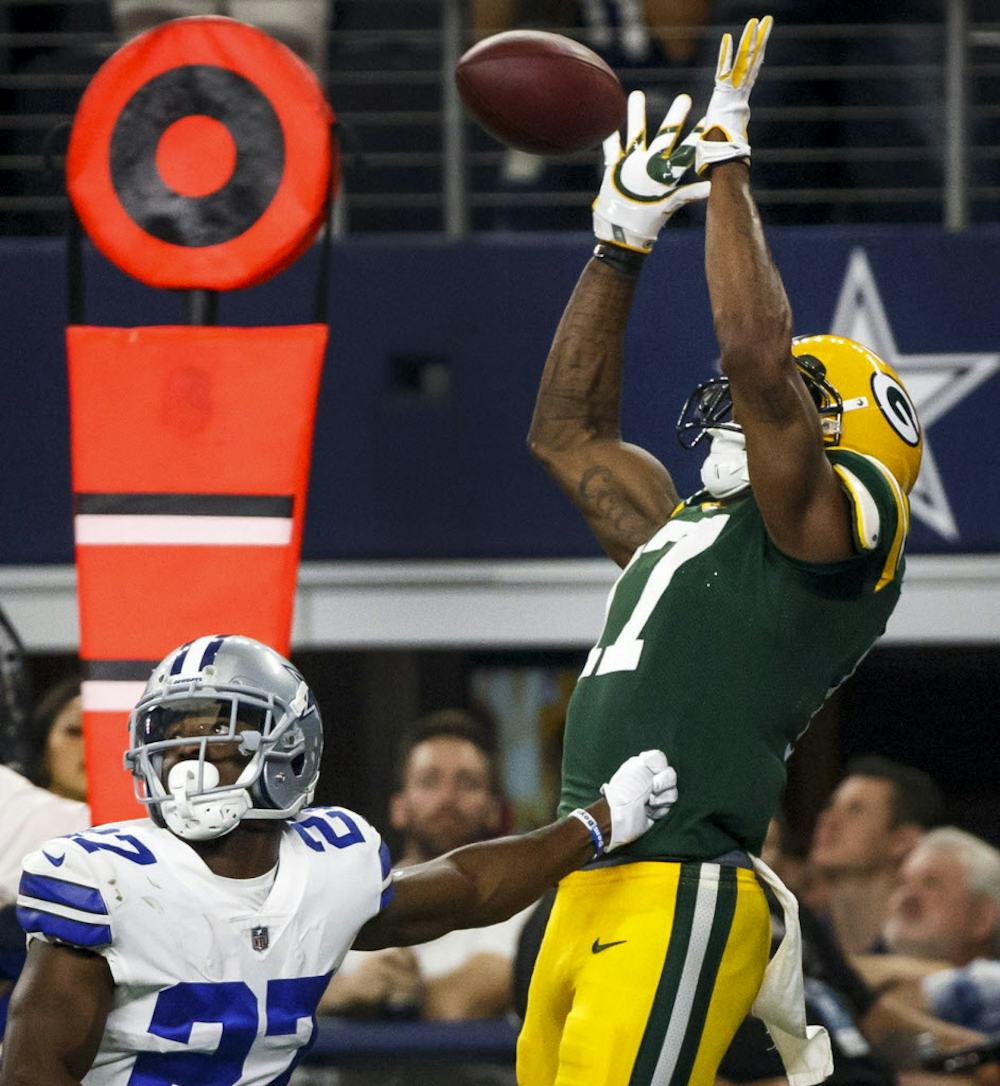
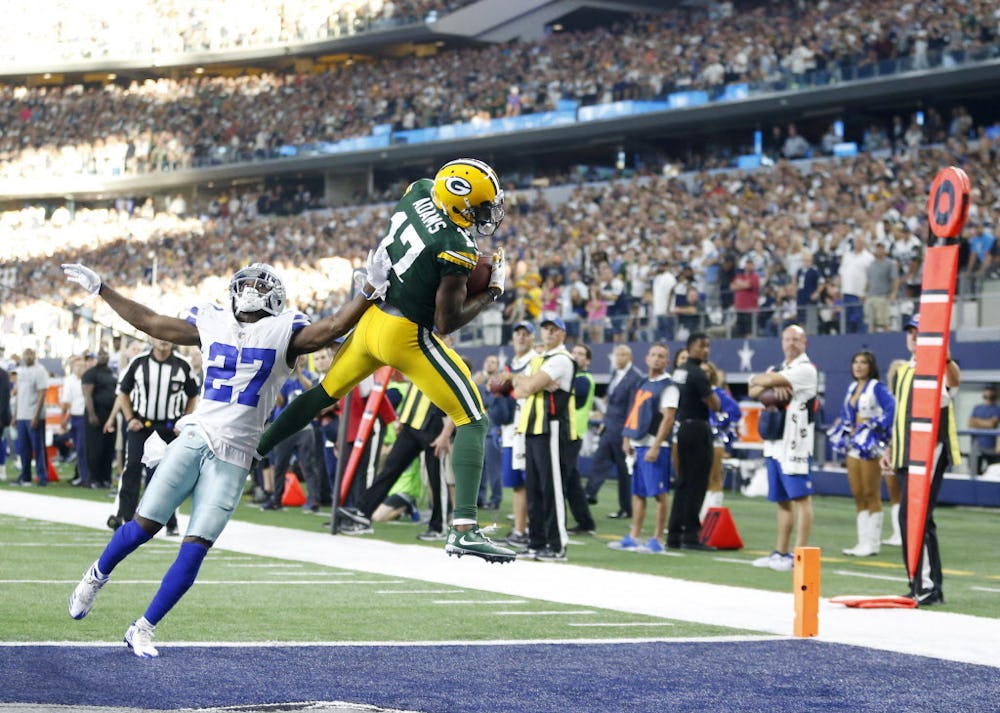
Aaron Rodgers to Davante Adams for the lead.  Note the receiver in a position to high-point the ball.


Strategic play calling: earlier in the series, same players, different play.  "Rodgers’ opening 14-yard back-shoulder pass to Davante Adams did more than that. To hear Rodgers tell it, the first play set up the last one, the TD toss to Adams near the end-zone sideline with 11 seconds to go."  If you're a rookie defensive back, do you anticipate them going back to the other shoulder because that previously worked, or to some other receiver instead?
The Packers actually ran the same exact play one snap earlier, on first-and-10 at the Dallas 12, with Rodgers missing Adams low on the back-shoulder fade. As Adams went back to the line of scrimmage, the two decided to try the pass again.

This time, Rodgers put it higher and Adams caught the touchdown, his second of the day.

“I came back and let him know, ‘Do it again. Let’s go back to it,’” Adams said. “He gave me that look and I was like, ‘Let’s do it again.’ He threw it over there and threw a perfect ball. I didn’t really have to do much.”
Sometimes, it's the body language.  "Rodgers said Adams gave him a look with his eyes when he came back to the huddle that told him to go right back to him."

New cheerleaders, same body language.


Retrieved from Dallas Morning News.

And yes, that's the same Davante Adams who was in the concussion protocol after being smacked by a Chicago Bear.  "Adams said he was cleared from the protocol on Friday afternoon. Still, nobody would’ve faulted Adams if he’d preferred to sit out a week and gather himself."

Unfortunately, because of the intrusion of National Anthem politics into football's pre-kickoff rituals, we have to consider a further self-destruction of the Dallas Cowboys.  Owner Jerry Jones appears to be taking Our President's advice, and threatening players who do anything other than stand at attention with a firing.  That provoked ESPN's Jemele Hill to suggest that people boycott the Cowboys ... as if the anthem protests aren't doing that already ... and ESPN have benched Jemele Hill.

The Packers, on the other hand, have been locking arms and standing for the Anthem.  On one of the local fan shows, receiver Jordy Nelson explained that the team is looking for a way to call attention to the reality as many of the young men have perceived it: difficult circumstances and disrespect from officialdom (and we could add to that taking on the risks of concussions and a shortened life with shattered mental faculties) without appearing to be disrespectful to the country.

That might be part of how team players learn to believe in each other, and we'll see if Mr Jones does more damage to Cowboy morale than another big Packer comeback did.

And yes, there was another big Packer comeback, four years ago.


Unattributed Green Bay Packer photograph.

Aaron Rodgers was not the quarterback that day.  Next man up, and of late the rookies have been rotated into games from the beginning.

5.10.17

NO KIDDING.

Streetsblog, The Problem With America’s New Streetcars.  "Cities may have valid reasons for seeking more downtown investment, but these streetcars should be recognized for what they are: economic development projects, not solutions to the transit and transportation problems cities face today."  Yes, that was explicit in the construction of the Shaker Heights Rapid Transit and implicit in the first extension of the Chicago Rapid Transit to Niles Center, now Skokie.

If you're going to run the rapid transit lines as public services, it's not so much farebox recovery as sustainable commercial and residential development, i.e. a tax base, that matters.

FINIS, CREDENTIALED ESTABLISHMENT?

The warning signs were there, if you knew where to look.  (It's happened a lot faster than I anticipated, viz this from 2013: "Changing the expectation for presidents, nay for Washington politicians generally is a task several orders of magnitude tougher. It might take even more serious government failure to change minds.")

Kurt Schlichter, however, has lost all patience with the Wise Experts.
So, as a practical matter, we only lose our rights if we allow ourselves to be shamed, threatened, whined, and lectured into giving them up by skeevy tragedy-buzzard pols, mainstream media meat puppets, and late night chucklemonkeys whose names and faces all blend together into one unfunny, preachy blur.
I think he's saying, "mess with the Bill of Rights at your peril."

But National Review's Jay Cost is suggesting the Credentialed Experts are irrelevant, if perhaps more politely.
Since at least Woodrow Wilson, progressives have grumbled about the Founders’ achievement, often complaining that the Constitution does not facilitate vigorous government. Power is too divided in this system, Wilson sniffed, leaving the government incapable of acting in behalf of a popular majority. Of course, it is so easy to complain about a majority’s inaction precisely because the Constitution has done such a good job of preventing tyranny of the majority.

Moreover, the Constitution assumes a process of civic deliberation that still rubs people the wrong way. It establishes Congress as the fount of all legislative authority, and by extension it empowers the people who elect the legislature. But over the years, Congress’s power has been shoveled off to unelected bureaucrats and judges. A few years ago, Peter Orszag, former director of President Obama’s Office of Management and Budget, argued in the New Republic, in a piece titled “Too Much of a Good Thing,” that what we really need is less of that good thing — less democracy. Power should be transferred more fully to experts who can make decisions that the people themselves cannot make.

This view, quite popular in today’s Washington, D.C., is a reimagining of the old notion of mixed estates, whereby certain groups of people (in this case, the credentialed experts) effectively enjoy a permanent place in government regardless of their numbers in society. The Founders rejected this view, in favor of a robust civic republicanism whereby the people do the hard work of governing themselves.
In place of a "basket of deplorables," contemplate an "unfunny, preachy blur of chucklemonkeys."

Writing for Common Dreams, Richard Eskow also says Enough.
People aren’t against globalization as [former British prime minister Tony] Blair defines it. They’re against trade deals that hurt them economically in order to benefit powerful interests. The “globalization” the left opposes is something altogether different: the domination of multilateral decision-making by powerful financial interests. That’s worth opposing.
Funny, that sounds a lot like Trumpian populism, if perhaps seasoned with a sincerity that a billionaire rent-seeker knows better than to attempt.

The turfing-out, however?  More likely to come.
The consensus rule of political insiders across the globe, from center-left to center-right, has not responded to voters’ needs or wishes. As a result, it is falling. That’s not tragedy; it’s democracy. Europe’s center-left became complacent and complicit: complacent in its power, and complicit in its relationship to corporate power.

Professor [Sheri] Berman worries that, without, “populism will flourish and democracy will decay.” But the left’s populism is answering the unmet needs of people in Western Europe and the United States. That’s not decay; it’s progress.
Again, that's more polite than "preachy, unfunny blur." And yet ...

THE SPEED-UP COMES TO THE FACULTY.

When the union organizer has success on the shop floor, it's likely because an overweening management has pushed people too far.  (Who is John Galt?  Same argument, different sort of organizer.)

Thus has a union come to Northern Illinois University's faculty, and thus does the anger over having to do more with less bubble up.
No group on campus has received a wage increase since January 2012, and with new tasks being added to their jobs, faculty members think the time has come to see added benefits.

The reasons a wage increase is needed stem from new tasks added to what the university expects from faculty, [United Faculty Alliance vice president Rosemary] Feurer said.

“We’ve been saddled with new job duties, recruiting students, healthcare costs, been denied travel costs to conferences, and we’ve had to pay out of pocket,” Feurer said. “We’ve actually had a pay decrease with all that.”

Feurer said professors are now expected to be in constant contact with students, something she said was not the norm in the past. They are also expected to be involved in initiatives including recruiting events and research. Feurer also said salaries have not increased despite inflation and rising healthcare costs over the years.
I have not been able to verify all these claims, although I understand that departments have gone cold turkey on travel, and that some departments have removed telephones from faculty offices (and that might have the effect of some students ringing their professors on their personal 'phones at all hours ...)

Moreover, if faculty are helping out with student recruiting events, perhaps that is because some positions for deanlets and deanlings are going vacant.

Unfortunately, in the state of fiscal fragility, California is Connecticut is Illinois is Puerto Rico is Greece is Venezuela is Zimbabwe.  And Our President recently put Puerto Rico in receivership.  (Or not: you have to take Mr Trump seriously but not literally.)

3.10.17

DOWNSIZING IS A FALSE ECONOMY.

Earlier this summer, we picked up a Fred Frailey column suggesting railroad operations guru Hunter Harrison was liquidating CSX Transportation.  How serious was he?

Enough so, apparently, that the efforts of Alfred Perlman and Robert Young to reduce the New York Central from four tracks to two wasn't enough of an economy.  (Yes, there are still traces of The Water Level Route in place across New York, if you know where to look.)


So now Mr Harrison wants to reduce two main tracks to one in places.  Mr Frailey has some fun with that idea.
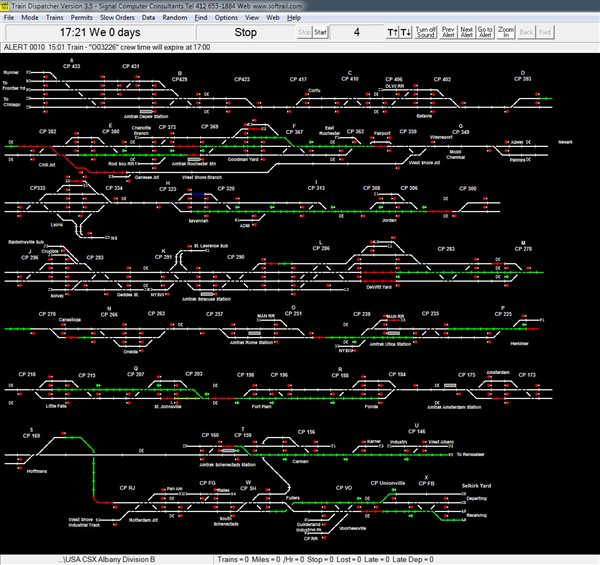
A couple of years ago I built a simulation model for CXS [c.q.] between Buffalo and Selkirk using interactive Train Dispatcher 3 software. I’ve just employed this platform to run the trains actually operated over the territory on a recent midweek day. Then I went into the software, removed 100 miles of double track over the 295-mile stretch—and reran those same trains.
I cut young people who play a lot of games on their 'phones some slack as I too am a Train Dispatcher 3 junkie, although my efforts are more in the "what if" category, such as adding train frequencies between Chicago and the Twin Cities and allowing 125 mph running in places.  But there's enough about railway operations in 12" = 1' for enthusiasts to simulate the real thing.
CSX currently operates 38 regularly scheduled trains a day between Buffalo and Syracuse (DeWitt Yard), and 40 between Syracuse and Selkirk/Albany. Of these, eight are Amtrak trains, six handle automobiles, 10 are manifest freights and 14 to 16 are intermodal trains. Plus there are locals, unit ethanol trains, maintenance of way trains, industrial jobs around the big cities and occasional extras.

Given the complexity of operations across Upstate New York—intermodal hotshots overtaking manifest and auto trains and Amtrak schedules overtaking everything—I didn’t try to redesign the network into a conventional single-track road. Instead, I took out pieces of double track between some existing control points until I had eliminated 100 track miles that can be redeployed to lengthen sidings on the Chicago-Waycross, Ga., artery. I left double track on the approaches to Selkirk and Buffalo and through both Syracuse and Rochester. I also left in place the West Shore bypass line around Rochester.
Looks like he also left the short stretch of four tracks, only one alongside a passenger platform, at Buffalo.


That single-tracking emulated what Messrs. Young and Perlman did a half century ago, when the outside sidings between the towers in place at the time became the third or fourth track for recessing trains.  Note here that some of those sidings have been retained as places to put slower trains out of the way of faster trains.  And put them out of the way they must be.
Surprisingly, the original railroad with its double track intact is almost as hard to dispatch as the one minus those 100 miles of second main. Because of frequent overtakes, you cannot just fleet trains. Instead, you are constantly getting slower trains out of the way of faster trains running up behind them.

The price of removing those 100 miles is a 28 percent increase in delays, caused either by waiting at red signals or being unable to make track speed. That extra lost time adds up to 23 hours. Because I tried to observe train priories—Amtrak, intermodal, auto, manifest, local, industrial, in that order—those trains at the low end suffered most, and the Amtrak and intermodal trains least.

I concluded that losing those 100 miles of double track wouldn’t cripple CSX across New York. All things considered, 23 hours of added delay may be a price worth paying.

Wait, you say! Won’t this stunt future traffic growth? Yes indeed, but who says there’s going to be an increase in traffic? CSX has slowly been going out of business all during the 21st Century, its manifest business down 20 percent since 2000, its coal franchise a shadow of its former self and its intermodal growth at least temporarily halted. Former management under Michael Ward may have talked the growth talk, but didn’t walk it. I have no reason to think Ward’s successor, Hunter Harrison, will act differently.
That's been my experience. When I'm riding the Lake Shore (on rails, not on the replacement bus that I've been presented with too often) the train frequently crosses from one main to the other, and those crossovers must get so much use that the rough running is on the straight side ...

For years, though, the Wizards of Wall Street have been seeking control of CSX in order to make management spend less money on track.  To my naive view, that looks like slowly liquidating the company, but perhaps that is the intention.

MAKE THEM WET THEIR CREASED PANTS?

Nils Gilman suggests that the transgression of all the normal rules by the Trump Administration is deliberate, and there are voters who perceive it as necessary.
What united Trump fans was not so much a policy wish list that had been neglected by mainstream politicians across the political spectrum, but a heartfelt need to say “No!” to a political class that had long ago stopped listening.

Understood in this way, Trump’s gleeful and truculent displays of contempt for longstanding norms regarding acceptable political behavior become much less difficult to comprehend. And yet no one really got it during the campaign.
More precisely, there were people who got it, but they weren't prepared to accept it.
The conventional view is that to be serious about policy in a democracy requires not only legislative goals, but also a sense for how legislation will in turn be adopted by agencies and bureaucracies. Not every President has come to the office with this skill set, but every President has sought to quickly figure out the mechanics of government in order to push through a legislative agenda. This in turn has required that the Commander-in-Chief learn how government actually operates. In short, the job has required gaining expertise in the management of a bureaucracy.
In short, the perceived role of the president is in doing the things the talking head process worshippers yammer on about: that used to be limited to an hour of Friday on public broadcasting, and Sunday pregaming for the unchurched and unPackered, but with cable news one can have it any time, in any flavor.

THE BUBBLE TURNS INSIDE OUT.

Years ago, my introduction to a rational expectations hyperinflation came by way of the example of California houses that sold for way more than the capitalized value of expected rents.  What happens next (although nobody knows the day or the hour) is not amusing.

We live in interesting times.
Supply on the low end is tight because during the housing crash investors large and small bought hundreds of thousands of foreclosed properties and turned them into rentals. There are currently 8 million more renter-occupied homes than there were in 2007, the peak of the housing boom, according to the U.S. Census.

Investors could take the opportunity of high prices and high demand to sell these properties, but today's high rents offer them better returns.

Low supply of homes for sale might also seem like a great opportunity for the nation's homebuilders. Yes, they went through an epic housing crash, but they have since consolidated market share and righted their balance sheets. Homebuilders are simply not building enough inexpensive houses that the market needs.
Markets have steep grading curves, and rates of return function to allocate capital.
That is why sales of newly built homes, like existing homes, have been disappointing. The latest read on August new home sales from the U.S. Census surprised analysts with a 3.4 percent monthly drop, along with a rise in inventory. The homes are there, they're just not selling, and it's not hard to figure out why.

"The recent home sales data has reflected a slower pace and I continue to believe it's due to more a push back on pricing," wrote Peter Boockvar, chief market analyst with the Lindsey Group, in a response to the data release.

Just 2 percent of newly built homes sold in August were priced under $150,000, and just 14 percent priced under $200,000. Compare that with the existing home market, where more than half of homes sold in August were priced under $250,000.
In part, regulatory constraints affect what the builders can build.
Builders say they would like to build more affordable homes but cannot because the math doesn't work. The costs of land, labor, materials and regulatory compliance are just too high. In addition, younger homebuyers want to live closer to urban areas, not in the far-out exurbs, where builder costs are far lower.

"It's time we stopped sugarcoating the truth with this data — the simple fact is that we are severely underproducing housing in this country, relative both to basic demographics and currently high demand from buyers," wrote Gudell, who notes that inventory is stuck at roughly mid-1990s levels, but the country has grown by more than 60 million people since then. "Buying conditions, in theory, are great right now: Jobs and incomes are growing, and rock-bottom mortgage interest rates are helping keep financing costs low. What's missing from the equation is a lack of homes actually available to buy at a price point that's reasonable for most buyers."
But I don't understand what comes next.
The trouble is, even though the market is woefully mismatched, home prices will not come down as long as there are some buyers out there willing and able to spend more and more money for less and less house.

"We expect price pressure to remain pretty strong well into the fall," said Nela Richardson, chief economist at Redfin. "First-time buyers are struggling to find a footing in this market. The first-time buyer share is down from historical levels, but the thing is, you don't need everyone to buy a house in this market. As long as there are one or two buyers who can afford, and those buyers can be investors, then the sale will go through, and that's what we're seeing at some level."

So, what does all this mean for the economy and personal wealth? It means the renter nation will persist and fewer Americans will be able to save and grow their money in a home. It also means rents will continue to rise due to high demand, leaving more Americans with less disposable income to spend.
Maybe. Investors might buy houses as long as the acquisition price is less than the capitalized value of the rents.  That has the effect of bidding up the prices of houses that can be converted to rentals (and for the moment, budget-constrained renters are actually in a better position to buy than they will be until that price adjustment goes through.)  In turn, that changes the incentives to turn out tracts full of look-alike, priced-alike housing, particularly in tracts catering to those higher net worth buyers who are no longer there.  And we might see a reversal of the teardown tendency in the old streetcar suburbs, in which smaller houses were torn down (and sometimes two lots combined) in order to put in bigger houses with a more tony address than [Phony British Location] [Phony Geography] [Rustic Noun], Yuppie Hell A Tank of Gas From Anywhere.

1.10.17

RETAIL RAILROADING.

That's something the freight carriers have mostly been getting away from.

But when the consignee is willing to pay for the unloading facility, Union Pacific can handle it.
[Union Pacific Distribution Services] employees have made a science out of building wind distribution centers, completing 47 centers over the years. Two more are currently underway in Buffalo, New York, and Montevideo, Minnesota. The turnaround for each completed facility is about six months, and they are typically underwritten by the customer. A recent solution is a wind distribution center in Carlisle, Iowa, just outside Des Moines. The site was built to handle nearly 500 turbines over a three-year span.
A turbine consists of three blades (each an oversize load), the rotor and alternator assembly, and a mast (which may be shipped in sections.)

That's still relatively few carloads per week.
For the new Iowa distribution center, two tracks were built off Union Pacific’s main line and the road into and out of the facility were extended to ensure emergency response vehicle accessibility.

“We spend a lot of time talking to community members,” Kroese said. “We want to be good neighbors.”

Once infrastructure is completed, the facility’s operation works much like a finely choreographed ballet. First, trains come in from Colorado delivering components to build inventory, which is stored until trucks haul parts out of the distribution center.

“It’s like grocery shopping,” Kroese said. “Trucks come in and pick up the specific components they need – three blades, four tower sections, one nacelle (the top of the turbine) and a hub – and then head to the project site.”
The components could be trucked the entire distance from factory to field, but for the expense of securing oversize load permits and checking clearances.  The extension to, say, requiring oversize load permits for any movement of a 53 foot trailer, is left as an exercise.

SO EPISTEMIC THE CLOSURE THEY'RE CHOKING?

The pundit class have discovered, in the past week or so, that there is more to the insurgency of disaffected normals than Donald Trump's presidency.

One possibility might be that the normals are using Gramscian tactics on the transgressives.  John Fonte was thinking about these things at the turn of the century: that is, before the Florida recount, before the towers fell, before the financial bubble popped, before hope and change, before the Trumpening.  Minding the Campus recently reissued the essay.  This passage, which captures the thinking of identity-politics types, might equally apply to the ongoing insurgency.
Power, in Gramsci’s observation, is exercised by privileged groups or classes in two ways: through domination, force, or coercion; and through something called “hegemony,” which means the ideological supremacy of a system of values that supports the class or group interests of the predominant classes or groups. Subordinate groups, he argued, are influenced to internalize the value systems and world views of the privileged groups and, thus, to consent to their own marginalization.
Thus, it is the role of the vanguardists to convince the oppressed to withdraw their sanction.
But there is an idea from Atlas Shrugged in which it is the entrepreneurs and producers who withdraw their sanction.  What happens, then, when the supposedly privileged refuse to be guilt-tripped any more?
Gramsci believed that it was necessary first to delegitimize the dominant belief systems of the predominant groups and to create a “counter-hegemony” (i.e., a new system of values for the subordinate groups) before the marginalized could be empowered. Moreover, because hegemonic values permeate all spheres of civil society — schools, churches, the media, voluntary associations — civil society itself, he argued, is the great battleground in the struggle for hegemony, the “war of position.” From this point, too, followed a corollary for which Gramsci should be known (and which is echoed in the feminist slogan) — that all life is “political.” Thus, private life, the workplace, religion, philosophy, art, and literature, and civil society, in general, are contested battlegrounds in the struggle to achieve societal transformation.
Indeed, and when the Hollywood awards shows and higher education and, horrible dictu, the National Football League take the wrong side, can we speak of a counter-counter-hegemony?

OF COURSE THEY ROLLED IT OUT IN TEXAS.

Texas -- more specifically, the Dallas area -- is ground zero for parvenus and obnoxious pickup trucks.

It is no accident, dear reader, that Ford rolled out the F-450 at the Texas State Fair.
Pushing the price boundaries again, Ford debuted the 2018 F-Series Super Duty Limited pickup truck Thursday at the State Fair of Texas that inches the once-humble haulers closer to the $100,000 mark.

With the most capability and all optional packages selected, the F-450 Super Duty Limited tops out at a price of $94,455. For that, you can tow trailers that weigh more than 30,000 pounds.
That's encouraging, as there are a lot of go-karts masquerading as pickup trucks that can't haul 4x8 sheets of building material or tow a 30 foot racing sloop or the draft horses to the circus parade.  The F-450 can at least pull, although I have my doubts about the cargo capacity where those building materials are concerned.

Perhaps, though, it's all about the styling for the parvenus.
“There are heavy-duty truck customers who need Super Duty-level capability and want true luxury,” Ford trucks marketing manager Todd Eckert said in a statement. "We created this new truck to answer the call for even more premium choices in the Super Duty range as we see more and more truck customers trending to more premium models.”
Right.  Well, for years, the intellectual heirs of Sinclair Lewis have made any sort of powerful motor vehicle a signal of Babbittness. Or, with their kin at the drive-train, the sport-utes, rolling enablers of road rage.

Thus, perhaps the pickup truck, even if the driver has no idea what a socket wrench is and no capability to schlep drywall around, is a political statement.
The fancy pants set at CNN or the Washington Post wouldn’t be caught dead in a pickup truck. Instead opting for their hybrid or electric cars, or something similar from Uber. Illustrating once again how out of touch the coastal elites are with the rest of the country, and the millions of Trump voters.
There's more at the link.

The Economist's Lexington was thinking about the political economy of parvenus and pickups in the previous presidential cycle.  Not surprisingly, he's at ... the rollout at the Texas State Fair.
Many of the priciest were bought by self-employed contractors, precisely because they all but live in their trucks. By week, their luxury trucks haul heavy machinery. At the weekend, buyers want a pickup that makes them proud as they take their spouse to a restaurant or tow a boat to the lake. In Europe, notes a Detroit executive, their equivalent might drive a Transit van, but would not use that to take a partner to dinner.

Today’s pickups demonstrate pragmatism. That may seem counter-intuitive: with their big engines and Tonka-toy looks, trucks suggest a refusal to compromise with fuel prices or fears of global warming. But industry buzz is around the success of a turbocharged, six-cylinder Ford engine that uses a fifth less fuel than older, larger V8 engines of similar power. The new V6 will help Ford meet tougher federal fuel-efficiency standards, but is not being marketed that way. It is sold as a money-saver. Over 200,000 have been sold so far, though not long ago a truck engine without eight cylinders was doomed in any barstool bragging contest.
The girl worth your while is the one who also can drive a stick, but I digress.  It's the political economy of productivity.
Pickup buyers dislike overt government nagging. They do not feel guilty about driving exceptionally large vehicles. They revere hard work, starting with their own. But offer a nifty technological fix, packaged right, and they will embrace goals such as saving the planet. Pragmatism is profitable, and profit is a powerful force.
Lexington might be overanalyzing this.  To a tradesman, fuel is an expense, and conserving on fuel whilst being able to tote more stuff to the job site (or to tow Muffy's horses to the dressage competition) is a good thing.  Put another way, getting more oomph out of a gallon of gas lowers the carbon footprint whilst getting stuff done.  And if it's cocking a snook at the metrofexuals at the same time, all the better.

BEFORE THE SNOWS FLY.

Chelsey Lewis tours the inland coasts of southern Wisconsin.
One of my favorite spots to do that close to home is the Seven Bridges Trail at Grant Park in South Milwaukee.  A network of trails winds along wooded bluffs and down to a rocky beach on Lake Michigan.  It's a beautiful spot for hiking in summer and fall.

To the south in Racine, the expansive North Beach is similar to Milwaukee's Bradford, with volleyball courts and a concession stand (open Memorial Day through Labor Day). The beach was the first in Wisconsin to be certified as a Blue Wave clean beach by the National Clean Beaches Council.
Perhaps, more inducements for Foxconn to establish that factory near the state line?

But the real jewel is Geneva Lake, once upon a time the midwestern home of the America's Cup.
One of the best ways to get in the know is on a boat cruise with Lake Geneva Cruise Line.

Captain Nancy Baldwin told our group of about 40 that the cruise line has offered public tours of the lake for 160 years as we boarded the Geneva at the Riviera dock in downtown Lake Geneva.

In the past, boat was the only way to reach our destination: Black Point Estate on the lake's southern shore.

But first, a 45-minute cruise along the north shore narrated by Baldwin, who told us about the great estates that used to and currently line its shores, from nearly one mile of shoreline owned by the Wrigleys (of chewing gum fame) to the white-columned Harris mansion (originally built for Chicagoan Norman W. Harris of the Harris Trust and Savings Bank, now owned by Chicago investment manager Richard Driehaus), where an annual birthday party with a huge fireworks show is a July staple.
The things you learn.  Summer season, one of the cruises is also the mail boat, and on hot days the youngsters who serve as messengers might cool off by accidentally on purpose missing their return to the mail boat (never, though, if they've picked letters up).  But that Black Point is a state historical site, accessible only by boat (so as to damp down those motoring visitors) is new information to me.

There's also a museum of yacht racing lore on the south shore.


Among all that yachting memorabilia, and the travelling trophies of the Lake Geneva Yacht Club, are prizes endowed by the likes of the Wrigley and Elwood families, created in honor of General Sheridan, and won by the non-political Koch brother.

28.9.17

CONTEMPLATING MONUMENTS.

A few years ago, Michael Lewis lamented the diminished aesthetics of recent public art.
As different as [Washington, D. C.'s recent Martin Luther] King and [General and President Dwight] Eisenhower memorials are, the public’s dismay in each instance has the same cause: These aren’t the men we knew. It is not easy, of course, to make a succinct statement in sculptural form of the essence of a man’s life. It is something American art has always struggled with, especially in our chronic divided loyalty between realism and idealism. But this is the least of the problems with the Eisenhower and King memorials. They fail fundamentally as monuments, not because they misunderstand the nature of their subjects, but because they misunderstand what a monument is, or should be.

As traditionally understood, a monument is the expression of a single powerful idea in a single emphatic form, in colossal scale and in permanent materials, made to serve civic life.
But iconoclasm became a thing, long before the current iconoclasm took root.
Monuments and memorials today are discursive, sentimental, addicted to narrative literalism, and asking to be judged on good intentions rather than visual coherence. This change began, ironically, with a critique of the overwrought memorials of the Victorian era. In reaction, the first generation of modern architects decided that we needed an entirely different vocabulary of monuments. So when modernism went about dislodging the structures of traditional society, culture, religion, and the political and social order, it also began dispensing with the arches and columns that paid tribute to that order. This was not easy, however, because modernism was concerned with the future and monuments are retrospective.
The challenge, as we shall see, is that "good intentions" are temporally relative and emergent.
[W]e can remember that greatness is possible. For more than a century and a half, we built monuments with spectacular success. We have only been building them badly for a generation. I look at these recent designs, which are perhaps an honest reflection of our divided and uncertain culture, and can’t help but think we can do better once more.
First, though, the division and uncertainty must proceed.

Or perhaps there has always been division and uncertainty: we just haven't considered the history.

CALL THEM TO ACCOUNT.

At The American Interest, Andrew Michta calls out the indolent political class.
In truth, we are not witnessing a dramatic systemic change driven by conniving external forces, but a meltdown of political authority in the West caused by the relatively straightforward indolence of its political class. Our troubles are less about liberalism’s decline or the ascendancy of left or right politics. Simply put, the citizenry in the West has been frustrated for decades with its elites’ inability to deliver workable solutions to the problems of slow growth, deindustrialization, immigration, and the overall decline of self-confidence across the West.

The legitimacy, and hence stability, of the international system rests to a degree on the ability of the leading powers to deliver at home—or, simply put, to govern.
That presupposes there is something called governing, but one point at a time.
The increasingly self-selecting, self-contained nature of the political class has been at the center of the systemic dysfunction bedeviling Western democracies. It has led voters in 2016 to view with suspicion anyone connected to politics. Trump’s election is a case in point, as is Brexit, the rise of the AfD in Germany, and the progressive re-nationalization of European politics overall. At the same time, domestic institutions are increasingly characterized by sclerosis throughout the West. It has manifested itself in tandem with the growing crisis of political leadership at home. If unchecked, it will further undermine faith in state institutions, and could even delegitimize democracy itself.

Because Western elites continue to fail to deliver real solutions to problems like immigration and deindustrialization, an irreversible loss of public support for fundamentals like free trade, liberalism, and multilateralism is no longer just a theoretical possibility.
That's the reasoned case.  Then there's Kurt Schlichter.  Voters are quicker to fire underachieving leaders than used to be the case.
The ritual sacrifice of Eric Cantor was not a fluke. The election of Donald Trump was not a fluke. None of this is a fluke. We really mean it. We want change. And if you won’t give it to us, we’ll fire you and elect someone who will.
"Change," dear reader, does not mean putting your trust in Democrats.
We face an enemy that hates us, that wants us suppressed and silenced, that will do everything it can to take our First, Second, and every other Amendment’s rights from us and condemn us to a future of baking liberals’ cakes and fearing that we might be jailed for using the wrong pronoun.
He exaggerates, but only slightly.

Perhaps the place to start is by placing less faith in Governance as Solving Problems in the first place.

SUNDOWN TOWNS HIDING IN PLAIN SIGHT?

Possibly.  That's a review of a recent book, The Color of Law: A Forgotten History of How Our Government Segregated America.  Once upon a time, communities, particularly small towns and tony suburbs, were explicitly segregated, or sundown towns.  But it's possible to accomplish the same outcomes, without violating the civil rights laws, by careful curating of the in-migrants, as Charles Haywood suggests is standard in Oak Park, Illinois.
When I arrived, my “advisor” gave me a sheet that said, in deliberately obscurantist legalese, “We will give you listings on the basis of your race.” This blatantly illegal practice (not made legal by disclosure, either) took me aback. Why, I thought, would they do that? It did not take long for me to figure out: They wanted, and still today want, to prevent black people from clustering there (shades of the M. Night Shyamalan movie The Village), which could attract more black people who might thereby start to view Oak Park as welcoming to African Americans. So they scatter black people among white people, and they try to locate white people among black people already living in Oak Park, both to prevent clustering that might attract more black people.
Or to prevent a population mix from reaching a tipping point: the multicultural makeup that is an unstable equilibrium being hard to establish in the first place, let alone to maintain?
Non-black people (me, for example) tend to think of housing discrimination as something in the past, engineered mostly by individuals in their private capacities, though with effects in the current day. It’s more convenient to think that way, after all. Just as importantly, we tend to think that if, in some cases, the government did engage in segregation (de jure), it doesn’t anymore, so there’s little to talk about. Plus we conclude that by now the effects of private and government actions are impossible to separate. Rothstein rejects all these explanations, or rather, claims they obscure more than clarify. First, there was, until relatively recently, vastly more de jure segregation than most people are aware. Second, even if legal segregation is now gone, what we think of as de facto segregation was primarily driven by earlier de jure segregation—and therefore the government, not private choice, is almost exclusively responsible for present-day patterns of segregation, as well as the consequent multiple negative effects on African Americans in the present day. Third, because it was our government, we are all responsible for finding a solution.
Alas, though, relying on government brings in the dual burdens of enforcement and one-policy-fits all, which is likely to preclude curating incoming populations in such a way as to create stable integrated patterns ... imagine the kind of contortions that create a freshman class, applied nation-wide.

26.9.17

SUNSET FOR ELEPHANTS.

The Kelly Miller Circus made a visit to Kingston, Illinois.  It's late September, but the weather is more like mid-July, which is when the coming of the circus used to be the main event of summer in rural America.


Patrons have the opportunity to view the menagerie, and ride ponies, camels, and elephants before the show starts.  But our political masters have banned performing elephants in Illinois effective at the beginning of 2018.


No doubt our progressive betters will tell us it is for the benefit of children of all ages that they can no longer have this experience.


Cindy and Jenny take a bow, all the same.


For now, they're leaving the men and horses, hoops and garters alone.


See you down the road.

BLUNT IS NOT INCORRECT.

I'll confess to ignoring a lot of the culture-wars and political to-ing-and-fro-ing of late: in part because I can (staying current on the latest controversies not being part of the obligation of showing up prepared for class any more); in part because being able to go to touristy destinations while the weather is still good and a lot of the tourists have their kids back in school.

But the battles of ideas go on, and the Wax and Alexander essay on the value of bourgeois norms continues to take meaningful incoming.  Start with Professor Wax's colleague at the Penn law school, Jonathan Klick.  "I Don’t Care if Amy Wax Is Politically Incorrect; I Do Care that She’s Empirically Incorrect."
The real world is a messy place. Broad claims that general cultural norms obviously are the key to the good life are bound to be problematic. That doesn’t mean that arguments shouldn’t be made; it doesn’t even mean that, perhaps, some cultures aren’t better than others as judged by a particular objective function. But it does mean these debates are far from settled, and claims like those made by Rod Dreher that Wax’s critics “lack the moral courage and the common sense to affirm what everyone knows” are patently silly.

I don’t think Wax is a racist, and I don’t care if she’s not politically correct. But I do believe arguments that only take note of (or, worse yet, merely assume) convenient empirical facts while ignoring inconvenient ones deserve to be criticized. This is true when you disagree with someone’s underlying normative views, but it’s even more important when you don’t.
Yes, let's weigh the evidence. But let's not smear the messenger, which, unfortunately, is what much of the reaction to the Wax and Alexander essay does.  Yes, in social science, it is difficult to establish causation, even when casual empiricism suggests there's a correlation.  But smearing the messenger has long been part of the academic establishment's tool box.
Ultimately, all of us, including [Brookings's Isabel] Sawhill and Wax, are building on the insights of sociologist (and later Senator) Daniel Patrick Moynihan and his famous report on the state of black families, which he wrote while working for the Labor department during the Johnson administration. What is less widely known is that Moynihan wrote a private memo in a format suitable for his boss (Willard Wirtz, the Secretary of Labor) to give to President Johnson, underlining the absolute urgency of re-tooling federal policy to promote and not undermine marriage and family stability among African Americans. Moynihan argued that the decline of marriage was the “master problem,” the “principal cause” of the problems facing Black America, and he predicted that African Americans would not be able to attain equality if this problem was not addressed.

Unfortunately, Moynihan was roundly condemned as a racist for his analysis of the black family and the importance of marriage, and his advice was largely ignored. He was socially shunned by many of his colleagues at Harvard. It wasn’t until several decades later that sociologists began saying (quietly) that he was probably right. Now Wax is being pilloried for broaching the same topic — for saying that marriage and culture really really matter, and that some norms, some cultures, are more conducive to success in modern America than others. Does anyone seriously believe that all cultures are equal–either morally (including the culture of Nazi Germany) or as packages of norms and practices that are likely to lead to success?
I could add, on the more farcical side, vice president Dan Quayle and Candace Bergen's Murphy Brown: there too, logic and content came well after the mockery.  But let's be precise about "all cultures are equal" serving as a distraction, whilst "packages of norms and practices that are likely to lead to success" is a call for a lot of hard work.

25.9.17

TODAY'S RAILROAD READING.

India's First Post, and Marginal Revolution, both make use of "ferroequinology."

Regular readers know the word: let the rest of the world catch on.

They take it seriously on the subcontinent.
Every year, railfans across India meet at an event hosted by the Indian Railways Fan Club Association (IRFCA). The one stop destination for railfans, IRFCA was started with few rail fans in United States discussing Indian trains over e-mail in 1989. With the spread of the internet in recent years, the group now boasts of 10,000 plus members spanning across continents. Railfans share their collective passions for history, photography, travel, scheduling, and engineering around railways on the website’s forum and schedule informal ‘railfanning’ sessions.

They have also documented just about everything to do with the Indian Railways — locomotives, signaling, operations, rolling stock, books and research, tracks, loco sheds, zones, freight, technical documents, its history, and maps. IRFCA maintains a complete database of locomotives running all across India, with technical specifications. In fact, the IRFCA picture gallery features a collection of the finest pictures ever of Indian Railways.

Some of the railfans tend to know train timetables by heart. They can determine when and where a locomotive was manufactured with just a glance at the serial number; recognise the sound of a WAP-7 locomotive horn from kilometers away; and recall when a particular stretch of track was built, electrified, doubled or even closed.

Once in a year, railfans across India meet at any pre-decided place where they discuss everything related to railways. They also have sessions and presentations, which covers technical topics, railway photography, trips, travelogues and much more.
Their work is more difficult, as the photography of trains is illegal in India.  (Arguably, that's consistent: photography of trains from public property is legal in the United States, but there are lots of local authorities, not to mention meddlesome busybodies, who didn't get the memo, and they might give a ferroequinologist a hard time.)

But preservation, and conventions?  Yep.

You can't post too many pictures of Silver Pilot.


Illinois Railway Museum, 17 September 2017.

Here's an old model of a sister unit, Silver Bullet, rendered in cast bronze.


Indianapolis O Scale show, 22 September 2017.

THE FOOTBALL BUBBLE IS DEFLATING.

John Kass notes the feedstock of new players is dwindling.
To witness the death of the multibillion-dollar National Football League, you really don't need to see sportswriters wringing their hands over the moral dilemma of covering America's Roman circus of brain trauma.

And you don't need to watch multimillionaire football stars, pampered for most of their lives, ostentatiously disrespecting the American national anthem, kneeling, their raised fists in the air.

You don't need to see the desperation in the NFL's television commercials: actresses in team gear, holding snack trays to feed their (virtual) extended team-gear-wearing families, as the NFL begs middle-class women to mother their game before it dies.

You don't have to do any of that to see how football is dying.

All you have to do is go out to a youth football field, as I did on Sunday morning, and talk to parents and coaches.
And that's before Aaron Hernandez's autopsy became public, and Our President injected himself into the ostentatious disrespect of The Star Spangled Banner.

But the signs are there, the signs are there.
You really think the NFL is worried about young athletes? If so, they'd have changed the rules years ago, abandoning face masks, enlarging the ball to make it difficult to throw, switching to one platoon football.
And yet, the Rockford television stations, which would put the story of a Chicago Cub pitcher carrying a perfect game against the White Sox into the ninth inning hitting a walk-off home run (because they'd use the designated hitter on the south side) that breaks up the Sox pitcher's no-hitter behind a story involving a high school cross country team that's running in the state championship, have been, during their high school football training camp reporting, featuring teams that have gone from eleven to seven on a side, and there are some new teams reflecting consolidations among high schools.  In both situations, it's fewer kids going out for football, despite the shot at more than fifteen minutes of fame on local television.

Perhaps, though, the real portent is a recent agreement between Wisconsin and Old Notre Dame.
This series would be an easy sell for both fan bases; the city of Chicago is filled with alumni of both schools, while Green Bay is about a five hour drive from South Bend, Indiana (depending on Chicago traffic). Another added historical bonus is the Packers’ historical connection to the Fighting Irish; the Packers’ initially wore blue and gold as a tribute to Notre Dame’s uniforms because team founder Curly Lambeau had attended the university.

Stay tuned for more details and projected dates, but football fans in the Midwest should start getting excited about the prospect of another thrilling college football game at the greatest pro football stadium on Earth.
That's right, one game on the Frozen Tundra of Lambeau Field, where the University of Wisconsin Marching Band put on at least one halftime show (and hangs around for the Fifth Quarter) each season for the entertainment of Packer fans, and another game at the Chuckholed Prairie of Soldier Field, where the decorations might read Northern Illinois, but the attendance is overwhelmingly Iowa or Wisconsin (or any of the other Big Ten universities).

But Notre Dame scheduling a major opponent away from Touchdown Jesus?  They've always drawn well at home, and it used to be that Notre Dame would defect from whatever college football cartel the Oklahomas and Texases and Ohio States and Universities of Spoiled Children cobbled together, because they'd get a better division of the revenue going it alone.

Follow the money, or the lack thereof.

24.9.17

FAST TRAINS DON'T REQUIRE FANCY INFRASTRUCTURE.

A recent 10 things you never knew about train travel in Germany in The Local Germany includes this.
In 1933, "the Flying Hamburger" sped from Berlin to Hamburg in less than two hours. The sheer pace of the diesel-powered locomotive signaled the death knell for steam powered trains. Even today, the high-speed train between the two cities is not a huge amount quicker, taking 1 hour and 43 minutes.

In 1936, a Flying Hamburger broke the 200 km/h barrier, dashing between the two cities at a top speed of 205 km/h.
Regular readers know that this is how that's done.  But the Germans could excite those traction motors too:
Das Wunder der neuen Zeit ist 42 Meter lang, flüsterleise und unverschämt schnell. Tausende Berliner jubeln, als der violett-elfenbeinfarbene Dieseltriebzug am 15. Mai 1933 um 8.02 Uhr morgens rauchend und sonor brummend den Lehrter Bahnhof in Berlin zu seiner Jungfernfahrt verlässt. Auch auf der Fahrtstrecke säumen Zuschauer die Schienen, belagern Brücken und Bahnsteige. Nur zwei Stunden und 18 Minuten später erreicht der zweiteilige Zug den Hamburger Hauptbahnhof; beim Einlaufen begrüßt ihn auch hier eine große Menschenmenge.
That 42 meter, two-unit train set summons memories of the ACF Motorailer diesel cars that were overshadowed by Budd's Zephyrs and Flying Yankee.

Fortunately, at least one of the Fliegende Hamburger sets is in preservation.


Berlin, 23 July 2001, excursion from Leipzig Station to Spreewald and return.

And here's a set in motion.


I wonder if, on those mainline excursions, they're given free rein to what the motors will allow.  Like this.


THE CASE FOR A PROPER BALANCE SHEET.

It's likely, as James Kunstler has suggested, that Our President struck a deal with House and Senate Democratic leadership to raise the debt ceiling as a credible commitment to the financial markets.  (Such an action was necessary anyway, because the flood insurance trust fund was at its borrowing limit, and in order for the flood insurance trust fund to borrow more money, the Treasury has to borrow the money.)
The event is converging with the US government running out of money this fall without new authority to borrow more by congress voting to raise the US debt ceiling. Perhaps the emergency of Hurricane Harvey and its costly aftermath will bludgeon congress into quickly raising the debt ceiling. If that doesn’t happen, and the debt ceiling is not raised, the federal government might have to pretend that it can pay for emergency assistance to Texas and Louisiana. That pretense can only go so far before government contractors balk and maybe even walk.

Ordinarily, failure to raise the debt ceiling would lead to a government shut-down, including hurricane recovery operations, unless the president invoked some kind of emergency powers. That would be decisive action, but it could also be the beginning of something that looks like a full-out dictatorship. Powers assumed are often not surrendered when the original emergency is over. And what would the president use for money if a substantial enough number of congresspersons and senators are prompted by their distaste for Mr. Trump to drag out the process of financially re-liquefying the government? (And nevermind even passing a budget.)
But you don't have to rush out yet, dear reader, to stock the fallout shelter with fresh hard-tack, and make sure there are hollow-points for the pistols.
The message from the debt ceiling stalemate to the bond market would be that the US can no longer be relied on to pay its debts. Interest rates on US Treasury paper would have to go up as the long-lost concept of risk returned to the bond scene. People and institutions will not be induced to hold bonds unless the yield is recalibrated to the actual risk. Of course, in the mysterious world of bonds (i.e. securitized debt), the price of bonds goes down as interest rates rise. Meaning a lot of current holders of bonds would be hammered if they tried to sell. Rates rising would also spell big trouble for corporations and governments who have to make regular interest payments to bond-holders. A rate rise to as little as 3 percent on US Treasury bonds could spin the country into comprehensive bankruptcy.
Why not?