That's an interesting juxtaposition. Where did the neighbor get the resources to buy the Cadillac? Is it safe to steal transportation from drug-runners or absentee landlords? And isn't the fencing of stolen goods a way to obtain the money that the alderman suggests does the convincing? There's more to fixing a broken city than job training, even of the kind that might equip individuals to do the higher-paying jobs.Since 1998, Wisconsin has lost nearly 90,000 manufacturing jobs. Milwaukee has suffered the brunt of that, hemorrhaging 7,500 positions in 2005 alone. The unemployment rate hovers around 7%, up from 2.6% in 1998 and nearly double the national average. In inner-city neighborhoods, the level rises to nearly 60% for working-age males. With only half of adults earning more than a high school diploma, the city's residents aren't well matched for the white-collar jobs most common today. The number of able men wandering the streets in the daytime is striking.
[Milwaukee mayor Tom] Barrett's administration has tried to address unemployment through a huge investment in real estate development and tax incentives to attract business. The mayor says those efforts have created more than 10,000 local jobs. Most of them, however, are either high-tech positions beyond the skills of many Milwaukee residents or low-wage service slots in retail shops and chain restaurants that pay less than needed to support a family.
"People who have put in a full day's work are generally too tired to go out and terrorize the neighborhood by night," alderman Willie Wade says. Employment can assuage other social ills. It leads to more homeownership--meaning fewer absentee landlords and the drug houses that can go with them. And a job can anchor an entire family. Says Wade: "A little money in his pocket can convince a man to be a father to his children instead of stealing his neighbor's Cadillac."
9.12.06


I suppose there will be those constituents, including some on the faculty and in the administration, who will carp that professors are spending too much time in their labs, and not enough time on remediation. But the real astonisher is in the concluding paragraph.Backed by $1 million grants from Harley-Davidson Inc. and Wisconsin Energy Corp., the University of Wisconsin-Milwaukee has created a UWM Research Foundation that will invest in patents, company spin-offs and entrepreneurialism.
UWM, which turned 50 this year, has been upgrading its research mission for the past two years with the aim of emulating universities like those in Boston, Atlanta and the Silicon Valley that act as engines of discovery and economic growth.
Currently, UWM barely registers on national rankings for research-and-development spending. It often operates in the shadow of the state's flagship university in Madison, one of the world's top-ranked biotechnology research centers.
The city's corporate community, however, has begun to line up behind UWM's uphill efforts on economic grounds. UWM officials said the grants from Wisconsin Energy and Harley amount to "seed funding," as the foundation seeks other backers and also aims to plow funds back into the foundation as it licenses and commercializes its homegrown innovations.
Gee, you mean there might be excess demand for higher-level academic work, including applied research and supervising Ph.D.s?"There were people at UW-Madison who have viewed UW-Milwaukee as an afterthought when it came to R&D," said Tom Still, president of the Wisconsin Technology Council, an advisory group to the state government. "Conversely, there were people at UW-Milwaukee who viewed Madison as the 800-pound gorilla eating more than its share of bananas."
That is changing, albeit slowly, Still said.
"The days are passing in which each university views the other as a potential competitor for resources," Still said.
The Board approved a resolution to enter negotiations with the United Methodist Church for the former Wesley Foundation and United Campus Ministries building at 633 Locust St., located by the NIU Parking Deck. The price negotiations will reflect NIU's interest to renovate the building and to use it for a central advising location, [president John] Peters said.I await the release of the university's strategic plan, and the instructions these advisors will be given, which will probably be along these lines.
It also appears that a $750K guarantee from the Poinsettia Bowl might not cover the incremental costs of participating.
That's proven too much for the Northern Star's editorial board.The Board later passed a resolution allowing entry into negotiation for upcoming Poinsettia Bowl costs. Eddie Williams, vice president of Operations, Finance and Facilities, said he will report the results of the negotiations at the next Board meeting in March.
NIU football coach Joe Novak and running back Garrett Wolfe were present to speak on behalf of the team.
Has somebody reminded the editorial board that a front porch is high-maintenance?Teams participating in bowl games typically incur costs, even after receiving money to go to the games. Bowl games are positive investments for any university; it gives the program exposure which results in increased student interest.
NIU gets $750,000 from the San Diego County Credit Union Poinsettia Bowl for playing in the game, and the NIU Foundation also covers the cost of some of the extra expenses for the game. After the BOT's decision Thursday, NIU will cover the remaining costs.
We have no qualms with NIU spending the amount of money it needs to adequately provide for the football team's well-deserved postseason game, but the BOT's decision raises some interesting questions that anyone paying student fees should demand an answer to.
What sort of message does it send to other departments in this academic institution when an athletic program that already gets a quarter of student fees receives what is, in essence, a blank check to do whatever it wants? What sort of checks and balances are set up when one individual has the authority to give away whatever figure is necessary?
It is scant consolation that the bowl guarantee may not be sufficient to cover the incremental cost of sending one of the country's traditional football powerhouses to the Emerald Bowl.
Florida State University President T.K. Wetherell decided it was too expensive to take the world's largest collegiate marching band along with FSU's football team, which will play at the Dec. 27 bowl game, Lee Hinkle, FSU vice president of university relations, said today.At the margin, however, it might be too expensive to take the team.
The bowl put up $1.2 million for expenses to bring the Seminoles to the west coast. That will cover the cost of flying out the team, feeding them and giving them rooms in the bowl-picked Hyatt Regency Embarcardero.Economics prelim question: If the team is capable of playing in one of the January bowls with a larger guarantee and additional television revenue, by qualifying for the Emerald, has it lost money?
My other thought is that you don't have to be Asian to worry nowadays that near-perfect SAT's and grades are not enough to get one into the Ivy League. As you can see here, placing in the 99th percentile on SAT's only gives one a 1 in 5 shot at getting in to Princeton. The other thing you can see is that top Ivy's are being honest when they say they want more than just good grades -- you can see at Princeton and Harvard that moving from 91st to 99th percentile on SAT's does little to improve a person's prospect of getting in. (On the Asian discrimination issue, that means that more than half of the kids in the top 1 percentile of SAT's will get turned down by Princeton, and some of these will be Asians. Whether that is discrimination or just brutally tough admissions is hard to say).I have maintained for some time now that the wise strategy for the flagship universities and the mid-majors has been to cater to that excess demand rather than give into the mob's demand for universal access, standards be d**ned, and that such a strategy is not likely to be fostered by urging faculty to forever be testing the job market. It doesn't have to be Princeton or Harvard offering that "very high quality" of education as the efforts of Illinois and Wisconsin to go after Coasties as a way of increasing the revenue yield.
Which leads me to my main point -- the Ivy League needs to find a way to increase capacity. The number of kids that are "ivy-ready" has exploded over the last decades, but the class sizes at Ivy schools have remained flat. For years I have been campaigning at Princeton for this, and I am happy to see they are increasing the class size, but only by a small amount. Princeton has an endowment larger than the GNP of most countries. To date, it has spent that money both well and poorly. Well, because Princeton is one of just a handful of schools that guarantee that if you get in, they will make sure you can pay for it, and they do it with grants, leaving every student debt free at graduation. Poorly, because they have been overly focused on increasingly what I call the "educational intensity" or the amount of physical plant and equipment and stuff per student. In this latter case, we have got to be near the limit of spending an incremental $10 million to increase the education quality by .01%. We should instead be looking for ways to offer this very high quality of education to more people, since so many more are qualified today.
By the way, one of the reasons Ivy League schools don't take my advice is because of the faculty. The very first thing that the faculty wants is more endowed chairs, more equipment, more office space, etc. The very last thing most faculty wants is more students that would force them to actually teach more rather than publish and do research.
That last paragraph, however, perpetuates the myth, popularized in Profscam, wherein the Harvard history majors' association sold shirts imprinted [History], calling attention to the Harvard notation for [class not available] because large chunks of the faculty were involved in grants or advising doctoral students or perhaps spending too much time in committees. Does the Coyote really believe that there is some vast reserve of excess capacity that can be tapped at Princeton or at Harvard or anyplace else to serve more undergraduates with the existing faculty? In the mid-majors, journalism faculty can be enticed away by smaller class sizes. That argument probably generalizes to the Ivies. Or should Ivy faculty be told "Stop advising those Ph.D. students!" Or "Stay out of your lab and quit seeking grants!"
8.12.06
DECK THE HALLS.
Now that the snow has been cleared away, we can go Currier and Ives at Altgeld Hall.

With enough snow, we concede nothing aesthetically to those New England private colleges.
For the adventurous, hayrides were available. Although the wind had damped down, we are still dealing with temperatures in the low teens.

Inside, there's a cake auction in progress to raise money for Hope Haven, the local shelter. That charity is a frequent partner in University activities, for example the basketball teams shot free throws to raise money.

Also on offer: a concert by the DeKalb Municipal Band: some seasonal favorites, some of the band's summer standards -- not surprisingly, several reprises of Northern Illinois Night at the sesquicentennial series, and (illustrated) an improvisational (in the Dixieland style?) Amazing Grace featuring the principal clarinetist, trumpeter, and trombonist.

The auditorium has been backdated to its late-1800s ornateness. Perhaps a few detail shots someday. The renovation outside and inside sometimes seemed to drag on longer than the occupation of Germany (wait, there are still U.S. troops in Germany) but the resulting building is a fine setting for public events such as tonight's open house.
I'll leave the analysis to military analysts and specialists in international relations. Does the carnal definition of "international relations" refer here to Sunni and Shia governments conducting multiple proxy wars on Iraqi soil with U.S. troops attempting to keep some of the proxies apart?Saudi Arabia is a key U.S. ally in the Middle East. The Iraq Study Group report noted that its government has assisted the U.S. military with intelligence on Iraq.
But Saudi citizens have close tribal ties with Sunni Arabs in Iraq, and sympathize with their brethren in what they see as a fight for political control - and survival - with Iraq's Shiites.
The Saudi government is determined to curb the growing influence of its chief rival in the region, Iran. Tehran is closely linked to Shiite parties that dominate the Iraqi government.
Saudi officials say the kingdom has worked with all sides to reconcile Iraq's warring factions. They have, they point out, held talks in Saudi Arabia with Shiite cleric Muqtada al-Sadr, whose militia is accused of killing Sunnis.

As time went on, Fred Usinger, longtime president of Usinger's Famous Sausage Co., came to look a bit like a Usinger elf.
There was a certain twinkle in his eye, and his white whiskers seemed to grow in different directions. People began to mention Usinger's picture on the sausage logo and packages, said his daughter, Debra Usinger, retail director for the firm.
"And then it dawned on me," she said. "It was the picture of the elf on the package."
"He always had a great twinkle," said son Fritz Usinger, company president. "He was the head elf."
For comparison, here is the canonical depiction of Usinger elves.
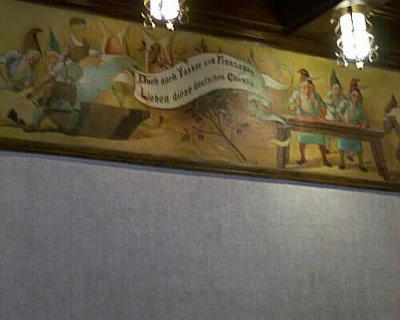
The business remains a family business, with Frederick III's son Fritz becoming Wurstmacher-in-chief in 1988. Fritz's father was also known as "Fritz" and the chief elf in the murals is Fritzie, which, if memory serves, is also the name of a Usinger breakfast sausage.
We send our condolences to the family and best wishes to the continued prosperity of the business.
The 10 pm news has focused on this story to the exclusion of all else. The Federal Bureau of Investigation has been interested in the suspect for the past month or two. (This plot has in common with the June Sears Tower plot that the ringleader -- here an individual actor -- was so eager to acquire materiel for his effort that he didn't bother vetting a supplier.) Cherry Valley law enforcement were, per FBI procedures, not alerted until the suspect was in custody. Rockford area Moslems are distancing themselves from the suspect, who, all and sundry emphasize, acted alone. (Editorial note: the WIFR-TV stories linked above all have embedded links to video, should readers wish to go multimedia.)Derrick Shareef, 22, of Rockford was arrested Wednesday when he met with an undercover agent in a parking lot to trade a set of stereo speakers for four hand grenades and a handgun. According to an FBI affidavit, he was planning on planting the grenades in garbage cans in the CherryVale Mall with an accomplice who was really an FBI informant.
A handcuffed Shareef appeared before U.S. Magistrate Judge Maria Valdez, who ordered him held without bond and set a Dec. 20 hearing on a motion for bail, made by defense attorney Michael Mann.
According to the affidavit, the DeKalb County courthouse was among several government targets Shareef considered attacking.
“I don't talk calm when it comes to this,” the affidavit quotes him telling the informant. “'Cause man, the courthouse in DeKalb where I be going every month ... You go in there and you clock the first three (guards) at the door that they got, and you up in there, you know what I'm saying?”
A person acting alone, on a private grievance rather than a transformative vision, is also capable of creating a great deal of havoc. This evening, commuter train service out of the Ogilvie Transportation Center was badly disrupted after an individual took hostages and killed some people in a law office upstairs. The entire building was cleared on police orders just before the start of the rush hour. Evening train service resumed at 5.19. In lieu of regular service, available rakes were positioned, loaded, and sent out when filled to make all stops on their assigned routes. The Chicago newspapers and broadcasters have ongoing coverage, with more information and analysis likely to be available Saturday.
7.12.06

Western Illinois is another team that has owned a long winning streak against Northern Illinois. Over and done with.
Next up for the team and their classmates: final exams. That January 6 date for the next home game is correct.
Gurnee, Ill. - 5-6 p.m. – North side of Grand Avenue underpass, east side of Depot Road across from Viking Middle School park, 4460 Old Grand Ave. Benefits Northern Illinois Food Bank.The train will also call at Sturtevant and Pewaukee that Saturday before heading to the Twin Cities on former Milwaukee lines on Sunday, Monday, and Tuesday, and thence to Saskatchewan on former Soo lines.
There are, however, what he characterizes as "paradoxes."Is our generation less competent?
Not really. The United States routed the Taliban from Afghanistan by early December 2001. America’s first clear-cut victory against the Japanese, at Midway, came six months after Pearl Harbor.
Do we lack the unity of the past?
Perhaps. But we should at least remember that after Pearl Harbor, a national furor immediately arose over the intelligence failure that had allowed an enormous Japanese fleet to approach the Hawaiian Islands undetected. Extremists went further — clamoring that the Roosevelt administration had deliberately lowered our guard as part of a conspiracy to pave the way for America’s entrance into the war.
Are we in over our heads fighting in both Afghanistan and Iraq?
Hardly. Within days after Pearl Harbor, the U.S. found itself in a three-front war against Germany, Italy and Japan — an Axis that had won a series of recent battles against the British, Chinese and Russians.
If memory serves, some of the early advocates of swift action against the Taliban and other rogue regimes, including Iraq, were also on record as recommending that President Bush do something to get citizens to make either symbolic or real sacrifices for the duration. Yes, each day that we go about our peacetime business without a terrorist attack is a small victory. By the same token, each day that we go about our peacetime business without being mugged is a small victory: that, however, is successful policing, something distinct from succesful war-waging.A stronger, far more affluent United States believes it can use less of its power against the terrorists than a much poorer America did against the formidable Japanese and Germans.
World War II, which saw more than 400,000 Americans killed, was not nearly as controversial or frustrating as one that has so far taken less than one-hundredth of that terrible toll.
And after Pearl Harbor, Americans believed they had no margin of error in an elemental war for survival. Today, we are apparently convinced that we can lose ground, whether in Afghanistan or Iraq, and still not lose either the war or our civilization.
Of course, by 1945, Americans no longer feared another Pearl Harbor. Yet, we, in a far stronger and larger United States, are still not sure we won’t see another Sept. 11.
It was also not long after 1945 that Americans feared something far worse than another Pearl Harbor. Those "duck and cover" drills didn't exist simply to keep civil defense inspectors employed. Do any readers remember having the afternoon showing of the Mickey Mouse Club interrupted for live coverage of Adlai Stevenson quizzing Anastas Mikoyan (or was it Andrei Gromyko?) in the well of the General Assembly? "We interrupt this program" was a big deal in those days.
"Tabernacle!" shouted one example. "Small cupboard locked by key in the middle of the altar containing the ciborium."
Another explained that ciborium is a container that holds the hosts for communion. (Host and ciborium are serious swear words in Quebec's French language, too.)
While some of the words were used in a blasphemous fashion all the way back to the 1800s, they became especially common as francophones turned their backs on the Roman Catholic church over the past 40 years.
"There are a lot of people in our society who don't even know what these words mean anymore," said Rev. Jean Boyer, a Montreal priest who was visiting Notre-Dame Basilica on Sunday.
"We're hoping once the shock passes, people will think more about the true meaning of the words. There are many young people who don't even know that in old times this was blasphemy."
It's a uniquely Quebec problem for the church, says Monique Carmel, a linguist and professional translator.
"These words were used as blasphemy and a form of rebellion when the church held a great amount of power in Quebec society," Carmel said in an interview Sunday. "France has been a secular society since Napoleon, so you don't see this there."
Quite.College football is so out of sorts that Michigan and USC were hoping not to go to the Rose Bowl this year.
Pasadena, we have a problem. When the Rose Bowl is the booby prize for a Big Ten and Pac-10 school, college football is in more trouble than we first thought.
Rip Track takes a time out from supplying the infrastructure to predict that the Special Ed Conference will encounter a few washouts early in 2007.
6.12.06
Headquarters continues to skim revenues from Liberal Arts to support pet projects elsewhere, and dollars still fail to follow enrollments.There's been about a seven percent increase in journalism majors since 2001, and while the number of students in the department is growing, the number of faculty members is not.
Dale Zacher and his wife, Yu-Li Chang-Zacher, two of the journalism department's five tenure-track professors, will leave the university after this semester.
Chang said she and her husband have chosen to go elsewhere.
Zacher said his new position is a better opportunity, and the reason he's leaving is not related to work conditions. He does, however, say his class sizes at NIU are too big.
He said there are 22 people in his Basic Newswriting class. The classes will have a maximum class size of 15 at Zacher's new job, a number that caught his attention, Zacher said.
Associate Professor Brian Thornton teaches upper level journalism courses and said even in his Journalism Law and Regulation class, he has about 50 students. Only three tenure-track professors will remain to teach more than 280 journalism majors.
The Association for Education in Journalism and Mass Communication recommends 18 to 20 as a maximum class size for accredited journalism classes.
Zacher said the support staff in communications will take over the classes.
Chang and Zacher's contracts were up for renewal at the end of the academic year. Thornton said the department would have liked more of a "heads up" before they decided to leave.
The department is in the process of finding instructors to take over their classes, and none of the classes will be cancelled, Thornton said.
"We need more people, we need more money and we need more classes," Thornton said.
In the spring of 2006, the journalism department was in the process of searching for a full or associate professor. After that search, the department hired Assistant Professor Bill Cassidy. The department is now in the process of finding another professor in addition to replacements for Chang and Zacher, Thornton said.
As we first suspected, the six imams bounced from a US Airways flight misled the public about the incident and likely staged the whole thing as a scheme to weaken security.In Opinion Journal, Debra Burlingame reminds passengers that common carriers can still have rules.
Once your foot traverses the entranceway of a commercial airliner, you are no longer in a democracy in which everyone gets a vote and minority rights are affirmatively protected in furtherance of fuzzy, ever-shifting social policy. Ultimately, the responsibility for your personal safety and security rests on the shoulders of one person, the pilot in command. His primary job is to safely transport you and your belongings from one place to another. Period.She also notes that, after 9/11, passengers have revised their prior beliefs about their fellow passengers.
Until the hijackers stormed the cockpit door, they were just a handful of Middle Eastern-looking men on their way to sunny California. So, yes, let's be exceedingly clear about the whole matter. Some 3,000 men, women and children are dead because the unassuming people on those airplanes did not look at them and see murderers.And I think we call this chutzpah:
Today, [Muslim American Society] Executive Director Mahdi Bray says his organization wants more than an apology. He wants to "hit [US Airways] where it hurts, the pocketbook," and, joined by the Council on American-Islamic Relations (CAIR), will seek compensation for the imams, civil and federal monetary sanctions, and new, sweeping legislation that will extract even bigger penalties for airlines that engage in "racial and religious profiling." An investigation by the Department of Homeland Security's Office of Civil Rights and Civil Liberties is under way. Not incidentally, it is the "fatwa department" of MAS that pushed for segregated taxi lines that would permit Muslim cab drivers at the Minneapolis airport to reject passengers carrying alcohol.
I'll classify the suspension as a potential flaw in professional football's substance abuse policy.The Saints suffered a big blow to their defense Tuesday when they found out defensive tackle Hollis Thomas, who is having a career year, is being suspended for four games because he violated the league's steroid policy due to asthma medication he takes.
Thomas has been challenging the positive steroid test and had the support of the Saints. Thomas is a 335-pound defensive tackle who has struggled to keep his weight down and doesn't have the body that normally would be linked to steroids.
During his August drug test, the 11-year veteran out of Northern Illinois was taking an asthma product called Advair twice a day while also using an inhaler four times a day.
If New Orleans makes the playoffs, Thomas would be eligible to play. He can be added to the active roster on Jan. 1, 2007, the day after the regular season ends.
Closer to home, the university remains closemouthed about Tuesday's dust-up in the technology department.
There are snow days when we're isolated from the rest of the world, but we manage.There were no serious injuries in the six to eight accidents that had occurred by about 8:30 a.m. today on Route 38 west of Kishwaukee College and on Route 64 between about Glidden and McQueen roads, Chief Deputy Kevin Hickey said.
Sections of Route 64 were closed between about 7 a.m. and 8 a.m. due to four or five accidents, he said. Two or three accidents were reported on Route 38 as well. Closing the roads gave emergency personnel room to work.
“It's definitely a strategy for officer safety,” he said.
5.12.06
Virginia Postrel concurs in part and dissents in part.But the real problem with our politics today is that the prevailing ideological categories are intellectually exhausted. Conservatism has risen to power only to become squalid and corrupt, a Nixonian mélange of pandering to populist prejudices and distributing patronage to well-off cronies and Red Team constituencies. Liberalism, meanwhile, has never recovered from its fall from grace in the mid-'60s. Ever since, it has lacked the vitality to do more than check conservative excesses--and obstruct legitimate, conservative-led progress. As a governing philosophy, liberalism has been moribund: When Jimmy Carter and Bill Clinton managed to win the White House, they did so only by successfully avoiding the liberal stigma.
Today's ideological turmoil, however, has created an opening for ideological renewal--specifically, liberalism's renewal as a vital governing philosophy. A refashioned liberalism that incorporated key libertarian concerns and insights could make possible a truly progressive politics once again--not progressive in the sense of hewing to a particular set of preexisting left-wing commitments, but rather in the sense of attuning itself to the objective dynamics of U.S. social development. In other words, a politics that joins together under one banner the causes of both cultural and economic progress.
Conservative fusionism, the defining ideology of the American right for a half-century, was premised on the idea that libertarian policies and traditional values are complementary goods. That idea still retains at least an intermittent plausibility--for example, in the case for school choice as providing a refuge for socially conservative families. But an honest survey of the past half-century shows a much better match between libertarian means and progressive ends. Most obviously, many of the great libertarian breakthroughs of the era--the fall of Jim Crow, the end of censorship, the legalization of abortion, the liberalization of divorce laws, the increased protection of the rights of the accused, the reopening of immigration--were championed by the political left.
Furthermore, it has become increasingly clear that capitalism's relentless dynamism and wealth-creation--the institutional safeguarding of which lies at the heart of libertarian concerns--have been pushing U.S. society in a decidedly progressive direction. The civil rights movement was made possible by the mechanization of agriculture, which pushed blacks off the farm and out of the South with immense consequences. Likewise, feminism was encouraged by the mechanization of housework. Greater sexual openness, as well as heightened interest in the natural environment, are among the luxury goods that mass affluence has purchased. So, too, are secularization and the general decline in reverence for authority, as rising education levels (prompted by the economy's growing demand for knowledge workers) have promoted increasing independence of mind.
Yet progressives remain stubbornly resistant to embracing capitalism, their great natural ally. In particular, they are unable to make their peace with the more competitive, more entrepreneurial, more globalized U.S. economy that emerged out of the stagflationary mess of the 1970s. Knee-jerk antipathy to markets and the creative destruction they bring continues to be widespread, and bitter denunciations of the unfairness of the system, mixed with nostalgia for the good old days of the Big Government/Big Labor/Big Business triumvirate, too often substitute for clear thinking about realistic policy options.
Hence today's reactionary politics. Here, in the first decade of the twenty-first century, the rival ideologies of left and right are both pining for the '50s. The only difference is that liberals want to work there, while conservatives want to go home there.
But the alliance Brink proposes requires three difficult shifts:Dan Drezner observes,1) A commitment on both sides to a safety net for the poor but not to pursuing economic equality for its own sake. This is the easiest part and has largely happened already, despite protests from both hard-core levellers and anti-transfer libertarians. But many of the loudest Democrats and libertarians (small-l, the relevant ones) won't go along.If it's going to happen, such an alliance can only start among honest intellectuals who are not interested in scoring partisan points.
2) An abandonment of Herbert Croly-style technocracy as the governing philosophy of the Democratic Party, not only in economics but in social policy, where "centrists" like Hillary Clinton tend to confuse governing with raising children. Technocracy long ago lost its ideological oomph, but Democrats have a knee-jerk commitment to regulation. Today's good government liberals generally pay homage to tolerance, pluralism, and market processes. The trick is to draw connections between those values and specific policies.
3) A deliberate resolve to form a dynamist alliance at a time when "progressives" are increasingly redefining themselves as stasist populists--trade protection has become an ideological position, for instance, rather than a favor for special interests--and many self-styled "small government" supporters argue vociferously for vast expansions of police and planning powers to limit immigration. In this regard, I am more encouraged by the defenses of trade coming out of places like TNR and Slate than I am by the fawning on Jim Webb coming out of Reason. (The guy even wants to bring back the draft, which used to be a deal breaker for libertarians.).
Again, however, Lindsey does omit the successes in microeconomic policy -- deregulation, welfare reform, declines in marginal tax rates, shifts in antitrust policy, the 1986 tax reform -- that conservative fusionism produced in the past few decades.He has additional commentary and links to further reaction.
I've had some opportunities to do a bit more reading, and Mr Lindsey's essay and these reactions will help me put a few more book reviews together. I've been a bit busy with end-of-semester projects but hope to get a few think pieces up over the weekend.
Now for a few more data points. I've discovered that the longest current losing streak in major college football belongs to Duke University.
That streak comes not long after another losing streak.Here are some humiliating tidbits that I've read various places or came up with that barely begin to describe the ineptitude of our program.
-At 0-12, Duke is one of only two winless D-1A football teams, the other being Florida International.
-Duke sports the longest losing streak of any D-1A football team, at 20 games.
-Duke has not beaten a D-1A football team in over two years (their win last year was against a D-1AA program, and this year they managed to lose to a D-1AA program).
-Over the last three years, Duke has managed a whopping 3 wins, and over the course of my four years at Duke, the squad has put up a grand total of 7 wins.
Duke ran its losing streak to 23 games by the end of the 2001 season, and many prognosticators thought the Blue Devils had a good shot at breaking Northwestern's record of 34 straight losses by the end of this season. Blue Devils coach Carl Franks explained what, exactly, the problem was: "Winning football games has certainly been harder than I anticipated." On a positive note, Duke proved the prognosticators wrong by winning their 2002 season opener against East Carolina, 23-16.I don't know that those losing streaks are hurting Duke's yield management. (That they have two pretty good basketball teams might offset their 0-for-the 21st century elevens; do their football spectators yell "hurry up, November" in the manner of 1970s Badger fans?)
The off-field problems of the lacrosse team might have some effect on their yield, but the hysterical reaction of some faculty members to the seriousness of the charges, notwithstanding the weakness of the evidence, ought to matter more than the strength of basketball or the weakness of football.
The survey of intercollegiate losing streaks identifies a few other universities that seemed to manage despite a rickety front porch.
The [Northwestern] Wildcats were in the midst of a 34-game losing streak (the longest in Division I-A history) during the 1981 season, when they lost all of their games, getting outscored 505-82 -- an average of 40 points a game. Northwestern fans celebrated a 61-14 home loss to Michigan State by tearing down the goalposts and marching through Evanston shouting, "We're the worst!" After the Wildcats ended their losing streak, defeating Northern Illinois 31-6 on Sept. 25, 1982, coach Dennis Green said, "When I woke up this morning, I knew it was a special day."That's either the year of the California Bowl for Northern Illinois, or the year before. Kellogg students used to razz their winning guests: That's alright, that's OK, You're going to work for us some day!
Columbia lost 44 games in a row during these years, the second-longest in major college football history. Things got so bad that the band played the "Mickey Mouse Club" theme when the team took the field. During one 1985 game against Harvard, Columbia actually looked like it might win -- it was leading 17-0 with five minutes left in the third quarter. But the Crimson came back, and scored 49 unanswered points in the time remaining. When the Lions lost their 35th straight, to set a Division 1-AA record, their coach, Larry McElreavy, told The New York Times, "I'm realistic; there's not a lot of talent here."Isn't "Ivy League football" an oxymoron? On the other hand, those HO-scale front porches on G-scale dwellings don't seem to scare applicants away. And again, Columbia's acquiescence in verbal terrorism by heirs to the 1968 rebellion ought bother applicants more than any history of ineptitude on fall Saturday afternoons. (Be grateful, Ivies, nobody's offering your athletic program pittances to play on Sunday evening or Wednesday night in November or the Friday morning immediately after Thanksgiving.)
Imagine the following: You go to Target with your prescription and they charge you $4 for the drug plus a $5 tax to be paid to the pharmacist in North Soytown. Would you scream injustice? Now suppose you go to Target with your prescription and they charge you $9, going all to them. Who do you scream at now? The only reason they never do the first is because you would complain -- if you wouldn't, they would gladly have the money go to the local pharmacist rather than Arkansas-based WalMart."Protecting competitors is not equivalent to protecting competition." True, false, or debatable? Credit for your explanation.
I heard this news last night on the television station from which University Diaries obtained the online story. The virtual side of the television station has a further story. The Northern Star has not yet published the story, and university officials have not yet released the name of the second professor, who was stitched up at Kishwaukee Hospital and released.An apparent argument between two Northern Illinois University professors ended with one allegedly hitting the other on the head with an aluminum rod.
Radha Balamuralikrishna, 44, of Aurora was charged with aggravated battery Monday morning. According to University Police Lt. Matthew Kiederlen, Balamuralikrishna and another professor had a disagreement over something just before 11 a.m.
“You had two colleagues that apparently got into an argument or heated discussion about something,” Kiederlen said. “One got upset to the point that he grabbed a small aluminum rod and hit the other on the head.”
Students witnessed the incident, he said. Police did not know what the rod's usual intended use would be.
Both men work in the same department, Kiederlen said. Balamuralikrishna is an associate professor of technology. Kiederlen did not release the name of the second professor involved in the incident.
Developing ...
4.12.06
St. Louis and environs got clobbered by the ice storm. Here in Flatland there's great powder, but no topography to speak of, and the heaviest snow bands missed Chestnut and some of the Wisconsin River ski runs.I'm fine, except for being a little bit cold (I've been camping out in my office, which has heat but isn't all that comfortable). I just booked a hotel room for tonight in case my power isn't back - the power company's estimates for when power will be back are pretty much useless, although they said Friday that some customers might not have power for 5 days (i.e. until Wednesday).
At worst, about 1/2 million Ameren customers were without power; as of now, that's down to just under 400,000. In my zip code, the number of outages actually went up since Friday before finally coming down a little in the past couple of hours. What's most irritating is that there is power within 2 blocks of my apartment (there's a large shopping mall within 1/4 mile that briefly lost some of its power on Saturday, but the power company had them fixed very quickly), but for some reason they seemed to have skipped over my neighborhood.
(Where did I see that post about the power companies restoring power to the businesses and the richest as well as the poorest neighborhoods first because those are the customers most likely to raise hell?)
In other words, to have an intuitive grasp of economics, you might just need to take a step or two up the evolutionary ladder.The context properly takes some of the sting out of that sentence. Read and understand the article, and review the comments at Economist's View, where I found the link to the article.

(Via Newmark's Door.)
At one time, the main road from Chicago to Omaha looked like that also. But early in the automobile age, something called the Lincoln Highway Association imagined a paved road from coast to coast. No more mud season, forsooth! But rather than build the road itself, the Association prevailed on localities to build seedling miles, preferably in sections where the contrast with the mud road would be most dramatic. The objective was to convince residents to write their Congressmen and get the national government to pay for the roads.
The first such mile was built just west of Malta, Illinois.

Four more “seedling miles” were constructed in 1915. These “prototypes” immediately became popular motorist destinations. The stark contrast between these smooth patches of pavement and the bumpy or muddy roads leading up to them created a groundswell of public opinion in favor of “Good Roads.”During snow season, the Malta section (now rebuilt) is probably easier to use than any section of the Moscow-Yakutsk road.

Although the national government did pay for most of the road construction, private initiatives provided some of the incidentals.
By the end of 1927, the association had become inactive. As a last hurrah, Gael Hoag, its last paid representative, arranged to have thousands of Boy Scouts fan out to install concrete markers with a bust of Lincoln along the highway on Sept. 1, 1928.
A few of those concrete markers remain. A reconstituted Lincoln Highway Association works to conserve relics of that original highway.
Do I have any Russian readers? Could former Young Pioneers organize Russian youth for a similar mile-marker planting project and some seedling miles?

These will run to the eastern fringes of the Green Mountains.
The train has a renovated “ski coach” lined with two-foot high cylinders to hold up to 34 sets of skis and racks to hold up to 12 snow boards.What's next, specials to the Rockingham Races?
An outbound train will leave Boston’s North Station at 8:35 a.m. on Saturdays and Sundays and make stops at Ayer at 7:09 a.m., Littleton at 7:17 a.m., South Acton at 7:25 a.m., West Concord at 7:30 a.m., Concord at 7:34 a.m. and arrive in Fitchburg at 10:06 a.m.
Service returning to towns will leave Fitchburg at 5:35 p.m.
The cost from Boston is $6, but Wachusett Mountain will reimburse the train fare for skiers. McKeehan has also lined up packages with nearby hotels allowing visitors get a deal on a weekend visit.
Jeff Crowley, president of Wachusett Mountain, said the MBTA put the line together only four months after his company pitched the idea.
3.12.06
On the rare occasion these teams meet, the nation secretly prays for a terrorist dirty-bomb attack to wipe out both insufferably smug and self-important programs.
We Americans haven't needed our neighbors for anything important, and hence neighborliness—local solidarity—has disappeared. Our problem now is that there is no way forward, at least if we're serious about preventing the worst ecological nightmares, that doesn't involve working together politically to make changes deep enough and rapid enough to matter. A carbon tax would be a very good place to start.Something about that strikes me as a bit forced. I suspect there's as much anomie in paying your taxes as there is in sitting in front of your television.

There's even a post about Erie Islands water snakes noshing on gobies.
It continues,Florida, which defeated Arkansas 38-28 on Saturday night to win the Southeastern Conference title, jumped two spots from No. 4 and passed idle Michigan. The Wolverines haven't played since losing 42-39 to the Buckeyes in Columbus, Ohio, on Nov. 18.
Southern California's 13-9 loss to UCLA caused the shake-up at the top of the rankings. The Trojans became the sixth team ranked No. 2 to lose this season, joining Texas, Notre Dame, Auburn, Florida and Michigan. USC fell six spot to No. 8.No. 4 LSU was followed by Big East champ Louisville, Wisconsin and Big 12 champion Oklahoma.
After USC, Boise State was No. 9 and Auburn was 10th, giving the SEC three top-10 teams.Those of us who attended real colleges can work out where half of the top six came from ...
“When you hear, ‘The economics department at U. of C.,’ one’s free association is ‘pro-business, greedy bastards,’” says Sanderson (pause, jaw thrust) in the first lecture. “I tend to think that’s not the case. Greedy bastards we may be, but we’re not pro-business. Republicans tend to be very pro-business. It’s a genetic defect of Republicans. Democrats tend to be anti-business, another genetic defect. We are not anti-business; we are not pro-business. We are pro-choice in the ultimate sense of pro-market."There are bull sessions in progress at Greg Mankiw's site and at In These Times (scroll down, then follow the link to the extended discussion) that make for good reading.
I like Professor Sanderson's use of oversubscribed courses as a way of getting students thinking about allocating scarce resources.
Put simply: efficiency is a goal, but not the only goal. It gets more challenging once one gets down to policy.Noting that there are only 26 spots left in the class for the 52 students who would still like to enroll, he asks, "How should we figure out who gets to go into the class?" The students--eager, studious and serious--shoot their hands up and offer a variety of ideas: Seniority? First-come, first-serve? Ask prospective students to write an essay? It takes about a minute for a confident young man to give the answer Sanderson's looking for: "auction by price."
"As a reasonable indication of how much you want something, how much you're willing to pay is a pretty good means of measuring," Sanderson says. "A lot of things in economics will turn in one way or another on price. Price has a lot going for it as a generalized expression of commitment. The thing we don't like about, say, first-come, first-serve, is that if someone really wants to get in, they could start lining up now. But the problem is that I don't really benefit from your expression of interest, whereas if you pay me, we both are benefiting."
This makes sense, but I'm uneasy. Wouldn't giving a place in class to the highest bidder result in the rich students getting in and the financial-aid kids being left out? And since people don't have equal amounts of money to spend, how good a measure of desire is price in this situation?
"Random and first-come have the benefit of being fair," Sanderson says, anticipating the objection. "There's an interesting dichotomy of fair vs. efficient." But, Sanderson asks, what, really, is fair? If we think some kind of random lottery drawing was a fair way of getting into the class, would that be a fair way of awarding grades? "Obviously not!," I think. Why? Sanderson lets us mull that over, but the answer floats up immediately: because I work hard for my grades and I deserve them. In other words, those who work hard and get good grades are like those who work hard and have a lot of money to win spots that are auctioned by price.
"We're trying to balance these things out," Sanderson continues. "What's efficient? What's fair? Often they are in tension."

The new cover looks right, and we're once again reading THE Magazine of Railroading.
In one of the redesigns (why does Corporate America insist on such things?) not shown in the picture, the slogan became "The Leading Magazine of Railroading" or some such nuanced thing. I had the opportunity to tease then-Editor Rob McGonigal, a well-known Pennsy fan, about R7 The Standard Railroad Of The World + deciding to become "The Northeast's Pretty Good Railroad." Sometimes one has to persevere.
Inside the latest issue: Illinois is the Greatest Railroad State, and you'll see a few pictures from the neighborhood.
2.12.06
The team, however, had departed DeKalb Thursday night and rallied to defeat Cincinnati before what I understand was a small audience. Northwestern defeated Princeton.
I had some business elsewhere in the northern suburbs and headed over to the tournament afterwards. A few Princetonians came for a weekend in the City of the Big Shoulders ruined by two losses in the tournament. But I did see all sorts of interesting orange ties and other collegiate idiosyncracies uncommon in the land grants and mid-majors.
Northwestern has some theater style seating and I had my choice of seats. Section 105, Row F, seat 7 sounds like a good choice. (Work it out.)
In the title game, Northern Illinois were not exactly gracious guests.

I know that traditions ought not be overturned lightly, but the St. Anthony Chorale as alma mater (to lost causes, more lost causes, more lost causes, q.e.d?)

That makes Northern Illinois 1-1 against the Big East and 2-0 against the Big 11 Ten.

Good going, kids.


Perhaps more important, I've discovered sources of a Chicago edition of The Onion to complement the Milwaukee and Madison editions I'd long known about north of the Cheddar Curtain.

along with a link to a full explanation. I'm going to have to watch for this phenomenon: sunsets are supposed to occur later from December 7 on, with sunrises occurring earlier until January 4.
Since economics teaches you a way of thinking, it's broadly useful--take some, you won't regret it.Ayup.
Pending the court cases, both players are suspended.DeKalb Police Lt. Jim Kayes said William Ikegwuonu, a junior business administration major and NIU football player; and his brother, Jack Ikegwuonu, a student and football player for the University of Wisconsin-Madison; were arrested after a victim found both brothers in his apartment in the 800 block of Fotis Drive at about 2:00 a.m. [November 25].
Kayes said one of the suspects was holding the victim's Xbox but dropped it as the victim entered his apartment. Both suspects fled and the victim gave chase, Kayes said.
According to a DeKalb Police report, one of the suspects entered an apartment building right down the street from the site of the burglary, while the other continued to run away. The victim called police, who apprehended Jack Ikegwuonu, Kayes said.
Kayes said the victim identified Jack Ikegwuonu as one of the suspects. William Ikegwuonu later came to the DeKalb Police Department, where police arrested him and his brother for residential burglary and criminal trespass to a residence.
Wisconsin's procedure is similar.Kayes said the DeKalb Police Department has a good relationship with NIU football head coach Joe Novak.
Novak said he has spoken with Ikegwuonu, and notified him that he has been suspended indefinitely from the team.
"We have a rule that as soon as you are arrested, you're suspended," Novak said. "Now we'll let it take its course and go from there."
The University of Wisconsin football team will open bowl practices today without sophomore cornerback Jack Ikegwuonu, who was suspended from the team Friday for violating the Athletic Department's student-athlete discipline policy.Lovely. Add the probation officers to the comp list.

My recollections were accurate.
The city of DeKalb declared a snow emergency [Friday] morning, meaning city officials are urging residents to stay home and are only plowing arterial roads in an effort to keep up with the snow. The city announced garbage pickup for Friday would be delayed until Saturday.Bad as this was, it was mostly snow. Downstate, and Missouri, are getting the worst of it. The Alton Route is currently running only one train a day instead of four, and Interstates 55 and 80 are not in good winter driving condition.
DeKalb County Engineer Bill Lorence had one word for how efforts to clear the roads were going this morning: “badly.”
The county had all 11 of its plows out this morning, but as of about 7:30 a.m. one was involved in an accident on Peace Road north of Sycamore and another was stuck on Malta Road.
Even people who are used to driving in the snow “haven't seen this kind of snowstorm in many years,” Lorence said.
Nearly 600 Amtrak passengers in Illinois and Missouri were delayed up to 10 hours Friday and Saturday morning, Amtrak spokesman Marc Magliari said. With many tracks still strewn with downed trees and power lines, passengers were eventually taken by bus to their final destinations.This evening, I am getting "cannot find server" alerts for Missouri-based Signifying Nothing and Sports Economist. Report in when your services work, guys.
Trees were blown onto homes and cars, and a big Christmas tree in front of the New Hampshire Statehouse was toppled.
Truck driver David Huwe just got his 18-wheeler and load of frozen food back on the road Saturday after being stuck for more than 12 hours at a rest stop near Princeton, Ill., on Interstate 80, which was blocked by scores of trucks and cars that slid off the icy highway.
By Saturday morning, the city had cleared my street and I had the sidewalks and driveway cleared.

The moon is near full and that Night Before Christmas stuff about "luster of midday" is about right.
1.12.06
An awful lot of taxpayer money is potentially going to be spent on a rail line that may not even be needed.Passenger Rail, on the other hand, is not happy with Amtrak using peak load pricing.
What the post illustrates is precisely the importance of understanding economics.But should Amtrak (or whatever form national Passenger Rail takes in the future)build enough new equipment to meet peak demands?
We say yes! Why? Because holidays and vacations are the make and break for any travel-related business in the US. Any business will get more repeat business and off-peak business if it can handle the peaks with style and class.
Stop playing games with numbers on tickets that should be flat rated. Get some balls and start serving the train-riding public like a real railroad! You may be surprised on how much new money you can make.Those flat-rate tickets did so well for the real railroads that they paid (yes, paid, check your history) the government to take the passenger service off their hands. (Reading, Southern, and Rio Grande figured they'd lose less money by not joining up.)
The way to make money is to price over peak and off peak in such a way that revenues match incremental costs. Oliver Williamson solved the problem in 1966 (JSTOR). Telephone companies began using the method in the late 1970s, and deregulated airlines applied it extensively.
In some ways the job doesn't sound too much different from keeping a tavern in a college town.[Kristin] Stanford is known to the locals in Ohio’s Put-in-Bay Harbor as “the Island Snake Lady.” Although working toward her Ph.D. in biology at NIU, she spends most of her time at Put-in-Bay, where she serves as recovery plan coordinator for the endangered Lake Erie Water Snake.
The region encompassing the islands and mainland of Lake Erie between the Ohio and Ontario borders is a paradise for boaters and fishermen. It’s also the only place worldwide where the snakes can be found. Out of necessity, Stanford, a native of Mt. Prospect, has become an expert at catching the creatures, which might be likened to the punk rockers of the Great Lakes’ reptilian world.
“These water snakes are probably the smelliest, dirtiest snakes out there,” Stanford says. “When you pick them up, their defensive response is to thrash around and spray you with feces and musk. On the other end, they bite and bite and bite. It’s not exactly a friendly snake.”
“I don’t mind getting bit. It’s kind of gross when they poop all over you. But the barfing is definitely the worst part,” Stanford says. “It’s really smelly.”The research also discovers that predator-prey cycles can emerge in response to invasive species.
What happens if that fish virus also gets into the snakes?Stanford’s job would accurately be described as half scientist, half outreach coordinator. In addition to monitoring the population of the snakes, she works to improve their nasty image. And she’s getting help from an unlikely suspect—an invasive, bottom-dwelling fish known as the goby. The exotic species threatens the habitat of native fish, including walleye and smallmouth bass, which are prized by locals and tourists alike.
As it turns out, the water snakes have a voracious appetite for the pesky goby—a fact the scientists learned from studying the snakes’ diet.
The show runs this evening, looks like 6 pm Central.
It's official:
- Due to the winter weather, NIU is closed today. Classes are canceled.
Herewith the weather report.
We were just slightly shy of a blizzard warning, according to the National Weather Service, but no matter...for all intents and purposes, we are there. As of 9:45 AM, we have 12" down in DeKalb, and maybe one more to go, before we calm down by around 10:30 AM. Will keep this short and sweet, but here's how things will play out:At nine this morning, here's the view from the kitchen window.
Now through noon: snow tapers off and ends. Northwest winds at 25-35 MPH may touch 40 MPH at times.
Noon-6 PM...northwest winds at 25-35 MPH with occasional higher gusts will continue with near blizzard conditions in rural and open areas, and very difficult travel everywhere else. Wind chills in the lower teens.
6 PM Friday-5 AM Saturday: northwest winds gusting above 25 MPH tonight will still cause blowing and drifting snow. Wind chills will drop to nearly -10 by 5 AM.
Saturday...with northwest winds at 10-20 MPH and probably diminishing to 10-15 MPH, you'll finally be able to more or less get around OK. Just be careful on lesser traveled roads. Temperatures reaching the middle 20s, but wind chills in the teens.

That squirrel must have considered his trip necessary. I'm hearing plows and other heavy machinery nearby; perhaps all will be dug out by dark.
One politically popular idea is to try to send more young adults to college. This may seem appealing, but in reality we already have too many students in college who lack sufficient basic skills.He goes on to suggest that financial aid be further unbundled from the institutions of higher learning, and that the ability of incumbent institutions to control accreditation be tamed.
In November, after grading a batch of papers, I posted the following notice to the web site for an economics course that I teach at George Mason University:Many students did poorly with writing quality. If it were up to me, a lot of you would be taking remedial English classes. I would advise everyone to think twice about using the word "on." For example, it is wrong to say, "The book discusses on economic growth" when the proper sentence is "The book discusses economic growth."My recollection from my career in government and business is that written communication skills still matter. Out of over 100 students in my class at George Mason, no more than a handful could function in any capacity in a job that required writing a memorandum. Over half of the students are utterly incompetent when it comes to grammar and syntax. They have no ability to communicate complex ideas. Yet I do not fail these students. I feel that I must reserve my F's for the students who do not turn in papers at all.
Another entry barrier is the accreditation process, which is controlled by the incumbents. Imagine what would happen in another industry, such as supermarkets or landscaping services, if in order to start a new business in that industry you had to become accredited by a board consisting mostly of incumbents in that industry. Nobody likes competition, and it is easy to think of excuses not to accredit a newcomer, especially an innovative upstart. If we had such an accreditation system in place in other industries, competition would be stifled, and the incumbents would be under no pressure to improve service or reduce costs. Creating a consumer-oriented accreditation board would help to lower this important entry barrier.The problem, however, is that the history of the accrediting agencies becomes exactly the problem of the independent regulatory commissions or the intrafraternity council: citizens have little incentive to cultivate the regulators while existing certified providers do. Here's a preview of the upcoming regulated industries class: The existing service is adequate. The existing providers are able to provide additional service should it be required. The applicant is not competent to provide service.
RUNNING EXTRA: King Banaian posts a lament over the "capstone" paper (a pale shadow of the old senior thesis?)
Tell me about it. We have a similar capstone paper requirement in the economics department. (I think some "assessor" asked for it as a way of obtaining some evidence on a consistent basis from year to year to be placed on a list that was later misplaced, um, no, that's Dr. Zhivago's girlfriend, isn't it?) I've been tempted to claim a section of English 104, the freshman composition course, on my annual service report to reflect the work I've often done on basic copy editing and paragraph structure. (The writing coordinator once circulated my advice on papers throughout the university, including my wisecrack about Snoopy on his doghouse.)Our university adopted years ago an upper division writing requirement for all students, which went into effect last year. For most students this comes in a senior 'capstone' course. So students write in other classes, but are expected somehow to learn to write by the time they are seniors enough to complete a "writing intensive course" (the university's words, and please don't ask me to explain what they mean.)
Since this seems to be my day for goofy ideas, let me put forward another one: How about a qualifying exam for students at the end of their sophomore years to test grammar and syntax? Students unable to pass the test may register for their junior year but must take a no-credit remedial course in writing and retake the test the next semester. Those who do not pass are dropped from the university.
Many students take six years or more to complete their degrees. Many of them took their required English course in their first year. Just as students who fall out of practice with their algebra or calculus or statistics might lose some sharpness of their quantitative skills, so too might students who don't write much lose their ability to understand grammar and syntax. Expecting it to be revived in a class in their last semester, at the same time that they are writing (horrific) cover letters to potential employers saying they are graduating from our school. These leave a bad impression of both the student and the school when written poorly. If we want to make the writing requirement more than just a hoop to jump through, we should invest more in the effort.
Repeat with me: Amateur athletics. Nothing to do with money. Nothing to do with money.So, suppose you were the University of Nevada playing Boise St. last Saturday...
Your 8-3 record has already locked up a bowl appearance regardless of your result against the conference leader. However, with a win, Boise St. would be 12-0 and poised to make a historic appearance in a BCS bowl game. The Western Athletic Conference (WAC) would therefore be poised to take home a $15 million paycheck, which is roughly $14 million more than it would take home if Boise St. lost and had to settle for playing in the designated WAC games: the ever prestigious Hawaii Bowl, the New Mexico Bowl, and the MPC Bowl.