30.9.26

MORE STEAM TRAINS TO CONNECT PEOPLE.

The cheerful ferroequinology story of the summer was Big Boy venturing off Union Pacific metals to participate in a semiquincentennial event in Philadelphia, with echoes of a Reading Iron Horse Ramble along the way.


Steve Smedley photograph retrieved from Trains Magazine.

Big Boy is back in Wyoming, and as far as I know 2102 has not serenaded Mrs Travis Kelce outside Reading.

The return of big steam to excursion service continues.


New Mexico Heritage Rail photograph retrieved from Trains Magazine.

Santa Fe 2926 has operated previously in the modern era.  She's steamed up as part of expanded operation on New Mexico Heritage Rail trackage, along historic Route 66.  The trackage carries the New Mexico Rail Runner commuter trains.  Don't take a wrong turn at Albuquerque!

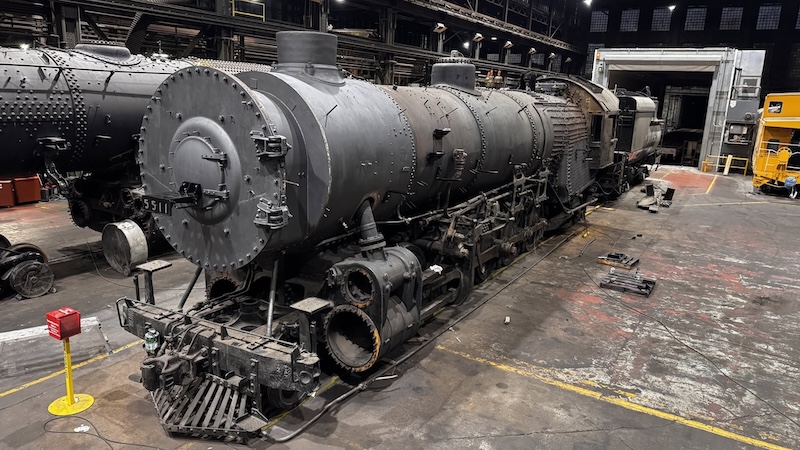
Closer to Cold Spring Shops headquarters, Railroading Heritage of Midwest America, working out of the onetime Rock Island Lines shop complex at Silvis, has performed a hydrostatic test on Union Pacific TTT-6 freight mauler 5511, the next step toward operating it.


Railroading Heritage photo retrieved from Railfan and Railroad.

The locomotive last operated in Union Pacific service in 1956, and remained in Union Pacific storage at Green River and Cheyenne, ultimately being donated, along with other steamers, including Challenger 3985, to Railroading Heritage.  That might be one of the other steamers disassembled in the background.

The TTT is a somewhat more powerful mudsucker than the Chinese QJ steamers on Iowa Interstate's inactive roster.

THE SECRET IS OUT.

Advice to beginning faculty members: deans might not read, but they can count.  "Does it come as a surprise that much of the research enterprise turns into a quest for the minimal publishable unit?  Or that average people cut corners?"  Now comes frequent Instapundit source, Wisconsin Law's Ann Althouse, with confirmation from within the enterprise, in the form of Fields Medalists objecting to people, not necessarily academic mathematicians, using algorithms to solve the famous open problems in mathematics.
The goals of the AI companies and the goals of the mathematical community are severely misaligned. We see these as part of broader alignment issues impacting other scientific and creative professions, as well as the whole of society.

Research mathematics deals with understanding basic structures of shapes, numbers, and natural phenomena. Over the course of generations, it has built a large corpus of sophisticated ideas, methods, abstractions, and other tools to comprehend the mathematical landscape. In turn, modern technologies and sciences are based on mathematical tools.
A retired mathematician's comment suggests the use of algorithms might not affect the academic enterprise much in any event.
I have literally never used AI in any of my research. My area is obscure enough that I doubt AI would have much interest any time soon in the research I do. Slightly more broadly, the big unsolved problems in my field (e.g. the Alperin weight conjecture) could maybe be finished by AI, but (best case scenario for AI) it would be pretty transparent that it was putting the finishing touches on a project that humans had been building up for decades (for instance, the McKay conjecture and the Height Zero conjecture were around in my field for decades, and have recently been solved by humans - humans who spent years putting the finishing touches on work that others had spent decades building up).
His concluding remark, however, motivated my thesis. "And a person reading about the proof of Fermat's Last Theorem might be inspired to sharpen their analytical skills, learn some math, and that could develop into something useful.  Like developing AI, oddly enough."

HOW'S THAT CONFERENCE REALIGNMENT GOING?

Last fall, ESPN's Ryan McGee's version of the Bottom Ten included Northern Ill-ugh-noise.  It's another year, another conference, and leading the list is Northern Ill-ugh-noise.
The Other Huskies were bitten by the Georgia State Not Southern Panthers 35-14 last week. Props to NIU for equally distributing its losses, with one each to teams in the Big Ten, Missouri Valley, Big 12 and Sun Belt. That is, as we say on "Marty & McGee" "apro-pro" because I can never remember which conference NIU is now in.
Not that it matters this Saturday, as they have the Flying Byes of Open Date U., to use Mr McGee's terminology, followed by an evening homecoming game with the Flying Falcons of Air Force, which also play in the Mountain West.  Off we go, into the bowl chase yonder.  Both the university's orchestra and the community symphony orchestra have performances scheduled for that Friday and Saturday.

29.9.26

THE RACE TO ELEVEN WINS.

David Manney's "From Uecker on the Radio to 103 Wins: What a Season" celebrates the Milwaukee Brewers path to the playoffs.
Some of my favorite Brewers memories don't begin at a ballpark.

They begin on a hot Wisconsin summer night with my dad, my brother, and me fishing on Half Moon Lake in Carson Park while Bob Uecker called the game on the radio. You could hear the water, the insects, maybe somebody fumbling with tackle, and Ueck describing baseball as only he could.

Those nights became part of what the Brewers mean to me.

There were ballpark memories, too. I remember going to the Met in Minneapolis and watching Larry Hisle hit two home runs against the Twinkies, including one off the fair pole.

Years later, sitting in the left-center field bleachers at the Metrodome, I had binoculars on home plate while Paul Molitor stole home while Robin Yount stood at the plate. It remains one of the greatest baseball moments I've ever seen in person.

And I know what some of you are thinking: the MLB lost some of you as a fan. I respect that. For me, however, baseball is part of me.

Growing up in Eau Claire, Wis., it meant it was easier to see the Brewers play the Twins than to drive three hours to Milwaukee County Stadium.
Until 1971, I was able to listen to, and suffer through, Brewer games on WTMJ, with Merle Harmon, and later Bob Uecker, on the play-by play; for the last forty years I've been able to enjoy the day games, but must make do with, or without, a scratchy radio broadcast of the night games, including much of that season-ending series win in Philadelphia and the sweep of the Cardinals.

THE BITTER FRUITS OF ADULTISM.

Deconstruct "I'm the boss, you're the kid," and bear what follows.
I’ve never considered taking a drink into an interview. I’m not even comfortable taking one if offered. I don’t do it because it’s generally a short enough process that it’s unnecessary.

And frankly, saying you need to stay caffeinated to talk to a potential boss sends signals I don’t know that I’d have been a fan of.

The problem here is that people are opining on this sort of thing often without asking a question of why we tended not to bring beverages to interviews in the first place. It’s one of a thousand examples of people seeking to upset the status quo without understanding why the status quo exists.

On the flip side, many of those who are upset over it may not even know why they’re upset over it. I doubt anyone came right out and said, “You guys tend to be so boring that I need as much caffeine as possible to stay awake to talk to you.” They just got bent out of shape from the start.

These little rules are common, but they generally all start from somewhere, and like Chesterton’s Fence, we need to understand them and why they exist before we set about dismantling them.
That's Tom Knighton, reacting, correctly, to the most recent first world problem: should a job-seeker bring an iced coffee to a job interview.  His conclusion?
Perhaps more importantly, why do you think you need it inside with you for a 20-minute interview? Or do you just need to knock down doors for the sake of knocking them down?

If so, be careful, because you might be on the other side of that desk and have to deal with someone just like you, only worse, and have no recourse left because of what you did at the time.
Call me old school, bringing your own drink, hot or iced, into an interview, let alone food, signals a lack of seriousness.  If the interviewer offers you coffee, tea, or water, politely accept or decline: the prudent thing might be to decline, the offer might be to put you at ease or perhaps as a test of your impulse control.

The economics job meetings offered a different sort of hazard: there were departments that conducted interviews with bottles of the adult beverages in plain view.  Always politely decline an offer of one!

COMPLEX ADAPTIVE SYSTEMS, DOING WHAT THEY D**N WELL PLEASE.

In mid-August, "If you don't like the weather, wait" proved to be logical advice.  "The Old Farmer's Almanac forecast is out, and the Great Lakes summary might be 'expect anything."  "The almanac forecast predicts the northern Plains and Upper Midwest could be drier at times, 'especially when the southern storm track becomes dominant.' Still, intense cold, wind and snow are possible, with clippers, sudden cold snaps and snowy periods likely.'"  So, too, with the northern hemisphere's hurricane season, which is defying all the expectations.

Saith the reporters, "Hurricane season is broken. Two oceans are historically out of whack."  How so?
The 2026 hurricane season has been remarkable, from the potentially record-breaking calm in the Atlantic Ocean to the hyperactive eastern and central Pacific Ocean.

Only seven tropical storms have formed in the Atlantic, while 18 tropical storms and hurricanes have formed in the Pacific. In a normal year, the Atlantic and the eastern Pacific hurricane basins see similar activity, with 14 to 15 named storms, including seven to eight hurricanes by the time the season ends on Nov. 30. This year, the Atlantic hasn't yet produced a single hurricane, while the eastern Pacific has already produced eight.

What's interesting about this season is that a few of the storms that have occurred in the two basins originated in Africa and were influenced by the same powerful climate phenomenon, El NiƱo. But the results have been very different, with fierce hurricanes in the Pacific and unremarkable tropical storms in the Atlantic.
Maybe it's time to look more carefully at the observations and recalibrate those extrapolation models, which are excessively sparse anyway.

28.9.26

THE LIMITS TO THERAPEUTIC CULTURE.

Earlier this month, we noted Sally Satel, a skeptic of much of therapeutic culture, nonetheless suggesting that despite its overuse, sometimes a psychotic is a psychotic.  That post concluded, "And so the research enterprise, the patient beavering away at ever more challenging anomalies not easily covered under a bright line rule, goes on."

Today's example: Jessi Gold's "Sometimes Stress Is Just Stress" in Inside Higher Ed.  Her warning: students might be quick to use the language of therapeutic culture, without the supporting therapy.
As a psychiatrist and a faculty member, I have noticed a growing trend among students: Everyday emotions are increasingly described as psychiatric diagnoses. Students are no longer simply sad—they are depressed. They aren’t just stressed—they are anxious. With this lens, normal developmental challenges like academic pressure, relationship struggles and social adjustment are now filtered through the language of mental illness.

While casual use of mental health terminology and self-diagnosis isn’t new, social media has dramatically expanded its reach.
It's likely that anyone in medicine has ample horror stories of people who come in with all sorts of fearful questions, that is, if they don't question what the practitioner is spelling out.

I'M DONALD TRUMP AND I APPROVE THIS MESSAGE.

Troll level: way beyond Dick Tuck.
The National Republican Senatorial Committee (NRSC) is apparently seeking regulatory guidance on a very serious campaign-finance matter: how exactly should it report Hasan Piker’s generous contributions to the Republican Party?

In a letter to the Federal Election Commission, the NRSC asked how it should quantify the value of Piker’s commentary, which reaches millions across Twitch and other digital platforms. After all, when a prominent left-wing streamer repeatedly says things so inflammatory, divisive, and politically self-defeating that they may as well be GOP advertising, surely someone has assigned a dollar value to the service.
I wonder what rights a political influencer has to his social media clips that get quoted, either in full (the most effective way to attack a person is to show him unedited) or in part (which also puts the person on the back foot, spending time showing how he's taken out of context).  Those social media clips will be dropping, what with Election Day about five weeks away.

CHOKE ON IT.

Last week, the mullahs' travelling stooge complained, "It cannot be the case that everyone benefits from the Strait of Hormuz while we are denied access."  One of Iran's military leaders, Amir Hatam, sought to raise the pressure.  "If Iran cannot trade, if Iran cannot live, no one will be able to trade or live."  Pretty big talk from somebody with little leverage.

That article also quotes Our President, perhaps correctly evaluating the correlation of forces.  "They want to make a deal to open the Hormuz Strait immediately because they're losing so badly."  He's still teasing a deal.  "Iran is seeking sanctions relief, access to frozen assets and an easing of U.S. pressure before making its biggest concessions. The Trump administration says there will be no agreement unless Tehran first makes concrete progress on its nuclear program."

The correlation of forces have never been more favorable for an end to the mullahs' nuclear ambitions, their terrorizing of the civilian population, and the end of their financing of assorted delinquents wrapping themselves in theology throughout Asia Minor and the rest of the world.  Let the anaconda's coils continue to tighten.

25.9.26

AFTER THEY'VE TRIED EVERYTHING ELSE.

Regular readers have known since at least 2020 that parking lots are productive assets and pricing them as such makes economic sense.  Maybe, rather than assessing homeowners and hoteliers for street repairs, ask the beneficiary to bear the burden.  "Milwaukee drivers could pay more to park under proposed 2027 budget to help fund road repairs."

TAKE THE MULLAHS' STOOGE UP ON HIS OFFER.

"In defiant speech, Pezeshkian calls out Trump and says Iran will fight 'until our last breath'."

Because of course he did.
Iran's president said Wednesday that his people have been "victims of terrorism" by the United States, delivering a rare wartime speech at the U.N. General Assembly a day after President Donald Trump said he may "annihilate" the Islamic Republic if a deal isn't reached soon to end the nearly seven-month war.

The defiant speech by President Masoud Pezeshkian marked a striking instance of a foreign leader addressing the world body while their country is at war with the host nation. While defending his country, Pezeshkian held up large photos of the late Supreme Leader Ali Khamenei and the more than 150 Iranian schoolchildren killed on the first days of the war.

"We have only defended ourselves. We are not terrorists," Pezeshkian said at the General Assembly. "Our innocent people have been the targets of cowardly attacks and aggressions imposed upon our country. And we defended ourselves with utmost strength. America and Israel attacked us."
Gee, you think riling up your starveling base to yell "Death to Israel, death to America" for nearly a half century is a good way to win friends and influence people?  Reap what you sow, stooge.

Our diplomats are having none of it.
He added of the United States: "Yes they did hit us, but we did not bend the knee." Toward the end of his speech, Pezeshkian called out Trump by name.

"It must be understood by Mr. Trump and those who seek to bully us that we are ready for dialogue and diplomacy and negotiations without accepting the language of force," he said.

Shortly after, both U.S. and Israeli officials blasted the speech, saying that it was hypocritical for the Islamic Republic to present itself as the victims of the world.

U.S. Secretary of State Marco Rubio told reporters: "I don't know what standing Iran has to lecture anyone on human rights or the international system when they habitually violate it."
The stooge had to posture that way because his political masters in Teheran speak their own language of force.  "Iran has presented the US with a roadmap to end the war that echoes the two countries' June agreement — a 60-day ceasefire, the reopening of the Strait of Hormuz, and groundwork for further talks — The National reported."  Same nonsense, different talking head.  Renounce the nukes, Iran, and stop funding those proxies, and then we can lift the sanctions and let your leaky ships sail.

ADAM SMITH CORRECTLY DIAGNOSED THE SITUATION YEARS AGO.

I used to summarize the political economy of antitrust with the following:
To widen the market and to narrow the competition is always the interest of the dealers ... The proposal of any new law or regulation of commerce which comes from this order, ought always to be listened to with great precaution, and ought never to be adopted, till after having been long and carefully examined, not only with the most scrupulous, but with the most suspicious attention. It comes from an order of men, whose interest is never exactly the same with that of the public, who have generally an interest to deceive and even to oppress the public, and who accordingly have, upon many occasions, both deceived and oppressed it.
I wouldn't name the author, rather I'd ask students if anyone had an idea who it was. More than a few for Karl Marx and sometimes I'd get a J. S. Mill, both good choices.  It's in The Wealth of Nations, Book I, Chapter XI.

Widening the market and narrowing the competition is easier with Government Doing Something.


It doesn't matter how good the intentions of the legislators who established the board is, or how much public enthusiasm there is for Wise Experts to carry out the legislative intent.
In principle, the concept of the independent commission is a delegation of powers from the executive and legislative functions of government to subject specialists, holding the ability to implement legislative intent without burdening those legislators with determining what the price of a streetcar ride or the content of a sandwich served to economy class fliers was to be.

Like most principles, the concept sounded better on paper or sketched on a chalkboard than they did in practice.  A left-leaning commentator of the nineteenth century responded to the creation of the Interstate Commerce Commission with an epigram to the effect of the agrarians and the communists getting their laws, and the robber barons keeping their railways.  The same lesson applies to any other independent regulatory commission, or to the more recent administrative state agencies to which we turn.

The problem with any delegation of legislative authority to an agency is that the people most affected by the agency decisions will take the greatest interest in what the agency does.  In the early years, a farmer might have a keen interest in what the rate on a carload of grain is, or an environmentalist in the acid content of power plant smoke.  Over time, though, the regulatory procedures become codified, and boring, and the agrarians and communists of the next generation find other shiny objects to get worked up over, whilst the railroaders or power companies or television stations or air carriers or baby formula manufacturers find ways to get along by going along in such a way as to capture the agencies.  The agencies thus become cartel managers, protecting the incumbent firms, and the best thing to do might be to reduce their powers and banish them forever.
Does anyone seriously think that, should the leading developers of artificial intelligence, or machine learning if you will, will not cultivate the members of any agency Congress or a legislature sets up to regulate their competition?  It doesn't even take the kind of insider majority on the boards, as Mr Slivinski fears.  Wouldn't the management of any business subject to that regulation figure out where the board members play golf, when their birthdays and anniversaries are, what their children aspire to, in order to capture the agency, no matter how stocked with idealists it might be, with kindness?

24.9.26

PERMISSIONLESS INNOVATION.

Donald "Cafe Hayek" Boudreaux manages to offer an economics lesson and keep a straight face.
I applaud this market experiment with a, shall we say, unusual kind of leisure spot.

But the experiment is failing. And yet some people – ignorant of the foundation, working, and benefits of free markets – are unjustly criticizing the owners of this experiment for trying to salvage it.
The "unjust criticism?"  It brings to mind a parody of the late Yogi Berra's observation, phrased as "They're so inclusive nobody goes there any more."  Lift a mask requirement on Saturdays, alienate the "immunocompromised disabled divas," never mind that there still is a mask requirement all the other days the bar is open.  Benjamin Bartee is less than impressed.  "One night per week without the muzzle, in 2026, in a town with nary a single case of COVID, was enough to warrant the avalanche of outrage from the 'disabled community.'"


Perhaps lifting that requirement on Saturday was a mistake, but for a different reason.  The bar is in Greenfield, Massachusetts, a few miles upriver from Northampton, where people practicing alternative lifestyles are as common as seagulls in Boston: all the same, there might be people trying out an alternative lifestyle on the best pickup night of the week who welcome the anonymity of a Biden muzzle.  That the interest of the queer-adjacent aligns with that of the immunocompromised is convenient. 

RONALD REAGAN, VINDICATED.

Two score and three years ago, the Smart People scoffed at his Strategic Defense Initiative ideas as "Star Wars."  Stay the course, the Gipper said.  Or perhaps it was Star Trek they had doubts about.  Zap a missile with a laser?  Perhaps that's still a challenge if it's an intercontinental ballistic missile.  An Iranian flying gas main is another matter.  "US military spending $500M on ‘war-ready’ laser weapons — and zapping drones in Iran, along US border."
Iranian citizens have witnessed some dazzling laser shows recently — but they’re not the kind you’d see at a Metallica concert.

The US military has been deploying lasers in the Strait of Hormuz to knock out regime hardware, taking out “drones and incoming cruise missiles at a much lower cost than using more expensive kinetic weapons like missiles,” the Department of War recently confirmed.

The US project to harness laser power has been 50 years in the making and outstrips the capabilities of any other military on Earth.
A Navy man I spoke with at an early spring swap meet (we were figuring out whether a 3-D printed Phalanx turret was O Scale: it was) confirmed the existence of such systems.  They're cheaper to operate either than Phalanx, with its depleted uranium slugs, or the SM series surface-to-air interceptors.  But they use a lot of electricity and apparently have noisy capacitors to generate the laser pulses.  Ships, however, have turboelectric power plants for propulsion.
Laser technology works by drawing energy from generators or battery packs which is then converted into light particles called photons. The photons are then concentrated as a single beam, which is only visible under infrared light, not the naked eye. They heat the surface they are directed onto until it explodes or melts.
That might be, at a more modest scale, how laser-assisted secondary cataract removal works, only with quieter capacitors and carefully calibrated energy.

GREAT MOMENTS IN IDENTITY POLITICS.

America's True Newspaper of Record strikes again!  "Experts Believe Lindsay Clancy Case May Set Feminist Movement Back Decades, But There May Be Some Negative Effects As Well."


The story continues.
The current feminist wave, which includes the belief that women are inherently superior leaders due to their peaceful nature, has been undercut by millions of women openly cheering homicide. "The Clancy trial has somehow caused feminists to argue that women are completely controlled by their hormones," said legal expert Ben McCray. "They now vehemently say that women are so weak and feeble that they can't even be held responsible for their own actions. The nation now agrees with their assessment."
Psychiatrist Sally Satel had thoughts about that argument.  Satire or not, the women of the fevered brow do a pretty good job of bringing on the mockery simply by being their authentic selves.  Not too long ago, Indiana Fever reserve Sophie Cunningham, who shies away from the culture wars, noted, "You can be girly, and you can go out and kick someone's a**."

23.9.26

ALL ROADS LEAD TO BYZANTIUM.

"Ancient Rome Built 190,000 Miles Of Roads And Researchers Just Traced Them All."
Reuters reports researchers just mapped the network of roads that Romans connected across Europe to parts of the Middle East and Northern Africa to better understand the world's first continental travel route, and find out if all roads do indeed lead to Rome. It turns out they don't.

The study published earlier this week mapped out the roads into what the Roman network could have looked like at the peak of the empire's power, sometime between the 2nd to 4th centuries AD. That network of main roads and little countryside paths didn't centralize in Rome, though. Tom Brughmans, classical archaeologist at Aarhus University in Denmark and one of the leads on the project, told Reuters that, "...when we consider all movement within the entire Italian peninsula, we were shocked to discover that the most central road actually follows the opposite Adriatic coastline, bypassing Rome altogether."

The roads of the empire actually met in Constantinople, or Istanbul, Turkey, as it is known today. There the city was more centrally located, as it bordered both Europe and Asia along the Bosporus Strait, where ancient ferries were known to easily traverse between the two continents.
That finding should be no more surprising than, say, the railroads converging at Chicago. A via triumphalis such as the Appian Way might be a useful setting for a procession Ottorino Respighi could set to music, or perhaps as a place to display the suffering carcasses of rebels, as in Spartacus.

THE UNITED NATIONS, FAILING AT ITS CORE MISSIONS.

It's long been a useless debating society contributing to traffic jams in New York.
A look at the resolutions passed by last year's General Assembly—often nonbinding, unlike those of the U.N. Security Council—shows an organization that meddles in the domestic politics of its members while failing to pursue its stated mission to "maintain international peace and security."

Active wars rage in Asia, Africa, Europe, and the Middle East, with internecine conflicts erupting yearly in Latin America and the Caribbean. Yet the previous General Assembly passed five times as many U.N. resolutions directed at Israel as any other nation, including countries with notorious human rights records like Cuba, Iran, and Myanmar.

Thanks to its unwieldy organizational structure, the U.N. is highly susceptible to waste, fraud, and abuse. It can't enforce the policies it adopts, and its actions often depend on the whims of the Security Council, whose five permanent members opportunistically exercise veto power. Unable to do much to curtail global conflicts, the U.N. has focused on issues better handled by domestic governments, like environmental laws and racial justice.

The incongruent nature of its mission and what happens in practice are perhaps best seen in the U.N.'s Human Rights Council, which is currently presided over by a representative of Indonesia, whose government sanctions arbitrary killings, torture, and crackdowns on dissent, according to the State Department's 2024 Country Reports on Human Rights Practices.
That might be about as well as any international organization can do.  Each country gets one vote in the General Assembly.  That's obviously less than democratic, if you apportion by population.  Five permanent members of the Security Council can gridlock anything they don't like.  Its continued existence at least gives the sort of process-worshipper who sees value in a rules based international order as something to invoke, or perhaps an opportunity to write position papers.

YES. NEXT QUESTION?

New Yorker contributor Jennifer Wilson asks, "Have Conservatives Taken Sexy Back?"  I don't know that "conservatives" ever gave it up, it's humorless leftist scolds who frown at revealing swimsuits, let alone appreciating others revealing themselves in revealing swimsuits, and that might have been the case back in the day of hot rods.


Funnily, the author frames her thesis as an attempt to rebut a claim that has little basis in fact.
The setting was certainly an interesting choice on the part of the “Euphoria” star, who spent the better part of last year running from the controversy over her ad for American Eagle Outfitters—also a sponsor of this year’s Stagecoach—in which, following a brief explainer on genetic determinism, a voice-over boasted of the blond, blue-eyed actress’s “great jeans.” The inspiration had seemingly been “Genes,” a near-identical ad that Brooke Shields did for Calvin Klein in the nineteen-eighties, but, in 2025, jokes about Sweeney’s supposed physical supremacy appeared to be giving free press to a right-wing talking point. By then, conservatives had concocted a theory that the fifties-pinup physique of Sweeney, a registered Republican, was an affront to progressive sensibilities; a year earlier, the National Post, a right-leaning news site, had raised the question “Are Sydney Sweeney’s breasts double-D harbingers of the death of woke?” While we were pretending not to be looking, breasts had somehow become Republican-coded.
Read on, and the basis for her confusion is clear.  "When I was growing up, in the early two-thousands, 'conservative' meant conservative. The right was the party of George W. Bush, abstinence-only sex education, and Christian evangelical teens who recited chastity pledges and wore promise rings under the banner of 'True Love Waits.'"

21.9.26

ROLLING INTO THOSE EARLIER SUNSETS.

Three years ago, I teased the prototype railroads about adopting a concept from model railroading.


Two Atlas F units from the original issue, circa 1972, extensively reworked with P&D Hobby Shop transmissions, more powerful can motors, and Ring Engineering onboard power control modules.  The B unit, a P&D shell on a modified early Atlas chassis (yes, I scrounge all sorts of stuff at swap meets) is the battery car.  Go ahead and complain about the phase variations on the grilles.

Those units feature in an end of summer video now available for your viewing pleasure.


They're leading the westbound Gull past the steel works and into Boston staging.  If I weren't as obsessive about having interiors in the cars I build, there'd be diners and parlor cars for the day trains.  The Gull got in before breakfast time, hauling Farmington milk for Borden, Maritimes fish, assorted parcels (were a few boots put on board at Freeport?) and interline sleepers from Halifax, Calais, and Van Buren.  After the passenger train clears, the morning switcher goes to work, delivering scrap metal for the Open Hearth shop, then crossing over to work General Electric on the inward side.

LET GO AND START OVER.

If we really knew what the answers were, we wouldn't have to do research.  But in order to attempt to answer a question, a researcher has to have information.  That brings frustrations of its own.
At the end of my third year as a Ph.D. student, I had nothing to show for it. No publications. No data to analyze. No conference presentations. Despite years of long hours and hard work, I had no publishable results. I lost my confidence, my sleep and—most painfully—the joy in doing science. I started thinking that my next and only logical step was to quit my program.
That wasn't for lack of an interesting question.  "I had been offered a project investigating the causes of Alzheimer’s disease, one of the most devastating neurodegenerative illnesses of our time."  The researcher did perform useful work in identifying a dead end.  Unfortunately, sometimes the most promising of projects, which understanding Alzheimer's is, turn into a research dead end, and you don't get a Minimal Publishable Unit for null results.

There were other biomarker projects to investigate, and this student's second attempt was more successful.
Not only was the new project promising and technically feasible, but I had the chance to get exposed to new methodologies and scientific processes, including handling research ethics submissions, navigating material transfer agreements and contributing to big grant applications. My energy levels were restored, as was my faith in my supervisor.

About two years into the new project, I have now presented at three international conferences and published my second research paper in a well-respected journal, as well as other commentaries, reviews and opinion pieces, on both gliomas and, surprisingly, Alzheimer’s disease. I have made international friends and collaborators who keep fueling my passion for top-notch science.
That prior work?  Bygones are forever bygones.  Second time through, though, the cultural capital this student developed in the first project might have helped with the submissions, agreements, and applications.