21.5.18

PRIVILEGE IS CIVILIZATION.

Maybe, instead of writing another mini-dissertation, I should simply illustrate.

Here is my favorite picture from last month's excursion.


OMAHA, 26 APRIL 2018
Children playing with their sand pails, Vierville-sur-mer.

I saw similar scenes elsewhere.  (There are more detailed photo albums at my Facebook page, if you're curious.)


UTAH, 26 April 2018
School trip experiencing a ride on a Higgins boat, La Madeleine.


GOLD, 27 April 2018
Seaside at Arromanches.

Remnants of Port Winston, or MULBERRY B, at sea.


SWORD, 27 APRIL 2018
Windsurfer, low tide, Colleville-sur-Plage.


JUNO, 27 APRIL 2018
Former strongpoint, more children playing in the sand.


A family outing to Pointe-du-Hoc.


A family portrait at Longues-sur-Mer.


THESE ENDURED ALL AND GAVE ALL THAT JUSTICE AMONG NATIONS MIGHT PREVAIL AND THAT MANKIND MIGHT ENJOY FREEDOM AND INHERIT PEACE.

That is the peace those young people inherited.

Your privilege knapsack, dear reader, contains institutions and conventions that have conferred evolutionary advantages to adopters, and they have been secured by the efforts of people who came before.


Saalfeld, Germany, June 1945.  John Karlson photograph.

"We are always in danger of losing them," notes psychologist Steven Pinker, in an interview with Reason's Nick Gillespie.  By all means, read and understand the interview.  Professor Pinker concludes, "We have made accomplishments. They're precious, we're always in danger of losing them, and what will happen going forward depends very much on the choices that we make now."

Do we really want those kids to have to experience Occupation and Liberation all over again?

LOOKING FOR A MARKET TEST.

Tonight's feel-good story at the end of NBC's nightly news features a former debt collector who continues to buy accounts receivable at a discount only to retire the debts using charitable contributions.


The Good Samaritan is able to buy these accounts for pennies on the dollar.  Currently, the charity is reviewing the case files, and delivering good news to some people, but not taking applications from indebted patients for relief.

What sort of margin are health care businesses maintaining in their prices, in order for such deep discounting to be possible?  What is the role of third-party payments, or of quasi-perfect price discrimination, in establishing that margin?  Are those discounts representative of the factoring of receivables in other lines of business?

There is no shortage of interesting research questions, in health economics, or in any other kind of economics.

20.5.18

NOT QUITE A NATIONAL RAIL NETWORK?

My recent brief encounter with the French railroads was a diesel rail car, Cherbourg to Bayeux.


The electrification is for the service to Paris.  There are no TGV trains running to Cherbourg.

Again, my luck is with me.  The intermittent job actions French railroaders are staging included the 26th and 27th of April, not the 25th.  Perhaps it was the round of Blue Ribbons I bought in Chicago, or perhaps the bottle of wine the travel agent stood me to, that I shared at table shipboard on the first formal night, that kept the Gods of the High Iron smiling on me.  Vacationers day-tripping out of Paris for the various Normandy destinations were not so lucky.

When it runs, though, the French passenger rail service is primarily a Paris-centered service.  A number of the regional lines are long gone.  For example, the station at Bernières-sur-mer is now the tourist office.


We did the same thing at Woods Hole, with the same results.  The French refer to the Normandy landings as le choc, and on high summer days the traffic through the seaside towns, such as Bernières, at the centre of the Canadian effort on JUNO, likely is shocking.  The regional rail can be convenient.

The good news is, we've rediscovered rail travel to Old Orchard Beach and parts of the Jersey Shore, and perhaps Floridians will do so.

REVEALED PREFERENCES?

The Rock Valley College softball team recently won their fifth straight national championship (in the National Junior College Athletic Association, that is) defeating along the way a Brookdale, New Jersey, squad (sorry, Matt) then taking down top-seed Herkimer College.  It's mostly local kids, and it's unlikely any of them grew up in the hothouse environment of kid sports turning pro that Time lamented a going on a year ago.

And yet, there might be something about the Rockford sports stories that's not a good thing.  I've previously griped about the nature of sports coverage on Rockford television, slightly reworded, it's like this.  "Rockford television stations would put the story of a Chicago Cub pitcher carrying a perfect game against the White Sox into the ninth inning hitting a walk-off home run [of the seventh game of the World Series] that breaks up the Sox pitcher's no-hitter behind a story involving a high school cross country team that's running in the state championship."  In the ongoing basketball playoffs, it was the Toronto Raptors, not the nearby Milwaukee Bucks, getting what little coverage there is in a year the Bulls are working on their golf, because a Rockford Auburn graduate now wears a Raptor jersey.  And senior signing day is generally a sports thing, not an academic thing.

Meanwhile, Rockford is still dealing with a twenty-year-old Money magazine "worst city in America" ranking and a more recent "third most miserable" from Forbes.

To borrow from another fairly recent post, Rockfordians can enjoy the decline, and follow the next crop of rising softballers.

What we don't reward, we get less of.

DELAY IS THE DEADLIEST FORM OF DENIAL.

Yesterday, we noted that six years elapsed from Florida East Coast thinking about a passenger train from Miami to West Palm Beach and perhaps beyond.

Eleven years ago today, readers saw a post about plans to return a passenger train between Chicago and Dubuque, perhaps on its historic Illinois Central routing, perhaps on a hybrid routing.

Those tracks remain freight service only today.  There's plenty of blame to go around. Railroad companies that think the tracks must rest for six hours between trains, or perhaps they fear being crowded out by the passenger train operators.  Civic boosters who want the train a few miles closer to their town.  Politicians who have strange ideological ideas about trains.

Those caveats noted, it is difficult not to think that public provision with the attendant procedural complexities impedes the development of Passenger Rail services in places where it's not practical to fly, and the roads are no fun.

19.5.18

THE DAWNING OF RAILROAD AWARENESS.

We first noted Florida East Coast's plans to build a passenger railroad six years ago.  Focus, dear reader, on this.  "Much of the existing traffic on Florida East Coast is intermodal, and container trains cruising at 90 play well with passenger trains at 110 or 125."  Later that year, I offered further analysis.
It's intriguing that the operator wants to be freed of Congressional meddling with Amtrak, which is the cynic's interpretation of "exempt from federal oversight." The stipulation that the new trackage will be Passenger Service Only likely calms fears at the CSX Railroad of freight competition. The absence of joint ticketing, or any mention of connectivity, troubles me. The value of a Passenger Rail network is in being able to make connections. Admittedly, Amtrak's Florida service is a pale shadow of what Seaboard Coast Line operated almost up to 30 April 1971, and the Miami to Orlando service has more promise as a boat train connecting cruise ship passengers to the theme parks and Grapefruit League stadia.
That service is now up and running as Brightline.  As of yet, there are no plans to run tracks into Port Everglades Quay (that place is big enough that you'd probably have to install moving sidewalks to provide connections, particularly to the voyages catering to older folks.)

18.5.18

LONELY WATERS.

There's a lot of seaborne commerce, and there's also a lot of ocean.  Time to make the jump from Ponta Delgada to Cherbourg.

First, note the pragmatic use of portholes on Regal Princess.


The hull is as the designers intended, this is not a modernized upper works grafted onto an older hull, the way Milwaukee Clipper is a tear-down and rebuild of Juniata.

The second day out of Florida, there was a freighter following a similar course to avoid one of the cyclonic storms still disrupting air travel and bringing snow to the Great Lakes and the Official Region.


Two days later, another cruise ship passed astern and to starboard.


The day before landfall at Ponta Delgada, this bulk carrier crossed close aboard ahead and to port.


I estimate this ship's closest approach as a mile or two, although judging distances on the water is difficult (one reason overly optimistic swimmers tire and drown).

Mostly, though, it was calm seas and water, water everywhere.  I didn't see any of the floating islands of plastic junk that mariners are reporting.  Princess were doing their part to limit the damage, by not issuing straws with drinks.


On the run into the Channel, our course came under one of the air corridors.  If you're in a hurry, you're up there.


That, though, is one of the mysteries of cruising.  Tablemates, in the course of making conversation, would ask about my flight from Chicago, given the crappy weather we'd been having.  Then I mentioned that I had already been in cruise mode, Chicago to Washington to Fort Lauderdale.  Invariably:  how long did that take?  (It's cruise mode: does it matter?)  If all goes well: leave Chicago on Thursday, Washington on Friday, and there's time for a margarita Saturday night prior to shipping out on the Sunday.  But if that Thursday connection goes awry ...

The fliers, however, had their stories of misrouted baggage being delivered to their hotel rooms at 1 am on the Sunday, or of connections by way of Chicago or other northeastern hub airports being disrupted, and I sure saw a lot of people scurrying aboard in the last hour before the gangway came in.  It's as if the sailing is a way to recombobulate from the joys of not-quite-instantaneous-or-dependable air travel.

After ten days at sea, it's time to take leave of Regal Princess, at Cherbourg.


High speed catamaran ferry Normandie Express (a bigger, faster version of our Lake Express) is making way for the Princess.

A few days before this adventure started, news reached Cold Spring Shops of job actions on the French railways.  Stay tuned.

UNBUNDLING THE TRACKS FROM THE TRAINS MIGHT INTRODUCE TOO MANY COMPLEXITIES.

In principle, there's no reason not to think of railroad tracks as a kind of highway network, and separate ownership (and maintenance) of the tracks from operation of the trains.  The idea is at least fifty years old (there's a suggestion in Trains in the second half of the 1960s, i.e. before the wreck of the Penn Central, of doing just that, and National Review's William F. Buckley once endorsed the idea, albeit before the advent of search engines) and that's sort of what they're doing on British metals (to a lesser extent, with some passenger and freight operators elsewhere on the continent as well.)

In practice, the introduction of Demsetz auctions by which train operating companies bid for the right to offer services on rail corridors runs afoul of excessive optimism and sunk costs.

The beat goes on.  Virgin Trains, for instance, recently had its East Coast franchise (London Kings Cross to Edinburgh, i.e. the Flying Scotsman line) terminated.
From [24 June], DOHL, a government-owned ‘operator of last resort’, would take over the franchise and begin preparations for the creation of an integrated East Coast Partnership business with a single team managing both operations and infrastructure. [Transport Secretary Chris] Grayling told [Parliament] that the business would be ‘publicly run for a short period’, mirroring the period between 2009 and 2014 when Directly Operated Railways managed ICEC services under the East Coast brand.
A single team managing operations and infrastructure.  We used to call such a thing a railway.  There was a Permanent Way department and an Operating department.  They're sort of moving in that direction with the government action.  "From June 24, VTEC is to be replaced by the London North Eastern Railway brand, evoking the name of the company which ran the East Coast Main Line prior to nationalisation in 1948."

But not completely.  "On May 15 Grand Central submitted an application to the Office of Rail & Road seeking to run a sixth daily Sunderland to London King’s Cross return service, an additional train between Bradford Interchange and London, an early morning service from Wakefield Kirkgate to London and a 10-car late evening service departing London before 22.00 and splitting at Doncaster to serve Wakefield and York."  All of those are historic routes of London and North Eastern, and later the North Eastern Region of British Railways.

When I'm over there, my rail pass is good on any train, run by any company.  I think individual tickets work that way, but wouldn't it be simpler, for instance, for all trains calling at Doncaster, whether enroute Wakefield or Leeds or Bradford or York or Newcastle or Edinburgh Waverly to be run by the same railway?

KUDOS.

Northern Illinois basketball player Kim Moore, member of the Consulting-Specifying Engineer Forty Under Forty Class of 2018.  "Moore is an electrical engineering manager with more than 15 years of experience as well as a comprehensive background in distribution engineering including group and project management. She has had years of experience within the engineering industry prior to founding KDM Engineering."

14.5.18

BAUMOL'S COST DISEASE?

The phenomenon itself seems intuitive.  "Because labor markets across different sectors are connected, rising productivity in manufacturing leads the cost of labor-intensive services — such as education and health care — to rise."  It's trotted out by special-pleaders in health care and education as a way of deflecting criticism of rising prices, generally by arguing that it takes as long to perform a string quartet, or set a broken bone, or lead a discussion of Julius Caesar, today, as it did in the Steam Era, or in the Age of Sail.

Never, ever, send an economist to sea with lots of time to contemplate things.  Such as a bottle of champagne.  Doesn't it take just as long to raise the grapes, and don't you have to press the juice carefully, and won't rushing the fermentation with chemical additives give you vinegar, not bubbly?


Then building this stack of glasses requires just as much care on the part of the stewards as it did when Commodore Sir Arthur Rostron was the star at Cunard.


In like manner to the canonical Beethoven quartet, the Palm Court music can't be rushed through.  Perhaps, though, engaging two string players, rather than a full Palm Court orchestra, might be a way of keeping the atmosphere whilst engaging in economies.  College faculty who have not had a raise in years might concur.

Finally, the Captain has to take time away from the bridge to say a few words of welcome.  As of yet, there are no holographic captains capable of passing around the ceremonial first glasses.

I don't know that there's a full academic study necessary to present the history of the champagne fountain at sea.


Were they more frequent on Mauretania or Normandie or United States, and were they limited to first-class passengers in the first-class lounge, as opposed to being available to all passengers in the great hall on the first formal night?

But I had a lot of time to reflect (as well as to sleep in or to swim or -- pleasant surprise -- to talk about sailing and model railroading with fellow passengers!) and my thoughts turned to this.


Put simply, the photograph shows the useful parts of the administration of the ship.

I confess that I didn't look into the full Carnival - Princess - Pacific and Orient organization chart, but I'm probably on solid ground suggesting that there isn't an Assistant to the Associate Cruise Director for Diversity, and the simplest explanation is that there likely isn't an Associate Cruise Director for Diversity.  Therefore, there likely isn't an expansive staff justifying its existence by imposing urgent, unimportant demands on the crew, such as demanding an explanation for the absence of ragtime music in the Palm Court repertoire, or demanding a justification for the inclusion of ragtime music in the Palm Court repertoire.  Heck, why not issue both demands, just to be on the safe side?  Never mind that the musicians are providing responses to these requests when they might be practicing, or performing.

But that's not the full story, dear reader.  The right to travel is a restriction on the powers of government.  The presumption, at least among the United States, the European Union, the British Commonwealth countries, and most of the countries hosting ports of call for cruise ships, is that people enjoy a presumption of free movement in the absence of evidence to the contrary, which is why people subject to criminal investigation must surrender their passports, and why customs inspectors quiz travellers pursuing unusual itineraries.

Suppose, instead, that governments treated the right to travel as a positive right, and there was a Passenger Protection and Affordable Cruising Act.  Would we be more likely to hear Baumol's Cost Disease explanations for "rising cruising costs?"

THE ART OF RAILROAD PHOTOGRAPHY.

It's not as if I need an excuse to take a train ride, but the Grohmann Museum at Milwaukee School of Engineering is providing one.  Railroad publicist and journalist Wallace W. Abbey is getting the commemoration he deserves.  "The stunning photographs he made of trains and the people who operated and rode them were informed by the years he worked in the industry in jobs that ranged from repairman's helper and leverman to public relations executive."  The exhibition will be available until 19 August.

13.5.18

TO THE SPANISH MAIN, WE SAIL AWAY.

Specifically, to the Azores, which, with their connections to the Era of Explaration and the Battle of the Atlantic, have long intrigued.  Our conveyance is Regal Princess, relocating from the Caribbean to the Baltic for the summer.

The cruise ship terminal in Fort Lauderdale is adjacent to the cargo port.  It figures that if Fort Lauderdale is home to the yachts of the oligarchs (as well as a Laser fleet, there are days I miss dinghy sailing),


... there are probably customers for German land-yachts nearby.


Höegh operate a large fleet of these ships.  Didn't get close enough to read the name.  There are still a few bulk carriers plying the oceans.


HTC Delta is a Marshall Islands registered bulk carrier, proportioned to fit the Seaway, although she's currently somewhere in the Caribbean.


Nearby, there are some intracoastal barge-towboat tankers.

Here.  We.  Go.


There are some freighters waiting to enter the port.  I wonder what sort of security the Harbormaster must maintain, the passenger ships in coming and going do have waterborne traffic cops observing their movements.  Regal Princess did not slow to discharge a pilot, rather, the master sounded the whistle (the Love Boat theme, for television watchers) and off we went.


A crossing of the North Atlantic in April is ... multiple opportunities to go swimming, and get sunburned.  (No, I'm not expecting sympathy.)


The master and the navigator work with the meteorological offices to stay clear of the storms that are still bringing snows to the Great Lakes, and south of the iceberg limit.  Lake Michigan in August is not necessarily as nice as this!


The bridge wings are at about the fifteenth deck, no flying bridge here.  No Chadburn, either. Each of the two power plants is controlled, directly from the bridge, by a single lever with gradations of forward and reverse speeds.


Red sky at night, sailor's delight.  Conditions aboard were conducive to sleeping in.  No jet lag here.

After a week at sea, Ponta Delgada on São Miguel is the first landfall.


Regal Princess is slightly longer and slightly wider than Mesabi Miner, but a great deal taller as up to 2700 passengers and a full crew of 1400 people take up more space than a load of iron ore, particularly as one of the objects of a cruise is to sell a lot of duty free stuff and offer concerts and magic shows and other entertainments.

One ship pretty well fills the harbor.  The next day, 23 April, they expected five!

The Azores?  That came as a bit of a surprise, the local economy is dairy and tropical fruits, not so much a fishery, and the islands are volcanic, making for hot springs and the kind of upscale retirements that involve taking the waters.

DEVELOPMENT-ORIENTED TRANSIT.

Strong Towns's Rachel Quednau offers the rationale for Florida's Brightline.  You don't build the rail line first and hope for the edge cities to follow.  "The idea is that now you have manufactured a dense neighborhood where people can live without needing a car and use the rail line to commute to work."  Rather, you find a way to put the rail line into a dense neighborhood, and South Florida surely qualifies.  As her colleague Charles Marohn has it, "Great places need a train less than a train needs a great place. Build the place first and transit becomes the logical, inevitable next step. No more transit oriented development schemes. What we need is development oriented transit."

The challenge, where the street cars and interurbans are long gone, and the railroad routes have become bike trails, is in making that first tranche of replacement investment, replacing the bus with light rail, or upgrading a freight track for diesel multiple units, before going all in on faster full-service trains.

FOR IT'S WORK ALL DAY WITH NO SUGAR IN YOUR TAY.

But Union Pacific are offering signing bonuses of up to $25K for new hires, as are BNSF.

The back story is that railroads are winning business away from the truckers, who confront labor shortages themselves.

In transportation, though, tight labor markets on the supply side coexist with difficult working conditions.  How soon into their training will the new railroaders learn about the 3 am call time?

12.5.18

IS SITTING IN TRAFFIC THAT MUCH FUN?

The city fathers of Glenview engage in rent-seeking, the better to impede the free movement of long-distance commuters along the Hiawatha line.
The Glenview Board of Trustees voted Tuesday to allocate $400,000 to opposition efforts against a planned project on the Amtrak Hiawatha line.

The money will go toward communications, research, lobbying, potential litigation and a contingency fund, according to a staff report.

The Federal Railroad Administration and the Illinois and Wisconsin departments of transportation have proposed increasing service on the Amtrak Hiawatha line, which runs from Chicago to Milwaukee and stops in Glenview, from seven to 10 round trips, said Jeff Brady, director of community development.

In October 2016, the three agencies released a draft environmental assessment that recommends building a two-mile freight train holding track along the existing Metra train tracks that would run from Glenview to Northbrook and building a new crossover switch on Metra tracks south of Dewes Street, Brady said.

About two weeks after the draft environmental assessment was released, the Glenview Board of Trustees passed a resolution opposing the findings in the assessment. The village cited three concerns: the alleged need to increase Hiawatha service by three round trips, short-term solutions proposed to accommodate rail traffic and environmental impacts.
In part, Passenger Rail advocates are paying the price for the downsizing of The Milwaukee Road. My working timetable for 26 April 1964 shows eight Milwaukee round trips, authorized 90 mph between Mayfair and Lake, and a 75 car eastbound siding at Tower A-20, approximately where this new holding track would go, as well as now-removed 150 car sidings on both sides of the track at Caledonia (long gone) and Lake (the east end of the westbound sidings is where the Milwaukee Airport station is).  Services were even faster in the 1950s.

Go back far enough, The Milwaukee Road are operating a dozen Milwaukee round trips.  Travellers have additional choices to the east, using the North Shore Line and Chicago and North Western.  The Amtrakers each day will adversely affect Glenview property values?  Please.

Perhaps it is time to consider moving the north suburban Amtrak stop from Glenview to Lake Forest, or perhaps to establish one stop at Deerfield, where a number of rush-hour Metra commuter trains turn back, and a second stop at Gurnee, for Six Flags and the outlet mall.

ECONOMICS IS ABOUT SEX, DEATH, AND WHY THE LINES ARE LONGEST AT THE ROLLERCOASTER, ISN'T IT?

That makes for a provocative political economy question, then: is there a positive right to sex?  (Cue John Galt: provided by whom?  Blank-out.  So put a bag over your head and do it for the greater good.)

All wise-cracking aside, that's the fallout from a recent terrorist incident in Toronto, where it was not a devotee of the caliphate running pedestrians down, rather it was somebody who was a flop with chicks, hadn't kissed one since 1966, and couldn't find a bottle of Love Potion No. 9.

TAKING THEIR CUES FROM THEIR SURROUNDINGS?

A mom in Palos Heights, Illinois, is not happy with motorists on the opposite side of a stroad passing a stopped school bus that is disembarking her kids.  Natalie Martinez of WMAQ picks up the story.


Yes, it is the law in Illinois that traffic in BOTH directions must stop for a school bus displaying its stop sign, deploying its pole, and flashing those red lights.  The pole, however, only extends across one lane of traffic, and motorists on stroads have lots of other clues that they are on effectively a limited-access highway and ought behave accordingly.

Never mind the hazards to school kids (but how many schools are laid out as if on the ground plan for a shopping mall, with a campus complete with a parking crater, a bus boarding area, and traffic jams for parents dropping off and picking up kids) and to residents along College Drive.  "[Citizen journalist Eren Evers] said it’s dangerous to even pick up your mail at the curb."  Yes, because Palos Heights was Intelligently Designed that way.

Yes, Palos Heights can assign additional police to the school zone, and shadow the school buses, but the problem is not one to lay off on Illinois drivers alone, tempting though that is.  To slow the cars, rethink College Drive.

10.5.18

INTRAMODAL COMPETITION.

The big Passenger Rail surprise in 2018 is the opening of Florida's Brightline service, a real-estate development project making use of Florida East Coast rails, with hopes of offering service between the Orlando airport (and the studio-affiliated theme parks nearby?) and Miami.  Earlier this month, I had an opportunity to ride the promotional trains currently serving Fort Lauderdale and West Palm Beach.  When the service rolled out, a one-way ticket in standard or coach class, which is "Smart" service in Brightline's locution was $10, and the one-way ticket in business or first class, which Brightline calls "Select," was $15, including access to treats in the Select Lounge and a drink on the house enroute, and that proved so popular that a Select ticket is now $20 each way.

The trains run as four-car formations with a diesel at each end.  We'll see, once the trains start running to Miami and Orlando, if they add more cars.


That's the Bright Green set at Fort Lauderdale.  (Sorry, I'm not yet ready to ram words together with an upper-case letter midships suggesting it's not yet a compound word!)

The station shows the influence of airport design.


To the left, one of the Brightline real-estate projects, including a parking deck identified with the yellow trim.  The company is the official transportation partner of Miami's professional basketball team.  Perhaps by next season, fans will be able to park at a reduced rate in the deck and ride a train to a Heat game.  The driveway at the station door is in the same style as at any single-level airport: go inside and there is ticketing, baggage checking and baggage claim (there not being room for large parcels in the carriages), then security screening and upstairs (at Fort Lauderdale, there's a skywalk crossing the street) to the departure lounges.


Smart Service passengers have the use of this lounge.  Escalators lead to trackside.


Passengers holding Select tickets have the opportunity, after scanning their tickets at a gate, to use this lounge, which includes treats set aside for consumption while they wait.

ORWELL'S PIGS.

Animal Farm is an allegory, perhaps of the Great October Socialist Revolution and the subsequent purges, or perhaps of the maneuvering among the True Believers during the years of purges, war, and occupation.  Those years are the period Robert Gellately's Stalin's Curse: Battling for Communism in War and Cold War, the subject of Book Review No. 11, describes.

Stalin, Mr Gellately argues, saw in the roll-back of the Third Reich to the Elbe an opportunity to introduce Marxism-Leninism-Stalinism into countries that might otherwise not be receptive to the blandishments of Scientific Socialism.  Stalin, however, was a seminarian before he began to fancy himself a theoretician of revolution, and the intriguing among Stalin's allies in what became the Warsaw Pact are about what you'd expect in an ideological movement that fancies itself a substitute for religion, with a claim to understand the dynamics of history (hint, dear reader: complex adaptive systems tend to do what they d**n well please) that continues to fascinate self-styled intellectuals to this day.

PILOTS TOUCHING, HEAD TO HEAD.

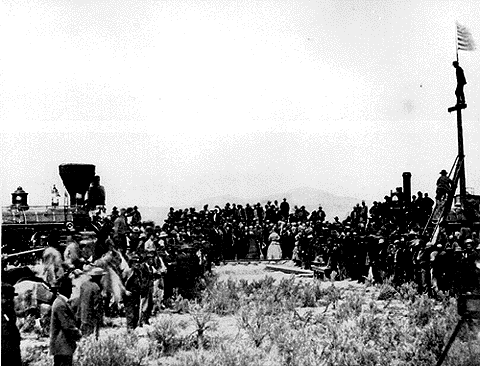
The Pacific Railroad is (almost) complete.


Promontory Point, Utah, May 10, 1869.

The "almost" refers to the absence of a Missouri River bridge at Council Bluffs, that came a few years later.  Four years after the end of the Southern Rebellion . . . DONE.

Happy 149th to the Transcon and let the stack trains roll.

For the sesquicentennial, Union Pacific (which now includes Central Pacific) plan to roll out Big Boy 4014.

8.5.18

A CORRIDOR, IF THEY'D DEVELOP IT.

We continue our excursion from Washington to points south.  With the Capitol Limited getting into Washington reasonably close to time, a same-day connection to any of the southern trains is possible.  But given the stakes on this trip, I did not want to gamble with a blown connection in Washington followed by a delayed arrival in Florida.

THE WAR OF THE TWO HERODS.

For V-E Day, Book Review No. 10 offers Brian Moynahan's Leningrad: Siege and Symphony: The Story of the Great City Terrorized by Stalin, Starved by Hitler, Immortalized by Shostakovich.  With that many levels of sub-title, you effectively have a Shrink Lit in free-form summarizing the plot.  The two Herods are invoked in a lament by stage designer Liubov Shaporina, "The horrors of [Stalin's terror] and [Hitler's siege] were a punishment that the intelligentsiya deserved," (page 90). Some of those intelligentsiya were attempting to hold body, soul, and Stalinism together in Leningrad; some awaiting torture and execution by NKVD, which kept up its work rooting out wreckers, saboteurs, and enemies of the people even as the Stukas were diving; and some, including Shostakovich himself, were contributing to the war effort in far-away Kuybyshev (once again, Samara) where there was a Secret Tank Factory, where it was a criminal offense to remark on the resemblance of the local military trucks to Studebakers, and where a few protected writers and composers could offer their support to the war effort.

Author Moynahan begins with two chapters on the Terror and the Invasion, then organizes the subsequent events month-by-month.  Much of the siege writing parallels Harrison Salisbury's The 900 Days (in what other siege did the restoration of streetcar service demoralize the besieger?)  We conclude with the Leningrad performance of the symphony (which had been performed, to mixed reviews, elsewhere, including in the United Kingdom and the States) followed by yet another Stalinist purge, and author Moynahan raising the possibility that composer Shostakovich was an ambivalent comrade, at best.

(Cross-posted to 50 Book Challenge.)

THAT TENSION BETWEEN OTHERING AND COOPERATING.

Arnold Kling (via Cafe Hayek) summarizes it thus.
Self-interest does not explain economic behavior. Instead, what we observe results from the complex interaction of self-interest, tribalism, and cultural intelligence. Both pro-market economists and their critics should try to resist over-simplification. None of us should under-estimate the importance of cumulative cultural intelligence, as reflected in the social norms and formal institutions that enable human cooperation in large-scale society.
The mediating institutions are emergent.  Getting the right mix of caution toward with openness to others is hard.  Mr Kling notes, "Tribalism makes us generous and egalitarian toward people we regard as familiar (note that the words “familiar” and “family” have the same root). But tribalism makes us hostile and suspicious toward people who are unfamiliar."  Overcoming tribalism (which probably conferred evolutionary advantages) is hard.
But for hundreds of thousands of years, we could not extend cooperation beyond the level of a tribal band. Instead, when two bands encountered each other, violence was a typical result. We are naturally inclined to fear and hate people outside of our own tribe.

Only in the last 10,000 years or so did we develop social institutions that enabled us to coexist somewhat peacefully in large societies. The first large societies that emerged were strictly hierarchical, in which each person knows his or her place, as in the Indian caste system. In these hierarchical societies, slavery was considered natural.

The major religions brought another binding force into human affairs. People were willing to trust strangers who showed that they followed the same religious rituals. The religions also began to steer us toward valuing the dignity of every human being.

Finally, a few hundred years ago, we began to seek alternatives to fixed hierarchies as means for organizing ourselves. Democracy and market capitalism emerged.
The forms that emerge, though, have a better chance of lasting if they confer evolutionary advantage.
To enable large societies to coordinate economically, there is no better institution than the market. In a market context, individuals make rational calculations of self-interest, but within a set of constraints that are socially constructed. When we deal with strangers, as we must in market transactions, we assume that while they are self-interested they also are committed to following a set of rules, both written and unwritten. The market cannot rely on self-interest alone. It would not function without these institutional norms, which must be socially enforced.

For economic purposes, tribal solidarity works at small scale. We can be egalitarian and altruistic in groups where we know one another and feel close to one another.

At a large scale, tribal solidarity does not suffice. We do not know how to coordinate to deliver the goods and services that we enjoy without using market prices. We do not know how to motivate people to choose occupations that serve the needs of the larger community except through self-interest.
Yes, and there are implicit rules of social construction, although social science has not yet looked in a systematic way for what those might be.

LET SOMEBODY ELSE SUPPORT SUSTAINABILITY.

A power company is seeking authority to build wind turbines not far from Cold Spring Shops headquarters.  People who will live or farm almost under the towers aren't happy.  "Many attendees wore stickers and brought in signs reflecting a stance against a wind farm being built in the county. Some said to the board during public comment that they are all for renewable energy for the county, but not in places where people live."  They raise the usual fears of ambient noise, and flickering sunlight.

What intrigues, though, is how quickly the wind turbines wear out (or become obsolescent?)
The board invited Lee County zoning administrator Chris Henkel to the meeting for a question-and-answer session about Lee County’s experience with wind farm decommissioning. Henkel said the county was one of the first in the state to have wind farms, and now it is starting to decommission them 13 years later.

Henkel said his county worked out an agreement with power companies that built the farms that they need to hold $40,000 a tower in escrow funds and give the escrows back to the county if the power companies decide to decommission towers.
The story is still developing, and I am seeing some "No Wind Farm" signs in nearby fields.

YOU CAN'T SANITIZE POLITICAL CLEANSING.

The Katyn Massacre monument that stood near the site of the Exchange Place station in Jersey City will be moved to storage during a planned reconstruction of the plaza, and it might not be returned to its current location.
Plans to relocate a memorial commemorating the massacre of tens of thousands of Polish officers by the Soviet Union in 1940 is facing opposition here in Jersey City and from the Polish Consulate.

The Katyn memorial, a 34-foot-tall monument depicting a bound-and-gagged soldier impaled in the back by a bayoneted rifle, has been a fixture at Exchange Place since 1991. The city plans to put it in storage during a planned transformation of the Exchange Place plaza into a public park, and the statue may not return to its current location.

Asked to comment, Poland's ambassador to the United States, Piotr Wilczek, said he is "concerned" about the sudden announcement that the memorial may be moved and by the "lack of dialogue" between the city and the Polish-American community.
It's not clear whether plans to move the statue reflect squeamish sensibilities, or fears by local businesses that in-your-face public art is unprofitable.
The park creation is a project of the Exchange Place Special Improvement District. Its chair, Mike DeMarco, who is also CEO of real-estate firm Mack-Cali, said it's the city's decision whether the statue remains there after the plaza renovation is complete. His personal preference is that it is moved elsewhere.

"I don't think the statue's appropriate for a major metropolitan area," DeMarco told The Jersey Journal. "It's a little gruesome ... I can't imagine how many mothers go by and have to explain it to their children."

DeMarco added that the notion that Russians are backstabbers is "not exactly a politically correct idea nowadays."
Um, mightn't that be good reason to leave the monument where it is, lest people take too sanguine a view of Russians, or of Stalinism?

7.5.18

IT'S THE MOST WONDERFUL TIME OF THE YEAR.

The end of the academic year for the retired academician, definitely.  Fuss at me for the schadenfreude if you must!

There's this tradition around Northern Illinois University that the final Friday of the fourteen weeks of instruction is a Reading Day.  That's mostly honored in the breach, particularly if summer has made an early appearance after April was more like "Uninstalling February ... please wait ...."

The spring sports are still in action, and the conference baseball and softball tournaments will take place next week, during exam week.  There oughta be a law ...


Interesting convention in college baseball, when the team with the ball has a conference on the mound the team batting gets to hold its own conference in the dugout.  Look closely, the director of operations for women's basketball is doing homework in the stands.


The recreation center at the university set up a kayak and raft rental near the lagoon.  Here some intrepid paddlers are exploring the upper dells of the Kishwaukee River.


Here's a resourceful way to get some studying in.  The recreation folks take a dim view of shooting those rapids.


Same idea, different part of the lagoon.


Make way for goslings!


Speaking of hammock time ...

That was two years ago, but the post-trip recombobulation is over and the weather is favorable.

THE TRIVIUM WAS NOT TO BE BREEZED THROUGH.

Jeff "Quid Plura" Sypeck posts a speech he gave to a gathering of writing teachers, "'The old wine of ancient learning': The medieval classroom and its lessons for modern writing instructors."

Go, read and understand, take your time, there's a lot to reflect on there.

CAN A TRAIN BE LATE IF IT NEVER GETS TO THE STATION?

There's a philosophical question worthy of Kant or Nietzsche, which is relevant because the way the Germans handle annulled trains changes the denominator used in calculating on-time performance.
Some 140,000 Deutsche Bahn trains never arrived at their destination last year. That awkward statistic was reported by the Rheinische Post based on a parliamentary question post by the Green Party.

That constituted a rise of 20,000 on the number of trains that broke down during the journey in 2016.

The figures show that 97,000 trains set off but never arrived at their final destination due to technical failures. Meanwhile a further 40,000 trains did not even make it out of the departure station.
The good news is, German trains generally run on memory-pattern schedules, sometimes on half-hourly or tighter headways. If one fails, it might be easier to put the passengers on the follower, and that might mean less disruption of the schedules, and better overall timekeeping, than if the operators make every effort to get the failed trains running.

WHY IT MATTERS.

Students debate issues peacefully, reports the Northern Star.
The Young Americans for Liberty and the NIU College Democrats held a debate Thursday night in DuSable Hall covering gun control, the concept of taxation and free speech.

Participants provided varying perspectives on gun control and the current climate, the concept of taxation as beneficial or disadvantageous and free speech pertaining to the right to refuse service.
No students or faculty were harmed in the course of this gathering, and nobody attempted to stop a presentation by yelling "Safety."  Well done.

6.5.18

IF YOU CAN'T BE FREQUENT, AT LEAST BE DEPENDABLE.

It has long been a Cold Spring Shops position that Passenger Rail operations be frequent, that trains make dependable connections with each other, and that the value is in the intermediate stops.

Let me offer, dear reader, a meditation on these themes inspired by the first leg of a recent trip.  There is a dependable Regional Rail connection that gets to within twenty miles of DeKalb.


That's a seven-car formation from Chicago that will form the 2.18 departure of Train 52 for Chicago.  There's no snow on the ground, but it's still chilly, and additional snow storms are on offer for the upper Midwest.  Below is the view out the back door on the morning of April 9, just before this adventure began.


We arrive Chicago as the evening rush is taking shape.  The Metropolitan Lounge is filling, as sleeper passengers from the arriving trains await the boarding call for their onward trains.  All the trains from the west are on time or close enough to time that Amtrak will not be providing lodging and arranging replacement space tonight.  There's now a vendor selling canned beer to complement the bag snacks and pop currently available gratis.  Buy a Blue Ribbon.

I'm holding space on Thirty, and understandably apprehensive about the tender mercies of Norfolk Southern across Indiana and Ohio.  Get to talking with a couple enroute somewhere in West Virginia on Fifty.  (You don't want a cross-country connection involving the tri-weekly Cardinal to blow up.)  Buy a round of Blue Ribbons.  They're called before Thirty is.

Amtrak 30 Capitol Limited, Chicago to Washington, D.C., 10-11 April 2018.

Genesis diesels 156 (in Rudolph paint scheme), 52
New baggage car 61060
Transition sleeper 39015, Superliner sleepers 32002, 32075, Cross Country Cafe car 37016, Sightseer lounge 33044, Superliner coaches 31008, 34096, 34084.

Leave Chicago 6.39 (by my watch, not synchronized with standard clock: with gates closed five minutes before scheduled departure, hold 7.30 reservation for dinner.

Here, a note on dependability.  Company at table includes two women of Fort Wayne who had made a day trip into Chicago to buy merchandise for a store one of them owns.  Neither had ridden a train before, both were enjoying the outing.  (Once upon a time, they would have had The Pennsylvania Railroad direct to Fort Wayne, and perhaps in the future they will have a corridor service linking Columbus with Chicago.)  They had opportunity for a sit-down meal, and the wait staff were properly attentive that there were passengers on a short schedule aboard.

But for how much longer?  The latest attempt by Amtrak to emulate the airlines might be the elimination of dining service on the Capitol (once home to the salad bowl and Deer Park spring water of Baltimore and Ohio) and Lake Shore (must we really mention the watermelon pickle of the old Twentieth Century?)  I'm not making this up.  Quoting Jim "Travel and Trains" Loomis, "I come across a press release from Amtrak announcing that there will be no more hot food for sleeping car passengers on the Capitol Limited and the Lake Shore limited.

"Instead, those of us riding in and paying top dollar for sleeping car accommodations will be able to order meals being prepared off site somewhere and delivered to our roomettes or bedrooms."

Did I mention the two women were riding coach?  If they have to schlep their own food aboard, they might as well be riding the bus.  Meanwhile, on the sleepers, will the food delivery be when the train passes a given location, no matter what time it is, and will it be tied to a train-order hoop the way the freight crews sometimes get fed?

The good news is, I didn't know this at the time I boarded, and perhaps buying a round of Pabsts satisfied the gods of the high iron.  South Bend 9.14 - 9.19; Elkhart 9.40 - 9.43; Waterloo 10.33 - 10.34 for the front end, 10.35 - 10.41 for the coaches.  Sack time, without the stress of sitting waiting for signals to clear.  Observe Toledo, Cleveland, and Pittsburgh without bothering to check times: that dark hour connection for Altoona, Harrisburg, and Philadelphia holds, but no through service linking Philadelphia, Pittsburgh, Cleveland, and Chicago annoys.

Next morning, decide to rejoin the world somewhere around Connellsville, somewhere around 7.30, on Baltimore and Ohio rails.  Cumberland two stops, 9.50 - 9.54 and 9.56 - 10.10; service stop east of town, Martinsburg 11.51 - 11.58; Harpers Ferry 12.20 - 12.22; Rockville two stops, 1.10 - 1.11 and 1.12 - 1.13; arrive Washington Union Station at 1.36.


Upstairs, into the station, there's a massive queue awaiting the 2.0 departure of a regional train that originates in Newport News and must use the southern tracks.  That's the downside of the food court and retail space being placed in the concourse area of Union Station, where the train gates, baggage claim, baggage checking, and the Club Acela lounge also are.  The queue stretches almost the full extent of the concourse.


That view dates to a previous visit, on 20 October 2014.  The space at far right of the photo is for passenger services and the departure lounges.

The old waiting room area, by contrast, is a great empty space.


In Chicago, Amtrak cope with the large passenger loadings and cramped space by using the Great Hall as ... imagine this ... a waiting room with benches, and passengers are escorted to their trains directly from there.  But perhaps that is a good problem to have, more passengers waiting to get on a train than there is space for them to wait, and at least for the present, they don't have to report an hour early for screening and check-in and all the rest, and on those high platforms, there are plenty of doors through which to board.

I may have to make a habit of buying a round for travelling acquaintances.  But dog-gone it, Amtrak, stop messing with the food service and degrading the first class.

STRIKING THAT BALANCE.

My extended hiatus from social media has been refreshing, instructive, and I did get some serious reading done.  There's likely enough stuff going on to provide plenty of content for the next month or so.  We'll start with Book Review No. 9, getting back to an area of work I have neglected since mid-February, featuring Amy Chua's Political Tribes: Group Instinct and the Fate of Nations.  Her thesis is straightforward, laid out in the first paragraph.  "[T]he tribal instinct is not just an instinct to belong.  It is also an instinct to exclude."  Or, as we would have it, "being receptive to mutually beneficial interactions with people who are in some way different also confers evolutionary advantages, and strategies that are safe for new adopters can be more robust than strategies that exclude all but old adopters"
What's bothering Professor Chua is that those tribal instincts have been present in places such as Vietnam and Iraq, where United States interventions turned out badly, and they might be emerging in the United States itself, where she characterizes the United States as a "super-group."  In her scheme, "a super-group is a distinctive kind of group: one in which membership is open to individuals from all different backgrounds ... .  Even more fundamentally, a super-group does not require its members to shed or suppress their sub-group identities.  On the contrary, it allows those subgroup identities to thrive, even as individuals are bound together by a strong, overarching collective identity."

It is a shame that Professor Chua does not rely on social scientific work in constructing her argument: it sounds much like, yet differs subtly from, a long-standing view of the United States as fundamentally an ideological nation in which people enjoy a great deal of individual autonomy provided they adhere to the general principles of equality before the law written into the Constitution and the Declaration of Independence.  Or, again, as we would have it, "give these kids an America to buy into, and an America that buys into these kids, and we'll be OK."

Unfortunately, what she sees happening in the United States is a variation on the tribal politics she has previously studied elsewhere, in which a "market-dominant minority" (her term: it overlaps but is not identical with Thomas Sowell's "middleman minority") appears to be rigging the system or dominating commerce to its own benefit and to the disadvantage of others less fortunate.  Think overseas Chinese in Malaysia or Indian merchants in Uganda and now consider Chinese merchants in Vietnam, something that might have been on her mind for years, or Venezuelans of primarily Castilian origins.

Her argument suggests that a market-dominant minority might be defined by shared aesthetics, rather than shared religion (the Sunni running Iraq) or ancestry (overseas Chinese, Jews) and that might be what's happening in the United States.  Page 6: "America's elites today, especially progressive ones, often don't realize how judgmental they are.  They disdain tacky [c.q.] things, and, not coincidentally, those tacky things -- fake tans, big hair, pro wrestling, chrome bull testicles hanging from the back of a big truck -- are usually associated with lower-income Americans."

In typical United States fashion, though, membership in the Credentialed Elite is open to anyone who buys into the right ideas and rocks the right status markers -- Ivy degrees, wine cellars, hybrid cars, soccer -- although, she argues, that membership is being harder to earn.  Once more, as we would have it, "accidental hegemony and of social development being somewhat messier than any one policymaker or committee of policymakers could control."  Now mix a tussle among Normals and cosmopolitans with a changing demographic in which the old ethnic spoils system of the big cities breaks down, and conditions in the United States could get very bad, very quickly.  Or not, as she concludes with a number of anecdotes, from her own experience at Yale and from conversations with others, in which people make efforts to work with each other despite the differences that ought render their methodologies incommensurable or their differences irreconcilable.

The endnotes to Political Tribes might reward careful study.  Professor Chua is evidently one of Yale Law's public intellectuals: for all her writing over the years about tribal interaction, her academic website makes no reference to technical writing.  She has, however, consulted and made reference to technical work in social psychology and politics, and there might be opportunities for further research in engaging the controversies she leaves open.

(Cross-posted to 50 Book Challenge.)
