16.9.25

PRIVILEGE CHECKING AT MILWAUKEE COMMUNITY COLLEGE.

The Milwaukee Brewers have ways of keeping players from getting too full of themselves.
Those in the Brewers organization insist there is no classified formula for their success, but the answer might be best summed up in an internal game the organization plays called the "Check Game."

"It started in the coach's room," Brewers manager Pat Murphy told ESPN recently. "To remind us, it's not about us. It's about the team. Anyone is fair game."

The rules of the Check Game are simple. If you talk about your own accolades, you get a check. If you try to defend yourself, that's a check. If you pass on blame to someone else, that might be a check as well.

"And if you bitch about a check, you get a bigger check," Murphy said with a smile.

"[General manager] Matt Arnold was a two-time defending champion. If he said something about a player like, 'We drafted him in Tampa,' that was a check."
It's not privilege shaming.  It's a tradition a generational player might not buy into.  It works as a team-building activity.
The point of the game exemplifies the concerted effort across the organization to align the different departments, so every voice is heard and valued -- and the game makes it clear to everyone that making the team better is more important than who gets the credit.

"The Check Game is a really important game inside the clubhouse and the culture and the ecosystem of the team," Brewers play-by-play announcer Brian Anderson said. "It's a little bit of a borderline shaming game, so if you're in it for yourself, you're going to get a check and you're going to be on that board.

"No one wants to be on that board."
The way baseball works, it might be the bottom of the order that has to start the rally and bring the top of the order up to bat, and thinking of yourself as that Little League kid remembering to protect the plate with two strikes and make the pitcher pitch to you gets you on base more effectively than trying to be what you're not.
The Brewers can go toe-to-toe with the $300 million powerhouses at the top of the National League standings because instead of trying to compete dollar for dollar, they've created the kind of unique environment that the Check Game fosters. It's a vibe that feels more like the atmosphere in a college locker room than what you would expect in a professional clubhouse.

As you make your way through American Family Field on game day, you come to understand that notion when you hear the team's manager, known simply as Murph throughout Milwaukee, refer to his first- and second-year players as "freshmen" and "sophomores."

Murphy, 66, coached 22 years at the collegiate ranks, first at Notre Dame and then Arizona State, and old habits die hard.

"We joke around with each other and say that it's Milwaukee Community College just because that's how we play the game and that's the kind of guys we have," Christian Yelich said. "And Murph's the manager and there's a lot more talks about fundamentals and baserunning and little details of a game that you might hear in college."

Murphy waves off any talk that his team performs fundamentals better than most. He even gets text messages about his club's ability to do the little things from friends -- but he won't take the bait and risk receiving a check in the game he helped cultivate.

"I don't think we have a secret sauce, and I don't think we do things that much better than anyone else," he said. "We've got a great group that competes. We're under construction. We're not setting limits on what we can do. How do we get better today? That's the emphasis. That will always be the emphasis."
So this season has gone.  "After making history at Yankee Stadium for a number of the wrong reasons, the Milwaukee Brewers won their home opening series."  You don't give up on the season after a week, you steal a lot of bases on Easter Sunday, you cash in on the George Webb promotion, and you better not let up once you're the first team into the playoffs.  Maybe mentioning the playoffs too loudly gets you a check.

THEIR SALARIES DEPEND ON "DOING SOMETHING."

According to Reason's J. D. Tuccille, "After Charlie Kirk's Murder, Politicians Can Back Away From the Brink, or Make Matters Worse."  A suspect, and perhaps some accomplices, are in custody, but it's the usual slanging match in Washington.  In the manner of Shakespearean actors, the elected officials play to the groundlings.  "In a country of widely disparate values, divergent ways of life, and policy preferences to match, people are moving to live with their political tribes and apart from their opponents even as the political class increasingly centralizes power and rules from the top down."  You get a lot of sound and fury, and it signifies nothing, because each faction, upon securing a controlling majority in Washington, uses that power to the benefit of its own groundlings.
Republicans and Democrats alike treat winning political office as winner-take-all opportunities to transform the country and jam their agendas down the throats of the losers. The result has been escalating frustration and a willingness to look to extreme tactics against political enemies.
Maybe, in the way Winston Churchill has it, as a last resort, Americans will try the right thing.
Charlie Kirk's assassination was a very unwelcome example of offline action.

So, will the political class keep beating war drums? Or will they step back from escalating the conflict? If they really seek to improve matters, politicians could start by shutting up and leaving us alone.
As we prepare to post, the protest and demonstration scene is calm apart from a few campus skirmishes.  We'll have an opportunity to take stock next week.

MANAGING EMERGENCE IN THE NEIGHBORHOOD.

When there are no visual cues to drive slowly, people don't drive slowly.


Posting speed limits?  That's a fool's errand.
Too many streets, though, give drivers all sorts of clues that it's OK (not legal, not safe for kids, dogs, or basketballs) to go fast. There's a neighborhood speed limit of 25 governing the streets serving Cold Spring Shops headquarters, and yet the street in front of headquarters provides a convenient, relatively free of parked trucks, shortcut from the townhouses to the mile road. I'm not saying it's an expressway, and yet an early evening on my deck with a radar gun might be instructive.
All over northern Illinois, the neighborhood speed limits are at odds with the visual cues.
Eric Olson explains the phenomenon to readers of DeKalb's Daily Chronicle.
After driving long enough on a regular basis, people tend to develop a kind of intuition about what the speed limit should be in an area just by surveying how many lanes there are, what kind of pavement there is, how many stoplights there are, whether the road is in the country or in town.
What intrigues him is the proposal by Sycamore authorities to reduce the speed limit on a stretch of road that's signed for 45 yet winds around in such a way as to appear more safe at 40 or so.  What's more commonly the case in Illinois is roads that provide visual cues to go faster.  Such roads, which perhaps might better be described as stroads, have speed limits that appear to be too low.
Indeed, and thus the bizarre phenomenon that the same two-lane section road might be signed anywhere from 25 to 45 in otherwise similarly settled areas, while the stroads and boulevards might be posted from 35 to 55. This week, DeKalb posted a stretch of a section road still in farm country that was 55 down to 45, and the stretch that was posted 45 is now 35.  For all the attention anyone is paying to the change.

HIGHER EDUCATION IS BEYOND PARODY.

The house organ for all wokeness, all the time, in higher education, lets Cherian George sound off.  "The killing of Charlie Kirk highlights the need for universities to foster counter-polarizing dialogue, not commodified debates."

Any time somebody uses "commodified" In All Earnestness, you know that the nonsense will flow freely.  So let it be with Cheri.
The killing of political activist Charlie Kirk has thrown into sharp relief the hostility between conservatives and progressives and between champions of free speech and crusaders against hate propaganda. It also highlights a less obvious dichotomy: between a marketplace of commodified opinion, on the one hand, and seedbeds for deliberation and dialogue, on the other. The former dominates the political culture in open societies. The latter is what universities urgently need to cultivate.

The New York Times columnist Ezra Klein privileged the ethos of the marketplace in his immediate response to the news of Kirk’s death. “Kirk was practicing politics in exactly the right way. He was showing up to campuses and talking with anyone who would talk to him.
Because universities have been doing such a good job cultivating deliberation and (genuine) dialogue.  As far as Mr Klein's column, I excerpt heavily from it here.

15.9.25

CUT THE CRAP AND TALK LIKE A NORMAL ADULT.

Josh "Disaffected Newsletter" Slocum has had enough of "I feel" where "I claim" or "I suspect" are more to the point.
Adults did not sound like this in the 1980s. Almost no one said “I feel that taxes are too high.” They said, “Taxes are too high.” Notice that they didn’t even qualify it with the slightly more assertive “I think.” Why? Because we all already know that, because you are making this statement, this statement is “what you think.”

“I think” became “I feel,” and both became necessary to buffer simple, direct statements. Or, seen another way, typically masculine statements.

It’s a socially required ritual apology. You may not ever have though about it directly the way I’m putting it out there under the microscope here, but you know it’s true. Somewhere inside, you “feel” that you “have to” pre-apologize for making a direct or declarative statement.

Readers, friends, countrymen—this is fucking nuts. It’s a lunatic feminine overreach and I’m well tired of it.

Every day online, and now in the real world, I feel the pressure to pre-apologize. To qualify. I’ve internalized the idea (and you have, too) that making declarative statements is a per se act of aggression. That it’s normal for others to react to declarative, unbuffered statements as the speaker “judging” them.

This is not normal. It’s bullshit. It’s kindergarten-teacher bullshit.

I resent it, which is why I’m writing this. Secondarily, I hope this gooses the “I feel like” out of some of you, maybe for the first time.

While it started with women in the simpering professions, it has metastasized to all professions and industries. Men are doing it as much as women. And also? Women didn’t speak this way when I was a kid. They were actual grown-ups just like men.

Years ago when I first slipped into this habit of “I feel,” or “In my view only, not saying it’s true for you,” I resented it but I didn’t know why. I knew something about it was smarmy and dishonest, but I couldn’t put my finger on it.

Now I know what it is. It’s feminine longhouse control. The unspoken demand to pre-apologize and pre-soften any statements is a filtering mechanism. It shows others who is pliant and plastic, who will mouth the right phrases, who will perform the required self-abnegation ritual, and who will not.
Flaccid speech betrays a flaccid mind, indeed.  But so it goes in the world of Inclusive Euphemism.  Now, apparently, the Royal Yachting Association has pronounced anathema on "Man Overboard."
The national governing body for sailing, which was founded in 1875, urges members to use language which "honours and values" women and non-binary people within the sport and recreational activity and avoid the terms that "might not be comfortable for a person who recognises themselves to be a woman or non-binary".

The guide suggests that the phrases can still be used to "raise the alarm where a person has fallen overboard to initiate the emergency procedures", but outside of these situations "person in water" is advised.

Critics said the new language guidance would have past sailors from previous eras "turning in their graves".

The Royal Yachting Association guide states: "Some language in sailing and boating environments might not value or represent people who identify as female or prefer gender neutral terms.
Some people are crusin' for a keel-haulin'.  And founded in 1875.  Youngsters in the scheme of Wisconsin yacht racingAhoy, non-binary swabs!
Talk like a normal adult, indeed.

DALLAS DID NOT KILL JACK KENNEDY.

What turned out to be Charlie Kirk's final tweet invoked another story that has riled up the Normals.  I'm only able to quote the text of the post.  "If we want things to change, it's 100% necessary to politicize the senseless murder of Iryna Zarutska because it was politics that allowed a savage monster with 14 priors to be free on the streets to kill her."

Weekend public protests in the wake of Mr Kirk's death tended to be mannerly mourning.  Perhaps the cooler heads will prevail.

EMERGENCE CAN NOT BE NUDGED.

Regular readers know why.  I never lack for opportunities to riff on that phenomenon, though, particularly when people who think they have the answers neglect the laws of conservation in economics.  "For decades, a misleading narrative about mental illness among the unhoused obscured the true source of the crisis: hyper-commodified housing."  That's Ben McCarthy in The (Misnamed) Progressive.  As is often the case, the problem is not too much "commodification," it is too little.
[E]lected officials and the coalition of policy advocates behind them argue that untreated mental illness and substance use are a core cause—if not the core cause—of skyrocketing homelessness in the United States. Unhoused people, the narrative goes, are primarily homeless because they have failed to accept treatment and can no longer be easily forced into it. In fact, the primary cause of homelessness is a nationwide shortage of affordable housing. Millions of units of government-subsidized housing from decades past have been lost even as market-rate housing grows astronomically more expensive.

In casting the problem as an epidemic of individual pathology rather than one of political economy, these leaders have ignored the obvious economic reality: The rise of homelessness has resulted primarily from the hyper commodification of housing. In New York City and much of the United States, urban studies scholars Peter Marcuse and David Madden write in their book In Defense of Housing, “housing is becoming ever less an infrastructure for living and ever more an instrument for financial accumulation.”

The truth is that [New York mayor Eric] Adams’s and others’ rhetoric surrounding mental illness and homelessness stems from a decades-old misleading narrative that has fundamentally distorted the public discourse around both housing and mental illness alike. As private equity firms have purchased hundreds of thousands of rent-stabilized apartments in New York City over the past twenty-five years, this false narrative has served the interests of a political class beholden to the entire real estate industry. In doing so, it has caused real harm to some of the most vulnerable New Yorkers by attempting to decouple their material conditions from the economic and political forces that shape them.
Look, this is not difficult.  Note, there is no shortage of housing per se, there is what the authors refer to as a shortage of "affordable housing," and they persist in their delusion that if you pass a law that makes housing "affordable," there will be affordable housing.  Sorry, no.  On Manhattan, and in San Francisco, and anyplace else where there are serious agglomeration economies favoring high-value-added work, the real estate on which those rent-stabilized apartments sit will be seriously expensive.
Two principles of land use immediately emerge.  First, [the highest value added activities]have a ceteris paribus advantage in bidding for any parcel of land.  Second, activities that encounter higher transportation costs lose advantage at greater distances.  Thus, in the two-century old model, dairy products command a high price and spoil (we're before mechanical refrigeration or railroads, recall) quickly, thus those will be closest to the city, but dairies will be out-bid by timbering or cornfields or ranching.

Introduce mechanical refrigeration and railroads and motor trucks, and the highest bidders for land might be factories or restaurants or households.  The principle is the same, though, the value of a parcel of land will be one at which a householder is indifferent between locating there, or locating somewhere else.  The model as modified still predicts falling land values at distances from the city center.  Thus, we'll see additional margins along which people might substitute, such as suffering the transportation costs but being able to live in a bigger house: easier for a faculty member at Cornell than it might be at Northwestern or at Stanford, where faculty qualify for housing subsidies.  The underlying principle is the same: in equilibrium a householder will be indifferent among the bundles of location and housing type offered.  Because that equilibrating tendency leads to similar houses clustered together, providing temptations for builders to put down cookie-cutter developments, Wise Experts think they can dictate neighborhood form with zoning codes.  That works until new price incentives emerge.

But will we ever see a central business district that generates so much in the form of locational rents, in the presence of so small a transportation cost, for knowledge or financial industries (and there are reasons to suspect that it will be knowledge or financial industries, not manufacturing) that the service businesses get priced out, and the only land devoted to housing of any kind is at a distance, as appears to be happening in San Francisco, but not yet in Chicago?
If I remember correctly, New York's "rent stabilized" apartments stabilize the rents for the duration of the tenancy or until the property changes hands.  Thus, the current residents of those apartments might be people who landed on Central Park West and thought they were Aaron Judge, and they're making a good living in finance or broadcasting or entertainment, squatting, if you will, on the affordably priced rentals.  The logic of the land rent gradient, though, suggests that at the passing of those tenants, or at sale, those properties are worth a lot more than the capitalized value of those stabilized rents.

Isn't rent control marvellous?  In stabilizing the rents in the face of locational agglomeration economies, public policy makes the buildings themselves so valuable that only private equity can buy them.

12.9.25

BOTTOM STORY OF THE WEEK?

Plus Size Model Ashley Alexiss Says It’s ‘Really Sad’ She’s Not Considered a Role Model After 100-Lb. Weight Loss.  I can't very well say this post is on the lighter side, can I?
Ashley Alexiss is opening up about how her 100-pound weight loss has changed the way some people view her and why she’s determined to stay true to herself.

“I often get comments and stuff that I’m no longer a role model or I’m no longer someone that someone can look up to,” Alexiss tells PEOPLE exclusively. “And I think that that’s really sad because I went through a life-changing loss. I lost my dad, and my dad was my best friend.”

The former Sports Illustrated model, who spent 15 years building a career in plus-size fashion, says the transformation wasn’t intentional. “About two and a half years ago, I gave up drinking. I was kind of just tired of feeling like a--. Like, having a few hours of fun and then having to essentially pay for it for two days with a hangover. My body just didn’t metabolize alcohol well. And also in the midst of that, my dad was battling cancer and he actually passed away a year ago yesterday.”
Just like those solipsistic woke folks.  The lady loses her dad and she's doing a couple of things that will be good for her health and the identity politics types shame her for taking care of herself.
Alexiss explains that grief had profound physical effects. “It changes your mind, it changes how you operate. And it had physical effects on me as well,” she says. “I think that a lot of people assumed that I wasn’t happy in my body or that I was ashamed of it, which is so far from the truth because I spent 15 years being a plus-size model, and my motto has always been, ‘Beauty is not a size.' And I think that still rings true. Being 100 pounds lighter, it doesn't change."

But navigating a new body hasn’t been easy. “I will say that it has become more difficult to learn to really appreciate this body because I spent so long fighting for my plus-sized body to be accepted and to be noticed in a way that was respected based on societal standards. And it's been a challenge,” she says.

“A lot of people think, ‘Well, now you’re skinny.’ And I’m like, ‘Mm, yeah. But I’m also getting the attention and respect that I should have gotten 100 pounds heavier.’ Like, that doesn’t change. A person is still a person whether they’re 215 or 115 [pounds].”
Yes, a person's a person, no matter how small (or large); and yet those "societal standards" might confer evolutionary advantage (and save air passengers from having to buy two seats?)  Note who she's putting a ring on it with.
I’m recently engaged and I’m prepping for our wedding. And doing all the things of being a bride while also grieving is a challenge, but I’m trying to do the things that make me feel the best version of me so I can be the best version for my fiancé, as well."

Her fiancé has also been a source of constant support. “He is a fitness addict. Like, he's in the gym every day, It's nice because he doesn’t push that on me. He lets me still be me. And whatever that looks like, whether it’s being a couch potato or wanting to go run around Coachella, he supports that, and I think that’s really important.”
Mazel tov.

TURNING POINT, AMERICA?

Along with the measured responses to Charlie Kirk's murder there's a lot of seething online anger.  Start, dear reader, with Hot Air's David Strom smacking the critical theory commonplaces down.
You have to understand the fundamental principle of modern Critical Theory, which is that words are weapons, and using the wrong words, even if they are "true," is an act of violence. And, modern leftists believe, violence of this kind should be met with violence in the world. Shooting Charlie Kirk because he said the wrong things wasn't violence, but self-defense.
That's an idea so crazy only an intellectual can believe it, and, unsurprisingly, they do.
It shouldn't shock you that randos on the internet celebrated Kirk's death, but it should shock everybody that teachers, professors, and Deans of colleges are. They are not random people, but ones who are in positions of responsibility who teach the next generation how to think and behave.
As do street preachers.
This Chicago-born suburbanite brought all of the racial innuendo to political speech and rhetorically violated the safety and security of Blacks, people of-color, the LGBTQIA community, perverted the history of race and racism in America, attempted to legitimize the nation as a white bastion of civilization and Christianity, and in general perfected the use of racial and hateful language and molded it into a form of acceptable and legitimate political debate and viewpoint.

But the legitimate debate aspect was far from legitimate historical benign speech, nor was it nonviolent in character. In fact, it touched all of the refrains of the vile language of the past that resulted far too many times in lynchings and other forms of racial violence and upheaval.
That seems to be the talking point at Common Dreams.
We can honor the sadness millions are feeling over Kirk’s murder, and maintain basic civil human decency, while also being honest about the deeply harmful and offensive things Charlie Kirk said. We can condemn political violence and Kirk’s murder while also condemning Charlie Kirk for the rotten, vile hatred he fomented.

And yes, while respecting that many are mourning, this is precisely the time to remind people of the hatred and division Kirk sowed and profited handsomely from.
That post goes on to argue that words are violence.  Such a totalitarian idea, and it's breeding resistance.  Connecticut senator Chris Murphy, who cheats on his wife, is not doing much to lower the temperature.  “We're in a war right now to save this country. And so you have to be willing to do whatever is necessary in order to save the country.”  That's what some of the participants in the futile and stupid gesture in the Federal Capitol also believed.

POLITICAL ECONOMY IS HARD.

Look, it's probably not sporting to pick on Common Dreams contributors such as Jackson Diianni.  "Every other developed country guarantees healthcare to all citizens as a basic human right. We’re essentially the only ones that decided to turn our health into a commodity."

YOUR LUXURY BELIEFS GET PEOPLE KILLED.

I've long feared that there are suburbs and small towns one flash-mobbed convenience store away from going sundown.

It might be that one knife attack on the rapid transit will have the same effect.  Free Press contributor Kat Rosenfeld builds that case.
Until the aforementioned security footage from that night was released—footage that shows not just the moments leading up to [Iryna] Zarutska’s murder, but the horrifying aftermath as Brown stalks up and down the car leaving a literal trail of blood in his wake—the story oddly flew under the radar. It did so for the same reasons that it’s now become a flashpoint in the online discourse about crime, disorder, and public safety in American cities today.

For conservatives, this incident seems a slam-dunk indictment of the progressive attitudes toward policing and criminal justice that emerged in the wake of the 2020 police killing of George Floyd—and accompanying policies that make it virtually impossible to keep serial offenders off the streets. Commentators on the right have noted, correctly, that Brown had a history of violence, a lengthy criminal record, and well-documented mental health issues; he never should have been on the train that night, and if not for having been released pending trial for his most recent offenses by a sympathetic judge, he wouldn’t have.

The greater issue is a cultural one: a growing frustration with what often feels like limitless tolerance for public disorder and antisocial behavior—and with it, a sense that one must not only avoid discussing these things to remain a liberal in good standing, but actively pretend they don’t exist.
Can you think of a better indictment of luxury beliefs?  Suggest that maybe some people ought be in prison or the insane asylum for a long time, and risk not being invited to the next wine tasting.
The problem with this taboo around certain uncomfortable truths about public disorder is that when you make discussing those truths a thing that is Simply Not Done by decent progressive people, you leave the field of discourse wide open to the kind of person who cares about neither progressive politics nor decency. That is where we are now.

Good liberals, for instance, would rather die than address the fact that Decarlos Brown Jr. is not just homeless and mentally ill but black, as people who perpetrate this kind of violence disproportionately are. In lieu of a thoughtful, data-driven conversation about why this might be and how to solve it, discussing this fact is now the gleeful and exclusive purview of trollish accounts.
Catch the False Dilemma, dear reader?  It is simple enough to have a thoughtful, data-driven conversation about the way luxury beliefs don't work out, on the rapid transit or in the streets, that establishes the indecency of progressive politics.  Ms Rosenfeld sort of gets it.  "Nowhere is that clearer than in a well-intentioned attempt to give the mentally ill more agency that instead resulted in vastly fewer people accessing the care they desperately needed."

FIFTEEN MINUTES OF FAME?

"Cynical Publius" has a lot of fans at Twitchy, and his posts are often insightful.  A day ago I clipped an excerpt from one of his longer missives and reposted it.
This morning, it turned up as the graphic above a Craig Shirley post at Conservative HQ.  The post itself is a litany of Abufes and Ufurpations.  A sampling:
A Senator Bernie Sanders supporter shoots a GOP congressman and Sanders says nothing, tacitly endorsing it.

They burn and destroy Elon Musk’s auto dealerships simply because they disagree with him.

They try twice to assassinate Donald Trump and the left either yawns or cheers them on.

They killed Charlie Kirk because he dared to utter words and ideas they want to exterminate.

And when a prayer for Charlie Kirk and his family was offered on the floor of the House of Representatives, Democrats hoot and yell and shout it down.

It has come to this.
What it has come to is the punishment cycles of the grim strategy outcome.

It doesn't matter that for each item on the list, there is a deflection to something not on the list that the opposition doesn't like.

It doesn't matter that for each compare and contrast, e.g. "We are the producers. They are the consumers; We are the productive members of society. They are the destructive members of society; We believe in construction. They believe in destruction," there is, somewhere, a script-flipping invoking capitalist exploitation or environmental decay or cronyism or that Existential Threat to Our Democracy(TM).

It doesn't matter that for each right-populist invocation of "walking on eggs" or "cancel culture" there might be a True Believer saying "So's your influencer."
But once again, lefties are held to a different standard from righties. And I’m frankly tired of having to be the one who is reasonable. One of these days I’m going to get very tired of being reasonable.
Kurt Schlichter could not have put it any better.

Breaking out of the punishment cycles becomes ever-more challenging.

11.9.25

CIVILIZATION IS NOT BUILT BY VIOLENCE.

Yesterday, Turning Point U.S.A. founder Charlie Kirk was shot while tossing red ballcaps into a crowd at a Utah university.  My title quotes Donald "Cafe Hayek" Boudreaux, who posted excerpts from several of the more restrained reactions to the news.  There's plenty of less restrained stuff circulating.  You won't find any of that here today.

Ezra Klein, who probably agreed with very little of the Turning Point policy plans, also writes wisely.
The foundation of a free society is the ability to participate in politics without fear of violence. To lose that is to risk losing everything. Charlie Kirk — and his family — just lost everything. As a country, we came a step closer to losing everything, too.

We’ve been edging closer for some time now.
Yes.  At least for today, the "edging closer" is still in the form of invective on social media.
Kirk, the founder of Turning Point USA, was gunned down during a speech at Utah Valley University.

You can dislike much of what Kirk believed and the following statement is still true: Kirk was practicing politics in exactly the right way. He was showing up to campuses and talking with anyone who would talk to him. He was one of the era’s most effective practitioners of persuasion. When the left thought its hold on the hearts and minds of college students was nearly absolute, Kirk showed up again and again to break it. Slowly, then all at once, he did. College-age voters shifted sharply right in the 2024 election.
I submit, dear reader, that the "shifted sharply right" among younger voters might have been more about applying the brakes on the corona tyranny and the Student Affairs curriculum than a ringing endorsement of Trumpian populism; and yet, tossing red ballcaps around and inviting people who disagree to make their case is exactly what persuasion, nay, what the academic enterprise, is supposed to be about.

THOSE ENUMERATED AND LIMITED POWERS.

Law and Liberty's John McGinnis correctly notes, "More Government, More Gerrymandering."

Well, yes.  Cold Spring Shops suggests, at least once a week, sometimes once a day, that the best thing for government to do is to go away.

COMPETENT PEOPLE?

Inside Higher Ed editor Sara Custer laments the new strings the Trump administration is attaching to funding the universities (news flash: there have always been strings attached, there's a post in preparation noting the same) and asks, "Who is going to rebuild higher ed after it’s dismantled?"

Higher education has been doing a pretty good job of self-dismantling for thirty years.
Where are we now?  Regular "college bubble updates" on Pajamas Media.  A political economy of inequality that touches on tax cuts at the same time the U.S. News problem suggests a flight to perceived quality of higher education, a flight that I fear is more about being able to mingle with and form networks of high achievers, rather than to hear from the very best Mr Chips regularly.
Maybe money-hemorrhaging jokes run by idiots might do better by reclaiming the good of the intellect and returning to the norms of civilized discourse.  If that means turfing out more senior administrators and the editors of the house organs for all wokeness, all the time, and for business as usual publishing acts of contrition and retiring to their wine cellars all the better.

10.9.25

MY PARENTS SALVAGED THE PEARL HARBOR WEATHER LOGS AND ALL I GOT WAS A T-SHIRT.

Why did those weather logs wind up in California?
In the 1970s, Oretta Kanady was working at the Norton Air Force Base in San Bernardino, California, when she noticed an old logbook in the trash. She didn’t know what it was, but she asked her superiors if she could keep it. They said yes.

When she got home, she gave the tome to her teenage son, Michael William Bonds. He never examined it closely—but he kept it.

“I’ve had it ever since.”
He's now 65, and he recently looked at it.
The volume turned out to be a logbook from the naval base at Pearl Harbor in Hawaii. Now, half a century later, the National Archives has recovered the text, which includes records from before, during and after the attack on December 7, 1941.

At more than 500 pages, the logbook contains “regular, handwritten entries from March 1941—when war in Europe was raging but prior to the entry of the United States—to June 1942 at the Battle of Midway,” according to a statement from the National Archives.

Bonds didn’t recognize the logbook’s significance until last year, when he moved in with his fiancée, Tracylyn Sharrit, in Hemet, California. She was helping him unpack his books when she noticed the mysterious volume. Every page that had been filled in featured a stamp at the top, which read either “Pearl Harbor” or “Pearl Harbor, T.H.”—short for Territory of Hawaii.

The logbook recorded the barometric pressure, air temperature, water temperature, wind direction, wind force and weather every four hours, as well as the names of the ships that came and went each day. It also featured a section at the bottom of each page titled “remarks.”
Yes, there were some interesting remarks.  I wonder if someone in the Pearl Harbor office brought it to California for safekeeping.  Strictly speaking, that logbook is still Federal property, and it has been delivered to the National Archives with a whole lot less fuss than any of the last two presidents' document boxes.  "A special agent with the National Archives flew to California, and the couple handed over their discovery. As gratitude, they received two National Archives T-shirts."  The pages have been saved to pixels.

And now you know the rest of the story.

ANTIRACISM IS A TOOL OF THE BOSSES.

Yes, I'm deliberately borrowing a communist commonplace.  "Racism is a tool of the ruling class to divide the working class and to stop them locating the root of their exploitation."  Now, maybe that's not a proper commonplace.  "Examples of such analyses are unfortunately abundant in the Marxist-Leninist movement. Progressive Labor Party (PLP) provides only the most blatant of these analyses in their documents on divisions within the working class. For example, they state, 'Racism is the bosses’ key weapon...to keep workers divided and unable to challenge union misleadership and exploitation of all workers – Black and white.'"  Is there anything so pathetic as the sectarian disputes among communists?  So many big words.  So many run-on sentences.  So little content.  And yet, the commonplace persists.
Racism is among the myriad tools capitalism relies on to keep workers ground down, distracted and failing to see the class reality at the core of the system. Workers can improve their own lives only by casting off the divisions spurred by racism and all such oppression. Likewise, racism can be ended only when the economic structures that uphold it, along with all other forms of oppression, are destroyed and replaced by a system geared around meeting people’s needs, not generating profit. This was the political conclusion of Marx’s Capital, and it remains as relevant today as when it was written.
Capital does none of those things, although it posits an interesting business cycle of capital accumulation that culminates in the destruction of those economic structures.  But nowhere in the twenty-odd chapters leading up to that apocalypse do we find anything referring to the so-called "late stage" capitalism that generations of communists have proclaimed to be all around us.

DEVELOPING YOUR INTUITION.

I've long been a fan of Armen Alchian and William Allen's University Economics (there are variations using different titles that are also useful) in part because of the end-of-chapter imponderables.  As the academic year gets into full swing, here's Econ Log's David Henderson offering one of my favorite questions.
Evidence of the very extent of specialization of knowledge is provided by Albert Einstein’s assertion just prior to his death (Socialist International Information): “The economic anarchy of capitalist society as it exists today is in my view the main cause of our evils. Production is carried on for profit, not for use.” Give evidence of your superiority over Einstein by exposing his error in economic analysis.
It's easy enough to answer if you understand trading for mutual gain, and yet there are enough conscience-cowboys running around who think "production for use" is a Deep Profundity that knowing how to ask the right questions of such a conscience-cowboy is a useful skill.

The post concludes with another Imponderable that will reward careful thought.  "We often see apparently intelligent people, observing that the share of income of the bottom 20% has fallen, argue that the poor are getting poorer."

The reward in teaching, dear reader, whether it is kindergarteners or doctoral candidates, is in allowing the youngsters to grapple with the Imponderables until the penny drops.

9.9.25

WASTE NOT, WANT NOT.

It's possible that the millionaire next door dresses the kiddos in hand-me-down clothes, or goes thrifting.

Northern Star columnist Byrdie Seda advises her classmates to live like the millionaire next door.  "It’s OK to wear thrifted, second-hand or cheaper clothes."

The subtext of her column?  Students at a regional comprehensive mid-major ought live prudently.
It can be difficult to find fashionable, current and affordable clothes in today’s economy— especially with social media usage growing rampantly, wanna-be influencers portraying lavish lifestyles and fancy outings that feature countless luxury items.

It can be difficult for people to not feel left out if they aren’t also having those experiences.

The reality is, most people overhype their life on social media and post the highlights of their life and nothing else. They often splurge on things they don’t need such as, fancy cars, expensive jewelry and lavish decor, just so that they can show off.

This sort of mindset also tends to follow people into the real world, causing them to feel that they not only have to follow trends on the internet, but also in real life.

This mindset also causes many young people, especially Generation Z, to feel an immense amount of pressure when it comes to how they present themselves and what they wear. The amount of money that people spend under the mindset of wanting to fit in and the culture of overconsumption causes a lot of mental, environmental and social consequences, which is why buying second-hand clothes is a far better option for people nowadays.
I'm eleven years into retirement, and thus cannot offer any from the field observations of sorority rush these days.  I do not recall the sort of positional arms races that seem to be all the rage in the Southeastern Conference these days going on in DeKalb.

GOVERNMENTS WORK FOR THE PEOPLE.

Virginia senator and failed vice-presidential hopeful Tim Kaine got himself nominated for the Golden Moutza award for sort of suggesting it's the other way around.
Kaine, a self-professed Catholic who supports abortion, shocked Americans a few days ago when he declared it “extremely troubling” to say rights come from God rather than the government.

“The notion that rights don’t come from laws and don’t come from the government, they come from the Creator — that’s what the Iranian government believes,” Kaine said Sept. 3 during a Senate hearing. “So, the statement that our rights do not come from our laws or our governments is extremely troubling.”

It’s extremely troubling to me that a Malaka can be a Senator. You fool Kaine. Ever hear of the Democrat from Virginia Thomas Jefferson? He wrote the Declaration of Independence explicitly stating that our rights come from God.
My Chicago Boyz colleague Mike calls out "The Malignant Idiocy of Tim Kaine."  The idiocy is even deeper, as the senator elaborated on his Iranian remark this way.  "It’s a theocratic regime that bases its rule on Sharia law and targets Sunnis, Bahá’ís, Jews, Christians and other religious minorities. And they do it because they believe that they understand what natural rights are from their Creator."  Put another way, the mullahs base their rule on a corollary to the Divine Right of Kings.  "The 'endowed by their Creator' passage vesting rights in individuals is a rebuttal to the divine right of kings: it was not the Hand of God that made the Stuart Tudor Hanover Battenberg Windsor family Defenders of the Faith, Emperors of India, and sovereigns over British North America."  Writing to a slightly different situation, Matt "Dean Dad" Reed explains that passage in the Declaration thus:  "There may be hierarchical roles for various reasons, but the people occupying those roles are just people. They have the same human flaws as everybody else. And the power they’re granted is both a grant—that is, removable—and for a limited purpose. It is not license. Nobody is entitled to abuse anyone else, and nobody deserves abuse."

A MILLION BUCKS DOESN'T GO AS FAR AS IT USED TO.

Common Dreams contributor Paul Buchheit has long provided us with entertainment, and, despite retiring from his academic gig, he's still amusing.  "A Challenge for Democrats: Getting the Stockholders to Embrace a Stockholder's Tax."  By which he's referring to that misnamed "income tax" in Monopoly, in which the player can decide to fork over $200 to the bank, or work out his net worth.  Apparently it's prudent to fork over the $200 rather than make the calculation after the third trip past Go.

Paulie thinks it's a good idea.  "There are many good reasons for stockholders to welcome a modest annual tax on stock holdings, chief among them that this would be an investment in America. But somebody is going to have to make that argument."

Why?  Follow the money.
The wealthiest 10% of Americans own 93 percent of the stock market. (The richest 10% of U.S. adults approximately matches the number of U.S. millionaires.) And fortuitously, for them, most of their windfall has derived passively as the S&P 500 has gained a pre-inflation average of over 10 percent annually over the past half-century.
Put another way, there's been enough inflation that just about anybody who salted any money away was in a position to become a millionaire.  That pre-inflation increase in the value of stockholdings?  Not so spectacular.

8.9.25

GENAU.

Red State's Ward Clark correctly notes, "If you have to adulterate a beer, then it's not good beer."

Exactly.  "A proper beer has only water, barley, yeast, and (not too many) hops."


Mr Clark demonstrated an appreciation for those traditional Milwaukee brewers.  "We Boomers grew up in the halcyon days of cheap American lagers that were best drunk ice-cold, and after a long, hot day out in the sun, there was nothing quite like an icy-cold can of good old American lager."

These days, alas, those traditional Milwaukee beers all come out of the same factory.  They're still closer to proper than not, as in not overly hopped, not given overtones of citrus (and who let those wine snobs into the conversation), and as for that wedge of lime in a Corona, well, Mr Clark might have just caused an international incident.  "I'm reliably informed that the original purpose of that, in Mexico, was to keep flies out of your beer (yuck), and besides, Corona tastes like river water anyway, so a lime or lemon wedge could only help."

It IS Oktoberfest season, and there are a few more pleasant evenings to quaff a Marzen, and maybe enjoy the sunset and the moonrise.

Prosit!

WE COULD RETURN TO THE NORMS OF INTELLIGENT DISCOURSE.

So suggests Reason's J. D. Tuccille.  "The idea that you wait your turn to speak and then express your disagreement must be based on expectations of civility and enforcement of the same. If you can't stay quiet when it's somebody else's turn, or refrain from throwing punches over disagreement, that needs to carry consequences."

Unfortunately, the universities he calls attention to are guilty of breaking that norm and calling it Enlightenment.
Today it might be students in a Michigan political science or public administration class fretting about something they said about Our President going on their permanent record; a few years ago, it might have been Michigan students fretting about something they said coming to the attention of a bias response team.  "Does it come as a surprise that a Glenn Youngkin or Ron DeSantis [or latterly, a second act for Donald Trump] emerges as a corrective?"  I'll let people who pay closer attention to the nuances of law and politics work out whether Republican complaints about Democrats "weaponizing government" were the tat and Our President's "politicized Justice Department" are the tit; and his complaint that "Campus officials are trying to decide how to respond to government orders to remove ideas" is amusing in light of all the things Student Affairs types have done to remove; or failing to remove, to "problematize" or to cast as secular sins inconvenient ideas.  The professor attempts to flip the script on that history.  "For example, it seems silly to write an op-ed fulminating that some employees at a university proposed an unofficial list of words it wants people to avoid using when the federal government is formally purging a much longer list of words."

You could propose to end the punishment cycles and restore Western norms.
Unfortunately, restoring Western norms of intelligent discourse means extending tolerance to dangerous ideas, which means Western norms are repressive tolerance.  But, as Mr Tuccille notes, when the heckler's veto becomes part of Liberating Tolerance, the people so subjected might not be interested in the Strongly Held Opinions that might underpin that heckling.
It's a given that if one party to a disagreement keeps breaking the rules in order to harm opponents, the other participants will eventually sink to the challenge and adopt—or escalate—out-of-bounds tactics themselves. That's bad enough in any conflict, but it can be disastrous for a free and open society if the rules being broken by all parties are fundamental free speech norms. For years, we've seen left-leaning students and faculty on college campuses shout down and sometimes assault speakers with whom they disagree. Now right-leaning students have joined the party, embracing the heckler's veto and even the use of violence to muzzle dissent.
Well, the Practitioners of Liberating Tolerance made those rules, didn't they?  "[W]e're in the punishment cycle of a grim strategy equilibrium.  It came to this, though, when the Nash equilibrium of reasoned discourse became one more bourgeois (that was a sneer word back in the day) convention to be deconstructed."  Have your counter-protest ready to go.
The Foundation for Individual Rights and Expression (FIRE) maintains a database of efforts to silence speakers, most of them far less dramatic in nature. The majority over the years have come from the left, but not exclusively so. FIRE now suggests that enthusiasm for the heckler's veto is growing on the right.

"Until recently, these vices primarily belonged to Democratic students, with a staggering 79% of students who identify as strong Democrats agreeing that shouting down a speaker is at least rarely acceptable," Chapin Lenthall-Cleary wrote last week for the organization. "Republicans have finally, perhaps belatedly, arrived at the party, with over half of strong Republicans now saying it's acceptable to shout down a speaker."
The practitioners of liberating tolerance liked their new rules, until somebody made them play by them.  "Kurt Schlichter frequently cautions the Angry Left that Militant Normals can play by the new rules. 'The pushback is going to be impolite. It’s going to be mean. It’s going to lack decorum. But hey, aren’t those are the new rules?'"

They are, but who will be first to speak for restoring the norms of intelligent discourse?
It's not hard to guess why opinions have shifted on this issue. If you've seen your events disrupted and your speakers drowned out and roughed up for years by people who insist that such tactics are perfectly acceptable, it's inevitable that you'll finally take them at their word. If shouting down anybody who disagrees with one side is fine and dandy, then it must be equally acceptable if other groups return the favor. And so, taking on an engagement at a college campus threatens to become an exercise in frustration if not a contact sport, no matter whose views are represented.
Who will be first to take the bourgeois conventions seriously?

LAKEFRONT LIBERALS' LUXURY BELIEFS.

Our President is contemplating sending National Guard troops to support immigration enforcement efforts in major cities.  It's muddled and authoritarian, according to Matt Bernius at Outside the Beltway.
Separately this week, Trump indicated that he and his team are in the planning process of deploying the National Guard to three cities: Baltimore, Chicago, and New Orleans. The [impetus] (?? — Ed.), according to official comments, was over the issue of crime.
Meanwhile, in those fifteen square miles of privilege surrounded by the Third World, Illinois governor J. B. Pritzker has been assuring all and sundry that Chicago is safe and the local authorities can handle it.  John Kass is having none of it.
Hey Gov. Pritzker, if Chicago is so safe why not prance around the West and South Sides at night without your phalanx of  armed bodyguards? You might go it alone. But you wouldn’t dare do that. You expect minority women of low-incomes to take the filthy and dangerous CTA at night to and from work. And to vote Democrat, for you. You must think them to be stupid.

Of course you do. They keep voting Democrat. They’re not stupid. Those women are good people. And they don’t deserve the garbage thrown at them by politicians and the press.

Angry? Yeah, I’m angry, with good reason. Because there is another deadly game going on in America, a political game of Russian Roulette that unfortunately is not so obvious.

And who loses? Not the American political class. But some lose. They lose everything.

This game is played by Democrats seeking to maintain power in the mapping and gerrymandering of Congressional Districts. And it has killed many Americans and broken many American families and killed many children.
Yes, often in those districts that keep voting Democrat, in part because no other political party has offered a better value propositionEnterprise zones, less restrictive zoning, and no broken windows, anyone?  I mean, stopping crime is one of those eighty-twenty issues, and those fifteen square miles of privilege aren't as safe as they once might have been.
Pedestrians can't walk downtown without being accosted by the homeless and illegal beggars. Kids can't play in the parks without navigating "tent cities" and dodging needles and fentanyl zombies. The Fire Department is responding to out-of-control fires in these encampments at least weekly. The rat and bedbug infestations are rampant and as we mentioned, the buckets of human waste, piles of garbage and discarded gas cylinders make Chicago look and smell like a Third World shithole.

The fact that enforcement is suddenly on the table makes it obvious the polling numbers are massively supportive of what's coming in the next week or so.
There's much more material from assorted keyboard warriors urging additional law enforcement in Chicago, and other major cities.  That is for another post on another day.

5.9.25

LET OKTOBERFEST SEASON BEGIN.

In Milwaukee, the Oktoberfest season begins with German Fest, the final weekend of July, and continues into early October.  Here are highlights of the opening ceremonies there and the rituals elsewhere.


In Wisconsin, and at selected locations in the State Line area south of the Cheddar Curtain, there are several Oktoberfesten to choose among.


Find yourself an Oktoberfest and go to it.

TWENTY-THREE YEARS AND COUNTING.

On this day in history, the Cold Spring Shops opened.


A few things have changed over the years.  The template (although that required some improvisation a few years ago to keep it as is) and the platform have not.  I might shift the focus as events, or my mood, dictate, but migrating to a different platform strikes me as a lot of work for not much payoff.

Thank you for your continued readership.

WASTE NOT, WANT NOT.

Associated Press contributor Matt Sedensky reports, "Millionaires multiply across the US, but most find it’s not all mansions and champagne."  Well, yeah, even adjusting for inflation.
Apparently the modest life styles of millionaires, as documented in The Millionaire Next Door, are modest because a million doesn't buy what it used to. Or so a quick visit to the gated communities and private resorts and yacht showrooms suggests. It takes a billion to get into Richistan, and that billion often comes from a business startup that the owner sells to a corporation for a large sum of money. That dynamic has been recognized in business journalism at least since "Adam Smith's" Supermoney, albeit the acquiring corporation is no longer a conglomerate, the source of the supermoney in those days, at least as long as the accountants could perpetuate the rising pattern of earnings right up to bankruptcy day. (I'm borrowing shamelessly from Supermoney for that passage.) That, however, is not the focus of Richistan. It's where the money goes: to gaudy yachts and trophy houses to house trophy wives who have to be appeased. Not a pretty picture, but in all likelihood, a small sample.
The small sample Mr Sedensky starts with is consistent with what we understood about those millionaires next door, twenty years or so ago.
As a child, Heidi Barley watched her family pay for groceries with food stamps. As a college student, she dropped out because she couldn’t afford tuition. In her twenties, already scraping by, she was forced to take a pay cut that shrunk her salary to just $34,000 a year.

But this summer, the 41-year-old hit a milestone that long felt out of reach: She became a millionaire.

A surging number of everyday Americans now boast a seven-figure net worth once the domain of celebrities and CEOs. But as the ranks of millionaires grow fatter, the significance of the status is shifting alongside perceptions of what it takes to be truly rich.

“Millionaire used to sound like Rich Uncle Pennybags in a top hat,” says Michael Ashley Schulman, chief investment officer at Running Point Capital Advisors, a wealth management firm in El Segundo, California. “It’s no longer a backstage pass to palatial estates and caviar bumps. It’s the new mass-affluent middleweight class, financially secure but two zeros short of private-jet territory.”
That's always been the case: the millionaire next door is that Someplace who bought a house suitable to fill up with kids, held it for a long time, and probably put a lot of sweat equity into a business.  There are many more millionaires who got the net worth that way, rather than by waiting for a will to be read.  Mr Sedensky hints at something else that is at work.
Thirty years ago, the IRS counted 1.6 million Americans with a net worth of $1 million or more. UBS — using data from the United Nations, World Bank, International Monetary Fund and central banks of countries around the globe — put the number at 23.8 million in the U.S. last year, a nearly 15-fold increase.

The expanding ranks of millionaires come as the gulf between rich and poor widens. The richest 10% of Americans hold two-thirds of household wealth, according to the Federal Reserve, averaging $8.1 million each. The bottom 50% hold 3% of wealth, with an average of just $60,000 to their names.
That last sentence bundles the millionaire next door in with the venture capitalists, entertainers, and those professional athletes who learned enough personal finance to salt away some of their earnings during their playing days in order not to wind up cut, disabled, and brokeThat bottom 50%?  "There is more than money that separates prosperity from poverty, in the office or on the field."

So it is, dear reader, in the Barley household.
Barley was working as a journalist when her newspaper ended its pension program and she got a lump-sum payout of about $5,000. A colleague convinced her to invest it in a retirement account, and ever since, she’s stashed away whatever she could. The investments dipped at first during the Great Recession but eventually started growing. In time, she came to find catharsis in amassing savings, going home and checking her account balances when she had a tough day at work.

Last month, after one such day, she realized the moment had come.

“Did you know that we’re millionaires?” she asked her husband.

“Good job, honey,” Barley says he replied, unfazed.

It brought no immediate change. Like many millionaires, much of her wealth is in long-term investments and her home, not easy-to-access cash. She still lives in her modest Orlando, Florida, house, socks away half her paycheck, fills the napkin holder with takeout napkins and lines trash cans with grocery bags.
This son of Depression babies approves!  Those takeout napkins suggest frugality but not to excess, if you cook all your meals at home you aren't taking any fast food out, or the napkins that come in the bag.  And lining trash cans with grocery bags?  If I were dictator, I'd issue a ukase mandating paper bags, for just that reason.

CONTINUING THE THERAPEUTIC DELUSION.

How else respond to John K. Wilson,  "The Myth of Antisemitism at Harvard," in the house organ for all wokeness all the time inside and outside higher education?
The Trump administration’s assertion that Harvard has committed antisemitic discrimination against Jews is a series of falsehoods fabricated by an antisemitic president and his obedient bureaucrats who seek to punish their perceived political enemies on fraudulent grounds.
Higher education has been inflicting the sorts of wounds on itself that brought another dose of Trump, and it's unlikely the Militant Normals are going to be sympathetic to Professor Wilson's weeping and wailing.  "Years ago, I wrote, 'Universities best serve their students through rigorous development of reasoning skills and respect for what we have learned. Rigor is likely to diminish incivility on campus, because students kept busy grappling with intellectual problems will have less time to fight with each other. Better that they be unhappy with a few demanding professors.'"  Weep and wail, though, he does.
Still, it’s important to examine this absurd finding of antisemitism at Harvard in depth, because it sets a standard that all colleges will be expected to obey, and because it requires the worst attacks on free speech ever ordered by the federal government.

Most of the government’s report comes not from any investigation of its own, but from Harvard’s own self-examination of antisemitism on campus.
That investigation turned up some troubling things.
The other primary evidence against Harvard cited by the Trump administration was a 2024 Harvard survey of 2,295 students, faculty and staff that found 61 percent of Jewish respondents felt there were academic or professional repercussions for expressing their political beliefs, and 15 percent of Jewish respondents said they did not feel physically safe on campus. But the Notice of Violation completely omits the fact that the same survey found that a much higher proportion of Muslims feared professional repercussions (92 percent) and feared for their physical safety (47 percent).
Which means the therapeutic delusions will continue.
The surveys indicate that Islamophobia at Harvard is a far worse problem than antisemitism. Yet Harvard hasn’t taken any significant actions against Islamophobia, and Harvard hasn’t adopted a new definition of Islamophobia to prohibit double standards in criticizing Muslim nations. And the Trump administration has done nothing despite the far greater fears expressed by Muslims at Harvard.

Is there antisemitism at Harvard? Sure, there’s antisemitism everywhere, just as there is racism, sexism, Islamophobia, homophobia, transphobia and every other form of bigotry. But we don’t hold universities responsible for banning these ideas under threat of massive government retaliation. In fact, we demand exactly the opposite: Colleges must protect hateful ideas and refuse to censor them.
No, universities do a pretty good job of banning all those made-up -isms and -phobias without any coaching from government.  Is it too much to ask that people in higher education stop referring to "Islamophobia" and recognize that there is a strain in Islam that people have good reason to be skeptical of?  Is it too much to ask that people in higher education stop invoking "homophobia" and "transphobia" and recognize that polymorphous perversity is at best a mixed blessing and at worst enables mental illness?

But Professor Wilson is not done being silly.
The government will make a list of every protest and controversial view expressed on a campus, quote a few right-wing students looking for a Columbia-style payday about how they are trembling in fear at hearing ideas they don’t like, and conclude that the university failed to do enough to protect the sensitive feelings of conservative students against the horrors of being criticized.

Although this charade of antidiscrimination law has begun with the Trump administration pretending to care about antisemitism, it won’t be long before men start complaining about the hostile environment caused by feminists, white guys express their fear of anyone uttering the word “diversity” and, of course, all the straight people and devout Christians who are oppressed by the gays. If this kind of ridiculous evidence of “harassment” is accepted against a university for allowing free speech, then it can be equally applied by the Trump administration to any college that permits students and faculty to criticize right-wing dogmas about race, gender or sexuality.
Dear reader, does that not sound like the perfect opportunity for some procedural jiu-jitsu?  Make the diversity deanlets and the curriculum-usurpers in Student Affairs play by their own rules!

NO BAD IDEA EVER GOES AWAY.

So it is with "industrial policy."
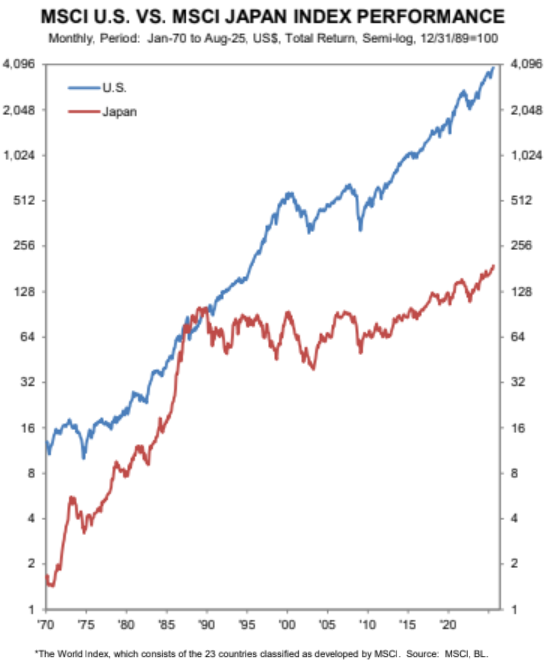
The last time national industrial policy – where the government picks winners and losers in the market – was in vogue was the late 1970s and early 1980s.

Japan’s fast-growing economy was all the rage – with nearly a dozen bestselling books marveling over the “rising sun.” Campy economists like MIT’s Lester Thurow (aka “less than thorough”) lectured us that America had to be more like them, toss out our antiquated devotion to free markets, and allow politicians to choose what companies and strategic industries to invest in.
Of late, Japan has become a country of old people and disaffected young people, and they're no longer getting rich.  (Via Cafe Hayek.  There's more good stuff in today's links.)


Unfortunately for the public, each election becomes an opportunity for a different set of grifters to claim they have earned their spurs, and they should don boots and saddle their constituents with more burdens.
But now we have Republicans supporting a handout of $10 billion to Intel, and Democrats still pouring tens of billions more into green energy flops like Solyndra as if they were genius stock pickers, like Warren Buffett. Even more dangerous is the rise of big government Republicanism, sometimes called National Conservatism, which espouses industrial policy.

Here we go again!
It's always the same category error.  If it isn't Japan envy, it's China envy.  A few years ago it was the Jarrett regency.  "[I]ndustrial policy is a way of generating rents and creating a swamp that has to be drained. I thought we had enough of Government Czars forty years ago, but Donald Boudreaux notes no bad idea ever goes away."  This time around it's Donald Trump playing text-a-tariff.  Mostly that's choking off shipments of European model train components to the States and other minor inconveniences.

4.9.25

PRESERVATION RAILWAYS HAVE THEIR BASKET CASE PROJECTS, TOO.

Last month, we saw some model railroading projects that included swap meet purchase, acquired cheaply, that will require a good deal of work before they run.

Preservation railways also take on basket case projects, as that is frequently the condition in which old and rare examples of the railroading art present themselves.


Such is the case with Car 162 at the East Troy Electric Railroad.  It might be the oldest extant car from a 1915 order Brill built for the Chicago and Milwaukee Electric Railway.  Sister car 160 is in regular service at Illinois Railway Museum.  Builder records suggest 162 was finished and delivered first.

The car was in the collection of a Connecticut museum for many years, where it was stored outside, and museum curators recognized they couldn't conserve everything, and perhaps cars representing railways closer to home ought be conserved first.  Thus it arrived at East Troy, and it is in the well-equipped repair shop to be worked on until the active-service cars rotate in for their winter overhauls.

WHY CHICAGO MIGHT GET A DOSE OF HOMELAND SECURITY.

Our President has been feuding with Chicago's mayor and his party comrade in the governor's office.
Chicago has given Our President two opportunities to appeal to the median voter on seriously skewed issues: its status as a sanctuary city, and its mostly peaceful summer weekends.  And yes, as CNN's Stephen Collinson notes, these United States are still a constitutional republic, and separation of powers is still a valid concept (if flung down and danced upon in the expediency of the moment by politicians).  "When Pritzker on [August 25] told Trump, 'Do not come to Chicago. You are neither wanted here nor needed here,' he was echoing tensions fundamental to the American system of governance that were stirred at notable moments of US history — for instance, in the run-up to the Civil War and around federal enforcement of civil rights laws."