IST'S NICHT EIN HAUFEN MIST? Academy Girl has a new post up, and I want the name of this person. There are some jacks not yet assigned. Get this, this person said, "Tenured people teaching at the graduate level and doing graduate level work and courses work much "harder" than the sessionals at the "lower" level." This person is so clueless I don't even know where to begin fisking him. Tenured people teaching at the graduate level are talking about their own research, or at least they OUGHT to be, albeit not exclusively. They are working with self-selected acolytes who ought to have some sense about why they're in the field and what the important questions are. (Perhaps I'm assuming too much. That is true to an extent in economics.) Let's see, doing what you want and hanging out with people who want to know something about it? That's harder work?
Compare and contrast that with the people enrolled in the lower level class. Here the professor or the adjuncts (is "sessional" a Canadian term, like "chesterfield" or "hoser?") are working with other-selected congregants who may or may not have any sense about why they are in the class and they may have no idea what the important questions in that discipline are. (I hear this lament from people who have taken economics in college and hated it all the time.) A good teacher in such a course HAS to have time to take questions, because the students will have questions. It is a crime to treat these classes as cash cows to be set up as large lectures with quiz sections, where there are few to no opportunities to take questions. Furthermore, a good teacher in such a course HAS to be able to distinguish a truly clueless question (which calls for some convex combination of firmness and patience, which differs from student to student) from a subtle but not well posed question (and these DO come up.) That is less hard work? Give. Me. A. Break.
For the record, I will teach economics at all levels in an academic year, from an introductory level price theory (principles of microeconomics, for those of you in Dane County) which is often a real joy to teach, through the limited industrial economics offerings we have (an antitrust class and a rejuvenated public utilities class) and the first graduate level price theory class (where I had to crack down today on students submitting answers consisting of derivations with no expository sentences.) And I have long maintained (learned it from my father years ago) that it is a mistake to put inexperienced professors -- let alone graduate students, or hires picked up on the fly -- in front of introductory level students. Consider an Army in which the recruit's first encounter with basic training is with a recently trained PFC. Well, maybe you don't want to consider that, ponyemayite?
10.2.04


VIEWPOINT DIVERSITY AND SELF-SELECTION. Pandagon reacts to a story about an advertisement in the Duke University student newspaper detailing a preponderance of registered Democrats on the Duke faculty.
Kieran at Crooked Timber extends the remarks on self-selection among academics in useful ways.
Returning to the Duke Chronicle article, political science chairman Michael Munger suggests "In at least one case, a department chair [c.q.] has said they thought the function of Duke was to rid conservative students of their hypocrisies." Professor Healy suggests that philosophy chairman Robert Brandon is being tongue-in-cheek when he says, "We try to hire the best, smartest people available. If, as John Stuart Mill said, stupid people are generally conservative, then there are lots of conservatives we will never hire." Tongue in cheek it might be, but I think there's a seven of hearts with his name on it. And Duke lobbyist John Burness, by asserting, "If you look at the humanities in general, there's a great deal of creativity that goes on. In a sense it's innovation, and a perfectly logical criticism of the current society, in one form or another, that plays itself out in some of these disciplines. It doesn't surprise me that you might find people in humanities are more liberal than conservative." This is the kind of sophistry that gives b.s. a bad name. Herrn. Schneider und Schwarz, the eight of hearts, nicht wahr? Tightly Wound has a concurring opinion.
SECOND SECTION: Jesse at Pandagon has more on the parallel network of policy shops for conservative intellectuals, which may or may not be the beginnings of a good industry study.
Well, the conservative philosophy tends to be very materialistic. That's not a criticism, it's a simple observation. Conservative economic systems attempt to make it easier to acquire and retain wealth. Liberal systems, by contrast, treat money as an engine for social progress. It's nice if people get rich, but it's even nicer if everyone has health care. That ideological split is instructive. Those who can get into academia are, in most cases, highly educated and intelligent. Usually, they could be making significantly more in the private sector. So those who enter in the public sector tend to rank material acquisition as a lower priority, a value hierarchy consistent with liberal ideals. The flip side of this would be conservatives entering the private sector, as material wealth is more highly regarded within their value system and the public sector is a terrible route through which to acquire it.That's my understanding of the purpose of the Institute for Humane Studies and the Mercatus Center, and there are other such organizations. It would help, however, if academicians whose area of expertise is in writing or in a physical science would understand that there are rules of construction and laws of conservation in the use of money: you can't achieve social progress simply by throwing money in preferred directions.
If this analysis is correct, the fault lies not with the highly charged, politically active liberals. It lies with the conservatives who are unwilling to go into academia and teach the next generation. If true, then it is not up to the Left to fix the problem by shutting up, it is up to the Right to fix the problem by encouraging their best and brightest to train the young and ensure their values are given a fair hearing.
Kieran at Crooked Timber extends the remarks on self-selection among academics in useful ways.
Returning to the Duke Chronicle article, political science chairman Michael Munger suggests "In at least one case, a department chair [c.q.] has said they thought the function of Duke was to rid conservative students of their hypocrisies." Professor Healy suggests that philosophy chairman Robert Brandon is being tongue-in-cheek when he says, "We try to hire the best, smartest people available. If, as John Stuart Mill said, stupid people are generally conservative, then there are lots of conservatives we will never hire." Tongue in cheek it might be, but I think there's a seven of hearts with his name on it. And Duke lobbyist John Burness, by asserting, "If you look at the humanities in general, there's a great deal of creativity that goes on. In a sense it's innovation, and a perfectly logical criticism of the current society, in one form or another, that plays itself out in some of these disciplines. It doesn't surprise me that you might find people in humanities are more liberal than conservative." This is the kind of sophistry that gives b.s. a bad name. Herrn. Schneider und Schwarz, the eight of hearts, nicht wahr? Tightly Wound has a concurring opinion.
SECOND SECTION: Jesse at Pandagon has more on the parallel network of policy shops for conservative intellectuals, which may or may not be the beginnings of a good industry study.
JUST SUCK IT UP. Rachel Brem is having problems keeping her patience with students who just can't get their acts together. The Superintendent is particularly impatient with the class of student that is in college to get a degree in order to earn a promotion, yet uses that job as a reason to not do the class work. You think there might be a broader behavior pattern at work here?
BATTLE OF THE SEXES. Apartment 11-D compiles a number of anecdotes that couples contemplating matrimony might contemplate negotiating before they visit the city clerk's office.
A POSITIVE THEORY OF PAYING TO CUT IN LINE? No, Lynne at Knowledge Problem has not scooped my research, but she does have some thoughts, and some links, on the folly of allocating landing slots at airports by methods that do not include priority pricing. There have to be some commonalities between priority pricing at amusement parks and high-occupancy toll roads. Expect lighter posting the next couple of days, I have to think about that.
TEACHABLE MOMENTS. Topic for the regulated industries class: does the public have an interest in regulating the content of entertainment, specifically the halftime show? Apartment 11-D makes the argumentam ad popularum, and Daniel Henninger attempts to find common cause in the aesthetics. Assignment to the students: are there any arguments from principle being advanced in either essay?
On the lighter side, Scrapple Face has now started another site, Boycott MTV. Insta Pundit, who has already Instalanched the site, observes,
On the lighter side, Scrapple Face has now started another site, Boycott MTV. Insta Pundit, who has already Instalanched the site, observes,
I'm not shocked by MTV, or repulsed. Just bored and annoyed. Frankly, I'd like MTV better if it showed actual people enjoying actual sex, rather than the winking, leering pseudo-sex that is its stock in trade.I'm not going to Indeed that. Rather, I suggest that MTV offers bad winking, leering pseudo-sex. If you want to see some really good flirtation, seduction, rejection, and romance, with some serious athleticism thrown in, watch any community Ukrainian or Russian dance troupe in action.
9.2.04
TODAY'S IMMIGRATION ROUNDUP: Econ Log looks at two dimensions of the underground economy. One dimension is the provision of domestic services to rich working moms, the effect Mother Jones may or may not have complained about. The other is the induced innovation problem, wherein part of the underground economy is technologically backwards account the ready availability of labor that is cheap relative to capital. Mr Kling takes a page out of Gary Becker's book, asking about the effect of illegal immigration on the labor force participation of women.
Max at Common Sense and Wonder has some related cultural observations.
Max at Common Sense and Wonder has some related cultural observations.
MID-MAJOR DEGREE, NO FRILLS? Joanne Jacobs has some troubling information about the performance of the state-supported universities. It doesn't do any good to offer low prices and access if students can't complete their schedules, and it doesn't do any good to threaten the faculty with new measurements of productivity while giving them ever more therapeutic responsibilities. To make matters worse, Number 2 Pencil reports that admission decisions at many public colleges might be more a matter of formula than of careful matching of students with programs.
That's not the worst news for the day. I took a break from writing to get a can of pop. The pop machine is in the English department's building. I heard a colleague from one of the departments housed there advising a senior, "you'll have a better chance of getting into a Ph.D. program with a publication in hand." Getting into a Ph.D. program??!? What is the purpose of a Ph.D. program, if not learning to write research? Now you have to do research to get into a program to learn to do research? No wonder there's an academic pyramid scheme in some disciplines, and an inexhaustible supply of postulants and novitiates to make up the new academic labor system.
That's not the worst news for the day. I took a break from writing to get a can of pop. The pop machine is in the English department's building. I heard a colleague from one of the departments housed there advising a senior, "you'll have a better chance of getting into a Ph.D. program with a publication in hand." Getting into a Ph.D. program??!? What is the purpose of a Ph.D. program, if not learning to write research? Now you have to do research to get into a program to learn to do research? No wonder there's an academic pyramid scheme in some disciplines, and an inexhaustible supply of postulants and novitiates to make up the new academic labor system.

NO MORE VERTICAL ZOO?
The 39-year-old towers, known as Ogg Hall, house about 1,000 students on the southeast side of campus. A new residence facility called the Dayton Street Development will rise in their place.A new University of Wisconsin plan would tear down the vertical zoo. What is it about me and high-rises? Wayne State University demolished Mackenzie Hall, an old hotel, after I left, and now goes Ogg Hall. Ask me about getting gassed there, and about building a swimming pool in the shower room.
COLD SPRING SHOPS GETS RESULTS. I haven't finished assigning names to cards and already I have to put an X-mark on one of the active cards, University of Wisconsin president Katherine Lyall, the queen of diamonds, who has announced her retirement. University regents expect her successor to be expensive. Clearly, they've not heard of the principle of comparative advantage. "UW System regents have already declared the search to be a national, even international one. The one thing they've stressed is that the next president have stellar academic qualifications." Right. For the most part, the best researchers don't get involved in administration, and I can think of a couple of excellent academic economists who have been stellar failures as university presidents.
TONIGHT'S WICKED THOUGHT: Vagina-Friendly Week at Ball State. Think about it. (Via Critical Mass, who is offering to collect your V-Day stories, and whose main page has lots of information about the descent into madness of the so-called humanities.
8.2.04
WHOOSH! One of the presentations at the Inland Lake Yachting Association's Winter Inland is a new Melges Boat Works scow handling disc set. (I pity those of you who don't live near the lakes of the Upper Midwest. There's nothing quite like a big racing scow in full cry.)
I had heard about this stunt before, but on the disc is the evidence: Buddy Melges and crew towed a water skier behind an E Scow. (It was too windy that July day in 2003 to use the larger A Scow as the towboat.) The sailboat, with the water skier in tow, reaches across Wisconsin's Lake Geneva from the Lake Geneva Yacht Club on the south shore toward Williams Bay. At mid-lake, the scow and the video boat pass close by a powerboat, parked mid-lake to do some fishing. The body language on the powerboat skipper when the skier goes by is priceless.
I had heard about this stunt before, but on the disc is the evidence: Buddy Melges and crew towed a water skier behind an E Scow. (It was too windy that July day in 2003 to use the larger A Scow as the towboat.) The sailboat, with the water skier in tow, reaches across Wisconsin's Lake Geneva from the Lake Geneva Yacht Club on the south shore toward Williams Bay. At mid-lake, the scow and the video boat pass close by a powerboat, parked mid-lake to do some fishing. The body language on the powerboat skipper when the skier goes by is priceless.
QUOTE OF THE DAY: "As part of learning Norwegian culture, immigrants could learn that they can't bring their hatreds to their new country." That's Joanne Jacobs. The SCSU Scholars have recommended a Mark Steyn essay, currently available only on paper, that provokes further related thoughts. More during the week.
GETTING THE RULES RIGHT. A First Amendment protection for yobbery at college sporting events? So suggests this USA Today article. Fortunately, some people have some sense left.
I will let the experts in political theory fire away at me, but my sense is that the First Amendment protects criticism of the Government, not yobbery directed at basketball players. Quoting from Federalist LI,
SECOND SECTION: U.S.S. Clueless, in a defense of propagandist Michael Moore against accusations of treason, makes a similar point about the role of the First Amendment.
Kermit Hall, president of Utah State University, is an expert on First Amendment issues. He says free speech at public universities is ''at once the most obvious and the most paradoxical of constitutional principles'' -- obvious because the role of open expression is essential to academic freedom and paradoxical because it must be balanced against imperatives for civility and respect.Quite right. Cold Spring Shops is pleased to call attention to academic administrators who get things right. Utah State's student code is reasonable as such things go, confining student responsibilities to prepare for classes and mind their manners. No "inappropriately directed laughter" here. There is freedom to assemble not limited to free speech zones no larger than the mainsail on a Laser.
But Hall says the Maryland case is not a close call. He believes public universities have not only a right to eject students who chant obscenities but a responsibility to do so in consideration of others' rights to watch a game in a safe setting. Hall says students should be warned first, then have their tickets pulled.
I will let the experts in political theory fire away at me, but my sense is that the First Amendment protects criticism of the Government, not yobbery directed at basketball players. Quoting from Federalist LI,
In a free government, the security for civil rights must be the same as that for religious rights. It consists in the one case in the multiplicity of interests, and in the other, in the multiplicity of sects. The degree of security in both cases will depend on the number of interests and sects; and this may be presumed to depend on the extent of country and number of people comprehended under the same government.The quote suggests to me the bundling of freedoms later enumerated under the First Amendment. The context is the protection of the rights of minorities against the interests of majorities. Spectators at sporting events do not qualify as factions influencing government policies. Kick the yobs out, I say.
SECOND SECTION: U.S.S. Clueless, in a defense of propagandist Michael Moore against accusations of treason, makes a similar point about the role of the First Amendment.
That's why the First Amendment was proposed; except for its clauses relating to religion, it is intended to protect the right of citizens to speak and write criticism of the government without legal peril. More broadly, and including the clauses relating to religion, the real point of the First Amendment is to protect what could be referred to as freedom of conscience, the freedom of each person to form opinions and to make moral decisions.The interpretation of its purpose is slightly different: Federalist LI clearly suggests that multiplicity of interest and multiplicity of sect are parallel freedoms. The construction of the First Amendment to apply to political speech is evident in Mr DenBeste's argument. Holding harsh views of the opposing team's basketball players does not qualify for such protection.
IL DESTINO DI GRANT APPLICATION. Tonight's Lighter Academic Reading comes from a Cold Spring Shops reader. This has been around the Internet a few times, but enjoy it anyway.
This opera came to me several years ago from William W. Reeves, then the director of the Office of Sponsored Programs. Some other director of a similar office at some unnamed university originally wrote the following:
Il Destino di Grant Application
A Tragic Opera in Three Acts
by Lloyd Fricker
Cast (in order of vocal appearance)
Alfredo, a professor ........................................ Baritone
Wu Li, a postdoc ............................................ Tenor
Kathy, another postdoc ................................... Alto
Nicolette, Alfredo's secretary ............................ Soprano
Adriana, Alfredo's wife ..................................... Soprano
Bubba, Alfredo's son .......................................Tenor
Julieta, Alfredo's daughter ............................... Soprano
Stephano, Scientific Review Administrator ...........Bass
Doug, Grants Technical Assistant ......................Tenor
Erminio, another professor................................. Bass
Act I, Alfredo's Office
The curtain rises on Alfredo in his office; nearby, his postdocs, Wu Li and Kathy, are hard at work on a manuscript that has been rejected by Nature.
In a dramatic opening aria, the researchers lament the fact that the journal reviewers found their manuscript unexciting ("Il reviewers sono molto stupidi"). Nicolette, Alfredo's secretary, arrives with a box of grant applications that Alfredo, as an NIH reviewer, must evaluate. Alfredo opens it, and finding only 12 applications, rejoices. He is joined by the two postdocs and the secretary in a quartet extolling the virtues of having but 12 applications to read ("Il lighto loado"). Their happiness soon turns to sorrow, however, as Alfredo discovers a note indicating that he is to be the primary reviewer on an additional 18 applications that will arrive at a later date ("Il grande boxo di granti"). The four lament the twist of fate, Murphy's law, and the Peter Principle. Alfredo, grieved that he will have no time to spend with his lab group or family for the next six weeks, departs sadly homeward bearing the box of applications.
Act II - Scene 1, Alfredo's office (one month later)
Alfredo is still hard at work on the applications, having completed only four. He sings a sad aria. Stefano, the Scientific Review Administrator for his study section, wants the triage list of applications that didn't make the cut by the next day ("Il listo di crappo"). At that moment Nicolette enters bearing an envelope from NIH. Believing it contains yet another
supplement, Alfredo tosses it onto a pile and searches for his place in the application he was reading. Just then, Wu Li enters with some important data that must be published immediately, before competitors beat them to it. They sing a dramatic duet ("La publicazione o il scoopo") in which Alfredo regrets that he cannot help write the article as he must read 26 more applications before the study section meeting next week. As Wu Li leaves, Alfredo returns yet again to the grant application, only to be interrupted by Kathy. She is distraught that she hasn't gotten a raise in the two years she has been with Alfredo. He promises her a large raise if his own application is funded, explaining that he is waiting for the summary statement ("Il sheeto pinko"). After their duet, Kathy leaves and Alfredo returns once again to the application. A minute later, he jumps from his seat and snatches the envelope he had tossed hastily onto his desk, as he realizes suddenly that it is actually the long-awaited summary statement ("La posta junko il sheeto pinko"). Trembling, Alfredo tears open the envelope, then lets out a cry upon seeing the score, which is clearly not in the fundable range. He sings a moving aria lamenting the lack of sufficient funding for basic science and his own unfortunate lack of success ("Mio granto es finito"). Unable to concentrate any longer, Alfredo goes home.
Scene 2, Alfredo's home (later that night)
Alfredo arrives home and finds Adriana, Bubba, and Julieta overjoyed that he has returned before they have gone to sleep. Their happiness is short-lived, however, as he confesses the cause of his surprise homecoming. They are not sympathetic to the fact that only a small number of people actually get their grant applications funded, and dismayed that Alfredo's application was considered only "excellent" ("Papa es un nincompoopo"). Disheartened, Alfredo sits at his desk and begins to read another application. Just as at work, however, he cannot read for more than a minute before being interrupted - now by his wife and children. After a couple of hours, Alfredo has nearly finished reading an entire page. Unfortunately, he falls asleep before reaching the next one.
Act III, A Holiday Inn in Valhalla, home of the Gods and Goddesses of NIH
The scene opens to reveal a large table surrounded by serious-looking men and women. Alfredo is among the mortals, who have been invited to Valhalla to decide the fate of 137 grant applications. At the side of the room are the Gods and Goddesses of NIHthe program officers of the various agencies, dressed in white tunics. They are feeding from a large tray of grapes, and drinking decaf coffee. Stephano, the Scientific Review Administrator, begins the meeting with an hour-long aria about the grant review process and the need for confidentiality ("Non asko, non tello"). The first grant application to be reviewed is one for which Alfredo was the primary reviewer. Alfredo likes this application, which describes an imaginative series of experiments concerning an important but little-studied biological question ("Se succeede, il Nobel Prizo"). Furthermore, all its key points are presented in a single page the limit of Alfredo's attention span, given all the interruptions he must tolerate. His enthusiasm is countered by the other reviewer in what has come to be the most famous aria of the opera ("Non hypothesiso, non preliminary dato"). Other reviewers join in with comments on the applicant's lack of independence and the absence of feasibility studies, and the general observation that the problem must not be very important or others would already be working on it. Finally, the Grants Technical Assistant rises and joins in the singing ("Givmi il floppi disco"). Everybody in the room then joins in, except for the Gods and Goddesses - who have moved from the grapes to a large table filled with melon balls, which they eat with toothpicks - and a man in a Holiday Inn uniform restocking the toothpicks. When it becomes clear that no new comments have been made for at least 45 minutes, a vote is finally called for, and in a dramatic moment, Alfredo sings out "1.0," while the other reviewers vote for a worse score ("Il granto non-competitivo"). They arrive at a consensus score of 2.0. During the aria, the man in the Holiday Inn uniform becomes noticeably distressed. He consumes vast quantities of coffee and finally collapses as the application's score is announced. In a surprise twist, one of the NIH Goddesses reveals that the man is in fact Erminio, the applicant of the failed grant. Although fatally poisoned by the bad coffee, Erminio sings a moving aria reflecting on the weaknesses of the current grant review system ("Il reviewers screwed-uppo"). The opera ends with the reviewers placing Erminio's lifeless body in the boxes that held the discarded grant applications, and covering him with glossy photos of his data. As the curtain is lowered, one reviewer comments that it's a good thing the application wasn't given a really bad score, or who knows what the applicant would have done ("Il Unabombo").
6.2.04
FUTURE O SCALER? The "Finer Print" section of the Northern Star interviews students each day. Today's victim (the column is not available on line) is a model railroader.
Whoa, whoa. What is model railroading?
It's the adult version of playing with toy trains.
Do people give you crap for this?
The only place I really get crap is the model train club that I am part of. They yell when something isn't prototypical.
So are these a bunch of nerds then?
I wouldn't call them nerds.
Dorks?
Some of them are dorks, but some of them are pretty cool guys. A few of them need a little class.
Does it ever get competitive?
Well, what's competitive?
Has anyone ever taken a swing at someone?
Not yet, but we do have a lot of interclub politics.
Are there different political parties?
Well, there are the guys who spend the big bucks and then some who spend very little.
I'd surmise that this student is a member of a club of HO modelers, but that last sentence reeks of O gauge.
ULTIMATE TRAINS? Compare and contrast.
The latest in Japanese Shin Kansen bullet trains, 2004, via Transport Blog
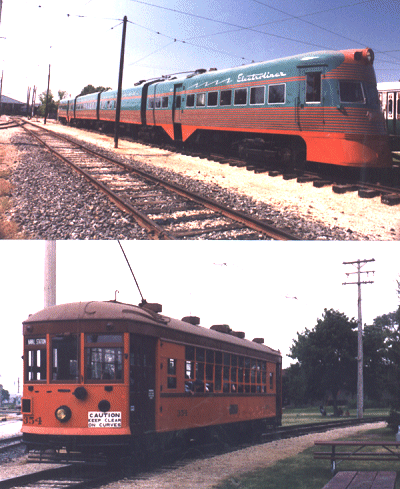
The restored North Shore Line Electroliner, built 1940, at the Illinois Railway Museum. (The picture of the streetcar comes bundled with the picture of the Electroliner at this Electroliner page
The latest in Japanese Shin Kansen bullet trains, 2004, via Transport Blog
The restored North Shore Line Electroliner, built 1940, at the Illinois Railway Museum. (The picture of the streetcar comes bundled with the picture of the Electroliner at this Electroliner page
NO HOURS OF SERVICE LAW FOR RAPID TRANSIT? Live from the Third Rail is baffled by this. Tired train crews make careless mistakes.
MOSCOW SUBWAY BOMBING. The Superintendent notes with great sorrow the attack on the commuters and transit workers of the Moscow Metro. Buzz Machine has discovered a Russian source, Russ Pundit, who posts the statement of a passenger on the train.
SECOND SECTION: This news report provides a link to a Moscow Metro map. The bad guys may have had more mayhem in mind. The explosion occurred before the train reached Paveletskaya, an important junction of Route 2 (dark green) with the Route 5 loop (orange) line. Consider Washington's Metro Center, or Boston's Park Street.
SECOND SECTION: This news report provides a link to a Moscow Metro map. The bad guys may have had more mayhem in mind. The explosion occurred before the train reached Paveletskaya, an important junction of Route 2 (dark green) with the Route 5 loop (orange) line. Consider Washington's Metro Center, or Boston's Park Street.
5.2.04
SYMBOLISM OVER SUBSTANCE. Writing a statement of teaching philosophy for a job application, or in search of tenure or promotion? Newmark's Door has some examples, as well as the correct characterization of the genre.
REDEFINING HOBBIES. Apt. 11-D has further thoughts on finding time for hobbies, and whether or not computer simulations are hobbies. Been there, done that, got the backache to prove it. There's a reason I suggested turning off the computer. If war simulations do not suit your fancy, perhaps sitting in a dispatcher's office or being station master at a busy British way-station or terminus will. But they can easily keep you off your work bench.
ONE-DROP RULE? "So apparently under common usage an American who was born and raised in Africa is less of an African-American than one whose family has been here for centuries." So notes Best of the Web, observing the stripping of protected class status from Mrs John Kerry.
4.2.04
MORE WORK FOR MESSRS. SCHNEIDER AND SCHWARTZ. King at SCSU Scholars nominates Oklahoma University Dean John Snow, who appears to be making an un-person of a colleague. The nomination has been passed along, with the Superintendent's note that the dean in question is a dean at, well, Oklahoma, where the purpose of the college of liberal arts is to keep football players eligible. Dean Snow's dossier will have to be reviewed in light of recent developments at conference rival Colorado, where the football team is more open about its recruiting, and where the most recent affirmative action bake sale offered a proper send-up of "coming out" events.
Messrs. Schneider and Schwarz are also seeking a suitable representative from the University of Michigan. The story has been Instalanched, but John at Discriminations passes along the disturbing news that officials at the University of Michigan have been taking a page out of the Arab League playbook (would that Bo Schembechler had that for the Rose Bowl) by organizing a secondary boycott of firms that support a Michigan referendum that would change affirmative action as practiced at the universities. This Brian Dickerson column has details.
Messrs. Schneider and Schwarz are also seeking a suitable representative from the University of Michigan. The story has been Instalanched, but John at Discriminations passes along the disturbing news that officials at the University of Michigan have been taking a page out of the Arab League playbook (would that Bo Schembechler had that for the Rose Bowl) by organizing a secondary boycott of firms that support a Michigan referendum that would change affirmative action as practiced at the universities. This Brian Dickerson column has details.
POINT-COUNTERPOINT. Is there too much commuting in the United States? John at Crooked Timber suggests there might be, viewing favorably the arguments that the modern big-box store shopping cluster leads to more time spent on shopping trips, and more traffic congestion in the large, space-consuming parking lots. Kevin at Truck and Barter suggests that analysts consider the role of zoning codes and other legislation. A jurisdiction can pass a law making the construction of a superstore more difficult. The law does not have the effect of suppressing the demand. The store locates elsewhere, and takes its traffic congestion with it.
Possible dissertation topic: what are the efficiency and equity consequences of making your community a Wal-Mart free zone?
Possible dissertation topic: what are the efficiency and equity consequences of making your community a Wal-Mart free zone?
RONALD COASE, CALL YOUR OFFICE. Wisconsin Lawmakers look to limit obesity cases. No suits have yet been filed alleging that the restaurant made the patron fat, but some people just can't be too careful.
QUESTION OF THE DAY:
My economist's reaction.
To employers: You get what you pay for.
To employees: He who sells his product for a lower price know what it's worth.
The comments at the Invisible Adjunct post are worth looking at. I have reservations, however, about drawing parallels between adjunct appointments and apprenticeships, given the existence of a tenure track. There are, however, some old and mostly ignored principles on academic freedom and tenure that long-term temporary employees of academic departments ought to be more aggressive about invoking.
To put the question another way: what are the professional obligations of someone who is expected to perform the work of a professional under conditions of deprofessionalization?That's from Invisible Adjunct, who has resumed publishing.
My economist's reaction.
To employers: You get what you pay for.
To employees: He who sells his product for a lower price know what it's worth.
The comments at the Invisible Adjunct post are worth looking at. I have reservations, however, about drawing parallels between adjunct appointments and apprenticeships, given the existence of a tenure track. There are, however, some old and mostly ignored principles on academic freedom and tenure that long-term temporary employees of academic departments ought to be more aggressive about invoking.
THE LUMP OF LABOR FALLACY. Virginia Postrel treats a blunderer kindly. My reaction to statements such as "There are only a finite number of jobs in the US economy - once a critical mass number have been offshored we enter the cascading unemployment phase - when those jobs dependent on the offshored jobs and industries likewise disappear." Put bluntly: Jobs can neither be created nor destroyed, only changed in form. Scarcity of resources, with competing uses, implies at any time there is more work to be done than workers to do it. The trick is to convert the work into a form where workers (particularly those with a poor understanding of calculus and a high opinion of themselves?) can do it.
SETTING THEM UP FOR FAILURE.
SECOND SECTION: Number 2 Pencil provides extensive context, with cross-references.
What it does to those poor kids is criminal. They're so disoriented, totally fish out of water. They don't have a clue how to behave, how to dress, how to talk, how to read and write at the level of the freshmen accepted at the competitive northeast institutions. It's truly pathetic. Their classmates spend vacations skiing, going to their cottages at the beach, traveling, they have their own cars, their own plastic, etc. As far as the quota kids are concerned, they may as well be from outer space. The reaction is to act up and act tough further alienating themselves. It's an awful system.That's from a letter to Andrew Sullivan about the boondoggle called "admit unprepared students and call it 'access'." One has to wonder whether or not such "access" doesn't provide support for unfavorable stereotypes in students who have been brought up all their lives to reject such thinking as prejudice.
SECOND SECTION: Number 2 Pencil provides extensive context, with cross-references.
2.2.04
FOURTH TURNING ALERT?
Older priests today often complain that their younger colleagues are arrogant, pompous, and rigid, and that they love to parade around in clerical dress. The image that comes to mind is young versions of the old ethnic monsignors of the Depression era.That's Father Andrew Greeley (via Betsy's Page) on a generation gap in the priesthood. Regular readers of Cold Spring Shops will understand that rebelling against the establishment is not equivalent to leftward ho!
THE DEATH OF HOBBIES? Apartment 11-D suggests people are just too busy:
The secret is to make the time, rather than lament its lack. Turn off the television (easy for me to say, there are 100 channels of nothing here.) Turn off the computer and go to your workbench. Build.
There is a connection between the outsourcing debate and the disappearance of time-intensive hobbies Dr. Laura noted. Go here and scroll down to the bargain purchase that requires work. It is one of what will prove to be three Boston and Maine 4-8-2s in the roundhouse: the reassembled one from this engine, a kit that I recently bought, and a ready-to-run one from China. If you figure the opportunity cost of my time and the tooling I have to put together to reassemble the one and build the kit, the ready-to-run one from China will be cheaper, and on technical points it might be better put-together out of the box.
We’re too busy. Everyone is spending more hours at work. More time raising kids. There is the computer to eat up spare minutes. And 100 channels on the TV. Technology and work have spelled the end to stamp collecting, gardening, crocheting, quilting, canning, pickling. I don’t think I would categorize blogging as a hobby. Since I use blogging as a means for brainstorming ideas and as a rough draft of future writing projects, it falls under work for me.Up to a point. It's not clear that everyone is spending more hours at work, but that's a conversation we've had before. Kids can be a great catalyst for hobbies. Model railroaders use Thomas the Tank engine as a recruiting dodge all the time. It's not unknown for a mom to pass along her enthusiasm for tropical fish to her kids. Get the picture?
The secret is to make the time, rather than lament its lack. Turn off the television (easy for me to say, there are 100 channels of nothing here.) Turn off the computer and go to your workbench. Build.
There is a connection between the outsourcing debate and the disappearance of time-intensive hobbies Dr. Laura noted. Go here and scroll down to the bargain purchase that requires work. It is one of what will prove to be three Boston and Maine 4-8-2s in the roundhouse: the reassembled one from this engine, a kit that I recently bought, and a ready-to-run one from China. If you figure the opportunity cost of my time and the tooling I have to put together to reassemble the one and build the kit, the ready-to-run one from China will be cheaper, and on technical points it might be better put-together out of the box.
OUTSOURCING ROUNDUP.
Noneconomist visitors to Cold Spring Shops note well: the immiserization of Americans will not be the fault of foreign workers accepting lower wages. It will be the fault of an education establishment that destroys the human capital that makes the high productivity happen.
I tend to be simple-minded about it and say that outsourcing will continue until the wage in each country equals the value of marginal product of that country's workers. Put another way, the high productivity of US workers will place a finite upper bound on the outsourcing of tech jobs.That's Knowledge Problem. Never understimate the power of a no-arbitrage condition. Read the whole thing, and the Marginal Revolution roundup of the arguments she suggests.
Noneconomist visitors to Cold Spring Shops note well: the immiserization of Americans will not be the fault of foreign workers accepting lower wages. It will be the fault of an education establishment that destroys the human capital that makes the high productivity happen.
QUESTIONING MY CHEESEHEAD CREDENTIALS? The American Mind claims That's Not Wisconsin Chili. I admit to doing some improvising, but if you go to Chili John's in Green Bay or Real Chili in Milwaukee, you'll find something similar, if perhaps a bit tamer.
The Wisconsin chili Mr Hackbarth is referring to is what we know as camp chili, because it's particularly easy to prepare over a Coleman camp stove or something similar.
In a 4 quart kettle, brown 1 pound ground beef. Chop one large onion and one green pepper and saute them along with the meat until the onions become transparent. Drain the grease.
Add one 12 oz can tomato soup and one can water. Stir in one 12 oz can chili beans (or red kidneys, in a pinch you can even use what passes for baked beans in the Midwest, it is a waste of proper New England baked beans to dump them in a chili), one handful elbow macaroni, 1 tsp. chili powder, 1/2 tsp. salt, and a pinch of parsley.
Simmer until the elbow macaroni is cooked and all flavors are blended, about 30-45 minutes.
CLASS ACT. Never mind the two fading celebrities and the accidental-or-not exposure of Janet Jackson. Let us pause a moment to note that Beyonce Knowles sang the National Anthem correctly, without any made-up words, and with the ending sounding as properly march-like as you can do with 3/4 time.
1.2.04
TONIGHT'S RECOMMENDED READING. The Engineering Department of Cold Spring Shops recently received a copy of Atlantic: The Well Beloved Engine (details or compare prices.) The book makes a provocative statement about the world speed record for steam locomotives.
The passing of the Hiawathas left the usual legacy of enigmas which surround the Atlantic type. Were they the fastest of all locomotives? This is contentious territory. The LNER A4 Pacific Mallard holds the official world speed record for steam locomotives at 126 mph, but reliable sources have spoken of Hiawathas [which the Milwaukee classed as the A type, and unofficially referred to them as "Milwaukees" rather than Atlantics -- SHK] running capably at 120 mph, where the calibration of the speedometer ran out. Alfred W. Bruce (The Steam Locomotive in America, 1952) stated that during time-schedule stabilising runs "... the hand of the speed indicator was often reported against the pin at 128 mph. Exactly what maximum speed was reached is not known -- but it was plenty!"There is nothing quite so interesting as a discussion about a moot point. The Superintendent has long maintained that the fastest steam locomotives in the world were the Milwaukee type's successors, the F-7 class Baltics, and that either Milwaukee speedster beats the Gresley Streaks account the latter's greater propensity to come apart at speeds in excess of 80 mph (they'd barely protect Amtrak's current timings on the C&M with that, let alone the 1938 timings). There is a line drawing in Atlantic (also in the February Backtrack) that illustrates how much bigger the Milwaukees were than their British rivals. Alas, the fastest steam locomotive in preservation in Hiawatha territory is ... a Gresley Streak.
ADDING TO THE DECK OF CARDS. First, an update. Bill and Mary's Timothy Sullivan continues to behave like he's been hit on the head with nine clubs. Discriminations notes that Mr Sullivan is one of those people who is quick to find "hurtful" the actions of others who disagree with him. His own actions are simply imposing desirable correctives. Critical Mass has more.
Second, Messrs. Schneider and Schwarz have concurred with the Superintendent's suggestion that Pitzer's Laura Skandera Trombley be the eight of hearts.
Third, Joanne Jacobs has identified a good candidate for the nine of diamonds, Chester Finn. This designation may strike some readers as a bit unusual, but there are good reasons for making Mr. Finn a relatively weak trump card (it can be used by the defenders to frustrate a Player or Players with a weak hand, but it must be viewed with some care by its holder, should the holder be in the position of picking up the blind.)
Chester Finn is the nine of diamonds as a caution to those who would seek to turf out the existing academic mindset that there are weak trumps and strong trumps that can accomplish the turfing-out. Mr Finn's argument is a relatively weak argument. It takes something to beat nothing. Unfortunately, Mr Finn has taken the case against empty curricula and competition for students on the basis of amenities and used it to make some more controversial suggestions about the role of the university. Consider "A fee-for-service basis for college-delivered services that not all students avail themselves of: placement offices, art studios, psychological counseling, health care, etc." Would it really be better to contract out the hiring to the American Federation of State, County, and Municipal Employees? Would it be prudent to have a residential campus without a clinic? And does Mr Finn envision a curriculum without any of the visual or performing arts? Or consider this proposal: "Faculty paid well but worked hard: a full teaching load, no tenure, and the expectation that their job is to teach. (Those wanting to engage in research raise grant dollars and "buy out" some of their teaching time.)" First, define "full teaching load." Does Mr Finn envision a few faculty members each meeting four or five large lecture classes per semester, or will there be ample opportunities for group projects, interactive learning, and frequent assignments, promptly graded. Second, does Mr Finn propose to turn into research only that which can be funded (if it is of commercial value, let the businesses or government agencies hire Ph.D.s and pay them proper salaries; if there is to be a government agency such as National Science Foundation funding the research, the academic politics do not go away.) Has he considered the possibility that independent and creative research (with perhaps some revised incentives to produce stuff that others will read) has its value? A student at a university where nobody does any research is in the position of a wallflower at a party, watching others engaging in the intelligent conversation. (Thanks to Steven Landsburg for this metaphor.) It does not follow that restoring Aristotle and Aquinas to the curriculum means there are no open questions for the philosophers and political theorists (and others) to explore. The act of exploring such ideas goes by the name of research.
Most importantly, the for-profit no-frills university Mr Finn hails is really making its money off of failures elsewhere in the system; it is not a substitute for a serious university education.
All is not perfect in higher education. Change for its own sake, however, is not equivalent to improving the service.
Second, Messrs. Schneider and Schwarz have concurred with the Superintendent's suggestion that Pitzer's Laura Skandera Trombley be the eight of hearts.
Third, Joanne Jacobs has identified a good candidate for the nine of diamonds, Chester Finn. This designation may strike some readers as a bit unusual, but there are good reasons for making Mr. Finn a relatively weak trump card (it can be used by the defenders to frustrate a Player or Players with a weak hand, but it must be viewed with some care by its holder, should the holder be in the position of picking up the blind.)
Chester Finn is the nine of diamonds as a caution to those who would seek to turf out the existing academic mindset that there are weak trumps and strong trumps that can accomplish the turfing-out. Mr Finn's argument is a relatively weak argument. It takes something to beat nothing. Unfortunately, Mr Finn has taken the case against empty curricula and competition for students on the basis of amenities and used it to make some more controversial suggestions about the role of the university. Consider "A fee-for-service basis for college-delivered services that not all students avail themselves of: placement offices, art studios, psychological counseling, health care, etc." Would it really be better to contract out the hiring to the American Federation of State, County, and Municipal Employees? Would it be prudent to have a residential campus without a clinic? And does Mr Finn envision a curriculum without any of the visual or performing arts? Or consider this proposal: "Faculty paid well but worked hard: a full teaching load, no tenure, and the expectation that their job is to teach. (Those wanting to engage in research raise grant dollars and "buy out" some of their teaching time.)" First, define "full teaching load." Does Mr Finn envision a few faculty members each meeting four or five large lecture classes per semester, or will there be ample opportunities for group projects, interactive learning, and frequent assignments, promptly graded. Second, does Mr Finn propose to turn into research only that which can be funded (if it is of commercial value, let the businesses or government agencies hire Ph.D.s and pay them proper salaries; if there is to be a government agency such as National Science Foundation funding the research, the academic politics do not go away.) Has he considered the possibility that independent and creative research (with perhaps some revised incentives to produce stuff that others will read) has its value? A student at a university where nobody does any research is in the position of a wallflower at a party, watching others engaging in the intelligent conversation. (Thanks to Steven Landsburg for this metaphor.) It does not follow that restoring Aristotle and Aquinas to the curriculum means there are no open questions for the philosophers and political theorists (and others) to explore. The act of exploring such ideas goes by the name of research.
Most importantly, the for-profit no-frills university Mr Finn hails is really making its money off of failures elsewhere in the system; it is not a substitute for a serious university education.
Third, higher education has developed a fast-growing sector that (no thanks to me) follows the no-frills formula: the proprietary sector, characterized by the University of Phoenix and kindred vendors of efficient and relatively inexpensive postsecondary schooling. Entrepreneurs have figured out a formula for delivering an acceptable level of instruction and training at reasonable cost to people who are willing to pay for it. More remarkably, while traditional suppliers weep over their deficits and deferred maintenance, the proprietors of these new institutions are making money!Sure, charge people a few hundred bucks to get together with colleagues in related business, let them talk shop, and issue them a certificate. The companies might be willing to pony up some of the money to subcontract their employee training to others. But the exchange of a few marketing strategies or production tricks is not the same thing as a real university degree, and the act of writing some business memoranda for college credit is just paying twice for something the high schools should have done.
All is not perfect in higher education. Change for its own sake, however, is not equivalent to improving the service.
TRULY A WORLD WIDE WEB. Reform K-12 links back to this map after receiving a visitor from Cold Spring Shops who was reading Cold Spring Shops from Iraq! For full credits, I discovered this map while visiting Sgt. Hook's chili competition, and he discovered it at Blackfive (not to be confused with the Stanier Five or Henry the Green Engine) who, it transpires, is posting from the lake shore of Greater DeKalb.
30.1.04
WHERE HAVE YOU BEEN, CHARLIE BROWN?

create your own visited country map
or write about it on the open travel guide
create your own visited country map
or write about it on the open travel guide
29.1.04
GREEN BAY CHILI. Herewith the Cold Spring Shops entry in Sgt. Hook's Chili Competition.
Pour the contents of a 12 oz can of beer and half the can of water into a two quart crockpot. Stir in 1/2 Tbsp. paprika, 3 Tbsp. chili powder, 1 Tbsp. Accent, 1 Tbsp. garlic powder, 1 Tbsp. ground cumin seed, 1 tsp. ground white pepper, and 1 tsp. ground cayenne pepper. Turn the crock pot on low and toss in a 1 oz unsweetened chocolate square.
In a skillet, brown 2 lb. coarsely ground chuck (or 2 lb. stewing beef cut into cubes). Saute 1 medium onion chopped with the meat. Drain the grease and add the cooked meat and onions to the crock pot.
Chop fresh hot peppers to taste. (My most recent batch used six jalapenos and 4 habaneros.) Stir the chopped peppers into the crockpot. Cover and let it cook at low heat for 3 or 4 hours.
Serve over cooked chili beans or elbow macaroni.
Real Wisconsin chili comes with a vinegar dressing. Drop 3 or 4 cayenne peppers into a cruet, and pour vinegar over the peppers. Keep on hand for your chili feeds.
IT TAKES A VILLAGE? Opinion Journal snarks at etiquette experts, but it would be mannerly of you to read the article cited.
CROSSOVER VOTING. It's been Instalanched, but read Citizen Smash's discovery of the requirement to declare a party identity in order to vote in the California primary. It is worth remembering that the primaries are primarily a party function, and citizens who skip the primaries are not presumptively derelict of their civic duties. The parties go to great length to prevent crossover voting, the phenomenon of voting for the candidate you least like in order to enhance the chances for the candidate you most like. The Making of the President 1960 (details or compare prices) has some rather colorful passages about the effects of crossover voting.
PROFITING BY OTHERS' IGNORANCE? Invented spelling might mean some bargains to be had by those entrepreneurs sufficiently alert to opportunities to buy the goods and sell them at auctions where the item has a correctly spelled name. Hat tip: Marginal Revolution.
28.1.04
IN MEMORIAM. Elroy Hirsch, 1923-2004. Some readers might have heard the legend about Mr Hirsch buying beer for everybody wearing red in some bar. It really happened. I was there. We're talking about the 1978 college hockey finals (none of this Frozen Four silliness) in Providence, Rhode Island. Heavily favored Wisconsin lost first to Boston University and then to Bowling Green -- a harbinger of the Midwestern axis of evil? -- to the disappointment of numerous Wisconsin students who had made their spring break trips to Providence rather than the usual sunny climes. After the third-place game many of the faithful retired to a nearby bar (no, I don't remember the name) where the drinks were on the house. Mr Hirsch had laid $500 on the bar and instructed the staff to serve anyone wearing red.
IT TAKES A VILLAGE. And if the village has all the redeeming features of a hippie commune and a trailer park, it's tough to be a government school. O'Donnell Web, Reform K-12, and Number 2 Pencil say, STOP WHINING.
It may be piling on to add my own observations, but the concluding paragraph of the essay bears further scrutiny.
It may be piling on to add my own observations, but the concluding paragraph of the essay bears further scrutiny.
You would use public school dollars to construct new forms of theocratic education, yet the U.S. General Accounting Office national survey showed that a third of my buildings are dangerous and unsafe – yet no help is forthcoming. Do as you will, but for me, I will stand proudly in my neighborhood, America’s last egalitarian institution, my arms embracing the finest educators, administrators and support personnel in the world – dedicated to helping our children realize the American dream.As if trendy environmentalism, mushy multiculturalism, and fuzzy constructivism are not theology per se. As if there is anything egalitarian in celebrating sports and ignoring chess. As if there will be any realization of the American Dream on a foundation of invented math, invented spelling, and nobody fails because nobody is challenged.
CHOICES AND CONSEQUENCES. Reason's Ronald Bailey is unimpressed with arguments that too much choice is unsound.
PROCESS, NUANCE, FAILURE? Academic Game reports that the University of Saskatchewan, home to the Ace of Diamonds, Peter MacKinnon, will review safety and security. Don't drop those martial-arts courses just yet.
On the bright side, this is Canada. The university is less likely to have to take a hard look at its athletic programs, as the recruitment of unsocialized louts and the concomitant provision of fixers to look the other way when said louts expect to have their way with the ladies as a matter of right has not yet become par for the course in Canadian intercollegiate athletics. Likewise, the university is less likely to have to consider the likelihood that recruiting students out of rough neigbourhoods so as to achieve greater diversity will bring to campus the habits, including criminal activity, that keep those neigbourhoods rough.
The review will include: an assessment of the effectiveness of current safety programs and activities on campus; a review of the timelines, adequacy and mechanism for seeking feedback and advice from the university community on safety issues; an assessment of staffing levels in security and the appropriateness of their training and preparedness. There will be University-wide consultation with advocacy groups on campus including the Student Union Women's Centre.How shall I fisk thee? Let me count the ways. First, check that totally unnecessary colon introducing the elements. Second, get a load of those Silent Generation therapeutic words, assessment, mechanism, appropriateness, and preparedness. Evidently nobody gets kicked out or imprisoned. Third, note the pandering to special interests. Look forward to mandatory "Take Back the Night" and Eve Ensler's talking privates for everybody.
On the bright side, this is Canada. The university is less likely to have to take a hard look at its athletic programs, as the recruitment of unsocialized louts and the concomitant provision of fixers to look the other way when said louts expect to have their way with the ladies as a matter of right has not yet become par for the course in Canadian intercollegiate athletics. Likewise, the university is less likely to have to consider the likelihood that recruiting students out of rough neigbourhoods so as to achieve greater diversity will bring to campus the habits, including criminal activity, that keep those neigbourhoods rough.
WHAT'S WRONG WITH THIS PICTURE? A thought experiment: consider a National Organization for Women chapter with a male president. Or a National Association for the Advancement of Colored People chapter with a non-colored president. Under the usual tenets of progressive intolerance, wouldn't these situations be anomalies crying out for some consciousness raising?
Now consider a Christian organization with a Christian president. Clearly an anomaly that requires re-education. Gonzaga president Robert J. Spitzer, S.J., has been recommended to Messrs. Schneider and Schwartz for inclusion in the sheepshead deck. (Hat tip: Milt's File.)
Now consider a Christian organization with a Christian president. Clearly an anomaly that requires re-education. Gonzaga president Robert J. Spitzer, S.J., has been recommended to Messrs. Schneider and Schwartz for inclusion in the sheepshead deck. (Hat tip: Milt's File.)
REWARDING MISBEHAVIOR? An amnesty for illegal immigrants is undesirable because it rewards people for sneaking into the country illegally, nicht wahr? Per corollary, a tax amnesty is undesirable because it rewards people for evading taxes? Yes, but how expensive is it to catch all the tax evaders? Sometimes the amnesty brings in more revenue.
A BOWL OF RED. Via Black Five (going to have to ask that man about that name), Sgt. Hook's Chili Cookoff, which includes some audience participation. Given the commitments of this weekend, I'm unlikely to be able to test and comment on one of the other recipes, but I do intend to melt the internet later tonight. Yum!
23.1.04
PRIMARY ON THE PRIMARIES. Atlantic Blog has put together responses by some of the Democratic hopefuls to a set of questions the Jeff Jacoby at the Boston Globe put to all of the active candidates. I like Is there any serious problem in American society that you do not believe calls for some kind of government response?
THE CRISIS OF CAPITALISM? Bob Herbert recalls Michael Harrington (The Other America is out of print??) Mr Herbert sees only the class struggle. Some additional words from Adam Smith seem pertinent:
The proposal of any new law or regulation of commerce which comes from this order, ought always to be listened to with great precaution, and ought never to be adopted till after long and carefully examined, not only with the most scrupulous, but with the most suspicious attention. It comes from an order of men, whose interest is never exactly the same as that of the public, who have generally an interest to deceive and even to oppress the public, and who accordingly have, upon many occasions, both deceived and oppressed it.
BRIEF IMMIGRATION ROUNDUP. Sneakeasy's Joint has been following the story, with five posts devoted to the debate.
QUOTE OF THE DAY: "Better to be known for doing something in your life other than sneaking out the night before the big game." That's Packer super-substitute Max McGee, who put on a great show at the first Super Bowl (which was anything but super) despite breaking training the night before.
PEOPLE RESPOND TO INCENTIVES. The Wisconsin Senate has approved a tax deduction for expenses people incur in the course of donating organs. (It is a curious world we live in, in which I link to a New York Times article datelined Chicago.) The bill has passed the Assembly, and the Governor intends to sign it. There is, however, a potential conflict with the National Organ Transplant Act. The good news is, there are still job opportunities for economists.
"When you get as high as $10,000 you start to wonder what that means to people and if there is some coercion that goes on with that," said Howard M. Nathan, president and chief executive of the Gift of Life Donor Program, a nonprofit agency in Philadelphia.Yeah, Northern Illinois University coerced me in 1986 by beating Wayne State's counter-offer by $6,000. Offer me more duress like that, please.
But State Representative Steve Wieckert, a Republican from Appleton who sponsored the bill, said it was not intended to offer cash for human organs. Instead, the tax credit would help remove an obstacle that prevents people from donating, he said.Huh? Sometimes, you just have to go back to the original sources.
"We want to be very careful that we are not getting into the business of selling organs but to encourage organ donation," Mr. Wieckert said. "No one, rich or poor, would receive any additional money for donating. All they would do is lose less money."
But man has almost constant occasion for the help of his brethren, and it is in vain for him to expect it from their benevolence only. He will be more likely to prevail if he can interest their self-love in his favour, and show them that it is for their own advantage to do for him what he requires of them. Whoever offers to another a bargain of any kind proposes to do this. Give me that which I want, and you shall have this which you want, is the meaning of every such offer; and it is in this manner that we obtain from one another the far greater part of those good offices which we stand in need of. It is not from the benevolence of the butcher, the brewer, or the baker, that we expect our dinner, but from their regard to their own interest. We address ourselves, not to their humanity but to their self-love, and never talk to them of our own necessities but of their advantages. Nobody but a beggar chuses to depend chiefly upon the benevolence of his fellow-citizens. Even a beggar does not depend on it entirely.That's from The Wealth of Nations (details or compare prices.)
22.1.04
IT'S A GUY THING, YOU WOULDN'T UNDERSTAND. Newmark's Door finds a Dave Barry column subtitled "Problem solving, guy style." It's all in fun, but there is a serious point. I have taken some heat for insisting that the term "gender" be expanded to include the option, "Non-Quiche-Eating Real Guy." Want some more anecdotal evidence? (Of course you do, that's why you're reading this, nicht wahr?) Last night I caught the first spring semester recital by the Vermeer Quartet. At intermission I was chatting with a colleague from my department, and her husband, and another colleague from another department, and his wife, and I made a comment about the Vermeer being good for the university even if the BCS was not, and everybody else reacted, Huh??
Even more seriously, Number 2 Pencil and King of Fools react to a Marshall Poe essay in the latest Atlantic noting a growing educational achievement gap between boys and girls. (Boys' test scores may have historically exceeded girls' test scores on average as the less academically inclined boys selected out of writing the College Boards.)
One point in the article is worth further commentary:
But boys' educational stagnation has long-term economic implications. Not even half the boys in the country are taking advantage of the opportunity to go to college, which has become almost a prerequisite for a middle-class lifestyle. And languishing academic attainment among a large portion of our population spells trouble for the prospects of continued economic growth. Unless more boys begin attending college, the nation may face a shortage of highly skilled workers in the coming decades.Perhaps the recruitment of more male teachers, or the provision of a less-girly curriculum, or a reluctance to treat high-energy behavior as something to be medicated away will help. It's also worth considering that highly-skilled is not equivalent to college-educated in many cases (start here, look here, and play this golden oldie for details) and the decision of schools to offer fewer shop and other skilled trade classes will only have the effect of raising the incomes of those relatively few people who discover those opportunities.
TODAY'S IMMIGRATION ROUNDUP. Milt's File suggests that Victor Davis Hanson has made the case against partial amnesty regularization of some illegal immigrants. Perhaps. Mr Hanson is correct to point out that some illegal immigration is with the expectation of receiving public assistance, although the optimal policy for the host country might thus to be to stretch out the time interval between amnesties, so as to obtain more cheap labor subsidies from the underground economy, or to quell the temptation to migrate solely in expectation of public benefits. He is also correct to suggest that the presence of cheap illegal labor affects innovation in industries using that labor. That is a great thesis topic.
Mr Hanson also returns to the debate between assimilation and acceptance, a point Econ Log also addresses. (The articles on a potential caste system more rigid than the underground economy and a proposal to create a market in work permits, both recommended therein, are also worth a look.)
The assimilation debate is nothing new. Think about this: the identity-politics weenies (yes, that is a technical term) use an aggregate, "white," that includes Germans, Italians, Georgians, Badgers, and Californians alike. This essay hints at the emergence of a melting pot in some high-technology sectors.
THE FATAL CONCEIT, AGAIN. Let me see if I understand Barry Schwartz:
Finally, increased choice forces people to take personal responsibility for all choices that turn out to be less than perfect. With so many options available, there is no excuse for anything less than perfection, and when less than perfection is what you end up getting, the fault must be yours.OK, fine, but does it follow that expanding the opportunities for people to manage their pensions will lead them to make worse choices? What evidence does Professor Schwartz (who is on Messrs. Schneider and Schwarz's short list should he ever become an academic administrator) have that a limited menu of choices designed by Congress or by other experts is superior to the evolution of a small set of preferred choices from among a large menu offered for people to select among? (Sorry about that Germanic sentence.) Captains Quarters, who brought the essay to my attention, has further comments.
While a life without any freedom of choice would not be worth living, it appears not to be true that more choice inevitably leads to more freedom and greater happiness. Indeed, there may be a point when choice tyrannizes people more than it liberates them. The implication of this news, both for individuals and for government officials, is that sound social policy simply cannot consist of throwing an ever-greater menu of options at the American people
MAKING THE CASE FOR A CARD. Pitzer College President Trombley continues to receive recommendations for a spot in the deck of cards, possibly as the eight of hearts. King at SCSU Scholars, who attended one of the Claremont colleges, puts her position in a broader context. (No, it is not sufficient to dismiss Pitzer as not a BCS program.) Joanne Jacobs surveys the commentary and offers the quote of the day: "The problem is not with the measuring system. The problem is that some students who want to go to college are poorly prepared for higher education."
TRANSPARENCY. Academic Game would like to see more of it in the academy.
This Timothy Burke post, on the peculiar economics of the academic journals (via Apartment 11-D) is also worth a read.
This Timothy Burke post, on the peculiar economics of the academic journals (via Apartment 11-D) is also worth a read.
THE BASILICA OF CONSTANTINE, ANYONE? Live from the Third Rail links to coverage of the design for the new World Trade Center tube station at Hudson Terminal. The designer is Santiago Calatrava, who conceived the racing sailboat (?) at Milwaukee's lakefront Art Center. The article reports that the design will shine natural light down to track level, 60 feet below the street. Mr Calatrava could do worse than to pay tribute to the trainshed at Penn Station, which in its original form had lots of natural light down to track level.
STORMY, HUSKY, BRAWLING, CITY OF THE BIG HAGGIS? I heard the news on the radio last night. Knowledge Problem picked it up. (Lynne, we'd expect a Pittsburgher to be au courant with head cheese and czarnina.)
Not to be outdone, Tightly Wound finds the concept of a vegetarian haggis (What would you use for the wrap? Some questions are better not asked.) amusing. And some readers apparently can't tell a haggis from a hodag.
Not to be outdone, Tightly Wound finds the concept of a vegetarian haggis (What would you use for the wrap? Some questions are better not asked.) amusing. And some readers apparently can't tell a haggis from a hodag.
IT'S GOING TO BE A CHARACTER BUILDER. No big surprise to visitors from the Northern Alliance, but I don't want to hear any whinging from more temperate regions about how cold it is there. You want cold? We've got cold.
21.1.04
TAVERNS FOR TOTS. Write a loophole, expect somebody to exploit it, notes Tyler at Volokh Conspiracy.
STRATEGIC VIEWPOINT IMBALANCE? Suppose university students take a conservative stance as a transgression against an academic establishment that pretends to be transgressive? Kathy at On the Third Hand suggests the best strategy for adult conservative activists might be to carp less about the lack of viewpoint diversity in the faculty.
OLD TRADITIONS DIE HARD. In yesterday's public utilities class, I asked students why some people might equate being rich with being evil. One student offered that the person might have become rich by making others poor, which is certainly the case with Roman tax collectors at the beginning of the current era, although Adam Smith discovered the power of trading for mutual gain.
Something similar might be at work in international trade, in this Common Sense and Wonder commentary on yet another Arnold Kling column. Perhaps many people's attitudes toward trading reflect long-evolved practices of sharing the misery, rather than trading for mutual gain. I'm unlikely to retire the parable of Wilmette and Waukegan anytime soon.
Something similar might be at work in international trade, in this Common Sense and Wonder commentary on yet another Arnold Kling column. Perhaps many people's attitudes toward trading reflect long-evolved practices of sharing the misery, rather than trading for mutual gain. I'm unlikely to retire the parable of Wilmette and Waukegan anytime soon.
REGULARIZATION, NOT AMNESTY. President Bush sought to distinguish regularization of some illegal workers doing jobs no legal resident or citizen would do from amnesty and the legal track to residency and citizenship. It's a distinction without a difference.
FOR SERIOUS POLICY WONKS ONLY. Via OxBlog, a Compendium of State of the Union speeches since Woodrow Wilson (figures) brought back the annual speech in 1913.
HEY, BIG SPENDER! The current President Bush matches only Gerald Ford in the rate of expansion of federal spending. The opposition? See you and raise you.
IT'S THE UNANTICIPATED PROMISES THAT MATTER. Perhaps it matters more that the President, with a little help from our fellow citizens in uniform, has smoked the terrorists out of their holes, got them running, and brought them to justice, than that he hasn't perfected the common schools. Here's an Australian observer's impression.
SOAK-THE-RICH? Doesn't help to raise tax rates in the top bracket if people migrate, and individual States, even the People's Republic of California, cannot collect exit taxes. Details at Dynamist.
ANOTHER CANDIDATE FOR THE DECK OF CARDS? Pitzer College president Laura Skandera Trombley nominates herself, by trashing the entire Scholastic Aptitude Test on the basis of one question.
QUOTE OF THE DAY: "We value fast success, easy money and easy sex---everything material—and shut aside the things that are important to our lives and happiness—such as education, hard work, and self-respect." Charlie Sykes posts an excellent winner of Milwaukee's Martin Luther King Day student speech contest.
ESTABLISHING PROPERTY RIGHTS. Arnold Kling notes that the most effective Social Security lockbox is your own account. He demolishes the argument that setting up private accounts will impose transition costs on taxpayers.
The teachable moment in his essay is a recognition of the laws of conservation in economics. Milton Friedman once made the same point this way: suppose the government issued savings bonds to each citizen with value equal to each person's expected pension as of that date. The observed national debt would increase, but a large contingent liability to the government would vanish.
The teachable moment in his essay is a recognition of the laws of conservation in economics. Milton Friedman once made the same point this way: suppose the government issued savings bonds to each citizen with value equal to each person's expected pension as of that date. The observed national debt would increase, but a large contingent liability to the government would vanish.
NOTICE OF EMBARGO. Invisible Adjunct announces a two-week embargo on posting; contemplates longer suspension of service. Best wishes.
20.1.04
DISPLAY SIGNALS AND RUN AS FIRST AND SECOND NO. 19. There are some updates to yesterday's posts. That's likely it for tonight, as the stack of held mail from the Post Office includes the most recent issues of Backtrack and Railway, and it looks like the Small Prairie Tank model has arrived. (There is a State of the Union tonight, but I'll let the usual suspects cover it. If President Bush says anything about immigration reform, I'll be on it for you.)
FOURTH TURNING ALERT. Morton Kondracke, via Drudge:
Mr Kondracke is on somewhat less solid ground in his continuation:
A Bush campaign official said, "It's called the theory of political socialization. Who are the most Democratic people in America? It's the over-65 age group. Why? Because the two presidents they knew best were Franklin Roosevelt and Herbert Hoover. And who are the most Republican? People in their 40s, who came of age in the last two years of Jimmy Carter and the first two years of Ronald Reagan. If your politics were being formed during the last two years of Bill Clinton and the first two years of George Bush, there's a fairly good chance that we'll have your support."Process, nuance, failure, good-bye!
Mr Kondracke is on somewhat less solid ground in his continuation:
Kondracke writes, "It seems impossible that a generation reared on free-love television and rap music, a generation far more tolerant of ethnic diversity and homosexuality than its elders, could support the GOP, whose base in anchored in the religious right. In fact, Democratic theorists such as Ruy Teixeira, John Judis and Stan Greenberg look upon the expanded role of minorities, cosmopolitan regions and diversity-minded young people to produce an 'emerging Democratic majority' through the force of demography.Not quite that simple. It was the hippies and other "cosmopolitans" that engaged in free love and aborted the unintended products of conception. The uncool people, who didn't get the publicity, deferred gratification and cherished the children that came along. Those children are more likely to have grown up comfortable with Republican (possibly of the South Park stripe) ideas. There's a research project waiting to be done here. (Hat tip: Shot in the Dark.)
A NATION OF ENTREPRENEURS? Or is it Temp Nation? Hobbs Online points to a growing statistical discrepancy between employment levels as estimated by the Bureau of Labor Statistics's Payroll Survey, and the Joint Economic Committee's Household Survey. The post also has proper scorn for those individuals who view self-employment as somehow not a real job.
Some of the speechifying after last night's Iowa caucuses suggests a statistical discrepancy between Democratic and Republican thinking about the economy. Both Senators Edwards and Kerry sounded very Rooseveltian themes. Perhaps that comes as no surprise.
Some of the speechifying after last night's Iowa caucuses suggests a statistical discrepancy between Democratic and Republican thinking about the economy. Both Senators Edwards and Kerry sounded very Rooseveltian themes. Perhaps that comes as no surprise.
MORE WORK FOR MESSRS. SCHNEIDER AND SCHWARTZ? King at SCSU Scholars finds a report from Penn State (motto: No Age Discrimination in our Football Program) in which an unnamed "Diversity Advocate" produces a perfect specimen, as if preserved in amber, of 1969-style liberating tolerance. We can't issue a card without a name, unfortunately. InstaPundit finds more crushing of dissent at Alabama (figures, their elephant can't crush a pack of huskies, but dissent is another matter) and this news report provides some candidates for the list, as well as confirmation of our earlier judgement that Auburn's William Walker is well and truly qualified to be the ace of spades.
SUCCUMBING TO FILTHY LURES FROM THE WEST. The European Union discovers what Stalin and Khrushchev attempted to fence in: people who respond to incentives. This time it's Continental academicians. (Hat tip: The Cranky Professor.)
A TAXONOMY OF STUDENTS, as seen by Drew Moody of the Northern Star. Got some news for you: preppies are not a subset of yuppies, and there are some huskies that run after touchdowns -- the cheerleaders have to be pretty quick to keep up with some of them.
AVIAN RIGHTS CONFLICT WITH PROPERTY RIGHTS. Details at Knowledge Problem, who has returned and offered some good stuff.
CURIOUS GOOGLE SEARCH STRING: Stanley Fish Deck Jack Blog. Despite my best efforts, I'm not the top entry.
19.1.04
SOME ADDITIONS TO THE DECK OF CARDS. The headhunting firm of Schneider and Schwarz have reviewed the dossiers of recent nominees for the Most Unwanted Academic Administrators deck of cards. They report that two nominees have made a good case for status as trump cards, and there are two failed administrators.
The University of Tennessee's John Shumaker, nominated by The Cranky Professor, has been named Jack of Diamonds. That is the eighth most powerful trump, losing to any other jack or to any queen, but nonetheless a powerful card to hold, as it can be used to frustrate an opponent's plans, and in some variants of the five-handed game it can be used to pick the Player's partner (the other three being the Opponents), which Messrs. Schneider and Schwarz noted was fitting for a candidate who pretended to pick a partner in order to obtain a personal amnesty for a nanny.
The Ace of Diamonds is Peter Mackinnon of the University of Saskatchewan, nominated by Academic Game. The aces have the highest point value, and the ace of diamonds is a trump card, although it loses to any jack or any queen. The consultants' recommendation noted that Mackinnon made a strong case for one of the other jacks, in light of CBS's The District recently highlighting the gundecking of crime reports by college administrators as a recruiting dodge, and in light of the Canada-envy (for speech codes, multilingualism, and socialized medicine) exhibited by many in the academy, but recommended him for a higher point value but less powerful card because he is, well, president of a university in Saskatchewan, which is a sparsely-populated version of Wisconsin, but without the Packers.
Former University of Massachusetts President William M. Bulger has earned the status of 10 of Spades. This card can be useful in following a lead to a fail suit, if you are one of the Opponents on defense player and you are confident any remaining Players can follow the lead. It is also a convenient card for the Picker to hide in the blind, should there be some good trumps in the blind. Messrs. Schneider and Schwarz thought that fitting for an administrator who attempted to dig a spider hole for hiding his ties with organized crime.
James Holderman, formerly president of the University of South Carolina, nominated by The Cranky Professor, has been convicted of money laundering and dealing in false immigration papers. Although the Superintendent argued for a higher ranking in light of recent developments in immigration policy, he accepts the consultant's nomination of Mr Holderman for the Seven of Spades, which is accompanied only with the notation, "What a miserable failure."
To summarize the deck, the following cards are now named.
TRUMPS
Donna Shalala, Miami, Florida, Queen of Clubs
Roberta Matthews, Brooklyn, Queen of Hearts
Katherine Lyall, Wisconsin, Queen of Diamonds
Stanley Fish, Illinois-Chicago, Jack of Clubs
Peter Mackinnon, Saskatchewan, Ace of Diamonds
FAIL
William Walker, Auburn, Ace of Spades
William M. Bulger, Massachusetts, 10 of Spades
Timothy Sullivan, Bill and Mary, 9 of Clubs
James Holderman, South Carolina, 7 of Spades.
More nominations are welcome. I can't make all this stuff up myself.
TODAY'S AMNESTY UPDATE. John Leo (via Milt's File) sees the income-distribution effects of augmenting the supply of low-skilled workers, whilst neglecting the possibility of amnestied immigrants becoming business owners, and bemoans the effect of a current amnesty on the expectation of future amnesties, which might be a feature, not a bug. Atlantic Blog links a Theodore Dalrymple column (for subscribers only) that sees some value in allowing asylum seekers (another form of illegal immigration) to work.
ECONOMICS, BAD OR GOOD. Some objections to the Mars mission. Jim Stingl visits a shelter, and hears the expected:
Professor Bainbridge invokes the Welfare Economics Paradigm to evaluate the role of government as space-exploration provider.
Andrew Sullivan puts the space proposals in broader perspective and suggests that as a public-choice strategy, the Administration's profligacy is not swinging votes. (Didn't his father make the same mistake, catering to his critics in a way that antagonized his base?)
People need health care and housing and jobs and food and better education and help fighting crime in their neighborhoods and help kicking drug habits, he said. It makes more sense to funnel our money that way rather than shooting it skyward.Wouldn't it take a better education to be a rocket scientist? Bad economics.
Professor Bainbridge invokes the Welfare Economics Paradigm to evaluate the role of government as space-exploration provider.
I don't think you can make the case anymore that space travel is a public good.That's better.
Andrew Sullivan puts the space proposals in broader perspective and suggests that as a public-choice strategy, the Administration's profligacy is not swinging votes. (Didn't his father make the same mistake, catering to his critics in a way that antagonized his base?)
MORAL RELATIVISM, MULTICULTURALISM, AND LOYALTY OATHS. The Narod'niy Kommissariat Vnutrekhi Del' General Education Committee has reviewed the resubmission of Principles of Microeconomics for general education credit. Their one objection:
Joanne Jacobs has more on those empty calories.
SECOND SECTION: King at SCSU Scholars compares and contrasts their general education guidelines with Northern Illinois University's
The committee thought that, given the nature of the subject matter, much more could be done with multiculturalism. If this is being done, could you document that, and if not, could you explain why?Review the guidelines for multiculturalism here and judge for yourself how many of the dimensions are empty calories and how many are loyalty oaths.
Multiculturalism is one of the things the committee has been looking at most closely. It is my understanding that the various curriculum committees on campus have been very keen to incorporate multiculturalism as broadly as feasible across the university curriculum, and especially in the general education program.
Joanne Jacobs has more on those empty calories.
SECOND SECTION: King at SCSU Scholars compares and contrasts their general education guidelines with Northern Illinois University's
THERE IS APPARENTLY A CHEDDAR CURTAIN. Illinois ranks among the most corrupt states, Wisconsin among the least corrupt. Details here. (Hat tip: Marginal Revolution.)
MY NAME IN DNEPROPETROVSK IS CURSED. Critical Mass posts a complaint by a graduate student in mathematics suggesting mathematics writing has deteriorated into a Glass Bead Game; two dissenting mathematics faculty comment. Getting results published first has not apparently deteriorated to the level Tom Lehrer once satirized.
ECONOMIC SNAKE OIL? Steven Malanga suggests that catering to the "creative classes" (read hip and bohemian) is not the road to urban development. That does not stop Milwaukee's city fathers from converting a piece of the Beer Line into a bike trail, although officialdom's hopes that the locals will Help Keep Milwaukee Clean seem a bit optimistic.
MEME OF THE DAY: Notitletown. (Via Number 2 Pencil.) Let's see, after P-A-C comes P-A-N, then P-A-T, shouldn't be too hard to pick a favorite for the Super Bowl.
THE USE OF GOVERNMENT TO KEEP PEOPLE APART. On Martin Luther King Day, Winds of Change recalls the old state-enforced racial classification, and the editorial staff at the Northern Star lament over the new state-enforced racial classification.
RUNNING EXTRA: Number 2 Pencil notes that the absence of an "other" option is fallout from mandates requiring stratified tracking of academic progress according to ethnicity.
RUNNING EXTRA: Number 2 Pencil notes that the absence of an "other" option is fallout from mandates requiring stratified tracking of academic progress according to ethnicity.
Subscribe to:
Posts (Atom)