Showing posts sorted by relevance for query electric air line. Sort by date Show all posts

9.6.25

A PROJECT OVER A CENTURY IN THE MAKING.

Make no small plans, urges Alexander Kofman for the High Speed Rail Alliance.
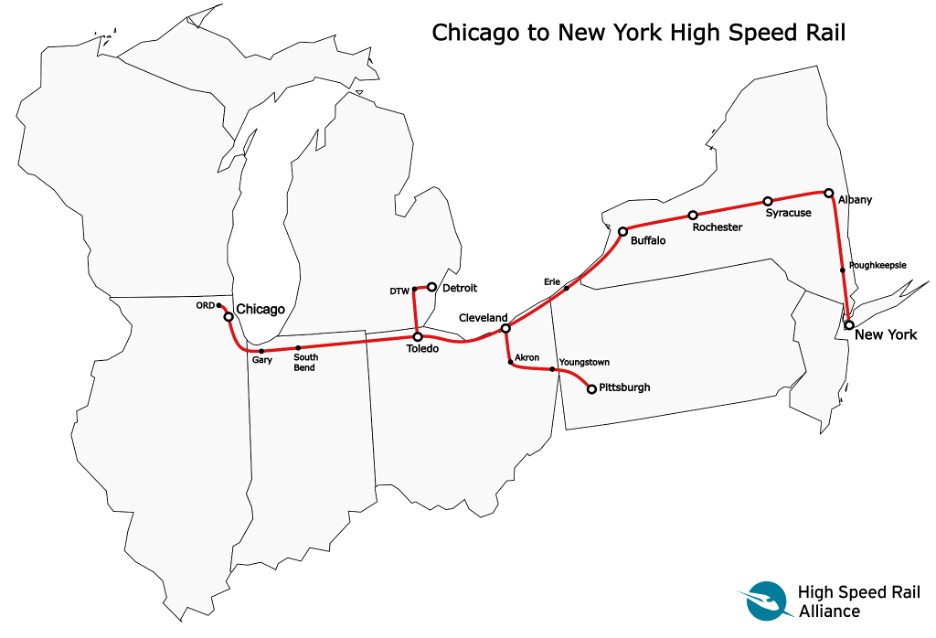
In the same 20 years that it would take to design and build high-speed rail between Chicago and St. Louis, Milwaukee, or Detroit, a wider-ranging effort could instead design and build a line of national scope and importance. Industry and government are equally capable of planning small projects and megaprojects. If it would take us the same 20 years to fight for a short line as for a long one, we should go big. We should aspire to meet the moment and demand the project the country really needs: a high-speed line connecting Chicago and New York.

The route proposed for this high-speed line essentially follows the current route of the New York section of Amtrak’s Lake Shore Limited, which follows the shore of Lake Erie to connect to the population centers in Western New York before turning down the Hudson River to serve New York City. A high-speed line will require a dedicated right of way for much of its length, but limited track-sharing may be possible, especially in the approaches to Chicago and New York. The exact routing is beyond the scope of this proposal; we can envision the route at a high level and call out the larger communities that would be expected to receive service, but without getting into route choices at the local scale.
For what it's worth, at the start of the twentieth century, within two decades a short line intended to connect Chicago to New York did fund raising, bought rolling stock, built about 25 miles of track, ran some trains, and quit before the United States entered the War to End All Wars.


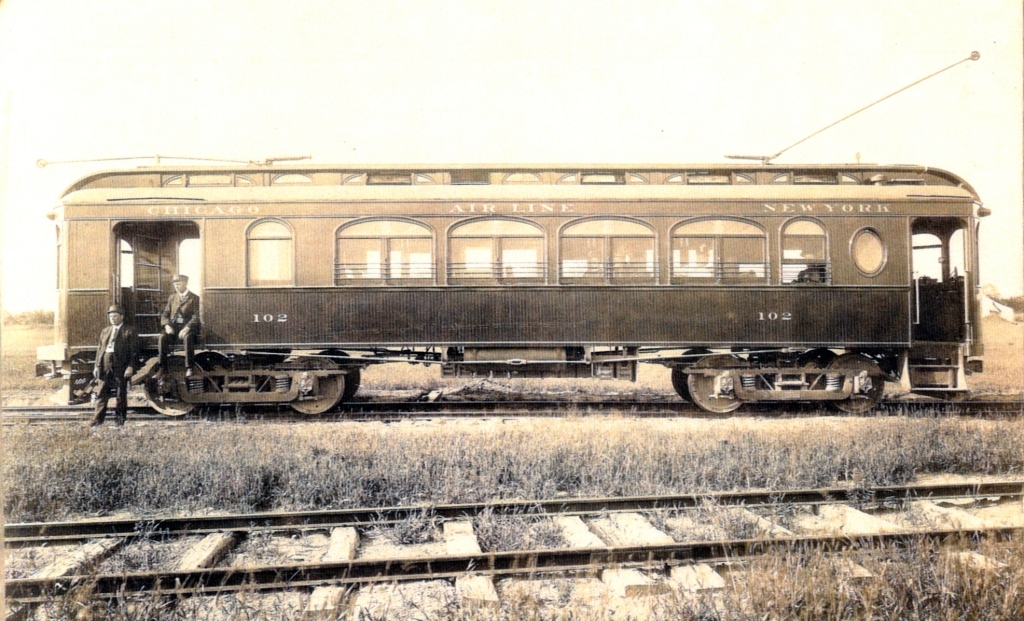
Chicago-New York Electric Air Line
Image from New York and Chicago history page.

That project envisioned only the most generous of curves once the line got around the southern tip of Lake Michigan.
If your objective is to provide a high-speed rail line that permits ten-hour timings, your railroad will be an undertaking of Biblical proportions. Ev'ry valley shall be exalted, every hill made low, the crooked straight, and the rough places plain.

Air Line proposal map from Mary MacLane's Air Line historical photos.

On the other hand, that's only a 90 mph railroad. Upgrade it for field-shunted Electroliners and you're in New York about 7 1/2 hours after you've left Chicago, and if you give it the fourth-generation Electroliner treatment and you can have your coffee in New York and meet a client for lunch in Chicago.
The proposed routing for 2025 and beyond envisions going around, rather than through, the Alleghenies.


The amusing part, dear reader, is that the gentleman who promoted the original Chicago-New York Electric Air Line, back when the interurbans were the dot.com craze of the era, started his musings on such a project on a New York Central train which, as it approached Albany, was farther from Chicago than it was upon leaving New York.

29.5.26

DISCOVERING THE ELECTRIC PRESERVATION RAILWAYS OF THE STATE LINE.

Mercedes Streeter of The Autopian stumbles upon the East Troy Electric Railroad.
Countless historic American streetcar and interurban lines have disappeared since their heyday, but I found a place where you can still experience a commute like it’s 1920. This is the East Troy Electric Railroad, Wisconsin’s last running interurban railroad, and it’s one of the most tranquil rides you’ll ever take that doesn’t even surpass 15 mph.

The East Troy Electric Railroad is one of my favorite kinds of museums. Nestled in the town of East Troy in southeastern Wisconsin, this museum doesn’t really have the marketing of the Illinois Railway Museum or the federally recognized status of the National Railroad Museum. Instead, it’s a museum that you hear about through word of mouth or stumble upon on social media, and it has the same kind of lovely charm as a mom-and-pop shop. The museum is small enough that, if you’re not paying attention, you could drive right by it and not notice it was there.
We've called attention to the East Troy Electric Railroad numerous times.  It's unusual among preservation railways in that its busiest season is fall, for apple picking and leaf peeping.

19.6.08

GETTING THE OBJECTIVES RIGHT. Megan McArdle is taking requests, including "Why does [passenger] rail suck?" Some of her post focuses on the government's schizophrenic role in funding on the one hand and doing environmental protection on the other hand, and there is a followup on the peculiarities of fully allocated cost accounting as well as a response to Chris Lawrence weighing the costs and benefits of a less dirigiste structure for government. Vermont Tiger's Geoffrey Norman offers a less cheerful view of public servants.

When the Chris Dodds of the world are running the railroads, they'll get sleepers and eat off good china in the dining car.

The rest of us will be packed into boxcars and eating stale bread.
That's not far from the perception many Midwesterners have of Acela Expresses for Boswash and standing-room-only three car Horizon rakes in Illinois and Indiana.

But it's a response to the lead-in to Chris Lawrence's post inviting me to weigh in that I'll work on here. Consider the example Ms McArdle uses to introduce the procedural thicket.

Why isn't there a high speed train from New York to Chicago? Well, first of all, this would greatly anger legislators from New York and Michigan, who like the fact that the Chicago train must pass through Buffalo and Detroit, even if this assures that almost no one with a job will actually use it.
She rules out partial privatization of Amtrak.

Amtrak can't be even partially privatised, because then who would run trains from New York through Buffalo and Detroit to Chicago in a speedy eighteen hours?
Here's why the objective of the rail system matters. At one time, The Pennsylvania Railroad and the New York Central reached New York from Chicago in sixteen hours (for one brief shining moment, in 15:30) with steam power. (The Pennsylvania had the more direct route, but east of Pittsburgh comes The Mountain, while New York Central used Lake Erie and the Mohawk and Hudson Rivers to run a longer distance at a faster speed.)

Going the great way around struck some railroad promoters as silly, particularly because that New York Central train headed west by way of Albany, which left the passenger at a greater air distance from Chicago than he or she was at Grand Central Terminal.

Thus, the figure of merit for a genuine high-speed train service linking Chicago and New York begins at ten hours.


Promotional poster image from Mary MacLane's Air Line historical photos. Click to enlarge.

If your objective is to provide a high-speed rail line that permits ten-hour timings, your railroad will be an undertaking of Biblical proportions. Ev'ry valley shall be exalted, every hill made low, the crooked straight, and the rough places plain.

Air Line proposal map from Mary MacLane's Air Line historical photos. Click to enlarge.

On the other hand, that's only a 90 mph railroad. Upgrade it for field-shunted Electroliners and you're in New York about 7 1/2 hours after you've left Chicago, and if you give it the fourth-generation Electroliner treatment and you can have your coffee in New York and meet a client for lunch in Chicago. On the other hand, you've laid out a railroad that misses the intervening cities, precisely the problem that would prevent politicians in those cities from committing public monies to be treated as a third-rail equivalent of flyover country.

(A historical note before I get back to the objectives: there really was an attempt to build the Chicago-New York Electric Air Line, which rather cheekily advertised its initial service between Gary and La Porte, Indiana. The aforementioned Mary MacLane has assembled a comprehensive Air Line website, including a page of contemporary images of its ruins. La Porte County in Indiana is home to two historical associations that include Air Line material on their websites.)

The problem of blending long-distance and short-haul corridor services has long challenged railroads. Those sixteen-hour flyers tended to be overnight sleeping car trains that called at Pittsburgh or Buffalo at times used by the military to begin invasions, and New York Central's Twentieth Century Limited, perhaps the most famous of the flyers, rolled through Cleveland without stopping. In the year or so leading up to the Penn Central merger, New York Central conducted a speed test with a jet-assisted rail diesel car, announced its plans to restructure its passenger train service, discontinued the Twentieth Century Limited, and introduced a memory-pattern service between Buffalo and Grand Central Terminal. No other corridors were set up at that time. The Pennsylvania Railroad discontinued the Broadway Limited and renamed the General as the Broadway Limited. After the merger, the resulting railroad was too overwhelmed with other problems to be able to set up promising corridors such as Pittsburgh-Cleveland-Detroit, Pittsburgh-Columbus-Indianapolis-St. Louis, Cincinnati-Indianapolis-Chicago, or Cleveland-Columbus-Cincinnati. A Trains speed survey of the era noted that those cities would have merited Trans-Europ Express service, the precursor to the TGV and ICE and Eurostar and Great North Eastern. Even with the skimpy offerings, the Penn Central timetables offered more frequent New-York Chicago services over more routes (via Pittsburgh on The Pennsylvania Railroad, via St. Thomas and Detroit west of Buffalo on the Michigan Central, and via Cleveland and Toledo on the Lake Shore and Michigan Southern). The grubby day trains that remained in Ohio and Indiana all died before Amtrak, although the memory pattern service east of Buffalo persists under the same Empire Service label.

And thus the problem facing people who wish to expand Amtrak. That north central corridor service in the region west of Pittsburgh and Buffalo and east of St. Louis and Chicago would be a very different service from one predicated on longer distance high-speed service, such as Denver-Chicago (doable dawn to dusk with existing technology) or Chicago-New York. But perhaps people who wish to expand the passenger rail network as a way of coping with (permanently?) higher gasoline prices would do well to study old timetables. Thanks to that Vermont Tiger post, we discover editorialists at The Brattleboro Reformer doing just that.

It's 1938 and you want to take a weekday trip from Brattleboro to New York City. A glance at the Boston and Maine Railroad's turntable shows six trains to choose from.

The Washingtonian, the top overnight train run jointly by the Central Vermont, Boston and Maine, New Haven and Pennsylvania railroads between Montreal and Washington, D.C., leaves Brattleboro at 3:30 a.m. and arrives at Penn Station at 8:12 a.m.

If you're not that much of an early riser, Train 74, the Connecticut Yankee, leaves Brattleboro at 4:35 a.m. and gets you to Grand Central Terminal by 9:45 a.m. -- the quickest train to the city. Or you could catch Train 78, which leaves Brattleboro at 5:52 a.m. and arrives at Grand Central at 11:40 a.m.

If you're sleeping in ...

They conclude,"There is no reason for rail service to be worse today than it was in 1938." That was a very good year. The Milwaukee Road introduced the world's fastest steam locomotives. But perhaps there are good reasons for the rail service to change (somehow the Boston and Maine enlarging Hoosac Tunnel for double-stacks, which hadn't yet been invented, strikes me as an improvement in rail service.) All the same, the renewed focus on passenger rail is reason for advocates and policy makers to review the best practices, and the errors, of the late steam era.

4.4.18

IS PERFECT THE ENEMY OF GOOD, WHEN THE STATUS QUO IS "NOTHING"?

For a long time, we've been following the attempts, by private interests, to develop faster Passenger Rail in Texas.  Those attempts have come in train with special pleading by rent-seekers, and the NIMBY roam.  Thus, ten years on, no new trains.  Don't say I didn't warn you.
A debate between the dedicated high-speed passenger line advocates and the advocates of less costly combined freight-passenger-toll truckway projects brings with it the risk that no rail improvements will be forthcoming. That leaves Texas with the impossibly slow Heartland Flyer and Eagle and the try-weakly Sunset Limited, all of which made better times with handfired Harriman Standard 4-6-2s and their counterparts.
Impossibly slow? Yup.
Train originates at San Antonio this day, at 6.45 the conductor says, "Let's go for a train ride."  Leave San Antonio 7 am, on time.  First stop San Marcos, 52 miles away, 8.32, double stop, away 8.39.  Texas Central wishes to get from Houston to Dallas in 90 minutes.  I'm enjoying a good breakfast and conversation in the diner, yet have flashbacks to those German trains of two months previous.
There are, however, two proposals seeking assent from Texas authorities.  One proposal has the imprimatur of the French Societe National de Chemin de Fer, or perhaps they simply go as SNCF for continuity, the way the private Canadian National are still CNR.  Whatever the affiliation, the logic is impeccable. "'Look at the state as a whole. Instead of creating a link, create a network,' said SNCF America president Alain Leray."

Yes, and build it by increments.
Maryland-based SNCF America, a branch of the French National Railway, pitched its "Texas T-bone" idea to the Federal Railroad Administration in 2008 and 2016. The plan calls for "higher speed rail" service of 125 mph.

The railroad administration has instead proceeded to work with Texas Central Partners on a Dallas-to-Houston bullet line featuring speeds up to 210 mph and using Japanese technology.

"Of course, SNCF, the state-owned and highly-subsidized French National Railway would declare they are against competition and block the world's best high-speed train technology from coming to the U.S.," Texas Central said in a prepared statement.
Perhaps you make the case for faster trains by improving timings, frequency, and connectivity on existing lines. Compare and contrast the two proposals.


The French plan uses the large Fort Worth intermodal terminal, already served by the two intercity Amtrak trains and the Dallas area suburban trains, and existing rail lines linking existing cities.  Yes, a direct line between San Antonio and Houston would be nice, but adding frequencies on both of those routes, properly timed, means lots of rail opportunities for passengers north of Temple.  That's going to be important in the beginning, weaning Texans from their pickup trucks will require frequency and dependability, and more frequent trains running at 79 mph, with acceleration to 110 and 125 as improved signalling and more robust diesels arrive strikes me as a more sure way of building ridership.

The Texas Central plan appears to envision a new Dallas to Houston Electric Air Line, perhaps in the median of a toll road dedicated to trucks (what, there won't be any paths for stack trains overnight?) as well as another Air Line to San Antonio, and perhaps new construction paralleling the existing route of the Eagle, all of which seeks a home where the nimbrods roam.  "Much of the opposition to the Texas Central plan comes from landowners opposed to eminent domain."  Thus, Texas Central might find themselves in the position of California, building relatively useless track where there is little resistance, thus ending up with no opportunities to build ridership.  Worse, they're neglecting a development the French project might be embracing. "While North Central Texas Council of Governments officials are working with planners for a commuter line from Fort Worth to Waco, Temple-Killeen, Austin, San Antonio and Laredo, Texas Central is not committed to providing that service."  That "commuter line" ought not be confused with Chicago's Metra or New York's Metro-North, although intermingling regional trains, e.g. Waco-Fort Worth, Georgetown-Austin, San Antonio-Laredo with cross-country trains running the full distance or partial distance (would it be too much to ask for a Dallas-Laredo sleeper overnight?) is the kind of thing European railroads do as a matter of course.

Cold Spring Shops prays that if the T-Bone plan becomes a Passenger Rail network, that there be one operator honoring all tickets, this business of no interline ticketing between Amtrak and any of the urban Commuter Rail operators being bad business.

Recall, dear reader, that the French TGV trains rolled out as incremental improvements, and they still use the same tracks into the urban stations as their steam-powered predecessors.

3.4.09

MORE RESERVATIONS ABOUT THAT MADISON TRAIN. I noted some last week. James Rowen raises the same questions.
People are noticing that putting the Madison high-speed rail station at the airport on the far NE side of town discourages riders interested in using the service between Milwaukee and Madison.
The article he links expands.

The problem with a downtown Madison station is that this train line isn't just a Milwaukee-to-Madison route, a state official says. It's intended to become a segment of a longer route that would eventually run all the way from Chicago to the Twin Cities, as part of a Midwestern network of fast, frequent trains. And a side trip through the capital city's crowded isthmus and back again would eat up too much time for travelers continuing beyond Madison, said Randy Wade, the state Department of Transportation's passenger rail manager.

To reach downtown Madison, trains would have to slow down on their way through numerous crossings, then back up all the way to the airport to leave town, Wade said. That also would boost the cost of the route, he said. Wade did not have figures on how much time or money a downtown spur would add.

Danielsen said he would be happy with a connecting local train, like the St. Louis light rail line that connects that city's downtown to its airport. And planners have considered running a Dane County commuter train to the airport. But the current plan for that $250 million project is to run from Middleton to downtown to Sun Prairie, bypassing the airport.

Ah, the problems with intentions. Chicago to the Twin Cities by way of Milwaukee, Madison, and La Crosse is going the Great Way Round: the more direct way through Milwaukee would go directly to Portage, while the more direct way through Madison would bypass Milwaukee and head to Eau Claire rather than La Crosse. Think Indians and numbers ending in two zeroes. We thus end up with one high-speed line, maybe, that, in attempting to give each constituency a little something, ends up with a project that pleases nobody. And if the Madison service becomes operational in the first four years of the Obama administration, and he goes the way of Jimmy Carter, the high speed service terminates at the airport for all time. The Chicago - New York Electric Air Line at least had the sense to build connecting lines into Gary and LaPorte where, well, passengers lived, and it built an Electric Park near Westville. That kept some money coming in long after plans to continue west to Chicago and east to Akron failed.

Alas, a connecting line into central Madison gets burdened with everything that's involved in public enterprise.

The Sun Prairie route was chosen because it could better serve commuters, Madison city transportation planner Dave Trowbridge said. The airport route has not been ruled out, however, and could be added as a spur in the future, he said.

But at the rate the projects are moving, the Milwaukee-to-Madison train is likely to be running before the commuter rail system completes its initial line, let alone an extension, Trowbridge said.

As a result, train travelers heading for downtown Madison are most likely to complete their trip by bus, Trowbridge said. Madison Metro Transit now has a local route to the airport, but a train station would likely lead to creation of a direct shuttle to downtown, operated by either the bus system or a private business, he said.

I just opened my June 1954 Official Guide to page 994, the time table for The Milwaukee Road's Madison service via Watertown. Train 33, the On Wisconsin: d Watertown 8.34, Waterloo 8.51, Marshall 8.57, Sun Prairie 9.12, Franklin Street 9.35, Madison 9.42. How hard would it be to through-route the fasts on the commuter line, at least until it's clear that the extension west of Madison to the Cities is in the works? Or to light a fire under the government agencies that are entangling the commuter line in endless process?

25.9.22

TODAY'S RAILROAD READING.

What happens when a snowstorm disrupts operations on an electrified mountain railroad?
Our work outfit had a 2-6-6-2 Mallet and we were called to push a steam rotary over the pass. A snow slide at Falcon had blocked the tracks and tore down the overhead trolley wires. Our rotary crew had cleared the passing track at Falcon, then we went to work on our other assignments for the day.

When we got to East Portal, we plowed out the sidings and had a meet with a westbound freight train.
That's got the tension necessary to a work of railroad fiction. Now bring in the human interactions.
Good railroad fiction has in common with good sea stories the opening line, "No s***, this really happened." The stories in the anthologies I've read tend to fall into a few broad categories: the rigid manager who has a humbling experience, the dispatcher or telegrapher that keeps 'em rolling despite natural or man-made problems, the maintainer that comes up with an inventive if not quite by the book fix.
Only we are in a no s*** this really happened situation.
Since the wire at Falcon was now buried in a pile of snow, the train would have to go through there with the pantographs down. With the trolley overhead gone, there were no working air compressors on the train as there was no source of electricity to run them.

This meant there would be no regenerative braking and the crew would have to handle train braking using only the compressed air in the system. Additionally, there was no way to release the train brakes once they were set.

As the train rolled through the gap in the trolley overhead, the brakes crept on more and more, threatening to stop the moving train. With no compressors the crew had no way to kick off the air brakes to keep the train moving through the gap. Eventually the train stalled with both electric engines sitting in the section that had no electricity.
That's a safety feature. You wouldn't want leakage in the brake line, thanks to entropy and amplified by cold weather, to have the brakes releasing.  But you have to put enough pressure back into the brake line to be able to reapply the brakes, once you have a pusher on and the train ready to move.
The air in the braking system on the freight had leaked off after two to three hours on a cold night in the mountains. We backed onto the it and coupled up the air from our 2-6-6-2. Then the old-time hoghead on the Mallet released the brakes and started pumping air into the train, but the air from the steam engine was too little and too late.

As soon as the brakes released, away went the train, and us with it.

I was in the rotary and the air gauge said 15 pounds in the train line. I knew that once the train started moving, we wouldn’t have enough brakes to stop it.
Will this story end with a broken train and dead and injured people? Will the substation flash over when the electric locomotives go into regeneration from too high a speed?  Will the steam locomotive engineer come to blows with the engineer on the helper electric locomotive?  Click over for the rest of the story.

26.5.17

IN PLACE OF HERO PROJECTS, INCREMENTAL IMPROVEMENTS.

Reason's Steven Greenhut, in common with most of Reason's transportation writers, is no fan of high speed trains, especially California's project, which, like the old Chicago - New York Electric Air Line, is starting out with some expensive construction between Nowhere and Vacant Fields.


Chicago-New York Electric Air Line

At the conclusion of his article, however, is a sensible suggestion. "If state officials weren't spending so much money on these wasteful rail-related transit projects, they'd have extra money to fix roads, bridges and freeways—and to provide realistic transit projects rather than overbuilt boondoggles designed with a future fantasy train in mind."

Yes, additional frequencies on the existing regional routes (Amtrak and the city-specific commuter services), making better connections between the Los Angeles and San Diego regional trains, and filling in some of the gaps in the rail network (connect Bakersfield to Los Angeles and Santa Barbara to San Luis Obispo) are likely to be more productive at less cost than a San Francisco to Los Angeles Neubaustrecke that, like its German and Japanese counterparts, will have to be tunnelled through difficult terrain.

The roads?  Perhaps it's in the public interest to let some of them crumble.

21.3.11

JUST SLIGHTLY AHEAD OF ITS TIME?  Destination: Freedom discovers a new high speed rail initiative.
Two enterprising Chicago high-speed rail advocates are announcing formation of a project to build a 220 mph line connecting Chicago to New York, and other cities located on the Northeast Corridor.

Long-time rail advocates Mike Lee and Charles Paidock are recruiting individuals from across the transportation community to develop plans, specifications, and secure private/public funding for this project.  While they are supportive of associations that foster passenger train travel, or short local high-speed lines within a state, the two prefer to focus instead on getting down to building a real railroad in the way that hasn’t been seen in a over a hundred years.

Charles Paidock said:  “Putting little high-speed lines here and there is ok, but all you’re actually doing is just putting in another commuter line, and improving public transit.  And I’ve seen all sorts of plans for regional networks, but nobody except us apparently has a map of the United States.  It only makes sense to have a route connecting these two major metropolitan areas.”

The construction of a railroad from New York, to Pittsburgh, and then on to Chicago was actually proposed in 1907.  Approval was granted for construction, but there was an economic panic later that year, and the start of World War I made financing the project doubtful, so it never was built.  The two largest railroads in the United States at the time, the Pennsylvania and the New York Central, later ran competing passenger trains along different routes between New York and Chicago, attracting sizeable numbers of passengers, until the advent of superhighways and airlines.
The New York and Chicago Railroad appears to be a legitimate suggestion (a legitimate business enterprise would be another matter), and its organizers recognize that the idea is, oh, 100 years old.


Chicago-New York Electric Air Line.
Image from New York and Chicago history page.

We've seen the Air Line before. The current plan envisions a railroad that calls at Cleveland and Pittsburgh along the way, rather than seeking the most direct course.


The organizers will have a table at Chicago Union Station on National Train Day, May 7.

6.10.08

SPEEDING UP THE TRAINS. The Federal Railroad Safety Improvement Act includes substantial moneys for safety improvements and provision for the equipment to permit faster running by Amtrak.

Modern, comfortable, double-deck trains with wide seats and large windows would churn along at top speeds of 110 m.p.h. The faster trains would shave hours off trips, delivering passengers from one downtown to another hundreds of miles away.

Amtrak trains in most of the Midwest now operate at up to 79 m.p.h., although average speeds are much slower, especially around Chicago due to freight traffic.

Driving, which results in more than 40,000 fatalities a year, would take a back seat as a transportation choice, proponents say.

So, too, would air travel as consumers factor in the time it takes to go through airport security, the hassle of flying and the time spent traveling from outlying airports.

Travel times of almost 51/2 hours on Amtrak's route between Chicago and St. Louis would be cut to 3 hours and 49 minutes on a high-speed train, according to preliminary estimates.

In the past year, more than 501,000 rides were taken on Amtrak's Lincoln Service route between Chicago and St. Louis, a 284-mile trip, a 15 percent increase over the previous year. Some 1.2 million rides a year would be taken when the route is served by high-speed trains, according projections by the Illinois Department of Transportation.

In addition to the congressional action, the Federal Railroad Administration last week approved grants to Illinois to install train-control and cab-signaling systems on part of the route to facilitate high-speed trains.

A high-speed rail line between Chicago and the Twin Cities could be running within five years, according to U.S. Rep. James Oberstar (D-Minn.), chairman of the House Transportation Committee. The roughly eight-hour trip on Amtrak from Chicago to St. Paul would be cut to about 51/2 hours under the working proposal.

Planners envision the line running from Chicago up through Milwaukee, Madison, the Twin Cities and eventually Duluth, while separate routes from Chicago would extend east to Detroit, Cleveland and Cincinnati.

It's apparent there would be a strong market. Even today, with slow service and a poor on-time performance record, Amtrak finished fiscal 2008 last week with its sixth straight year of ridership growth.

I've provided an image of a traditional bi-level streamlined train capable of 90 mph operation. The news article has a graphic giving the anticipated travel times after the upgrade. It has no historical context. I've augmented that graphic's presentation of current and proposed running times with best running times from my April 1951 Official Guide. From Chicago to

  1. St. Louis (110 mph line) 5:20 current, 3:49 proposed; 5:10 in 1951. Some of the track on this line is good for 110 and the alley tracks through Springfield have been improved. I'll be nice and not mention an electric air line proposal from the early 1900s for this route.
  2. Milwaukee (110 mph) 1:29 present, 1:04 proposed; 1:15. Regular readers know where I stand on this service. That accelerated timing is four minutes slower than a Milwaukee Road proposal in 1938, using streamlined 4-6-4s, that was shelved under an agreement with the Chicago and North Western, a competing carrier that could match a 75 minute timing but could not manage a 60 minute timing.
  3. Detroit (110 mph) 5:36 current, 3:46 proposed; 5:10. There's some 100 mph track in western Michigan already. There is more potential on this line at some of the intermediate stops, including Dearborn and Birmingham for business travelers and Ann Arbor and Kalamazoo for student traffic than there is in Detroit itself.
  4. Cleveland (110 mph) 6:24 current, 4:22 proposed; 5:47. The map suggests a routing along the old New York Central, which calls at South Bend and Toledo and some small cities.
  5. Cincinnati (110 mph) 8:10 current (triweekly), 4:08 proposed; 5:30 using the New York Central's route via Indianapolis.
  6. Carbondale (90 mph) 5:30 current, 4:22 proposed; 4:32. The Illinois Central used to run extra sections of trains at college breaks, on a 100 mph railroad. Corporate downsizing included removing the safety appliances and much of the second main track.
  7. Omaha (79 mph) 8:37 current, 7:02 proposed; 8:57 using the proposed Rocky Mountain Rocket via Des Moines, the Denver Zephyr made it in 7:30 on the current Amtrak route, and the Midwest Hiawatha took 8:30 on trackage that has since been torn out. The Des Moines route is more thickly settled. It requires work.
  8. St. Paul (110 mph) 8:05 current, 5:31 proposed; 6:15 on the Afternoon Hiawatha or the Morning Zephyr. The high-speed plan includes a Watertown-Madison-Portage diversion from the current route. Will there be a European-style reversal of direction in Madison, or will the station be somewhere on the east side of town, remote from the university and the capitol?
I'm enthusiastic about this proposal, although I'll believe it when I see it implemented.

30.12.06

ARCOLA, TUSCOLA, PEPSI-COLA. The expanded Amtrak service to Carbondale, Illinois, is not yet as comprehensive as the mini-corridor service the Illinois Central operated until the coming of Amtrak, but it now permits a day return trip to either end of the line.


Illinois Central services, February 1970.
Click the image for the actual sized schedule.
Note Memphis service. Northbound American runs on a comparable schedule.
Southbound City of Miami is about 30 minutes faster into Carbondale.

The new trains have seen a 61 percent increase in ridership over comparable totals a year ago and the corridor serves a number of the Illinois public universities along the eastern border of the state.

At Christmastime, the Great Hall (why not call it a waiting room?) of the Chicago Union Station is well-decorated.


The mini-corridor service originated at Chicago's Illinois Central Station on the lakefront. Amtrak rerouted all trains into Chicago Union Station, making use of a connecting track called the St. Charles Air Line that involves a reverse move out of the station and some slow running on elevated trackage.

The Metra Electric has been taking delivery of a new fleet of electric gallery cars (the original units are pushing 40) that have the control station upstairs, as is the case with the diesel control trailers on the other lines. A few of the older cars are on the easterly tracks.

In the background is the rebuilt Soldier Field. I sometimes wish the Chicago authorities had said "Build your new stadium in Arlington Heights" or "Go back to Decatur" rather than foist this questionable aesthetic on the lakefront.

The train ultimately makes its way out of suburban territory (including the southbound odyssey out of Kankakee) but it's unable to make the 1970s timings. Illinois Central was the last of the Chicago corridor operators to remove the 100 mph operation on its passenger mains, and the two-track speedway is now a rather busy single-track line with frequent passing sidings.

At Gilman, we had to duck into the TP&W interchange to clear a path for the northbound morning Saluki.

The station building, which is the setting of a famous double-time-exposure centerspread in Trains in the late 1950s, is in use by CNR maintenance staff. The Gilman station, in keeping with Amtrak's practice of building facilities in suburban locations, is a halt hard by the parking lot of a Citgo mini-mart in the truck stop quarter of town.

Further south, there appeared to be work in progress building an additional siding at Rantoul, and the station at Champaign has been made over as the "Illinois Terminal," although I saw no evidence of electric cars awaiting riders for Danville or Springfield.

The mini-corridor trains do not operate in the push-pull fashion of the Illinois Zephyr or Hiawatha lines. The train arriving Carbondale (close to time) turns on a wye north of downtown.

Concrete coaling towers proved to be such a good investment in durability that their removal is uneconomic. As long as there's enough overhead clearance for stack trains, railroads tend to leave them alone.

The campus of Southern Illinois University is easy walking distance from the Carbondale station, which is staffed with ticket and baggage agents.

Somebody got a deal on the plans for Chadbourne Hall.

I'd like to have train service this close to Northern Illinois University (viewed here from a pedestrian bridge linking the Chadbourne triplets to the main campus on the other side of Highway 51.)


I understand that all the turn-of-the-twentieth century state normal schools received a castle for a main building. This one is named Altgeld Hall, much like its counterpart at Northern Illinois.

I like our design better, and it's oriented for full sun on its front facade most of the day.

The Main Line of Mid-America is still a busy freight railroad connecting traditional CNR property Grand Trunk and new CNR property Wisconsin Central to Gulf ports.

There's not much time in town, especially if the incoming equipment is a few minutes late. On the other hand, there's no risk of getting stranded in Carbondale on a day-return trip as the equipment down as the morning Saluki goes up as the evening Illini. There's usually enough time to recess the train on a center servicing track away from excessively eager passengers and clear of the two tracks through town.


The service is still decently fast, capable of overtaking everything on Interstate 57 in open country, and during the holidays the lighted houses add to the view. Much of the run is at speed through smaller towns with their public illuminations and a Casey's general store at city limits. How long, though, before the secularist killjoys decide that herald angels and westward-leading stars are contrary to the Establishment Clause?

Amtrak 392 Saluki, Carbondale-Chicago, 28 December 2006: Genesis diesel 41, Amfleet dinette-business class car 48177, Horizon coaches 54517 - 54579 - 54536. Temperature approximately 50o (F), dry rail.

Leave Carbondale 4:05:50; DuQuoin 4:26:55-4:28:37; Centralia 5:00:11-5:01:43; Effingham 5:45:44-5:47:15; stop south of Mattoon, no explanation, no meet 6:03-6:06; Mattoon 6:16:21-6:17:40, meet train 393 waiting in siding 6:44, Champaign 6:54:00-6:59:05 (business class full out of Champaign, I suspect that when the semester begins coach will be crowded even with strengthened formations), Rantoul 7:12:36-7:13:00, second stop, moving again 7:16:40; Gilman 7:42:38-7:43:00; Kankakee 8:04:57-8:05:25; Homewood 8:32:14-8:34:48, fast run through south suburbs and no impediments on Air Line or reversal into station, Chicago 9:18:37. I didn't have to run to catch the 9:40 to Elburn.

23.12.17

EVERY VALLEY SHALL BE VAULTED.

German Rail completes the München to Berlin fast railroad, a project that could only be possible with the Cold War over.  The new service is time-competitive with air, and faster (and less nerve-wracking) than driving.

Trains use existing stations and urban trackage, with the fast lines giving the impression of a souped up Lackawanna Cutoff or Long Drag (to think of two rail lines where policy makers swallowed the highway lobby's blandishments.)
Three separate 187.5-mph high speed lines opened between 2006 and 2017 with three other sections of existing line connecting the new high speed lines rebuilt for operation at up to 144 mph. All the major stations on the route have also been modernized.

The 67-mile long section opening this month was the most complex to build as most of it cuts through — or under — the hills of the Thüringen Forest. Of the 67-mile length of the route, more than a third, or 25.6 miles, is in tunnels built for 187.5-mph operation with 7.5 miles of bridges and viaducts as well. The Erfurt to Ebensfeld section has cost about $12 billion and work was stopped for several years in the late 1990s due to a shortage of funding.

The line has been built for mixed use with freight permitted and passing loops [double-ended sidings -- ed.] to allow ICE trains to overtake freight trains. So far no freight has operated as access tolls are higher than the regular network.

Services on the new line are being operated using the existing Deutsche Bahn ICE fleet which has been fitted with cab signalling [positive train control] to operate on the new line.
The modern German style of viaduct (Miniatur Wunderland have at least one model in action) gives the impression of a minimalist Nicholson Viaduct.  But unlike the promoters of the Chicago-New York Electric Air Line (which figured in a Christmas video a few years back) they're not building a dead-straight, dead-level railroad.

Freight train operations are restricted by day, although I can report at least one delay enroute Hamburg from Nürnberg account freight train interference.

30.6.09

EVERYTHING OLD IS NEW AGAIN.

Trains for America picks up a Chicago Tribune story about a super-interurban connecting Chicago and St. Louis by way of Urbana and Springfield.
The trip between Champaign and Chicago would take 45 minutes; and 90 minutes between Springfield and Chicago, the study said. The study estimated the cost of building the 220-m.p.h. Chicago-to-St. Louis corridor at $11.5 billion in 2012 dollars. It does not include the cost of new trains, maintenance facilities and other expenses.

Construction of IDOT's 110-m.p.h. plan from Chicago to St. Louis is estimated to cost $2 billion, officials said. But the association's study said the straight and level railroad alignments in Illinois provide "ideal conditions for implementing fast operation at reasonable cost."
The idea dates to 1894.
Ground will be broken for the Chicago and St. Louis Electric Railroad, it is said, on May 1. Twenty miles of the road from Alpine Heights into [Chicago] are to be built.
In the early days of electric railroading, somebody, possibly the Dr. Wellington Adams named in the article, envisioned a 100 mph electric railroad on a straight course between Chicago and St. Louis. I saw a woodcut depicting such a four-track railroad in some traction history, possibly Trolley Car Treasury. (It's a different proposal from the Chicago - New York Electric Air Line.)

The Midwest High Speed Rail proposal deviates from the existing Amtrak line that uses the Alton Route. The Illinois Central line between Chicago and Champaign used to be a fast railroad, and the current station at Champaign is the former Illinois Terminal station. Although the Illinois Terminal got out of Champaign during the Depression, it offered service to Decatur, Springfield, and St. Louis, latterly with these streamliners.


The Illinois Traction Society sells art prints of these streamliners, including one of a two-car train vaulting over Route 66.

1.6.23

WILL CALIFORNIA FUND REGIONAL RAILROAD ELECTRIFICATION?

I never lack for stories of Technocratic Overreach, do I?
Rob Himoto’s Santa Maria Valley Railroad is the quintessential short line success story. His family bought the struggling 13.72-mile independent short line in 2006. Through hard work, they’ve been able to quadruple annual carloadings, diversify the railroad’s traffic base, and improve its track.

Himoto is understandably proud of the turnaround and the role the railroad plays in taking long-haul freight off the highway in California and beyond. But now the California Air Resources Board has come along with new locomotive emissions regulations that could bankrupt the Santa Maria Valley and threaten the viability of many of the state’s 24 other short lines.

The regulations, approved in April, pack a one-two punch. The first is an excise tax on locomotives that goes into effect in 2024, with the amount based on emissions each locomotive produces. The second prohibits locomotives older than 23 years from operating in California beginning in 2030. CARB’s wacky idea is that the excise tax is a forced savings plan that will help Class I and shortline railroads pay for new clean-burning or zero-emissions locomotives.

But the yearly excise tax will be a knock-out blow for some short lines. In Santa Maria Valley’s case, the bills on its active fleet — a GP7, GP9, and GP35 — will exceed the railroad’s annual revenue. What’s the Santa Maria Valley going to do when the forced spending account plan goes into effect next year? “I don’t know,” Himoto shrugs. “We’re at a loss.”

And there aren’t any other options. Santa Maria Valley rosters a pair of GE 70-tonners that are exempt from the excise tax because they produce less than 1,006 horsepower. Could they take over for the Geeps? “No,” Himoto laughs, shaking his head. “Not with our traffic.” The 70-tonners can’t handle the railroad’s typical 35- to 40-car train.
Oh, there are other options.


We start with two products of Milwaukee's Cold Spring Shops, moving ballast hoppers to upgrade the East Troy Electric Railroad, which has been electrically operated, mostly, under multiple owners, since 1907.  The constraint on heavy electric freight operation is in the substations and the overhead wire.  But Californians might raise a stink about chopping down enough trees to put the catenary poles up.

14.12.02

IT'S NOT A CORRIDOR. Tim Cavanaugh is not pleased with the alternatives Amtrak offers to flying from San Francisco to Los Angeles. Dissecting Leftism (scroll up) picks up the story, and comments, "[T]rain travel in the USA is still slower and more expensive than air travel or road travel. It is much the same in Australia. When will people accept that government subsidy is no long-term solution to ANYTHING?" The ball comes out of the scrum, and Transport Blog runs with "Amtrak's ludicrous San Francisco to Los Angeles run. It is almost as if Victorian governments had chosen to subsidise the horse and cart."

Please be advised that, although Amtrak has not done as effective a job with its corridors as it might have (see this evaluation of the Chicago-Milwaukee service) it is a faster service than driving in most of the Northeast most of the day, and a faster way from the Loop to Milwaukee on many days, and it's faster than flying from Capitol Hill at least to Philadelphia, or Providence to Manhattan, and don't even think about flying from Chicago to Milwaukee.

Please also be advised that the San Francisco-Los Angeles is not the West Coast Main Line. A train headed from Los Angeles to Santa Barbara has to climb the Chatsworth Hills, and there's another nasty hill just beyond San Luis Obispo. The other service ends at Bakersfield rather than go through Tehachapi Pass, it's spectacular railroading but darned slow.

Perhaps there is a reason not to subsidize passenger railroading Amtrak style, but wouldn't it make as much sense to further question the subsidized provision of roads and airways? Perhaps some private-sector version of the Chicago-New York Electric Air Line or the North Shore Line would be a more attractive investment then. And such a railroad (consider a Japanese Tokaido Line with trains that meet North American crashworthiness standards) would move people through California more quickly. However, the Los Angeles-San Diego is a more promising location for such a project.

25.6.08

REVISITING HISTORY. Despite recent wishful thinking, it's unlikely anyone is going to dust off the plans for the Chicago - New York Electric Air Line in the near future. More obscure interurbans, on the other hand, are getting a second life. The Overhead Wire connects to a news article from Hampton Roads praising local legislators for writing a Virginia Beach extension into a proposed light rail line for Norfolk. It is difficult to agree with legislators proposing such a thing for their constituents' own good, which is the tone of their quotes. We are, however, anticipating a return of electric cars to Virginia Beach. Check Hilton and Due, here it is at page 331.
The Norfolk Southern, a railroad, operated 48 miles of electrified trackage, making a loop from Norfolk to Virginia Beach and back to Norfolk, serving the important resort area of Virginia Beach and nearby points. This operation was converted to gasoline rail-bus service in 1935, which was provided until all passenger service on the line was abandoned, November 8, 1947.
The electric service, which enthusiasts of the Norfolk Southern Railroad (it later became a Southern Railway property and ultimately lent its name to the merged Norfolk Southern system) have not yet mentioned in their chronology, required the railroad to note on its 1931 timetable listing Pullman service to points north and west that this timetable was for the Steam Division.

26.5.23

NEITHER NIKOLA TESLA NOR JOHN GALT.

There's a lot of ambient electricity in the atmosphere.  Capturing it is another matter.  "Scientists have invented a device that can continuously generate electricity from thin air, offering a glimpse of a possible sustainable energy source that can be made of almost any material and runs on the ambient humidity that surrounds all of us, reports a new study."

Don't go looking for Galt's Gulch in Amherst any time soon.
Now, researchers at the University of Massachusetts, Amherst, have developed an Air-gen device that yields electricity from contact with water droplets that pass through its porous material. In this way, the Air-gen technology creates “a spontaneous and sustained charging gradient for continuous electric output” that “opens a wide door for the broad exploration of sustainable electricity from ambient air,” according to a study published on Wednesday in Advanced Materials.

“One day we may get clean electricity literally anywhere, anytime by using Air-gen technology (i.e., the concept of ‘ubiquitous powering’), because air humidity is 24/7 continuous and everywhere,” Jun Yao, an assistant professor of electrical and computer engineering at UMass Amherst and senior author of the study, said in an email to Motherboard.
In the way of research, this idea came about as a consequence of lessons learned pursuing a different line of research.
“The initial discovery was made back in 2020 and was really a serendipitous one—we found that Air-gen made from a specific material called protein nanowires synthesized by a type of bacterium called Geobacter can continuously produce electricity from air humidity,” Yao said.

“But that time, we considered the effect exclusive to this specific material (although we had some initial intuition/indication that the effect may expand to other materials as well),” he continued. “The current work is based on our initial intuition, which then leads to the discovery of this ‘generic’ Air-gen effect working with literally all kinds of materials. So it turns an initially narrow window to a wide-open door for broad potential/impact.”

Indeed, the results revealed that practically any material could become an Air-gen device provided it was perforated with tiny holes measuring 100 nanometers or fewer. At this scale, the holes are big enough to allow water to pass through an upper chamber into a lower chamber, but are small enough that the droplets make contact with the material as they move down through the holes. As a consequence, a charge imbalance is created in the device because the water droplets increase the charge of the upper layer by soaking it as they move into the lower chamber.
Don't hope to power your home computer, let alone your space heater, any time soon. "The microscale device was able to produce continuous energy equivalent to several hundred millivolts for a test period of a week, which is much longer than other air generator concepts that had a one-time power output that lasted no more than 48 hours." Scaling up is possible, but will it ever be commercially sensible?
“A general understanding is that the energy density is low (which can be intuitively understood that the air is very thin), so a single-layer of Air-gen has no way to compete with other power sources (e.g., solar, wind) for matched power volume,” Yao explained. “However, the beauty is that air is diffusive and filled in the entire vertical space, which means that we can stack many layers of air-gen devices in the vertical space to improve power (without taking up additional space footprint).”

“So in principle, Air-gen can be more space efficient” than other power sources, he continued. “Moreover, they can be engineered into varied form factors and neatly blend into the environment (even without one’s notice)” versus the example of “a solar panel that exclusively takes up space.”
I wonder what's involved in the special tooling to perforate material with such small holes, or if there's a way of doing the same sort of work with some sort of permeable membranes.

22.1.23

LEARNING THE TRAGIC VISION YOUNG.

Ferroequinologists developed the locution, "E-T-T-S," to note the depressingly common phenomenon of something good in railroading going away.  To outsiders, what the enthusiasts lamented might have been karma after a century of the railroads acting like the worst sort of rent-seekers, or it might have been a simple lack of enlightenment.  After the War, the promise of Route 66 or the perpetual fun side of high school the Beach Boys were singing about made lamentations about trains being discontinued or streetcars replaced by buses so last year, to use a locution not yet in common parlance.  And, from sixty years ago, the congestion to come on the expressways was something to be fixed by smart roads, and the possibility that all that public money spent on building the road network would ineluctably lead to additional public money being spent on a "wonderful transition" to something not a public road network, and sold under the rubric of building back better would likely have been laughed off as delusions.

14.2.19

THERE IS NEVER A GOOD TIME TO BUILD THE WRONG PROJECT.

California governor Gavin Newsom will finish the a-building section of high speed railroad in the Central Valley, but the continuations to San Francisco or Los Angeles are on hold.
“Let’s be real,” he says. “The project as currently planned would cost too much and, respectfully, take too long. Right now, there isn’t a path to get from Sacramento to San Diego, let alone from San Francisco to L.A. I wish there were,” the San Francisco Gate reports.

Instead of completing the intended route, pegged at $77 billion to build in the next decade, Newsom wants to finish tracks between Bakersfield and Merced in the Central Valley. Roadbed construction, including several massive bridges, is nearly complete on the initial Fresno-Madera segment.

“Abandoning high speed rail entirely means we will have wasted billions and billions of dollars with nothing but broken promises...and lawsuits to show for it.,” he claims. He intends to make use of the investments already made rather than send $3.5 billion in federal funds back to Washington, D.C.
That's a sunk cost fallacy at work. It's also the logic of Federal money.  When Wisconsin governor Scott Walker scrapped the extension of the Hiawatha service to Madison, whatever operating subsidies he didn't commit the state to might have been exceeded by the breach-of-contract damages to Talgo, the builder of the trains for the project, and when his secretary of transportation asked if he could apply the Federal money allocated to rails to fixing the highways instead, the Secretary of Transportation said no.  Republican governor in Wisconsin, Democrat president, reverse the roles today, same problem.

4.5.23

CALIFORNIA DREAMING, AND NOT IN A GOOD WAY.

The California Air Resources Board has issued new ukases.  The technology-forcing effects of those ukases might involve a lot of wishful thinking.  "California has passed regulations requiring dramatic measures to reduce diesel locomotive emissions within the state — including all new locomotives to offer zero-emission operation by 2035 — although the rail industry says the rules exceed the technology needed to meet them."  The details:
“Locomotives are a key part of California’s transportation network, and it’s time that they are part of the solution to tackle pollution and clean our air,” said CARB Chair Liane Randolph in a press release.That release also said emissions from one train are worse than those of 400 heavy-duty trucks. “With the new regulation, we are moving toward a future where all transportation operations in the state will be zero emissions.”

But the leading candidates to replace diesel technology — battery-electric and hydrogen fuel-cell locomotives — are still in their infancy. The Association of American Railroads said in a statement to the Associated Press that “there is no clear path to zero-emissions locomotives,” adding, “Mandating that result ignores the complexity and interconnected nature of railroad operations and the reality of where zero emission locomotive technology and the supporting infrastructure stand.”

In a lengthy and pointed statement, the American Short Line and Regional Railroad Association called the decision “an incredibly abrupt, dramatic, unrealistic, and counterproductive forced shift” of locomotives, and says the rule will place the financial viability of some small railroads at risk.

“While the spirit behind this rule is consistent with short lines’ environmental commitment, the rule itself is impractical, unworkable, and simply not feasible for most short lines,” said ALSRRA President Chuck Baker. “In addition, this rulemaking does not acknowledge the impact of the elimination of some short line rail service to Californians.”

Locomotives are not alone in facing new CARB regulations. A day after passing the locomotive regulations, the board banned the sale of new diesel trucks by 2036 and required all trucks to be zero emission by 2042. The CEO of the American Trucking Association, Chris Spear, told Reuters the state was “setting unrealistic targets and unachievable timelines that will undoubtedly lead to higher prices for the goods and services delivered to the state and fewer options for consumers.”
Let's leave aside for the moment the possibility that the deprivation is the point.  The railroaders' responses have taken some stick for neglecting electric locomotives as an option.  Just for fun, dear reader, estimate how many trees might have to be chopped down to provide poles to support the catenary on those short lines, which could use interurban locomotive technology.

The fun begins on the main lines crossing the mountains, where the railroads have concluded that serious electrification consistent with the kind of tonnages handled is not currently cost-effective.

Yes, The Milwaukee Road's Lines Electrically Operated crossed three mountain ranges in Washington, Idaho, and Montana, and, yes, some longish freight trains hauled by two Cold War era motors ran, although in later years, those motors were aided by diesels operating in multiple with the motors.  What the casual observer might not know is that the railroad arranged to be billed for power based on their peak load usage, and that toward the end, the remaining one or two freight trains a day would be held during peak load time in order to keep the power bill down.  Apparently the kind of substation capacity that would be required to keep contemporary U.S. freight trains moving is expensive even today.  A related point: the fastest train on the old North Shore Line was three standard cars, as two cars didn't have the oomph of three to overcome air resistance, whilst a fourth car would drag down the substation.  I suspect the challenge facing rail electrification is similar, there are limits to how many motors can be put on a train before the substation protests.

It's not that railroaders aren't considering mainline freight electrification, possibly augmented by hybrid locomotives using something other than diesel to recharge the batteries, and by putting batteries in electric locomotives and limiting the catenary to where recharging doesn't drag down the substation.  The ideas are a century old; the imperative, whether by technology forcing or by rising fossil fuel prices, is not yet that strong.

19.5.18

THE DAWNING OF RAILROAD AWARENESS.

We first noted Florida East Coast's plans to build a passenger railroad six years ago.  Focus, dear reader, on this.  "Much of the existing traffic on Florida East Coast is intermodal, and container trains cruising at 90 play well with passenger trains at 110 or 125."  Later that year, I offered further analysis.
It's intriguing that the operator wants to be freed of Congressional meddling with Amtrak, which is the cynic's interpretation of "exempt from federal oversight." The stipulation that the new trackage will be Passenger Service Only likely calms fears at the CSX Railroad of freight competition. The absence of joint ticketing, or any mention of connectivity, troubles me. The value of a Passenger Rail network is in being able to make connections. Admittedly, Amtrak's Florida service is a pale shadow of what Seaboard Coast Line operated almost up to 30 April 1971, and the Miami to Orlando service has more promise as a boat train connecting cruise ship passengers to the theme parks and Grapefruit League stadia.
That service is now up and running as Brightline.  As of yet, there are no plans to run tracks into Port Everglades Quay (that place is big enough that you'd probably have to install moving sidewalks to provide connections, particularly to the voyages catering to older folks.)