3.11.16

MAKE THE WATER LEVEL ROUTE GREAT AGAIN.

A Passenger Rail advocate takes the occasion of a Chicago and Cleveland World Series to meditate on the shrunken Midwestern passenger service.
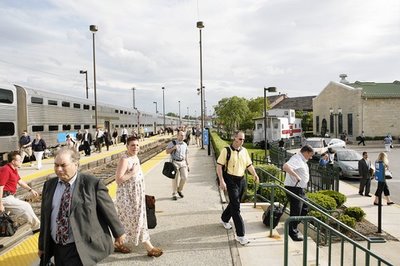
Thousands of Cubs fans are making their way from Chicago to Cleveland for Game 7 of the World Series tonight. Throughout the series fans from both teams have been making the journey between Chicago and Cleveland either by plane, train or automobile. This is a great time to highlight how the Lakeshore corridor could provide a more viable option between these two great midwestern cities.

Just this past week I was reminded of the incredible potential that exists along the Lakeshore corridor. I took a very enjoyable train ride from Chicago to Toledo to see a presentation on All Aboard Florida. The track was in great shape the whole way out and the trip time was comparable to driving but there is room for growth.
The track is in great shape to expedite the movement of stack trains, automobiles, and other priority cargo. But the passenger train service, such as it is, reflects the success of the New York Central Railroad in trimming its cross-Ohio service, fifty years ago.

Here's the westward service as of 24 April 1966, the beginning of Daylight Saving Time.


The New England States and Twentieth Century Limited disdained Cleveland, changing crews at Collinwood east of downtown and bypassing the Union Terminal on the Lakefront Line, which is now the route Amtrak's service uses.  The overnight extension of the Empire State Express was coach only, without food service, west of Cleveland.  Sleeping cars and food service cars came off The Chicagoan at Cleveland.  Train 201, as its number and profusion of stops would suggest, was an accommodation train, probably hemorrhaging the mail and express that once justified its operation.

The eastbound workings were no better.  The Cleveland sleepers returned to New York on Six, and the New England States deigned to stop at Cleveland to add a St. Louis to New York sleeping car -- perhaps New York Central, anticipating its merger with The Pennsylvania Railroad, was saddling its future partner with the St. Louis service.


There wasn't much for Amtrak to build on, and when Chicago to Cleveland service offered multiple frequencies, as it did for a short while, one of the promised frequencies, predicated on retrieving the mail and express once carried by 201 and 222, never ran.

Amtrak Form W23/65M effective May 21, 2000.

We're not looking at a corridor service, with the Lake Shore filling in for the Century and New England States, and 45 and 46, the mail and express trains, never running.

But speeding up the service, the Midwest High Speed Rail Association notes, doesn't call for massive investments in track and electrification.
We think that some simple improvements such as level boarding, high performance trains and better amenities would make the service more attractive. A Chicago-Cleveland trip time of less than five and a half hours could be accomplished by increasing average speeds throughout the route by just 5 mph and increasing the top speed between 47th street and east Gary to 79 mph.
A Cold Spring Shops "Free Rein to 110" campaign might be in order. That, plus additional frequencies. Perhaps we can take up the issue of an Ohio network, bringing Cincinnati, Columbus, Dayton into the mix, another day.

POLITICS IS DOWNSTREAM FROM CULTURE.

And the culture is polluted.  They're beginning to catch on on the left.  Here's a Vox interview of J. D. (Hillbilly Elegy) Vance, with Sean Illing.  It covers a lot of ground.  Let's focus on this excerpt.
In some ways I feel like people on the left are so unwilling to place moral blame on the poor for some of their decisions that they completely ignore the way that poor people actually grow up and the way that they actually conduct their lives.

You don’t have to think that a poor kid who grew up in dirt poverty in rural Appalachia is to blame for their circumstances to recognize that a lot of the habits that that kid picked up along the way are going to be very destructive in terms of raising a family or going to college or being successful in the workplace.

There’s this sort of weird detachment from the actual lives that people live, and I just think liberals have to get a little bit more comfortable talking about what it is that’s different about that poor kid, not just his material circumstances but also the attitudes and the expectations that he developed in the first 15 to 20 years of his life growing up in poverty, and how can we counteract it.

That has to be part of the conversation on the left.
That conversation is starting. In The Guardian, here's a lengthy reflection by Lynsey Hanley that might be discovering a Hillbilly Elegy in the Midlands.  Again, I'll focus on an excerpt.
This is how privilege becomes truly concentrated – through the systematic denial of the way economic, social and cultural capital works, by the very people who are hogging it. Such blanket denial serves to convince members of the middle class that, generation after generation, they have to tighten their grip on the advantages they have, because they are always at risk of losing them.

When I was growing up, in the 1980s and 90s in Solihull, no one ever used the term “working class”. Instead it was “people like us”, or “the likes of us”, by which I took to mean a discrete group bound by occupation and geography who could expect certain things out of life but not others. Casual violence – symbolic, domestic and public – was endemic. Casual racism was part of daily conversation. Casual cynicism pervaded: a consequence of casual exploitation and casual displacement, which fed into people’s souls and manifested in them treating everything like one great frigging joke, because that was how they felt they had been treated their entire lives. To be casual about horrific things was a cover for fear.
He's going to get into the coping strategies of the lads, but it's that "people who are hogging it" (whether it's forting up in Santa Monica or Central Park West or enrolling toddlers in Harvard Prep Day Care) that's going to get the traction.  Meanwhile, the people who are hard done by are the recipients of Anti-Social Behavior Orders rather than affirmative action or Model Cities.
I never sat in the front row at school. I was always at the back: in the same row as the lads, but never with them. I thought they were throwing their lives away. They knew they were throwing their lives away, and yet they refused to acknowledge that that was what they were doing. The cost of one of them saying, “Come on lads, we can have a laff outside of school, we’re here to learn so we don’t have to do jobs we hate later on,” would have been too much for any one of them to stand. In any case,[sociologist Paul] Willis argued, working-class males are trusted so little within the wider social structure, that even if “the lads” had changed their minds and decided to work hard, there was no guarantee that it would have got them better jobs.

Willis wasn’t exactly saying that resistance, in the form of mild yet persistent insubordination, was futile – more that it was the boys’ own habits of playing up, as much as the unfairness of “the system”, that led them to become trapped in low-paid and unfulfilling jobs. He concluded: “There is an element of self-damnation in the taking on of subordinate roles in western capitalism … however, this damnation is experienced, paradoxically, as true learning, affirmation, appropriation, and as a form of resistance.” Solidarity made sense to the lads because they understood that they were all headed for the same destiny and would need mates when they got there. In this way a survival strategy becomes a self-fulfilling prophecy.
Two countries, two school systems, two social structures, and yet the rough lads are being left behind. And angry.

Last night, Chris Matthews signed off his Hardball with a recommendation that, Hillary Clinton winning narrowly or bigly, the Political Establishment take seriously the Donald Trump challenge.  The segment is not yet available in their archives.  When it is, I'll likely link to it, as he's recognizing something the Pajamas Media people have been saying for some time, that the next manifestation of political populism is likely to make Donald Trump look like a gentleman.  Overly hyped, perhaps, but worth considering.

CIVIL LIBERTIES FOR ME, BUT NOT FOR THEE.

Sometimes, the American Civil Liberties Union lives up to its reputation as the American Criminal Liberties Union.  I don't have to make this up. Cops Criticizing Colin Kaepernick Sent 'Ominous' Message At NJ High School Football Game.  Those cops are not commenting on Mr Kaepernick's recent play.  Rather, local police helped unfold a large flag before a high school football game.  Panic ensues.
"The police have a duty to defend the rights of protesters, not to use such a large-scale display of force that effectively silences people with differing viewpoints," said ACLU-NJ Policy Counsel Dianna Houenou in a statement.

"The statements made by the deputy police chief and the event's ostentatious show of power send an ominous, frightening message," added ACLU organizer Jasmine Crenshaw. "That, as an official stance, law enforcement will not tolerate expressions acknowledging our nation’s history of unequal treatment and systematic oppression."
There's more from Mx Crenshaw in a separate article.
"Entrance to one of the biggest sporting events in the area should not require that someone accept an atmosphere that suppresses political protest," Crenshaw said in a statement. "The magnitude of this event chills the belief that police should be held accountable when they abuse their power or discriminate against people of color, and pressures student athletes to act as props of the police."
Good grief.  But completely predictable for the so-called Civil Liberties Union.  On occasion I buy a video from Public Broadcasting, and that's probably why on occasion I get an issue survey from the Civil Liberties Union, which really ought to register as a political action committee for the freakazoids.  What did the survey focus on?  Religious freedom -- as in freedom to discriminate, freedom to get abortions, the rest of the BLTGQUINOA stuff.  Issue priorities -- preventing voter fraud, abortions, BLTGQUINOA stuff.  But the mask comes off in the strategies section.  "The ACLU is standing up to extremists in Congress and state legislatures who are conducting an all-out assault on reproductive rights, religious liberty, and LGBT equality."  And they beg for money.  But in the fine print, at the bottom of the page:  Contributions to the ACLU are not tax deductible for charitable purposes.  Well, it's indistinguishable from a Bernie Sanders Super-PAC.  That's a relief.

The survey came with a prepaid envelope, so I sent it back, with a few nasty remarks.  Maybe they'll go away.  (I was tempted to say b****r off, but they might take that as a proposition.)

WE KNEW THIS.

Hospital competition and patient choice can improve healthcare quality.  Nice to see research consistent with the testable implications of price theory.
In contrast to the fears that choice is only for the rich and healthy, this study suggests that relaxing the constraints on where patients can go for hospital treatment can benefit the sickest of patients, including those needing extensive surgical intervention. Hospital competition and patient choice can play a useful role in improving healthcare, even in heavily regulated and centralized systems.
People who work in economics get that decisions at the margin affect inframarginal producers and consumers as well. That's a difficult concept to get across to everyone else. Although it might be the case that "the rich and the healthy" (the marginal consumers) are exercising more choices the actions taken by the clinics to respect those choices lead to improvements for "the sickest of patients" (the inframarginal consumers.)

CUB FANS ARE MORE CHEERFUL WHEN THE BASEBALL EXTRA FLIES WHITE FLAGS.

Yes, white flags by day, and white lights by night, are the traditional marker of an extra train.  With centralized traffic control, the necessity of identifying extra trains for the benefit of tower operators and other train crews isn't so urgent.  But there's an older tradition also involving flying a flag: at Chicago's Wrigley Field, there are flag hoists indicating the standings, division by division, and (it probably began in the era of day baseball) the outcome of the day's game is revealed to all passing by with a blue W rampant on a white flag, or a white L rampant on a blue flag.

Last night, the Cubs got to #FlyTheW on the last game of the season.  And commuters on the South Shore Line, in case they're not taking the day off with a hangover, get the word.


Northern Indiana Commuter Transit District photo retrieved from Trains Magazine.

As George Carlin noted, in baseball, you don't know when it will end, and sometimes you go to extra innings.  You have to figure that a World Series featuring the two most frustrated teams in Organized Baseball would go to seven games, and the seventh game would go to extra innings.  With a rain delay.

But in Cleveland and Toronto, and unlike Washington, D.C., the rapid transit would be available after the games ended.  So, too, with the South Shore Line.
To do its part, the Northern Indiana Commuter Transportation District's South Shore began running a single extra train after Cubs home games during the playoffs departing Chicago one hour after the games ended. For Major League Baseball's World Series, which moves to Chicago on Friday, the trains will depart 90 minutes after the last out.

When the Cubs win at home or on the road, W flags adorn the South Shore trains through the next day.
The extras are called, despite the interurban tradition of the owl car living on on the South Shore.
The idea for the extra trains sprang from regular-season night games when South Shore riders complained they left Wrigley early rather than wait for the 12:45 a.m. homeward train.

From Millennium Station, five miles and a short walk from Wrigley by the Chicago Transit Authority Red Line, the Cubs Extra runs express to Hegewisch on the Illinois-Indiana line making regular stops from there to the Carrol Avenue station in Michigan City. [South Shore marketing vice-president] Parsons says the W flags are a first for the line, and they are considering something similar for other Chicago pro teams.
As of this writing, Chicago authorities appear to be scheduling the celebratory parade for Monday. Expect to see interurbans displaying signals and running as extras.

To this day, a blue flag on rolling stock is a warning that the car is not to be moved.

SECOND SECTION:  The parade will be Friday.  Details to follow.

2.11.16

NOT OUR CLASS, DEARIE.

A Washington Post reporter goes into the Republican-leaning suburbs of Milwaukee to discover that Donald Trump is still not playing well with the voters.
Most of the well-kept lawns here are dotted with signs for Sen. Ron Johnson (R) and for other down-ballot candidates, but support for Trump is less evident.

“You’re in a town that’s about going to college and raising a family. People are polished and hard-working. He’s not one of us,” said Andy Schwichtenberg, a 28-year-old stockbroker.

“I did try,” Schwichtenberg added with a sigh. “I went to a rally.” But he was not swayed and he was turned off by the crowd, which he noted was packed with men and women “who came there on Harleys.”
Where are the social justice warriors fretting about the class snobbery, the stereotyping, the Othering?Oh, wait, Mr Schwichtenberg is referring to the people Mrs Clinton consigned to the basket of deplorables.  The appletini set will not tut-tut.  It's Prussian Wisconsin Nice on display, but bear in mind that burgher and bourgeois share a common etymology.

And perhaps the Prussian Wisconsin Nice will emerge as an Ivanka Voter.
She doesn’t have a Trump sign in her yard, either because it would get egged or she doesn’t want to fight with the neighbors. She knows all about Ivanka’s clothing line and brand, and thinks she would be great in the White House, because she’s classy and sophisticated, polished and well-spoken, all the things her father is not. She’s very clear that there are things that Trump says that she doesn’t agree with. She does not think of herself as racist. She describes herself as “socially moderate.”

But she’s voting for him.
We'll find out next week.

PARSING THE MEANING OF IS.

Yes, I'm alluding to the notorious deposition by impeached, disbarred, President Clinton.  But in Slate, Timothy Noah got to the heart of the matter.
Bill Clinton really is a guy who's willing to think carefully about "what the meaning of the word 'is' is." This is way beyond slick. Perhaps we should start calling him, "Existential Willie."
The ability to parse words carefully is useful in the practice of law.  You don't want to craft a document that gives away the store you're selling.  But it's Mr Noah's allusion to philosophy that matters here.

30.10.16

SPEAKING OF THE MONUMENTS WE'VE DESTROYED.

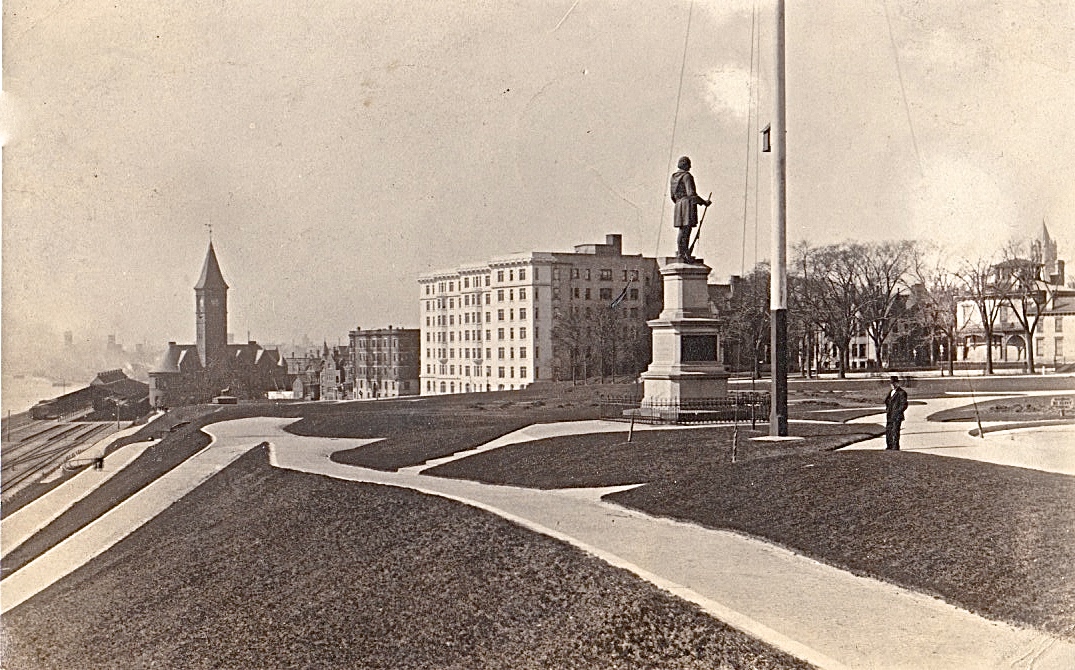
The lakefront station of Chicago and North Western in Milwaukee was the best of both worlds for a budding train enthusiast, as it was just south of Juneau Park, where a bluff was the perfect place to watch fireworks, sometimes launched from the boat basin, and on one occasion, from a car ferry.  Here's what it looked like before the city started filling in the lake for additional parkland, roads, and the boat basin.


But there weren't enough roads, and part of the urban renewal or modernization or what have you involved running an expressway along the lakefront (tonight I'm not going to litigate the ways that project failed, and the fallout of undoing it in places.)  There's nothing like a railroad right-of-way for running an expressway, and the North Western Depot had to go.

At the time, the railroad would probably be happy to be rid of the station, and of the passenger service.  This image, from just before trains moved over to the new Union Station (now the Intermodal Passenger Station) shows how the railroad was making money from surplus real estate.


Image retrieved from Milwaukee Journal-Sentinel.  Unattributed photographer.

That framing once supported a neon sign blurbing the dieselized Twin Cities 400.  At night, circuitry gave the impression that the wheels were turning.  But after the Twin Cities 400 came off, the sign might have been an expensive bit of misleading publicity.  (There's a neon tribute, inspired in part by the sign, now in place north of Milwaukee.)

This article, from the Milwaukee Journal's Green Sheet (the section that included the comics, and that was cause for sibling rivalry claiming dibs thereon) uses the occasion of the demolition of Milwaukee's current lakefront transportation center to reflect on the demolition, after serious preservation efforts, of the North Western Depot.
[Landmarks Preservation official Robert] Perrin, the city development chief who finally argued for the depot's demolition, acknowledged that it was a loss to the city.

"By tearing these things down, gradually the city becomes denuded of its architectural identity. Eventually, Milwaukee will look like any other city."
That happened often in those days.  The transportation center (mostly a parking deck) will come down to make space for a 44 story apartment tower.  Perhaps some of the people moving up from the middle class will occupy space there.  But they won't have a 75 minute Commuter 400 with the best griddle cakes on earth leaving from lake level.

THE CASE FOR MAINTENANCE.

Keep things that are great in a state of good repair, and you never have to fret about making those things, whether we're talking about the United States, the railroads, or the Green Bay Packers, great again.  But, as in everything that involves allocating scarce resources, there's a tradeoff, ably explored in a Freakonomics podcast, "In Praise of Maintenance."  Here 'tis, as offered by Lee Vinsel, one of the participants in the conversation.  "Our thesis is basically that our culture’s obsession with innovation and hype has lead us to neglect maintenance and maintainers."  That comes from Aeon's "Innovation is Overrated."  But you have to strike a balance, and Harvard's Larry Summers explains how hard that is.  "People always think more about how new ground can be broken than they think about how existing institutions can be sustained or existing facilities can be maintained. It leads to a constant trap where we underinvest in old things, then old things disappoint, us then we feel a need for new things, then to satisfy that need for new things we under-invest more in old things and the cycle goes on."  Sometimes, though, the old things disappoint because somebody came along with an improvement, and you don't want to find yourself in the position of Youngstown Steel, left behind because a small integrated steel mill along a river is done in simultaneously by larger integrated steel mills at deepwater ports and by steel recyclers with ever-better metallurgies.  Instructive.

29.10.16

MAKE THE PENNSYLVANIA STATION GREAT AGAIN.

This summer, City Journal arts maven Catesby Leigh suggested that the best way to improve the rabbit warren under Madison Square Garden that calls itself Penn Station would be to ... restore The Pennsylvania Station.  The article starts with some necessary background.
In 1961, a mere half-century after Charles Follen McKim’s Pennsylvania Station opened, the once-mighty but now financially moribund Pennsylvania Railroad cut a deal with a private developer that led to its demolition, completed five years later.

The result was the worst trade-off in American architectural history, one that would make historic preservation a popular cause. The grandeur of the old station’s interior—never entirely effaced by the postwar invasion of advertising signage and displays of the latest-model automobiles, not to mention the crazy space-age ticket counter that somehow landed in the waiting room—was supplanted by a glassy office-tower slab, 2 Penn Plaza, and the cylindrical pile of Madison Square Garden. Each weekday, 650,000 people make their way through the entrails of this dystopian complex—“mashed,” just as Progressive Architecture magazine forewarned after the destruction of McKim’s station got under way, “into subterranean passageways like ancient Christians.”
Focus on that 650,000 people. With the commuter traffic, that may be upwards of 300,000 distinct individuals each day, most of them dashing from or to their trains.  By contrast, during the second World War, the records for passenger loadings were around 400,000 tickets lifted by conductors on departing trains.  To provide additional space for servicemen to wait, The Pennsylvania Railroad built floors at the arrival concourse level in the open parts of the train hall.  The east end of the train hall looked like this on a busy day.


New York Pennsylvania Station, July 1944
Life Google Images via The Bowery Boys.

Before the War, there was a clear space above the tracks beyond the west gates.


Yes, we've been following these plans to expand the station, or adaptively reuse the post office to the west, or dial PEnnsylvania 6-5000 to book a room, or something, for some time.

But moving the Garden to the Post Office site, or perhaps locating it above the coach yard, and building a railroad station that looks like a railroad station intrigues.
The Garden really does need to move—and building the new one within Farley’s capacious masonry envelope is an attractive option—because Penn Station needs to expand vertically to be a station worthy of New York City. Reconstruction of McKim’s station is the best way for that to happen. It is far from certain that a new annex across 31st Street from the existing station will be needed to handle additional rail traffic from a new Hudson railway tunnel, as Amtrak contends. To be constructed over the next two decades, the new tunnel is the centerpiece of Amtrak’s big-ticket Gateway Program, which includes construction of this Penn South annex to accommodate seven new underground tracks.
More intriguing, however (as well as technically more challenging) is a possibility to widen the platforms while providing fewer tracks by through-routing Long Island and New Jersey Transit commuter trains. That's one way to conserve on coach yards, as the rush-hour trains might tie up during the day at yards that are generally full only at night. But the Long Island is 600 volt third-rail direct current, the former Pennsylvania and Lackawanna electrified lines in New Jersey use overhead wire energized with kilovolts of alternating current. Will the good people of Long Island accede to overhead wires?

But the idea is gaining some traction, fittingly, in conservative circles, with American Conservative executive editor Lewis McCrary offering a qualified endorsement.  The article links to other manifestations of the same proposal.

Now, if we can talk about an improved Pennsylvania Station, can we talk about multiple train frequencies to Pittsburgh with overnight services for and from Chicago and St. Louis?

AFFORDABLE HEALTH CARE IS THE PITS.

Federalist writer M. K. Ham has an unpleasant October Surprise.  Her family's high-deductible premium has almost doubled.
My monthly payment, which was the amount of a decent car payment, is now the size of a moderate mortgage. The president refers to these for thousands of citizens as “a few bugs” when to us it feels like a flameout.

For this astronomical payment, I get a plan with an astronomical deductible that my healthy family of three will likely never hit except in the most catastrophic of circumstances.

Let’s rewind to my pre-Obamacare health care situation. Throughout my life and career, I have had both employer-based coverage and significant periods during which I bought private insurance with high deductibles and low premiums. During the run-up to Obamacare, President Obama referred to these plans as “junk” plans, but my family and I received perfectly good care and service through them. We were responsible, healthy citizens consuming a small amount of health care, paying out of pocket for most of it, and making sure we weren’t deadbeats should something catastrophic come to pass. Our health insurance was a rational and responsible purchase.
The Patient Protection and Affordable Care Act, which is two lies for the price of one in the title, is three broken promises.
When President Obama sold Obamacare to the American people, he promised three things. 1) That we could keep our plans if we liked them. 2) That the new system would offer competition between great options through an Obamacare marketplace, and 3) That our premiums would go down. Not “go up slower” or “go up but eventually go down,” but go down— $2,500 was the figure.

The letter I got last week is a betrayal of every one of those promises. I did not get to keep the plan I liked. The new system does not offer competition between great options through an Obamacare marketplace. And my premiums have gone up more than 150 percent in two years.

This was all predictable and predicted, by many (including me!).
After a series of examples, the punch line.
Putting aside the embarrassing launch debacle (also predictable and predicted by me!), the law has created products that aren’t worth buying. I’m a responsible citizen and single parent of two young children. Let’s think about the incentives this system presents.

It would make far more economic sense to pay the tax penalty for not having insurance, save the monthly payment, and squirrel it away for a catastrophic event that may never occur. Should a catastrophic event occur, work out a payment plan with doctors and hospitals, for which you’d use the squirreled away premiums until the next open enrollment period, at which point you just jump right back into a plan again because they can’t keep you out for preexisting conditions. Should a catastrophic event never occur, you’ve got no small part of a college education put away. My health insurance used to be a rational and responsible purchase. It’s beginning to feel like neither.
Then comes the reference to a pit that might be as nasty as the Great Pit of Carkoon.
Those who support the law during its meltdown suggest jacking up the cost of rejecting this terrible product to make it more painful than the cost of the terrible product. To them, we are but Westley in the Pit of Despair and they are the technocratic torturer at the switch puzzling just how much pain they can inflict without going full Humperdinck and killing the strapping, young patient.

That’s how the Affordable Care Act became neither affordable nor care. It’s almost as if you could have predicted it. Inconceivable!
Yes, and jacking up the penalty is truth in taxation: if Colorado's Amendment 69 is truthful, the increase in some kinds of taxes to support single payer will be substantial.  Watch the bond markets if there's a Democratic sweep, or if there's a Conrail Option without substantial tax increases (not limited to Donald Trump) accompanying it.

GO, COUNCIL, GO! GO, COUNCIL, GO!

Hey, Chicago, whaddaya say?  Council's going to whine today.  "[S]pare a moment of sympathy for Chicago's aldermen, those public servants making six figure salaries, who until very recently enjoyed the perk of being able to buy Cubs' postseason tickets at face value, rather than on the open market, like the rest of us commoners."  That's unethical, as we saw on Thursday past.

Behaving ethically, however, is something else restricted to the commoners.
[T]wo Chicago aldermen reportedly blew off budget hearings earlier this week to take a road trip to Cleveland "in an SUV with a lobbyist and fundraiser" to watch Game 1 of the World Series, according to [Chicago's] Tribune

And because irony is apparently dead, 40 out of 50 Chicago city aldermen did not attend yesterday's annual ethics board meeting, according to Chicago Now. The Board of Ethics, which reportedly receives $850,000 in annual taxpayer funding, received no questions from the few aldermen who bothered to attend, and the meeting lasted five minutes.

In a petulant display, Alderman Anthony Beale, reportedly played a "Go Cubs, Go" chime on his cellphone to protest he and his colleagues' loss of an elite perk previously reserved only for stewards of good government like himself.
Contrast that with the treatment of university faculty, who can be given a do-over if they don't spend sufficient time on their annual online ethics training, and if you fail to complete the online module in the month provided, you get a longer version of the do-over, a letter of reprimand placed in your personnel file, double secret probation, and for all I know (having always completed the training within the time windows specified) Alberich puts a curse on you.

The gods of baseball, however, have not yet lifted the Curse of the Billy Goat.  Maybe the good people of Cleveland will bring in the blessing of Bob Uecker and the aldermanic special pleading will be just a bit outside.  Cubs are facing elimination Sunday.

Chicago's aldermen, however, being good Democrats all, will likely run away from the Cubs even faster than their Congressional colleagues are currently running away from FBI Director James Comey.

I have a bottle of Sprecher in reserve for the conclusion of the Series.

27.10.16

ON A RUSSIAN WORKBENCH.

This video, probably from somewhere in Russia, probably in a scale smaller than O, is another effort to build a model of the Andreyev 4-14-4.  It's interesting that the builder painted the wheels and motion before assembling the chassis.


This mechanism has two gearboxes, which is an interesting way to relieve stresses on the connecting rods, although the motor now has to turn two worm gears.  There's still some hesitation at the ends of the strokes, something I've been working with as well.

The radius rod is mounted in neutral, which makes the task of rigging the combination lever to crosshead and valve stem less challenging.

Let's wish the builder continued success.

THAT COMING DEMOCRATIC CRACKUP.

On Tuesday evening's Hardball, Chris Matthews, usually a reliable Democrat shill, noted that his party has a problem.  It started in his interview with current vice president and railfan Joe Biden.
MATTHEWS: Why do they – why is it the Democratic Party? Is it because of all the contributors with their money have made it more of an elite party, Ivy League?
BIDEN: This is not – you know, there`s no malarkey. The fact of the matter is, those people we`re talking about built this country.
MATTHEWS: Yes.
BIDEN: They built it. And they are smarter than we give them credit for. There`s almost, like – what`s happened in both parties is there`s sort of a – a yielding to pedigree.
MATTHEWS: Yes.
BIDEN: You know, the guy who goes to Penn State or University of Delaware and the guy goes to Yale or Penn, well, the guy at Yale or Penn must know more. It doesn`t work that way.
MATTHEWS: I haven`t noticed that.
BIDEN: Oh, you haven`t?
Mr Biden uses the "deferring to pedigree" phrase a second time.  The vice president goes on to discuss Charles Murray's snob test.
BIDEN: And because it`s now at the point where there is – it is merit-based, where you – whether you`re part of the elite, we`ve kind of forgotten about ordinary Americans out there.
MATTHEWS: I know.
BIDEN: And so it`s like – it drove my boys crazy. I had them take the test in the book, and it said, Have you ever been on a factory floor? Have you – were you raised in a neighborhood where over 60 percent of the people didn`t go to college, where you – if you get a chance to go to Starbucks or McDonald`s for coffee, where do you go? Do you know anybody who has whole milk in their refrigerator? I mean, there is…
MATTHEWS: Because everybody else has skim milk, the elitists, yes.
BIDEN: No, but so – so part of it is that it`s understandable. The good news is it`s based on merit advancement in many cases now. But the bad news is that these folks who were the people who are – not the salt of the earth, they`re the stuff that makes everything grow.
MATTHEWS: Yes.
BIDEN: And they`re capable of so much more. That`s why I think our focus on free college education, our focus on making sure that there`s child care to get women back in the job market, our focus on things that are just basically simple fairness, minimum wage.
I mean, people want to know that we really do – my dad used to have an expression, Chris. He said, I don`t expect the government to solve my problem, but I expect them to understand it.
Let's leave for another day whether Mr Biden really understands the problem. It's the transition of the blue collar voter from reliably Democrat to Hillary Deplorable that I'm focusing on.

Here's Mr Matthews, setting the conversation for the evening's panel of Democrat Operatives.
MATTHEWS: Well, joining me right now for their reaction individually is Robert Costa, national political reporter at “The Washington Post” and MSNBC political analyst. Howard Fineman is global editorial director, of course, Huffington Post, also an MSNBC political analyst. And Katie Packer is a Republican strategist formerly with the Romney campaign.

I`m going to leave the pugilistics aside for a second here.

Robert Costa, I have never heard Biden lay this out so clearly, this sense that we have this meritocracy gone bankrupt, whereby only the people at the very top academically are given any consideration by the Democrats in terms of policy.

He speaks with personal experience, it seems, for a guy that went to University of Delaware for example, about this almost British-style system, where, if you didn`t go to Oxford or Cambridge, don`t talk, we`re not listening.
Let's also leave aside, for the moment, whether we're seeing an American Oxbridge at work, or whether Mr Biden is a bit of a jerk and he gets treated accordingly.  The discussion that follows is less than edifying, and I really don't care to worry about what the shape of the 2020 presidential ticket will be before the 2016 votes are counted, or stolen.

Mr Matthews, however, returns to that Democratic crackup during his sign-off.
My sit-down with Joe Biden in Pittsburgh today tells me that at least one top national Democrat understands the Trump phenomenon. While others may look down their noses at the Trump voter, the longtime senator from Delaware gets it. He sees their failure to connect with those white working class voters excited by Trump. He sees the economic but also the cultural factors that have driven the majority of white non-college educated Pennsylvania voters to line up with the New York billionaire, which is what we`re seeing in polling right now. He`s winning among those people, Trump is.

Biden talked today about what he calls the pedigree problem, how the Democratic Party at the top views anyone not an Ivy Leaguer as below intellectual consideration. How the party has kind of forgotten about ordinary Americans out there, how those people are smarter than they`re given credit for.
The Social Register set have been using poor and non-white voters as mascots for years; that is another disconnect in the making.

A COMPLEX PROPOSITION.

An American Council on Science and Health editorial advocates that Scientists Should Fight Postmodern Public Values.  Inasmuch as what passes as postmodern philosophy is a radical skepticism that questions coherent beliefs of any kind (reality might be more subtle) one might ask, rudely or not, how can the absence of any value be a value?  Or something.

Let's look at this passage.
[P]ostmodernism isn't the only problem. Americans, in particular, increasingly believe that scientists should not be allowed to do whatever they desire and instead should be held accountable to the public. Because many scientists receive funding from taxpayers, many Americans feel that politicians have a right to dictate what scientists can and cannot study. Even though the vast majority of politicians (and voters) are not in a position to decide which research is worthwhile, the point is still legitimate and, in our current cultural and political climate, nearly impossible to dispute.
I think we saw that conflict between Lernfreiheit and science bought and paid for last week. "Yet, the inefficiency of poetry or pure physics (that is, physics not tied to corporate and government grants and agendas) is an incommensurate gift and of great value."

There are two bad ideas at work.  One is the idea that only the government ought be funding research.  Perhaps university endowments exist for a reason.  But that's defensible only to the extent that researchers conduct their work with a sober sense of purpose and in a way that respects the moral status of other people.  The other, which may have its roots in postmodern thinking, is that science per se disrespects the moral status of other people: pick any pejorative ending in -centric and reflect.

NO CIRCUS, NO ELEPHANTS.

I have been adamant that a real circus includes elephants, and I model that circus.

I've also noted that circuses are not inherently detrimental to the welfare of elephants.

But the big cities have been passing job-killing regulations that lead to unemployed elephants, as the downside of running what you call The Greatest Show on Earth and what students of circus know as Big Bertha is that you have to play the big cities.

Thus do Ringling Barnum's powerful performing pachyderms go out to pasture, where Washington Post reporter Kristin Henderson has followed them.
Elephants have been the stars of American circuses since circuses began. Why the elephants? Why not the equally odd-looking camels or just-as-beautiful horses? What was it about elephants that drew humans to them? They’re smart, but so are primates. They’re big and long-lived, but so are whales. They live in close-knit families, but so do wolves. None of those other mammals has become such a part of our culture. We’ve got pink elephants, white elephants, the GOP mascot and the elephant in the room, while the name of the 19th century’s beloved Jumbo came to signify all things large.
Ms Henderson contrasts the behavior of Ringling Barnum's elephant crews with the lurid stories of abused elephants of days and circuses gone by.  (Some of that lore made its way into Water for Elephants.)  I wonder if there isn't a little projection, or perhaps false analogy, in the following.
In the century before the Great Depression, abused circus elephants that killed their tormentors were sometimes viewed as criminals and executed. But more often, an elephant that broke its chains and left a swath of destruction through an American town was cheered on by crowds of average folks living hardscrabble lives. For them, the elephant’s rampage was probably the cathartic fulfillment of their own frustrated fantasies.
Beware the trumpeting of the Trumpening? Or perhaps I want this long national nightmare to be resolved? But that's old legend, combined with modern understanding of animal training.
Starting in 1969, the legendary Ringling animal trainer Gunther Gebel-Williams pioneered a way of presenting wild animals in shows: as friendly partners rather than as dangerous beasts to be dominated by brave men. “That change seemed at first almost like a nuance,” says Janice Aria, who has worked with elephants and bears during a long career with Ringling. “But I saw that really had an amazing trickle-down effect into the way all of us approached this. You know, wait a minute, maybe it isn’t always the loudest voice, it isn’t the strongest person. It’s the person that can most intuitively connect with these animals that’s going to get the most consistent result from them.” Since the 1970s, Aria has watched elephant handling go from an all-male community with a cowboy attitude to women making up about half of Ringling’s handlers today, including the top two people in charge of animal stewardship: Aria, the director, and her deputy. The way Aria sees it, “Women have an inherent nurturing that many guys don’t have, and I think elephants respond really well to that.”

During those 40-plus years, training and handling methods grew steadily more professional and humane. “We used to manage elephants with stimuli that taught them to move away from things,” says Brandie Smith, the National Zoo’s associate director of animal care. “Now we use operant and positive conditioning to teach them to move toward things. That’s now the accepted standard for shaping behavior during training.”
The art of animal training is giving the animal incentive to do what it wants to do anyway.  The better trainers might have been quicker to figure that out, and you really don't want to do anything abusive around an animal that weights four tons, or, as with the lions and tigers and bears, oh my! that could rip your head off if you mistreated one.  Ms Henderson notes that elephants are capable of identifying their friends.
Psychologist G.A. Bradshaw, author of “Elephants on the Edge,” describes how elephants have demonstrated they’re capable of distinguishing between humans who hurt them and humans who don’t. In Africa, young elephants who witnessed the slaughter of their families by one group of humans were rescued by other humans. Later, out in the bush, those still-wild elephants protected their human rescuers from dangers that included their fellow wild elephants.
Those are savanna elephants, which are rare in circus acts.  Rainforest elephants comprise most of the remaining acts.  Ringling's pachyderms, however, are no longer performing.
When the portal curtains opened and the ringmaster began to belt “The Star-Spangled Banner,” they walked out into the spotlight for the show’s made-in-America opening moment: a man from Wisconsin striding briskly alongside an elephant from Asia ridden by a woman from Mongolia carrying a large, flowing American flag. The routine was simple. Once around the arena, stop, raise trunk and right foot in a kind of salute to the land of the free and the home of the brave. It’s hard to say if Asia was enjoying herself, but the audience was cheering wildly.

Is it inherently wrong to make elephants entertain us? Does it make a difference if, unlike Asia, they were born in captivity, so long as we work to give them a happy, healthy life? When elephants’ basic needs are met, when they grow excited in anticipation of something good and interact peacefully with those around them, that looks like something that could be called happiness. Watching Asia and her traveling sisters week after week, that was what I saw.
Ms. Henderson, after a passage that eloquent, I will cut you some slack for referring to Circus World as a theme park.  Big Bertha's elephants are at a complex in Florida, without the audible and visible cues that the show is about to start.  Are they bored?  Who knows.
As we wait for the science to catch up, does the departure of the Ringling elephants from the public arena reveal that we’re finally learning how to be a wiser, more humane society? Or does it just expose our willingness to settle for easy answers in response to the loudest voices? The answer may well be both.
Read the article, weigh the evidence, draw your own conclusion.

Over the summer, the Karlson Brothers Circus acquired additional model elephants.  You'll be able to see the travelling circus in miniature, even as the real thing changes.

CHECK YOUR PRIVILEGE.

Chicago Fire is fiction.  Clout in the Chicago city council is real.  Favors from rent-seekers are real.
The head of the city ethics agency has warned Chicago aldermen and other elected officials that if they accept the Cubs' offer to buy coveted playoff tickets at face value, they must attend personally and have their presence announced publicly.
As anyone who has ever sat the annual ethics training required of Illinois university employees (no rushing through it, peasant, or you get a do-over!) there is a gift ban, and the offer of a baseball team of tickets at face value to a public official qualifies as a covered gift.
In the ethics chief's memo, obtained by the Chicago Tribune, [director Steven] Berlin noted that city officials are not allowed to accept gifts worth more than $50 unless they come from a friend or family member. The difference between Cubs face-value prices and "understood 'fair market value' … clearly exceeds $50," Berlin wrote.

But the city ethics ordinance does allow officials to attend events "in their official capacity," he added. So, officials can take the offer, provided they go in person and are "publicly acknowledged at each game you attend in some public way." Depending on when that announcement is made, aldermen and others risk some loud boos.
There are members of the city council, however, for which playoff tickets from sports teams are simply prerogatives of office, which makes for interesting listening to the radio.  Moreover, there might be South Side aldermen for whom being publicly announced at Wrigley Field (do they get two ruffles and flourishes and the first verse of "There's a Little Tin Box" on the organ?) creates a clip that will appear in an attack ad next primary season.

COMPARE AND CONTRAST.

Three days a week, Amtrak's Cardinal makes its way between Chicago and New York by way of Indianapolis, Cincinnati, Panem, er, D.C. and Philadelphia.  The other four days, there's a regional train between Chicago and Indianapolis, which also exists to haul bad-ordered cars to the repair shops at Beech Grove.

That regional train is now being operated by a private company, Iowa Pacific Holdings, using Iowa Pacific staff and Iowa Pacific rolling stock.  There's a dining car serving real food on real china, and business class passengers rate a Great Dome lounge.  They pay more for the privilege, but it's apparently worth it.
Almost 2,500 people rode the Hoosier State last month, and that was up 46% compared to September of last year. It was also the fifth consecutive month when this year’s ridership exceeded the numbers from 2015. And there’s more: according to the Indiana DOT, revenue from tickets sold in September totaled more than $82,000 and that was a 64% increase from September of last year.

For examples of one-way Chicago-to-Indianapolis adult fares, I picked two mid-week days next month for a snapshot comparison: One-way Business Class, CHI – IND, on the Cardinal is $64; one-way Business Class on the Hoosier State is $70.

I shall now risk stating the obvious: People will respond to a quality experience and they will pay more for it. Likewise, nickel-and-diming passengers by cutting costs is counter-productive.
Downsizing is a false economy, forsooth!

RECLAIMING THE CULTURE?

Tuesday evening's Chicago Fire featured a major plot in which Stella rescues a runaway kid from a fire (we'll overlook for the moment that there's a homeless camp in one of the long-abandoned and sealed freight tunnels) then enlists the help of her chief, the director of Chicago Med, and the State's Attorney to locate him and maybe nudge him away from a bad place.  The minor plot involves Matt and Gabby caught up in some sort of Council Wars where an Establishment Politician uses the threat to expose Matt's use of clout to qualify a foster child as a blank check for all sorts of Political Favors.  But it turns out that the Establishment Politician is client of a political consultant who would like to groom Matt for higher office.  Matt finds out and tells the consultant she's fired.  (From the nasty expression on her face, I suspect we've not seen the last of her.)

It's not as aspirational as Father Knows Best or High Noon, and yet the good guys and the straight shooters hold the high ground as the credits roll.

26.10.16

KEEPING THE RAILROAD FLUID.

The Milwaukee Road's Sioux once offered overnight service between Sioux Falls and Chicago by way of Mason City and Madison.  The railroad passenger business paid its way by handling mail and express (this being before anybody anticipated Federal Express; there were stringent weight limits on air mail at the time.)  Thus local passenger trains, such as the La Crescent to Savanna local by way of Dubuque would exchange passengers, parcels, and on occasion cars, with the Sioux.

Today, the Sioux is running late, perhaps account sheep on the tracks or ghost riders in the sky, and the local has to hold at Marquette, Iowa, to make the connection.  You do not want to miss the connecting baggage car, particularly if just-weaned piglets or nursery stock are among the consignments, believe me!


This is not a good place for a train to wait for long, as there's lots of Dead Freight to be moved along the west bank of the Mississippi River.  The steel works in St. Louis is going to want that iron ore sometime soon.

Eventually, the name train shows up, and the transfers and switching proceed.


The coal mines downriver (on a model railroad, you sometimes have to be creative) have been loading cars, and it will be useful to get these passenger trains on the way in order to move the Dead Freight one way, and the coal, which is waiting in downriver sidings, the other way.  Passenger Services in Chicago will have to placate any irate passengers who arrive a little late for the opening bell at the Board of Trade.

Here, the Dead Freight gets under way from Marquette, as the first of the coal trains, for LaCrescent and points railroad west, arrives.  This coal train will add other cars for those destinations.  It's mostly a water-level railroad.


The second coal train, headed for Ossian, Iowa, where there's a generating station (you get to be creative on a model railroad) closes in on the LaCrescents.


The covered hopper cars are a signature of the Edmore Patrol, working a cement plant and grain elevators there.  The most dramatic model railroading license is in the background, where Sewell, West Virginia has somehow moved to where you'd expect to find McGregor, Iowa.


It's all in a day's work for the dispatcher.  Strong coffee, sharp pencils, a fresh trainsheet, and hope everything stays on the rails.

POLITICS IS DOWNSTREAM FROM CULTURE.

Enroute east two weeks ago, I was listening to a segment on Charlie Sykes's show about what the Republic had done to deserve the major party candidates we got.  On my way west, I picked up Dan Rivers out of Youngstown asking listeners a similar question.


Getty Images photo via Today,  retrieved from Bing Images.

We can start with the conventional explanations from the here and now, such as National Review's Jim Geraghty, who laments An Election Unworthy of America.  "The primaries gave the general electorate two bad, disliked, dishonest, vindictive options . . . and in far too many cases, the general electorate responded appallingly, making a crummy situation worse."  The people had the opportunity to reject these choices, and they didn't.  Sometimes that's the way popular sovereignty works, and the people get what they deserve, good and hard.  That's Mr Geraghty's parting shot.  "In 2016, the question is no longer whether we can keep [the Republic] but whether we want to keep it."

Or, as Warren Henry for The Federalist suggests, the media-entertainment complex put a thumb or two on the scale: Before Progressives Hated Trump, They Were For Him.  The column is a rogues' gallery of Deep Thinkers who, before the spectre of a Trump win materialized, pushed variations on a theme that Donald Trump Is No Winger, Despite Being Crude.  Thus, did the protective institutions crumble.  "One of these [hazards] is the message that elevating and defending such people sends to the larger society, whether one views it as normalizing such behavior generally or as a double-standard for the wealthy or powerful. There is also the question of whether ignoring a candidate’s temperament results in a nominee who increases the threat of war (nuclear or otherwise) or undermines the dollar as the world’s reserve currency."  Where Mr Henry errs is in thinking that normalcy enjoyed safeguards: those are rotten.

The rottenness was a long time in coming.  It was anticipated by the editorial board of New York's Times.  "We want and deserve tin-can architecture in a tinhorn culture. And we will probably be judged not by the monuments we build but by those we have destroyed."  That was a lament for the destruction of The Pennsylvania Station, but the destruction of monuments has since taken many other forms.

Consider, first, the Trump nuptials illustrated above.  About the same time The Pennsylvania Station disappeared, the Consciousness Revolution was at work, questioning all sorts of traditions.  Smash monogamy!  Nuke the nuclear family!  Coat and tie radicals like Bill and Hillary might not have been out front with that campaign, but consider their marriage.  Staying together for the sake of engaging in a protracted conversation about policy matters, OK; and there's no question about Chelsea's parentage.  But Hillary gets to have girlfriends on the side, and so does Bill.  The real winners of that part of the Consciousness Revolution, though, are Donald and Melania.  Politics be hanged.  "Today the only victors in the sexual revolution are those men and women who are good-looking and clever enough to enjoy multiple partners with a minimum of emotional and financial commitment. The dowdy and the not-so-clever (or not-so-unscrupulous) are used by the well-endowed and find loneliness and frustration where, in a previous generation, they would probably have been able to start families."

Then comes the deconstruction of coherent beliefs of any kind.  The humanities committed suicide.  As did political feminism.  Thus there's no guarantee that the Clinton camp's current efforts to turn Donald Trump into this year's version of Der Gropenführer (efforts that didn't stop Arnold Schwarzenegger from winning in California, anyway.)

Stir in the pernicious cults of transgressivity and authenticity.


In a do-your-own-thing world, there's no answer.

Thus, Ben Domenech, also with The Federalist, notes, here's why we get that choice.
There is a reason progressives spent half a century slowly eroding society’s pillars to the point where the people produced by our families, communities and schools no longer desire this, a point at which a reversion to this form of reactionary nationalism is possible. Trumpism is not the same as populism or the New Right, and it speaks to something much worse than an intellectual crisis. It is what happens when no one trusts anyone any more.
We will be judged by the monuments we've destroyed.

BY MR FEINGOLD'S STANDARDS, NAPERVILLE IS NOT A COMMUNITY.

The former senator from Wisconsin, now working to get his job back, takes a dig at the Joseph Project, a faith-based initiative providing van transportation for Milwaukee residents to factory jobs in Sheboygan.  "It’s not enough to pick people up in a van and send them away a couple hours and have them come back exhausted at the end of the day. That doesn’t make a community."  Perhaps not.  It's called the work-a-day routine.  There's even a song about it.  And, unlike rush hour passengers on Metra, the Joseph Project commuters are assured of a seat on their conveyance.


Chicago Tribune photograph by Michael Tercha.

At National Review, Alexandra DeSanctis notes that (unlike the Patient Protection and Affordable Care Act -- ed.) the Joseph Product is working, and it's well-received by participants.

Mr Feingold might gripe that his critics are selectively quoting him.  His continuation is instructive, perhaps, though, not in a way he'd like.  "There needs to be more investment in minority-owned businesses, community policing and in public schools, Feingold said."

How shall I start?

In the John Galt fashion:  Invested by whom?  Blank-out.

In the Great Society fashion:  More urban renewal?  Enough of your good intentions, already?  Ditto for your malicious intentions.

He's right, though: entrepreneurship and good schools are present in Naperville.  Are the politicians in the Milwaukees of the country providing the environment in which those phenomena can flourish?

BREAKING THE EMPLOYMENT - INSURANCE BUNDLE.

Perhaps it's time to consider interstate competition among insurance companies, and greater commercial freedom for health care enterprises.  The faculty union at Brookdale Community College have a new contract, but there won't be a lot of new discretionary spending during the holidays.
Union: Health insurance is eating our raises!

Mgmt: Health insurance is eating our budget!

Insurance Company (in the corner): Nom nom nom nom (burp) nom nom nom (chair collapses) nom nom nom
So much for bending the cost curve. So much for a public option, or for single payer.
The catastrophic cost -- and rate of increase -- of health insurance is the 800 pound gorilla of higher ed finance.  It’s the primary driver behind adjunctification.  It’s increasing faster than any of our revenue sources, and it seems to be picking up steam.  In negotiation sessions, it’s the sun around which every other issue orbits.

(For those keeping score at home, that makes it a nuclear fusion powered 800 pound gorilla that knows how to drive a steam-powered car, and anchors a series of satellites.  Scary stuff.)
Substantively, the insurance companies have to quote rates based on the adverse selection that's enabled by the so-called Patient Protection and Affordable Care Act, wherein people can avoid buying insurance until they get sick, then they buy coverage, and their risk management people have to calculate that tolerably well, or they go broke.  With single payer, risk management becomes wishful thinking.  Oops.  But I appreciate the candor: it's not just the Pajamas Media crazies that see the 29 hour loophole at work diminishing the tenure-track faculty, whether at the community colleges or at the Ivies.

Metaphorically, we're not dealing with that 800 pound gorilla, it's more like a sarlacc in the Pit of Carkoon, but with a faster metabolism.  Greece didn't take 500 years to succumb to blue social model benefits.

The reckoning is coming for the United States.
Postwar prosperity made the system tenable long enough for it to start to seem natural, but it never really made sense.  Now we’re seeing the flaws in the system get so large that they start to deform or consume other sectors of the economy.  Prospective entrepreneurs don’t start companies because they can’t afford to pay for their own health insurance.  Employers everywhere pay careful attention to maximum hours for part-time status, because the marginal cost of going over is prohibitive.  If you don’t believe me, ask your HR office what the monthly premium for COBRA is.

Locally, we managed to piece together a deal that puts off the day of reckoning for a few more years.  I’m glad we did -- really, really glad we did -- but the basic underlying trendlines are still there. That’s not something we can solve locally.  That requires a national solution.  Absent that, I foresee the rides getting bumpier and bumpier until something breaks.
Yes, in many ways, that postwar prosperity worked as a resource curse.  And the Conrail Option will mean a longer bumpy ride, and it will break.  Badly.  More badly than the current bodge.  And on current trends, a President Hillary and a Democrat Congress will own the wreckage.

And they'll deserve it.  Here's National Review's Kevin Williamson, correctly pointing out that "These idiots thought this would work."
The terrifying fact is that the architects of Obamacare thought they could brazen their way through this, that they were so smart that they could tell you rubes whatever it was you needed to hear to get the bill passed and then just fly by the seat of their pants, fixing everything on the fly in a grand display of enlightened technocratic adhocracy.

Oops.
And if the Democrat-Academic-Media-Entertainment Complex get their way, the adhocracy will own the failure. Recall the political maneuvering by which the two lies for the price of one became the Patient Protection and Affordable Care Act in the first place.  Don't expect much sympathy from me if Mrs Pelosi becomes Speaker of the House and she has to deal with what's in it.  Gutting a tauntaun to keep warm might be a more appealing option.

At The Federalist, David Harsanyi expects Democrats will learn no such lesson.
Republicans can let the law, which Democrats still solely own, die. They can then reform the health-care system by allowing it to function more like every other successful market in the country — with minimal interference from politicians. Or we can all accept a giant unfunded liability, higher taxes, and further socialization of our health-care system. The only question will be: how quickly.

There’s one thing for sure: no matter what happens, liberal cheerleaders of Obamacare will continue to act as if the law was an awe-inspiring success.
Yes, and they'll continue to subscribe to the grand fiction of living at the expense of everyone else, at least until more of their voters wake up to the reality that the sarlacc is slowly digesting them.

THE CASE FOR MARKET TESTS.

Your taco truck just got voted off the Capitol Square.
There are only 40 spots available for food carts. Rather than let the customers decide with their purchases which carts will get to remain, the city of Madison conducts a popularity contest to see who gets voted off the isthmus. It being Madison, bonus points are granted for seniority, just like public employees before Act 10.

Those food testers that participate in the survey must try the food at 80 percent of the city's food carts. Since there are 60 carts, that means trying the food at 48 carts over two weeks, or three carts per day. Since some of them are not operating on Sunday, the wannabe food cart judge has to eat four meals per day from the carts just to meet the minimum. To sample them all, a person would have to eat five meals per day, provided the person took a (much needed) day of rest on Sunday to digest their experiences.
You'd think, if there are forty permits, and more than forty food vendors, that an auction might make more sense than a poll with a serious small-sample problem. Plus the food truck operator who paid too much for a slot would learn from experience not to bid so much next time. (It's not so difficult to write the rules in such a way that the lowest of the top forty bids would set the market for everybody; that's too large a set of bidders for a bidding ring to emerge.)

But this is the Peoples' Republic of Madison, and market tests are Too Tacky For Words.
But the free market isn't being allowed to work. It isn't Donald Trump's wall kicking the tacos out of the downtown, it's the city itself. Those that should have the most to say about the survivability of a food cart on the Capitol Square, the actual paying customers, are actually robbed of their ability to have a say. Their food dollars don't matter in the success of a business, just 15 people who may never eat a taco on the Capitol Square again.

This kind of instability, the success of a business subject to bureaucratic whims rather than market forces, will only hurt the quality of the food carts in the long term. Who would want to invest in the kind of quality ingredients and equipment to build a steady customer base when the location may be taken away from them in a year?
I suppose the logic is that the steady customer base maps accurately into preferences in a survey.  But why rely on a proxy when a market test elicits the information directly, plus the city might be pleasantly surprised with the lease fees it collects.

THEY WANTED TO GET AWAY WITH IT.

Just another day at the office for John Podesta, Neera Tanden, and the rest of Hillary Clinton's merry band of deplorables.
“We’ve taken on a lot of water that won’t be easy to pump out of the boat,” Podesta wrote to Tanden in September 2015, at a time when Clinton’s campaign feared that Vice President Biden was about to enter the race for the Democratic presidential nomination. “Most of that has to do with terrible decisions made pre-campaign, but a lot has to do with her instincts.”

Tanden responded, “Almost no one knows better [than] me that her instincts can be terrible.”
We can at least be reassured that Hillary's Elphaba cackle is her "authentic weirdness." So much to look forward to.

25.10.16

COLERAIN IS THE NEXT FERGUSON.

Strong Towns frequently feature communities that were once vibrant manifestations of car culture and suburban affluence.  Many of them, including Colerain, Ohio, a Cincinnati suburb, have turned into swamps of public squalor amid private destitution (to tweak an old J. K. Galbraith phrase.)  It goes beyond the downscale people attempting to cross the butt-ugly stroads, which is the focus of the post.  "What are the options for the folks who find themselves standing on the side of Colerain Avenue? They can work part time at one of the fast food outlets. They can scrape by month to month with payday loans and pawn shop transactions. Or they can join the military which is by far the best career option, although it comes with certain risks."  The author's thesis, consistent with Strong Towns writers' emphasis on the suburban growth ponzi scheme, is that these once-promising bedroom suburbs have become obsolete and the strip malls and tract houses have trickled down to people less capable of taking care of what they have.
Back in the 1950’s, Colerain Township was the recipient of a wave of respectable prosperous families who were crossing the municipal line out of Cincinnati. They drove through Mount Airy Forest and left behind high taxes, high crime, lower quality public services, old unfashionable buildings, and poor black people. If you couldn’t afford a brand new home and a car… you clearly didn’t belong.

The schools were new. The shopping centers and office parks were new. Tax revenue poured in. Police, teachers, and administrators were hired. Parks were created. Libraries opened. Life was very good.

Fast forward sixty five years. Everything that used to be shiny and new is now aging – not all of it well. There are now decades of accumulated salaries, pensions, and health care obligations for municipal workers, past and present. The roads, water pipes, lift stations, sewerage treatment plant, and public buildings are all in need of expensive maintenance. Tax revenue is in decline. This town like nearly every other town of its vintage is functionally insolvent.

There are now newer suburbs farther out where the homes are larger and the neighborhoods more exclusive. Mason and Beavercreek are where the prosperous families are migrating to these days. Young, educated people and wealthy empty-nesters are heading back to rapidly reviving inner city neighborhoods in Cincinnati. Colerain Township now has declining property values and is experiencing an influx of lower income residents. In the big scheme of things this post war suburb was disposable.
What we see are the errors in suburban development, as summarized in one photograph.


The central crossroads, Colerain Township, Ohio.
Retrieved from Strong Towns on 25 October 2016.

The colorful circle at the crossing is a recent war memorial.  The author wishes to emphasize the difficulty of stopping to reflect at the memorial, or to pause while walking to the pub or the coffee house or the toy store.  And the retail spaces elsewhere seem lost amonsgt those vast, empty parking craters.

Perhaps Colerain is doomed, thanks to a combination of the blue social model and misinformed intelligent design.  That's what author Johnny Sanphillippo suggests.
The memorial park is sitting in a sea of low-value surface parking lots, empty buildings, and buildings that are only occupied because they were bribed into existence with subsidies and tax abatements to keep up appearances. Meanwhile millions of dollars worth of public infrastructure sit underutilized.

Ultimately, Colerain has two options. It can reduce its physical infrastructure and default on its promises to municipal employees, which is the de facto path most post-war suburbs are on. Or it can add significant amounts of higher value private development to the existing public infrastructure chassis to generate more revenue. There are no other options.

I doubt the good people of Colerain are interested in transforming their old parking lots and dead strip malls into a thick Main Street downtown full of mixed-use buildings with shops on the ground floor and offices and apartments upstairs. I don’t think they’d even know how to build that sort of thing if they tried. They’re too obsessed with parking ratios and flower beds that look like the prosperous suburbs they no longer are. I’m not even sure there’s even a market for that kind of thing in this location. So I see continued decline and more desperate attempts at resurrection by pure faith. So be it.
And why, Mr Sanphillippo, are you relegating the current residents of Colerain to the Slough of Despond?  With the disappearance of the middle class upward and downward, are you arguing that there is insufficient demand to rebuild the commercial spaces as the kind of thick urban spaces that sell well, and to convert some of the empty spaces and some of the residential sites just off the main roads into larger lots with larger houses?

Or are we getting more Fergusons and fewer Hinsdales because there's too much prole drift, and too much deconstruction of the mores of the upper middle class?