4.1.18

A REGION THE FOOTBALL TEAM CAN BE PROUD OF?

That's the Old Confederacy.
Despite Alabama’s grinding, eventual Sugar Bowl dominance, it’s not inconceivable this title game could have been Clemson vs. Georgia — a battle of schools located fewer than 80 miles apart. Had a play or two gone differently in the Rose Bowl, it would have been Oklahoma vs. Alabama. Oklahoma-Clemson wasn’t all that farfetched, either.

You pick the matchup. It didn’t really matter. From the moment the four-team bracket was announced, it was essentially a Southern regional tournament; the vast majority of the country’s college football fans were outsiders looking in.

Sure, it’s a feature of the system — of 130 FBS teams, only four make the Playoff. But when the largest swaths of the country are regularly shut out, it’s a troubling trend.
Or, perhaps it's revealed preferences.

In the aftermath of Wisconsin's Orange Bowl victory, Badger fans were pointing to how relatively few five-star players amongst home-grown walk-ons got the better of the Convicts 'Canes and attended a university that produced way more Rhodes Scholars (who must have a varsity letter of some kind.)

The powers that be have been doing all sorts of things to bring down the Southeastern Conference.  OK, I was being mean a decade ago suggesting that S.E.C. meant Special Education Conference (and North Carolina's eligibility course scam was to make their basketball teams more powerful in the Atlantic Coast Conference, but until recently, that was universities served by the old Atlantic Coast Line, i.e. in the Heart of Dixie).  And yet, the image of lacquered women and charming rogues hanging out on fraternity house porches lasts.  The cool kids, not the nerds, and just a little Lost Cause nostalgia.  But proving important theorems?  That's for the B1G.  (Apart from Michigan, which didn't beat a team that got a bowl bid last season -- no Kellogg's or Post endorsements for you! -- the other B1G teams, including newcomer Penn State won their bowl games.  They do, however, prove important theorems in Ann Arbor.)

There may be, however, a connection between how the local collegiate teams are doing and how their professional counterparts fare.  Consider, this year, how New Orleans, [North] Carolina, and Atlanta are all in one conference playoff, and Jacksonville have returned to the other.  At least, with the Green Bay Packers shaking up their front office, the Wisconsin Badgers stand strong.

3.1.18

SOUPING UP THE TRANS-PENNINE.

I admit to enjoying riding the Route of the War of the Roses, er, the York to Liverpool via Leeds and Manchester Trans-Pennine services, when I have the occasion to do so.

For the most part, that service has made use of various glorified (and sometimes not so glorified) railbuses and on occasion a locomotive-hauled train destined for Newcastle and beyond would show up.

Now, though, Midland commuters and the occasional pub-crawlers will have new, purpose-built coaching stock.
Hitachi commences work on the third fleet being built for TransPennine Express; totalling an extra 13 million extra seats per year. The new intercity trains will connect Northern England and Scotland with 19 new five carriage trains containing Japanese bullet train technology.

Production work has begun on two test trains in Japan which will arrive in the UK in 2018. The trains will be maintained at Hitachi’s newly built £80 million depot in Doncaster, home to 250 employees and four apprentices. Investment in the trains and new depot come alongside the Great North Rail Project, which will upgrade key parts of the route to enable better services.
I suppose it's uncharitable to suggest that putting Nystrom trucks and ribbed sides on a baggage car means the baggage car contains 1938 Hiawatha technology, but good suspensions and improvements in framing and body strength with less weight is a good thing, bullet train hype or not.  And Doncaster, historic home of Sir Nigel Gresley's steamers: Happy New Year.  Make the Great Northern Great Again, forsooth!
As well as connecting North of England and Scotland the fleet will run from Manchester and Liverpool, across the iconic Pennines to cities such as Leeds, York, Newcastle and Edinburgh.

The trains will provide 161 additional seats compared to existing trains and passengers will benefit from spacious carriages, extra legroom and additional luggage space. Each new train will offer fast, free Wi-Fi in both Standard and First Class as well as a complimentary on-board entertainment system, Exstream, allowing customers to stream the latest movies and TV shows during their journey.

Berry Sas, Hitachi Rail Europe Projects Director, said: “Millions of journeys along the popular transpennine route will be transformed once these pioneering intercity trains are introduced into service.”
As those trains will be under wires from Leeds as far as Edinburgh, they will have the capability to switch from diesel to electric drive en-route.  Nice to see that the FL9 dual-mode principle has grown up.

LOSING THE INTELLECTUAL TRADITION.

Joy Pullmann makes the case for Why Every American Should Study Western Heritage 101.  It's a column-length endorsement of Hillsdale College president Larry Arnn's free introductory lecture.
Thus, ignorance of one’s intellectual tradition leads to cultural chaos. He gives examples of this cultural chaos, including the refusal of high school and college teachers to tell students what constitutes good literature and why, instead telling students there is no way of knowing.
That's also long been my theme, although I am more provocative.

Here's why trendy thinking is hazardous.
He says a “virus has come among us,” a virus in the form of the idea that “the things in the past have been superseded, they’re not valuable, they’re obsolete.” While this may be true of some things, particularly technological advancements, he says this is not true of many things, particularly truths about human nature that over time Western culture has uncovered and handed down.
Sometimes, the loss of the past ideas appears innocuous.  For the past few weeks, I've tuned out much of the clutter of the news channels and social media, and worked on other projects, to the accompaniment of seasonal music on a Music Choice channel.  But I'm struck by the way contemporary artists cover the sacred tunes.  Consider Stille Nacht, in the pop versions of Silent Night.  Everybody likes that "sleep in heavenly peace," sometimes enough to graft it onto a modified third stanza, but "Jesus, Lord at Thy birth" generally doesn't make the cut, let alone those quaking shepherds of the second stanza.  In Joy to the World, I can excuse the omission of the counterpoints symbolizing Heaven, then Nature, singing and repeating the sounding joy: maybe that's too much for pop audiences to follow.  But then such covers also leave out the third stanza totally.  Sins, sorrows, thorns, curses.  To a secular view, that's such a downer, although the whole point of Christmas as a religious event is in seeing off the sins, sorrows, thorns, and curses.  Perhaps, though, I'm overthinking things.  Many of the covers, including the famous Bruce Springsteen version, omit the elephants, boats, and kiddie cars from Santa Claus is Coming.

Save your pouting, dear reader, for the more serious consequences of denying coherent beliefs.
“There needs to be a revival of learning,” [Arnn] says in the Q&A with Hillsdale journalism professor John Miller, a National Review contributor. “We are in the midst of great movements in America. There’s a crisis, and what that means is, soon enough, not necessarily this year but soon enough, we’re going to have to pick how we govern ourselves. Because we’re sort of doing it both ways now and we’re running out of money… That choice, however can only be well-made by somebody who has a thorough understanding of the two alternatives, either this progressive-bureaucratic form or the constitutional form that has governed America for most of its history.”

For several generations now, he says, this broad and deep knowledge that is key to America’s survival as a singular nation that preserves citizens’ natural liberties has been eroded. Western civilization’s centuries of dialogue between Athens and Jerusalem — two historic cities that represent reason and faith, respectively — establish universals about human nature that Americans once again need to draw upon to make key decisions about our future. This is why the college has put this lecture series, and many others, online.

“There’s a truth to by found by reason for every human being and a truth to be found by faith for every human being,” Arnn says. “…There are things to know that are lovely and ennobling to know.”
Wishing these things away as "hegemonic" or "triggering" or what have you isn't likely to turn out well.

THE NEW NEWS IS OLD NEWS.

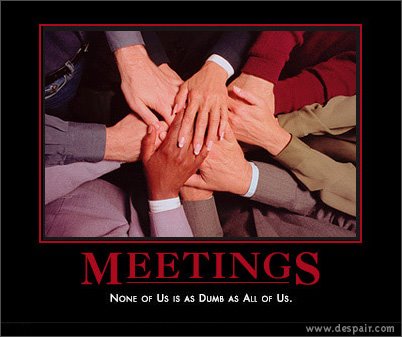
Collaboration creates mediocrity.  Yes, that's long been a theme of mine.


The poster may still be available from Despair, Inc.  But let's have Inc.'s Geoffrey James elaborate.
In previous columns, I've pointed out that open-plan offices, with all their interruptions, distractions, and noise pollution, are productivity sinkholes. I've also pointed out that collaboration tends to penalize the competent who end up doing most of the work.

A recent study published in Applied Psychology has now confirmed that a collaborative work environment can make top performers--the innovators and hard-workers--feel miserable and socially isolated.

The problem is that rather than seeing a top performer as a role models, mediocre employees tend to see them as threats, either to their own position in the company or to their own feelings of self-worth.

Rather than improving their own performance, mediocre employees socially isolate top performers, spread nasty rumors about them, and either sabotage, or attempt to steal credit for, the top performers' work. As the study put it: "Cooperative contexts proved socially disadvantageous for high performers."

This social isolation creates special difficulties for introverted employees who work in open-plan offices. While some extroverts seem to draw energy from a chaotic environment, introverts find such environments draining.

Sometimes the only way that introverts can get their work completed is to work from home, creating even more potential social isolation. Indeed, top performers who work from home are natural and easy target for workplace gossip and backbiting.

Unless checked, this tendency can result in an exodus of top talent.
There are a number of "unless checked" phenomena to explore in that passage.  My formulation for "penalize the competent" takes the form "punished for being cooperative."  The challenge, whether we are considering an academic, corporate, or other bureaucratic environment, is in coming up with the right set of incentives and rules by which people will take on the onerous tasks properly, rather than doing them badly so as not to be assigned them again.  I note, further, that this collaboration talk might have been a way to get away from strict hierarchies, in which the incompetent insubordinate is fired (or confined to quarters) but when the superior is incompetent, it's the incompetent superior sabotaging or stealing the credit for the subordinate top performer.  And I haven't even touched the ways in which collaboration becomes a forum for straining at gnats.  (Mr James's column found via Joanne Jacobs.)

2.1.18

IN PRAISE OF THE HIAWATHA.

Huffington Post offer Ten Reasons To Visit Chicago.  Well, nine.

10. For the beer and cheese in Milwaukee
Just a two-hour drive, train or bus ride away is Milwaukee, Wisconsin. Squeeze in time for a day trip – especially you are a beer or cheese lover – and tick off another state.

What this article doesn't mention (which is a serious lapse for a posting intended for British and continental readers who might have priors about the parlous state of U.S. trains) is that the Hiawathas run roughly on two-hour headways, and the accommodations are more comfortable than those of your typical regional rail train.  Nor does the article mention how close a number of the named attractions are to the Intermodal Station, where the buses and trains call.
Milwaukee Public Market is the perfect place for a gourmet feast with its large selection of local vendors, food counters, restaurants, bakeries and even a wine bar. You can’t leave Milwaukee without tasting cheese curds – these mouthwatering delights are best enjoyed breaded and fried. You won’t look at cheese the same way ever again!

Visit the home of PBR as Pabst Milwaukee Brewery and Taproom is located in downtown Milwaukee. Take a stroll to Best Place at the Historic Pabst Brewery where you can learn about the history of Pabst.

Stop by Milwaukee’s spy bar – Safe House – located down an alley way with an unassuming entrance. You’ll need a password to get in though but don’t worry if you don’t know it though. All will be revealed after completing a task on arrival!

Milwaukee is home to a great selection of breweries which offer tours, but if you are looking for a tour which offers a generous amount of beer and will have you doubled over with laughter then go to Lakefront Brewery.
And you can eat a bratwurst without worrying about whether you're debasing Illinois's currency!

Best, though, to hold off until spring.  We're re-enacting the Ice Bowl in weather and in spirit this week and next, if not in Packer outcomes.

EVEN DAVE BARRY MOCKS YOU.

Dave Barry's year-end round-up never fails to amuse.  But you know you're in trouble when you read this.
Venezuelan President Nicolás Maduro, seeking to prop up his nation’s collapsing economy, announces the creation of a new digital currency called the “Petro,” which will be backed by a combination of oil reserves and a magic feather. The Illinois Legislature quickly follows suit, announcing that from now on the financially troubled state will pay its debts with the “Porko,” a digital currency backed by bratwurst.
That's going to be interesting, when (as perhaps Mr Barry has learned after the Orange Bowl) the bratwurst is in Wisconsin.

Illinois's troubles, however, are no laughing matter.
Gov. Bruce Rauner has advanced a turnaround agenda, most of it swatted down by Democrats who control the legislature. What is the alternative proposed by House Speaker Michael Madigan or Senate President John Cullerton to bring more jobs, to reel in all the people — prospective employers and employees alike — now decamping to Wisconsin, Iowa, Indiana, Texas, Florida, Colorado ...?

There was — is — virtually none. Rauner aside, most of the ruling pols don’t say much. Madigan and Cullerton have spent a combined 86 years in Springfield, so don’t look to them for bold, disruptive ideas to create private sector growth, rescue public finances and create more taxpayers. The Illinois most of us see as gravely challenged is the Illinois they’ve created.
It's an Illinois that major employers avoid, perhaps tempted by that bratwurst.  "State and local lawmakers apparently didn’t get a wake-up call when Foxconn snubbed Illinois to build a giant electronics factory just over the state line in Wisconsin — close enough to benefit from Illinois’ transportation system but safely out of range of this state’s infamous dysfunction."  Promises to be an interesting year, with gubernatorial elections along with at least one Senate seat.  Thus far, no primary challenge to the governor, and the Democrats running more as Not Rauner than as Not Business As Usual.

ACT LIKE YOU'VE MADE A PLAY BEFORE.

The Orange Bowl is still not The Orange Bowl, and yet using it as a consolation prize for teams that didn't survive the algorithm that replays the Southeastern Conference title game establishes the national tournament field makes a nod to tradition.  Even when that nod gives the Miami Hurricanes effectively a home bowl game, hosting Wisconsin.

The Miami fans have adopted what appears to be a defensive coordinator's incentive called a "turnover chain."


Al Diaz photograph retrieved from Miami Herald.

I'll let people with more refined sensibilities than mine deconstruct the cultural appropriation of a bit of gangsta bling by Miami's upscale fans.  I think the lady to the left of the chain-wielder is attempting to make the orange-and-green hands gesture, although that sure looks like the latest version of the finger-and-thumb W the Badger fans currently flash.

Yes, Miami got to rock the bling early in the game (with a little help from instant replay) and after a few big plays and Miami taking a 14-3 lead, the ESPN announcers were getting into their usual patter about Southern teams and "athleticism" and "outside speed" and "five-star recruits."

Wisconsin linebacker Andrew Van Ginkel correctly anticipated a pass, giving Wisconsin the ball on Miami's 21.  Turnover battle even.  Wisconsin went on to score, and score again, and score again, going into the locker room leading 24-14.  Quarterback Alex Hornibrook gave the impression of a left-handed Aaron Rodgers for much of the game, making accurate passes in tight quarters.  Come the third quarter, and a Miami rally, cornerback Derrick Tindal intercepts a pass in the end zone: lead of 24-21 holds.  Badgers leading on turnovers.  At the end, another Wisconsin interception closes the game out.

Here's how Miami Herald scribe Walter Villa saw it.
Miami was expecting Georgia Tech but got Oklahoma.

In other words, the 10th-ranked Hurricanes, who lost the Orange Bowl 34-24 to the No. 6 Wisconsin Badgers on Saturday night at Hard Rock Stadium, never would’ve thought that their defense would get beat by sophomore Alex Hornibrook, a pedestrian passer who was named the game’s MVP.

After all, Wisconsin running back Jonathan Taylor entered the game with 1,847 yards and broke NFL star Adrian Peterson’s NCAA rushing record for a freshman in the game. Miami was surely expecting a ground attack, a la Georgia Tech.

On Saturday, however, Hornibrook made like Oklahoma’s Heisman Trophy-winning Baker Mayfield, completing 23-of-34 passes for a season-best 258 yards, a career-best four touchdowns and no interceptions as the Badgers (13-1) completed the first 13-win season in program history.
Mr Villa, can you say Aaron Rodgers? And ... glass half full department ... that late 1960s decline of the Packers came a few years after the mid-1960 decline of the Badgers. The mid-1990s revival of the Packers came a few years after the Badgers won a Rose Bowl.  And for all that talk about team speed, well, let Miami quarterback Malik Rosier have the final word.  “One time, the first interception I had, it was a great job by the guy. [Left tackle K. C.] McDermott tried to cut [Andrew Van Ginkel]. He did a great job getting his hands up and the ball just unfortunately wound up hitting him. They were fast, they were physical and they just did a great job of making me throw low-percentage passes.’’

THE COFFEE FUND IS DEPLETED.

A DeKalb sports pundit suggests the little tin box has been unlocked a few too many times.


The problem: five years of underachieving football, where achieving means winning bowl games.
After a terrible fake punt call and another postseason blowout, this time a 36-14 loss to Duke on Tuesday in the Quick Lane Bowl, new leadership would help. If this were the Bears, I’d urge George McCaskey to immediately fire the head coach – the way Hub Arkush has been doing.

But the Huskies play for a public university that already has spent its buyout budget this year. Even if NIU has the cash to make a coaching change, it lacks the political capital.

Earlier this year, the board of trustees had to vote – twice – to pay former Mismanager-in-Chief Doug Baker a severance worth $600,000. They took heat for that golden parachute from politicians, the public and the news media.

Baker’s $450,000 salary was nowhere near the $623,000 Carey will earn in 2017. It would cost the school about $950,000 to buy out Carey’s contract, according to USA Today.

If NIU spends more than $1.5 million on buyouts in a year, it’ll be clobbered with that fact any time financial issues arise – and rightly so.

Maybe NIU officials should just do what they’re doing with the president’s job – say they’re not going to hire or sign anyone until 2019, when Carey’s contract will expire.

Then, if Carey leads the Huskies through the gauntlet of nonconference foes scheduled for 2018 – at Iowa, Florida State and BYU, plus a home date with Utah – and comes out with even two wins, maybe he stays.
That's right, Northern Illinois continue to schedule highly regarded teams, and they have enough of a history winning such games, including at least one at Iowa in the past few years, and they earn bowl games with opponents you might have heard of, when it comes to the bowl games themselves, it's not so pretty.

THE WEAKEST PART MUST STAND THE STRAIN.

Fifty years ago, the Green Bay Packers closed out 1967 with the Ice Bowl.
Green Bay went 9-4-1 in ’67 and limped into the playoffs on the heels of season-ending losses to the Los Angeles Rams and Pittsburgh Steelers. Hall of Fame running backs Jim Taylor and Paul Hornung were gone. So, too, was the team’s aura of invincibility. This was an aging team that had lost key players to injury.
That's right, I'm not going to have another wallow in the past today.

Rather, I want you, dear reader, to reflect on the wonderful one-hoss shay.  There was one more, anti-climactic thumping of the Oakland Raiders followed by Vince Lombardi, for a year, serving as general manager, at the beginning of a quarter century of futility.

27.12.17

WHAT IS HONEST NEVER SINKS.

We'll finish the Fifty Book Challenge for this year a bit short of our goal, at Book Review No. 31.  Michael McCarthy's Ashes Under Water: The SS Eastland and the Shipwreck that Shook America looks at some of the personalities involved in Eastland's capsize and the subsequent investigation.  Mr McCarthy (of Grand Haven, not to be confused with an embattled football coach with a season turned to ashes on the west shore of Lake Michigan) stays away from the technical material, much of which has already been covered, and well, by Jay Bonasinga in The Sinking of the Eastland: America's Forgotten Tragedy and by George Hilton in  Eastland: Legacy of the Titanic.  But did you know that flamboyant trial lawyer Clarence Darrow was defending architect Frank L. Wright against a Mann Act violation?  (These days, we drop people from the canon or from polite society, sometimes retrospectively, for less.  Imagine architectural history without Wright.)  And that Eastland chief engineer Joseph Erickson relied on the bit of Norse folk wisdom that provides this review with its title to ultimately be cleared of any charges stemming from the capsize?  For that matter, have you considered that water ballast might be a necessary evil in a boat that must sometimes navigate channels subject to the caprices of wind, current, and sand?  Or that Kenesaw Mountain Landis, not yet commissioner of baseball, owed his name to a lost leg?  For the more substantive stuff, read the book.

Thus did I find Ashes Under Water a useful complement to the aforementioned technical works, and thus do I close my chronicles of this most interesting year.

(Cross-posted to 50 Book Challenge.)

UNLEASH THE CONTROVERSIES.

Here I had hoped to close out the year with lighter, more cheerful fare, and yet even the football gods work against me. Packers must move on from Dom Capers.
Receivers, tight ends and running backs running free, defensive linemen jumping offside, and maybe the worst of all, quarterback Cam Newton caught on television telling linebacker Clay Matthews before the snap, “You’ve been watching film, huh? Watch this.”

“This” turned out to be Newton throwing to halfback Christian McCaffrey running uncovered over the middle for an easy touchdown while the Packers bungled a coverage they had worked on during the week.

The die is cast and McCarthy has no choice but to fire Capers and begin searching for someone who can pull together the talent the Packers have on defense.
With the Philadelphia Eagles and Minnesota Vikings riding strong defenses and replacement quarterbacks into the playoffs, and the Chicago Bears sweeping their games with the AFL teams they played this year, the discontent is only going to grow.  I'll hold off on any more football postings until next year.

TEACH THE CONTROVERSIES.

That's long been a theme of mine, as to a naive view, all this talk in economics courses about "markets" and "prices" and "firms" and "competition" is a celebration of the existing commercial orderSorry, no.

Contrast the introspection in economics with the lack of self-reflection in this lament by a zampolit from Beloit College.
Many of us are trained to see and then speak on institutional and structural systems of oppression. I have been trained specifically to see and call out institutional racism through an intersectional lens. If we are being told to just do our job, then we are. So the real question becomes, is society ready to accept the true point of an education, which is to develop a group of critically thinking, conscious citizens? Is higher education ready and capable of taking on this work?
Sorry, lady, you're guilty of affirming the consequent, rather than treating intersectionality as one among many working hypotheses, and labelling disparate outcomes as institutional racism without considering other possible, perhaps stronger explanations for those outcomes.  Put together a set of hypotheses involving intersectionality that yield clearer explanations and let the logic and content carry the day.  But that's work.  Easier to hector and deplorable-shame.
As educators, it is our job to teach students how to think critically so that they can engage with larger social issues. That is not confined to just the social sciences, but has an impact on all academic disciplines and departments. Yet as [James] Baldwin also said, society is not always that anxious to have a mass of critically thinking and engaged people, because “what societies really, ideally, want is a citizenry which will simply obey the rules of society. If a society succeeds in this, that society is about to perish.” That is why education matters more so now than ever as a location that should be unapologetically committed to developing students to become true critically engaged thinkers who learn how to apply those knowledges, methodologies and skills to locations outside spaces like this.

It is on college and university campuses, and within our classrooms and through our programming, where resistance to this encroaching normalized white supremacist ideology must be challenged. Now is not the time to side with neutrality.
Seriously? You're going to deconstruct the old rules by imposing your own rules, and saying now is not the time to consider other rules?  The good news, dear reader, is that at least one commenter at Inside Higher Ed caught the strange loop being tied.
Our goal is to have the campus and community understand what organizing and activism are, why individuals and groups participate in these practices, and what possibilities there are or can be when we engage in other ways of knowing and being. In doing so, we hope conversations and actions move away from partisanship and into understandings of what we want humanity to be. What humanity should be.
"What humanity should be." That way await the guillotines and gulags.  So it always is with people who are so wedded to their priors that to ask "what evidence would lead you to change your mind?" is heresy.

PREACH THE CONTROVERSIES.

Because of the way the televisions schedules came out for Christmas Eve, I was able to compare-and-contrast midnight mass, as recorded by NBC for rebroadcast from Vatican City, and as covered live by WGN from Chicago (and made available to cable subscribers across the United States.)

The Vatican bureaucracy, doing what it does best, appears to have circulated a rubric and suggested preaching points for the message, whether delivered by the Pontifex Maximus, by a Cardinal Archbishop, by a bishop, or by a parish priest in a remote settlement: and each has similar responsibilities, station or rank notwithstanding, during the service.

Perhaps, though, the order of worship involved that advice from Rome.  Both the Vatican and the Chicago services began with an add-on, the Christmas Proclamation, which the rules stipulate may not replace any other part of the service, although this may be chanted (both the Vatican and Chicago had people skilled in this art) or read (and in a smaller community, entrusted to the local Linus van Pelt?)  I had never heard this before, and it's intriguing.  An excerpt.  "[I]n the one hundred and ninety-fourth Olympiad; in the year seven hundred and fifty-two since the foundation of the City of Rome; in the forty-second year of the reign of Caesar Octavian Augustus, the whole world being at peace." Go tell it on the mountain. I'm probably doing the kind of thing that got my fourteenth great-grandfather tossed out of the Anglican Communion to point out that Augustus reigned forty years.

Among the readings, the Augustinian theme continues.  Luke 2, as chanted in Latin, read in English, and dramatized by Linus.  Augustus's census, when Cyrenius was governor of Syria.

In both services, there were readings and prayers in multiple languages.  On NBC, a church representative offered simultaneous translations into English.  On WGN, there were English subtitles, allowing a listener to work on his command of other languages.  I commend WGN for providing the captions rather than the voice-overs.  Alas, contemporary translations, whether closed-captioned or spoken, don't have the resonance and the rhythm of the King James Bible.  Dear reader, you cannot write good English prose without having read and listened to Shakespeare and to the King James Bible.  The committee that wrote the Revised Standard Version at least got that right.  Winston Churchill's speeches show that training.  The too-soon-departed editor of Trains, David P. Morgan, was the son of a British-born Presbyterian minister, and you could pick that up without knowing his biography.

The message, perhaps with some advice from Pope Francis, emphasized two components of the story as told by Luke.  "No room for them in the inn" indicates Joseph, of the house and lineage of David, being rejected by his own kind.  Perhaps, although humans under the same roof as animals was the reality for most of the population until recently, and "inn" refers to a tavern with perhaps some sleeping accommodations.  Think Tabard Inn of The Canterbury Tales; or Holiday Inn with a sales convention in town during the Mad Men era; or Quality Inn in a warm climate during spring break; or Hampton Inn hosting a big wedding party.  These days, we have hospitals and clinics to keep the children, and the near-to-term moms, away from the roistering.  Not so much in an era when fresh fish might be a special treat, and the tax-collector might be even more reviled than he is today.

Speaking of fresh fish, let us reflect on the shepherds, who in this year's message are "marginalized people."  There is a special circle in hell for anyone who introduces these culture-studies terms into ordinary discourse.  But didn't anybody in Francis I's staff remember who the Great Shepherd is?  On earth, if those men are not keeping the wolves, and the Saracens, away from the flock, those loaves and fishes will have to be stretched even further.  Count your blessings, and let's at least have a message that is more attuned to realities, back in the day, and these days.

But perhaps I should not carp.  This year, there were fewer people holding up their smart 'phones to record the processional in Rome, and the one discordant note in Chicago featured a parishioner turning around to snap a selfie as the Cardinal Archbishop passed by during the recessional.  I got the sense, though, that there were a lot of people present at the Vatican for the experience.  Chicagoans who stay up late into the night are going to make a joyful noise and bring an offering, and when you have some very lively censer-swinging and the Cardinal Archbishop belting out "O come let us adore him" for the microphone to send urbi et orbi, why not?  Oh, and working "kingdom" and "power" and "glory forever" into the closing prayer.  Those used to be fighting words.

23.12.17

LOOKS LIKE CHRISTMAS.

This year's vintage trains run at prototype speeds.  There's also a tease of the serious models.


Is that hopper car empty because everyone was good, or is it going back to the mine for more coal?

Thanks to all for looking in, and to all a good night.

FROM THE RUINS OF THE NORTH STAR CONFERENCE.

Once upon a time, in a basketball universe far away, the women's teams of DePaul, Northern Illinois, Notre Dame, and Wisconsin-Green Bay played in a common conference.  (Football I know was another matter and I don't recall the details for men's basketball.)

EVERY VALLEY SHALL BE VAULTED.

German Rail completes the München to Berlin fast railroad, a project that could only be possible with the Cold War over.  The new service is time-competitive with air, and faster (and less nerve-wracking) than driving.

Trains use existing stations and urban trackage, with the fast lines giving the impression of a souped up Lackawanna Cutoff or Long Drag (to think of two rail lines where policy makers swallowed the highway lobby's blandishments.)
Three separate 187.5-mph high speed lines opened between 2006 and 2017 with three other sections of existing line connecting the new high speed lines rebuilt for operation at up to 144 mph. All the major stations on the route have also been modernized.

The 67-mile long section opening this month was the most complex to build as most of it cuts through — or under — the hills of the Thüringen Forest. Of the 67-mile length of the route, more than a third, or 25.6 miles, is in tunnels built for 187.5-mph operation with 7.5 miles of bridges and viaducts as well. The Erfurt to Ebensfeld section has cost about $12 billion and work was stopped for several years in the late 1990s due to a shortage of funding.

The line has been built for mixed use with freight permitted and passing loops [double-ended sidings -- ed.] to allow ICE trains to overtake freight trains. So far no freight has operated as access tolls are higher than the regular network.

Services on the new line are being operated using the existing Deutsche Bahn ICE fleet which has been fitted with cab signalling [positive train control] to operate on the new line.
The modern German style of viaduct (Miniatur Wunderland have at least one model in action) gives the impression of a minimalist Nicholson Viaduct.  But unlike the promoters of the Chicago-New York Electric Air Line (which figured in a Christmas video a few years back) they're not building a dead-straight, dead-level railroad.

Freight train operations are restricted by day, although I can report at least one delay enroute Hamburg from Nürnberg account freight train interference.

21.12.17

REMEMBERING HUNTER HARRISON.

The CSX Railroad announced last Thursday that operations guru and former Illinois Central, Canadian National, and Canadian Pacific chief E. Hunter Harrison would be taking medical leave.  He crossed the final summit on Saturday.
Harrison began his career in 1963 as a carman-oiler with the St. Louis-San Francisco Railroad, while he was still in high school. During his career, he became famous for applying the "scheduled railroad" concept to railroads to improve their operating efficiency.
The scheduled railroad concept is straightforward enough. Trains are made up of cars that are moving cargo from a shipper to a consignee.  Take care of serving the shippers, and the trains will take care of themselves.
Hunter Harrison learned railroading at the knee of a brilliant, profane Texan, William (Pisser Bill) Thompson, who was on his way to becoming VP-operations of the Frisco in the late 1960s when Hunter encountered him at Tennessee Yard in Memphis. “Young man,” said Thompson, spreading his arm toward a sea of freight cars, “what do you see out there?” “A lot of good business, Mr. Thompson,” replied Harrison. Retorted Thompson: “What? Good business? See, that’s the difference, Hunter. I see a bunch of delayed cars, and you say it’s good business.”
He took that lesson to heart, although Trains columnist Fred Frailey sees strengths and weaknesses.
Harrison learned inventory control and asset utilization. Later, within Burlington Northern’s Seattle Region, he tried before others did to run individual cars strictly by schedule, thereby getting better utilization of equipment, including locomotives. Later still, running operations at Illinois Central, he put into practice all the ideas that had been brewing within him, including balance—if you run a train east, run one west, and better yet, have them meet mid-way and swap crews, thereby ending away-from-home expenses. He later did his magic at Canadian National and Canadian Pacific, and upon his death was eight months into a remaking of CSX.

So a genius at railroad operations, yes. But was the man a genius at running a railroad? Running a railroad, after all, is about more than running trains. You have to consider retaining your customers and finding new ones, dealing with government, building high morale and on and on and on. No, he was not a genius, and in fact I would call the man merely ordinary in some aspects of being a chief executive and deficient in a few critical areas. To say this does not detract one iota from the respect I have always shown for him. We are all imperfect creatures.
His latest project, CSX,  might have posed a different set of challenges.  Back to Mr Frailey.
Did Harrison put the railroad on the right path or leave it in shambles, having ripped its practices and institutional knowledge almost to shreds while not living long enough to build a new foundation? I wish the former but suspect the latter.

His former colleague at CN and now his successor at CSX, Jim Foote, has his work cut out. I interviewed Foote in 2009 and thought him whip-smart and funny (meaning a quick thinker).  Nowhere in his background is experience in operations. And operations is where CSX now stands exposed.

Lastly, I wish Hunter Harrison had been better teaching people how to think like him than he was, through his Hunter Camps, to act like him. It’s an important distinction. In other words, you can tell me what to do (Hunter Camps) but how do I learn to think like you? Maybe that is our biggest loss.
The succession in the executive suite, or at quarterback, matters, and yet there is a lot of precision transportation that relies on alert sales agents, billing clerks, and dispatchers.

SEASON'S END.

The Green Bay Packers will not be going into Christmas with a playoff on the line.
Not with that defense. Not with that lack of commitment to the run. Not with so few impact players.

The Packers were 28 yards away from playing a third straight overtime game and possibly pulling out a season-saving victory over the Carolina Panthers on Sunday at Bank of America Stadium.

But it was just a tease because since winning Super Bowl XLV they have been neither good enough nor talented enough to do more than put up a good front week after week.

If Aaron Rodgers had led the offense to a second touchdown in less than 3 minutes and the Packers had won the coin flip in overtime and scored a touchdown to pull out a miracle victory to improve to 8-6, it would have been merely a reprieve.
Perhaps the fans and the sports pundits will express enough discontent for headquarters to address weaknesses on the team that don't involve injured quarterbacks.
It would have lasted until the Minnesota Vikings or Detroit Lions or some playoff opponent brought them back to reality with a slap in the face. They would have packed up their bags, noted how close they got again and then gotten ready to do it again.

General manager Ted Thompson’s anachronistic approach to talent acquisition has left them exposed at one specific position or area of athleticism or facet of the game at the end of every season since the Packers won their 13th championship in February 2011.

Every year it seems, they overcome a slew of injuries, rally to win the division or make the playoffs and then have their weaknesses picked at until it’s time to congratulate the opposition for moving on.
Apart from the aforementioned Super Bowl season, and the repeated failure of special teams in Seattle, those weaknesses tend to have been on defense.  Heck, it was the Packers who made Colin Kaepernick a phenomenon for a couple of years.  Just line up and tackle people.

Thus endeth an eight year run of Packers playing in the post-season.  There was one prior such run, although nobody makes much of it. Lose to Philadelphia.  Defeat New York.  Defeat New York.  Defeat Cleveland(p).  Lose to St. Louis(p).  Defeat Baltimore(d) and Cleveland.  Defeat Dallas and Kansas City(*).  Defeat Los Angeles, Dallas, and Oakland(*).

The footsteps of giants.  "There is something Lambeau and Lombardi accomplished that subsequent head coaches have not yet done."

My wish for 2018: that the Packers fix their problems on defense, and continue to pay attention to the succession at quarterback (Boy, did I miss that one, but I'm not complaining).  I still have bad memories of a battered Bart Starr coming out to attempt to salvage one more season, one more run at Bud Grant and the Vikings, only to leave more racked-up.

(p) Playoff Bowl.  Vince Lombardi referred to this game as hinky-dinky, and it vanished with the divisional alignment.

(d) Western Conference playoff game.  No tie-break formulas in those days.

(*) The anti-climactic interleague bragging rights game that only later became the Super Bowl.  I think the name for that game originated with the name of the biggest entree at Chili John's.

19.12.17

PERSISTENCE.

Northern Illinois guard Paulina Castro returns to the lineup.
“[Paulina] is inspirational,” junior guard Mikayla Voigt said as she tried to hold back tears. “The fact that she was able to keep such a positive attitude through all of that and still be such a big supporter for the team and then come back to be healthy again and able to play basketball, it’s truly a miracle. I mean I don’t think it’s anything short of that.”

Castro continues to maintain a positive attitude, as she is now contributing both on and off the court. Carlsen said Castro taught her and the entire team a life lesson during her journey.

“It gets better,” said Castro. “You know there are days when you feel like ‘wow, this sucks’, but it gets better and that is something that I learned. You learn to appreciate even the smallest of things when you don’t know how the next day is going to go. I think that is why basketball was such an escape for me was because I just learned to appreciate it so much more.”
Just go read the story.

A DIFFICULT DAY ON THE CASCADE CORRIDOR.

Amtrak train 501, making its first trip on an avoiding line intended to speed up the Seattle to Portland services, apparently went into a curve in advance of a junction too fast.  Jim "Travel & Trains" Loomis lost two fellow Passenger Rail advocates in the wreck.
I have just learned that the Rail Passengers Association lost two members in yesterday’s derailment: Jim Hamre, an elected member of our Board of Directors, and Zack Wilhoite, an RPA member. There are no adequate words.
His post also notes a number of complaints serious ferroequinologists raise about press coverage of things that run on rails.
There is the unbelievable irony of this event occurring to the very first train on the very first day that this new stretch of track was open. That alone is reason enough for suspecting foul play.

The cause of the event will be found and if it proves to be a true accident–human error, if you will– rightly or wrongly, blame will be assigned and some poor bastard’s life will be ruined.

In reporting on the accident—and, yes, I acknowledge that the media is under pressure to get the information out there as quickly as possible—there is nevertheless an obligation to get the facts right. For minutes and then hours, media reports kept referring to this as a “high-speed” train and to the line itself as “high-speed”. Dammit! Wrong and wrong again.

As I understand it, the crash occurred just as the train was entering a brand new stretch of track, the purpose of which being to permit Amtrak trains to run at somewhat higher speeds than conditions on the previous route would permit. You can bet that investigators will be going over the first 100 yards or so of that track with the proverbial fine tooth comb. Don’t expect a definitive report to be coming out soon. But when it does—just one guy’s gut opinion—I suspect there will be evidence of foul play. Damn!
The early evidence is of a train going too fast into a speed restriction of thirty mph for the curve over the bridge, and there is a speed restriction of 42 mph for Talgo trains where this route ... not a new railroad by any means, rather a former Northern Pacific track that has been in place since at least the 1920s, joins the seaside route that Amtrak, and most of the heavy coastal freight traffic, has been using.  Amtrak's passenger trains will be joining the Tacoma area Sound Transport commuter trains on this line, which might have been reprofiled for faster running.


Point Defiance bypass project map retrieved from Washington State Department of Transportation.

Note: not a new line, definitely not a German Neubaustrecke (there will be occasion to celebrate one of those in a day or so) and certainly not a high-speed line by German standards, by Acela standards, or by the standard set by The Milwaukee Road in Wisconsin, eighty years ago.

Let me quote from a booklet of safety instructions issued by the Elgin Joliet and Eastern Railway in August, 1953.  "All the safety appliances that could be installed would be of no value, unless you have safe men to operate them."  So what is keeping the engineer from doing what he is supposed to be doing?  "'How is it that a train was going 80 miles an hour,' Savannah Guthrie asks, 'around a curve where the speed limit was 30?'"

Yes, it is likely that people will make much of the absence of Positive Train Control on this line, or even of the control equipment on the new diesel that will probably be written off.


Unattributed AP photograph retrieved from Daily Mail.

Why, though, would a train operator not be aware that the end of the fast running and the upcoming junction with the original route was nearby.  As I asked in the aftermath of the derailment account excessive speed of a Spanish Talgo train, "passengers are trusting the engineer to have sufficient route knowledge that he's made the proper brake application in advance of an approaching junction."  We ought be grateful that the Talgo cars in use in North America protect passengers more effectively.

Also, apparently, a local official viewed with alarm the introduction of 79 mph passenger trains through his community, and those fears were also raised by officers at a nearby military installation.

What sort of a world do we live in, when a 79 mph train raises safety fears at a military base?


Afternoon Hiawatha at Camp McCoy, Wisconsin, summer 1964.
Kent Kobersteen photograph scanned from Scribbins, The Hiawatha Story,  page 120.

Despite the derailment, the provision of additional routes for diesel trains good for 110-125 mph (as the above picture illustrates, this was routine a half century ago) remains a productive use of infrastructure money, private and public.

CRUISING THE WEB.

Check out "Monday's Child is Full of Links."  Props for a well-timed frack you, a reference to "Progressive Finishing Schools," and a reference to the Unicorn State.  Enjoy.

16.12.17

TAKING STOCK.

Almost a year into the Trump presidency, and how stand things?

Declare victory and leave the social media to others, urges Victor Hanson.
[P]ersonal dueling with journalists, celebrities and politicians is not only becoming superfluous, but it is now distracting Trump's audiences from a growing record of achievement.

Nine months ago, critics left and right were writing off Trump as an irrelevant buffoon without a clue of what to do in the White House. They predicted perennial sloth and inaction.

Not now. Trump's Cabinet and judicial appointments, executive orders and deregulation measures are systematically overturning the progressive Obama project.

Abroad, the Trump national security team has recalibrated U.S. foreign policy from an apologetic recessional to engaged, principled realism.
Yes, those accomplishments are making some people mad, but there is a substantial overlap among those people and people who were weak on communism, who are soft on counterterrorism and crime, who offer misguided education policies.
Republican politicians once grumbled about the utopian Paris climate accord but never thought of doing much about it. Trump, like him or hate him, summarily withdrew America from the agreement -- and shrugged off the ensuing green outrage.

Members of Congress occasionally expressed support for the recognition of Jerusalem as the capital of Israel -- but on the expectation that no barnstorming candidate would ever dare to officially recognize Jerusalem as such if elected president.

Prior to 2017, conventional economic wisdom dictated that the Dow Jones industrial average would not soon climb above 22,000, that the unemployment rate in peacetime could not fall to 4 percent, and that the GDP could not grow at an annual rate of 3 percent. All those shibboleths have either been blown up or may yet be blown up in 2018.
The real test of this administration will come when the stock market correction or recession or both occur.

LET'S DECLARE IDIOCY A FORM OF INTELLECT.

Civility is oppression.  Seriously.
Through an analysis of interview data, [Northern Iowa researchers C. Kyle Rudick and Kathryn B. Golsan] generated 3 categories describing whiteness-informed civility (WIC): (a) WIC functions to create a good White identity, (b) WIC functions to erase racial identity, and (c) WIC functions to assert control of space. These thematic concepts show how WIC is characterized by logics of race-evasion, avoidance of race-talk, and exclusion of people of color. The authors conclude by offering ways for instructors to interrogate WIC through classroom practices informed by critical communication pedagogy.
The article is from Taylor and Francis, a publishing outfit that provides @RealPeerReview no end of material.  And of course, dear reader, any scholar who uses "interrogate" as if some institutional concept ought be dragged into the Lubyanka for round-the-clock questioning and then dispatched with a small pistol.

LAVENDER'S BLUE, DILLY DILLY.

The culture-studies types have completely ruined the art of social criticism.

It thus falls to the economists to keep it alive.
I laughed so hard to the point of nearly crying. This one ad brilliantly calls out the snobbery of craft brew culture and all the pomp that goes with it. Nowhere does it make a direct pitch for Bud Light. It just says exactly what we think but never say: Bud Light is a people’s beer, and that’s just fine because now the people rule.

So embedded in this commercial is a bit of the story of the rise of capitalism itself. It was the marketing principle that flipped history. No longer would the elite of the past determine the tastes of the kingdom and the way resources would be used. There would be mass production for the masses of people. It was a revolution in history, and one that would never stop.

And from a marketing point of view, this commercial deals directly with Bud Light’s real competition in the craft brew industry, which is making inroads by the day. Bud Light obviously cannot claim to have a better product. And guess what? Everyone knows that. Everyone knows what a Bud Light is: it is a beer-like drink that is watery but let’s you drink a six pack in an evening without any great disaster the next day. Sorry snobs, but the people like this feature.
He's right about the near-beer properties of light beer, you know.

And the advert, of course, had to be set in England, because Reinheitsgebot!


But hey, even in a beer commercial there might be some hidden meanings.  "In the real world, it is the local craft brews that broke the monopoly control of the old-world domestics, to add some free-market competition to a stagnant industry. And that makes this ad even more special, with Bud Light trying to recapture the legitimacy of its dominant market position."

Noted on Newmark's Door.

Prosit!

13.12.17

ARCH DELUXE.

Norfolk Southern have replaced a vintage girder bridge at Portageville, New York, with a photogenic arch bridge.


Norfolk Southern Corporation photograph retrieved from Trains, THE Magazine of Railroading.

Higher, faster, stronger.
The $75 million bridge replaces the former Erie Railroad Portageville Bridge, an often-photographed iron-and-steel landmark built in 1875. It stands more than 230 feet above the Genesee River in New York’s Letchworth State Park.

...

The new span, built 75 feet south of the old truss bridge, allows NS to run industry-standard 286,000-lb. cars over the Southern Tier line, up from the current 273,000-pound limit. Trains can move across the bridge at 30 mph, up from 10 mph on the old span.

The line carries about a dozen trains per day and is a key link in Norfolk Southern’s route to New England from the west. It also handles some freight bound for Canada and northern New Jersey.
No passenger trains will be delayed. The Norfolk Southern main line between Chicago and New York City uses the old New York Central between Chicago and Cleveland, the old Nickel Plate between Cleveland and Buffalo, and the Southern Tier is the former Erie-Lackawanna line, via Binghamton, and then some odd routing that avoids either Scranton and Port Jervis.

Apparently, railroad infrastructure can receive public moneys, even in Trump-unfriendly jurisdictions.
The bridge was funded through a public-private partnership among Norfolk Southern, the New York State Department of Transportation, and the Federal Highway Administration.

At 2:20 p.m. Monday, Norfolk Southern’s 36T, an eastbound merchandise train running from Buffalo to Allentown, Pa., with stops in Corning and Binghamton, N.Y., became the first to run across the new bridge.

“This is a very exciting day for Norfolk Southern and for the future of freight rail service in New York’s Southern Tier region,” said James A. Squires, NS chairman, president and chief executive “The successful completion of this bridge is an excellent demonstration of how the public and private sectors can work together on freight transportation projects that generate significant public benefits and are vital to U.S. commerce. It’s also a testament to Norfolk Southern’s robust bridge program and the ingenuity of engineers and railroaders.”

“The new Portageville Bridge complements the beauty of Letchworth State Park while providing safer, more efficient freight rail service,” said New York Gov. Andrew M. Cuomo. “Through a combined effort with Norfolk Southern, government leaders and the public, we have built a modern arch bridge which will support economic growth in the region and continue our drive to strengthen and modernize transportation infrastructure across the state for generations to come.”
The old bridge will be removed. As the railroad passes through a state park, and ferroequinologists have been taking pictures of trains here for years, local authorities are looking forward to enhanced tourism and recreational activities on the river.  "The bridge’s arch design minimizes the railroad’s environmental footprint in the Genesee River Gorge and complements the scenic vistas found in Letchworth State Park."

THE FACULTY ARE THE STEWARDS OF THE UNIVERSITY.

That has long been my stance, and a recent (Instalanched) essay by two exiles from Evergreen State College explains, in detail, why that must be the case.
In 2015, Evergreen hired a new president. Trained as a sociologist, George Bridges did two things upon arrival. First, he hired an old friend to talk one-on-one to members of our community — faculty, staff, and students. We talked about our values and our visions for the college. But the benefit of hindsight suggests that he was looking for something else. He was mapping us, assessing our differences, our blind spots, and the social tensions that ran beneath the surface. Second, Bridges fired the provost, Michael Zimmerman. The provost, usually synonymous with the vice president for academics, is the chief academic officer at an institution of higher education. Zimmerman would have disapproved of what Bridges had in mind and would have had some power to stop it. But he was replaced by a timid (though well-liked) insider who became a pawn due to his compromised interim status and his desire not to make waves.

Having mapped the faculty and fired the provost, Bridges began reworking the college in earnest. Surprise announcements became the norm as opportunities for discussion dwindled.
That the faculty couldn't raise more objections to the purging of the provost, or take steps in committees and faculty councils to stop the usurpations, suggested the faculty had long ago abdicated powers that were properly theirs.  And faculty, no matter how radical their politics, might be the fiercest protectors of the curriculum, if they'd but have kept those powers.
The president took aim at what made Evergreen unique, such as full-time programs. He fattened the administration, creating expensive vice president positions at an unprecedented rate, while budgets tightened elsewhere due to drops in student enrollment and disappearing state dollars. He went after Evergreen’s unparalleled faculty autonomy, which was essential to the unique teaching done by the best professors.

All of this should have been alarming to a faculty in which professors have traditionally viewed administrative interference in academic matters with great suspicion. But Bridges was strategic and forged an alliance with factions known to be obsessed with race. He draped the “equity” banner around everything he did. Advocating that Evergreen embrace itself as a “College of Social Justice,” he argued that faculty autonomy unjustly puts the focus on teachers rather than students, and that the new VP for Equity and Inclusion would help us serve our underserved populations. But no discussion was allowed of students who did not meet the narrow criteria of being “underserved.” Because of the wrapping, concerns about policy changes were dismissed as “anti-equity.” What was in the nicely wrapped box turned out to be something else entirely.
That's how it has always worked.  Dress the usurpations up in pet projects that the faculty might be disposed to go along with anyway, particularly if those projects carry names such as "diversity" or "equity" or "multiculturalism."  Then, once the precedent for usurping is there, start behaving like a boss.
[T]he “Equity Council” that [the president] had appointed and empowered shifted into high gear. It produced a document laden with proposals that tear at the foundations of a liberal arts college. It recommended, for example, using “diversity and equity in the criteria for prioritizing faculty hires.” As is clear from the minutes of the council’s meetings, this goes well beyond affirmative action, which is itself illegal in the state of Washington. Taken to its logical conclusion, this policy would mean hiring no more artists, or chemists, or writing faculty, or any faculty, really, unless their research or training could be defended on the grounds of “equity.” That would spell the end of the liberal arts college.
Excellence is overrated.  (Oh, wait, that's a post for another day.)  "Equity," however, is whatever the people who have the power think it should be.  But the administrative sycophants among the faculty went along (was it so they could continue to be invited to the right parties?)
These faculty members and their accomplices in the administration are primarily at fault. They are the adults. At an institution of higher education, it is the faculty’s job to teach, not to preach; to educate, not indoctrinate. Some of the students who became protesters will be paying off their loans for years, and for what? They were let down by an institution that imposed and nurtured grievance and propaganda rather than educating and conferring knowledge. Evergreen handed them temporary power, an intoxicating thing, instead of establishing boundaries and legitimately empowering them with insight and wisdom.
Or, to use Matt "Dean Dad" Reed's formulation, the faculty often serve as Burkean conservatives.  The search function at his site is bloggered right now, so I can't cite an illustration of him using the phrase more in sadness than in anger (the faculty often being the saucer that cools off overheated administrative initiatives).  Meanwhile, the students were rendered unemployable because they never had to confront the evidence that might induce them to rethink their priors.  And the authors had only one national news outlet to tell their side of the story.  Tucker Carlson on Fox News, forsooth.
Left and Right historically disagree on the extent of current inequities in the system, and on the wisdom of solution making. Those on the Left tend to focus on the inequities in the system; those on the Right tend to argue for personal responsibility. The Left tends to see structural unfairness, and is inclined to intervene. The Right tends to see a landscape of opportunity, and fears the unintended consequences of new initiatives. Both positions have merit and, despite the frequent tenor of conversations between factions, they are not mutually exclusive. Wisdom is likely to emerge from the tension between these worldviews, uniting good people around the value of a fair system that fosters self-reliance as it distributes opportunity as broadly as possible.
Yes, but that takes work. Work involves standards of performance. And standards of performance well might be oppressive.  But the absence of standards is more oppressive.

12.12.17

MAKING CHRISTMAS GREAT AGAIN.

Move it downtown.  Start with the department store music.
Many of these songs were written during the immediate postwar period of optimism, cultural unity, and thriving Main Street economics. It’s Beginning to Look a Lot Like Christmas mentions all the classic signs of the holiday—the carols, the bells, the snow—but the first thing it portrays is “the five and ten (variety store) glistening once again with candy canes and silver lanes aglow.” The song then conveys the excitement of Christmas as toys appear “in every store.”

It’s clear that the role of these local shops and their front window displays goes far beyond shopping. They not only provide all the toys needed for presents and gifts (the entire third verse of the song) but are an essential part—if not the most central aspect—of the holiday ambiance.
Yes, with the kids making their list and checking it twice.  "Some of that was still in place in the last days of The America That Worked(TM), it being a family ritual, come early December, for everyone to scrub up, spiff up, and head Downtown to do the Christmas shopping, and enjoy a meal at the Boston Store restaurant."  Mom, Dad, grandparents, siblings, schoolteacher, school gift exchange, check, check, check.
Today, however, we’ve lost this unique part of the season. Whether it’s the constant sale of toys at our big retailers, or the year-round availability of holiday products through the internet, there is nothing actually special about shopping at Christmas. And it’s not just the experience we’ve lost—there is now less joy in the products that we buy. Every gift from a big-box store is tainted with the knowledge that it is one of a million copies, while “artisan” gifts brought from small shops are so profligate with campiness (organic blueberry goat’s milk soap) that buying them becomes a smug competition in who can spend the most money on the oddest item.

The very layout of the typical auto-centric American suburb also quietly kills the spirit of Christmas. Everything leading up to the holiday has become stressful and hectic, while still being glum and uninspired. The mall and the big-box stores feel even more depressing around the holidays, as you walk through an expanse of parked cars in the cold and snow. There’s no reward for your misery: Target and Wal-Mart still feel the same when you get inside, except that they’re probably more crowded. You’ve been here a thousand times before and you’ll be back next Tuesday to return the gifts you didn’t want and pick up toilet paper. This cheerless shopping experience is underpinned by the knowledge that your dollars are not staying in the community but are being vacuumed out to Wall Street.
When an American Conservative writer uses a "buy local" talking point, dear reader, you know there's an E-T-T-S moment at hand.  "Do we want our children to associate Christmas with spending hours at the mall or lazily clicking through Amazon? Or do we want them to realize that our physical structures can be part of their heritage and have a lasting impact for generations?"

Unfortunately, the era of the department-store sponsored Christmas parade (sometimes involving a train) is gone, apart from Macy's in New York City, the national telecast of which has deteriorated into celebrity newscasters interviewing celebrity entertainers while all the sisters and cousins and aunts of the kids marching in the parade strain for a glimpse of their high school's colors or a few bars of the parade songs.

WHEN HIGHER EDUCATION BREAKS THE SOCIAL CONTRACT.

That's a central element of Richard Vedder and Justin Strehle's Case for Taxing College Endowments.
There are two good reasons why the endowment tax makes sense to some politicians. First, public attitudes toward universities have distinctly soured in recent years. What the public perceives as outrageous student behavior, feckless university leadership, and excessive tuition fees has combined with a growing hostility by Republican lawmakers angered over the large political donations and public criticism that academics have made attempting to oust them from office. Lawmakers are growing tired of feeding the mouths that bite them. Revenues raised by taxing colleges can modestly help fund other tax reductions that lawmakers want to make, which are probably economically beneficial to the well over 90 percent of the population living outside the Ivory Towers of Academia.

Second, our econometric examination of college endowments suggests a large portion of endowment income is dissipated in relatively unproductive fashions, financing a growing army of relatively well-paid university administrators and giving influential faculty low teaching loads and high salaries. We estimate that roughly only about 15 cents out of each additional dollar of endowment income goes to lower net tuition fees (published tuition fees—sticker prices– are much higher at highly endowed schools, but those schools also give more scholarship aid). When a newly endowed scholarship is created, schools typically either reduce their student aid support from other funds or raise sticker prices to capture some of the newly funded endowment resources for other purposes.
I've been fighting with Business as Usual along lines suggested in the first paragraph for years: no surprise there.  The second paragraph, referring to empirical work not otherwise cited or acknowledged in their essay, raises the unsurprising point that money is fungible.

Continuing, though, perhaps taxing endowments is another way of reducing the regressive transfers inherent in higher education as currently understood.
A healthy portion of [endowment returns and other subsidies] are used to provide higher salaries or other perks such as hiring lots of new administrative assistants such as more assistant deans, “sustainability coordinators” or “diversity officers” to perform irksome jobs or meet politically correct objectives such as fighting global warming or achieving the optimal skin colorization of the students and faculty. As endowments rise, so do full professor salaries and the numbers of professors serving a given number of students. To a considerable extent, endowments are a successful rent-seeking scam of the power brokers within universities.

At public universities, subsidies are provided by state governments that usually are less than $1,000 a student but are occasionally higher. The five highest state appropriation levels per student among the 13 public Big Ten universities range between $10,000 and $15,000, equal to the amount that would be provided by an endowment of $250,000 per student where the annual spending rate is four to six percent of the endowment principal. Thus, the GOP excise tax on endowments takes effect only at institutions where endowment spending is generally well above the public subsidies provided at state universities.
Now, if we could get the land-grants and mid-majors to recognize that they are in the same business as the Ivies, and turf out all the irksome special education impedimenta that keep U.S. News selling those ratings ...