Illinois, Michigan and Wisconsin are working with Amtrak to increase train speeds from the 79 m.p.h. top speed in most locations to 110 m.p.h., which is the maximum that can be safely handled by Amtrak's existing locomotives and coaches. Speeds higher than that would require elaborate barriers to prevent accidents between trains and vehicles at railroad crossings.The cost-effective policy might involve more grade separations, although such projects can be more effective than barriers. (On the other hand, Britain's East Coast Main Line still has a few occupation crossings, with a telephone to obtain permission to herd sheep across the tracks. These crossings also provide stiles for pedestrians to cross the right-of-way-fence.)
Showing posts sorted by relevance for query give free rein to 110. Sort by date Show all posts
Showing posts sorted by relevance for query give free rein to 110. Sort by date Show all posts
18.4.09
GIVE THEM FREE REIN TO 110.
I've been making the case for faster conventional trains in the Midwest, and they might happen.


9.6.25
A PROJECT OVER A CENTURY IN THE MAKING.
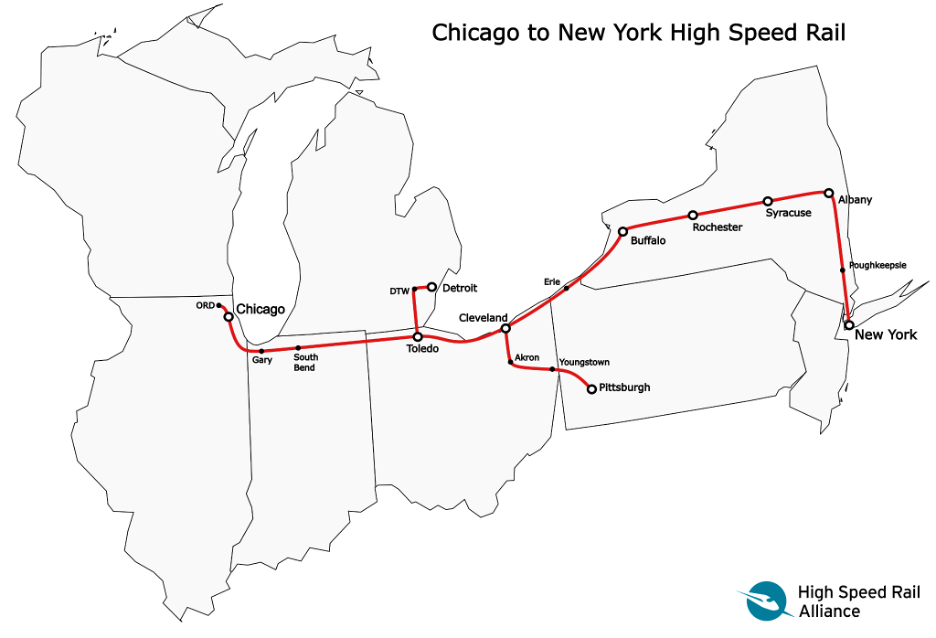
Make no small plans, urges Alexander Kofman for the High Speed Rail Alliance.

That project envisioned only the most generous of curves once the line got around the southern tip of Lake Michigan.

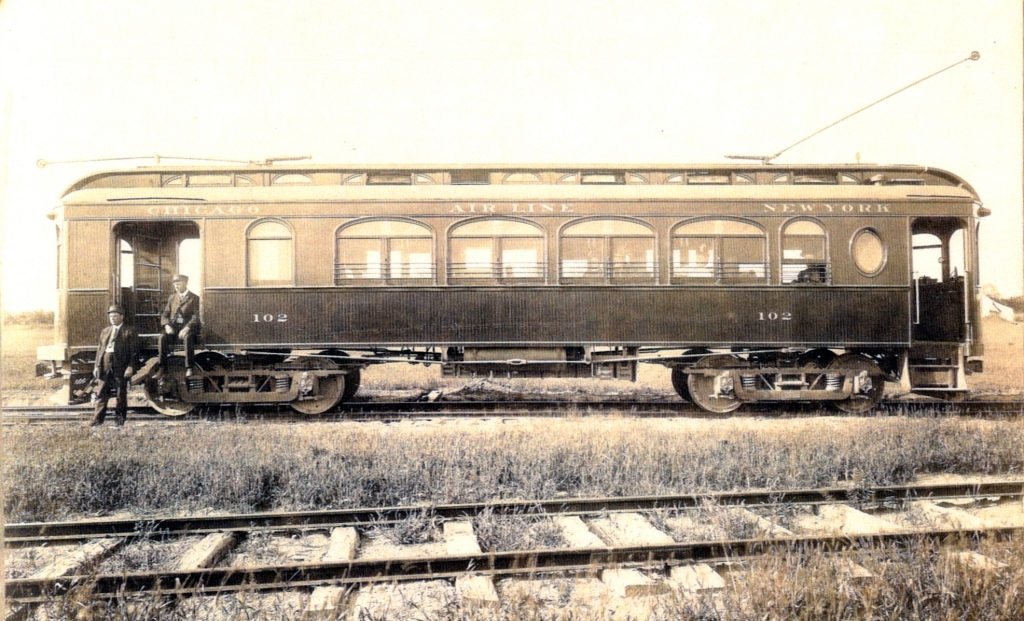
In the same 20 years that it would take to design and build high-speed rail between Chicago and St. Louis, Milwaukee, or Detroit, a wider-ranging effort could instead design and build a line of national scope and importance. Industry and government are equally capable of planning small projects and megaprojects. If it would take us the same 20 years to fight for a short line as for a long one, we should go big. We should aspire to meet the moment and demand the project the country really needs: a high-speed line connecting Chicago and New York.For what it's worth, at the start of the twentieth century, within two decades a short line intended to connect Chicago to New York did fund raising, bought rolling stock, built about 25 miles of track, ran some trains, and quit before the United States entered the War to End All Wars.
The route proposed for this high-speed line essentially follows the current route of the New York section of Amtrak’s Lake Shore Limited, which follows the shore of Lake Erie to connect to the population centers in Western New York before turning down the Hudson River to serve New York City. A high-speed line will require a dedicated right of way for much of its length, but limited track-sharing may be possible, especially in the approaches to Chicago and New York. The exact routing is beyond the scope of this proposal; we can envision the route at a high level and call out the larger communities that would be expected to receive service, but without getting into route choices at the local scale.

If your objective is to provide a high-speed rail line that permits ten-hour timings, your railroad will be an undertaking of Biblical proportions. Ev'ry valley shall be exalted, every hill made low, the crooked straight, and the rough places plain.The proposed routing for 2025 and beyond envisions going around, rather than through, the Alleghenies.Air Line proposal map from Mary MacLane's Air Line historical photos.
On the other hand, that's only a 90 mph railroad. Upgrade it for field-shunted Electroliners and you're in New York about 7 1/2 hours after you've left Chicago, and if you give it the fourth-generation Electroliner treatment and you can have your coffee in New York and meet a client for lunch in Chicago.


The amusing part, dear reader, is that the gentleman who promoted the original Chicago-New York Electric Air Line, back when the interurbans were the dot.com craze of the era, started his musings on such a project on a New York Central train which, as it approached Albany, was farther from Chicago than it was upon leaving New York.
7.1.07
CHEDDAR CURTAIN FREE TRADE ZONE. The Milwaukee Journal-Sentinel sees advantages in expanding interstate trade even if that turns Cedarburg into the northernmost suburb of Chicago.
On the other hand, perhaps the recognition of a Cheddar Curtain Free Trade Zone will convince Wisconsin policymakers to give their indentured-servitude-tuition break (which Inside Higher Ed picked up, two months after we had it, and which the dean at Anonymous Community has trashed) the burial in an unmarked grave it deserves.
And never mind spending that money on downtown or on restoring the interurbans: the tollway, Metra, and the Hiawathas are a good place to start. The Journal-Sentinel has a public forum going on the crossborder phenomenon, and one participant has an interesting wish list.
Some Wisconsin natives have long viewed with disdain Milwaukee's relative closeness to the Windy City. The FIB acronym and the phrase Chicago-style politics are not compliments.The article recognizes a bid-rent curve at work in housing prices the farther one locates from Chicago. But new residents north of the State Line are likely to be surprised when the Law of Peak Hour Traffic Congestion catches up with them.
But new homes and businesses continue to fill some of the undeveloped gaps between the two cities. Although Milwaukee and Chicago likely will retain their separate identities - no rooting for the Bears in the playoffs - there's a growing sense among many business and government leaders that southeastern Wisconsin should better exploit the economic ties with northern Illinois, home to the nation's third-largest metropolitan economy (after New York and Los Angeles).
Karin Hembrock's interior furnishings business, From Afar, draws at least one-third of its business at its Walker's Point store from northern Illinois.The availability of fast Hiawatha service from Mitchell Field to Glenview is also inducing North Shore travelers to fly out of Milwaukee (or is it the availability of chocolate chip cookies on Midwest Express?) Some people are boosting the Milwaukee-Racine-Kenosha commuter service.
Four years ago, Hembrock opened a second store, in the Chicago suburb of Winnetka, which has helped push more Chicago-area residents to her Milwaukee location. Her Illinois customers tell her it's easier to drive from the northern Chicago suburbs to Milwaukee than to downtown Chicago. Once they're here, they can combine shopping with a trip to the Milwaukee Art Museum or other attractions, she said.
Many area business operators support the rail project, said Karl Ostby, president of Kenosha-based Southport Bank. A region tied together by commuter rail would allow southeastern Wisconsin companies to draw employees from a much larger talent pool, said Ostby, the transit authority's chairman.In proper public-choice fashion, the bankers appear to like the idea of being located close to a commuter train stop on a train line that somebody else paid for. What happened to the idea of the trolley company building the electric park to keep the cars active on Sundays or stringing transmission wires in order to sell more lightbulbs and appliances. (Consider the full implications of The Milwaukee Light Heat & Traction Company.)
The creation of rail stations also would stimulate development, said Richard Hansen, president of Racine-based Johnson Financial Group, which operates Johnson Bank.
"You look at every Metra stop, it turns into a great growth area," Hansen said.
On the other hand, perhaps the recognition of a Cheddar Curtain Free Trade Zone will convince Wisconsin policymakers to give their indentured-servitude-tuition break (which Inside Higher Ed picked up, two months after we had it, and which the dean at Anonymous Community has trashed) the burial in an unmarked grave it deserves.
What the Wisconsin plan utterly fails to grasp is the nature of the educated worker. If you want to attain a critical mass of young creative-class types, you won't do it by trapping them. You'll do it by attracting them, until they start attracting each other. Pour the money that would have gone into tracking down those miscreants who moved at age 28 for a spouse or a job into something actually useful, like maybe upgrading a second campus to Madison level or upgrading some Madison programs to the next level, or even strengthening the academic transfer core programs at Wisconsin cc's. Maybe refurbish some downtowns or improve some light-rail systems or slow the rate of tuition increases generally or cut somebody's taxes. But don't try to clip the wings of ambitious young people whose idea of the world stretches beyond the state line.Now you are beginning to catch on.
And never mind spending that money on downtown or on restoring the interurbans: the tollway, Metra, and the Hiawathas are a good place to start. The Journal-Sentinel has a public forum going on the crossborder phenomenon, and one participant has an interesting wish list.
I hope it creeps right up into the Fox Cities. A high speed rail would hugely benefit both Wisconsin and Illinois. Imagine if you could take a high speed train from Appleton or Green Bay or Milwaukee to downtown Chicago. You could theoretically live in Wisconsin and work in Chicago or vice versa. It certainly works on the East Coast. We have so much to offer in Wisconsin from the Illinois border to Green Bay - let's take advantage of our benefits and tie the two states together for mutual economic advantage. I am generally opposed to taxes, but even I would support a huge sales tax increase to fund high speed rail between pretty much anywhere in Wisconsin and Chicago. Let's do it!I'd recommend building it by increments, the way Illinois and Wisconsin have been doing it on the St. Louis, Carbondale, and Milwaukee lines. First, get the 110 mph track working between Dwight and Springfield, then give the Hiawathas free rein to 110 the way K. F. Nystrom and C. H. Bilty intended, then put the second track and the 110 back in on the Illinois Central, then get something resembling the old 400 corridor started north of Milwaukee. (Perhaps a photo essay on vanished Midwestern corridors is in order.)
2.9.16
A LEGACY OF THE BERLIN AIRLIFT.
With the partition of Germany after V-E Day, and the subsequent establishment of rail and air corridors for transportation to and from Berlin, a direct rail route linking Berlin with Munich didn't exist.
Meanwhile, in the States, Amtrak's hopes of replacing the Acela Expresses with a state-of-the-art fast electric train provoke only scorn.
But the carping focuses on the current electrically-operated portions of the Amtrak network, and it perpetuates the canard that the United States is not thickly settled enough to warrant German-style electrified fast-train networks.
Finally, the skeptics suggest there's no room to build the upgraded tracks required to speed up the trains.

That's a blurry picture from a dirty interurban window of a South Shore Freight billboard placed for the edification of motorists and truckers on the Indiana Toll Road. The South Shore Line bought land to get their tracks out of the streets of East Chicago, Indiana, but never had the money to build the tracks. Then came the Indiana Toll Road, coveting the land. Which the South Shore was happy to sell, with the provision that their tracks be built alongside. Thus, commuters can board a train for the Loop, rather than stew in traffic on the Toll Road. (And how different the wisdom of the South Shore from the New Haven, which sold similar real estate to the Connecticut Turnpike Authority, without a provision to build new tracks.)
Why not, the next time someone proposes widening an interstate, request that the plans provide for rail tracks in the median, or elevated with the supports in the median?
People who travel between between Berlin and Munich these days have to grapple with the impossible decision of choosing between an expensive flight, a cheap but crowded bus, or a pricey and slow train journey.At least the expensive flight is no longer at risk of being harassed by MiGs. But the absence of a faster rail link between Germany's two most famous party cities is an opportunity for the rail network, on the wish list since reunification. And it will be capable of handling the fast trains.
The current train route wanders all the way over to Frankfurt am Main before cutting back into northern Bavaria and down to Munich. It takes about six hours and ten minutes, hardly value for a ticket that costs somewhere between €75 and €120.
Since a bus normally costs around €20 and only takes an hour more, many people choose to stick to the road.
It is quite a feat of construction though - trains will cross over 29 bridges and go through 22 tunnels. In fact, during the roughly half hour spent on the new piece of track, trains will be inside tunnels for ten minutes.Note: it's not necessary to build an entirely new rail line; rather, a strategically positioned cutoff does the job. But the connecting lines will have to handle more trains.
The line that it will be connected with also needs to be beefed up to include four adjacent sets of track.I've got to check on the options for Berlin to Hamburg, another stretch that involved the border crossing until 1990.
Then at long last people travelling between Germany’s two most important cities won’t need to spend hours deciding whether to take the bus or the plane - and they’ll save time travelling too.
Meanwhile, in the States, Amtrak's hopes of replacing the Acela Expresses with a state-of-the-art fast electric train provoke only scorn.
Amtrak's announcement that it plans to spend $2.4 billion upgrading its fleet of Acela trains is a little bit like a guy who plans to buy a new Ferrari to use on his daily commute and nothing else.There's money being spent on faster diesels and new coaches for the rest of the country, and an upgrade of the Cold Spring Shops "Free Rein to 110" campaign to give the diesel trains free rein to 125 or 140 mph might be in order, particularly as positive train control is cut in on the main lines.
Sure, you've got a flashy new toy that can outrun anything else on the road—but if the roads are clogged and you can't put the pedal down to really make that baby hum, then what's the point?
But the carping focuses on the current electrically-operated portions of the Amtrak network, and it perpetuates the canard that the United States is not thickly settled enough to warrant German-style electrified fast-train networks.
Those grand plans to reshape how Americans travel keep running into some pesky facts of life in the 21st Century: like the fact that most of America is not densely populated enough to make high speed rail work the way it does in Japan or Germany, or the fact that there's a limited amount of space on train lines in the northeast.There's actually potential for such a fast train network south of Washington, D. C. Likewise, there are missing parts of the Chicago area regional rail network, as far east as Cleveland or Buffalo, southeast to Cincinnati and Louisville, and west to Kansas City. The midwestern routes might be better suited to fast diesel trains, however.
Finally, the skeptics suggest there's no room to build the upgraded tracks required to speed up the trains.
A European-style high speed rail system would have to operate on its own right-of-way, but thats a problem too. There's simply not enough available space in the densely populated northeast. Acquiring a new railroad right-of-way by buying up some of the most expensive real estate in the country is simply unaffordable even for the federal government, and relying on a massive application of eminent domain would uproot untold hundreds of families and businesses while still being prohibitively expensive.Actually, there is. The same people who carp about wasteful public spending on rail at Reason and the like are frequently advocates of increased public spending on highways. But there's a precedent for building rail capacity and a widened road at the same time.

That's a blurry picture from a dirty interurban window of a South Shore Freight billboard placed for the edification of motorists and truckers on the Indiana Toll Road. The South Shore Line bought land to get their tracks out of the streets of East Chicago, Indiana, but never had the money to build the tracks. Then came the Indiana Toll Road, coveting the land. Which the South Shore was happy to sell, with the provision that their tracks be built alongside. Thus, commuters can board a train for the Loop, rather than stew in traffic on the Toll Road. (And how different the wisdom of the South Shore from the New Haven, which sold similar real estate to the Connecticut Turnpike Authority, without a provision to build new tracks.)
Why not, the next time someone proposes widening an interstate, request that the plans provide for rail tracks in the median, or elevated with the supports in the median?
30.1.17
COMPOUNDING THE ERROR.
On television, the Money Pit is on Oak Island, Nova Scotia.
To the transportation critics of National Review, the Money Pit is the California bullet train (Via Newmark's Door.)
Only now might the folly of building the Bay Area lines to an idiosyncratic wide gauge hit home. The existing cars are long, and the lines designed for, cruising speeds of up to 70 mph. Perhaps such a rapid transit line could also handle the bullet trains, through Silicon Valley and into San Francisco proper.
There is a precedent.

That's the Mother of All Bullet Trains, at Belmont, with Wrigley Field behind. Back then, you'd likely have the Milwaukee Braves pennant atop the National flagstaff and the New York Yankees atop the American, and the rush hour flag hoist would be the Blue Lima. And yes, the Electroliners would fit into the subway, if required.
Back to the National Review article, with some better news from the commuter rail area.
The Brightline proposal might be part of a larger project, in which the railroad is part of a real-estate development project. That's not implausible, in fact, that's the way a lot of Japanese passenger railroads roll. There's an old computer game called A-Train (even back then, some wags called it Sim Trump!) that might give the hobbyist an idea how it's done.
To the transportation critics of National Review, the Money Pit is the California bullet train (Via Newmark's Door.)
The California High-Speed Rail Authority is seven years behind schedule on the easiest-to-build Central Valley segment. Delay is deadly to an expensive and over-budget effort, as it prevents a large public constituency from coalescing to support it, while scaring off elected officials. Federal authorities blame the delays on sluggish environmental approvals (Come on, this is California! They should have seen that one coming . . . ), not acquiring the needed rights-of-way in the richest farmland in America, and not quickly processing the paperwork to unlock federal money.It isn't helping things that this bullet train is going the Great Way Around, rather than into the thickly settled parts of the San Francisco peninsula. Meanwhile, the Bay Area Rapid Transit might be building an extension, through Silicon Valley, and apparently they know the way to San Jose. "BART is coming to town, tunneling a “J”-shaped route from the Berryessa station, which is scheduled to open this fall, beneath Santa Clara Street to Diridon Station, then turning north beneath Stockton Avenue and finally surfacing beyond Interstate 880 at the former Union Pacific Railroad Newhall Yard and a terminal station adjacent to Santa Clara’s Caltrain station." It's not clear from this map of the San Jose line whether riders will be riding northward east of the bay or west of the bay.
Only now might the folly of building the Bay Area lines to an idiosyncratic wide gauge hit home. The existing cars are long, and the lines designed for, cruising speeds of up to 70 mph. Perhaps such a rapid transit line could also handle the bullet trains, through Silicon Valley and into San Francisco proper.
There is a precedent.
That's the Mother of All Bullet Trains, at Belmont, with Wrigley Field behind. Back then, you'd likely have the Milwaukee Braves pennant atop the National flagstaff and the New York Yankees atop the American, and the rush hour flag hoist would be the Blue Lima. And yes, the Electroliners would fit into the subway, if required.
Back to the National Review article, with some better news from the commuter rail area.
In Florida, an alternative vision of high-speed rail is unfolding using updated diesel-electric locomotives built by Siemens — ironically, in a Sacramento, Calif., facility. Unlike California’s all-government effort, Florida’s Brightline is a private venture, with executive leadership drawn from the hospitality industry. Brightline’s investors have raised $1 billion to use existing tracks to operate a train between Miami and West Palm Beach, reliably shaving 30 minutes off a 90-minute drive, with service starting this summer.Existing infrastructure is adequate for Brightline's version of the "Free Rein to 110" campaign we have championed at Cold Spring Shops. And let's think about the cost-effectiveness. Consider an 85 mile rail route. Average 60 mph, make the run in 85 minutes. Push the average speed to 120 mph, cut just over 40 minutes from the trip time. Push the speed again, to 240 mph, now you've cut the trip time another 20 minutes. But it's a lot cheaper to reduce the trip time from 85 minutes to 45 give or take than it will be to achieve the further reduction to 25 minutes or so.
Brightline’s investors plan to raise an additional $1.5 billion to operate a line from Miami to Orlando. Their trains will travel at up to 125 mph on this route. By comparison, California’s vaporware electric train is supposed to hit a top speed of 220 mph in its San Jose–to–LA run, assuming political considerations would allow it to operate non-stop. It will operate at up to 125 mph in the 51 miles from San Francisco to San Jose.
The Brightline proposal might be part of a larger project, in which the railroad is part of a real-estate development project. That's not implausible, in fact, that's the way a lot of Japanese passenger railroads roll. There's an old computer game called A-Train (even back then, some wags called it Sim Trump!) that might give the hobbyist an idea how it's done.
7.2.11
FREE REIN TO 110 IS CHEAPER THAN DOING STUDIES. Trains columnist Fred W. Frailey takes stock of Passenger Rail projects, many of which are being undone in the procedural wrangling among the passenger train operators, the freight railroads, and the Federal Railroad Administration. The money for infrastructure improvements isn't getting much in the way of infrastructure improvements.
Imagine a rail line now handling 20 trains a day that capacity modeling on computers shows could handle another ten freight trains. The railroad wants enough new capacity built into the line through HSR grants to handle new higher speed passenger trains and those ten future freights. FRA’s stance, in turn, is to protect the public purse against giving railroads anything they haven’t paid for. The actual points of contention are over the details, but future capacity remains the 800-pound gorilla.On the other hand, more modest projects, on actually existing corridors, make progress.
So impasse results, and a year after the Department of Transportation announced the first of the HSR grants, there’s very little to show for it. New governors in Ohio and Wisconsin returned almost $1.4 in grants, which were redistributed to other states. The governors of Iowa and Florida may do likewise, rejecting another $2.4 billion-plus, and Michigan is concerned it can’t afford the required matching funds. California’s high-speed network has gotten grants totaling about $3 billion, but that’s a pittance for an endeavor to connect San Francisco and Southern California that now carries a $43 billion price tag — this in a state whose public finances now resemble those of a third-world country.
The biggest project actually underway is in Illinois, where Union Pacific is upgrading track to permit three 110-mph round trips between Chicago and St. Louis, reducing travel time by as many as 48 minutes from the current schedules of roughly 5 hours 30 minutes. Federal grants will finance almost all of this $1.1 billion undertaking. A second phase, which would involve double-tracking the entire route to permit eight 110-mph round trips, would cost an additional $3 billion. That phase is under review and remains unfunded. UP, by the way, plans to significantly increase the number of freights it operates between Chicago and St. Louis, and says the two-step construction plan provides capacity for both passenger and freight trains.That double-tracking will restore the track capacity of the old Chicago and Alton (without the color-position lights) and give Union Pacific a more direct line from St. Louis to Chicago than either the former Chicago and Eastern Illinois line it acquired from Missouri Pacific or the former Litchfield and Madison line, with some nasty grades in the Illinois Valley, it acquired from Chicago and North Western. The proposed train frequency exceeds that offered by the Alton and Gulf Mobile and Ohio: both passengers and the freight train operator benefit. If the work is done, there will be faster passenger train service, and more freight train capacity. In many corridors, the only work involves meetings and reports, in other words, non-work.
In all, DOT made 107 HSR grants last year. But looks are deceiving, because the great majority are what I call welfare payments to the consulting business. They pay for state rail plans, feasibility and environmental studies, design of projects not yet funded, and a host of other paper projects.There is good news outside the Land of Lincoln.
So far as I know, the only HSR construction actually underway outside of Illinois is in New England. There, Pan Am Railway is upgrading tracks between Portland and Brunswick, Me., to permit a 30-mile extension of the five Downeaster round trips to and from Boston, at a cost of $38 million. And in Vermont, $50 million is being spent to upgrade a 190-mile segment of RailAmerica subsidiary New England Central Railroad. Amtrak’s Vermonter will benefit by having top speed raised from 50 mph to as much as 79 mph, speeding its trip by at least an hour. Everywhere else, it’s still big hat, no cattle.The Downeaster is an excellent example of incremental improvements of ordinary passenger trains, beginning from a very unfavorable position. Guilford Transportation, or whatever the heirs to Patrick McGinnis call themselves, was more hostile to passenger trains than Union Pacific, and New Hampshire more than willing to host station stops at Durham, Exeter, and Dover, as long as Maine and Massachusetts paid for the trains. And yet the trains run, and, with a little luck, you'll see swag from L. L. Bean being schlepped home by train in a few years.
19.8.13
ADVANTAGE, COLD SPRING SHOPS.
It's easy being a prophet when one pays careful attention to the fundamentals. Wisconsin's Department of Transportation continues to work on upgrades to its existing Amtrak routes.
But wait, there's more ...
Trains from Milwaukee to Chicago and St. Paul, Minn., may be faster and more frequent in the near future, as Amtrak and transportation departments in Wisconsin and neighboring states study the possibility of expanding service on regional routes.That's converting 89 minute trains to 78 minute trains. The Cold Spring Shops Free Rein to 110 campaign involves spending additional money on signalling and crossing protection, compared to boosting train speeds to 90 (yes, yes, the Hiawatha used to Reduce to 90 for Rondout and the State Line curve). "The Cold Spring Shops position, however, is that incremental improvements -- where incremental can mean getting rid of those post-war Interstate Commerce Commission regulations that ended 110 mph running on block-signalled railroads with jointed rail -- will build ridership in such a way that subsequent upgrades to bullet trains make more sense."
Encouraged by ridership that has doubled over the past decade and standing-room-only conditions on some trains, the Wisconsin Department of Transportation has plans to add three express trains to the Hiawatha route, boosting the number of trips a day from seven to 10.
The express trains would skip local stops, serving only Union Station in Chicago, Mitchell International Airport and downtown Milwaukee, and reach a maximum speed of 90 miles per hour, compared with 79 mph now, decreasing travel times by 11 minutes.
"The department really feels that people are becoming aware of the Hiawatha service and its convenience, and are looking for alternative modes of transportation," said DOT spokesman Brock Bergey.
In a 2011 survey by the Texas Transportation Institute, more than half of Hiawatha passengers on weekdays were commuting or making a business trip, while about three in four weekend passengers were visiting family or taking a trip for fun. A significant number of passengers, 14%, said that if the train weren't available, they would not have made a trip. Avoiding highway congestion was the primary reason people took the train.Let's hope that the added schedules permit shifting one of the 89 minute trains ... 85 minute trains? to late evening, for those Summerfest or Lyric Opera or just out for dinner on the Mag Mile or in East Towne to go on a date and return the same evening.
A recently completed project has paved the way for added trains by making it easier for passenger and freight trains to bypass one another on the tracks and stay on time, Bergey said. New crossovers, which allow trains to switch tracks, and other infrastructure went into operation in January, according to Canadian Pacific Railway Ltd., a publicly traded freight company that owns the tracks.
But wait, there's more ...
Ridership growth is also driving plans for a second daily train on the Empire Builder route, which grew by 16% from 2011 to 2012, that links Chicago, Milwaukee, the Twin Cities and stops to the west, including Seattle, Amtrak spokesman Marc Magliari said. Amtrak is conducting the study.A Minnesota planner refers to the St. Cloud train as a "baby step" toward increased service. Or toward restoring what used to be. "Consider a network consisting of Chicago - Madison - Portage - LaCrosse - Rochester, Chicago - Milwaukee - Portage - LaCrosse - St. Paul, possibly continuing to St. Cloud, Fargo, and Grand Forks." Leave the Chicago - Madison - Portage for another day. I give you the April 10, 1974 Amtrak system timetable. Westbound, the North Coast Hiawatha operated daily Chicago - Minneapolis, and tri-weekly west of there, leaving Chicago at 10.30, Minneapolis (the now-demolished station) 7.00, calling at St. Cloud 8.15 and arriving Fargo at 11.20. The Empire Builder operated via Willmar in those days, leaving Chicago at 2.30, Minneapolis at 10.45, and arriving Fargo 3.25 and Minot at 9.00. Eastbound the Builder left Minot at 7.55, Fargo 1.25, overnight to Minneapolis with a 7.00 departure, and arriving Chicago 2.50. The triweekly Hiawatha left Fargo at 6.40, St. Cloud 10.15, made a 45 minute stop at Minneapolis (on the days it operated, it switched in additional coaches there), leaving at 12.30 with an 8.20 arrival in Chicago. Make use of some of that faster track on the Old Milwaukee Road and these schedules can be tightened.
"A second round-trip is a significant improvement for passengers by providing more same-day trips without overnight stays and by making it more likely our scheduled arrivals and departure times meet their travel needs," Magliari said.
A draft of a feasibility study should be available in December, and would focus on adding a second train at current speeds, 79 mph. It would terminate in St. Cloud, Minn., instead of continuing on to Seattle as the existing route does.
Several groups in favor of expanding the Hiawatha and Empire Builder routes say both lines have had proven success and would be a boon for the economy.Frequency, connectivity, convenient times, reliable schedules. Build it and the riders come.
The added trips on the Hiawatha, in particular, would be positive for economic development, strengthening a vision of southeastern Wisconsin, Chicago and northwestern Indiana as one mega-metro area, said Metropolitan Milwaukee Association of Commerce spokeswoman Julie Granger.
"The stronger connections we have to what is a huge thriving city can only benefit the region," Granger said.
14.8.18
BUILD IT BY INCREMENTS.
The Cold Spring Shops formula for introducing faster Passenger Rail service does not begin with hero projects and 300 km/h fifth-generation Electroliners. "First get the trains running, then give them free rein to 110 or 124, then tweak the schedules for connectivity, then work on interline ticketing." Ohio strikes me as a logical place to begin, introducing a semblance of the old Pennsylvania Railroad service between Columbus and Chicago and the old New York Central between Cleveland and Cincinnati.
Perhaps, in Ohio, if they think in terms of Inter City 125 diesel trains or their contemporary Siemens Brightline counterparts, rather than electric bullet trains or hyperloops, they'll get somewhere.
Perhaps, in Ohio, if they think in terms of Inter City 125 diesel trains or their contemporary Siemens Brightline counterparts, rather than electric bullet trains or hyperloops, they'll get somewhere.
Most successful high-speed rail systems around the world are built using the Phased Network Approach, integrating new high-speed tracks with the existing rail network, according to [the Midwest High Speed Rail Association]. High-speed rail is a system that serves many destinations, both large and small, by adding new segments of high-speed track to existing railroad network in Midwestern states.Much of the trackage across Ohio was good for 100 mph running back in the steam era, perhaps restoring a state of good repair there is your first step. Dependable connections at Columbus or Cleveland or Toledo are your second step.
[Midwest spokesman Rick] Harnish said the region can look to new projects in Europe as an example of effective travel systems, including Germany’s Deutsche Bahn.Yes, and the Germans didn't start their Neubaustrecke as disconnected projects between High Desert and Nearly Nowhere, the way California has been doing it. I wonder if the first revenue train to turn a wheel on the California high-speed tracks will be a San Joaquin given free rein to 125.
“The key to their system is that they have a comprehensive, country-wide network that runs on either hourly or twice-hourly service,” he said. “All of the trains show up in the station at the same time, and so you can easily get from anywhere in the country to anywhere else… it’s all very interconnected, the system works in a very cohesive way. Sometimes the trains are only going 80 miles per hour, sometimes they’re on 150-mile-per-hour tracks, and sometimes they’re on 200-mile-per-hour tracks. But because they’ve got a very reliable hourly service… it makes the service very convenient,” he said.
6.6.08
THINK ABOUT THE CORRIDORS FIRST. Megan McArdle reacts to Senator McCain's plans to defund Amtrak.
The lines that actually run at a profit--those in the Virginia-Massachussetts corridor--would still be profitable, and presumably operated by some private company. The other lines are a mixed bag, environmentally; it isn't really good for the environment to run trains at low capacity. And the federal government, because of the EIS process, other procedural barriers, and a great deal of logrolling, has so far not succeeded in making sensible upgrades to the system. The Acela was announced in 1994, actually went live six years later despite the really rather minor infrastructure improvements required, and at lavish expense now gets passengers to Boston one half-hour quicker in slightly comfier seats.The New Haven-Boston electrification is hardly a minor infrastructure improvement, although it made possible a substantial time saving at New Haven, where the motor came off and a diesel came on. The short stretches of 150 mph track in Massachusetts and Rhode Island are mainly for show.
Moreover, if oil prices stay high, the math changes substantially for passenger rail, making new routes more profitable. People will probably never take the train en masse from New York to Los Angeles, but a direct train from New York to Chicago could start looking good, particularly when you factor in the drive to out-of-the way airports, delays, and time spent removing your shoes in security lines.Let's start with something simpler. Give the GM&O free rein to 110 mph from Pequot to Carlinville and add more Chicago-Springfield-St. Louis frequencies. Restore the 110 mph between Morton Grove and Tomah on the Milwaukee and add more Chicago-Milwaukee-La Crosse-St. Paul frequencies. Use the Water Level Route more aggressively between Chicago and Cleveland. Chicago to New York is a bit much right now, although the old Penn Central managed an eighteen hour timing. On the other hand, I was listening to a radio debate about expanding O'Hare Field (more corporate welfare for United and American) in which a critic of the proposal noted that a plane from Cleveland would spend more time on the ground than in the air (and that's gate-to-gate, we haven't mentioned check-in and security and the "boarding process".)
America's freight rail system, while it needs a lot of work, is world-class. Its passenger rail should be too. But it's so far proven pretty much impossible for the government to make it that way--and not merely because we don't have enough liberal politicians who like rail. Most politicians like rail. But they like a lot of other things better, like getting re-elected.The problem with writing for a policy magazine in the Official Region is that one sees everything in terms of politics. I keep noting the passenger-unfriendly Union Pacific and the possibility for public funding of passenger services being a way to adjust their attitudes. On the other hand, when Union Pacific fires stack trains through DeKalb at 70 mph on a railroad capable of 110, perhaps the railroad is getting something right.
18.12.05
THE ALL WEATHER MODE MAKES HEAVY WEATHER. This painting greets passengers disembarking from or boarding the Hiawatha at Milwaukee's downtown station.

Last month's mental health excursions got me thinking about doing some more train riding, this time with work less time-sensitive than a stack of homework assignments. In browsing the Hiawatha schedules, it all of a sudden occurred to me ... this is an 89 minute timing end to end. In steam days, the Milwaukee bragged on its 85 Minute Train service that made one stop at Glenview. A plan forms. Board the 10.20 am off Chicago. Ride to Milwaukee. Stuff self with Real Chili. Browse some bookshops. Board the 3.00 pm return, get home at a decent hour.
The plan started to unravel at Union Station. The 8.00 Milwaukee, due in at 9.29 to turn as the 10.20, limped in at 9.59. Instead of the cleaners descending on the train to prepare it for the quick turnaround, carmen and mechanics got to work cutting out a bad-ordered coach. The station staff kept us informed of developments, but many of those weren't encouraging. "We've now broken the train apart." "We've brought the replacement coaches over." "We've put the train back together." "The lights aren't working yet." Some passengers left the boarding area, opting to drive instead. Around 11.40, the train is finally ready for boarding, with an 11.58 departure. With no further difficulties, a somewhat more rushed lunch and the original schedule is still possible. There were, however, reasons beyond troubles with the coaches delaying the inbound equipment. The signalling was not working north of the Wisconsin border, requiring the crew to make "know-nothing" stops at permissive signals, proceeding at restricted speed, as well as to dismount and inspect the points at interlockings. Plod, plod. Finally, into Milwaukee at 2 pm. The equipment on the delayed 10.20 is supposed to become the 1.00 pm return to Chicago. Amtrak annulled that train and used the equipment to protect the 3.00 pm trip. I looked at the departure board, noted that there was another departure at 5.45, and modified my plans somewhat. (After having to arrange overnight lodging in Brussels, on short notice, relying on schoolbook German, I'm not going to give up easily on an itinerary.) Walk to the chili parlor. Stuff self. Walk to the bookstore. Spend money. Window-shop the Grand Avenue. Have an E-T-T-S moment thinking about eight stories of Gimbel's where the riverside Borders now is, and eight stories of Boston Store where a much-reduced store occupies the first two floors, the upper stories are lofts, and the bargain basements are gone. I wonder if any of the owners of eighth-floor condos have memories of the toy departments that were once there ...
Back to the station. More troubling developments. The stock of the 1.00 train ordinarily turns as the 3.15 Chicago, arriving at 4.44 with an hour to turn it as the 5.45. Amtrak apparently decided to annul the 3.15, although there would be stock in Chicago for one, rather than contend with the signal troubles and more late running. Thus, the 5.45 return is also annulled, with the 7.30 train to be run, and the possibility of Chicago passengers being able to board a late-running Empire Builder expected around 6.40. I'm thinking about the 2 hour running time with the signal troubles, the prospect of equipment failure, and the risk of missing the 12.40 am scoot to Geneva if everything goes badly. Some people are pooling their money to hire a van and drive to Glenview and downtown...
The worst-case scenario doesn't materialize, fortunately. At about 6.40 there is some noise outside. Not the Builder. It's the 5.08 Chicago. Might the signal troubles be fixed? Station staff advises all passengers to plan to go on the 7.30 as the Builder is still somewhere beyond Columbus.
Board train. Horizon car with leg and foot rests??? Consider possibility of a good run. Recall lap-timer feature on watch. Recall how to start it.
Amtrak 342 Hiawatha Service, Milwaukee-Chicago: 200 - 54557 - 51503 - 54579 - 54563 - 54017 - 54525 - 39. Locomotives 200 and 39 are "Genesis" series diesels. 54-series Horizon coaches have corridor density seating, 51-series have long-distance density with leg and foot rests. 15 degrees Fahrenheit at Milwaukee, clear and dry. The service difficulties have scared away passengers at Mitchell International (four passengers on) and Sturtevant (nobody on or off). Mayfair in the 72nd minute, Pacific Junction in the 75th minute, Noble Street 80, Madison Street 85, stop 85:52.75. Give 'em free rein to 110 and let's do some serious corridor railroading.
The Builder? It pulled into Milwaukee while 342 was loading. We left on time. The Builder left a minute or two later, and passed 342 on Lake Hill as 342 was leaving Mitchell International. (Note to overseas readers: two main tracks lets you do things you can't on double track.) But the signal gremlins apparently were not exorcised by the full moon, as we passed the Builder at the new crossovers north of Caledonia (A-70?) and ran ahead of it the rest of the way into Chicago. The crossovers at Wadsworth worked properly, getting 342 out of the way of a freight train and the 8.05 Chicago. Our arrival at Union Station caused some consternation among the redcaps, who had brought all their electric baggage carts onto track 17 expecting to meet the Builder. The Builder ran through and unloaded on track 28 at 9.15.
Metra back to Geneva was routine. But that was not the end of the weekend.

Geneva, Illinois, 9 am, December 18, habitat of the American dung beetle. Metra's weekend pass makes for a great day rover. I used it to get to Kenosha for the trolleys, and I have used it to shop at bookstores in Printer's Row and Hyde Park, and if I were venturesome enough, those in Evanston as well. There's also a way to go to Blue Island on one line and return on another, and at one time there were some great Polish grocery stores in downtown Blue Island, are they still there?
But today, it's the interurban time machine.
As a matter of pride, I still aim to walk from the Burlington or Milwaukee or North Western to the South Shore in 20 minutes. Today's routing includes a stop at the Union Station bakery, after confirming an on-time departure of the 10.20 Hiawatha (but the chili parlor's Sunday hours are different ...) and a walk east on Adams Street, where, between LaSalle and Clark, I discover a pub called "Elephant and Castle," complete with the figure that later evolved into the bishop (yes, you'd think it's the rook, but the Russian notation for "bishop" begins with "C" as in "Slon," and that's Russian for "elephant," go figure) on the sign. Keep this in mind for future reference. On my first trip to London, I made a point to ride to "Elephant and Castle" because that struck me as such a fine name for a pub. Get there to find a small mall, decorated with a pink elephant, and no food court, and a rather tatty billiards club. There's no place like home, there's no place like home. There's also a rather funky old-style office tower with lots of domes on the northwest corner of Lake and Wabash. Looks like it's been there since I was riding the North Shore, but this is the first time it registered ... lighting didn't work with the cheap digital, but I had the Canon along. Picture of the building later.
The cheap digital did work well enough in "Millennium Station," the new name for the Illinois Central - South Shore Randolph St. Station in the basement of the Prudential Building.

This is looking past the passenger waiting area toward the South Shore ticket office and boarding concourse. There isn't a straight line in the place until one goes through the doors to the South Shore's platforms.
The old Gary, Indiana, New York Central and Baltimore and Ohio joint station is still standing, if somewhat trashed. The U.S. Steel Gary Works continues to smelt iron and cast steel.

But the signal gremlins were at it again ... the 11.59 am Chicago-South Bend was knocked for about 20 minutes owing to signal troubles along the East Chicago bypass and through Gary. I wasn't concerned about missing my return train from South Bend, as the outbound equipment returns as the inbound train, but the signal troubles and the prospect of heavy loads of Chicago Bear fans on the return had me wondering about cutting my connection back to the North Western a bit close.
Not to worry. Through the dunes, the signals were working. The South Shore dispensed with the traditional "cut" at Michigan City Shops, and with no passengers on or off at Hudson Lake, it's a fast ride to the South Bend airport.

In at 3.35, time to disembark and take a few pictures, passengers begin boarding.
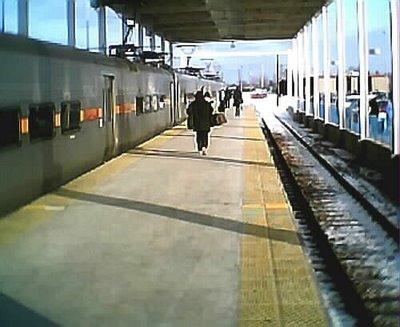
It's still possible to work a streetcar turnaround. Departure for Chicago is at 3.42. At Grandview substation, the South Shore begins to parallel the old New York Central. There was a long freight train going west as we crept around the curve onto the original mainline alignment. Off the curve, wind up the controller, overtake that freight train within two miles and leave it behind. The "genius department" at Michigan City Shops still has its work to do.

The oldest of the South Shore's current fleet of cars are about the same age at which the South Shore rebuilt its steel "arks" as the longer, air-conditioned cars that had to be babied along into the early 1980s. Time passes...
No "add" at Michigan City either, and relatively few Bear fans boarding. The train made an additional stop at 18th Street to set down the Bear fans close to Soldier Field, and I did make the connection with time to spare.

Last month's mental health excursions got me thinking about doing some more train riding, this time with work less time-sensitive than a stack of homework assignments. In browsing the Hiawatha schedules, it all of a sudden occurred to me ... this is an 89 minute timing end to end. In steam days, the Milwaukee bragged on its 85 Minute Train service that made one stop at Glenview. A plan forms. Board the 10.20 am off Chicago. Ride to Milwaukee. Stuff self with Real Chili. Browse some bookshops. Board the 3.00 pm return, get home at a decent hour.
The plan started to unravel at Union Station. The 8.00 Milwaukee, due in at 9.29 to turn as the 10.20, limped in at 9.59. Instead of the cleaners descending on the train to prepare it for the quick turnaround, carmen and mechanics got to work cutting out a bad-ordered coach. The station staff kept us informed of developments, but many of those weren't encouraging. "We've now broken the train apart." "We've brought the replacement coaches over." "We've put the train back together." "The lights aren't working yet." Some passengers left the boarding area, opting to drive instead. Around 11.40, the train is finally ready for boarding, with an 11.58 departure. With no further difficulties, a somewhat more rushed lunch and the original schedule is still possible. There were, however, reasons beyond troubles with the coaches delaying the inbound equipment. The signalling was not working north of the Wisconsin border, requiring the crew to make "know-nothing" stops at permissive signals, proceeding at restricted speed, as well as to dismount and inspect the points at interlockings. Plod, plod. Finally, into Milwaukee at 2 pm. The equipment on the delayed 10.20 is supposed to become the 1.00 pm return to Chicago. Amtrak annulled that train and used the equipment to protect the 3.00 pm trip. I looked at the departure board, noted that there was another departure at 5.45, and modified my plans somewhat. (After having to arrange overnight lodging in Brussels, on short notice, relying on schoolbook German, I'm not going to give up easily on an itinerary.) Walk to the chili parlor. Stuff self. Walk to the bookstore. Spend money. Window-shop the Grand Avenue. Have an E-T-T-S moment thinking about eight stories of Gimbel's where the riverside Borders now is, and eight stories of Boston Store where a much-reduced store occupies the first two floors, the upper stories are lofts, and the bargain basements are gone. I wonder if any of the owners of eighth-floor condos have memories of the toy departments that were once there ...
Back to the station. More troubling developments. The stock of the 1.00 train ordinarily turns as the 3.15 Chicago, arriving at 4.44 with an hour to turn it as the 5.45. Amtrak apparently decided to annul the 3.15, although there would be stock in Chicago for one, rather than contend with the signal troubles and more late running. Thus, the 5.45 return is also annulled, with the 7.30 train to be run, and the possibility of Chicago passengers being able to board a late-running Empire Builder expected around 6.40. I'm thinking about the 2 hour running time with the signal troubles, the prospect of equipment failure, and the risk of missing the 12.40 am scoot to Geneva if everything goes badly. Some people are pooling their money to hire a van and drive to Glenview and downtown...
The worst-case scenario doesn't materialize, fortunately. At about 6.40 there is some noise outside. Not the Builder. It's the 5.08 Chicago. Might the signal troubles be fixed? Station staff advises all passengers to plan to go on the 7.30 as the Builder is still somewhere beyond Columbus.
Board train. Horizon car with leg and foot rests??? Consider possibility of a good run. Recall lap-timer feature on watch. Recall how to start it.
Amtrak 342 Hiawatha Service, Milwaukee-Chicago: 200 - 54557 - 51503 - 54579 - 54563 - 54017 - 54525 - 39. Locomotives 200 and 39 are "Genesis" series diesels. 54-series Horizon coaches have corridor density seating, 51-series have long-distance density with leg and foot rests. 15 degrees Fahrenheit at Milwaukee, clear and dry. The service difficulties have scared away passengers at Mitchell International (four passengers on) and Sturtevant (nobody on or off). Mayfair in the 72nd minute, Pacific Junction in the 75th minute, Noble Street 80, Madison Street 85, stop 85:52.75. Give 'em free rein to 110 and let's do some serious corridor railroading.
The Builder? It pulled into Milwaukee while 342 was loading. We left on time. The Builder left a minute or two later, and passed 342 on Lake Hill as 342 was leaving Mitchell International. (Note to overseas readers: two main tracks lets you do things you can't on double track.) But the signal gremlins apparently were not exorcised by the full moon, as we passed the Builder at the new crossovers north of Caledonia (A-70?) and ran ahead of it the rest of the way into Chicago. The crossovers at Wadsworth worked properly, getting 342 out of the way of a freight train and the 8.05 Chicago. Our arrival at Union Station caused some consternation among the redcaps, who had brought all their electric baggage carts onto track 17 expecting to meet the Builder. The Builder ran through and unloaded on track 28 at 9.15.
Metra back to Geneva was routine. But that was not the end of the weekend.

Geneva, Illinois, 9 am, December 18, habitat of the American dung beetle. Metra's weekend pass makes for a great day rover. I used it to get to Kenosha for the trolleys, and I have used it to shop at bookstores in Printer's Row and Hyde Park, and if I were venturesome enough, those in Evanston as well. There's also a way to go to Blue Island on one line and return on another, and at one time there were some great Polish grocery stores in downtown Blue Island, are they still there?
But today, it's the interurban time machine.
As a matter of pride, I still aim to walk from the Burlington or Milwaukee or North Western to the South Shore in 20 minutes. Today's routing includes a stop at the Union Station bakery, after confirming an on-time departure of the 10.20 Hiawatha (but the chili parlor's Sunday hours are different ...) and a walk east on Adams Street, where, between LaSalle and Clark, I discover a pub called "Elephant and Castle," complete with the figure that later evolved into the bishop (yes, you'd think it's the rook, but the Russian notation for "bishop" begins with "C" as in "Slon," and that's Russian for "elephant," go figure) on the sign. Keep this in mind for future reference. On my first trip to London, I made a point to ride to "Elephant and Castle" because that struck me as such a fine name for a pub. Get there to find a small mall, decorated with a pink elephant, and no food court, and a rather tatty billiards club. There's no place like home, there's no place like home. There's also a rather funky old-style office tower with lots of domes on the northwest corner of Lake and Wabash. Looks like it's been there since I was riding the North Shore, but this is the first time it registered ... lighting didn't work with the cheap digital, but I had the Canon along. Picture of the building later.
The cheap digital did work well enough in "Millennium Station," the new name for the Illinois Central - South Shore Randolph St. Station in the basement of the Prudential Building.

This is looking past the passenger waiting area toward the South Shore ticket office and boarding concourse. There isn't a straight line in the place until one goes through the doors to the South Shore's platforms.
The old Gary, Indiana, New York Central and Baltimore and Ohio joint station is still standing, if somewhat trashed. The U.S. Steel Gary Works continues to smelt iron and cast steel.

But the signal gremlins were at it again ... the 11.59 am Chicago-South Bend was knocked for about 20 minutes owing to signal troubles along the East Chicago bypass and through Gary. I wasn't concerned about missing my return train from South Bend, as the outbound equipment returns as the inbound train, but the signal troubles and the prospect of heavy loads of Chicago Bear fans on the return had me wondering about cutting my connection back to the North Western a bit close.
Not to worry. Through the dunes, the signals were working. The South Shore dispensed with the traditional "cut" at Michigan City Shops, and with no passengers on or off at Hudson Lake, it's a fast ride to the South Bend airport.

In at 3.35, time to disembark and take a few pictures, passengers begin boarding.
It's still possible to work a streetcar turnaround. Departure for Chicago is at 3.42. At Grandview substation, the South Shore begins to parallel the old New York Central. There was a long freight train going west as we crept around the curve onto the original mainline alignment. Off the curve, wind up the controller, overtake that freight train within two miles and leave it behind. The "genius department" at Michigan City Shops still has its work to do.

The oldest of the South Shore's current fleet of cars are about the same age at which the South Shore rebuilt its steel "arks" as the longer, air-conditioned cars that had to be babied along into the early 1980s. Time passes...
No "add" at Michigan City either, and relatively few Bear fans boarding. The train made an additional stop at 18th Street to set down the Bear fans close to Soldier Field, and I did make the connection with time to spare.
17.10.19
NOW GIVE THEM FREE REIN TO 110.
There's nothing quite so durable as a day coach, properly taken care of.
The roomettes might be reconfigured (and there's a lot less plumbing to freeze up this way) but who is going to want to pay the extra fare when there's no food service on offer?
Without additional frequencies and more 110 mph running, what value will the upgraded coaches add on the regional routes?
If you haven’t traveled by train in a while, Amtrak is summoning you to a new level of comfort on the rails.Reclining-seat leg-rest coaches were regular on Western long distance trains long before Amtrak; the Amfleet II cars still cram more seats with less legroom between them than those cars offered, and the the seat pitches on the Horizon cars are still tight by railroad standards. In addition, those cars are generally set up with half the seats facing in each direction, so as to conserve on the work required to turn them at the end of the line.
For coach trips on Midwestern routes, Amtrak is introducing refurbished Horizon cars that make some riders mistakenly think they’re in business class. From the carpets on up to leatherette seats that promise more lumbar support, it’s an overhaul of cars that have been around since the 1980s. “These cars are workhorses. You’ll find them all over the Midwest,” said Amtrak spokesman Marc Magliari.
On overnight runs to the East Coast, Amtrak is now using remodeled coach cars, also dating from the 1980s, with plusher reclining seats, suitable for sleeping on the cheap. Called Amfleet II, they still have legroom that puts airlines to shame. “This is like first class but it’s coach,” said Roger Harris, executive vice president at Amtrak.
For those who book the sleepers, the railroad is getting a new fleet with more room for luggage, softer linens, a sturdier pullout table and more power outlets.
The smallest accommodation, the roomette, no longer has a toilet in the compartment in the new Viewliner II railcars. Amtrak executives said passengers never liked the in-room toilet anyway because it took up precious space and your traveling companion had to scram if you wanted privacy.
The roomettes might be reconfigured (and there's a lot less plumbing to freeze up this way) but who is going to want to pay the extra fare when there's no food service on offer?
Without additional frequencies and more 110 mph running, what value will the upgraded coaches add on the regional routes?
21.5.15
THE VALUE OF FREQUENCY AND CONNECTIVITY.
The gods of the high iron are, to quote David P. Morgan, "a sardonic lot," and sometimes they give us a train wreck for Infrastructure Week. (On a smaller scale, I've been doing my part.) But the derailment of Amtrak 188 has provoked a number of policy discussions, including the value of upgrading the Passenger Rail network, the usefulness of a national Passenger Rail system, and the possibility of privatizing part of Amtrak. We open with a Michael Tomasky observation about service on the Northeast Corridor being no faster today than it was fifty years ago.
And our east coast savants misperceive the Amtrak network beyond the Official Region. Case in point: this New York Times investigation of the difficulties the railroads experience installing and cutting in Positive Train Control. First, a reality check.
They recognize that the General Notice and the Special Instructions have a purpose.
I wonder, though, whether any proposal to privatize the Northeast Corridor and liquidate the rest of Amtrak would pass Congress, Republican enabling of rent-seeking road-builders notwithstanding. The national network permits connections, inconvenient though they often are, between the overnight trains and the corridor trains. The overnight trains are in some places the only option other than a private automobile for intercity travel. And the pundit class in the Official Region might be able to learn something about the mind-set of people in "fly-over country" by riding a train through it.
[The Beatles] did Ed Sullivan’s show and then took a train from New York to Washington DC, where they performed their first live U.S. concert (with a young Al Gore in attendance, fwiw).Perhaps The Pennsylvania Railroad took better care of those sections than Amtrak has. And perhaps The Pennsylvania Railroad laid on a special train for the Beatles. But the best running time in timetables of the era is just over three hours. (That noted, Baltimore to Boston on an Acela involves performance that the Afternoon Zephyr could achieve with good old Electro-Motive diesels, Budd dome coaches, and cab signalled single track.) At the time, I remarked, "[F]aster trains, in much of the country, are possible at much lower outlays than those feared." That is unlikely to be the course of human events. It might help, though, if observers of the national scene would get out of the Official Region and think about Passenger Rail service as a network, involving Amtrak or whatever long distance and regional operators emerge, and the big-city commuter rail operations, as a system. But last Sunday's Fox News Sunday discussion of the derailment and the policy implications reached bipartisan consensus on the possibility of privatizing the Northeast Corridor and liquidating the rest of Amtrak. The panelists appeared to accept the argument that the Northeast Corridor is "profitable". (Yes, on an above-the-wheels basis, something that airlines have trouble doing these days. But not according to generally accepted accounting principles calling for recovery of the capital investments, i.e. infrastructure.) Here's Jim Loomis of Trains and Travel, with the corrective.
I was reading along learning nothing new because I know all there is to know about all that until I came across a line that just staggered me. It wasn’t anything about the group; rather, it was a reference to their “two hour and 15 minute train trip.” Their what?! That trip today, as you know, is at best two hours and 40 minutes, but that is only for the “high-speed” Acela, and in truth that’s only theoretical. It’s usually more like two hours and 55 minutes. That is, if it gets there, as we might add after Tuesday night’s tragedy.
It seemed totally beyond belief that the train ride from New York to Washington could have been faster in 1964 than it was the year I was reading this article. But it was true: I was so floored by this that I called Amtrak and some rail experts I know to check, and it checked out. The reason: aging sections of track that trains have to slow down for.
If you believe the Amtrak accountants (and a lot of people don’t) revenues from the NEC exceed operating costs. But there are a couple of other very relevant factors to consider.Keeping in mind that at the height of its prosperity, The Pennsylvania Railroad's Philadelphia Improvements did not include a re-profiling of Frankford Junction. (And the New Haven Railroad looked at the return on investment to building a straighter line through Connecticut and sold the real estate it had acquired for that purpose to the Connecticut Turnpike Commission.)
For one thing, Amtrak’s long-distance network feeds passengers into Northeast Corridor trains, and if the long-distance network goes away, the Northeast Corridor will lose some share of that business.
Then there’s the matter of Amtrak’s equipment, much of which is old and needs replacing.
But the real issue—the big bull elephant in the room—is the issue of the Northeast Corridor’s infrastructure. By that, I mean the repair, maintenance and upkeep of the 450-or-so miles of tracks and catenary, tunnels and bridges between Boston and Washington. Amtrak estimates that more than fifty billion dollars is needed just to bring everything up to a state of good repair.
So what do you think? Will a prospective buyer take on all that?
And our east coast savants misperceive the Amtrak network beyond the Official Region. Case in point: this New York Times investigation of the difficulties the railroads experience installing and cutting in Positive Train Control. First, a reality check.
Rail safety experts have noted that far less costly upgrades, including an older braking system found on tracks opposite the site of last week’s crash in Philadelphia, would have prevented high-speed derailments like this one. And they say that even with positive train control, not all accidents can be avoided.They refer to intermittent Automatic Train Control, which has been protecting commuters on the Galena Division for nearly 100 years, and to Automatic Train Stop, which is in use elsewhere in the Metra network.
They recognize that the General Notice and the Special Instructions have a purpose.
Despite the current focus on new technology, accident rates for both freight and passenger trains have been dropping in recent years. The overall rate of accidents per million train miles fell to 2.3 in 2014, from 4.1 in 2005, a 44 percent drop, according to statistics compiled by the Federal Railroad Administration.And yet, the article offers this. "Chicago’s commuter rails are not likely to have the safety system for years while comparatively sleepy train service on Amtrak’s Michigan line already has it." That supposedly sleepy Michigan service is the first installment of the Cold Spring Shops "Free Rein to 110" campaign, which envisions incremental upgrades to track, running times, and frequency in preference to electrified bullet trains. In Michigan, there's insufficient frequency, running times east of Dearborn are painfully slow, and Detroit or Pontiac aren't the traffic generators they could be. Moreover, the regional routes out of Chicago are not timetabled in such a way as to connect with other regional routes, or with Metra. (I'm not familiar enough with the expanding California services to commend or carp about connectivity there.)
The safety of passenger railroads, including all 22 commuter rail systems and Amtrak, shows a similar improvement, with overall accident rates falling to 1.3 per million train miles in 2014 from 2.3 per million train miles in 2005. In fact, there were no passenger fatalities involving these railroads in three of the past four years, according to federal data.
I wonder, though, whether any proposal to privatize the Northeast Corridor and liquidate the rest of Amtrak would pass Congress, Republican enabling of rent-seeking road-builders notwithstanding. The national network permits connections, inconvenient though they often are, between the overnight trains and the corridor trains. The overnight trains are in some places the only option other than a private automobile for intercity travel. And the pundit class in the Official Region might be able to learn something about the mind-set of people in "fly-over country" by riding a train through it.
9.4.14
IT'S NOT NECESSARILY HOW FAST THE TRAINS GO.
Progressive Railroading reports on Louisiana Department of Transportation efforts to develop Passenger Rail service between Baton Rouge and New Orleans. The last such service expired before Amtrak: just over two hours to go 80 miles inclusive of four intermediate stops, on the Kansas City Southern.
The Louisiana approach draws lessons from the Hiawatha service.
On a relatively short corridor, there are still opportunities to run the trains fast.
Give the Hiawathas free rein to 110, or 125, and post those 60 minute schedules (Airport at 0:10, Sturtevant at 0:18, Glenview at 0:42, Chicago at 1:00). Is it too much to ask for a bar car?
In Louisiana, start with two or three trips on times more suited for business than for the beginning or the end of the business day (and for Louisiana State games, where the bar car will do a brisk business) on timings faster than those posted by the old Flying Crow, and develop from there.
The Louisiana approach draws lessons from the Hiawatha service.
In 2010, the Wisconsin Department of Transportation (WisDOT) turned away federal high-speed dollars for a Madison-Milwaukee-Chicago high-speed link at the insistence of Wisconsin Gov. Scott Walker. Today, WisDOT instead is focusing on upgrading the Milwaukee-Chicago portion of the corridor, over which Amtrak Hiawatha trains operate. A study is being conducted to determine options for adding three additional round trips, for a total of 10, between the two cities, says [transportation consultant Alan] Tobias.Just as I have been suggesting for years.
“Because the corridor is only 90 miles long, there aren’t a whole lot of opportunities to save a lot of time, so the focus is on increasing frequencies so people have more options,” he says.
On a relatively short corridor, there are still opportunities to run the trains fast.
Many states still are interested in high-speed rail — HNTB [a transportation planning firm] is involved in “quite a few studies across the country” that prove it, says Tobias — but in many regions, an incremental approach might make more sense.Exactly. On the Hiawatha service, four three-car rakes on 92 minute timings with two intermediate stops have bloomed to seven six-car rakes on 89 minute timings (often 84 minutes in practice) with a third intermediate stop, and that with a few stretches of track now good for 79 mph rather than 70. In steam days, The Milwaukee Road was contemplating a 60 minute nonstop timing for Hiawathas.
“We tend to get hung up on that high-speed number, and it is appealing,” says Tobias. “But the best way to go faster is to not go slow. You can make incremental improvements to conventional services that help to improve travel time, increase frequencies and improve reliability, and sometimes that’s just as important, if not more.”
Give the Hiawathas free rein to 110, or 125, and post those 60 minute schedules (Airport at 0:10, Sturtevant at 0:18, Glenview at 0:42, Chicago at 1:00). Is it too much to ask for a bar car?
In Louisiana, start with two or three trips on times more suited for business than for the beginning or the end of the business day (and for Louisiana State games, where the bar car will do a brisk business) on timings faster than those posted by the old Flying Crow, and develop from there.
14.3.17
FREQUENCY, CONNECTIVITY, AND AESTHETICS.
Travel and Trains considers the case for Regional Rail, outside the Amtrak and 403(b) state-supported nexus.
Perhaps, once the additional trains are running, we can think about making them look better.
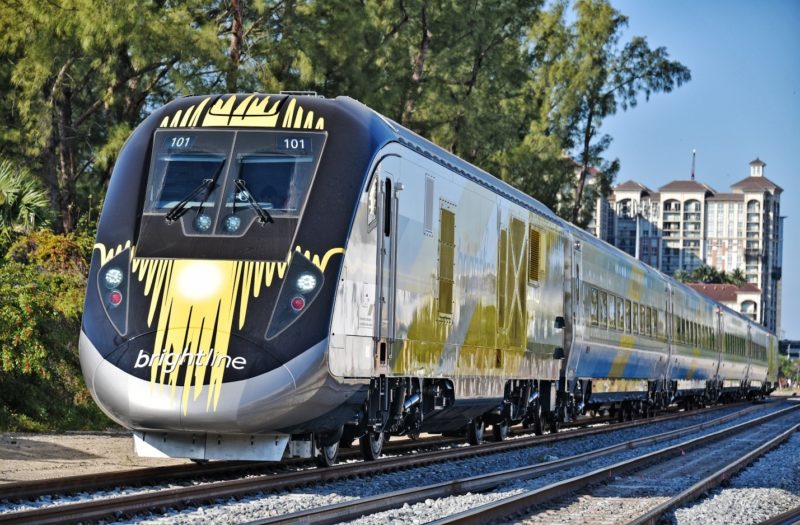
Here's a Brightline set, apparently on rebuilt Florida East Coast tracks.

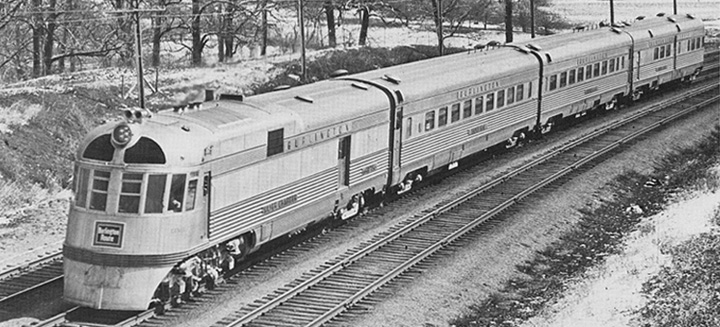
Provide a common profile to the coaches and the power car and you get the Mark Twain Zephyr (which will still win the creature comfort contest with that parlor-cafe-observation.)

Or you could mimic the profile of an Electroliner.
In those days, two flag hoists took care of the pennant races in baseball.
More important than the aesthetics, though, might be interline ticketing. These new train services will have their own fares and ticketing, and on lines where they share tracks with Amtrak, there's the potential for ill will as a new passenger gets on a train with the wrong ticket.
At least we're talking about adding trains to the Passenger Rail network. First get the trains running, then give them free rein to 110 or 124, then tweak the schedules for connectivity, then work on interline ticketing.
In order to have a fighting chance at profitability, passenger trains need passengers. Lots of them. Enough ridership to generate enough revenue to make the enterprise work. As a practical matter, that means any new for-profit passenger service has to operate along high-density corridors or, at the very least, provide a connection between two major markets.Unfortunately, locals aren't crazy about additional passenger trains, because of property values, or something.
It’s encouraging to note that there are a surprising number of corridors that might be able to support profitable passenger trains: Los Angeles-San Francisco; Cleveland-Columbus-Cincinnati; Dallas-Houston; Chicago-St. Louis; Chicago-Minneapolis; Denver-Salt Lake City; Tampa-Orlando; Miami-Orlando; and a few more.
Brightline [commencing service in Southeastern Florida] has run into passionate opposition from some of the residents along the route which already exists for the parent company’s freight operation. The residents claim that Brightline passenger trains running at speeds of 100 miles per hour on existing track will mean the end of there [c.q.] world as they know it.Yes, there are good blue-state liberals in Connecticut who are on board with spending public money on infrastructure, as long as it's not straightening out the New Haven because that might make it harder to get to the yacht club or the tennis courts, and we will continue to follow the opposition of people in Chicago's northern suburbs to improving the Hiawatha service.
Perhaps, once the additional trains are running, we can think about making them look better.
Here's a Brightline set, apparently on rebuilt Florida East Coast tracks.

Unattributed image retrieved from Travel and Trains.
Provide a common profile to the coaches and the power car and you get the Mark Twain Zephyr (which will still win the creature comfort contest with that parlor-cafe-observation.)
Unattributed photograph retrieved from Railway Classics.
Or you could mimic the profile of an Electroliner.
In those days, two flag hoists took care of the pennant races in baseball.
More important than the aesthetics, though, might be interline ticketing. These new train services will have their own fares and ticketing, and on lines where they share tracks with Amtrak, there's the potential for ill will as a new passenger gets on a train with the wrong ticket.
At least we're talking about adding trains to the Passenger Rail network. First get the trains running, then give them free rein to 110 or 124, then tweak the schedules for connectivity, then work on interline ticketing.
16.12.11
I DIDN'T GET TREATED LIKE A TERRORIST.
Joe Sharkey of the New York Times discovers First Class on what passes for the West Coast Champion these days.
Note also, that's the one train remaining from Tampa to anywhere, and it's running on the not-always-dependable CSX south of Washington, D.C. Provide additional frequency, and give those long-distance trains free rein to 90 (or, with the newer equipment coming, 110) and you might have something.
I'm pleased to see additional Establishment reporters making the case for the long-distance passenger train.
Given the length of the trip, I reserved a sleeper compartment. The private sleeper had two comfortable seats that could fold down into a bunk bed and a second bunk that ratcheted toward the ceiling when not in use. It also had a toilet, sink, a work table and an electrical outlet.Note that 500 mile figure: ten hours driving time, with bathroom stops and hotels at the end of the journey, and the aggravation of traffic and the rolling roadblocks the long-distance truckers have become. Or one hour in the air, with another hour or two in security and waiting to board through one door, plus transportation to and from airports. Choosing any rental car is scant compensation for being set down miles away from wherever you want to be.
The fare was $480.80, which included four meals in the adjacent dining car. By comparison, one-way nonstop airline fares on that route ranged from $248 to $301 this week.
“We’re seeing more business travelers, usually on trips of about 500 miles but sometimes even all the way to New York,” said Dennis M. Lyons, an Amtrak product development officer. I ran into him at Union Station in Tampa as I was boarding the Silver Star, which travels about 1,500 miles from Miami to New York, with brief stops at about 20 cities along the way.
The Silver Star, one of more than a dozen of Amtrak’s long-haul trains, carried about 393,000 passengers in 2010, up 6 percent from 2009, Amtrak says.
Before boarding, I was skeptical about this adventure, but I have to report that the trip was more civilized than air travel and worth it this one time. The dining car menus offer a good range of selections. Communal dining — that is, you’re seated at a small table with strangers — was a nice change from the general social alienation of air travel.
Note also, that's the one train remaining from Tampa to anywhere, and it's running on the not-always-dependable CSX south of Washington, D.C. Provide additional frequency, and give those long-distance trains free rein to 90 (or, with the newer equipment coming, 110) and you might have something.
I'm pleased to see additional Establishment reporters making the case for the long-distance passenger train.
18.1.11
GIVE THEM FREE REIN TO 110. A Milwaukee Journal-Sentinel report acknowledges the potential for faster Hiawathas. Proposed running times will be the fastest ever.
Here is the 1941 train schedule.
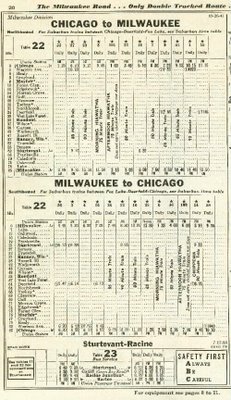
The proposed timings with some infrastructure improvements between the Airport station and the beginning of Metra territory, inclusive of intermediate stops, are encouraging.

The article envisions additional trains.
Here is the 1941 train schedule.
The proposed timings with some infrastructure improvements between the Airport station and the beginning of Metra territory, inclusive of intermediate stops, are encouraging.
The article envisions additional trains.
A separate $12 million federal grant, unaffected by the Milwaukee-to-Madison controversy, is already paying for upgrades to the platform at the Mitchell International Airport station and to the Hiawatha tracks, and the state can use the remaining $2 million from the larger grant for Hiawatha upgrades.That's probably wishful thinking, even the North Shore Line, before Highway 41 was doubled through Racine and Kenosha County, offered hourly service. Journal-Sentinel editors endorse the train, and the Hiawatha line makes Metro's list of most promising rail corridors.
With a third train, the Hiawatha could add an eighth, and perhaps even a ninth, daily round trip, Beitzel said. Hiawatha ridership has grown more than 99% since Amtrak and the state added a seventh round trip in late 2002.
Jay Sorensen, a Shorewood-based transportation consultant, said the Hiawatha attracts an even higher proportion of affluent business riders than his former employer, Midwest Airlines. He says authorities could double the Hiawatha's frequency "and demand would rise to meet that.... They could make it so blindingly convenient, by having trains every half-hour, that people say, 'Why am I driving?'"
15.4.10
RIDING THE RAILS. Some good news from Amtrak. There's more ridership on the midwestern corridor routes.
Give them free rein to 110.
More travelers seeing the benefit of rail over air travel for trips of 500 miles or less, as evidenced by the quote from Amtrak spokesman, Marc Magliari, "While Amtrak considers the car its primary competition, the rail service has captured about 16 percent of the combined air-rail market between Chicago and St. Louis."That the airlines seek to make the boarding process even more unpleasant by charging for use of the in-cabin storage compartments -- so you funnel through that one door even more slowly as the transactions take place is only inducing further substitutions.
Give them free rein to 110.
Subscribe to:
Posts (Atom)