25.2.16

A NEW KIND OF TRIGGER WARNING.

The latest microaggression folly appears to be preemptive.  Here's a story out of the University of Houston, as reported by the house organ for business as usual.
A PowerPoint slide in the presentation, arranged by the president of the central campus’s Faculty Senate, Jonathan Snow, provides suggestions for faculty members to alter their behavior, among other things, when the law takes effect for all four-year public colleges in the state, on August 1.
Without irony:

You may want to
  • Be careful discussing sensitive topics
  • Drop certain topics from your curriculum
  • Not "go there" if you sense anger
  • Limit student access off hours

That happens to be precisely the rubric of issuing trigger warnings or purging microaggressions from your course outlines and your presentations.  This time, though, it's scary.
"It’s a terrible state of affairs," Mr. Snow, a professor of isotope geochemistry, said in an interview with The Chronicle. "It’s an invasion of gun culture into campus life. We are worried that we have to change the way we teach to accommodate this minority of potentially dangerous students."
"Changing the way we teach" to accommodate head cases or snowflakes prone to getting the vapors, though, is de rigueur.  At least there are a few sensible Chronicle subscribers pointing out in the comments that permit holders are vetted, perhaps more thoroughly than professors of isotope geochemistry.

It's all particularly silly, as the Texas law allows private universities can invoke private property rights, and public universities can impose restrictions on carry (as is the case at Northern Illinois University, where Illinois now issues carry permits.)

As far as the fears some of the people interviewed in these stories raise about engaging in self-censorship because the possible (not actual) presence of a revolver is "intimidating," come off it.  It's more likely that the pistol-phobic weenies might learn a little politeness, such as not snarking at gun owners (or evangelicals or home-schoolers or conservatives) and expecting that everyone will go along with it.

For those snarks, after all, are also micro-aggressions, and as such, covered under the new dispensation on campus.
The list includes "race, color, language, national origin, age, marital status, sex, sexual orientation, gender identity, gender expression, disability, religion, height, weight, veteran's status and other social identities and identity markers."
Better for the advocates of concealed carry, whether in Texas or elsewhere, to jam the bias reporting system with complaints about the usual smugness all too many academics demonstrate.

IT'S ALL ABOUT THE TRADEOFFS.

Going on eight years ago, Newsweek got involved in the work-life balance debate then raging in the presidential campaign with an attempt to be provocative about upscale working moms.
Sarah Palin has nothing on Christopher Ruhm. On Thursday, the University of North Carolina, Greenboro, economist published a study showing that kids from high-socioeconomic-status families take a long-term hit when their moms work outside the home—at ages 10 and 11, they perform more poorly on cognitive tests and are also more likely to be overweight than those whose high-status mothers leave the workforce. Children from low-status families, on the other hand, don't seem to suffer as much when their moms work. In fact, many of them do better on the same tests, and they're more fit, than similarly disadvantaged kids with stay-at-home moms.

The findings are surprising, and it's easy to read them as a warning to affluent, educated mothers: if you want the best for your child, don't work. (Conversely, if you're not well-off: get your kid to day care.) But those are dangerous conclusions to draw from the study, and even Ruhm—whose own wife worked while raising their children—says so. "This comes down to a fundamental principle of economics: something has to give. We can't have it all," he says. "But I would never tell anybody what to do or not do about that. I certainly wouldn't tell my wife." So what are women facing a choice between work and home—and those many more for whom work is an economic necessity—supposed to make of these findings?
Like everything else in social science, it's in the details.  Mr Ruhm, who has since moved to the University of Virginia, provides the necessary disclaimers early in the paper.
As with all non-experimental analyses, caution must be taken in providing a causal interpretation to these findings. Compared to most previous research, however, particularly comprehensive controls for non-random selection into maternal employment are included and some effort is made to investigate reverse causation – where child outcomes influence future labor supply. Remaining omitted variables biases may lead to underestimates of the adverse effects and reverse causation is probably more important for low than high SES families. The qualitative pattern of results, however, seems unlikely to be strongly affected.
There's a good deal of prior research on the topic, although a quick check of Google Scholar doesn't turn up any obvious ripostes or extensions.  Here's how Mr Ruhm frames his finding.
The results suggest that maternal employment has small average effects but sharply disparate impacts across categories of youths. Moderate labor supplies is estimated to have no impact or to benefit “disadvantaged” children and long hours, which occur rarely, are unlikely to leave them much worse off. By contrast, maternal job-holding is predicted to have deleterious consequences for “advantaged” adolescents. One reason for the negative effects on cognitive development is probably that these children are removed from enriching home environments when their mothers work. The elevation in obesity is less easily explained, although the data suggest a role for determinants common to both the child and mother (like family eating habits).
The translation into more laymanlike language at Newsweek elaborates, but says the same thing.
Why do mothers' choices have such different effects on kids, depending on their socioeconomic situations? Most likely, says Ruhm, the low-status kids get more intellectual stimulation in day care or with other caretakers, such as grandparents, than they do at home. Meanwhile, the high-status kids may find day care less enriching than being with their highly educated mothers. When these moms go back to work, "you're pulling the [high-status] kids out of these really good home environments," says Ruhm, "and a lot of the alternatives just aren't as good."

The same pattern was true of weight: low-status kids weren't any thinner or fatter depending on what their mothers did, but high-status kids with working moms did have a slightly higher risk of being overweight at 10 or 11. The biggest effect on weight came when mothers were working during their high-status children's school years. Maybe, says Ruhm, these moms didn't have time to cook healthy dinners and after-school snacks: "If you're working a lot and you're eating out and buying fatty food, that could have an effect on obesity later in the child's life." Or maybe those kids were left unsupervised more often, and thus had more opportunities to eat cookies in front of the TV—and fewer opportunities to run around outside. "Parents who are working but want to make sure their kids are supervised and safe will often load up the house with sedentary activities, since they can't always be there to take them to sports or to the park," says Karen Eifler, an associate professor of education at the University of Portland. "Their kids are more likely to have a TV or computer and videogames in their room—and also, the higher your economic status, the more likely you are to have those three machines in your house."
Capital assets matter. Some are physical, some are human, and some are social.

SUMMIT CAUSEN, SUMMIT DUX.

An oldie from Voluntary Xchange suggesting that special advisors to the president get a title other than "tsar."
Obama is the Caesar, cabinet secretaries are analogous to Roman governors, and the Roman dux to our czar.

The part of this that is missing (and I'm not expert enough to add it) is that under the Franks, a dux was named as the local (and loyal) representative of the Frankish king to rule over captive peoples who were still tribal, but while no longer nomadic didn’t really have a fixed geographic region either (for example Chrodobert was dux of the Alemans in the 7th century).
The dux, though, isn't necessarily loyal to the Frankish king, if this year's story arc in Vikings continues.  Rollo has the local authorities crossbow his temporarily not nomadic subjects, but there's likely to be more side-shifting as the season progresses.

THE COMING LIBERTARIAN MOMENT?

The recent death of Justice Scalia turns the upcoming national general election into one more consequential.  Perhaps, though, the best consequence might be less consequence, or less reliance on a one size fits all public policy, whether arrived at through bipartisan consensus or codified by nine votes.

24.2.16

A CASE FOR IMPROVING THE TRAINS.

The most frequently delayed air route in the country is the fifty minute hop between South Bend and Chicago's O'Hare.  That South Bend gets slammed by lake effect snow each winter has a lot to do with it.

A fifty-minute, approximately 100 mile plane trip, however, doesn't make much sense.  And there's the beginning of a better way to get South Bend passengers to O'Hare.


In my experience, it's common for some South Bend air passengers (there are cross-country flights out of the airport) to begin or end their journey on the South Shore Line.

South Bend to O'Hare or Midway, though, is a pokey proposition, with a change from the interurban to the L in downtown Chicago, with several blocks walk or a costly taxi ride, and the L service to the airport is on normal-service, all-stop trains.  That's where Chicago's Cross Rail project ought to come in.

THE CULTURE OF AUTHENTICITY BITES THE PERPETUALLY AGGRIEVED.

Ben Shapiro writes about the unmanning of American politics.  (It's not quite as graphic as a scene from the first episode of Vikings a few nights ago, but it's still not for the faint of heart.)
Normally, the masculinity gap in American politics could be filled by an upstanding man -- a man, yes, but one tied to values, a man who uses the aggressive instinct in pursuit of defending the innocent and punishing the guilty. But the feminist movement has made such men obsolete. Men were simply too dangerous; it was safer to emasculate them. Now men are expected to be betas; the only alphas left are toxic alphas willing to break every taboo and violate every standard.

There's still a space for masculinity in American politics. But thanks to the vacuum of decent men, indecent men rise. Men like Donald Trump.
That's one possibility.  I submit, though, that the cowed betas drew the wrong inference.

That is, the very people who are most shocked! outraged! appalled! at the way Mr Trump carries on are precisely the least capable of objecting.  Forty years of celebrating epater-les-bourgeois behavior and the artistic avant-garde and gender-bending and the pernicious affirmation of thug culture as authentic will do that.  Mr Trump is simply being authentic.  Authentically not politically correct, to be precise.

THOSE ECONOMIC LAWS OF CONSERVATION.

No matter how many times I stress this, there's still reason to reinforce the lesson.  Here's Best of the Web's James Taranto, back before that service went behind a paywall, four years ago, suggesting that population growth has a different effect on wages than changes in labor force participation, specifically by increased female labor force participation.
For the purpose of our point, however, there is a very substantial difference between population growth and participation growth. The latter disrupts the labor market in a way that the former does not.

That's because growth in the population adds consumers as well as workers to the economy. In fact, since every worker is a consumer but not every consumer is a worker, population growth adds more consumers than workers to the economy. More consumers mean more demand for goods and services, and in turn for labor to provide them. That increase in demand countervails the increase in labor supply.

By contrast, women were consumers even before they entered the workforce en masse. And while a two-income household (or two one-income households) may consume more than an old-fashioned household with one breadwinner would, it is counterintuitive to suggest that a woman's entering the workforce, on average, increases the demand for labor as much as or more than it increases the supply.
No, but the nature of production and the nature of consumption change.  And Income = Wages + Interest + Rent + Profit.  Thus, it's irrelevant whether the demand for labor changes differently than the supply of labor in the presence of increased participation, compared with increased population.  What matters is that prices adjust.
To be sure, there are industries that have boomed as the result of the commercialization of what were formerly women's domestic duties. If you told someone in 1960 that you were planning to go into business running a "day-care center," you'd probably get a puzzled look.
Contemporary day care centers might have appropriated many of the gains to participation.  "At the margin, oughtn't the equilibrium working mom be indifferent between staying attached to the labor force (which makes the so-called pay gap go away) or leaving the labor force (which depresses lifetime earnings)."  Likewise, there's a margin to optimize between home cooking or outsourced cooking.  Here's Mr Taranto.  "Another example is prepared food, especially from fast-food restaurants. With Mom and Dad both busy at the office (assuming Dad is around at all), home-cooked meals are far less common than they used to be."

THIS IS THE WAY THE WORLD ENDS.

Taxpayers in Katy, Texas, recently approved a $748m school bond package.  News reports describe the "centerpiece" of the planned capital expenditures as a twelve thousand seat football stadium with an expected first cost of $59m up to about $70m.
The school district's current stadium is 34 years old and was built when there were only three high schools in the area. Now seven schools must share it, and school officials say the time to build a new one is now.

When its game day in Katy, the Tigers can roar with the best of them, but the defending state champs share their aging facility with six other football teams.

School officials say the district has outgrown it. They want voters to approve the sale of bonds to kick off construction of the 14,000-seat stadium.

Asked about critics concerns that is a luxurious, kind-of-out-of-control stadium, John Eberlan, a project committee member, said: "That's not what we've designed -- not at all."

So what is what they've designed?

"We told the architects that what we needed was a stadium that would pass, and so we needed to present to the community a reasonable, conservative construction," Eberlan said.

Surprisingly, one of the plan's loudest critics is in the stands. Cyndi Lawrence is a local tea party leader. Her son -- a junior high school quarterback -- could eventually play in the proposed stadium.

"It comes out to be $5,000, almost $5,000 per seat," Lawrence said. "At 14,000 seats, I have real issue with that price tag. It's outlandish and I think the taxpayers are starting to realize its way too much."
Judge for yourself whether the project is out of control.  The current stadium seats around ten thousand fans.  The new one will include a two-story press box, a Jumbotron, and a field house with space set aside for a future hall of fame.  But it will be shared among several high schools, unlike the 18,000 seat stadium serving Allen, Texas, that has "has a state-of-the-art scoreboard, 42 concession stands, and 192 public toilets."

I may have to look into the curricular offerings at Allen and Katy (the latter is part of the Houston sprawl) to see if students have the option of calculus, astronomy, or advanced physics.

23.2.16

RECLAIMING THE CULTURE.

Here's Paige Lewis, suggesting that traditional Democrat identity politics might be failing.
While Republicans identify voters by issues, Democrats identify voters by race, ethnicity, sex, and sexual preferences.

A suspicious and significant number of black Democrats are quietly leaning toward the Republican Party, and that could possibly defy conventional wisdom’s prognostications. With leading black Republicans in elected office and serving as community leaders, the shift away from the Democrats is largely based on failing schools, lack of economic opportunity, and traditional values, particularly religious beliefs.
Failures, by the way, that seven years of Hope and Change have failed to undo.
While listening to Democrats bemoan the lack of leadership in their party, we also hear them express deep disappointment in Obama’s two-terms in the White House, who undoubtedly set himself up for failure by promising nearly impossible superlative achievements, such as taming the oceans, but also moderate goals of a transparent administration, holding big business responsible for the banking collapse that set off the Great Recession, and his overall lack of ability – or willingness – to solve long-term issues in the rising national debt and the illegal immigration crisis. Mr. Obama kept U.S. troops in Iraq longer than George W. Bush’s exit plan, and he still has not closed Guantanamo Bay as promised. In regards to environmental policy, the sky is still scheduled to fall on January 20, 2017.
It's something that socialists who ordinarily argue with Democrats, but still vote for them, recognize. Thus Katrina VanDen Heuvel.
Across the world we see Japan in decline, China slowing, Europe stagnant at best and Russia and Brazil headed into depression. Whether the United States can remain an island of slow growth in a troubled world remains to be seen.

What Democrats better learn — and learn fast — is that more and more people get that the rules have been rigged for the very few. They see the corrupted politics, the revolving door between Wall Street and Washington. They see that entrenched interests clean up while average Americans get cleaned out. And increasingly, Americans are in revolt against the establishments of both parties that have led us down this road.

That is the power of Sen. Bernie Sanders (I-Vt.) and Donald Trump.
Perhaps she, too, is not seeing the quiet defection of parts of the old rainbow coalition toward especially Mr Trump.
Democratic candidates enjoy a natural demographic advantage in this fall’s elections, as Republicans continue to offend the rising American majority — people of color, young people, single women.

The one challenge for any Democratic candidate is that he or she must be the candidate of fundamental change, not the candidate of continuity. The rules are still rigged; our politics still corrupted. Republicans stand in the way. Democrats will win if their voters come out to vote. And the only way to inspire that is to champion the change we need, not the progress we’ve made.
Ms VanDen Heuvel has elsewhere endorsed Senator Sanders in the primaries, which makes her "not the candidate of continuity" claim particularly amusing.  What is the senator doing, if not advancing the same agenda of nanny-statism, technocracy, and centralized government that has passed as "progressive democracy" for the past 125 years?

A LIBERTARIAN MANIFESTO.

Reason's Nick Gillespie quips that Bernie Sanders and Hillary Clinton Are Running For President of Geritol Nation.  Donald Trump, too.
While Trump and Sanders benefit from a sense of pent-up frustration and social and political lassitude, it's also clear they have no way forward. They are the last gasp of what might be called the long 20th century. They're not harbingers of a new way of looking at the world and reshaping our policies to engage how technology and other forces have changed our economy, our culture, and our politics. They—and their true-believing, ardent fans—are the equivalent of old men yelling at clouds. The anger is real and meaningful and needs to be appreciated, but it hardly provides a path to a future where power has been disrupted, decentralized, and disintermediated.
And the major political parties are more about preserving their perquisites than about securing the blessings of liberty.
Conservatives at least have the excuse of wanting to maintain the status quo or, better yet, return to the status quo of five or 10 or 15 years ago. That's their whole point as an ideological group and it explains their consistent resistance to virtually all forms of social change that give more power to individuals.

Liberals are at least supposed to be less hung up on the past and captivated by efficiency that makes life better for all of us, especially the poor. And yet, as Vanneman points out, their politics seem much more focused on keeping things exactly as they are for a middle- to upper-middle class group.
That's Alan Vanneman, with seven sensible steps that neither major party will take.  Go.  Read.  Understand.

IT'S SO HARD TO GET GOOD HELP.

Thus do the powers that be at Northern Illinois University defend retaining headhunters.
Northern Illinois University has spent almost $1 million in the past five years to hire search firms to help fill a handful of executive-level positions, records show, at a time when other workers complain of not receiving raises and student tuition and fees increased.
The principal beneficiary of the money appears to be Atlanta-based Parker Executive Search, whose efforts at placing college presidents and athletics directors sometimes identify clunkers.  This passage is salient.
The newspaper's report also highlighted the National Collegiate Athletic Association's relationship with Parker, which one sports economist called "the old boys' club." The NCAA used Parker to hire Mark Emmert as its president in 2010. Emmert, who also used Parker when he was president of the University of Washington, then used the firm to fill several other administrative vacancies in the NCAA.
Put another way, there used to be inter-institutional cooperation in identifying rising stars. The executive search firm might be a way of introducing phony objectivity into the searches, but it's still business as usual, complete with compliant faculty committees rubber-stamping the candidates.

It appears as if Northern Illinois University switched consultants as a way of inoculating itself against serial administrators.
NIU previously hired two admissions directors who were found by The Spelman and Johnson Group (SJG), based in Easthampton, Massachusetts. But Brandon Laguna, hired November 2009 at a $98,000 base salary, left the post in September 2011. Then Kimberley Williams got the job, and was paid $106,000, according to NIU records, but left two weeks shy of being in the position for a year.
I don't pay a lot of attention to every deanlet and deanling that was brought in, but why couldn't someone already in Admissions be promoted?
Ted Dabrowski, of the Illinois Policy Institute, a nonpartisan conservative research group, said that using search firms often is a way to go for many organizations such as NIU looking to fill high-level positions.

“The bigger issue is that the university may be spending money that it should actually be using to help bring tuitions down,” Dabrowski said. “If universities are really struggling with their expenses, they need to look at every single expense. And one of those, of course, is if they’re spending lots of money on recruitment alone.”

Despite the money NIU has spent on searches for some staff, other positions that it would retain a firm to help fill are being staffed now by interim leaders. Baker cites the school’s current fiscal challenges – because of the state budget impasse and expectations of losing state aid when the state does adopt a spending plan – as reasons for not pursing permanent replacements.

At the NIU Board of Trustees’ December 2015 meeting, Trustee Cherilyn Murer cautioned that NIU should slow down on its reliance on search firms. She noted that the university’s proximity to Chicago should be helpful in the recruitment process.

“I really encourage us, to the best of our ability, to lessen our dependency on outside search firms,” Murer said. “We’re a large university. We have a lot of skills, a lot of capabilities.”

Phillips told the Daily Chronicle that it isn’t cheaper for the university to search for candidates on its own. The search firms’ expenses include creating ads and announcements for the positions, placing the ads in various job boards and listings, and prescreening applicants, among other efforts. Phillips said NIU doesn’t have resources to do all that.
Somewhere in the records of prior searches are lists of the sites and publications on which the announcements ran, as well as copy (a lot of which ought to be in a standard form that will satisfy scrutiny from the legal department.)  Come off it.

Likewise, perhaps the interim leaders are capable of elevation to permanent positions.

22.2.16

POSTURE LIKE A DEMOCRAT, LIVE LIKE A REPUBLICAN.

Naomi Schaefer Riley (via College Insurrectionparses a recent study of the collegiate mindset.
Sadly for their Marxist professors and Bernie Sanders, it seems these kids, even at the age of 18, have already embraced the middle-class bourgeois values of most other Americans.

According to the survey, 82 percent of freshmen considered it “very important” or “essential” to be “very well off financially.” That’s the highest number since the survey started 50 years ago (when it was only 47 percent) and it’s 5 points higher than just five years ago.

You can chalk up that rise to a stagnant economy, though in 1975 things were not exactly looking rosy. More likely it’s the fact that a lot more kids are going to college now and a higher percentage of them are from working-class backgrounds. They’re staking everything on college boosting them into the upper, or at least the middle, classes.

Whether their college education will accomplish that is another story. Their professors and administrators seem sadly focused on creating the next revolutionary vanguard rather than teaching them how to be better readers and writers.
There's not much learning going on.  Over the weekend, news has reached Cold Spring Shops of the crybullies at Brown University expecting accommodation (the latest euphemism for "deadlines waived") for time spent protesting.  As Katherine Timpf quips,  "Honestly, I don’t see why a social-justice activist would need to spend money on an education anyway . . . it’s so clear that they’re already so much smarter than the rest of us."

OFFICIAL WASHINGTON AT WORK.

The city's department of transportation offers a streetcar primer.
The video’s hero is a young man eager to learn the ropes before a date with a streetcar obsessive. He’s trained by a lovely trolley instructor whose patience, energy, and general transit wisdom makes you wonder how he doesn’t realize she’s the one I really loved all along. Then again, this is a young man who can’t figure out how to ride a streetcar on his own.
The one thing the department got right, concludes the post, was disabling the comments to the video.

18.2.16

PASS THE RED SIGNAL AT RESTRICTED SPEED.

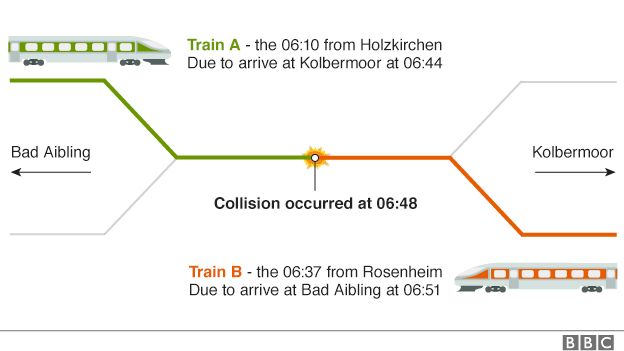
The BBC offers analysis of the Bad Aibling interurban collision.  In short, a dispatcher mistakenly opened the track to the two trains.


Illustration retrieved from BBC.

The diagram appears to be in error, given what I learned in a discussion at The Local Germany.

That is, Train A is due Kolbermoor at 6.44.  Train B is scheduled to leave Kolbermoor at 6.45.

Without any safety appliances, archaic superiority of train rules are sufficient to preclude a crash.  If Train A is the superior train, train B must wait at Kolbermoor for train A.  If train B is the superior train, train A has authority to leave Kolbermoor, with train A obligated to clear for train B at Bad Aibling or, if it is sufficiently late, at a siding closer to Holzkirchen.

Under train order operation, the dispatcher can change the location of the meet.  But he must notify the train that is losing its right first.  With centralized traffic control, he is only able to change the location of the meet once train A has accepted the signal at Bad Aibling by changing the signal at Bad Aibling to STOP, then waiting for the machinery to allow him to clear a signal at Kolbermoor.  Dispatchers and operators refer to this as "running time," the purpose of which is precisely to prevent somebody from doing something rash and creating a collision.  The usual running time interval is five minutes; for the line in question delaying a train at Bad Aibling for the purpose of resetting the meet loses more time than simply letting the train proceed to the meet at Kolbermoor.

What none of the reports explain, thus far, is the way in which the dispatcher overrode whatever safety appliances were in place.
The track was fitted with an automatic braking system. The system is meant to alert the driver when a train is approaching a red light. If the driver does not respond quickly enough, or if the train goes through the red light, the brakes are activated.

Officials say the system had passed safety checks and the investigation did not find evidence of any technical malfunction, pointing to the actions of the controller.
It's possible that the motormen can acknowledge the signal without reducing speed, under some types of train control. I'm still looking for a more complete description of the safety appliances in place on this line.

Two trains, running at track speed on the strength of a manual override?  The actions of the dispatcher and the motormen would astonish a Harry Bedwell or an E. S. Dellinger, whose short stories often involved the Railroad By The Book official tangling with the agent or operator whose corner cutting might have proven fatal, or might have demonstrated a capability for improvisation when it's necessary.
Trains are equipped with layers and layers of safety features. But even the very last available precaution seems to have failed in this case.

Officials say they assume both train drivers also had no visual contact before the crash, as the site is on a bend, so they did not apply the brakes manually.

Analysts say there now appears to be a case for making restrictions on manual overrides to the automatic safety systems tighter.
Every line in the Book of Rules has been written in somebody's blood.  Thus it will be in Germany.

A manual override to automatic safety systems is something not to be taken lightly, which is why procedures to do so involve additional safeguards such as running time, or granting authority to pass the signal at restricted speed.

CONCURRENCE?

Here's the state of the world, as viewed at the beginning of the Obama Administration.  Victor Davis Hanson sees decline and fall.
We are starting to fathom that when times got iffy, we lacked the resilience of the proverbial Joads and the grit of that tough Depression-era generation, and certainly we seem different sorts from those who built and flew B-17s amid the Luftwaffe.

Instead, this generation has gone quite stark raving mad the last seven months, hysterical, and decided we would simply borrow, charge it, print money, blame, accuse—almost anything other than roll up our sleeves, take a cut in our standard of living, pay off what we owe, admit that we lived too high on the hog, and find a certain nobility in shared sacrifice.

So again, here we are reduced to begging the Chinese to subsidize our life-styles, while 500 million of their own poor make their American counterparts of the lower classes here seem like well-heeled grandees.
Here we are, with the front runners for the presidency seeking either to taxing the rich to subsidize business as usual, or to starting a trade war with China.  The common culture hasn't gotten any better, either.
I was always an advocate of informality, of casualness, but now when on a plane, in a restaurant, at Starbucks, I am struck by the rare well-dressed person who does not crowd. How odd the extra-polite woman, who conducts herself with charm and grace at the counter, or the gentleman who opens doors, says excuse me, and whose intelligent conversation I enjoy listening in on—like a dew drop to someone thirsting in the desert. In contrast, when the punk walks by, with radio blaring, mumbling obscenities, flashing the 'I'll kill you' stare,” it all leaves me in depression.

Worse still, on the opposite end of the scale, is the master of the universe who elbows his way onto a plane while he blares on the telephone and blocks the aisle. I feel creepy after walking through an electronics store and seeing some of the video game titles and covers.
The monuments we've destroyed ... it began with Penn Station.  Then it got worse.
We all seem to stare at the rare genius under a semi, working on the transmission, or someone on a catwalk riveting a girder, or a teacher who can wade into an unruly class and say "damn it, we are going to learn calculus one way or another".
From about the same time, Chris Hedges, who likely disagrees with Mr Hanson on almost any area of political economy or foreign policy,also saw the rot.
In decaying societies, politics become theater. The elite, who have hollowed out the democratic system to serve the corporate state, rule through image and presentation. They express indignation at AIG bonuses and empathy with a working class they have spent the last few decades disenfranchising, and make promises to desperate families that they know will never be fulfilled. Once the spotlights go on they read their lines with appropriate emotion. Once the lights go off, they make sure Goldman Sachs and a host of other large corporations have the hundreds of billions of dollars in losses they incurred playing casino capitalism repaid with taxpayer money.
This is before anyone even conceived of Donald J. Trump turning a bad comedy schtick into a presidential run or Hillary Clinton accepted honoraria because Goldman Sachs offered.
We live in an age of moral nihilism. We have trashed our universities, turning them into vocational factories that produce corporate drones and chase after defense-related grants and funding. The humanities, the discipline that forces us to stand back and ask the broad moral questions of meaning and purpose, that challenges the validity of structures, that trains us to be self-reflective and critical of all cultural assumptions, have withered. Our press, which should promote such intellectual and moral questioning, confuses bread and circus with news and refuses to give a voice to critics who challenge not this bonus payment or that bailout but the pernicious superstructure of the corporate state itself. We kneel before a cult of the self, elaborately constructed by the architects of our consumer society, which dismisses compassion, sacrifice for the less fortunate, and honesty. The methods used to attain what we want, we are told by reality television programs, business schools and self-help gurus, are irrelevant. Success, always defined in terms of money and power, is its own justification. The capacity for manipulation is what is most highly prized. And our moral collapse is as terrifying, and as dangerous, as our economic collapse.
I submit that the universities have been complicit in that trashing, with the instrumental students recognizing that too many of the traditional liberal arts have become cults of the self, without job prospects for the majors.  That noted, the moral collapse continues.  There has been no economic recovery, but that's another matter.  Mr Hedges is prescient, however, about where the moral collapse leads.
Our elites are imploding. Their fraud and corruption are slowly being exposed as the disparity between their words and our reality becomes wider and more apparent. The rage that is bubbling up across the country will have to be countered by the elite with less subtle forms of control. But unless we grasp the "societal play of forces that operates beneath the surface of political forms" we will be cursed with a more ruthless form of corporate power, one that does away with artifice and the seduction of a consumer society and instead wields power through naked repression.
We are not yet there, but the ominous signs proliferate.

17.2.16

THE FUNDAMENTALS MATTER.

In the study of economics, it's useful to understand price theory and political economy.  Income theory is a sub-field of applied political economy.  In Quartz, Allison Schrager argues the controversies of income theory make no sense without their historical context.
Two extraordinary things happened to the economics profession in the last 20 years. Economics became the most popular course at many universities and the financial crisis seriously damaged the field’s credibility.

No wonder there’s a major rethink underway on how economics is taught. But the traditional economics taught to undergraduates held up better than many people realize. In order to help today’s students understand the new economic order, we don’t need to throw out existing models. Instead we need to teach more economic history. One of the best parts of my economics education was the two years of economic history I took as an undergraduate. Those courses still influence how I understand the evolution of markets. Most important, they gave me a long-term perspective and awareness that understanding the economy requires both a solid intellectual framework and an openness to new ideas.
News flash: there have been episodes of secular stagnation, capitalist crises of overproduction, and speculative bubbles before.  Without awareness of that past, and knowledge of the controversies over the years, the Keynesian Cross and the Hicks-Hansen synthesis and rational expectations and dynamic stochastic general equilibrium are simply devices for torturing people without the visual-spatial strengths to follow them.
Economics offers a series of parables to help us understand how the economy works. The parables are abstractions that make many simplifying assumptions because the world is too complicated to capture in a simple model. Economists may argue about which assumptions are appropriate or what the best framework is to describe a problem, but this does not mean any one approach is totally wrong. Often it’s not that one model is wrong, it is just applied to the wrong problem.

For instance, most undergraduates are introduced to Keynesian ideas through the IS/LM model. The model describes a snap-shot of an economy in a recession. But it is less useful to understand how an economy develops over the long term or how risk and uncertainty matter. It’s a great model to answer some questions, but terrible for others. But it is not always obvious, even to top economists, when to use what model. That is where the divisions arise.
Without knowledge of exchange, arbitrage, indifference, and opportunity cost, it's even possible to go wrong.

Post-Crash Economics appear to have done so.
Schrager goes on to characterise economics as “a series of parables to help us understand how the economy works.” Firstly, this is an incredibly weak characterisation of economic theory: are we supposed to be enthusiastic that what we’re learning equates to little more than mathematical ‘parables’? Does this not create the type of ‘anything goes’ situation that the scientific method is supposed to prevent? We actually believe and hope that economics as a field is better than this.
It is. The mathematics provides precision to the parables, generating testable implications.  The quickest way to call out a parable is to identify an unexploited gain from trade or a dominant strategy not used or wishful thinking.  That does not preclude considering macroeconomic models other than the Keynesian Cross and its offspring.

ANOTHER ROGUE'S GALLERY.

At the beginning of the year, Minding the Campus called the roll of the worst campus administrators of 2015.

That was before Mount St. Mary hedge fund manager Simon "I'll drown the bunnies, and if you object, I'll drown you too" Newman put his institution on the map.  And at the top of the Ten Worst Colleges for Free Speech list compiled by Greg Lukianoff of the Foundation for Individual Rights in Education.

There is some overlap between the worst administrators and the most repressive colleges and universities, as in Marquette's continued attempt to banish John "Marquette Warrior" McAdams.  (What's the over-under on Marquette sitting on the results of its dismissal hearing until March Madness distracts coverage?)

Sometimes, though, institutions that harbor petty tyrants at least respect the ancient verities.
But because the university did publicly defend the professors' free speech and academic freedom rights, we decided that Yale did not edge out the 10 schools who made the list this year. FIRE will, however, keep a close eye on Yale to see if it lives up to its glowing promises of freedom of speech.

Another university, or, in this case, university system, that did not quite make this year's list, but easily could have, is the University of California (UC) system.
That despite Janet "Big Sis" Napolitano making the administrators list.


Missouri did not make the top ten, either, despite having the poster girl for petty tyrants on faculty.

THE END OF BUSINESS AS USUAL.

Reason's Nick Gillespie identifies the fruits by which we know the Democrats and Republicans.
When you look at what each party has wrought just in the 21st century alone, the only real question is why the Dems or Reps have any members left? Separately, they pushed (among other things) Medicare expansion, Obamacare, No Child Left Behind, massive, unwarranted, and ongoing expansions in food stamps, disability spending, drone srikes, losing wars, immigration deportations, and huge piles of debt. All while demonizing the other party and only getting together every couple of years to work around spending caps that were put in place because they couldn't get it together to write and pass annual budgets.

If we are lucky as a country, we are just a few more debates away from Trump and Sanders pushing party identification into the single digits—they are the only two candidates who are throwing off any sort of energy and interest but they are also genuinely unpopular with anyone other than primary voters, who already represent a dead-end mind-set in American politics. By presenting unapologetic, cartoon versions of what their parties-of-convenience stand for, they are revealing to all of us that the Democratic and Republican parties need to reboot themselves every bit as much as the Spider-Man movie franchise does.
Looking ahead, though, Mr Gillespie might still be seeing too rosy a future.
As currently constituted, neither party can reliably represent a country that is getting more and more socially liberal and fiscally conservative. In a word, a country that is increasingly libertarian in what it demands from government: Less intrusion into everyday life and better spending of tax dollars. If and when the parties decide they are serious about changing their platforms to better reflect more Americans, each might consider moving toward that libertarian center not for ideological reasons but for pragmatic ones.
Perhaps, but Mr Trump and Mr Sanders are filling beer halls with constituents who expect to live at the expense of others (Mexico pays for the wall!  Universal free college!) and accordingly giving rent seekers yuge opportunities to continue to suck at the public teat.

In a related column, Mr Gillespie seems to get this.
If it’s true that Trump and Sanders are the only candidates throwing off sparks, it’s worth underscoring that they are not genuinely popular among Americans writ large. Rather, they are generating intense responses among the shrinking ranks of partisans and dead-enders who respond to what they think are purer and purer distillations of what the parties really should stand for. As fewer and fewer of us choose to identify as Republicans and Democrats, those that still do will get harder- and harder-core until the number of true believers approaches zero.
The best possible outcome, dear reader, might well be continued gridlock.

16.2.16

CREATING A LAP.

The first maxim of safe railroad operation is that two trains not be allowed to occupy the same section of track at the same time.  There are all sorts of ways to ensure this, the simplest of which involves the use of a timetable, and the only necessary technology is synchronized watches.  Let us review the purpose of the timetable.  "Note, in railroading, that a timetable does not REQUIRE a train to be at a station at the specified time. Rather, it means that the train will not be BEYOND that station BEFORE that time."

In the course of reporting on the Bad Aibling interurban collision, I became involved in an instructive (now closed) discussion on this article, in the course of which a participant cited the normal timetable. The wreck occurred during the morning rush hour.
The 6:37 train from Rosenheim to Holzkirchen arrives Kolbermoor 6:40 and should depart 6:45 AFTER the 6:10 Holzkirchen to Rosenheim train arrives Kolbermoor 6:44.

The Rosenheim bound train was delayed but unfortunately the Holzkirchen bound train did not wait and departed on time.
Here's where the failure of the signalling system, whether by accident, or by deliberate error, arises.

Under normal procedure, the Holzkirchen train will not be BEYOND Kolbermoor before 6:45.

Under North American timetable and train order operation, the dispatcher can hold the Rosenheim train at Bad Aibling for the Holzkirchen train.  With centralized traffic control, it's even easier.  Provided the Rosenheim train has not yet accepted the signal at Bad Aibling, he simply takes away the Bad Aibling to Kolbermoor section, and clears the route from Kolbermoor into an open track at Bad Aibling.  The circuitry prevents conflicting routes to be set.

And yet, two trains occupied conflicting routes. Investigators are now alleging human error.
An investigation has now been opened into the actions of the controller who was in charge of the stretch of track in Bad Aibling south-east of Munich on the day of the fatal crash.

If the controller “had acted according to the rules and according to his duty, the collision would not have happened,” lead prosecutor Wolfgang Giese said in press conference held on Tuesday afternoon.

"There is no evidence of technical problems... Our investigation shows that this was human error with catastrophic consequences," he added.
Authority to run Rosenheim to Bad Aibling laps authority to run Bad Aibling to Rosenheim.  Broken trains and dead people.  It's a lesson as old as railroading.  The Crusty Chief Dispatcher continues to teach it.

A CONSERVATIVE POSTURE TOWARD HIGHER EDUCATION.

In Glock and Man at Mount St. Mary's, Daniel J. Flynn correctly characterizes embattled president Simon "I'll drown the bunnies, and the tenured faculty too" Newman as a college president in over his big head.
A true liberal arts education in what Matthew Arnold described as “the best which has been thought and said” equips young people with the tools to govern their souls and their society. This instruction, once dubbed the education fit for a king, must fit for everybody in a nation governed by millions of people, as Mortimer Adler pointed out more than a half century ago. The world needs educated graduates who know how to think rather than trained ones told what to think.

The Nicomachean Ethics and Measure for Measure do a better job in instructing souls and citizens than computer programming. We need the latter; more so do computer programmers need Aristotle and Shakespeare. Their eternal quality beats the ephemeral education the big man on campus pushes in Emmitsburg, Maryland.

Capitalists err in running businesses like charities, donating shareholder money to causes and campaigns. A related mistake sees capitalists running charities like businesses. Tenure, shared governance, freedom of speech, and other features of campus life make it impossible for a college president to govern, at least for long, as a dictatorial CEO. And if he does, he opens the school to expensive lawsuits, ridicule in national newspapers, and the ensuing scorn from prospective students, quality faculty, and donors.
Precisely.

THIS IS WHAT MAKING PROGRESS LOOKS LIKE.

In the New York Post, Kyle Smith takes stock of the fractured polity.
As President Obama prepares to carefully fasten his bike helmet and ride off into the sunset, how do we know his presidency has been a total failure?

Because even liberals say so. The famous thrill going up their legs (in the words of Chris Matthews) is now forming a cold, embarrassing puddle in their shoes. There’s a reason why Hillary Clinton, campaigning as the guarantor of Obama’s third term, just got smoked by a kooky geriatric. Bernie Sanders is catching on in part because he tacitly concedes that Obama has been a dud.

“We voted for hope and change, Mr. President, but what did we get?” asks progressive radio host Bill Press, a longtime voice of the left on CNN shows such as “Crossfire,” in his new book “Buyer’s Remorse: How Obama Let Progressives Down” (Threshold Editions).

The answers are saddening: “stagnant wages, a struggling middle class, rising income inequality and a diminished social safety net.”
Ouch.

And yes, in the most recent Democratic debate, it still sounded like the candidates were running against fifteen years of Herbert Hoover.

URBAN OR SUBURBAN EMERGENCE. NONCONVEXITIES COME LATER.

Political economy is all about trade-offs.  That's even the case when something happens that appears to be for the good, as this children's primer on urban evolution from Place Makers notes.
I was pondering yet again the many challenges we presently face that are rooted in our urban renaissance, and how vexing it is that something generally perceived as a net-positive can still carry with it no shortage of downsides and externalities.

In short, no scheme, no policy, no market trend, no infrastructure deployed will correct everything absolutely. They all contribute. Hopefully positively, but always incrementally. And always, it seems, with some element of negative consequence or concurrence caught up in their wake.
To wit, the peace dividend that created The America That Worked(TM).
Fortunately…
We could expand outward! Glorious greenfields awaited!

Unfortunately…
That land was far from everyone’s job. And friends. And stores. And churches. No one wanted to be so far away.

Fortunately…
We created majestic freeways to whisk our young men and their families around, as easy as those short walks and trolley rides of yesteryear!

Unfortunately…
Every new resident and the car they brought with them made that experience incrementally worse for everyone.

Fortunately…
With all our newfound prosperity, we could finally clean up our slummy cities with new, public housing!

Unfortunately…
Urban renewal’s destruction of struggling but functioning neighborhoods also destroyed functioning micro economies, severed social support networks, and further concentrated poverty.
Some of that exurban expansion was strictly emergent, and some of it was at the urging of Wise Experts.  Similarly, emergence played a big role in the exodus from the cities, but expertise gave us urban renewal.

There's a recent Strong Towns post identifying potentially serious difficulties with the Suburban Experiment that gives insufficient credence to emergence.
There are two differences between the Traditional Development Pattern and the Suburban Experiment that we find significant and critical. First, in the traditional approach, development happens incrementally over time. Things start small and then mature in phases. For the suburban approach, we tend to work in large steps with grand designs.

Economies of scale is a modern ethic that, combined with our perceived affluence, supersedes the more bootstrapping mindset of incrementalism.

The second difference is closely related. With the traditional approach, all development is on a continuum of improvement. It starts incremental and it is always seeking the energy to move to the next level of advancement. With our post-War Suburban Experiment, we build everything to a finished state. No additional improvement is anticipated or even desired.

That shift in mindset is really important. When your ethic is to build things to a finished state, the tendency is to demand the highest quality you can hope to experience. That means that even cities that are struggling financially are often weighed down by regulation and bureaucracy that ensures "quality construction". Lost is the notion of bootstrapping -- doing what you can with what you have available -- and with it the notion of widespread upward mobility.
The cookie-cutter aspect of suburban development, however, is itself an emerged phenomenon.  Yes, any subdivision is predictably homogeneous these days, and any major crossroad, whether in New Hampshire or New Mexico, looks a lot like any other major crossroad.  But the idea of a small number of similar houses began with Levittown, the McDonald's idea began with one California drive-in that bought a lot of milk-shake makers, and Best Western Motels simply offered comparable accommodations among a number of otherwise independent motelliers, long before Holiday Inn or Red Roof Inn came up with standard designs.

Perhaps the installed bases of standardized housing or standardized food or standardized lodging bring with them impediments to further improvement.  On the other hand, aren't the downwardly mobile crossroads and suburbs saddled with earlier iterations of what looked like standard practice?

Thus there will be incremental improvement, and occasionally, those increments will prove disruptive.

15.2.16

AVOID THE STRAIN, TAKE THE TRAIN.

The United Kingdom generalizes the Flying Scotsman.
The UK has announced plans for a north to south high speed rail network this week, which will in effect bring the passenger door-to-door more quickly, easily and comfortably than any airline can currently manage. The proposed rail links will run between London and Glasgow and Edinburgh, with stops on the way for Birmingham and Manchester. Travel times from London to Scotland will be cut to two hours 16 minutes, with travel times between London and Manchester cut to just over an hour.
The announcement dates to the fall of 2009. Work on the project is in progress in a number of places, including along the Great Western main line between Reading and Paddington Station.  The faster trains will call at Heathrow Airport, the better to offer international passengers a fast train option.

THERE WAS A CHIEF INSPIRATION OFFICER.

The expense-preference behavior at Northern Illinois University goes on and on and on.


In a previous post, I noted first class upgrades for consultants, but was not able to document the chief inspiration officer.

There was one, and she, too, is making restitution.
Former affiliate employee Magaly Rodriguez owes $2,793.63 in travel expenses which NIU President Doug Baker said was reimbursed inappropriately by NIU, according to an NIU news release Wednesday.

Rodriguez was hired in 2013 as a change specialist functioning as a consultant until May 16, 2014. In May, Rodgriguez’ title was changed to affiliate employee which disqualified her for the consultant work-related expense coverage, said NIU Spokesperson Joe King.

Rodriguez spent $1,604.80 on airfare, $1,128.15 on airport transportation and $60.68 on meals, while traveling between Minnetonka, Minn., O’Hare International Airport and DeKalb, according to a Jan. 20 Divison of Finance and Administration letter sent to Rodriguez.
Just what knowledge did this person possess that somebody local couldn't provide?
As a change specialist, Rodriguez provided consulting services for NIU in December 2013 which included conducting workshops for deans, the senior cabinet and associate provosts and directors. As an affiliate employee, Rodriguez hosted workshops for academic departments and advised senior leaders, King said. Rodriguez works for Volentum, an enterprise management consulting company that teaches problem-solving methods, where she created methods of building communication and a sense of community, according to Volentum’s website.

“All of her work was focused on helping the university create a climate that is open to change where the university can approach change in a positive and productive way so that we can adapt and excel in a very dynamic time,” King said.

Rodriguez’ improper reimbursement was one of the reasons Baker “implemented an examination and overhaul of the longstanding financial procedures in the president’s office,” according to the news release.
Translation: those deanlets and deanlings have to justify the oxygen they use, and meeting and retreating and issuing statements in Dilbert-issue corporate speak is more impressive when someone from elsewhere is present.

Where is the faculty leadership to point out that these administrative usurpations are disrupting the community of scholarship, and not in a good way?

WRECKAGE OR RENEWAL?

Start with signs of the wreckage.  Charles Murray, who has written extensively about social polarization and cultural rot, summarizes.
The new upper class consists of the people who shape the country’s economy, politics and culture. The new lower class consists of people who have dropped out of some of the most basic institutions of American civic culture, especially work and marriage. Both of these new classes have repudiated the American creed in practice, whatever lip service they may still pay to it.
The establishment, whatever its political leanings, becomes a cohort of people who believe they have been born booted and spurred to saddle and ride the people.
The members of the new upper class are seldom attracted to the films, TV shows and music that are most popular in mainstream America. They have a distinctive culture in the food they eat, the way they take care of their health, their child-rearing practices, the vacations they take, the books they read, the websites they visit and their taste in beer. You name it, the new upper class has its own way of doing it.

Another characteristic of the new upper class—and something new under the American sun—is their easy acceptance of being members of an upper class and their condescension toward ordinary Americans. Try using “redneck” in a conversation with your highly educated friends and see if it triggers any of the nervousness that accompanies other ethnic slurs. Refer to “flyover country” and consider the implications when no one asks, “What does that mean?” Or I can send you to chat with a friend in Washington, D.C., who bought a weekend place in West Virginia. He will tell you about the contempt for his new neighbors that he has encountered in the elite precincts of the nation’s capital.

For its part, mainstream America is fully aware of this condescension and contempt and is understandably irritated by it.
Barbara Burt, observing the same events, from a different perspective, offers "ten reasons the [Democrat] establishment missed the boat."  Although she seems disappointment that Barack Hussein Obama was unable to fundamentally transform the United States into another case of Eurosclerosis, some of her points harmonize with Mr Murray's observations.
If those in the one percent live a comfortable, safe life, they don’t feel the frustration experienced by the less lucky when dealing with the daily hassles of hamstrung government. Underfunded schools? Lousy transportation alternatives? Environmental hazards? Crumbling infrastructure? Ineffective (or worse) policing? Government at all levels seems unable to provide services that communities require to thrive. And because the problems have grown so big and feel so unsurmountable, incremental change—as a process within the current system—appears impossibly slow and easily diverted. To use a favorite phrase of the elite, what’s needed is “disruption” of that failed system. Well, out in the land, there’s a definite appetite for disruption, born out of despair.
Disruption, as I understand it, is emergent and not likely to be advanced, whether by the suits expecting it or by the commissars willing it, through sheer force of will.

13.2.16

THE SAFE COURSE MUST BE TAKEN.

On most railroads with timetabled passenger trains using the same track in both directions, there is a clear protocol by which one train waits at the end of a side track to clear the movement of another train.

Here is the protocol being observed on the Wellington to Johnsonville section of New Zealand's railroads.  This branch looks like William Jackson Palmer hired John I. Beggs to build the tracks.


Khandallah Road Station, 6 January 2000.

Note that the signal at the far end of the platform is red.  This is a STOP AND STAY aspect, and it will clear to permit the train I'm on to descend the steep grade into Wellington station.  The signal at the opposite side of the approaching train is also STOP AND STAY.  Modern signal installations generally set all signals governing opposing movements either to STOP OR STAY, if at the end of multiple track, or to STOP, in case a train runs past the STOP AND STAY and enters the single track.  That (improper) entrance will also set signals facing the approaching train to STOP.  An investigation is embarrassing to the carrier, and some crew members will be disciplined, but that's better than broken trains and dead people.

Here we see the same protocol at work on the South Shore Line.


Sheridan siding, Michigan City, Indiana, 13 August 1966.

The approaching train is leaving the single track that runs through the middle of Michigan City streets.  There are two levels of protection at work here, the red signal and a line in the employee timetable establishing a meet here.  Recent South Shore schedules have moved many of the scheduled meets elsewhere, because of heavy passenger loadings affecting the timekeeping, particularly of rush-hour trains.

The latest news out of Germany suggests that in the Bad Aibling collision, the dispatcher and the train crews neglected to take the safe course -- with one of the trains running four minutes late?
Investigators currently believe that the controller mistakenly allowed both trains to enter the single stretch of track at the same time.

While a warning signal is supposed to be set off in such circumstances, it is possible to circumvent it.

If this is how events took place it would seem the controller only noticed his mistake at the last second - as indicated by the use of the emergency call.
There's more in the Süddeutsche Zeitung, auf Deutsch.

History rhymes.  In the fatal Speedrail collision in 1950, the southbound train accepted a permissive signal, and the motorman of the northbound train, also president of the railroad, ordered an employee to line his train for the main line, against a signal that turned out afterwards to be a stop signal.  At Bad Aibling, it appears that the dispatcher allowed a train to pass a stop signal, only to attempt to reverse his error later.  In both collisions, curves reduced the line of sight for the operators.

TO PRESIDENT NEWMAN: NUTS!

Inside Higher Ed reports that Mount St. Mary College in Maryland has reinstated faculty members who dared call out their president, a corporate raider who compared struggling students to expendable bunnies.  Faculty members, commendably, are rediscovering who the stewards of the college are.
University reverses course on action that outraged many in academe, but also says board still backs controversial president. Professors aren't ready to return. UPDATE: Faculty sends letter to president, asking him to resign by Monday.
The details:
Whether the tensions will be resolved remains unclear. Inside Higher Ed reached Thane Naberhaus, one of the faculty members who was fired this week, despite having tenure, and asked him if he was planning to return. His email response: "Hell no."
A man that eloquent deserves to be reinforced.
He elaborated: "I'll refuse to be reinstated until Newman is gone and some others are gone."

Ed Egan is the adviser to the student newspaper, and is the other faculty member who was fired and who the university said has now been reinstated. In an interview, he said Newman called him and told him he would be reinstated in part because the Roman Catholic Church has declared a Year of Mercy.

Egan said he was uncertain about returning and that he was bothered by the statement -- and went to the faculty meeting to tell his colleagues why. Egan said he told them that the president's statement was "as if I had done something wrong and was in need of his mercy." In fact, the reinstatement is an attempt to "placate" the campus so that it will not consider all the issues that go beyond the two professors.

"Reinstating me does not make these other problems go away, and Simon Newman needs to show mercy on Mount St. Mary's and resign," Egan said. He added that he is consulting lawyers on his next moves.
A faculty vote of no confidence in Mr Newman might be more significant than a similar vote taken at Harvard, where president Lawrence Summers made an accurate if inartful statement about faculty capabilities, one that did not square with the preconceptions of the identity politics militants.  Here, a president with no understanding of academic culture has broken a fundamental premise about how a university operates, one that goes beyond free speech and due process.  Where are the faculty members at perhaps better known universities, perhaps with broader recognition as scholars, also reclaiming curricular policy from serial administrators and the swarms of deanlets and deanlings who harass the faculty and eat up all the pay raises?

THE ROT BEGINS EARLIER.

Catherine Rampell of the Washington Post, no member of the vast right wing conspiracy, offers evidence of illiberal lefty militancy.  "Today’s students are indeed both more left wing and more openly hostile to free speech than earlier generations of collegians."  How bad is it?  Liberating tolerance (more accurately, illiberal intolerance) is as routine as skipping morning classes.
According to the findings, the current crop of freshmen can lay claim to multiple superlatives. Among them: most willing to shut down speech they find offensive.

About 71 percent of freshmen surveyed in the fall said they agreed with the statement that “colleges should prohibit racist/sexist speech on campus.” This question has been asked on and off for a couple of decades, and 2015 logged the highest percentage of positive responses on record. For comparison, the share in the early 1990s hovered around 60 percent; also high, but not as high as today.
Yes, dear reader, this is a survey of matriculants at 200 institutions of higher learning leftist indoctrination.  The matriculants appear to be self-selected to be reinforced in their prejudices.
The highest share of students since 1973 now consider themselves left of center. And the highest share of college freshmen ever (or at least since this question was first asked in 1970) call themselves “far left.”
Their brain-brothers, apparently, would rather intimidate Ms Rampell than debate her.
I’m hardly an arch-conservative, and whenever I write things that college students disagree with, I get a lot of email demanding retraction, recantation, apology, prostration. Some younger readers — not all that much younger than I, mind you — have accused my writing of “taking away” both their voices and their agency, as if free speech were zero-sum.
These students, however, have lost the good of the intellect before they receive the fat envelope from the conditioning station of choice.
Remember that these survey questions were asked of newly matriculated college freshmen. That is, students are setting foot on campus already more liberal, more protest-happy and more amenable to speech restrictions than their predecessors.

Which suggests that colleges themselves are not wholly responsible for rising liberal and illiberal tendencies on campus — even if they do sometimes aid and abet both trends.
Perhaps it's a different grade of Distressed Material from the matriculant who can't read or figure at the sixth grade level, but Distressed Material it still is.

12.2.16

THE VALUE OF OTHERING.

That's not who we are.  "It’s a way to call a policy, idea, or person un-American without using that harsh term.  It subtly conveys what would otherwise be an incendiary claim." Take away the polemics, dear reader, and you have a useful explanation of the value of a standard, whether we are speaking of what it means to buy into America, or what academic integrity is, or what Christian values are, or what operating a railroad safely involves.

KICKED WHERE IT HURTS.

Opinion-mongers of all stripes appear to be in agreement that this year's election is all about populist rage, although the world-view of the platform the monger occupies predicts the way in which the rage takes form.  Then there's John Kass.
What I'm enjoying now is a bit subtle, taking place in the shadows, where the establishment lords are quivering just a bit. And I plan on savoring it for a while, because finally both sides, Democrats and Republicans, are getting what they deserve.

The national Combine sends out its meat puppets on TV to preach the talking points about who is electable and who is not and who is an embarrassment and who is not. But about half the voters in each party loathe the establishment candidates. They've had enough.

The middle-aged are tired of being afraid for their jobs, or working part-time jobs, and they're angry. And the young, raised to expect the world, don't see much of a future.

Sanders promises a revolution. Trump and Cruz promise battle. They're the ones with the energy. They're the ones telling voters they'll put the boots to the status quo. And the others? They're just holding on.
This is not the year, however, to conduct another advance auction of stolen goods.
The establishment doesn't think that way. Their parties are a gathering of interests, formed to use government to protect what they have, to take from others, to increase their slice. The candidates are chosen like fine horseflesh, the idea being to find the one you can ride to the gold.

Voters know this now. There should be no doubt except among the thickest partisan meat puppets.

They know Hillary is of the establishment, and they know Jeb! and the others are of the establishment, and they're tired. They've watched the banks that are too big to fail get federal bailouts after the economic catastrophe, and none of the big fish went to prison. They've seen their jobs shipped overseas, and they're told that their anger isn't only irrational but bothersome.
Just under nine months to go.

IT'S OBAMA'S WORLD.

The last two Democrat hopefuls, and the rest of us, are living in it.
The loathsome and reprehensible caricature of America foisted upon its citizenry by Sanders and Clinton — a country with undeniably serious problems and challenges that is still the last great hope of Earth and a place Americans should and mostly do still feel grateful to have as their unique birthright — is another sign that we have a great many lessons we’re going to have to learn all over again.

In the 1980s, Democrats found themselves forced to battle the impression that they were anti-American.
In the 1980s, Donks had to distinguish themselves from Jimmy Carter and confront Morning in America, which did include an economic recovery and hints of disarray in the Evil Empire.

The correlation of forces is less favorable today.

IF YOU WANT TO BE GOOD TO THE ENVIRONMENT, CLUSTER IN CITIES.

Or why the Lorax went wrong, even without failing to replant the Truffula trees.  The authors show their work.

11.2.16

A TRAIN IS SUPERIOR TO ANOTHER TRAIN BY RIGHT, CLASS, OR DIRECTION.

Why was one of the interurbans involved in the Bad Aibling collision not in a designated siding?
It’s believed the trains collided at or close to the track speed of about 62 mph. Neither engineer may have seen the other on the curved track until just before the moment of impact; both were killed, along with at least eight other people, and dozens were injured. “Black boxes” have been recovered and are being analyzed.

The eastbound train was to have been held at Bad Aibling, where there’s a passing track, until the westbound train arrived. Instead, the two trains hit about a mile east of town. Why did the eastbound engineer not know to wait for opposing traffic?

Moreover, both trains were fitted with PZB90 cab signaling, designed to sound an alarm and bring trains to a stop if there’s a danger of collision. How could the eastbound train proceed past a red signal without triggering automatic braking?
There will be a lot of speculation about mechanical failure.  Sixty years after Fail-Safe, can a capacitor failure still lead to a train wreck?

More troubling, though, is that "was to have been held" locution.  Recall, from our primer on positive train control, what the role of a timetable (which designates superiority by class and direction) is.
Note, in railroading, that a timetable does not REQUIRE a train to be at a station at the specified time.  Rather, it means that the train will not be BEYOND that station BEFORE that time.
Thus, if the Bad Aibling meet is stipulated in the timetable, and westbound trains are superior to eastward trains, the eastbound must wait.  No further signalling is required.  If the westbound is seriously delayed, the train dispatcher (I don't know the German equivalent job title) can change the meeting siding in a number of ways.  And if the dispatcher set up a meet on the fly, which is possible with centralized traffic control, the machinery will not permit conflicting routes to be set.  Thus one train must see a stop signal.

Curiouser and curiouser.

AN EPITAPH FOR OUR TIMES.

Pronounced by Derek Hunter.
The [Democrat] party underestimated just how radical its base had become. After decades of fostering discontent with American society as a weapon against Republicans, the monster the party created has turned against it.
The argument extends directly to the emergence of unteachable crybullies in higher education.

A UNIVERSITY IS NOT A JUMPED UP TRADE SCHOOL OR A CONDITIONING STATION FOR DOCILE CITIZENS.

That's "Underground Grammarian" Richard Mitchell, who I have previously cited at greater length.
Former Mount St. Mary philosopher John Schwenkler makes the same point, suggesting that neither is a university a place for drowning bunnies.
The Mount, though, is supposed to be different. It’s supposed to be a community, a place where administrators aren’t bosses, students aren’t customers, and faculty aren’t employees. Simon Newman, with his MBA and previous stint at Bain Capital, seems not to care about this.
Neither do a lot of deanlets and deanlings, hedge fund experience or not. Nor, sometimes, do trendy and transgressive faculty.  But the good of the intellect is something that ought to be cultivated.
In the time I taught at Mount St. Mary’s I encountered many students who would likely have been better off waiting a few years before going to college, or maybe not going at all. I also encountered many more who struggled at various times, and as freshmen especially, before turning around to become wonderful students and exemplary adults. Many such students have spoken out in the wake of Newman’s callous comments, recalling what it was like to be a struggling college student, and the way that faculty and administrators at the Mount reached out to help them work through this. Large secular universities, like the one where I teach now, usually aren’t able to do this sort of thing, at least not in such a focused way. Having access to this level of support and understanding is one of the things that makes going to a small Catholic college arguably worth the bill.
Yes, perhaps the common schools ought to be doing a better job, and the high schools that turn out a lot of Distressed Material ought be identified and shamed and sent the bill.  And the common culture ought be less trashy.  And still, running Mount St. Mary, or Marquette, or Northern Illinois more like a business surely produces the miserable people, the people who have lost the good of the intellect.