Showing posts sorted by date for query 110 mph Hiawatha. Sort by relevance Show all posts
Showing posts sorted by date for query 110 mph Hiawatha. Sort by relevance Show all posts
31.1.22
NEW LIFE FOR THE ROODHOUSE DOODLEBUG LINE?
Once upon a time, the Gulf Mobile and Ohio Railroad got to Kansas City. That was close to a withered arm of the property, originally built by Baltimore and Ohio subsidiary Chicago and Alton in order to get a better division of the revenue. Wabash similarly built to Kansas City and Omaha with something similar in mind, which is why you see Norfolk Southern there. In no case were the railroads that passed through Kansas City en route to Chicago (I'm looking at you, Santa Fe) willing to short-haul themselves to the benefit of Wabash or the Alton.


12.4.21
RETHINKING AMTRAK.
The carrier is going on fifty years old, and the average age of its coaching stock is now higher than that of the stock it acquired from the participating railroads. It's still a political football, and Politico's Michael Grunwald takes the occasion of the latest pork-barrel proposal to hit Capitol Hill to get a few kicks in. "Is there any reason for Amtrak executives to propose a new route from New York City to President Biden’s beloved birthplace of Scranton, Pa., other than the obvious reason?" Strictly speaking, that project ought to be the purview of New Jersey Transit, but returning trains to the old Lackawanna Cutoff has long been on peoples' minds.
It might help if people would think about the value of dependable train service in other metropolitan corridors.
So before Amtrak fantasizes about new lines to Pueblo, Colo., and Eau Claire, Wis., it ought to focus on upgrading its most important and successful line, the Northeast Corridor between Boston and Washington, D.C.The Front Range (Cheyenne - Denver - Pueblo) has long been on the list of emerging corridors, and a regional service with connectivity among the Wisconsin college towns and Chicago and the Cities is an improvement on the over-promised fast diesel trains of ten years ago. You really wouldn't want to play ducks and drakes with the semis on Interstate 25 along the Front Range or 90-94 across Wisconsin. Let the record show that the Acela corridor is not profitable, and most of the train service you find in Germany or Japan might be just the thing for the Front Range or the Driftless Area.
It’s the only Amtrak route that runs an operating profit. It’s the only Amtrak route that runs primarily on tracks that Amtrak owns. And it includes four of Amtrak’s five busiest stations as well as the one named for the president. With top speeds of 150 miles per hour, it’s as close as Amtrak gets to high-speed rail. Its average speeds are less than 90 miles per hour, but if you ignore the frequent delays, spotty Wi-Fi and lousy food, it at least vaguely resembles the train service you might find in Germany or Japan.
Yes, there's work to be done on the Northeast Corridor, and getting elected representatives to go along with fixing it might not be easy.
Amtrak already shuttles three times as many passengers between Washington and New York as the airlines do. Upgrading its aging infrastructure could reduce trip times and improve reliability enough to draw even more travelers out of planes or cars.That's always been the problem, hasn't it? To continue the Metroliner demonstration project with federal money, national politicians must support it. That's how we once had a second train through the northern tier of states; it served the major cities of Montana, which is to say Senate majority leader Mike Mansfield's base; and Harley Staggers and Robert Byrd took good care of West Virginia. Without something for people who don't live along the coasts, there's no infrastructure bill. "Politicians attack [the Postal Service and Amtrak] as money pits, but they also insist on propping up little-used money-losing train routes and post offices in their states. Congress will ultimately decide the details of the American Jobs Act, and some Democrats might like Amtrak’s plan for dubious new lines in swing states like Georgia, Arizona and Pennsylvania." But those lines might not be so dubious. "It’s to provide efficient and convenient passenger rail in some places that improves American mobility while reducing carbon emissions from cars and planes." There's no secret to how this is done. "Americans rarely even contemplate taking a long-distance train unless it’s faster than driving and departs frequently enough that it doesn’t require much trip planning." That happens to describe the Hiawatha service between Chicago and the Milwaukee airport station, which boards more passengers than the downtown Milwaukee station, the trains take about 75 minutes, which is sometimes optimistic to drive between the Loop and Lake-Cook Road, and, until the corona tyranny began, the service was on approximately two hour headways. It doesn't take California-style levels of investment in the 200 mph trains to get a train service with frequent, dependable, and connecting service. Free rein to 110 or 125 mph with the diesels is also desirable.
Amtrak seems to recognize the urgency of this problem, noting in its vision statement that the Northeast Corridor has “dozens of bridges, stations and tunnels … in need of immediate replacement or rehabilitation.” But by some estimates, just bringing the Northeast Corridor up to a state of good repair could vacuum up more than half the American Jobs Plan’s $80 billion rail budget. Upgrading the corridor to approach true high-speed rail could vacuum up all of it.
18.2.20
ENCOURAGING DEVELOPMENTS IN REGIONAL RAIL.
The Madison model railroad show took place last weekend, and among the exhibitors there were the Wisconsin Association of Rail Passengers, with supporting material from the Illinois and Minnesota Passenger Rail advocates.
The desired improvement on the Illinois side of the Cheddar Curtain involves ten round trips with a maximum speed of 90 mph. I have to wonder about that: three intermediate stops (Milwaukee's airport, Sturtevant, and a conditional Glenview stop) and the best we can do is an 87 minute train.
I know I repeat myself, but repeat myself I must.
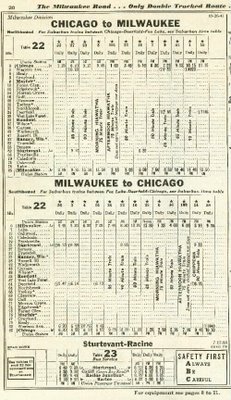
That's a similar spacing of trains to the proposed expanded service. With today's diesels and Free Rein to 110, is it too much to ask for an 80 Minute Train or a 75 Minute Train making those three stops?
Several of those 1941 trains continued beyond Milwaukee: to Green Bay, Wausau, the Cities, and the West Coast. The good news is that Minnesota's Passenger Rail advocates are beginning to see the value of a corridor through their state. Eastbound, a 7 am departure from Fargo - Moorhead, a noon departure from the Cities (much like the Afternoon Hiawatha) and a 7.15 pm arrival in Chicago. Westbound, a 10.20 am departure from Chicago (that was a Hiawatha time slot until recently; the Morning Hiawatha left at 10.30); leave the Cities at 6 pm for a 10.30 crossing of the Red River.
I like the way they're thinking in Minnesota.
The desired improvement on the Illinois side of the Cheddar Curtain involves ten round trips with a maximum speed of 90 mph. I have to wonder about that: three intermediate stops (Milwaukee's airport, Sturtevant, and a conditional Glenview stop) and the best we can do is an 87 minute train.
I know I repeat myself, but repeat myself I must.
That's a similar spacing of trains to the proposed expanded service. With today's diesels and Free Rein to 110, is it too much to ask for an 80 Minute Train or a 75 Minute Train making those three stops?
Several of those 1941 trains continued beyond Milwaukee: to Green Bay, Wausau, the Cities, and the West Coast. The good news is that Minnesota's Passenger Rail advocates are beginning to see the value of a corridor through their state. Eastbound, a 7 am departure from Fargo - Moorhead, a noon departure from the Cities (much like the Afternoon Hiawatha) and a 7.15 pm arrival in Chicago. Westbound, a 10.20 am departure from Chicago (that was a Hiawatha time slot until recently; the Morning Hiawatha left at 10.30); leave the Cities at 6 pm for a 10.30 crossing of the Red River.
I like the way they're thinking in Minnesota.
The second easiest and least costly route to implement in Minnesota is a second train from St. Paul/Minneapolis-Fargo/Moorhead on the current Amtrak route through St. Cloud. This could be a daytime train leaving Fargo/Moorhead in the early morning going east and leaving St. Paul in the evening headed west. The most cost effective way to operate this service would be as a continuation of the proposed second train between the Twin Cities and Chicago. To achieve the highest ridership and cost recovery, we believe the route should extend to Fargo/ Moorhead rather than just St. Cloud.Exactly.
Currently Amtrak serves St. Cloud, Staples, and Detroit Lakes, but additional stops at Little Falls, Wadena, and a northern suburb like Fridley or Anoka for a Minneapolis oriented stop should be seriously evaluated. This route could eventually support three trains a day (morning, noon and late afternoon plus the current overnight Empire Builder service. One train could be extended to Grand Forks and Winnipeg in the future.
3.8.19
THE CONCEPT IS CORRECT, THE EXECUTION, NOT SO MUCH.
Trains Passenger Rail pundit Malcolm Kenton suggests these might be the good new days for Ontario residents who would like more rail options. Among other things, there is now a Kitchener to Waterloo latter-day interurban. It's not quite the second coming of the old Grand River Railway and Lake Erie and Northern that offered connecting service as far south as Brantford and Port Dover. It's a start.
More encouraging is what the Passenger Rail authorities would like to accomplish with the Toronto - Ottawa - Montreal service.
The plan to separate passenger and freight trains between Montreal and Toronto makes sense on paper. It's also a way to provide for even faster running later, if the tracks are surveyed and laid out with a subsequent installation of electrified running in mind.
In practice, though, Bill Stephens, who is also a Trains columnist, has doubts.
Perhaps we begin by suggesting that provincial transportation authorities run the assets they have as businesses. Here's a question for discussion: what are the current tolls on the Queen's Expressways?
More encouraging is what the Passenger Rail authorities would like to accomplish with the Toronto - Ottawa - Montreal service.
[The authority] won a significant victory to advance its plan to build a new high-performance passenger-only rail line between Toronto, Ottawa, Montreal and Quebec City. The Canada Infrastructure Bank’s decision last week to spend $71 million CAD to begin engineering and economic analysis on the project, while remaining open to helping fund its construction provided that the analysis returns favorable results, gives VIA [the authority -- ed.] confidence that it can attract private investment to help the government-owned corporation complete the project.In fact, given the state to which Passenger Rail has fallen, as well as the nature of the high-density corridors in North America, including the Richmond to Portland stomping grounds of Amtrak's Northeast Corridor services, Free Rein to 110 with contemporary diesel trains is the more sensible way to start.
Keep in mind that the proposed line is not world-class high-speed rail — it would be a conventional line allowing conventional equipment to operate at up to 110 mph with numerous grade crossings. Nevertheless, it would cut travel times by up to one third less than current schedules and offer much greater reliability by not being shared with freight. This milestone, along with Virgin Trains USA’s expansion to Orlando proceeding apace, proves that modern passenger rail projects in North America don’t have to be grade-separated bullet trains or use some flashy new technology like maglev or hyperloop in order to attract private-sector participation and deliver tremendous utility to the traveling public and to local and regional economies.
If VIA can overcome the hurdles of political will and resistance on the part of its host railroad Canadian National, and if its urban regions continue to develop and modernize rail transit, Ontario’ populous southeast and southwest regions would be well-positioned to continue providing a high quality of life to their growing populations as energy and other resources inevitably become scarcer with climate change and growing global demand. Many locales stateside could learn from this success.
The plan to separate passenger and freight trains between Montreal and Toronto makes sense on paper. It's also a way to provide for even faster running later, if the tracks are surveyed and laid out with a subsequent installation of electrified running in mind.
In practice, though, Bill Stephens, who is also a Trains columnist, has doubts.
There’s much to like in VIA’s so-called high frequency rail plan. Transit times on the new corridor, VIA says, would be 25% faster than the current schedules, which cover Toronto-Montreal in about 5 hours. The new corridor would permit 110 mph operation, up from the current maximum of 100 on some sections of CN. VIA could provide more frequent service without begging CN for permission to run additional trains. And VIA projects 95% on-time performance on its own tracks.Perhaps a few overpasses in the right places (would you believe one will be built in the area of Tower A-2 in Chicago?) might help. That, and people who know how to move trains.
But the whole plan falls down in the busy terminal areas in and around Toronto and Montreal. That’s where VIA’s trains would still have to negotiate trackage thick with freight and commuter traffic.
Transport Canada’s solution to this problem is laughable. “VIA Rail Canada would work with track owners to conclude necessary agreements and ensure that both freight and passenger operations can go smoothly,” a spokeswoman says.
VIA has said that passenger trains and freight trains are simply incompatible. What’s required, the thinking goes, is separate routes for passenger and freight. That’s never been true. If it were, Amtrak’s Hiawatha trains would not have clocked 96% reliability last year on Canadian Pacific trackage between Chicago and Milwaukee.Yes, the current seven Hiawatha trips a day are generally reliable (although on occasion a rake misses an entire trip: if it doesn't run at all, it can't be late?), but getting back to ten trips is proving to be difficult, and separate passenger and freight routes well might be the way to go. (Stay tuned. I'm working on that one.) Yes, it's on public officials to sell internal improvements: we have not-in-my-back-yard sentiments in part as a reaction to the excesses of eminent domain over the years. The point of internal improvements, though, is to introduce trade-tested betterments, that is to say, Pareto improvements.
Keeping passenger and freight trains on time takes a combination of operational discipline, the right track capacity, and a willingness to make it work. CN takes pride in its operational discipline, and executives say the Eastern portion of the railroad, between Chicago and Halifax, is underutilized. What’s missing, it seems, is a willingness to expedite VIA trains.
VIA needs a cooperative host railroad more than it needs a new route that would bypass intermediate population centers, face opposition from the not-in-my-backyard crowd, take years to build, and in the end would still have to rely on shared trackage in key areas.
Perhaps we begin by suggesting that provincial transportation authorities run the assets they have as businesses. Here's a question for discussion: what are the current tolls on the Queen's Expressways?
19.6.19
REDUCE SPEED TO NINETY.
Regular readers know there were a few spots along The Milwaukee Road that the Hiawatha could not safely exceed that speed.
Regular readers will therefore not be surprised that I was delighted to discover this. Orlando's Sun-Sentinel is alerting readers to infrastructure construction that doesn't involve tax dollars.
Regular readers will therefore not be surprised that I was delighted to discover this. Orlando's Sun-Sentinel is alerting readers to infrastructure construction that doesn't involve tax dollars.
Next month, motorists on S.R. 528 may notice earth work for rail corridor that will cross south Orange County through an area of state conservation lands and Deseret Ranches pasture."Virgin" are the partners with Brightline. The trains will use existing Florida East Coast tracks as far as Cocoa Beach, and the area south of West Palm is thickly settled with lots of level crossings. Thus "Free Rein to 110" is pretty good. There's no reason to apologize for not running at Acela speeds.
Michael Cegelis, Virgin’s senior vice president for rail infrastructure, said the ride from Miami to Orlando will span three speed limits.
From Miami to West Palm, Virgin Trains will be limited to 79 mph.
From West Palm Beach to Cocoa, top speed will be 110 mph.
From Cocoa to Orlando International Airport, speed will vary slightly.
Cegelis said at Interstate 95, Virgin tracks will pass under S.R. 528 from its north side to its south side, a jog that will hold trains to 90 mph.
From I-95 to State Road 417, Virgin Trains will hug S.R. 528 – the Beachline – at 125 mph. Even motorists breaking the 70 mph speed limit on the adjoining expressway will be quickly overtaken by Virgin’s trains, company officials noted.
Amtrak’s Acela Express between Washington D.C. and Boston advertises itself as capable of 150 mph, making it the nation’s fastest rail service. But Acela is hampered by an aging track corridor and doesn’t often reach that speed.Virgin and Florida East Coast are demonstrating the value of diesel trains on existing track structures, as well as a less expensive line west to Orlando.
14.2.19
THERE IS NEVER A GOOD TIME TO BUILD THE WRONG PROJECT.
California governor Gavin Newsom will finish the a-building section of high speed railroad in the Central Valley, but the continuations to San Francisco or Los Angeles are on hold.
“Let’s be real,” he says. “The project as currently planned would cost too much and, respectfully, take too long. Right now, there isn’t a path to get from Sacramento to San Diego, let alone from San Francisco to L.A. I wish there were,” the San Francisco Gate reports.That's a sunk cost fallacy at work. It's also the logic of Federal money. When Wisconsin governor Scott Walker scrapped the extension of the Hiawatha service to Madison, whatever operating subsidies he didn't commit the state to might have been exceeded by the breach-of-contract damages to Talgo, the builder of the trains for the project, and when his secretary of transportation asked if he could apply the Federal money allocated to rails to fixing the highways instead, the Secretary of Transportation said no. Republican governor in Wisconsin, Democrat president, reverse the roles today, same problem.
Instead of completing the intended route, pegged at $77 billion to build in the next decade, Newsom wants to finish tracks between Bakersfield and Merced in the Central Valley. Roadbed construction, including several massive bridges, is nearly complete on the initial Fresno-Madera segment.
“Abandoning high speed rail entirely means we will have wasted billions and billions of dollars with nothing but broken promises...and lawsuits to show for it.,” he claims. He intends to make use of the investments already made rather than send $3.5 billion in federal funds back to Washington, D.C.
19.5.18
THE DAWNING OF RAILROAD AWARENESS.
We first noted Florida East Coast's plans to build a passenger railroad six years ago. Focus, dear reader, on this. "Much of the existing traffic on Florida East Coast is intermodal, and container trains cruising at 90 play well with passenger trains at 110 or 125." Later that year, I offered further analysis.
It's intriguing that the operator wants to be freed of Congressional meddling with Amtrak, which is the cynic's interpretation of "exempt from federal oversight." The stipulation that the new trackage will be Passenger Service Only likely calms fears at the CSX Railroad of freight competition. The absence of joint ticketing, or any mention of connectivity, troubles me. The value of a Passenger Rail network is in being able to make connections. Admittedly, Amtrak's Florida service is a pale shadow of what Seaboard Coast Line operated almost up to 30 April 1971, and the Miami to Orlando service has more promise as a boat train connecting cruise ship passengers to the theme parks and Grapefruit League stadia.That service is now up and running as Brightline. As of yet, there are no plans to run tracks into Port Everglades Quay (that place is big enough that you'd probably have to install moving sidewalks to provide connections, particularly to the voyages catering to older folks.)
17.1.18
A FALSE ANALOGY.
Madison's Ann Althouse counts her blessings. Apparently, the cost over-runs on California's bullet train continue to increase, and she compares that, favorably, with the expenses Wisconsin avoided with the cancellation of the extension of Hiawatha service to Madison.
Sorry, that comparison is inaccurate. Wisconsin's proposed service was an incremental extension of an existing corridor to provide additional connectivity to a line that has been experiencing increased ridership and additional frequencies. But Passenger Rail advocates in Wisconsin failed to make the case for that expanded connectivity and convenience, letting the nay-sayers characterize the project as something for the benefit of Madison rent-seekers, or something.
Restoring 110 mph speeds between Chicago and Watertown and speeding up service over historical timing from Watertown to Madison is a very different proposition from building a new railroad ab initio in a corridor currently being served by one slow cross-country trains and two or three regional trains that get no closer to Los Angeles than to Bakersfield. California's error is in building the first section of their high-speed line alongside the Bakersfield route in relatively open country.
That California's Department of Transportation currently is adding capacity with neutered Jersey Arrow coaches suggests the potential for incremental improvements, perhaps in fifteen or twenty years leading to a full-on Neubaustrecke linking Los Angeles with San Francisco. Unfortunately, it's probably too late to mothball the San Joaquin Valley construction and commence that connection of Glenview with Bakersfield.
Sorry, that comparison is inaccurate. Wisconsin's proposed service was an incremental extension of an existing corridor to provide additional connectivity to a line that has been experiencing increased ridership and additional frequencies. But Passenger Rail advocates in Wisconsin failed to make the case for that expanded connectivity and convenience, letting the nay-sayers characterize the project as something for the benefit of Madison rent-seekers, or something.
Restoring 110 mph speeds between Chicago and Watertown and speeding up service over historical timing from Watertown to Madison is a very different proposition from building a new railroad ab initio in a corridor currently being served by one slow cross-country trains and two or three regional trains that get no closer to Los Angeles than to Bakersfield. California's error is in building the first section of their high-speed line alongside the Bakersfield route in relatively open country.
Yes, additional frequencies on the existing regional routes (Amtrak and the city-specific commuter services), making better connections between the Los Angeles and San Diego regional trains, and filling in some of the gaps in the rail network (connect Bakersfield to Los Angeles and Santa Barbara to San Luis Obispo) are likely to be more productive at less cost than a San Francisco to Los Angeles Neubaustrecke that, like its German and Japanese counterparts, will have to be tunnelled through difficult terrain.Or, if you must build a section of railroad, perhaps the place to begin is with a Bakersfield to Glenview line constructed to Shinkansen or Neubaustrecke standards, but commencing operation with conventional diesel trains authorized 125 to 140 mph on the new trackage, and conforming to existing speed restrictions on the existing San Joaquin routing north of Bakersfield and Metrolink trackage into Los Angeles. That is, get passengers used to more frequent and more dependable through trains, then start adding the capacity and upgrading the lines as demand appears. Bear in mind, dear reader, that Japan began with the standard gauge New Tokaido Line when they ran out of capacity on an already busy electrified Cape gauge line. Bear also in mind that the Hiawatha service was, early in the 1980s, three or four trains a day, with consists of two or three coaches.
That California's Department of Transportation currently is adding capacity with neutered Jersey Arrow coaches suggests the potential for incremental improvements, perhaps in fifteen or twenty years leading to a full-on Neubaustrecke linking Los Angeles with San Francisco. Unfortunately, it's probably too late to mothball the San Joaquin Valley construction and commence that connection of Glenview with Bakersfield.
19.12.17
A DIFFICULT DAY ON THE CASCADE CORRIDOR.
Amtrak train 501, making its first trip on an avoiding line intended to speed up the Seattle to Portland services, apparently went into a curve in advance of a junction too fast. Jim "Travel & Trains" Loomis lost two fellow Passenger Rail advocates in the wreck.

Note: not a new line, definitely not a German Neubaustrecke (there will be occasion to celebrate one of those in a day or so) and certainly not a high-speed line by German standards, by Acela standards, or by the standard set by The Milwaukee Road in Wisconsin, eighty years ago.
Let me quote from a booklet of safety instructions issued by the Elgin Joliet and Eastern Railway in August, 1953. "All the safety appliances that could be installed would be of no value, unless you have safe men to operate them." So what is keeping the engineer from doing what he is supposed to be doing? "'How is it that a train was going 80 miles an hour,' Savannah Guthrie asks, 'around a curve where the speed limit was 30?'"
Yes, it is likely that people will make much of the absence of Positive Train Control on this line, or even of the control equipment on the new diesel that will probably be written off.

Why, though, would a train operator not be aware that the end of the fast running and the upcoming junction with the original route was nearby. As I asked in the aftermath of the derailment account excessive speed of a Spanish Talgo train, "passengers are trusting the engineer to have sufficient route knowledge that he's made the proper brake application in advance of an approaching junction." We ought be grateful that the Talgo cars in use in North America protect passengers more effectively.
Also, apparently, a local official viewed with alarm the introduction of 79 mph passenger trains through his community, and those fears were also raised by officers at a nearby military installation.
What sort of a world do we live in, when a 79 mph train raises safety fears at a military base?

Despite the derailment, the provision of additional routes for diesel trains good for 110-125 mph (as the above picture illustrates, this was routine a half century ago) remains a productive use of infrastructure money, private and public.
I have just learned that the Rail Passengers Association lost two members in yesterday’s derailment: Jim Hamre, an elected member of our Board of Directors, and Zack Wilhoite, an RPA member. There are no adequate words.His post also notes a number of complaints serious ferroequinologists raise about press coverage of things that run on rails.
There is the unbelievable irony of this event occurring to the very first train on the very first day that this new stretch of track was open. That alone is reason enough for suspecting foul play.The early evidence is of a train going too fast into a speed restriction of thirty mph for the curve over the bridge, and there is a speed restriction of 42 mph for Talgo trains where this route ... not a new railroad by any means, rather a former Northern Pacific track that has been in place since at least the 1920s, joins the seaside route that Amtrak, and most of the heavy coastal freight traffic, has been using. Amtrak's passenger trains will be joining the Tacoma area Sound Transport commuter trains on this line, which might have been reprofiled for faster running.
The cause of the event will be found and if it proves to be a true accident–human error, if you will– rightly or wrongly, blame will be assigned and some poor bastard’s life will be ruined.
In reporting on the accident—and, yes, I acknowledge that the media is under pressure to get the information out there as quickly as possible—there is nevertheless an obligation to get the facts right. For minutes and then hours, media reports kept referring to this as a “high-speed” train and to the line itself as “high-speed”. Dammit! Wrong and wrong again.
As I understand it, the crash occurred just as the train was entering a brand new stretch of track, the purpose of which being to permit Amtrak trains to run at somewhat higher speeds than conditions on the previous route would permit. You can bet that investigators will be going over the first 100 yards or so of that track with the proverbial fine tooth comb. Don’t expect a definitive report to be coming out soon. But when it does—just one guy’s gut opinion—I suspect there will be evidence of foul play. Damn!

Point Defiance bypass project map retrieved from Washington State Department of Transportation.
Note: not a new line, definitely not a German Neubaustrecke (there will be occasion to celebrate one of those in a day or so) and certainly not a high-speed line by German standards, by Acela standards, or by the standard set by The Milwaukee Road in Wisconsin, eighty years ago.
Let me quote from a booklet of safety instructions issued by the Elgin Joliet and Eastern Railway in August, 1953. "All the safety appliances that could be installed would be of no value, unless you have safe men to operate them." So what is keeping the engineer from doing what he is supposed to be doing? "'How is it that a train was going 80 miles an hour,' Savannah Guthrie asks, 'around a curve where the speed limit was 30?'"
Yes, it is likely that people will make much of the absence of Positive Train Control on this line, or even of the control equipment on the new diesel that will probably be written off.

Unattributed AP photograph retrieved from Daily Mail.
Why, though, would a train operator not be aware that the end of the fast running and the upcoming junction with the original route was nearby. As I asked in the aftermath of the derailment account excessive speed of a Spanish Talgo train, "passengers are trusting the engineer to have sufficient route knowledge that he's made the proper brake application in advance of an approaching junction." We ought be grateful that the Talgo cars in use in North America protect passengers more effectively.
Also, apparently, a local official viewed with alarm the introduction of 79 mph passenger trains through his community, and those fears were also raised by officers at a nearby military installation.
What sort of a world do we live in, when a 79 mph train raises safety fears at a military base?

Afternoon Hiawatha at Camp McCoy, Wisconsin, summer 1964.
Kent Kobersteen photograph scanned from Scribbins, The Hiawatha Story, page 120.
Despite the derailment, the provision of additional routes for diesel trains good for 110-125 mph (as the above picture illustrates, this was routine a half century ago) remains a productive use of infrastructure money, private and public.
1.5.17
THEY MADE SOME TRAINS WORTH TRAVELING AGAIN.
Amtrak began operating on 1 May, 1971. The title of this post refers to their original slogan. Here's coverage of the first day in Milwaukee, where we no longer had train service to Green Bay, but we regained a train to Seattle. Today, we'll look at some evidence of what has changed (sometimes for the better) and what has stagnated.
Let's start with the Empire Builder, my canonical example of an overpurposed train. By Thanksgiving of 1971, it had become what looked very much like a Burlington Northern train, despite Milwaukee Road, and on occasion Union Pacific or Gulf Mobile and Ohio diesels in charge.
Let's start with the Empire Builder, my canonical example of an overpurposed train. By Thanksgiving of 1971, it had become what looked very much like a Burlington Northern train, despite Milwaukee Road, and on occasion Union Pacific or Gulf Mobile and Ohio diesels in charge.
5.6.14
MAKING A CASE FOR MORE TRAINS.
A guest commentary in the Milwaukee Journal-Sentinel wants more funding for Amtrak.

That's the Illinois Railway Museum's Nebraska Zephyr, still capable of track speed on the Way of the Zephyrs. As I noted at the time, "Amtrak and Illinois Department of Transportation, you could do worse."

On May 1, 1971, these 1942 ribbed-side Hiawatha coaches were assigned to Twelve and 23, the Watertown - Milwaukee "Cannon Ball" (not so named in the timetable, but identified as such on station bulletin boards.) But they must have put away more than a few fast miles behind the likes of One and Fifteen and 105 and the other Hiawatha power.
What intrigues, though, is the picture the Journal-Sentinel runs with the editorial.

The Hiawatha Service ordinarily runs with plain vanilla Amfleet and Horizon coaches and it draws passengers. The former Great Northern Great Dome comes to Chicago around Thanksgiving to provide additional passenger seating. (Spare dinette cars also turn up, these are popular with packs of collegians looking to get some studying in.)
Is it too much to ask for some dome cars, some first-class seating, a day train Chicago to Fargo or Grand Forks and return (there may even be a case for an overnight service Chicago and Williston), some day service to Madison and Green Bay, and some late-evening trips on the C&M for opera or Summerfest or sports traffic?
America can't compete in the 21st-century economy with an Amtrak system forced to get by with decades-old equipment and decaying infrastructure. We need a fully modernized Amtrak that can accommodate the higher speeds that many states are already planning. And that takes long-term investment by the federal government, in partnership with states and the private sector. We also need to make sure that our freight rail system, which provides the track for much of Amtrak's service, is safe and adequately staffed — just the way Badger State residents say they want it.There are ways in which the freight railroads and the passenger train operators can benefit mutually from upgrades to the tracks. Union Pacific get faster tracks for piggyback trains out of the in-progress speeding-up of the Alton Route. The editorialists miss the opportunity to make a few salient points. First, connectivity of the corridor trains in Chicago is a must. Second, accommodating faster trains doesn't have to be a massive project. Let me show you a train, and coaches, capable of 110 mph operation.
That's the Illinois Railway Museum's Nebraska Zephyr, still capable of track speed on the Way of the Zephyrs. As I noted at the time, "Amtrak and Illinois Department of Transportation, you could do worse."
On May 1, 1971, these 1942 ribbed-side Hiawatha coaches were assigned to Twelve and 23, the Watertown - Milwaukee "Cannon Ball" (not so named in the timetable, but identified as such on station bulletin boards.) But they must have put away more than a few fast miles behind the likes of One and Fifteen and 105 and the other Hiawatha power.
What intrigues, though, is the picture the Journal-Sentinel runs with the editorial.
Milwaukee Journal-Sentinel photograph by Gary Porter.
The Hiawatha Service ordinarily runs with plain vanilla Amfleet and Horizon coaches and it draws passengers. The former Great Northern Great Dome comes to Chicago around Thanksgiving to provide additional passenger seating. (Spare dinette cars also turn up, these are popular with packs of collegians looking to get some studying in.)
Is it too much to ask for some dome cars, some first-class seating, a day train Chicago to Fargo or Grand Forks and return (there may even be a case for an overnight service Chicago and Williston), some day service to Madison and Green Bay, and some late-evening trips on the C&M for opera or Summerfest or sports traffic?
9.4.14
IT'S NOT NECESSARILY HOW FAST THE TRAINS GO.
Progressive Railroading reports on Louisiana Department of Transportation efforts to develop Passenger Rail service between Baton Rouge and New Orleans. The last such service expired before Amtrak: just over two hours to go 80 miles inclusive of four intermediate stops, on the Kansas City Southern.
The Louisiana approach draws lessons from the Hiawatha service.
On a relatively short corridor, there are still opportunities to run the trains fast.
Give the Hiawathas free rein to 110, or 125, and post those 60 minute schedules (Airport at 0:10, Sturtevant at 0:18, Glenview at 0:42, Chicago at 1:00). Is it too much to ask for a bar car?
In Louisiana, start with two or three trips on times more suited for business than for the beginning or the end of the business day (and for Louisiana State games, where the bar car will do a brisk business) on timings faster than those posted by the old Flying Crow, and develop from there.
The Louisiana approach draws lessons from the Hiawatha service.
In 2010, the Wisconsin Department of Transportation (WisDOT) turned away federal high-speed dollars for a Madison-Milwaukee-Chicago high-speed link at the insistence of Wisconsin Gov. Scott Walker. Today, WisDOT instead is focusing on upgrading the Milwaukee-Chicago portion of the corridor, over which Amtrak Hiawatha trains operate. A study is being conducted to determine options for adding three additional round trips, for a total of 10, between the two cities, says [transportation consultant Alan] Tobias.Just as I have been suggesting for years.
“Because the corridor is only 90 miles long, there aren’t a whole lot of opportunities to save a lot of time, so the focus is on increasing frequencies so people have more options,” he says.
On a relatively short corridor, there are still opportunities to run the trains fast.
Many states still are interested in high-speed rail — HNTB [a transportation planning firm] is involved in “quite a few studies across the country” that prove it, says Tobias — but in many regions, an incremental approach might make more sense.Exactly. On the Hiawatha service, four three-car rakes on 92 minute timings with two intermediate stops have bloomed to seven six-car rakes on 89 minute timings (often 84 minutes in practice) with a third intermediate stop, and that with a few stretches of track now good for 79 mph rather than 70. In steam days, The Milwaukee Road was contemplating a 60 minute nonstop timing for Hiawathas.
“We tend to get hung up on that high-speed number, and it is appealing,” says Tobias. “But the best way to go faster is to not go slow. You can make incremental improvements to conventional services that help to improve travel time, increase frequencies and improve reliability, and sometimes that’s just as important, if not more.”
Give the Hiawathas free rein to 110, or 125, and post those 60 minute schedules (Airport at 0:10, Sturtevant at 0:18, Glenview at 0:42, Chicago at 1:00). Is it too much to ask for a bar car?
In Louisiana, start with two or three trips on times more suited for business than for the beginning or the end of the business day (and for Louisiana State games, where the bar car will do a brisk business) on timings faster than those posted by the old Flying Crow, and develop from there.
19.8.13
ADVANTAGE, COLD SPRING SHOPS.
It's easy being a prophet when one pays careful attention to the fundamentals. Wisconsin's Department of Transportation continues to work on upgrades to its existing Amtrak routes.
But wait, there's more ...
Trains from Milwaukee to Chicago and St. Paul, Minn., may be faster and more frequent in the near future, as Amtrak and transportation departments in Wisconsin and neighboring states study the possibility of expanding service on regional routes.That's converting 89 minute trains to 78 minute trains. The Cold Spring Shops Free Rein to 110 campaign involves spending additional money on signalling and crossing protection, compared to boosting train speeds to 90 (yes, yes, the Hiawatha used to Reduce to 90 for Rondout and the State Line curve). "The Cold Spring Shops position, however, is that incremental improvements -- where incremental can mean getting rid of those post-war Interstate Commerce Commission regulations that ended 110 mph running on block-signalled railroads with jointed rail -- will build ridership in such a way that subsequent upgrades to bullet trains make more sense."
Encouraged by ridership that has doubled over the past decade and standing-room-only conditions on some trains, the Wisconsin Department of Transportation has plans to add three express trains to the Hiawatha route, boosting the number of trips a day from seven to 10.
The express trains would skip local stops, serving only Union Station in Chicago, Mitchell International Airport and downtown Milwaukee, and reach a maximum speed of 90 miles per hour, compared with 79 mph now, decreasing travel times by 11 minutes.
"The department really feels that people are becoming aware of the Hiawatha service and its convenience, and are looking for alternative modes of transportation," said DOT spokesman Brock Bergey.
In a 2011 survey by the Texas Transportation Institute, more than half of Hiawatha passengers on weekdays were commuting or making a business trip, while about three in four weekend passengers were visiting family or taking a trip for fun. A significant number of passengers, 14%, said that if the train weren't available, they would not have made a trip. Avoiding highway congestion was the primary reason people took the train.Let's hope that the added schedules permit shifting one of the 89 minute trains ... 85 minute trains? to late evening, for those Summerfest or Lyric Opera or just out for dinner on the Mag Mile or in East Towne to go on a date and return the same evening.
A recently completed project has paved the way for added trains by making it easier for passenger and freight trains to bypass one another on the tracks and stay on time, Bergey said. New crossovers, which allow trains to switch tracks, and other infrastructure went into operation in January, according to Canadian Pacific Railway Ltd., a publicly traded freight company that owns the tracks.
But wait, there's more ...
Ridership growth is also driving plans for a second daily train on the Empire Builder route, which grew by 16% from 2011 to 2012, that links Chicago, Milwaukee, the Twin Cities and stops to the west, including Seattle, Amtrak spokesman Marc Magliari said. Amtrak is conducting the study.A Minnesota planner refers to the St. Cloud train as a "baby step" toward increased service. Or toward restoring what used to be. "Consider a network consisting of Chicago - Madison - Portage - LaCrosse - Rochester, Chicago - Milwaukee - Portage - LaCrosse - St. Paul, possibly continuing to St. Cloud, Fargo, and Grand Forks." Leave the Chicago - Madison - Portage for another day. I give you the April 10, 1974 Amtrak system timetable. Westbound, the North Coast Hiawatha operated daily Chicago - Minneapolis, and tri-weekly west of there, leaving Chicago at 10.30, Minneapolis (the now-demolished station) 7.00, calling at St. Cloud 8.15 and arriving Fargo at 11.20. The Empire Builder operated via Willmar in those days, leaving Chicago at 2.30, Minneapolis at 10.45, and arriving Fargo 3.25 and Minot at 9.00. Eastbound the Builder left Minot at 7.55, Fargo 1.25, overnight to Minneapolis with a 7.00 departure, and arriving Chicago 2.50. The triweekly Hiawatha left Fargo at 6.40, St. Cloud 10.15, made a 45 minute stop at Minneapolis (on the days it operated, it switched in additional coaches there), leaving at 12.30 with an 8.20 arrival in Chicago. Make use of some of that faster track on the Old Milwaukee Road and these schedules can be tightened.
"A second round-trip is a significant improvement for passengers by providing more same-day trips without overnight stays and by making it more likely our scheduled arrivals and departure times meet their travel needs," Magliari said.
A draft of a feasibility study should be available in December, and would focus on adding a second train at current speeds, 79 mph. It would terminate in St. Cloud, Minn., instead of continuing on to Seattle as the existing route does.
Several groups in favor of expanding the Hiawatha and Empire Builder routes say both lines have had proven success and would be a boon for the economy.Frequency, connectivity, convenient times, reliable schedules. Build it and the riders come.
The added trips on the Hiawatha, in particular, would be positive for economic development, strengthening a vision of southeastern Wisconsin, Chicago and northwestern Indiana as one mega-metro area, said Metropolitan Milwaukee Association of Commerce spokeswoman Julie Granger.
"The stronger connections we have to what is a huge thriving city can only benefit the region," Granger said.
5.6.13
THE SPILLOVER BENEFIT OF LIMITED TRAINS.
I'm reverting to ancient interurban terminology in the title. A "local" car will stop on signal anywhere (street corner, road crossing, possibly in front of your house) upon the proper signal to the motorman. An "express" car stops only at designated stations (possibly including some of the corners and crossings, perhaps designated by the notation f -- stops on signal, use light at night.) A "limited" car has no conditional stops, and may be scheduled to stop only at a limited number of the designated stations.
In contemporary parlance, high-speed rail may be serving the function of the limited trains, without the necessity of trundling through city streets or sharing the elevated with rapid transit cars, generating traffic and enhancing property values to boot.
In contemporary parlance, high-speed rail may be serving the function of the limited trains, without the necessity of trundling through city streets or sharing the elevated with rapid transit cars, generating traffic and enhancing property values to boot.
“The bullet train offers the possibility,” [UCLA economist Matthew] Kahn said, “that they effectively become suburbs of those communities. And become desirable to a subset of people who live there.”Not to count rivets, but Amtrak's trains don't average 150 mph on The Broad Way. There are enough Clockers and Acela Expresses running between New York and Philadelphia to make possible a day of business in one city by a resident of another city. There's also enough Hiawatha service to turn Milwaukee into a suburb of Chicago, even without the 100 mph speeds and 75 minute timings of the 1930s, and some of the wealthier banlieus of Chicago have non-stop service to and from the Loop (Naperville Zephyrs every 20 minutes for two hours each weekday morning, most notably, and the down Elburn 400 just after 5 pm.) In New Jersey, Trenton, Princeton Junction, New Brunswick, and Metuchen enjoy enhanced property values from the presence of New Jersey Transit and its limiteds capable of speeds that don't delay the Acelas and Clockers. Faster service between Cleveland and Chicago: possibly beneficial to property owners in Cleveland, but look for enhanced property values in Toledo or Elkhart and South Bend.
Small cities need to be too far to drive to but too close to fly to the nearest “megacity.” Kahn used Philadelphia as an example. Right now, he said, a trip to New York City takes 80 minutes by high-speed Amtrak, which averages 150 miles per hour.
“If that became a half hour away because of the high-speed rail, I think Philadelphia home prices would jump sharply,” Kahn said. “There’d be much more demand to live there.”
Kahn and his co-author Siqi Zheng found bullet trains unintentionally created new suburbs called “sweet spots” about 60 to 470 miles from mega cities. Bullet trains provide big-city benefits despite the distance without “downsides like high housing costs, overcrowding, or air and water pollution,” Kahn said.
“It really comes down to," Kahn said, "is there a train that moves at 150 miles per hour" and are there good local connections to it? "Then there's certainly some potential there."
For instance, he added, “if the train moved fast enough between Cleveland and Chicago, I think there’d be similar gentrification in Cleveland.”
29.11.12
ADDITIONAL CAPACITY FOR THANKSGIVING.
The Alton Route segment between Dwight and Pontiac, in Illinois, once again supports 110 mph running, just in time for the traffic heading over the river and through the woods. A lot of that traffic is collegians bound for Chicago, on the Alton Route from Illinois State and neighboring universities. (Somehow we make do at Northern Illinois without a train, although it's frustrating watching stack trains go by at 70 mph and wondering what if.) Passenger loadings were high. Because there is no large pool of spare equipment, the Chicago area corridor service is mostly reserved, and reservations were hard come by.
The biggest bottleneck in the Midwest is also on Sunday, when all five Chicago to St. Louis trains (including the Texas Eagle) are sold out between the endpoints; only the early morning departure is available on Wednesday. All Lincoln Service trains are running with five Amfleet I or Horizon coaches instead of the usual four. The situation is much better on Michigan’s Wolverine corridor than it has been in past Thanksgivings.In the Chicago area, Amtrak assigned additional cars to the Chicago-Milwaukee Hiawatha service, including a full-length lounge car offering table space for groups or card players, and the one remaining full-length dome car, a former Great Northern car giving its best impression of a Super Dome Hiawatha. (For a short time after the discontinuance of the Olympian Hiawatha, Super Domes were assigned as cafe-lounge cars on Madison and Milwaukee corridor trains.)
19.10.12
PASSENGER RAIL PROGRESS.
In March, we noted a plan for privately-operated passenger trains in Florida. My assessment at the time noted, "the freight railroads would like to have the kind of control over scheduling and reliability that comes from common mechanical standards, dispatching, and scheduling." That's evident from the All Aboard Florida filing with the Surface Transportation Board, as reported in Trains.
In Illinois, passenger trains are again rolling at 110 mph.
The Associated Press reporting on the Illinois test run does nothing to counter the suspicion that mainstream journalists are Democratic operatives masquerading as journalists.
There's also enough repaired and renovated rolling stock on hand to provide Thanksgiving relief trains on the Michigan corridor.
The pathing of the relief train indicates a weakness of the network east of Ann Arbor. I'm referring to the early summer timetable, in which trains require about 4 hours 30 minutes for the 243 miles Chicago to Ann Arbor, and two hours for the 61 miles Ann Arbor to Pontiac. Thus, the eastbound relief train meets the westbound midday train 353 somewhere in western Michigan, turns on a wheel at Ann Arbor, and meets the eastbound evening train 354 either on the fast rail or on Norfolk Southern's two main tracks. The regular westbound evening train doesn't get away from Pontiac until after 4 pm.
It's progress, though, compared to what Amtrak inherited from Penn Central.
The passenger train operator will rebuild a second track along the Florida East Coast Railway between Miami and Cocoa, Fla., and build entirely new track on right-of-way leased from the Florida Department of Transportation and Orlando-Orange County Expressway Authority. This would place about 40 miles of new rail line alongside or in the median of state Route 528, which runs between Cocoa and the Orlando airport and is operated by the OOCEA.It's intriguing that the operator wants to be freed of Congressional meddling with Amtrak, which is the cynic's interpretation of "exempt from federal oversight." The stipulation that the new trackage will be Passenger Service Only likely calms fears at the CSX Railroad of freight competition. The absence of joint ticketing, or any mention of connectivity, troubles me. The value of a Passenger Rail network is in being able to make connections. Admittedly, Amtrak's Florida service is a pale shadow of what Seaboard Coast Line operated almost up to 30 April 1971, and the Miami to Orlando service has more promise as a boat train connecting cruise ship passengers to the theme parks and Grapefruit League stadia.
All Aboard Florida will not seek public operating subsidies for the project, but is exploring the possibility of obtaining construction financing through the Federal Railroad Administration's Railroad Rehabilitation and Improvement Financing Program. Through the program the railroad can apply for direct loans and loan guarantees through the FRA.
The filing stipulates the new passenger service will not be a part of the interstate passenger rail network and should be exempt from federal oversight. All Aboard Florida will not participate in any through ticketing program with Amtrak. It also says no freight service will be operated by All Aboard Florida, or over the new right-of-way to Orlando. It does say that, for flexibility in operations, FEC dispatchers will have the option of using either track on the shared right-of-way for freight and passenger traffic.
In Illinois, passenger trains are again rolling at 110 mph.
The demonstration included a 15-mile segment of 110 mph running between Dwight and Pontiac, Ill., for Illinois Gov. Pat Quinn, U.S. Sen. Dick Durbin, U.S. Transportation Secretary Ray LaHood, Federal Railroad Administrator Joe Szabo, Amtrak Chairman Tom Carper, and a host of local politicians and reporters.The test run offered the public officials a chance to do what comes naturally.
Heritage-painted GE P42 No. 66 led the special train out of Chicago to Normal, Ill., along with Amtrak No. 63. Both units are equipped with the Incremental Train Control System already used on Amtrak’s 110 mph Michigan Line trackage between Porter, Ind., and Kalamazoo, Mich., as well as UP’s cab signals. This is the first installation that joins ITCS’s ability to verify that quad-gate highway crossings are clear and operational with the UP cab signal system. Although higher speeds up to 150 mph are routinely attained on the grade-separated Northeast Corridor, the cab signal-ITCS combination launched in Illinois fulfills the requirements of positive train control in highway grade crossing territory.
At Normal, while the politicians were giving speeches, the diesels ran around the train on a passing track and coupled up to [Amtrak official car] Beech Grove for the trip back to Chicago.Too bad the train doesn't cut as attractive a figure at 110 mph as the Nebraska Zephyr would.
The Associated Press reporting on the Illinois test run does nothing to counter the suspicion that mainstream journalists are Democratic operatives masquerading as journalists.
In a modest milestone for President Barack Obama's high-speed rail vision, test runs will start zooming along a small section of the Amtrak line between Chicago and St. Louis at 110 mph Friday.Governor Quinn has publicly hailed the 110 mph speed (a Global Positioning System speed estimate hit 111; that's likely an approximation error) as a first "outside the Northeast." In the Amtrak era, that's true, although the Pioneer Zephyr's dawn-to-dusk run included some Illinois mileage at 112; the 1935 Hiawatha test train maintained 112.5 for several miles across the Wisconsin sand country, and speeds in that range were routine for the 75 Minute Trains between Milwaukee and Chicago until 1950. Let the younger generations enjoy the higher speeds, as they've had no previous experience of them.
The 30-mph increase from the route's current top speed is a morale booster for advocates of high-speed rail in America who have watched conservatives in Congress put the brakes on spending for fast train projects they view as expensive boondoggles. But some rail experts question whether the route will become profitable, pose serious competition to air and automobile travel, or ever reach speeds comparable to the bullet trains blasting across Europe and Asia at 150 mph and faster.
U.S. Transportation Secretary Ray LaHood and Gov. Pat Quinn are scheduled to be on board when an Amtrak train hits 110 mph for the first time in Illinois. But it will only maintain that speed for a short time, somewhere along the 15 miles between Dwight and Pontiac, before braking back to more normal speeds.
There's also enough repaired and renovated rolling stock on hand to provide Thanksgiving relief trains on the Michigan corridor.
One round trip, Nos. 356 and 359, will make a same-day turn at Ann Arbor on Wednesday, Nov. 21, and the following Friday through Sunday. No. 356 will leave Chicago at 9:20 a.m., 2 hours after the departure of morning train No. 350 to Detroit and Pontiac, and return from Ann Arbor at 4:05 p.m., more than 3 hours prior to afternoon train No. 355’s westbound stop.That freight train interference is salient on the former New York Central main line between Porter and Englewood; less so on the trackage east of Kalamazoo that Norfolk Southern will be conveying to Michigan for Passenger Rail purposes.
A shorter round trip, Nos. 358 and 357, leaves Chicago at 10 p.m. Wednesday through Sunday, remains overnight on Amtrak-owned trackage in front of the station at Kalamazoo, Mich., and returns to Chicago at 6:15 a.m. the following morning, Thursday through Monday. Amtrak tested this schedule over Labor Day weekend in 2010. The four additional trains can be operated with only one additional set of equipment, though the consist will be exchanged with other Midwest operations to allow for maintenance in Chicago.
The holiday service expansion in Michigan can serve as a prototype for expanded frequencies on this corridor, a national network route where only agreements with Norfolk Southern and Canadian National, not states, are needed. Those host railroads approved the temporary service expansion because normally heavy freight traffic would be reduced on a holiday weekend. It is also in a region that has sufficient operating and onboard crews available to staff the additional trains, which will all offer business class and café car amenities.
The pathing of the relief train indicates a weakness of the network east of Ann Arbor. I'm referring to the early summer timetable, in which trains require about 4 hours 30 minutes for the 243 miles Chicago to Ann Arbor, and two hours for the 61 miles Ann Arbor to Pontiac. Thus, the eastbound relief train meets the westbound midday train 353 somewhere in western Michigan, turns on a wheel at Ann Arbor, and meets the eastbound evening train 354 either on the fast rail or on Norfolk Southern's two main tracks. The regular westbound evening train doesn't get away from Pontiac until after 4 pm.
It's progress, though, compared to what Amtrak inherited from Penn Central.
13.7.12
A DIFFICULT DAY FOR THE CREW DISPATCHERS.
The Cold Spring Shops "Free Rein to 110" campaign is bearing some fruit, with test runs taking place in Illinois, and scheduled service now in place in Michigan. With the coming of summer, and the four-day energy-conserving schedule in place at the office, there's no guilt in checking the Amtrak website for business class space on a Michigan train. Sure enough, space available to and from Royal Oak, the destination on a pre-speedup trip four years ago. Because of changes Norfolk Southern has made to its freight service, the current service is faster west of Kalamazoo, but slower east to Detroit and Pontiac. The new Dearborn station will be adjacent to the Henry Ford Museum, if that is ever built, and the faster services Michigan is promising might make day-trips from Chicago to that museum possible. Perhaps in another four years?
Amtrak Wolverine 350, Chicago to Pontiac, 6 July 2012: P32 diesel 27, Amcafe 48178, Horizon coaches 54559, 54541, 54519, P32 diesel 26. I don't know whether the diesels are top-and-tailed, or if the trailing one in each direction is along for the ride. Temperature is hot and sticky. Business Class allowed to board around 7 am; attendant passes out Chicago Tribune. Leave 7.30.19 (watch set to the National Bureau of Standards online time service a few days earlier, not synchronized with the public clocks in Union Station); hold for inward Rock Island scoot at Englewood 7.44; Hammond-Whiting 8.00.42 - 8.03.13, meet 29 at station; 110 mph running begins in earnest east of Michigan City, New Buffalo 9.46.55 - 9.48.00; Niles 10.06.49 - 10.10.11; Dowagiac 10.19.49 - 10.21.05; head in Decatur, meet 351 10.30, stop at east siding switch 10.30.40, go 10.31.43, head in Lawton, meet 363 10.43, no stop; arrive Kalamazoo 10.58.10. Thus endeth the fast running. But there is fast running, something that's missing from the Hiawatha service, as is food service, something this mural in the cafe emphasizes.

Leave Kalamazoo 11.02.31; Battle Creek 11.31.52 - 11.37.18; Jackson 12.27.31 - 12.28.31; meet 353 east of Chelsea 12.52, no stop; Ann Arbor 1.08.58 - 1.45.11, large crowd waiting; Dearborn 1.43.02 - 1.45.41; Detroit 2.05 - 2.08, arrive Royal Oak 2.28. The old Grand Trunk line northwest from Milwaukee Junction is in somewhat better shape north of the Ferndale intermodal terminal, although it is still jointed rail. I think that's a downgrade from the state it was in in the late 1980s.
The Detroit area also dealt with some extreme weather, and power was out at businesses on the west side of Washington Street, but on, perhaps in limited quantities, on the east side. The air conditioning was out at a Caribou coffee shop that was nevertheless full of people studying. Royal Oak is home to the first BD's Mongolian Grill, an establishment where you put together a mix of proteins and vegetables that the staff will grill while you wait. Good lunch, cold pop, the Barnes and Noble was open, and the Caribou could whip up iced Mint Conditions. Lots more time to explore when the trains are on time. Now to get that Henry Ford Museum stop open.

A few people boarded at Royal Oak, and the crew made a request that passengers not put luggage on seats or nap on two seats. Three coaches constitute a skimpy rake for a weekend Michigan train, even with the colleges on summer schedule. Leave Royal Oak 5.55.30, conductor advises a delay with an intermodal train going into the Ferndale yard 5.59.36; stop, start, stop, start, stop, good to go 6.07.12; Detroit 6.28.28 - 6.31.06; Dearborn 6.49.25 - 6.52.13, meet 352 near Wayne Junction 6.54; Ann Arbor 7.23.25 - 7.26.30.

This diesel and coach, damaged sometime this spring, await shipment to Beech Grove or Wilmington from Jackson. There's still a Conrail Shared Assets area in Michigan. Jackson 8.01.09 - 8.03.00; conductor advises there is a brush fire ahead near the Jackson airport and we will be held. Stop 8.12, moving 9.41 at restricted speed; conductor advises we have not been cleared past the fire, which is still not struck, stop 10.20, go 10.29, pass fire site 10.39, pass Albion 10.54. Train will swap crews with 354: stop 11.03 to trade engineers, move 11.08, stop 11.09 to swap train crews, go 11.15; arrive Battle Creek 11.44.01, conductor advises passengers to hit the bricks to smoke, as there will be another crew exchange, this crew delayed a few hours on 364 account engine troubles in Chicago. Go 11.56.25; Kalamazoo 12.26.20 - 12.31.06, train loading on track away from station platform; Dowagiac 12.55.46 - 12.56.31; Niles 1.05.49 - 1.07.16; all eastbound trains have arrived and left and temperatures are low enough to allow uninterrupted cruising at 110; New Buffalo 1.25.40 - 1.26.26; Michigan City 12.39.20 - 12.40.30 Central time, no chance of catching the last dinky to Aurora; Hammond 1.22.15 - 1.23.25; arrive Chicago 1.50. The equipment for 8-28, with the Super Dome and Skytop Lounge Cedar Rapids, is leaving for the coach yard as we arrive. Union Station now closes at 1 am or when the last Amtrak arrives, station staff advises there are all-night eateries in Greektown. Yes, and some interesting people-watching -- the city that never sleeps is a different city after dark than by day. First dinky of Saturday morning gets away at 6.30. Hot shower and change of clothes welcome at 8.30.
13.6.12
A CLARIFICATION FROM THE VATICAN.
Britain's Railway is the longest-published ferroequinology magazine in the world. They've recently released a number of single-theme short books (bookazine is the latest barbarism perpetuated as a neologism) on a number of subjects, including a Flying Scotsman Travelogue. That work made reference to s previous offering, World's Fastest Steam Railway: London King's Cross to Edinburgh Waverley.
Yes, a number of fast steam locomotive trials took place on the East Coast Main Line, but turn to page 79 for an intriguing passage from the Defenders of the Faith.
That noted, the Flying Scotsman Travelogue clearly describes a more colourful railroad than the Route of the Hiawathas. Dauntless dive-bombers flying out of Glenview or off lake steamers converted to practice aircraft carriers and on occasion crashing in Lake Michigan aren't quite as exotic as Zeppelins brought down by rifle fire, and Abraham Lincoln's stolen horse in Portage not as wild a political story as Cromwell or Mary Queen of Scots. It's also hard to conceive of a camp train headed for a college of wizardry and witchcraft loading from any odd-numbered track in Chicago's Union Station.
Yes, a number of fast steam locomotive trials took place on the East Coast Main Line, but turn to page 79 for an intriguing passage from the Defenders of the Faith.
On July 20, 1934, Chicago, Milwaukee, St. Paul and Pacific Railroad 4-6-4 No. 6402 was tested in order to show that a high-speed service was feasible. Heading a regular service train from Chicago, to Milwaukee, it hauled the 380-ton train over the 85 minutes [c.q. -- 85.5 miles from Union Station to the Everett Street Depot] in 67 minutes and 37 seconds. A maximum speed of 103mph was reached.Count Cold Spring Shops among the "some". For partisans of British steam performance, however, the next paragraphs are instructive.
It also averaged 89.92mph for a 68.9 mile length. British author Bryan Benn believes it is the first claim of more than 100 mph (in which the surviving documentation strongly indicates its accuracy), and therefore it may be deemed by some to have beaten Flying Scotsman by a few months. The success of the test run led to the railroad launching its 'Hiawatha' express in 1935.
At the time, the 'Hiawatha' was the fastest scheduled express train in the world.All as we have informed readers for years. We await the opportunity to declare a new North American steam speed record.
A recorded run with a dynamometer car behind locomotive No. 2 on May 15, 1935, from Milwaukee and Wisconsin [Milwaukee to New Lisbon, actually -- there is still a wye to turn a steam train at New Lisbon] saw 112.5mph recorded over a 14 mile stretch [this figure out of deference to the claimed speed record of New York Central 999, which Chicago's Museum of Science and Industry still unaccountably credits with that speed]. As such, it would have been the first steam locomotive to officially exceed 110 mph.
They were followed in service by the six F7 streamlined 4-6-4s which were introduced in 1939 and ran at speeds in excess of 100mph on a daily basis. One was recorded at 125mph on a run between Chicago and Milwaukee after managing an average of 120mph for 4 1/2 miles, a whisker short of Mallard's record. The F7s were also recorded as running to the fastest scheduled speed between stations; the 'Twin Cities Hiawatha' [Morning Hiawatha] had to cover the 78 miles from Portage to Sparta [other way] in 58 minutes at an average of 81mph.
That noted, the Flying Scotsman Travelogue clearly describes a more colourful railroad than the Route of the Hiawathas. Dauntless dive-bombers flying out of Glenview or off lake steamers converted to practice aircraft carriers and on occasion crashing in Lake Michigan aren't quite as exotic as Zeppelins brought down by rifle fire, and Abraham Lincoln's stolen horse in Portage not as wild a political story as Cromwell or Mary Queen of Scots. It's also hard to conceive of a camp train headed for a college of wizardry and witchcraft loading from any odd-numbered track in Chicago's Union Station.
28.1.12
ACCUMULATING SMALL ADVANTAGES.
On a Passenger Rail corridor, frequency and capacity matter, more than dramatic increases in speed.
The California corridors have received new cars in the last few years, the Northeast Corridor has the Acela Expresses, and there are stretches of the Empire Corridor capable of 110 mph speeds. The Hiawatha and Downeaster services make do with Amfleet or Horizon coaches and top out at 79 mph, yet the riders keep coming.
Another Midwestern corridor that is doing well is the Chicago-St. Louis by way of Normal and Springfield. I understand that Northern Illinois University faces stiff competition for students from Illinois State, one reason given for the marketing and branding initiatives. Perhaps the prospect of fast frequent trains to Normal matter more. Whether the absence of a train connecting the northern suburbs of Chicago to Madison affects Wisconsin's recruiting efforts is a topic worthy of further investigation.
Amtrak’s Chicago-Milwaukee Hiawatha Service set a ridership record in 2011, carrying 823,163 passengers. According to the Wisconsin Department of Transportation, that is a nearly 4 percent increase from 2010 when ridership totaled 792,848.That 1989 reference is to the state support from Wisconsin and Illinois for operating additional trains, boosting the frequency from three round trips a day to the current six daily and a seventh except Sunday. At Amtrak's inception, there were two round trips daily and a third except Sunday, a few of which offered lunch-lounge service in Tip Top Taps once in use on the Afternoon and Olympian Hiawathas. Today's trains are six-car formations, with beverage service from a cart on selected trains.
Amtrak’s Hiawatha Service includes seven Chicago-Milwaukee round trips Monday through Saturday and six round trips on Sunday. A one-way 86-mile trip from Chicago to Milwaukee takes about 90 minutes.
In addition to the calendar year record, monthly records for the service were set in every month but August of last year. According to Amtrak’s 2011 fiscal year data, the Hiawatha is the busiest Amtrak corridor in the Midwest and the sixth busiest in the country.
Hiawatha Service began in 1989. It is jointly funded by the states of Wisconsin and Illinois. The service was to be extended from Milwaukee to Madison, Wis., but last year Wisconsin Gov. Scott Walker refused the federal money that would have paid for the extension.
The California corridors have received new cars in the last few years, the Northeast Corridor has the Acela Expresses, and there are stretches of the Empire Corridor capable of 110 mph speeds. The Hiawatha and Downeaster services make do with Amfleet or Horizon coaches and top out at 79 mph, yet the riders keep coming.
Another Midwestern corridor that is doing well is the Chicago-St. Louis by way of Normal and Springfield. I understand that Northern Illinois University faces stiff competition for students from Illinois State, one reason given for the marketing and branding initiatives. Perhaps the prospect of fast frequent trains to Normal matter more. Whether the absence of a train connecting the northern suburbs of Chicago to Madison affects Wisconsin's recruiting efforts is a topic worthy of further investigation.
29.7.11
BEWARE OF TRAINS. If it's a tie at the railroad crossing, you lose. It doesn't matter whether you're tangling with Dead Freight at 35 mph or coal empties at 50 or a scoot at 70 or Traditional Passenger Rail at 110.
High-speed trains are on the fast track in Illinois, and state officials are expecting development of these swift new trains will create hundreds of new jobs.Have we lost so much of our collective intelligence that a return to the train speeds of The Abraham Lincoln and The Hiawatha and the Twin Zephyrs is a new menace to our health? Complaining aside, the use of capital budgets to grade-separate the rails from the roads makes good sense. Our old friends at Burma Shave had a public service announcement in those days.
But critics fear that allowing the 110 mph trains on the flat prairie rails of Illinois is just too dangerous, CBS2’s Mike Parker reports.
HE SAW THE TRAIN
TRIED TO DUCK IT
KICKED FIRST THE GAS
AND THEN
THE BUCKET.
BURMA SHAVE
TRIED TO DUCK IT
KICKED FIRST THE GAS
AND THEN
THE BUCKET.
BURMA SHAVE
Subscribe to:
Posts (Atom)





