21.10.16

FREQUENCIES MATTER.

During the summer, the Amtrak Hiawatha service offered a late night departure from Chicago and Milwaukee, Saturdays only.  The experiment continues.  More encouragingly, the state departments of transportation are seeking public comment on additional frequencies.  Ten round trips are not quite the service levels as recently as 1968, when there were four round trips as far as the Twin Cities and three or four round trips as far as Green Bay, as well as about a dozen Milwaukee and Chicago trips operated by two railroads, but it's still an improvement on the three round trips plus the Empire Builder on Amtrak Day.  And they're contemplating some accelerated timings with 90 mph maximum speeds outside the Chicago area (apparently there are constraints threading Amtrak in amidst the scoots.)  But the current service offers some 89 minute trains (sometimes 85 minutes in practice) while the best the proposed faster trains attain is an 87 minute timing.  I think there's room for improvement.

But some local officials aren't on the train.
Glenview Deputy Village Manager Don Owen has a different idea.

Come up with something better that will not send property values plunging along a two-mile stretch in Glenview and Northbrook where freight trains will park while faster passenger streamliners pass. There are currently seven daily round trips.
The holding track he's objecting to is along the Chicago and North Western's Techny Cutoff, which freight trains off The Milwaukee Road use to get into Bensenville Yard. These days the cutoff belongs to Union Pacific and Canadian Pacific run the Hiawathas for Amtrak.

But his alternative is ludicrous.  "Owen said a solution could be as simple as adding a car to the more popular trains on the Amtrak schedule."  Yes, that will be helpful to a harried commuter on the 5.08 for Milwaukee, which strains the capacity of the six-car rakes in use on the Hiawathas.  That extra car will be of no use to the symphony-goer or Milwaukee Bucks fan who has no late evening train north.

There's a neglected actor for your consideration.  "There was also an alternative of creating a freight bypass from the Wisconsin state line to the area."  The backbone for such a bypass is already present.  The Techny Cutoff connects to a Chicago and North Western freight bypass that at one time was two tracks most of the way to St. Francis interlocking southeast of Milwaukee, where the Milwaukee freight bypass began.  The old Chicago and North Western passenger main continues into downtown Milwaukee.  At one time there was a connection between that passenger main and The Milwaukee Road at Washington Street, when all Milwaukee passenger trains called at the station now called the Intermodal Station.  Canadian Pacific freight trains generally pass through the Intermodal Station.

Thus one possibility is to use some infrastructure money to restore the Washington Street connecting track, rebuild the Passenger Main to St. Francis, and add additional sidings on the Freight Bypass.

Alternatively, use the infrastructure money to restore the outside sidings that were once on The Milwaukee Road near the current airport station, and further south at about Caledonia (Tower A-68, to be railroad specific) and lengthen the existing outside sidings at Sturtevant.

But to propose that an additional coach or two on the rush hour trains is a sufficient fix?  Please.

TSAR VLADIMIR IS WAVING HIS WILLY.

A Russian carrier battle group is transiting the English Channel, and the Royal Navy are observing.  Remain calm, all is well, counsels The Guardian.
Military experts disagree on whether the 30-year-old aircraft carrier and its support vessels are truly needed to augment the already impressive Russian air capability in  Syria. After all, most of the Russian aircraft capable of using the carrier – such as the Su-33s and newer MiG-29Ks – have been using Hmeimim airbase in the Syrian coastal province of Latakia since September 2015, and the base is capable of launching even more sorties than at present.
Although Admiral Kuznetsov rates as one of the largest aircraft carriers at sea, it is smaller than, and carries fewer aircraft than, any of the Nimitz class carriers, mostly named for former Presidents.

What's interesting is the Expert Commentary, about Tsar Vladimir strengthening his position in Syria in advance of a "more hawkish" President Hillary.

IT'S THE DISTRESSED MATERIAL.

When you admit unprepared students and call it access, what do you have to do to boost retention?  Regular readers know the answer.  At Illinois State University, the faculty are being mugged by reality.  And the administrators are behaving like administrators, bringing in consultants to push the new party line.
David Attis, the managing director of strategic research at [Educational Advisory Board], who presented at Illinois State earlier this year, didn’t deny that he advised professors to limit high-failure courses. But he said the comment was part of a larger conversation about rethinking courses with relatively rates of failure, withdrawal and students earning D grades so that more undergraduates finish them and earn credit to advance toward their degrees (many high-fail courses are gateway classes to certain majors).

That doesn’t mean handing out A’s, B’s and C’s, Attis said. Instead, universities are encouraged to run controlled experiments in which a pilot course redesign runs in tandem with a longer-running version of the course. Students in both sections are given the same final assessment, and their grades are compared. If students in the new course do better those in the old one, he said, it’s clear rigor wasn’t sacrificed -- instruction was simply improved.
Or, perhaps, the longer-running version of the course is doing what the high schools should have done (perhaps did do, but the Distressed Material blew it off).  Here's the consultant position.  But sometimes the truth comes out.
Attis acknowledged that some professors bristle at the notion of catering their courses to students, rather than students adjusting to meet their teaching styles. But more underprepared students are now attending college as result of access efforts, and universities both want and need to help them succeed.
Mike drop.

TWO LIES FOR THE PRICE OF ONE.

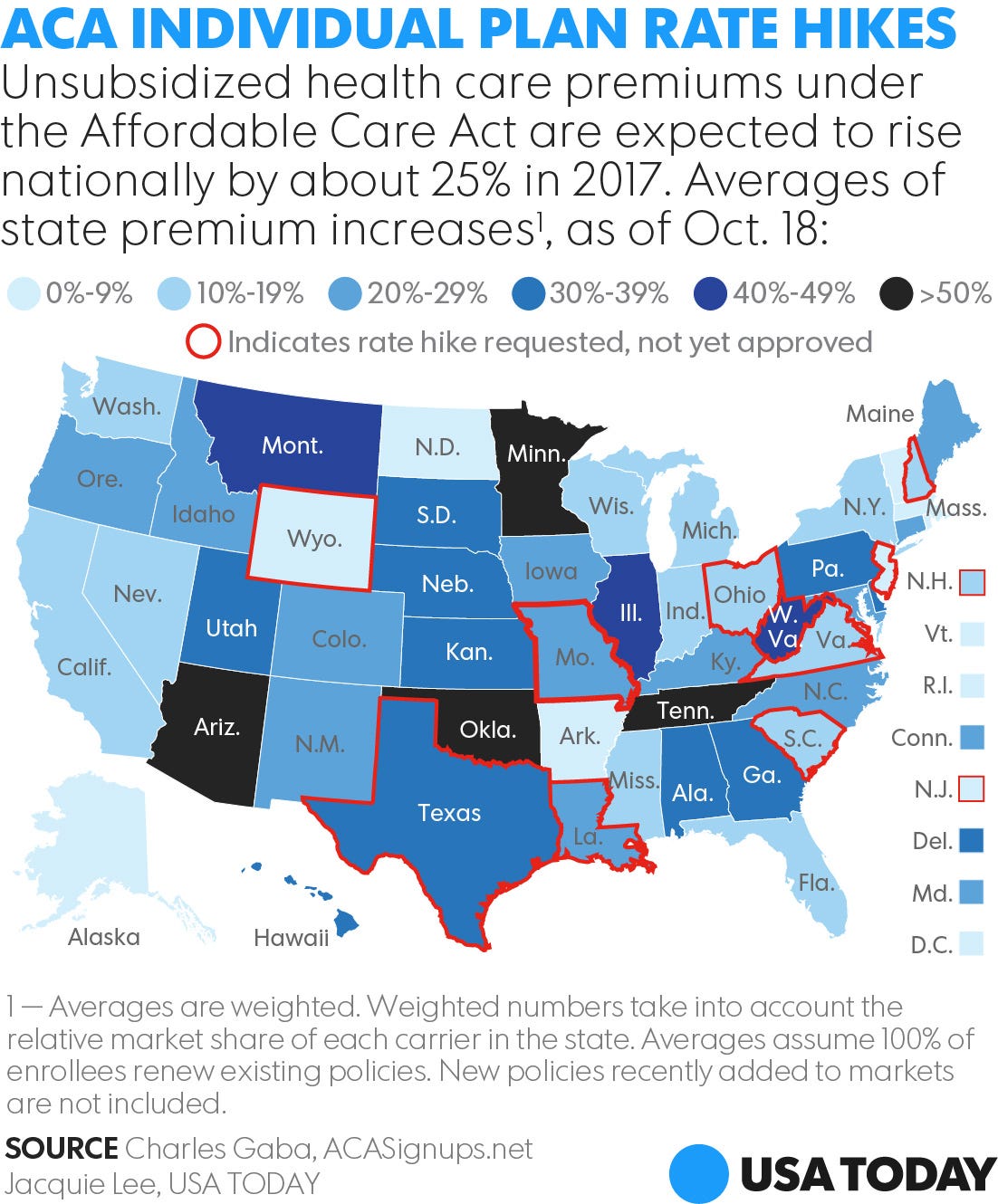
Patient protection and affordable care.  Not.


USA Today graphic retrieved from Town Hall on 21 October 2016.

As the article puts it, The Cascade of 2017 Obamacare Premium Hikes Has Arrived.
The reason that so many major insurers are pulling out of Obamacare is that the disproportionately sicker risk pools are quite expensive to cover, resulting in huge financial losses to the providers.  To offset those losses, enormous rate increases are being approved, making coverage even less affordable for the relatively healthy consumers trying to keep their heads above water -- including millions who receive taxpayer subsidies through the law.  As their costs skyrocket even further, more and more younger, healthier people will either walk away from the law, or continue to avoid signing up for it.  After all, paying the individual mandate tax is much cheaper than shelling out big bucks every month, on top of out-of-pocket costs; plus, in the event of a health emergency, insurers are required under the law to accept all comers during open enrollment, regardless of pre-existing conditions. 
It was HillaryCare before it was Obamacare. Will the Opposition be able to do anything with the nasty surprises arriving in so many mailboxes?  Or are we staring at the Conrail Option during the first hundred days of a Hillary presidency?  Such a nasty prospect.

18.10.16

THE EVOLUTION OF INFRASTRUCTURE.

The Lincoln Highway name lives on, even though the contemporary roads are often different.  The name often goes with U. S. Highway 30, particularly east of Chicago, although Thirty is often widened and relocated to avoid the villages and hamlets through which the Lincoln Highway was often the main street.  Across Indiana, for example, Thirty is a four-lane road offering the truckers an opportunity to bypass the Indiana Toll Road, and the tolls charged thereon.  (The operator of the Toll Road is not doing much these days to win friends and influence people, with construction going on forever toward the west end, and several service plazas out of service for rebuilding all at once.)

In parts of Indiana, however, the original two-lane Lincoln Highway remains as a rural road, or as the main street of the smaller villages and hamlets.  And just to its south is what remains of the Pittsburgh Fort Wayne and Chicago, which as a component of The Pennsylvania Railroad's Lines West provided a racetrack for passenger trains, particularly in the flatlands west of Crestline.

But now, pull into the appropriately named hamlet of Hamlet, Indiana, and you find the offices of the Chicago Fort Wayne and Eastern Railroad.


Splendid weather for mid-October.  Friday the Thirteenth comes on a Thursday.

The Fort Wayne line is now a Genesee and Wyoming property.  Wisconsin and Southern is not, but that's a Wisconsin and Southern diesel in front of an elevator that appears to generate more than a few carloads.


I stopped at Hamlet in order to get in front of a short freight train pulled by a locomotive in Indiana and Ohio colors.  That's another property not in Genesee and Wyoming's portfolio.  Go figure.  But the one remaining main track has been given proper care, and the railroad is good for forty mph running.  The track improvements offer shippers another choice for through cars bound east of Chicago, but these must be handed off to a connecting carrier at Crestline.  Single-carrier service to Pittsburgh and the east coast ended with the partitioning of Conrail, perhaps the idea of moving all the freight to The Water Level Route (cargo bound for Pittsburgh and Philadelphia making a right turn at Cleveland) hived off inefficiently much capacity.

In a few minutes, the freight train showed up.


I wonder if there are more sidings at Hamlet now than there were in Pennsylvania Railroad days.  Executives of the more successful railroads in the sunbelt contrasted their efforts at attracting shippers with the long stretches of rural operation in the Great Lakes region and relatively few shippers.

Once upon a time, Hamlet was the crossing of New York Central's Kankakee Belt line and the Fort Wayne, complete with a tower.


Undated photo from the Conrail era retrieved from Kankakee Belt history page.

The crossover and crossing are east of the elevator.  The Kankakee Belt is gone here, part of the Conrail elimination of duplicate facilities.  Look closely at the left, that's the original Lincoln Highway.  Those tracks still look capable of carrying a poppet-valve duplex drive at 120 mph with The Broadway Limited or The Trail Blazer.

I was able to get ahead of the freight train one more time.  At Donaldson, that appears to be another carload of ferroequinologists out for the photography.


The road paralleling the tracks may be another section of the original Lincoln Highway.

A regional freight carrier replaces Lines West of The Standard Railroad of the World.  It could be worse.  In the Chicago area, the former Erie Railroad grade, which offered ample clearances for high and wide loads, is now a bicycle trail.

12.10.16

YOU'RE NOT OBLIGATED TO VOTE.

Mike "Dirty Jobs" Rowe has a few things to say about the presidential nominations, and what it means to have a right to vote.  First, a recognition that politics is downstream from (the trashy, splintery) culture.  "Sure, we can blame the media, the system, and the candidates themselves, but let’s be honest – Donald and Hillary are there because we put them there. The electorate has tolerated the intolerable. We’ve treated this entire process like the final episode of American Idol. What did we expect?"

Then some advice about how to get yourself a liberal education, something the higher education establishment has forgotten how to do.  "Spend a few hours every week studying American history, human nature, and economic theory. Start with 'Economics in One Lesson.' Then try Keynes. Then Hayek. Then Marx. Then Hegel. Develop a worldview that you can articulate as well as defend. Test your theory with people who disagree with you. Debate. Argue. Adjust your philosophy as necessary. Then, when the next election comes around, cast a vote for the candidate whose worldview seems most in line with your own."

But if a voter opts out?  Just because you can, it doesn't follow that you must.  We enjoy a right to keep and bear arms, but somehow a lot of people go through life without an arsenal at home.

TRUTH ACCOMPANIED BY PRECISION.

This year's economics Nobel went to contract theorists Oliver Hart and Bengt Holmström.  In Bloomberg View, Tyler Cowen explains the significance of the results, and notes the importance of the researchers taking the time to understand the refractory empirical phenomena being theorized about.

Not everybody is cheering.  Start with Arnold Kling.
Think of their work as consisting of three steps.

1. Identifying some real-world complexities that affect how businesses operate. For example, output may result from both effort and luck. Output may be joint. A worker’s job description may include more than one objective.

2. Construct a mathematical optimization model that incorporates such complexities.

3. Offer insights into designing appropriate compensation systems, including when to outsource an activity altogether.

A big question is: how important is step 2?

In the eyes of the mainstream economics profession, it is extremely important. Without it, you either do not get to step 3, or your claims in step 3 lack reliability and credibility. Step 2 is why Hart and Holmström earned the Nobel Prize.

In my view, step 2 is unnecessary. If anything, it tends to get in the way, often creating a barrier to doing step 1 properly, because economists limit themselves to what is mathematically tractable. I think that Hart and Holmström sometimes (often?) made good choices in step 1, and that is what accounts for the value of where they arrived at in step 3.
Mr Kling's contention is a common one in economics: it's sometimes possible to conceive of something in general terms using words, but being able to produce a more careful delineation of conditions under which it is present using mathematics is hard. I have boxes of scribblings yet dealing with problems I thought I could make some headway against and yet fell short.  And veteran theorist Hal Varian once wrote an essay on doing research wherein he noted, in response to a workshop comment from a colleague who was attempting something more challenging, that his first attempts were more challenging (and failed.)  There's an element of complaint present, as well, in his observation that the late Alchian Allen and the still-living Harold Demsetz had worked on similar contracting problems, using a more literary form of price theory.  But the prize goes to the work that more precisely delineates the conditions under which the phenomenon is present.

THE STATE IS THAT GRAND FICTION.

Deep in the heart of blue-state Austin, residents are discovering that they are the everybody else, or the fellow behind the tree, and they're not happy.
“I’m at the breaking point,” said Gretchen Gardner, an Austin artist who bought a 1930s bungalow in the Bouldin neighborhood just south of downtown in 1991 and has watched her property tax bill soar to $8,500 this year.

“It’s not because I don’t like paying taxes,” said Gardner, who attended both meetings. “I have voted for every park, every library, all the school improvements, for light rail, for anything that will make this city better. But now I can’t afford to live here anymore. I’ll protest my appraisal notice, but that’s not enough. Someone needs to step in and address the big picture.”

The arrival of this year’s appraisal notices — which in Travis County showed homes’ average market values jumped 12.6 percent and average taxable values rose 8 percent for 2014 — is sparking a push for reform. Similar jumps have occurred in Williamson and Hays counties.
There are no state income taxes in Texas, which complicates the analysis, but rising property values put homeowners in a rough place, particularly if those homeowners want their city government to spend money on amenities.

In Illinois, there is a state income tax, but rising property values push some homeowners to protest.
Jeff McGrath and Dan Aylward paid thousands of dollars of real estate taxes with $1 bills at the county treasurer's office and vowed to do so again in September and every due date afterward until the taxes stop increasing.
You want good schools, you get good schools, then property values go up? Not necessarily.
Both men say there is too much government and way too much being paid to school administrators. Both men say though the market value of their homes may not be considered pricey, their properties won't sell because the taxes are too high.
With the state legislature being unable to put proper budgets together, property tax relief extracted by Springfield through the income and sales taxes might not be immediately forthcoming.

JUST CALL IT GOVERNMENT FAILURE.

Trains Magazine's Fred Frailey is dismayed with the slow implementation of positive train control by the Passenger Rail operators.
The spectacle we now have is that the freight railroads have spent almost $7 billion of their dollars diligently inventing and implementing PTC technology, while at least three of the nation’s largest commuter-train railroads haven’t really done a damn thing. I’ll stop here to credit Amtrak with implementing its version of Positive Train Control on its own Northeast Corridor trackage, and between Philadelphia and Harrisburg. And I’ll tip my hat to the politicians in California who provided the funds for Metrolink in Los Angeles to do the same—Metrolink, of course, being the entity whose own disaster prodded Congress to act in the first place eight years ago.

But what of Metra in Chicago, Jersey Transit, and Metro-North Railroad in New York and Connecticut? As I said, not really a damn thing. Illinois is broke, and New Jersey close to it. New York and Connecticut are stressed out as well. And appropriating scarce capital dollars for huge technical projects that neither politicians nor journalists can explain clearly is something of a non-starter when you’re competing against all the other uses of public dollars. Ask the average Joe or Jane in Newark or New Haven or Cicero: Do you want PTC or more cops and more meds for grandma? Your choice. Guess how they’ll reply?
I bet they won't reply, "Raise my taxes."

HIGHER EDUCATION CONTINUES TO BECLOWN ITSELF.

Vast tracts of the social sciences have gone insane, Margaret Wente of Toronto's Globe and Mail contends.  It's culture-studies interrogation of pumpkin spice latte and other metrofexual affectations this time around.  From the abstract:
Starbucks’ pumpkin spice latte, a widely circulated essay in McSweeney’s on “Decorative Gourd Season,” pumpkins in aspirational lifestyle magazines, and the reality television show Punkin Chunkin provide entry points into whiteness–pumpkin connections. Such analysis illuminates how class, gender, place, and especially race are employed in popular media and marketing of food and flavor; it suggests complicated interplay among food, leisure, labor, nostalgia, and race. Pumpkins in popular culture also reveal contemporary racial and class coding of rural versus urban places. Accumulation of critical, relational, and contextual analyses, including things seemingly as innocuous as pumpkins, points the way to a food studies of humanities and geography. When considered vis-à-vis violence and activism that incorporated pumpkins, these analyses point toward the perils of equating pumpkins and whiteness.
Come. Off. It.

It's more of the trendy, terminally silly stuff crowding out real education.  I've been pointing this out for nearly thirty years (long before anybody heard of the Internet, let alone web logs) and it's gratifying to have Ms Wente bringing the smack.
How does this stuff get published? Because critical thinking has gone out the door. The standard methods of research and inquiry do not apply. In fact, they are widely thought to be sexist and racist, because they’re rooted in white male ways of thinking. Science that built on the foundations of masculine rationality and abstract logic can’t possibly reflect the experience of women and minorities. Therefore, feelings, anecdotes and “lived experience” vastly outweigh what used to be known as “objective truth.”

Why am I so irate about this? One reason is that such work is a discredit to genuine academics and the pursuit of knowledge. Another is that race, gender and oppression studies have metastasized far beyond their little enclaves and spread to many other disciplines, including much of the humanities and parts of the sciences. Some universities have launched feminist biology programs because regular biology is too sexist. No one seems to mind that kids are squandering their time and our resources (to say nothing of their parents’ resources) on rubbish. I believe the damage to the public image of our universities is not inconsiderable – something their administrations might want to ponder in these straitened times.

The worst part is that these bad ideas metastasize into the wider world, into politics and public policy and ordinary life. Today we think the only way to fight racism and sexism is to identify everyone by race and sex – and that the only way to respond to people who claim victim status is to grant them special privileges.
Yeah, and that generates all sorts of affirmative action asterisks. The rot has been a long time in coming, and the recognition of it has been there for a long time. It may not be given to me to finish the task of reclaiming higher education, and yet there are others still in the fight.

11.10.16

PROTEST WITH YOUR VOTE.

Here's how the electoral college helps you.  "Americans, if you live in a "safe state" (about two-thirds of the population does), now's your chance to rock the boat and make your vote count."  Heck, if you live in a swing state, and you understand the lesser of two evils to still be evil, tick the box for Gary Johnson or Jill Stein or one of the other options anyway, as at the margin, your vote is unlikely to affect the outcome.  You're not going to get what you want, but picking the lesser evil isn't going to give you what you want either.

THE HIPSTERS' LIONEL SET IN 12" = 1'

A City Lab post is, shall we say, skeptical about streetcars.
It’s hard not to succumb to the charms of the streetcar, the frisky chocolate lab of urban transit. Urbanists delight in their walkability-promoting scale and commitment to permanency—those rails stuck in the street seem to embody the faded promise of public transportation itself. Environmentalists dig their cleaner emissions (assuming your local grid isn’t coal-fired) and greater passenger capacity, compared to diesel-spewing buses. Older folks appreciate their nostalgia factor and low-floor boarding, which makes them easier on wheelchair users and aging knees. The business community enjoys the developer-friendly subsidies and other sundry tax breaks that that often accompany their construction. And just about everyone likes the whole Euro-classy vibe they evoke.
Put another way, the rent-seekers and the aesthetes go for the streetcars. But a proper streetcar service is a network.  Most of the cities have installed short lines in shopping districts, which bus riders can still reach on the city bus.
The fact that both Cincinnati and KC’s systems are more popular on weekends seems to support one of the fundamental arguments against them: They’re more tourist toys than transportation systems used by residents and commuters. Too slow and short to function as bona fide people-movers, they’re just expensive downtown amenities for out-of-towners, opponents say, gobbling public dollars that should be devoted to more useful forms of public transit.
Read on and you see that streetcars are part of the same infrastructure medicine as sports stadiums and concert halls.  Oops.

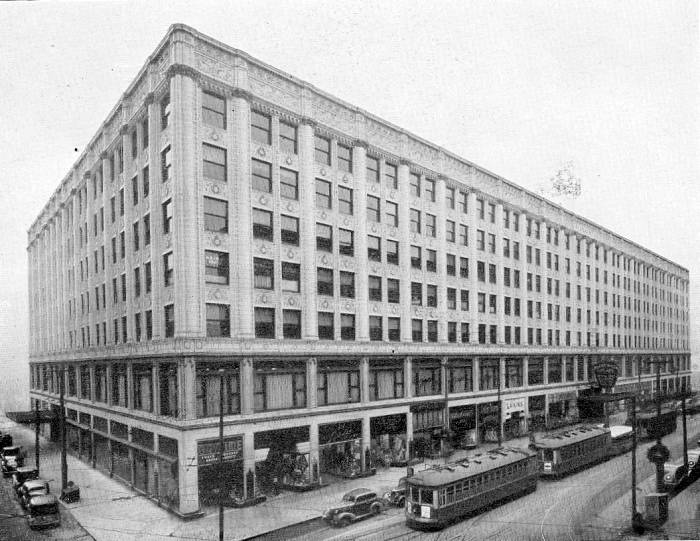
I understand the Milwaukee streetcar project is going forward.  Let me refresh your memory.  Here's how you do streetcars to the Plankinton Arcade (a precursor of the Grand Avenue Mall.)


ECONOMICS IS ABOUT SEX, DEATH, AND WHY THE LINES ARE LONGEST AT THE ROLLER COASTER.

Yes, that's long been one of my tag lines, but it's as useful a way as any to introduce Noah Smith's Bloomberg View column explaining why contract theorists Oliver Hart and Bengt Holmström merited recognition from a prize committee in Stockholm.
The research here is deep microeconomic stuff. It’s about incentives, and imperfect information, and long-term relationships. It’s about delicate strategic interactions between people who don’t know each other’s capabilities or intentions. But it’s related to lots of real-world economic issues -- performance pay, mergers and acquisitions, bank lending and corporate structure.

What it’s not about is the kind of economics you read about in the news. It’s not about growth or unemployment, fiscal stimulus or interest rates, trade agreements or productivity. It might be indirectly related to those things -- Holmström’s work on financial crises and debt certainly has relevance for what happened in 2008. But it isn't what you expect to see economists arguing about when you open up Bloomberg or pick up the New York Times.

It’s not macroeconomics -- the study of how the broad economy works.
Mr Smith reminds readers why the history of economic thought is important.
Economics debates in the news media and on the blogs tend to make a big distinction between macro and micro, painting the former as unscientific and the latter as serious science. There’s a grain of truth to that, but it’s not that simple.

What really happened was that macro developed first. Economists saw big, important phenomena like growth, recessions and poverty happening around them, and they wrote down simple theories to explain what they saw. The theories started out literary, and became more mathematical and formal as time went on. But they had a few big things in common. They assumed the people and the companies in the economy were each very tiny and insignificant, like particles in a chemical solution. And they typically assumed that everyone follows very simple rules -- companies maximize profits, consumers maximize the utility they get from consuming things. Pour all of these tiny simple companies and people into a test tube called “the market,” shake them up, and poof -- an economy pops out.
It might be more accurate to say that macroeconomics as we understand it emerged out of political economy, which beginning with Adam Smith and progressing at least through Karl Marx and J. S. Mill, focused on why wealth happened and who got it and who would be left out, and what might be done to Change Things.  But the notion of a company was new to Adam Smith and misunderstood by Karl Marx and it took a long time to get a handle on why some transactions might be handled more effectively by markets whilst others were within the locus of control of a management.  And, to use a phrase from Harold Demsetz, who really ought be considered for recognition, to think about how a world in which information is costly is different from a world in which information is free.  The standard blackboard economics supply-and-demand model rests on free information.  When information becomes costly, other models, such as Hart's, Holmström's,  Jean Tirole's (from last year), Oliver Williamson's (from a few years ago) and the game theorists offer information.

10.10.16

500 DEAD IN TRAIN WRECK.

I'd have to search the archives for a while to find evidence of a fatal train wreck with that sort of death toll.  But on the roads, it's business as usual, writes editor Jim Wrinn of Trains Magazine.
Just today, I read that the U.S. is on target to see an increase in traffic fatalities for the second year in a row. Just in the first half of 2016, more than 17,000 people have died in traffic accidents. That is 34 500-passenger commuter trains smashing themselves to pieces and taking every life on board with them.
That's part of a reflection on press coverage of last week's commuter train overrunning the bumper at Hoboken Terminal, where at least one national source confused the absence of positive train control on the train with the absence of an automatic brake??

I've grumbled over the years about the sloppy reporting that frequently accompanies coverage of economics, or of railroading.  Why can't the rest of the press corps be as knowledgeable about the subjects they cover as the sports reporters?

THE NEGLECTED ACTORS.

Reason presents its quadrennial survey of presidential preferences among its writers.  There's not a lot of love for the major party offerings.  Contributors also have the opportunity to offer their impressions of the Era of Hope and Change.  A sampling.

Nick Gillespie will miss "The foolish, momentary optimism some people had that nothing could be as bad as the Bush years."

Bill Kauffman will miss "I'll miss Barack's empathetic understanding of small-town Americans and Michelle's sparkling wit."

David Weigel offers a longer meditation.  "I think it's a very good thing that the wild optimism that accompanied Obama was put in check. One of the stranger aspects of this election cycle was seeing so many people flock to Bernie or Trump in the hopes that an Honest Politician could fix Washington. That baffled me—for a whole generation, the lesson of Obama was that there are gigantic and often useful veto points and that you should not see presidential candidates as white knights. You should not idolize them. You want change? You're on your own; get to work. You're scared that the new leader will 'fundamentally transform' the country? Actually, you can stop him."  That about sums it up: the creepy and failed Cult of Obama becomes the meandering Cult of Trump or the symbolic and corrupt Cult of Hillary.

Mollie Hemingway delivers several backhanded compliments.  "I will miss Obama's comity and executive restraint, the way he followed through with his promises to rein in government and manage wars better than George W. Bush did, his steadfast avoidance of killing American citizens without due process, and the way he worked so hard to keep the federal bureaucracy from persecuting people for their political and religious beliefs."

Cheer up, it could be worse.  Might as well cheer up, it is going to be worse.

NO ONE IS IN CHARGE OF IT.

Kevin Williamson makes the case for emergent order.  Civilization progresses by expanding the number of tasks people can do without thinking about them.  Why, then, do the self-styled progressives think it's all about Expertise?  "When it comes to important social concerns such as health care, affordable housing, and education, the progressives say: 'This is too important to leave to the unpredictability of the free market.' Others say: 'This is too important not to leave to the unpredictability of the free market.'"  Go, read, understand.

6.10.16

TODAY IS GERMAN-AMERICAN DAY.

By Presidential Proclamation.  " I encourage all Americans to learn more about the history of German Americans and reflect on the many contributions they have made to our Nation."

At Antietam.


That's a New York regimental monument.

Or perhaps, you'd rather celebrate in a more conventional way.


Einigkeit und Recht und Freiheit!

THE MICROFOUNDATIONS OF TRADE POLICY.

The Economist offers an instructive essay on the political economy of trade agreements.  As with anything else in economics, it's the tradeoffs.  By all means read the whole thing (before the paywall closes) but let me highlight salient passages.
China’s accession to the [World Trade Organization] caused a big shock. The country’s size, and the speed at which it conquered rich-world markets for low-cost manufacturing, makes it unique. By 2013 it had captured one-fifth of all manufacturing exports worldwide, compared with a share of only 2% in 1991.

This coincided with a fresh decline in factory jobs in America. Between 1999 and 2011 America lost almost 6m manufacturing jobs in net terms. That may not be as dramatic as it sounds, since America is a large and dynamic place where around 5m jobs come and go every month. Still, when David Autor of the Massachusetts Institute of Technology (MIT), David Dorn of the University of Zurich and Gordon Hanson of the University of California, San Diego, looked into the job losses more closely, they found something worrying. At least one-fifth of the drop in factory jobs during that period was the direct result of competition from China.

Moreover, the American workers who had lost those jobs neither found new ones close by nor searched for work farther afield. They either swelled the ranks of the unemployed or, more often, left the workforce. That contradicts the widespread belief that America’s jobs market is fluid and flexible. When men lose a factory job, they often stay put. Those who managed to find new jobs were paid less than before and were working in industries that were vulnerable to competition from imports. In subsequent research, the authors found that lost factory jobs also had a depressing effect on aggregate demand (and thus non-manufacturing jobs) in the affected areas. In total, up to 2.4m jobs may have been lost, directly and indirectly, as a consequence of imports from China.
As the comparative advantage of the United States has traditionally been in knowledge-intensive, advanced technology goods, the change in manufacturing trade patterns ought come as no surprise, China being in a better place to do the routine production.  But the victory dividend after World War II left a lot of U.S. blue collar workers with less formal schooling in a bad place.
In 1964 male high-school graduates were about as likely to be in the workforce as college-educated men, but now only 83% of those with a high-school degree or less are in the workforce, against 94% of those who finished college (see chart). This mirrors a growing divergence in wages. In the mid-1960s the pay of less educated men averaged 80% of college-educated ones, but by 2014 that proportion had fallen to 60%.

It is unlikely that men are dropping out of work voluntarily. More than a third of inactive men live in poverty; less than a quarter have a working spouse. So the most obvious explanation is a fall in demand for less-skilled men. That in turn is partly linked to a long-term decline in manufacturing, whose share of the jobs market peaked in the days when almost all prime-age men worked. The CEA study found that states with a higher-than-average share of jobs in construction, mining and (to a lesser degree) manufacturing tend to have more prime-age men in the workforce. It does not help that men who lose their jobs are increasingly rooted in unemployment black spots.
For "unemployment black spots," think Rust Belt.  But trade effects and productivity effects have similar consequences for men with fewer years of school, something that in the U.S. is likely reinforced by the comparative advantage.
A steady drop in the share of prime-age men in the workforce going back half a century cannot be pinned on America signing free-trade agreements or China’s emergence as an exporter of manufactures, both of which happened fairly recently. Factory jobs peaked in the 1970s, but manufacturing output has continued to increase. Indeed, America’s share of world manufacturing output, on a value-added basis, has been fairly stable at a bit under a fifth for the past four decades. Thanks to advances in technology, fewer workers are needed to produce the same quantity of goods. But since trade with lower-cost countries and technological change have similar effects on labour-intensive production in the rich world, it is hard to disentangle their effects.
Thus doing trade policy is like doing any other trade policy in the form of a Marshallian improvement, where the movement to a larger opportunity set economy-wide leaves some people in a worse position.
Sober advocates of free trade know that over time the gains from it come from greater efficiency, not from more jobs, the number of which is largely determined by demography and the strength of aggregate demand. It is easier to spot the link between freer trade and factory closures than the more dispersed benefits trade brings to workers across other industries. Exporting firms in all countries and across a variety of industries are more productive, grow faster and pay higher wages than non-exporting firms. But a lot of the gains from trade come from the direct benefit of cheaper imports and their indirect effect on productivity.
Trade protection, however, makes the lot of the poorer people worse.  For example, think of all the cheap Chinese stuff on the shelves of Wal-Marts.  But nobody's talking about that in the current election cycle.

BILL CLINTON'S KINSLEY GAFFE.

Forget about Wikileaks or the Drudge Report or Donald Trump's tax returns or Hillary Clinton's lung function.  The real October Surprise might come to people who log on to the health insurance exchanges and discover that they can't keep their current insurance, and the replacement insurance will be worse.
ObamaCare is set to create winners like the people who now have insurance for the first time and losers like the millions that [Bill] Clinton described. Contrary to Obama’s oft-repeated broken promise, they couldn’t keep their doctor or coverage if they wanted to and are now, thanks to the collapse of the exchanges, paying far more than they used to for policies they don’t like. The middle class got it in the neck. As the prices continue to go up and as the mandates are applied to businesses, the tally of ObamaCare losers will to continue to grow.

Democrats absolutely refuse to acknowledge the basic facts Bill Clinton mentioned in his rant. While they pay lip service to the notion that Obamacare needs some fixing, their attitude to the basic contradiction at its heart is to deny that it exists. The obvious alternatives to this disaster—the market-based ideas of the House Republicans or the left’s preferred single payer option—are matters the Hillary Clinton campaign will contemplate. Which is why the only Democrat willing to say this is the man who is currently playing the role of the party’s crazy old uncle.
Resign yourself to the Conrail option?  Here's W. R. Mead's take.
[E]ven the hardiest defenders of what was once presented as the greatest Democratic policy innovation in a generation are now having to concede that it looks more and more like the inevitable failure the critics have always said it was. There is lots to chew on here, and the worried blue outlets now edgily coming to terms with one of the greatest failures in Democratic Party history still can’t quite admit the full scope of the failure. Naturally enough they are calling for more of the same: more bureaucracy, more centralization, more complex webs of cross subsidies, more ‘free’ stuff for more people.
And if you think health care is expensive now ...

Meanwhile, the exchanges are vanishing in Tennessee, coming undone in Minnesota,  and this morning on Betsy's Page there's enough gloom to fill Thomas Hardy's moors.  Plus physicians refusing to be treated like Wal-Mart's vendors.  Here's the box Reason's Peter Suderman sees Hillary Clinton in.  "Crucial elements of Obamacare are on teetering on the brink of collapse, and the only solutions that its backers have on offer involve spending more public money and giving the government even greater power over health coverage and care."

GET THE VISUAL CUES RIGHT.

Grand Forks, North Dakota, like much of the rest of the country, is not a safe place for kids to walk to school.  It's not about school district consolidation or the abolition of fitness privilege.  It's the infrastructure, stupid.
We have a few streets in town that continually need to have flashing speed limit signs and police stationed on them to deter speeders. We also have streets that don't need those measures. The difference isn't in the number of cars or the number of speed limit signs. The difference is in the design.

Show me an area where police need to continually set up to catch speeding drivers, and I'll show you a street design that encourages speeding and is unsafe for pedestrians.

For decades, cities have adopted the same safety design principles for neighborhood streets that they've used for highways. On highways, wide shoulders and buffer zones are added to wide driving lanes to help drivers take corrective action if they veer off of the road at high speed. There are no pedestrians crossing highways, so pedestrian safety is not taken into account, and rightly so.

But on neighborhood streets, wide buffer zones and wide traffic lanes encourage drivers to drive fast, lowering awareness and decreasing reaction time. This is a problem when there are pedestrians present.
Yeah, there's speeding where there are stroads. So much for intelligent design.
We can build streets that are safe for pedestrians, or we can build them so that cars can move through at a rapid pace.

A street can't do both. It simply doesn't work. In fact, trying to achieve both goals ends up accomplishing neither and puts people in danger.

If we're serious about making our streets and crosswalks safe for pedestrians, then we must accept that the only way to do so is to get cars to slow down. This also would require accepting the trade-off, which is the few seconds that would be added to our commute each day.
Fortunately, they are beginning to catch on.  "When lanes are built too wide, many bad things happen. In a sentence: pedestrians are forced to walk further across streets on which cars are moving too fast and bikes don't fit."  Narrow the lanes in residential areas.  Spend less money building infrastructure, there's less infrastructure to crumble.
Our lives are currently being put at risk daily by fifty state DOTs and hundreds of county road commissions who mistakenly believe that high-speed street standards make our cities and towns safer. In my most considered opinion, these agencies have blood on their hands, and more than a little. There are many standards that they need to change, but the easiest and most important is probably the 12-foot lane. Armed with the facts, we can force this change. But only if we do it together.

It's time to push this discussion to its logical conclusion. Until conflicting evidence can be mustered, the burden of proof now rests with the DOTs. Until they can document otherwise, every urban 12-foot lane that is not narrowed to 10 feet represents a form of criminal negligence; every injury and death, perhaps avoidable, not avoided—by choice.
We'll take up the matter of the 53 foot trailer plague another day.